Does Climate Change or Human Activity Lead to the Degradation in the Grassland Ecosystem in a Mountain-Basin System in an Arid Region of China?



Abstract
1. Introduction
2. Materials and Methods
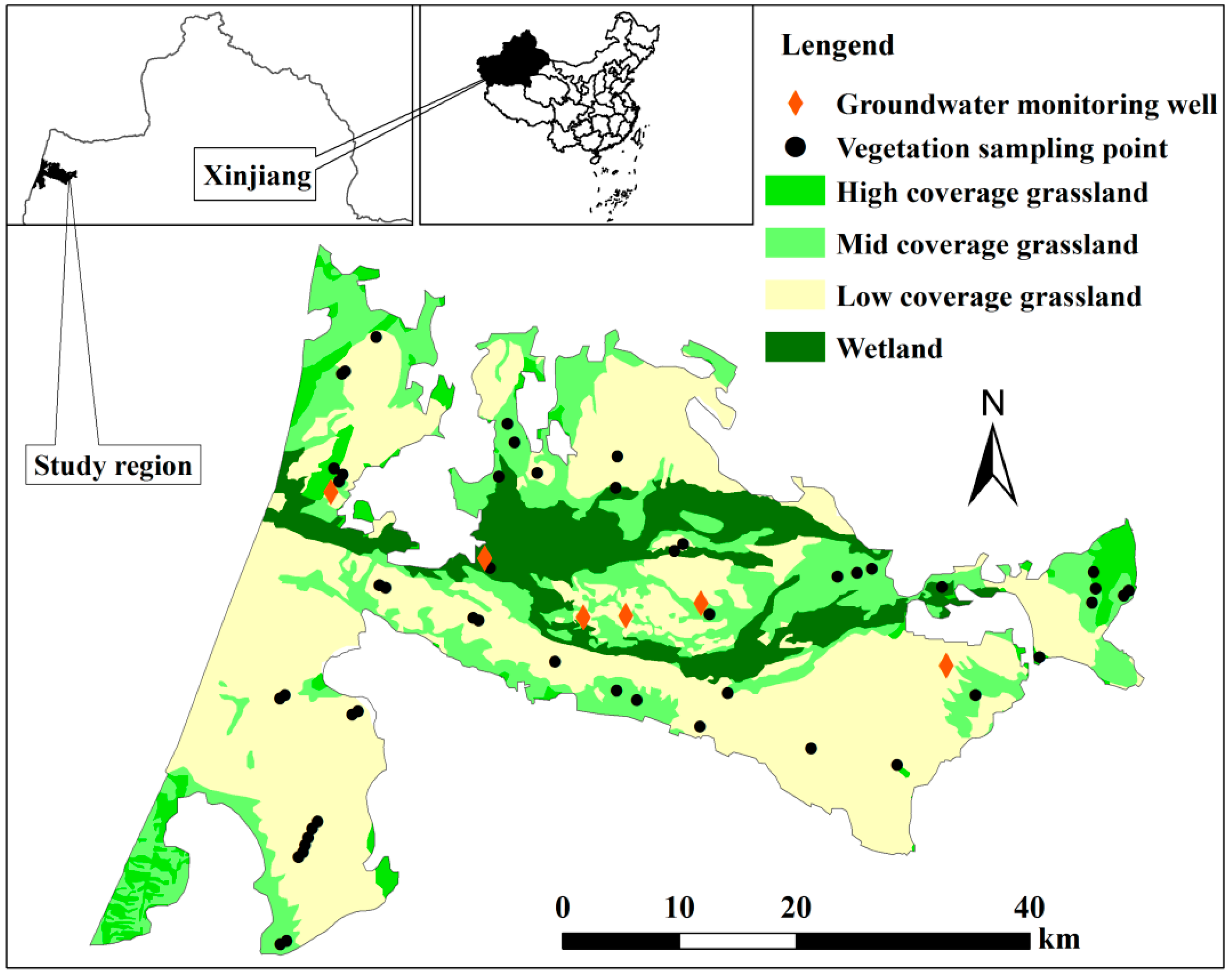
2.1. Study Area Description
2.2. Data Sources
2.3. Methods
2.3.1. Vegetation Coverage Calculation
2.3.2. Vegetation Productivity Calculation
2.3.3. Temperature Vegetation Drought Index (TVDI) Calculation
2.3.4. Phenology Index Calculation
2.3.5. Difference Calculation
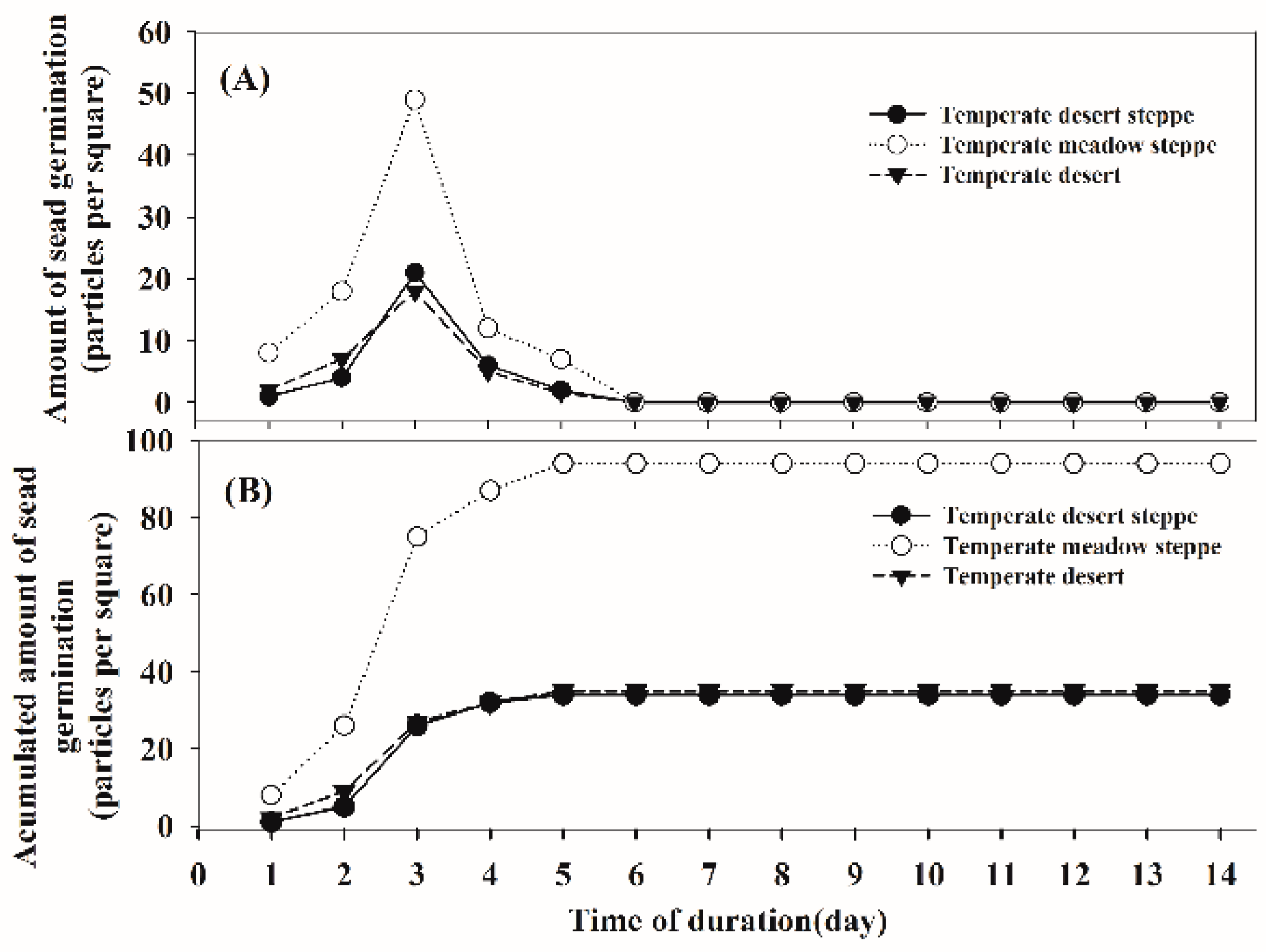
2.3.6. Germination Experiments Using Soil Seed Banks
2.3.7. Analysis of Trends
3. Results
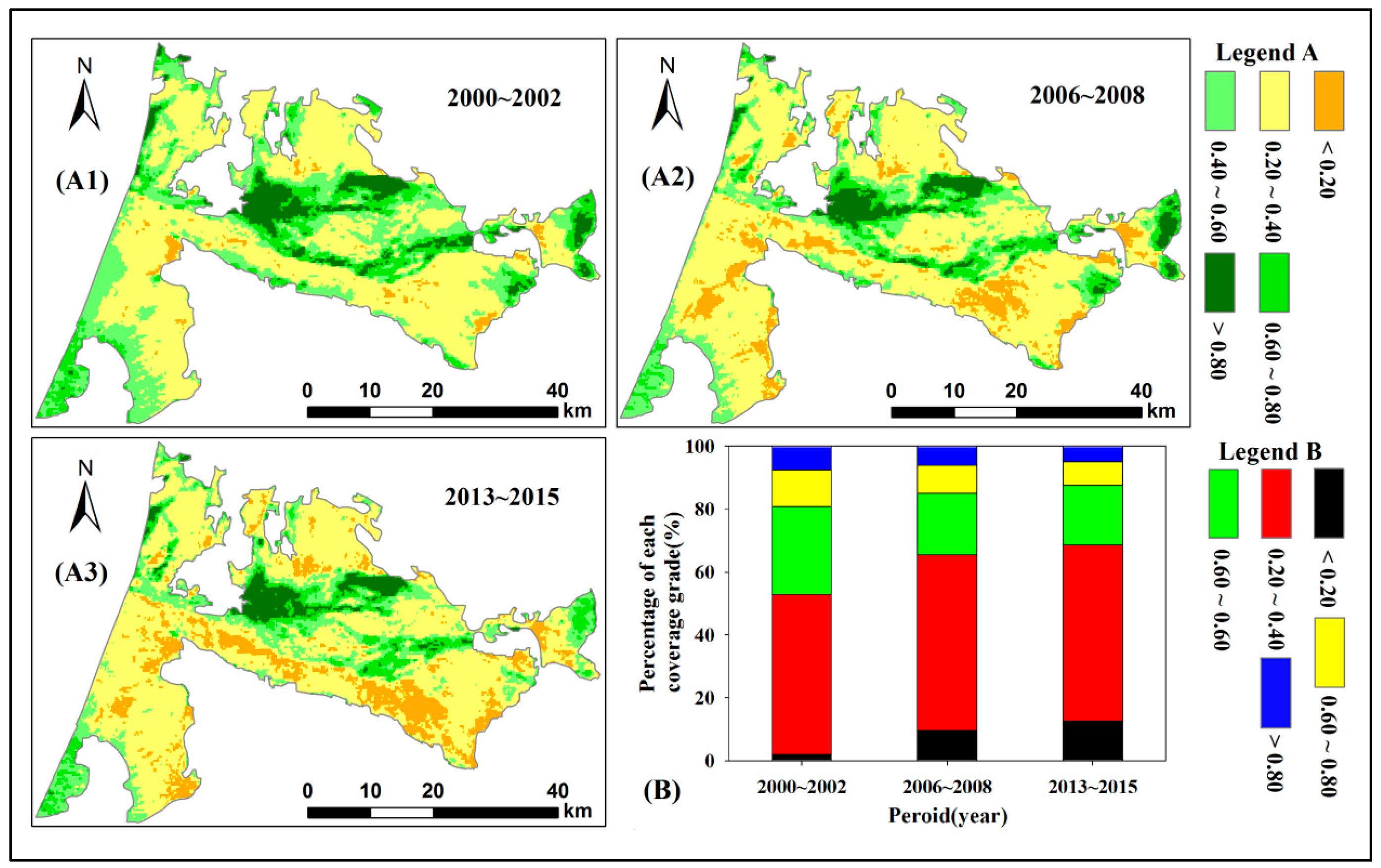
3.1. Area Changes of Different Coverage Grades in Kulusitai Grassland
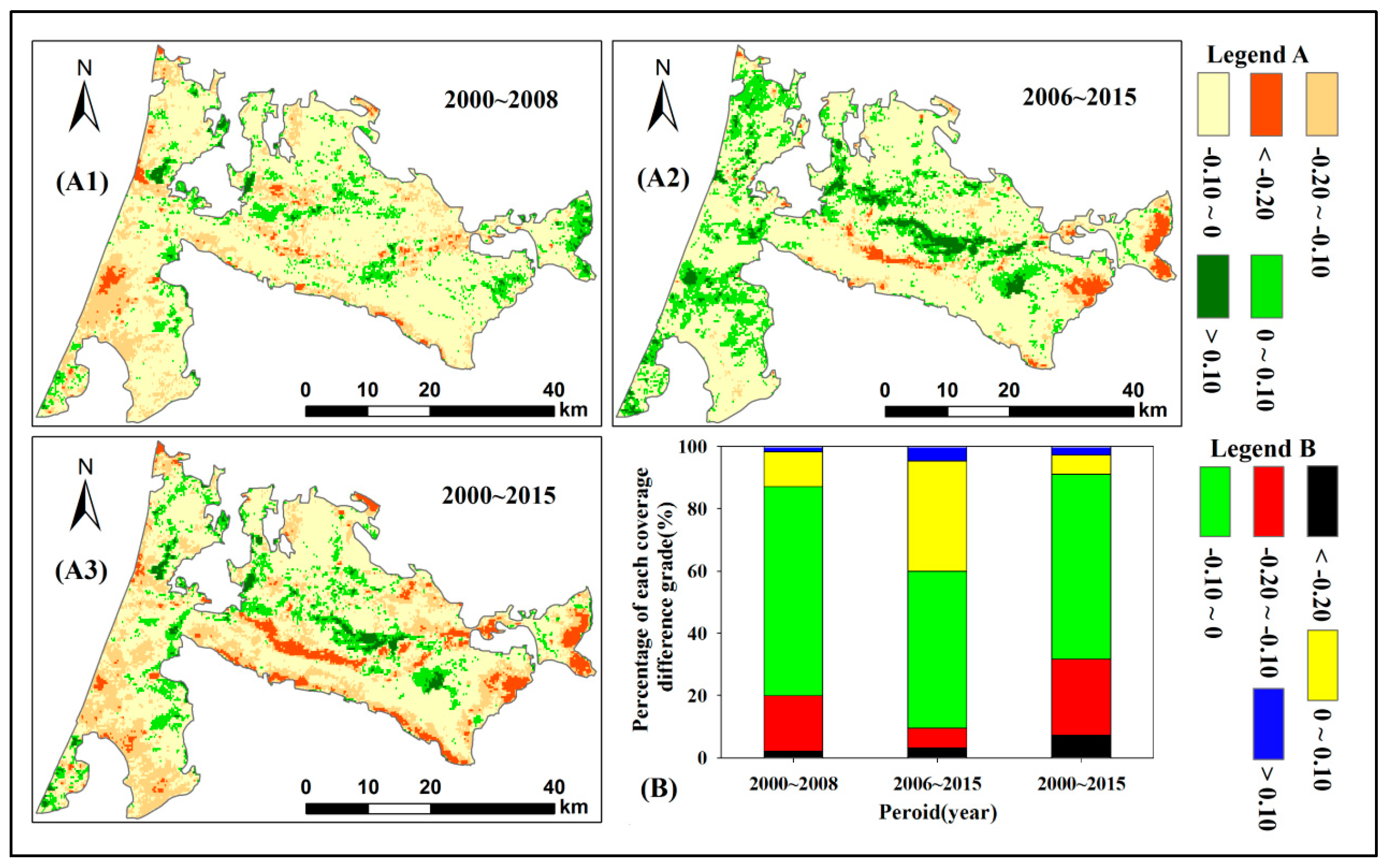
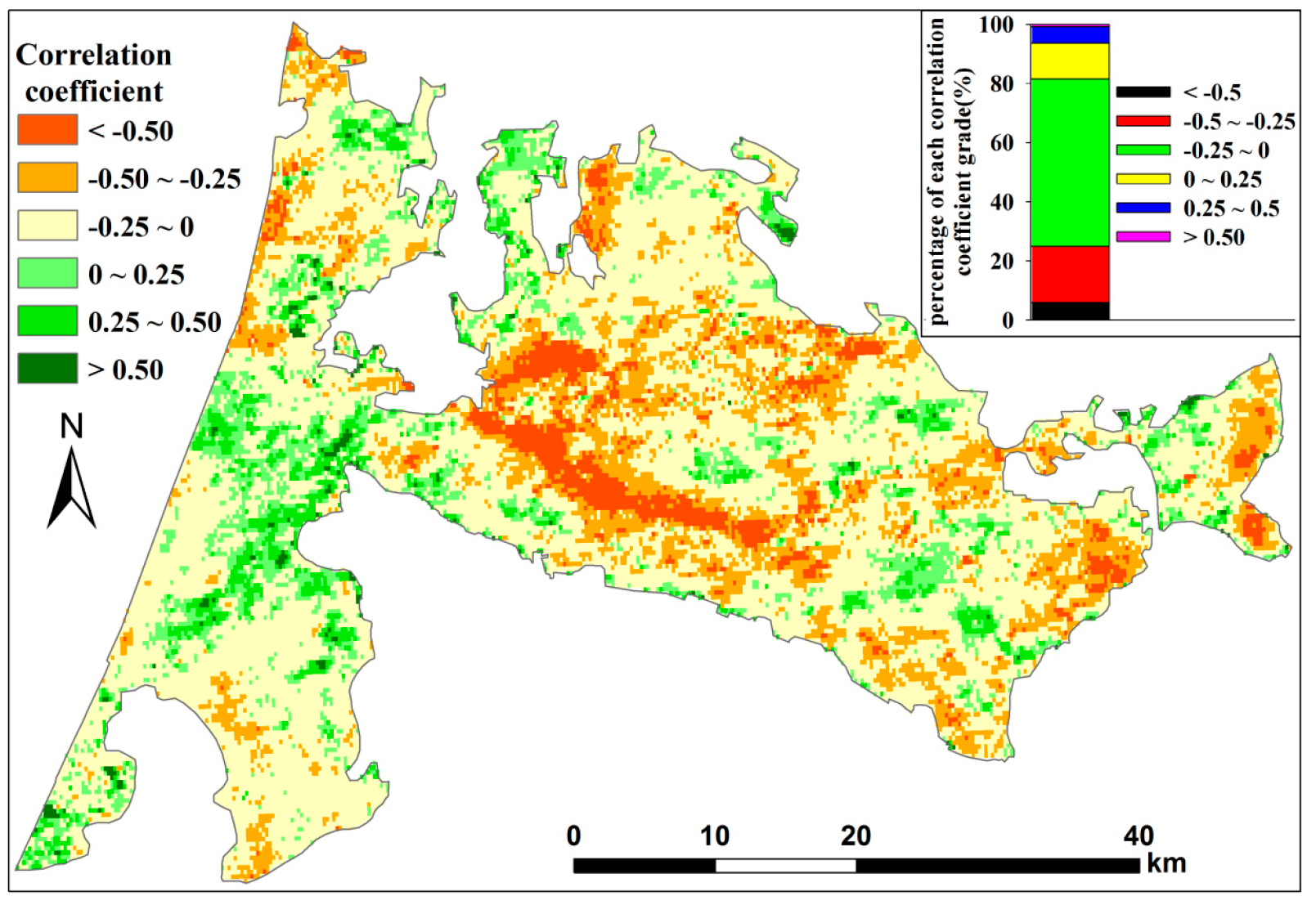
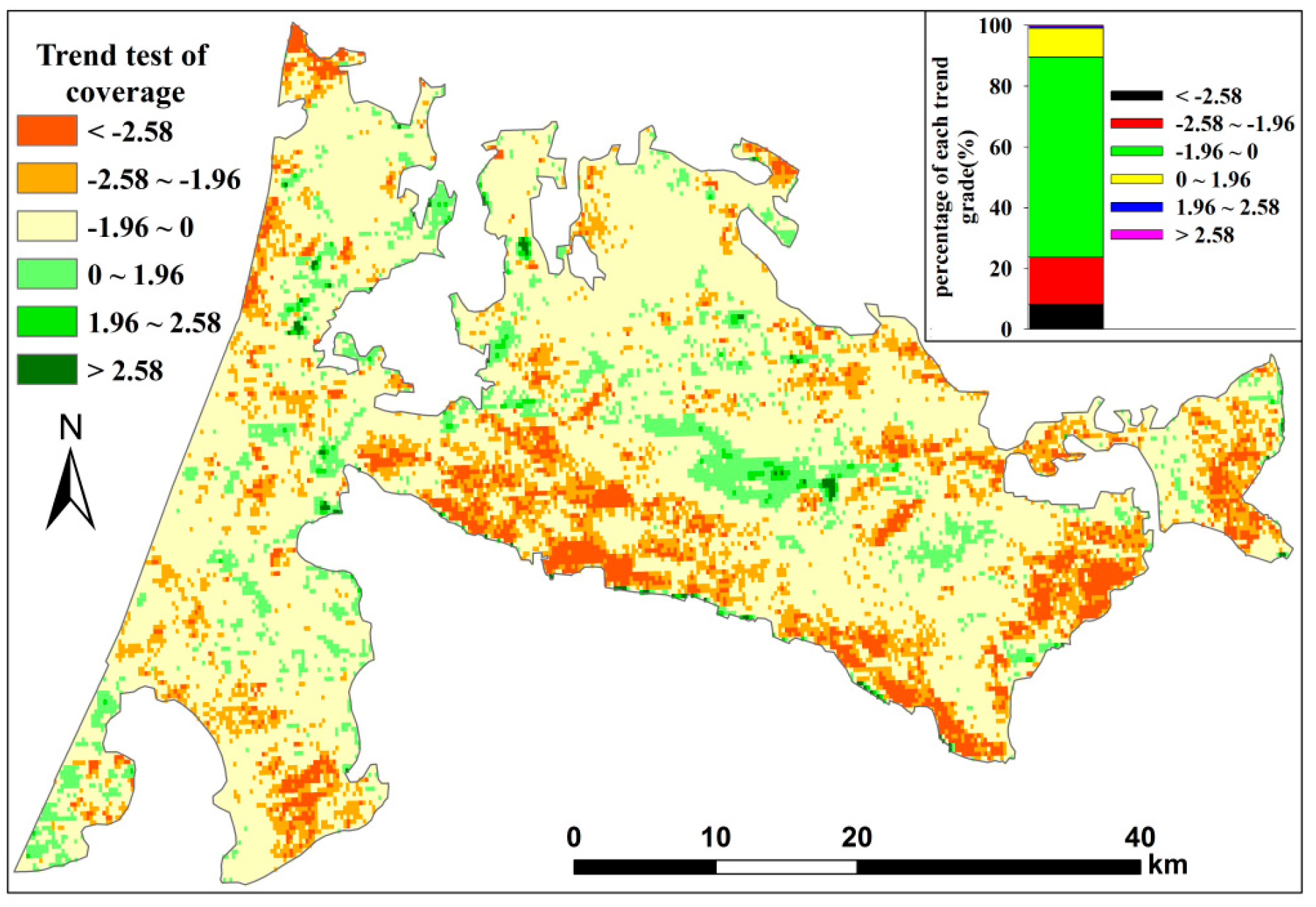
3.2. Changes in Vegetation Coverage in the Kulusitai Grassland
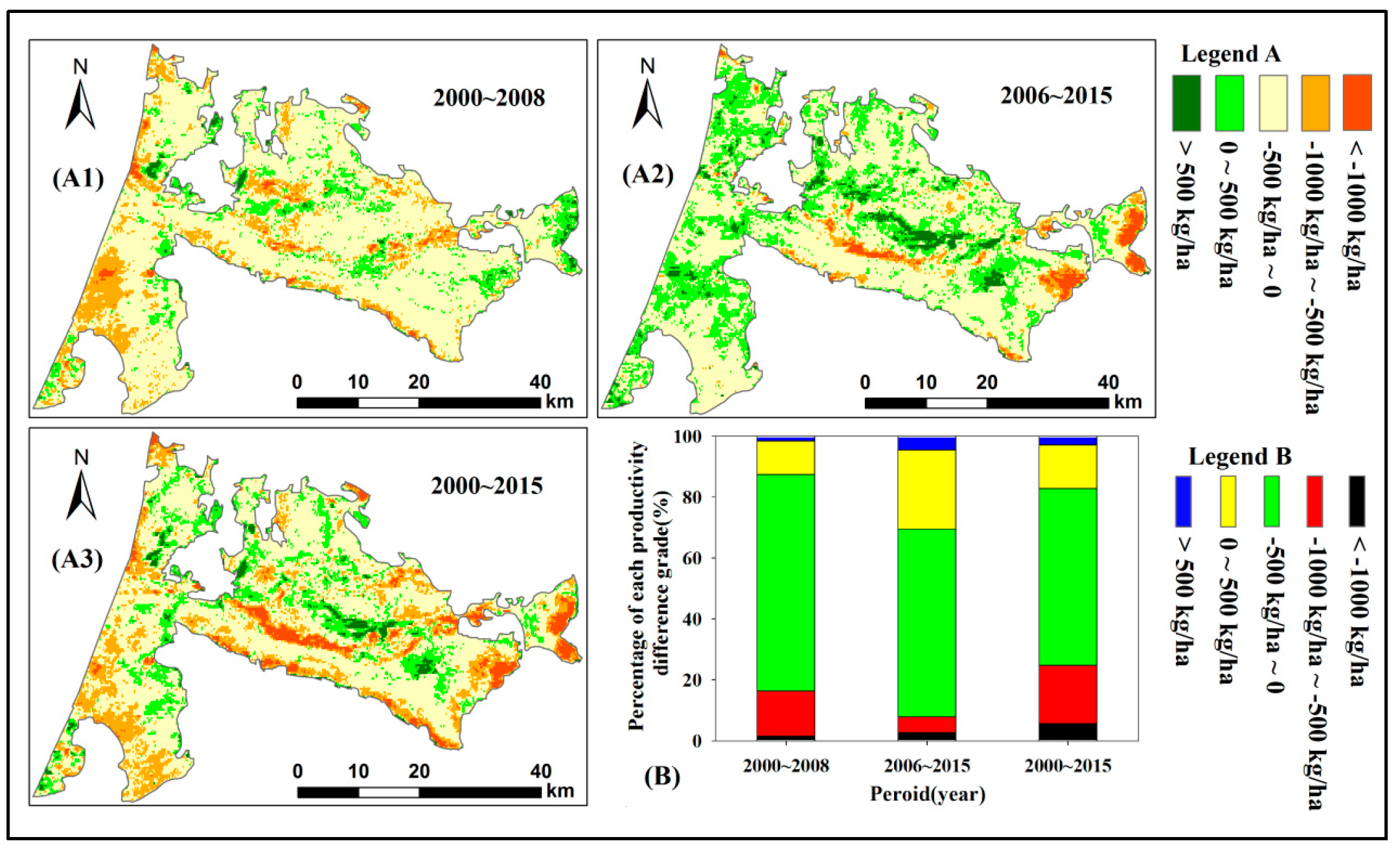
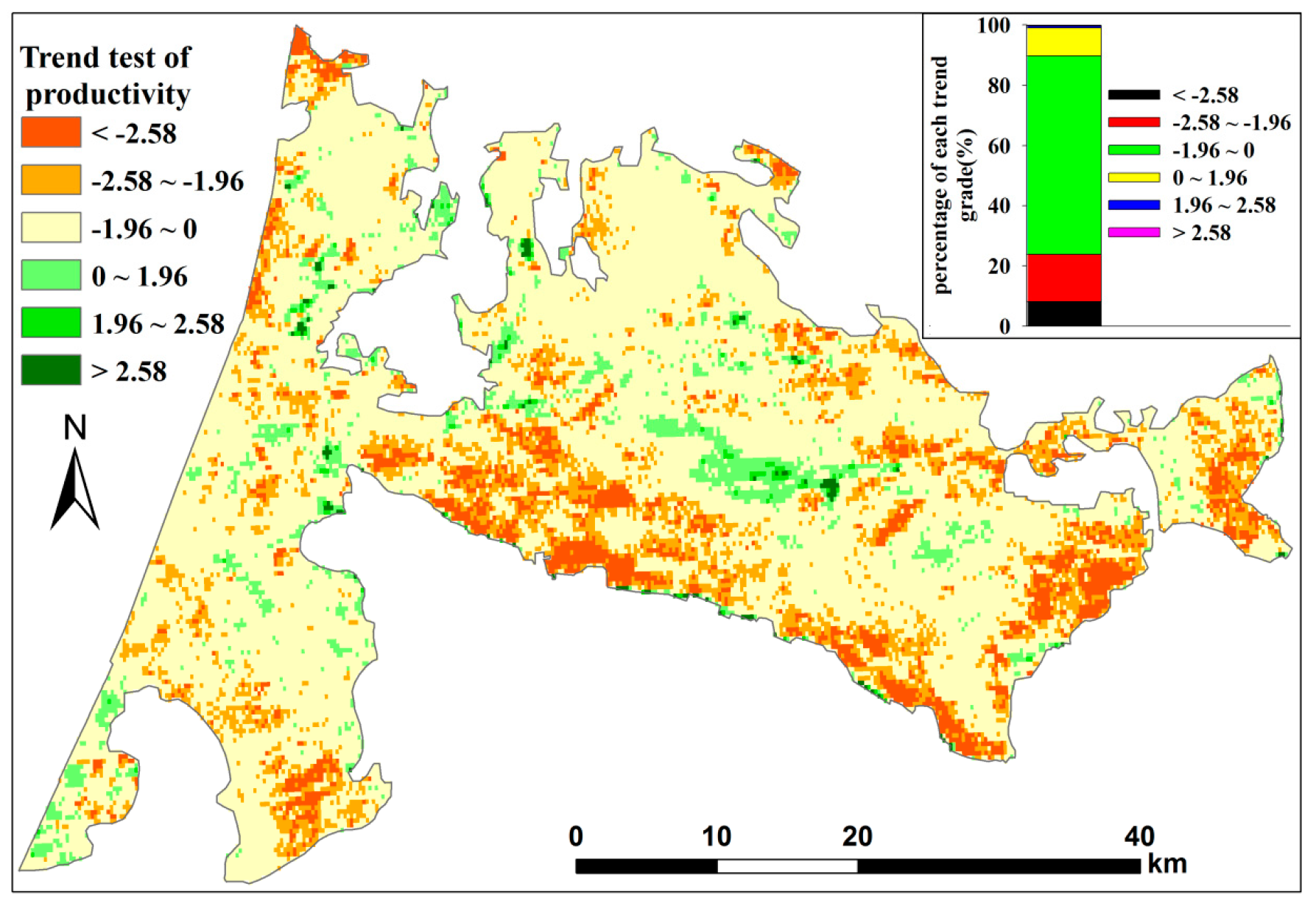
3.3. Productivity Changes in the Kulusitai Grassland
3.4. Changes in Phenology in the Kulusitai Grassland
4. Discussion
4.1. Reasons for Ecological Degradation of the Kulusitai Grassland
4.1.1. Influence of Soil Water on Ecological Degradation
4.1.2. Influence of Climate Change and Human Activities on Ecological Degradation
4.2. Potential for Ecological Restoration in the Kulusitai Grassland
4.3. Measures for Ecological Restoration in the Kulusitai Grassland
5. Conclusions
Author Contributions
Funding
Conflicts of Interest
References
- Houghton, R.A. The Worldwide Extent of Land-use Change: In the last few centuries, and particularly in the last several decades, effects of land-use change have become global. BioScience 1994, 44, 305–313. [Google Scholar] [CrossRef]
- Chase, J.M.; Leibold, M.A.; Downing, A.L.; Shurin, J.B. The effects of productivity, herbivory, and plant species turnover in grassland food webs. Ecology 2000, 81, 2485–2497. [Google Scholar] [CrossRef]
- Gross, K.L.; Mittelbach, G.G.; Reynolds, H.L. Grassland invasibility and diversity: Responses to nutrients, seed input, and disturbance. Ecology 2005, 86, 476–486. [Google Scholar] [CrossRef]
- Schönbach, P.; Wan, H.; Gierus, M.; Bai, Y.F.; Müller, K.; Lin, L.J.; Susenbeth, A.; Taube, F. Grassland responses to grazing: Effects of grazing intensity and management system in an Inner Mongolian steppe ecosystem. Plant Soil 2011, 340, 103–115. [Google Scholar] [CrossRef]
- Gang, C.C.; Zhou, W.; Chen, Y.Z.; Wang, Z.Q.; Sun, Z.G.; Li, J.L.; Qi, J.G.; Odeh, I. Quantitative assessment of the contributions of climate change and human activities on global grassland degradation. Environ. Earth Sci. 2014, 72, 4273–4282. [Google Scholar] [CrossRef]
- Veron, S.R.; Paruelo, J.M.; Oesterheld, M. Assessing desertification. J. Arid Environ. 2006, 66, 751–763. [Google Scholar] [CrossRef]
- Zhang, X.S. Ecological restoration and sustainable agricultural paradigm of Mountain-Oasis-Ecotone- Desert system in the north of the Tianshan Mountains. Acta Bot. Sin. 2001, 43, 1294–1299. [Google Scholar]
- Zhang, L.; Nan, Z.; Xu, Y.; Li, S. Hydrological impacts of land use change and climate variability in the headwater region of the Heihe river basin, northwest china. PLoS ONE 2016, 11, 0158394. [Google Scholar] [CrossRef]
- Bi, X.; Li, B.; Fu, Q.; Fan, Y.; Ma, L.X.; Yang, Z.H.; Nan, B.; Dai, X.H.; Zhang, X.S. Effects of grazing exclusion on the grassland ecosystems of mountain meadows and temperate typical steppe in a mountain-basin system in Central Asia’s arid regions, China. Sci. Total Environ. 2018, 630, 254–263. [Google Scholar] [CrossRef]
- Yu, Y.; Liu, J.; Wang, H.; Liu, M. Assess the potential of solar irrigation systems for sustaining pasture lands in arid regions—A case study in northwestern china. Appl. Energy 2011, 88, 3176–3182. [Google Scholar] [CrossRef]
- Gao, Q.Z.; Li, Y.; Xu, H.M.; Wan, Y.F.; Jiangcun, W.Z. Adaptation strategies of climate variability impacts on alpine grassland ecosystems in Tibetan plateau. Mitig. Adapt. Strateg. Glob. Chang. 2014, 19, 199–209. [Google Scholar] [CrossRef]
- Zhou, W.; Gang, C.C.; Zhou, L.; Chen, Y.Z.; Li, J.L.; Ju, W.M.; Odeh, L. Dynamic of grassland vegetation degradation and its quantitative assessment in the northwest china. Acta Oecol. 2014, 55, 86–96. [Google Scholar] [CrossRef]
- Akiyama, T.; Kawamura, K. Grassland degradation in china: Methods of monitoring, management and restoration. Grassl. Sci. 2007, 53, 1–17. [Google Scholar] [CrossRef]
- Kamp, J.; Koshkin, M.A.; Bragina, T.M.; Katzner, T.E.; Milner-Gulland, E.J.; Schreiber, D.; Sheldon, R.; Shmalenko, A.; Smelansky, L.; Terraube, J.; et al. Persistent and novel threats to the biodiversity of Kazakhstan’s steppes and semi-deserts. Biodivers. Conserv. 2016, 25, 2521–2541. [Google Scholar] [CrossRef]
- Cingolani, A.M.; Renison, D.; Tecco, P.A.; Gurvich, D.E.; Cabido, M. Predicting cover types in a mountain range with long evolutionary grazing history: A GIS approach. J. Biogeogr. 2008, 35, 538–551. [Google Scholar] [CrossRef]
- Salhab, J.; Wang, J.L.; Anjum, S.A.; Chen, Y.X.; Com, M. Assessment of the grassland degradation in the southeastern part of the source region of the Yellow river from 1994 to 2001. J. Food. Agric. Environ. 2010, 8, 1367–1372. [Google Scholar]
- Gundel, P.E.; Irisarri, J.G.N.; Sorzoli, N.S.; Mosso, C.E.; García-Martínez, G.; Golluscio, R. Germination requirements of two sheep-preferred grasses (Hordeum comosum and Koeleria vurilochensis var. patagonica) from semiarid Patagonian steppes. J. Arid Environ. 2012, 78, 183–186. [Google Scholar] [CrossRef]
- Tian, F.; Schlütz, F.; Herzschuh, U.; Mischke, S. What drives the recent intensified vegetation degradation in Mongolia—Climate change or human activity? Holocene 2014, 24, 1206–1215. [Google Scholar] [CrossRef]
- Komac, B.; Pladevall, C.; Domènech, M.; Fanlo, R. Functional diversity and grazing intensity in sub-alpine and alpine grasslands in Andorra. Appl. Veg. Sci. 2015, 18, 75–85. [Google Scholar] [CrossRef]
- Ndehedehe, C.E.; Ferreira, V.G.; Agutu, N.O. Hydrological controls on surface vegetation dynamics over West and Central Africa. Ecol. Indic. 2019, 103, 494–508. [Google Scholar] [CrossRef]
- Jiang, L.L.; Jiapaer, G.; Bao, A.M.; Guo, H.; Ndayisaba, F. Vegetation dynamics and responses to climate change and human activities in Central Asia. Sci. Total Environ. 2017, 599–600, 967–980. [Google Scholar] [CrossRef]
- Qi, S.; Luo, F. Land-use change and its environmental impact in the Heihe river basin, arid Northwestern China. Environ. Geol. 2006, 50, 535–540. [Google Scholar] [CrossRef]
- Bai, Y.; Xu, H.L.; Ling, H.B. Eco-service value evaluation based on eco-economic functional regionalization in a typical basin of northwest arid area, china. Environ. Earth Sci. 2014, 71, 3715–3726. [Google Scholar] [CrossRef]
- Ann, V.; Stephenm, M.; Ye, L.; Eric, V.R. Chronosequence analysis of two enclosure management strategies in degraded rangeland of semi-arid Kenya. Agr. Ecosyst. Environ. 2009, 129, 332–339. [Google Scholar]
- Liang, Y.; Han, G.; Zhou, H.; Zhao, M.; Snyman, H.A.; Shan, D.; Havstad, K.A. Grazing intensity on vegetation dynamics of a typical steppe in northeast Inner Mongolia. Rangel. Ecol. Manag. 2009, 62, 328–336. [Google Scholar] [CrossRef]
- James, J.J.; Svejcar, T.J.; Rinella, M.J. Demographic processes limiting seedling recruitment in arid grassland restoration. J. Appl. Ecol. 2011, 48, 961–969. [Google Scholar] [CrossRef]
- Jacquemyn, H.; Mechelen, C.V.; Brys, R.; Honnay, O. Management effects on the vegetation and soil seed bank of calcareous grasslands: An 11-year experiment. Biol. Conserv. 2011, 144, 416–422. [Google Scholar] [CrossRef]
- Kalamees, R.; Püssa, K.; Zobel, K.; Zobel, M. Restoration potential of the persistent soil seed bank in successional calcareous (alvar) grasslands in Estonia. Appl. Veg. Sci. 2012, 15, 208–218. [Google Scholar] [CrossRef]
- Metsoja, J.A.; Neuenkamp, L.; Zobel, M. Seed bank and its restoration potential in Estonian flooded meadows. Appl. Veg. Sci. 2014, 17, 262–273. [Google Scholar] [CrossRef]
- Li, S.; Verburg, P.H.; Lv, S.; Wu, J.; Li, X. Spatial analysis of the driving factors of grassland degradation under conditions of climate change and intensive use in Inner Mongolia, China. Reg. Environ. Chang. 2012, 12, 461–474. [Google Scholar] [CrossRef]
- Yang, Q.; Qin, Z.H.; Li, W.J.; Xu, B. Temporal and spatial variations of vegetation cover in Hulunbuir grassland of Inner Mongolia, China. Arid. Land. Res. Manag. 2012, 26, 328–343. [Google Scholar] [CrossRef]
- Xu, D.; Guo, X. Some insights on grassland health assessment based on remote sensing. Sensors 2014, 15, 3070–3089. [Google Scholar] [CrossRef]
- Jeganathan, C.; Dash, J.; Atkinson, P.M. Remotely sensed trends in the phenology of northern high latitude terrestrial vegetation, controlling for land cover change and vegetation type. Remote Sens. Environ. 2014, 143, 154–170. [Google Scholar] [CrossRef]
- Jeong, S.J.; Ho, C.H.; Gim, H.J.; Brown, M.E. Phenology shifts at start vs. end of growing season in temperate vegetation over the Northern Hemisphere for the period 1982–2008. Glob. Chang. Biol. 2011, 17, 2385–2399. [Google Scholar] [CrossRef]
- Riley, J.D.; Craft, I.W.; Rimmer, D.L.; Smith, R.S. Restoration of magnesian limestone grassland: Optimizing the time for seed collection by vacuum harvesting. Restor. Ecol. 2004, 12, 311–317. [Google Scholar] [CrossRef]
- Cornelius, C.; Heinichen, J.; Drösler, M.; Menzel, A. Impacts of temperature and water table manipulation on grassland phenology. Appl. Veg. Sci. 2014, 17, 625–635. [Google Scholar] [CrossRef]
- Liang, W. The grassland resources and its utilzation in Kulusitai. Prataculturalence Sci. 1995, 12, 20–21. [Google Scholar]
- Liang, W. The ecosystem deterioration in grassland of Kulusitai and its preventive strategy. Grassl. China 2001, 23, 75–78. [Google Scholar]
- Holben, B.N. Characteristics of maximum-value composite images from temporal AVHRR data. Int. J. Remote Sens. 1986, 11, 1417–1434. [Google Scholar] [CrossRef]
- Lauver, C.L.; Whistler, J.L. A hierarchical classification of Landsat TM imagery to identify natural grassland areas and rare species habitat. Photogramm. Eng. Remote Sens. 1993, S.59, 627–634. [Google Scholar]
- Hunt, E.R.; Daughtry, C.; Eitel, J.; Long, D. Remote Sensing Leaf Chlorophyll Content Using a Visible Band Index. Agron. J. 2011, 103, 1090. [Google Scholar] [CrossRef]
- Sandholt, I.; Rasmussen, K.; Andersen, J. A simple interpretation of the surface temperature/vegetation index space for assessment of surface moisture status. Remote Sens. Environ. 2002, 79, 213–224. [Google Scholar] [CrossRef]
- Tagesson, T.; Horion, S.; Nieto, H.; Fornies, V.Z.; González, G.M.; Bulgin, C.E.; Ghent, D.; Fensholt, R. Disaggregation of SMOS soil moisture over West Africa using the Temperature and Vegetation Dryness Index based on SEVIRI land surface parameters. Remote Sens. Environ. 2018, 206, 424–441. [Google Scholar] [CrossRef]
- Jönsson, P.; Eklundh, L. Timesat-a program for analyzing time-series of satellite sensor data. Comput. Geosci. 2004, 30, 833–845. [Google Scholar] [CrossRef]
- Li, J.M. Characteristic of Soil Seed Bank and Seed Germination in Soil Seed Bank Requirement for Water Conditions in the Lower Reach of the Tarim River. Ph.D. Thesis, Chinese Academy of Sciences, Beijing, China, 2009. [Google Scholar]
- Kendall, M.G.; Gibbons, J.D. Rank Correlation Methods, 5nd ed.; Griffin: London, UK, 1990. [Google Scholar]
- Ling, H.; Xu, H.; Shi, W.; Zhang, Q. Regional climate change and its effects on the runoff of Manas River, Xinjiang, China. Environ. Earth Sci. 2011, 64, 2203–2213. [Google Scholar] [CrossRef]
- Verheijen, F.G.A.; Cammeraat, L.H. The association between three dominant shrub species and water repellent soils along a range of soil moisture contents in semi-arid Spain. Hydrol. Process. 2007, 21, 2310–2316. [Google Scholar] [CrossRef]
- Ye, M.; Xu, H.L.; Qiao, M.; Ren, M. Discussion on the rational water content for restoring semi-shrub artemisia in desert grassland. J. Arid. Land Resour. Environ. 2012, 26, 121–125. [Google Scholar]





| Coverage Grade | <0.20 | 0.20–0.40 | 0.40–0.60 | 0.60–0.80 | >0.80 | Area in 2000–2002 | Transfer Out from 2000–2002 |
|---|---|---|---|---|---|---|---|
| <0.20 | 0.30 | 0.09 | 0.00 | 0.00 | 0.00 | 0.39 | 0.09 |
| 0.20–0.40 | 2.13 | 7.54 | 0.31 | 0.02 | 0.00 | 10.00 | 2.47 |
| 0.40–0.60 | 0.05 | 3.05 | 2.00 | 0.31 | 0.04 | 5.45 | 3.45 |
| 0.60–0.80 | 0.00 | 0.26 | 1.16 | 0.71 | 0.12 | 2.25 | 1.53 |
| >0.80 | 0.00 | 0.04 | 0.26 | 0.40 | 0.81 | 1.51 | 0.71 |
| Area in 2013–2015 | 2.48 | 10.98 | 3.73 | 1.44 | 0.97 | 19.60 | -- |
| Transfer into 2013–2015 | 2.18 | 3.44 | 1.73 | 0.74 | 0.16 | -- | 8.25 |
| Item | Mean Value | Coefficient of Variation | Min to Max | Zc | H0 | |||
|---|---|---|---|---|---|---|---|---|
| 2000–2015 | 2011–2015 | 2000–2015 | 2011–2015 | 2000–2015 | 2011–2015 | |||
| Length of growthseason (day) | 205.6 | 207.1 | 6.6 | 7.6 | 180–227.8 | 183.7–226.5 | 0.68 | A |
| Date of the peak in biomass (day) | 207.5 | 213.8 | 2.8 | 1.2 | 197.2–216.7 | 209.9–216.7 | 2.75 | R |
| Item | Period | Mean Value | Standard Deviation | Rate of Change | Zc | H0 |
|---|---|---|---|---|---|---|
| Precipitation (mm) | 1957–2015 | 270.13 | 63.72 | 0.16 | 0.22 | A |
| Air temperature (°C) | 1957–2015 | 6.31 | 1.23 | 0.06 | 6.31 | R |
| Evaporation (mm) | 1957–2015 | 1688.98 | 184.16 | 4.22 | 2.24 | R |
© 2019 by the authors. Licensee MDPI, Basel, Switzerland. This article is an open access article distributed under the terms and conditions of the Creative Commons Attribution (CC BY) license (http://creativecommons.org/licenses/by/4.0/).
Share and Cite
Yan, J.; Zhang, G.; Deng, X.; Ling, H.; Xu, H.; Guo, B. Does Climate Change or Human Activity Lead to the Degradation in the Grassland Ecosystem in a Mountain-Basin System in an Arid Region of China? Sustainability 2019, 11, 2618. https://doi.org/10.3390/su11092618
Yan J, Zhang G, Deng X, Ling H, Xu H, Guo B. Does Climate Change or Human Activity Lead to the Degradation in the Grassland Ecosystem in a Mountain-Basin System in an Arid Region of China? Sustainability. 2019; 11(9):2618. https://doi.org/10.3390/su11092618
Chicago/Turabian StyleYan, Junjie, Guangpeng Zhang, Xiaoya Deng, Hongbo Ling, Hailiang Xu, and Bin Guo. 2019. "Does Climate Change or Human Activity Lead to the Degradation in the Grassland Ecosystem in a Mountain-Basin System in an Arid Region of China?" Sustainability 11, no. 9: 2618. https://doi.org/10.3390/su11092618
APA StyleYan, J., Zhang, G., Deng, X., Ling, H., Xu, H., & Guo, B. (2019). Does Climate Change or Human Activity Lead to the Degradation in the Grassland Ecosystem in a Mountain-Basin System in an Arid Region of China? Sustainability, 11(9), 2618. https://doi.org/10.3390/su11092618