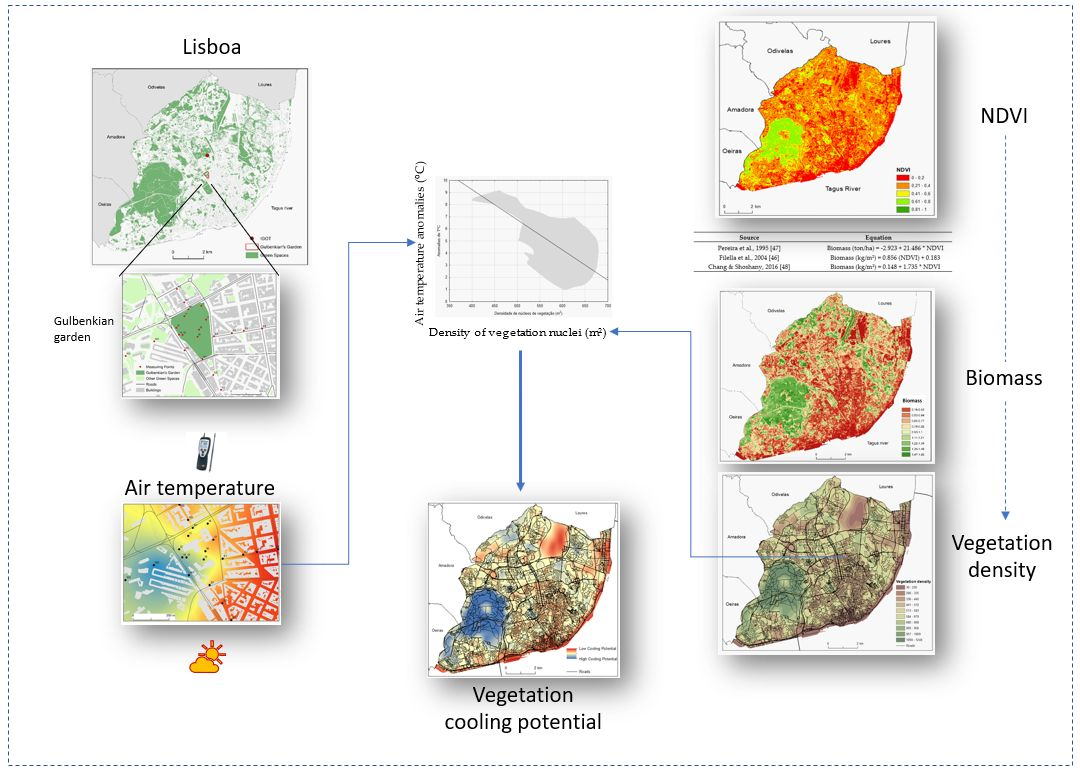
Evaluating the Cooling Potential of Urban Green Spaces to Tackle Urban Climate Change in Lisbon



Abstract
1. Introduction
2. Materials and Methods
2.1. Study Area
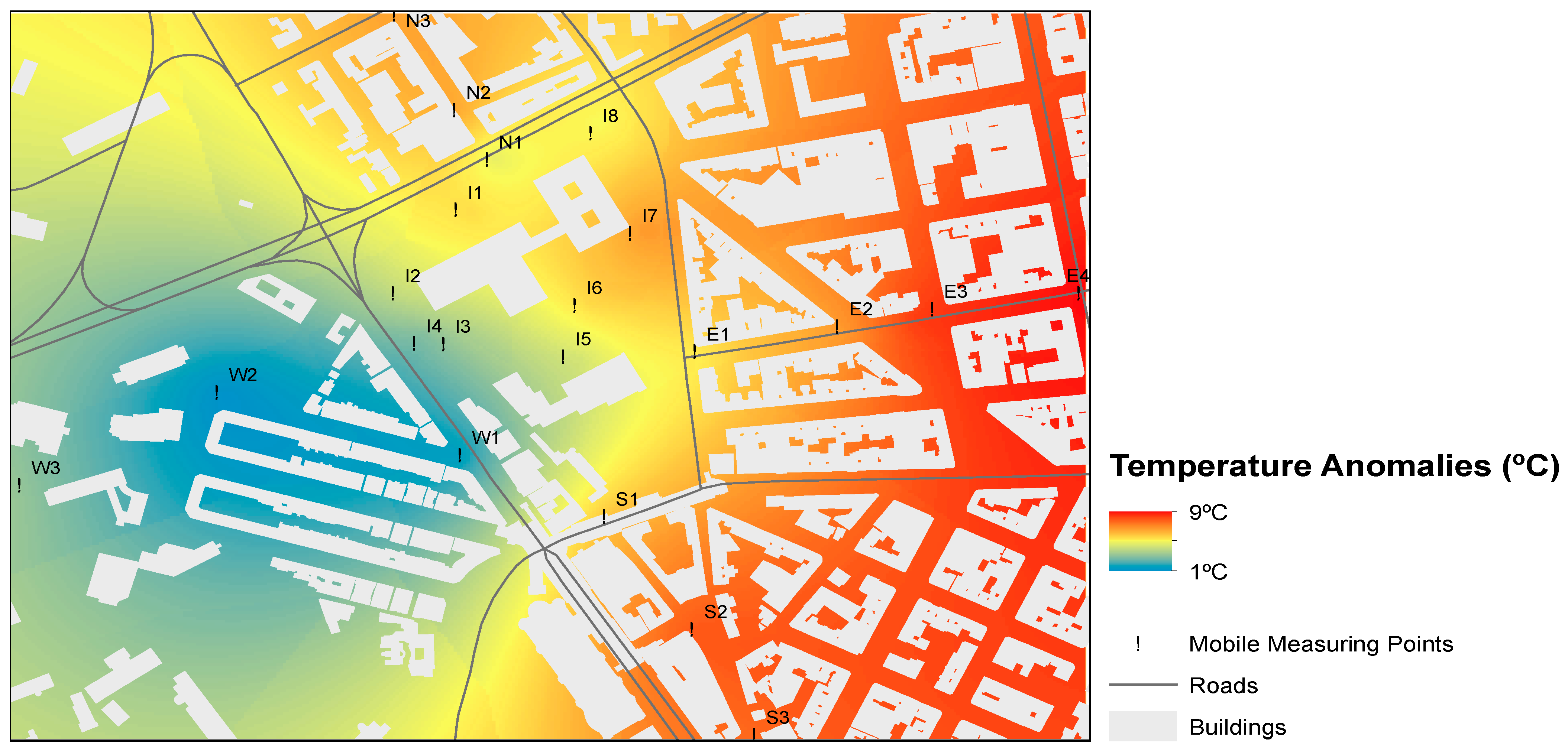
2.2. Acquisition and Treatment of Climatic Data
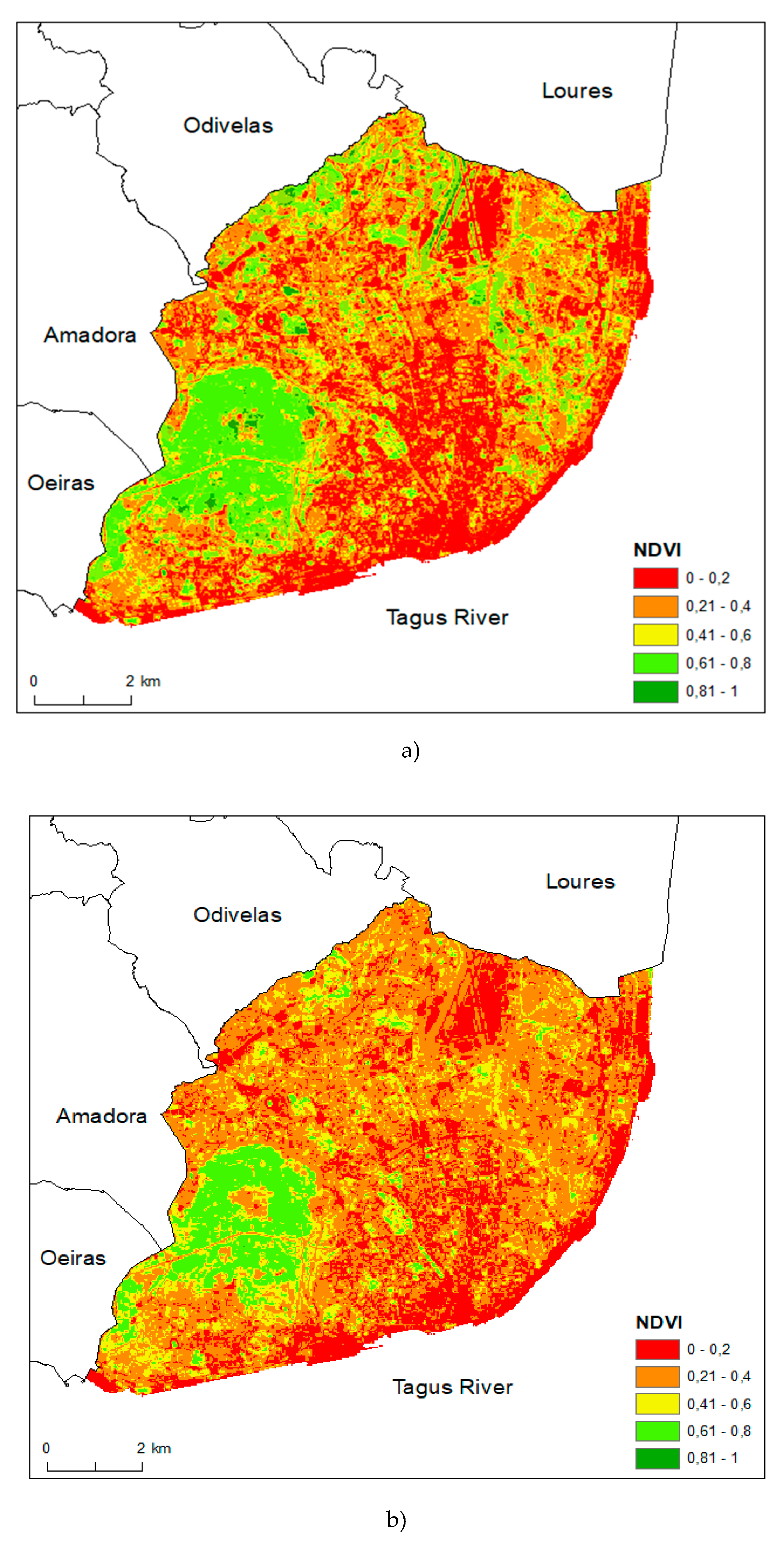
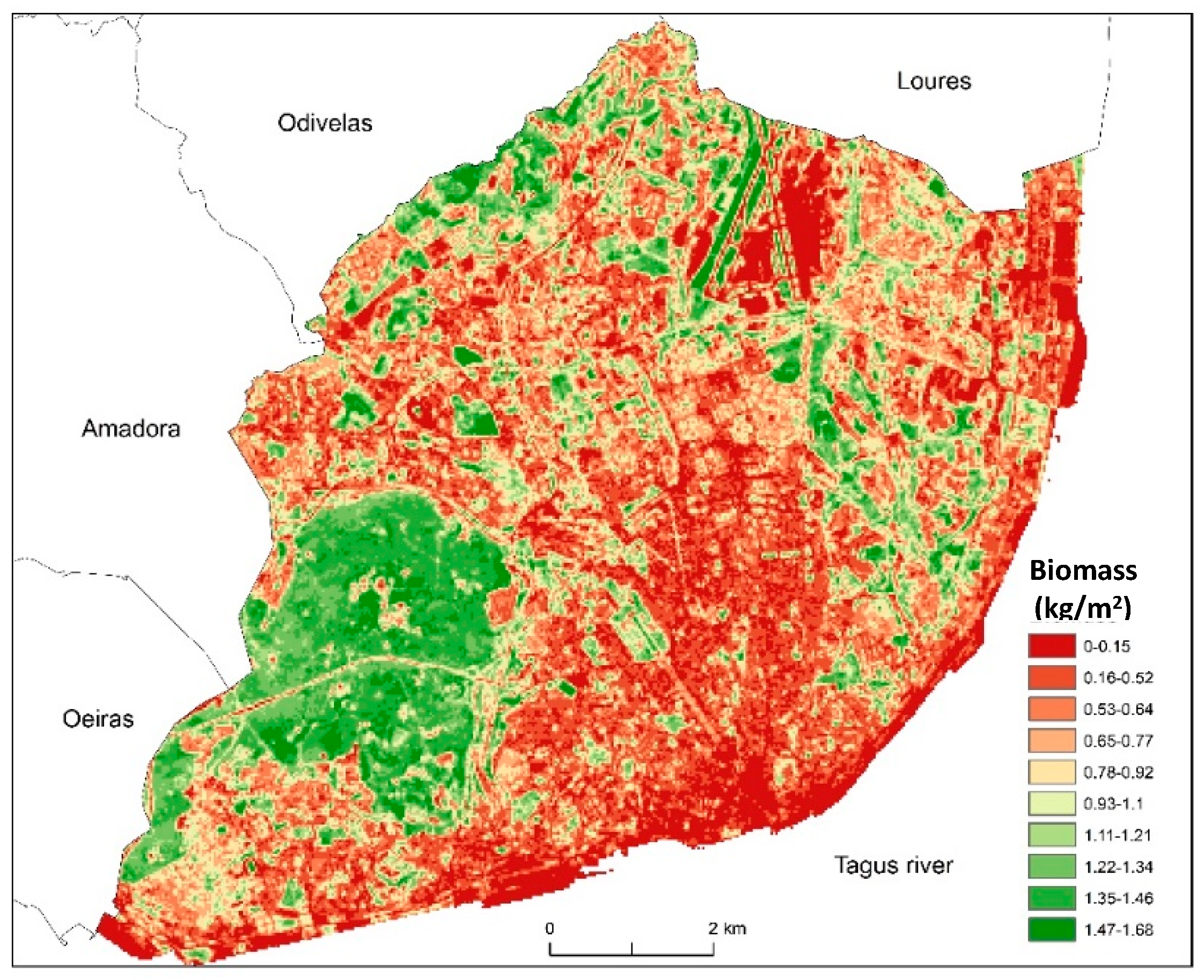
2.3. Estimation of Urban Biomass in Lisbon
- NIR corresponds to near-infrared band and;
- Red represents the red band.
2.4. Estimation of Cooling Potential of Green Spaces
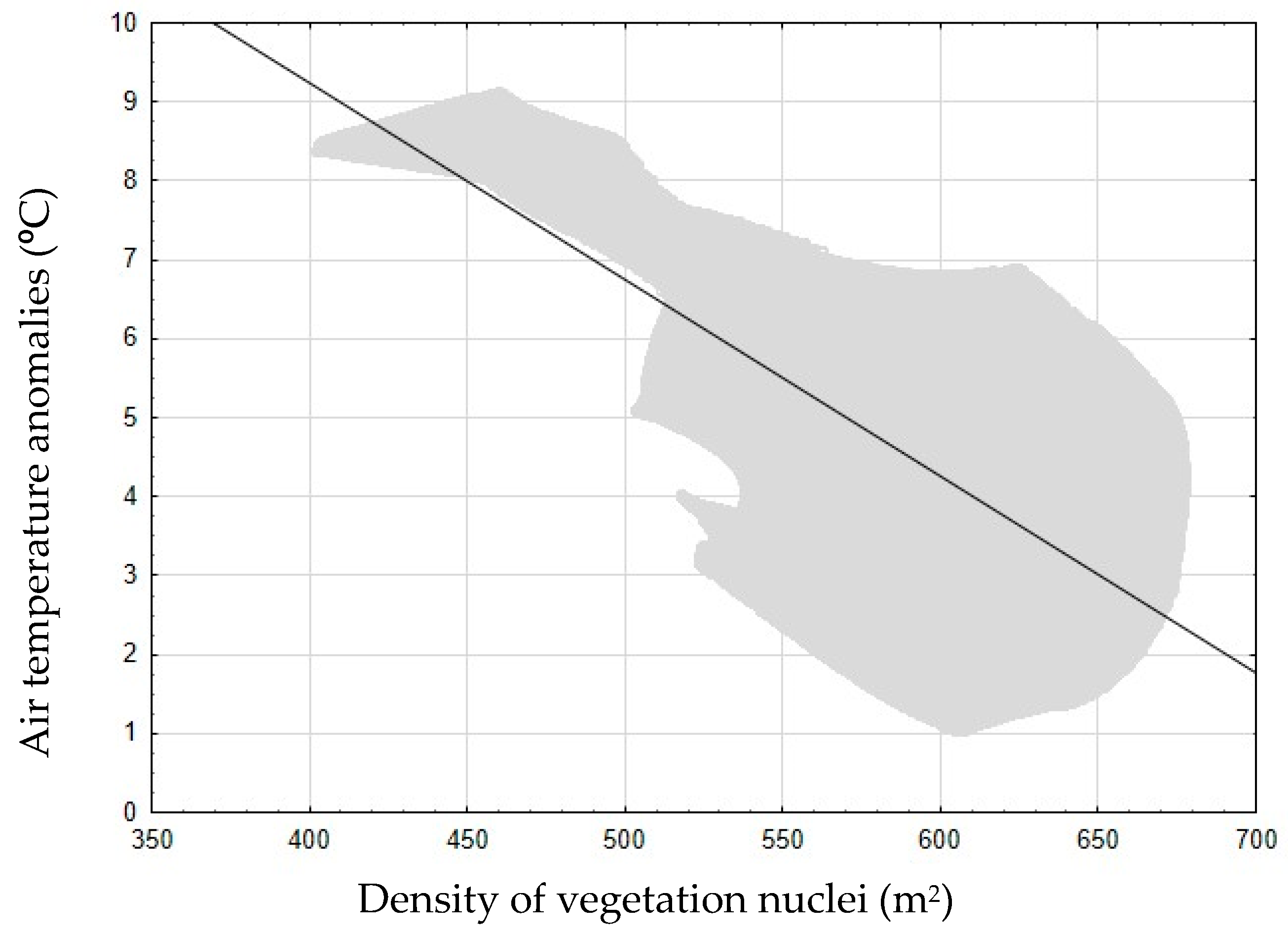
- On a first attempt, the correlation between AGB and the temperature differences at Gulbenkian’s Garden was tested and turned out not statistically significant for both seasons (R = 0.6).
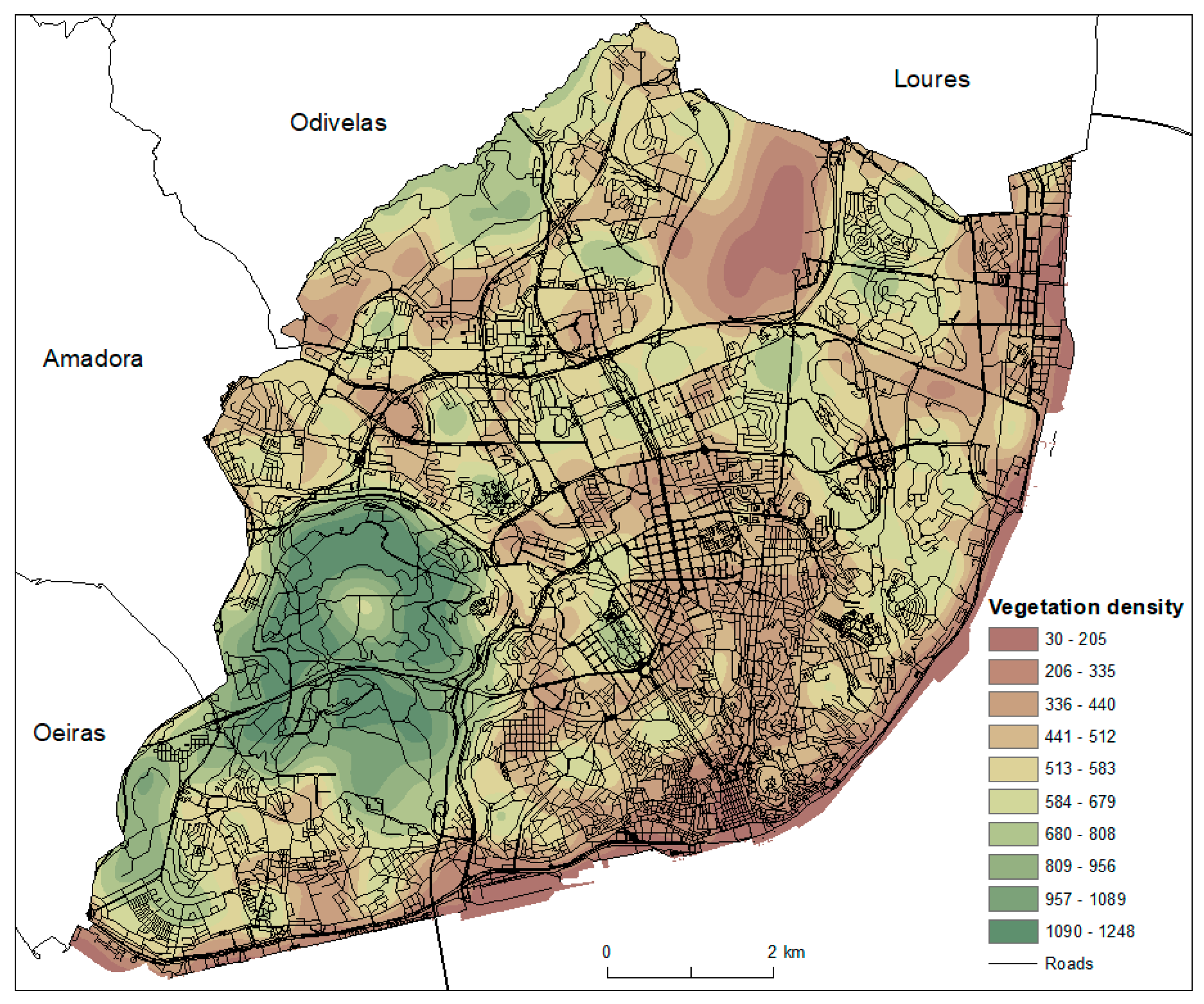
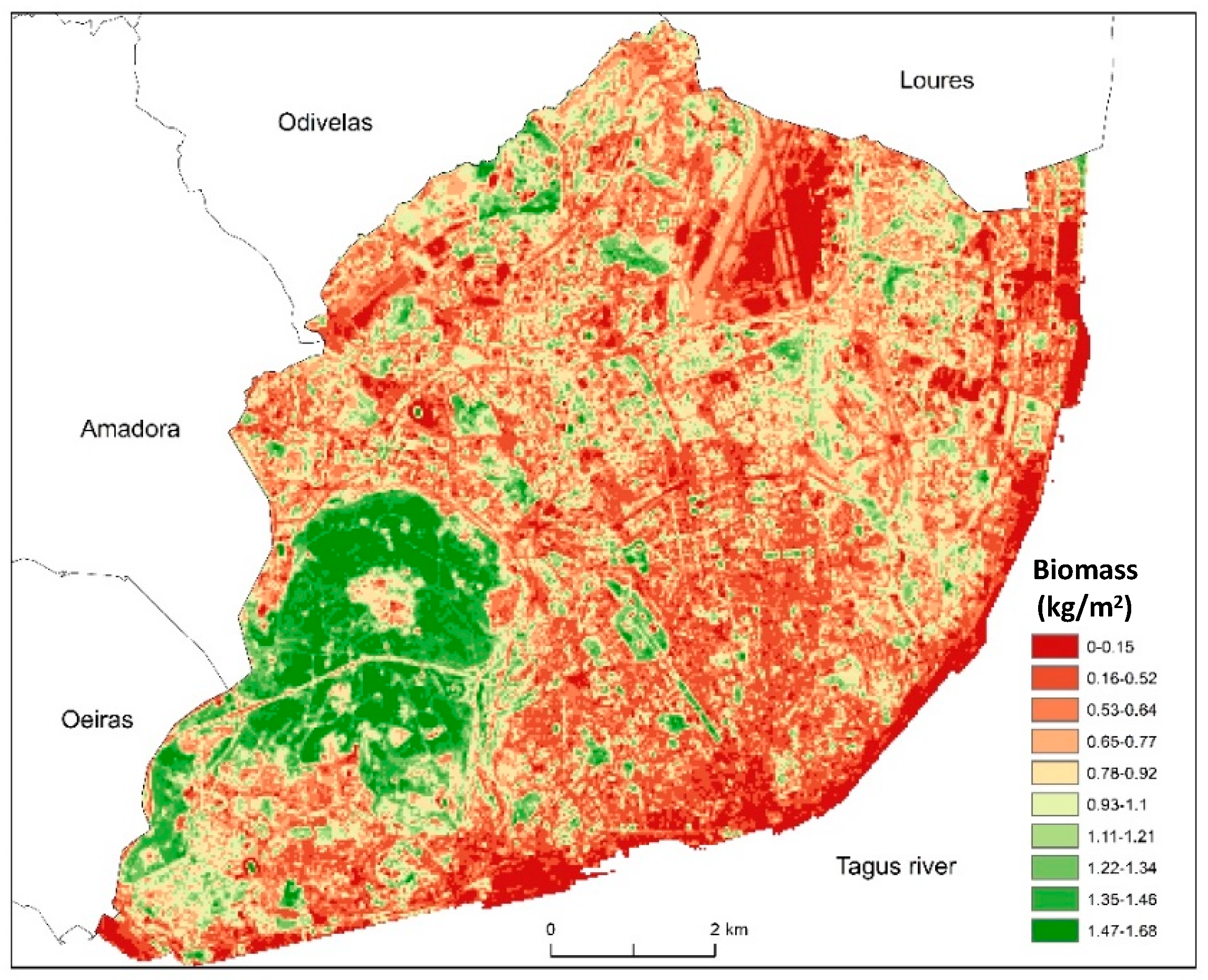
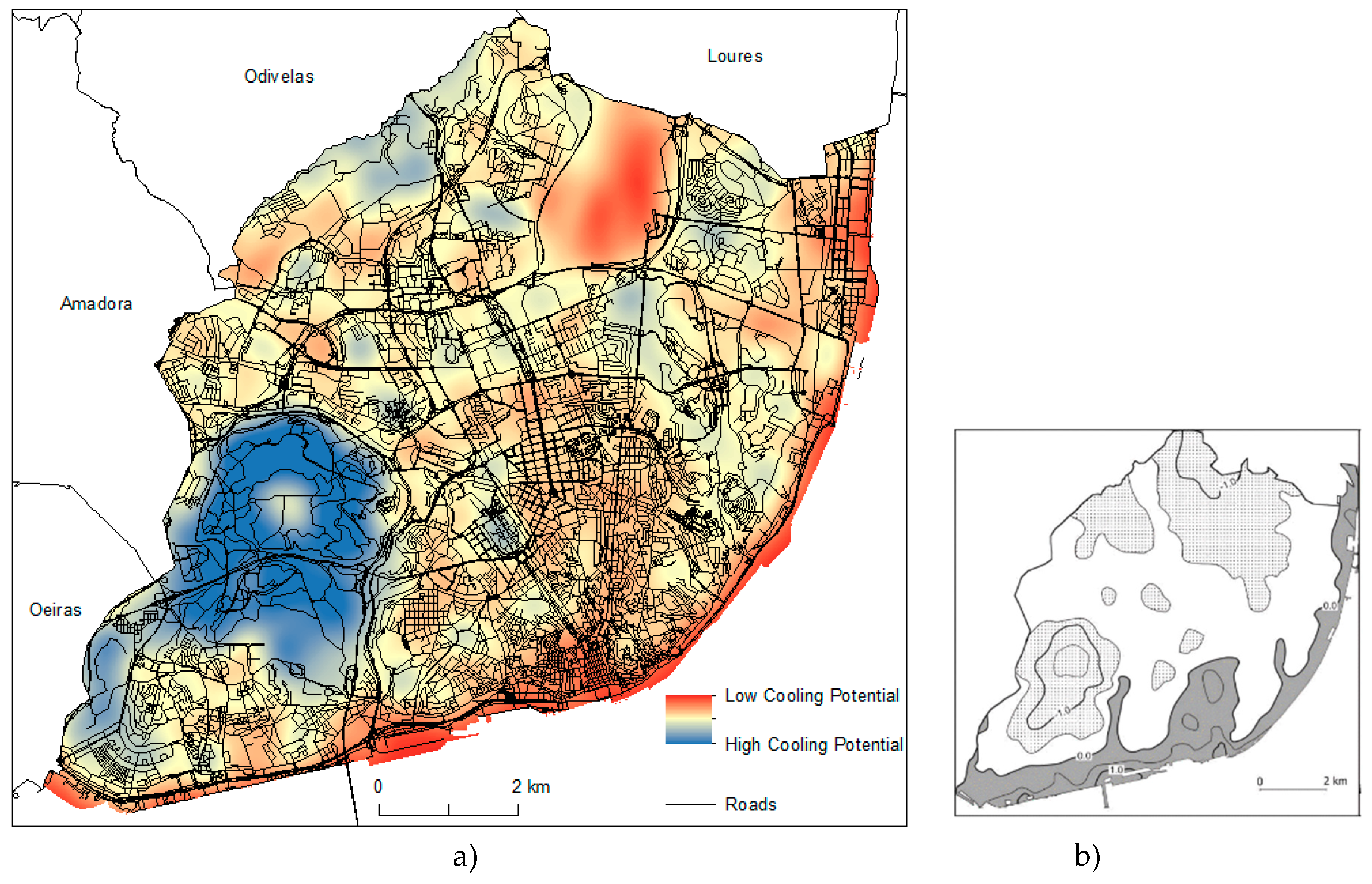
- On a second and final attempt, the linear regression model incorporated a map with the density of vegetation produced from green volume estimations of the city instead of AGB. This parameter was calculated for both winter and summer (Figure 4) using the Kernel density, which estimates the magnitude of green mass per area.
3. Results
3.1. Biomass in Lisbon
3.2. The Cooling Potential of Green Spaces in Lisbon
4. Discussion
5. Conclusions
Author Contributions
Funding
Acknowledgments
Conflicts of Interest
References
- Alcoforado, M.J.; Andrade, H.; Oliveira, S.; Festas, M.J.; Rosa, F. Alterações Climáticas e Desenvolvimento Urbano; Política de Cidades—4. 2009. Available online: http://www.forumdascidades.pt/content/alteracoes-climaticas-e-desenvolvimento-urbano (accessed on 27 April 2019).
- Andrade, H.J.N. Bioclima humano e temperatura do ar em Lisboa. Ph.D. Thesis, Physical Geography, College of Languages, University of Lisbon, Lisbon, Portugal, 2003. [Google Scholar]
- Soares, A.L.B.S.S.S.L. O valor das árvores—Árvores e Floresta Urbana de Lisboa. Ph.D. Thesis, Landscape Architecture, Instituto Superior de Agronomia, University of Lisbon, Lisbon, Portugal, 2006. [Google Scholar]
- Streilling, S.; Matzarakis, A. InFluen of single and small clusters of trees on the bioclimate of a city: A case study. J. Arboric. 2003, 929, 309–316. [Google Scholar]
- Voogt, J.A.; Oke, T.R. Thermal remote sensing of urban climates. Remote Sens. Environ. 2003, 86, 370–384. [Google Scholar] [CrossRef]
- Doick, K.; Hutchings, T. Air temperature regulation by urban trees and green infrastructure. For. Res. 2013, 12, 1–10. [Google Scholar]
- Gago, E.J.; Roldan, J.; Pacheco-Torres, R.; Ordónez, J. The city and urban heat islands: A review of strategies to mitigate adverse effects. Renew. Sustain. Energy Rev. 2013, 25, 749–758. [Google Scholar] [CrossRef]
- Shashua-Bar, L.; Hoffman, M.E. Vegetation as a climatic component in the design of an urban street. An empirical model for predicting the cooling effect of urban green areas with trees. Energy Build. 2000, 31, 221–235. [Google Scholar] [CrossRef]
- Bowler, D.E.; Buyung-Ali, L.; Knight, T.M.; Pullin, A.S. Urban greening to cool towns and cities: A systematic review of the empirical evidence. Landsc. Urban Plan. 2010, 96, 147–155. [Google Scholar] [CrossRef]
- Venhari, A.A.; Tenpierik, M.; Hakak, A.M. Heat mitigation by greening the cities, a review study. Environ. Earth Ecol. 2017, 1, 5–32. [Google Scholar] [CrossRef]
- Bueno-Bartholomei, C.L.; Labaki, L.C. How much does change of species of trees affect their solar radiation attenuation? In Proceedings of the International Conference on Urban Climate, Lodz, Poland, 1–5 September 2003; Available online: http://meteo.geo.uni.lodz.pl/icuc5/text/O_1_4.pdff (accessed on 23 April 2019).
- Fung, C.K.W.; Jim, C.Y. Assessing the cooling effect of different vegetation settings in a Hong Kong golf course. Procedia Environ. Sci. 2017, 37, 626–636. [Google Scholar] [CrossRef]
- Leuzinger, S.; Votg, R.; Kömer, C. Tree surface temperature in an urban environment. Agric. For. Meteorol. 2010, 150, 56–62. [Google Scholar] [CrossRef]
- Shashua-Bar, L.; Pearlmutter, D.; Erell, E. The cooling efficiency of urban landscape strategies in a hot dry climate. Landsc. Urban Plan. 2009, 92, 179–186. [Google Scholar] [CrossRef]
- Lin, B.-S.; Lin, Y.-J. Cooling effect of shade trees with different characteristics in a subtropical urban park. HortScience 2010, 45, 83–86. [Google Scholar] [CrossRef]
- Potchter, O.; Cohen, P.; Bitan, A. Climatic behavior of various urban parks during hot and humid summer in the Mediterranean city of Tel Aviv, Israel. Int. J. Climatol. 2006, 26, 1695–1711. [Google Scholar] [CrossRef]
- McDonald, R.; Kroeger, T.; Boucher, T.; Longzhu, W.; Salem, R. Planting Healthy Air. A global Analysis the Role Urban Trees in Addressing Particulate Matter Pollution Extreme Heat; The Nature Conservancy: Arlington, VA, USA, 2013. [Google Scholar]
- Long, H.; Li, X.; Wang, H.; Jia, J. Biomass resources and their bioenergy potential estimation: A review. Renew. Sustain. Energy Rev. 2013, 26, 344–352. [Google Scholar] [CrossRef]
- Alves, E.D.L.; Lopes, A. The Urban Heat Island Effect and the Role of Vegetation to Address the Negative Impacts of Local Climate Changes in a Small Brazilian City. Atmoshpere 2017, 8, 18. [Google Scholar] [CrossRef]
- Hentz, A.M.K.; Ruza, M.S.; Corte, A.P.D.; Sanquetta, C.R. Enciclopédia Biosfera; Centro Científico Conhecer: Goiânia, Brazil, 2014; Volume 10, pp. 2810–2823. [Google Scholar]
- Kumar, L.; Sinha, P.; Taylor, S.; Alqurashi, A.F. Review of the use of remote sensing for biomass estimation to support renewable energy generation. J. Appl. Remote Sens. 2015, 9, 1–28. [Google Scholar] [CrossRef]
- Lu, D. The potential and challenge of remote sensing-based biomass estimation. Int. J. Remote Sens. 2006, 27, 1297–1328. [Google Scholar] [CrossRef]
- Das, S.; Singh, T.P. Correlation analysis between biomass and spectral vegetation indices of forest ecosystem. Int. J. Eng. Res. Technol. 2012, 1, 1–3. [Google Scholar]
- Coltri, P.P.; Ramirez, G.M.; Walter, M.K.C.; Junior, J.Z.; Pinto, H.S.; Nascimento, C.R.; Gonçalves, R.R.V. Utilização de índices de vegetação para estimativas não-destrutivas da biomassa, estoque e sequestro de carbono do Cafeeiro Arábica. In Proceedings of the Anais XIV Simpósio Brasileiro de Sensoriamento Remoto, Natal, Brazil, 25–30 April 2009. INPE 121–128. [Google Scholar]
- Garroutte, A.I.; Hansen, A.J.; Lawrence, R.L. Using NDVI and EVI to Map Spatiotemporal Variation in the Biomass and Quality of Forage for Migratory Elk in the Greater Yellowstone Ecosystem. Remote Sens. 2016, 8, 404. [Google Scholar] [CrossRef]
- Formica, A.F.; Burnside, R.J.; Dolman, P.M. Rainfall validates MODIS-derived NDVI as an index of spatio-temporal variation in green biomass across non-montane semi-arid and arid Central Asia. J. Arid Environ. 2017, 142, 11–21. [Google Scholar] [CrossRef]
- Fernández-Manso, O.; Fernández-Manso, A.; Quintano, C. Estimation of aboveground biomass in Mediterranean forestsby statistical modelling of ASTER fraction images. Int. J. Appl. Earth Obs. Geoinf. 2014, 31, 45–56. [Google Scholar] [CrossRef]
- Lopes, A. Modificações no clima de Lisboa como consequência do crescimento urbano. Ph.D. Thesis, Physical Geography, Institute of Geography and Spatial Planning, University of Lisbon, Lisbon, Portugal, 2003. [Google Scholar]
- McHale, M.R.; Burke, I.C.; Lefsky, M.A.; Peper, P.J.; McPherson, E.G. Urban forest biomass estimates: Is it important to use allometric relationships developed specifically for urban trees? Urban Ecosyst. 2009, 12, 95–113. [Google Scholar] [CrossRef]
- Raciti, S.M.; Hutyra, L.R.; Newell, J.D. Mapping carbon storage in urban trees with multi-source remote sensing data: Relationships between biomass, land use, and demographics in Boston neighborhoods. Sci. Total Environ. 2014, 500–501, 72–83. [Google Scholar] [CrossRef] [PubMed]
- Goh, J.Y.; Miettinem, J.; Liew, S.C.; Kwoh, L.K. Estimating biomass in managed urban greenery areas using canopy cover percentages derived from NDVI. In Proceedings of the 32nd Asian Conference on Remote Sensing, Taipei, Taiwan, 3–7 October 2011; Volume 3, pp. 1716–1721. [Google Scholar]
- Zoulia, I.; Santamouris, M.; Dimoudi, A. Monitoring the effect of urban green areas on the heat island in Athens. Environ. Monit. Assess 2009, 156, 275–292. [Google Scholar] [CrossRef]
- Yu, Z.; Guo, X.; Jorgensen, G.; Vejre, H. How can urban green spaces be planned for climate adaptation in subtropical cities? Ecol. Indic. 2017, 82, 152–162. [Google Scholar] [CrossRef]
- Feyisa, G.L.; Dons, K.; Meilby, H. Efficiency of parks in mitigating urban heat island effect: An example from Addis Ababa. Landsc. Urban Plan. 2014, 123, 87–95. [Google Scholar] [CrossRef]
- Alcoforado, M.J. O Clima da Região de Lisboa. Contrastes e Ritmos Térmicos; Centro de Estudos Geográficos: Lisboa, Portugal, 1993; Volume 15, p. 347. [Google Scholar]
- Franco, S.F.; Macdonald, J.L. Measurement and valuation of urban greenness: Remote sensing and hedonic applications to Lisbon, Portugal. Reg. Sci. Urban Econ. 2018, 72, 156–180. [Google Scholar] [CrossRef]
- Santos, M.; Cruz, C.S.; Alves, F.L.; Metelo, I.; Bogalho, V. Câmara Municipal de Lisboa. Biodiversidade na Cidade de Lisboa: Uma Estratégia Para 2020; Documento técnico. 3ª Edição (Digital)-Versão Digital (Revista); Câmara Municipal de Lisboa: Lisboa, Portugal, 2015. [Google Scholar]
- Mendes, F.H.; Filho, D.F.S.; Lopes, A.M.S. Proposta de Metodologia Para A Quantificação da Cobertura Arbórea na Cidade de Lisboa a Partir de Imagem de Alta Resolução; Enciclopédia Biosfera; Centro Científico Conhecer: Goiânia, Brazil, 2015; Volume 11, pp. 3254–3265. [Google Scholar]
- Câmara Municipal de Lisboa. Guia Ilustrado de Vinte e Cinco Árvores de Lisboa; Câmara Municipal de Lisboa: Lisboa, Portugal, 2010. [Google Scholar]
- Quintal, R. Jardim da Fundação Calouste Gulbenkian; Calouste Gulbenkian Foundation’s Garden: Flora; Fundação Calouste Gulbenkian: Lisboa, Portugal, 2014. [Google Scholar]
- Oke, T.R. Initial Guidance to Obtain Representative Meteorological Observations at Urban Sites; World Meteorological Organization: Geneva, Switzerland, 2004; Volume 81, p. 51. [Google Scholar]
- Eisfelder, C.; Kuenzer, C.; Dech, S. Derivation of biomass information for semi-arid areas using remote-sensing data. Int. J. Remote Sens. 2012, 33, 2937–2984. [Google Scholar] [CrossRef]
- Galidaki, G.; Zianis, D.; Gitas, I.; Radoglou, K.; Karathanassi, V.; Tsakiri–Strati, M.; Mallinis, G. Vegetation biomass estimation with remote sensing: Focus on forest and other wooded land over the Mediterranean ecosystem. Int. J. Remote Sens. 2017, 38, 1940–1966. [Google Scholar] [CrossRef]
- Lu, D. Aboveground biomass estimation using Landsat TM data in the Brazilian Amazon. Int. J. Remote Sens. 2005, 26, 2509–2525. [Google Scholar] [CrossRef]
- Zhu, X.; Liu, D. Improving forest aboveground biomass estimation using seasonal Landsat NDVI time-series. ISPRS J. Photogramm. Remote Sens. 2015, 102, 222–231. [Google Scholar] [CrossRef]
- Filella, I.; Peñuelas, J.; Llorens, L.; Estiarte, M. Reflectance assessment of seasonal and annual changes in biomass and CO2uptake of a Mediterranean shrubland submitted to experimental warming and drought. Remote Sens. Environ. 2004, 90, 308–318. [Google Scholar] [CrossRef]
- Pereira, J.M.C.; Oliveira, T.M.; Paul, J.C.P. Satellite-based estimation of mediterranean shrubland structural Urban Foresty and Urban Greenery parameters. EARSeL Adv. Remote Sens. 1995, 4, 14–20. [Google Scholar]
- Chang, J.; Shoshany, M. Mediterranean shrublands biomass estimation using Sentinel-1 and Sentinel-2. In Proceedings of the IEEE International Geoscience and Remote Sensing Symposium (IGARSS), Beijing, China, 10–15 July 2016; pp. 5300–5303. [Google Scholar] [CrossRef]
- Andrade, H.; Lopes, A. A Utilização de um SIG Para A Estimação das Temperaturas em Lisboa. Clima Y Ambiente Urbano en Ciudades Ibéericas e IberoAmericanas; Parteluz: Madrid, Spain, 1998; pp. 85–91. [Google Scholar]
- Lopes, A.; Alves, E.; Alcoforado, M.J.; Machete, R. Lisbon Urban Heat Island Updated: New Highlights about the Relationships between Thermal Patterns Wind Regimes; Hindawi: London, UK, 2013; p. 11. [Google Scholar] [CrossRef]
- Monteiro, M.V.; Doick, K.J.; Handley, P.; Peace, A. The impact Greenspace Size on the Extent Local Nocturnal Air Temperature Cooling in London. Urban For. Urban Green. 2016, 16, 160–169. [Google Scholar] [CrossRef]
- Reis, C.E. A eficiência térmica no potencial de arrefecimento de dois espaços verdes em Lisboa. Master’s Thesis, Physical Geography and Spatial Planning, Institute of Geography and Spatial Planning, University of Lisbon, Lisbon, Portugal, 2018. [Google Scholar]
- Alcoforado, M.J.; Lopes, A.; Andrade, H.; Vasconcelos, J. Orientações Climáticas Para o Ordenamento Em Lisboa; Centro de Estudos Geográficos da Universidade de Lisboa: Lisbon, Portugal, 2005. [Google Scholar]
- Fuller, R.A.; Gaston, K.J. The scaling of green space coverage in European cities. Biol. Lett. 2009, 5, 352–355. [Google Scholar] [CrossRef]





| Measuring Points | Air Temperature Anomalies (Δ)(°C) | ||||||
|---|---|---|---|---|---|---|---|
| 24/04 | 20/05 | 18/06 | 25/06 | 07/07 | 09/07 | 23/07 | |
| I1 | 4.6 | 6.0 | 3.8 | 6.8 | 2.6 | 0.4 | 2.2 |
| I2 | 1.5 | 4.3 | 2.6 | 6.3 | 5.6 | 3.4 | 4.9 |
| I3 | 0.7 | 3.7 | 1.9 | 4.8 | 3.4 | 1.2 | 2.2 |
| I4 | 1.2 | 2.4 | 0.0 | 3.8 | 2.4 | 0.2 | 0.9 |
| I5 | 2.4 | 4.0 | 0.3 | 5.8 | 3.4 | 1.2 | 0.7 |
| I6 | 4.4 | 6.0 | 3.9 | 5.1 | 3.4 | 1.2 | 1.0 |
| I7 | 4.5 | 7.4 | 3.4 | 7.6 | 4.8 | 2.6 | 2.3 |
| I8 | 3.0 | 4.7 | 3.2 | 6.1 | 4.8 | 2.6 | 3.5 |
| N1 | 1.7 | 3.9 | 1.4 | 2.2 | 3.3 | 3.4 | 0.5 |
| N2 | 4.6 | 7.2 | 1.2 | 2.8 | 2.7 | 3.2 | 1.8 |
| N3 | 4.4 | 6.9 | 1.1 | 2.5 | 1.6 | 1.4 | 0.6 |
| W1 | 3.9 | 1.0 | 2.5 | 7.6 | 3.1 | 2.6 | 0.7 |
| W2 | 7.7 | 1.0 | 6.2 | 8.2 | 4.7 | 8.0 | 2.9 |
| W3 | 5.1 | 3.5 | 5.0 | 7.8 | 5.6 | 7.8 | 3.6 |
| S1 | 5.2 | 6.5 | 2.8 | 3.8 | 4.6 | 5.0 | 2.6 |
| S2 | 6.8 | 8.4 | 4.1 | 5.5 | 3.1 | 2.3 | 3.0 |
| S3 | 5.0 | 7.8 | 5.4 | 8.5 | 1.8 | 1.1 | 2.1 |
| E1 | 4.9 | 5.1 | 3.9 | 4.2 | 4.3 | 4.5 | 4.5 |
| E2 | 10.0 | 6.6 | 4.7 | 6.1 | 5.9 | 4.8 | 2.7 |
| E3 | 9.0 | 8.9 | 5.6 | 8.4 | 6.9 | 5.3 | 2.8 |
| E4 | 7.1 | 9.2 | 6.3 | 7.2 | 5.4 | 3.5 | 4.5 |
| Source | Equation |
|---|---|
| Pereira et al.; 1995 [47] | Biomass (ton/ha) = −2.923 + 21.486 * NDVI |
| Filella et al.; 2004 [46] | Biomass (kg/m2) = 0.856 (NDVI) + 0.183 |
| Chang & Shoshany, 2016 [48] | Biomass (kg/m2) = 0.148 + 1.735 * NDVI |
| Winter (5 February 2016) | Summer (17 July 2017) | |||||||
|---|---|---|---|---|---|---|---|---|
| Whole City | Green Spaces | Street Trees | Whole City | Green Spaces | Street Trees | |||
| ᾱ (kg/m2) | Total (ton) | ᾱ (kg/m2) | ᾱ (kg/m2) | ᾱ (kg/m2) | Total (ton) | ᾱ (kg/m2) | ᾱ (kg/m2) | |
| [46] | 0.6 | 10.2 | 0.7 | 0.4 | 0.5 | 21.1 | 0.6 | 0.5 |
| [47] | 0.7 | 19.4 | 0.9 | 0.3 | 0.5 | 35.9 | 0.6 | 0.3 |
| [48] | 1.0 | 47.1 | 1.1 | 0.7 | 0.8 | 57.5 | 0.9 | 0.7 |
| Average Biomass | 0.7 | 23.1 | 0.9 | 0.5 | 0.6 | 37.4 | 0.7 | 0.5 |
| Variables | Results |
|---|---|
| Equation | Y = 19.2162 − 0.0249 * x (P < 0.001) |
| Correlation Coefficient (R) | −0.74 |
| Determination Coefficient (R2) | 0.55 |
© 2019 by the authors. Licensee MDPI, Basel, Switzerland. This article is an open access article distributed under the terms and conditions of the Creative Commons Attribution (CC BY) license (http://creativecommons.org/licenses/by/4.0/).
Share and Cite
Reis, C.; Lopes, A. Evaluating the Cooling Potential of Urban Green Spaces to Tackle Urban Climate Change in Lisbon. Sustainability 2019, 11, 2480. https://doi.org/10.3390/su11092480
Reis C, Lopes A. Evaluating the Cooling Potential of Urban Green Spaces to Tackle Urban Climate Change in Lisbon. Sustainability. 2019; 11(9):2480. https://doi.org/10.3390/su11092480
Chicago/Turabian StyleReis, Cláudia, and António Lopes. 2019. "Evaluating the Cooling Potential of Urban Green Spaces to Tackle Urban Climate Change in Lisbon" Sustainability 11, no. 9: 2480. https://doi.org/10.3390/su11092480
APA StyleReis, C., & Lopes, A. (2019). Evaluating the Cooling Potential of Urban Green Spaces to Tackle Urban Climate Change in Lisbon. Sustainability, 11(9), 2480. https://doi.org/10.3390/su11092480