


Abstract
The assessment systems for green building have been developed and implemented for decades. Well-known systems include the U.S. system LEED, the U.K. system BREEAM, the Canadian system GB tools, and the Japanese system CASBEE. These systems will be discussed and compared together with Taiwan’s EEWH system. Each assessment system may contain a different set of evaluation items to evaluate the sustainability level of a building project. Contrarily, the assessment system for green civil infrastructure projects is rarely discussed and developed globally. In Taiwan, studies have been conducted to develop a new assessment system with some reasonable key indicators and evaluation items, serving as the tool to evaluate the sustainability level of a green civil infrastructure project. In this paper, the authors studied and summarized different key indicators and evaluation items, and made comparisons among some major assessment systems for both green building and green civil infrastructure projects. Based on the comparison of the various assessment systems, it is found that greenery, recycling of materials, water conservation, carbon emission reduction, and energy saving are considered in both green building and green civil infrastructure assessment systems. Nevertheless, external building structure, energy consumption, healthy air and temperature, illumination of the indoor environment, rainwater recycling, and underground reservoirs are considered only in green building assessments, but not in green civil infrastructure assessments. Moreover, durability, benefits, landscape, humanities, culture, and creativity, which are discussed adequately in green civil infrastructure assessments, are not highlighted in green building assessments. In addition, two construction projects in Taiwan, one green building project and one green civil infrastructure project, are presented to exemplify sustainability practices and assessments.
1. Introduction
1.1. Foreword
In the past, certain sustainability indicators for infrastructure have been proposed [1,2]. The Key Assessment Indicators have been established to evaluate sustainability issues in engineering fields [3]. Some construction methods, such as the prefabrication method, were considered as a sustainable approach to the construction industry [4]. For better management of construction projects, the Building Information Modeling (BIM) was adopted for sustainability research and studies [5]. Also, circular and flexible criteria for the residential users’ living quality were discussed as sustainability issues [6]. In recent years, sustainability issues have been widely studied and discussed in all fields of engineering and construction. The main purpose of conducting sustainability research is to prevent construction projects from depleting resources or bringing harmful effects and impacts on the environment during the lifecycle. In addition, it is expected that studies on sustainable infrastructure can help protect the environment. The researches on green building and the development of related key indicators have been conducted for some decades. Although most countries have developed their own green building assessment systems, the assessment of sustainability level for civil infrastructure projects is yet to be available. In this paper, the authors will discuss some key sustainability indicators for civil infrastructure projects and make necessary comparisons. Figure 1 shows the framework of research in this paper.
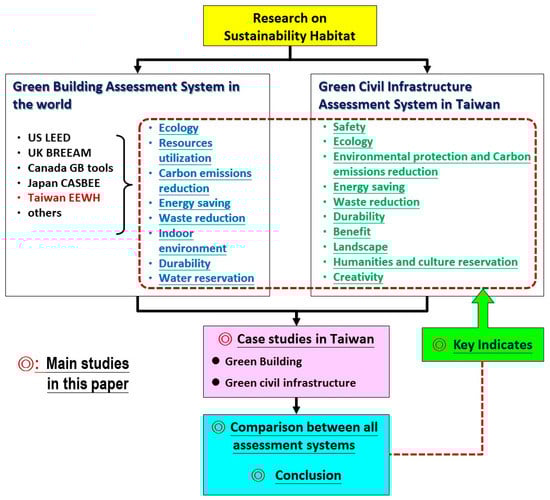
Figure 1.
The framework of research.
1.2. Objective and Methodology
This paper aims to study the assessment systems for green building and green civil infrastructure, and make comparisons to identify how the assessment systems for green building and green civil infrastructure differ from each other. In addition to careful comparisons of the assessment systems, case studies are presented to showcase how assessments for green building and green civil infrastructure are carried out.
1.3. Green Building
“Green building” refers to a building that can meet the goal of environmental friendliness, considering its structure and application processes throughout the entire lifecycle, including planning, design, construction, operation, maintenance, repair, and demolition. Energy saving is one of the major criteria for designing green buildings. The green building assessment system of Taiwan, EEWH (Ecology, Energy saving, Waste reduction, Health), was established in September 1999 [7]. This system aims to sufficiently meet needs in ecology, energy saving, waste reduction, and health. It is the fourth green building certification system in the world, after the U.S. system LEED, the U.K. system BREEAM, and the Canadian system GB tools.
To be defined as a “green building,” some commonly highlighted characteristics and features are listed as follows:
- Savings of energy, efficiency of water usage, and the use of other resources
- Pollution and waste reduction
- Carbon emission reduction
- Re-use and recycling of materials
- Use of renewable energy, e.g., wind or solar energy
- Improvement of indoor environment and air quality
- Use of green and sustainable materials
- Consideration of biodiversity in design
Some major green building assessment systems in the world will be presented in Section 2.
1.4. Green Civil Infrastructure in Taiwan
To date, there has been little research on green civil infrastructure assessment. A research paper on sustainable infrastructure and sustainability education was proposed in 2011 [8]. In 2014, Mehmet and Islam proposed to manage sustainability assessment of civil infrastructure projects using work, nature, and flow [9]. Jang et al. proposed a sustainable performance index (SPI) for assessing green technologies in urban infrastructure projects in 2018 [10].
In Taiwan, civil engineers have gradually taken sustainability into consideration in the design and construction of building and civil infrastructure projects, such as residential buildings, roads, highways, bridges, tunnels, water supply systems, sewers, power grids, and telecommunications. Specifically, “green” infrastructure is being emphasized due to its long lifecycle. In this paper, the authors will present the features of green civil infrastructure, including safety, ecology, environmental protection, carbon emission reduction, energy saving, waste reduction, durability, benefit, landscape, humanities and culture reservation, and creativity. Figure 2 shows the major issues of concern for conventional and sustainable civil infrastructure projects [11]. Through comparing the key indicators between green building and green civil infrastructure, ways to improve and strengthen sustainability practices in both building and civil infrastructure projects can be identified.
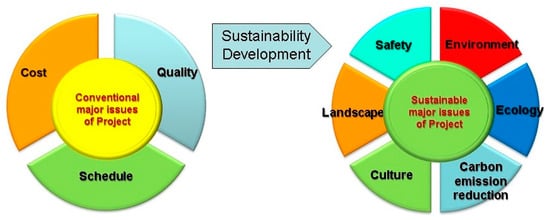
Figure 2.
Major issues of concern for conventional and sustainable civil infrastructure projects [11].
Compared to civil infrastructure, it is relatively easier to apply green concepts to building projects and establish an assessment system, despite the varying functions of buildings with time. On the contrary, it is always a challenge to establish a general sustainability assessment system for all types of civil infrastructure project. Different types of civil infrastructure projects, such as tunnels, bridges, dams, roads, rails, telecom communication systems, etc., may contain different features and characteristics, and, thus, it is rather difficult to come up with an assessment system that can cover such a wide range of sustainability issues. Grouping civil infrastructure projects and items of similar natures as follows might provide an avenue for the development of a green civil infrastructure assessment system.
- Roads: Embankments, retaining walls, pavements, slopes, etc.
- Tunnels: Tunnel boring machine, shield machine, cut-and-cover tunnel, etc.
- Bridges: Ground sourcing, free cantilever, advancing sourcing, etc.
- Plants: Power station, factory plant, warehouse, etc.
- Utilities: Telecom communication, power, gas, water, draining, etc.
- Transportation: Rail, MRT, gondola, etc.
- Others.
Research studies on sustainability issues worldwide appear to encounter similar situations. In this study the authors will highlight the achievements on sustainability issues in both green building and green civil infrastructure projects around the world to show the major differences between these two types of projects.
2. Major Green Building Assessment Systems around the World
There are 26 green building assessment systems or evaluation tools that have been developed and implemented worldwide. In this paper, the authors will highlight some major assessment systems, which include the U.S. system LEED, the U.K. system BREEAM, the Canadian system GB tools, and the Japanese system CASBEE, and will make comparisons among these systems in the following sections. In addition, sustainability practices of green buildings and civil infrastructures in Taiwan will be studied and compared in this paper. Figure 3 shows the distribution of green building assessment systems in the world.
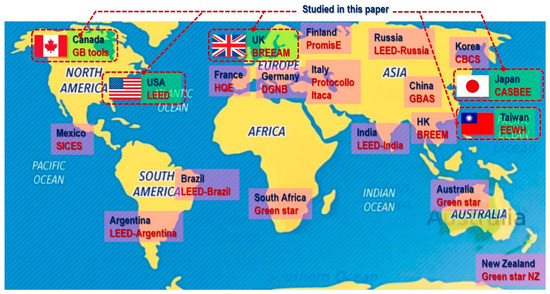
Figure 3.
Distribution of green building assessment systems around the world.
2.1. United States: LEED
The Leadership in Energy and Environmental Design (LEED) was established by the U.S. Green Building Council (USGBC) in 1995 [12]. It is the most well-known and adopted system, which is acceptable in over 165 countries and territories, for evaluation of sustainable buildings around the world. The latest version of the LEED system is Ver. 4.1, which was released recently. With an emphasis on energy saving and efficiency, sustainable development, water preservation, material selection, and indoor air quality, the LEED system works for all types of buildings, from existent buildings to those still in the design and planning phase. The LEED is the most applied system to evaluate the sustainability achievements for new construction and major renovations (LEED BD+C), as shown in Table 1.

Table 1.
The key indicators of LEED (BD + C) for new construction and major renovations [12].
The above checklist for evaluation contains 55 detailed items, 12 required items, and 62 selective items for new construction, core and shell, schools, retail centers, hospitals, data centers, warehouses and distribution centers, and healthcare centers. Four rating levels are available for LEED, as follows [12]:
- Certified level: 40–49 points
- Silver level: 50–59 points
- Gold level: 60–79 points
- Platinum level: 80 points above
This rating process is designed to inspire project teams to make efforts for innovative solutions that support public health and the environment and energy saving during a project’s lifecycle.
2.2. United Kingdom: BREEAM
The Building Research Establishment Environmental Assessment Method (BREEAM) was established by British Building Research Establishment (BBRE) in 1990 [13]. This is the first assessment system for green building. There are 2,275,541 buildings located in 80 countries registered with BREEAM, and 566,811 of them have received a certificate [13].
In the BREEAM system, some elements are assessed to determine the overall performance of a new building construction project as follows:
- The environmental section weightings
- The minimum BREEAM standards
- The BREEAM rating level benchmarks
BREEAM uses an explicit weighting system, which is derived from a combination of consensus-based weightings and ranking by a panel of experts. The outputs from calculation of this weighting system are then used to determine the relative value of the environmental sections used in BREEAM and their contribution to the overall BREEAM score. Table 2 shows the BREEAM Environmental section weightings.
Table 2.
The BREEAM Environmental section weightings [13].
The section score will be calculated using the following Formula:
Section score (%) = (credits achieved/credits available) × weight
- Credits achieved: the credits gained from the experts’ determination
- Credits available: the maximum credits of a section
- Weight: as shown in Table 2
After calculation and summation from Table 2 and Formula (1), the final BREEAM score will be obtained to determine the score rating of a new building project, as shown in Table 3.
Table 3.
BREEAM rating benchmarks [13].
2.3. Canada: Green Building (GB) Tool
The green building certification system [14] includes the “Energy Star Certification” and “U.S. LEED.” In addition, the Building Owners and Managers Association’s Building Environmental Standards (BOMA BEST) program also serves as the Canadian industry standard for commercial building sustainability certification.
2.3.1. Energy Star
Any product with the blue Energy Star Certification, which is granted by Natural Resources Canada (NRCan), could save energy and money without any sacrifices in performance. The same applies to the buildings with Energy Star Certification as well. The Energy Star certified commercial and institutional buildings could be regarded as green buildings, which could meet strict energy performance standards.
Currently, seven types of buildings are eligible to apply for Energy Star Certification, as follows [14]:
- K-12 schools
- Commercial offices
- Hospitals
- Supermarkets and food stores
- Medical offices
- Senior care communities and residential care facilities
- Ice and curling rinks
In order to receive the Energy Star Certification, it is necessary to earn a score of at least 75 points that meet certain eligibility criteria. In addition, the application of Energy Star Certification must be verified by the licensed professional program.
2.3.2. LEED Holder
The Canada Green Building Council (CaGBC) is the license holder for the U.S. LEED green building rating system in Canada. It is a national organization that has been working since 2002. To promote green building and sustainable community development practices in Canada, the CaGBC is a non-profit organization, which has made great contributions to the development of sustainable green buildings.
2.4. Japan: CASBEE
The assessment system of green buildings in Japan was named the Comprehensive Assessment System for Built Environment Efficiency (CASBEE) [15], which was developed in 2002 by the research committee that was established in 2001. The first CASBEE assessment tool was designed for office buildings. It was upgraded in 2003, 2004, and 2005 to develop other new tools for newly constructed buildings, existing buildings, and renovation projects, respectively. The design concept of CASBEE assessment tools is based on the three following principles [15]:
- Comprehensive assessment throughout the lifecycle of the building
- Assessment of the Built Environment Quality and Built Environment Load
- Assessment based on the newly developed Built Environment Efficiency (BEE) indicator
The CASBEE assessment tools comprise different scales, as follows:
- Housing Scale (construction)
- Building Scale (construction)
- Urban Scale (town development)
- City Scale (city management)
Figure 4 shows the schematic diagram of the four scales of CASBEE tools.
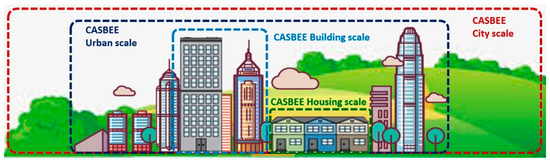
Figure 4.
The four scales of CASBEE [15].
To implement the CASBEE assessment, two spaces are defined: inside and outside spaces. These two spaces are divided by a virtual enclosed space boundary and other elements. The inside space could be considered as a “private property” and evaluated by the factor Q: The Built Environment Quality. It represents the living amenity for the building users. The outside space could be considered as a “public property” and evaluated by the factor L: The Built Environment Load. It represents the negative aspects of environmental impact which go beyond the virtual enclosed space to the outside. Figure 5 shows the division of the assessment categories for Q and L based on the virtual enclosed space boundary.
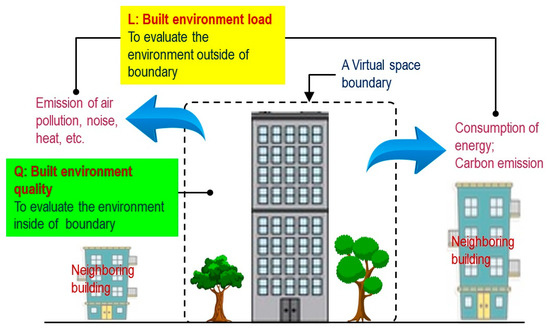
Figure 5.
The division of the assessment categories for Q and L based on the virtual enclosed space boundary [15].
Based on the definition of Q and L above, the value of Built Environment Efficiency (BEE) is calculated from the Formula (2) below:
BEE = Q (Built Environment Quality)/L (Built Environment Load)
The value of BEE represents the performance of the building on sustainable practices. Figure 6 shows the environmental labeling based on BEE. The ranks of assessment results include C, B-, B+, A, and S, which are in order of increasing value of BEE. The building can be labeled as a “Sustainable building” and “Ordinary building” when the BEE value is greater than 1.5 and in the range of 0.5–1.5, respectively.
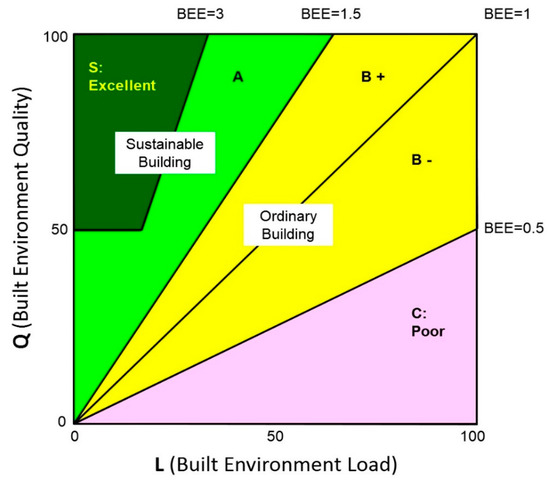
Figure 6.
The environmental labeling based on BEE [15].
3. Sustainability Practices in Taiwan
3.1. Assessment System for Green Buildings: EEWH
The main concept of green building assessment system in Taiwan contains four categories: “Ecology”, “Energy saving”, “Waste reduction”, and “Health” (EEWH). After the U.S. system LEED, the U.K. system BREEAM, and the Canadian system GB tools, the EEWH system is the fourth assessment system for green building evaluation in the world. The EEWH system emphasizes on energy efficiency enhancement, energy saving, adequate use of resources and materials, indoor environmental quality, and affordable environmental load.
There are nine indicators included in the four major categories of EEWH, namely “Biodiversity”, “Greenery,” “Water content of site,” “Daily energy conservation,” “CO2 emission reduction,” “Construction waste reduction,” “Indoor environment,” “Water conservation,” and “Sewage and waste disposal facility improvement.” Table 4 shows the indicators contained in each category of EEWH.
Table 4.
Evaluation items contained in each category of EEWH [7].
Recently, a public building project, which cost more than 50 million NTD, is required to apply for the “Green Building Candidate Certificate” prior to its construction [7]. The certificate level is defined in the candidate process based on the design of the building. All the required practices for the evaluation items should be implemented with sufficient records, as requested by the EEWH assessment system. The final evaluation for the green building will be carried out after completing the construction to verify whether all evaluation items have been well implemented during the construction period. The “Green Building Label” certificate will be issued after acceptance of the project by the client and verification of performance by the EEWH evaluation team. Table 5 shows the green building evaluation score list. Table 6 shows the green building label and final score distribution list. The application process for the EEWH green building label is shown in Figure 7.
Table 5.
Green building evaluation score list under EEWH [7].
Table 6.
Green building label and final score distribution list [7].
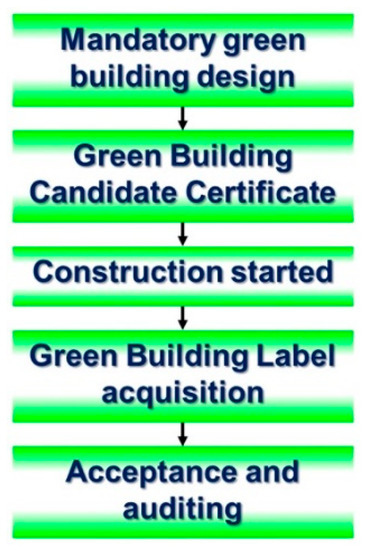
Figure 7.
Standard application process for EEWH green building labels.
EEWH certified green buildings are expected to save 20% in electricity and 30% in water in the building lifecycle, in order to reduce resource consumption. It is also expected to provide a better and sustainable living environment, resulting in better health and amenities for the user.
3.2. Key Sustainability Indicators for Green Civil Infrastructure
The authors established a set of key sustainability indicators for green civil infrastructure, including safety, ecology, environmental protection and carbon emission reduction, energy saving, waste reduction, durability, benefit, landscape, humanities and culture reservation, and creativity. In this assessment system, a total of 48 evaluation items are discussed to determine the sustainability level of a green civil infrastructure project. Three evaluation levels with weights are contained in this system. Table 7 shows the major evaluation items (level 2) contained in each indicator (level 1). Figure 8 shows the three levels of the proposed green civil infrastructure assessment system.
Table 7.
Major evaluation items contained in each indicator.
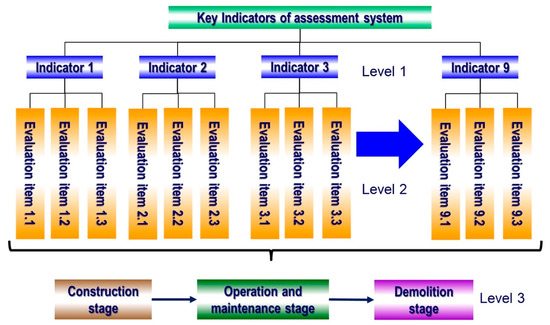
Figure 8.
The three levels of the proposed green civil infrastructure assessment system.
The weights of the three levels in the proposed green civil infrastructure assessment system are symbolized as Wijk (level 3), Wij (level 2), and Wi (level 1). The initial credits are obtained via the expert review, which includes the questionnaires, and uses the regression method to calculate the level three weights, Wijk. By adopting the Multiple Attribute Value Technique (MAVT) method [16] and related formulas, the weights of level 2 and level 1, i.e., Wij and Wi, are obtained by a series of calculation.
Since different types of civil infrastructure projects involve different features, it is unlikely for a civil infrastructure assessment system to be suited for all types of projects. In view of this, the authors have developed several assessment systems for tunnels, bridges, slope protection, and pavements separately. Key indicators and evaluation items, together with their weights, are tailor-made for each type of the civil infrastructure projects.
For any new project to be evaluated by the assessment system, the evaluation work will be performed by the audit team members to determine the score of each evaluation items. A total score is obtained through summing the values of each individual key indicator. The rating of a new project based on this assessment system is divided into five grades, as follows:
- Certified grade: A total score greater than or equal to 50 points, but less than 60 points.
- Bronze grade: A total score greater than or equal to 60 points, but less than 70 points.
- Silver grade: A total score greater than or equal to 70 points, but less than 80 points.
- Gold grade: A total score greater than or equal to 80 points, but less than 90 points.
- Diamond grade: A total score greater than or equal to 90 points.
3.3. Case Studies in Taiwan
3.3.1. The Taipei 2017 Summer Universiade Athletes’ Village and Linkou Public Housing Project (LPHP)
The LHPH project is located in the Linkou District, New Taipei City, Taiwan. It includes nine 19- to 21-story buildings, and was delivered using a design-build method. The main function of the LPHP project is to serve as public housing. In addition, it also served as the Athletes’ Village for the 2017 Taipei Summer Universiade before the residents moved in. Table 8 shows the basic information of LPHP. Figure 9 shows the plan view of the LPHP project.
Table 8.
Basic information of the LPHP.
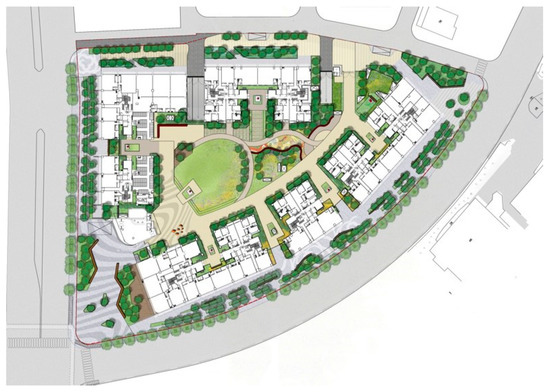
Figure 9.
The plan view of LPHP.
The LPHP project met most key indicators required by EEWH, the Taiwanese green building assessment system, and received a silver grade certificate. The features of LPHP are highlighted below:
- Lush greenery: Increasing greenery areas provide more fresh air (high CO2 absorbing capability) and a comfortable environment to the residents.
- Sunlight and ventilation: Three sides of the buildings in LPHP receive good sunlight and ventilation. This helps with energy saving.
- Rainwater recycling: A rainwater recycling system is available and is used for watering plants.
- Permeable pavement: The adoption of permeable bricks increases water infiltration to the underground, reducing the chance of flooding.
- Waste reduction: Reuse of falsework materials minimizes construction waste and its disposal.
- Work quantity reduction: Adopting a special retaining method to reduce work quantity for basement excavation.
In this paper, a special retaining method called “Anchor Pile with Steel Cable System” was used [17]. This retaining method can prevent the happening of unforeseen disasters and reduce carbon emission. Table 9 lists the main parts of this retaining system, and Figure 10 shows its cross-section.
Table 9.
Main components of the “Anchor Pile with Steel Cable System” method [17].
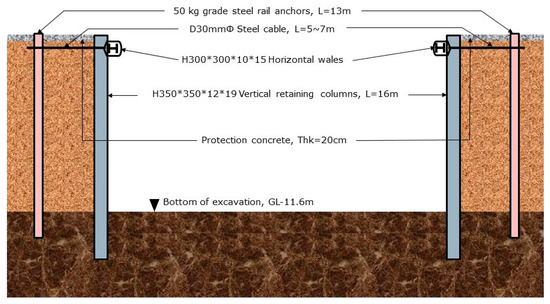
Figure 10.
Cross-section of the “Anchor Pile with Steel Cable System” method [17].
In accordance with Terzaghi’s formula, a soil horizontal pressure diagram can be obtained, as shown in Figure 11.
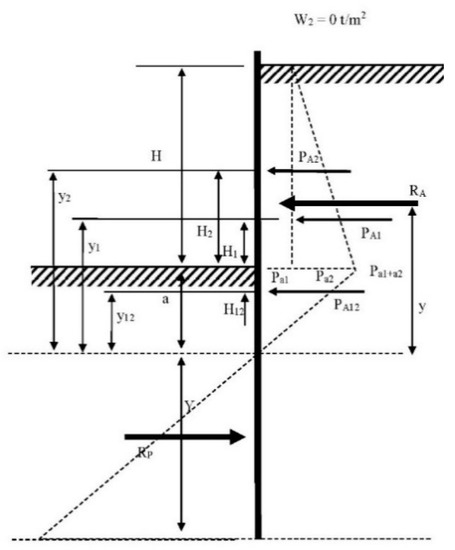
Figure 11.
Soil horizontal pressure diagram according to Terzaghi’s formula [17].
Applying all horizontal soil pressures occurring in this project, the pressure balance condition is determined, as shown in Figure 12.
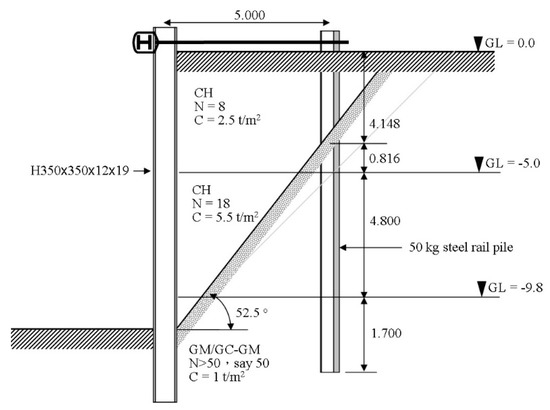
Figure 12.
Soil horizontal pressure balance condition [17].
The parameters γd, ψ, K0, KA, and KP are then decided, as listed in Table 10. Table 11 shows the calculated results for the H350 retaining steel columns, including σ (tension stress), τ (shear stress), and Δ (deflection).
Table 10.
Parameters of soil at the construction site. [17].
Table 11.
Calculated results for H350 retaining steel columns, including σ, τ [17].
The allowable stress of ASTM A36 materials (σa) is 1500 kg/cm2, and τa is 1000 kg/cm2. The σmax and τmax, shown in Table 11 illustrate the safety of the retaining system of this project.
The “Anchor Pile with Steel Cable System” (APSCS) method achieved effective carbon reduction due to the use of fewer materials (Table 12).
Table 12.
Carbon reduction of the APSCS Method through material conservation [17].
Furthermore, the APSCS method saved up to NTD $350 million on construction costs, and shortened the project duration by at least 60 days. Most importantly, this method provides a safer environment for people to do construction work [18,19,20]. It is concluded that APSCS has successfully prevented the occurrence of any accidents during basement excavation, without the use of horizontal steel strut members.
3.3.2. Suhua Highway Improvement Project (SHIP)
The Suhua Highway Improvement Project (SHIP) [11] is located in eastern Taiwan, running in a north–south direction and connecting Suao (north end) and Hualien (south end). Project design started in 2008 and the associated construction work commenced in 2013. The project is expected to finish in early 2020. It includes eight tunnels (24.5 km), thirteen bridges (8.5 km), and embankments (5.8 km), with a total length of 38.8 km. Some key areas of sustainability, including ecology, landscape, carbon reduction, and cultural preservation, have been taken into consideration in the design and construction phases. The highway design also incorporated local characteristics into the bridge, making it a pleasant addition to the landscape.
Based on the proposed key indicators for green civil infrastructure in this research (Table 7), the development of sustainability practices in the SHIP project is shown in Figure 13.
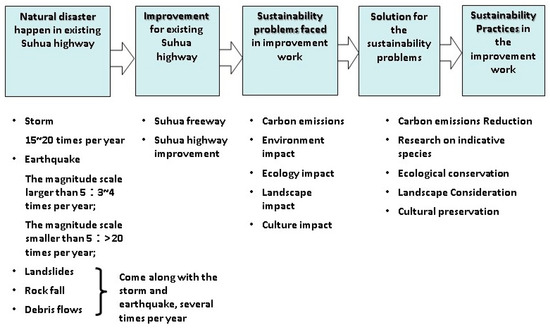
Figure 13.
Development of sustainability practices in the SHIP project [11].
In this paper, the authors highlighted some major sustainability practices of the SHIP project, as follows:
- Carbon footprint inventory [11,21,22]: Improvements in material manufacturing processes and machine operations during construction effectively reduce carbon emission. In SHIP, engineers focused on two areas: modifying the concrete mixture and improving the efficiency of equipment and machines.
- Concrete mixture for carbon reduction [11,23]: In SHIP, the average carbon emission during cement production is 0.58 kg CO2e/kg. The concrete mixture was modified by substituting cement with recyclable materials, such as coal fly ash (CFA) and ground-granulated blast-furnace slag (GGBFS), which was estimated to reduce carbon emission by 13–18% compared to the average value. Table 13 shows the estimated percentages of carbon reduction during the construction phase for the four individual contracts of the SHIP project.
Table 13. Estimated percentages of carbon reduction [11].
- Efficiency of equipment and machines for carbon reduction: Carbon emission was found to reduce by up to 34–43% from the original estimate. This can be attributed to the adjustment made to the concrete mixture by replacing cement with CFA and GGBFS. Table 14 shows the summary of carbon reduction results for contracts A1 to A3 and C1
Table 14. Summary of carbon reduction results for contracts A1 to A3 and C1 [11].
- Research on specified species [24]: The habitats of local animal species can be severely impacted by construction activities. In SHIP, the biologists developed a research program to monitor changes in species’ population and health during the construction process. Table 15 shows the observed frequencies of specified species during 2012 to 2016.
Table 15. The observed frequencies of specified birds around the project site during 2012–2016 [11,24].
- Ecological conservation: The highway alignment has been adjusted carefully, such that the removal or cutting of protected trees will not be required. The electrical control room for the tunnel was built underground to minimize any impact on the aboveground environment. Furthermore, efforts in design have been made to prevent roadkill. Special shading boards and light-cutting devices have been installed along the road edges to protect insects and other small flying species [11].
- Landscape: The highway passes by a village called Baimi Community, which is located between Suao and the Dongao tunnel. The structure of the Baimi Scenic Bridge is an extradosed bridge with a total length of 340M. The engineers introduced the shape of a rice grain in the design of the bridge pylons, as “Baimi” means “rice” in English. This design incorporated local characteristics into the bridge and made it a pleasant addition to the landscape [11].
- Cultural preservation: During the excavation of the bridge foundation near Hanbern, the engineers discovered ancient human ruins, including ancient tools and goods, which led to the name “Hanbern Historic Remains”. These ancient artifacts are considered to be the relics of a Neolithic culture that was prevalent in this area 1100–1800 years ago. Since these artifacts have archeological significance, bridge construction work was suspended for several years until on-site archeological research was completed. Figure 14 shows on-site pictures of the “Baimi Scenic Bridge” [11].
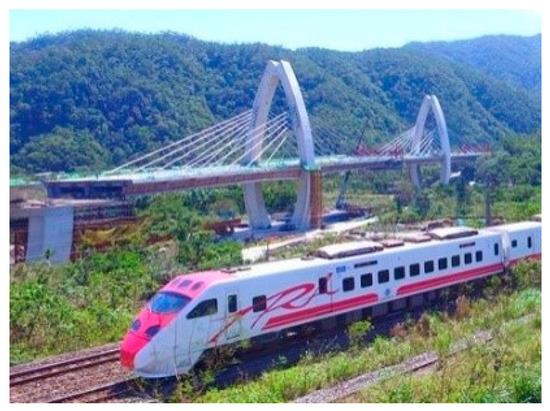 Figure 14. Photos of the Baimi Scenic Bridge [11].
4. Comparisons of Assessment Systems between Green Building and Civil Infrastructure
Based on the studies of global assessment system on sustainability practices, the authors summarized and compared the key indicators of green building and green civil infrastructure assessment systems. Table 16 shows the evaluation items (marked by “●”) under each key indicator for the various assessment systems [7,11,12,13,14,15].
Table 16.
The evaluation items under each key indicator for the various assessment systems (summarized by the authors) [7,11,12,13,14,15].
As shown in Table 16, some evaluation items are concerned with both green building and green civil infrastructure (marked with █ background color). These items include greenery, recycling of materials, water conservation, carbon emission reduction, and energy savings of facilities. Nevertheless, some items are concerned only with green building assessment, but not with green civil infrastructure assessment (marked with █ background color). These items include external structure of building, power consumption, healthy air and temperature, illumination of indoor environment, rainwater recycling, and underground reservoirs. Moreover, durability, benefits, landscape, humanities, culture, and creativity are discussed adequately in green civil infrastructure assessment, but not the priority items in green building assessment. Perhaps some assessment items for green civil infrastructure, like landscape and durability, can be considered in green building assessment in the future.
5. Contribution
In this paper, the authors collected and summarized the major green building assessment systems in the world and compared them with green civil infrastructure assessment. These data may be useful for the improvement of the existing assessment systems, especially from environmental and ecological perspectives.
6. Conclusions
After reviewing the major green building assessment systems in the world, such as the U.S. system LEED, the U.K. system BREEAM, the Canada system GB tools, and the Japanese system CASBEE, and comparing them with green civil infrastructure assessment indicators and items, it is found that some evaluation items are concerned with both green building assessment and green civil infrastructure assessment. These items include greenery, recycling of materials, water conservation, carbon emission reduction, and energy savings of facilities. Nevertheless, some items are concerned only with green building assessment, but not in green civil infrastructure assessment. These items include external structure of building, power consumption, healthy air and temperature, illumination of indoor environment, rainwater recycling, and underground reservoirs. Also, durability, benefits, landscape, humanities, culture, and creativity are discussed adequately in green civil infrastructure assessment, but not deemed as priority items in green building assessment. These findings are of paramount importance, especially as assessment systems for green civil infrastructure are still under development in most countries, and this paper can serve as a good reference for relevant research in the future.
Author Contributions
The structure of the paper was determined together by the three co-authors. T.-Y.L. provided most of the data in this paper and wrote the first draft of the paper. P.-H.C. edited the paper from an academic point of view. N.N.S.C. edited the paper from a practical point of view. All three co-authors have read and approved the final manuscript.
Funding
This research received no external funding.
Conflicts of Interest
The authors declare no conflict of interest.
References
- World Bank. World Development Rep. 1994: Infrastructure for Development; Oxford University Press: Oxford, UK, 1994; pp. 1–12. [Google Scholar]
- World Bank. Infrastructure at the Crossroads: Lessons from 20 Years of World Bank Experience; World Bank: Washington, DC, USA, 2006; pp. 1–9, 65–80. [Google Scholar]
- Shen, L.; Wu, Y.; Zhang, X. Key assessment indicators for the sustainability of infrastructure projects. J. Constr. Eng. Manag. ASCE 2011, 137, 441–451. [Google Scholar] [CrossRef]
- Jiang, L.; Li, Z.; Li, L.; Gao, Y. Constraints on the promotion of prefabricated construction in China. Sustainability 2018, 10, 2516. [Google Scholar] [CrossRef]
- Amoruso, F.M.; Dietrich, U.; Schuetze, T. Development of a building information modeling-parametric workflow based renovation strategy for an exemplary apartment building in Seoul, Korea. Sustainability 2018, 10, 4494. [Google Scholar] [CrossRef]
- Geldermans, B.; Tenpierik, M.; Luscuere, P. Circular and Flexible Infill concepts: Integration of the residential user perspective. Sustainability 2019, 11, 261. [Google Scholar] [CrossRef]
- Intelligent Green Building. EEWH Assessment System. Available online: https://smartgreen.abri.gov.tw/welcome.php (accessed on 15 January 2019).
- Kevern, J.T. Green building and sustainable infrastructure: Sustainability education for civil engineers. ASCE 2011, 137, 107–112. [Google Scholar] [CrossRef]
- Mehmet, A.B.; Islam, H. Managing sustainability assessment of civil infrastructure projects using work, nature, and flow. ASCE 2014, 30, 04014019. [Google Scholar]
- Jang, W.; Lee, S.K.; Han, S.H. Sustainable performance index for assessing the green technologies in urban infrastructure projects. ASCE 2018, 34, 04017056. [Google Scholar] [CrossRef]
- Shau, H.J.; Liu, T.Y.; Chen, P.H.; Chou, N.N.S. Sustainability practices for the Suhua Highway Improvement Project in Taiwan. Int. J. Civ. Eng. 2019, 1–11. [Google Scholar] [CrossRef]
- USGBC. US LEED Assessment System. 2019. Available online: https://new.usgbc.org/leed (accessed on 15 January 2019).
- UK BREEAM. UK BREEAM Assessment System. 2019. Available online: https://www.breeam.com/ (accessed on 15 January 2019).
- Natural Resources Canada. Natural Resources Cananda Assessment System. 2019. Available online: https://www.nrcan.gc.ca/energy/efficiency/buildings/20695 (accessed on 15 January 2019).
- CASBEE. Japan CASBEE Assessment System. 2019. Available online: http://www.ibec.or.jp/CASBEE/english/ (accessed on 15 January 2019).
- Zhong, Y.; Ling, F.Y.Y.; Wu, P. Using multiple attribute value technique for the selection of structural frame material to achieve sustainability and constructability. J. Constr. Eng. Manag. ASCE 2017, 143, 04016098. [Google Scholar] [CrossRef]
- Liu, T.Y.; Chen, P.H.; Chou, N.N.S. Disaster prevention and carbon reduction effectiveness of a special retaining method for excavation. In Proceedings of the 30th KKHTCNN, Symposium on Civil Engineering, Taipei, Taiwan, 2–4 Novemeber 2017. [Google Scholar]
- New Asia Construction and Development Corp. Basement Excavation Plan for Taipei 2017 Summer Universiade Athlete’s Village and Linkou Public Housing Project; New Asia Construction and Development Corp: Taiwan, 2013. (In Chinese) [Google Scholar]
- New Asia Construction and Development Corp. Analysis and Calculation of Basement Excavation Retaining Method for Taipei 2017 Summer Universiade Athlete’s Village and Linkou Public Housing Project; New Asia Construction and Development Corp: Taiwan, 2013. (In Chinese) [Google Scholar]
- New Asia Construction and Development Corp. Site SPT Test Report for Taipei 2017 Summer Universiade Athlete’s Village and Linkou Public Housing Project; New Asia Construction and Development Corp: Taiwan, 2013. (In Chinese) [Google Scholar]
- Chou, S.L. Research Report of Carbon Footprint Inventory for Suhua Highway Improvement Project; Suhua Highway Improvement Project Office: Taiwan, 2014. (In Chinese) [Google Scholar]
- Hsu, P.J. 2013 Annual Progress Report of Carbon Footprint Inventory for Suhua Highway Improvement Project; Suhua Highway Improvement Project Office: Taiwan, 2013. (In Chinese) [Google Scholar]
- Sinotech Engineering Consultants, Ltd. 2013 Annual Report for Suhua Highway Improvement Project; Suhua Highway Improvement Project Carbon Footprint Inventory Report: Taiwan, 2013. (In Chinese) [Google Scholar]
- Endemic Species Research Institute. 2012–2016 Annual Research Report on Indicative Species for Suhua Highway Improvement Project; Suhua Highway Improvement Annual Project: Taiwan, 2012–2016. (In Chinese)
© 2019 by the authors. Licensee MDPI, Basel, Switzerland. This article is an open access article distributed under the terms and conditions of the Creative Commons Attribution (CC BY) license (http://creativecommons.org/licenses/by/4.0/).