

Embedded in Nature: Challenges to Sustainability in Communities of the Greater Yellowstone Ecosystem



Abstract
1. Introduction
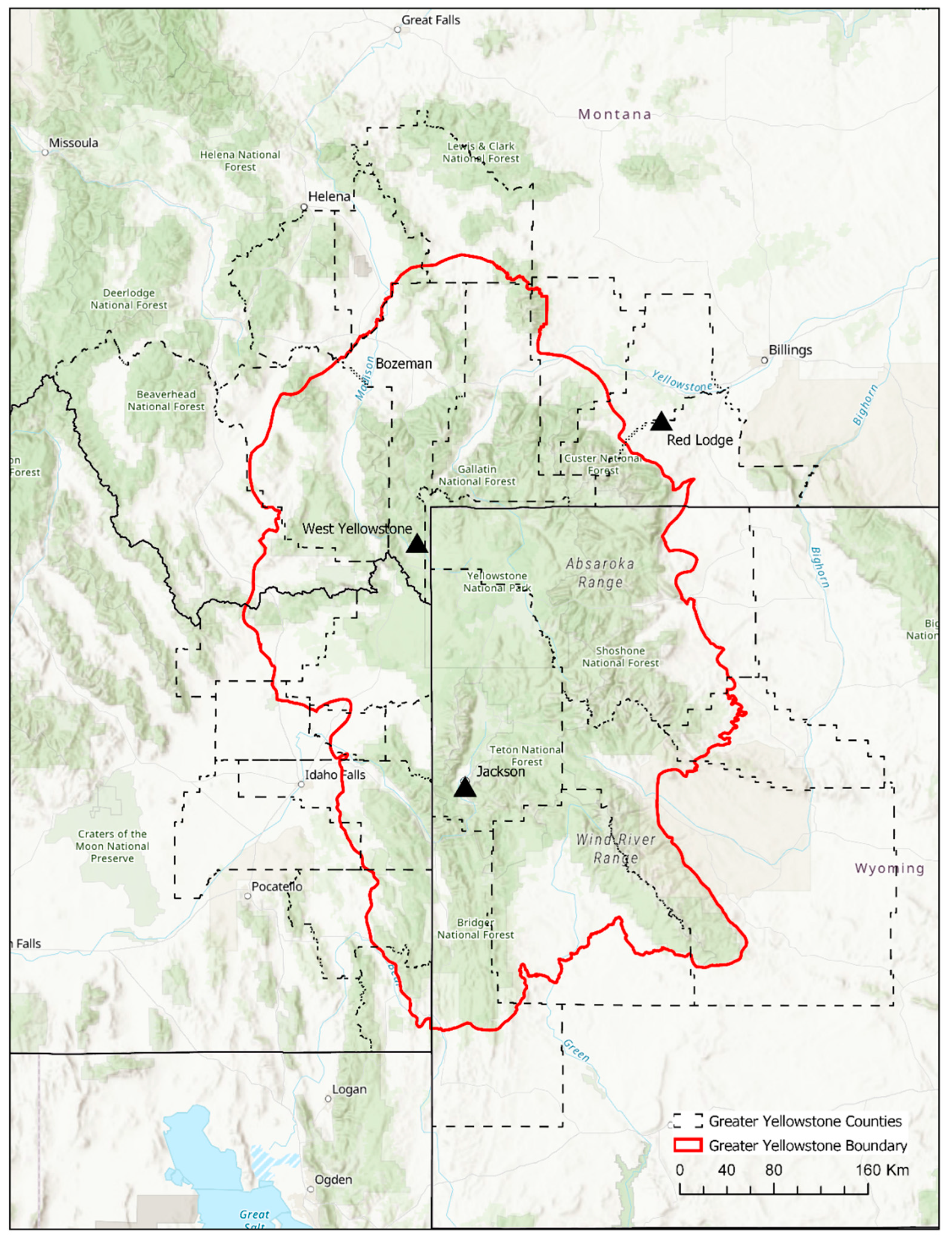
1.1. The Greater Yellowstone Ecosystem
1.2. A Framework for Sustainable Community Development
2. Methods
Key Informant Interviews
3. Results
3.1. West Yellowstone, Montana
Unfortunately, part of the problem here is businesses come in...and buy a business for two years. He leaves…and you don’t have a solid community. There are a lot of people who have been here with a lot of history, they tend to be cliquish with the newcomers and then the newcomers leave, and what are you left with?
…the leaders of the community...are really starting to retire or have passed away. They had a vision of what they thought West Yellowstone was that has not necessarily transposed itself to the newer, younger business owners. And because we’ve got such different interests, different perspectives, it is extremely hard for this community to agree on what our strengths are.
... by the time we’ve got done addressing one thing we are already confronted with a new issue. So, you know a perfect example is access to Yellowstone in the winter. You know when you spend years working really hard to build a business in a certain direction and then you have to respond to courts, and then you have to respond back to environmentalists, and then you have to switch. Nowhere else have I seen businesses that have to totally change how they think, operate, and market as much as they do in West Yellowstone.
Ten years ago our winters were almost as good as our summers…they were right there and that made things wonderful and kept more motels open year round, more people employed year round. Now that we don’t have that half the town or maybe more is closed down in the winter time.
We always say that one good snowmobile family from Minnesota is the equivalent of a whole lot of skiers because those people eat and drink, party and they enjoy themselves, and that’s what we want. You know it’s nice to say we have some nice skiers who come to town and they are lovely people…they bring their children and lovely families. But they are not hanging out at the bars spending money, they are not going downtown.
You could close the Beartooth Highway tomorrow and, while that’s a segment of Red Lodge marketing, they could still get away with marketing all the other things there is to do. If you close access to Grand Teton…[that] would affect Jackson in the summer, but they still have the ski resorts and an airport and they could literally supply a lot of activities without even requiring the parks. If you closed our access to Yellowstone, it would be a whole different kind of dynamic here.
West Yellowstone is also unique in that it is surrounded on all sides by public lands. So there’s not a lot of population around to support the infrastructure and consequently, again it’s a double-edged sword. We built this place to be a nice place so more people come. There’s about 2 million people that go through here and yet there is no population base to support all the police and fire and of that stuff. So we have to rely on tourism and the resort tax. We have to be innovating in these other types of things in order to make a go. There is nobody else like that.
3.2. Red Lodge, Montana
That is the challenge for communities like Red Lodge when you are so close to the largest business center in the region, which is Billings. You are just not going to redevelop your downtown to where you…meet all the community needs within the city limits. That is not going to happen. And there are dreamers out there who are not business people, who think it is just a matter of getting the right mix and it will all come together. I go to the meetings. I participate in the discussion and tell them over and over and over again that you are never going to see that happen again in small town Montana.
Local business owners whose livelihoods depends on the three months of summer and tourism feel, some of them feel, like they lose a week of business during that week because your typical…bike rally attendees aren’t typically there to browse the stores, the souvenir store and things like that. There’s so many bikes that come into town that it tends to take up parking so people who might have stopped roll on through. And then street dances—streets are closed for dances and the business owners on those streets feel like their customers don’t even have a shot getting into them.
I think it’s easier for a sizeable developer, someone with deep pockets to really come in here and do things in a way that would not have the kind of resistance they would have in a community like Jackson.
At some levels we are fortunate that those communities have kind of gone before us and we can learn from them and I think that people in our community that are really on, in that kind of realm, are sensitive to that and are trying their hardest to get us out front of that.
We don’t have a Walmart; we don’t want one. You know, you’re going to pay more, your quality of food is maybe not going to be as good at the grocery store, we’re at the end of the line kind of thing. You are going to pay more for gas. So don’t start trying to change it and make it what you left, because pretty soon it’s going to be the same thing you left and then it’s why did you leave there anyway? If that’s what you wanted, why did you leave?
I would say other communities—every community that borders the park—has the same challenge. They are just at different points on that time line or continuum, and on a different scale. And then the political climate is different. Wyoming is different than Montana politically, so what goes on in Cody, for example—our closest gateway community, it’s amazing how different we are as communities. We are only 60 miles apart, yet we’re very, very different. It’s funny people down in Cody look longingly at the things we have going on, and our people look longingly at the things that they have going on, so there’s a lot of mutual envy, but yet neither community would say ‘I would want to be like that.’
3.3. Jacson, Wyoming
I think that as we worked on the comprehensive plan we have moved away from the idea of a straight balance of the triple bottom line, to the idea that we want the social equity, and we want this strong economy, both of those thing when you look at them are dependent on the ecology of the area. So keeping that open space, keeping the wildlife, it is our economy, it is why people move here, it does bring all the people together so it is our society as well, and I think that is, the one thing I would add to that personally, I think it has to be a bigger, a bigger picture discussion. You can’t ship your impacts over the pass down the canyon, and think that they go away and you’re protecting the ecosystem, because they are an ecosystem too.
I think the biggest challenge for Jackson is to find the balance between where do we want our open space and where do we want our density. And the comprehensive plan has run smack dab into the middle of that and it’s a train wreck right now. Politically everyone stands up and says, our natural resources, our habitat is the most important thing… but it isn’t, there is nothing actually promoting open space.
Just the cost of living here is high and … it is very, very difficult to come here as a young person and then make a living to the point where you can afford to stay here long-term. And without that progression of people who were coming into the community and investing in it personally with their time and energy, and able to live here, it will suffer a lot in the long term. Because eventually…it’s just going to degrade to either a tourist only, or a seasonal resident only environment, and that is when I think you really do start to erode your base of people who make it a good place to live, and who have the values that can form those long term themed decisions and get you…focusing on more than just ... this season’s bottom economic line.
I think there are very few people in Teton County who would tell you they are pro-growth. I don’t know that any of us really want this place to get any bigger, but I think…what I would strive for is responsible growth, and balanced development. I think we do it such a dis-service to say we don’t want to growth and we’re not going to plan for it, because we know that is not the way it works.
I think they have the same problem. I think they don’t have it to the degree we do. I’m not sure that they have experienced the kind of growth, especially in second home ownership that we have seen. I mean, look at West Yellowstone and it’s still pretty tiny. It’s doesn’t have 10,000 square foot homes, to the extent that we do. I think I would probably guess that they recognize it. And if they had the opportunity to go all out and develop they would do it.
4. Discussion
5. Conclusions
Author Contributions
Funding
Conflicts of Interest
References
- Travis, W.R. New Geographies of the American West: Land Use and Changing Patterns of Place; Island Press: Washington, DC, USA, 2007. [Google Scholar]
- Smith, M.D.; Krannich, R.S. “Culture Clash” Revisited: Newcomer and Longer-Term Residents’ Attitudes Toward Land Use, Development, and Environmental Issues in Rural Communities in the Rocky Mountain West. Rural Sociol. 2009, 65, 396–421. [Google Scholar] [CrossRef] [Scilit]
- Harrington, L.M.B. Sustainability theory and conceptual considerations: A review of key ideas for sustainability, and the rural context. Pap. Appl. Geogr. 2016, 2, 365–382. [Google Scholar] [CrossRef] [Scilit]
- Cutter, S.L. The vulnerability of science and the science of vulnerability. Ann. Assoc. Am. Geogr. 2003, 93, 1–12. [Google Scholar] [CrossRef] [Scilit]
- Kates, R.W. Readings in Sustainability Science and Technology. Available online: https://www.hks.harvard.edu/centers/cid/publications/faculty-working-papers/readings-sustainability-science-and-technology (accessed on 19 October 2018).
- Smit, B.; Wandel, J. Adaptation, adaptive capacity and vulnerability. Glob. Environ. Chang. 2006, 16, 282–292. [Google Scholar] [CrossRef] [Scilit]
- Turner, J. Travels in the Greater Yellowstone; Thomas Dunne Books: New York, NY, USA, 2009. [Google Scholar]
- Clark, T.W.; Amato, E.D.; Whittemore, D.G.; Harvey, A.H. Policy and programs for ecosystem management in the Greater Yellowstone ecosystem: An analysis. Conserv. Biol. 1991, 5, 412–422. [Google Scholar] [CrossRef] [Scilit]
- Lynch, H.J.; Hodge, S.; Albert, C.; Dunham, M. The Greater Yellowstone Ecosystem: Challenges for regional ecosystem management. Environ. Manag. 2008, 41, 820–833. [Google Scholar] [CrossRef] [Scilit] [PubMed]
- Bergstrom, R.D. Perceptions of Sustainable Community Development in Jackson, Wyoming. Appl. Geog. Conf. 2012, 35, 133–141. [Google Scholar]
- Hansen, T.; Coenen, L. The geography of sustainability transitions: Review, synthesis and reflections on an emergent research field. Environ. Innov. Soc. Transit. 2015, 17, 92–109. [Google Scholar] [CrossRef] [Scilit]
- Hansen, A.J.; Rasker, R.; Maxwell, B.; Rotella, J.J.; Johnson, J.D.; Parmenter, A.W.; Langner, U.; Cohen, W.B.; Lawrence, R.L.; Kraska, M.P.V. Ecological causes and consequences of demographic change in the new west. BioScience 2002, 52, 151. [Google Scholar] [CrossRef] [Scilit]
- Kendall, L. Bozeman Area Again Ranked Fastest-Growing of Its Size in the Nation. Bozeman Daily Chronicle. Available online: https://www.bozemandailychronicle.com/news/bozeman-area-again-ranked-fastest-growing-of-its-size-in/article_881f7994-a3d7-5f68-b85c-5875d2c0749a.html (accessed on 7 March 2019).
- Wilkinson, T. Unnatural Disaster: Will America’s Most Iconic Wild Ecosystem be Lost to a Tidal Wave of People? Available online: https://mountainjournal.org/the-wildest-ecosystem-in-america-faces-death-by-too-many-people (accessed on 19 October 2018).
- Gude, P.H.; Hansen, A.J.; Rasker, R.; Maxwell, B. Rates and drivers of rural residential development in the Greater Yellowstone. Landsc. Urban Plan. 2006, 77, 131–151. [Google Scholar] [CrossRef] [Scilit]
- National Park Service Visitor Use Statistics. Available online: https://irma.nps.gov/Stats/ (accessed on 1 June 2018).
- Patten, D.T. Human impacts in the Greater Yellowstone Ecosystem: Evaluating sustainability goals and eco-redevelopment. Conserv. Biol. 1991, 5, 405–411. [Google Scholar] [CrossRef] [Scilit]
- Swanson, L. Growth and Change in the Yellowstone-Teton Region; Yellowstone Business Partnership: Bozeman, MT, USA, 2007; p. 118. [Google Scholar]
- Stoughton, J.A.; Marcus, W.A. Persistent impacts of trace metals from mining on floodplain grass communities along Soda Butte Creek, Yellowstone National Park. Environ. Manag. 2000, 25, 305–320. [Google Scholar] [CrossRef] [Scilit]
- Mineland Restoration. Available online: www.ecorestoration.montana.edu (accessed on 20 August 2017).
- Woods, E.D. “More valuable than gold”: Yellowstone businesses prepare to fight mining. The Guardian, 16 July 2017.
- Steingisser, A.; Marcus, A. Human impacts on geyser basins. Yellowstone Sci. 2009, 17, 7–18. [Google Scholar]
- Barrick, K.A. Protecting the geyser basins of Yellowstone National Park: Toward a new national policy for a vulnerable environmental resource. Environ. Manag. 2010, 45, 192–202. [Google Scholar] [CrossRef] [Scilit] [PubMed]
- Riebsame, W.E.; Gosnell, H.; Theobald, D.M. Land use and landscape change in the Colorado mountains: Theory, scale, and pattern. Mt. Res. Dev. 1996, 16, 395. [Google Scholar] [CrossRef] [Scilit]
- Gosnell, H.; Abrams, J. Amenity migration: Diverse conceptualizations of drivers, socioeconomic dimensions, and emerging challenges. GeoJournal 2011, 76, 303–322. [Google Scholar] [CrossRef] [Scilit]
- Bennett, D.; McGinnis, D. Coupled and complex: Human-environment interaction in the Greater Yellowstone Ecosystem, USA. Geoforum 2008, 39, 833–845. [Google Scholar] [CrossRef] [Scilit]
- Shafer, C.L. Land use planning: A potential force for retaining habitat connectivity in the Greater Yellowstone Ecosystem and Beyond. Glob. Ecol. Conserv. 2015, 3, 256–278. [Google Scholar] [CrossRef] [Scilit]
- Gosnell, H.; Haggerty, J.H.; Travis, W.R. Ranchland ownership change in the Greater Yellowstone Ecosystem, 1990–2001: Implications for conservation. Soc. Nat. Resour. 2006, 19, 743–758. [Google Scholar] [CrossRef] [Scilit]
- Goldstein, B. The Struggle over ecosystem management at Yellowstone. BioScience 1992, 42, 183–187. [Google Scholar] [CrossRef] [Scilit]
- Johnson, J.D. Impacts of tourism-related in-migration: The Greater Yellowstone Region. In Environmental Impacts of Ecotourism; CABI: Wallingford, UK, 2004; pp. 25–40. [Google Scholar]
- Johnson, J.; Maxwell, B.; Aspinall, R. Moving nearer to heaven: Growth and change in the Greater Yellowstone Region, USA. In Nature-Based Tourism, Environment and Land Management; Buckley, R., Pickering, C., Weaver, D.B., Eds.; CABI: Wallingford, UK, 2003; pp. 77–88. ISBN 978-0-85199-732-2. [Google Scholar]
- McCool, S.F.; Burgess, C.; Nickerson, N. Toward a Sustainable Tourism and Recreation Industry in Montana: An Examination of Concepts and Industry Perceptions; Institute for Tourism and Recreation Research: Missoula, MT, USA, 1998. [Google Scholar]
- Greater Yellowstone Coordinating Committee. Recreation in the Greater Yellowstone Area: An interagency Report; Greater Yellowstone Coordinating Committee: Bozeman, MT, USA, 2006. [Google Scholar]
- Glorioso, R.S.; Moss, L.A.G. Amenity migration to mountain regions: Current knowledge and a strategic construct for sustainable management. Soc. Chang. 2007, 37, 137–161. [Google Scholar] [CrossRef] [Scilit]
- Burger, B.M.; Carptenter, R. Rural Real Estate Markets and Conservation Development in the Intermountain West; Lincoln Institute of Land Policy: Cambridge, MA, USA, 2010. [Google Scholar]
- Rittel, H.W.J.; Webber, M.M. Dilemmas in a general theory of planning. Policy Sci. 1973, 4, 155–169. [Google Scholar] [CrossRef] [Scilit]
- Kiasatpour, S.; Whitfield, C. Politics in action: Wolves, snowmobiles, and bison and the Greater Yellowstone Ecosystem. Political Sci. Politics 2008, 41, 193–206. [Google Scholar] [CrossRef] [Scilit]
- Duffield, J.; Neher, C.; Patterson, D. Wolves and People in Yellowstone: Impacts on the Regional Economy; Yellowstone Park Foundation: Missoula, MT, USA, 2006. [Google Scholar]
- Yochim, M.J. Yellowstone and the Snowmobile: Locking Horns over National Park Use; University Press of Kansas: Lawrence, KS, USA, 2009; ISBN 978-0-7006-1642-8. [Google Scholar]
- Kilpatrick, A.M.; Gillin, C.M.; Daszak, P. Wildlife-livestock conflict: The risk of pathogen transmission from bison to cattle outside Yellowstone National Park. J. Appl. Ecol. 2009, 46, 476–485. [Google Scholar] [CrossRef] [Scilit]
- Bergstrom, R.D.; Harrington, L.M.B. Understanding agents of change in amenity gateways of the Greater Yellowstone region. Community Dev. 2017, 49, 145–160. [Google Scholar] [CrossRef] [Scilit]
- NRC. Our Common Journey: A Transition Toward Sustainability; National Academies Press: Washington, DC, USA, 1999; ISBN 978-0-309-08638-7. [Google Scholar]
- Leiserowitz, A.A.; Kates, R.W.; Parris, T.M. Sustainability values, attitudes, and behaviors: A review of multinational and global trends. Annu. Rev. Environ. Resour. 2006, 31, 413–444. [Google Scholar] [CrossRef] [Scilit]
- Levin-Keitel, M.; Mölders, T.; Othengrafen, F.; Ibendorf, J. Sustainability Transitions and the Spatial Interface: Developing Conceptual Perspectives. Sustainability 2018, 10, 1880. [Google Scholar] [CrossRef] [Scilit]
- Bridger, J.C.; Luloff, A.E. Toward an interactional approach to sustainable community development. J. Rural Stud. 1999, 15, 377–387. [Google Scholar] [CrossRef] [Scilit]
- Dempsey, N.; Bramley, G.; Power, S.; Brown, C. The social dimension of sustainable development: Defining urban social sustainability. Sustain. Dev. 2011, 19, 289–300. [Google Scholar] [CrossRef] [Scilit]
- Szitar, M.-A. Learning about Sustainable Community Development. Procedia Soc. Behav. Sci. 2014, 116, 3462–3466. [Google Scholar] [CrossRef] [Scilit]
- Congreve, A. Sustainable Communities. In International Encyclopedia of Housing and Home; Elsevier: Amsterdam, The Netherlands, 2012; pp. 97–110. ISBN 978-0-08-047171-6. [Google Scholar]
- Storey, K. Fly-in/Fly-out: Implications for Community Sustainability. Sustainability 2010, 2, 1161–1181. [Google Scholar] [CrossRef] [Scilit]
- Eizenberg, E.; Jabareen, Y. Social Sustainability: A New Conceptual Framework. Sustainability 2017, 9, 68. [Google Scholar] [CrossRef] [Scilit]
- Colantonio, A. Social sustainability: Linking research to policy and practice. In Sustainable Development: A Challenge for European Research; Oxford Institute for Sustainable Development: Brussels, Belgium, 2009. [Google Scholar]
- Rogers, P.P.; Jalal, K.F.; Boyd, J.A. An Introduction to Sustainable Development; Earthscan: London, UK, 2012; ISBN 978-1-84977-047-7. [Google Scholar]
- Kemp, R.; Martens, P. Sustainable development: How to manage something that is subjective and never can be achieved? Sustain. Sci. Pract. Policy 2007, 3, 5–14. [Google Scholar] [CrossRef] [Scilit]
- Hamstead, M.P.; Quinn, M.S. Sustainable community development and ecological economics: Theoretical convergence and practical implications. Local Environ. 2005, 10, 141–158. [Google Scholar] [CrossRef] [Scilit]
- Bridger, J.C. Community stories and their relevance to planning. Appl. Behav. Sci. Rev. 1997, 5, 67–80. [Google Scholar] [CrossRef] [Scilit]
- Roseland, M.; Spiliotopoulou, M. Sustainable Community Planning and Development. In Encyclopedia of Sustainable Technologies; Elsevier: Amsterdam, The Netherlands, 2017; pp. 53–61. ISBN 978-0-12-804792-7. [Google Scholar]
- Callaghan, E.G.; Colton, J. Building sustainable & resilient communities: A balancing of community capital. Environ. Dev. Sustain. 2008, 10, 931–942. [Google Scholar]
- Nelson, P.B. Perceptions of Restructuring in the Rural West: Insights from the “Cultural Turn”. Soc. Nat. Resour. 2002, 15, 903–921. [Google Scholar] [CrossRef] [Scilit]
- Keske, C.M.H.; Bixler, R.P.; Bastian, C.T.; Cross, J.E. Are Population and Land Use Changes Perceived as Threats to Sense of Place in the New West? A Multilevel Modeling Approach: Are Population and Land Use Changes Perceived. Rural Sociol. 2017, 82, 263–290. [Google Scholar] [CrossRef] [Scilit]
- Newman, L.; Dale, A. The role of agency in sustainable local community development. Local Environ. 2006, 10, 477–486. [Google Scholar] [CrossRef] [Scilit]
- Saha, D.; Paterson, R.G. Local Government Efforts to Promote the “Three Es” of Sustainable Development: Survey in Medium to Large Cities in the United States. J. Plan. Educ. Res. 2008, 28, 21–37. [Google Scholar] [CrossRef] [Scilit]
- Marchese, D.; Reynolds, E.; Bates, M.E.; Morgan, H.; Clark, S.S.; Linkov, I. Resilience and sustainability: Similarities and differences in environmental management applications. Sci. Total Environ. 2018, 613–614, 1275–1283. [Google Scholar] [CrossRef] [Scilit]
- Lew, A.A.; Ng, P.T.; Ni, C.-C.N.; Wu, T.-C.E. Community sustainability and resilience: Similarities, differences and indicators. Tour. Geogr. 2015, 18, 18–27. [Google Scholar] [CrossRef] [Scilit]
- Derissen, S.; Quaas, M.F.; Baumgärtner, S. The relationship between resilience and sustainability of ecological-economic systems. Ecol. Econ. 2011, 70, 1121–1128. [Google Scholar] [CrossRef] [Scilit]
- Magis, K. Community Resilience: An Indicator of Social Sustainability. Soc. Nat. Resour. 2010, 23, 401–416. [Google Scholar] [CrossRef] [Scilit]
- Meadows, D.H. Indicators and Information Systems for Sustainable Development: A Report to the Balaton Group, September 1998; Sustainability Institute: Hartland Four Corners, VT, USA, 1998. [Google Scholar]
- Brereton, D.; Pattenden, C. Measuring what matters: Monitoring the contribution of a new mining project to community sustainability. In Proceedings of the 3rd International Conference on Sustainable Development Indicators in the Minerals Industry, Mlos Island, Greece, 17–20 June 2007. [Google Scholar]
- Parris, T.M.; Kates, R.W. Characterizing a sustainability transition: Goals, targets, trends, and driving forces. Proc. Natl. Acad. Sci. USA 2003, 100, 8068–8073. [Google Scholar] [CrossRef] [Scilit] [PubMed]
- Geist, H.J.; Lambin, E.F. Proximate Causes and Underlying Driving Forces of Tropical Deforestation. BioScience 2002, 52, 143. [Google Scholar] [CrossRef] [Scilit]
- Yochim, M.J.; Lowry, W.R. Creating Conditions for Policy Change in National Parks: Contrasting Cases in Yellowstone and Yosemite. Environ. Manag. 2016, 57, 1041–1053. [Google Scholar] [CrossRef] [Scilit]
- Compas, E. Measuring exurban change in the American West: A case study in Gallatin County, Montana, 1973–2004. Landsc. Urban Plan. 2007, 82, 56–65. [Google Scholar] [CrossRef] [Scilit]
- WCED. Our Common Future; Oxford University Press: Oxford, NY, USA, 1987; ISBN 978-0-19-282080-8. [Google Scholar]
- Mebratu, D. Sustainability and sustainable development. Environ. Impact Assess. Rev. 1998, 18, 493–520. [Google Scholar] [CrossRef] [Scilit]
- Qin, H.; Flint, C. Changing Community Variations in Perceptions and Activeness in Response to the Spruce Bark Beetle Outbreak in Alaska. Sustainability 2017, 9, 67. [Google Scholar] [CrossRef] [Scilit]
- Howe, J.; McMahon, E.; Propst, L. Balancing Nature and Commerce in Gateway Communities; Island Press: Washington, DC, USA, 1997; ISBN 978-1-55963-545-5. [Google Scholar]
- U.S. Census Bureau American Fact Finder. ACS Demographic and Housing Estimates. Available online: https://factfinder.census.gov/faces/nav/jsf/pages/index.xhtml (accessed on 18 February 2019).
- Land Solutions, LLC. West Yellowstone Growth Policy; Land Solution LLC.: West Yellowstone, MT, USA, 2017; p. 65. [Google Scholar]
- City of Red Lodge. 2013 Red Lodge Growth Policy; Red Lodge City Council: Red Lodge, MT, USA, 2013; p. 54. [Google Scholar]
- Matthews, C. This Playground for the Rich is the Most Economically Unequal City in America. Available online: http://fortune.com/2016/06/17/inequality-jackson-wyoming/unequal (accessed on 7 March 2019).
- Jackson Hole Community Housing Trust. Housing in Teton County. Available online: https://www.housingtrustjh.org/about/housing-in-teton-county (accessed on 19 October 2018).
- Krannich, R.S.; Humphrey, C.R. Using Key Informant Data in Comparative Community Research: An Empirical Assessment. Sociol. Methods Res. 1986, 14, 473–493. [Google Scholar] [CrossRef] [Scilit]
- Marshall, M.N. Sampling for qualitative research. Fam. Pract. 1996, 13, 522–526. [Google Scholar] [CrossRef] [Scilit] [PubMed]
- Rubin, A.; Babbie, E.R. Essential Research Methods for Social Work; Crooks Cole: Belmont, CA, USA, 2009. [Google Scholar]
- Schensul, S.L. Essential Ethnographic Methods: Observations, Interviews, and Questionnaires; AltaMira Press: Walnut Creek, CA, USA, 1999; ISBN 0-7619-9144-1. [Google Scholar]
- Haig, B. Grounded Theory as Scientific Method. Available online: https://pdfs.semanticscholar.org/5886/43f9ded159acc42daeefed6f1d1952bea546.pdf (accessed on 28 February 2018).
- Glaser, B.G.; Strauss, A.L. The Discovery of Grounded Theory: Strategies for Qualitative Research; Aldine Transaction: New Brunswick, Canada; London, UK, 2009; ISBN 978-0-202-30260-7. [Google Scholar]
- Babchuk, W.A. Grounded Theory 101: Strategies for Research and Practice. In Proceedings of the Midwest Research to Practice Conference in Adult, Continuing, Community and Extension Education, Northeastern Illinois University, Chicago, IL, USA, 21–23 October 2009. [Google Scholar]
- Baker, C.J. ‘Unguided’ Snowmobiles Return to Yellowstone. Available online: http://www.powelltribune.com/stories/unguided-snowmobiles-return-to-yellowstone,4010 (accessed on 19 October 2018).
- Bergstrom, R.D. Defining sustainability in the Greater Yellowstone Ecosystem. J. Sustain. Dev. 2018, 11, 32–43. [Google Scholar] [CrossRef] [Scilit]
- Bergstrom, R.D. Conceptualizing sustainable community development within West Yellowstone, Montana between 2000 and 2010. Pap. Appl. Geogr. 2010, 33, 373–382. [Google Scholar]

| Population | Agriculture, Forestry, Fishing, Hunting, and Mining (% of all workers) | Retail (%) | Professional, Scientific & Management (%) | Education & Health Care (%) | Entertainment, Accommodation & Food Services (%) | Median Income | Median Home Value | Below Poverty Line (%) | |
|---|---|---|---|---|---|---|---|---|---|
| West Yellowstone, Montana | 1139 | 1.9 | 14.3 | 3.7 | 4.6 | 46.9 | $32,134 | $244,400 | 14 |
| Red Lodge, Montana | 2328 | 4.6 | 5.6 | 11.2 | 20.7 | 19.6 | $42,120 | $227,900 | 19.3 |
| Jackson, Wyoming | 10,279 | 3.1 | 9.8 | 9.5 | 16.2 | 33.3 | $70,517 | $573,400 | 8.8 |
| Location | Business Owner | City Official | NGO | Average Years in Residence | Male | Female | Total |
|---|---|---|---|---|---|---|---|
| West Yellowstone, MT | 6 | 2 | 2 | 34 | 7 | 3 | 10 |
| Red Lodge, MT | 2 | 4 | 4 | 19 | 6 | 4 | 10 |
| Jackson, WY | 0 | 7 | 2 | 16 | 8 | 1 | 9 |
| Regional NGO | 0 | 0 | 3 | 18 | 1 | 2 | 3 |
| Total | 8 | 13 | 11 | 22 | 22 | 10 | 32 |
| West Yellowstone | Jackson | Red Lodge | Other | Total Responses | % of All Responses | |
|---|---|---|---|---|---|---|
| Tourism & Economy | 10 | 2 | 5 | 6 | 23 | 42.6 |
| Collective Vision | 3 | 0 | 0 | 0 | 3 | 5.6 |
| Growth & Development | 0 | 3 | 3 | 2 | 8 | 14.8 |
| Federal Policy & Regulations | 5 | 0 | 0 | 0 | 5 | 9.3 |
| Environmental Protection | 0 | 3 | 0 | 0 | 3 | 5.6 |
| City vs. County | 0 | 0 | 1 | 0 | 1 | 1.9 |
| Community Development | 4 | 3 | 1 | 1 | 9 | 16.7 |
| Misc. (climate change/energy) | 0 | 1 | 0 | 1 | 2 | 3.7 |
© 2019 by the authors. Licensee MDPI, Basel, Switzerland. This article is an open access article distributed under the terms and conditions of the Creative Commons Attribution (CC BY) license (http://creativecommons.org/licenses/by/4.0/).
Share and Cite
Bergstrom, R.D.; Harrington, L.M.B. Embedded in Nature: Challenges to Sustainability in Communities of the Greater Yellowstone Ecosystem. Sustainability 2019, 11, 1459. https://doi.org/10.3390/su11051459
Bergstrom RD, Harrington LMB. Embedded in Nature: Challenges to Sustainability in Communities of the Greater Yellowstone Ecosystem. Sustainability. 2019; 11(5):1459. https://doi.org/10.3390/su11051459
Chicago/Turabian StyleBergstrom, Ryan D., and Lisa M.B. Harrington. 2019. "Embedded in Nature: Challenges to Sustainability in Communities of the Greater Yellowstone Ecosystem" Sustainability 11, no. 5: 1459. https://doi.org/10.3390/su11051459
APA StyleBergstrom, R. D., & Harrington, L. M. B. (2019). Embedded in Nature: Challenges to Sustainability in Communities of the Greater Yellowstone Ecosystem. Sustainability, 11(5), 1459. https://doi.org/10.3390/su11051459

