

The Inclusion of a Sustainability Awareness Indicator in Assessment Tools for High School Buildings




Abstract
:1. Introduction
2. Education and Sustainability Awareness
3. Materials and Methods
4. Results and Discussion
4.1. Santa Catarina and Cristo Redentor Schools, Brazil
- (i)
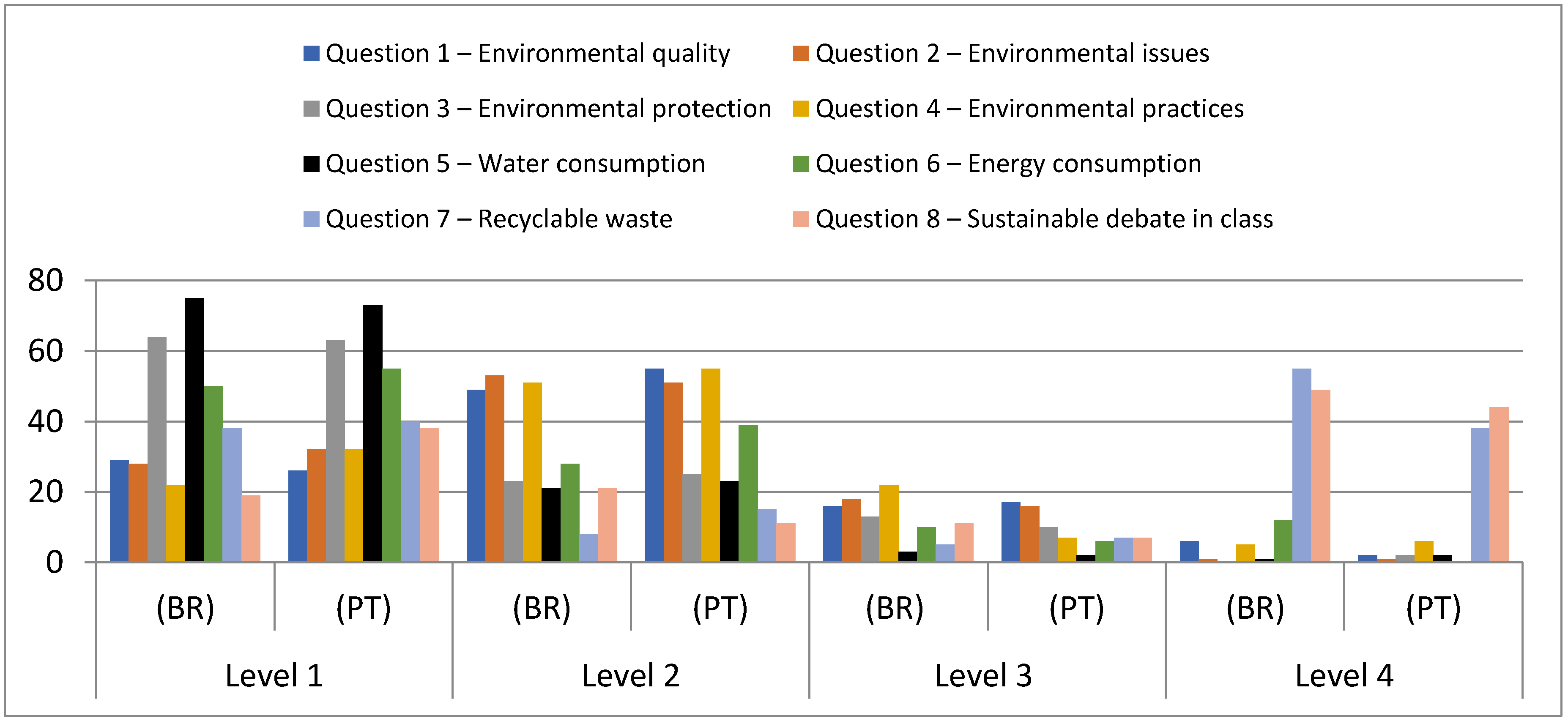
- 78% (29% + 49%) of the students stated that they are very or reasonably interested in issues related to environmental concerns (Question 1);
- (ii)
- 81% of the students stated that they always, or with some frequency, mention subjects related to the environment in the classroom. In this aspect, the results seem quite appropriate, since the worldwide trend is to increase the concern with sustainability (Question 2);
- (iii)
- 87% of the students stated that they always, or with some frequency, protect the environment in their daily lives. This is a good result, considering that the majority of students are involved in saving the environment (Question 3);
- (iv)
- 73% of the students stated that they always, or with some frequency, take environmental attitudes in their own home and try to teach them to their family. The students adopt sustainable attitudes at home, so this is part of their daily lives (Question 4);
- (v)
- 96% of the students stated that they always or with some frequency close the tap after use. Only one percent declares that they do not close it. This low result related to the number of students who do not close the tap after use is good, which means that the majority of the students are aware of the impact that careless use of water can cause (Question 5);
- (vi)
- 78% of the students stated that they always or with some frequency turn off the lights and fans when they leave the room. Twelve percent of the students declare that they do not turn off the light. Therefore, the majority of the students are aware of the impact that irresponsible use of electricity consumption can cause (Question 6);
- (vii)
- 46% of the students always or with some frequency participate in selective waste collection, and 55% of the students do not. In Brazil, concern with recycling began in schools only a short time ago. Therefore, there are still few recycling collection places (Question 7);
- (viii)
- 40% of the students stated that environmental issues should be addressed through events and other academic projects. Therefore, the students want to learn about sustainability, but only eventually, and without including it as part of the school curriculum (Question 8).
4.2. Francisco de Holanda High School, Portugal
- (i)
- 81% of the students stated that they are very or reasonably interested in issues related to environmental concerns. The students indicated that they have much or reasonable interest in issues related to environmental concerns (Question 1);
- (ii)
- 84% of the students stated that they always, or with some frequency, mention subjects related to the environment in the classroom. In this aspect, the results are adequate, since the global trend is to increase concerns about sustainability (Question 2);
- (iii)
- 88% of the students stated that they always, or with some frequency, separate recyclable waste and save water and/or save electricity, and just two percent do nothing to protect the environment. Therefore, most students are supporting the environment (Question 3);
- (iv)
- 87% of the students stated that they always, or with some frequency, take environmental attitudes into their homes and try to teach them to their families (Question 4);
- (v)
- 96% of the students stated that they always or with some frequency close the sink after use. Just two percent declare that they do not close the sink. This shows that most students are aware of the impact that careless use of water can cause (Question 5);
- (vi)
- 94% of the students stated that they always or with some frequency turn off lights and fans when leaving a place. None of the students declared that they do not turn off the light. This result, related to the number of students who care about the impact of irresponsible use of energy consumed by light, demonstrates that most students are aware of the impact that irresponsible energy use can cause (Question 6);
- (vii)
- 55% of the students stated that they always or with some frequency participate in the selective collection of recyclable waste. This result shows that most students are concerned about this aspect, but it is still necessary to do something to promote students’ attitudes about recycling (Question 7);
- (viii)
- 49% of the students declared that subjects related to the environment should be communicated through events and other academic projects, but, for 56%, this subject should be part of the assessment of their high school grade (Question 8).
- (i)
- For each of the countries, Fcalculated = 0.001 < Ftabulated = 2.20 (probability equal to 0.05), i.e., there is no significant variability in the data among the countries. Brazilian and Portuguese students have the same parameters regarding school framing of sustainability issues.
- (ii)
- For the comparative sustainability awareness of students from both countries, Fcalculated = 5.19 > Ftabulated = 2.20 (probability equal to 0.05), i.e., there is significant variability in the sustainability awareness of students among the countries.
5. Conclusions
Author Contributions
Funding
Acknowledgments
Conflicts of Interest
Appendix A
- 1.
- Qualify your environmental interest.
- A)
- Very interested
- B)
- Reasonably interested
- C)
- Little interested
- D)
- No interest
- 2.
- How often the environmental issues are mentioned in class?
- A)
- Always
- B)
- With some frequency
- C)
- Rarely
- D)
- Never
- 3.
- How often do you do something to protect the environment in your daily life?
- A)
- Always
- B)
- With some frequency
- C)
- Rarely
- D)
- Nothing
- 4.
- Do you have environmental practices at home and try to teach it to your family?
- A)
- Always
- B)
- With some frequency
- C)
- Rarely
- D)
- Never
- 5.
- How often do you close the tap after use?
- A)
- Always
- B)
- With some frequency
- C)
- Rarely
- D)
- Never
- 6.
- How often do you turn off the lights and fans when leaving a room?
- A)
- Always
- B)
- With some frequency
- C)
- Rarely
- D)
- Never
- 7.
- Do you usually do the selective collection of recyclable waste?
- A)
- Always
- B)
- With some frequency
- C)
- Rarely
- D)
- Never
- 8.
- How the environmental issues should be addressed in high schools?
- A)
- As a mandatory course
- B)
- As an elective course
- C)
- In specific courses
- D)
- In events and other academic projects
References
- Reidel, J. Erfolgreich oder ruinös? Transnationale unternehmen und nachhaltige entwicklung–kritische reflexion aus menschenrechtlicher perspektive. In Successful or Ruinous? Transnational Companies and Sustainable Development-Critical Reflection from a Human Rights Perspective. Munique: Oekom de 2010; Revan: Rio de Janeiro, Brazil, 2003. [Google Scholar]
- Freericks, R. Freizeitwissenschaft. Handbuch für Pädagogik, Management und Nachhaltige Entwicklung; Oldenbourg Wissenschaftsverlag: München, Germany, 2010. [Google Scholar]
- Saraiva, T.; Almeida, M.; Bragança, L.; Barbosa, M. Environmental comfort indicators for school buildings in sustainability assessment tools. Sustainability 2018, 10, 1849. [Google Scholar] [CrossRef]
- Soeparno and Muslim, S. Effectiveness of E-Learning for Students Vocational High School Building Engineering Program. In IOP Conf. Series: Materials Science and Engineering; IOP Publishing: Bristol, UK, 2018; Volume 336, p. 012039. [Google Scholar]
- Alfianto, I.; Sulton, M.; Sari, A.A.; Dardiri, A. Energy performance of the vocational high school building for the convenience of thermal and lighting comfort in Medan. American Institute of Physics Human-Dedicated Sustainable Product and Process Design: Materials, Resources, and Energy. In AIP Conference Proceedings; AIP Publishing: Melville, NY, USA, 1977. [Google Scholar]
- Kupferschmidt, F.; Wigger, B.U. Public versus private finance of High school buildings: Efficiency and distribution factors. Perspekt. Wirtsch. 2006, 7, 285–307. [Google Scholar] [CrossRef]
- Forato, T.C.M.; Martins, R.A.; Pietrocola, M. History and Nature of Science in High School: Building Up Parameters to Guide Educational Materials and Strategies. Sci. Educ. 2011, 21, 657–682. [Google Scholar] [CrossRef]
- Leonardi, M.L.A. A educação ambiental como um dos instrumentos de superação da insustentabilidade da sociedade atual [Environmental education as one of the tools to overcome the current society’s unsustainability]. In CAVALCANTI, C. (org.); Meio Ambiente Desenvolvimento Sustentável e Políticas Públicas: São Paulo, Brazil, 2002. [Google Scholar]
- Moreira, P.A.A.M.; Silva, L.M.; Luz, M.P. Educação Ambiental na escola: A realidade do setor público e Privado–estudo de caso Environmental (Education in the School: The Reality of the Public and Private Sector—Case Study). In Departamento de Engenharia; Universidade Católica de Goiás: São Paulo, Brazil, 2009. [Google Scholar]
- UNESCO. Educação para um futuro sustentável: Uma visão transdisciplinar para uma ação compartilhada. In Education for a Sustainable Future: A Transdisciplinary Vision for Shared Action; IBAMA: Brasília, Brazil, 1999. [Google Scholar]
- Ntona, E.; Arabatzis, G.; Kyriakopoulos, G. Energy saving: Views and attitudes of students in secondary education. Renew. Sustain. Energy Rev. 2015, 46, 1–15. [Google Scholar] [CrossRef]
- Monroe, M.C.; Oxarart, A.; Plate, R.R. A Role for Environmental Education in Climate Change for Secondary Science Educators. Appl. Environ. Educ. Commun. 2013, 12, 4–18. [Google Scholar] [CrossRef]
- Ntanos, S.; Kyriakopoulos, G.L.; Arabatzis, G.; Palios, V.; Chalikias, M. Environmental Behavior of Secondary Education Students: A Case Study at Central Greece. Sustainability 2018, 10, 1663. [Google Scholar] [CrossRef]
- Repka, P.; Švecová, M. Environmental education in conditions of National Parks of Slovak Republic. Procedia-Soc. Behav. Sci. 2012, 55, 628–634. [Google Scholar] [CrossRef]
- Hassan, A.; Noordina, T.A.; Sulaimana, S. The status on the level of environmental awareness in the concept of sustainable development amongst secondary school student. Procedia Soc. Behav. 2010. [Google Scholar] [CrossRef]
- Cavalheiro, J.S. Consciência ambiental entre Professores e alunos da Escola Básica Dr. Paulo Devanir Lauda. In Environmental Awareness among Teachers and Students of the Basic School Dr. Paulo; Universidade Federal de Santa Maria (UFSM): Camobi, Brazil, 2008. [Google Scholar]
- Kim, A.A.; Sadatsafavi, H.; Medal, L.; Ostergren, M.J. Impact of communication sources for achieving campus sustainability. Resour. Conserv. Recycl. 2018, 139, 366–376. [Google Scholar] [CrossRef]
- LEED v4 for School. U.S. Green Building Council. Available online: http://www.usgbc.org (accessed on 19 August 2018).
- BREEAM Education. Scheme Document. SD 5051. Available online: http://ecoconsulting.net/www/breeamschools.pdf (accessed on 8 July 2018).
- Mateus, R. Sustainability Assessment of Construction—Proposals for the Development of Sustainable Buildings. Ph.D. Thesis, University of Minho, Guimarães, Portugal, 2010. [Google Scholar]
- JFminas. Available online: http://www.jfminas.com.br/portal/historia/colegios (accessed on 10 June 2018).
- Portal Parque Escolar. Available online: https://www.parque-escolar.pt/ (accessed on 28 September 2018).
- UFU Sustentável. Available online: http://www.sustentavel.ufu.br/node/74 (accessed on 10 June 2017).

| Questions | Level 1 | Level 2 | Level 3 | Level 4 |
|---|---|---|---|---|
| Good | Average | Bad | Terrible | |
| Question 1—Environmental quality | 29 | 49 | 16 | 6 |
| Question 2—Environmental issues | 28 | 53 | 18 | 1 |
| Question 3—Environmental protection | 64 | 23 | 13 | 0 |
| Question 4—Environmental practices | 22 | 51 | 22 | 5 |
| Question 5—Water consumption | 75 | 21 | 3 | 1 |
| Question 6—Energy consumption | 50 | 28 | 10 | 12 |
| Question 7—Recyclable waste | 38 | 8 | 5 | 55 |
| Question 8—Sustainable debate in class | 19 | 21 | 11 | 49 |
| Questions | Level 1 | Level 2 | Level 3 | Level 4 |
|---|---|---|---|---|
| Good | Average | Bad | Terrible | |
| Question 1—Environmental quality | 26 | 55 | 17 | 2 |
| Question 2—Environmental issues | 32 | 51 | 16 | 1 |
| Question 3—Environmental protection | 63 | 25 | 10 | 2 |
| Question 4—Environmental practices | 32 | 55 | 7 | 6 |
| Question 5—Water consumption | 73 | 23 | 2 | 2 |
| Question 6—Energy consumption | 55 | 39 | 6 | 0 |
| Question 7—Recyclable waste | 40 | 15 | 7 | 38 |
| Question 8—Sustainable debate in class | 38 | 11 | 7 | 44 |
| Questions | Level 1 | Level 2 | Level 3 | Level 4 | ||||
|---|---|---|---|---|---|---|---|---|
| (BR) | (PT) | (BR) | (PT) | (BR) | (PT) | (BR) | (PT) | |
| Question 1—Environmental quality | 29 | 26 | 49 | 55 | 16 | 17 | 6 | 2 |
| Question 2—Environmental issues | 28 | 32 | 53 | 51 | 18 | 16 | 1 | 1 |
| Question 3—Environmental protection | 64 | 63 | 23 | 25 | 13 | 10 | 0 | 2 |
| Question 4—Environmental practices | 22 | 32 | 51 | 55 | 22 | 7 | 5 | 6 |
| Question 5—Water consumption | 75 | 73 | 21 | 23 | 3 | 2 | 1 | 2 |
| Question 6—Energy consumption | 50 | 55 | 28 | 39 | 10 | 6 | 12 | 0 |
| Question 7—Recyclable waste | 38 | 40 | 8 | 15 | 5 | 7 | 55 | 38 |
| Question 8—Sustainable debate in class | 19 | 38 | 21 | 11 | 11 | 7 | 49 | 44 |
© 2019 by the authors. Licensee MDPI, Basel, Switzerland. This article is an open access article distributed under the terms and conditions of the Creative Commons Attribution (CC BY) license (http://creativecommons.org/licenses/by/4.0/).
Share and Cite
Saraiva, T.S.; Almeida, M.; Bragança, L.; Barbosa, M.T. The Inclusion of a Sustainability Awareness Indicator in Assessment Tools for High School Buildings. Sustainability 2019, 11, 387. https://doi.org/10.3390/su11020387
Saraiva TS, Almeida M, Bragança L, Barbosa MT. The Inclusion of a Sustainability Awareness Indicator in Assessment Tools for High School Buildings. Sustainability. 2019; 11(2):387. https://doi.org/10.3390/su11020387
Chicago/Turabian StyleSaraiva, Tatiana Santos, Manuela Almeida, Luís Bragança, and Maria Teresa Barbosa. 2019. "The Inclusion of a Sustainability Awareness Indicator in Assessment Tools for High School Buildings" Sustainability 11, no. 2: 387. https://doi.org/10.3390/su11020387
APA StyleSaraiva, T. S., Almeida, M., Bragança, L., & Barbosa, M. T. (2019). The Inclusion of a Sustainability Awareness Indicator in Assessment Tools for High School Buildings. Sustainability, 11(2), 387. https://doi.org/10.3390/su11020387

