

Assuring SME’s Sustainable Competitiveness in the Digital Era: A Labor Policy between Guaranteed Minimum Wage and ICT Skill Mismatch


Abstract
1. Introduction
- The dynamics that link ICT skills mismatch and SME’s sustainable competitiveness and economic growth in the technological era [20], to observe their effects for the labor market in general, and for employment in the world, in particular, in European countries;
- The impact of a guaranteed minimum wage in the European labor market (without Croatia because of a lack of data for the period of 2007–2015), using a longitudinal model to analyze the described effects with an explorative investigation in Romania.
2. Current State of Knowledge
2.1. ICT Skills Mismatch
- (i)
- Vertical mismatch [30,31,32]. The level of education or qualification is less or more than required, measured in terms of being under-skilled or having a skill deficit, or being over-skilled or having a skill surplus for a required skill. An ICT skill deficit can be an obstruction for firms regarding the challenges that disruptive technologies impose. Therefore, companies that do not adapt to the new skill technological reality could lose their competitiveness.
- (ii)
- Horizontal mismatch [30,32,33]. The skills are inappropriate for the job. Individuals who adapt quickly to new technological work demands have a greater chance for re-employment. Instead, hesitant workers could have more difficulties, and it is probable that they have to accept positions that are not in line with their skills [34]. In fact, ICT skill underutilization, due to a lack adoption of new skills by firms, could result in an atrophy of the workers’ skills, and a productivity and economic growth decrease [31,32,33,34,35].
- (iii)
- Skill gaps [31,36,37,38]. When the demand or supply for a particular type of skill exceeds the supply/demand of people with that skill—usually measured in terms of unfilled and hard-to-fill vacancies. ICT skill shortages occur when a company cannot find suitably qualified workers, and under-skilled workers man vacant posts. This could have negative consequences on economic growth, because skill shortages slow the rate at which more efficient technologies and approaches to work organization are adopted [39].
- (iv)
- Skill obsolescence (skills previously used in a job are no longer required and/or skills have deteriorated over time) [40,41]. According Allen and de Grip [41], there are two models of skill obsolescence, namely: the dynamic model and the static model. In the first model, workers are in dynamic companies where ICT job contents constantly change. In this context, companies invest so as to overcome obsolescence, so there is “a constant research of the balance between shifts in the skills requirements of the job and the updating of skills”. In the static model, skill obsolescence causes unemployment, because this approach assumes that an employee’s ICT skill level remains moderately stagnant throughout their career.
2.2. Guaranteed Wage on Labour Market
2.3. ICT Skills Mismatch, Guaranteed Minimum Wage, and SME’s Competitiveness
3. Research Methodology
3.1. An Overview of the Labor Market in European System
3.2. An Explorative Investigation in the Romanian Labour Market
- (1)
- for Keynesian unemployment, meaning that GDP (Y) and its evolution is the dependent variable that takes into account the employed workforce (L);
- (2)
- for neo-classical unemployment, meaning that the employed workforce (L) is considered the dependent variable and whether it is in concordance with the evolution of GDP (Y).
4. Findings
4.1. The Impact of ICT Skills on Employment and SME’s Sustainable Competitiveness
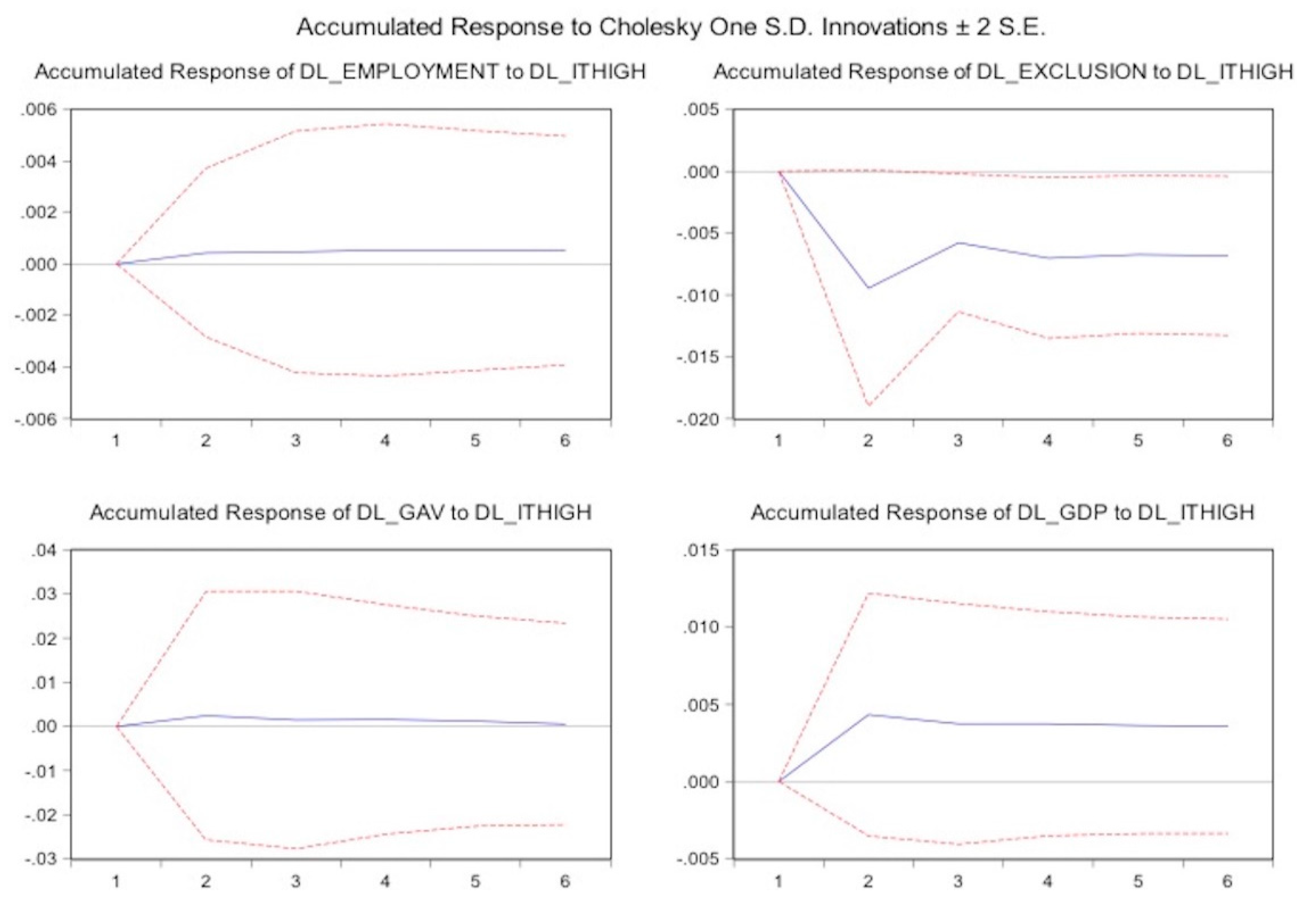
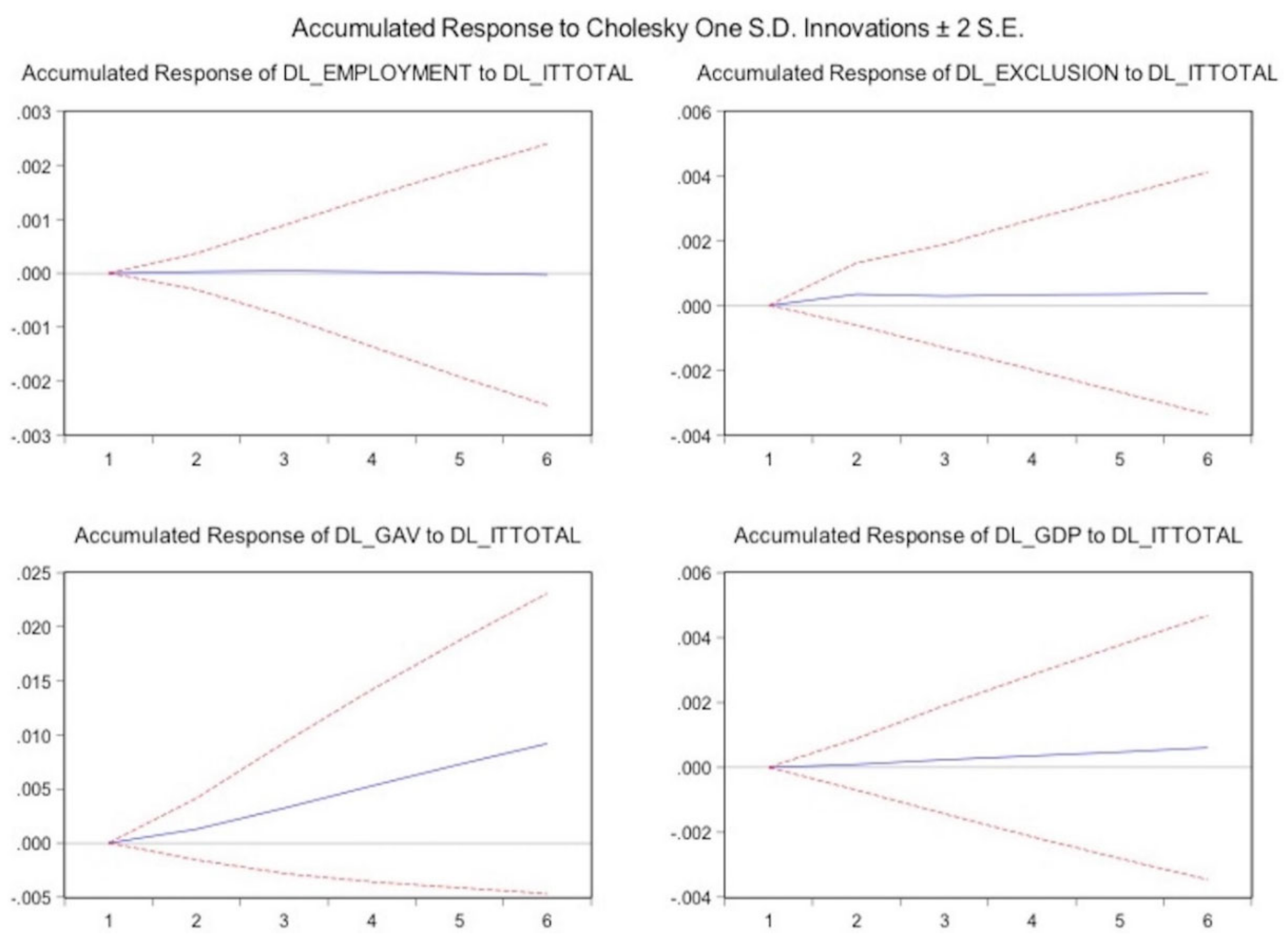
- GDP = gross domestic product per capita at PPS
- GAV = gross added value in IT sector
- IThigh = number of IT personnel with tertiary education
- ITtotal = number of IT personnel with tertiary education and non-tertiary education
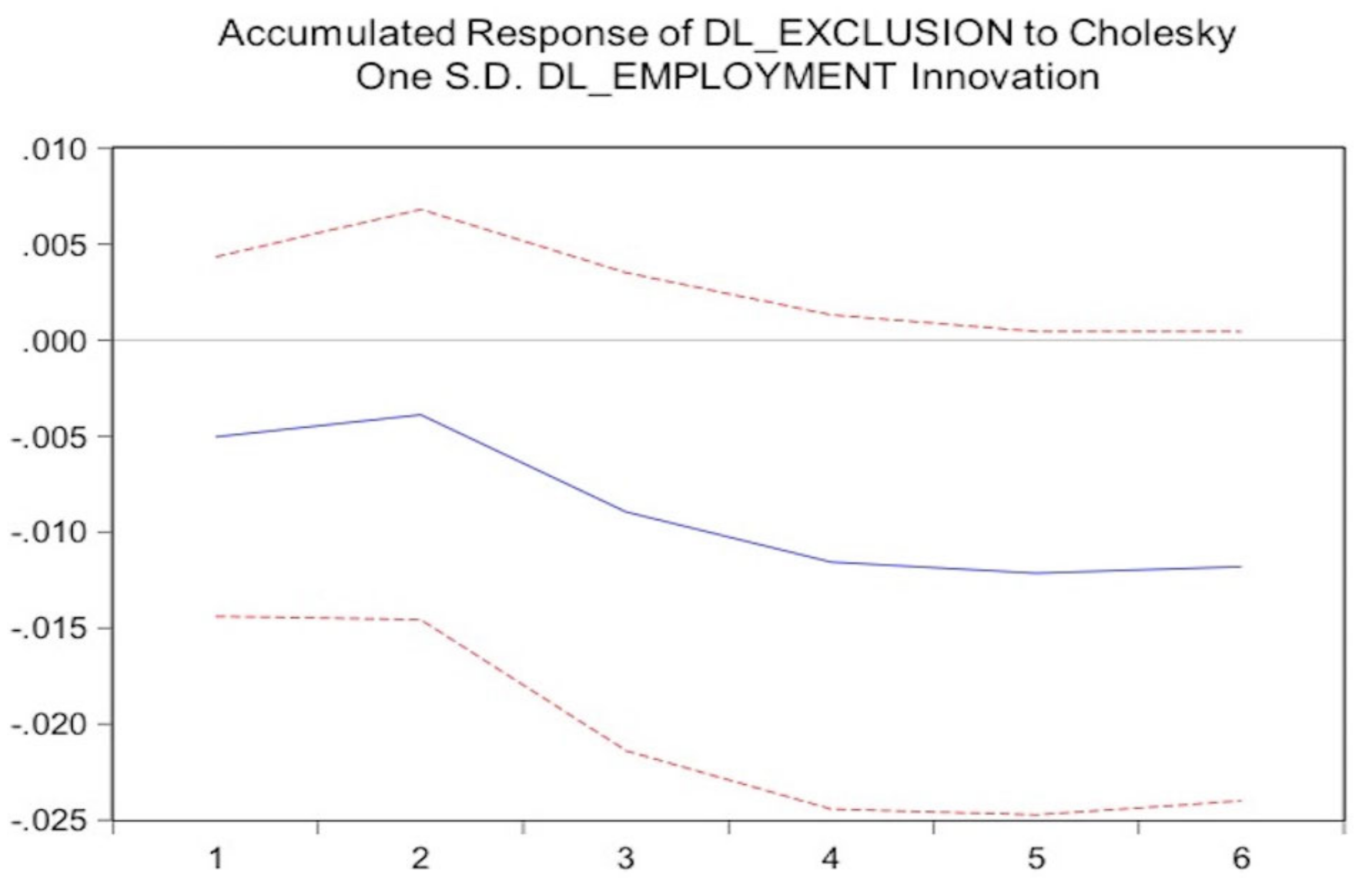
- Employment = number of persons employed
- Exclusion = risk of social exclusion of the unemployed
- ITC skill mismatch = number of IT personnel with tertiary education/number of IT personnel with a tertiary education and non-tertiary education
4.2. The Impact of Guaranteed Minimum Wage on Employment and SME’s Sustainable Competitiveness
5. Conclusions
6. Research Implication
- (1)
- Prepare young people for the jobs of the future, by ensuring that they are equipped with the right type of skills to successfully navigate through an ever-changing, technology-rich work environment, and give all workers the opportunity to continuously maintain their skills, up skill and/or riskily throughout their working lives.
- (2)
- Design labor market institutions (e.g., guaranteed minimum wage, employment protection, and health and safety regulations) that encourage employers to seize the opportunities offered by technological change and globalization, while making sure that the risks are not borne disproportionately by workers in the form of low pay, precariousness, and poor working conditions.
- (3)
- Re-think social security systems to minimize the chances of people slipping through the holes by (i) tailoring or adapting them to the new forms of employment, or (ii) decoupling them entirely from people’s work status and history.
- (4)
- Strengthen activation frameworks to mitigate some of the inevitable adjustment costs of moving towards more globalized and technologically advanced economies by helping those workers who have been displaced by changing skills needs into a new job quickly.
- (5)
- Promote new forms of social dialogue that allow for tailored solutions to new challenges to emerge at the firm-level, while strengthening the voice of those workers who are increasingly working independently and separated by distance, language, and legal context.
Author Contributions
Funding
Conflicts of Interest
References
- Scholarios, D.; Van der Heijden, B.I.; Van der Schoot, E.; Bozionelos, N.; Epitropaki, O.; Jedrzejowicz, P.; Knauth, P.; Marzec, I.; Mikkelsen, A.; Van der Heijde, C.M. Employability and the psychological contract in European ICT sector SMEs. Int. J. Hum. Resour. Manag. 2008, 19, 1035–1055. [Google Scholar] [CrossRef] [Scilit]
- Gastaldi, L.; Corso, M. Smart healthcare digitalization: Using ICT to effectively balance exploration and exploitation within hospitals. Int. J. Eng. Bus. Manag. 2012, 4. [Google Scholar] [CrossRef] [Scilit]
- Gobe, M. Emotional Branding: The New Paradigm for Connecting Brands to People; Skyhorse Publishing, Inc.: New York, NY, USA, 2001. [Google Scholar]
- Gravili, G.; Benvenuto, M.; Avram, A.; Viola, C. The influence of the Digital Divide on Big Data generation within supply chain management. Int. J. Logist. Manag. 2008, 29, 592–628. [Google Scholar] [CrossRef] [Scilit]
- Wilden, R.; Gudergan, S.; Lings, I. Employer branding: Strategic implications for staff recruitment. J. Mark. Manag. 2010, 26, 56–73. [Google Scholar] [CrossRef] [Scilit]
- Lazear, E.P.; Oyer, P. Personnel Economics. In Handbook of Organisational Economics; Gibbons, R., Roberts, D.J., Eds.; Princeton University Press: Princeton, NJ, USA, 2009. [Google Scholar]
- Handel, M.J. Skills mismatch in the labor market. Ann. Rev. Sociol. 2003, 29, 135–165. [Google Scholar] [CrossRef] [Scilit]
- Zulkifly, O.; Ishak, Y.; Abu Hassan, M.S. Inflasi pendidikan mengikut ketentuan dalam pasaran buruh Malaysia. J. Ekon. Malays. 2010, 44, 61–71. [Google Scholar]
- Quintini, G. Over-Qualified or Under-Skilled. 2011. Available online: https://www.oecd-ilibrary.org/content/paper/5kg58j9d7b6d-en (accessed on 18 March 2019).
- Bennett, S.; Maton, K.; Kervin, L. The ‘digital natives’ debate: A critical review of the evidence. Br. J. Educ. Technol. 2008, 39, 775–786. [Google Scholar] [CrossRef] [Scilit]
- McGuinness, S.; Pouliakas, K.; Redmond, P. How Useful is the Concept of Skills Mismatch? 2017. Available online: http://hdl.handle.net/10419/170770 (accessed on 18 March 2019).
- Hagemejer, K. Review of approaches to assess the sustainability of social protection floors. In Social Protection Goals in East Asia; Taylor & Francis Group: London, UK, 2018; Available online: https://www.taylorfrancis.com/books/e/9781351867788/chapters/10.4324%2F9781315232348-2 (accessed on 18 March 2019).
- Mortensen, D.T. Unemployment insurance and job search decisions. ILR Rev. 1977, 30, 505–517. [Google Scholar] [CrossRef] [Scilit]
- Shavell, S.; Weiss, L. The optimal payment of unemployment insurance benefits over time. J. Polit. Econ. 1979, 87, 1347–1362. [Google Scholar] [CrossRef] [Scilit]
- Carone, G.; Salomaki, A.; Immervoll, H.; Paturot, D. Indicators of Unemployment and Low-Wage Traps; OECD Social, Employment and Migration Working Paper No. 18; OECD: Paris, France, 2003. [Google Scholar]
- Matković, T.; Caha, D. Patterns of welfare-to-employment transitions of Croatian Guaranteed Minimum Benefit recipients: A preliminary study. Pub. Sect. Econ. 2017, 41, 335–358. [Google Scholar] [CrossRef] [Scilit]
- Hemerijck, A. The self-transformation of the European social model(s). Int. Polit. Ges. 2002, 4, 39–67. [Google Scholar]
- Bargain, O.; Orsini, K. In-work policies in Europe: Killing two birds with one stone? Labour Econ. 2006, 13, 667–697. [Google Scholar] [CrossRef] [Scilit]
- Card, D.; Krueger, A.B. Myth and Measurement: The New Economics of the Minimum Wage-Twentieth-Anniversary Edition; Princeton University Press: Princeton, NJ, USA, 2015. [Google Scholar]
- Lloyd, C.; Payne, J. Licensed to skill? The impact of occupational regulation on fitness instructors. Eur. J. Ind. Relat. 2017. [Google Scholar] [CrossRef] [Scilit]
- Freeman, R.B. Minimum Wages—Again! Int. J. Manpow. 1994, 15, 8–25. [Google Scholar] [CrossRef] [Scilit]
- Kalleberg, A.L. The mismatched worker: When people don’t fit their jobs. Acad. Manag. Perspect. 2008, 22, 24–40. [Google Scholar] [CrossRef] [Scilit]
- Farooq, S. Mismatch between education and occupation: A case study of Pakistani graduates. Pak. Dev. Rev. 2011, 50, 531–552. [Google Scholar] [CrossRef] [Scilit]
- Gravili, G.; Fait, M. Social Recruitment in HRM: A Theoretical Approach and Empirical Analysis; Emerald Group Publishing Limited: Bingley, UK, 2016. [Google Scholar]
- Groot, W.; Van Den Brink, H.M. Overeducation in the labor market: A meta-analysis. Econ. Educ. Rev. 2000, 19, 149–158. [Google Scholar] [CrossRef] [Scilit]
- Chambers, E.G.; Foulon, M.; Handfield-Jones, H.; Hankin, S.M.; Michaels, E.G. The war for talent. McKinsey Q. 1998, 44–57. Available online: http://www.executivesondemand.net/managementsourcing/images/stories/artigos_pdf/gestao/The_war_for_talent.pdf (accessed on 18 March 2019).
- McGuinness, S. Overeducation in the labour market. J. Econ. Surv. 2006, 20, 387–418. [Google Scholar] [CrossRef] [Scilit]
- Rubb, S. Overeducation in the labor market: A comment and re-analysis of a meta-analysis. Econ. Educ. Rev. 2003, 22, 621–629. [Google Scholar] [CrossRef] [Scilit]
- Sloane, P.J. Much ado About Nothing? What does the Overeducation Literature Really Tell us. In Overeducation in Europe; Edward Elgar Publishing: Cheltenham, UK, 2003. [Google Scholar]
- Halaby, C.N. Overeducation and skill mismatch. Sociol. Educ. 1994, 67, 47–59. [Google Scholar] [CrossRef] [Scilit]
- Desjardins, R.; Rubenson, K. An Analysis of Skill Mismatch Using Direct Measures of Skills; OECD Education Working Paper No. 63; OECD Publishing: Paris, France, 2011. [Google Scholar]
- Verhaest, D.; Sellami, S.; Van der Velden, R. Differences in horizontal and vertical mismatches across countries and fields of study. Int. Labour Rev. 2017, 156, 1–23. [Google Scholar] [CrossRef] [Scilit]
- Domadenik, P.; Farcnik, D.; Pastore, F. Horizontal Mismatch in the Labour Market of Graduates: The Role of Signaling. IZA Discussion Paper No. 7527. Available online: https://papers.ssrn.com/sol3/papers.cfm?abstract_id=2314822 (accessed on 18 March 2019).
- Acemoglu, D.; Autor, D. Skills, Tasks and Technologies: Implications for Employment and Earnings. In Handbook of Labor Economics; Elsevier: Amsterdam, The Netherlands, 2011; Volume 4, pp. 1043–1171. [Google Scholar]
- Allen, J.; Van der Velden, R. Educational Mismatches versus Skill Mismatches: Effects on Wages, Job Satisfaction, and On-the-Job Search. Oxf. Econ. Pap. 2001, 53, 434–452. [Google Scholar] [CrossRef] [Scilit]
- Heckman, J.J. Skill formation and the economics of investing in disadvantaged children. Science 2006, 312, 1900–1902. [Google Scholar] [CrossRef] [Scilit] [PubMed]
- Jackson, D. An international profile of industry-relevant competencies and skill gaps in modern graduates. Int. J. Manag. Educ. 2010, 8, 29–58. [Google Scholar] [CrossRef] [Scilit]
- Cappelli, P.H. Skill gaps, skill shortages, and skill mismatches: Evidence and arguments for the United States. ILR Rev. 2015, 68, 251–290. [Google Scholar] [CrossRef] [Scilit]
- Foley, P.D.; Watts, H.D. Skills shortages and training a forgotten dimension in new technology. R D Manag. 1994, 24, 99–109. [Google Scholar]
- Rosen, S. Measuring the obsolescence of knowledge. In Education, Income, and Human Behavior; Thomas Juster, F., Ed.; NBER: Cambridge, MA, USA, 1975; pp. 199–232. [Google Scholar]
- Allen, J.; de Grip, A. Does skill obsolescence increase the risk of employment loss? Appl. Econ. 2012, 44, 3237–3245. [Google Scholar] [CrossRef] [Scilit]
- Caroli, E.; Van Reenen, J. Skill-biased organizational change? Evidence from a panel of British and French establishments. Q. J. Econ. 2001, 116, 1449–1492. [Google Scholar] [CrossRef] [Scilit]
- OECD. Enhancing the Competitiveness of SMES in the Global Economy: Strategies and Policies; OECD: Paris, France, 2013. [Google Scholar]
- Piva, M.; Santarelli, E.; Vivarelli, M. The skill bias effect of technological and organisational change: Evidence and policy implications. Res. Policy 2005, 34, 141–157. [Google Scholar] [CrossRef] [Scilit]
- Thoenig, M.; Verdier, T. A theory of defensive skill-biased innovation and globalization. Am. Econ. Rev. 2003, 93, 709–728. [Google Scholar] [CrossRef] [Scilit]
- Cișmaș, L. Microeconomia Bunăstării; Editura Mirton: Timișoara, Romania, 2004; p. 279. [Google Scholar]
- Ailenei, D.; Angelescu, C.; Cristescu, A.; Hrisanta, M. A Fuzzy Sets Model for Companies Behaviour of Absorption Minimum WageShocks: An Analysis of Inflationary Risks. IBIMA Publishing Journal of Economics Studies and Research. 2011. Available online: http://www.ibimapublishing.com/journals/JESR/jesr.html (accessed on 18 March 2019).
- Sutch, R. The Unexpected Long-Run Impact of the Minimum Wage: An Educational Cascade; No. w16355; National Bureau of Economic Research: Cambridge, UK, 2010. [Google Scholar]
- Fox, L. Minimum Wage Trends: Understanding Past and Contemporary Research; Economic Policy Institute: Washington, DC, USA, 2006. [Google Scholar]
- Semmel, B. Imperialism and Social Reform; George Allen & Unwin Ltd. Anchor Books Doubleday & Company, Inc.: Garden City, NY, USA, 1960. [Google Scholar]
- Alesina, A.F.; Zeira, J. Technology and Labour Regulations; NBER Working Paper No. 12581; National Bureau of Economic Research: Cambridge, MA, USA, 2006. [Google Scholar]
- Abbott, L.F. Statutory Minimum Wage Controls: A Critical Review of their Effects on Labour Markets, Employment, and Incomes, 2nd ed.; ISR Publications: Manchester, UK, 2000; ISBN 978-0-906321-22-5. [Google Scholar]
- Rockwell, L.H., Jr. Wal-Mart Warms to the State. 2005. Available online: https://mises.org/library/wal-mart-warms-state (accessed on 10 March 2019).
- Partridge, M.D.; Partridge, J.S. Do minimum wage hikes reduce employment? State-level evidence from the low-wage retail sector. J. Labor Res. 1999, 20, 393–413. [Google Scholar] [CrossRef] [Scilit]
- Wilson, M. Increasing the Mandated Minimum Wag: Who Pays the Price? The Heritage Foundation: Washington, DC, USA, 1998; Available online: https://www.heritage.org/budget-and-spending/report/increasing-the-mandated-minimum-wage-who-pays-the-price (accessed on 16 March 2019).
- Meer, J.; West, J. Effects of the minimum wage on employment dynamics. J. Hum. Resour. 2016, 51, 500–522. [Google Scholar] [CrossRef] [Scilit]
- Atkinson, R.D. Create Jobs by Expanding the R&D Tax Credit; Information Technology and Innovation Foundation: Washington, DC, USA, 2010. [Google Scholar]
- Klette, J.; Førre, S.E. Innovation and job creation in a smallopen economy-evidence from norwegian manufacturing plants 1982–92. Econ. Innov. New Technol. 1998, 5, 247–272. [Google Scholar] [CrossRef] [Scilit]
- Linden, G.; Dedrick, J.; Kraemer, K.L. Innovation and job creation in a global economy: The case of Apple’s iPod. J. Int. Commer. Econ. 2011, 3, 223–239. [Google Scholar]
- Kletzer, L.G. Imports, Exports, and Jobs: What Does Trade Mean for Employment and Job Loss? WE Upjohn Institute: Kalamazoo, MI, USA, 2002. [Google Scholar]
- Avram, M. Management Contabil; Universitaria Publishing: Craiova, Romania, 2010; p. 135. [Google Scholar]
- Castro, D.; Atkinson, R.D.; Ezell, S.J. Embracing the Self-Service Economy; Information Technology and Innovation Foundation: Washington DC, USA, 2010. [Google Scholar]
- Boyer, R. Is a finance-led growth regime a viable alternative to Fordism? A preliminary analysis. Econ. Soc. 2000, 29, 111–145. [Google Scholar] [CrossRef] [Scilit]
- Lavoie, M.; Stockhammer, E. Wage-Led Growth: Concept, Theories and Policies. Project Report for the Project “New Perspectives on Wages and Economic Growth: The Potentials of Wage-Led Growth”; International Labour Office: Geneva, Switzerland, 2012. [Google Scholar]
- Stockhammer, E. Financialization, income distribution and the crisis. Investigación Económica 2012, 71, 39–70. [Google Scholar]
- Schmitt, J. Why Does the Minimum Wage Have No Discernible Effect on Employment? Center for Economic and Policy Research: Washington, DC, USA, 2013. [Google Scholar]
- Bartel, A.P. Training, wage growth, and job performance: Evidence from a company database. J. Labour Econ. 1995, 13, 401–425. [Google Scholar] [CrossRef] [Scilit]
- Dunne, T.; Foster, L.; Haltiwanger, J.; Troske, K.R. Wage and Productivity Dispersion in U.S. Manufacturing: The Role of Computer Investment; No. 563; Institute of Labour Economics (IZA): Bonn, Germany, 2004. [Google Scholar]
- Duncan, G. Unemployment and social exclusion in the European Union. J. Eur. Soc. 1999, 1, 139–167. [Google Scholar]
- Brown, C.; Gilroy, C.; Kohen, A. The effect of the minimum wage on employment and unemployment. J. Econ. Lit. 1982, 20, 487–528. [Google Scholar]
- Brown, C. Minimum wage laws: Are They Overrated? J. Econ. Perspect. 1988, Summer, 133–145. [Google Scholar] [CrossRef] [Scilit]
- CEDEFOP. Learning and Innovation in Enterprises; Research Paper No. 27; CEDEFOP: Luxembourg, 2012. [Google Scholar]
- Dima, B.; Lobonţ, O.R.; Moldovan, N.C. Does the Quality of Public Policies and Institutions Matter for Entrepreneurial Activity? Evidences from the European Union’s Member States. Panoeconomicus 2016, 63, 425–439. [Google Scholar] [CrossRef] [Scilit]
- Pirtea, M.G.; Nicolescu, C.; Boţoc, C. Do Romanian Companies Follow Pecking Order Financing? Econ. Comput. Econ. Cybern. Stud. Res. 2014, 48, 1–15. [Google Scholar]

| Policies/Resuts | Distributional Policies | ||
|---|---|---|---|
| Pro-Capital | Pro-Labor | Other Factors | |
| Policies | No guaranteed minimum wage Low bargaining power of collective workers’ associations Wage moderation | Increase of guaranteed minimum wage Stronger bargaining power of collective workers’ associations | Technological innovations Globalization Financialization |
| Results | Weak increase of wages Lower share of wage in total expenditures Higher wage dispersion | Strong increase of wages Stable or increasing wage share in total expenditures Lower wage dispersion | |
| Dependent Variable: DL_EMPLOYMENT | Dependent Variable: DL_GDP | ||||||||
|---|---|---|---|---|---|---|---|---|---|
| Variable | Coefficient | Std. Error | t-Statistic | Prob. | Variable | Coefficient | Std. Error | t-Statistic | Prob. |
| DL_GDP | 0.077 | 0.022 | 3.431 | 0.002 | DL_EMPLOYMENT | 3.148 | 0.917 | 3.431 | 0.002 |
| C | −0.005 | 0.005 | −0.905 | 0.371 | C | 0.035 | 0.033 | 1.087 | 0.284 |
| R-Squared | 0.241 | Mean dependent var | −0.003 | R-squared | 0.241 | Mean dependent variable | 0.028 | ||
| Adjusted R-squared | 0.221 | SD dependent variable | 0.036 | Adjusted R-squared | 0.221 | SD dependent variable | 0.230 | ||
| S.E. of regression | 0.032 | Akaike info criterion | −4.013 | SE of regression | 0.203 | Akaike info criterion | −0.299 | ||
| Sum Squared Residual | 0.037 | Schwarz criterion | −3.928 | Sum squared residual | 1.529 | Schwarz criterion | −0.213 | ||
| Log Likelihood | 80.263 | Hannan–Quinn criterion | −3.983 | Log likelihood | 7.826 | Hannan–Quinn criterion | −0.268 | ||
| F-statistic | 11.775 | Durbin–Watson statistic | 2.183 | F-statistic | 11.775 | Durbin–Watson statistic | 2.619 | ||
| Prob (F-statistic) | 0.001 | Prob (F-statistic) | 0.001 | ||||||
| Root | Modulus |
|---|---|
| 0.999497 | 0.999497 |
| 0.330901 − 0.401447i | 0.520246 |
| 0.330901 + 0.401447i | 0.520246 |
| −0.220393 − 0.055168i | 0.227193 |
| −0.220393 + 0.055168i | 0.227193 |
| 0.072755 | 0.072755 |
| Lag | LogL | LR | FPE | AIC | SC | HQ |
|---|---|---|---|---|---|---|
| 0 | 86.80363 | NA | 2.02 × 10⁻⁹ | −2.992727 | −2.771729 | −2.907497 |
| 1 | 268.4650 | 316.2254 * | 9.25 × 10⁻¹² * | −8.387593 | −6.840605 * | −7.790981 * |
| 2 | 284.2230 | 23.92887 | 2.06 ×10⁻¹¹ | −7.637891 | −4.764914 | −6.529896 |
| 3 | 306.6568 | 29.08072 | 3.87 × 10⁻¹¹ | −7.135435 | −2.936469 | −5.516059 |
| 4 | 349.5572 | 46.07829 | 3.93 × 10⁻¹¹ | −7.391008 | −1.866053 | −5.260250 |
| 5 | 397.1344 | 40.52874 | 4.20 × 10⁻¹¹ | −7.819794 | −0.968849 | −5.177653 |
| 6 | 451.9835 | 34.53459 | 5.09 × 10⁻¹¹ | −8.517908 * | −0.340973 | −5.364385 |
| Joint Test | ||
|---|---|---|
| Chi-square | df | Prob. |
| 944.7042 | 567 | 0.0000 |
| Lags | LM-Stat | Prob |
|---|---|---|
| 1 | 62.00175 | 0.0045 |
© 2019 by the authors. Licensee MDPI, Basel, Switzerland. This article is an open access article distributed under the terms and conditions of the Creative Commons Attribution (CC BY) license (http://creativecommons.org/licenses/by/4.0/).
Share and Cite
Avram, A.; Benvenuto, M.; Avram, C.D.; Gravili, G. Assuring SME’s Sustainable Competitiveness in the Digital Era: A Labor Policy between Guaranteed Minimum Wage and ICT Skill Mismatch. Sustainability 2019, 11, 2918. https://doi.org/10.3390/su11102918
Avram A, Benvenuto M, Avram CD, Gravili G. Assuring SME’s Sustainable Competitiveness in the Digital Era: A Labor Policy between Guaranteed Minimum Wage and ICT Skill Mismatch. Sustainability. 2019; 11(10):2918. https://doi.org/10.3390/su11102918
Chicago/Turabian StyleAvram, Alexandru, Marco Benvenuto, Costin Daniel Avram, and Ginevra Gravili. 2019. "Assuring SME’s Sustainable Competitiveness in the Digital Era: A Labor Policy between Guaranteed Minimum Wage and ICT Skill Mismatch" Sustainability 11, no. 10: 2918. https://doi.org/10.3390/su11102918
APA StyleAvram, A., Benvenuto, M., Avram, C. D., & Gravili, G. (2019). Assuring SME’s Sustainable Competitiveness in the Digital Era: A Labor Policy between Guaranteed Minimum Wage and ICT Skill Mismatch. Sustainability, 11(10), 2918. https://doi.org/10.3390/su11102918

