

Climate Change Adaptation and Gender Inequality: Insights from Rural Vietnam



Abstract
1. Introduction
2. Materials and Methods
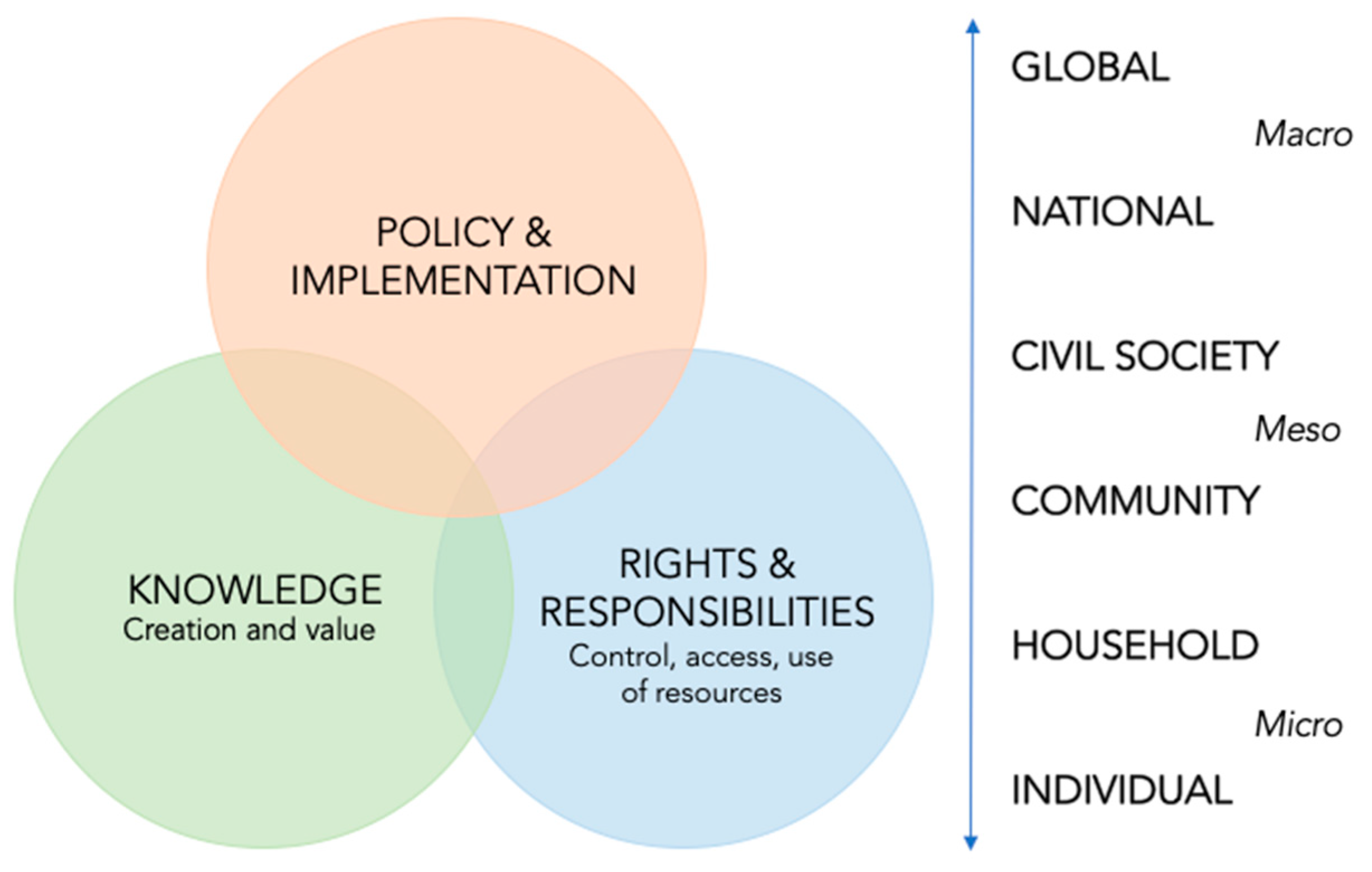
3. Theory
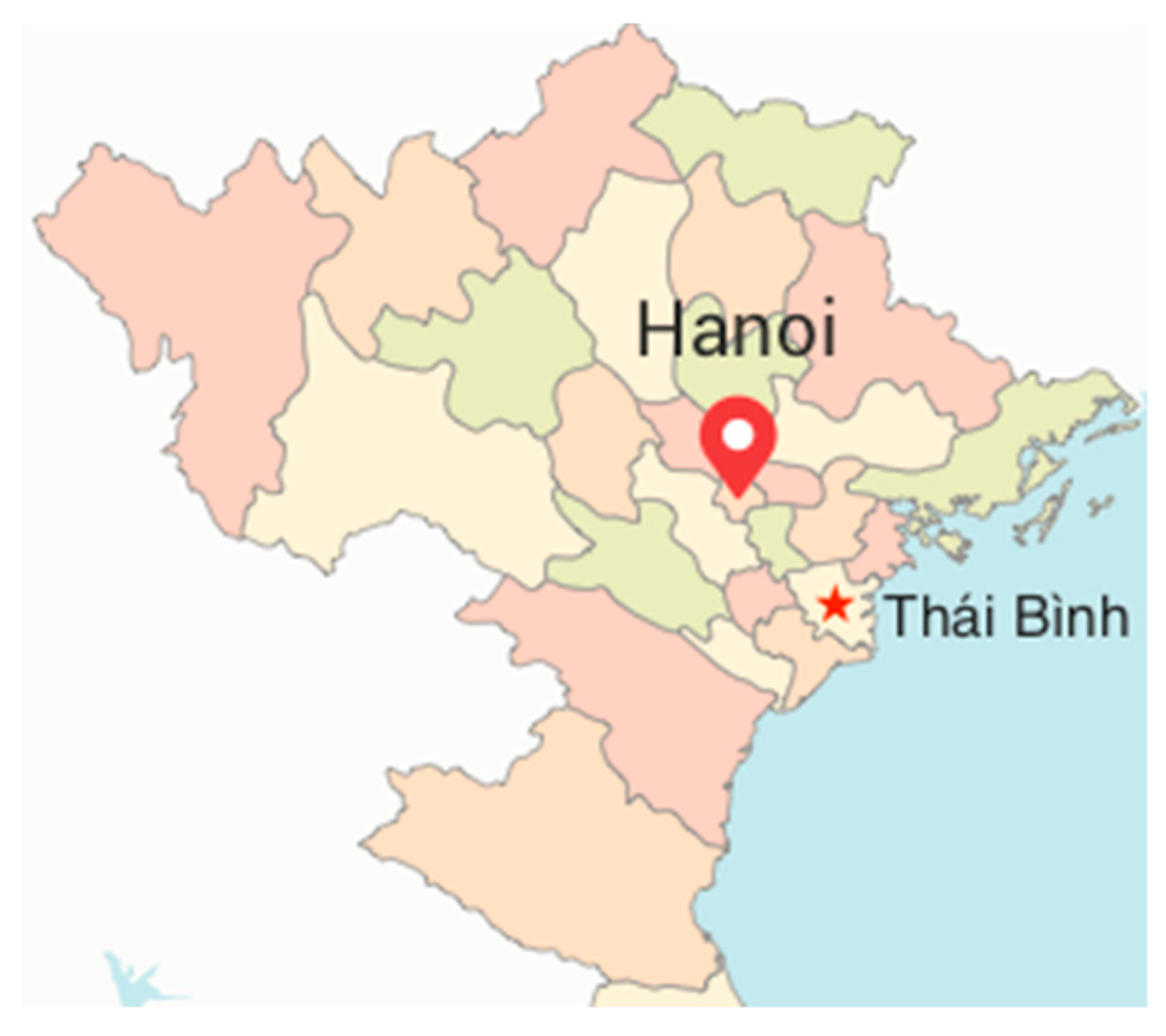
4. The Setting—Vietnam and Thái Bình
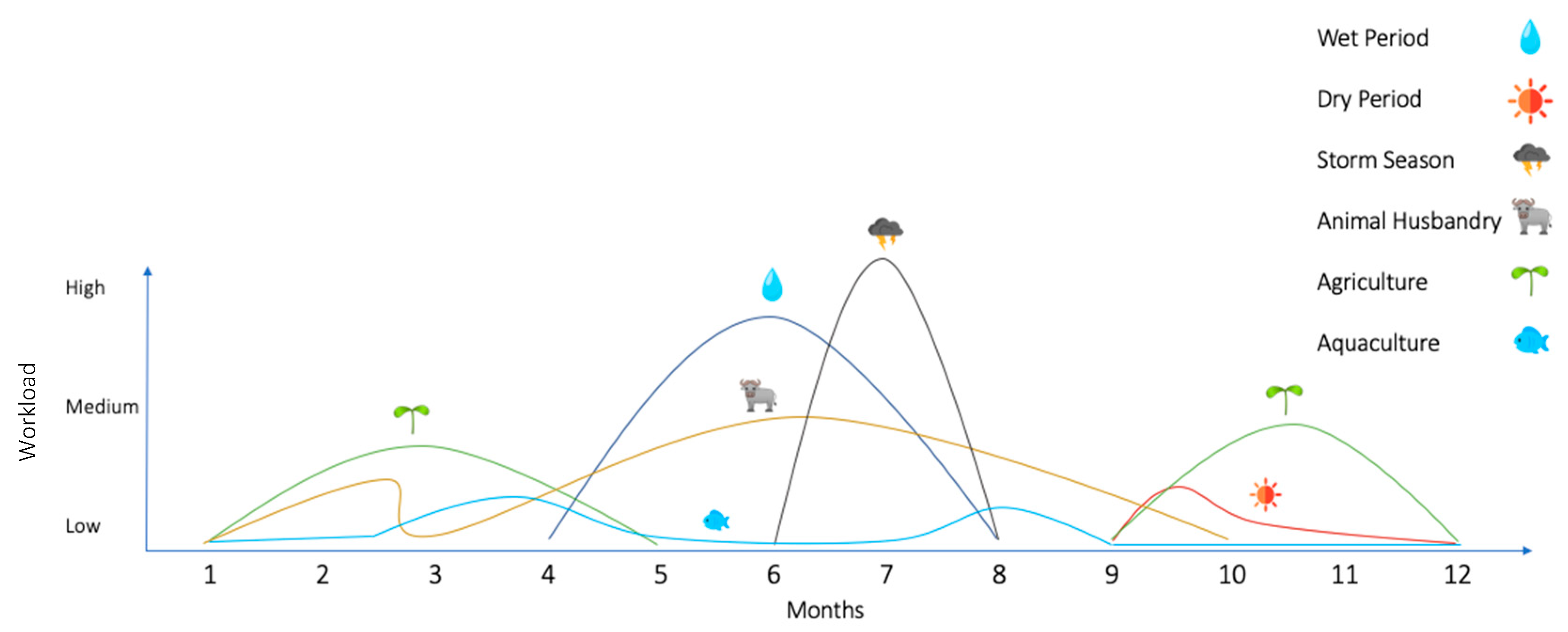
Agrarian Life in Thái Bình
5. Results and Discussion
5.1. Post-đổi Mới: Gendered Land Rights and Responsibilities
If men carry a 50 kg bag of rice, they can do it in about 2 h. Women, they have to bear children, therefore their health worsens. If they do heavy work, it affects their health later, meaning that they will not live as long.
Men walk around in the community, go outside the boundary of the village to talk to other people and exchange ideas, while women stay behind.
They [husband and wife] usually say that they have to discuss with each other but […] men always make the final decision, for example on the house or things that are costlier. A purchase that costs more than 150,000 Đồng (150,000 VND is equivalent to approximately 5.70 EUR) is made by the man in the household, and when it is below that, the wife is allowed to make the decision. So, even when they are going to buy a rice cooker and if it’s more expensive than 150,000 Đồng they are not allowed to make the decision to buy it without their husband’s approval.
The man is the leader of the family, below us is our wives. They play secondary roles.
Women work harder than men, both in farming and housework.
You have to listen to us, we know the reality.
Rice production was the most important crop produced during the time of state subsidies, so men were responsible for rice plantation. Later on, when Vietnam became a market economy, prices went down to almost nothing and women became responsible for the rice plantation. Now, men are responsible for aquaculture […]. Women should not work with shrimp farming, because of the taboo that women will cause bad luck to the shrimp farming. It is a cultural notion, where, for example, women are not supposed to participate in certain practices based on ideas such as women’s menstruation being considered dirty and thus seen to be bad for shrimp farming.
Vietnam is a society of traditional patriarchal values, so men are more respected than women.
5.2. Knowledge: Gendered Views on Farming and Climate Change
If we are looking into the awareness of climate change, it seems like men are more aware of those problems than women.
In 2012, all the rice crops blew away. The drying rice on the roofs was blown away.
When they live together they complement each other with different types of knowledge. So, what I want to say is that women’s knowledge is very important but it has been disregarded […] and the role of the women is very important in the household economy. On a broader scale, it is very important in decision-making, but most of the time policies are made by men, and not by women. So, because they are men, they cannot understand what women need and do not have the same knowledge as women, so there becomes a gap and lack in the policy-making.
5.3. Feminisation and Devaluation of Farming
It is common in Vietnam that women have to stay at home and you do a lot of work on the farm while men will go outside to get other jobs for other incomes. […] Men tend to go outside and find other higher incomes for their family and therefore women stay at home and men leave for other work. So, women do both household work and farming.
Women are left behind in the countryside when their children are moving abroad or to the cities to find prosperity, and then only women and old people are left in the rural areas. This is the most common trend in Vietnam.
In urban areas, women’s empowerment is more prevalent. For example, women can be in power positions and can focus more on their career. But in the rural areas, there is a remarkable difference. It is more traditional and will take a longer time to catch up with the urban side. Education level is an issue, but also culture and traditions are stricter in rural communities than in the urban areas.
5.4. Expected Increased Production
We don’t have any money. Honestly. When we lose resources, we have to take full responsibility ourselves. And in order to continue next year, we have to borrow money from the bank. So, if we lose crops or materials, we’re completely lost.
They [the authorities] just aim for development by increasing the production every year. No matter what. If there are storms, rain, or drought that affect the farming, it doesn’t matter […] for example, this year we gained 5 tonnes of rice per hectare so […] next year they push for 6 tonnes per hectare because it has to increase from last year […] That’s the mentality of politics and policies in Vietnam. So, they just look at figures and revenue but in fact they don’t care about what people are facing.
If it [extreme weather that destroys the produce] happens one year, we can maintain our production. However, if it continues every year it becomes more difficult, which leads to food suppliers not wanting to buy our produce anymore, as they cannot rely on inconsistent production.
5.5. A Call for Inclusive and Situation-Based Policies
To be honest, they [local authorities] don’t have enough money to implement and enforce it [the national strategy] on the provincial level.
We have been here for 33 years, but we have never gotten any support from them [the authorities].
6. Conclusions—Gender Matters
Author Contributions
Funding
Acknowledgments
Conflicts of Interest
References
- Christoplos, I.; Ngoan, L.D.; Sen, L.T.H.; Huong, N.T.T.; Nguyen, H. Changing arenas for agricultural climate change adaptation in Vietnam. Dev. Pract. 2016, 27, 132–142. [Google Scholar] [CrossRef] [Scilit]
- Nguyen, T.A.; Vu, D.A.; Van Vu, P.; Nguyen, T.N.; Pham, T.M.; Nguyen, H.T.; Le, H.T.; Nguyen, T.V.; Hoang, L.K.; Vu, T.D.; et al. Human ecological effects of tropical storms in the coastal area of Ky Anh (Ha Tinh, Vietnam). Environ. Dev. Sustain. 2017, 19, 745–767. [Google Scholar] [CrossRef] [Scilit]
- Le, T.H.S.; Bond, J. Agricultural adaptation to flood in lowland rice production areas of Central Vietnam: Understanding the ‘regenerated rice’ ratoon system. Clim. Dev. 2017, 9, 274–285. [Google Scholar]
- Nguyen, T.L.H.; Bo, Y.S.; Fahad, S. Farmers’ perception, awareness and adaptation to climate change: Evidence from northwest Vietnam. Int. J. Clim. Chang. Strateg. Manag. 2017, 9, 555–576. [Google Scholar]
- Socialist Republic of Viet Nam. National Strategy on Climate Change. Socialist Republic of Viet Nam. 2011. Available online: http://www.chinhphu.vn/portal/page/portal/English/strategies/strategiesdetails?categoryId=30&articleId=10051283 (accessed on 15 March 2018).
- McElwee, P. Vietnam’s Urgent Task: Adapting to Climate Change. Curr. Hist. 2017, 116, 223–229. [Google Scholar]
- Bergstedt, C. Cultivating Gender: Meanings of Place and Work in Rural Vietnam; NIAS Press: Copenhagen, Denmark, 2015. [Google Scholar]
- Mishra, A.K.; Pede, V.O. Perception of climate change and adaptation strategies in Vietnam. Int. J. Clim. Chang. Strateg. Manag. 2017, 9, 501–516. [Google Scholar] [CrossRef] [Scilit]
- Abdulkadir, A. Climate Change Adaptation, Mitigation, and the Attainment of Food Security in the Sudano-Sahelian Belt of Nigeria. In Handbook of Climate Change Mitigation and Adaptation, 2nd ed.; Chen, W.-Y., Suzuki, T., Lackner, M., Eds.; Springer: New York, NY, USA, 2017; pp. 849–861. [Google Scholar]
- Jerneck, A. Taking gender seriously in climate change adaptation and sustainability science research: Views from feminist debates and sub-Saharan small-scale agriculture. Sustain. Sci. 2017, 13, 403–416. [Google Scholar] [CrossRef] [Scilit] [PubMed]
- Carvajal-Escobar, Y.; Quintero-Angel, M.; Garcia-Vargas, M. Advances in Geosciences Women’s role in adapting to climate change and variability. Adv. Geosci. 2008, 14, 277–280. [Google Scholar] [CrossRef] [Scilit]
- Vincent, K.E.; Tschakert, P.; Barnett, J.; Rivera-Ferre, M.G.; Woodward, A. Cross-chapter box on gender and climate change. In Climate Change 2014: Impacts, Adaptation, and Vulnerability. Part A: Global and Sectoral Aspects. Contribution of Working Group II to the Fifth Assessment Report of the Intergovernmental Panel of Climate Change; Cambridge University Press: Cambridge, UK, 2014; pp. 105–107. [Google Scholar]
- Bryman, A. Social Research Methods, 5th ed.; Oxford University Press: Oxford, UK, 2016. [Google Scholar]
- Socialist Republic of Viet Nam. National Strategy on Gender Equality for the 2011–2020 Period. Socialist Republic of Viet Nam. 2012. Available online: http://www.chinhphu.vn/portal/page/portal/English/strategies/strategiesdetails?categoryId=30&articleId=10050924 (accessed on 15 March 2018).
- Socialist Republic of Viet Nam. Viet Nam Sustainable Development Strategy for 2011–2020. Socialist Republic of Viet Nam. 2012. Available online: http://www.chinhphu.vn/portal/page/portal/English/strategies/strategiesdetails?categoryId=30&articleId=10050825 (accessed on 15 March 2018).
- Rocheleau, D.; Thomas-Slayter, B.; Wangari, E. Feminist Political Ecology: Global Issues and Local Experience; Routledge: Abingdon, UK, 1996. [Google Scholar]
- Mehta, L. Dianne Rocheleau: The Feminist Political Ecology Legacy and Beyond. In The Palgrave Handbook of Gender and Development, 1st ed.; Harcourt, W., Ed.; Palgrave Macmillan UK: London, UK, 2016; pp. 262–275. [Google Scholar]
- Wise, S.; Stanley, L. Breaking Out Again: Feminist Ontology and Epistemology, 2nd ed.; Routledge: Abingdon, UK, 1993. [Google Scholar]
- Smith, D.W.; Scarpaci, J.L. Urbanization in transitional societies: An overview of Vietnam and Hanoi. Urban Geogr. 2001, 21, 745–757. [Google Scholar] [CrossRef] [Scilit]
- King, V.T.; Nguyen, P.A.; Nguyen, H.M. Professional middle class youth in post-reform Vietnam: Identity, continuity and change. Mod. Asian Stud. 2008, 42, 783–813. [Google Scholar] [CrossRef] [Scilit]
- Hanh, H.Q.; Azadi, H.; Dogot, T.; Ton, V.D.; Lebailly, P. Dynamics of Agrarian Systems and Land Use Change in North Vietnam. Land Degrad. Dev. 2017, 28, 799–810. [Google Scholar] [CrossRef] [Scilit]
- Christoplos, I.; Sen, L.T.H.; Ngoan, L.D. Chaning Approaches to Food Security in Viet Nam. In New Challenges to Food Security: From Climate Change to Fragile States; Christoplos, I., Pain, A., Eds.; Routledge: Abingdon, UK, 2014; pp. 241–257. [Google Scholar]
- Fforde, A. The emerging core characteristics of Vietnam’s political economy. Asian Pac. Econ. Lit. 2017, 31, 45–60. [Google Scholar] [CrossRef] [Scilit]
- Labbé, D. Critical reflections on land appropriation and alternative urbanization trajectories in periurban Vietnam. Cities 2016, 53, 150–155. [Google Scholar] [CrossRef] [Scilit]
- Ponce, N.; Gertler, P.; Glewwe, P. Will Vietnam grow out of malnutrition. In Household Welfare and Vietnam’s Transition; World Bank: Washington, DC, USA, 1998; pp. 257–275. [Google Scholar]
- Poussard, H. Building an extension network in Vietnam. J. Agric. Educ. Ext. 1999, 6, 123–130. [Google Scholar] [CrossRef] [Scilit]
- van Trinh, M.; Lovell, J. Impact of Climate Change, Adaptation and Potential Mitigation to Vietnam Agriculture. In Handbook of Climate Change Mitigation and Adaptation, 2nd ed.; Chen, W.-Y., Suzuki, T., Lackner, M., Eds.; Springer: New York, NY, USA, 2017; pp. 899–924. [Google Scholar]
- Thái Bình Statistics Office. Thai Binh Statistical Yearbook, 2016th ed.; Statistical Publishing House: Thái Bình, Vietnam, 2017.
- McElwee, P.; Nghiem, T.; Le, H.; Vu, H. Flood vulnerability among rural households in the Red River Delta of Vietnam: Implications for future climate change risk and adaptation. Nat. Hazards 2016, 86, 465–492. [Google Scholar] [CrossRef] [Scilit]
- Hemani, C. Approaches to Climate Change Adaptation of Vulnerable Coastal Communities of India. In Handbook of Climate Change Adaptation; Springer: Berlin/Heidelberg, Germany, 2015; pp. 1521–1568. [Google Scholar]
- Jacobs, S. Doi Moi and Its Discontents: Gender, Liberalisation, and Decollectivisation: Lund University Libraries. J. Work. Rights 2008, 13, 17–39. [Google Scholar] [CrossRef] [Scilit]
- Menon, N.; Rodgers, Y.V.; Kennedy, A.R. Land Reform and Welfare in Vietnam: Why Gender of the Land-Rights Holder Matters. J. Int. Dev. 2017, 29, 454–472. [Google Scholar] [CrossRef] [Scilit]
- Bélanger, D.; Li, X. Agricultural Land, Gender and Kinship in Rural China and Vietnam: A Comparison of Two Villages. J. Agrar. Chang. 2001, 9, 204–230. [Google Scholar] [CrossRef] [Scilit]
- Luong, H.V. Tradition, Revolution, and Market Economy in a North Vietnamese Village, 1925–2006; University of Hawaii Press: Honolulu, HI, USA, 2010. [Google Scholar]
- Delta, R.R.; Van, V.H. Gender, Doi Moi and Coastal Resource Management in the Red River Delta, Vietnam. In Gender and Natural Resource Management: Livelihoods, Mobility and Interventions; Resurreccion, B.P., Elmhirst, R., Eds.; Eartthscan: London, UK, 2008; pp. 23–42. [Google Scholar]
- Cramb, R.A.; Purcell, T.C.; Ho, T.C. Participatory assessment of rural livelihoods in the Central Highlands of Vietnam. Agric. Syst. 2004, 81, 255–272. [Google Scholar] [CrossRef] [Scilit]
- Quisumbing, A.R.; Meinzen-Dick, R.; Raney, T.L.; Croppenstedt, A.; Behrman, J.A.; Peterman, A. Closing the Knowledge Gap on Gender in Agriculture. In Gender in Agriculture, 1st ed.; Quisumbing, A.R., Meinzen-Dick, R., Raney, T.L., Croppenstedt, A., Behrman, J.A., Peterman, A., Quisumbing, A.R., Raney, T.L., Croppenstedt, A., Eds.; Springer: Amsterdam, The Netherlands, 2014; pp. 3–27. [Google Scholar]
- Thinh, H.B. Rural Employment and Life: Challenges to Gender Roles in Vietnam’s Agriculture at Present; Pathways out Poverty: Washington, DC, USA, 2009. [Google Scholar]
- Satyavathi, C.T.; Bharadwaj, C.; Brahmanand, P.S. Role of Farm Women in Agriculture: Lessons Learned. Gend. Technol. Dev. 2010, 14, 441–449. [Google Scholar] [CrossRef] [Scilit]
- Lambrou, Y.; Piana, G. Gender: The Missing Component of the Response to Climate Change; FAO: Rome, Italy, 2006. [Google Scholar]
- de Brauw, A.; Huang, J.; Zhang, L.; Rozelle, S. The Feminisation of Agriculture with Chinese Characteristics. J. Dev. Stud. 2013, 49, 689–704. [Google Scholar] [CrossRef] [Scilit]
- Srivastava, N. Feminisation of agriculture: What do survey data tell us? J. Rural Dev. 2011, 30, 341–359. [Google Scholar]
- Chambers, R. Whose Reality Counts? Putting the First Last; ITDG Publishing: London, UK, 1997. [Google Scholar]
- Ponce, N.; Vu, L.; Glewwe, P. Impacts of Rising Food Prices on Poverty and Welfare in Vietnam. J. Agric. Resour. Econ. 2011, 36, 14–27. [Google Scholar]
- Mottaleb, K.A.; Rejesus, R.M.; Murty, M.; Mohanty, S.; Li, T. Benefits of the development and dissemination of climate-smart rice: Ex ante impact assessment of drought-tolerant rice in South Asia. Mitig. Adapt. Strateg. Glob. Chang. 2017, 22, 879–901. [Google Scholar] [CrossRef] [Scilit]
- Gabrielsson, S. Gender Matters—Adaptive Capacities to climate variability and change in the Lake Victoria Basin. In Climate Change Adaptation and Development—Transforming Paradigms and Practices; Routledge: Abingdon, UK, 2015; pp. 83–97. [Google Scholar]
- Pye, L. Why One-Party Dominant Systems Decline. In India and the Politics of Developing Countries: Essays in Memory of Myron Weiner; SAGE Publications: Thousand Oaks, CA, USA, 2004; pp. 41–59. [Google Scholar]
- Huynh, P.T.; Resurreccion, B.P. Women’s differentiated vulnerability and adaptations to climate-related agricultural water scarcity in rural Central Vietnam. Clim. Dev. 2014, 6, 226–237. [Google Scholar] [CrossRef] [Scilit]
- Fforde, A. Economics, History, and the Origins of Vietnam’s Post-War Economic Success. Asian Surv. 2009, 49, 484–504. [Google Scholar] [CrossRef] [Scilit]
- Hibbard, M.; Tang, C.C. Sustainable Community Development: A Social Approach from Vietnam. Community Dev. 2004, 35, 87–104. [Google Scholar] [CrossRef] [Scilit]
- Lux, S.J.; Straussman, J.D. Searching for balance: Vietnamese NGOs operating in a state-led civil society. Public Adm. Dev. 2004, 24, 173–181. [Google Scholar] [CrossRef] [Scilit]
- Nikkhah, H.A.; Redzuan, M.R. The Role of NGOs in Promoting Empowerment for Sustainable Community Development. J. Hum. Ecol. 2010, 30, 85–92. [Google Scholar] [CrossRef] [Scilit]
- Shaw, R. Community-based climate change adaptation in Vietnam: Inter-linkages of environment, disaster, and human security. In Multiple Dimension of Global Environmental Changes; TERI Publication: New Delhi, India, 2006; pp. 521–547. [Google Scholar]
- Gabrielsson, S.; Ramasar, V. Widows: Agents of change in a climate of water uncertainty. J. Clean. Prod. 2013, 60, 34–42. [Google Scholar] [CrossRef] [Scilit]
© 2019 by the authors. Licensee MDPI, Basel, Switzerland. This article is an open access article distributed under the terms and conditions of the Creative Commons Attribution (CC BY) license (http://creativecommons.org/licenses/by/4.0/).
Share and Cite
Ylipaa, J.; Gabrielsson, S.; Jerneck, A. Climate Change Adaptation and Gender Inequality: Insights from Rural Vietnam. Sustainability 2019, 11, 2805. https://doi.org/10.3390/su11102805
Ylipaa J, Gabrielsson S, Jerneck A. Climate Change Adaptation and Gender Inequality: Insights from Rural Vietnam. Sustainability. 2019; 11(10):2805. https://doi.org/10.3390/su11102805
Chicago/Turabian StyleYlipaa, Josephine, Sara Gabrielsson, and Anne Jerneck. 2019. "Climate Change Adaptation and Gender Inequality: Insights from Rural Vietnam" Sustainability 11, no. 10: 2805. https://doi.org/10.3390/su11102805
APA StyleYlipaa, J., Gabrielsson, S., & Jerneck, A. (2019). Climate Change Adaptation and Gender Inequality: Insights from Rural Vietnam. Sustainability, 11(10), 2805. https://doi.org/10.3390/su11102805