Sustainability Leaders’ Perceptions on the Drivers for and the Barriers to the Integration of Sustainability in Latin American Higher Education Institutions



Abstract
1. Introduction
2. Methods
Data Collection and Analyses
3. Findings and Discussion
3.1. Findings on Drivers for Change towards Sustainability in HEIs
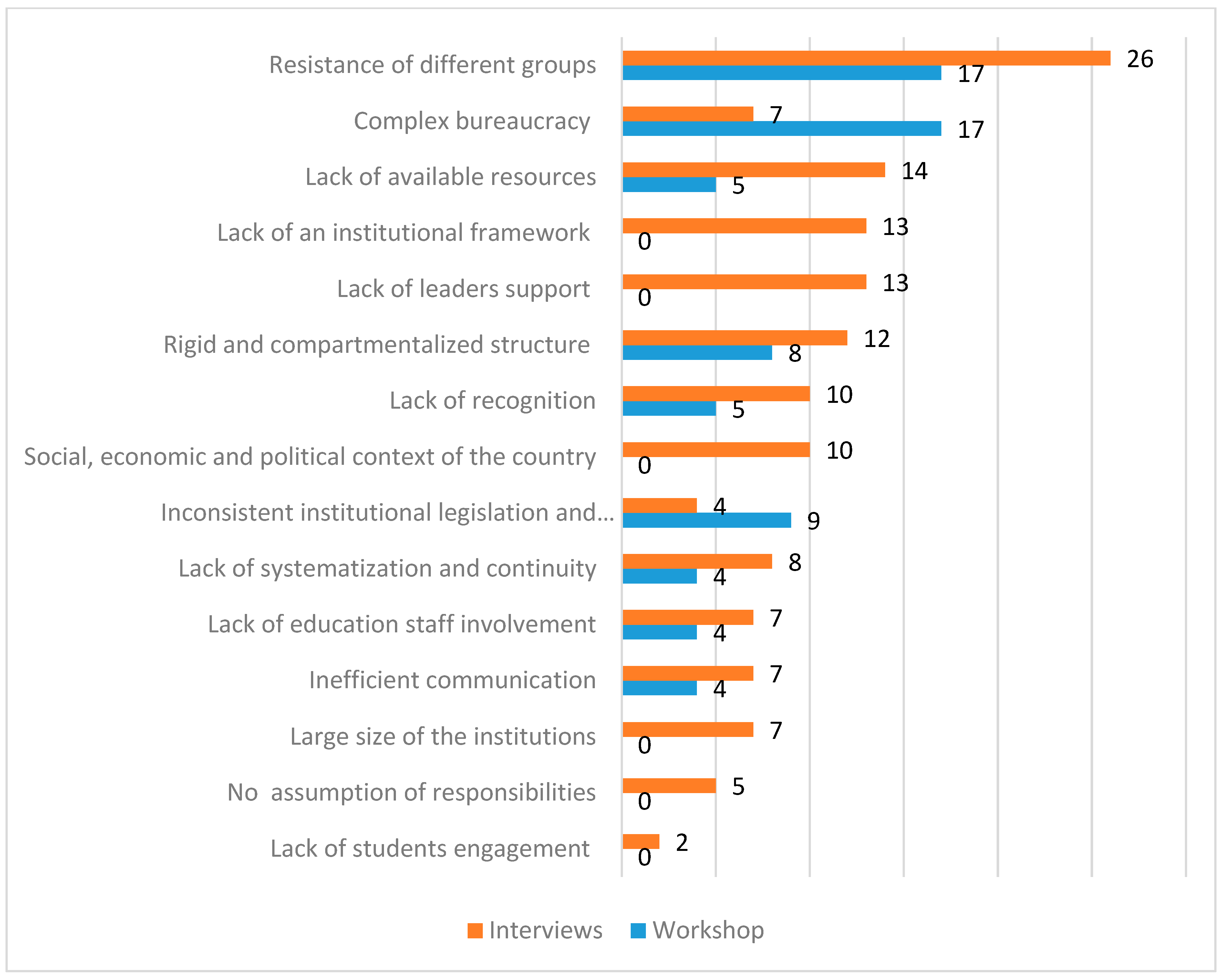
3.2. Findings on Barriers to Change towards Sustainability in HEIs
3.3. Relationship between Drivers for and Barriers to Change towards Sustainability in HEIs
4. Conclusions
Author Contributions
Funding
Acknowledgments
Conflicts of Interest
References
- UN General Assembly. Transforming Our World: The 2030 Agenda for Sustainable Development; United Nations: New York, NY, USA, 2015; Volume 1. [Google Scholar]
- Cortese, A.D. The critical role of higher education in creating a sustainable future. Plan. High Educ. 2003, 31, 15–22. [Google Scholar]
- Koester, R.J. The Sustainable University: Progress and Prospects; Sterling, S., Maxey, L., Luna, H., Eds.; Earthscan/Routledge: London, UK; New York, NY, USA, 2013; ISBN (e-book) 978-0-203-10178-0. [Google Scholar]
- Tilbury, D. Another world is desirable: Transforming higher education for sustainability. In The Sustainable University: Process and Prospects; Sterling, S., Maxey, L., Luna, H., Eds.; Earthscan/Routledge: London, UK, 2013; pp. 97–112. [Google Scholar]
- Lozano, R. Incorporation and institutionalization of SD into universities: Breaking through barriers to change. J. Clean. Prod. 2006, 14, 787–796. [Google Scholar] [CrossRef] [Scilit]
- Sterling, S.; Thomas, I. Education for sustainability: The role of capabilities in guiding university curricula. Int. J. Sustain. High. Educ. 2006, 1, 349–370. [Google Scholar] [CrossRef] [Scilit]
- Blake, J.; Stephen, S. Tensions and transitions: Effecting change towards sustainability at a mainstream university through staff living and learning at an alternative, civil society college. Environ. Educ. Res. 2011, 17, 125–144. [Google Scholar] [CrossRef] [Scilit]
- Barth, M. Many roads lead to sustainability: A process-oriented analysis of change in higher education. Int. J. Sustain. High. Educ. 2013, 14, 160–175. [Google Scholar] [CrossRef] [Scilit]
- Lozano, R.A. Holistic perspective on corporate sustainability drivers. Corp. Soc. Responsib. Environ. Manag. 2015, 22, 32–44. [Google Scholar] [CrossRef] [Scilit]
- Leal Filho, W. Teaching sustainable development at university level: Current trends and future needs. J. Balt. Sci. Educ. 2010, 9, 273–284. [Google Scholar]
- Lozano, R.; Lukman, R.; Lozano, F.; Huisingh, D.; Lambrechts, W. Declarations for sustainability in higher education: Becoming better leaders, through addressing the university system. J. Clean. Prod. 2013, 16, 10–19. [Google Scholar] [CrossRef] [Scilit]
- Michelsen, G. Policy, politics and polity in higher education for sustainable development. In Routledge Handbook of Higher Education for Sustainable Development; Barth, M., Michelsen, G., Thomas, I., Rieckmann, M., Eds.; Routledge: London, UK, 2016; pp. 40–55. [Google Scholar]
- Global University Network for Innovation (GUNI). Approaches to SDG 17 Partnerships for the Sustainable Development Goals (SDGs). A Publication by the GUNi Group of Experts in SDGs and Higher Education. 2018. Available online: http://www.guninetwork.org/files/approaches_to_sdg17-partnerships_for_the_sdgs.pdf (accessed on 10 April 2018).
- Wright, T.S.A. Definitions and frameworks for environmental sustainability in higher education. Int. J. Sustain. High. Educ. 2002, 3, 203–220. [Google Scholar] [CrossRef] [Scilit]
- Wals, A.E.J. Sustainability in higher education in the context of the UN DESD: A review of learning and institutionalization processes. J. Clean. Prod. 2014, 62, 8–15. [Google Scholar] [CrossRef] [Scilit]
- Ferrer-Balas, D.; Adachi, J.; Banas, S.; Davidson, C.I.; Hoshikoshi, A.; Mishra, A.; Motodoa, Y.; Ostwald, M. An international comparative analysis of sustainability transformation across seven universities. Int. J. Sustain. High. Educ. 2008, 9, 295–316. [Google Scholar] [CrossRef] [Scilit]
- Verhulst, E.; Lambrechts, W. Fostering the incorporation of sustainable development in higher education. Lessons learned from a change management perspective. J. Clean. Prod. 2015, 106, 189–204. [Google Scholar] [CrossRef] [Scilit]
- Blanco-Portela, N.; Benayas, J.; Pertierra, L.R.; Lozano, R. Towards the integration of sustainability in Higher Education Institutions: A review of drivers for and barriers to change. J. Clean. Prod. 2017, 166, 563–578. [Google Scholar] [CrossRef] [Scilit]
- Sammalisto, K.; Arvidsson, K. Environmental management in Swedish higher education: Directives, driving forces, hindrances, environmental aspects and environmental co-ordinators in Swedish universities. Int. J. Sustain. High. Educ. 2005, 6, 18–35. [Google Scholar] [CrossRef] [Scilit]
- James, M.; Card, K. Factors contributing to institutions achieving environmental sustainability. Int. J. Sustain. High. Educ. 2012, 13, 166–176. [Google Scholar] [CrossRef] [Scilit]
- Lidgren, A.; Rodhe, H.; Huisingh, D. A systemic approach to incorporate sustainability into university courses and curricula. J. Clean. Prod. 2006, 14, 797–809. [Google Scholar] [CrossRef] [Scilit]
- Krizek, K.J.; Newport, D.; White, J.; Townsend, A.R. Higher education’s sustainability imperative: How to practically respond? Int. J. Sustain. High. Educ. 2012, 13, 19–33. [Google Scholar] [CrossRef] [Scilit]
- Ralph, M.; Stubbs, W. Integrating environmental sustainability into universities. High. Educ. 2014, 67, 71–90. [Google Scholar] [CrossRef] [Scilit]
- Chiappetta Jabbour, C.J.; Sarkis, J.; Lopes de Sousa Jabbour, A.B.; Govindan, K. Understanding the process of greening of Brazilian business schools. J. Clean. Prod. 2013, 61, 25–35. [Google Scholar] [CrossRef] [Scilit]
- Moore, J. Barriers and pathways to creating sustainability education programs: Policy, rhetoric and reality. Environ. Educ. Res. 2005, 11, 537–555. [Google Scholar] [CrossRef] [Scilit]
- Dahle, M.; Neumayer, E. Overcoming barriers to campus greening: A survey among higher educational institutions in London, UK. Int. J. Sustain. High. Educ. 2001, 2, 139–160. [Google Scholar] [CrossRef] [Scilit]
- Aleixo, A.M.; Leal, S.; Azeiteiro, U.M. Conceptualization of sustainable higher education institutions, roles, barriers, and challenges for sustainability: An exploratory study in Portugal. J. Clean. Prod. 2018, 172, 1664–1673. [Google Scholar] [CrossRef] [Scilit]
- Lozano, R. Orchestrating organisational changes for corporate sustainability. Greener Manag. Int. 2012, 57, 43–64. [Google Scholar] [CrossRef] [Scilit]
- Benayas, J.; Alba, D.; Justel, A. Proyecto RISU. Definición de Indicadores para la evaluación de las políticas de sustentabilidad en universidades latinoamericanas. Madrid: Universidad Autónoma de Madrid y Alianza de Redes Iberoamericanas de Universidades por la Sustentabilidad y el Ambiente, Executive Summary. 2014, p. 52. Available online: http://ariusa.net/es/informe-sobre-resultados-del-proyecto-risu (accessed on 15 June 2017).
- Blanco-Portela, N. Análisis de Impacto del Proyecto RISU: Un Estudio desde las Transformaciones y Mejoras en las Estructuras y Dinámicas de las Universidades Latinoamericanas Frente a la Sostenibilidad. Ph.D. Thesis, Universidad Nacional de Educación a Distancia, Madrid, Spain, September 2017. [Google Scholar]
- Merton, R.K.; Kendall, P.L. The focused interview. Am. J. Sociol. 1946, 51, 541–557. [Google Scholar] [CrossRef] [Scilit]
- Mayring, P. Qualitative Inhaltsanalyse—Grundlagen und Techniken; Beltz: Weinheim, Germany; Basel, Switzerland, 2010. [Google Scholar]
- Velazquez, L.; Munguia, N.; Sanchez, M. Deterring sustainability in higher education. An appraisal of the factors which influence sustainability in higher education institutions. Int. J. Sustain. High. Educ. 2005, 6, 383–391. [Google Scholar] [CrossRef] [Scilit]
- Ceulemans, K.; Lozano, R.; Alonso-Almeida, M.D.M. Sustainability reporting in higher education: Interconnecting the reporting process and organisational change management for sustainability. Sustainability 2015, 7, 8881–8903. [Google Scholar] [CrossRef] [Scilit]
- Mohamad, Z.F.; Kadir, S.N.A.; Nasaruddin, A.; Sakai, N.; Zuki, F.M.; Hussein, H.; Sulaiman, A.H.; Salleh, M.S.A.M. Heartware as a driver for campus sustainability: Insights from an action-oriented exploratory case study. J. Clean. Prod. 2018, 196, 1086–1096. [Google Scholar] [CrossRef] [Scilit]


| Drivers for Change | Description and Remarks |
|---|---|
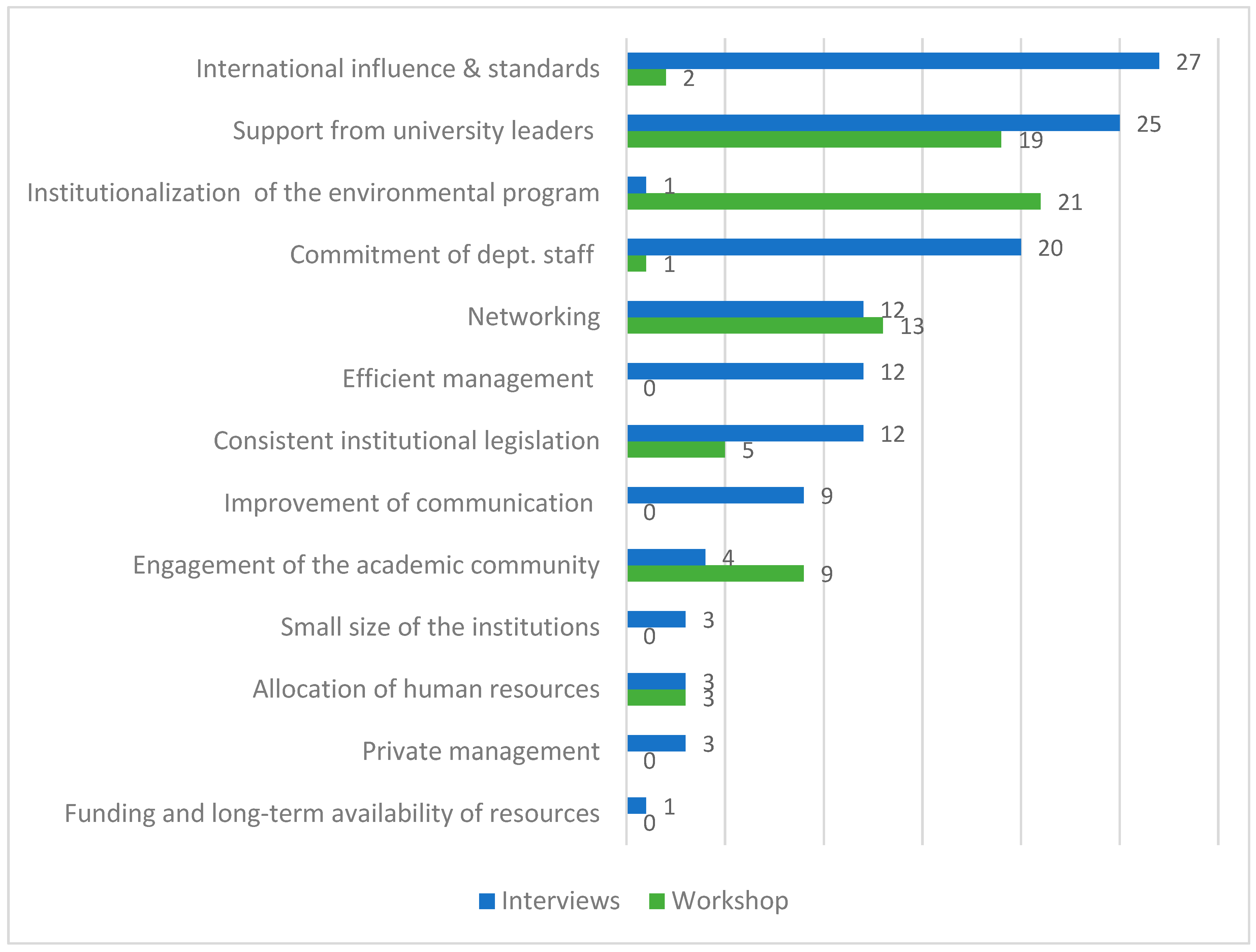
| s.1. Commitment of dept. staff with assumption of roles and responsibilities | Any department of the academic institution reacting positively with their commitment and involvement in the transformation of the institution. They understand the need to rethink their daily activities by incorporating sustainability criteria. Departments and schools lead projects, assuming their responsibility in design and execution. |
| s.2. International influence & standards. Environmental certifications and good practices marketing | The status of the academic institution is benefited (nationally and internationally) when the university is committed to sustainability matters. Students increasingly prefer to study in universities that are actively engaged in these matters. With regard to global issues, internal actions are widely supported to move from theory to practice. Several universities have certifications of environmental quality, and this stand makes them more adept to support any actions. Moreover, some universities compete for international rankings and thus they are extra motivated to follow good practices. |
| s.3. Allocation of human resources | Employment of personnel. Designation of a ULS and a work team with full time dedication (or combined with teaching). They manage the integration and development of sustainability practices at the institution. |
| s.4. Consistent institutional legislation | Existence of an environmental sustainability policy in the institution. Water, waste and energy management are regulated by institutional programs. The action plan of the institution has well-defined references to the assimilation of sustainable development in teaching and research practices. Social responsibility and liability is regulated, so any environmental problem that affects the academic community and the nearby settlements can be effectively addressed. |
| s.5. Engagement of the academic community | Participation and support of the academic community for activities organized by the sustainability office. |
| s.6. Networking | Fluent exchange of knowledge and experiences between universities is perceived as highly beneficial. A positive feeling of reinforcement comes from sharing with others the same goal. Moreover, collaboration also promotes joint participation in transversal research between universities. |
| s.7.Institutionalisation of the sustainability | A sustainable development program that redefines the whole institutional framework. Institutional action plans have a long-term focus. Sustainability alters the organizational structure, as well as teaching and research practices. Environmental issues are progressively more prominently embedded in the culture of the institution. Each new action executed incorporates more criteria in terms of sustainability. |
| s.8. Support from university leaders and policy makers | The management board of the institution firmly supports the sustainability project. Interest is solidified with financial resources in a dedicated budged line. Any approval of new policies, regulations and guidelines at all levels of the institution to integrate sustainable practices is backed by the directorship. |
| s.9. Funding and long-term availability of resources | The existence of funding under a strategic planning that guarantees the long-term availability of resources for the institutionalization project. The institution can allocate resources for development plans that integrate sustainable practices. |
| s.10 Small size of the institutions | Smaller institutions tend to allow for faster processing. The management board is more approachable. Actions and activities can be more easily communicated and have a deeper impact on the community. |
| s.11. Improvement of the communication channels | Effective communication that reaches the whole community. Department chiefs boost and reproduce the information in their schools. The institutional website has an area to disseminate details of sustainability activities, actions and projects within the university. |
| s.12. Private management | Private universities have less bureaucracy and the allocation of resources is less restricted |
| s.13. Efficient management on changing the internal organizational structure | Existence of an efficient management that encompasses the integration of sustainability. Flexibility of curricula. Sustainability has been incorporated transversely or in sections of the curricula. Integration of the environmental management with the teaching, research and social responsibilities of the institution. Sustainable development is not disconnected from academic practices and is solely focused on the compliance of legal regulations. |
| Barriers | Description and Remarks |
|---|---|
| b.1. Inconsistent institutional legislation and implementation | Even though the management board expresses its commitment towards the institutionalization of sustainability, the process of setting up a sustainability policy and associated ordinances to regulate specific actions is slow or absent. In multiple institutions, such commitment, despite being in the vision and mission of the university, does not move from theory to practice. As a result, the environmental management programs do not become institutionalized, and thus, only isolated actions are implemented. |
| b.2. Complex bureaucracy | Government hindrances to budget allocation, excessive paperwork, delays in processing, and the need for guarantees from different departments for the approval of resources, and dedicated space or time by personnel may obstruct the actions, and slow down the progress of the integration. Execution time can stretch with action requirements. |
| b.3. Inefficient communication | Communication channels in institutions are not effective. Lack of assertive communication among the academic community is an obstacle to change, leading to isolated actions, and duplicity of efforts and resources. Scarce dissemination of details of project activities and the efforts of change and achievements from devoted students or lecturers. ULSs are forced to repetitively remind all involved of the purpose of the project at all levels, as the progress stalls when communication is halted. Thus, this activity is strongly perceived as time and resource consuming, and is proportional to institution size. In addition, departments might carry out isolated actions, directed at their members, without knowing of institutional projects with a central office and representatives that could coordinate their development. |
| b.4. Lack of education staff involvement. | Lecturers are swamped by the number of hours dedicated to teaching, and do not have time to work on other activities. This is more common with older lecturers, who are reluctant to participate in any activity that they were not employed for. Environmental matters are perceived as a ‘filler’ detractor from the ‘real’ knowledge that the student are required to learn as per their educational plan. |
| b.5. Lack of long-term planning, systematization and continuity. | The high turnover of personnel slows down any action, since they often require starting from zero with the arrival of a new employee. After the departure of the dedicated person/s from the institution, the project is often lost, highlighting the fact that it was not institutionalized. All efforts and resources invested are thus lost. This is also evident with the arrival of a new chancellor, as all project efforts are unknown to new staff, receive no continuity, and years of work and allocated resources are lost. |
| b.6 Lack of recognition | The relevance given to the integration of sustainability is highly situational, mainly associated with a specific date or event; however, after it, the matter is set aside, displaced by other projects and interests of the institution. Institutional planning does not formally recognize the project of institutionalization of sustainability, and so the resources for its execution are limited or non-existent. At the same time, other projects are prioritized, restraining the integration of sustainable higher education. |
| b.7 Lack of available resources | Lack of economic resources and academic personnel dedicated to developing different actions, projects and activities. The management board does not perceive sustainability projects as priority, therefore it does not allocate economic resources or personnel (coordinators and work teams) to develop them. |
| b.8 Resistance of different groups. Lack of social legitimacy | Generalized reticence to modify any behavior and activity that have been carried out in the institution for a long time. Reticence to leave routines, and transit towards more responsible actions. This attitude is generalized, shared by all groups of the academic community—students, lecturers, administrative staff, and service personnel. A culture of ‘we’ve done it that way, and it works, so there is no reason for change’ causes serious impediments to the success of any action. |
| b.9 Rigid and compartmentalized internal organizational structure | Operating system is very rigid, with several steps required to approve any change. The academic structure is also very fixed, with delimited curricula, being highly specialized, missing a holistic approach or space for transverse actions. Any transverse action between departments and schools is tiresome and costly, even for courses on dedicated educational planning. |
| b.10. No assumption of responsibilities | There is a general lack of initiative by the personnel in departments, either to take on leading roles on sustainability activities, or to suggest new actions. The SL tries to promote the assignation and assumption of responsibilities, but this has a low initial response, which decreases over time. |
| b.11 Large size of the institutions | A large number of schools and campuses, together with the large number of lecturers and students, makes it much harder to reach and stimulate the engagement of the academic community in processes aimed at the integration of sustainability |
| b.12. Lack of student’s engagement in extra-curricular activities | It is hard to encourage the student to participate due to the number of academic activities, which limits their time to participate in other activities. There is no academic support from department boards to stimulate students to take part in extra-curricular activities |
| b.13. Social, economic and political context of the country | Budget cuts to public universities, political instability of governments, and social crises cause sustainability to be recognized as ‘low priority’, thus leading to a deprivation of resources for its execution. |
| b.14. Lack of support from university leaders and policy makers | The central management board of the institution does not back the project, show interest, allocate resources to develop it, and/or decide to assign time to its personnel to attend to sustainability matters. |
| b.15. Lack of an institutional framework for sustainability | The integration of sustainability practices is not supported by the directorship. Therefore, it is solely developed with isolated actions and small projects, orchestrated voluntarily by lecturers without any assigned time to fulfil these tasks. As a consequence, their actions do not alter structures and practices of the institution. |
| Scope | Barriers to Change | Drivers for Change |
|---|---|---|
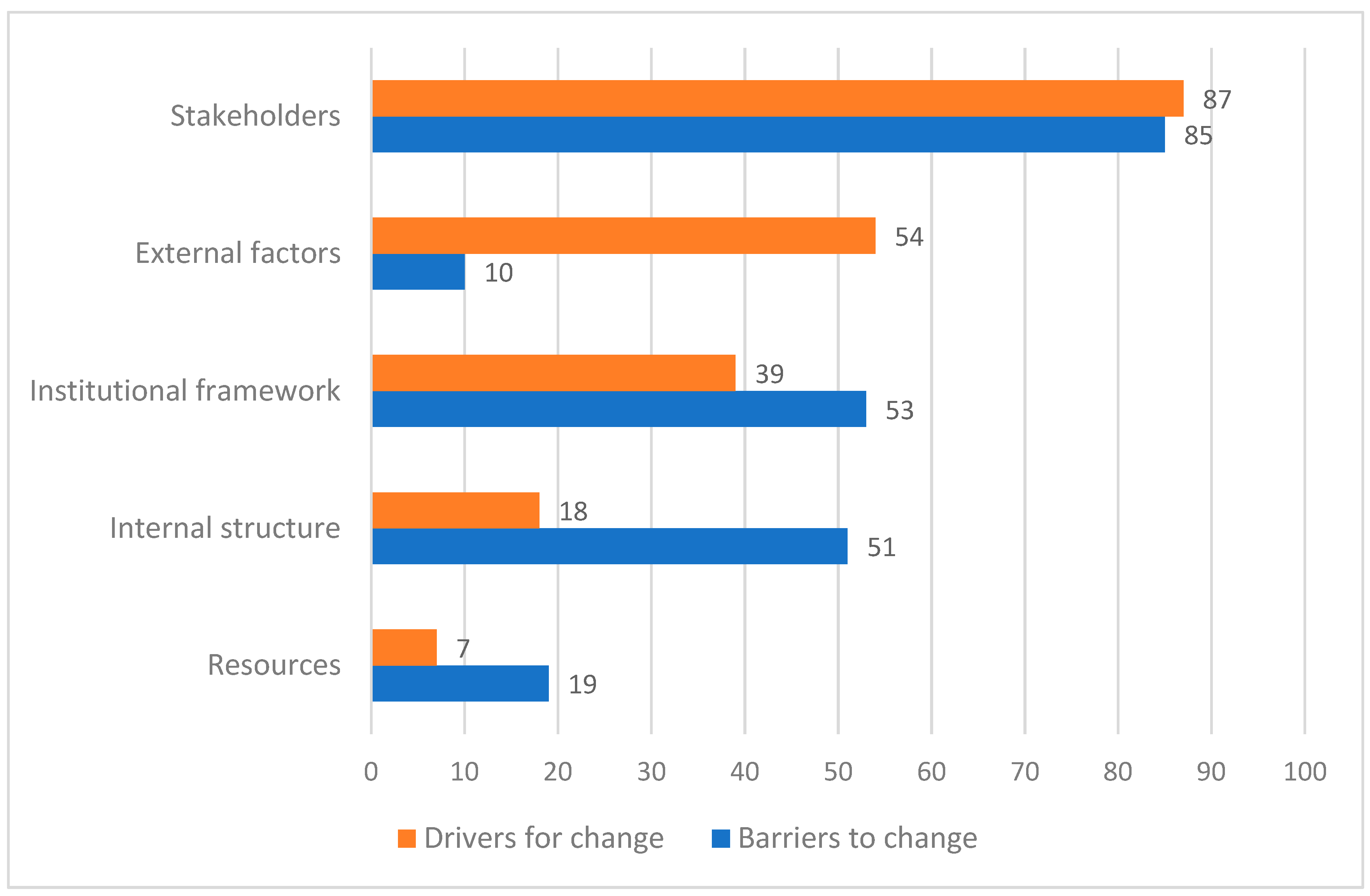
| Internal structure | Rigid organizational structure Complex bureaucracy | Efficient internal management |
| Size of the institution | Small size | |
| Private institution | ||
| External factors | Social and political context of the country | Networking Good practices marketing International influence & standards. Environmental certifications |
| Stakeholders | Lack of university leaders support | University leaders support |
| Inefficient communication | Assertive communication | |
| Lack of responsibilities Lack of education staff involvement Lack of student participation Group resistance to change | Committed personnel, dept. staff with assigned roles and responsibilities; engagement of the academic community | |
| Institutionalframework | Inconsistent legislation | Consistent institutional legislation |
| Lack of an institutional framework for sustainability | Institutionalization of sustainability | |
| Lack of long-term planning and continuity Lack of recognition | ||
| Resources | Lack of resources | Allocated human resources; funding and long-term availability of resources |
© 2018 by the authors. Licensee MDPI, Basel, Switzerland. This article is an open access article distributed under the terms and conditions of the Creative Commons Attribution (CC BY) license (http://creativecommons.org/licenses/by/4.0/).
Share and Cite
Blanco-Portela, N.; R-Pertierra, L.; Benayas, J.; Lozano, R. Sustainability Leaders’ Perceptions on the Drivers for and the Barriers to the Integration of Sustainability in Latin American Higher Education Institutions. Sustainability 2018, 10, 2954. https://doi.org/10.3390/su10082954
Blanco-Portela N, R-Pertierra L, Benayas J, Lozano R. Sustainability Leaders’ Perceptions on the Drivers for and the Barriers to the Integration of Sustainability in Latin American Higher Education Institutions. Sustainability. 2018; 10(8):2954. https://doi.org/10.3390/su10082954
Chicago/Turabian StyleBlanco-Portela, Norka, Luis R-Pertierra, Javier Benayas, and Rodrigo Lozano. 2018. "Sustainability Leaders’ Perceptions on the Drivers for and the Barriers to the Integration of Sustainability in Latin American Higher Education Institutions" Sustainability 10, no. 8: 2954. https://doi.org/10.3390/su10082954
APA StyleBlanco-Portela, N., R-Pertierra, L., Benayas, J., & Lozano, R. (2018). Sustainability Leaders’ Perceptions on the Drivers for and the Barriers to the Integration of Sustainability in Latin American Higher Education Institutions. Sustainability, 10(8), 2954. https://doi.org/10.3390/su10082954