An Original Approach Combining CFD, Linearized Models, and Deformation of Trees for Urban Wind Power Assessment




Abstract
1. Introduction
2. Data and Methods
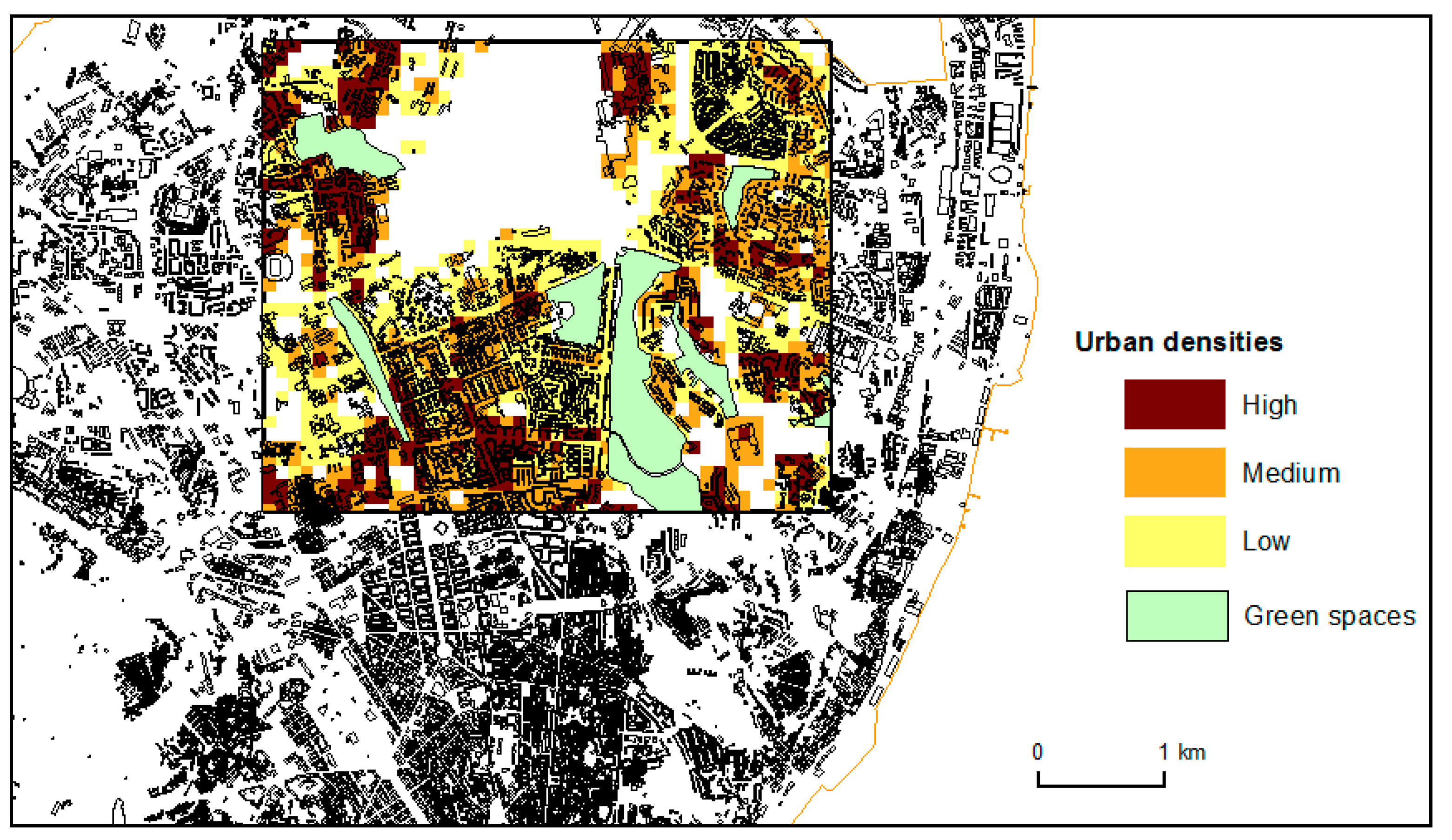
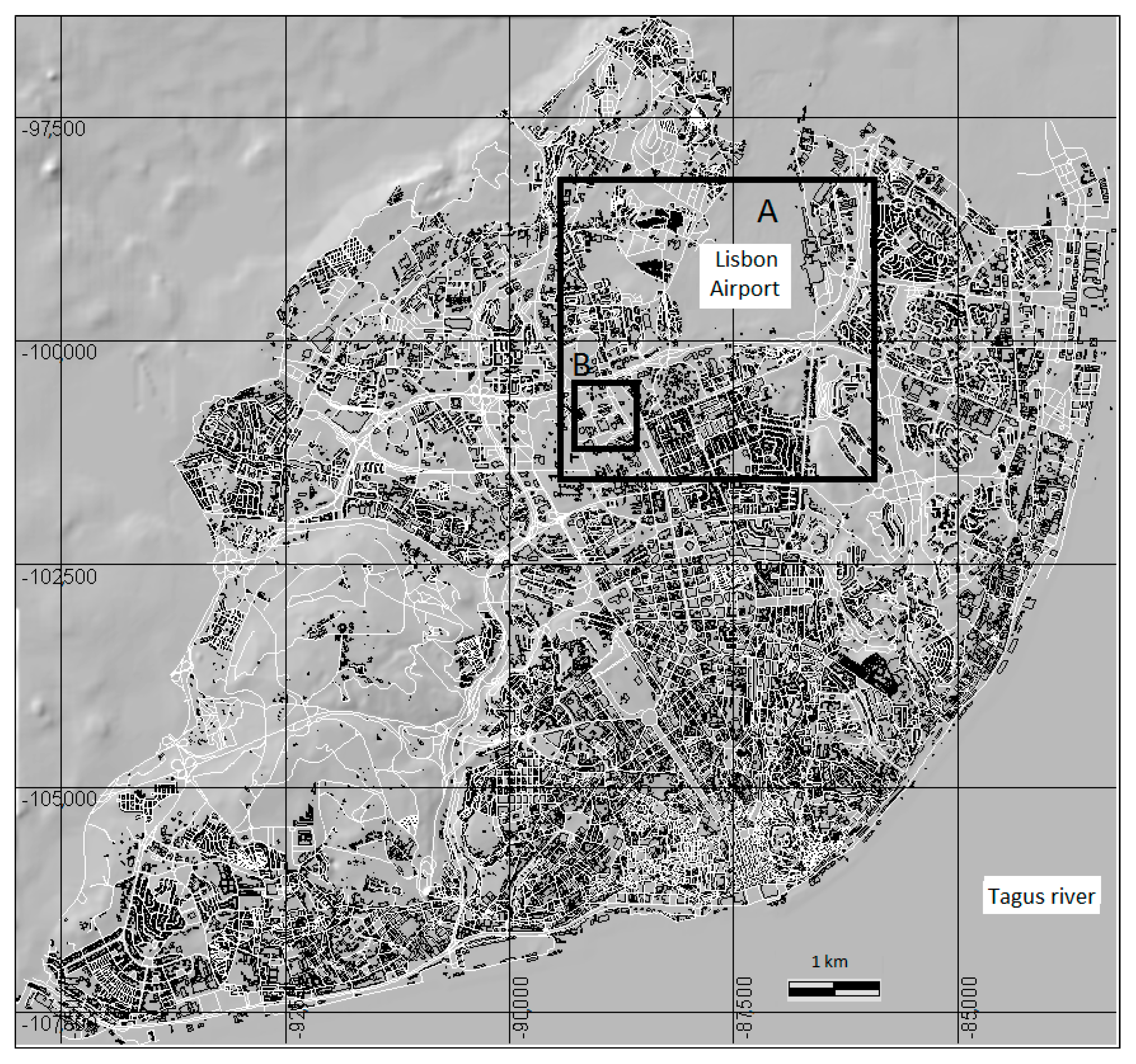
2.1. Site Description of Lisbon
2.2. Bioindicators
2.3. Measurement of Tree Deformation for the Wind Speed Assessment
2.4. Wind Data and Modeling
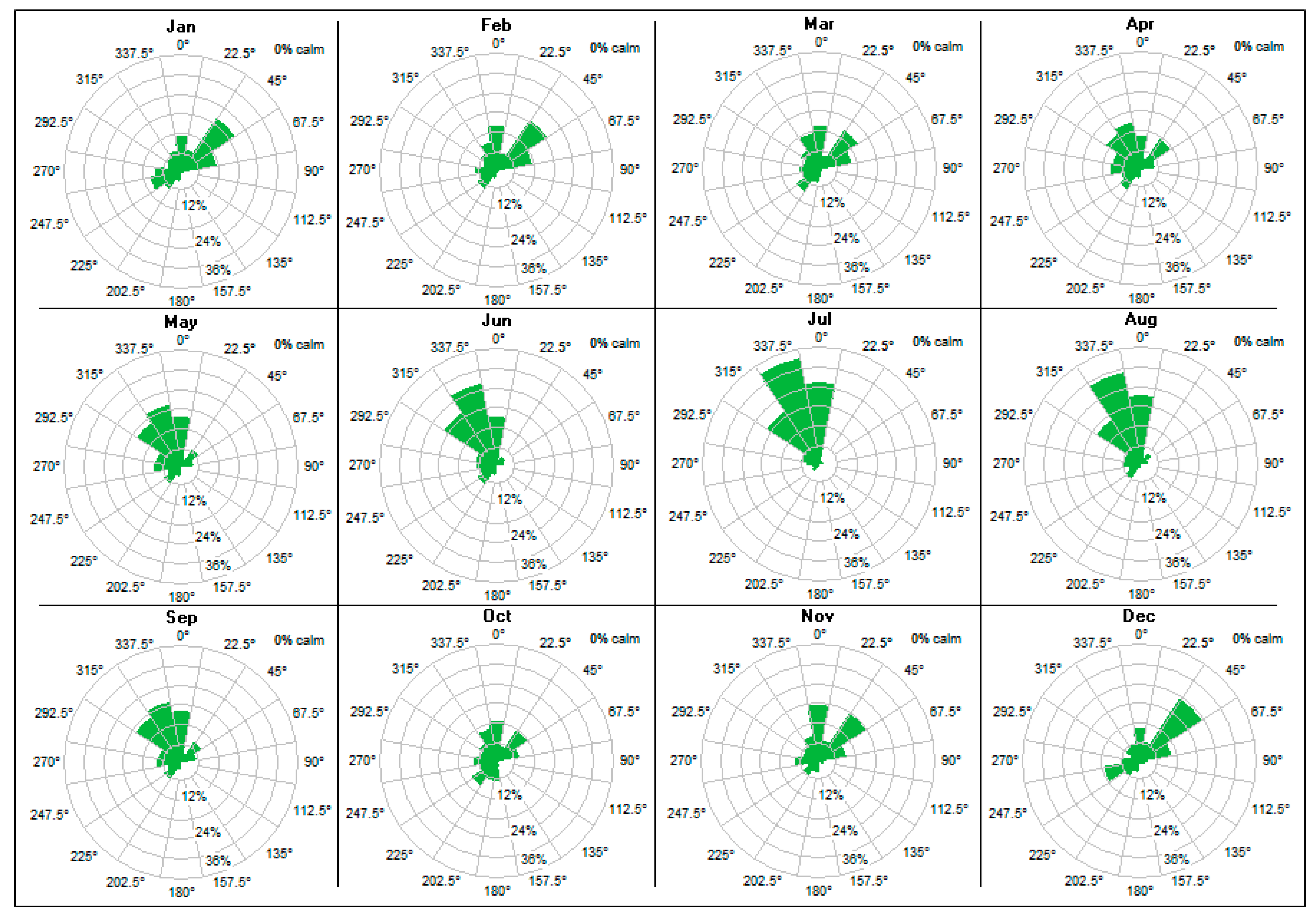
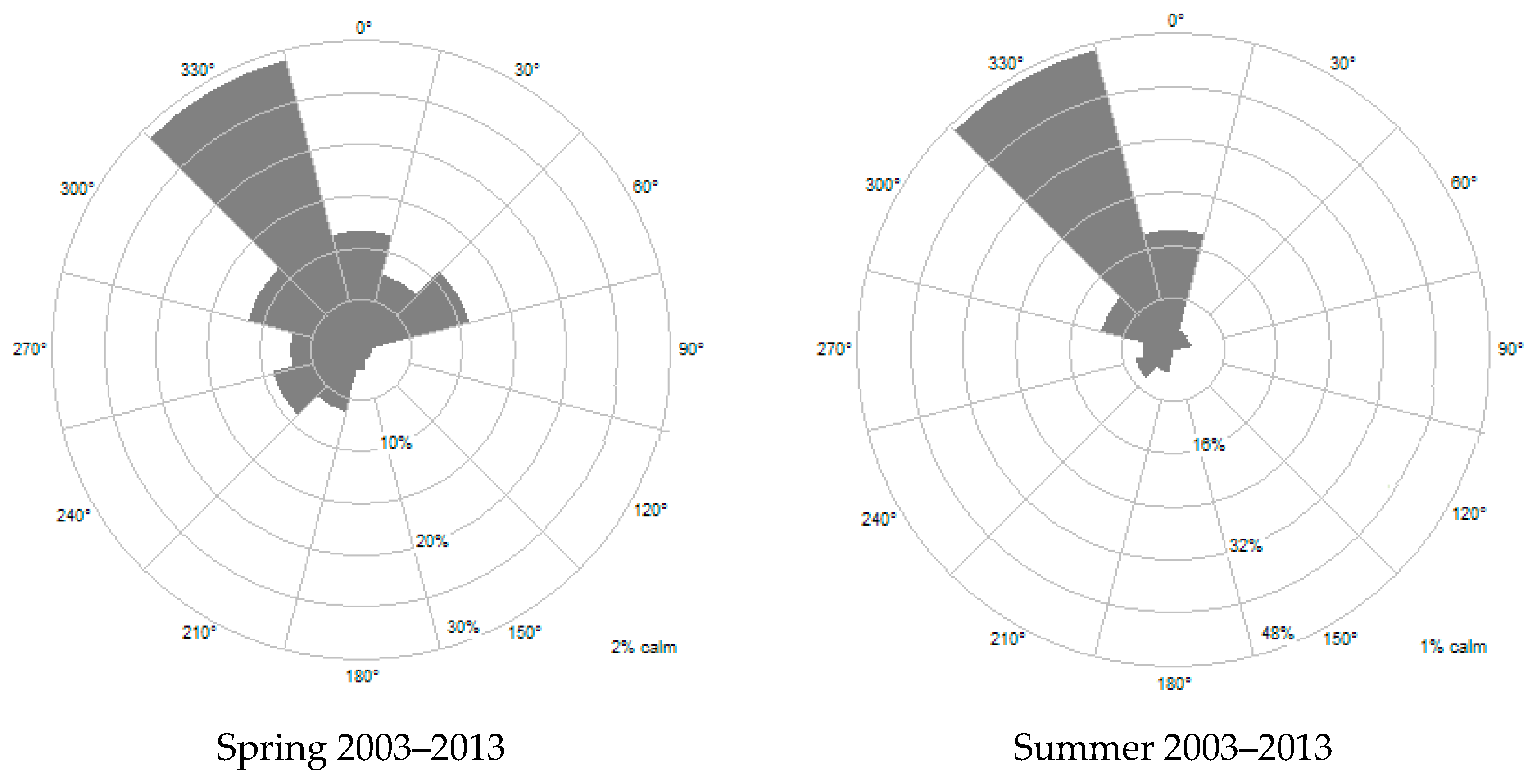
2.4.1. Wind Data
2.4.2. Models (ENVI-Met and WAsP)
3. Results
3.1. Wind Conditions in the Northern Part of Lisbon
3.2. The Griggs-Putnam Index of Tree Deformations in Urban Areas (Inside ULisboa Neighborhood)
3.3. Micro-Meteorological (ENVI-Met) Wind Flow Assessment (Inside ULisboa Neighborhood)
3.4. WAsP Local Wind Power Assessment
4. Discussion
5. Conclusions
Acknowledgments
Conflicts of Interest
References
- Kaltschmitt, M.; Streicher, W.; Wiese, A. Renewable Energy. In Technology, Economics and Environment; Springer: Berlin/Heidelberg, Germany; New York, NY, USA, 2007; ISBN 978-3-540-70947-3. [Google Scholar]
- Turner, J.A. A Realizable Renewable Energy Future. Science 1999, 285, 687–689. [Google Scholar] [CrossRef] [PubMed]
- Newman, P.W.G. Sustainability and cities: Extending the metabolism model. Lands. Urban Plan. 1999, 44, 219–226. [Google Scholar] [CrossRef]
- Alcoforado, M.J.; Andrade, H.; Lopes, A.; Vasconcelos, J.; Vieira, R. Observational studies on summer winds in Lisbon (Portugal) and their influence on daytime regional and urban thermal patterns. Merhavim 2006, 6, 90–112. [Google Scholar]
- Lopes, A.; Saraiva, J.; Alcoforado, M.J. Urban boundary layer wind speed reduction in summer due to urban growth and environmental consequences in Lisbon. Environ. Model. Softw. 2011, 26, 241–243. [Google Scholar] [CrossRef]
- Häckel, H. Meteorologie, 7th ed.; UTB Verlag Stuttgart: Stuttgart, Germany, 2012; ISBN 13 978-3825237004. [Google Scholar]
- American Wind Energy Association (AWEA). In the Public Interest. How and Why to Permit for Small Wind Systems. In A Guide for State and Local Governments; AWEA: Washington, DC, USA, 2008. [Google Scholar]
- Krohn, S.; Damborg, S. On Public Attitudes towards Wind Power. Renew. Energy 1999, 16, 954–960. [Google Scholar] [CrossRef]
- Lopes, A.; Correia, E. A proposal to enhance urban climate maps with the assessment of wind power potential. The case of Cascais Municipality (Portugal). In Proceedings of the BIOCLIMATE 2012, “Bioclimatology of Ecosystems” International Scientific Conference, Ústí nad Labem, Czech Republic, 29–31 August 2012; pp. 68–69, ISBN 978-80-213-2299-8. [Google Scholar]
- Berge, E.; Gravdahl, A.R.; Schelling, J.; Tallhaug, L.; Undheim, O. Wind in Complex Terrain. A Comparison of WAsP and Two CFD-Models; Kjeller Vindteknikk AS: Gunnar Randers Vei, Norway, 2006. [Google Scholar]
- Simões, T.; Estanqueiro, A. A new methodology for urban wind resource assessment. Renew. Energy 2016, 89, 598–605. [Google Scholar] [CrossRef]
- Acker, T.; Chime, A.H. Wind Modeling Using WindPro and WAsP Software; Sustainable Energy Solution Lab, Mechanical Engineering Department, Northern Arizona University: Flagstaff, AZ, USA, 2011; pp. 1–11. [Google Scholar]
- Cullen, S. Trees and wind: Wind scales and speeds. J. Arboric. 2002, 28, 237–242. [Google Scholar]
- Wade, J.E.; Hewson, E.W. Trees as a Local Climatic Wind Indicator. J. Appl. Meteorol. 1979, 18, 1182–1187. [Google Scholar] [CrossRef]
- Putnam, P.C. Power from the Wind; Van Nostrand-Reinhold: Princeton, NJ, USA, 1948; 223p. [Google Scholar]
- Yoshino, M.M. Studies of wind-shaped trees: Their classification, distribution and significance as a climatic indicator. Climatol. Notes 1973, 12, 1–52. [Google Scholar]
- Hewson, E.W.; Wade, J.E.; Baker, R.W. A Handbook on the Use of Trees as an Indicator of Wind Power Potential; Final Report; Oregon State University: Corvallis, OR, USA, 1979. [Google Scholar]
- Sagrillo, M. Site Analysis for Wind Generators. Part 1: Average Wind Speed. Home Power 1994, 40, 86–90. [Google Scholar]
- Sagrillo, M. Site Analysis for Wind Generators. Part 2: Your Site. Home Power 1994, 41, 60–65. [Google Scholar]
- Mattio, H.F.; Ponce, G.A. Nociones Generales de Energía Eólica; National University of Salta: Salta, Argentina, 1998; pp. 159–167. [Google Scholar]
- Meneses, B.; Lopes, A. An integrated approach for wind fields assessment in coastal areas, based on bioindicators, CFD modeling, and observations. Theor. Appl. Climatol. 2015, 128, 301–310. [Google Scholar] [CrossRef]
- Bruse, M.; Fleer, H. Simulating surface- plant-air interactions inside urban environments with a three dimensional numerical model. Environ. Softw. Model. 1998, 13, 373–384. [Google Scholar] [CrossRef]
- Correia, E.; Lopes, A.; Marques, D. An automatic GIS procedure to calculate urban densities to use in Urban Climatic Maps. In Proceedings of the 9th International Conference on Urban Climate, 12th Symposium on the Urban Environment, Toulouse, France, 20–24 July 2015. [Google Scholar]
- Portugal, INE. Censos 2011 Resultados Definitivos—Portugal; Statistics Portugal; Instituto Nacional de Estatística: Lisboa, Portugal, 2012.
- Lopes, A.; Alves, E.; Alcoforado, M.J.; Machete, R. Lisbon Urban Heat Island Updated: New Highlights about the Relationships between Thermal Patterns and Wind Regimes. Adv. Meteorol. 2013, 2013, 487695. [Google Scholar] [CrossRef]
- Freire, P.; Andrade, C. Wind-induced sand transport in Tagus estuarine beaches. Aquat. Ecol. 1999, 33, 225–233. [Google Scholar] [CrossRef]
- Borrego, C.; Tchepel, O.; Costa, A.M.; Amorim, J.H.; Miranda, A.I. Emission and dispersion modelling of Lisbon air quality at local scale. Atmos. Environ. 2003, 37, 5197–5205. [Google Scholar] [CrossRef]
- Alcoforado, M.J.; Lopes, A.; Alves, E.; Canário, P. Lisbon heat Island statistical study (2004-2012). Finisterra 2014, 49, 61–80. [Google Scholar] [CrossRef]
- Mayer, H. Baumschwingungen und Sturmgefährdung des Waldes; Münchener Universitäts-Schriften, Meteorologisches Institut: Munich, Germany, 1985; Volume 51, pp. 99–111. [Google Scholar]
- Amtmann, R. Dynamische Windbelastung von Nadelbäumen. In Forstliche Forschungsberichte München; Forstwissenschaftlichen Fakultät der Universität München: Munich, Germany, 1986; Volume 74, p. 52. [Google Scholar]
- Lopes, A.; Oliveira, S.; Fragoso, M.; Andrade, J.; Pedro, P. Wind risk assessment in urban environments: The case of falling trees during windstorm events in Lisbon. In Bioclimatology and Natural Hazards; Střelcová, K., Mátyás, C., Kleidon, L., Lapin, M., Matejka, F., Blaženec, M., Škvarenina, J., Holécy, J., Eds.; Springer: Dordrecht, The Netherlands, 2008; pp. 55–74. [Google Scholar] [CrossRef]
- Manwell, J.F.; McGowan, J.G.; Rogers, A.L. Wind Energy Explained. In Theory, Design and Application, 2nd ed.; WILEY: Chichester, UK, 2009; ISBN 978-0-470-01500-1. [Google Scholar]
- Hiester, T.R.; Pennell, W.T. The Meteorological Aspects of Siting Large Wind Turbines; PNL-2522; Pacific Northwest Laboratory: Richland, WA, USA, 1981. [Google Scholar]
- Blocken, B. 50 years of Computational Wind Engineering: Past, present and future. J. Wind Eng. Ind. Aerodyn. 2014, 129, 69–102. [Google Scholar] [CrossRef]
- Murakami, S. Overview of turbulence models applied in CWE-1997. J. Wind Eng. Ind. Aerodyn. 1998, 74–76, 1–24. [Google Scholar] [CrossRef]
- Lysenko, D.A.; Ertesvag, S.; Rian, K.E. Modeling of turbulent separated flows using OpenFOAM. Comput. Fluids 2013, 80, 408–422. [Google Scholar] [CrossRef]
- Robertson, E.; Choudhury, V.; Bhushan, S.; Walters, D.K. Validation of OpenFOAM numerical methods and turbulence models for incompressible bluff body flows. Comput. Fluids 2015, 123, 122–145. [Google Scholar] [CrossRef]
- Kalvig, S.; Manger, E.; Hjertager, B. Comparing different CFD wind turbine modelling approaches with wind tunnel measurements. J. Phys. Conf. Ser. 2014, 555, 012056. [Google Scholar] [CrossRef]
- Huttner, S.; Bruse, M. Numerical modeling of urban climate—A preview on ENVI-met 4.0. In Proceedings of the Seventh International Conference on Urban Climate, Yokohama, Japan, 29 June–3 July 2009. [Google Scholar]
- Baltazar, S. New Bioclimatic Maps of Lisbon. Finisterra 2014, 49, 81–94. [Google Scholar] [CrossRef]
- Elektrotechnik Stevens. Wind Turbine Skystream 3.7. Updated 2018. Available online: http://www.pro-umwelt.de/windturbine-skystream-37-p-802.html?language=en (accessed on 6 January 2016).
- Xzeres Wind. Wind Turbine Skystream 3.7. Updated 2013. Available online: http://www.windenergy.com/products/skystream/skystream-3.7 (accessed on 11 November 2015).
- Wooldridge, G.; Musselman, R.; Connell, B.; Fox, D. Airflow Patterns in a Small Subalpine Basin. Theor. Appl. Climatol. 1992, 45, 37–41. [Google Scholar] [CrossRef]
- Robertson, A. Estimating Mean Windflow in Hilly Terrain from Tamarack (Larix laricina (Du Roi) K. Koch) Deformation. Int. J. Biometeorol. 1986, 30, 333–349. [Google Scholar] [CrossRef]
- Gipe, P. Wind Power. Renewable Energy for Home, Farm, and Business. In Completely Revised and Expanded Edition; Chelsea Green Publishing: Chelsea, VT, USA, 2004; ISBN 9781931498142. [Google Scholar]
- Sellier, D.; Fourcaud, T. Crown structure and wood properties: Influence on tree sway and response to high winds. Am. J. Bot. 2009, 96, 885–896. [Google Scholar] [CrossRef] [PubMed]

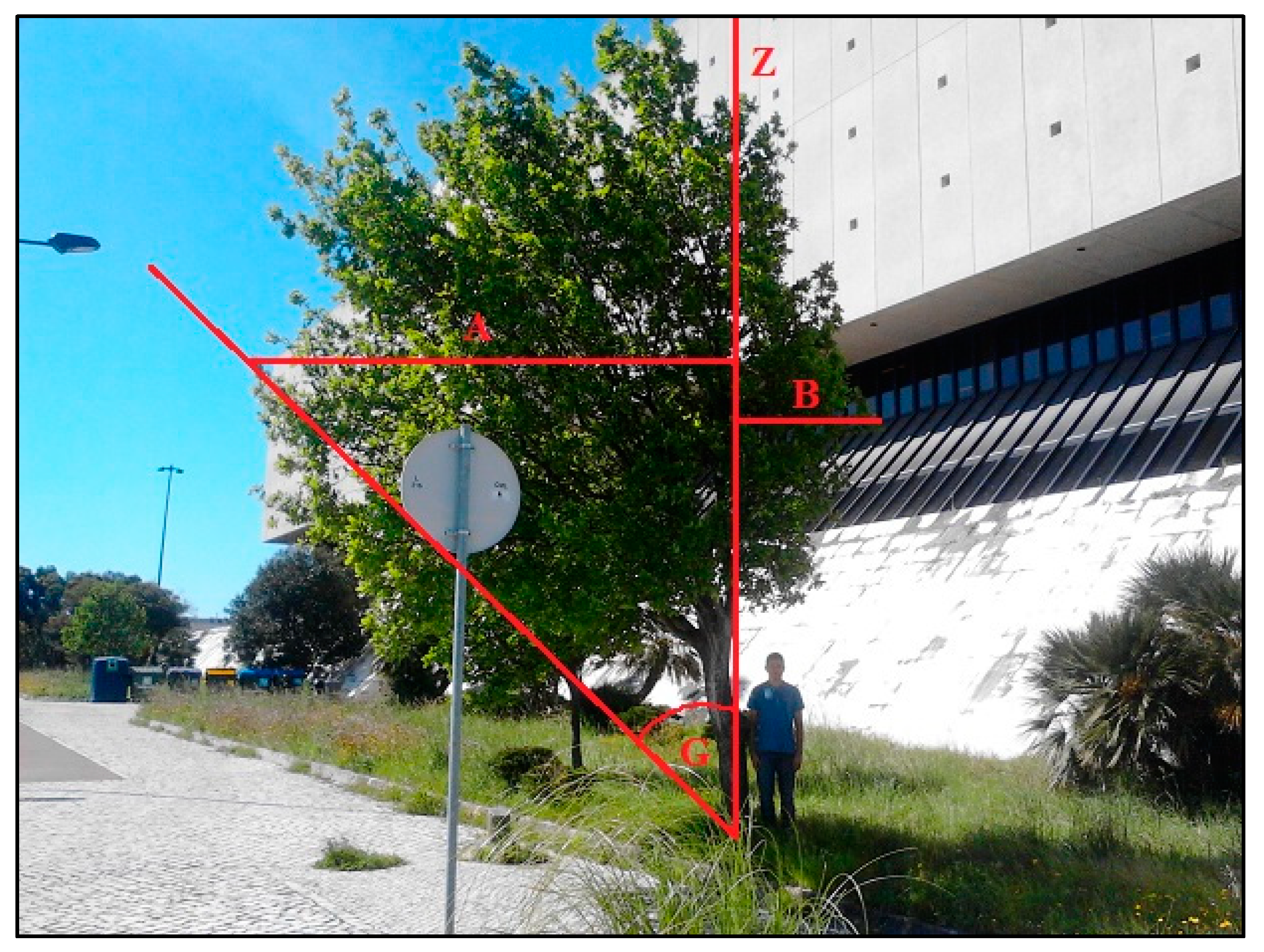
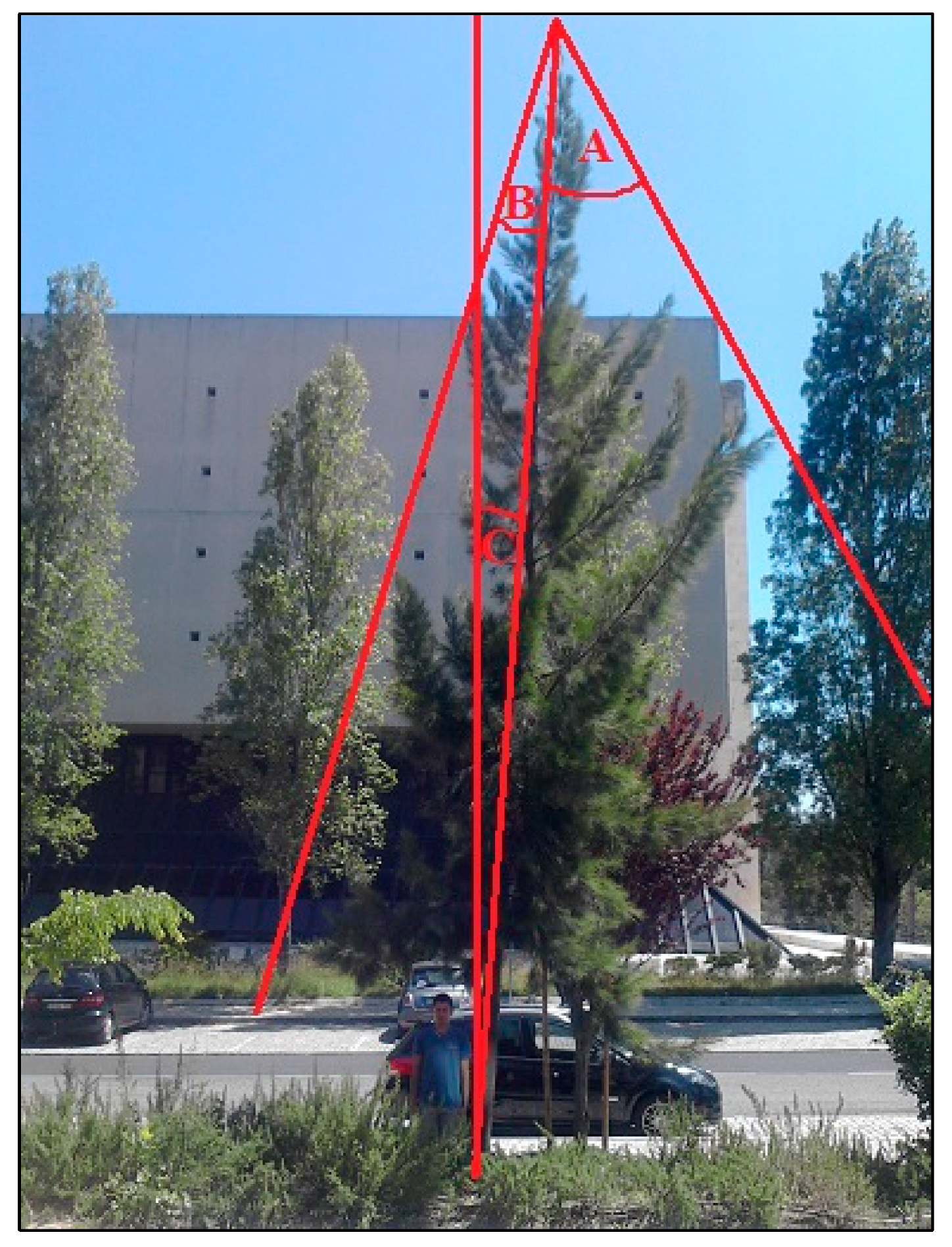
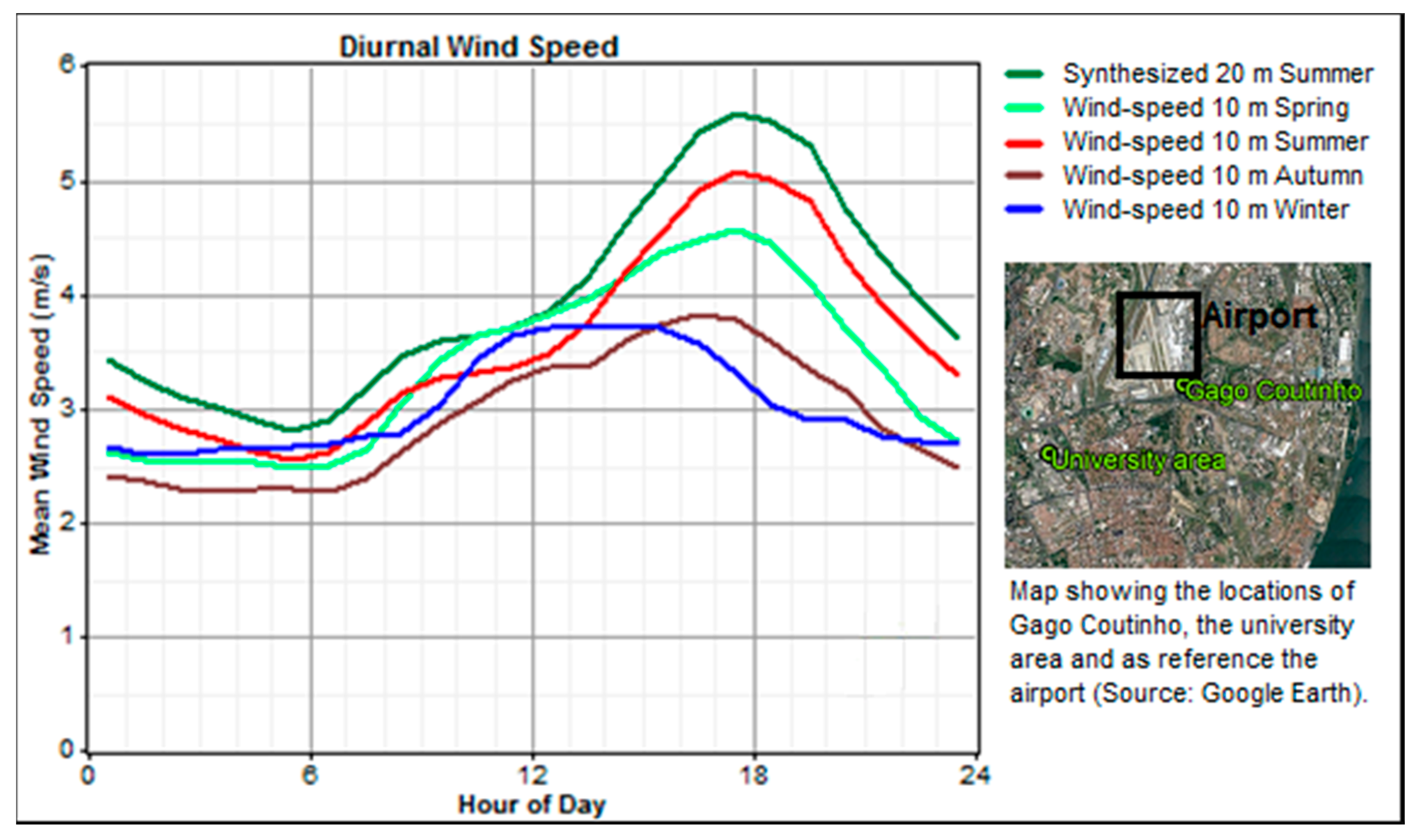

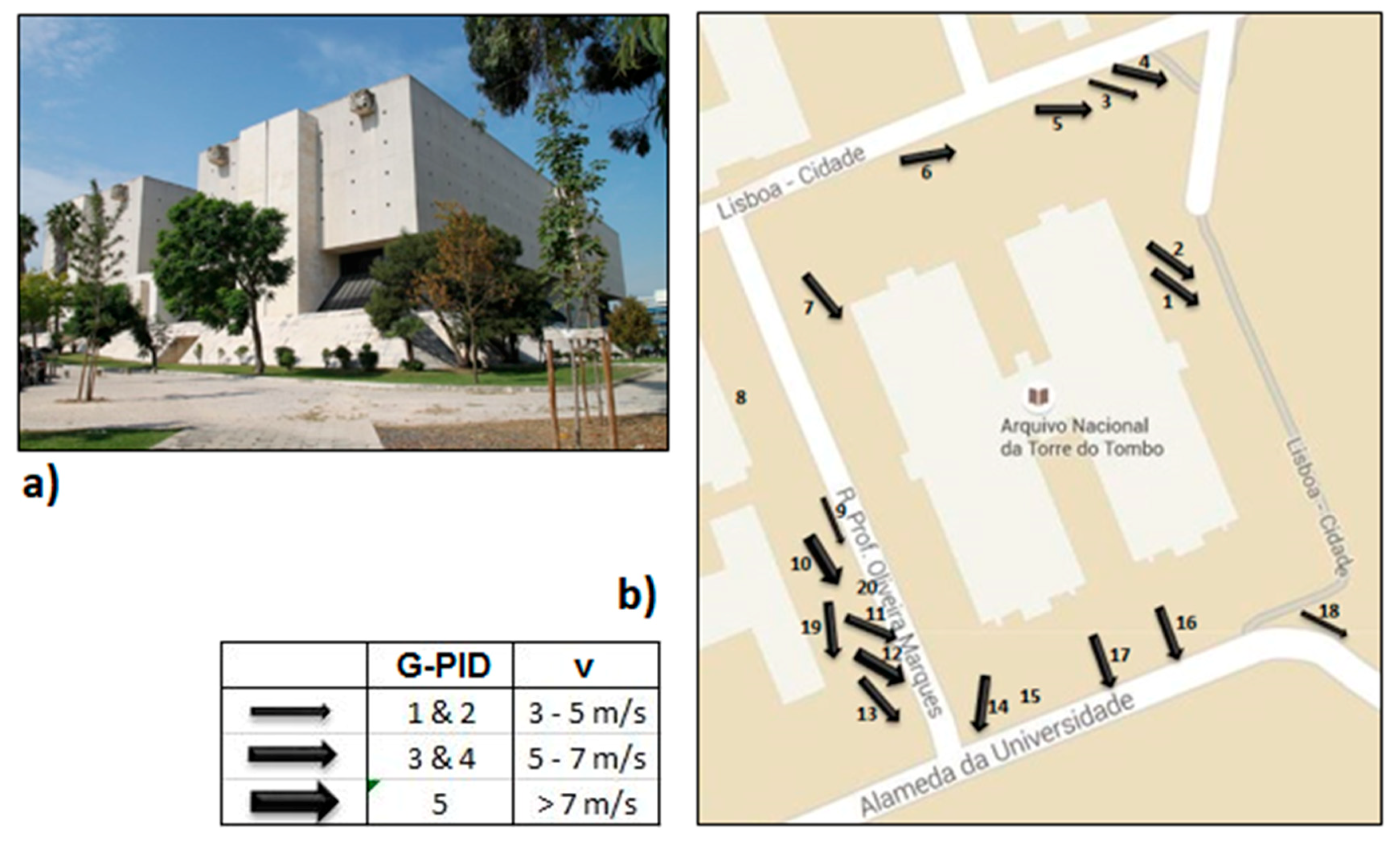
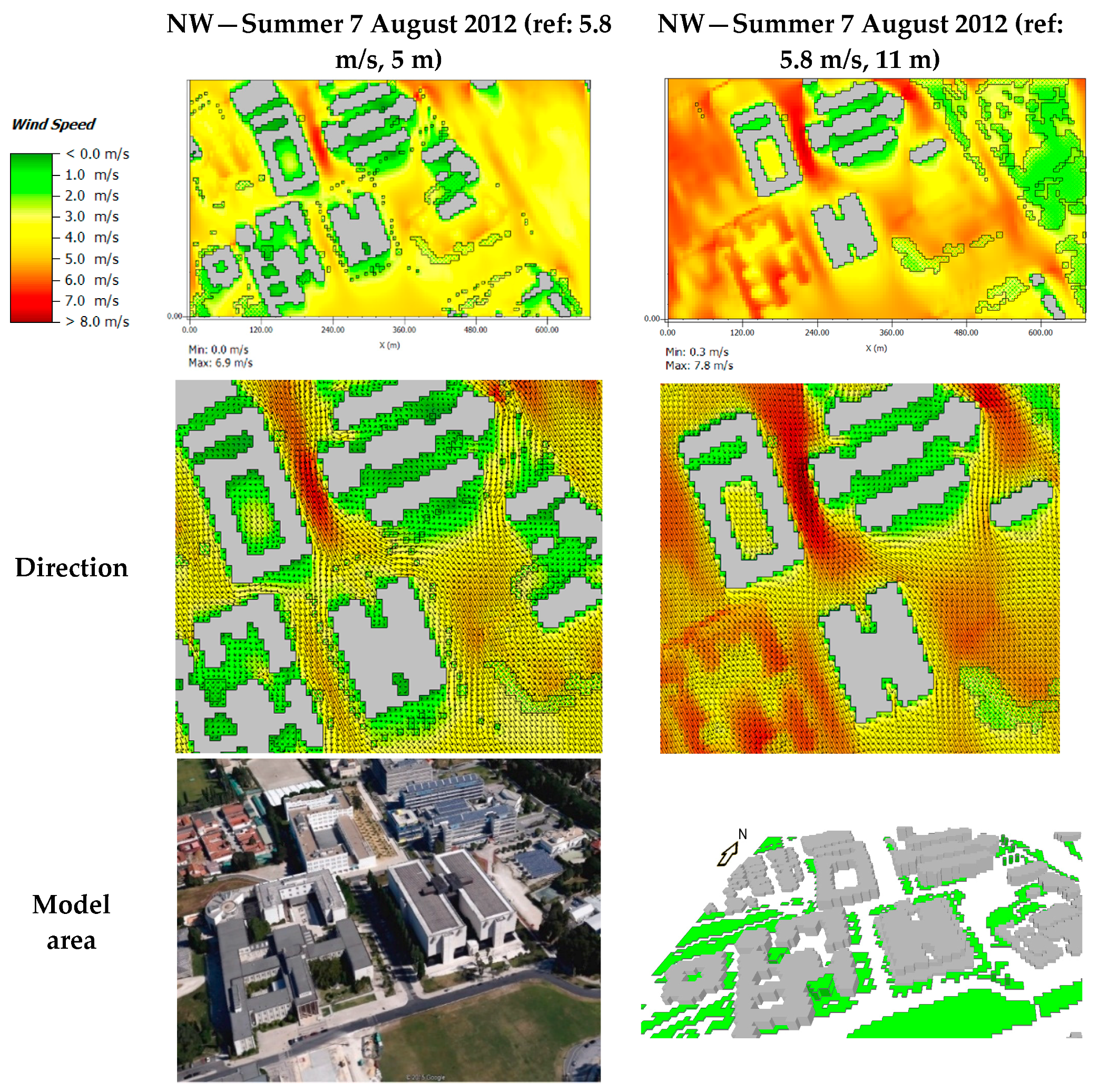
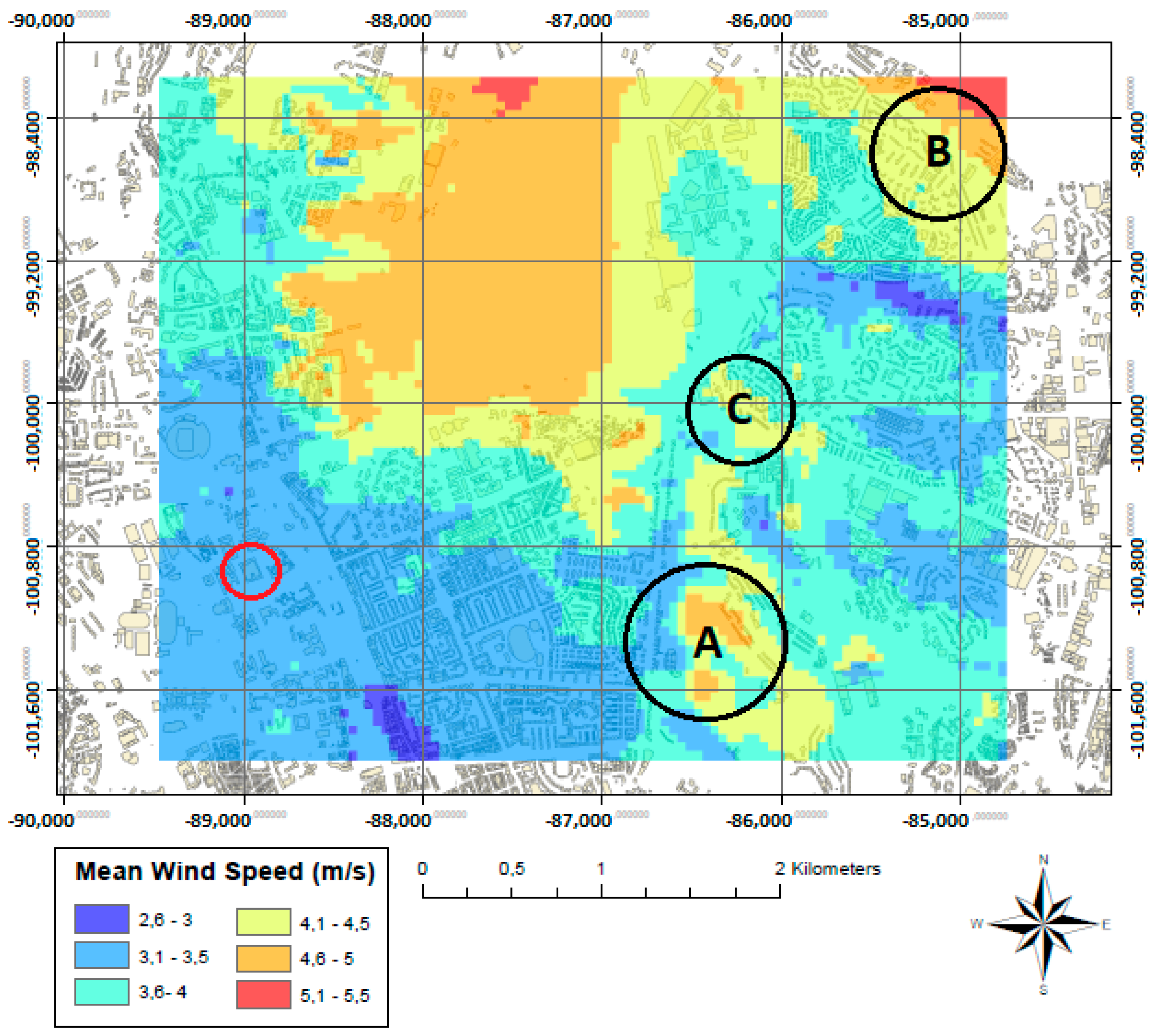
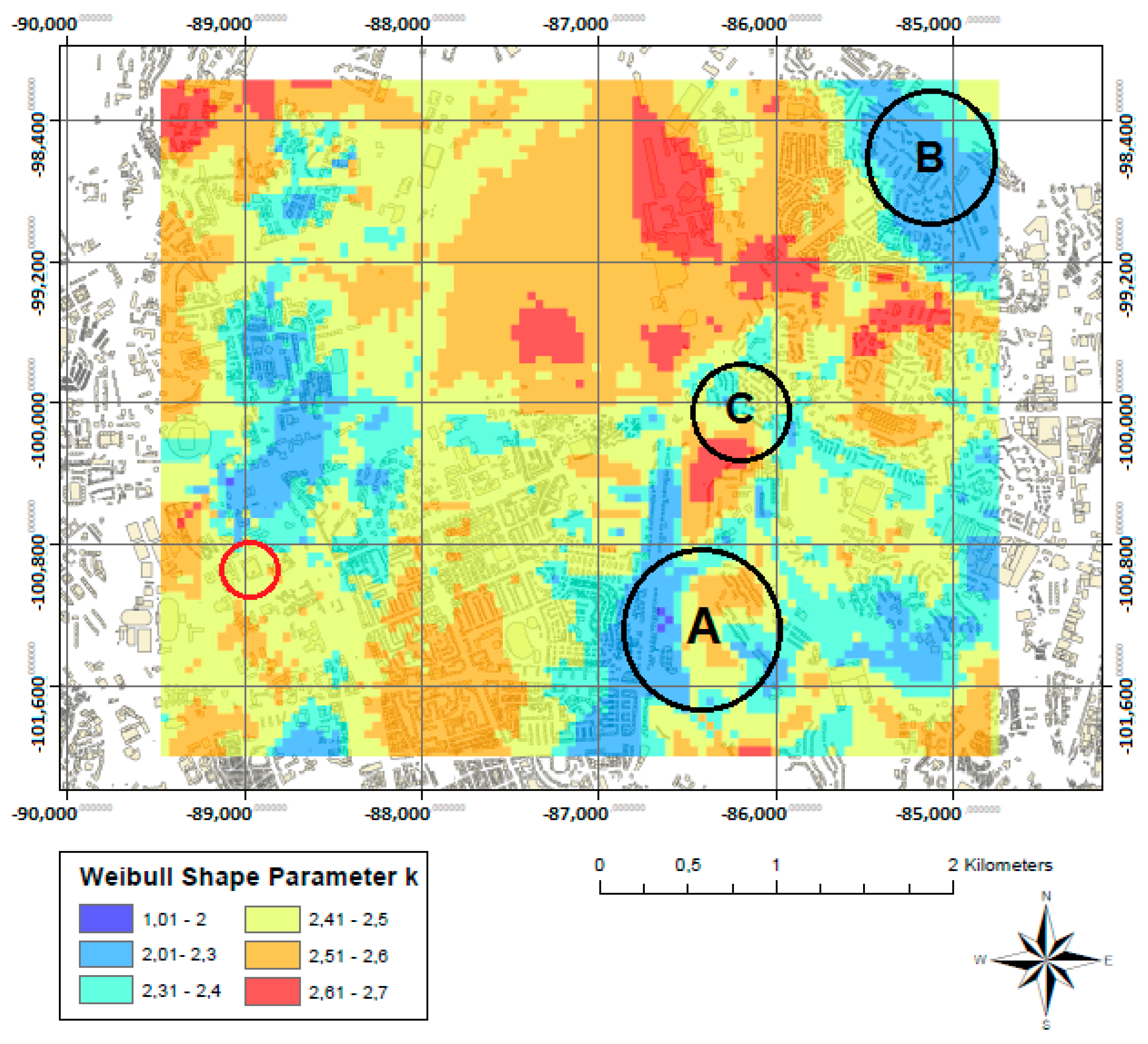
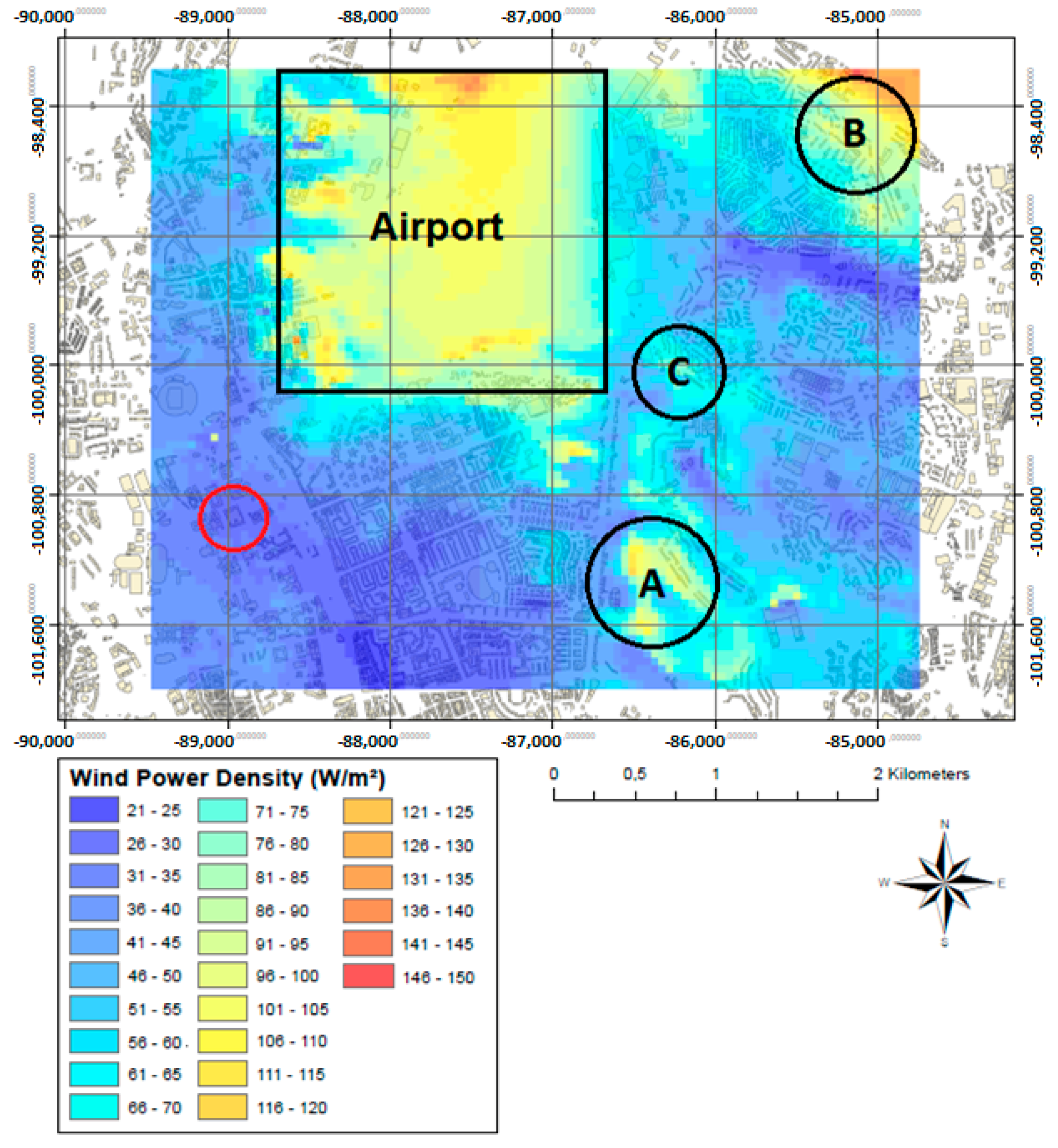
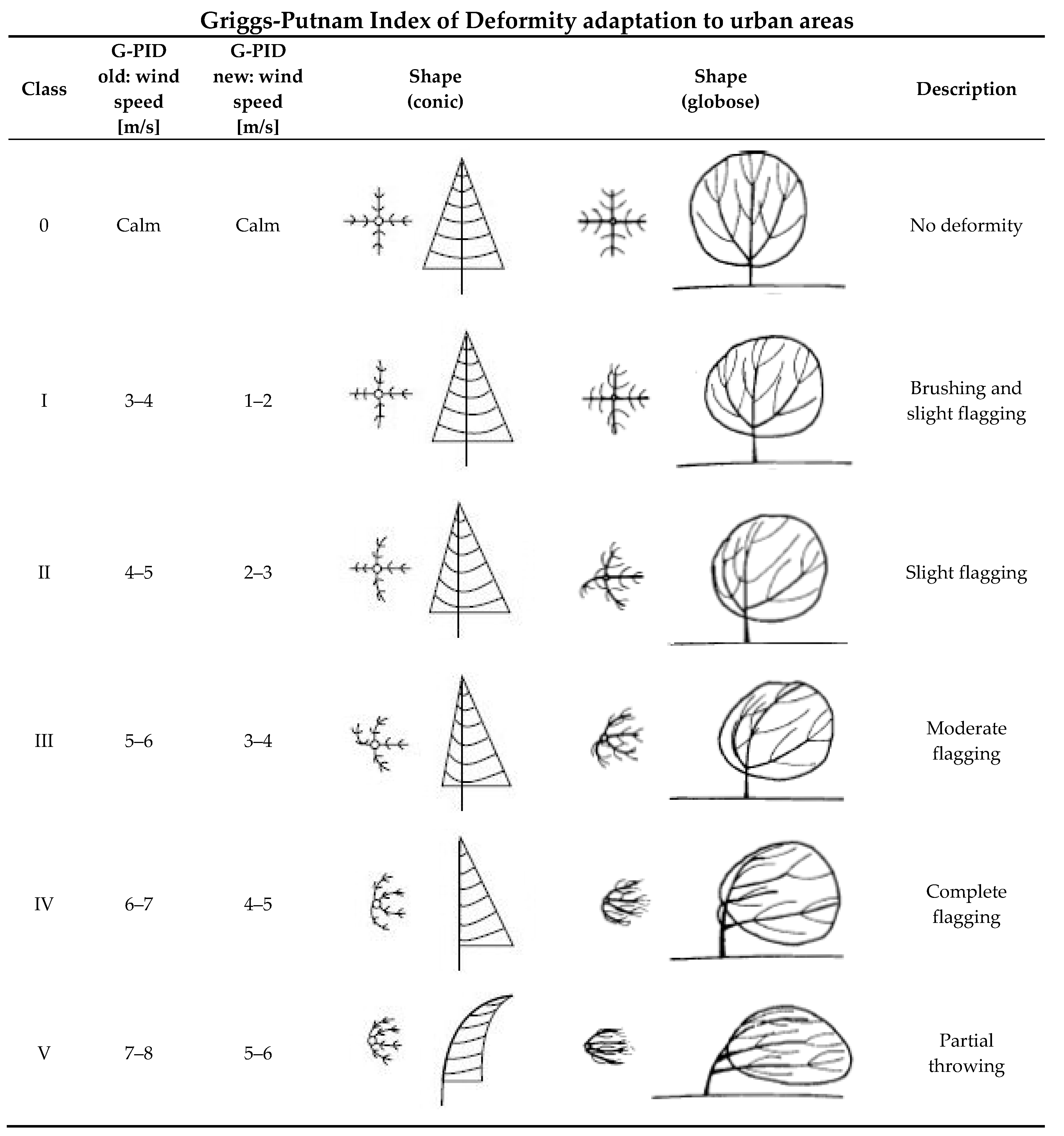

| Class | Wind Speed [m/s] | Description |
|---|---|---|
| 0 | insignificant wind speed | No Effect: Careful examination of needles, twigs, and branches indicates that the wind has had no noticeable influence on the tree. |
| I | 3–4 | Brushing: The small branches and needles appear bent away from the prevailing wind direction. The tree crown may appear slightly asymmetrical if carefully examined. |
| II | 4–5 | Slight Flagging: The small branches and the ends of the larger branches are bent by the wind, giving the tree a noticeably asymmetric crown. |
| III | 5–6 | Moderate Flagging: The large branches are bent toward the leeward side of the tree, giving the tree a nearly one-sided crown. |
| IV | 6–7 | Strong Flagging: All the branches are swept to the leeward and the trunk is bare on the windward side. The tree resembles a banner. |
| V | 7–8 | Partial Throwing: A partially thrown tree is one in which the trunk, as well as the branches, are bent to the lee. The trunk may be bent in a concave or convex fashion, but rises vertically near the ground and the degree of bending increases near the top of the trunk. |
| VI | 8–9 | Complete Throwing: The tree grows nearly parallel to the ground and along the path of the prevailing wind. The larger branches on the leeward side may extend beyond the tip of the trunk. |
| VII | >10 | Carpeting: The wind is so strong, permanent or accompanying conditions so severe (e.g., ice is present) that the tree takes the form of a shrub. Upright leaders are killed and lateral growth predominates. The crown grows across the ground like a prostrate shrub. |
| Date & Time | 17 of May 2012; 17:00 h | 7 of August 2012; 17:00 h |
|---|---|---|
| Wind speed (m/s)/direction (°) (10m) 1 | 4.9/340 | 5.8/330 |
| Initial potential temperature (K) 2 | θ = 293.5 | θ = 302.5 |
| Relative Humidity (2 m) (%) 3 | 73 | 48 |
| Specific Humidity (2500 m) (g water/kg air) 4 | q = 2.8 | q = 3.5 |
| Location (φ, λ, alt)/Köppen Class | 38°45′ N, 9°10′ W, ≈87 m/Csa | |
| Model horizontal area (a) | ≈2500 | |
| Grid size (x,y,z) dx, dy, dz (m) | 140 × 80 × 20 4.8 × 4.8 × 2 | |
| Roughness length (z0) at the Gago Coutinho meteorological station (m) (Complementary to the Wind Speed. Defines the surface roughness at the location, where the wind speed in 10 m was measured. Both values are used to calculate the geostrophic wind. Not further used after initialization.) | 0.1 | |
| Tree Number | Species | Geographic Direction Taking the Perspective from the Building Center (Azimuth in Degrees) | ||||||||||
|---|---|---|---|---|---|---|---|---|---|---|---|---|
| 1 | Quercus robur (British oak) | 45.90 | ||||||||||
| 2 | Quercus robur (British oak) | 39.04 | ||||||||||
| 3 | Prunus cerasifera (Cherry plum) | 11.64 | ||||||||||
| 4 | Prunus cerasifera (Cherry plum) | 14.76 | ||||||||||
| 5 | Acacia longifolia (Long leaf acacia) | 3.14 | ||||||||||
| 6 | Olea europaea (Olive tree) | 339.76 | ||||||||||
| 7 | Acacia longifolia (Long leaf acacia) | 299.05 | ||||||||||
| 8 | Fraxinus sp (Ash) | 274.19 | ||||||||||
| 9 | Populus sp (Poplar) | 235.53 | ||||||||||
| 10 | Prunus cerasifera (Cherry plum) | 228.96 | ||||||||||
| 11 | Prunus cerasifera (Cherry plum) | 209.54 | ||||||||||
| 12 | Prunus cerasifera (Cherry plum) | 203.99 | ||||||||||
| 13 | Morus alba (White mulberry) | 202.05 | ||||||||||
| 14 | Jacaranda mimosifolia (Palisander) | 189.17 | ||||||||||
| 15 | Jacaranda mimosifolia (Palisander) | 181.87 | ||||||||||
| 16 | Jacaranda mimosifolia (Palisander) | 147.74 | ||||||||||
| 17 | Jacaranda mimosifolia (Palisander) | 162.95 | ||||||||||
| 18 | Grevillea robusta (Australian silver oak) | 127.02 | ||||||||||
| 19 | Casuarina equisetifolia (Horsetail she oak) | 216.19 | ||||||||||
| 20 | Cercis siliquastrum (Judas tree) | 219.49 | ||||||||||
| Tree Number (globose) | Tree height (cm) | Tree height (m) | A (cm) | B (cm) | G (degree) | Height of reference person in picture (cm) | Height of reference person in reality (m) | A (m) | B (m) | G (radian) | G-PID | Final G-PID (rounded) |
| 1 | 8.93 | 6.11 | 4.90 | 1.70 | 42.39 | 2.50 | 1.71 | 3.35 | 1.16 | 0.74 | 3.82 | 4 |
| 2 | 8.90 | 7.25 | 5.50 | 2.00 | 45.56 | 2.10 | 4.48 | 1.63 | 0.80 | 3.76 | 4 | |
| 4 | 9.95 | 5.87 | 7.50 | 4.40 | 47.50 | 2.90 | 4.42 | 2.59 | 0.83 | 2.76 | 3 | |
| 6 | 9.59 | 3.28 | 7.80 | 3.50 | 67.95 | 5.00 | 2.67 | 1.20 | 1.19 | 3.74 | 4 | |
| 8 | 14.88 | 12.72 | 10.40 | 2.40 | 58.16 | 2.00 | 8.89 | 2.05 | 1.02 | 5.63 | 6 | |
| 10 | 11.08 | 4.21 | 4.30 | 1.00 | 22.91 | 4.50 | 1.63 | 0.38 | 0.40 | 4.81 | 5 | |
| 11 | 11.95 | 5.24 | 4.00 | 1.70 | 27.27 | 3.90 | 1.75 | 0.75 | 0.48 | 2.96 | 3 | |
| 12 | 8.43 | 5.15 | 3.40 | 0.80 | 29.61 | 2.80 | 2.08 | 0.49 | 0.52 | 4.91 | 5 | |
| 13 | 11.42 | 4.07 | 6.50 | 2.30 | 46.14 | 4.80 | 2.32 | 0.82 | 0.81 | 3.85 | 4 | |
| 14 | 10.42 | 4.57 | 6.60 | 2.40 | 46.61 | 3.90 | 2.89 | 1.05 | 0.81 | 3.79 | 4 | |
| 15 | 9.42 | 6.71 | 4.90 | 0.50 | 48.60 | 2.40 | 3.49 | 0.36 | 0.85 | 10.88 | 11 | |
| 16 | 11.64 | 8.29 | 6.50 | 2.30 | 67.79 | 2.40 | 4.63 | 1.64 | 1.18 | 4.33 | 4 | |
| 17 | 6.04 | 7.38 | 3.90 | 2.20 | 56.64 | 1.40 | 4.76 | 2.69 | 0.99 | 3.03 | 3 | |
| 20 | 9.01 | 3.67 | - | - | - | 4.20 | - | - | - | - | - | |
| Tree Number (conic) | Tree height (cm) | Tree height (m) | A (degree) | B (degree) | G (degree) | Height of reference person in picture (cm) | Height of reference person in reality (m) | A (radian) | B (radian) | G (radian) | G-PID | Final G-PID (rounded) |
| 3 | 5.72 | 4.66 | 67.85 | 33.80 | 19.26 | 2.10 | 1.71 | 1.18 | 0.59 | 0.34 | 2.44 | 2 |
| 5 | 13.08 | 7.99 | 34.71 | 14.39 | 9.47 | 2.80 | 0.61 | 0.25 | 0.17 | 2.62 | 3 | |
| 7 | 11.40 | 7.80 | 43.12 | 18.09 | 20.16 | 2.50 | 0.75 | 0.32 | 0.35 | 2.83 | 3 | |
| 9 | 11.30 | 4.60 | 24.64 | 25.20 | 6.14 | 4.20 | 0.43 | 0.44 | 0.11 | 1.11 | 1 | |
| 18 | 9.82 | 5.60 | 33.93 | 16.83 | 15.16 | 3.00 | 0.59 | 0.29 | 0.26 | 2.35 | 2 | |
| 19 | 10.87 | 9.78 | 31.61 | 11.96 | 4.15 | 1.90 | 0.55 | 0.21 | 0.07 | 2.74 | 3 | |
| Tree Number | Species | ENVI-Met Simulations Results at the Three Height Levels (m) | G-PID (m/s) | ||||||
|---|---|---|---|---|---|---|---|---|---|
| 5 m | 11 m | 15 m | |||||||
| Spring (m/s) | Summer (m/s) | Spring (m/s) | Summer (m/s) | Spring (m/s) | Summer (m/s) | ||||
| globose | 1 | Quercus robur (British oak) | 2.9 | 3.4 | 3.7 | 4.7 | 4.3 | 5.7 | 6.5 |
| 2 | Quercus robur (British oak) | 3.1 | 3.7 | 3.8 | 5 | 4.4 | 5.8 | 6.5 | |
| 4 | Prunus cerasifera (Cherry plum) | 1.2 | 2 | 2.3 | 3.2 | 3.1 | 4.3 | 5.5 | |
| 6 | Olea europaea (Olive tree) | 3.1 | 3.2 | 3.8 | 6 | 5.1 | 6.8 | 6.5 | |
| 10 | Prunus cerasifera (Cherry plum) | 3.9 | 5.1 | 4.7 | 5.9 | 5.2 | 6.5 | 7.5 | |
| 11 | Prunus cerasifera (Cherry plum) | 3.2 | 4.2 | 4.7 | 5.5 | 5.1 | 6.6 | 5.5 | |
| 12 | Prunus cerasifera (Cherry plum) | 3.2 | 4.5 | 4.7 | 5.8 | 5.2 | 6.6 | 7.5 | |
| 13 | Morus alba (White mulberry) | 3.7 | 4.4 | 4.4 | 5.8 | 5.2 | 6.7 | 6.5 | |
| 14 | Jacaranda mimosifolia (Palisander) | 3.4 | 4.2 | 4.3 | 5.5 | 5 | 6.4 | 6.5 | |
| 16 | Jacaranda mimosifolia (Palisander) | 2 | 3 | 3.1 | 4 | 4.7 | 5.2 | 6.5 | |
| 17 | Jacaranda mimosifolia (Palisander) | 1.9 | 2.9 | 3.1 | 4 | 4.4 | 5.2 | 5.5 | |
| conic | 3 | Prunus cerasifera (Cherry plum) | 1.8 | 2.6 | 2.3 | 3 | 3.1 | 4.6 | 4.5 |
| 5 | Acacia longifolia (Long leaf acacia) | 1.8 | 3 | 2.8 | 4.2 | 3.5 | 5.4 | 5.5 | |
| 7 | Acacia longifolia (Long leaf acacia) | 2.6 | 3.2 | 4 | 4.4 | 4.8 | 5.4 | 5.5 | |
| 9 | Populus sp (Poplar) | 2.6 | 3.5 | 3.9 | 5 | 5.1 | 6.2 | 3.5 | |
| 18 | Grevillea robusta (Australian silver oak) | 2.8 | 3.5 | 3.9 | 4.9 | 4.6 | 5.6 | 4.5 | |
| 19 | Casuarina equisetifolia (Horsetail she oak) | 3.6 | 4.5 | 4.7 | 6 | 5.1 | 6.4 | 5.5 | |
| Total average (m/s) | 2.8 | 3.6 | 3.8 | 4.9 | 4.6 | 5.8 | 5.9 | ||
© 2018 by the authors. Licensee MDPI, Basel, Switzerland. This article is an open access article distributed under the terms and conditions of the Creative Commons Attribution (CC BY) license (http://creativecommons.org/licenses/by/4.0/).
Share and Cite
Konopka, J.; Lopes, A.; Matzarakis, A. An Original Approach Combining CFD, Linearized Models, and Deformation of Trees for Urban Wind Power Assessment. Sustainability 2018, 10, 1915. https://doi.org/10.3390/su10061915
Konopka J, Lopes A, Matzarakis A. An Original Approach Combining CFD, Linearized Models, and Deformation of Trees for Urban Wind Power Assessment. Sustainability. 2018; 10(6):1915. https://doi.org/10.3390/su10061915
Chicago/Turabian StyleKonopka, Jan, António Lopes, and Andreas Matzarakis. 2018. "An Original Approach Combining CFD, Linearized Models, and Deformation of Trees for Urban Wind Power Assessment" Sustainability 10, no. 6: 1915. https://doi.org/10.3390/su10061915
APA StyleKonopka, J., Lopes, A., & Matzarakis, A. (2018). An Original Approach Combining CFD, Linearized Models, and Deformation of Trees for Urban Wind Power Assessment. Sustainability, 10(6), 1915. https://doi.org/10.3390/su10061915