Consumer Purchase Intentions for Sustainable Wild Salmon in the Chinese Market and Implications for Agribusiness Decisions

Abstract
1. Introduction
2. Background and Literature
3. Methodology
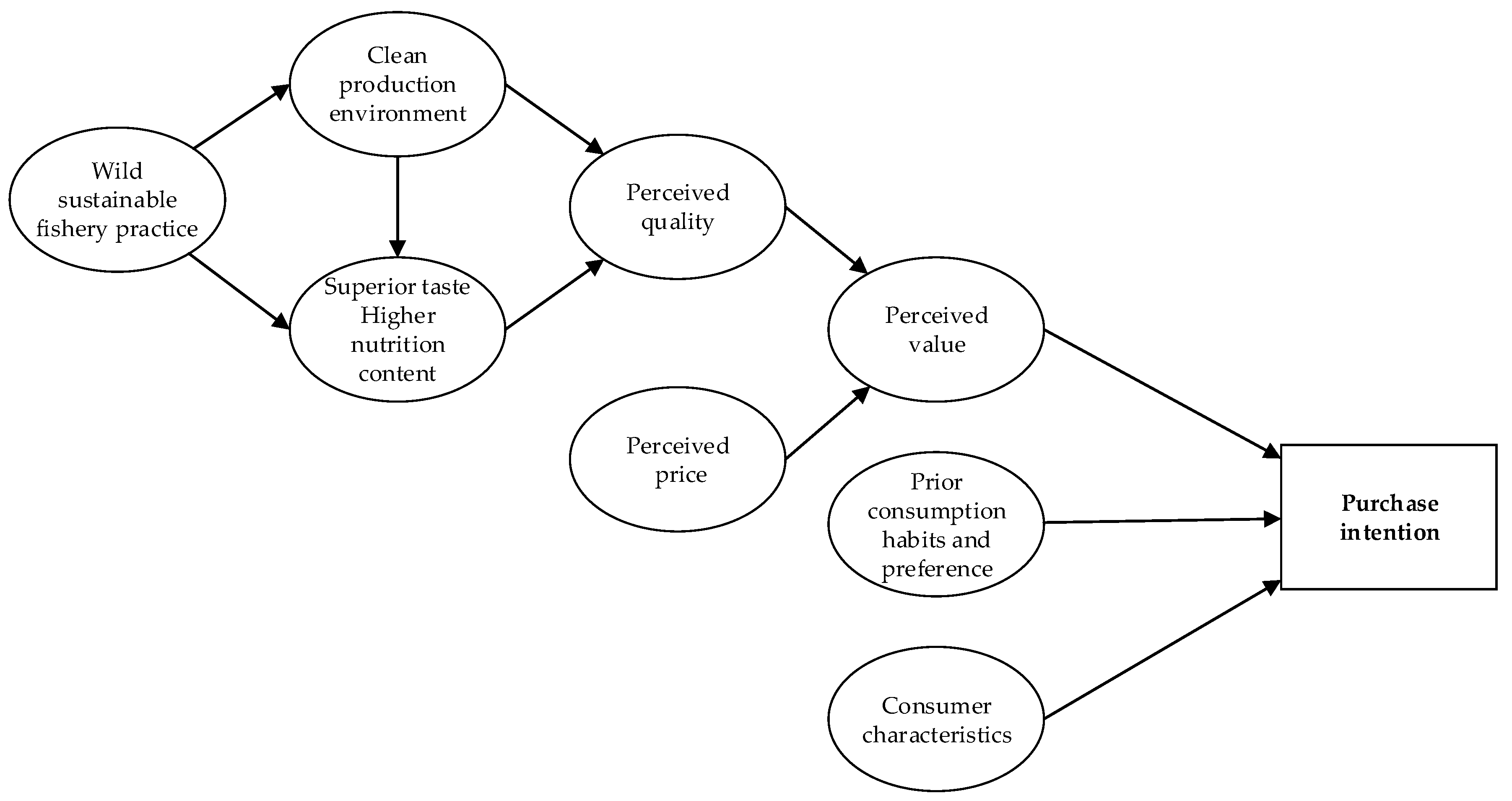
3.1. Conceptual Framework
3.2. Model
3.3. Survey and Data
4. Results
4.1. Purchasing Wild Salmon Fillet from a Sustainable Production Environment
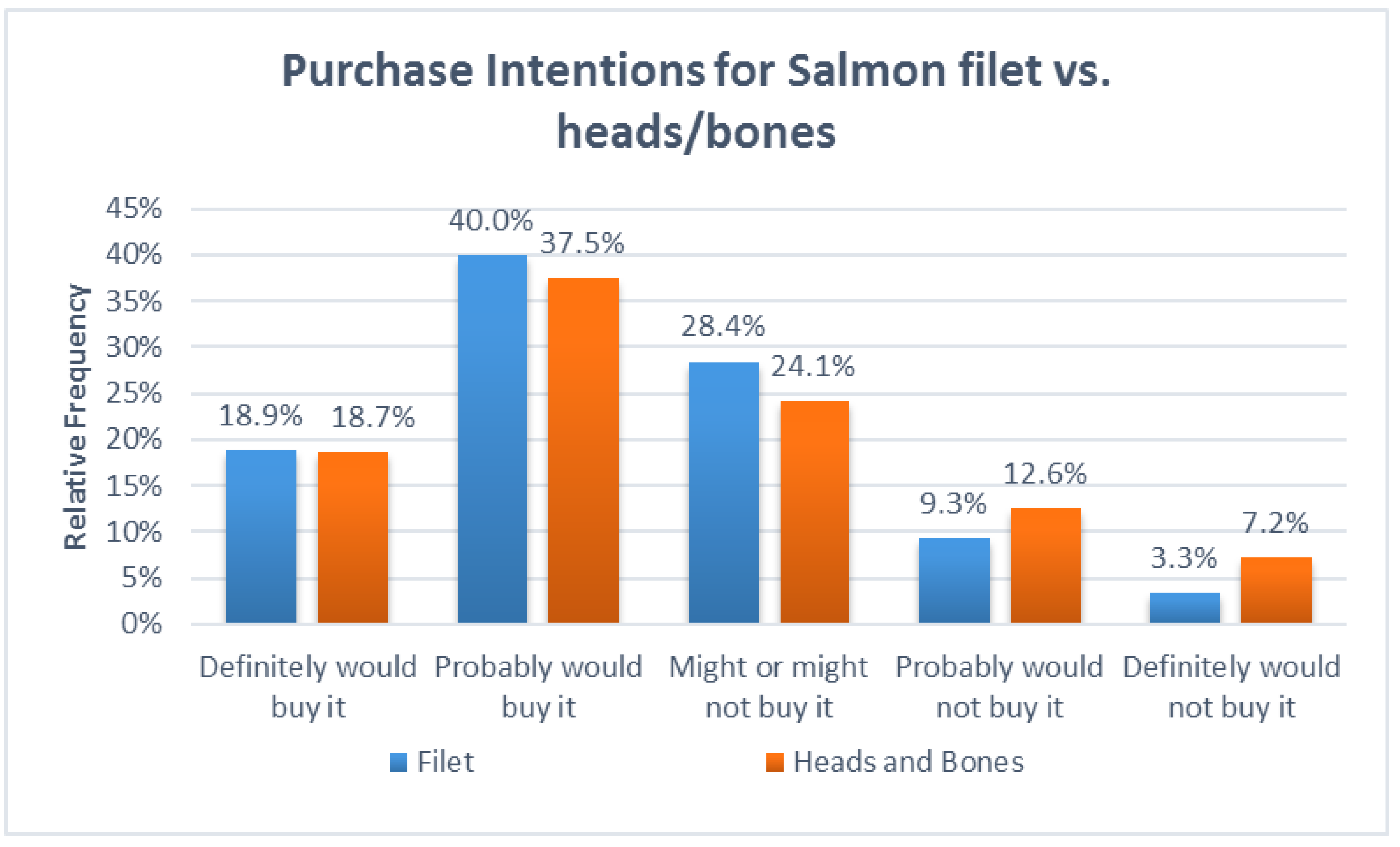
4.2. Sustainable Consumption of Wild Salmon Varietal Parts to Minimize Waste
5. Discussions and Conclusions
Author Contributions
Acknowledgments
Conflicts of Interest
References
- Vermeir, I.; Verbeke, W. Sustainable food consumption: Exploring the consumer “attitude–behavioral intention” gap. J. Agric. Environ. Ethics 2006, 19, 169–194. [Google Scholar] [CrossRef] [Scilit]
- Kantor, L.S.; Lipton, K.; Manchester, A.; Oliveira, V. Estimating and addressing America’s food losses. Food Rev. 1997, 20, 2–12. [Google Scholar]
- Wang, L.; Cai, Y.; Fang, L. Pollution in Taihu Lake China: Causal chain and policy options analyses. Front. Earth Sci. China 2009, 3, 437. [Google Scholar] [CrossRef] [Scilit]
- Fabinyi, M. Historical, cultural and social perspectives on luxury seafood consumption in China. Environ. Conserv. 2012, 39, 83–92. [Google Scholar] [CrossRef] [Scilit]
- FAOSTAT. Food and Agriculture Organization of the United Nations Food and Agriculture Data. Available online: http://www.fao.org/faostat/en/#home (accessed on 11 January 2018).
- Fabinyi, M. Sustainable seafood consumption in China. Mar. Policy 2016, 74, 85–87. [Google Scholar] [CrossRef] [Scilit]
- Salov, A. Working with China Alaska’s growing export partner. Alaska Bus. Mon. February 2012. Available online: http://www.wtcak.org/PDF2012/QandASalov.pdf (accessed on 11 January 2018).
- Food and Agriculture Organization (FAO). The State of World Fisheries and Aquaculture 2016. Available online: http://www.fao.org/3/a-i5555e.pdf (accessed on 11 January 2018).
- Liu, H. Joyvio Agriculture’s strategies in seafood consumption industry (in Chinese). Available online: http://www.sohu.com/a/194290749_115495 (accessed on 11 January 2018).
- Alaska Seafood Marketing Institute (ASMI). FY 2014–2015 Unified Export Strategy; Report; Alaska Seafood Marketing Institute: Juneau, AK, USA, 2013. [Google Scholar]
- Verbeke, W.; Ward, R.W. A fresh meat almost ideal demand system incorporating negative TV press and advertising impact. Agric. Econ. 2001, 25, 359–374. [Google Scholar] [CrossRef]
- Piggott, N.E.; Marsh, T.L. Does food safety information impact US meat demand? Am. J. Agric. Econ. 2004, 86, 154–174. [Google Scholar] [CrossRef] [Scilit]
- Wang, H.H.; Beville, P.G. The media impact of animal disease on the US meat demand. Agribusiness 2017, 33, 493–504. [Google Scholar] [CrossRef] [Scilit]
- Bennett, R.M. People’s willingness to pay for farm animal welfare. Anim. Welf. 1996, 5, 3–11. [Google Scholar]
- Napolitano, F.; Pacelli, C.; Girolami, A.; Braghieri, A. Effect of information about animal welfare on consumer willingness to pay for yogurt. J. Dairy Sci. 2008, 91, 910–917. [Google Scholar] [CrossRef] [Scilit] [PubMed]
- Tonsor, G.T.; Olynk, N.; Wolf, C. Consumer preferences for animal welfare attributes: The case of gestation crates. J. Agric. Appl. Econ. 2009, 41, 713–730. [Google Scholar] [CrossRef] [Scilit]
- De Pelsmacher, P.; Driesen, L.; Rayp, G. Do consumers care about ethics? Willingness to pay for fair-trade coffee. J. Consum. Aff. 2005, 39, 363–385. [Google Scholar] [CrossRef] [Scilit]
- Basu, A.K.; Hicks, R.L. Label performance and the willingness to pay for fair trade coffee: A cross-national perspective. Int. J. Consum. Stud. 2008, 32, 470–478. [Google Scholar] [CrossRef] [Scilit]
- Drichoutis, A.C.; Vassilopoulos, A.; Lusk, J.L.; Nayga, R.M. Consumer preferences for fair labour certification. Eur. Rev. Agric. Econ. 2017, 44, 455–474. [Google Scholar] [CrossRef] [Scilit]
- Buzby, J.C.; Fox, J.A.; Ready, R.C.; Crutchfield, S.R. Measuring consumer benefits of food safety risk reductions. J. Agric. Appl. Econ. 1998, 30, 69–82. [Google Scholar] [CrossRef] [Scilit]
- Lusk, J.L.; Norwood, F.B.; Pruitt, J.R. Consumer demand for a ban on antibiotic drug use in pork production. Am. J. Agric. Econ. 2006, 88, 1015–1033. [Google Scholar] [CrossRef] [Scilit]
- Costa-Font, M.; Gil, J.M.; Traill, W.B. Consumer acceptance, valuation of and attitudes towards genetically modified food: Review and implications for food policy. Food Policy 2008, 33, 99–111. [Google Scholar] [CrossRef] [Scilit]
- Loureiro, M.L.; Umberger, W.J. Estimating consumer willingness to pay for country-of-origin labeling. J. Agric. Resour. Econ. 2003, 28, 287–301. [Google Scholar]
- Loureiro, M.L.; Umberger, W.J. Assessing consumer preferences for country-of-origin labeling. J. Agric. Appl. Econ. 2005, 37, 49–63. [Google Scholar] [CrossRef] [Scilit]
- Loureiro, M.L.; Umberger, W.J. A choice experiment model for beef: What US consumer responses tell us about relative preferences for food safety, country-of-origin labeling and traceability. Food Policy 2007, 32, 496–514. [Google Scholar] [CrossRef] [Scilit]
- Wang, H.H.; Zhang, X.; Ortega, D.L.; Olynk Widmar, N.J. Information on food safety, consumer preference and behavior: The case of seafood in the US. Food Control 2013, 33, 293–300. [Google Scholar] [CrossRef] [Scilit]
- Hoffmann, R. Country of origin-A consumer perception perspective of fresh meat. Br. Food J. 2000, 102, 211–229. [Google Scholar] [CrossRef] [Scilit]
- Blend, J.R.; Van Ravenswaay, E.O. Measuring consumer demand for ecolabeled apples. Am. J. Agric. Econ. 1999, 81, 1072–1077. [Google Scholar] [CrossRef] [Scilit]
- Johnston, R.J.; Wessells, C.R.; Donath, H.; Asche, F. Measuring consumer preferences for ecolabeled seafood: An international comparison. J. Agric. Resour. Econ. 2001, 26, 20–39. [Google Scholar]
- Loureiro, M.L.; McCluskey, J.J. Will consumers pay a premium for eco-labeled apples? J. Consum. Aff. 2002, 36, 203–219. [Google Scholar] [CrossRef] [Scilit]
- Gil, J.M.; Sanchez, G.M. Market segmentation and willingness to pay for organic products in Spain. Int. Food Agribus. Manag. Rev. 2000, 3, 207–226. [Google Scholar] [CrossRef] [Scilit]
- Magnusson, M.K.; Arvola, A.; Hursti, U.K.K.; Åberg, L.; Sjödén, P.O. Choice of organic foods is related to perceived consequences for human health and to environmentally friendly behaviour. Appetite 2003, 40, 109–117. [Google Scholar] [CrossRef] [Scilit]
- Batte, M.T.; Hooker, N.H.; Haab, T.C.; Beaverson, J. Putting their money where their mouths are: Consumer willingness to pay for multi-ingredient processed organic food products. Food Policy 2007, 32, 145–159. [Google Scholar] [CrossRef] [Scilit]
- Hughner, R.S.; McDonagh, P.; Prothero, A.; Shultz, C.J.; Stanton, J. Who are organic food consumers? A compilation and review of why people purchase organic food. J. Consum. Behav. 2007, 6, 94–110. [Google Scholar] [CrossRef] [Scilit]
- Lai, J.; Wang, H.H.; Ortega, D.L.; Olynk Widmar, N.J. Factoring Chinese consumers’ risk perceptions into their willingness to pay for pork safety, environmental stewardship, and animal welfare. Food Control 2018, 85, 423–431. [Google Scholar] [CrossRef] [Scilit]
- Yin, S.; Wu, L.; Du, L.; Chen, M. Consumers’ purchase intention of organic food in China. J. Sci. Food Agric. 2010, 90, 1361–1367. [Google Scholar] [CrossRef] [Scilit] [PubMed]
- Paul, J.; Rana, J. Consumer behavior and purchase intention for organic food. J. Consum. Mark. 2012, 29, 412–422. [Google Scholar] [CrossRef] [Scilit]
- Thøgersen, J.; de Barcellos, M.D.; Perin, M.G.; Zhou, Y. Consumer buying motives and attitudes towards organic food in two emerging markets. Int. Mark. Rev. 2015, 32, 389–413. [Google Scholar] [CrossRef] [Scilit]
- Xie, B.; Wang, L.; Yang, H.; Wang, Y.; Zhang, M. Consumer perceptions and attitudes of organic food products in eastern china. Br. Food J. 2015, 117, 1105–1121. [Google Scholar] [CrossRef] [Scilit]
- Thøgersen, J.; Zhou, Y. Chinese consumers’ adoption of a ‘green’ innovation–The case of organic food. J. Mark. Manag. 2012, 28, 313–333. [Google Scholar] [CrossRef] [Scilit]
- Shi, Y.; Cheng, C.; Lei, P.; Wen, T.; Merrifield, C. Safe food, green food, good food: Chinese Community Supported Agriculture and the rising middle class. Int. J. Agric. Sustain. 2011, 9, 551–558. [Google Scholar] [CrossRef] [Scilit]
- Lang, T.; Barling, D.; Caraher, M. Food Policy: Integrating Health, Environment and Society; Oxford University Press: Oxford, UK, 2009. [Google Scholar]
- Aschemann-Witzel, J. Consumer perception and trends about health and sustainability: Trade-offs and synergies of two pivotal issues. Curr. Opin. Food Sci. 2015, 3, 6–10. [Google Scholar] [CrossRef] [Scilit]
- Bisogni, C.A.; Jastran, M.; Seligson, M.; Thompson, A. How people interpret healthy eating: Contributions of qualitative research. J. Nutr. Educ. Behav. 2012, 44, 282–301. [Google Scholar] [CrossRef] [Scilit] [PubMed]
- Hoek, A.C.; Pearson, D.; James, S.W.; Lawrence, M.A.; Friel, S. Shrinking the food-print: A qualitative study into consumer perceptions, experiences and attitudes towards healthy and environmentally friendly food behaviours. Appetite 2017, 108, 117–131. [Google Scholar] [CrossRef] [Scilit] [PubMed]
- Morrison, D.G. Purchase intentions and purchase behavior. J. Mark. 1979, 43, 65–74. [Google Scholar] [CrossRef] [Scilit]
- Whitlark, D.B.; Geurts, M.D.; Swenson, M.J. New product forecasting with a purchase intention survey. J. Bus. Forecast. Methods Syst. 1993, 12, 18–21. [Google Scholar]
- Laroche, M.; Kim, C.; Zhou, L. Brand familiarity and confidence as determinants of purchase intention: An empirical test in a multiple brand context. J. Bus. Res. 1996, 37, 115–120. [Google Scholar] [CrossRef] [Scilit]
- Brown, M.; Pope, N.; Voges, K. Buying or browsing? An exploration of shopping orientations and online purchase intention. Eur. J. Mark. 2003, 37, 1666–1684. [Google Scholar] [CrossRef] [Scilit]
- Yeon Kim, H.; Chung, J.E. Consumer purchase intention for organic personal care products. J. Consum. Mark. 2011, 28, 40–47. [Google Scholar] [CrossRef] [Scilit]
- Hartmann, P.; Apaolaza-Ibáñez, V. Consumer attitude and purchase intention toward green energy brands: The roles of psychological benefits and environmental concern. J. Bus. Res. 2012, 65, 1254–1263. [Google Scholar] [CrossRef] [Scilit]
- Dodds, W.B.; Monroe, K.B.; Grewal, D. Effects of price, brand, and store information on buyers’ product evaluations. J. Mark. Res. 1991, 28, 307–319. [Google Scholar] [CrossRef] [Scilit]
- Chang, T.Z.; Wildt, A.R. Price, product information, and purchase intention: An empirical study. J. Acad. Mark. Sci. 1994, 22, 16–27. [Google Scholar] [CrossRef] [Scilit]
- Hui, M.K.; Zhou, L. Linking product evaluations and purchase intention for Country-of-Origin effects. J. Glob. Mark. 2002, 15, 95–116. [Google Scholar] [CrossRef] [Scilit]
- Kumar, A.; Lee, H.J.; Kim, Y.K. Indian consumers’ purchase intention toward a United States versus local brand. J. Bus. Res. 2009, 62, 521–527. [Google Scholar] [CrossRef] [Scilit]
- Sheth, J.N.; Newman, B.I.; Gross, B.L. Consumption Values and Market Choice; South Western Publishing: Cincinnati, OH, USA, 1991. [Google Scholar]
- Sheth, J.N.; Newman, B.I.; Gross, B.L. Why we buy what we buy: A theory of consumption values. J. Bus. Res. 1991, 22, 159–170. [Google Scholar] [CrossRef] [Scilit]
- Sweeney, J.C.; Soutar, G.N. Consumer perceived value: The development of a multiple item scale. J. Retail. 2001, 77, 203–220. [Google Scholar] [CrossRef] [Scilit]
- Train, K.E. Discrete Choice Methods with Simulation; Cambridge University Press: New York, NY, USA, 2009; pp. 182–186. ISBN 9780521747387. [Google Scholar]
- Easton, M.D.L.; Luszniak, D.; Von der Geest, E. Preliminary examination of contaminant loadings in farmed salmon, wild salmon and commercial salmon feed. Chemosphere 2002, 46, 1053–1074. [Google Scholar] [CrossRef] [Scilit]
- Hites, R.A.; Foran, J.A.; Carpenter, D.O.; Hamilton, M.C.; Knuth, B.A.; Schwager, S.J. Global assessment of organic contaminants in farmed salmon. Science 2004, 303, 226–229. [Google Scholar] [CrossRef] [Scilit] [PubMed]
- Jamieson, L.F.; Bass, F.M. Adjusting stated intention measures to predict trial purchase of new products: A comparison of models and methods. J. Mark. Res. 1989, 26, 336–345. [Google Scholar] [CrossRef] [Scilit]
- Zipser, D.; Chen, Y.; Gong, F. The Modernization of the Chinese Consumer. McKinsey & Company 2016 China Consumer Report. Available online: http://mckinseychina.com/wp-content/uploads/2016/03/The-Modernization-of-the-Chinese-Consumer_EN.pdf (accessed on 11 January 2018).
- HKTDC Research. Shanghai: Market Profile. Available online: http://china-trade-research.hktdc.com/business-news/article/Facts-and-Figures/Shanghai-Market-Profile/ff/en/1/1X000000/1X06BVOR.htm (accessed on 11 January 2018).
- Zheng, Q.; Wang, H.H. Chinese Preferences for Sustainable Attributes for Food Away From Home: A Rank-Ordered Model. China Econ. Rev. 2016, 41, 148–158. [Google Scholar] [CrossRef] [Scilit]
- Zheng, Q.; Wang, H.H.; Fong, Q.; Lu, Y. Consumer Preference and Market Potential for Alaska Salmon in China: Preliminary Analysis. Alaska Sea Grant 2017, University of Alaska Fairbanks, MAB-70, Fairbanks. Available online: http://doi.org/10.4027/cpmpaspa.2017 (accessed on 11 January 2018).
- Wang, H.H. Five New Trends of Chinese Consumers. Forbes. Available online: https://www.forbes.com/sites/helenwang/2012/12/17/five-new-trends-of-chinese-consumers/ (accessed on 11 January 2018).



| Variable | Description | Mean (%) | Std Dev |
|---|---|---|---|
| age | Age in years | 37.20 | 13.51 |
| hhnum | Number of household members | 3.63 | 1.59 |
| income | Annual household income (in ten thousands of RMB) | 13.00 | 6.11 |
| male | Male | 0.35 (35%) | 0.48 |
| edu_hs | High school or lower | 0.26 (26%) | 0.44 |
| edu_col | Vocational school or associate | 0.22 (22%) | 0.42 |
| edu_ba | Bachelor’s degree | 0.37 (37%) | 0.48 |
| edu_grad | Graduate degree | 0.15 (15%) | 0.35 |
| d_child | Children presence | 0.50 (50%) | 0.50 |
| inc_in | Income increase over last two years | 0.51 (51%) | 0.50 |
| inc_de | Income decrease over last two years | 0.03 (3%) | 0.18 |
| inc_sa | Income stay the same over last two years | 0.46 (46%) | 0.50 |
| migrant | Migrate to city over last two years | 0.24 (24%) | 0.43 |
| city_BJ | Beijing | 0.33 (33%) | 0.47 |
| city_SH | Shanghai | 0.33 (33%) | 0.47 |
| city_GZ | Guangzhou | 0.33 (33%) | 0.47 |
| Variable | Description | Mean (%) | Std Dev | |
|---|---|---|---|---|
| Harvest Method | harvest_wild | Often buy wild seafood | 0.25 (25%) | 0.43 |
| harvest_both | Often buy both wild and farm raised seafood | 0.40 (40%) | 0.49 | |
| harvest_farm | Often buy farm raised seafood | 0.11 (11%) | 0.32 | |
| harvest_none | Does not pay attention to the difference | 0.24 (24%) | 0.43 | |
| Preservation Method | pres_water | Often buy fish preserved in water tank | 0.76 (76%) | 0.43 |
| pres_chill | Often buy chilled fish | 0.11 (11%) | 0.31 | |
| pres_froze | Often buy frozen fish | 0.05 (5%) | 0.22 | |
| pres_other | No strict preference for preservation method | 0.08 (8%) | 0.27 | |
| Preparation method | cook_raw | Often eat salmon raw, sashimi or sushi | 0.66 (66%) | 0.48 |
| cook_fry | Often eat salmon pan fried, deep fried or grilled | 0.13 (13%) | 0.34 | |
| cook_stew | Often eat salmon steamed, boiled or stewed | 0.15 (15%) | 0.36 | |
| cook_other | Often cook salmon using other methods | 0.06 (6%) | 0.24 | |
| Dining Venue | place_home | Often eat salmon at home | 0.21 (21%) | 0.40 |
| place_restarant | Often eat salmon at restaurants | 0.46 (46%) | 0.50 | |
| place_both | Often eat salmon at home and restaurants | 0.28 (28%) | 0.45 | |
| place_other | Often eat salmon at other venues | 0.05 (5%) | 0.21 | |
| Perceptions | clean | Perceive Alaska as a high quality, safe and clean seafood production environment | 0.57 (57%) | 0.50 |
| tasty | Perceive Alaskan wild seafood tastes better than farm raised seafood | 0.57 (57%) | 0.49 | |
| nutritious | Perceive Alaskan wild seafood as more nutritious than farm-raised seafood | 0.53 (53%) | 0.50 | |
| Variable | Coef. | Std. Err. | Odds Ratio |
|---|---|---|---|
| male | −0.123 | 0.126 | 0.884 |
| age | 0.005 | 0.005 | 1.005 |
| edu_col | 0.301 * | 0.181 | 1.351 |
| edu_ba | 0.401 ** | 0.176 | 1.493 |
| edu_grad | 0.588 *** | 0.226 | 1.800 |
| hhnum | 0.102 ** | 0.045 | 1.108 |
| d_child | −0.072 | 0.139 | 0.931 |
| income | −0.010 | 0.011 | 0.990 |
| inc_in | 0.207 * | 0.123 | 1.230 |
| inc_de | −0.452 | 0.348 | 0.637 |
| migrant | 0.012 | 0.143 | 1.012 |
| city_SH | 0.317 ** | 0.151 | 1.374 |
| city_GZ | 0.025 | 0.152 | 1.025 |
| harvest_wild | 1.052 *** | 0.186 | 2.864 |
| harvest_both | 0.790 *** | 0.159 | 2.203 |
| harvest_farm | 0.367 * | 0.217 | 1.443 |
| pres_water | −0.332 | 0.226 | 0.718 |
| pres_chill | −0.317 | 0.289 | 0.728 |
| pres_froze | −0.814 ** | 0.341 | 0.443 |
| cook_raw | 0.145 | 0.185 | 1.156 |
| cook_stew | −0.040 | 0.223 | 0.961 |
| cook_other | 0.567 | 0.438 | 1.763 |
| place_home | 0.980 *** | 0.188 | 2.665 |
| place_both | 0.697 *** | 0.148 | 2.008 |
| place_other | −1.358 *** | 0.476 | 0.257 |
| clean | 0.519 *** | 0.135 | 1.680 |
| tastey | 0.375 *** | 0.143 | 1.454 |
| nutritious | 0.219 | 0.142 | 1.245 |
| μ1 | −1.585 | 0.465 | |
| μ2 | −0.023 | 0.441 | |
| μ3 | 1.804 | 0.441 | |
| μ4 | 3.956 | 0.456 |
| Variable | Coef. | Std. Err. | Odds Ratio |
|---|---|---|---|
| Male | −0.179 | 0.123 | 0.836 |
| Age | −0.003 | 0.005 | 0.997 |
| edu_col | 0.362 ** | 0.178 | 1.436 |
| edu_ba | 0.196 | 0.172 | 1.216 |
| edu_grad | 0.284 | 0.22 | 1.328 |
| Hhnum | 0.026 | 0.042 | 1.026 |
| d_child | −0.165 | 0.136 | 0.848 |
| Income | −0.026 ** | 0.011 | 0.974 |
| inc_in | 0.319 *** | 0.121 | 1.375 |
| inc_de | −0.088 | 0.334 | 0.916 |
| Migrant | −0.009 | 0.14 | 0.991 |
| city_SH | 0.013 | 0.15 | 1.013 |
| city_GZ | 0.216 | 0.149 | 1.241 |
| harvest_wild | 1.261 *** | 0.184 | 3.529 |
| harvest_both | 0.631 *** | 0.154 | 1.879 |
| harvest_farm | 0.191 | 0.206 | 1.211 |
| pres_water | −0.423 * | 0.217 | 0.655 |
| pres_chill | −0.396 | 0.276 | 0.673 |
| pres_froze | −1.180 *** | 0.329 | 0.307 |
| cook_raw | −0.052 | 0.183 | 0.95 |
| cook_stew | 0.229 | 0.22 | 1.258 |
| cook_other | 0.204 | 0.432 | 1.227 |
| place_home | 0.523 *** | 0.182 | 1.686 |
| place_both | 0.252 * | 0.147 | 1.287 |
| place_other | −0.798* | 0.459 | 0.45 |
| Clean | 0.528 *** | 0.131 | 1.695 |
| Tasty | 0.032 | 0.14 | 1.033 |
| Nutritious | 0.298 ** | 0.138 | 1.347 |
| μ1 | −2.129 | 0.435 | |
| μ2 | −0.900 | 0.424 | |
| μ3 | 0.391 | 0.422 | |
| μ4 | 2.359 | 0.43 |
© 2018 by the authors. Licensee MDPI, Basel, Switzerland. This article is an open access article distributed under the terms and conditions of the Creative Commons Attribution (CC BY) license (http://creativecommons.org/licenses/by/4.0/).
Share and Cite
Zheng, Q.; Wang, H.H.; Lu, Y. Consumer Purchase Intentions for Sustainable Wild Salmon in the Chinese Market and Implications for Agribusiness Decisions. Sustainability 2018, 10, 1377. https://doi.org/10.3390/su10051377
Zheng Q, Wang HH, Lu Y. Consumer Purchase Intentions for Sustainable Wild Salmon in the Chinese Market and Implications for Agribusiness Decisions. Sustainability. 2018; 10(5):1377. https://doi.org/10.3390/su10051377
Chicago/Turabian StyleZheng, Qiujie, H. Holly Wang, and Yonggang Lu. 2018. "Consumer Purchase Intentions for Sustainable Wild Salmon in the Chinese Market and Implications for Agribusiness Decisions" Sustainability 10, no. 5: 1377. https://doi.org/10.3390/su10051377
APA StyleZheng, Q., Wang, H. H., & Lu, Y. (2018). Consumer Purchase Intentions for Sustainable Wild Salmon in the Chinese Market and Implications for Agribusiness Decisions. Sustainability, 10(5), 1377. https://doi.org/10.3390/su10051377