

A Methodology for the Selection of Multi-Criteria Decision Analysis Methods in Real Estate and Land Management Processes




Abstract
1. Introduction and Aims of the Work
- ELimination Et Choix Traduisant la REalitè (ELECTRE) [23];
- Multi-attribute utility theory (MAUT) [24];
- Analytic Network Process (ANP) [25];
- Measuring Attractiveness by a Categorical Based Evaluation (MACBETH) [26];
- Analytic Hierarchy Process (AHP) [27];
- Technique for Order of Preference by Similarity to Ideal Solution (TOPSIS) [28];
- Preference Ranking Organization Method for Enrichment Evaluations (PROMETHEE) [29].
- -
- No method can be considered perfect or applied to every type of problem [9].
- -
- The range of available procedures offers many different operating opportunities, but also poses the risk of using methods that are not suited to the decision-making problem at hand [16].
- -
- A conclusive analysis of decision-making procedures has yet to be carried out [9].
2. MCDA: Structure, Endogenous Variables, Exogenous Variables
2.1. Framework
2.2. The Correlation between the Action to Be Taken and the Variables (Exogenous and Endogenous) of MCDA Methods
2.3. Exogenous Variables
2.4. Endogenous Variables
2.5. Properties of MCDA Methods Transposed into a Binary Mathematical System
3. Selecting Methods of Multi-Criteria Decision Analysis: The Proposed Procedure
- The weighting of variables (optional action): A set of variables (that represents the criteria) and their potential qualifications (Table 15) has been defined (see also Section 3). The variables can be considered of equal importance or weight (equal weight method) or of different importance and weight [65,66,67]. Should it be necessary to consider the varying importance of the variables, a weight can therefore be assigned to each of them [68]. Different weights will directly influence the results of MCDA procedure. Consequently, it is essential to define the rationality and veracity of the criteria weights. Several methods of achieving this are discussed in the reference literature. For example: (i) subjective weighting methods such as direct assignment, Simple Multi-Attribute Rating Technique (SMART), SWING, SIMOS, pairwise comparison, AHP; (ii) Objective weighting methods such as entropy method, TOPSIS and combination weighting methods [66,67,69,70,71]. The most appropriate weighting method can be chosen by taking into consideration: (i) the variance in the degrees of criteria; (ii) the independency of criteria; (iii) the subjective preferences of the decision-makers and stakeholders when communicating their weights [68]. The exact number of criteria (and sub-criteria) may also have some relevance [35,59]. Direct assignment, SMART and SWING are the most used methods for addressing decision-making problems related to the settlement transformation process. The advantages of these being: the fast implementation times and the possibility to collect the views of stakeholders through questionnaires. However, the various weakness must also be considered including the difficulties connected to quantifying the uncertainty of the human input [66] and the subsequent conflict between the thoughts and priorities of the stakeholders and the expression of ranking and values. Appendix B describes how stakeholders may express the index of importance for each variable and their aggregation modalities [30].
- Determining the framework of expected properties: This involves the identification (presence or absence) of the qualifications needed by the different variables in order to address the decision-making problem in question. Those responsible for the process of settlement transformation must determine the needs and demands involved in the decision-making problem being examined. The choice must be based on the set of exogenous and endogenous variables and composed of both the required and expected properties, EP(Vn;Qn), of the method selected for the decision-making problem. The framework of the expected properties for each exogenous and endogenous variables (for the chosen method) is determined according to the formulas and Table A2 [30] attached in Appendix C.
- Calculation of the overall index of suitability: This is based on a comparison of the properties of the various MCDA methods (Table 15) with their expected properties. A general index can be obtained for the suitability of each potential method for resolving the evaluation problem. Before an overall index of suitability can be calculated, the suitability, SR(Vn;Qn), must be determined for each qualification of the variables listed on the new table. The suitability is determined by comparing the data of the properties of the MCDA methods, for each qualification of the variable (Table 15) with the data included on the table to be filled identifying the expected properties for each exogenous and endogenous variables (see Appendix C Table A2) [30]. Refer to Appendix D.1, for the possible configurations deriving from the calculation of the overall index of suitability [30]. The suitability results, SR(Vn;Qn), for each variable are then combined for each MCDA method in order to produce an aggregate index of suitability IS(Tn). In order to weigh the variables, the suitability results must be multiplied by the index of importance for the factors expressed by the stakeholders (see Appendix D.2 for the mathematical formula [30]). Should the suitability of 2 or more qualifications have been determined for a single variable, then it holds that if the binary system produces a number of results that are equal to 1, the overall result will be 1 when calculating the overall suitability. In the case of it not being necessary to weigh the variables, the aggregate index of overall suitability or IS(Tn) for each MCDA method is obtained as displayed [30] in Appendix D.3.
- The Identification of the method best suited to resolving the decision-making problem: Obtaining a ranking of the MCDA methods with respect to the overall suitability indicators acquired. The ranking, POS(Sn), of the overall indexes of suitability for each MCDA method is reached by listing the indexes of aggregate suitability, IS(Tn) or ISW(Tn), in descending order. The most suitable method is the one with the highest index of overall suitability.
4. Application of the Proposed Procedure to a Case Study
4.1. A Procedural Application: The Evaluation of Design Proposals Responding to the Call for Tenders for a New Office Building at the Chamber of Deputies in Rome
4.2. Weighting of the Variables
4.3. Determination of the Framework of Expected Properties
4.4. Calculation of the Overall Index of Suitability
4.5. Results: Identification of the Method Best Suited to Resolving the Decision-Making Problem
5. Discussion and Conclusions
Author Contributions
Conflicts of Interest
Appendix A. Input Level Calculation

| Score to Be Assigned | Parameters of the Input Level Definition and Calculation | |||
|---|---|---|---|---|
| Data and Parameter Quantity (1) | Definition Time (2) | Skills and Level of Knowledge of the Decision Problem (3) | Use of Other Integrated Techniques (4) | |
| 1 | High | Long | High | Necessary |
| 0.5 | Medium | Medium | Medium | Advised |
| 0 | Low | Short | Low | Unnecessary |
Appendix B. Weighting of the Variables by the Options Considered Preferable to the Stakeholders
- -
- Simple, if all stakeholders are considered of equal importance;
- -
- Weighted, if the stakeholders are considered of varying importance [74].
Appendix C. Determination Modality of the Framework of Expected Properties
| Type of Variables | Weight | Variables | Qualification of Variables | Expected Properties in Relation to Decision-Making Problem |
|---|---|---|---|---|
| Exogenous | 0 ≤ W ≤ 1 | Number of evaluation elements | Limited number of criteria and sub-criteria and a small number of alternatives | Request = 1; Not request = 0 |
| Limited number of criteria and sub-criteria and a large number of alternatives | Request = 1; Not request = 0 | |||
| Large number of criteria and sub-criteria and a small number of alternatives | Request = 1; Not request = 0 | |||
| Large number of criteria and sub-criteria and a large number of alternatives | Request = 1; Not request = 0 | |||
| 0 ≤ W ≤ 1 | Typology of indicators | Quantitative | Request = 1; Not request = 0 | |
| Qualitative | Request = 1; Not request = 0 | |||
| Mixed | Request = 1; Not request = 0 | |||
| 0 ≤ W ≤ 1 | Stakeholders to be included in the decision process | Participatory process not activated | Request = 1; Not request = 0 | |
| Participatory process activated with a limited and specialized number of stakeholder | Request = 1; Not request = 0 | |||
| Participatory process activated with a significant number of stakeholder preferably organized in categories | Request = 1; Not request = 0 | |||
| 0 ≤ W ≤ 1 | Expected solution | Definition of n alternatives valid in relation to objectives | Request = 1; Not request = 0 | |
| A better overall alternative definition for the purpose | Request = 1; Not request = 0 | |||
| The ideal alternative definition closest to the lens | Request = 1; Not request = 0 | |||
| 0 ≤ W ≤ 1 | Technical support of a Decision Aid Specialist | Yes (advisable) | Request = 1; Not request = 0 | |
| No (not necessary) | Request = 1; Not request = 0 | |||
| Endogenous | 0 ≤ W ≤ 1 | Type of decision-making problems | Sorting | Request = 1; Not request = 0 |
| Description | Request = 1; Not request = 0 | |||
| Ranking/Choice | Request = 1; Not request = 0 | |||
| 0 ≤ W ≤ 1 | Solution approach | Outranking approach | Request = 1; Not request = 0 | |
| Full aggregation approach | Request = 1; Not request = 0 | |||
| Goal, aspiration or reference level approach | Request = 1; Not request = 0 | |||
| 0 ≤ W ≤ 1 | Implementation procedure | Preference thresholds, indifference thresholds, veto thresholds | Request = 1; Not request = 0 | |
| Preference thresholds, indifference thresholds | Request = 1; Not request = 0 | |||
| Utility function | Request = 1; Not request = 0 | |||
| Pairwise comparison on rational scale and interdependencies | Request = 1; Not request = 0 | |||
| Pairwise comparison on interval scale | Request = 1; Not request = 0 | |||
| Pairwise comparison on rational scale | Request = 1; Not request = 0 | |||
| Ideal option and anti-ideal option | Request = 1; Not request = 0 | |||
| 0 ≤ W ≤ 1 | Input level | High | Request = 1; Not request = 0 | |
| Medium | Request = 1; Not request = 0 | |||
| Low | Request = 1; Not request = 0 | |||
| 0 ≤ W ≤ 1 | Output typology | Partial ordering obtained by expressing pairwise preferences degrees | Request = 1; Not request = 0 | |
| Total ordering obtained by expressing pairwise preferences degrees | Request = 1; Not request = 0 | |||
| Full ordering obtained by considering the scores | Request = 1; Not request = 0 | |||
| Full ordering with score closest to the aim assumed | Request = 1; Not request = 0 | |||
| 0 ≤ W ≤ 1 | Decision problem solution | n categories of alternatives of equal score but different behaviour | Request = 1; Not request = 0 | |
| Alternative with the higher global score | Request = 1; Not request = 0 | |||
| Alternative with the closest score to the ideal solution | Request = 1; Not request = 0 |
Appendix D. The Calculation of the Overall Index of Suitability
Appendix D.1. Possible Configurations
Appendix D.2. Equation to Obtain Weighted Suitability Results (Partial Coherence Results)
- SRW(Vn;Qn): weighted suitability results (partial coherence results);
- SR(Vn;Qn): suitability results (partial coherence results);
- W(Vn): weighting judgement expressed in Vn variable (between 0 and 1).
Appendix D.3. Equation to Obtain Index of Overall Suitability (Overall Coherence Index)
- IS(Tn): index of overall suitability (overall coherence index);
- SR(Vn;Qn): suitability results (partial coherence results);
- NVn: number of variables considered.
- ISW(Tn): index of overall weighted suitability (overall coherence index);
- SRW(Vn;Qn): weighted suitability results (partial coherence results);
- NVn: number of variables considered.
References
- Guarini, M.R.; Chiovitti, A.; Battisti, F.; Morano, P. An Integrated Approach for the Assessment of Urban Transformation Proposals in Historic and Consolidated Tissues. In Computational Science and Its Applications—ICCSA 2017; Gervasi, O., Murgante, B., Misra, S., Borruso, G., Torre, C.M., Rocha, A.M.A.C., Taniar, D., Apduhan, B.O., Stankova, E., Cuzzocrea, A., Eds.; Springer: Cham, Switzerland, 2017; pp. 562–574. [Google Scholar]
- Marakas, G.M. Decision Support Systems in the 21st Century; Prentice Hall: Upper Saddle River, NJ, USA, 2003; Volume 134. [Google Scholar]
- Klapka, J.; Piňos, P. Decision support system for multicriterial R&D and information systems projects selection. Eur. J. Oper. Res. 2002, 140, 434–446. [Google Scholar]
- Belton, V.; Stewart, T. Multiple Criteria Decision Analysis—An Integrated Approach; Kluwer Academic Press: Boston, MA, USA, 2002. [Google Scholar]
- Figueira, J.; Greco, S.; Ehrgott, M. Multiple Criteria Decision Analysis—State of the Art Survey; Springer: New York, NY, USA, 2005. [Google Scholar]
- Nijkamp, P.; Beinat, E. Multi-Criteria Analysis for Land Use Management; Kluwer Academic Publishers: Dordrecht, The Netherlands, 1998. [Google Scholar]
- Hartog, J.A.; Hinloopen, E.; Nijkamp, P. A sensitivity analysis of multi-criteria choice-methods: An application on the basis of the optimal site selection for a nuclear power plant. Energy Econ. 1989, 11, 293–300. [Google Scholar] [CrossRef]
- Huang Ivy, B.; Keisler, J.; Linkov, I. Multi-criteria decision analysis in environmental sciences: Ten years of application and trends. Sci. Total Environ. 2011, 409, 3578–3594. [Google Scholar] [CrossRef] [PubMed]
- Ishizaka, A.; Nemery, P. Multi-Criteria Decision Analysis, Methods and Software; Wiley and Sons Ltd.: Chichester, UK, 2013. [Google Scholar]
- Roy, B. Méthodologie Multicritére d’Aide à la Décision; Economica: Paris, France, 1985. [Google Scholar]
- Guitoni, A.; Martel, J.M. Tentative guidelines to help choosing an appropriate MCDA method. Eur. J. Oper. Res. 1998, 109, 501–521. [Google Scholar] [CrossRef]
- Vincke, P. L’aide Multicritère à la Décision, Édition de l’Université de Bruxelles; Bruxelles: Brussels, Belgium, 1989. [Google Scholar]
- Colson, G.; De Bruyn, C. Models and Methods in Multiple Objectives Decision Making, Models and Methods in Multiple Criteria Decision Making; Pergamon Press: Oxford, UK, 1989. [Google Scholar]
- Fishburn, P.C. A survey of multiattribute/multicriterion evaluation theories. In Multiple Criterion Problem Solving; Zionts, S., Ed.; Springer: Heidelberg, Germany, 1978; pp. 181–224. [Google Scholar]
- Guitouni, A.; Martel, J.M.; Vincke, P.; North, P.B. A Framework to Choose a Discrete Multicriterion Aggregation Procedure; Defence research establishment valcatier (DREV): Ottawa, ON, Canada, 1998; Available online: https://pdfs.semanticscholar.org/27d5/9c846657268bc840c4df8df98e85de66c562.pdf (accessed on 28 July 2017).
- Roy, B.; Bouyssou, D. Aide Multicritère à la Décision: Methodes et Cas; Economica: Paris, France, 1993. [Google Scholar]
- Keeney, R.L.; Raiffa, H. Decisions with Multiple Objectives: Preferences and Value Trade-Offs; Cambridge University Press: Cambridge, UK, 1993. [Google Scholar]
- Cinelli, M.; Stuart, R.; Coles, K.K. Analysis of the potentials of multi criteria decision analysis methods to conduct sustainability assessment. Ecol. Indic. 2014, 46, 138–148. [Google Scholar] [CrossRef]
- Al-Shemmeri, T.; Bashar, A.; Pearman, A. Model choice in multi-criteria decision aid. Eur. J. Oper. Res. 1997, 97, 550–560. [Google Scholar] [CrossRef]
- Celik, M.; Deha, I.E. Fuzzy axiomatic design extension for managing model selection paradigm in decision science. Expert Syst. Appl. 2009, 36, 6477–6484. [Google Scholar] [CrossRef]
- Kurka, T.; Blackwood, D. Selection of MCA methods to support decision making for renewable energy developments. Renew. Sustain. Energy Rev. 2013, 27, 225–233. [Google Scholar] [CrossRef]
- Saaty, T.L. The modern science of multicriteria decision making and its practical applications: The AHP/ANP approach. Oper. Res. 2013, 61, 1101–1118. [Google Scholar] [CrossRef]
- Roy, B. Classement et choix en presence de points de vue multiples: La méthode ELECTRE. Rev. Fr. Inform. Rech. Opér. 1968, 8, 57–75. [Google Scholar] [CrossRef]
- Dyer, J.S. MAUT—Multiattribute utility theory. In Multiple Criteria Decision Analysis: State of the Art Surveys; Springer: New York, NY, USA, 2005; pp. 265–292. [Google Scholar]
- Saaty, T.L. Analytic network process. In Encyclopedia of Operations Research and Management Science; Springer: New York, NY, USA, 2001; pp. 28–35. [Google Scholar]
- Bana e Costa, C.; Vansnick, J. MACBETH: An interactive path towards the construction of cardinal value functions. Int. Trans. Oper. Res. 1994, 1, 387–500. [Google Scholar] [CrossRef]
- Saaty, T. A scaling Method for priorities in hierarchical structures. J. Math. Psychol. 1977, 15, 234–281. [Google Scholar] [CrossRef]
- Hwang, C.L.; Yoon, K. Multiple Attribute Decision Making: Methods and Applications; Springer: Heidelberg, Germany, 1981. [Google Scholar]
- Brans, J.P.; Vincke, P. Note—A Preference Ranking Organisation Method: The PROMETHEE Method for Multiple Criteria Decision-Making. Manag. Sci. 1985, 31, 647–656. [Google Scholar] [CrossRef]
- Guarini, M.R.; Battisti, F.; Chiovitti, A. Public Initiatives of Settlement Transformation: A Theoretical-Methodological Approach to Selecting Tools of Multi-Criteria Decision Analysis. Buildings 2018, 8, 1. [Google Scholar] [CrossRef]
- European Commission. Evaluation Methods for the European Union’s External Assistance; Evaluation Tool; European Commission: Brussels, Belgium, 2006; Volume 4, Available online: http://ec.europa.eu/europeaid/sites/devco/files/evaluation-methods-guidance-vol4_en.pdf (accessed on 28 July 2017).
- Seixedo, C.; Tereso, A. A Multi-criteria Decision Aid Software Application for selecting MCDA Software Using AHP, Conference Paper In 2nd International Conference on Engineering Optimization, Lisbon, Portugal. 2010. Available online: http://hdl.handle.net/1822/19355 (accessed on 5 October 2017).
- Campbell, J.D.; Jardine, A.K.; McGlynn, J. Asset Management Excellence: Optimizing Equipment Life-Cycle Decisions; CRC Press: Boca Raton, FL, USA, 2016. [Google Scholar]
- Guarini, M.R.; Battisti, F. Evaluation and Management of Land-Development Processes Based on the Public-Private. Adv. Mater. Res. 2014, 869–870, 154–161. [Google Scholar] [CrossRef]
- Bouyssou, D. Some remarks on the notion of compensation in MCDA. Eur. J. Oper. Res. 1986, 26, 150–160. [Google Scholar] [CrossRef]
- Chung, E.S.; Lee, K.S. Prioritization of water management for sustainability using hydrologic simulation model and multi-criteria decision making techniques. J. Environ. Manag. 2009, 90, 1502–1511. [Google Scholar] [CrossRef] [PubMed]
- Liu, D.F.; Stewarr, T. Object-oriented decision support system modelling for multi-criteria decision making in natural resource management. Comput. Oper. Res. 2004, 31, 985–999. [Google Scholar] [CrossRef]
- Qin, X.S.; Huang, G.H.; Chakma, A.; Nie, X.H.; Lin, Q.G. A MCDM-based expert system for climate change impact assessment and adaption planning—A case study for the Georgia Basin, Canada. Expert Syst. Appl. 2008, 34, 2164–2179. [Google Scholar] [CrossRef]
- Guarini, M.R.; Locurcio, M.; Battisti, F. GIS-Based Multi-Criteria Decision Analysis for the “Highway in the Sky”, ICCSA 2015; Springer: Cham, Switzerland, 2015; Volume 9157, pp. 146–161. [Google Scholar]
- Haimes Yacov, Y. On the Universality and contributions of Multiple Criteria Decision Making: A systems-based Approach. J. Mult. Criteria Decis. Anal. 2011, 18, 91–99. [Google Scholar] [CrossRef]
- Bouyssou, D. Building criteria: A prerequisite for MCDA. In Readings Multiple Criteria Decision Aid; Springer: Berlin/Heidelberg, Germany, 1990; pp. 58–80. [Google Scholar]
- Roy, B.; Vanderpooten, D. The European school of MCDA: Emergence, basic features and current works. J. Mult. Criteria Decis. Anal. 1996, 5, 22–38. [Google Scholar] [CrossRef]
- Del Giudice, V.; de Paola, P.; Torrieri, F. An Integrated Choice Model for the Evaluation of Urban Sustainable Renewal Scenarios. Adv. Mater. Res. 2014, 1030–1032, 2399–2406. [Google Scholar] [CrossRef]
- Torrieri, F.; Batà, A. Spatial Multi-Criteria Decision Support System and Strategic Environmental Assessment: A Case Study. Buildings 2017, 7, 96. [Google Scholar] [CrossRef]
- Belton, V.; Pictet, J. A framework for group decision using a MCDA model: Sharing, aggregating or comparing individual information? J. Decis. Syst. 1997, 6, 283–303. [Google Scholar] [CrossRef]
- Ukeni, A.O.; Anthony, A.; Michael, S.; Sonia, G. Balancing stakeholder views for decision-making in steel structural fire design. In Proceedings of the International Conference on Performance-based and Life-cycle Structural Engineering, Brisbane, Australia, 9–11 December 2015; School of Civil Engineering, The University of Queensland: Brisbane, Australia, 2015; pp. 983–992. [Google Scholar]
- Lahdelma, R.; Salminen, P.; Hokkanen, J. Using Multi-criteria Methods in Environmental Planning and Management. Environ. Manag. 2000, 26, 595–605. [Google Scholar] [CrossRef] [PubMed]
- Li, Y.; Thomas, M.A. A Multiple Criteria Decision Analysis (MCDA) Software selection Framework. In Proceedings of the 47th Hawaii International Conference on System Science (HICSS), Waikoloa, HI, USA, 6–9 January 2014; pp. 1084–1094. [Google Scholar]
- Kaspar, R.; Ossadnik, W. Evaluation of AHP software from a management accounting perspective. J. Model. Manag. 2013, 8, 305–319. [Google Scholar]
- MakeItRational AHP Software. Available online: http://makeitrational.com/analytic-hierarchy-process/ahp-software (accessed on 5 October 2017).
- Expertchoice. Available online: http://www.expertchoice.com (accessed on 5 October 2017).
- Super Decisions CDS. Available online: https://superdecisions.com (accessed on 5 October 2017).
- RightChoice. Ventana Systems UK. Available online: http://www.ventanasystems.co.uk/services/software/rightchoice/ (accessed on 5 October 2017).
- M-MACBETH Software. Available online: http://www.m-macbeth.com (accessed on 5 October 2017).
- Smart Picker Pro: The Desktop Application. Available online: http://www.smart-picker.com/products. (accessed on 5 October 2017).
- Electre III-IV Software. Available online: http://www.lamsade.dauphine.fr/spip.php?rubrique64&lang=fr (accessed on 5 October 2017).
- Triptych: TOPSIS. Available online: http://www.stat-design.com/Software/TOPSIS.html (accessed on 5 October 2017).
- Salet, W.G.; Thornley, A.; Kreukels, A. Metropolitan Governance and Spatial Planning: Comparative Case Studies of European City-Regions; Taylor & Francis: Oxford, UK, 2003. [Google Scholar]
- Bouyssou, D.; Perny, P. Ranking methods for valued preference relations: A characterization of a method based on leaving and entering flows. Eur. J. Oper. Res. 1992, 61, 186–194. [Google Scholar] [CrossRef]
- Saaty, T. The Analytic Hierarchy Process; Mcgraw Hill: New York, NY, USA, 1980. [Google Scholar]
- Bana e Costa, C.; Vansnick, J. On the Mathematical Foundations of MACBETH. In Multiple Criteria Decision Analysis: State of the Art Surveys; Springer: New York, NY, USA, 2005; pp. 409–442. [Google Scholar]
- Lai, Y.J.; Hwang, C.L. Fuzzy multiple objective decision making. In Fuzzy Multiple Objective Decision Making; Springer-Verlag: Berlin/Heidelberg, Germany, 1994; Volume 44, pp. 139–262. [Google Scholar]
- Hwang, C.L.; Paidy, S.R.; Yoon, K.; Masud, A.S.M. Mathematical programming with multiple objectives: A tutorial. Comput. Oper. Res. 1980, 7, 5–31. [Google Scholar] [CrossRef]
- Behzadian, M.; Otaghsara, S.K.; Yazdani, M.; Ignatius, J. A state-of the-art survey of TOPSIS applications. Expert Syst. Appl. 2012, 39, 13051–13069. [Google Scholar] [CrossRef]
- Baudry, G.; Macharis, C.; Vallée, T. Range-based Multi-Actor Multi-Criteria Analysis: A combined method of Multi-Actor Multi-Criteria Analysis and Monte Carlo simulation to support participatory decision making under uncertainty. Eur. J. Oper. Res. 2018, 264, 257–269. [Google Scholar] [CrossRef]
- Ascough, J.C., II; Maier, H.R.; Ravalico, J.K.; Strudley, M.W. Future research challenges for incorporation of uncertainty in environmental and ecological decision-making. Ecol. Model. 2008, 219, 383–399. [Google Scholar] [CrossRef]
- Salo, A.; Hämäläinen, R.P. Multi-criteria Decision Analysis in Group Decision Processes. In Handbook of Group Decision and Negotiation, Advances in Group Decision and Negotiation; Kilgour, D.M., Eden, C., Eds.; Springer: Dordrecht, The Netherlands, 2010; pp. 269–283. [Google Scholar]
- Wang, J.-J.; Jing, Y.-Y.; Zhang, C.-F.; Zhao, J.-H. Review on multi-criteria decision analysis aid in sustainable energy decision-making. Renew. Sustain. Energy Rev. 2009, 13, 2263–2278. [Google Scholar] [CrossRef]
- Saaty, T.L.; De Paola, P. Rethinking Design and Urban Planning for the Cities of the Future. Buildings 2017, 7, 76. [Google Scholar] [CrossRef]
- Ribeiro, F.; Ferreira, P.; Araújo, M. Evaluating future scenarios for the power generation sector using a Multi-Criteria Decision Analysis (MCDA) tool: The Portuguese case. Energy 2013, 52, 126–136. [Google Scholar] [CrossRef]
- Dulmin, R.; Mininno, V. Supplier selection using a multi-criteria decision aid method. J. Purch. Supply Manag. 2003, 9, 177–187. [Google Scholar] [CrossRef]
- Guarini, M.R.; D’Addabbo, N.; Morano, P.; Tajani, F. Multi-Criteria Analysis in Compound Decision Processes: The AHP and the Architectural Competition for the Chamber of Deputies in Rome (Italy). Buildings 2017, 7, 38. [Google Scholar] [CrossRef]
- Nesticò, A.; Sica, F. The sustainability of urban renewal projects: A model for economic multi-criteria analysis. J. Property Invest. Financ. 2017, 35, 397–409. [Google Scholar] [CrossRef]
- Guarini, M.R.; Battisti, F. Benchmarking Multi-criteria Evaluation: A Proposed Method for the Definition of Benchmarks in Negotiation Public-Private Partnerships. In Computational Science and Its Applications–ICCSA 2014; Springer: Cham, Switzerland, 2014; Volume 8581, pp. 208–223. [Google Scholar]
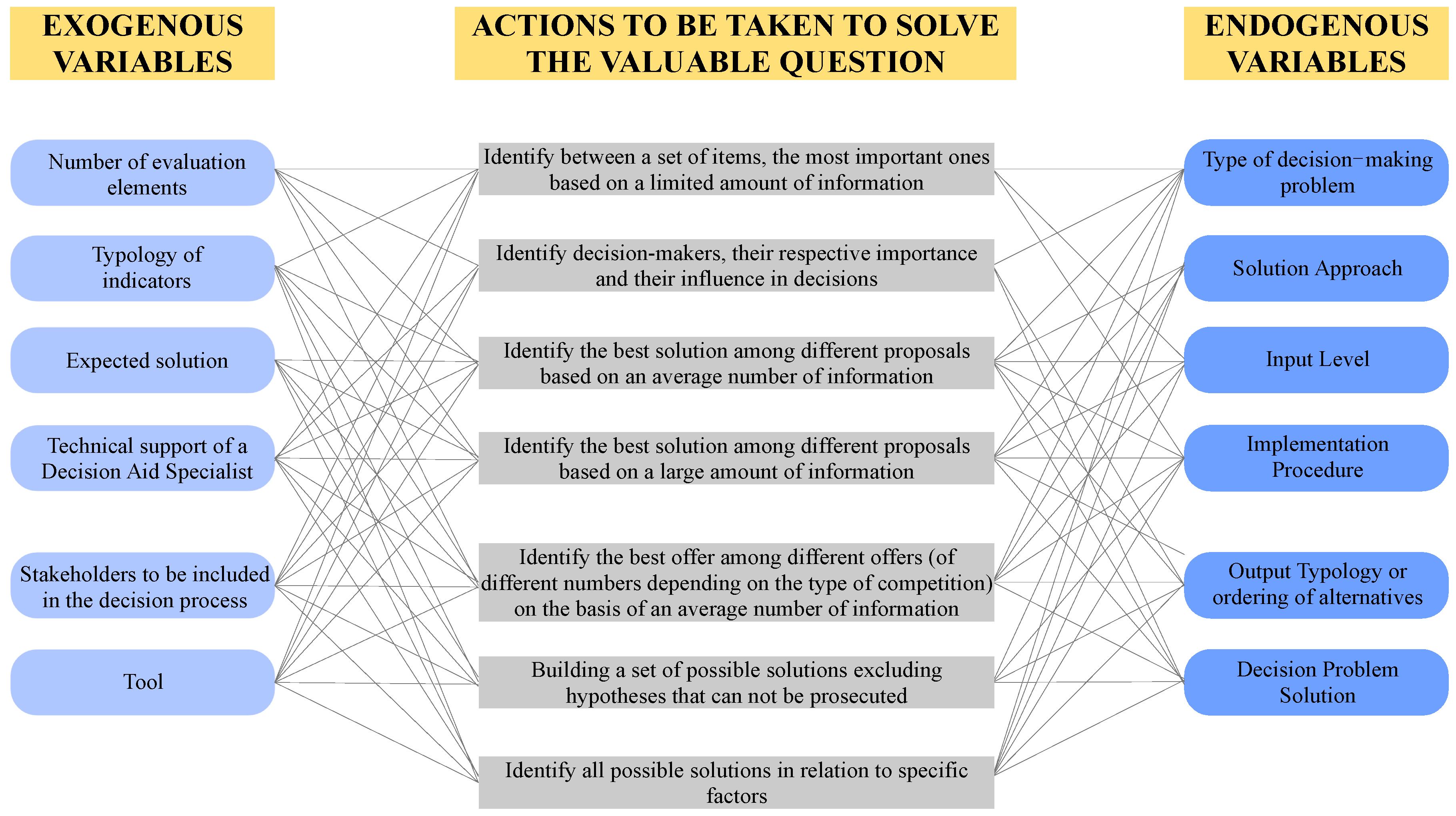
| Phases of the Building Process | Valuable Question | Action Fields of Decision-Making Problems | Action to Be Taken to Solve the Valuable Question | ||
|---|---|---|---|---|---|
| Normative References (Italy) | - Presidential Decree 380/2001 s.m.a.; - D.lgs. 50/2016 s.m.a. | Leg. 50/2016 s.m.a. | D.L. 351/2001 s.m.a.; D.L. 112/2008 s.m.a., D.lgs. 42/2004 s.m.a., D.L. 85/2010 s.m.a. | Presidential Decree 380/2001 s.m.a. | - |
| Programming | Preliminary needs studies | Priority of needs identification | - Settlement development; - Redevelopment, recovery, reuse, urban regeneration; - Development of discarded areas/buildings; - Decision support in project management; - Valuation of public buildings (Legislative Decree 351/2001, Article 3-bis of Legislative Decree 112/2008, Article 58 of the Italian Civil Code); - Valorization of Cultural Heritage (D.L. 85/2010, Articles 5–7 s.m.a.); - Valorization of landscape-environmental assets (D.L. 85/2010, Articles 5–7 s.m.a.) | - Restoration and conservation interventions; [Article 3 par. 1(c)]; - Renovation of buildings; [Article 3 par. 1(d)]; - New construction works; [(Article 3, par. 1 (e1–e7)]; - Urban planning interventions; [(Article. 3 par. 1(f)] | Identify between a set of items, the most important ones based on a limited amount of information |
| Designers and advisors selection | Identification of subjects to be included in Life Cycle Management | Identify decision-makers, their respective importance and their influence in decisions | |||
| Economic technical feasibility project | Design solution that identifies the best relationship between cost and benefit for the community, in relation to the specific needs to be met and performance to be provided (Legislative Decree 50/2016, Article 23, paragraph 5) | Identify the best solution among different proposals based on an average number of information | |||
| Design | |||||
| Definitive project | Best design solution in accordance with the requirements, criteria, constraints, addresses and indications set by the contracting authority and, where applicable, the feasibility project (Legislative Decree 50/2016, Article 23, paragraph 7) | Identify the best solution among different proposals based on a large amount of information | |||
| Executive project | Best design solution in terms of form, type, quality, size and price and in relation to the solution proposed in the maintenance plan of the work and its parts in relation to the life cycle (Legislative Decree 50/2016, Article 23 par. 8) | ||||
| Work execution | Relocation of work | Finding the best deal (based on the most economically advantageous bid criterion) | Identify the best offer among different offers (of different numbers depending on the type of competition) on the basis of an average number of information | ||
| Management during exercise | Service delivery | Identify the most advantageous management solutions and/or the most suitable operator in accordance with the objectives | Building a set of possible solutions excluding hypotheses that can not be prosecuted | ||
| Ordinary and extraordinary maintenance (Presidential Decree 380/2001 s.m.a., Article 3, paragraph 1, letter a, b) | Definition of the ordinary and extraordinary maintenance solution in relation to the modalities and times for the interventions | Identify all possible solutions in relation to specific factors | |||
| Numeric Configuration of Evaluation Elements |
|---|
| Limited number of criteria and sub-criteria and a small number of alternatives |
| Limited number of criteria and sub-criteria and a large number of alternatives |
| Large number of criteria and sub-criteria and a small number of alternatives |
| Large number of criteria and sub-criteria and a large number of alternatives |
| Typology of the Indicators | Features of Indicators |
|---|---|
| Quantitative | Measurable in specific units |
| Qualitative | Not measurable but subject to judgments of merit that may also employ specially designed scales of measurement (ordinal, cardinal or mixed) |
| Mixed | Both quantitative and qualitative |
| Participatory Process | Number of Stakeholders |
|---|---|
| Not activated | Zero |
| Actived with a limited and specific number of stakeholders | Narrow |
| Activated with a high number of stakeholders, if possible organised into categories | Large |
| Type of Solution | Selection Criterion |
|---|---|
| Valid alternatives | Based on the aims of the objective |
| Best alternative | Based on the objective |
| Coherent alternative | Closest to the objective itself |
| Role of the Decision Aid Specialist | The Presence of Technical Support from a Decision Aid Specialist |
|---|---|
| Only technical manager of the MCDA method used to respond to the problem under evaluation | Yes |
| Only facilitator for understanding the decision-making phase(s) of the process | Yes |
| Both technical and facilitator roles | Yes |
| No role for the Decision Aid Specialist | No |
| Number of Evaluation Elements | Typology of Indicators | Expected Solution | Technical support of a Decision Aid Specialist | Stakeholders to Be Included in the Decision Process | Tool |
|---|---|---|---|---|---|
| Limited number of criteria and sub-criteria and a small number of alternatives | - Quantitative; - Qualitative; - Mixed | Definition of n alternatives valid in relation to objectives | - Yes; - No | - Participatory process not activated; - Participatory process activated with a limited and specialized number of stakeholder; - Participatory process activated with a significant number of stakeholder preferably organized in categories | ELECTRE |
| Limited number of criteria and sub-criteria and a large number of alternatives | A better overall alternative definition for the purpose; The ideal alternative definition closest to the lens | MAUT | |||
| Large number of criteria and sub-criteria and a small number of alternatives | AHP; ANP | ||||
| Large number of criteria and sub-criteria and a large number of alternatives | MACBETH; PROMETHEE; TOPSIS |
| Categories | Decision-Making Problem |
|---|---|
| Description problem | Identify the main distinctive features for a group of alternatives |
| Sorting problem | The definition of homogeneous groups of alternatives by characteristics |
| Ranking and Choice problem | The ranking of alternatives, from best to worst |
| Method of Approach | Qualification * |
|---|---|
| Full Aggregation Approach | “A score is evaluated for each criterion and these are then synthesized into a global score. This approach assumes compensable scores, i.e., a bad score for one criterion is compensated for by a good score on another”. |
| Outranking Approach | “A bad score may not be compensated for by a better score. The order of the option may be partial because the notion of incomparability is allowed. Two options may have the same score, but their behavior may be different and therefore incomparable”. |
| Goal, aspiration or reference level approach | “A goal for each criterion is defined, and then the closest options to the ideal goal or reference level are identified”. |
| Modelling Effort Parametres | Indicators |
|---|---|
| Data and parameters to be traced and inserted into the evaluation model | High, medium, low |
| Requested time to collect and process data | Long, medium, short |
| Skills needed to manage and process data | High, medium, low |
| Use of additional evaluation techniques for the collection of data used in the MCDA | Necessary, advised, unnecessary |
| Implementation Procedures | Data Processing and Aggregation |
|---|---|
| Preference thresholds, indifference thresholds, veto thresholds | Pairwise preference degree comparing the performance of n alternatives. To find the preference level, the evaluation must consider the preference and indifference thresholds. On the basis of these thresholds, positive, negative and unicriterion net and global flows are created taking into account the weights attributed to each criterion. If an action performs negatively according to a single criterion, it may also be included in a veto threshold that definitively excludes that option from the final ranking. |
| Utility function | The expression of the measure of desirability or preference of each alternative with respect to the others. Different criteria are considered in the function. For each criteria, the marginal utility is determined as representing the partial contribution that each criteria brings to the overall utility assessment. The Global utility is expressed by Global Utility Scores (generally expressed in values between 0 and 1) which are commonly calculated by the additive method or with a weighted sum, based on the weighted importance (weight) for each criterion, or by a simple addition. |
| Pairwise comparisons on a ratio scale | The construction of evaluation matrices. The comparison of the elements included in the evaluation matrices, structured according to a hierarchical system of criteria, sub-criteria and alternatives. It is performed by simultaneously comparing two elements at a time with respect to the hierarchically superior element on the basis of a rational numerical scale (Saaty Fundamental Scale). |
| Pairwise comparisons on a ratio scale with interdependencies | The construction of evaluation matrices called Supermatrix. The Comparison of the elements included in the Supermatrix, which are organised into clusters of criteria, sub-criteria and alternatives, is performed by simultaneously comparing two elements at a time taking into account any interdependencies between them, for example: (i) inner dependencies in cluster criteria; (ii) inner dependencies in the alternative cluster; (iii) outer dependencies (correlation between two different clusters). Based on the influences (also called nodes) between elements or clusters, the Supermatrix is completed considering the influence of each node on the others and expressed on a rational scale (Saaty Fundamental Scale). In the case of no interdependence between the elements being compared, a value of zero is inserted into the Supermatrix. |
| Pairwise comparisons on an interval scale | The construction of evaluation matrices also called matrices of judgements. The comparison between the evaluation elements (alternatives and criteria) is implemented by a pairwise comparison based on a semantic qualitative scale (traditionally translated into quantitative values from 1 to 7). Values are generally included in the matrix of judgments where the relative attractiveness of the criteria and alternatives is also expressed by the consideration of the weight attributed to each criterion. |
| Ideal option and anti-ideal option | The expression for each alternative, of the shortest distance to the ideal (virtual) solution and the longest distance from the anti-ideal solution, taking into account the performance of alternatives referred to each criterion and to the weight of each criterion. The distance is expressed by calculating a distributive normalization and an ideal normalization of the recorded performances. |
| Output Typologies | Calculation Method |
|---|---|
| Partial and complete order obtained by expressing pairwise preference degrees and scores | A simultaneous consideration of the positive and negative global performance flows evaluated for each alternative or simply by considering the net flows that make it possible to understand whether the alternatives being deliberated obtain a higher rank, a minor rank or if two or more alternatives are incomparable or equally valid. |
| Partial and complete order obtained by expressing pairwise outranking degrees | Degrees of preference can lead to a partial rank (if two or more alternatives are incomparable) or a total rank (if the incomparability hypothesis is not allowed) of alternatives traditionally through the expression of degrees of concordance and discordance according to the criteria considered. |
| Full order obtained by considering the scores assigned to the alternatives in various ways (pairwise comparisons with or without interdependencies, utility functions, pairwise comparisons on an interval scale) | By complex and general scores (a hypotheses of incomparability between two alternatives is not admitted) and a general approval of the ordering of alternatives from the best to the worst. |
| Full order with a score closest to the desired objective | The calculation of the proximity coefficient for each alternative traditionally expressed in values between 0 and 1 where value 1 expresses the closest proximity to the aim. |
| Solutions | Incomparability | Solution foundation |
|---|---|---|
| n categories of alternatives of equal score but different behaviors | Admitted | The consideration of several valid alternatives at the same time |
| Alternative with the higher global score | Not admitted | The choice of alternative that gets the highest score |
| Alternative with the closest score to the ideal solution | Not admitted | Choosing the alternative that gets a score, which is closest to the ideal normalization of the recorded performances for the alternatives considered. |
| Type of Decision-Making Problems | Solution Approach | Implementation Procedure | Input Level | Output Typology | Decision Problem Solution | Tool |
|---|---|---|---|---|---|---|
| Sorting/ Description | Outranking approach | Preference thresholds, indifference thresholds, veto thresholds | Medium | Partial ordering obtained by expressing pairwise preferences degrees | n categories of alternatives of equal score but different behaviour | ELECTRE |
| Ranking/Choice | Full aggregation approach | Utility function | High | Full ordering obtained by considering the scores | Alternative with the higher global score | MAUT |
| Pairwise comparison on rational scale and interdependencies | High | Full ordering obtained by considering the scores | Alternative with the higher global score | ANP | ||
| Pairwise comparison on interval scale | High | Full ordering obtained by considering the scores | Alternative with the higher global score | MACBETH | ||
| Pairwise comparison on rational scale | Low | Full ordering obtained by considering the scores | Alternative with the higher global score | AHP | ||
| Goal, aspiration or reference level approach | Ideal option and anti-ideal option | Low | Full ordering with score closest to the aim assumed | Alternative with the closest score to the ideal solution | TOPSIS | |
| Outranking approach | Preference thresholds, indifference thresholds, veto thresholds | Medium | Partial ordering obtained by expressing pairwise preferences degrees | n categories of alternatives of equal score but different behaviour | ELECTRE | |
| Total ordering obtained by expressing pairwise preferences degrees | Alternative with the higher global score | |||||
| Preference thresholds, indifference thresholds | Medium | Partial ordering obtained by expressing pairwise preferences degrees | n categories of alternatives of equal score but different behaviour | PROMETHEE | ||
| Partial ordering obtained by expressing pairwise preferences degrees | Alternative with the higher global score |
| Type of Variables | Variables | Qualification of Variables | Properties of MCDA Tool in Binary System | ||||||
|---|---|---|---|---|---|---|---|---|---|
| ELECTRE | MAUT | ANP | MACBETH | AHP | TOPSIS | PROMETHEE | |||
| Exogenous | Number of evaluation elements | Limited number of criteria and sub-criteria and a small number of alternatives | 1 | 0 | 0 | 0 | 0 | 0 | 0 |
| Limited number of criteria and sub-criteria and a large number of alternatives | 0 | 1 | 0 | 0 | 0 | 0 | 0 | ||
| Large number of criteria and sub-criteria and a small number of alternatives | 0 | 0 | 1 | 0 | 1 | 0 | 0 | ||
| Large number of criteria and sub-criteria and a large number of alternatives | 0 | 0 | 0 | 1 | 0 | 1 | 1 | ||
| Typology of indicators | Quantitative | 1 | 1 | 1 | 1 | 1 | 1 | 1 | |
| Qualitative | 1 | 0 | 1 | 1 | 1 | 1 | 1 | ||
| Mixed | 1 | 0 | 1 | 1 | 1 | 1 | 1 | ||
| Stakeholders to be included in the decision process | Participatory process not activated | 1 | 1 | 1 | 1 | 1 | 1 | 1 | |
| Participatory process activated with a limited and specialized number of stakeholder | 1 | 1 | 1 | 1 | 1 | 1 | 1 | ||
| Participatory process activated with a significant number of stakeholder preferably organized in categories | 1 | 1 | 1 | 1 | 1 | 1 | 1 | ||
| Expected solution | A better overall alternative definition for the purpose | 1 | 0 | 0 | 0 | 0 | 0 | 0 | |
| The ideal alternative definition closest to the lens | 0 | 0 | 0 | 0 | 0 | 1 | 0 | ||
| A better overall alternative definition for the purpose | 0 | 1 | 1 | 1 | 1 | 0 | 1 | ||
| The ideal alternative definition closest to the lens | 0 | 0 | 0 | 0 | 0 | 1 | 0 | ||
| Technical support of a Decision Aid Specialist | Yes (advisable) | 1 | 1 | 1 | 1 | 0 | 0 | 0 | |
| No (not necessary) | 0 | 0 | 0 | 0 | 1 | 1 | 1 | ||
| Endogenous | Type of decision-making problems | Sorting | 1 | 0 | 0 | 0 | 0 | 0 | 0 |
| Description | 1 | 0 | 0 | 0 | 0 | 0 | 0 | ||
| Ranking/Choice | 1 | 1 | 1 | 1 | 1 | 1 | 1 | ||
| Solution approach | Outranking approach | 1 | 0 | 0 | 0 | 0 | 0 | 1 | |
| Full aggregation approach | 0 | 1 | 1 | 1 | 1 | 0 | 0 | ||
| Goal, aspiration or reference level approach | 0 | 0 | 0 | 0 | 0 | 1 | 0 | ||
| Implementation procedure | Preference thresholds, indifference thresholds, veto thresholds | 1 | 0 | 0 | 0 | 0 | 0 | 0 | |
| Preference thresholds, indifference thresholds | 0 | 0 | 0 | 0 | 0 | 0 | 1 | ||
| Utility function | 0 | 1 | 0 | 0 | 0 | 0 | 0 | ||
| Pairwise comparison on rational scale and interdependencies | 0 | 0 | 1 | 0 | 0 | 0 | 0 | ||
| Pairwise comparison on interval scale | 0 | 0 | 0 | 1 | 0 | 0 | 0 | ||
| Pairwise comparison on rational scale | 0 | 0 | 0 | 0 | 1 | 0 | 0 | ||
| Ideal option and anti-ideal option | 0 | 0 | 0 | 0 | 0 | 1 | 0 | ||
| Input level | High | 0 | 1 | 1 | 1 | 1 | 0 | 0 | |
| Medium | 1 | 0 | 0 | 0 | 0 | 0 | 1 | ||
| Low | 0 | 0 | 0 | 0 | 0 | 1 | 0 | ||
| Output typology | Partial ordering obtained by expressing pairwise preferences degrees | 1 | 0 | 0 | 0 | 0 | 0 | 1 | |
| Total ordering obtained by expressing pairwise preferences degrees | 1 | 0 | 0 | 0 | 0 | 0 | 1 | ||
| Full ordering obtained by considering the scores | 0 | 1 | 1 | 1 | 1 | 0 | 0 | ||
| Full ordering with score closest to the aim assumed | 0 | 0 | 0 | 0 | 0 | 1 | 0 | ||
| Decision problem solution | n categories of alternatives of equal score but different behaviour | 1 | 0 | 0 | 0 | 0 | 0 | 1 | |
| Alternative with the higher global score | 0 | 1 | 1 | 1 | 1 | 0 | 0 | ||
| Alternative with the closest score to the ideal solution | 0 | 0 | 0 | 0 | 0 | 1 | 0 | ||
| Goal | General Objectives | Criteria | Sub-Criteria | Typology of Indicators | Indicators |
|---|---|---|---|---|---|
| The urban void solution by the inclusion of new functions | Architectural and Urban quality | Urban fabric filling in relationship with the historical development process | Alignment of the new building to the urban fabrics before demolition (Rilievo IGM 1873) | Qualitative | - Total; - Partial; - Absent |
| Presence of inner courts (covered or uncovered) following the tradition of the historical urban fabric | Qualitative | - Present; - Absent | |||
| Organic relationship between buildings and urban spaces | Connection between design spaces, urban spaces and parliamentary functions close to the design area | Qualitative | - Very high; - High; - Medium; - Low; - Very low | ||
| Mixed use providing by concentration of commercial functions on Matrix route in order to restore its functional and morphological continuity | Qualitative | - Total; - Partial; - Absent | |||
| Easy access to non parliamentary functions on matrix route (Via di Campo Marzio) | Qualitative | - Total; - Partial; - Absent | |||
| Technical and functional quality | Flexibility and integrability of inner and outer spaces from functional and distributive point of view | Minimizing of unmovable structures to reduce the impact on the dynamic and alternative use of spaces | Qualitative | - Very high; - High; - Medium; - Low; - Very low | |
| Minimizing of technical and structural elements to reduce the impact on the dynamic and alternative use of spaces | Qualitative | - Total; - Partial; - Absent | |||
| Economic and financial aspects | Spending Control | Cost reduction | Quantitative | % on base amount established for call for tenders | |
| Cost sustainability connected with energy saving | Quantitative | €/year | |||
| Maintenance costs por year | Quantitative | €/year | |||
| Economic Convenience | Environmental costs | Quantitative | € | ||
| Costs Benefits ratio | Quantitative | Net Present Value (€) |
| Type of Variables | Variables | Weight | Qualification of Variables | Expected Properties to Decision-Making Problem | |
|---|---|---|---|---|---|
| Value | Motivation | ||||
| Exogenous | Number of evaluation elements | 0.5 | Limited number of criteria and sub-criteria and a small number of alternatives | 0 | - |
| Limited number of criteria and sub-criteria and a large number of alternatives | 0 | - | |||
| Large number of criteria and sub-criteria and a small number of alternatives | 0 | - | |||
| Large number of criteria and sub-criteria and a large number of alternatives | 1 | Related to Criteria, Sub-Criteria and Indicators of Evaluation; Considering a significant participation in the call | |||
| Typology of indicators | 0.75 | Quantitative | 0 | - | |
| Qualitative | 0 | - | |||
| Mixed | 1 | Related to Criteria, Sub-Criteria and Indicators of Evaluation | |||
| Stakeholders to be included in the decision process | 1 | Participatory.Process not activated | 0 | ||
| Participatory.Process activated with a limited and specialized number of stakeholder | 0 | ||||
| Participatory.Process activated with a significant number of stakeholder preferably organized in categories | 1 | Need to activate a participatory process with a significant number of categories of stakeholders | |||
| Expected solution | 1 | Definition of n alternatives valid in relation to objectives | 0 | - | |
| A better overall alternative definition for the purpose | 1 | Need to select the best design proposal | |||
| The ideal alternative definition closest to the lens | 0 | - | |||
| Technical support of a Decision Aid Specialist | 0.25 | Yes (advisable) | 1 | Need to speed up decision making | |
| No (not necessary) | 0 | - | |||
| Endogenous | Type of decision-making problems | 0.5 | Sorting | 0 | - |
| Description | 0 | - | |||
| Ranking/Choice | 1 | Need to form a ranking among the design proposals | |||
| Solution approach | 1 | Outranking approach | 0 | - | |
| Full aggregation approach | 1 | Necessity of project proposals in relation to all achievements | |||
| Goal, aspiration or reference level approach | 1 | ||||
| Implementation procedure | 1 | Preference thresholds, indifference thresholds, veto thresholds | 0 | - | |
| Preference thresholds, indifference thresholds | 1 | Need to check the performance of project proposals in relation to thresholds | |||
| Utility function | 0 | - | |||
| Pairwise comparison on rational scale and interdependencies | 0 | - | |||
| Pairwise comparison on interval scale | 0 | - | |||
| Pairwise comparison on rational scale | 0 | - | |||
| Ideal option and anti-ideal option | 1 | Need to check the performance of project proposals in relation to thresholds | |||
| Input level | 0.75 | High | 1 | - Amount of data and parameters: high (calculation for weighing the modelling effort level in relation to the input level parameters as indicated in Table A1) - Times for the definition: medium; -Skills and degree of knowledge of the decision-making problem: high; - Use of integrated techniques: not necessary | |
| Medium | 0 | - | |||
| Low | 0 | - | |||
| Output typology | 1 | Partial ordering obtained by expressing pairwise preferences degrees | 0 | - | |
| Total ordering obtained by expressing pairwise preferences degrees | 0 | - | |||
| Full ordering obtained by considering the scores | 1 | Need to measure the performance of project proposals | |||
| Full ordering with score closest to the aim assumed | 1 | ||||
| Decision problem solution | 1 | n categories of alternatives of equal score but different behaviour | 0 | - | |
| Alternative with the higher global score | 1 | Need to identify the project proposal with the best performance in relation to the goals | |||
| Alternative with the closest score to the ideal solution | 1 | ||||
| Type of Variables | Variables | Weight | Qualification of Variables | Consistency in Relation to the MCDA Tools in Relation to the Expected Qualification | ||||||
|---|---|---|---|---|---|---|---|---|---|---|
| ELECTRE | MAUT | ANP | MACBETH | AHP | TOPSIS | PROMETHEE | ||||
| Exogenous | Number of evaluation elements | 0.5 | Limited number of criteria and sub-criteria and a small number of alternatives | 0.00 | 0.00 | 0.00 | 0.00 | 0.00 | 0.00 | 0.00 |
| Limited number of criteria and sub-criteria and a large number of alternatives | 0.00 | 0.00 | 0.00 | 0.00 | 0.00 | 0.00 | 0.00 | |||
| Large number of criteria and sub-criteria and a small number of alternatives | 0.00 | 0.00 | 0.00 | 0.00 | 0.00 | 0.00 | 0.00 | |||
| Large number of criteria and sub-criteria and a large number of alternatives | 0.00 | 0.00 | 0.00 | 0.50 | 0.00 | 0.50 | 0.50 | |||
| Typology of indicators | 0.75 | Quantitative | 0.00 | 0.00 | 0.00 | 0.00 | 0.00 | 0.00 | 0.00 | |
| Qualitative | 0.00 | 0.00 | 0.00 | 0.00 | 0.00 | 0.00 | 0.00 | |||
| Mixed | 0.75 | 0.00 | 0.75 | 0.75 | 0.75 | 0.75 | 0.75 | |||
| Stakeholders to be included in the decision process | 1 | ParticipatoryProcess not activated | 0.00 | 0.00 | 0.00 | 0.00 | 0.00 | 0.00 | 0.00 | |
| Participatory.Process activated with a limited and specialized number of stakeholder | 0.00 | 0.00 | 0.00 | 0.00 | 0.00 | 0.00 | 0.00 | |||
| Participatory.Process activated with a significant number of stakeholder preferably organized in categories | 1.00 | 1.00 | 1.00 | 1.00 | 1.00 | 1.00 | 1.00 | |||
| Expected solution | 1 | A better overall alternative definition for the purpose; The ideal alternative definition closest to the lens | 0.00 | 0.00 | 0.00 | 0.00 | 0.00 | 0.00 | 0.00 | |
| A better overall alternative definition for the purpose | 0.00 | 1.00 | 1.00 | 1.00 | 1.00 | 0.00 | 1.00 | |||
| The ideal alternative definition closest to the lens | 0.00 | 0.00 | 0.00 | 0.00 | 0.00 | 0.00 | 0.00 | |||
| Technical support of a Decision Aid Specialist | 0.25 | Yes (advisable) | 0.25 | 0.25 | 0.25 | 0.25 | 0.00 | 0.00 | 0.00 | |
| No (not necessary) | 0.00 | 0.00 | 0.00 | 0.00 | 0.00 | 0.00 | 0.00 | |||
| Endogenous | Type of decision-making problem.s | 0.5 | Sorting | 0.00 | 0.00 | 0.00 | 0.00 | 0.00 | 0.00 | 0.00 |
| Description | 0.00 | 0.00 | 0.00 | 0.00 | 0.00 | 0.00 | 0.00 | |||
| Ranking/Choice | 0.50 | 0.50 | 0.50 | 0.50 | 0.50 | 0.50 | 0.50 | |||
| Solution approach | 1 | Outranking approach | 0.00 | 0.00 | 0.00 | 0.00 | 0.00 | 0.00 | 0.00 | |
| Full aggregation approach | 0.00 | 1.00 | 1.00 | 1.00 | 1.00 | 0.00 | 0.00 | |||
| Goal, aspiration or reference level approach | 0.00 | 0.00 | 0.00 | 0.00 | 0.00 | 1.00 | 0.00 | |||
| Implementation procedure | 1 | Preference thresholds, indifference thresholds, veto thresholds | 0.00 | 0.00 | 0.00 | 0.00 | 0.00 | 0.00 | 0.00 | |
| Preference thresholds, indifference thresholds | 0.00 | 0.00 | 0.00 | 0.00 | 0.00 | 0.00 | 1.00 | |||
| Utility function | 0.00 | 0.00 | 0.00 | 0.00 | 0.00 | 0.00 | 0.00 | |||
| Pairwise comparison on rational scale and interdependencies | 0.00 | 0.00 | 0.00 | 0.00 | 0.00 | 0.00 | 0.00 | |||
| Pairwise comparison on interval scale | 0.00 | 0.00 | 0.00 | 0.00 | 0.00 | 0.00 | 0.00 | |||
| Pairwise comparison on rational scale | 0.00 | 0.00 | 0.00 | 0.00 | 0.00 | 0.00 | 0.00 | |||
| Ideal option and anti-ideal option | 0.00 | 0.00 | 0.00 | 0.00 | 0.00 | 1.00 | 0.00 | |||
| Input level | 0.75 | High | 0.00 | 0.05 | 0.05 | 0.00 | 0.05 | 0.00 | 0.00 | |
| Medium | 0.00 | 0.00 | 0.00 | 0.00 | 0.00 | 0.00 | 0.00 | |||
| Low | 0.00 | 0.00 | 0.00 | 0.00 | 0.00 | 0.00 | 0.00 | |||
| Output typology | 1 | Partial ordering obtained by expressing pairwise preferences degrees | 0.00 | 0.00 | 0.00 | 0.00 | 0.00 | 0.00 | 0.00 | |
| Total ordering obtained by expressing pairwise preferences degrees | 0.00 | 0.00 | 0.00 | 0.00 | 0.00 | 0.00 | 0.00 | |||
| Full ordering obtained by considering the scores | 0.00 | 1.00 | 1.00 | 1.00 | 1.00 | 0.00 | 0.00 | |||
| Full ordering with score closest to the aim assumed | 0.00 | 0.00 | 0.00 | 0.00 | 0.00 | 1.00 | 0.00 | |||
| Decision problem solution | 1 | n categories of alternatives of equal score but different behaviour | 0.00 | 0.00 | 0.00 | 0.00 | 0.00 | 0.00 | 0.00 | |
| Alternative with the higher global score | 0.00 | 1.00 | 1.00 | 1.00 | 1.00 | 0.00 | 0.00 | |||
| Alternative with the closest score to the ideal solution | 0.00 | 0.00 | 0.00 | 0.00 | 0.00 | 1.00 | 0.00 | |||
| Overall suitability index (IS) | 0.23 | 0.53 | 0.60 | 0.64 | 0.57 | 0.61 | 0.43 | |||
| MCDA Tool | Overall Suitability Index (IS) | Ranking |
|---|---|---|
| MACBETH | 0.64 | 1 |
| TOPSIS | 0.61 | 2 |
| ANP | 0.60 | 3 |
| AHP | 0.57 | 4 |
| MAUT | 0.53 | 5 |
| PROMETHEE | 0.43 | 6 |
| ELECTRE | 0.23 | 7 |
© 2018 by the authors. Licensee MDPI, Basel, Switzerland. This article is an open access article distributed under the terms and conditions of the Creative Commons Attribution (CC BY) license (http://creativecommons.org/licenses/by/4.0/).
Share and Cite
Guarini, M.R.; Battisti, F.; Chiovitti, A. A Methodology for the Selection of Multi-Criteria Decision Analysis Methods in Real Estate and Land Management Processes. Sustainability 2018, 10, 507. https://doi.org/10.3390/su10020507
Guarini MR, Battisti F, Chiovitti A. A Methodology for the Selection of Multi-Criteria Decision Analysis Methods in Real Estate and Land Management Processes. Sustainability. 2018; 10(2):507. https://doi.org/10.3390/su10020507
Chicago/Turabian StyleGuarini, Maria Rosaria, Fabrizio Battisti, and Anthea Chiovitti. 2018. "A Methodology for the Selection of Multi-Criteria Decision Analysis Methods in Real Estate and Land Management Processes" Sustainability 10, no. 2: 507. https://doi.org/10.3390/su10020507
APA StyleGuarini, M. R., Battisti, F., & Chiovitti, A. (2018). A Methodology for the Selection of Multi-Criteria Decision Analysis Methods in Real Estate and Land Management Processes. Sustainability, 10(2), 507. https://doi.org/10.3390/su10020507

