

A Pilot Study of Circulating microRNA Expression in Newly Diagnosed Type 2 Diabetes Using a Pooled Sample Approach

 , , and
Abstract
1. Introduction
1.1. MicroRNAs
1.2. The Relationship Between miRNA and Diabetes Mellitus
2. Materials and Methods
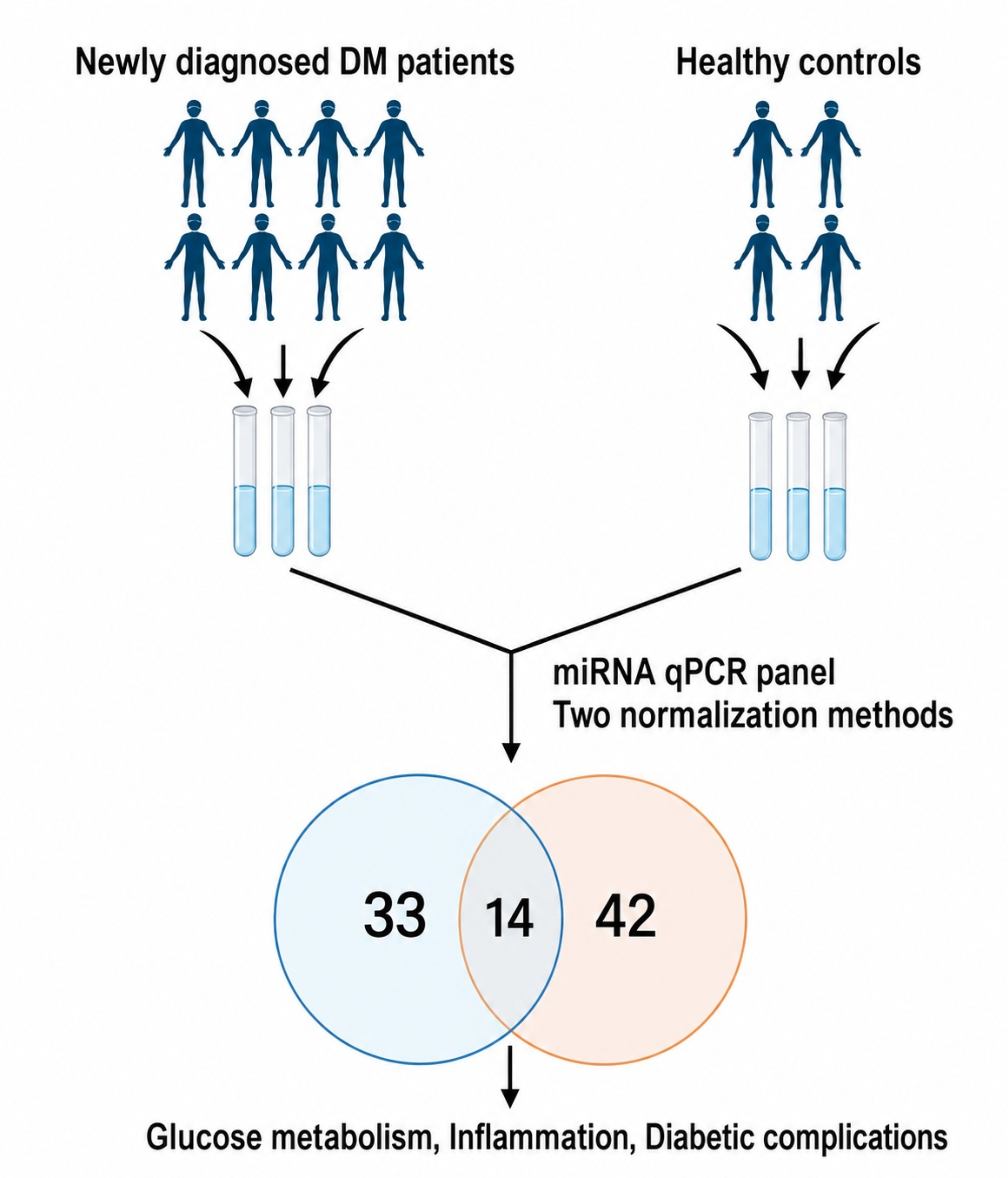
2.1. Research Design and Study Cohort
2.2. Specimen Collection and Processing
2.3. Analysis of Plasma miRNA Expression
2.4. Statistical Analysis
3. Results
3.1. Clinical and Demographic Characteristics of the Subjects
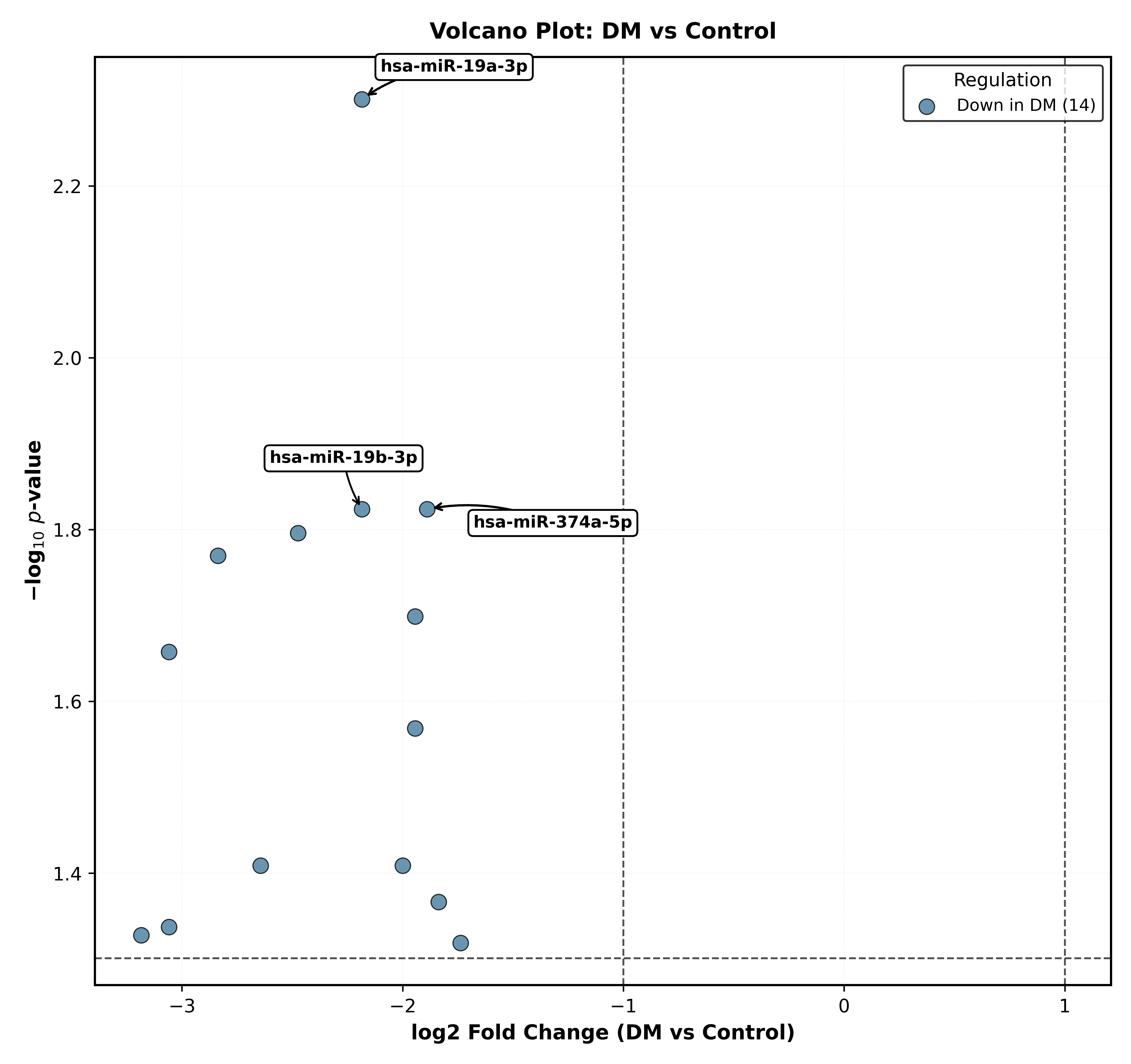
3.2. miRNA Analysis
3.3. Gene Analysis
4. Discussion
Limitations
5. Conclusions
Author Contributions
Funding
Institutional Review Board Statement
Informed Consent Statement
Data Availability Statement
Acknowledgments
Conflicts of Interest
References
- IDF Diabetes Atlas. International Diabetes Federation, 11. Available online: https://www.diabetesatlas.org (accessed on 17 February 2026).
- Crasto, W.; Patel, V.; Davies, M.J.; Khunti, K. Prevention of Microvascular Complications of Diabetes. Endocrinol. Metab. Clin. N. Am. 2021, 50, 431–455. [Google Scholar] [CrossRef] [PubMed]
- Brownlee, M. The Pathobiology of Diabetic Complications. Diabetes 2005, 54, 1615–1625. [Google Scholar] [CrossRef]
- Deng, J.; Guo, F. MicroRNAs and Type 2 Diabetes. ExRNA 2019, 1, 36. [Google Scholar] [CrossRef]
- Barutta, F.; Bellini, S.; Mastrocola, R.; Bruno, G.; Gruden, G. MicroRNA and Microvascular Complications of Diabetes. Int. J. Endocrinol. 2018, 2018, 6890501. [Google Scholar] [CrossRef] [PubMed]
- Kato, M.; Castro, N.E.; Natarajan, R. MicroRNAs: Potential Mediators and Biomarkers of Diabetic Complications. Free. Radic. Biol. Med. 2013, 64, 85–94. [Google Scholar] [CrossRef]
- Natarajan, R.; Putta, S.; Kato, M. MicroRNAs and Diabetic Complications. J. Cardiovasc. Trans. Res. 2012, 5, 413–422. [Google Scholar] [CrossRef]
- O’Brien, J.; Hayder, H.; Zayed, Y.; Peng, C. Overview of MicroRNA Biogenesis, Mechanisms of Actions, and Circulation. Front. Endocrinol. 2018, 9, 402. [Google Scholar] [CrossRef]
- Rezazadeh-Gavgani, E.; Oladghaffari, M.; Bahramian, S.; Majidazar, R.; Dolati, S. MicroRNA-21: A Critical Underestimated Molecule in Diabetic Retinopathy. Gene 2023, 859, 147212. [Google Scholar] [CrossRef]
- Chang, X.; Zhu, G.; Cai, Z.; Wang, Y.; Lian, R.; Tang, X.; Ma, C.; Fu, S. miRNA, lncRNA and circRNA: Targeted Molecules Full of Therapeutic Prospects in the Development of Diabetic Retinopathy. Front. Endocrinol. 2021, 12, 771552. [Google Scholar] [CrossRef]
- Trotta, M.C.; Gesualdo, C.; Platania, C.B.M.; De Robertis, D.; Giordano, M.; Simonelli, F.; D’Amico, M.; Drago, F.; Bucolo, C.; Rossi, S. Circulating miRNAs in Diabetic Retinopathy Patients: Prognostic Markers or Pharmacological Targets? Biochem. Pharmacol. 2021, 186, 114473. [Google Scholar] [CrossRef]
- Salim, U.; Kumar, A.; Kulshreshtha, R.; Vivekanandan, P. Biogenesis, Characterization, and Functions of Mirtrons. Wiley Interdiscip. Rev. RNA 2022, 13, e1680. [Google Scholar] [CrossRef]
- Kim, M.; Zhang, X. The Profiling and Role of miRNAs in Diabetes Mellitus. J. Diabetes Clin. Res. 2019, 1, 5–23. [Google Scholar] [CrossRef]
- Leitão, A.L.; Enguita, F.J. A Structural View of miRNA Biogenesis and Function. Non-Coding RNA 2022, 8, 10. [Google Scholar] [CrossRef]
- Vasudevan, S. Posttranscriptional Upregulation by MicroRNAs: Posttranscriptional Upregulation by MicroRNAs. Wiley Interdiscip. Rev. RNA 2012, 3, 311–330. [Google Scholar] [CrossRef]
- Makarova, J.A.; Shkurnikov, M.U.; Wicklein, D.; Lange, T.; Samatov, T.R.; Turchinovich, A.A.; Tonevitsky, A.G. Intracellular and Extracellular microRNA: An Update on Localization and Biological Role. Prog. Histochem. Cytochem. 2016, 51, 33–49. [Google Scholar] [CrossRef]
- Feng, J.; Xing, W.; Xie, L. Regulatory Roles of MicroRNAs in Diabetes. Int. J. Mol. Sci. 2016, 17, 1729. [Google Scholar] [CrossRef] [PubMed]
- Jo, S.; Chen, J.; Xu, G.; Grayson, T.B.; Thielen, L.A.; Shalev, A. miR-204 Controls Glucagon-Like Peptide 1 Receptor Expression and Agonist Function. Diabetes 2018, 67, 256–264. [Google Scholar] [CrossRef]
- Hunter, M.P.; Ismail, N.; Zhang, X.; Aguda, B.D.; Lee, E.J.; Yu, L.; Xiao, T.; Schafer, J.; Lee, M.-L.T.; Schmittgen, T.D.; et al. Detection of microRNA Expression in Human Peripheral Blood Microvesicles. PLoS ONE 2008, 3, e3694. [Google Scholar] [CrossRef] [PubMed]
- Zampetaki, A.; Kiechl, S.; Drozdov, I.; Willeit, P.; Mayr, U.; Prokopi, M.; Mayr, A.; Weger, S.; Oberhollenzer, F.; Bonora, E.; et al. Plasma microRNA Profiling Reveals Loss of Endothelial miR-126 and Other microRNAs in Type 2 Diabetes. Circ. Res. 2010, 107, 810–817. [Google Scholar] [CrossRef] [PubMed]
- Baldeón R, L.; Weigelt, K.; de Wit, H.; Ozcan, B.; van Oudenaren, A.; Sempértegui, F.; Sijbrands, E.; Grosse, L.; Freire, W.; Drexhage, H.A.; et al. Decreased Serum Level of miR-146a as Sign of Chronic Inflammation in Type 2 Diabetic Patients. PLoS ONE 2014, 9, e115209. [Google Scholar] [CrossRef] [PubMed]
- Kong, L.; Zhu, J.; Han, W.; Jiang, X.; Xu, M.; Zhao, Y.; Dong, Q.; Pang, Z.; Guan, Q.; Gao, L.; et al. Significance of Serum microRNAs in Pre-Diabetes and Newly Diagnosed Type 2 Diabetes: A Clinical Study. Acta Diabetol. 2011, 48, 61–69. [Google Scholar] [CrossRef]
- Yan, S.; Wang, T.; Huang, S.; Di, Y.; Huang, Y.; Liu, X.; Luo, Z.; Han, W.; An, B. Differential Expression of microRNAs in Plasma of Patients with Prediabetes and Newly Diagnosed Type 2 Diabetes. Acta Diabetol. 2016, 53, 693–702. [Google Scholar] [CrossRef]
- Condrat, C.E.; Thompson, D.C.; Barbu, M.G.; Bugnar, O.L.; Boboc, A.; Cretoiu, D.; Suciu, N.; Cretoiu, S.M.; Voinea, S.C. miRNAs as Biomarkers in Disease: Latest Findings Regarding Their Role in Diagnosis and Prognosis. Cells 2020, 9, 276. [Google Scholar] [CrossRef]
- Moldovan, L.; Batte, K.E.; Trgovcich, J.; Wisler, J.; Marsh, C.B.; Piper, M. Methodological challenges in utilizing miRNAs as circulating biomarkers. J. Cell. Mol. Med. 2014, 18, 371–390. [Google Scholar] [CrossRef] [PubMed] [PubMed Central]
- Villard, A.; Marchand, L. Diagnostic Value of Cell-Free Circulating Micrornas for Obesity and Type 2 Diabetes: A Meta-Analysis. J. Mol. Biomark. Diagn. 2015, 6, 251. [Google Scholar] [CrossRef] [PubMed]
- Bian, J.; Ge, W.; Jiang, Z. miR-26a-5p Attenuates Oxidative Stress and Inflammation in Diabetic Retinopathy through the USP14/NF-κB Signaling Pathway. J. Ophthalmol. 2024, 2024, 1470898. [Google Scholar] [CrossRef]
- Shi, R.; Chen, L.; Wang, W.; Deng, Y.; Liu, Y.; Zhou, H.; Lin, R. Plasma miR-26a-5p Is a Biomarker for Retinal Neurodegeneration of Early Diabetic Retinopathy. Eye 2021, 35, 1587–1599. [Google Scholar] [CrossRef]
- De Candia, P.; Spinetti, G.; Specchia, C.; Sangalli, E.; La Sala, L.; Uccellatore, A.; Lupini, S.; Genovese, S.; Matarese, G.; Ceriello, A. A Unique Plasma microRNA Profile Defines Type 2 Diabetes Progression. PLoS ONE 2017, 12, e0188980. [Google Scholar] [CrossRef] [PubMed]
- Lee, H.W.; Khan, S.Q.; Khaliqdina, S.; Altintas, M.M.; Grahammer, F.; Zhao, J.L.; Koh, K.H.; Tardi, N.J.; Faridi, M.H.; Geraghty, T.; et al. Absence of miR-146a in Podocytes Increases Risk of Diabetic Glomerulopathy via Up-Regulation of ErbB4 and Notch-1. J. Biol. Chem. 2017, 292, 732–747. [Google Scholar] [CrossRef]
- Rong, Y.; Bao, W.; Shan, Z.; Liu, J.; Yu, X.; Xia, S.; Gao, H.; Wang, X.; Yao, P.; Hu, F.B.; et al. Increased microRNA-146a Levels in Plasma of Patients with Newly Diagnosed Type 2 Diabetes Mellitus. PLoS ONE 2013, 8, e73272. [Google Scholar] [CrossRef] [PubMed]
- Guo, B.; Xu, X.; Chi, X.; Wang, M. Relationship of lncRNA FTX and miR-186-5p Levels with Diabetic Peripheral Neuropathy in Type 2 Diabetes and Its Bioinformatics Analysis. Ir. J. Med. Sci. 2024, 193, 2293–2299. [Google Scholar] [CrossRef] [PubMed]
- Liu, Y.; Zheng, W.; Pan, Y.; Hu, J. Low Expression of miR-186-5p Regulates Cell Apoptosis by Targeting Toll-like Receptor 3 in High Glucose–Induced Cardiomyocytes. J. Cell. Biochem. 2019, 120, 9532–9538. [Google Scholar] [CrossRef]
- Li, Y.; Luo, T.; Wang, L.; Wu, J.; Guo, S. MicroRNA-19a-3p Enhances the Proliferation and Insulin Secretion, While It Inhibits the Apoptosis of Pancreatic β Cells via the Inhibition of SOCS3. Int. J. Mol. Med. 2016, 38, 1515–1524. [Google Scholar] [CrossRef]
- Rajabinejad, M.; Asadi, G.; Ranjbar, S.; Varmaziar, F.R.; Karimi, M.; Salari, F.; Karaji, A.G.; Rezaiemanesh, A.; Hezarkhani, L.A. The MALAT1-H19/miR-19b-3p Axis Can Be a Fingerprint for Diabetic Neuropathy. Immunol. Lett. 2022, 245, 69–78. [Google Scholar] [CrossRef]
- Wang, D.; Wang, H.; Liu, C.; Mu, X.; Cheng, S. Hyperglycemia Inhibition of Endothelial miR-140-3p Mediates Angiogenic Dysfunction in Diabetes Mellitus. J. Diabetes Its Complicat. 2019, 33, 374–382. [Google Scholar] [CrossRef]
- Zhao, N.; Luo, Q.; Lin, R.; Li, Q.; Ma, P. MiR-142-3p Ameliorates High Glucose-Induced Renal Tubular Epithelial Cell Injury by Targeting BOD1. Clin. Exp. Nephrol. 2021, 25, 1182–1192. [Google Scholar] [CrossRef] [PubMed]


| Variable | All (Median + IQR) | Men (Median + IQR) | Women (Median + IQR) | DM (Median + IQR) | Controls (Median + IQR) |
|---|---|---|---|---|---|
| Age (years) | 53 (49–57) n = 36 | 51 (49–54) n = 19 | 56 (52–61.25) n = 17 | 54.5 (50–59.5) n = 24 | 51 (49–54) n = 12 |
| Variable | Value |
|---|---|
| Age (years) | 53.5 ± 8.5 |
| Weight (kg) | 101.5 (82–112.5) |
| Height (m) | 1.695 (1.635–1.765) |
| BMI (kg/m2) | 35.19 (29.375–40.885) |
| WC (cm) | 118.5 (106–121.5) |
| Glycemia (mg/dL) | 198.58 ± 109.51 |
| HbA1c (%) | 9.03 (6.74–11.05) |
| TC (mg/dL) | 181 (142–252.5) |
| LDLc (mg/dL) | 102.5 (78.5–152.5) |
| TG (mg/dL) | 206.95 ± 139.87 |
| HDLc (mg/dL) | 41.5 (34.5–47.5) |
| nonHDLc (mg/dL) | 141.5 (100.5–204) |
| SCr (mg/dL) | 0.78 (0.68–0.90) |
| eGFR (ml/min) | 96.6 ± 18.45 |
| ACR (mg/g) | 40.645 ± 66.886 |
| ALT (U/L) | 49.25 ± 24.12 |
| CAP (dB/m) | 325 (272–353) |
| Fibroscan (kPa) | 5.75 (4.75–6.65) |
| IL6 (pg/mL) | 5.767 ± 5.088 |
| CRP (mg/L) | 13.31 ± 11.22 |
| Uric acid (mg/dL) | 5.9 (4.9–6.85) |
| Variable | Men | Women | p-Value |
|---|---|---|---|
| Age (years) a | 51.38 n = 13 | 56.00 n = 11 | 0.1958 ns |
| Weight (kg) b | 104.00 89.50 to 119.50 | 100.00 81.25 to 108.50 | 0.4005 ns |
| Height (m) b | 1.75 1.71 to 1.79 | 1.63 1.61 to 1.65 | 0.0001 ** |
| BMI (kg/m2) b | 32.41 29.46 to 40.34 | 37.83 29.16 to 42.09 | 0.6905 ns |
| WC (cm) b | 118.00 104.50 to 123.25 | 119.00 106.75 to 121.75 | 0.8162 ns |
| Glycemia (mg/dL) a | 184.69 n = 13 | 215.00 n = 11 | 0.5115 ns |
| HbA1c (%) b | 9.00 6.50 to 10.53 | 9.06 6.85 to 12.21 | 0.2705 ns |
| TC (mg/dL) b | 193.00 146.00 to 221.50 | 160.00 141.00 to 252.75 | 0.9077 ns |
| LDLc (mg/dL) b | 103.00 84.25 to 126.00 | 98.00 59.20 to 168.00 | 0.6637 ns |
| TG (mg/dL) a | 207.38 n = 13 | 206.45 n = 11 | 0.9875 ns |
| HDLc (mg/dL) b | 40.00 33.75 to 46.00 | 45.00 36.25 to 48.75 | 0.4004 ns |
| nonHDLc (mg/dL) b | 154.00 105.25 to 188.25 | 125.00 96.50 to 204.50 | 0.8848 ns |
| SCr (mg/dL) b | 0.80 0.70 to 0.90 | 0.70 0.66 to 0.94 | 0.3993 ns |
| eGFR (ml/min) a | 104.09 n = 13 | 87.75 n = 11 | 0.0270 * |
| ACR (mg/g) a | 19.11 n = 12 | 64.14 n = 11 | 0.1081 ns |
| ALT (U/L) a | 56.31 n = 13 | 40.91 n = 11 | 0.1214 ns |
| CAP (dB/m) b | 338.00 263.75 to 380.25 | 312.00 278.50 to 348.75 | 0.8620 ns |
| Fibroscan (kPa) b | 5.70 4.57 to 6.98 | 6.00 4.98 to 6.28 | 0.9307 ns |
| IL6 (pg/mL) a | 4.47 n = 13 | 7.30 n = 11 | 0.1815 ns |
| CRP (mg/L) a | 11.32 n = 13 | 15.66 n = 11 | 0.3562 ns |
| Uric acid (mg/dL) b | 6.50 5.83 to 7.05 | 4.90 3.92 to 5.75 | 0.0319 * |
| Variable | With (%) | Without (%) |
|---|---|---|
| Diabetic neuropathy | 58.3 (n = 14) | 41.7 (n = 10) |
| Coronary disease | 25 (n = 6) | 75 (n = 18) |
| Cerebrovascular disease | 4.2 (n = 1) | 95.8 (n = 23) |
| Hypertension | 79.2 (n = 19) | 20.8 (n = 5) |
| MiRNA | p-Value | Fold Change | Fold Regulation |
|---|---|---|---|
| hsa-miR-652-3p | 0.020 | 0.26 | −3.91 |
| hsa-miR-106a-5p | 0.023 | 0.39 | −2.55 |
| hsa-miR-26a-5p | 0.016 | 0.18 | −5.65 |
| hsa-miR-222-3p | 0.047 | 0.11 | −8.90 |
| hsa-miR-152-3p | 0.025 | 0.29 | −3.44 |
| hsa-miR-146a-5p | 0.046 | 0.12 | −8.13 |
| hsa-miR-148b-3p | 0.008 | 0.25 | −3.99 |
| hsa-miR-20a-5p | 0.020 | 0.43 | −2.32 |
| hsa-miR-17-5p | 0.016 | 0.45 | −2.22 |
| hsa-miR-186-5p | 0.043 | 0.28 | −3.58 |
| hsa-miR-142-3p | 0.039 | 0.25 | −4.04 |
| hsa-miR-126-5p | 0.024 | 0.55 | −1.81 |
| hsa-miR-19a-3p | 0.005 | 0.22 | −4.57 |
| hsa-miR-144-3p | 0.048 | 0.27 | −3.67 |
| hsa-miR-126-3p | 0.025 | 0.36 | −2.78 |
| hsa-miR-18b-5p | 0.048 | 0.30 | −3.30 |
| hsa-miR-19b-3p | 0.015 | 0.22 | −4.55 |
| hsa-miR-502-3p | 0.011 | 0.51 | −1.96 |
| hsa-miR-140-3p | 0.022 | 0.12 | −8.48 |
| hsa-miR-532-3p | 0.039 | 0.16 | −6.20 |
| hsa-miR-15a-5p | 0.043 | 0.49 | −2.05 |
| hsa-miR-532-5p | 0.044 | 0.39 | −2.56 |
| hsa-miR-660-5p | 0.002 | 0.35 | −2.83 |
| hsa-miR-497-5p | 0.009 | 5.53 | 5.53 |
| hsa-miR-18a-5p | 0.045 | 0.31 | −3.18 |
| hsa-miR-29b-3p | 0.017 | 0.14 | −7.02 |
| hsa-miR-1260a | 0.019 | 3.36 | 3.36 |
| hsa-miR-100-5p | 0.0004 | 2.43 | 2.43 |
| hsa-miR-146b-5p | 0.027 | 0.26 | −3.88 |
| hsa-miR-378a-3p | 0.003 | 0.32 | −3.09 |
| hsa-miR-374a-5p | 0.015 | 0.27 | −3.74 |
| hsa-miR-483-5p | 0.025 | 10.78 | 10.78 |
| hsa-miR-21-5p | 0.025 | 0.41 | −2.44 |
| MiRNA | p-Value | Fold Change | Fold Regulation |
|---|---|---|---|
| hsa-miR-652-3p | 0.024 | 0.23 | −4.32 |
| hsa-miR-374b-5p | 0.014 | 0.28 | −3.55 |
| hsa-miR-93-5p | 0.012 | 0.28 | −3.55 |
| hsa-miR-484 | 0.003 | 0.41 | −2.44 |
| hsa-miR-26a-5p | 0.014 | 0.16 | −6.23 |
| hsa-miR-222-3p | 0.042 | 0.10 | −9.82 |
| hsa-miR-16-5p | 0.040 | 0.25 | −3.93 |
| hsa-miR-30c-5p | 0.046 | 0.20 | −5.11 |
| hsa-miR-146a-5p | 0.048 | 0.11 | −8.96 |
| hsa-miR-107 | 0.019 | 0.10 | −9.84 |
| hsa-miR-186-5p | 0.002 | 0.25 | −3.95 |
| hsa-miR-320b | 0.036 | 0.43 | −2.31 |
| hsa-miR-301a-3p | 0.021 | 0.31 | −3.26 |
| hsa-miR-151a-5p | 0.016 | 0.25 | −4.01 |
| hsa-miR-320a-3p | 0.033 | 0.40 | −2.48 |
| hsa-miR-103a-3p | 0.021 | 0.11 | −8.90 |
| hsa-miR-142-3p | 0.008 | 0.22 | −4.46 |
| hsa-miR-19a-3p | 0.042 | 0.20 | −5.04 |
| hsa-miR-195-5p | 0.022 | 13.25 | 13.25 |
| hsa-miR-18b-5p | 0.037 | 0.27 | −3.64 |
| hsa-miR-320d | 0.015 | 0.40 | −2.53 |
| hsa-miR-19b-3p | 0.018 | 0.20 | −5.03 |
| hsa-miR-155-5p | 0.035 | 2.74 | 2.74 |
| hsa-miR-140-3p | 0.0004 | 0.11 | −9.36 |
| hsa-miR-92b-3p | 0.007 | 2.06 | 2.06 |
| hsa-let-7d-5p | 0.013 | 0.25 | −3.92 |
| hsa-miR-532-3p | 0.001 | 0.15 | −6.84 |
| hsa-miR-320c | 0.007 | 0.36 | −2.77 |
| hsa-miR-130a-3p | 0.003 | 0.22 | −4.53 |
| hsa-let-7c-5p | 0.013 | 0.36 | −2.74 |
| hsa-miR-29b-3p | 0.049 | 0.13 | −7.74 |
| hsa-miR-136-5p | 0.015 | 1.91 | 1.91 |
| hsa-miR-146b-5p | 0.008 | 0.23 | −4.28 |
| hsa-miR-339-5p | 0.049 | 0.13 | −7.81 |
| hsa-miR-425-5p | 0.042 | 0.26 | −3.83 |
| hsa-miR-16-2-3p | 0.012 | 0.44 | −2.26 |
| hsa-miR-130b-3p | 0.010 | 0.26 | −3.79 |
| hsa-miR-363-3p | 0.045 | 0.24 | −4.15 |
| hsa-miR-374a-5p | 0.034 | 0.24 | −4.12 |
| hsa-miR-151a-3p | 0.006 | 0.27 | −3.68 |
| hsa-miR-136-3p | 0.044 | 6.83 | 6.83 |
| hsa-miR-15b-5p | 0.002 | 0.21 | −4.73 |
| miRNA | Ct Average ± SD | p-Value (<0.05) | Fold Change | Fold Regulation | |
|---|---|---|---|---|---|
| DM | Controls | ||||
| hsa-miR-652-3p | 33.55 ± 1.85 | 27.22 ± 0.91 | 0.020 | 0.26 | −3.91 |
| hsa-miR-26a-5p | 32.46 ± 1.39 | 25.60 ± 0.78 | 0.016 | 0.18 | −5.65 |
| hsa-miR-222-3p | 34.06 ± 1.11 | 26.55 ± 0.85 | 0.047 | 0.11 | −8.90 |
| hsa-miR-146a-5p | 33.70 ± 1.55 | 26.32 ± 0.96 | 0.046 | 0.12 | −8.13 |
| hsa-miR-186-5p | 34.47 ± 0.89 | 28.26 ± 0.75 | 0.043 | 0.28 | −3.58 |
| hsa-miR-142-3p | 31.10 ± 1.55 | 24.73 ± 0.84 | 0.039 | 0.25 | −4.04 |
| hsa-miR-19a-3p | 27.94 ± 0.43 | 21.38 ± 0.50 | 0.005 | 0.22 | −4.57 |
| hsa-miR-18b-5p | 34.59 ± 0.71 | 28.50 ± 0.53 | 0.048 | 0.30 | −3.30 |
| hsa-miR-19b-3p | 28.30 ± 0.37 | 21.75 ± 0.51 | 0.015 | 0.22 | −4.55 |
| hsa-miR-140-3p | 32.20 ± 0.52 | 24.76 ± 0.79 | 0.022 | 0.12 | −8.48 |
| hsa-miR-532-3p | 34.82 ± 0.16 | 27.82 ± 0.73 | 0.039 | 0.16 | −6.20 |
| hsa-miR-29b-3p | 34.31 ± 0.60 | 27.14 ± 0.53 | 0.017 | 0.14 | −7.02 |
| hsa-miR-146b-5p | 34.69 ± 0.54 | 28.37 ± 0.60 | 0.027 | 0.26 | −3.88 |
| hsa-miR-374a-5p | 34.36 ± 0.78 | 28.09 ± 0.50 | 0.015 | 0.27 | −3.74 |
| miRNA | Pathology | Common Genes |
|---|---|---|
| miR-652-3p | Diabetes | ISL1 |
| miR-26a-5p | Diabetes | PTEN, ADM, GSK3B, PTGS2, EP300, PPP1R15B, SLC5A1, FA2H, HGF, SLC19A2, TBC1D4, MTTP, HMGA1, ESR1, SELP, ATM, NAMPT |
| Obesity | PTEN, ABHD5, FBXO11, EP300, SLC5A1, PHF6, MTTP, ESR1, ACADM, NAMPT, CREBBP, BBS7 | |
| Dyslipidemia | MTTP | |
| Inflammation | PTEN, ADAM17, PTGS2, SELP | |
| Steatosis | MTTP | |
| miR-222-3p | Diabetes | PIK3R1, CXCL12, KDR, ESR1, MIA3, FXN, DNAJC6, CASR |
| Obesity | POGZ, MRAP2, PIK3R1, ESR1, TUB, SLC6A4 | |
| Inflammation | CXCL12 | |
| miR-146a-5p | Diabetes | APPL1, HIPK3, CCK, CCL5, CYP27B1 |
| Obesity | CCK, CYP27B1, HDAC8 | |
| Inflammation | IRAK1, CCL5 | |
| miR-186-5p | Diabetes | PIK3CA, SCN9A, PRKAA2, SUMO4, PIK3CG, PTH, TRMT10A, LPIN1, SIRT1, MAPK1, VEGFA, ANGPT2, PCSK2 |
| Obesity | NEGR1, VPS13B, PIK3CA, PHIP, PDE4D, PHF6, NSD1, LPIN1, SIRT1 | |
| Inflammation | PIK3CG, GJA1, XIAP, SIRT1, VEGFA | |
| miR-142-3p | Diabetes | GHR, TAB2, PGM1, NR3C1, ITPR3 |
| Obesity | CLOCK, GHR, NR3C1, SH2B1 | |
| Inflammation | IRAK1 | |
| miR-19a-3p | Diabetes | ESR1, PIK3CA, SGK1, ABCA1, IGFBP3, LDLR, PON2, TNFAIP3, ADIPOR2, NEUROD1, F3, IGF1, PTEN, SERPINE1, PPARA, SOCS1, SOCS3, MAPK1, JAZF1, MAPK8, PRKAA1, APPL1, HIPK3, EYA1, CBLB, ITCH, UCP3, GFPT1 |
| Obesity | ESR1, CLOCK, PIK3CA, ABCA1, IGFBP3, LDLR, HPRT1, ADIPOR2, CAST, ABHD5, IGF1, PTEN, TUB, SERPINE1, PPARA, SOCS3, UCP3, GFPT1 | |
| Dyslipidemia | ABCA1, LDLR | |
| Inflammation | GJA1, TNFAIP3, PTEN, SERPINE1, SOCS1, MAPK14, TBK1, TEK, TNIP1 | |
| miR-18b-5p | Diabetes | HIF1A, TNFAIP3, ESR1, CCN2, ATM |
| Obesity | PDE4D, ESR1 | |
| Inflammation | HIF1A, TNFAIP3 | |
| miR-19b-3p | Diabetes | ESR1, PIK3CA, SGK1, ABCA1, IGFBP3, LDLR, PON2, TNFAIP3, ADIPOR2, F3, NEUROD1, IGF1, PTEN, SERPINE1, PPARA, SOCS1, SOCS3, MAPK1, JAZF1, MAPK8, PRKAA1, APPL1, HIPK3, EYA1, CBLB, ITCH, UCP3, GFPT1 |
| Obesity | ESR1, CLOCK, PIK3CA, ABCA1, IGFBP3, LDLR, HPRT1, ADIPOR2, CAST, ABHD5, IGF1, PTEN, TUB, SERPINE1, PPARA, SOCS3, UCP3, GFPT1 | |
| Dyslipidemia | ABCA1, LDLR | |
| Inflammation | GJA1, TNFAIP3, PTEN, SERPINE1, SOCS1, MAPK14, TBK1, TEK, TNIP1 | |
| miR-140-3p | Diabetes | CXCL8, TAB2, HIPK3, SIRT1, SIM1, BCL2 |
| Obesity | AFF4, BSN, SIRT1, SIM1 | |
| Inflammation | CXCL8, SIRT1 | |
| miR-532-3p | Diabetes | PAPPA, PEA15, GLP1R |
| Obesity | PRDM16, KMT2A, GLP1R | |
| miR-29b-3p | Diabetes | FBN1, ADAMTS9, IGF1, PTEN, VEGFA, COL4A4, SGK1, FAM167A, PPP1R15B, TNFRSF1A, SIRT1, NOTCH2, LPL, CNR1, JAZF1, TNFAIP3, PIK3R1, AKT2 |
| Obesity | DNMT3A, NSD1, IGF1, PTEN, STX16 SLC6A14, SIRT1, LPL, CNR1, HBEGF, PIK3R1, AKT2, CLOCK | |
| Dyslipidemia | LPL | |
| Inflammation | COL1A1, PTEN, VEGFA, TNFRSF1A, SIRT1, TNFAIP3, OTULIN | |
| Steatosis | AKT2 | |
| miR-146b-5p | Diabetes | APPL1, HIPK3, CCK, CCL5, CYP27B1 |
| Obesity | CCK, HDAC8, CYP27B1 | |
| Inflammation | IRAK1, CCL5 | |
| miR-374a-5p | Diabetes | IGFBP3, BMP2, NKX2-2, CCL2, PDCD1, FABP2, SUMO4, ANLN, HGF, HSPA4, GLO1, NCOA1, LPL, TNFAIP3, LEPR, SELE, PAPPA |
| Obesity | IGFBP3, BMP2, CCL2, FABP2, TTC8, PDE4D, NCOA1, MYT1L, ABHD5, LPL, LEPR | |
| Dyslipidemia | LPL | |
| Inflammation | IL22, CCL2, PDCD1, TNFAIP3, SELE |
| miRNA | Gene Acronym | Full Gene Name | miRTarBase (Validated) | Evidence Type | Experimental Method |
|---|---|---|---|---|---|
| miR-26a-5p | PTEN | phosphatase and tensin homolog | Yes | Strong evidence | Reporter assay, Western blot, qPCR |
| GSK3B | glycogen synthase kinase 3 beta | Yes | Strong evidence | Reporter assay, Western blot, qPCR | |
| HGF | hepatocyte growth factor | Yes | Strong evidence | Reporter assay, Western blot, qPCR | |
| HMGA1 | high mobility group AT-hook 1 | Yes | Strong evidence | Reporter assay, Western blot, qPCR | |
| ESR1 | estrogen receptor 1 | Yes | Strong evidence | Reporter assay | |
| ATM | ATM serine/threonine kinase | Yes | Strong evidence | Reporter assay, Western blot, qPCR | |
| ADAM17 | ADAM metallopeptidase domain 17 | Yes | Strong evidence | Reporter assay, Western blot, qPCR | |
| miR-222-5p | ESR1 | estrogen receptor 1 | Yes | Strong evidence | Reporter assay, Western blot, qPCR |
| miR-146a-5p | CCL5 | C-C motif chemokine ligand 5 | Yes | Strong evidence | Reporter assay |
| miR-142-3p | TAB2 | TGF-beta activated kinase 1 (MAP3K7) binding protein 2 | Yes | Strong evidence | Reporter assay, Western blot |
| miR-19a-3p | ESR1 | estrogen receptor 1 | Yes | Strong evidence | Reporter assay, Western blot, qPCR |
| ABCA1 | ATP-binding cassette subfamily A member 1 | Yes | Strong evidence | Reporter assay | |
| PTEN | phosphatase and tensin homolog | Yes | Strong evidence | Reporter assay, Western blot, qPCR | |
| SOCS1 | suppressor of cytokine signaling 1 | Yes | Strong evidence | Reporter assay, Western blot, qPCR | |
| SOCS3 | suppressor of cytokine signaling 3 | Yes | Strong evidence | Reporter assay | |
| miR-18b-5p | ESR1 | estrogen receptor 1 | Yes | Strong evidence | Reporter assay |
| miR-19b-3p | ESR1 | estrogen receptor 1 | Yes | Strong evidence | Reporter assay, Western blot, qPCR |
| IGF1 | insulin-like growth factor 1 | Yes | Strong evidence | qPCR | |
| PTEN | phosphatase and tensin homolog | Yes | Strong evidence | Western blot | |
| SOCS1 | suppressor of cytokine signaling 1 | Yes | Strong evidence | Reporter assay, Western blot | |
| PRKAA1 | protein kinase AMP-activated catalytic subunit alpha 1 | Yes | Strong evidence | Reporter assay | |
| HIPK3 | homeodomain interacting protein kinase 3 | Yes | Strong evidence | Reporter assay | |
| CLOCK | clock circadian regulator | Yes | Strong evidence | Reporter assay, qPCR | |
| miR-140-3p | BCL2 | BCL2, apoptosis regulator | Yes | Strong evidence | Reporter assay, Western blot |
| miR-29b-3p | FBN1 | fibrillin 1 | Yes | Strong evidence | Reporter assay |
| PTEN | phosphatase and tensin homolog | Yes | Strong evidence | Reporter assay | |
| NOTCH2 | membrane integral NOTCH2 associated receptor 1 | Yes | Strong evidence | Reporter assay, Western blot, qPCR | |
| PIK3R1 | phosphoinositide-3-kinase regulatory subunit 1 | Yes | Strong evidence | Western blot | |
| AKT2 | AKT serine/threonine kinase 2 | Yes | Strong evidence | Reporter assay, Western blot, qPCR | |
| DNMT3A | DNA methyltransferase 3 alpha | Yes | Strong evidence | Reporter assay, Western blot, qPCR | |
| miR-146b-5p | IRAK1 | interleukin 1 receptor associated kinase 1 | Yes | Strong evidence | Reporter assay, Western blot, qPCR |
Disclaimer/Publisher’s Note: The statements, opinions and data contained in all publications are solely those of the individual author(s) and contributor(s) and not of MDPI and/or the editor(s). MDPI and/or the editor(s) disclaim responsibility for any injury to people or property resulting from any ideas, methods, instructions or products referred to in the content. |
© 2026 by the authors. Licensee MDPI, Basel, Switzerland. This article is an open access article distributed under the terms and conditions of the Creative Commons Attribution (CC BY) license.
Share and Cite
Deaconu, L.; Timar, R.Z.; Dragomir, C.; Seclaman, E.; Marcu, A.; Nitusca, D. A Pilot Study of Circulating microRNA Expression in Newly Diagnosed Type 2 Diabetes Using a Pooled Sample Approach. Clin. Pract. 2026, 16, 100. https://doi.org/10.3390/clinpract16060100
Deaconu L, Timar RZ, Dragomir C, Seclaman E, Marcu A, Nitusca D. A Pilot Study of Circulating microRNA Expression in Newly Diagnosed Type 2 Diabetes Using a Pooled Sample Approach. Clinics and Practice. 2026; 16(6):100. https://doi.org/10.3390/clinpract16060100
Chicago/Turabian StyleDeaconu, Loredana, Romulus Zorin Timar, Cristiane Dragomir, Edward Seclaman, Anca Marcu, and Diana Nitusca. 2026. "A Pilot Study of Circulating microRNA Expression in Newly Diagnosed Type 2 Diabetes Using a Pooled Sample Approach" Clinics and Practice 16, no. 6: 100. https://doi.org/10.3390/clinpract16060100
APA StyleDeaconu, L., Timar, R. Z., Dragomir, C., Seclaman, E., Marcu, A., & Nitusca, D. (2026). A Pilot Study of Circulating microRNA Expression in Newly Diagnosed Type 2 Diabetes Using a Pooled Sample Approach. Clinics and Practice, 16(6), 100. https://doi.org/10.3390/clinpract16060100