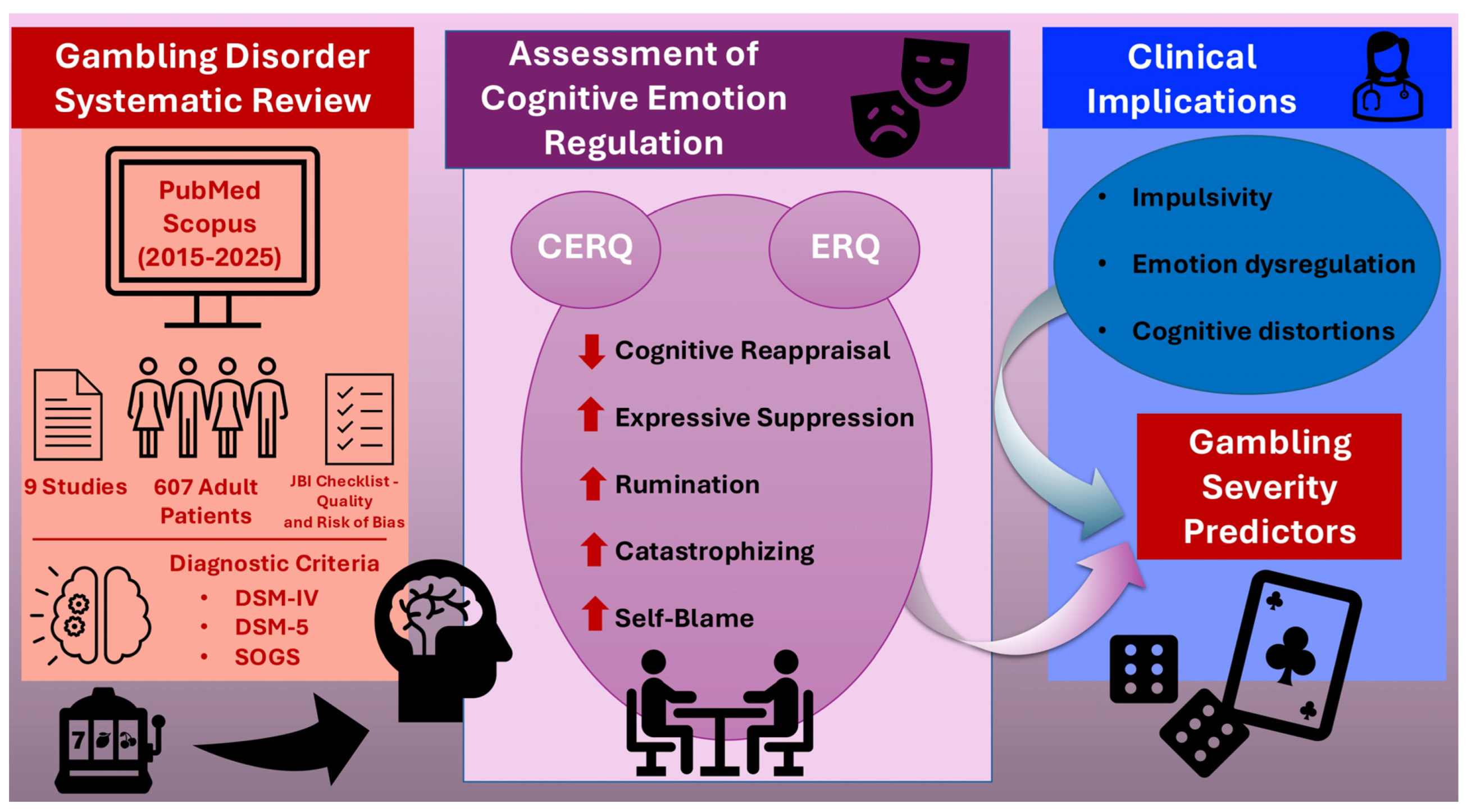


Assessment of Cognitive Emotion Regulation in Gambling Disorder: A Systematic Review of the Literature

 and
and 
Abstract
1. Introduction
2. Methods
2.1. Design and Search Strategy
2.2. Inclusion/Exclusion Criteria
2.3. Selection Process, Data Extraction and Synthesis
- •
- Identification: An initial search was performed in the databases using the specified combinations of search terms. All retrieved records were exported into a bibliographic file for further analysis.
- •
- Removal of duplicates: Duplicate articles were manually identified and removed.
- •
- Screening (title and abstract): Titles and abstracts were independently reviewed to assess their relevance. Studies that did not meet the inclusion criteria were excluded at this stage.
- •
- Eligibility: The full texts of the selected articles were read and analyzed to confirm their eligibility.
- •
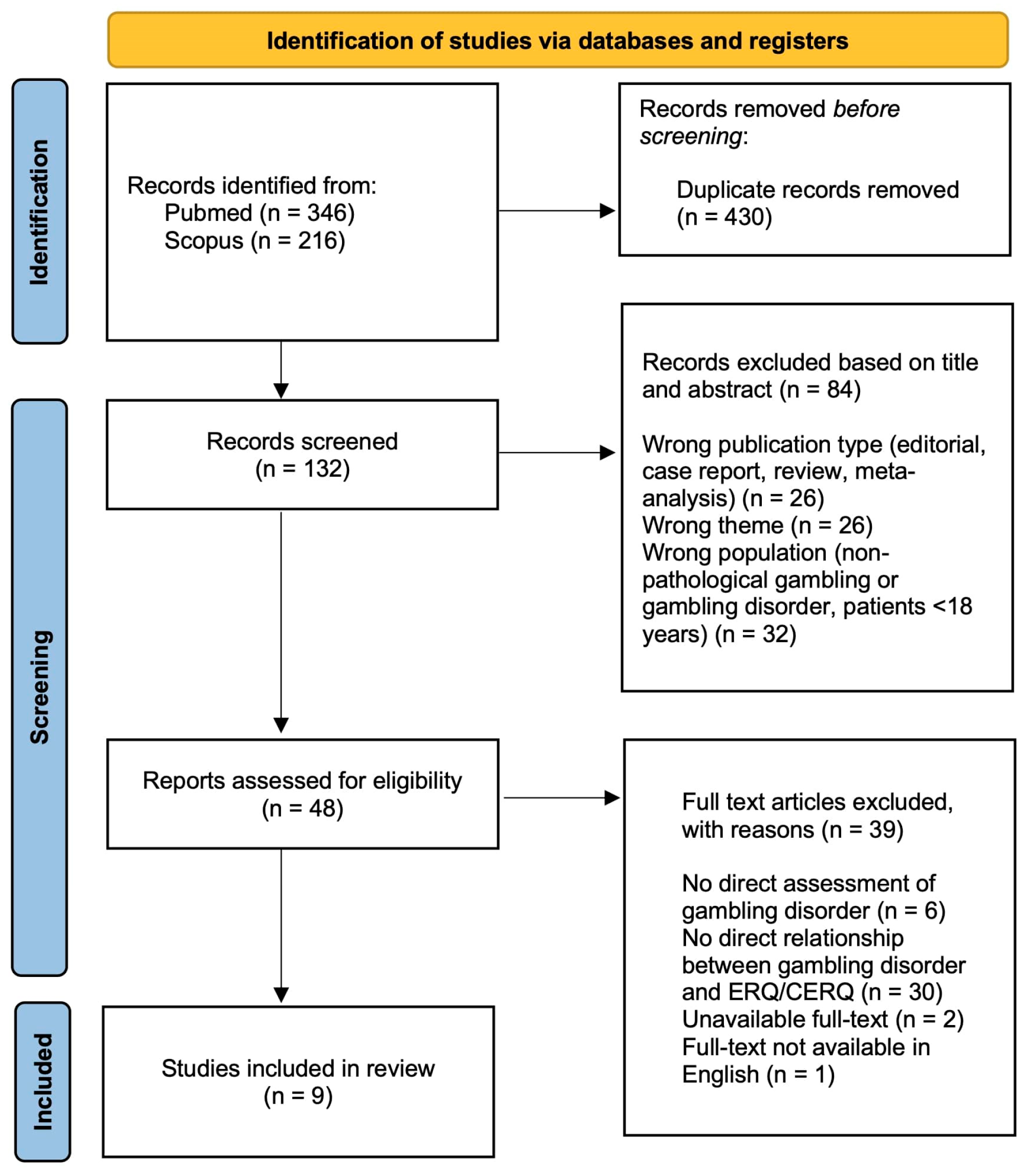
- Inclusion: Studies that met all inclusion criteria were incorporated into the final analysis. The total of 9 studies were included as presented in the PRISMA flow diagram (Figure 1).
2.4. Risk of Bias and Quality Assessment
3. Results
3.1. Study Characteristics
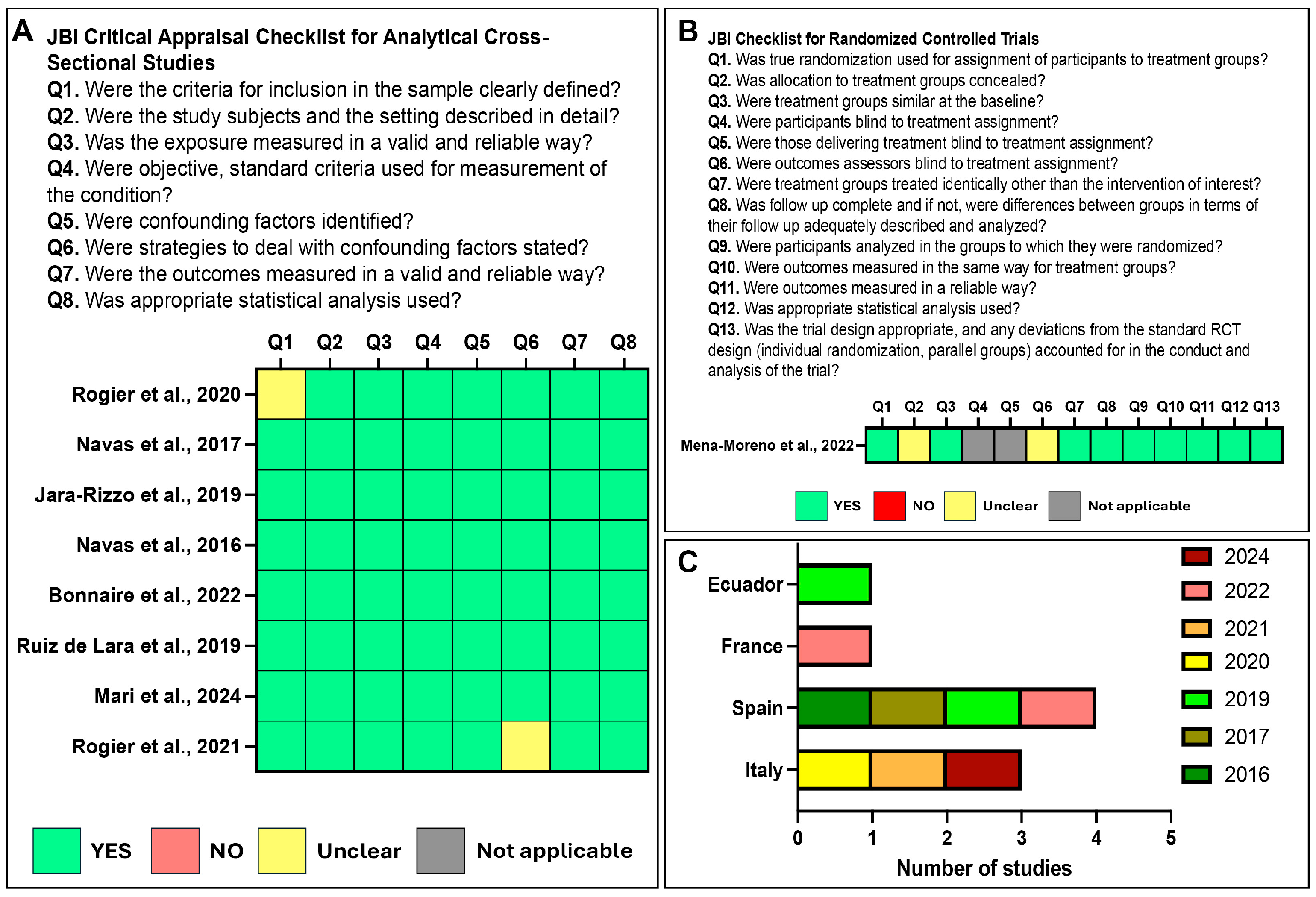
3.2. Quality Assessment of the Studies Included (Risk of Bias)

3.3. Overview of CERQ/ERQ Instruments, Associated Measures, and Key Findings
4. Discussion
4.1. Summary of Evidence
4.2. Strengths and Limitations
4.3. Future Directions
5. Conclusions
Supplementary Materials
Author Contributions
Funding
Institutional Review Board Statement
Informed Consent Statement
Data Availability Statement
Conflicts of Interest
Abbreviations
| ADHD | Attention Deficit Hyperactivity Disorder |
| AUDIT | Alcohol Use Disorder Identification Test |
| BIS-11 | Barratt Impulsiveness Scale |
| CBT | Cognitive behavioral therapy |
| CERQ | Cognitive Emotion Regulation Questionnaire |
| CES | Centrality of Event Scale |
| DAST-10 | Drug Abuse Screening Test |
| DERS | Difficulties in Emotion Regulation Scale |
| DES-II | Dissociative Experience Scale |
| DSM-5 | Diagnostic and Statistical Manual of Mental Disorders, Fifth Edition |
| ERQ | Emotion Regulation Questionnaire |
| ERS | Emotion Reactivity Scale |
| fMRI | Functional Magnetic Resonance Imaging |
| GAT | Gambling Affective Task |
| GDT | Game of Dice Task |
| GD | Gambling Disorder |
| GRCS | Gambling-Related Cognitions Scale |
| IGT | Iowa Gambling Task |
| JBI | Joanna Briggs Institute |
| OCD | Obsessive–Compulsive Disorder |
| PANAS | Positive and Negative Affect Schedule |
| PID-5 | Personality Inventory for DSM-5 |
| PGSI | Problem Gambling Severity Index |
| PRISMA | Preferred Reporting Items for Systematic Reviews and Meta-Analyses |
| SCL-90-R | Symptom Checklist—Revised |
| SMT | Slot Machine Task |
| SOGS | South Oaks Gambling Screen |
| TAS-20 | Toronto Alexithymia Scale |
References
- Yau, Y.H.; Potenza, M.N. Gambling disorder and other behavioral addictions: Recognition and treatment. Harv. Rev. Psychiatry 2015, 23, 134–146. [Google Scholar] [CrossRef] [PubMed]
- Rash, C.J.; Weinstock, J.; Van Patten, R. A review of gambling disorder and substance use disorders. Subst. Abus. Rehabil. 2016, 7, 3–13. [Google Scholar] [CrossRef] [PubMed]
- Hasin, D.S.; O’Brien, C.P.; Auriacombe, M.; Borges, G.; Bucholz, K.; Budney, A.; Compton, W.M.; Crowley, T.; Ling, W.; Petry, N.M.; et al. DSM-5 criteria for substance use disorders: Recommendations and rationale. Am. J. Psychiatry 2013, 170, 834–851. [Google Scholar] [CrossRef]
- Moreira, D.; Azeredo, A.; Dias, P. Risk Factors for Gambling Disorder: A Systematic Review. J. Gambl. Stud. 2023, 39, 483–511. [Google Scholar] [CrossRef]
- Grant, J.; Odlaug, B.; Chamberlain, S. Gambling Disorder, DSM-5 Criteria and Symptom Severity. Compr. Psychiatry 2017, 75, 1–5. [Google Scholar] [CrossRef]
- Fong, T. The Biopsychosocial Consequences of Pathological Gambling. Psychiatry (Edgmont (Pa. Townsh.)) 2005, 2, 22–30. [Google Scholar]
- Holdsworth, L.; Nuske, E.; Hing, N. The Relationship Between Gambling, Significant Life Events, Co-Morbidity and Associated Social Factors; Victorian Responsible Gambling Foundation: North Melbourne, Australia, 2013.
- Sharma, R.; Weinstein, A. Gambling disorder comorbidity a narrative review. Dialogues Clin. Neurosci. 2025, 27, 1–18. [Google Scholar] [CrossRef]
- Mari, E.; Cricenti, C.; Boccia, M.; Zucchelli, M.M.; Nori, R.; Piccardi, L.; Giannini, A.M.; Quaglieri, A. Betting on Your Feelings: The Interplay between Emotion and Cognition in Gambling Affective Task. J. Clin. Med. 2024, 13, 2990. [Google Scholar] [CrossRef]
- Månsson, V.; Molander, O.; Carlbring, P.; Rosendahl, I.; Berman, A.H. Emotion regulation-enhanced group treatment for gambling disorder: A non-randomized pilot trial. BMC Psychiatry 2022, 22, 16. [Google Scholar] [CrossRef] [PubMed]
- Marchica, L.; Mills, D.; Derevensky, J.; Montreuil, T. The Role of Emotion Regulation in Video Gaming and Gambling Disorder: A Systematic Review. Can. J. Addict. 2019, 10, 19–29. [Google Scholar] [CrossRef]
- Velotti, P.; Rogier, G.; Beomonte Zobel, S.; Billieux, J. Association between gambling disorder and emotion (dys)regulation: A systematic review and meta-analysis. Clin. Psychol. Rev. 2021, 87, 102037. [Google Scholar] [CrossRef]
- Orlowski, S.; Bischof, A.; Besser, B.; Bischof, G.; Rumpf, H.J. Deficits in emotion regulation strategies among problematic and pathological gamblers in a sample of vocational school students. J. Behav. Addict. 2019, 8, 94–102. [Google Scholar] [CrossRef]
- Neophytou, K.; Theodorou, M.; Artemi, T.-F.; Theodorou, C.; Panayiotou, G. Gambling to escape: A systematic review of the relationship between avoidant emotion regulation/coping strategies and gambling severity. J. Context. Behav. Sci. 2023, 27, 126–142. [Google Scholar] [CrossRef]
- Gori, A.; Topino, E.; Cacioppo, M.; Craparo, G.; Schimmenti, A.; Caretti, V. An Integrated Approach to Addictive Behaviors: A Study on Vulnerability and Maintenance Factors. Eur. J. Investig. Health Psychol. Educ. 2023, 13, 512–524. [Google Scholar] [CrossRef] [PubMed]
- Gori, A.; Topino, E.; Craparo, G.; Bagnoli, I.; Caretti, V.; Schimmenti, A. A Comprehensive Model for Gambling Behaviors: Assessment of the Factors that can Contribute to the Vulnerability and Maintenance of Gambling Disorder. J. Gambl. Stud. 2022, 38, 235–251. [Google Scholar] [CrossRef]
- Preece, D.; Becerra, R.; Robinson, K.; Gross, J. The Emotion Regulation Questionnaire: Psychometric Properties in General Community Samples. J. Personal. Assess. 2020, 102, 348–356. [Google Scholar] [CrossRef]
- Preece, D.A.; Petrova, K.; Mehta, A.; Gross, J.J. The Emotion Regulation Questionnaire-Short Form (ERQ-S): A 6-item measure of cognitive reappraisal and expressive suppression. J. Affect. Disord. 2023, 340, 855–861. [Google Scholar] [CrossRef]
- Larionow, P.; Mudło-Głagolska, K.; Preece, D.A. Latent Structure and Profiles of Emotion Regulation: Reappraisal and Suppression Patterns with the Polish Version of the Emotion Regulation Questionnaire. J. Clin. Med. 2025, 14, 587. [Google Scholar] [CrossRef]
- Cerolini, S.; Zagaria, A.; Vacca, M.; Spinhoven, P.; Violani, C.; Lombardo, C. Cognitive Emotion Regulation Questionnaire-Short: Reliability, Validity, and Measurement Invariance of the Italian Version. Behav. Sci. 2022, 12, 474. [Google Scholar] [CrossRef] [PubMed]
- Abdi, S.; Taban, S.; Ghaemian, A. Cognitive emotion regulation questionnaire: Validity and reliability of Persian translation of CERQ-36 item. Procedia-Soc. Behav. Sci. 2012, 32, 2–7. [Google Scholar] [CrossRef]
- Dominguez-Lara, S.; Moretti, L.; Ezequiel Flores-Kanter, P.; Muñoz-Navarro, R.; Medrano, L.A. Psychometric Analysis of Two Brief Versions of the CERQ in the Argentinean Population: CERQ-18 and CERQ-27. Psychol. Russ. 2023, 16, 26–43. [Google Scholar] [CrossRef]
- Fekar Gharamaleki, F.; Fathipour-Azar, Z. Cross-cultural adaptation and validation of cognitive emotion regulation questionnaire: A systematic review. Front. Psychol. 2025, 15, 1494665. [Google Scholar] [CrossRef]
- Page, M.J.; McKenzie, J.E.; Bossuyt, P.M.; Boutron, I.; Hoffmann, T.C.; Mulrow, C.D.; Shamseer, L.; Tetzlaff, J.M.; Akl, E.A.; Brennan, S.E.; et al. The PRISMA 2020 statement: An updated guideline for reporting systematic reviews. BMJ 2021, 372, n71. [Google Scholar] [CrossRef]
- Rash, C.J.; Petry, N.M. Gambling Disorder in the DSM-5: Opportunities to Improve Diagnosis and Treatment Especially in Substance Use and Homeless Populations. Curr. Addict. Rep. 2016, 3, 249–253. [Google Scholar] [CrossRef] [PubMed]
- Moola, S.; Tufanaru, C.; Aromataris, E.; Sears, K.; Sfetc, R.; Currie, M.; Lisy, K.; Qureshi, R.; Mattis, P.; Mu, P.-F. Chapter 7: Systematic Reviews of Etiology and Risk. In JBI Manual for Evidence Synthesis; JBI: North Adelaide, Australia, 2020. [Google Scholar]
- Rogier, G.; Beomonte Zobel, S.; Velotti, P. Pathological personality facets and emotion (dys)regulation in gambling disorder. Scand. J. Psychol. 2020, 61, 262–270. [Google Scholar] [CrossRef] [PubMed]
- Navas, J.F.; Contreras-Rodríguez, O.; Verdejo-Román, J.; Perandrés-Gómez, A.; Albein-Urios, N.; Verdejo-García, A.; Perales, J.C. Trait and neurobiological underpinnings of negative emotion regulation in gambling disorder. Addiction 2017, 112, 1086–1094. [Google Scholar] [CrossRef]
- Jara-Rizzo, M.F.; Navas, J.F.; Catena, A.; Perales, J.C. Types of Emotion Regulation and Their Associations with Gambling: A Cross-Sectional Study with Disordered and Non-problem Ecuadorian Gamblers. J. Gambl. Stud. 2019, 35, 997–1013. [Google Scholar] [CrossRef] [PubMed]
- Navas, J.F.; Verdejo-García, A.; LÓpez-GÓmez, M.; Maldonado, A.; Perales, J.C. Gambling with Rose-Tinted Glasses on: Use of Emotion-Regulation Strategies Correlates with Dysfunctional Cognitions in Gambling Disorder Patients. J. Behav. Addict. 2016, 5, 271–281. [Google Scholar] [CrossRef]
- Bonnaire, C.; Devos, G.; Barrault, S.; Grall-Bronnec, M.; Luminet, O.; Billieux, J. An empirical investigation of the Pathways Model of problem gambling through the conjoint use of self-reports and behavioural tasks. J. Behav. Addict. 2022, 11, 858–873. [Google Scholar] [CrossRef]
- Ruiz de Lara, C.M.; Navas, J.F.; Perales, J.C. The paradoxical relationship between emotion regulation and gambling-related cognitive biases. PLoS ONE 2019, 14, e0220668. [Google Scholar] [CrossRef]
- Mena-Moreno, T.; Munguía, L.; Granero, R.; Lucas, I.; Fernández-Aranda, F.; Gómez-Peña, M.; Moragas, L.; Verdejo-García, A.; Menchón, J.M.; Jiménez-Murcia, S. e-Estesia: A Serious Game for Reducing Arousal, Improving Emotional Regulation and Increasing Wellbeing in Individuals with Gambling Disorder. J. Clin. Med. 2022, 11, 6798. [Google Scholar] [CrossRef]
- Rogier, G.; Velotti, P.; Capone, A. Emotion regulation strategies and dissociation in Gambling Disorder Emotion regulation strategies and dissociation in Gambling Disorder. Int. Gambl. Stud. 2021, 22, 18–36. [Google Scholar] [CrossRef]
- Kozak, K.; Lucatch, A.M.; Lowe, D.J.E.; Balodis, I.M.; MacKillop, J.; George, T.P. The neurobiology of impulsivity and substance use disorders: Implications for treatment. Ann. N. Y. Acad. Sci. 2019, 1451, 71–91. [Google Scholar] [CrossRef]
- Demetrovics, Z.; van den Brink, W.; Paksi, B.; Horváth, Z.; Maraz, A. Relating Compulsivity and Impulsivity with Severity of Behavioral Addictions: A Dynamic Interpretation of Large-Scale Cross-Sectional Findings. Front. Psychiatry 2022, 13, 831992. [Google Scholar] [CrossRef] [PubMed]
- Grant, J.E.; Kushner, M.G.; Kim, S.W. Pathological Gambling and Alcohol Use Disorder. Alcohol. Res. Health 2002, 26, 143–150. [Google Scholar]
- Martinac, M.; Karlović, D.; Babić, D. Chapter 54—Alcohol and Gambling Addiction. In Neuroscience of Alcohol; Preedy, V.R., Ed.; Academic Press: Cambridge, MA, USA, 2019; pp. 529–535. [Google Scholar]
- Tackett, J.L.; Krieger, H.; Neighbors, C.; Rinker, D.; Rodriguez, L.; Edward, G. Comorbidity of Alcohol and Gambling Problems in Emerging Adults: A Bifactor Model Conceptualization. J. Gambl. Stud. 2017, 33, 131–147. [Google Scholar] [CrossRef] [PubMed]
- Del Pino-Gutiérrez, A.; Fernández-Aranda, F.; Granero, R.; Tárrega, S.; Valdepérez, A.; Agüera, Z.; Håkansson, A.; Sauvaget, A.; Aymamí, N.; Gómez-Peña, M.; et al. Impact of alcohol consumption on clinical aspects of gambling disorder. Int. J. Ment. Health Nurs. 2017, 26, 121–128. [Google Scholar] [CrossRef] [PubMed]
- Mușat, M.I.; Militaru, F.; Udriștoiu, I.; Mitran, S.I.; Cătălin, B. Alcohol Consumption Is a Coping Mechanism for Male Patients with Severe Anxiety Disorders Treated with Antidepressants Monotherapy. J. Clin. Med. 2024, 13, 2723. [Google Scholar] [CrossRef]
- Mușat, M.I.; Militaru, F.; Gheorman, V.; Udriștoiu, I.; Mitran, S.I.; Cătălin, B. Moderate Alcohol Consumption Increases the Risk of Clinical Relapse in Male Depressed Patients Treated with Serotonin-Norepinephrine Reuptake Inhibitors. Diagnostics 2024, 14, 1140. [Google Scholar] [CrossRef]
- Krause, K.; Bischof, A.; Lewin, S.; Guertler, D.; Rumpf, H.J.; John, U.; Meyer, C. Explaining the relation between pathological gambling and depression: Rumination as an underlying common cause. J. Behav. Addict. 2018, 7, 384–391. [Google Scholar] [CrossRef]
- Jolly, T.; Trivedi, C.; Adnan, M.; Mansuri, Z.; Agarwal, V. Gambling in patients with major depressive disorder is associated with an elevated risk of Suicide: Insights from 12-years of Nationwide inpatient sample data. Addict. Behav. 2021, 118, 106872. [Google Scholar] [CrossRef]
- Jauregui, P.; Estévez, A.; Urbiola, I. Pathological Gambling and Associated Drug and Alcohol Abuse, Emotion Regulation, and Anxious-Depressive Symptomatology. J. Behav. Addict. 2016, 5, 251–260. [Google Scholar] [CrossRef]
- Eldaief, M.; Dougherty, D. Advances in neuroimaging: Impact on psychiatric practice. Psychiatr. Times 2008, 25, 18–24. [Google Scholar]
- Masdeu, J.C. Neuroimaging in psychiatric disorders. Neurotherapeutics 2011, 8, 93–102. [Google Scholar] [CrossRef]
- Okuda, M.; Balán, I.; Petry, N.M.; Oquendo, M.; Blanco, C. Cognitive-behavioral therapy for pathological gambling: Cultural considerations. Am. J. Psychiatry 2009, 166, 1325–1330. [Google Scholar] [CrossRef][Green Version]
- Higueruela-Ahijado, M.; López-Espuela, F.; Caro-Alonso, P.Á.; Novo, A.; Rodríguez-Martín, B. Efficacy of cognitive-behavioral therapy in improving the quality of life of people with compulsive gambling, a systematic review. Arch. Psychiatr. Nurs. 2023, 43, 127–142. [Google Scholar] [CrossRef] [PubMed]
- Mide, M.; Mattiasson, J.; Norlin, D.; Sehlin, H.; Rasmusson, J.; Ljung, S.; Lindskog, A.; Petersson, J.; Saavedra, F.; Gordh, A.S. Internet-delivered therapist-assisted cognitive behavioral therapy for gambling disorder: A randomized controlled trial. Front. Psychiatry 2023, 14, 1243826. [Google Scholar] [CrossRef] [PubMed]
- Bergeron, P.-Y.; Giroux, I.; Chrétien, M.; Bouchard, S. Exposure Therapy for Gambling Disorder: Systematic Review and Meta-analysis. Curr. Addict. Rep. 2022, 9, 179–194. [Google Scholar] [CrossRef]
- Mena, T.; Fernández-Aranda, F.; Granero, R.; Munguía, L.; Steward, T.; Lopez-Gonzalez, H.; Pino-Gutiérrez, A.; Lozano-Madrid, M.; Gómez-Peña, M.; Moragas, L.; et al. A Serious Game to Improve Emotion Regulation in Treatment-Seeking Individuals With Gambling Disorder: A Usability Study. Front. Psychol. 2021, 12, 621953. [Google Scholar] [CrossRef]
- Giordano, R.; Donati, M.A.; Zamboni, L.; Fusina, F.; Primi, C.; Lugoboni, F. Alter Game: A Study Protocol on a Virtual “Serious Game” for Relapse Prevention in Patients With Gambling Disorder. Front. Psychiatry 2022, 13, 854088. [Google Scholar] [CrossRef]
- Ganesh, S.; Kandasamy, A.; Sahayaraj, U.S.; Benegal, V. Behavioral activation and behavioral inhibition sensitivities in patients with substance use disorders: A study from India. Indian. J. Psychiatry 2018, 60, 346–350. [Google Scholar] [CrossRef] [PubMed]
- Barrio-Martínez, S.; Cano-Vindel, A.; Priede, A.; Medrano, L.A.; Muñoz-Navarro, R.; Moriana, J.A.; Carpallo-González, M.; Prieto-Vila, M.; Ruiz-Rodríguez, P.; González-Blanch, C. Worry, rumination and negative metacognitive beliefs as moderators of outcomes of Transdiagnostic group cognitive-behavioural therapy in emotional disorders. J. Affect. Disord. 2023, 338, 349–357. [Google Scholar] [CrossRef] [PubMed]
- Yu, H.; Shi, Z.; Zhao, M. The Relationship between Metacognition, Rumination, and Sleep in University Students with a Tendency toward Generalized Anxiety Disorder. Behav. Sci. 2024, 14, 444. [Google Scholar] [CrossRef] [PubMed]
- Schneider, B.C.; Veckenstedt, R.; Karamatskos, E.; Pinho, L.G.; Morgado, B.; Fonseca, C.; Moritz, S.; Jelinek, L. Negative cognitive beliefs, positive metacognitive beliefs, and rumination as mediators of metacognitive training for depression in older adults (MCT-Silver). Front. Psychol. 2023, 14, 1153377. [Google Scholar] [CrossRef]
- Vieira, C.; Kuss, D.J.; Griffiths, M.D. Early maladaptive schemas and behavioural addictions: A systematic literature review. Clin. Psychol. Rev. 2023, 105, 102340. [Google Scholar] [CrossRef]


| Criteria | Inclusion Criteria | Exclusion Criteria |
|---|---|---|
| Study Type | Original research articles. | Reviews, meta-analyses, case reports, editorials. |
| Population | Adult participants (≥18 years) diagnosed with or evaluated for gambling disorder or pathological gambling. | Studies involving adolescents, general populations without gambling disorder, or non-human subjects. |
| Focus/Variables | Studies examining the relationship between gambling disorder and cognitive/emotion regulation, particularly using the ERQ or CERQ scales. | Studies without a direct measure of cognitive/emotion regulation or gam-bling disorder. |
| Publication Language | Articles published in English with full-text available. | Articles with no full-text available or not published in English. |
| Publication Date | Published between 25 October 2015 and 25 October 2025. | Published outside the specified date range. |
| Study Identification | Country | Study Design | Sample (n) | M/F Distribution | Age (Mean ± SD) Years | Diagnostic Criteria | Type of Gambling | Study Limitation |
|---|---|---|---|---|---|---|---|---|
| Rogier et al., 2020 [27] | Italy | Cross-sectional study | 79 (clinical group) + 101 (control group) | 81% male (addicted gamblers), 79% male (controls) | 47.73 ± 13.50 (gamblers); 46.88 ± 10.09 (controls) | SOGS | Various gambling types (unspecified) | -Gender imbalance; -Reliance on self-report measures; -Gambling type not considered; -Limited generalizability due to cultural factors. |
| Navas et al., 2017 [28] | Spain | Cross-sectional case–control study | Study 1: 41 (GD) + 45 (controls); Study 2: 17 (GD) + 21 (controls) | Study 1: 100% male; Study 2: GD patients 16 M/1 F; controls 20 M/1 F | Study 1: GD patients 35.22 ± 11.16; controls 33.22 ± 8.18 Study 2: GD patients 32.94 ± 7.77; controls 31.00 ± 4.60 | DSM-IV | Strategic (card games, sport bets) and passive gambling modalities (slot machine, lotteries) | -The emotions triggered by the cognitive reappraisal task were less intense than those experienced in daily life; -Small sample size limiting statistical power, particularly for neuroimaging analyses. |
| Jara-Rizzo et al., 2019 [29] | Ecuador | Cross-sectional study | 197 (patients = 27, community gamblers = 170) | Patients: 26% females; Community: 39% females | Patients: 25.74 ± 8.34; Community: 34.36 ± 13.73 | DSM-IV and SOGS | Various gambling types (unspecified) | -Gambling type not considered; -Subtle effects and measurement error, partly due to the use of proxy measures for key constructs. |
| Navas et al., 2016 [30] | Spain | Cross-sectional case–control study | 41 (GD) + 45 (controls) | 100% males | GD patients: 35.22 ± 11.16; controls: 33.22 ± 8.18 | DSM-IV | Various gambling types (unspecified) | -Sample composed only of males, limiting generalizability to females; -Gambling type not considered; -Limited sample size, reduced statistical power. |
| Bonnaire et al., 2022 [31] | France | Cross-sectional study | 59 (clinical group) + 107 (non-problematic community gamblers) | Clinical: 16.9% females and 83.1% males; Non-clinical: 38.3% females and 61.7% males | Clinical: 41.37 ± 11.42; Non-clinical: 38.74 ± 9.42 | DSM-5 | Mixed gambling modalities: chance-based games (lottery, scratch cards, slot machine) and skills-based games (poker, sport betting, horse race betting) | -Relatively small sample size in clinical group, reducing statistical power and possibly obscuring relevant factors; -Limited number of instruments per pathway, restricting comprehensive assessment of emotion regulation and impulsivity constructs. |
| Ruiz de Lara et al., 2019 [32] | Spain | Cross-sectional study | 30 (GD − DSM-5) + 20 (community gamblers − SOGS) + 196 (non-GD community gamblers) | 82 females, 164 males | 33.14 ± 13.88 | DSM-5 and SOGS | Type I (cards, casino games, skill games, sports bets) and Type II (lotteries, pools, bingo, slot machines) | -Small to medium effect sizes, partly due to measurement error and use of proxy measures for key constructs; -Limited sample size for subgroup comparisons (e.g., gambling modality or gambling motives). |
| Mari et al., 2024 [9] | Italy | Cross-sectional study | 24 (GD), 20 (Substance-Dependent Gambling − SDG), 20 (healthy controls − HC) | 100% male | GD: 35.89 ± 11.78 SDG: 35.10 ± 11.88 HC: 34.95 ± 12.80 | DSM-5 | Various gambling types (unspecified) | -Gambling type not considered; -Relatively small sample size, limiting generalizability of the findings. -Only male participants were included, preventing extension of results to female gamblers. |
| Mena-Moreno et al., 2022 [33] | Spain | Randomized controlled study with CBT intervention + serious game | 40 (experimental group) + 67 (control group) | 95.2% male | 40.2 ± 14.7 | DSM-5 | Various gambling types (unspecified) | -Gambling type not considered; -Predominantly male sample (only five women); -Trait impulsivity and emotion regulation (UPPS-P, DERS, ERQ) could not be compared between experimental and control groups; -Limited number of intervention sessions. |
| Rogier et al., 2021 [34] | Italy | Cross-sectional study | 79 (clinical group), 70 (control group) | Clinical: 84.81% males; Control: 82.86% males | Clinical: 46.48 ± 13.59; Control: 46.14 ± 12.12 | DSM-5 | Slot machines/video Lottery, sports betting, mixed online/offline gambling | -Relatively small sample size, limiting generalizability and subgroup analyses; -The Italian translation of the DES-II used in this study has not been validated. |
| Study Identification | CERQ/ERQ Versions | CERQ/ERQ Versions Description | Other Measures | Main Findings (GD Compared to Controls) | Key Predictors of GD Severity |
|---|---|---|---|---|---|
| Rogier et al., 2020 [27] | ERQ | 10-item self-report questionnaire with 2 scores: Cognitive Reappraisal and Expressive Suppression | Personality Inventory for DSM-5 (PID-5), DERS, SOGS | -Gamblers showed lower cognitive reappraisal and higher expressive suppression vs. controls, and higher scores in DERS and PID-5 domains; -ERQ: Reappraisal: Gamblers = 28.11 ± 7.24, Controls = 31.18 ± 6.22, F = 13.59, p < 0.001; Suppression: Gamblers = 16.24 ± 5.75, Controls = 14.07 ± 5.62, F = 4.08, p = 0.045. | -Impulsivity; -Suspiciousness; -Perseveration; -Emotion Dysregulation. |
| Navas et al., 2017 [28] | ERQ—Spanish version | 10-item ERQ: 6 items for Cognitive Reappraisal, 4 items for Expressive Suppression | SOGS, UPPS-P Impulsive Behavior Scale (focus on Negative Urgency), Multicage CAD-4, IQ (WAIS-IV or KBIT), functional magnetic resonance imaging (fMRI) Cognitive Reappraisal Task (Study 2) | -GD patients showed higher emotional suppression compared to controls (GD = 17.37 ± 5.38, HC = 14.93 ± 5.21, F (1,84) = 4.525, p = 0.036); -No differences in reappraisal between groups (GD = 29.07 ± 5.37, HC = 30.05 ± 7.11, F (1,84) = 0.503, p = 0.480); -GD patients showed hyperactivation of left premotor and middle frontal gyri during regulation of negative emotions; -Negative urgency correlated positively with emotional suppression and middle frontal gyrus activation during negative emotion regulation. | -Negative urgency significantly associated with emotional suppression and with left middle frontal activation; -The use of emotional suppression and increased activation of the middle frontal gyrus during negative emotion regulation are associated with impulsivity driven by negative emotions. |
| Jara-Rizzo et al., 2019 [29] | ERQ—Spanish version | 10-item ERQ: 6 items for Cognitive Reappraisal, 4 items for Expressive Suppression | SOGS, GRCS, UPPS-P Impulsive Behavior Scale, MultiCAGE CAD-4 | -Reappraisal was positively associated with gambling-related cognitive distortions (GRCS) (R2 = 0.079, p < 0.001); -Suppression was associated with higher levels of negative urgency (emotion-driven impulsivity) (z = 2.132, p = 0.033); -Positive urgency and sensation seeking were associated with gambling-related cognitive biases (illusion of control β = 0.188, p = 0.011; predictive control β = 0.188, p = 0.018; interpretative bias β = 0.140, p = 0.043). | -Positive urgency and sensation seeking were significant predictors of gambling-related cognitive distortions, which are linked to GD severity; -Negative urgency was associated with maladaptive emotion regulation (suppression). |
| Navas et al., 2016 [30] | CERQ—Spanish version | 27 5-point Likert scale items assessing 9 strategies: Self-blame, Other-blame, Rumination, Catastrophizing, Putting into perspective, Positive refocusing, Positive reappraisal, Acceptance, Refocus on planning | SOGS, GRCS, MultiCAGE CAD-4 | -GD patients showed higher scores than controls across all GRCS dimensions; -GD patients used self-blame, catastrophizing, and positive refocusing more frequently than controls (Self-blame: GDPs = 11.05 ± 3.09, HCs = 7.20 ± 2.54, F = 40.14, p < 0.01, η2 = 0.32; Catastrophizing: GDPs = 8.10 ± 2.74, HCs = 6.02 ± 1.91, F = 16.85, p = 0.01, η2 = 0.17; Positive refocusing: GDPs = 9.27 ± 2.26, HCs = 7.96 ± 2.87, F = 5.49, p = 0.02, η2 = 0.06); -Some “adaptive” emotion regulation strategies (e.g., putting into perspective, refocusing on planning) were paradoxically associated with greater gambling severity and cognitive distortions; -Putting into perspective: GDPs = 10.61 ± 2.82, HCs = 9.36 ± 3.09, F = 3.84, p = 0.05, η2 = 0.04; -Other blame (lower in GDPs): GDPs = 4.32 ± 1.54, HCs = 5.42 ± 1.83, F = 9.10, p < 0.01, η2 = 0.10. | -Refocusing on planning and putting into perspective appear to indicate gambling-related difficulties, reflected either in more severe symptoms or in more pronounced cognitive distortions. |
| Bonnaire et al., 2022 [31] | ERQ—French version | 10-item ERQ: 6 items for Cognitive Reappraisal, 4 items for Expressive Suppression | GRCS, TAS-20, Emotion Reactivity Scale (ERS), IGT, UPPS-P Impulsive Behavior Scale (short), GDT, Slot Machine Task (SMT) | -Treatment-seeking gamblers had higher expressive suppression (16.46 ± 6.54) than controls (14.46 ± 5.16, p = 0.032), and lower cognitive reappraisal (22.81 ± 8.89) than controls (27.07 ± 8.31, p = 0.002); -Emotional regulation difficulties, gambling-related cognitions, impulsivity, and behavioural persistence differentiated problem gamblers from non-problem gamblers. | -Gambling persistence (Persistence at the slot machine had the strongest predictive value); -Several emotional (dys)regulation processes (emotional reactivity, expressive suppression and cognitive reappraisal) significantly predicted clinical status. |
| Ruiz de Lara et al., 2019 [32] | CERQ—Spanish version | 9 strategies: Self-blame, Other-blame, Rumination, Catastrophizing, Putting into perspective, Positive refocusing, Positive reappraisal, Acceptance, Refocus on planning | SOGS, GRCS, UPPS-P Impulsive Scale | -Positive urgency predicted control illusion (B = 0.147, p = 0.028) and predictive control (B = 0.146, p = 0.014). Sensation seeking predicted predictive control (B = 0.173, p = 0.004), interpretative bias (B = 0.211, p < 0.001), and gambling expectancies (B = 0.266, p < 0.001). Reappraisal predicted control illusion (B = 0.173, p = 0.006), predictive control (B = 0.112, p = 0.043), and interpretative bias (B = 0.147, p = 0.010). Blaming others predicted all GRCS dimensions (e.g., control illusion: B = 0.189, p = 0.002). Rumination predicted predictive control (B = 0.139, p = 0.012); -Gamblers may use relatively sophisticated emotion-regulation strategies, including those typically considered adaptive, while simultaneously exhibiting strong cognitive distortions. | -Gambling seems to be easily triggered by a lack of positive experiences (rather than by the presence of negative ones); -The associations between impulsivity and gambling cognitions were specific to emotion- and motivation-driven facets of impulsivity; -Self-serving emotion regulation strategies were linked to a greater tendency to endorse biased gambling-related beliefs. |
| Mari et al., 2024 [9] | ERQ— Italian version | 10-item self-report; two subscales: Cognitive Reappraisal and Expressive Suppression. Rated on a 7-point Likert scale. | SOGS, Drug Abuse Screening Test (DAST-10), Alcohol Use Disorder Identification Test (AUDIT), Barratt Impulsiveness Scale (BIS-11), TAS-20, Difficulties in Emotion Regulation Scale (DERS-36), PANAS, IGT, GDT, Gambling Affective Task (GAT). | -Risky betting positively correlated with impulsivity, alexithymia, and emotion dysregulation; -Positive affective priming associated with lower bet amounts and longer response times (protective factor); -GD and Substance-Dependent Gambling groups showed higher motor and non-planning impulsivity; -Negative affect significantly higher in GD group; -Risky betting (GAT) correlated with: Risky choices in Game of Dice Task: r = 0.368, p < 0.01; Emotion regulation difficulties (DERS strategies): r = 0.435, p < 0.01 and Cognitive reappraisal (ERQ): r = −0.429, p < 0.01. | -Impulsivity (motor and non-planning); -Negative affect; -Emotion dysregulation; -Low cognitive reappraisal; -Alexithymia. |
| Mena-Moreno et al., 2022 [33] | ERQ—Spanish version | 10-item questionnaire assessing cognitive reappraisal and emotional suppression tendencies | SOGS, Symptom Checklist—Revised (SCL-90-R), DERS, UPPS-P Impulsive Behavior Scale | -Experimental group had fewer relapses, higher compliance, significant reduction in ERQ suppression and general psychopathology. | -Impulsivity; -Emotion regulation; -Emotional suppression; -Psychological distress. |
| Rogier et al., 2021 [34] | ERQ— Italian version | 10-item questionnaire with 2 scores: Cognitive Reappraisal and Expressive Suppression | PGSI (Problem Gambling Severity Index), DES-II (Dissociative Experience Scale, 3 subscales: Depersonalization/Derealization, Amnesia, Absorption) | -Individuals with GD showed lower cognitive reappraisal (27.97 ± 7.10 vs. 30.67 ± 6.31; F = 6.02, p = 0.015) and higher expressive suppression (16.53 ± 5.75 vs. 13.80 ± 5.78; F = 6.97, p = 0.009) than controls; -Reappraisal was negatively associated with gambling severity (r = −0.35, p < 0.001), whereas suppression was positively associated (r = 0.27, p = 0.008) and both independently predicted GD severity (β = −0.36 and β = 0.27, respectively). | -Lower Cognitive Reappraisal; -Higher Expressive Suppression; -Higher Dissociation (especially Amnesia and Absorption). |
Disclaimer/Publisher’s Note: The statements, opinions and data contained in all publications are solely those of the individual author(s) and contributor(s) and not of MDPI and/or the editor(s). MDPI and/or the editor(s) disclaim responsibility for any injury to people or property resulting from any ideas, methods, instructions or products referred to in the content. |
© 2026 by the authors. Licensee MDPI, Basel, Switzerland. This article is an open access article distributed under the terms and conditions of the Creative Commons Attribution (CC BY) license.
Share and Cite
Ioniță, I.; Mușat, M.I.; Cătălin, B.; Ciobanu, A.M. Assessment of Cognitive Emotion Regulation in Gambling Disorder: A Systematic Review of the Literature. Clin. Pract. 2026, 16, 56. https://doi.org/10.3390/clinpract16030056
Ioniță I, Mușat MI, Cătălin B, Ciobanu AM. Assessment of Cognitive Emotion Regulation in Gambling Disorder: A Systematic Review of the Literature. Clinics and Practice. 2026; 16(3):56. https://doi.org/10.3390/clinpract16030056
Chicago/Turabian StyleIoniță, Ioana, Mădălina Iuliana Mușat, Bogdan Cătălin, and Adela Magdalena Ciobanu. 2026. "Assessment of Cognitive Emotion Regulation in Gambling Disorder: A Systematic Review of the Literature" Clinics and Practice 16, no. 3: 56. https://doi.org/10.3390/clinpract16030056
APA StyleIoniță, I., Mușat, M. I., Cătălin, B., & Ciobanu, A. M. (2026). Assessment of Cognitive Emotion Regulation in Gambling Disorder: A Systematic Review of the Literature. Clinics and Practice, 16(3), 56. https://doi.org/10.3390/clinpract16030056