Article

Performance Validation of ORTHOSEG, a Novel Artificial Intelligence Tool for the Segmentation of Orthopantomographs and Intra-Oral X-Rays

1
Scaramozzino Dental Practice, 45020 Villanova del Ghebbo, RO, Italy
2
Section of Dentistry, Department of Clinical, Surgical, Diagnostic and Pediatric Sciences, University of Pavia, 27100 Pavia, PV, Italy
*
Authors to whom correspondence should be addressed.
Clin. Pract. 2026, 16(3), 54; https://doi.org/10.3390/clinpract16030054
Submission received: 2 February 2026 / Revised: 20 February 2026 / Accepted: 27 February 2026 / Published: 4 March 2026
(This article belongs to the Special Issue Clinical Outcome Research in the Head and Neck: 2nd Edition)

Abstract

Background: Dental radiographs are essential for diagnosis and treatment planning in modern dentistry. However, their manual interpretation is time-consuming and subject to variability, highlighting the need for automated tools to improve efficiency and consistency. This study aims to validate ORTHOSEG, a deep learning-based system designed to automate the segmentation of anatomical, pathological, and non-pathological elements in radiographs, including orthopantomograms, bitewings, and periapical images. Methods: ORTHOSEG’s performance was evaluated using a rigorously curated dataset of 150 dental radiographs, including 50 orthopantomograms, 50 bitewings, and 50 periapical images, with manual annotations by expert clinicians serving as the ground truth. The system’s segmentation performance was assessed using standard evaluation metrics, including mean Dice Similarity Coefficient (mDSC) and mean Intersection over Union (mIoU), and inference time was also recorded. Results: The system achieved high accuracy, with mDSC and mIoU values of 0.635 ± 0.233 and 0.576 ± 0.214, respectively. In particular for orthopantomograms, it achieved an mDSC of 0.756 ± 0.174 and an mIoU of 0.684 ± 0.172, surpassing existing benchmarks. Its segmentation capabilities extend to approximately 70 distinct elements, underscoring its comprehensive utility. The system demonstrated efficient computational performance, with processing times of 19.745 ± 3.625 s for orthopantomograms, 8.467 ± 0.903 s for bitewings, and 5.653 ± 0.897 s for periapical radiographs on standard clinical hardware. Conclusions: ORTHOSEG demonstrates efficiency suitable for integration into routine workflows. This study confirms ORTHOSEG’s reliability and potential to improve diagnostic workflows, offering clinicians a valuable tool for faster and more detailed radiograph analysis. Future research will focus on extending validation across diverse clinical scenarios to ensure broader applicability. However, this study has limitations, including the use of a dataset derived from a European population and the absence of usability and clinical workflow evaluation, which should be addressed in future studies.

1. Introduction

Dental radiographs are indispensable tools in modern dentistry, providing clinicians with critical insights into the anatomical structures and pathological conditions of the oral and maxillofacial regions [1]. They play a key role in diagnosing, planning treatments, and monitoring therapeutic outcomes, especially in managing conditions such as caries, periodontal disease, and bone resorption. Among the most commonly employed radiographic modalities are orthopantomograms, bitewings, and periapical images, which collectively enable comprehensive evaluation of dental hard tissues and disease states [2]. Despite their importance, interpreting radiographs is a time-consuming and cognitively demanding task. Manual interpretation requires significant focus and precision, leaving clinicians vulnerable to errors arising from fatigue or lapses in concentration, particularly in high-volume settings. These challenges can delay the diagnostic process and, in some cases, compromise accuracy, underlining the need for tools that can enhance efficiency without sacrificing reliability [3]. Advances in artificial intelligence (AI) have introduced automated segmentation systems capable of identifying and delineating structures in radiographic images [4,5,6]. Early methods based on traditional computer vision techniques, such as thresholding and region-growing algorithms, demonstrated some utility but struggled to handle variability in image quality and patient anatomy [7]. Deep learning has since emerged as a transformative approach, leveraging Convolutional Neural Networks (CNNs) to address these limitations. By learning features directly from data, CNN-based models have achieved significant success in segmentation tasks, such as caries detection [8,9,10,11], bone loss assessment [12,13,14], and anatomical labeling [15,16,17]. ORTHOSEG (ORTHOpanoramic and intraoral SEGmentation) is a deep learning-based AI system integrated into the Neowise software (version 1.5, CEFLA S.C., Imola, Italy). The core of the system consists of a suite of specialized deep learning models belonging to the convolutional neural network (CNN) family, with each model dedicated to a specific predictive task. In particular, these models are based on the Mask R-CNN (Region-based Convolutional Neural Network) architecture, which enables instance segmentation by performing pixel-level detection and classification of individual anatomical and pathological structures within radiographic images [18]. It offers automated segmentation of anatomical, pathological, and non-pathological elements in radiographs. Designed to improve diagnostic workflows, ORTHOSEG (CEFLA S.C., Imola, Italy) classifies each pixel to identify and delineate structures across various radiographic modalities, including orthopantomograms, bitewings, and periapicals. Its primary goal is to assist clinicians by providing a rapid and detailed visualization of radiographic findings, allowing them to focus on interpretation and decision-making while reducing the cognitive load associated with manual analysis. This study aims to validate the performance of ORTHOSEG (CEFLA S.C., Imola, Italy), assessing its accuracy and reliability in segmenting anatomical, pathological, and non-pathological elements in dental radiographs. The evaluation is based on comparing the system’s output against manual segmentations performed by experienced clinicians, which serve as the ground truth. By assessing its accuracy and reliability across different radiographic types, this research seeks to determine whether ORTHOSEG (CEFLA S.C., Imola, Italy) meets the standards required for integration into routine dental workflows. The research hypothesis of this study is that ORTHOSEG can achieve segmentation performance with quantitative accuracy metrics sufficient to enable reliable identification of anatomical, pathological, and non-pathological structures in orthopantomograms, bitewings, and periapical radiographs, supporting its applicability in routine clinical practice.

2. Materials and Methods

ORTHOSEG (ORTHOpanoramic and intraoral SEGmentation) is a deep learning-based AI system integrated into the Neowise software (CEFLA S.C., Imola, Italy). Table 1 reports the elements detected by the ORTHOSEG system. The materials and methods employed to assess and validate the performance of ORTHOSEG are illustrated, with the aim of demonstrating its potential clinical utility.

2.1. Dataset

A diverse cohort of 50 orthopanoramics, 50 bitewings and 50 periapicals was selected using different devices and varying acquisition parameters. Patients ranged from 8 to over 65 years old, representing a broad spectrum of European patients, without differentiating between ethnic groups and including both sexes. To analyze the impact of dental development, patients were categorized into two groups: mixed dentition (8–12 years) and permanent dentition (13–65 years). The distribution of these images is summarized in Table 2, Table 3 and Table 4. Specifically, the dataset comprised 50 orthopantomograms, 50 bitewings, and 50 periapical radiographs, ensuring balanced representation across radiographic modalities. For orthopantomograms, the sample included 28 male and 22 female patients, with 6 children (8–12 years), 32 adolescents and adults (13–65 years), and 12 elderly patients (>65 years). Bitewing radiographs included 25 male and 25 female patients, with 6 children, 27 adolescents and adults, and 17 elderly patients. Periapical radiographs included 22 male and 24 female patients, with 5 children, 8 adolescents and adults, and 37 elderly patients. This distribution ensured adequate representation of demographic subgroups for performance evaluation. All radiographs were anonymized before analysis and included cases with both pathological and non-pathological findings, such as agenesis, caries, lesions [19], extractions, fillings [20], root canal treatments [21], orthodontic brackets [22], and orthodontic wires. The sample size was determined based on a trade-off between quantity and quality. These images were obtained via consecutive selection to reflect a “real-world” distribution of dental anatomy, patient demographics, and pathological findings. By utilizing 50 samples per modality, the study ensured a sufficient sample size to satisfy the rule of thumb for the Central Limit Theorem (n > 30), ensuring that the evaluation metrics used are sufficiently reliable for each imaging type. Moreover, the inclusion of different age groups (children to elderly) naturally introduced a variety of developmental and degenerative conditions. The sample size was also influenced by the extremely time-consuming activity of defining the ground truth. In our labeling process, where each image is reviewed by at least two expert clinicians, we prioritized high-quality annotations over quantity to ensure a more reliable dataset. Finally, these sample sizes are comparable to those reported in the literature, often limited to one modality. For instance, in [9] the authors used 53 bitewings to test the system CranioCatch (Eskişehir, Turkey), while other studies tested commercial software such as the Diagnocat AI system (Miami, FL, USA) on 55 orthopanoramics [23], 214 periapicals, 24 bitewings [24] and 20 periapicals [25]. The radiographs were retrospectively collected from the clinical imaging archives of the Dental Clinic of the University of Pavia (Pavia, Italy). All radiographs were fully anonymized prior to analysis to ensure patient confidentiality and compliance with ethical and data protection regulations. The study was conducted in accordance with the Declaration of Helsinki and approved by the Unit Internal Review Board (approval number: 2025-1112). No formal a priori sample size calculation was performed, as this study was designed as a performance validation study of an AI system using a predefined annotated dataset rather than a prospective hypothesis-driven clinical trial. The dataset included 150 radiographs equally distributed among orthopantomograms, bitewings, and periapical images, which was considered sufficient to ensure a balanced and representative evaluation of the system’s segmentation performance across different radiographic modalities and demographic subgroups. This sample size is consistent with previously published validation studies in dental AI.

2.2. Ground Truth Definition for System Validation

The construction of the validation dataset was carried out to ensure high reliability and accuracy in evaluating the system’s performance. The annotation process of the validation dataset involved two experienced clinicians, each with a minimum of five years of clinical practice, who fulfilled complementary roles as annotator and reviewer. This dual-review process was designed to minimize bias and maximize the quality of the ground truth data, which serves as the reference standard for performance benchmarking. CVAT (version 2.21.0, CVAT.ai, Wilmington, DE, USA- https://github.com/cvat-ai/cvat accessed on 30th January 2026), a self-hosted web application, was used as the annotation tool, allowing for the manual classification and annotation of images. Additionally, the self-hosted solution enables the installation of the annotation system on a server physically located in the European Union, ensuring full compliance with GDPR (General Data Protection Regulation). The annotation process was divided into two distinct phases [26]:
  • Initial Annotation: The annotator performed manual segmentations on each radiography using the annotation tool.
  • Review and Quality Assurance: The reviewer meticulously examined the initial annotations to ensure their accuracy and adherence to established anatomical guidelines. Using cross-referencing techniques and visual validation, the reviewer corrected any discrepancies identified in the annotations. This phase also involved quality control checks to address any issues related to image resolution, segmentation consistency, or potential operator errors.

2.3. System Performance Validation

The performance evaluation is conducted by comparing the automatic detections against a testing dataset that serves as the ground truth [27,28]. The testing dataset was created as described in Section 2.2. The performance validation process utilizes a range of best-practice metrics to comprehensively assess the system’s performance [29]. This validation is run on a computer with an NVIDIA RTX A2000 GPU (VRAM 12 GiB, NVIDIA Corporate, Santa Clara, CA, USA) and an Intel Core i5-13500 CPU (2.50 GHz with 16 GiB of RAM, Intel Corporation, Santa Clara, CA, USA).

2.3.1. Metrics

This subsection describes the quantitative metrics adopted for the validation of ORTHOSEG. These metrics are widely adopted in the field of computer vision and medical image analysis for assessing the performance of segmentation systems [30,31]. All metrics were implemented internally in Python (version 3.8.18, Python Software Foundation, Wilmington, DE, USA).
The null hypothesis for the statistical analyses posited that no significant differences existed between the mean performance metrics (mDSC, mIoU, mPrecision, and mRecall) across the evaluated subgroups, including sex and age categories. These hypotheses were tested using a two-tailed independent t-test for sex-based comparisons and ANOVA for age-based comparisons, with statistical significance set at p < 0.05.
Mean Intersection over Union (IoU).
IoU is the ratio of the overlap area between the predicted object and the ground truth (correct) object to the area of their union [32]. It measures how well the predicted object overlaps with the actual object.
The IoU is defined as
I o U = I n t e r sec t i o n A r e a U n i o n A r e a
A higher IoU indicates better overlap, meaning the predicted object more accurately matches the ground truth.
The mIoU computes the average IoU across all categories [33]. The mIoU is defined as
m I o U = 1 C i = 1 C T P i T P i + F P i + F N i
where
  • C is the number of distinct categories that appear in either the ground truth annotations or the predictions;
  • TPi (true positive) is the number of correctly detected pixels that belong to class i, according to the ground truth segmentation;
  • FPi (false positive) is the number of pixels that the model incorrectly detects as belonging to class i when, according to the ground truth segmentation, they do not;
  • TNi (true negative) is the number of pixels correctly detected as not belonging to class i, according to the ground truth segmentation;
  • FNi (false negative) is the number of pixels that actually belong to class i, according to the ground truth segmentation, but which the system failed to detect.
A IoU score of 1 signifies a perfect match between the predicted and ground truth segmentations. However, if a class is absent in both the prediction and the ground truth, it also results in an IoU of 1. This highlights the need for careful interpretation, particularly in cases where multiple teeth are missing, as the metric can give a false sense of accuracy in such scenarios.
Mean Dice
The Dice coefficient (also known as the Dice Similarity Coefficient (DSC) or F1-score) is a widely used metric to evaluate the accuracy of segmentation algorithms [34]. It measures how well the predicted segmentation of an object matches the ground truth, and it ranges from 0 to 1, where 1 indicates perfect agreement between the predicted and ground truth segmentation.
DSC is defined as
D S C ( i ) = 2 I n t e r sec t i o n A r e a Pr e d i c t e d A r e a + G r o u n d T r u t h A r e a = 2 T P i 2 T P i + F P i + F N i
The Mean Dice Score (mDSC) is the average of the Dice scores across all categories. If there are C categories, the formula is
m D S C = 1 C i = 1 C D S C ( i )
mDSC provides an overall measure of segmentation performance across multiple classes. It is a balanced measure between precision and recall, with values closer to 1 indicating better segmentation quality.
Mean Precision
The mean precision measures how many of the predicted positive pixels are actually part of the ground truth [35]. It is defined as
m Pr e c i s i o n = T r u e P o s i t i v e A r e a T r u e P o s i t i v e A r e a + F a l s e P o s i t i v e A r e a = 1 C i = 1 C T P i T P i + F P i
Mean Recall
Recall (also known as sensitivity or true positive rate) measures how many of the actual positive pixels were correctly predicted. It focuses on the completeness of the predictions made by the model [11]. The mean recall is defined as
m R e c a l l = T r u e P o s i t i v e A r e a T r u e P o s i t i v e A r e a + F a l s e N e g a t i v e A r e a = 1 C i = 1 C T P i T P i + F N i

2.3.2. Statistical Analysis

Statistical analysis was performed to evaluate the segmentation performance of ORTHOSEG and to assess potential differences across demographic subgroups. Descriptive statistics, including the mean and standard deviation, were calculated for all performance metrics. Comparisons between male and female patients were conducted using a two-tailed independent samples t-test, while differences among age groups were evaluated using ANOVA. A significance level of p < 0.05 was adopted for all statistical analyses.

3. Results

The model was evaluated on a diverse dataset comprising 50 orthopantomograms, 50 bitewings, and 50 periapical radiographs, totaling 150 images. Segmentation results for all supported radiograph types are presented in Table 5, Table 6, Table 7, Table 8 and Table 9, with an mDSC of 0.635 ± 0.222.
Table 6 provides the mean inference time for each type.
Table 7, Table 8 and Table 9 detail the results for orthopantomograms, bitewings, and periapicals, respectively.
The system achieved an mDSC of 0.756 ± 0.174 for orthopantomograms with a mean processing time of 19.745 ± 3.625 s, an mDSC of 0.705 ± 0.154 for bitewings with a mean processing time of 8.467 ± 0.903 s, and an mDSC of 0.445 ± 0.197 for periapicals with a mean processing time of 5.653 ± 0.897 s.
To investigate potential performance variations based on demographic factors, the data was analyzed by sex and age group. Table 10 presents the metrics analyzed by sex, with p-values obtained from a two-tailed independent t-test.
Table 11 summarizes the results grouped by age, with p-values calculated using ANOVA to assess differences among age groups.
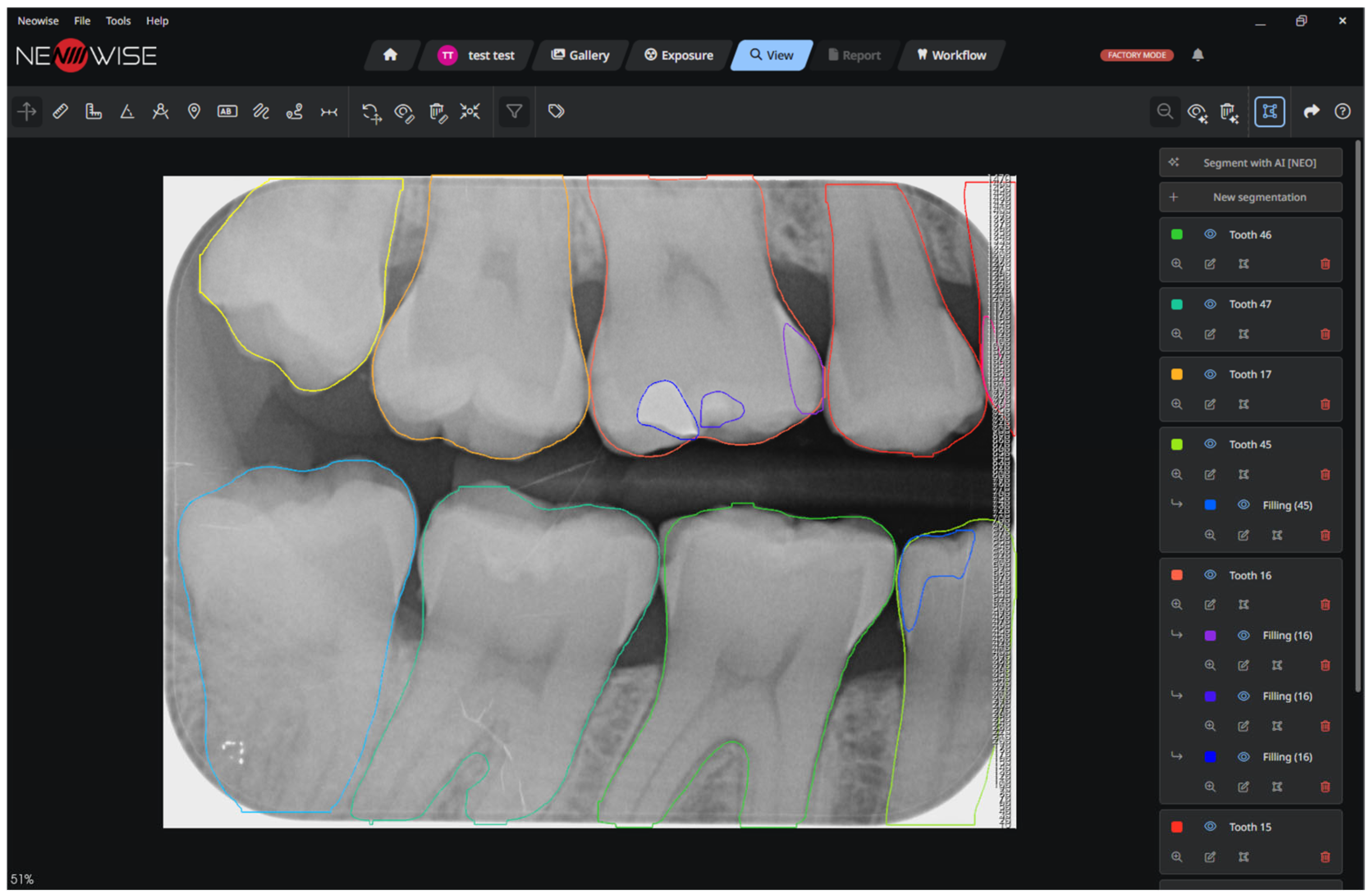
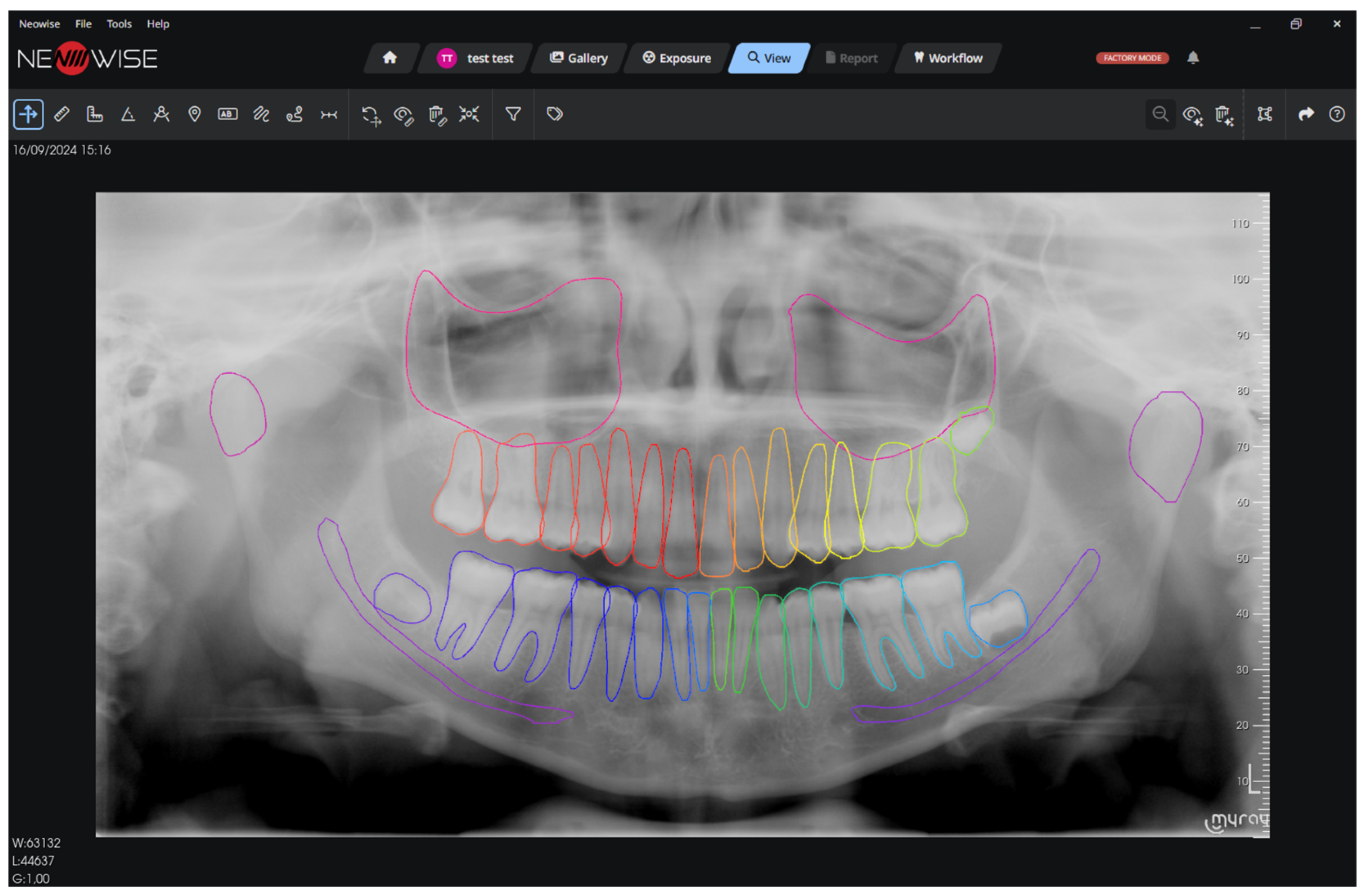
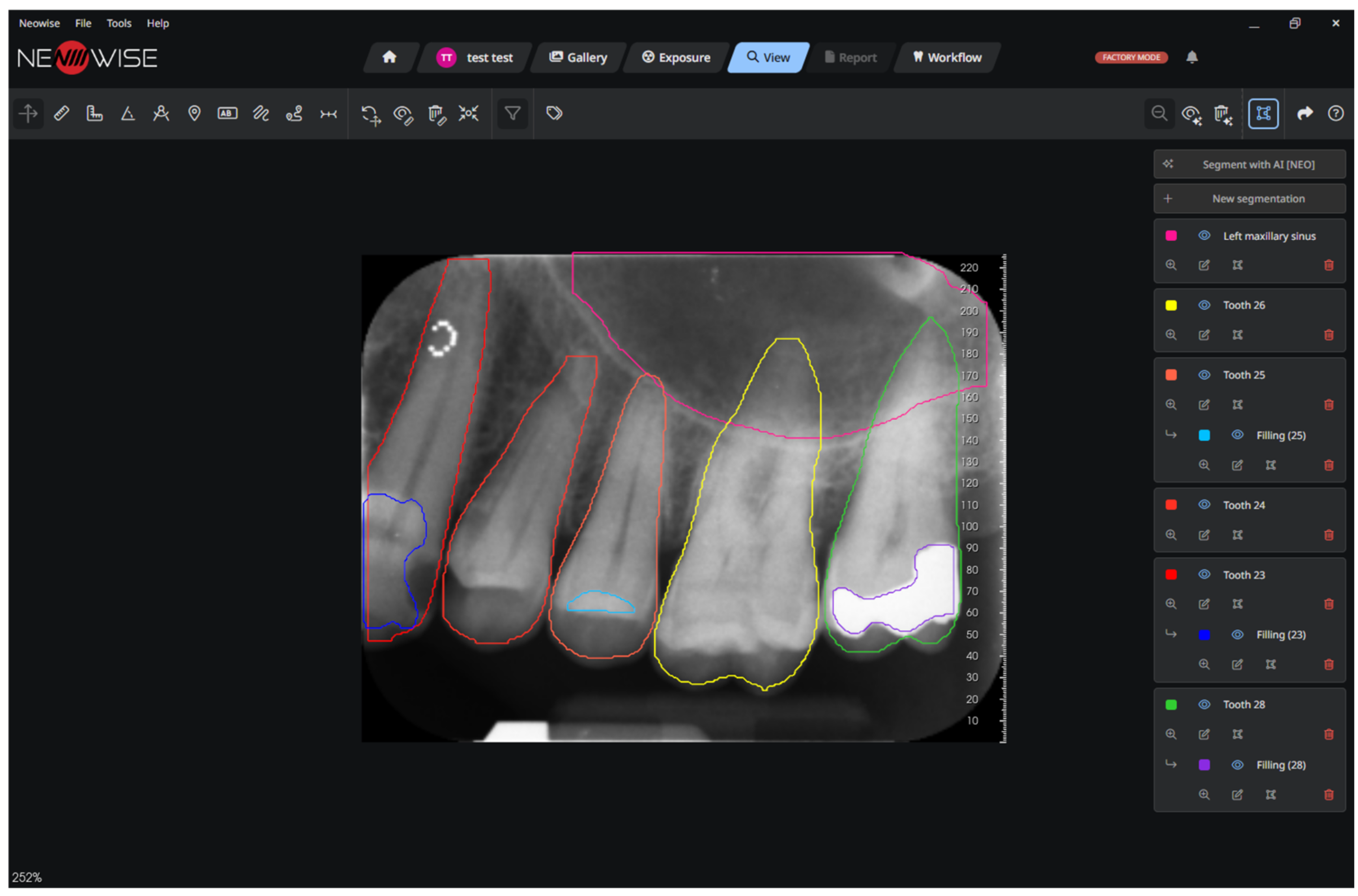
The analysis revealed no statistically significant differences in performance metrics between sexes. However, a statistically significant difference was observed among age groups. This can be attributed to the increased complexity of radiographs from elderly individuals, which often feature a greater abundance of both pathological and non-pathological elements compared to those of children, adolescents, and adults. Figure 1, Figure 2 and Figure 3 show the output of the ORTHOSEG for the three supported types of radiographs: orthopanoramic, bitewing and periapical, respectively.

4. Discussion

A rigorous evaluation of ORTHOSEG was conducted to assess its ability to segment anatomical, pathological, and non-pathological structures from dental radiographs. The study employed a dataset prepared by two experienced clinicians, who followed a dual-review protocol. One clinician performed manual annotations using CVAT, while the second clinician conducted a comprehensive review and quality assurance process. This approach, coupled with stringent checks to address segmentation consistency and image resolution, ensured that the dataset accurately represented real-world clinical scenarios.
ORTHOSEG showed strong performance, particularly for orthopantomograms and bitewings, achieving an mDSC of 0.756 ± 0.174 and 0.705 ± 0.154 and an mIoU of 0.684 ± 0.172 and 0.652 ± 0.151, respectively. Notably, these results were achieved while identifying and segmenting 70 distinct elements, including anatomical, pathological, and non-pathological structures, an extent of recognition that surpasses many existing systems [8]. This capability highlights ORTHOSEG’s potential to manage complex datasets effectively, ensuring a comprehensive analysis of radiographic images.
When compared to existing state-of-the-art solutions, ORTHOSEG demonstrated promising results. For example, U-Net and Faster R-CNN models have achieved an mIoU of 0.501 and an mDSC of 0.569 in dental segmentation tasks [5]. ORTHOSEG’s results exceed these benchmarks in terms of the quality and quantity of elements detected, suggesting its capability to deliver competitive performance in dental radiograph analysis while addressing a broader range of identifiable features. The results of the present study are consistent with previous research demonstrating the effectiveness of deep learning models in dental radiograph segmentation. Previous studies have reported Dice coefficients up to 0.569 and mIoU values up to 0.501 for periapical radiograph segmentation using U-Net-based architectures [5,15]. Similarly, high segmentation performance has been reported in periapical radiographs, with F1-scores up to 0.88, confirming the potential of deep learning systems for detailed radiographic analysis [22]. In bitewing radiographs, CNN-based segmentation models have achieved F1-scores of approximately 0.84 and diagnostic accuracies up to 0.87, supporting the reliability of artificial intelligence in dental radiographic analysis [9,10]. These findings are consistent with the performance observed for ORTHOSEG, particularly in orthopantomograms and bitewing radiographs. Furthermore, systematic and scoping reviews have emphasized the growing role of convolutional neural networks in improving diagnostic accuracy and supporting clinical decision-making in dentistry [4,11,21].
In addition to its segmentation accuracy, ORTHOSEG achieved efficient computational performance, with average processing times of 19.745 ± 3.625 s for orthopantomograms, 8.467 ± 0.903 s for bitewings, and 5.653 ± 0.897 s for periapical radiographs. These speeds were achieved on hardware commonly available in clinical settings, which suggests that the system could be easily integrated into routine workflows without requiring specialized computational infrastructure.
These results highlight the superior performance of the model on orthopantomograms, while the lower performance on periapical radiographs is attributed to the inherent complexity of these images, particularly in classifying individual teeth.
The lower segmentation performance observed in periapical radiographs may be attributed to several modality-specific factors. Compared to orthopantomograms and bitewings, periapical radiographs provide a more limited field of view and fewer surrounding anatomical reference structures, reducing the contextual information available for accurate segmentation. In addition, periapical radiographs often exhibit greater variability in tooth positioning, angulation, and anatomical overlap, which can increase segmentation complexity. Furthermore, in the present dataset, periapical radiographs included a higher proportion of elderly patients, who more frequently present restorations, implants, and structural alterations, potentially increasing image heterogeneity. These findings suggest that segmentation of periapical radiographs represents a more challenging task for AI systems and highlight the importance of continued optimization and validation.
The system’s segmentation results were consistent across sexes and children and adult age groups, reflecting its robustness and generalizability. However, a slight decrease in accuracy was observed when the system was applied to radiographs of older patients (65+ years), likely due to the increased complexity of their radiographs, which often feature a greater number of overlapping anatomical and pathological elements [36,37,38,39,40,41,42]. These findings underline the system’s adaptability while emphasizing the continued need for clinician oversight in managing complex cases.
By automating routine segmentation tasks, ORTHOSEG can reduce the time required for image interpretation, alleviating the cognitive burden on clinicians and enabling them to focus on evaluating complex cases and making informed clinical decisions.
This study has several limitations that should be acknowledged. First, the dataset used for evaluation was derived exclusively from a European population without differentiating between ethnic groups. Therefore, the findings may not be fully generalizable to patients from other geographic regions that can have different demographic and epidemiological characteristics. Second, dealing with AI systems means dealing with variability. Although the dataset was carefully curated and reviewed by experienced clinicians, it may not capture the full variability encountered in everyday practice, particularly in cases with rare pathologies or unusual anatomical conditions. Finally, the study focused on the system’s performance without analyzing its usability in the Neowise software, its clinical interaction, or its impact on diagnostic workflows.
Future work includes expanding the dataset to cover a broader and more representative patient population and include more imaging devices in order to confirm the system’s generalizability beyond the European sample examined in this study. Future research should focus on expanding the validation dataset to include a broader range of patient demographics and clinical scenarios, further refining the system’s performance and generalizability. This will ensure that ORTHOSEG continues to meet the evolving needs of modern dentistry, cementing its role as an indispensable tool in routine clinical practice.
Moreover, future studies could include prospective clinical trials in which clinicians would use the ORTHOSEG system on new patients, record its outputs in real time, and assess how its segmentation affects diagnostic decisions, reporting times, and workflow efficiency [43,44,45,46,47,48]. Finally, studies on user experience and usability among clinicians will be fundamental to ensure the effective integration of this AI-assisted tool into daily routine dental practice.


5. Conclusions

The results of this study confirm that ORTHOSEG meets the performance standards necessary for clinical integration, demonstrating its capability as a reliable and efficient tool for dental radiograph analysis in routine clinical practice. The system’s consistent, high-quality segmentation across various radiographic modalities underscores its potential as a valuable support tool for dental diagnosis and treatment planning. While the system demonstrates robust performance, manual verification by a clinician remains essential, particularly for cases with unique anatomical features or imaging artifacts. This ensures the highest reliability and accuracy in clinical practice. However, the combination of accurate segmentation, efficient processing times, and compatibility with standard clinical hardware highlights ORTHOSEG’s capacity to enhance diagnostic workflows in everyday clinical settings, ultimately contributing to improved patient care.

Author Contributions

Conceptualization, G.C., G.S. and M.C. (Marco Colombo); methodology, G.C., M.C. (Marco Chiesa) and A.S.; software, G.C.; validation, G.C. and G.S.; formal analysis, A.S.; investigation, G.C., M.C. (Marco Chiesa) and M.C. (Marco Colombo); resources, G.S. and M.C. (Marco Colombo); data curation, G.C. and A.S.; writing—original draft preparation, G.C., L.G. and M.P.; writing—review and editing, L.G. and M.P.; visualization, G.C., M.P. and A.S.; supervision, G.C. and M.C. (Marco Colombo); project administration, G.S. and M.C. (Marco Colombo); funding acquisition, G.S. All authors have read and agreed to the published version of the manuscript.

Funding

This research received no external funding.

Institutional Review Board Statement

The study was conducted in accordance with the Declaration of Helsinki and approved by the Unit Internal Review Board (protocol code: 2025-1112, date of approval: 12 November 2025).

Informed Consent Statement

Informed consent was obtained from all subjects involved in the study. Written informed consent has been obtained from the patients to publish this paper.

Data Availability Statement

The original contributions presented in this study are included in the article. Further inquiries can be directed to the corresponding authors.

Conflicts of Interest

The authors declare no conflicts of interest.

Abbreviations

The following abbreviations are used in this manuscript:
DSCDice Similarity Coefficient
mDSCmean Dice Similarity Coefficient
IoUIntersection over Union
mIoUmean Intersection over Union
AIArtificial Intelligence
CNNConvolutional Neural Network
GDPRGeneral Data Protection Regulation
ANOVAAnalysis of Variance

References

  1. El-Sayed, F.; Farag, Y. Dental radiographs for revealing hidden structures, masses, and cavities through X-ray imaging. J. Oral. Hyg. Health 2024, 12, 434. [Google Scholar] [CrossRef]
  2. Akarslan, Z.Z.; Akdevelioğlu, M.; Güngör, K.; Erten, H. A comparison of the diagnostic accuracy of bitewing, periapical, unfiltered and filtered digital panoramic images for approximal caries detection in posterior teeth. Dentomaxillofac. Radiol. 2008, 37, 458–463. [Google Scholar] [CrossRef] [PubMed]
  3. Schwendicke, F.; Samek, W.; Krois, J. Artificial Intelligence in Dentistry: Chances and Challenges. J. Dent. Res. 2020, 99, 769–774. [Google Scholar] [CrossRef] [PubMed]
  4. Chen, Y.; Stanley, K.; Att, W. Artificial intelligence in dentistry: Current applications and future perspectives. Quintessence Int. 2020, 51, 248–257. [Google Scholar] [CrossRef]
  5. Khanagar, S.B.; Al-Ehaideb, A.; Maganur, P.C.; Vishwanathaiah, S.; Patil, S.; Baeshen, H.A.; Sarode, S.C.; Bhandi, S. Developments, application, and performance of artificial intelligence in dentistry—A systematic review. J. Dent. Sci. 2021, 16, 508–522. [Google Scholar] [CrossRef]
  6. Ossowska, A.; Kusiak, A.; Świetlik, D. Artificial Intelligence in Dentistry—Narrative Review. Int. J. Environ. Res. Public Health 2022, 19, 3449. [Google Scholar] [CrossRef]
  7. Silva, G.; Oliveira, L.; Pithon, M. Automatic segmenting teeth in X-ray images: Trends, a novel data set, benchmarking and future perspectives. Expert Syst. Appl. 2018, 107, 15–31. [Google Scholar] [CrossRef]
  8. Lee, J.H.; Kim, D.H.; Jeong, S.N.; Choi, S.H. Detection and diagnosis of dental caries using a deep learning-based convolutional neural network algorithm. J. Dent. 2018, 77, 106–111. [Google Scholar] [CrossRef]
  9. Bayrakdar, İ.Ş.; Orhan, K.; Akarsu, S.; Çelik, Ö.; Atasoy, S.; Pekince, A.; Yasa, Y.; Bilgir, E.; Sağlam, H.; Aslan, A.F.; et al. Deep-learning approach for caries detection and segmentation on dental bitewing radiographs. Oral. Radiol. 2022, 38, 468–479. [Google Scholar] [CrossRef]
  10. Chen, X.; Guo, J.; Ye, J.; Zhang, M.; Liang, Y. Detection of Proximal Caries Lesions on Bitewing Radiographs Using Deep Learning Method. Caries Res. 2022, 56, 455–463. [Google Scholar] [CrossRef]
  11. Prados-Privado, M.; Villalón, J.G.; Martínez-Martínez, C.H.; Ivorra, C.; Prados-Frutos, J.C. Dental Caries Diagnosis and Detection Using Neural Networks: A Systematic Review. J. Clin. Med. 2020, 9, 3579. [Google Scholar] [CrossRef]
  12. Chang, H.-J.; Lee, S.-J.; Yong, T.-H.; Shin, N.-Y.; Jang, B.-G.; Kim, J.-E.; Huh, K.-H.; Lee, S.-S.; Heo, M.-S.; Choi, S.-C.; et al. Deep Learning Hybrid Method to Automatically Diagnose Periodontal Bone Loss and Stage Periodontitis. Sci. Rep. 2020, 10, 7531. [Google Scholar] [CrossRef]
  13. Cha, J.-Y.; Yoon, H.-I.; Yeo, I.-S.; Huh, K.-H.; Han, J.-S. Peri-Implant Bone Loss Measurement Using a Region-Based Convolutional Neural Network on Dental Periapical Radiographs. J. Clin. Med. 2021, 10, 1009. [Google Scholar] [CrossRef] [PubMed]
  14. Moran, M.; Faria, M.; Giraldi, G.; Bastos, L.; Conci, A. Do Radiographic Assessments of Periodontal Bone Loss Improve with Deep Learning Methods for Enhanced Image Resolution? Sensors 2021, 21, 2013. [Google Scholar] [CrossRef] [PubMed]
  15. Khan, H.A.; Haider, M.A.; Ansari, H.A.; Ishaq, H.; Kiyani, A.; Sohail, K.; Muhammad, M.; Khurram, S.A. Automated feature detection in dental periapical radiographs by using deep learning. Oral Surg. Oral Med. Oral Pathol. Oral Radiol. 2021, 131, 711–720. [Google Scholar] [CrossRef] [PubMed]
  16. Pinheiro, L.; Silva, B.; Sobrinho, B.; Lima, F.; Cury, P.; Oliveira, L. Numbering permanent and deciduous teeth via deep instance segmentation in panoramic x-rays. In Proceedings of the 17th International Symposium on Medical Information Processing and Analysis, Campinas, Brasil, 17–19 November 2021; SPIE: Bellingham, WA, USA, 2021; Volume 12088, pp. 95–104. [Google Scholar] [CrossRef]
  17. Bilgir, E.; Bayrakdar, İ.Ş.; Çelik, Ö.; Orhan, K.; Akkoca, F.; Sağlam, H.; Odabaş, A.; Aslan, A.F.; Ozcetin, C.; Kıllı, M.; et al. An artificial intelligence approach to automatic tooth detection and numbering in panoramic radiographs. BMC Med. Imaging 2021, 21, 124. [Google Scholar] [CrossRef]
  18. He, K.; Gkioxari, G.; Dollár, P.; Girshick, R. Mask R-CNN. In Proceedings of the IEEE International Conference on Computer Vision (ICCV), Venice, Italy, 22–29 October 2017; IEEE: New York, NY, USA, 2017; pp. 2961–2969. [Google Scholar]
  19. Pauwels, R.; Brasil, D.M.; Yamasaki, M.C.; Jacobs, R.; Bosmans, H.; Freitas, D.Q.; Haiter-Neto, F. Artificial intelligence for detection of periapical lesions on intraoral radiographs: Comparison between convolutional neural networks and human observers. Oral Surg. Oral Med. Oral Pathol. Oral Radiol. 2021, 131, 610–616. [Google Scholar] [CrossRef]
  20. Abdalla-Aslan, R.; Yeshua, T.; Kabla, D.; Leichter, I.; Nadler, C. An artificial intelligence system using machine-learning for automatic detection and classification of dental restorations in panoramic radiography. Oral Surg. Oral Med. Oral Pathol. Oral Radiol. 2020, 130, 593–602. [Google Scholar] [CrossRef]
  21. Aminoshariae, A.; Kulild, J.; Nagendrababu, V. Artificial Intelligence in Endodontics: Current Applications and Future Directions. J. Endod. 2021, 47, 1352–1357. [Google Scholar] [CrossRef]
  22. Bichu, Y.M.; Hansa, I.; Bichu, A.Y.; Premjani, P.; Flores-Mir, C.; Vaid, N.R. Applications of artificial intelligence and machine learning in orthodontics: A scoping review. Prog. Orthod. 2021, 22, 18. [Google Scholar] [CrossRef]
  23. Kazimierczak, W.; Wajer, R.; Wajer, A.; Kalka, K.; Kazimierczak, N.; Serafin, Z. Evaluating the Diagnostic Accuracy of an AI-Driven Platform for Assessing Endodontic Treatment Outcomes Using Panoramic Radiographs: A Preliminary Study. J. Clin. Med. 2024, 13, 3401. [Google Scholar] [CrossRef] [PubMed] [PubMed Central]
  24. Issa, J.; Jaber, M.; Rifai, I.; Mozdziak, P.; Kempisty, B.; Dyszkiewicz-Konwińska, M. Diagnostic Test Accuracy of Artificial Intelligence in Detecting Periapical Periodontitis on Two-Dimensional Radiographs: A Retrospective Study and Literature Review. Medicina 2023, 59, 768. [Google Scholar] [CrossRef] [PubMed] [PubMed Central]
  25. Szabó, V.; Szabó, B.T.; Orhan, K.; Veres, D.S.; Manulis, D.; Ezhov, M.; Sanders, A. Validation of artificial intelligence application for dental caries diagnosis on intraoral bitewing and periapical radiographs. J. Dent. 2024, 147, 105105. [Google Scholar] [CrossRef] [PubMed]
  26. Ari, T.; Sağlam, H.; Öksüzoğlu, H.; Kazan, O.; Bayrakdar, İ.Ş.; Duman, S.B.; Çelik, Ö.; Jagtap, R.; Futyma-Gąbka, K.; Różyło-Kalinowska, I.; et al. Automatic Feature Segmentation in Dental Periapical Radiographs. Diagnostics 2022, 12, 3081. [Google Scholar] [CrossRef] [PubMed]
  27. Amisha; Malik, P.; Pathania, M.; Rathaur, V.K. Overview of artificial intelligence in medicine. J. Fam. Med. Prim. Care 2019, 8, 2328–2331. [Google Scholar] [CrossRef]
  28. England, J.R.; Cheng, P.M. Artificial intelligence for medical image analysis: A guide for authors and reviewers. AJR Am. J. Roentgenol. 2019, 212, 513–519. [Google Scholar] [CrossRef]
  29. Schwendicke, F.; Golla, T.; Dreher, M.; Krois, J. Convolutional neural networks for dental image diagnostics: A scoping review. J. Dent. 2019, 91, 103226. [Google Scholar] [CrossRef]
  30. Zeiler, M.D.; Fergus, R. Visualizing and Understanding Convolutional Networks. In Computer Vision—ECCV 2014; Fleet, D., Pajdla, T., Schiele, B., Tuytelaars, T., Eds.; Lecture Notes in Computer Science; Springer: Cham, Switzerland, 2014; Volume 8689. [Google Scholar] [CrossRef]
  31. Amer, Y.Y.; Aqel, M.J. An Efficient Segmentation Algorithm for Panoramic Dental Images. Procedia Comput. Sci. 2015, 65, 718–725. [Google Scholar] [CrossRef]
  32. Everingham, M.; Eslami, S.M.A.; Van Gool, L.; Williams, C.K.I.; Winn, J.; Zisserman, A. The Pascal Visual Object Classes Challenge: A Retrospective. Int. J. Comput. Vis. 2015, 111, 98–136. [Google Scholar] [CrossRef]
  33. Long, J.; Shelhamer, E.; Darrell, T. Fully convolutional networks for semantic segmentation. In Proceedings of the IEEE Conference on Computer Vision and Pattern Recognition (CVPR), Boston, MA, USA, 7–12 June 2015; IEEE: New York, NY, USA, 2015; pp. 3431–3440. [Google Scholar] [CrossRef]
  34. Semerci, Z.M.; Yardımcı, S. Empowering Modern Dentistry: The Impact of Artificial Intelligence on Patient Care and Clinical Decision Making. Diagnostics 2024, 14, 1260. [Google Scholar] [CrossRef]
  35. Budagam, D.; Kumar, A.; Ghosh, S.; Roy, S.; Thiyagalingam, J.; Seelam, N. Instance Segmentation and Teeth Classification in Panoramic X-rays. arXiv 2024, arXiv:2406.03747. [Google Scholar] [CrossRef]
  36. Wang, C.; Yang, J.; Liu, H.; Yu, P.; Jiang, X.; Liu, R. Co-Mask R-CNN: Collaborative learning-based method for tooth instance segmentation. J. Clin. Pediatr. Dent. 2024, 48, 161–172. [Google Scholar] [CrossRef] [PubMed]
  37. Salehizeinabadi, M.; Neghab, S.; Ameli, N.; Baghi, K.K.; Pacheco-Pereira, C. Automated Classification of Dental Caries in Bitewing Radiographs Using Machine Learning and the ICCMS Framework. Int. J. Dent. 2025, 2025, 6644310. [Google Scholar] [CrossRef] [PubMed]
  38. Kim, E.; Hwang, J.J.; Cho, B.H.; Lee, E.; Shin, J. Classification of presence of missing teeth in each quadrant using deep learning artificial intelligence on panoramic radiographs of pediatric patients. J. Clin. Pediatr. Dent. 2024, 48, 76–85. [Google Scholar] [CrossRef]
  39. Burlea, Ș.L.; Buzea, C.G.; Nedeff, F.; Mirilă, D.; Nedeff, V.; Agop, M.; Ochiuz, L.; Armencia, A.O. Deep Learning Analysis of CBCT Images for Periodontal Disease: Phenotype-Level Concordance with Independent Transcriptomic and Microbiome Datasets. Dent. J. 2025, 13, 578. [Google Scholar] [CrossRef] [PubMed] [PubMed Central]
  40. Firincioglulari, M.; Boztuna, M.; Mirzaei, O.; Karanfiller, T.; Akkaya, N.; Orhan, K. Segmentation of Pulp and Pulp Stones with Automatic Deep Learning in Panoramic Radiographs: An Artificial Intelligence Study. Dent. J. 2025, 13, 274. [Google Scholar] [CrossRef] [PubMed] [PubMed Central]
  41. Gracea, R.S.; Chopra, S.; Östgren, P.; Benchimol, D.; Jacobs, R. Artificial Intelligence-Assisted Longitudinal Analysis Reveals a Novel Rare Fainting Wisdom Tooth Phenomenon in Fully Dentate Mandibles. Int. J. Dent. 2025, 2025, 1932229. [Google Scholar] [CrossRef]
  42. Kim, H.; Song, J.S.; Shin, T.J.; Kim, Y.J.; Kim, J.W.; Jang, K.T.; Hyun, H.K. Image segmentation of impacted mesiodens using deep learning. J. Clin. Pediatr. Dent. 2024, 48, 52–58. [Google Scholar] [CrossRef]
  43. Ardila, C.M.; Pineda-Vélez, E.; Vivares-Builes, A.M. Artificial Intelligence in Endodontic Education: A Systematic Review with Frequentist and Bayesian Meta-Analysis of Student-Based Evidence. Dent. J. 2025, 13, 489. [Google Scholar] [CrossRef]
  44. Pascadopoli, M.; Zampetti, P.; Nardi, M.G.; Pellegrini, M.; Scribante, A. Smartphone Applications in Dentistry: A Scoping Review. Dent. J. 2023, 11, 243. [Google Scholar] [CrossRef]
  45. Gaddam, B.; Alluri, L.S.C.; Amugo, I.; Berta, L.; Butler, M.; Ferguson, S.; Ferguson, A.; Harris, E.; Berthaud, V.; Pratap, S.; et al. A Crosstalk Between Periodontal Disease and Human Immunodeficiency Virus: Application of Artificial Intelligence and Machine Learning in Risk Assessment and Diagnosis-A Narrative Review. Dent. J. 2025, 13, 603. [Google Scholar] [CrossRef]
  46. Vitale, M.C.; Pascadopoli, M.; Zampetti, P.; Balbi, A.; Scribante, A. Reducing dental anxiety in children through tell-show-do technique vs. additional instructions with an artificial intelligence-based animated video: Randomized clinical trial. J. Clin. Pediatr. Dent. 2025, 49, 38–46. [Google Scholar] [CrossRef]
  47. Yılmaz, N.; Hakan Bozkurt, M.H.; Tüzüner, T.; Aslan, M. Artificial intelligence for detecting dental ankylosis in primary molars using panoramic radiographs—A retrospective study. J. Clin. Pediatr. Dent. 2025, 49, 120–130. [Google Scholar] [CrossRef]
  48. Ivanišević, A.; Tadin, A. Artificial Intelligence and Modern Technology in Dentistry: Attitudes, Knowledge, Use, and Barriers Among Dentists in Croatia—A Survey-Based Study. Clin. Pract. 2024, 14, 2623–2636. [Google Scholar] [CrossRef]
Figure 1. Orthopanoramic segmentation.
Clinpract 16 00054 g001
Figure 2. Bitewing segmentation.
Clinpract 16 00054 g002
Figure 3. Periapical segmentation.
Clinpract 16 00054 g003
Table 1. Elements detected by the ORTHOSEG system.
Segmented ElementsSegmentation Criteria
Permanent and deciduous teeth (each tooth is labeled according to the FDI notation)Segmentation should cover the entire tooth structure, from the root tips to the top of the enamel, including all internal components such as the pulp chamber, root canals, and any fillings or caries.
Right (left) mandibular condyleSegmentation should include the entire right (left) mandibular condyle, covering its cortical and cancellous bone regions.
Right (left) inferior alveolar nerve canalSegmentation should trace the entire right (left) inferior alveolar nerve canal, from its entrance at the mandibular foramen to its exit at the mental foramen.
Right (left) maxillary sinusSegmentation should cover the complete left maxillary sinus cavity, outlining its bony boundaries.
Orthodontic bandSegmentation should cover the entire orthodontic band, including all surfaces and attachments to the tooth.
BracketSegmentation should include the entire orthodontic bracket.
CrownSegmentation should cover the complete dental crown, including its outer surface and its core.
Root canal treatmentSegmentation should encompass the entire root canal treatment area, including the filling material from the root apex to the coronal seal.
ImplantSegmentation should cover the full dental implant, from its apical tip to the top of the fixture.
FillingSegmentation should include the complete filling material.
Endocanal pin
(a.k.a. Endodontic post)
Segmentation should encompass the entire post within the root canal.
Cast abutment pin
(a.k.a. Metal post and core)
Segmentation should encompass the entire fused metal post and core structure.
Piercings, jewelry, hair clips, or hearing aidsSegmentation should cover the entire object, such as piercings, jewelry, hair clips, or hearing aids, visible within the X-ray field.
Ghosting effect due to piercing, jewelry, hair clips, or hearing aidsSegmentation should include the ghost image artifacts caused by objects such as piercings, jewelry, hair clips, or hearing aids.
Pontic (intermediate element of a prosthetic bridge)Segmentation should include the entire pontic element.
BridgeSegmentation should include the entire prosthetic bridge, including the supporting structures and all intermediate elements (pontics).
Internal screw between crown and implantSegmentation should cover the entire internal screw that connects the crown to the implant fixture.
CariesSegmentation should cover the entire extent of the carious lesion, including any demineralized or decayed areas of the tooth.
Lesion associated with a toothSegmentation should encompass the full extent of any lesion directly associated with a tooth, including periapical, periodontal, or other types of tooth-related pathology.
Table 2. Distribution of orthopanoramic radiographs by origin, age and sex.
PopulationSystem Evaluation (Test) Dataset—NSystem Evaluation (Test) Dataset—%
SexMale2856.00%
Female2244.00%
AgeChildren (8–12)612.00%
Adolescents and adults (13–65)3264.00%
Elderly (>65)1224.00%
Table 3. Distribution of bitewing radiographs by origin, age and sex.
PopulationSystem Evaluation (Test) Dataset—NSystem Evaluation (Test) Dataset—%
SexMale2550.00%
Female2550.00%
AgeChildren (8–12)612.00%
Adolescents and adults (13–65)2754.00%
Elderly (>65)1734.00%
Table 4. Distribution of periapical radiographs by origin, age and sex.
PopulationSystem Evaluation (Test) Dataset—NSystem Evaluation (Test) Dataset—%
SexMale2247.83%
Female2452.17%
AgeChildren (8–12)510.00%
Adolescents and adults (13–65)816.00%
Elderly (>65)3774.00%
Table 5. Evaluation results for all supported radiograph types.
MetricMeanStandard Deviation
mDSC0.6350.222
mIoU0.5760.214
mPrecision0.6610.220
mRecall0.6280.219
Table 6. Inference time in seconds (s).
Image TypeMeanStandard Deviation
Orthopanoramic19.7453.625
Bitewing8.4670.903
Periapical5.6530.897
Table 7. Evaluation results for orthopanoramic radiographs.
MetricMeanStandard Deviation
mDSC0.7560.174
mIoU0.6840.172
mPrecision0.7690.180
mRecall0.7600.161
Table 8. Evaluation results for segmentation from bitewing radiographs.
MetricMeanStandard Deviation
mDSC0.7050.154
mIoU0.6520.151
mPrecision0.7350.159
mRecall0.6910.148
Table 9. Evaluation results for segmentation from periapical radiographs.
MetricMeanStandard Deviation
mDSC0.4450.197
mIoU0.3910.185
mPrecision0.4800.197
mRecall0.4320.195
Table 10. Evaluation results grouped by sex.
MetricMaleFemalep Value
MeanStandard DeviationMeanStandard Deviation
mDSC0.6510.2420.6270.2010.504
mIoU0.5930.2320.5660.1960.444
mPrecision0.6760.2370.6530.2030.530
mRecall0.6450.2430.6190.1940.478
Table 11. Evaluation results grouped by age.
MetricChildren (7–12)Adolescents and Adults (13–64)Elderly (>65)p Value
MeanStdMeanStdMeanStd
mDSC0.7220.1490.7270.1820.5200.222<0.0001
mIoU0.6550.1460.6680.1740.4620.214<0.0001
mPrecision0.7500.1460.7510.1790.5470.223<0.0001
mRecall0.7100.1500.7160.1840.5170.220<0.0001
Disclaimer/Publisher’s Note: The statements, opinions and data contained in all publications are solely those of the individual author(s) and contributor(s) and not of MDPI and/or the editor(s). MDPI and/or the editor(s) disclaim responsibility for any injury to people or property resulting from any ideas, methods, instructions or products referred to in the content.