

Characteristics, Complications, Comorbidities, and Other Manifestations of Inflammatory Bowel Disease: A 7-Year Tertiary Center Experience
 , , , ,
Abstract
1. Introduction
2. Materials and Methods
3. Results
4. Discussion
5. Conclusions
Author Contributions
Funding
Institutional Review Board Statement
Informed Consent Statement
Data Availability Statement
Conflicts of Interest
Abbreviations
| IBD | Inflammatory Bowel Disease |
| CD | Crohn’s Disease |
| UC | Ulcerative Colitis |
| BMI | Body Mass Index |
| NGHA | National Guard Health Affairs |
| PSC | Primary Sclerosing Cholangitis |
References
- Australian Institute of Health and Welfare. Chronic Condition Multimorbidity 2021: What is Multimorbidity and How Common Is It? Australian Institute of Health and Welfare: Canberra, Australia, 2021. Available online: https://www.aihw.gov.au/reports/chronic-disease/chronic-condition-multimorbidity-2021 (accessed on 17 October 2023).
- Banerjee, A.; Hurst, J.; Fottrell, E.; Miranda, J.J. Multimorbidity: Not Just for the West. Glob. Heart. 2020, 15, 35694. [Google Scholar] [CrossRef] [PubMed]
- MacRae, C.; Morales, D.; Mercer, S.W.; Lone, N.; Lawson, A.; Jefferson, E.; McAllister, D.; Akker, M.v.D.; Marshall, A.; Seth, S.; et al. Impact of Data Source Choice on Multimorbidity measurement: A Comparison Study of 2.3 Million Individuals in the Welsh National Health Service. BMC Med. 2023, 21, 309. Available online: https://pubmed.ncbi.nlm.nih.gov/37582755/#:~:text=Results%3A%20Using%20linked%20PC%2DHI (accessed on 17 October 2023). [CrossRef]
- Nicholson, K.; Almirall, J.; Fortin, M. The measurement of multimorbidity. Health Psychol. 2019, 38, 783–790. [Google Scholar] [CrossRef] [PubMed]
- Harrison, C.; Fortin, M.; Akker, M.v.D.; Mair, F.; Calderon-Larranaga, A.; Boland, F.; Wallace, E.; Jani, B.; Smith, S. Comorbidity versus multimorbidity: Why it matters. J. Multimorb. Comorbidity 2021, 11, 3993. [Google Scholar] [CrossRef]
- Breen, K.; Finnegan, L.; Vuckovic, K.; Fink, A.; Rosamond, W.; DeVon, H.A. Multimorbidity in Patients with Acute Coronary Syndrome Is Associated with Greater Mortality, Higher Readmission Rates, and Increased Length of Stay. J. Cardiovasc. Nurs. 2020, 35, E99–E110. [Google Scholar] [CrossRef]
- Rodrigues, L.P.; de Oliveira Rezende, A.T.; Delpino, F.M.; Mendonça, C.R.; Noll, M.; Nunes, B.P.; De Oliviera, C.; Silveira, E.A. Association between multimorbidity and hospitalization in older adults: Systematic review and meta-analysis. Age Ageing 2022, 51, afac155. [Google Scholar] [CrossRef]
- Van Wilder, L.; Devleesschauwer, B.; Clays, E.; Pype, P.; Vandepitte, S.; De Smedt, D. Polypharmacy and health-related quality of life/psychological distress among patients with chronic disease. Prev. Chronic Dis. 2022, 19, E50. Available online: https://www.cdc.gov/pcd/issues/2022/22_0062.htm (accessed on 17 October 2023).
- Chang, C.K.; Chen, Y.C.; Chou, Y.J.; Chou, P. Multimorbidity patterns and their association with depression: A population-based study. Healthcare 2025, 13, 1458. Available online: https://www.mdpi.com/2227-9032/13/12/1458 (accessed on 18 October 2023).
- Tran, P.B.; Kazibwe, J.; Nikolaidis, G.F.; Linnosmaa, I.; Rijken, M.; van Olmen, J. Costs of multimorbidity: A systematic review and meta-analyses. BMC Med. 2022, 20, 234. Available online: https://bmcmedicine.biomedcentral.com/articles/10.1186/s12916-022-02427-9 (accessed on 18 October 2023). [CrossRef]
- McDowell, C.; Farooq, U.; Haseeb, M. Inflammatory Bowel Disease. 2025. Available online: http://www.ncbi.nlm.nih.gov/pubmed/30137275 (accessed on 18 October 2023).
- Maaser, C.; Sturm, A.; Vavricka, S.R.; Kucharzik, T.; Fiorino, G.; Annese, V.; Calabrese, E.; Baumgart, D.C.; Bettenworth, D.; Borralho Nunes, P.; et al. ECCO-ESGAR Guideline for Diagnostic Assessment in IBD Part 1: Initial diagnosis, monitoring of known IBD, detection of complications. J. Crohn’s Colitis. 2019, 13, 144–164. [Google Scholar] [CrossRef]
- Dmochowska, N.; Wardill, H.R.; Hughes, P.A. Advances in Imaging Specific Mediators of Inflammatory Bowel Disease. Int. J. Mol. Sci. 2018, 19, 2471. [Google Scholar] [CrossRef] [PubMed]
- Colombel, J.-F.; Shin, A.; Gibson, P.R. AGA Clinical Practice Update on Functional Gastrointestinal Symptoms in Patients with Inflammatory Bowel Disease: Expert Review. Clin. Gastroenterol. Hepatol. 2019, 17, 380–390. [Google Scholar] [CrossRef]
- Hudson, M.; Chitolie, A.; Hutton, R.A.; Smith, M.S.; Pounder, R.E.; Wakefield, A.J. Thrombotic vascular risk factors in inflammatory bowel disease. Gut 1996, 38, 733–737. [Google Scholar] [CrossRef]
- Chalasani, N.; Younossi, Z.; LaVine, J.E.; Charlton, M.; Cusi, K.; Rinella, M.; Harrison, S.A.; Brunt, E.M.; Sanyal, A.J. The diagnosis and management of nonalcoholic fatty liver disease: Practice guidance from the American Association for the Study of Liver Diseases. Hepatology 2018, 67, 328–357. [Google Scholar] [CrossRef]
- Friedman, S.; Magnussen, B.; O’Toole, A.; Fedder, J.; Larsen, M.D.; Nørgård, B.M. Increased Use of Medications for Erectile Dysfunction in Men with Ulcerative Colitis and Crohn’s Disease Compared to Men Without Inflammatory Bowel disease: A Nationwide cohort Study. Am. J. Gastroenterol. 2018, 113, 1355. [Google Scholar] [CrossRef] [PubMed]
- D’Silva, A.; Fox, D.E.; Nasser, Y.; Vallance, J.K.; Quinn, R.R.; Ronksley, P.E.; Raman, M. Prevalence and risk factors for fatigue in adults with inflammatory bowel disease: A systematic review with meta-analysis. Clin. Gastroenterol. Hepatol. 2022, 20, 995–1009. [Google Scholar] [CrossRef] [PubMed]
- Al-Fawzan, A.A.; Al-Radhi, S.A.; Al-Omar, A.S.; Al-Mutiri, N.H.; Al-Ammari, A.M.; El-Gohary, M.; Shamsan, A.N.; Al Shehri, H.M.; Alghasab, N.S. A Study of the Epidemiology, Clinical, and Phenotypic Characteristics of Inflammatory Bowel Disease in the Northen-Central Region of Saudi Arabia. Diagnostics 2023, 13, 2135. [Google Scholar] [CrossRef]
- Burisch, J. Crohn’s disease and ulcerative colitis. Occurrence, course and prognosis during the first year of disease in a European population-based inception cohort. Dan. Med. J. 2014, 61, B4778. Available online: http://www.ncbi.nlm.nih.gov/pubmed/24393595 (accessed on 14 November 2025). [PubMed]
- Weisman, M.H.; Stens, O.; Kim, H.S.; Hou, J.K.; Miller, F.W.; Dillon, C.F. Inflammatory Bowel Disease Prevalence: Surveillance data from the U.S. National Health and Nutrition Examination Survey. Prev. Med. Reports. 2023, 33, 102173. [Google Scholar] [CrossRef]
- Rustgi, S.D.; Kayal, M.; Shah, S.C. Sex-based differences in inflammatory bowel diseases: A review. Therap. Adv. Gastroenterol. 2020, 13, 15043. [Google Scholar] [CrossRef]
- Massironi, S.; Viganò, C.; Palermo, A.; Pirola, L.; Mulinacci, G.; Allocca, M.; Peyrin-Biroulet, L.; Danese, S. Inflammation and malnutrition in inflammatory bowel disease. Lancet Gastroenterol. Hepatol. 2023, 8, 579–590. [Google Scholar] [CrossRef]
- Kunkle, B.; Singh, H.; Abraham, D.; Asamoah, N.; Barrow, J.; Mattar, M. Independent predictors of 90-day readmission in patients with inflammatory bowel disease: A nationwide retrospective study. J. Crohns Colitis 2025, 19, jjaf034. [Google Scholar] [CrossRef] [PubMed]
- Barnes, E.L.; Kochar, B.; Long, M.D.; Kappelman, M.D.; Martin, C.F.; Korzenik, J.R.; Crockett, S.D. Modifiable risk factors for hospital readmission among patients with inflammatory bowel disease: A nationwide analysis. Inflamm. Bowel Dis. 2017, 23, 1332–1340. [Google Scholar] [CrossRef]
- Ghahramani, S.; Tamartash, Z.; Sayari, M.; Vahedi, H.; Karimian, F.; Heydari, S.; Lankarani, K.B. Risk factors affecting 90-day readmission of patients with inflammatory bowel disease. Middle East J. Dig. Dis. 2022, 14, 34–43. [Google Scholar] [CrossRef] [PubMed]
- Kaazan, P.; Seow, W.; Yong, S.; Heilbronn, L.K.; Segal, J.P. The Impact of Obesity on Inflammatory Bowel Disease. Biomedicines 2023, 11, 3256. [Google Scholar] [CrossRef]
- Weissman, S.; Patel, K.; Kolli, S.; Lipcsey, M.; Qureshi, N.; Elias, S.; Walfish, A.; Swaminath, A.; Feuerstein, J.D. Obesity in Inflammatory Bowel Disease Is Associated with Early Readmissions Characterised by an Increased Systems and Patient-level Burden. J. Crohn’s Colitis 2021, 16, 1807–1815. [Google Scholar] [CrossRef]
- Tsai, L.; Nguyen, N.H.; Ma, C.; Prokop, L.J.; Sandborn, W.J.; Singh, S. Systematic Review and Meta-Analysis: Risk of Hospitalization in Patients with Ulcerative Colitis and Crohn’s Disease in Population-Based Cohort Studies. Dig. Dis. Sci. 2022, 67, 2451–2461. [Google Scholar] [CrossRef]
- Niv, Y. Hospitalisation of patients with Crohn’s disease: A systematic review and meta-analysis. Isr. Med. Assoc. J. 2020, 22, 111–115. [Google Scholar] [CrossRef]
- Mahadea, D.; Adamczewska, E.; Ratajczak, A.E.; Rychter, A.M.; Zawada, A.; Eder, P.; Dobrowolska, A.; Krela-Kaźmierczak, I. Iron Deficiency Anemia in Inflammatory Bowel Diseases—A Narrative Review. Nutrients 2021, 13, 4008. [Google Scholar] [CrossRef]
- Vernia, F.; Valvano, M.; Longo, S.; Cesaro, N.; Viscido, A.; Latella, G. Vitamin D in Inflammatory Bowel Diseases. Mechanisms of Action and Therapeutic Implications. Nutrients 2022, 14, 269. [Google Scholar] [CrossRef]
- Sang, M.M.; Sun, Z.L.; Wu, T.Z. Inflammatory bowel disease and diabetes: Is there a link between them? World J. Diabetes. 2022, 13, 126–128. [Google Scholar] [CrossRef] [PubMed] [PubMed Central]
- Kang, E.A.; Han, K.; Chun, J.; Soh, H.; Park, S.; Im, J.P.; Kim, J.S. Increased Risk of Diabetes in Inflammatory Bowel Disease Patients: A Nationwide Population-based Study in Korea. J. Clin. Med. 2019, 8, 343. [Google Scholar] [CrossRef] [PubMed] [PubMed Central]
- Singh, S.; Picardo, S.; Seow, C.H. Management of Inflammatory Bowel Diseases in Special Populations: Obese, Old, or Obstetric. Clin. Gastroenterol. Hepatol. 2020, 18, 1367–1380. [Google Scholar] [CrossRef] [PubMed]
- Jiang, K.; Chen, B.; Lou, D.; Zhang, M.; Shi, Y.; Dai, W.; Shen, J.; Zhou, B.; Hu, J. Systematic review and meta-analysis: Association between obesity/overweight and surgical complications in IBD. Int. J. Colorectal Dis. 2022, 37, 1485–1496. [Google Scholar] [CrossRef] [PubMed]



| Frequency N (%) | ||
|---|---|---|
| Gender | Female | 217 (46.7) |
| Male | 248 (53.3) | |
| Age (Years) | Mean (SD) | 38.4 (14.6) |
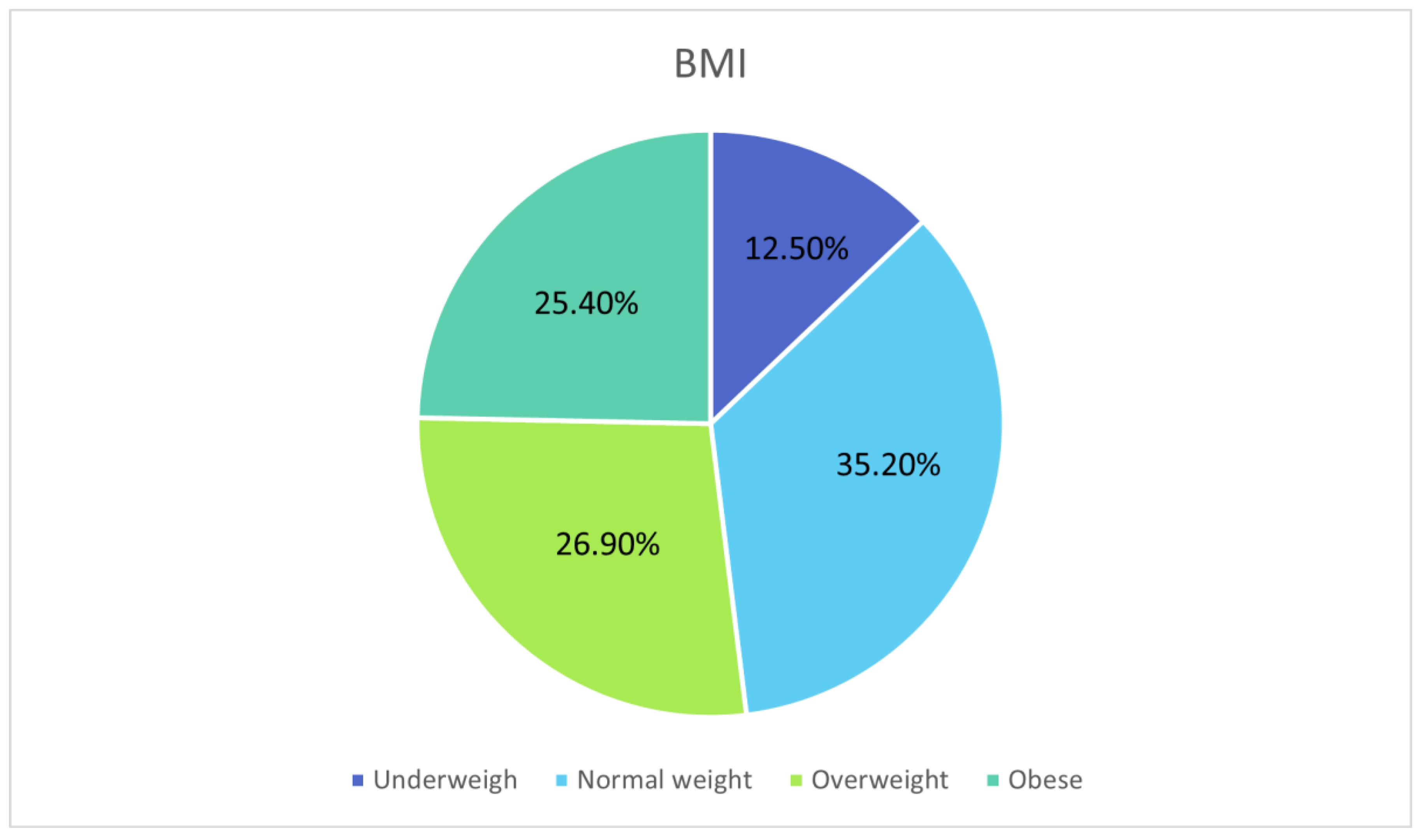
| BMI | Underweight | 58 (12.5) |
| Normal weight | 164 (35.3) | |
| Overweight | 125 (26.9) | |
| Obese | 118 (25.4) | |
| Nationality | Saudi | 452 (97.2) |
| Non-Saudi | 13 (2.8) | |
| Medication Type | Non-biological | 230 (49.6) |
| Biological | 234 (50.4) | |
| Duration of Longest Admission | Not admitted | 222 (47.7) |
| 1–3 days | 41 (8.8) | |
| 4–7 days | 90 (19.4) | |
| 8–14 days | 63 (13.5) | |
| 15 days–1 month | 33 (7.1) | |
| >1 month | 16 (3.4) | |
| Diagnosis | Crohn’s disease (CD) | 254 (54.6) |
| Ulcerative colitis (UC) | 211 (45.4) | |
| Comorbidities in IBD Patients | Sig. Value | ||||
|---|---|---|---|---|---|
| Patients with 1 Comorbidity N (%) | Patients with 2 Comorbidities N (%) | Patients with ≥3 Comorbidities N (%) | |||
| Gender | Female | 51 (41.5) | 32 (39.0) | 77 (60.6) | 0.002 |
| Male | 72 (58.5) | 50 (61.0) | 50 (39.4) | ||
| Age (Years) | Mean (SD) | 32.6 (10.7) | 38.8 (13.3) | 49.3 (16.4) | <0.001 |
| BMI | Underweight | 21 (17.1) | 11 (13.4) | 9 (7.1) | 0.006 |
| Normal weight | 45 (36.6) | 29 (35.4) | 38 (29.9) | ||
| Overweight | 32 (26.0) | 26 (31.7) | 30 (23.6) | ||
| Obese | 25 (20.3) | 16 (19.5) | 50 (39.4) | ||
| Nationality | Saudi | 117 (95.1) | 81 (98.8) | 125 (98.4) | 0.173 |
| Non-Saudi | 6 (4.9) | 1 (1.2) | 2 (1.6) | ||
| Medication Type | Non-biological | 51 (41.5) | 43 (52.4) | 80 (63.0) | 0.003 |
| Biological | 72 (58.5) | 39 (47.6) | 47 (37.0) | ||
| Longest Admission Duration | Not admitted | 56 (45.5) | 45 (54.9) | 70 (55.1) | 0.017 |
| 1–3 days | 8 (6.5) | 13 (15.9) | 7 (5.5) | ||
| 4–7 days | 32 (26.0) | 8 (9.8) | 17 (13.4) | ||
| 8–14 days | 15 (12.2) | 10 (12.2) | 14 (11.0) | ||
| 15 days–1 month | 9 (7.3) | 3 (3.7) | 13 (10.2) | ||
| >1 month | 3 (2.4) | 3 (3.7) | 6 (4.7) | ||
| Readmission | No | 80 (65.0) | 67 (81.7) | 97 (76.4) | 0.019 |
| Yes | 43 (35.0) | 15 (18.3) | 30 (23.6) | ||
| Condition | CD | 72 (58.5) | 40 (48.8) | 53 (41.7) | 0.029 |
| UC | 51 (41.5) | 42 (51.2) | 74 (58.3) | ||
| Type of IBD | Sig. Value | ||||
|---|---|---|---|---|---|
| CD N (%) | UC N (%) | Total N (%) | |||
| Anatomical involvement | No data | 7 (2.8) | 15 (7.1) | 23 (4.9) | <0.001 |
| Small intestine | 55 (21.7) | 12 (5.7) | 67 (14.4) | ||
| Large intestine | 22 (8.7) | 139 (65.9) | 161 (34.6) | ||
| Both | 134 (52.8) | 14 (6.6) | 148 (31.8) | ||
| Unspecified | 36 (14.2) | 30 (14.2) | 66 (14.2) | ||
| Extra-intestinal anatomical involvement | None | 212 (83.5) | 142 (67.3) | 354 (76.1) | <0.001 |
| Esophagus | 4 (1.6) | 2 (0.9) | 6 (1.3) | ||
| Stomach | 8 (3.1) | 8 (3.8) | 16 (3.4) | ||
| Rectum | 22 (8.7) | 57 (27.0) | 79 (17.0) | ||
| Oral | 8 (3.1) | 2 (0.9) | 10 (2.2) | ||
| Extra-GI manifestations | None | 228 (89.8) | 184 (87.2) | 412 (89.2) | 0.110 |
| Hepatobiliary | 3 (1.2) | 12 (5.7) | 15 (3.3) | ||
| Ocular | 2 (0.8) | 2 (0.9) | 4 (0.9) | ||
| Skin | 4 (1.6) | 1 (0.5) | 5 (1.1) | ||
| MSK | 11 (4.3) | 7 (3.3) | 18 (3.1) | ||
| Others | 7 (2.75) | 3 (1.4) | 10 (2.2) | ||
| GI Infection | None | 227 (89.4) | 181 (85.8) | 408 (87.7) | 0.483 |
| H. pylori | 6 (2.4) | 3 (1.4) | 9 (1.94) | ||
| C. difficile | 15 (5.9) | 16 (7.6) | 31 (6.7) | ||
| Tuberculosis | 3 (1.2) | 2 (0.9) | 5 (1.1) | ||
| CMV | 2 (0.8) | 6 (2.8) | 8 (1.7) | ||
| Salmonella | 1 (0.4) | 1 (0.5) | 2 (0.4) | ||
| C. perfringens | 0 (0.0) | 1 (0.5) | 1 (0.2) | ||
| Brucellosis | 0 (0.0) | 1 (0.5) | 1 (0.2) | ||
| Renal disease | None | 248 (97.6) | 199 (94.3) | 447 (96.1) | 0.142 |
| CKD | 6 (2.4) | 11 (5.2) | 17 (3.7) | ||
| Nephrotic | 0 (0.0) | 1 (0.5) | 1 (0.2) | ||
| Arthritis | No | 229 (90.2) | 184 (87.2) | 413 (88.8) | 0.314 |
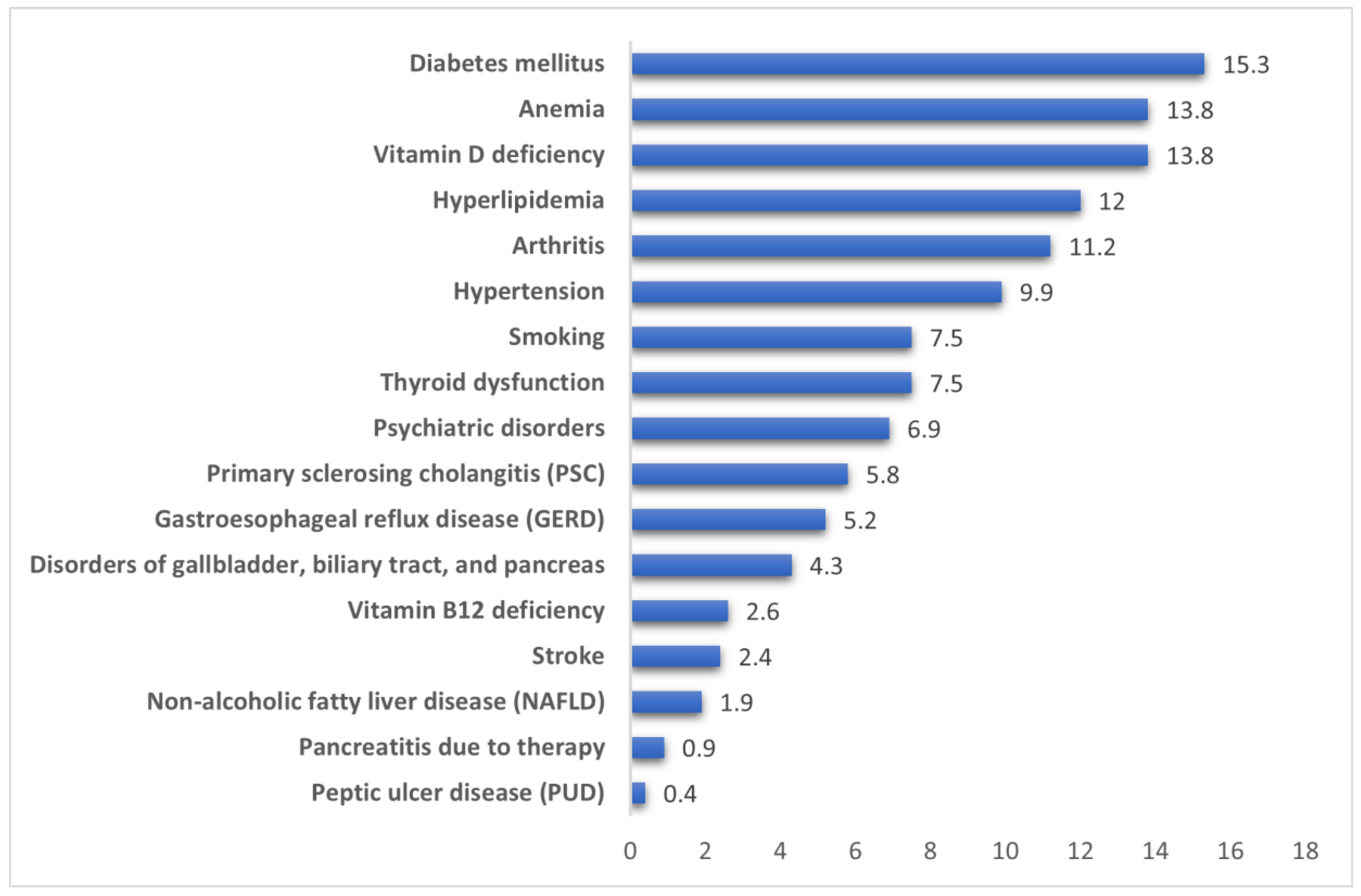
| Yes | 25 (9.8) | 27 (12.8) | 52 (11.2) | ||
| Diabetes | No | 225 (88.6) | 169 (80.1) | 394 (84.7) | 0.011 |
| Yes | 29 (11.4) | 42 (19.9) | 71 (15.3) | ||
| Endocrine disorders | None | 246 (96.9) | 186 (88.2) | 432 (93.1) | 0.002 |
| Hypothyroidism | 6 (2.4) | 20 (9.5) | 26 (5.6) | ||
| Hyperthyroidism | 2 (0.8) | 4 (1.9) | 6 (1.3) | ||
| Hyperlipidemia | No | 240 (94.5) | 169 (80.1) | 409 (88.0) | <0.001 |
| Yes | 14 (5.5) | 42 (19.9) | 56 (12.0) | ||
| Hypertension | No | 238 (93.7) | 181 (85.8) | 419 (90.1) | 0.004 |
| Yes | 16 (6.3) | 30 (14.2) | 46 (9.9) | ||
| Anemia | No | 193 (76.0) | 149 (70.6) | 342 (73.55) | 0.191 |
| Yes | 61 (24.0) | 62 (29.4) | 123 (26.45) | ||
| Vitamin D deficiency | No | 219 (86.2) | 182 (86.3) | 401 (86.24) | 0.991 |
| Yes | 35 (13.8) | 29 (13.7) | 64 (13.76) | ||
| Vitamin B12 deficiency | No | 248 (97.6) | 205 (97.2) | 453 (97.42) | 0.744 |
| Yes | 6 (2.4) | 6 (2.8) | 12 (2.58) | ||
| Primary sclerosing cholangitis | No | 251 (98.8) | 187 (88.6) | 438 (94.19) | <0.001 |
| Yes | 3 (1.2) | 24 (11.4) | 27 (5.81) | ||
| Smoking | No | 222 (87.4) | 199 (94.3) | 425 (91.4) | 0.007 |
| Yes | 26 (10.2) | 8 (3.8) | 40 (8.6) | ||
| Autoimmune diseases | No | 248 (97.6) | 204 (96.7) | 452 (97.20) | 0.507 |
| Psoriasis | 4 (1.6) | 4 (1.9) | 8 (1.72) | ||
| Celiac disease | 1 (0.4) | 3 (1.4) | 4 (0.86) | ||
| SLE | 1 (0.4) | 0 (0.0) | 1 (0.22) | ||
| Stroke | No | 252 (99.2) | 202 (95.7) | 454 (97.63) | 0.014 |
| Yes | 2 (0.8) | 9 (4.3) | 11 (2.37) | ||
| Psychiatric disorders | No | 237 (93.3) | 196 (92.9) | 433 (93.12) | 0.860 |
| Yes | 17 (6.7) | 15 (7.1) | 32 (6.88) | ||
| Diagnosis | ||||||
|---|---|---|---|---|---|---|
| CD | UC | p-Value | ||||
| Count | Column N % | Count | Column N % | |||
| Perianal Fistula | No | 208 | 81.9% | 202 | 95.7% | <0.001 |
| Yes | 46 | 18.1% | 9 | 4.3% | ||
| Hemorrhoid | No | 213 | 83.9% | 192 | 91.0% | 0.022 |
| Yes | 41 | 16.1% | 19 | 9.0% | ||
| Anal Fissure | No | 249 | 98.0% | 208 | 98.6% | 0.652 |
| Yes | 5 | 2.0% | 3 | 1.4% | ||
| Anal Abscess | No | 242 | 95.3% | 208 | 98.6% | 0.045 |
| Yes | 12 | 4.7% | 3 | 1.4% | ||
| Anal stricture | No | 252 | 99.2% | 210 | 99.5% | 0.674 |
| Yes | 2 | 0.8% | 1 | 0.5% | ||
| IBD Types | Sig. Values | |||
|---|---|---|---|---|
| CD N (%) | UC N (%) | |||
| Hemorrhoid and Perianal Conditions | ||||
| Perianal Fistula | No | 208 (81.9) | 202 (95.7) | <0.001 |
| Yes | 46 (18.1) | 9 (4.3) | ||
| Hemorrhoid | No | 213 (83.9) | 192 (91.0) | 0.022 |
| Yes | 41 (16.1) | 19 (9.0) | ||
| Anal Fissure | No | 249 (98.0) | 208 (98.6) | 0.652 |
| Yes | 5 (2.0) | 3 (1.4) | ||
| Anal Abscess | No | 242 (95.3) | 208 (98.6) | 0.045 |
| Yes | 12 (4.7) | 3 (1.4) | ||
| Anal Stricture | No | 252 (99.2) | 210 (99.5) | 0.674 |
| Yes | 2 (0.8) | 1 (0.5) | ||
| Different Complications | ||||
| Fistula | No | 149 (58.7) | 196 (92.9) | <0.001 |
| Yes | 105 (41.3) | 15 (7.1) | ||
| Strictures | No | 187 (73.9) | 208 (98.6) | <0.001 |
| Yes | 66 (26.1) | 3 (1.4) | ||
| Adhesions | No | 251 (98.8) | 211 (100.0) | 0.113 |
| Yes | 3 (1.2) | 0 (0.0) | ||
| Perforation | No | 244 (96.1) | 209 (99.1) | 0.043 |
| Yes | 10 (3.9) | 2 (0.9) | ||
| Abscess | No | 227 (89.4) | 208 (98.6) | <0.001 |
| Yes | 27 (10.6) | 3 (1.4) | ||
| Polyps | No | 247 (97.2) | 202 (95.7) | 0.374 |
| Yes | 7 (2.8) | 9 (4.3) | ||
| Bowel obstruction | No | 238 (93.7) | 210 (99.5) | 0.001 |
| Yes | 16 (6.3) | 1 (0.5) | ||
| Different Types of Surgeries | ||||
| Fistulotomy | No | 243 (95.7) | 210 (99.5) | 0.009 |
| Yes | 11 (4.3) | 1 (0.5) | ||
| Stricturoplasty | No | 231 (90.9) | 207 (98.1) | 0.001 |
| Yes | 23 (9.1) | 4 (1.9) | ||
| Abscess drainage | No | 240 (94.5) | 206 (97.6) | 0.088 |
| Yes | 14 (5.5) | 5 (2.4) | ||
| Ileocecal resection | No | 253 (99.6) | 209 (99.1) | 0.457 |
| Yes | 1 (0.4) | 2 (0.9) | ||
| Hemicolectomy | No | 252 (99.2) | 202 (95.7) | 0.014 |
| Yes | 2 (0.8) | 9 (4.3) | ||
| Proctocolectomy | No | 248 (97.6) | 211 (100.0) | 0.025 |
| Yes | 6 (2.4) | 0 (0.0) | ||
| Total colectomy | No | 246 (96.9) | 209 (99.1) | 0.103 |
| Yes | 8 (3.1) | 2 (0.9) | ||
| Subtotal colectomy | No | 245 (96.5) | 206 (97.6) | 0.461 |
| Yes | 9 (3.5) | 5 (2.4) | ||
| Small bowel resection | No | 245 (96.5) | 208 (98.6) | 0.151 |
| Yes | 9 (3.5) | 3 (1.4) | ||
| Ileocecectomy | No | 246 (97.2) | 209 (99.1) | 0.157 |
| Yes | 7 (2.8) | 2 (0.9) | ||
| Diagnosis | ||||||
|---|---|---|---|---|---|---|
| CD | UC | p-Value | ||||
| Count | Column N % | Count | Column N % | |||
| Fistulotomy | No | 243 | 95.7% | 210 | 99.5% | 0.009 |
| Yes | 11 | 4.3% | 1 | 0.5% | ||
| Stricturoplasty | No | 231 | 90.9% | 207 | 98.1% | 0.001 |
| Yes | 23 | 9.1% | 4 | 1.9% | ||
| Abscess drainage | No | 240 | 94.5% | 206 | 97.6% | 0.088 |
| Yes | 14 | 5.5% | 5 | 2.4% | ||
| Ileocecal resection | No | 253 | 99.6% | 209 | 99.1% | 0.457 |
| Yes | 1 | 0.4% | 2 | 0.9% | ||
| Hemicolectomy | No | 252 | 99.2% | 202 | 95.7% | 0.014 |
| Yes | 2 | 0.8% | 9 | 4.3% | ||
| Proctocolectomy | No | 248 | 97.6% | 211 | 100.0% | 0.025 |
| Yes | 6 | 2.4% | 0 | 0.0% | ||
| Total colectomy | No | 246 | 96.9% | 209 | 99.1% | 0.103 |
| Yes | 8 | 3.1% | 2 | 0.9% | ||
| Subtotal colectomy | No | 245 | 96.5% | 206 | 97.6% | 0.461 |
| Yes | 9 | 3.5% | 5 | 2.4% | ||
| Small bowl resection | No | 245 | 96.5% | 208 | 98.6% | 0.151 |
| Yes | 9 | 3.5% | 3 | 1.4% | ||
| Ileocecectomy | No | 246 | 97.2% | 209 | 99.1% | 0.157 |
| Yes | 7 | 2.8% | 2 | 0.9% | ||
| Duration of Longest Admission | Diabetes | Hyperlipidemia | Hypertension | Pancreatitis due to Therapy | |
|---|---|---|---|---|---|
| Duration of Longest Admission | Not admitted | 217 (55.1) | 218 (53.3) | 226 (53.9) | 257 (55.7) |
| 1–3 days | 30 (7.6) | 30 (7.3) | 33 (7.9) | 34 (7.4) | |
| 4–7 days | 68 (17.3) | 71 (17.4) | 71 (16.9) | 75 (16.3) | |
| 8–14 days | 47 (11.9) | 50 (12.2) | 50 (11.9) | 53 (11.5) | |
| 15 days–1 month | 20 (5.1) | 27 (6.6) | 26 (6.2) | 28 (6.1) | |
| >1 month | 12 (3.0) | 13 (3.2) | 13 (3.1) | 14 (3.0) | |
| p-value | 0.316 | 0.146 | 0.352 | 0.066 | |
| Fistulotomy | Yes | 25 (6.3) | 24 (5.9) | 25 (6.0) | 26 (5.6) |
| p-value | 0.975 | 0.618 | 0.426 | 0.744 | |
| Stricturoplasty | Yes | 18 (4.6) | 18 (4.4) | 19 (4.5) | 19 (4.1) |
| p-value | 0.501 | 0.878 | 0.656 | 0.099 | |
| Abscess drainage | Yes | 2 (0.5) | 3 (0.7) | 2 (0.5) | 3 (0.7) |
| p-value | 0.463 | 0.354 | 0.140 | 0.678 | |
| Ileocecal resection | Yes | 7 (1.8) | 10 (2.4) | 11 (2.6) | 11 (2.4) |
| p-value | 0.673 | 0.520 | 0.172 | 0.871 | |
| Hemicolectomy | Yes | 6 (1.5) | 6 (1.5) | 6 (1.4) | 6 (1.3) |
| p-value | <0.001 | 0.761 | 0.266 | 0.755 | |
| Proctocolectomy | Yes | 6 (1.5) | 6 (1.5) | 6 (1.4) | 6 (1.3) |
| p-value | 0.578 | 0.362 | 0.414 | 0.818 | |
| Total colectomy | Yes | 8 (2.0) | 10 (2.4) | 9 (2.1) | 10 (2.2) |
| p-value | 0.898 | 0.237 | 0.991 | 0.766 | |
| Subtotal colectomy | Yes | 10 (2.5) | 14 (3.4) | 13 (3.1) | 14 (3.0) |
| p-value | <0.001 | 0.160 | 0.726 | 0.723 | |
| Small bowel resection | Yes | 12 (3.0) | 12 (2.9) | 12 (2.9) | 12 (2.6) |
| p-value | 0.330 | 0.194 | 0.245 | 0.744 | |
| Ileocecectomy | Yes | 6 (1.5) | 9 (2.2) | 7 (1.7) | 8 (1.7) |
| p-value | 0.289 | 0.262 | 0.212 | 0.001 |
Disclaimer/Publisher’s Note: The statements, opinions and data contained in all publications are solely those of the individual author(s) and contributor(s) and not of MDPI and/or the editor(s). MDPI and/or the editor(s) disclaim responsibility for any injury to people or property resulting from any ideas, methods, instructions or products referred to in the content. |
© 2026 by the authors. Licensee MDPI, Basel, Switzerland. This article is an open access article distributed under the terms and conditions of the Creative Commons Attribution (CC BY) license.
Share and Cite
Alharbi, W.; Alasmari, T.; Rasheed, N.A.; Alonazi, J.A.; Alaqil, N.K.; Al Samih, M.; Alzahrani, N.S.; Bin Akrish, A.; Alaraidh, S. Characteristics, Complications, Comorbidities, and Other Manifestations of Inflammatory Bowel Disease: A 7-Year Tertiary Center Experience. Clin. Pract. 2026, 16, 45. https://doi.org/10.3390/clinpract16030045
Alharbi W, Alasmari T, Rasheed NA, Alonazi JA, Alaqil NK, Al Samih M, Alzahrani NS, Bin Akrish A, Alaraidh S. Characteristics, Complications, Comorbidities, and Other Manifestations of Inflammatory Bowel Disease: A 7-Year Tertiary Center Experience. Clinics and Practice. 2026; 16(3):45. https://doi.org/10.3390/clinpract16030045
Chicago/Turabian StyleAlharbi, Waleed, Turki Alasmari, Najla Al Rasheed, Jamila A. Alonazi, Naif K. Alaqil, Meshari Al Samih, Nawaf S. Alzahrani, Abdulaziz Bin Akrish, and Soliman Alaraidh. 2026. "Characteristics, Complications, Comorbidities, and Other Manifestations of Inflammatory Bowel Disease: A 7-Year Tertiary Center Experience" Clinics and Practice 16, no. 3: 45. https://doi.org/10.3390/clinpract16030045
APA StyleAlharbi, W., Alasmari, T., Rasheed, N. A., Alonazi, J. A., Alaqil, N. K., Al Samih, M., Alzahrani, N. S., Bin Akrish, A., & Alaraidh, S. (2026). Characteristics, Complications, Comorbidities, and Other Manifestations of Inflammatory Bowel Disease: A 7-Year Tertiary Center Experience. Clinics and Practice, 16(3), 45. https://doi.org/10.3390/clinpract16030045