
Article

Longitudinal Changes in Depression, Anxiety and Stress Symptoms Among Hemodialysis Patients
by
Adriana-Luciana Luca
1,*,
Felicia Militaru
2,
Mădălina Iuliana Mușat
3,4,
Ion Udriștoiu
2 and
Eugen Moța
1
1
U.M.F. Doctoral School Craiova, University of Medicine and Pharmacy of Craiova, 200349 Craiova, Romania
2
Department of Psychiatry, University of Medicine and Pharmacy of Craiova, 200349 Craiova, Romania
3
Experimental Research Centre for Normal and Pathological Aging, University of Medicine and Pharmacy of Craiova, 200349 Craiova, Romania
4
Department of Scientific Research Methodology, University of Medicine and Pharmacy of Craiova, 200349 Craiova, Romania
*
Author to whom correspondence should be addressed.
Clin. Pract. 2026, 16(2), 37; https://doi.org/10.3390/clinpract16020037
Submission received: 27 December 2025 / Revised: 24 January 2026 / Accepted: 5 February 2026 / Published: 8 February 2026

Abstract

Background/Objectives: Chronic kidney disease (CKD) progresses with the gradual and irreversible loss of renal function. In Romania, given the increasing number of patients undergoing hemodialysis (HD), the prevalence of psychiatric symptoms and disorders in this population has become particularly significant. Although important advances have been made in the management of psychiatric conditions in HD patients, their mental health remains relatively poor. The aim of this study was to observe the severity temporal trends of depression, anxiety and stress symptoms and correlations among HD patients. Methods: A total of 173 patients, underwent a detailed anamnesis, with emphasis dialysis duration, comorbidities and a complex psychiatric evaluation, followed by the application of the Socio-economic Scale (SES-3); Mini Mental State Examination (MMSE); and the Depression, Anxiety and Stress Scale 21R (DASS-21R). The dialysis performance (spKt/V) and Charlson Comorbidity (CCI) indices were provided by DIAVERUM Nephrology and Dialysis Center in Craiova. Results: The severity of depression and anxiety symptoms significantly increased over six months, 0.248 ± 1.432 vs. 0.453 ± 1.488 (p < 0.0001; rrb = 0.296) for depression, and −0.090 ± 1.004 vs. 0.089 ± 1.047 (p < 0.0001; rrb = 0.252) for anxiety; while stress-like symptoms remained stable 0.080 ± 1.318 vs. 0.164 ± 1.357 (p = 0.0661; rrb = 0.123), despite improvements in dialysis adequacy (spKt/V). Depression scores were moderately correlated with anxiety and weakly correlated with stress and spKt/V. Anxiety results were moderately correlated with stress, while both anxiety and stress showed negligible correlations with spKt/V. Clinical variables assessed showed moderate predictive value for psychological outcomes in this cohort. Conclusions: Our study confirms the temporal trend of severity of mental symptoms and their persistence among HD patients, highlighting the urge to integrate mental health screening and intervention programs and a multidisciplinary team adapted for each case.

1. Introduction

Chronic kidney disease (CKD) progresses towards the gradual and irreversible loss of renal functions, ultimately requiring renal replacement therapy [1].
During its progressive course, CKD is often associated with various somatic complications, such as arterial hypertension, left ventricular hypertrophy and uremic pericarditis; metabolic and nutritional changes; skeletal alterations; hematological complications including anemia; chronic inflammation; uremic encephalopathy; and, importantly, various degrees of psychiatric impairment [2,3,4].
In the final stage of CKD, dialysis becomes essential for patient survival. However, it imposes numerous restrictions: a strict dialysis schedule and hygiene–dietary limitations, triggering global changes in the patient, affecting physical, social and professional domains, with significant repercussions on mental health [5,6,7,8].
Regarding prevalence of mental health perturbances in hemodialysis (HD) patients, the most common alterations are depression and anxiety, reduced affective display, fatigue, feelings of incurability, feelings of uselessness, and anhedonia [9,10]. These conditions lead to decreased global functioning and an increased risk of suicide [11].
The recent literature highlights this burden in cross-sectional studies. For example, a 2021 study conducted on 524 HD patients from Sharkia Governorate, Egypt, using the Hospital Anxiety and Depression Scale (HADS), reported depression in 31.9% and anxiety in 33.7% of participants [12]. In 2020, another cross-sectional study from Egypt involving 117 HD patients, assessing Structured Clinical Interview for DSM Disorders (SCIDI) found an extremely high prevalence of psychiatric disorders (75.21%), with depression reported in 56.4% and anxiety in 51.3% [13].
Long-term studies indicate that these symptoms are not only highly prevalent but also relatively stable over time. In a 12-month prospective study including both recent and ongoing HD patients, Ng et al. identified individuals with persistently elevated levels of depression and anxiety, alongside subgroups with new-onset or remitting symptoms, pointing to heterogeneous emotional trajectories [14]. Likewise, a 16-month follow-up by Cukor et al. showed that diagnoses of depression and anxiety tend to persist and are associated with declines in health status [15].
Several other longitudinal cohorts have demonstrated an association between depressive symptoms and clinical outcomes. Both repeated assessments of depression in HD patients and baseline scores on psychometric instruments have been linked to increased mortality, with effect sizes comparable to those of established medical risk factors [16,17,18].
Although significant progress has been made through rapid psychotherapeutic interventions, counseling and psychiatric treatment, much more remains to be achieved [19,20,21]. Psychosocial interventions may partially modify the trajectories of anxiety and depression over a 12-month period; however, a subset of patients continues to follow “high-stable” symptom courses [22].
Cross-sectional evidence from Eastern Europe consistently shows a high prevalence of depression and anxiety among HD patients, with findings from Poland, Croatia, and Romania indicating substantial affective burden influenced by demographic and treatment-related factors [23,24,25,26]. Additional studies emphasize associations between stress and depressive symptoms and highlight the risk of underdiagnosing depression when relying solely on screening instruments [24,25].
To the best of our knowledge, there are no longitudinal studies from Eastern Europe that have repeatedly assessed mental health symptoms in HD patients. Additionally, psychological stress is seldom assessed as a distinct construct in longitudinal studies, and instruments that simultaneously quantify depression, anxiety, and stress have been used almost exclusively in cross-sectional or short-term interventional research among dialysis patients [27]. These gaps limit understanding of short-term symptom dynamics, supporting the relevance of a six-month observational window. A six-month interval is clinically meaningful in routine dialysis care, as it captures symptom evolution beyond transient fluctuations while remaining feasible for repeated assessment in medically burdened patients.
While longitudinal assessments of affective symptoms in HD populations have been reported previously, evidence remains limited for short-term trajectories and for underrepresented Eastern European cohorts. The present study builds incrementally on existing designs by applying a culturally adapted instrument and by examining depression, anxiety, and stress as distinct symptom dimensions over a six-month period. To address these gaps, this prospective observational longitudinal cohort study aimed as primary objective to assess the trajectories of depression, anxiety and stress symptoms among HD patients at the DIAVERUM Nephrology and Dialysis Center in Craiova, Romania using Depression, Anxiety, Stress Scale 21R (DASS-21R) adapted and standardized for the Romanian population, to find correlations between severity of mental health symptoms and clinical and paraclinical aspects—Charlson Comorbidity Index (CCI) and dialysis performance index (spKt/V), and to recognize the urgent need for rapid intervention and multidisciplinary collaboration. The novelty of the present study lies in its regional and methodological specificity. First, it focuses on a Romanian cohort of HD patients, an underrepresented population in Eastern European longitudinal mental health research. Second, it applies the Romanian-adapted and standardized version of the DASS-21R in a longitudinal HD context, extending its use beyond cross-sectional designs. Third, it examines changes in depression, anxiety, and stress symptom severity over a six-month interval, a timeframe that has been less frequently explored in previous longitudinal studies of dialysis populations. Together, these aspects may contribute to a more context-sensitive understanding of emotional symptom trajectories in HD patients and may highlight the potential relevance of timely psychological assessment and referral pathways in HD care.

2. Materials and Methods

2.1. Study Design and Subjects

This prospective, longitudinal, observational, single-center cohort study was conducted at the DIAVERUM Nephrology and Dialysis Center in Craiova over a two-year period, from December 2021 to November 2023. It included patients with end-stage CKD who had been undergoing HD for at least one year, three times per week. We considered a one-year period to be sufficient for patients to adapt to the HD regimen.
The initial study cohort consisted of 220 participants. We excluded 7 patients who presented MMSE scores ≤ 20 who had severe cognitive impairment; 6 patients with depressive disorder under psychiatric treatment, 1 patient with schizophrenia in his medical records; 1 patient with moderate to severe intellectual disability and 1 patient with congenital deafness who had difficulty understanding and responding to the questionnaires; 17 patients with major inconsistent responses between the two applications of the instruments whose data were considered unreliable; 9 patients who decided to voluntarily discontinue participation because of the fatigue; and 5 patients who died during the study period.
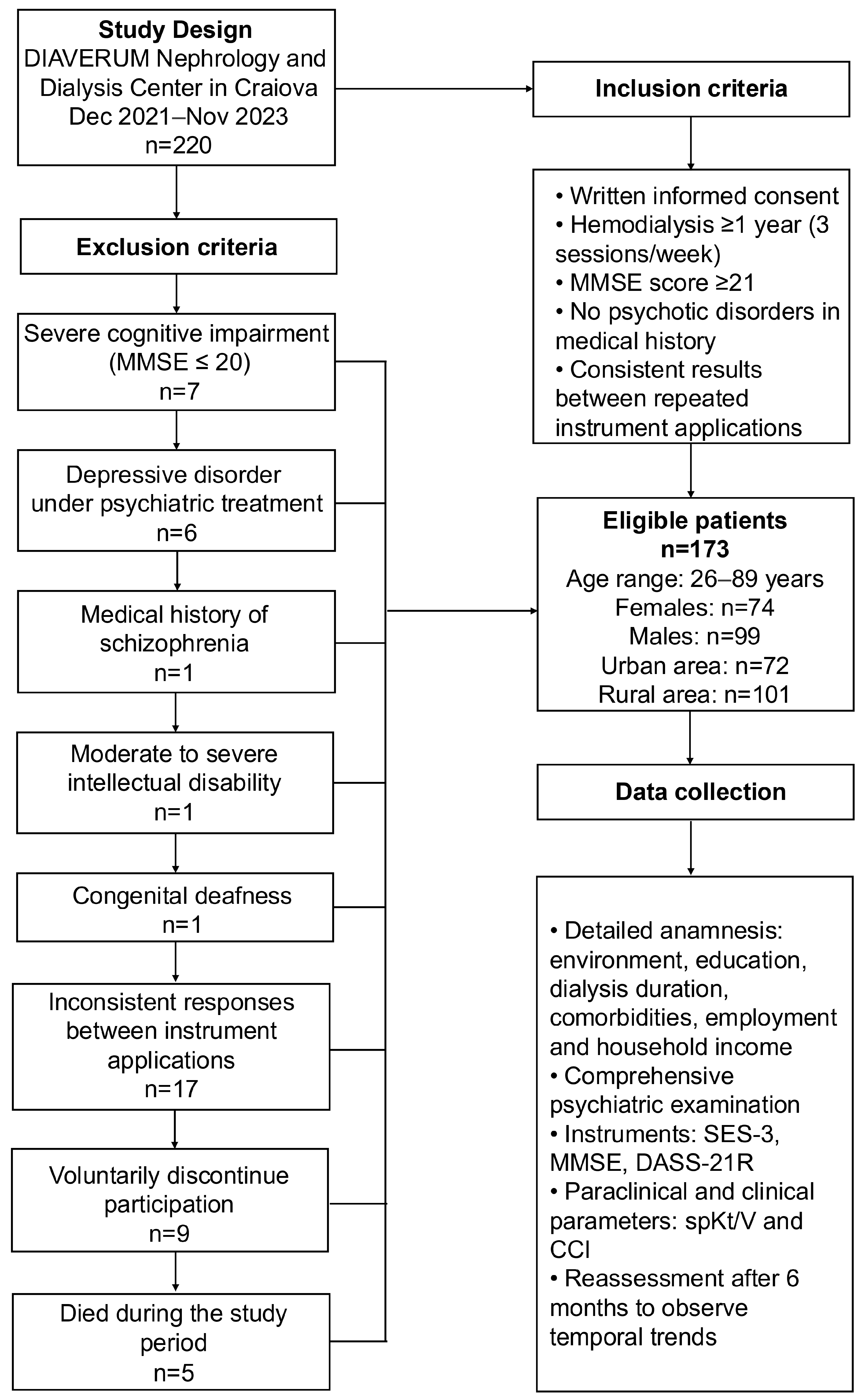
The final study cohort consisted of 173 patients—74 women and 99 men—with ages ranging from 26 to 89 years. Of these, 72 were from urban areas and 101 from rural areas (Figure 1).

2.2. Inclusion Criteria

Inclusion criteria included patients with end-stage CKD who were able to understand and respond to the study questionnaires in Romanian, could provide written informed consent and had HD for at least one year with a frequency of three times per week.

2.3. Exclusion Criteria

Exclusion criteria included patient choice of withdrawal from the study, an MMSE score ≤ 20, presence of medical comorbidities or psychiatric disorders in medical history or recent diagnosis at the time of the research that would interfere with the ability to understand and respond to the research instruments, undertaking psychotropic medication and inconsistent results between the two instrument applications.

2.4. Data Collection Process

After obtaining written informed consent from each patient, data collection began, including the following:
  • A detailed anamnesis emphasizing environment of origin, educational level, dialysis duration, associated comorbidities, occupation and monthly household income.
  • A comprehensive psychiatric examination assessing the entire mental status and recording the full range of symptoms.
  • Administration of the Socio-economic Scale (SES-3); Mini Mental State Examination (MMSE); and the DASS-21R adapted and standardized for the Romanian population.
  • The DIAVERUM Nephrology and Dialysis Center in Craiova provided access to relevant statistical data for this study, such as spKt/V and CCI.
These instruments (except SES-3), and clinical parameters were applied and noted twice: at baseline (T1) and after six months (T2) to minimize response variability and to observe changes in mental health status (Figure 1). This was an observational study and no study-mandated psychological intervention was delivered between T1 and T2; participants continued their usual HD care.
To ensure the validity and reliability of the self-reported data, we implemented a response-quality screening procedure. Inconsistent responses were defined as patterns indicating low engagement with the questionnaire rather than true symptom reporting. Specifically, excluded participants showed response profiles suggestive of superficial or non-attentive completion of the DASS-21R (n = 17). Participants were excluded if they showed:
(1)
logically contradictory answers across semantically similar items (e.g., endorsing both extreme absence and extreme presence of the same symptom construct), and/or
(2)
large, random-like fluctuations across items within the same subscale that were incompatible with a coherent symptom profile
(3)
substantial item non-response, defined as refusal or failure to answer multiple items, resulting in incomplete response profiles.
This approach is consistent with established methodological guidelines for questionnaire-based research and aims to minimize measurement error [28,29,30,31].

2.5. Variables and Measures

Cognitive deficits were assessed using the MMSE, first introduced by Dr. Marshall Folstein in 1975 [32]. The MMSE evaluates temporal–spatial orientation, attention, immediate and short-term memory, ability to perform concrete–abstract executive tasks, motor skills and language. It consists of 11 items, with total score ranging from 0 to 30: 0 indicates severe cognitive decline requiring institutionalization, while 30 indicates normal cognitive functioning [33].
Negative emotional symptoms of depression, anxiety and stress and their severity were assessed using DASS-21R, a self-report psychometric screening instrument developed in 1995 by Syd Lovibond and Peter Lovibond as a shortened version of DASS-42, which was adapted and standardized for the population in Romania under the coordination of Adela Perțe and Monica Barbu [34]. It includes 3 subscales with 7 items each, rated from a 0 to 3 Likert scale: 0—did not apply to me at all, 1—applied to me to some degree, or some of the time, 2—applied to me to a considerable degree, or a good part of the time, 3—applied to me very much, or most of the time.
The depression scale assessed (1) dysphoria, (2) hopelessness, (3) anhedonia, (4) apathy–abulia, (5) inactivity, (6) life devaluation and (7) self-esteem. The anxiety scale assessed (1) autonomic arousal, (2) musculoskeletal effects, (3) situational anxiety and (4) subjective anxiety experience. The stress scale, sensitive to chronic nonspecific arousal, assessed (1) psychological tension, (2) irritability and (3) hyperactivity.
For each subscale, a raw score of up to 21 was obtained. The raw score for each participant was then converted into a sex- and age (10-year intervals)-adjusted z-score according to the DASS-21R manual. Based on the resulting z-score, severity levels of symptoms were defined as follows: normal ≤ 0.5; mild 0.5 < z < 1.0; moderate 1.0 ≤ z < 2.0; severe 2.0 ≤ z < 3.0; extremely severe ≥ 3.0 [35].
We standardized all DASS-21R raw scores to z-scores to ensure comparability between time points. Raw scores often differ in variance across assessments; therefore, z-scores transformation provides a reduced distribution bias, and allows more valid detection of changes in symptom severity.
Socio-economic status was assessed at baseline using the SES-3 composite index (education, occupation, and household income), with total scores ranging from 0 to 6 and categorized as low (0–2), medium (3–4), or high (5–6) [36,37,38].
The effectiveness of a HD session is given by spKt/V, an essential parameter in CKD treatment [39]. The spKt/V values were provided by the DIAVERUM Nephrology and Dialysis Center in Craiova. The target values were as follows: <1.2 = inadequate (increased risk of complications and mortality if dialysis is not adjusted); 1.2–1.4 = adequate; >1.4 = optimal target (no additional proven clinical benefit beyond 1.6–1.8; higher values increase risks of hypotension, high catabolism and unnecessary resource use).
Long-term mortality risk was estimated by the DIAVERUM Nephrology and Dialysis Center in Craiova using the CCI, developed by Dr. Mary Charlson and colleagues in 1987 [40,41]. The CCI evaluates 19 categories of comorbidities, assigning scores based on severity. The sum represents the patient’s mortality risk [42]: 0 = no comorbidities; 1–2 = low comorbidity; 3–4 = moderate comorbidity; ≥5 = high comorbidity, increased mortality risk.

2.6. Data Analysis

Statistical data analysis was performed using IBM SPSS Statistics version 26 software (IBM Corp., Armonk, NY, USA), GraphPad 10.3.1 (GraphPad Software, Inc., San Diego, CA, USA), and Microsoft Office 365 (Microsoft Corp., Redmond, WA, USA). The figures were created using Adobe InDesign 21.0.1 (Adobe, San Jose, CA, USA). Demographic characteristics (gender, age categories, environment of residence, level of education, and household income thresholds) were summarized using absolute frequencies and percentages (n/%). Socio-economic status components, including educational attainment, occupational category, and household income were similarly described, using SES-3 composite method. Data normality was assessed using D’Agostino & Pearson test and Shapiro–Wilk test. As the data did not follow a normal distribution, T1–T2 differences were analyzed using the nonparametric Wilcoxon signed-rank test for paired observations. Effect size was calculated using the rank-biserial correlation (rrb) specific to the Wilcoxon signed-rank test [43]. Correlations between the analyzed parameters were examined using Spearman’s rank correlation coefficient, with significance assessed using two-tailed p-values. Multivariate logistic regression analyses were performed to identify independent predictors of depression, anxiety, and stress. The predictor variables included age (years), sex, CCI), and years on dialysis. Model performance was evaluated using receiver operating characteristic (ROC) curve analysis, with the area under the curve (AUC) used as an indicator of discriminatory ability. The threshold used to define the presence of depression, anxiety, or stress symptoms was a DASS-21R z-score of 0.5. Scores ≤ 0.5 were coded as 0 (absence of symptoms, normal range), while scores > 0.5 (mild, moderate, severe, or extremely severe) were coded as 1 (presence of symptoms). Odds ratios (ORs) with corresponding 95% confidence intervals (CI) were calculated for each predictor. Statistical significance was set at α = 0.05. Data are presented as percent or mean ± standard deviation (SD), and statistical significance is indicated as follows: * p < 0.05, ** p < 0.01, *** p < 0.001, **** p < 0.0001.

2.7. Research Ethics

This study was conducted in accordance with the Declaration of Helsinki and approved by the Ethics Committee of the University of Medicine and Pharmacy of Craiova, no. 177/29.10.2021, with all patients agreeing to participate. At the end of the study, participants who screened with severe symptom levels on any DASS-21R subscale (z ≥ 2.0; severe including extremely severe) were informed and offered referral for clinical evaluation through standard institutional care pathways, consistent with evidence-based guidance for depression, anxiety, and stress management [44,45,46].

3. Results

Among the 173 patients included in this study, 42.8% were women (n = 74) and 57.2% men (n = 99). We conducted a power analysis using the mean and standard deviation of the variables and evaluated statistical power for a target value of 0.8, which is a commonly accepted standard in research, with a two-tailed alpha level of 0.05. The results indicated that the minimum required sample size for detecting differences in depression scores was 44 patients, while for anxiety, stress, and spKt/V, the required sample size was 53 patients. In our study, the number of participants exceeded these minimum requirements, ensuring adequate statistical power to detect meaningful differences between groups.
By age distribution, 1.2% patients were ≤29 years old, 4% were between 30 and 39, 15% between 40 and 49, 25.4% between 50 and 59, 28.9% between 60 and 69, 20.8% between 70 and 79, and 4.6% ≥80 (Table 1), with a mean age of 61.19 ± 11.54 years for female, and 60.03 ± 13.29 years for male.

3.1. SES-3 Descriptive Results

Overall, most participants had high school/post-secondary/vocational education (51.4%, n = 89), while 31.2% (n = 54) had primary/middle school education and 17.3% (n = 30) had university/postgraduate studies. Occupationally, 46.2% (n = 80) were unskilled/manual/agricultural/unemployed, 35.8% (n = 62) were administrative/services/sales/technicians, and 17.9% (n = 31) were professionals/entrepreneurs/managers. Household income was above the national median threshold in 69.9% (n = 121) of participants, while 30.1% (n = 52) were in the 50–100% median threshold category. Using the SES-3 composite, medium socio-economic status predominated (49.7%, n = 86), followed by low (31.8%, n = 55) and high (18.5%, n = 32); the distribution by sex is shown in Table 2. Low SES was more frequent among females (44.6%) than males (22.2%), whereas high SES was more frequent among males (22.2%) than females (13.5%).

3.2. None of the Participants Showed Quantifiable Cognitive Impairment

The MMSE score was ≥21 in all patients, and variations between the two assessments (27.20 ± 2.35 and 27.64 ± 2.40) were minimal, within the inclusion criteria.

3.3. Depression and Anxiety Severity Scores, Together with Dialysis Adequacy, Increased from T1 to T2, Whereas Stress Severity Levels Remained Stable Across Time Points

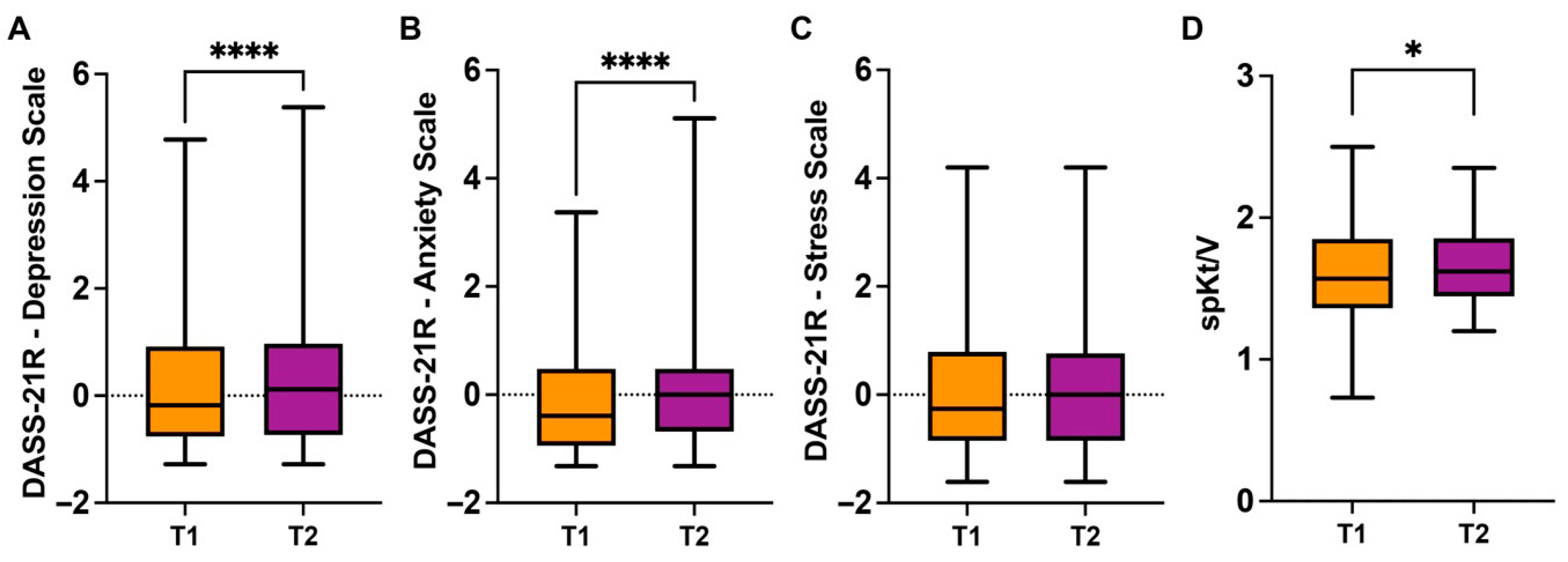
Analysis using the Wilcoxon signed-rank test showed elevated DASS-21R Depression severity scores at T2 (0.453 ± 1.488) compared to T1 (0.248 ± 1.432) (p < 0.0001; rrb = 0.296) (Figure 2A).
To improve clinical interpretability, we summarized the distribution of DASS-21R severity categories at both assessments. At T1 vs. T2, depression was classified as absent in 69.9% vs. 69.9%, mild in 6.4% vs. 5.8%, moderate in 10.4% vs. 11.0%, and severe (including extremely severe) in 13.3% vs. 13.3% of participants. Anxiety was absent in 78.6% vs. 79.2%, mild in 8.1% vs. 7.5%, moderate in 8.1% vs. 8.1%, and severe (including extremely severe) in 5.2% vs. 5.2%. Stress was absent in 69.9% vs. 70.5%, mild in 8.7% vs. 8.1%, moderate in 11.0% vs. 11.0%, and severe (including extremely severe) in 10.4% vs. 10.4%. Category shifts over six months were rate: for depression, 1 patient (0.6%) worsened and 1 (0.6%) improved, while 171 (98.8%) remained in the same severity range; for anxiety and stress, no patient worsened and 1 (0.6%) improved for each scale, with 172 (99.4%) remaining stable.
As part of the study’s ethical safeguards, 22.5% participants (n = 39) met the severe threshold (z ≥ 2.0 on at least one DASS-21R subscale) at both assessments and were offered at the end of the study referral for clinical evaluation through standard care pathways.
A similar pattern was observed for the DASS-21R Anxiety scale (Figure 2B), where T2 severity values (0.089 ± 1.047) were also increased compared to T1 (−0.090 ± 1.004) (p < 0.0001; rrb = 0.252). In contrast, no difference was found between T1 (0.080 ± 1.318) and T2 (0.164 ± 1.357) on the DASS-21R Stress scale (Figure 2C; p = 0.0661; rrb = 0.123).
For the clinical parameter spKt/V (Figure 2D), T2 values (1.645 ± 0.271) were higher than T1 values (1.595 ± 0.342) (p = 0.0103; rrb = 0.193).

3.4. Correlational Analysis of Psychological Outcomes and Dialysis Adequacy

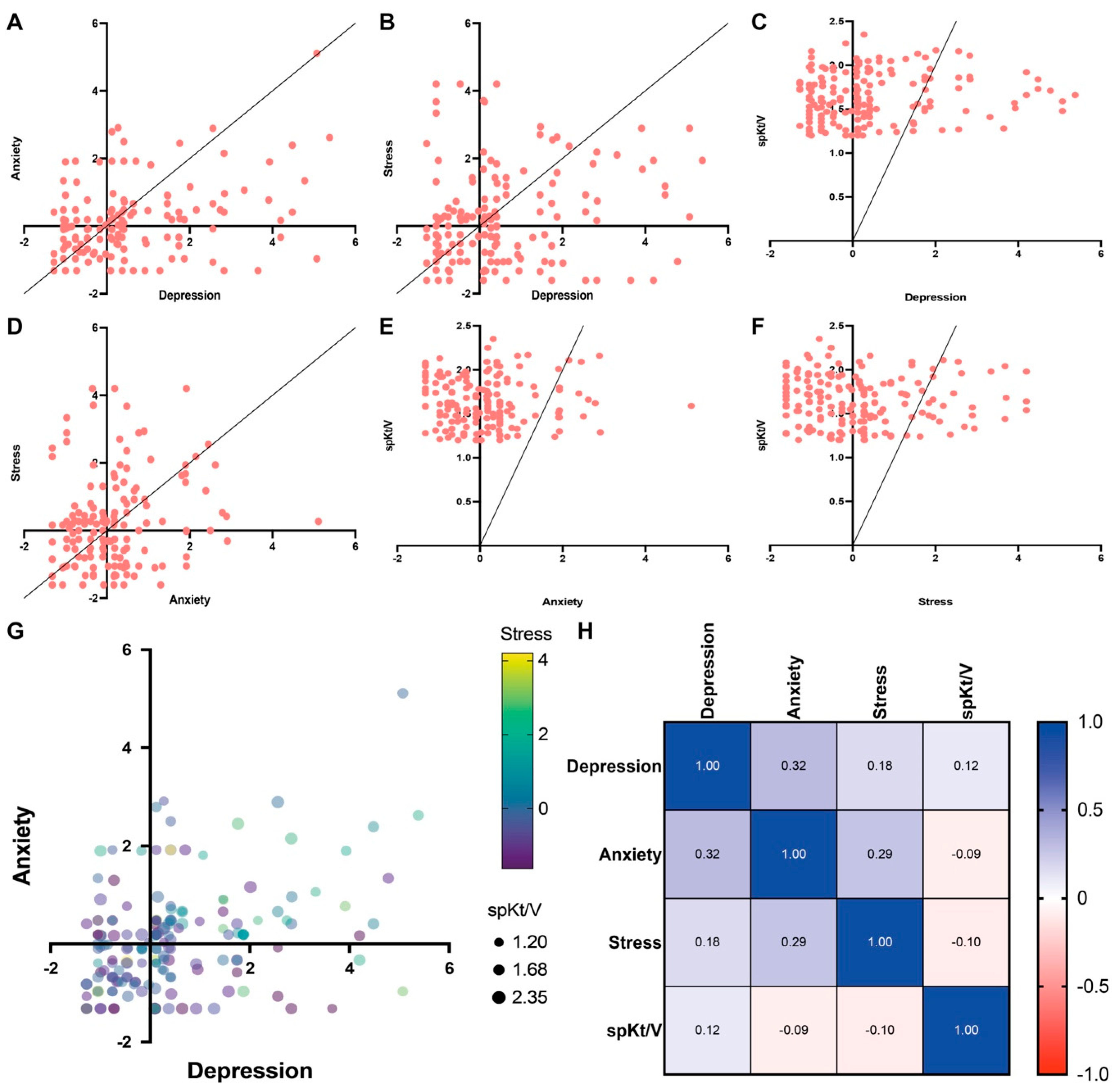
Depression was moderately correlated with anxiety (r = 0.32) (Figure 3A) and weakly correlated with stress (r = 0.18) (Figure 3B) and spKt/V (r = 0.12) (Figure 3C). Anxiety was moderately correlated with stress (r = 0.29) (Figure 3D), while both anxiety and stress showed negligible correlations with spKt/V (r = −0.09 and r = −0.10, respectively) (Figure 3E,F).
A combined visualization (Figure 3G) further highlights the clustering of depression and anxiety severity values, while also showing variability in stress levels (color-coded) and dialysis adequacy (point size). The correlation matrix (Figure 3H) confirmed these patterns (Table 3).
Table 4 summarizes the relationships between psychological variables and clinical parameters. Depression, anxiety, and stress severity levels showed no meaningful associations with comorbidity burden or dialysis duration, while spKt/V showed a small negative association with CCI.

3.5. Clinical Variables Show Moderate Predictive Value for Psychological Outcomes in This Cohort

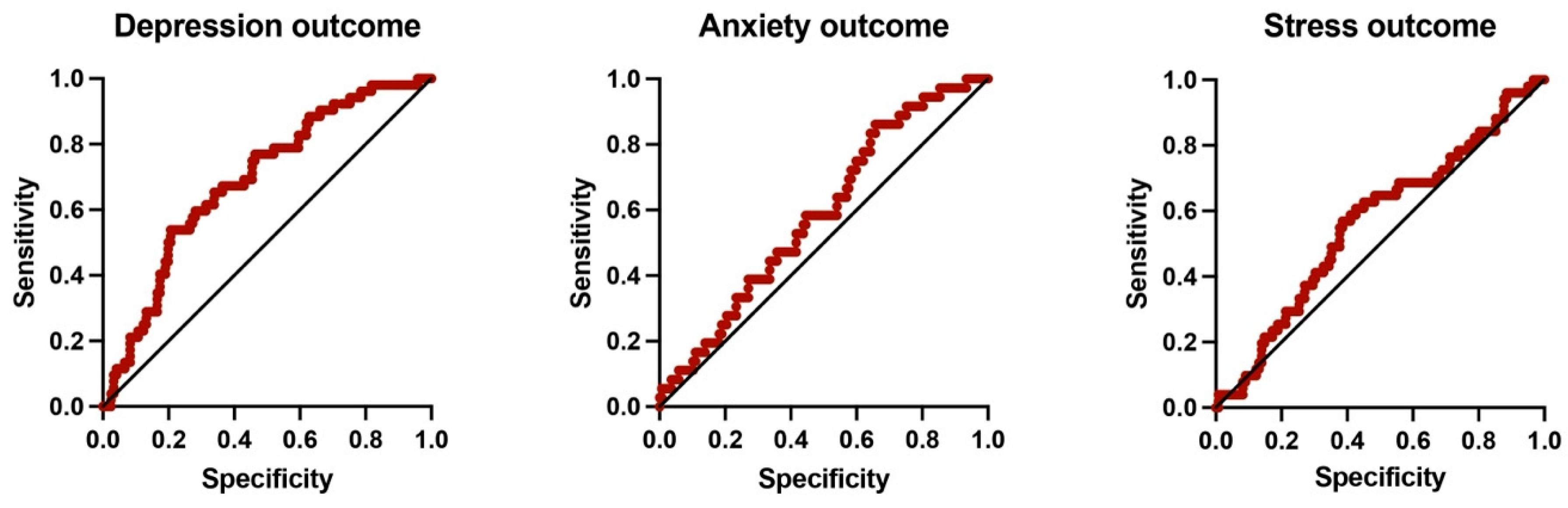
Multivariate logistic regression analyses were conducted to identify independent predictors of depression, anxiety, and stress. The predictors included age, sex, CCI, and years on dialysis (Figure 4).
Across all three outcomes, the models demonstrated limited explanatory power, and wide confidence intervals across predictors. Together, these findings suggest that age, sex, comorbidity index, and dialysis vintage have moderate predictive power of the included clinical variables for psychologic outcomes in this cohort (Table 5).

4. Discussion

The results of the present study provide new evidence regarding temporal changes in severity of depression, anxiety, and stress symptoms among Romanian HD patients, which can be observed using the standardized DASS-21R self-report questionnaire, adapted for the country’s population.
The use of the DASS-21R psychometric research instrument allows for the simultaneous assessment of three major mental health dimensions—depression, anxiety and stress. Additionally, being an easy-to-administer, reliable and valid instrument, it proved suitable for this category of patients, whose fatigue and the significant time required for dialysis treatment may limit their availability for complex psychological assessments.
Compared with other frequently used instruments, such as the State Trait Anxiety Inventory (STAI), Hospital Anxiety and Depression Scale (HADS), or Beck Depression Inventory (BDI), DASS-21R has the advantage of integrating stress as a distinct construct, which is particularly relevant in the context of adaptation to prolonged treatment for chronic illness [47].
In addition, a number of longitudinal studies in chronic disease populations have used the DASS-21 to monitor changes in emotional symptoms over time, supporting its utility in capturing symptom trajectories rather than diagnosing mental disorders [48,49,50,51,52]. This aligns with our study’s objective of observing fluctuations in depression, anxiety, and stress-related symptoms rather than establishing psychiatric diagnoses.
However, these results warrant cautious interpretation, as the study did not include a structured clinical interview to formally establish psychiatric diagnoses.
Our findings indicate the severity of depression and anxiety symptoms increased over six months, from 0.248 ± 1.432 in T1 to 0.453 ± 1.488 in T2 (p < 0.0001; rrb = 0.296) for depression, and from −0.090 ± 1.004 in T1 to 0.089 ± 1.047 in T2 (p < 0.0001; rrb = 0.252) for anxiety; whereas stress-like symptoms remained stable 0.080 ± 1.318 in T1 and 0.164 ± 1.357 in T2 (p = 0.0661; rrb = 0.123), despite improvements in dialysis adequacy (spKt/V), with T2 values (1.645 ± 0.271) higher than T1 values (1.595 ± 0.342) (p = 0.0103; rrb = 0.193), suggesting that stress might be perceived as chronical prolonged symptom that is independent from depressive or anxiety symptoms, or the studied clinical and paraclinical parameters.
Clinically, the worsening of depression and anxiety over a relatively short timeframe may be driven by cumulative treatment fatigue, persistent symptom burden (such as pruritus, insomnia, pain), but also by psychosocial factors that have been shown to influence emotional trajectories in longitudinal studies of HD patients [53,54,55,56]. Previous cohort studies have identified low perceived social support, maladaptive coping strategies, and illness-related uncertainty as key determinants of “high-stable” or worsening symptom trajectories over time, whereas stronger social support and adaptive coping are associated with more favorable emotional courses [57,58,59,60,61,62]. Although these psychosocial variables were not directly measured in the present study, their established role provides a relevant interpretative framework for the observed symptom progression.
Beyond psychosocial mechanisms, longitudinal evidence from other cohorts suggests that systemic inflammation may contribute to depressive symptom trajectories in HD patients. Elevated inflammatory markers, particularly C-reactive protein and interleukin-6, have been associated with persistent or worsening depression over time, independent of dialysis adequacy and comorbidity burden [16,53,63,64,65]. These findings support a biopsychosocial framework in which inflammatory processes may sustain emotional distress in a subset of patients. As inflammatory biomarkers were not assessed in the present study, this biological pathway could not be examined directly.
These observations support previous longitudinal findings showing that affective symptoms in HD patients tend to remain persistent or worsen over time. For instance, Ng et al. reported increases in depression and anxiety of approximately 0.40–0.60 SD over 12 months [14], while the changes in our sample correspond to ~0.20 SD for depression and ~0.18 SD for anxiety, indicating a milder, yet directionally similar pattern. Likewise, Cukor et al. found that over 70% of HD patients exhibited persistent or worsening affective symptoms during a 16-month period [15]. The incremental worsening of depression and anxiety symptoms in our cohort fits within a worsening-stable trajectory, consistent with international findings.
Moreover, repeatedly elevated depressive symptoms have been strongly associated with increased mortality in HD outpatients [16,17,18], highlighting the clinical relevance of our results.
Although statistically significant, the effect sizes in our study were small (depression rrb = 0.296, anxiety rrb = 0.252, stress rrb = 0.123). These values fall within the expected range of naturalistic symptom fluctuations documented in dialysis populations, which typically show small-to-moderate effect sizes over time [14,15].
The categorical analysis of DASS-21R severity provides important clinical context for the statistically significant mean changes observed over six months. Despite small increases in mean depression and anxiety scores, the vast majority of patients remained within the same severity category across assessments, with over 98% showing no categorical change. This finding suggests that, at the group level, symptom progression over a six-month interval is generally modest and characterized more by stability than by clinically meaningful deterioration.
At the same time, a substantial subgroup of patients consistently met criteria for severe symptoms on at least one emotional dimension, highlighting the presence of persistent high-burden cases that may not be fully captured by mean score changes alone. These results underscore the importance of complementing continuous symptom metrics with categorical severity distributions when interpreting longitudinal mental health data in HD populations.
In terms of values, our standardized DASS-21R z-scores are comparable to those reported in European studies using HADS or BDI, where most patients fall within the normal–mild symptom range but with wide interindividual variability [23,24,25,66].
The stability of stress symptoms despite increases in depression and anxiety levels mirrors the partial independence of DASS-21 subscales, as shown by Lovibond and Lovibond and later Romanian validation studies [34].
Depression, anxiety and stress severity symptoms in our cohort showed no associations with dialysis adequacy (r = 0.1157, r = −0.08782, r = −0.09958), comorbidity burden (r = 0.05526, r = 0.05052, r = −0.01321), or dialysis duration (r = −0.06729, r = −0.01855, r = −0.1495), similar to previous research demonstrating that emotional distress in HD patients is probably driven by psychosocial rather than biological factors [19,20,21]. Even though spKt/V improved, this did not translate into better mental health outcomes, confirming evidence that optimizing dialysis dose alone does not mitigate depression or anxiety symptoms [39]. The CCI summarizes the burden of 19 major comorbid conditions into a single weighted score reflecting overall mortality risk. In clinical terms, scores of 0 indicate absence of relevant comorbidity, values of 1–2 correspond to low comorbidity burden, 3–4 to moderate burden, and scores ≥ 5 denote high comorbidity associated with increased mortality risk.
Depression showed a moderate correlation with anxiety (r = 0.32) and a weak association with stress (r = 0.18), consistent with the typical internalizing symptom cluster commonly documented in dialysis populations [9,10,11].
The multivariate models showed only limited ability to discriminate between levels of severity symptoms of depression, anxiety, and stress, with AUC values around 0.6. This indicates that age, sex, comorbidity burden, and dialysis vintage have modest and inconsistent associations with mental health outcomes in this cohort, probably a consequence of single center analysis, underscoring the need for broader, patient-centered assessment approaches. This limited discriminative ability is consistent with the use of a low clinical threshold capturing mild symptoms, which increases sensitivity at the expense of specificity.
A biopsychosocial conceptual framework may therefore be more appropriate, in which clinical and treatment-related factors interact with symptom burden, psychosocial resources (e.g., perceived social support and coping strategies), behavioral factors such as sleep quality, and biological pathways (e.g., systemic inflammation) to shape longitudinal trajectories of depression, anxiety, and stress.
These findings emphasize the importance of incorporating psychosocial assessments—such as social support, coping strategies, and illness perceptions—into future models, as these variables have shown stronger predictive value for emotional distress in chronic illness populations [60,67,68].
While the present study provides insight into short-term symptom trajectories, its single-center design and reliance on self-report measures limit diagnostic precision and generalizability. Future multicenter studies incorporating structured clinical interviews and broader psychosocial assessments may help clarify which modifiable factors most strongly shape mental health outcomes and how targeted interventions influence symptom trajectories over longer follow-up periods.

5. Limitations

Our study is subject to several limitations, which merit discussion and should be considered. For example, this research presented several sources of potential bias.
The DASS-21R is not a diagnostic tool but a psychometric screening instrument; therefore, the results must be interpreted with caution and correlated with psychiatric evaluations, including comprehensive clinical assessments [27].
A second limitation reported in the literature concerns the self-report nature of the scale, which may induce subjective response and recall bias. To minimize measurement bias, instruments were administered twice by the same trained evaluator, excluding participants who exhibited substantial variability in their responses between administrations, as recommended by psychometric guidelines. Although applied to improve data validity, the removal of participants with low-engagement response patterns could have reduced the representativeness of the sample by excluding individuals who were less motivated, more fatigued, or cognitively burdened during questionnaire completion. Such characteristics may themselves be associated with higher psychological distress. Therefore, this procedure limits the generalizability of the findings to more engaged respondents.
Nevertheless, the possibility of residual information bias remains, given the reliance on medical records and self-reported socio-economic data.
Attrition bias may also be present, given that some participants discontinued involvement or died during the six-months interval, potentially leaving a healthier or more resilient cohort at T2.
Several other limitations should be acknowledged. This study was conducted in a single dialysis center in Romania, which may introduce selection bias and limit the generalizability of the findings to other regions or populations. Also, while two assessments were performed six months apart, we did not include a long-term follow-up to evaluate the persistence or progression of severity of psychological symptoms or non-linear trajectories reported in multi-year cohorts [14,15]. In this regard, the six-month timeframe, although practical for routine clinical monitoring [63,69], may not capture the complex, dynamic emotional trajectories described in studies with extended follow-up intervals. Longer observation periods would allow clearer differentiation between transient fluctuations and persistent affective patterns with stronger prognostic implications.
As for validity, assessing psychological symptoms in HD patients requires particular attention, as somatic features of CKD may mimic depressive and anxiety symptoms. Using DASS-21R, a tool validated for the Romanian population that prioritizes mental health indicators over somatic ones, limiting clinical overlap. Measurement validity was further supported by a comprehensive psychiatric assessment and exclusion of cognitive impairment through MMSE screening. This integrated approach aligns with international recommendations and supports the reliability of mental health severity estimates obtained in our cohort. However, the use of validated self-report questionnaires without a structured clinical assessment introduces a risk of misclassification bias, as symptom severity may be over- or underestimated compared with clinician-administered diagnostic tools.
Finally, several psychosocial determinants known to shape emotional outcomes in CKD—such as perceived social support, illness perceptions, pain severity, sleep quality, or overall quality of life were not assessed. These factors are well-established contributors to emotional distress in CKD and their omission likely reduced the explanatory power of the statistical.
The predictive performance of the regression models was low (AUC values ranging from 0.56 to 0.68), indicating only modest discriminatory ability. Therefore, the limited predictive performance of regression models in our study suggests that unmeasured psychosocial variables—such as coping strategies, family support, and perceived illness burden—may play a more prominent role than clinical indicators alone in shaping emotional symptom burden among HD patients. Their inclusion in future work may substantially enhance the explanatory value of predictive models and provide a more accurate representation of psychological risk profiles in HD patients.
Taken together, these aspects underscore the need for future studies with extended follow-up intervals to integrate a broader spectrum of psychosocial, behavioral, and clinical variables to more accurately characterize the determinants of mental health trajectories in HD populations.
Despite the potential limitations that may persist, the obtained results underscore the urgent need to include routine mental health assessments, using instruments such as DASS-21R, in current nephrological practice, and prompt intervention.

6. Conclusions

In this cohort of HD patients, depressive and anxiety symptom severity showed statistically significant but small mean increases over the 6-month follow-up, whereas stress levels remained largely unchanged, even as dialysis adequacy improved. While these trajectories were modest in magnitude at the individual level, they may suggest a persistent psychological vulnerability in patients with CKD and indicate that symptom burden can evolve over time alongside routine clinical care.
In this context, routine mental health monitoring may be considered throughout dialysis care, using validated instruments. Implementing brief, structured screening tools—such as the DASS-21R at predetermined intervals—may facilitate the early recognition of emerging symptoms and help identify patients who may benefit from timely support or further assessment, particularly when clinically relevant distress is detected.
In addition, feasible supportive components delivered within dialysis settings could be explored, such as concise psychoeducational input (e.g., brief explanations of the interplay between chronic illness, stress and emotional symptoms, pain management, and treatment adherence; succinct educational materials; and early indicators for seeking professional support), resilience-oriented approaches (e.g., focused cognitive reframing, adaptive coping skills training, or brief mindfulness practices), and clearly defined referral pathways. Such elements may help address modifiable psychosocial contributors to emotional distress and support patients’ adaptive capacity, while acknowledging that the present data do not justify broad clinical recommendations.
Early identification of emotional distress, timely referral when indicated, and coordinated multidisciplinary input may be considered components of comprehensive HD management. Nevertheless, the current observational findings do not support strong claims regarding the independence of stress from other symptom dimensions. Future multicenter studies with larger and more diverse samples, ideally incorporating structured clinical interviews and longer follow-up, are warranted to better delineate determinants of mental health trajectories in this population and to evaluate targeted, context-appropriate supportive approaches.

Author Contributions

Conceptualization, A.-L.L. and E.M.; methodology, A.-L.L. and E.M.; software, M.I.M.; validation, F.M., I.U. and A.-L.L.; formal analysis, M.I.M.; investigation, A.-L.L.; resources, E.M.; data curation, A.-L.L.; writing—original draft preparation, A.-L.L. and E.M.; writing—review and editing, A.-L.L. and E.M.; visualization, I.U.; supervision, E.M., M.I.M., F.M. and I.U. All authors have read and agreed to the published version of the manuscript.

Funding

This research received no external funding.

Institutional Review Board Statement

The study was conducted in accordance with the Declaration of Helsinki and, and approved by the Ethics Committee of the University of Medicine and Pharmacy of Craiova, protocol code 177; date of approval: 29 October 2021.

Informed Consent Statement

Informed consent was obtained from all subjects involved in this study.

Data Availability Statement

The data presented in this study are available from the corresponding author upon request. The data are not publicly available due to privacy restrictions.

Acknowledgments

The authors thank the staff of the DIAVERUM Nephrology and Dialysis Center in Craiova for their support, and especially psychologist Badea Oana for her patience and time.

Conflicts of Interest

The authors declare no conflicts of interest.

Abbreviations

The following abbreviations are used in this manuscript:
APAAmerican Psychological Association
BDIBeck Depression Inventory
CCICharlson Comorbidity Index
CKD Chronic Kidney Disease
DASS-21RDepression, Anxiety and Stress Scale 21R
HADSHospital Anxiety and Depression Scale
HDHemodialysis
MMSEMini Mental State Examination
NICENational Institute for Health and Care Excellence
NIHNational Institute of Health
PDPeritoneal dialysis
SES-3Socio-economic Scale
spKt/VSingle Pool Kt/V (urea clearance index)
STAIState Trait Anxiety Inventory

References

  1. Pethő, Á.G.; Tapolyai, M.; Csongrádi, É.; Orosz, P. Management of chronic kidney disease: The current novel and forgotten therapies. J. Clin. Transl. Endocrinol. 2024, 36, 100354. [Google Scholar] [CrossRef] [PubMed]
  2. Vermani, A.; Marwale, A.; Gokani, N. Psychiatric morbidity in end-stage renal disease patients’ on dialysis. MGM J. Med. Sci. 2020, 7, 26–30. [Google Scholar] [CrossRef]
  3. Zoccali, C.; Mallamaci, F.; Adamczak, M.; de Oliveira, R.B.; Massy, Z.A.; Sarafidis, P.; Agarwal, R.; Mark, P.B.; Kotanko, P.; Ferro, C.J.; et al. Cardiovascular complications in chronic kidney disease: A review from the European Renal and Cardiovascular Medicine Working Group of the European Renal Association. Cardiovasc. Res. 2023, 119, 2017–2032. [Google Scholar] [CrossRef]
  4. Arnold, R.; Issar, T.; Krishnan, A.V.; Pussell, B.A. Neurological complications in chronic kidney disease. JRSM Cardiovasc. Dis. 2016, 5, 2048004016677687. [Google Scholar] [CrossRef] [PubMed]
  5. Dąbrowska-Bender, M.; Dykowska, G.; Żuk, W.; Milewska, M.; Staniszewska, A. The impact on quality of life of dialysis patients with renal insufficiency. Patient Prefer. Adherence 2018, 12, 577–583. [Google Scholar] [CrossRef]
  6. Schick-Makaroff, K.; Wozniak, L.A.; Short, H.; Davison, S.N.; Klarenbach, S.; Buzinski, R.; Walsh, M.; Johnson, J.A. Burden of mental health symptoms and perceptions of their management in in-centre hemodialysis care: A mixed methods study. J. Patient Rep. Outcomes 2021, 5, 111. [Google Scholar] [CrossRef]
  7. Ćwiek, A.; Czok, M.; Kurczab, B.; Kramarczyk, K.; Drzyzga, K.; Kucia, K. Association between depression and hemodialysis in patients with chronic kidney disease. Psychiatr. Danub. 2017, 29, 499–503. [Google Scholar]
  8. Rikos, N.; Kassotaki, A.; Frantzeskaki, C.; Fragiadaki, M.; Mpalaskas, A.; Vasilopoulos, G.; Linardakis, M. Investigation of Perception of Quality of Life and Psychological Burden of Patients Undergoing Hemodialysis-Quality of Life of Hemodialysis Patients. Nurs. Rep. 2023, 13, 1331–1341. [Google Scholar] [CrossRef]
  9. Khan, A.; Khan, A.H.; Adnan, A.S.; Sulaiman, S.A.S.; Mushtaq, S. Prevalence and predictors of depression among hemodialysis patients: A prospective follow-up study. BMC Public Health 2019, 19, 531. [Google Scholar] [CrossRef]
  10. Dalal, P.K.; Kar, S.K.; Agarwal, S.K. Management of Psychiatric Disorders in Patients with Chronic Kidney Diseases. Indian J. Psychiatry 2022, 64, S394–S401. [Google Scholar] [CrossRef] [PubMed]
  11. Liu, C.-H.; Yeh, M.-K.; Weng, S.-C.; Bai, M.-Y.; Chang, J.-C. Suicide and chronic kidney disease: A case-control study. Nephrol. Dial. Transplant. 2016, 32, 1524–1529. [Google Scholar] [CrossRef]
  12. Kamel, R.; Fouad, M.; Goda, T. Anxiety and Depression among Hemodialysis Patients in Egypt. Zagazig Univ. Med. J. 2022, 28, 594–604. [Google Scholar]
  13. Elhadad, A.A.; Ragab, A.Z.E.A.; Atia, S.A.A. Psychiatric comorbidity and quality of life in patients undergoing hemodialysis. Middle East Curr. Psychiatry 2020, 27, 9. [Google Scholar] [CrossRef]
  14. Ng, H.J.; Tan, W.J.; Mooppil, N.; Newman, S.; Griva, K. Prevalence and patterns of depression and anxiety in hemodialysis patients: A 12-month prospective study on incident and prevalent populations. Br. J. Health Psychol. 2015, 20, 374–395. [Google Scholar] [CrossRef] [PubMed]
  15. Cukor, D.; Coplan, J.; Brown, C.; Peterson, R.A.; Kimmel, P.L. Course of depression and anxiety diagnosis in patients treated with hemodialysis: A 16-month follow-up. Clin. J. Am. Soc. Nephrol. 2008, 3, 1752–1758. [Google Scholar] [CrossRef]
  16. Kimmel, P.L.; Peterson, R.A.; Weihs, K.L.; Simmens, S.J.; Alleyne, S.; Cruz, I.; Veis, J.H. Multiple measurements of depression predict mortality in a longitudinal study of chronic hemodialysis outpatients. Kidney Int. 2000, 57, 2093–2098. [Google Scholar] [CrossRef] [PubMed]
  17. Peng, Y.S.; Chiang, C.K.; Hung, K.Y.; Chang, C.H.; Lin, C.Y.; Yang, C.S.; Chen, T.W.; Hsia, C.C.; Chen, D.L.; Hsu, W.D.; et al. Are both psychological and physical dimensions in health-related quality of life associated with mortality in hemodialysis patients: A 7-year Taiwan cohort study. Blood Purif. 2010, 30, 98–105. [Google Scholar] [CrossRef]
  18. Kazama, S.; Kazama, J.J.; Wakasugi, M.; Ito, Y.; Narita, I.; Tanaka, M.; Horiguchi, F.; Tanigawa, K. Emotional disturbance assessed by the Self-Rating Depression Scale test is associated with mortality among Japanese Hemodialysis patients. Fukushima J. Med. Sci. 2018, 64, 23–29. [Google Scholar] [CrossRef]
  19. Cukor, D.; Ver Halen, N.; Asher, D.R.; Coplan, J.D.; Weedon, J.; Wyka, K.E.; Saggi, S.J.; Kimmel, P.L. Psychosocial intervention improves depression, quality of life, and fluid adherence in hemodialysis. J. Am. Soc. Nephrol. 2014, 25, 196–206. [Google Scholar] [CrossRef] [PubMed]
  20. Morales García, A.I.; Arenas Jiménez, M.D.; Reig-Ferrer, A.; Alvarez-Ude, F.; Malek, T.; Moledous, A.; Gil, M.T.; Cotilla, E.M. Dispositional optimism in patients on chronic haemodialysis and its possible influence on their clinical course. Nefrologia 2011, 31, 199–205. [Google Scholar] [CrossRef]
  21. Dziubek, W.; Kowalska, J.; Kusztal, M.; Rogowski, Ł.; Gołębiowski, T.; Nikifur, M.; Szczepańska-Gieracha, J.; Zembroń-Łacny, A.; Klinger, M.; Woźniewski, M. The Level of Anxiety and Depression in Dialysis Patients Undertaking Regular Physical Exercise Training—A Preliminary Study. Kidney Blood Press. Res. 2016, 41, 86–98. [Google Scholar] [CrossRef]
  22. Griva, K.; Lam, K.F.Y.; Nandakumar, M.; Ng, J.-A.H.; McBain, H.; Newman, S.P. The effect of brief self-management intervention for hemodialysis patients (HED-SMART) on trajectories of depressive and anxious symptoms. J. Psychosom. Res. 2018, 113, 37–44. [Google Scholar] [CrossRef] [PubMed]
  23. Elezi, B.; Abazaj, E.; Zappacosta, B.; Hoxha, M. Anxiety and depression in geriatric hemodialysis patients: Factors that influence the border of diseases. Front. Psychol. 2023, 14, 1281878. [Google Scholar] [CrossRef] [PubMed]
  24. Kokoszka, A.; Leszczyńska, K.; Radzio, R.; Daniewska, D.; Łukasiewicz, A.; Orzechowski, W.M.; Piskorz, A.; Gellert, R. Prevalence of depressive and anxiety disorders in dialysis patients with chronic kidney disease. Arch. Psychiatry Psychother. 2016, 18, 8–13. [Google Scholar] [CrossRef]
  25. Starczewska, M.; Wojewska, D.; Schneider-Matyka, D. Assessment of stress level and prevalence of depression among haemodialyzed patients. Fam. Med. Prim. Care Rev. 2020, 22, 216–221. [Google Scholar] [CrossRef]
  26. Corduș, M.; Silisteanu, S.; Costea, A.I.; Toma, V.; Dănăilă, L.; Foia, L.G. Increased anxiety among hemodialysis patients during the COVID-19 pandemic. A single center experience. Med.-Surg. J. 2024, 128, 141–151. [Google Scholar] [CrossRef]
  27. Liu, W.J.; Musa, R.; Chew, T.F.; Lim, C.T.S.; Morad, Z.; Bujang, M.A.B. DASS21: A Useful Tool in the Psychological Profile Evaluation of Dialysis Patients. Am. J. Med. Sci. 2018, 355, 322–330. [Google Scholar] [CrossRef]
  28. Thomas, S.R.F.; DeVellis; Thorpe, C.T. Scale development: Theory and applications. California: SAGE Publications, Inc., 320 pages, $60.00 softcover. Pers. Psychol. 2022, 75, 243–244. [Google Scholar] [CrossRef]
  29. Meade, A.W.; Craig, S.B. Identifying careless responses in survey data. Psychol. Methods 2012, 17, 437–455. [Google Scholar] [CrossRef]
  30. Curran, P.G. Methods for the detection of carelessly invalid responses in survey data. J. Exp. Soc. Psychol. 2016, 66, 4–19. [Google Scholar] [CrossRef]
  31. Celhay, P.; Meyer, B.D.; Mittag, N. What leads to measurement errors? Evidence from reports of program participation in three surveys. J. Econom. 2024, 238, 105581. [Google Scholar] [CrossRef]
  32. Folstein, M.F.; Folstein, S.E.; McHugh, P.R. “Mini-mental state”. A practical method for grading the cognitive state of patients for the clinician. J. Psychiatr. Res. 1975, 12, 189–198. [Google Scholar] [CrossRef] [PubMed]
  33. Gallegos, M.; Morgan, M.L.; Cervigni, M.; Martino, P.; Murray, J.; Calandra, M.; Razumovskiy, A.; Caycho-Rodríguez, T.; Gallegos, W.L.A. 45 Years of the mini-mental state examination (MMSE): A perspective from ibero-america. Dement. Neuropsychol. 2022, 16, 384–387. [Google Scholar] [CrossRef]
  34. Lovibond, S.H.; Lovibond, P.F.; Perțe, A.; Albu, M. DASS—Manual Pentru Scalele de Depresie, Anxietate și Stres; Adaptarea și Standardizarea DASS pe Populația din România (DASS 21-R) [Manual for the Depression, Anxiety and Stress Scales; Adaptation and Standardization of DASS for the Romanian Population (DASS 21-R)]; Editure ASCR–Cognitrom: Cluj-Napoca, Romania, 2011. [Google Scholar]
  35. Dumitrescu, A.L.; Gârneaţă, L.; Guzun, O. Anxiety, stress, depression, oral health status and behaviours in Romanian hemodialysis patients. Rom. J. Intern. Med. 2009, 47, 161–168. [Google Scholar]
  36. American Psychological Association. Socioeconomic Status. Available online: https://www.apa.org/topics/socioeconomic-status (accessed on 3 October 2025).
  37. European Commission. Socioeconomic Status. Available online: https://knowledge4policy.ec.europa.eu/glossary-item/socioeconomic-status_en (accessed on 3 October 2025).
  38. National Institutes of Health. Socioeconomic Status. Available online: https://www.cancer.gov/publications/dictionaries/cancer-terms/def/socioeconomic-status (accessed on 3 October 2025).
  39. Daugirdas, J.T.; Depner, T.A.; Inrig, J.; Mehrotra, R.; Rocco, M.V.; Suri, R.S.; Weiner, D.E.; Greer, N.; Ishani, A.; MacDonald, R.; et al. KDOQI Clinical Practice Guideline for Hemodialysis Adequacy: 2015 Update. Am. J. Kidney Dis. 2015, 66, 884–930. [Google Scholar] [CrossRef]
  40. Charlson, M.E.; Pompei, P.; Ales, K.L.; MacKenzie, C.R. A new method of classifying prognostic comorbidity in longitudinal studies: Development and validation. J. Chronic Dis. 1987, 40, 373–383. [Google Scholar] [CrossRef]
  41. Charlson, M.E.; Carrozzino, D.; Guidi, J.; Patierno, C. Charlson Comorbidity Index: A Critical Review of Clinimetric Properties. Psychother. Psychosom. 2022, 91, 8–35. [Google Scholar] [CrossRef] [PubMed]
  42. Di Iorio, B.; Cillo, N.; Cirillo, M.; De Santo, N.G. Charlson Comorbidity Index is a predictor of outcomes in incident hemodialysis patients and correlates with phase angle and hospitalization. Int. J. Artif. Organs 2004, 27, 330–336. [Google Scholar] [CrossRef] [PubMed]
  43. Tomczak, M.; Tomczak-Łukaszewska, E. The need to report effect size estimates revisited. An overview of some recommended measures of effect size. Trends Sport Sci. 2014, 1, 19–25. [Google Scholar]
  44. National Institute for Health and Care Excellence (NICE). Depression in Adults with a Chronic Physical Health Problem: Recognition and Management; Clinical Guideline [CG91]; NICE: London, UK, 2009; Available online: https://www.nice.org.uk/guidance/cg91 (accessed on 11 October 2025).
  45. National Institute for Health and Care Excellence (NICE). Generalised Anxiety Disorder and Panic Disorder in Adults: Management; Clinical Guideline [CG113]; NICE: London, UK, 2011; Available online: https://www.nice.org.uk/guidance/cg113 (accessed on 11 October 2025).
  46. National Institute for Health and Care Excellence (NICE). Identifying and Managing Stress; Quality Standard [QS147]; NICE: London, UK, 2016; Available online: https://www.nice.org.uk/guidance/qs147/chapter/quality-statement-3-identifying-and-managing-stress (accessed on 11 October 2025).
  47. van Sandwijk, M.S.; Al Arashi, D.; van de Hare, F.M.; van der Torren, J.M.R.; Kersten, M.J.; Bijlsma, J.A.; Ten Berge, I.J.M.; Bemelman, F.J. Fatigue, anxiety, depression and quality of life in kidney transplant recipients, haemodialysis patients, patients with a haematological malignancy and healthy controls. Nephrol. Dial. Transpl. 2019, 34, 833–838. [Google Scholar] [CrossRef]
  48. Holton, S.; Wynter, K.; Peeters, A.; Georgalas, A.; Yeomanson, A.; Rasmussen, B. Psychological wellbeing of Australian community health service staff during the COVID-19 pandemic: A longitudinal cohort study. BMC Health Serv. Res. 2023, 23, 405. [Google Scholar] [CrossRef]
  49. Chen, W.; Peng, K.; Gao, M.; Meng, Z.; Wang, L.; Liao, Y. Factor structure and measurement invariance of the Depression anxiety stress scale (DASS-21) in Chinese left-behind and non-left-behind children: An exploratory structural equation modeling approach. BMC Public Health 2024, 24, 1660. [Google Scholar] [CrossRef]
  50. Martinez-Torteya, C.; Ramírez Hernández, L.I.; Trevino-de la Garza, B.; Pérez Tello, K.P.; Díaz Delgado, B.A. Longitudinal change in symptoms of depression, anxiety and post-traumatic stress disorder during the COVID-19 pandemic among Mexican college students. Int. J. Psychol. 2024, 59, 637–645. [Google Scholar] [CrossRef] [PubMed]
  51. Abberger, B.; Kieselbach, K. Rasch analysis of the Depression, Anxiety, and Stress Scale in patients with chronic pain. J. Psychosom. Res. 2024, 178, 111597. [Google Scholar] [CrossRef]
  52. Ali, A.M.; Hendawy, A.O.; Al-Amer, R.; Shahrour, G.; Ali, E.M.; Alkhamees, A.A.; Ibrahim, N.; Lamadah, S.M.T.; Ahmed, A.H. Psychometric evaluation of the Depression Anxiety Stress Scale 8 among women with chronic non-cancer pelvic pain. Sci. Rep. 2022, 12, 20693. [Google Scholar] [CrossRef] [PubMed]
  53. Bossola, M.; Di Stasio, E.; Marzetti, E.; De Lorenzis, K.; Pepe, G.; Vulpio, C. Fatigue is associated with high prevalence and severity of physical and emotional symptoms in patients on chronic hemodialysis. Int. Urol. Nephrol. 2018, 50, 1341–1346. [Google Scholar] [CrossRef]
  54. Kose, S.; Mohamed, N.A. The Interplay of Anxiety, Depression, Sleep Quality, and Socioeconomic Factors in Somali Hemodialysis Patients. Brain Sci. 2024, 14, 144. [Google Scholar] [CrossRef]
  55. Jhamb, M.; Abdel-Kader, K.; Yabes, J.; Wang, Y.; Weisbord, S.D.; Unruh, M.; Steel, J.L. Comparison of Fatigue, Pain, and Depression in Patients With Advanced Kidney Disease and Cancer-Symptom Burden and Clusters. J. Pain Symptom Manag. 2019, 57, 566–575.e3. [Google Scholar] [CrossRef]
  56. Zhu, J.; Wang, B. Insomnia, pruritus, and constipation in hemodialysis patients: A cross-sectional study. Front. Physiol. 2025, 16, 1637989. [Google Scholar] [CrossRef]
  57. Gibson, B.; Rosser, B.A.; Schneider, J.; Forshaw, M.J. The role of uncertainty intolerance in adjusting to long-term physical health conditions: A systematic review. PLoS ONE 2023, 18, e0286198. [Google Scholar] [CrossRef] [PubMed]
  58. Delgado-Domínguez, C.J.; Sanz-Gómez, S.; López-Herradón, A.; Díaz Espejo, B.; Lamas González, O.; de Los Santos Roig, M.; Berdud Godoy, I.; Rincón Bello, A.; Ramos Sánchez, R. Influence of Depression and Anxiety on Hemodialysis Patients: The Value of Multidisciplinary Care. Int. J. Environ. Res. Public Health 2021, 18, 3544. [Google Scholar] [CrossRef]
  59. Almutary, H. Psychosocial Aspects in Hemodialysis. In Updates on Hemodialysis; IntechOpen: London, UK, 2023. [Google Scholar]
  60. Sułkowski, L.; Matyja, A.; Matyja, M. Social Support and Quality of Life in Hemodialysis Patients: A Comparative Study with Healthy Controls. Medicina 2024, 60, 1732. [Google Scholar] [CrossRef]
  61. Muthukumaran, A.; Natarajan, G.; Thanigachalam, D.; Sultan, S.A.; Jeyachandran, D.; Ramanathan, S. The Role of Psychosocial Factors in Depression and Mortality Among Urban Hemodialysis Patients. Kidney Int. Rep. 2021, 6, 1437–1443. [Google Scholar] [CrossRef]
  62. Kimmel, P.L. Psychosocial factors in dialysis patients. Kidney Int. 2001, 59, 1599–1613. [Google Scholar] [CrossRef]
  63. Batail, J.M.; Corouge, I.; Blanchard, T.; Roy, J.C.; Robert, G.; Drapier, D. Inflammatory and MRI perfusion biomarkers in predicting persistence of depression: A 6-month Longitudinal Study. Transl. Psychiatry 2025, 15, 370. [Google Scholar] [CrossRef] [PubMed]
  64. Li, Y.; Zhu, B.; Shen, J.; Miao, L. Depression in maintenance hemodialysis patients: What do we need to know? Heliyon 2023, 9, e19383. [Google Scholar] [CrossRef]
  65. Bossola, M.; Di Stasio, E.; Giungi, S.; Rosa, F.; Tazza, L. Fatigue is associated with serum interleukin-6 levels and symptoms of depression in patients on chronic hemodialysis. J. Pain Symptom Manag. 2015, 49, 578–585. [Google Scholar] [CrossRef]
  66. Golenia, A.; Żołek, N.; Olejnik, P.; Żebrowski, P.; Małyszko, J. Patterns of Cognitive Impairment in Hemodialysis Patients and Related Factors including Depression and Anxiety. J. Clin. Med. 2023, 12, 3119. [Google Scholar] [CrossRef] [PubMed]
  67. Hassani, F.; Zarea, K.; Gholamzadeh Jofreh, M.; Dashtebozorgi, Z.; Chan, S. Effect of Perceived Social Support, Spiritual Well-being, Health Literacy, and Resilience on Quality of Life in Patients Undergoing Hemodialysis: A Structural Equation Model. Jundishapur J. Chronic Dis. Care 2022, 11, e123080. [Google Scholar] [CrossRef]
  68. Wang, Y.; Qiu, Y.; Ren, L.; Jiang, H.; Chen, M.; Dong, C. Social support, family resilience and psychological resilience among maintenance hemodialysis patients: A longitudinal study. BMC Psychiatry 2024, 24, 76. [Google Scholar] [CrossRef]
  69. Pieh, C.; Budimir, S.; Humer, E.; Probst, T. Comparing Mental Health During the COVID-19 Lockdown and 6 Months After the Lockdown in Austria: A Longitudinal Study. Front. Psychiatry 2021, 12, 625973. [Google Scholar] [CrossRef] [PubMed]
Figure 1. Study design and data collection process. Flowchart illustrating study period, inclusion and exclusion criteria, sample characteristics and data collection methods applied to 173 HD patients (74 females, 99 males; age range: 26–89 years) at the DIAVERUM Nephrology and Dialysis Center in Craiova (December 2021–November 2023) (created using Adobe InDesign 21.0.1).
Clinpract 16 00037 g001
Figure 2. Changes in psychological and clinical measures between Time 1 (T1) and Time 2 (T2). (A) DASS-21R Depression severity scores at T1 and T2. (B) DASS-21R Anxiety severity scores at T1 and T2. (C) DASS-21R Stress severity scores at T1 and T2. (D) spKt/V values at T1 and T2. Significance levels are marked as follows: * p < 0.05, **** p < 0.0001.
Clinpract 16 00037 g002
Figure 3. Correlations among psychological measures (Depression, Anxiety, Stress) and dialysis adequacy (spKt/V). (A) Scatterplot showing the relationship between Depression and Anxiety severity scores. (B) Scatterplot showing the relationship between Depression and Stress severity scores. (C) Scatterplot showing the relationship between Depression and spKt/V. (D) Scatterplot showing the relationship between Anxiety and Stress severity scores. (E) Scatterplot showing the relationship between Anxiety and spKt/V. (F) Scatterplot showing the relationship between Stress and spKt/V. (G) Combined scatterplot illustrating the association between Depression and Anxiety, with point color indicating Stress levels and point size representing spKt/V. (H) Heatmap displaying Spearman correlation coefficients (Spearman r) among Depression, Anxiety, Stress, and spKt/V.
Clinpract 16 00037 g003
Figure 4. Receiver operating characteristic (ROC) curves illustrating the discriminatory performance of the multivariate logistic regression models for depression, anxiety, and stress. Each model included age, sex, CCI, and years on dialysis as predictors. Each panel shows a ROC curve (red line) and the reference line (black diagonal).
Clinpract 16 00037 g004
Table 1. Demographic characteristics of the included patients (n = 173), using frequency (n) and percent (%).
ParameterValueFrequency (n)Percent (%)
GenderFemale7442.8%
Male9957.2%
EnvironmentUrban7241.6%
Rural10158.4%
StudiesPrimary school/Middle school5431.2%
High school/Post-secondary/Vocational school8951.4%
University/Postgraduate studies3017.3%
IncomeMedium threshold (50–100% of the national median line)5230.1%
High threshold (>national median line or over 2× minimum wage in the economy)12169.9%
Table 2. Socio-economic status (SES-3 composite) by sex (n = 173), using frequency (n) and percent (%).
SES-3 CategoryFemale (n/%)Male (n/%)Total (n/%)
Low33 (44.6%)22 (22.2%)55 (31.8%)
Medium31 (41.9%)55 (55.6%)86 (49.7%)
High10 (13.5%)22 (22.2%)32 (18.5%)
Table 3. Spearman correlations with 95% confidence intervals for depression, anxiety, stress severity symptoms, and dialysis adequacy.
Spearman rDepression
vs.
Anxiety
Depression
vs.
Stress
Depression
vs.
spKt/V
Anxiety
vs.
Stress
Anxiety
vs.
spKt/V
Stress
vs.
spKt/V
r0.32260.17890.11570.2862−0.08782−0.09958
95% confidence interval0.1779 to 0.45370.02604 to 0.3235−0.03848 to 0.26460.1388 to 0.4212−0.2381 to 0.06663−0.2493 to 0.05480
p value (two-tailed)<0.0001 ****0.0185 *0.1294 ns0.0001 ***0.2506 ns0.1924 ns
Significance levels are marked as follows: * p < 0.05, *** p < 0.001, **** p < 0.0001, ns—not statistically significant.
Table 4. Spearman correlations with 95% confidence intervals for psychological measures, comorbidity burden, and dialysis duration.
Spearman rDepression
vs.
CCI
Anxiety
vs.
CCI
Stress
vs.
CCI
spKt/V
vs.
CCI
Depression
vs.
Years of Dialysis
Anxiety
vs.
Years of Dialysis
Stress
vs.
Years of Dialysis
r0.055260.05052−0.01321−0.1780−0.06729−0.01855−0.1495
95% confidence interval−0.09913 to 0.2070−0.1038 to 0.2025−0.1664 to 0.1406−0.3227 to −0.02515−0.2186 to 0.08715−0.1716 to 0.1354−0.2963 to 0.004099
p value (two-tailed)0.4703 ns0.5092 ns0.8631 ns0.0191 *0.3791 ns0.8086 ns0.0496 *
Significance levels are marked as follows: * p < 0.05, ns—not statistically significant.
Table 5. Multivariate logistic regression for depression, anxiety and stress.
OutcomeArea Under the ROC CurveVariableOdds Ratio95% CI
DepressionAUC0.6890Age (in years)1.0030.9733 to 1.035
Std. Error0.04258Sex0.30100.1479 to 0.5974
95% CI0.6055 to 0.7724CCI1.1110.9370 to 1.316
p value<0.0001Years of dialysis1.0410.9498 to 1.141
AnxietyAUC0.5882Age (in years)0.98720.9555 to 1.020
Std. Error0.05013Sex0.71420.3334 to 1.530
95% CI0.4899 to 0.6865CCI 1.1320.9450 to 1.351
p value0.1038Years of dialysis1.0570.9566 to 1.165
StressAUC0.5624Age (in years)0.99290.9645 to 1.023
Std. Error0.04797Sex0.82890.4223 to 1.631
95% CI0.4684 to 0.6565CCI 0.95590.8063 to 1.123
p value0.1959Years of dialysis0.95980.8713 to 1.051
Disclaimer/Publisher’s Note: The statements, opinions and data contained in all publications are solely those of the individual author(s) and contributor(s) and not of MDPI and/or the editor(s). MDPI and/or the editor(s) disclaim responsibility for any injury to people or property resulting from any ideas, methods, instructions or products referred to in the content.