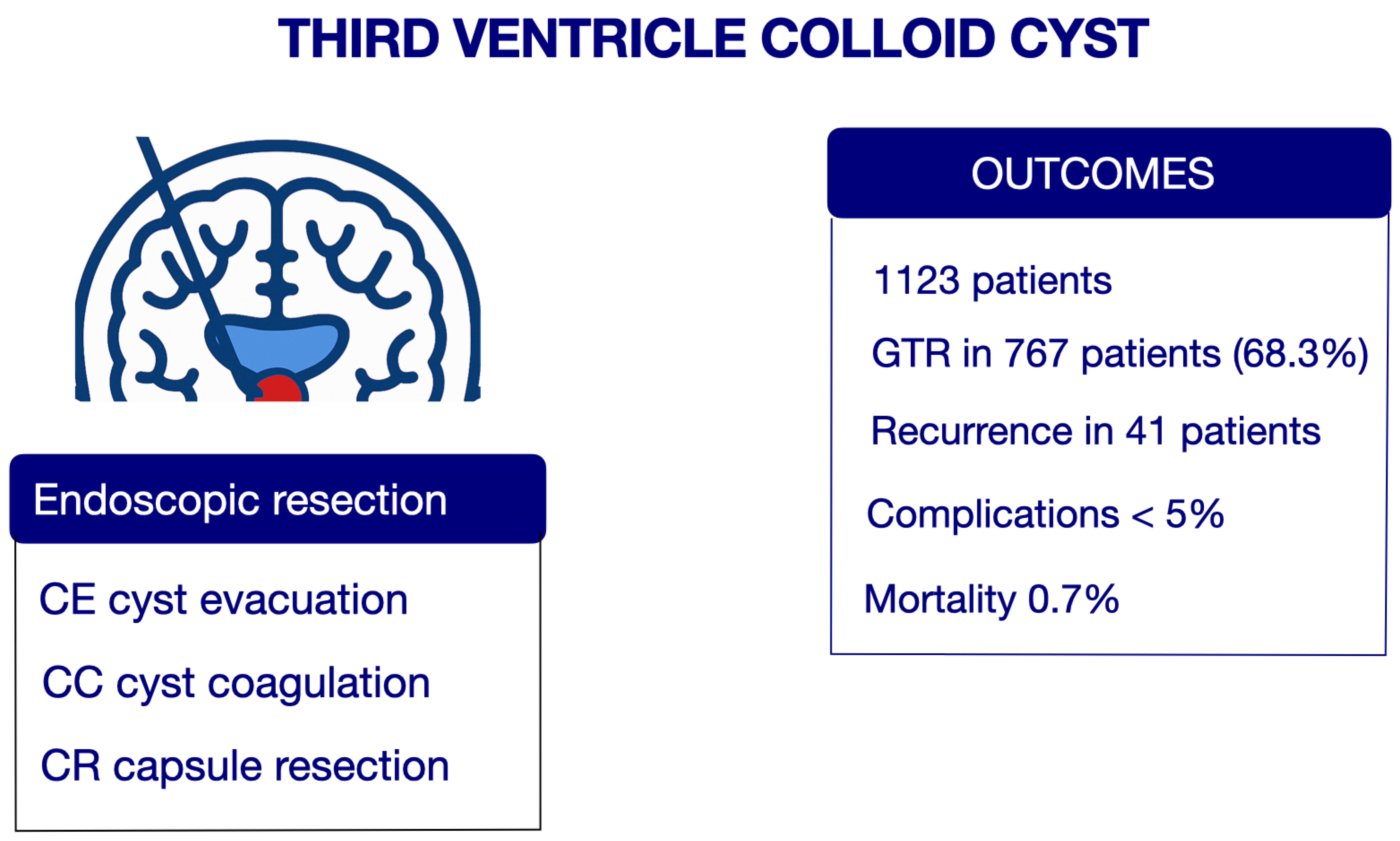

Endoscopically Treated Third Ventricle Colloid Cysts: A Systematic Review of Surgical and Clinical Outcomes



Abstract
1. Introduction
2. Materials and Methods
2.1. Literature Search Strategy
2.2. Data Extraction
2.3. Statistical Analysis
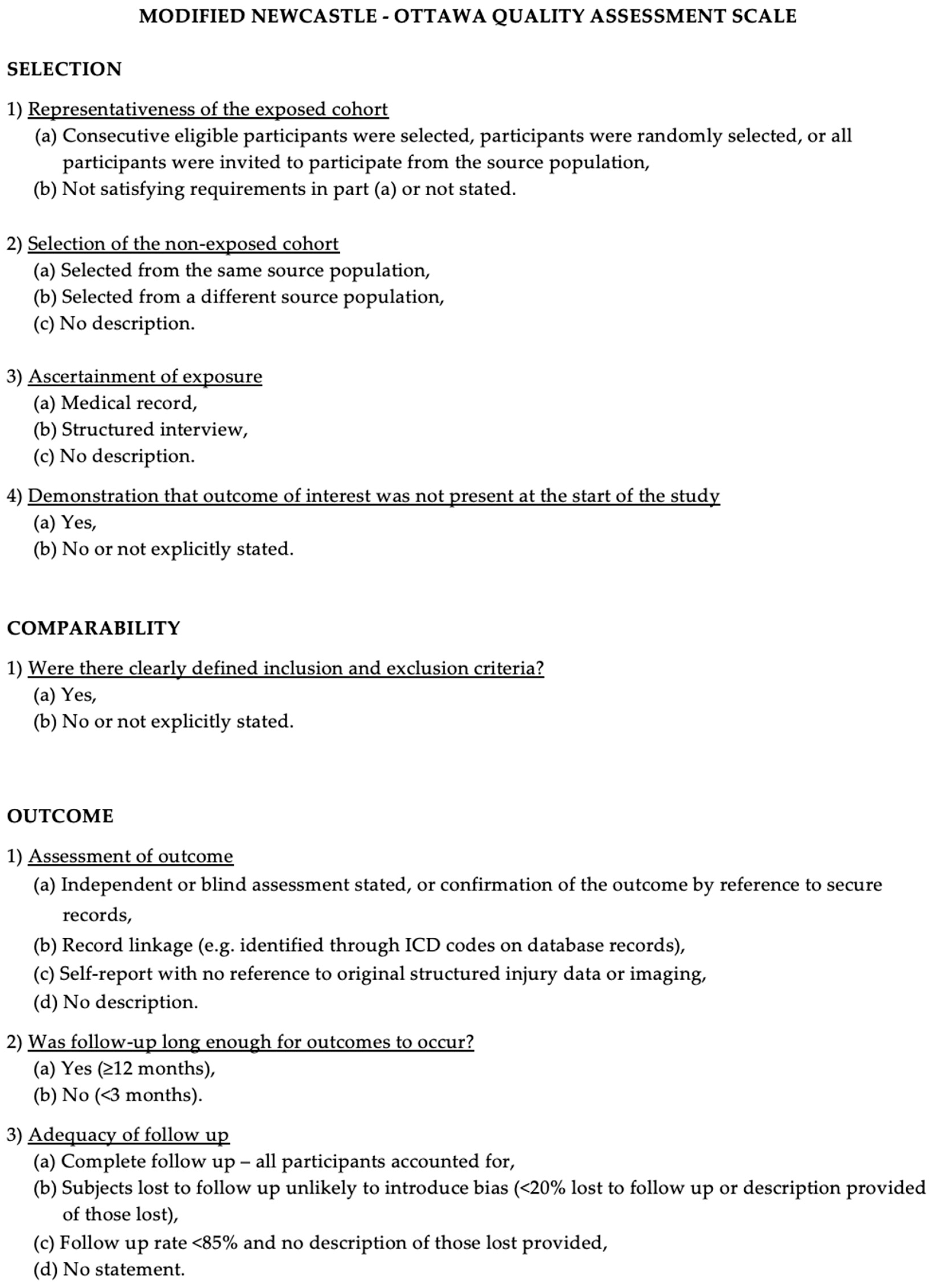
2.4. Risk of Bias Assessment
3. Results
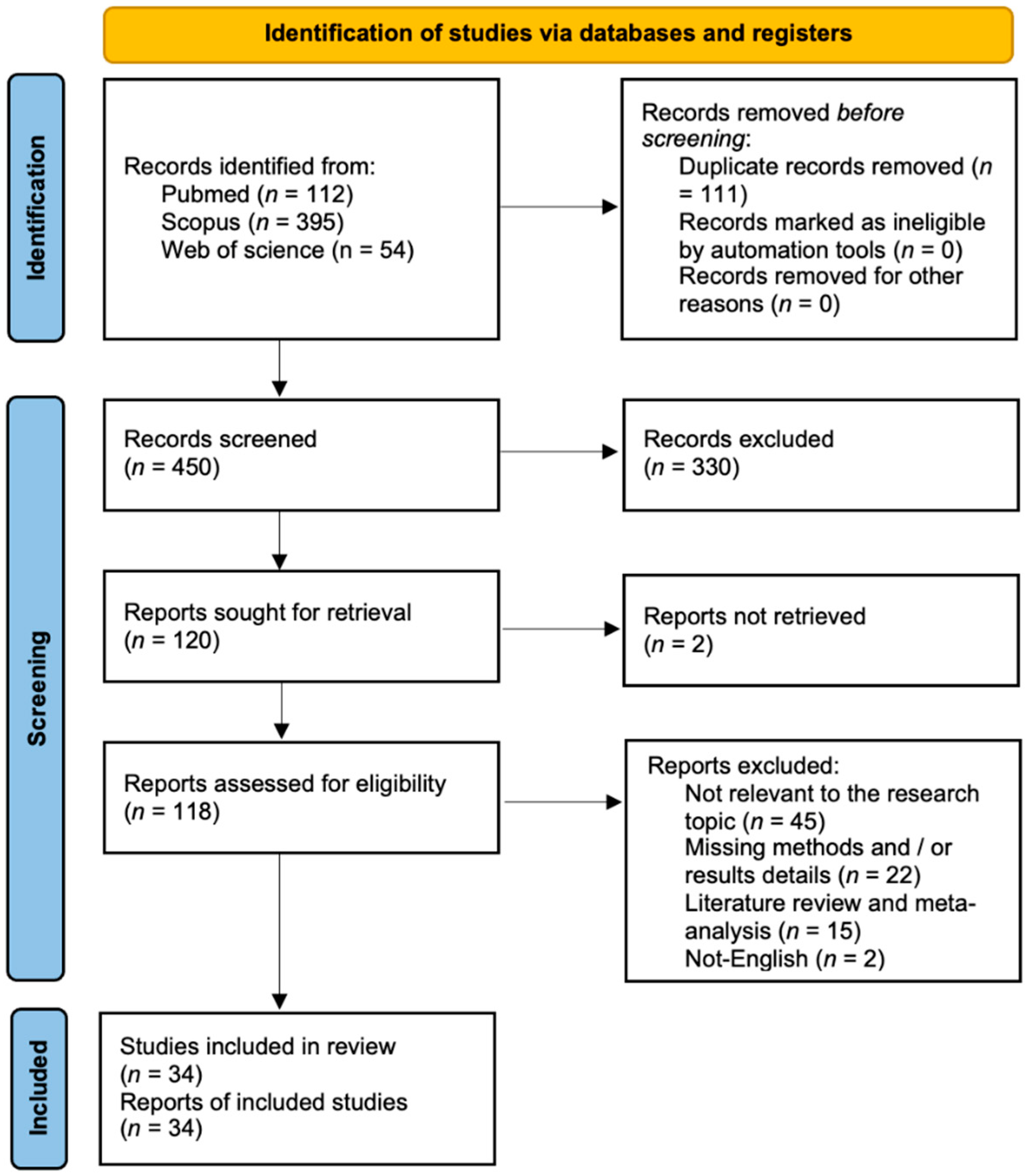
3.1. PRISMA
3.2. Clinical and Surgical Data
3.3. Surgical and Clinical Outcomes
4. Discussion
Limitations of the Study
5. Conclusions
Supplementary Materials
Author Contributions
Funding
Institutional Review Board Statement
Informed Consent Statement
Data Availability Statement
Conflicts of Interest
Abbreviations
| TVCCs | Third ventricle colloid cysts |
| GTR | Gross total resection |
| EVD | external ventricular drainage |
| CR | Capsule resection |
| CC | Capsule coagulation |
| CE | Cyst evacuation |
References
- Kabashi, A.; Dedushi, K.; Ymeri, L.; Ametxhekaj, I.; Shatri, M. Colloid Cyst of the Third Ventricle: Case report and Literature Review. Acta Inform. Med. 2020, 28, 283–286. [Google Scholar] [CrossRef] [Scilit]
- Turillazzi, E.; Bello, S.; Neri, M.; Riezzo, I.; Fineschi, V. Colloid cyst of the third ventricle, hypothalamus, and heart: A dangerous link for sudden death. Diagn. Pathol. 2012, 7, 144. [Google Scholar] [CrossRef] [Scilit]
- Ravnik, J.; Bunc, G.; Grcar, A.; Zunic, M.; Velnar, T. Colloid cysts of the third ventricle exhibit various clinical presentation: A review of three cases. Bosn. J. Basic. Med. Sci. 2014, 14, 132–135. [Google Scholar] [CrossRef] [Scilit] [PubMed]
- Ellenbogen, R.G. Transcortical surgery for lateral ventricular tumors. Neurosurg. Focus. 2001, 10, E2. [Google Scholar] [CrossRef] [Scilit] [PubMed]
- Delitala, A.; Brunori, A.; Russo, N. Supraorbital endoscopic approach to colloid cysts. Neurosurgery 2011, 69, ons176–ons182; discussion ons182–ons183. [Google Scholar] [CrossRef] [Scilit]
- Mishra, S.; Chandra, P.S.; Suri, A.; Rajender, K.; Sharma, B.S.; Mahapatra, A.K. Endoscopic management of third ventricular colloid cysts: Eight years’ institutional experience and description of a new technique. Neurol. India 2010, 58, 412–417. [Google Scholar] [CrossRef] [Scilit]
- Brunori, A.; de Falco, R.; Delitala, A.; Schaller, K.; Schonauer, C. Tailoring Endoscopic Approach to Colloid Cysts of the Third Ventricle: A Multicenter Experience. World Neurosurg. 2018, 117, e457–e464. [Google Scholar] [CrossRef] [Scilit] [PubMed]
- Arnaout, M.M.; Elsamman, A.K. Perspectives on Endoscopic Transseptal Interforniceal Approach for Retroforaminal Colloid Cysts. World Neurosurg. 2021, 152, e71–e80. [Google Scholar] [CrossRef] [Scilit]
- Page, M.J.; McKenzie, J.E.; Bossuyt, P.M.; Boutron, I.; Hoffmann, T.C.; Mulrow, C.D.; Shamseer, L.; Tetzlaff, J.M.; Akl, E.A.; Brennan, S.E.; et al. The PRISMA 2020 statement: An updated guideline for reporting systematic reviews. BMJ 2021, 372, n71. [Google Scholar] [CrossRef] [Scilit]
- The Newcastle-Ottawa Scale (NOS) for Assessing The Quality of Nonrandomised Studies in Meta-Analyses|Request PDF. Available online: https://www.researchgate.net/publication/288802810_The_Newcastle-Ottawa_Scale_NOS_for_Assessing_The_Quality_of_Nonrandomised_Studies_in_Meta-analyses (accessed on 30 October 2025).
- Abdou, M.S.; Cohen, A.R. Endoscopic treatment of colloid cysts of the third ventricle. Technical note and review of the liter-ature. J. Neurosurg. 1998, 89, 1062–1068. [Google Scholar] [CrossRef] [Scilit]
- Decq, P.; Le Guerinel, C.; Brugières, P.; Djindjian, M.; Silva, D.; Kéravel, Y.; Melon, E.; Nguyen, J.P. Endoscopic management of colloid cysts. Neurosurgery 1998, 42, 1288–1294; discussion 1294–1296. [Google Scholar] [CrossRef] [Scilit]
- Longatti, P.; Godano, U.; Gangemi, M.; Delitala, A.; Morace, E.; Genitori, L.; Alafaci, C.; Benvenuti, L.; Brunori, A.; Cereda, C.; et al. Cooperative study by the Italian neuroendoscopy group on the treatment of 61 colloid cysts. Childs Nerv. Syst. 2006, 22, 1263–1267. [Google Scholar] [CrossRef] [Scilit] [PubMed]
- Grondin, R.T.; Hader, W.; MacRae, M.E.; Hamilton, M.G. Endoscopic versus microsurgical resection of third ventricle colloid cysts. Can. J. Neurol. Sci. 2007, 34, 197–207. [Google Scholar] [CrossRef] [Scilit]
- Greenlee, J.D.W.; Teo, C.; Ghahreman, A.; Kwok, B. Purely endoscopic resection of colloid cysts. Neurosurgery 2008, 62, 51–55; discussion 55–56. [Google Scholar] [CrossRef] [Scilit]
- Hellwig, D.; Bauer, B.L.; Schulte, M.; Gatscher, S.; Riegel, T.; Bertalanffy, H. Neuroendoscopic treatment for colloid cysts of the third ventricle: The experience of a decade. Neurosurgery 2008, 62, 1101–1109. [Google Scholar] [CrossRef] [Scilit] [PubMed]
- Pinto, F.C.G.; Chavantes, M.C.; Fonoff, E.T.; Teixeira, M.J. Treatment of colloid cysts of the third ventricle through neuroendoscopic Nd: YAG laser stereotaxis. Arq. Neuropsiquiatr. 2009, 67, 1082–1087. [Google Scholar] [CrossRef] [Scilit] [PubMed]
- El-Ghandour, N.M.F. Endoscopic treatment of third ventricular colloid cysts: A review including ten personal cases. Neurosurg. Rev. 2009, 32, 395–402. [Google Scholar] [CrossRef] [Scilit]
- Boogaarts, H.D.; Decq, P.; Grotenhuis, J.A.; Le Guérinel, C.; Nseir, R.; Jarraya, B.; Djindjian, M.; Beems, T. Long-term results of the neuroendoscopic management of colloid cysts of the third ventricle: A series of 90 cases. Neurosurgery 2011, 68, 179–187. [Google Scholar] [CrossRef] [Scilit]
- Chibbaro, S.; Champeaux, C.; Poczos, P.; Cardarelli, M.; Di Rocco, F.; Iaccarino, C.; Servadei, F.; Tigan, L.; Chaussemy, D.; George, B.; et al. Anterior trans-frontal endoscopic management of colloid cyst: An effective, safe, and elegant way of treatment. Case series and technical note from a multicenter prospective study. Neurosurg. Rev. 2014, 37, 235–241; discussion 241. [Google Scholar] [CrossRef] [Scilit]
- Hoffman, C.E.; Savage, N.J.; Souweidane, M.M. The significance of cyst remnants after endoscopic colloid cyst resection: A retrospective clinical case series. Neurosurgery 2013, 73, 233–237; discussion 237–239. [Google Scholar] [CrossRef] [Scilit]
- Wilson, D.A.; Fusco, D.J.; Wait, S.D.; Nakaji, P. Endoscopic resection of colloid cysts: Use of a dual-instrument technique and an anterolateral approach. World Neurosurg. 2013, 80, 576–583. [Google Scholar] [CrossRef] [Scilit]
- Iacoangeli, M.; di Somma, L.G.M.; Di Rienzo, A.; Alvaro, L.; Nasi, D.; Scerrati, M. Combined endoscopic transforaminal-transchoroidal approach for the treatment of third ventricle colloid cysts. J. Neurosurg. 2014, 120, 1471–1476. [Google Scholar] [CrossRef] [Scilit]
- Ibáñez-Botella, G.; Domínguez, M.; Ros, B.; De Miguel, L.; Márquez, B.; Arráez, M.A. Endoscopic transchoroidal and transforaminal approaches for resection of third ventricular colloid cysts. Neurosurg. Rev. 2014, 37, 227–234; discussion 234. [Google Scholar] [CrossRef] [Scilit]
- Sribnick, E.A.; Dadashev, V.Y.; Miller, B.A.; Hawkins, S.; Hadjipanayis, C.G. Neuroendoscopic colloid cyst resection: A case cohort with follow-up and patient satisfaction. World Neurosurg. 2014, 81, 584–593. [Google Scholar] [CrossRef] [Scilit] [PubMed]
- Raouf, A.; Zidan, I. Endoscopic Removal of Third Ventricular Colloid Cyst: Experience of 90 Cases. Neurosurg. Q. 2015, 25, 46–50. [Google Scholar] [CrossRef] [Scilit]
- Sharifi, G.; Bakhtevari, M.H.; Samadian, M.; Alavi, E.; Rezaei, O. Endoscopic Surgery in Nonhydrocephalous Third Ventricular Colloid Cysts: A Feasibility Study. World Neurosurg. 2015, 84, 398–404. [Google Scholar] [CrossRef] [Scilit]
- Stachura, K.; Libionka, W.; Moskała, M.; Krupa, M.; Polak, J. Colloid cysts of the third ventricle. Endoscopic and open microsurgical management. Neurol. Neurochir Pol. 2009, 43, 251–257. [Google Scholar] [PubMed]
- Birski, M.; Birska, J.; Paczkowski, D.; Furtak, J.; Rusinek, M.; Rudas, M.; Harat, M. Combination of Neuroendoscopic and Stereotactic Procedures for Total Resection of Colloid Cysts with Favorable Neurological and Cognitive Outcomes. World Neurosurg. 2016, 85, 205–214. [Google Scholar] [CrossRef] [Scilit] [PubMed]
- Samadian, M.; Ebrahimzadeh, K.; Maloumeh, E.N.; Jafari, A.; Sharifi, G.; Shiravand, S.; Digaleh, H.; Rezaei, O. Colloid Cyst of the Third Ventricle: Long-Term Results of Endoscopic Management in a Series of 112 Cases. World Neurosurg. 2018, 111, e440–e448. [Google Scholar] [CrossRef] [Scilit]
- Azab, W.A.; Abdelnabi, E.A.; Mostafa, K.H. Efficacy and Safety of the Rotational Technique for Endoscopic Transforaminal Excision of Colloid Cysts of the Third Ventricle. World Neurosurg. 2019, 125, e602–e611. [Google Scholar] [CrossRef] [Scilit]
- Vorbau, C.; Baldauf, J.; Oertel, J.; Gaab, M.R.; Schroeder, H.W.S. Long-Term Results After Endoscopic Resection of Colloid Cysts. World Neurosurg. 2019, 122, e176–e185. [Google Scholar] [CrossRef] [Scilit]
- Lin, M.; Bakhsheshian, J.; Strickland, B.; Rennert, R.C.; Chen, J.W.; Van Gompel, J.J.; Young, I.I.R.L.; Kumar, P.P.; Coppens, J.; Curry, W.T.; et al. Navigable Channel-Based Trans-Sulcal Resection of Third Ventricular Colloid Cysts: A Multicenter Retrospective Case Series and Review of the Literature. World Neurosurg. 2020, 133, e702–e710. [Google Scholar] [CrossRef] [Scilit]
- Stachura, K.; Grzywna, E.; Krzyżewski, R.M.; Kwinta, B.M. Retrospective evaluation of endoscopic treatment in colloid cyst of the third ventricle. Videosurgery Other Miniinvasive Tech. 2021, 16, 604–611. [Google Scholar] [CrossRef] [Scilit]
- Zymberg, S.T.; Riechelmann, G.S.; da Costa, M.D.S.; Ramalho, C.O.; Cavalheiro, S. Third ventricle colloid cysts: An endoscopic case series emphasizing technical variations. Surg. Neurol. Int. 2021, 12, 376. [Google Scholar] [CrossRef] [Scilit]
- Alkhaibary, A.; Baydhi, L.; Alharbi, A.; Alshaikh, A.A.; Khairy, S.; Abbas, M.; Aboushady, A.M.; Almuntashri, M.; Alassiri, A.H.; Alkhani, A.; et al. Endoscopic versus Open Microsurgical Excision of Colloid Cysts: A Comparative Analysis and State-of-the-Art Review of Neurosurgical Techniques. World Neurosurg. 2021, 149, e298–e308. [Google Scholar] [CrossRef] [Scilit] [PubMed]
- Beaumont, T.L.; Limbrick, D.D.; Patel, B.; Chicoine, M.R.; Rich, K.M.; Dacey, R.G. Surgical management of colloid cysts of the third ventricle: A single-institution comparison of endoscopic and microsurgical resection. J. Neurosurg. 2022, 137, 905–913. [Google Scholar] [CrossRef] [Scilit]
- Roth, J.; Perekopaiko, Y.; Kozyrev, D.A.; Constantini, S. Pediatric Colloid Cyst Study Group (PCCSG). Pediatric colloid cysts: A multinational, multicenter study. An IFNE-ISPN-ESPN collaboration. J. Neurosurg. Pediatr. 2022, 29, 543–550. [Google Scholar] [CrossRef] [Scilit] [PubMed]
- Peron, S.; Galante, N.; Creatura, D.; Sicuri, G.M.; Stefini, R. Use of a neuro-evacuation device for the endoscopic removal of third ventricle colloid cysts. Front. Surg. 2023, 10, 1214290. [Google Scholar] [CrossRef] [Scilit]
- Unal, T.C.; Sencer, A.; Dolas, I.; Gulsever, C.I.; Sahin, D.; Dolen, D.; Ozata, M.S.; Ozturk, M.; Aras, Y.; Aydoseli, A. Full-endoscopic removal of third ventricular colloid cysts: Technique, results, and limitations. Front. Surg. 2023, 10, 1174144. [Google Scholar] [CrossRef] [Scilit] [PubMed]
- Cappabianca, P.; Cavallo, L.M.; Colao, A.; De Caro, M.D.; Esposito, F.; Cirillo, S.; Lombardi, G.; de Divitiis, E. Endoscopic endonasal transsphenoidal approach: Outcome analysis of 100 consecutive procedures. Minim. Invasive Neurosurg. 2002, 45, 193–200. [Google Scholar] [CrossRef] [Scilit]
- de Divitiis, O.; Conti, A.; Angileri, F.F.; Cardali, S.; La Torre, D.; Tschabitscher, M. Endoscopic transoral-transclival approach to the brainstem and surrounding cisternal space: Anatomic study. Neurosurgery 2004, 54, 125–130; discussion 130. [Google Scholar] [CrossRef] [Scilit]
- Porzio, M.; Costanzo, R.; Gerardi, R.M.; Iacopino, D.G.; Maugeri, R. Letter to the Editor Regarding “Endoscopic versus Open Microsurgical Excision of Colloid Cysts: A Comparative Analysis and State-of-the-Art Review of Neurosurgical Techniques”. World Neurosurg. 2022, 162, 208–209. [Google Scholar] [CrossRef] [Scilit]
- Alkhaibary, A.; Baydhi, L.; Alharbi, A.; Alshaikh, A.A.; Khairy, S.; Abbas, M.; Abdelkhalek Aboushady, A.M.; Almuntashri, M.; Alassiri, A.H.; Alkhani, A.; et al. In Reply to the Letter to the Editor Regarding “Endoscopic versus Open Microsurgical Excision of Colloid Cysts: A Comparative Analysis and State-of-the-Art Review of Neurosurgical Techniques”. World Neurosurg. 2022, 162, 210. [Google Scholar] [CrossRef] [Scilit]
- Butenschoen, V.M.; Lange, N.; Quiring, A.; Mikhina, L.; Gempt, J.; Shah, M.; Beck, J.; Evangelou, P.; Rohde, V.; Jankovic, D.; et al. Clinical symptoms and surgical outcome of colloid cysts of the third ventricle: A multicenter retrospective study. Brain Spine 2025, 5, 104196. [Google Scholar] [CrossRef] [Scilit]
- Elshamy, W.; Burkard, J.; Gerges, M.; Erginoglu, U.; Aycan, A.; Ozaydin, B.; Dempsey, R.J.; Baskaya, M.K. Surgical approaches for resection of third ventricle colloid cysts: Meta-analysis. Neurosurg. Rev. 2021, 44, 3029–3038. [Google Scholar] [CrossRef] [Scilit]
- Horn, E.M.; Feiz-Erfan, I.; Bristol, R.E.; Lekovic, G.P.; Goslar, P.W.; Smith, K.A.; Nakaji, P.; Spetzler, R.F. Treatment options for third ventricular colloid cysts: Comparison of open microsurgical versus endoscopic resection. Neurosurgery 2008, 62, 1076–1083. [Google Scholar] [CrossRef] [Scilit] [PubMed]
- Isaacs, A.M.; Bezchlibnyk, Y.B.; Dronyk, J.; Urbaneja, G.; Yong, H.; Hamilton, M.G. Long-Term Outcomes of Endoscopic Third Ventricle Colloid Cyst Resection: Case Series with a Proposed Grading System. Oper. Neurosurg. 2020, 19, 134–142. [Google Scholar] [CrossRef] [Scilit] [PubMed]
- Roth, J.; Constantini, S. Combined rigid and flexible endoscopy for tumors in the posterior third ventricle. J. Neurosurg. 2015, 122, 1341–1346. [Google Scholar] [CrossRef] [Scilit]
- Saleem, A.; Najibullah, M.; Shabbir, Z.; Azab, W. Endoscopic trans-septal interforniceal approach for excision of colloid cysts of the third ventricle using the rotational technique. Childs Nerv. Syst. 2023, 39, 3373–3379. [Google Scholar] [CrossRef] [Scilit] [PubMed]
- Sharifi, G.; Mohammadi, E.; Jafari, A.; Mousavinejad, S.A.; Bahranian, A.; Paraandavaji, E.; Khosravi, Y.D.; Mohammadkhani, M. Endoscopic versus Microsurgical Resection of Third Ventricle Colloid Cysts: A Single-Center Case Series of 140 Consecutive Patients. World Neurosurg. 2023, 175, e1110–e1116. [Google Scholar] [CrossRef] [Scilit]
- Sethi, A.; Cavalcante, D.; Ormond, D.R. Endoscopic Versus Microscopic Transcallosal Excision of Colloid Cysts: A Systematic Review in the Era of Complete Endoscopic Excision. World Neurosurg. 2019, 132, e53–e58. [Google Scholar] [CrossRef] [Scilit] [PubMed]
- Spennato, P.; Cinalli, M.A.; Di Costanzo, M.; Vitulli, F.; Ruggiero, C.; Di Martino, G.; Cinalli, G. Endoscopic ultrasonic aspirator-assisted removal of a third ventricular colloid cyst. Childs Nerv. Syst. 2023, 39, 3391–3395. [Google Scholar] [CrossRef] [Scilit] [PubMed]
- Spennato, P.; Onorini, N.; Vitulli, F.; Cinalli, M.A.; Di Costanzo, M.; Mirone, G.; Cinalli, G. Pure endoscopic ultrasonic removal of choroid plexus papillomas of the third ventricle: Technical report of two cases. Childs Nerv. Syst. 2023, 39, 3415–3420. [Google Scholar] [CrossRef] [Scilit] [PubMed]



| Author, Years | Anamnestic Data | Surgical Data | ||||||
|---|---|---|---|---|---|---|---|---|
| Patients N | Age Mean— Years | Cyst Size Mean—mm | Preoperative Hydrocephalus N (%) | Type of Endoscope | Surgical Route N (%) | Other Surgical Procedures N (%) | Type of Surgery N (%) | |
| Abdou et al., 1998 [11] | 13 | 39.0 | NA | 13 (100) | Rigid | Transforaminal 13 (100) | / | CR 13 (100) |
| Decq et al., 1998 [12] | 19 | NA | 23.0 | 2 (10.5) | Rigid | Transforaminal 19 (100) | NA | CR 19 (100) |
| Longatti et al., 2006 [13] | 61 | 41 | 32 | 53 (86.9) | Rigid | Transforaminal 61 (100) | / | CC 32 (52.4); CR 6 (9.8) |
| Grondin et al., 2007 [14] | 25 | 45.1 | 13.5 | 22 (88) | Flexible | Transeptal 25 (100) | / | CC 22 (88); CR 3 (12) |
| Greenlee et al., 2008 [15] | 29 | 32.4 | 18 | NA | Rigid | Transforaminal 29 (100) | Septostomy 1 (3.4) | CR 29 (100) |
| Hellwig et al., 2008 [16] | 20 | 43 | NA | 20 (100) | Flexible | Transforaminal 20 (100) | EVD 20 (100) | CR 20 (100) |
| Pinto et al. 2009 [17] | 11 | 38 | 14.4 | 11 (100) | Rigid | Transforaminal 11 (100) | / | CC 11 (100) |
| El-Ghandour 2009 [18] | 10 | 42.5 | NA | 10 (100) | Rigid | Transforaminal 10 (100) | TV 2 (20); septostomy 2 (20) | CC 10 (100) |
| Mishra et al., 2010 [6] | 59 | 32.0 | NA | 59 (100) | Rigid | Transforaminal 59 (100) | Septostomy 6 (10.2); EVD 14 (23.7) | CR 59 (100) |
| Delitala et al., 2011 [5] | 7 | 51.8 | 12.8 | 4 (57.1) | Rigid | Transforaminal 7 (100) | / | CR 7 (100) |
| Boogaarts et al., 2011 [19] | 91 | 43 | 16.4 | 16 (17.6) | Rigid | Transforaminal 91 (100) | TV 7 (7.7); septostomy 7 (7.7) | CR 91 (100) |
| Chibbaro et al., 2013 [20] | 29 | 34 | 2.1 | 25 (86.2) | Rigid | Transforaminal 29 (100) | Septostomy 25 (86.2); EVD 2 (6.9) | CR 29 (100) |
| Hoffman et al., 2013 [21] | 56 | 41 | 1.3 | 37 (66) | Rigid | Transforaminal 56 (100) | EVD 24 (42.9) | CC 9 (16.1); CR 45 (80.4) |
| Wilson et al., 2013 [22] | 22 | 47 | 1.2 | 19 (86.3) | Rigid | Transforaminal 22 (100) | EVD 17 (77.2) | CC 1 (4.5); CR 21 (95.5) |
| Iacoangeli et al., 2014 [23] | 5 | 48.6 | 26.4 | 5 (100) | Rigid | NA | TV 2 (40); septostomy 4 (80) | CR 5 (100) |
| Ibáñez-Botella et al., 2014 [24] | 24 | 39.6 | 16.3 | 2 (8.30) | Rigid | Transforaminal 24 (100) | TV 2 (8.3); septostomy 11 (45.8) | CR 24 (100) |
| Sribnick et al., 2014 [25] | 56 | NA | 9.80 | 33 (60.0) | Rigid | Transforaminal 56 (100) | Septostomy 43 (76.8) T-v 2 (3.60) | CR 56 (100) |
| Raouf et al., 2015 [26] | 90 | 40.3 | NA | NA | Rigid | Transforaminal 90 (100) | / | CR 79 (87.8) |
| Guive Sharifi et al., 2015 [27] | 18 | 35.3 | 26.0 | 0 (0) | Rigid | Transforaminal 18 (100) | EVD 6 (33.3) | CR 18 (100) |
| Stachura et al., 2009 [28] | 5 | 43.0 | NA | 0 (0) | Rigid | Transforaminal 5 (100) | / | CR 5 (100) |
| Birski et al., 2016 [29] | 27 | 37.2 | 12.5 | 23 (85.1) | Rigid | Transforaminal 27 (100) | / | CR 27 (100) |
| Samadian et al., 2018 [30] | 112 | 36.2 | NA | NA | Rigid | Transforaminal 112 (100) | EVD 68 (60.7) | CR 112 (100) |
| Brunori et al., 2018 [7] | 22 | 46.0 | 1.50 | 19 (86.4) | Rigid | Transforaminal 13 (59); transeptal 9 (41) | EVD 1 (4.50) | CR 22 (100) |
| Azab et al., 2019 [31] | 19 | 25.0 | 12.7 | 18 (94.7) | Rigid | Transforaminal 19 (100) | / | CR 19 (100) |
| Vorbau et al., 2019 [32] | 20 | 39.0 | NA | 19 (95.0) | Rigid | Transforaminal 20 (100) | / | CR 20 (100) |
| Lin et al., 2020 [33] | 16 | 50.0 | 14 | 12 (75.0) | Rigid | Transforaminal 16 (100) | EVD 3 (18.8) | CR 16 (100) |
| Stachura et al., 2021 [34] | 58 | NA | NA | NA | Rigid | Transforaminal 58 (100) | EVD 5 (8.60) | CR 58 (100) |
| Zymberg et al., 2021 [35] | 45 | 35.4 | 26.8 | 45 (100) | Rigid | Transforaminal 32 (71.1); transeptal 11 (24.5); interforniceal 2 (4.4) | / | CC 45 (100) |
| Ali Alkhaibary et al., 2021 [36] | 21 | 37.7 | 16.2 | NA | Rigid | Transforaminal 21 (100) | EVD 1 (4) | CR 21 (100) |
| Arnaout et al., 2021 [8] | 12 | 28.5 | 22.0 | 12 (100) | Rigid | NA | / | CR 12 (100) |
| Beaumont et al., 2022 [37] | 33 | 40.2 | 11.9 | 16 (48.5) | Rigid | Transforaminal 33 (100) | Septostomy 29 (87.9) EVD 9 (27.2) | CR 33 (100) |
| Roth et al., 2022 [38] | 62 | 12.8 | 12.6 | 61 (98.4) | Rigid | Transforaminal 62 (100) | Septostomy 45 (87); TV 8 (12.9) | CR 62 (100) |
| Peron et al., 2023 [39] | 5 | 45 | 12 | 4 (80) | Rigid | Transforaminal 5 (100) | / | CR 5 (100) |
| Unal et al., 2023 [40] | 21 | 41 | 13.9 | 13 (62) | Rigid | Transforaminal 21 (100) | EVD 1 (4.8) | CR 21 (100) |
Disclaimer/Publisher’s Note: The statements, opinions and data contained in all publications are solely those of the individual author(s) and contributor(s) and not of MDPI and/or the editor(s). MDPI and/or the editor(s) disclaim responsibility for any injury to people or property resulting from any ideas, methods, instructions or products referred to in the content. |
© 2026 by the authors. Licensee MDPI, Basel, Switzerland. This article is an open access article distributed under the terms and conditions of the Creative Commons Attribution (CC BY) license.
Share and Cite
Agosti, E.; Antonietti, S.; Viola, M.; Fontanella, M.M.; Fiorindi, A. Endoscopically Treated Third Ventricle Colloid Cysts: A Systematic Review of Surgical and Clinical Outcomes. Clin. Pract. 2026, 16, 29. https://doi.org/10.3390/clinpract16020029
Agosti E, Antonietti S, Viola M, Fontanella MM, Fiorindi A. Endoscopically Treated Third Ventricle Colloid Cysts: A Systematic Review of Surgical and Clinical Outcomes. Clinics and Practice. 2026; 16(2):29. https://doi.org/10.3390/clinpract16020029
Chicago/Turabian StyleAgosti, Edoardo, Sara Antonietti, Michael Viola, Marco Maria Fontanella, and Alessandro Fiorindi. 2026. "Endoscopically Treated Third Ventricle Colloid Cysts: A Systematic Review of Surgical and Clinical Outcomes" Clinics and Practice 16, no. 2: 29. https://doi.org/10.3390/clinpract16020029
APA StyleAgosti, E., Antonietti, S., Viola, M., Fontanella, M. M., & Fiorindi, A. (2026). Endoscopically Treated Third Ventricle Colloid Cysts: A Systematic Review of Surgical and Clinical Outcomes. Clinics and Practice, 16(2), 29. https://doi.org/10.3390/clinpract16020029