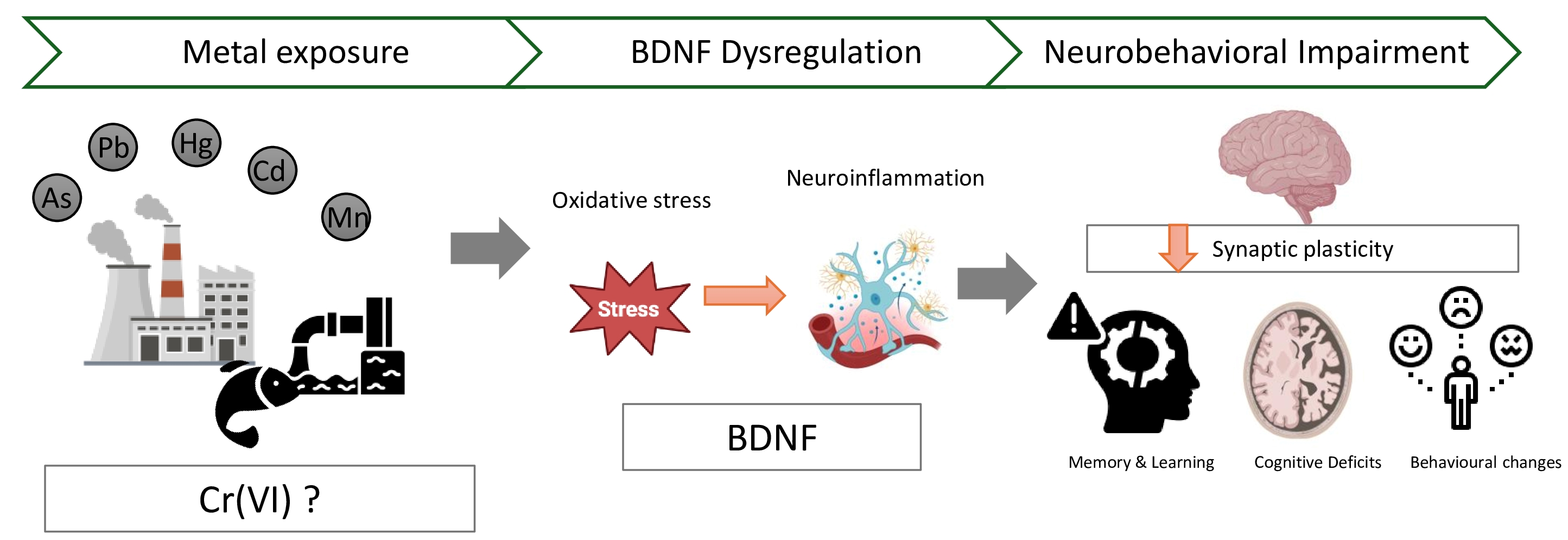

Environmental Metal Exposure and Brain-Derived Neurotrophic Factor (BDNF): A Systematic Review of Human and Experimental Evidence
 , , , ,
  and
and
Abstract
1. Introduction
2. Materials and Methods
2.1. Study Design
2.2. Information Sources and Search Strategy
2.3. Study Selection Process and Data Extraction
2.4. Quality Assessment and Risk of Bias
3. Results
3.1. Study Selection
3.2. Characteristics of Included Studies
3.3. Effects of Individual Metals on BDNF
3.4. Study Quality and Risk of Bias Assessment
4. Discussion
5. Conclusions
Supplementary Materials
Author Contributions
Funding
Institutional Review Board Statement
Informed Consent Statement
Data Availability Statement
Conflicts of Interest
References
- Colucci-D’Amato, L.; Speranza, L.; Volpicelli, F. Neurotrophic factor BDNF, physiological functions and therapeutic potential in depression, neurodegeneration and brain cancer. Int. J. Mol. Sci. 2020, 21, 7777. [Google Scholar] [CrossRef]
- Oyovwi, M.O.; Ogenma, U.T.; Onyenweny, A. Exploring the impact of exercise-induced BDNF on neuroplasticity in neurodegenerative and neuropsychiatric conditions. Mol. Biol. Rep. 2025, 52, 140. [Google Scholar] [CrossRef]
- Rahman, Z.; Singh, V.P. The relative impact of toxic heavy metals (THMs)(Arsenic (As), cadmium (Cd), chromium (Cr)(VI), mercury (Hg), and lead (Pb)) on the total environment: An overview. Environ. Monit. Assess. 2019, 191, 419. [Google Scholar] [CrossRef] [PubMed]
- Medda, N.; Patra, R.; Ghosh, T.K.; Maiti, S. Neurotoxic mechanism of arsenic: Synergistic effect of mitochondrial instability, oxidative stress, and hormonal-neurotransmitter impairment. Biol. Trace Elem. Res. 2020, 198, 8–15. [Google Scholar] [CrossRef] [PubMed]
- Rodríguez-Carrillo, A.; Verheyen, V.J.; Van Nuijs, A.L.; Fernández, M.F.; Remy, S. Brain-derived neurotrophic factor (BDNF): An effect biomarker of neurodevelopment in human biomonitoring programs. Front. Toxicol. 2024, 5, 1319788. [Google Scholar] [CrossRef] [PubMed]
- Ścibior, A.; Llopis, J.; Dobrakowski, P.P.; Męcik-Kronenberg, T. CNS-related effects caused by vanadium at realistic exposure levels in humans: A comprehensive overview supplemented with selected animal studies. Int. J. Mol. Sci. 2023, 24, 9004. [Google Scholar] [CrossRef]
- Hannan, M.A.; Dash, R.; Sohag, A.A.M.; Haque, M.N.; Moon, I.S. Neuroprotection against oxidative stress: Phytochemicals targeting TrkB signaling and the Nrf2-ARE antioxidant system. Front. Mol. Neurosci. 2020, 13, 116. [Google Scholar] [CrossRef] [PubMed]
- Zhou, C.C.; Gao, Z.Y.; He, Y.Q.; Wu, M.Q.; Chen, F.; Wang, J.; Liu, J.X.; Yan, C.H. Effects of lead, mercury, aluminium and manganese co-exposure on the serum BDNF concentration of pre-school children in Taizhou, China. Chemosphere 2019, 217, 158–165. [Google Scholar] [CrossRef] [PubMed]
- Mishra, S.; Bharagava, R.N. Toxic and genotoxic effects of hexavalent chromium in environment and its bioremediation strategies. J. Environ. Sci. Health Part C 2016, 34, 1–32. [Google Scholar] [CrossRef]
- Georgaki, M.N.; Charalambous, M.; Kazakis, N.; Talias, M.A.; Georgakis, C.; Papamitsou, T.; Mytiglaki, C. Chromium in water and carcinogenic human health risk. Environments 2023, 10, 33. [Google Scholar] [CrossRef]
- Georgaki, M.N.; Charalambous, M. Toxic chromium in water and the effects on the human body: A systematic review. J. Water Health 2023, 21, 205–223. [Google Scholar] [CrossRef]
- Ding, J.; Sun, B.; Gao, Y.; Zheng, J.; Liu, C.; Huang, J.; Jia, N.; Pei, X.; Jiang, X.; Hu, S.; et al. Evidence for chromium crosses blood brain barrier from the hypothalamus in chromium mice model. Ecotoxicol. Environ. Saf. 2024, 273, 116179. [Google Scholar] [CrossRef] [PubMed]
- Zhang, T.; Feng, L.; Cui, J.; Tong, W.; Zhao, H.; Wu, T.; Zhang, P.; Wang, X.; Gao, Y.; Su, J.; et al. Hexavalent chromium induces neurotoxicity by triggering mitochondrial dysfunction and ROS-mediated signals. Neurochem. Res. 2024, 49, 660–669. [Google Scholar] [CrossRef] [PubMed]
- Fu, S.C.; Liu, J.M.; Lee, K.I.; Tang, F.C.; Fang, K.M.; Yang, C.Y.; Su, C.C.; Chen, H.H.; Hsu, R.J.; Chen, Y.W. Cr (VI) induces ROS-mediated mitochondrial-dependent apoptosis in neuronal cells via the activation of Akt/ERK/AMPK signaling pathway. Toxicol. In Vitro 2020, 65, 104795. [Google Scholar] [CrossRef] [PubMed]
- Wang, F.; Li, Y.; Tang, D.; Yang, B.; Tian, T.; Tian, M.; Meng, N.; Xie, W.; Zhang, C.; He, Z.; et al. Exploration of the SIRT1-mediated BDNF–TrkB signaling pathway in the mechanism of brain damage and learning and memory effects of fluorosis. Front. Public Health 2023, 11, 1247294. [Google Scholar] [CrossRef]
- Stachowicz, K. Regulation of COX-2 expression by selected trace elements and heavy metals: Health implications, and changes in neuronal plasticity. A review. J. Trace Elem. Med. Biol. 2023, 79, 127226. [Google Scholar] [CrossRef]
- Karri, V.; Schuhmacher, M.; Kumar, V. Heavy metals (Pb, Cd, As and MeHg) as risk factors for cognitive dysfunction: A general review of metal mixture mechanism in brain. Environ. Toxicol. Pharmacol. 2016, 48, 203–213. [Google Scholar] [CrossRef]
- Bhattacharya, S.; Zhang, Q.; Carmichael, P.L.; Boekelheide, K.; Andersen, M.E. Toxicity testing in the 21st century: Defining new risk assessment approaches based on perturbation of intracellular toxicity pathways. PLoS ONE 2011, 6, e20887. [Google Scholar] [CrossRef]
- Singh, V.; Singh, N.; Verma, M.; Kamal, R.; Tiwari, R.; Sanjay Chivate, M.; Rai, S.N.; Kumar, A.; Singh, A.; Singh, M.P.; et al. Hexavalent-chromium-induced oxidative stress and the protective role of antioxidants against cellular toxicity. Antioxidants 2022, 11, 2375. [Google Scholar] [CrossRef] [PubMed]
- Sivakumar, K.K. Molecular Mechanisms of Hexavalent Chromium-Induced Premature Ovarian Failure. Doctoral Dissertation, Texas A&M University, College Station, TX, USA, 2018. [Google Scholar]
- von Stackelberg, K.; Guzy, E.; Chu, T.; Henn, B.C. Exposure to mixtures of metals and neurodevelopmental outcomes: A multidisciplinary review using an adverse outcome pathway framework. Risk Anal. 2015, 35, 971–1016. [Google Scholar] [CrossRef] [PubMed]
- Sarigiannis, D.; Karakitsios, S.; Anesti, O.; Stem, A.; Valvi, D.; Sumner, S.C.; Chatzi, L.; Snyder, M.P.; Thompson, D.C.; Vasiliou, V. Advancing translational exposomics: Bridging genome, exposome and personalized medicine. Hum. Genom. 2025, 19, 48. [Google Scholar] [CrossRef]
- Morgan, R.L.; Whaley, P.; Thayer, K.A.; Schünemann, H.J. Identifying the PECO: A framework for formulating good questions to explore the association of environmental and other exposures with health outcomes. Environ. Int. 2018, 121, 1027–1031. [Google Scholar] [CrossRef]
- Wells, G.A.; Shea, B.; O’Connell, D.; Peterson, J.; Welch, V.; Losos, M.; Tugwell, P. The Newcastle-Ottawa Scale (NOS) for Assessing the Quality of Nonrandomised Studies in Meta-Analyses. Available online: http://www.ohri.ca/programs/clinical_epidemiology/oxford.asp (accessed on 10 March 2026).
- Waspe, J.; Bui, T.; Dishaw, L.; Kraft, A.; Luke, A.; Beronius, A. Evaluating reliability and risk of bias of in vivo animal data for risk assessment of chemicals–Exploring the use of the SciRAP tool in a systematic review context. Environ. Int. 2021, 146, 106103. [Google Scholar] [CrossRef]
- Spulber, S.; Rantamäki, T.; Nikkilä, O.; Castrén, E.; Weihe, P.; Grandjean, P.; Ceccatelli, S. Effects of maternal smoking and exposure to methylmercury on brain-derived neurotrophic factor concentrations in umbilical cord serum. Toxicol. Sci. 2010, 117, 263–269. [Google Scholar] [CrossRef]
- Yu, X.; Chen, L.; Wang, C.; Yang, X.; Gao, Y.; Tian, Y. The role of cord blood BDNF in infant cognitive impairment induced by low-level prenatal manganese exposure: LW birth cohort, China. Chemosphere 2016, 163, 446–451. [Google Scholar] [CrossRef] [PubMed]
- Karim, Y.; Siddique, A.E.; Hossen, F.; Rahman, M.; Mondal, V.; Banna, H.U.; Hasibuzzaman, M.M.; Hosen, Z.; Islam, M.S.; Sarker, M.K.; et al. Dose-dependent relationships between chronic arsenic exposure and cognitive impairment and serum brain-derived neurotrophic factor. Environ. Int. 2019, 131, 105029. [Google Scholar] [CrossRef] [PubMed]
- Malavika, L.; Mitra, P.; Goyal, T.; Sharma, S.; Purohit, P.; Sharma, P. Association of blood lead levels with neurobehavior and BDNF expression in school going children. J. Trace Elem. Med. Biol. 2021, 66, 126749. [Google Scholar]
- Hossain, S.; Bhowmick, S.; Jahan, S.; Rozario, L.; Sarkar, M.; Islam, S.; Basunia, M.A.; Rahman, A.; Choudhury, B.K.; Shahjalal, H. Maternal lead exposure decreases the levels of brain development and cognition-related proteins with concomitant upsurges of oxidative stress, inflammatory response and apoptosis in the offspring rats. Neurotoxicology 2016, 56, 150–158. [Google Scholar] [CrossRef] [PubMed]
- Wang, L.; Fu, H.; Liu, B.; Liu, X.; Chen, W.; Yu, X. The effect of postnatal manganese exposure on the NMDA receptor signaling pathway in rat hippocampus. J. Biochem. Mol. Toxicol. 2017, 31, e21969. [Google Scholar] [CrossRef]
- Lin, X.; Zhao, J.; Zhang, W.; He, L.; Wang, L.; Li, H.; Liu, Q.; Cui, L.; Gao, Y.; Chen, C.; et al. Towards screening the neurotoxicity of chemicals through feces after exposure to methylmercury or inorganic mercury in rats: A combined study using gut microbiome, metabolomics and metallomics. J. Hazard. Mater. 2021, 409, 124923. [Google Scholar] [CrossRef]
- Li, L.X.; Chu, J.H.; Chen, X.W.; Gao, P.C.; Wang, Z.Y.; Liu, C.; Fan, R.F. Selenium ameliorates mercuric chloride-induced brain damage through activating BDNF/TrKB/PI3K/AKT and inhibiting NF-κB signaling pathways. J. Inorg. Biochem. 2022, 229, 111716. [Google Scholar] [CrossRef]
- Anyachor, C.P.; Orish, C.N.; Ezejiofor, A.N.; Cirovic, A.; Cirovic, A.; Ezealisiji, K.M.; Orisakwe, O.E. Nickel and aluminium mixture elicit memory impairment by activation of oxidative stress, COX-2, and diminution of AChE, BDNF and NGF levels in cerebral cortex and hippocampus of male albino rats. Curr. Res. Toxicol. 2023, 5, 100129. [Google Scholar] [CrossRef] [PubMed]
- Li, Y.; Liu, A.; Chen, K.; Li, L.; Zhang, X.; Zou, F.; Zhang, X.; Meng, X. Sodium butyrate alleviates lead-induced neuroinflammation and improves cognitive and memory impairment through the ACSS2/H3K9ac/BDNF pathway. Environ. Int. 2024, 184, 108479. [Google Scholar] [CrossRef]
- Yoo, M.H.; Kim, T.Y.; Kim, H.K.; Yoo, J.H.; Lee, B.S.; Koh, J.Y. Assessing the health hazards of low-dose ethylmercury: Neurochemical and behavioral impacts in neonatal mice through matrix metalloproteinase activation and brain-derived neurotrophic factor release. Ecotoxicol. Environ. Saf. 2025, 293, 118031. [Google Scholar] [CrossRef] [PubMed]
- Ben Mimouna, S.; Le Charpentier, T.; Lebon, S.; Van Steenwinckel, J.; Messaoudi, I.; Gressens, P. Involvement of the synapse-specific zinc transporter ZnT3 in cadmium-induced hippocampal neurotoxicity. J. Cell. Physiol. 2019, 234, 15872–15884. [Google Scholar] [CrossRef] [PubMed]
- Fujimura, M.; Unoki, T. BDNF specifically expressed in hippocampal neurons is involved in methylmercury neurotoxicity resistance. Environ. Toxicol. 2024, 39, 3149–3159. [Google Scholar] [CrossRef] [PubMed]
- Liu, R.; Bai, L.; Liu, M.; Wang, R.; Wu, Y.; Li, Q.; Ba, Y.; Zhang, H.; Zhou, G.; Yu, F.; et al. Combined exposure of lead and high-fat diet enhanced cognitive decline via interacting with CREB-BDNF signaling in male rats. Environ. Pollut. 2022, 304, 119200. [Google Scholar] [CrossRef]
- Gąssowska, M.; Baranowska-Bosiacka, I.; Moczydłowska, J.; Frontczak-Baniewicz, M.; Gewartowska, M.; Strużyńska, L.; Gutowska, I.; Chlubek, D.; Adamczyk, A. Perinatal exposure to lead (Pb) induces ultrastructural and molecular alterations in synapses of rat offspring. Toxicology 2016, 373, 13–29. [Google Scholar] [CrossRef]
- Namgyal, D.; Ali, S.; Mehta, R.; Sarwat, M. The neuroprotective effect of curcumin against Cd-induced neurotoxicity and hippocampal neurogenesis promotion through CREB-BDNF signaling pathway. Toxicology 2020, 442, 152542. [Google Scholar] [CrossRef]
- Sreevaram, H.H.; Kishore, A.; Sivanesan, S.; Prabhakaran, M.; Karunakaran, B.; Kasirajan, S.P.; Jyothi, A.K.; Francis, Y.M. Comparative neuroprotective efficacy of N-acetylcysteine and naringin in lead-induced neurotoxicity: Restoration of BDNF, neurotransmitters, and cognitive function. Morphologie 2025, 109, 101075. [Google Scholar] [CrossRef]
- Wei, L.; He, H.; Yang, S.; Shi, Q.; Wang, X.; Huang, L.; Lu, J.; Shen, Y.; Zhi, K.; Xiang, J.; et al. Synergistic suppression of BDNF via epigenetic mechanism deteriorating learning and memory impairment caused by Mn and Pb co-exposure. Ecotoxicol. Environ. Saf. 2024, 277, 116365. [Google Scholar] [CrossRef] [PubMed]
- Martínez-Hernández, M.I.; Acosta-Saavedra, L.C.; Hernández-Kelly, L.C.; Loaeza-Loaeza, J.; Ortega, A. Microglial activation in metal neurotoxicity: Impact in neurodegenerative diseases. BioMed Res. Int. 2023, 2023, 7389508. [Google Scholar] [CrossRef] [PubMed]
- Batool, A.; Saleem, S.; Naqvi, F.; Hasan, K.A.; Naqvi, F.; Haider, S. Thymol mitigates cadmium-induced behavioral and cognitive deficits by up-regulating hippocampal BDNF levels in rats. Pak. J. Pharm. Sci. 2022, 35, 671–678. [Google Scholar] [PubMed]
- Preety, S.S.; Tasin, F.R.; Sarder, A.; Halder, D.; Yasmin, F.; Mandal, C. Molecular signature of cadmium-mediated neurodevelopmental disorders in prenatal to postnatal stages. EXCLI J. 2025, 24, 797–823. [Google Scholar]
- Nicoletti, V.G.; Pajer, K.; Calcagno, D.; Pajenda, G.; Nógrádi, A. The role of metals in the neuroregenerative action of BDNF, GDNF, NGF and other neurotrophic factors. Biomolecules 2022, 12, 1015. [Google Scholar] [CrossRef] [PubMed]
- Klein, A.B.; Williamson, R.; Santini, M.A.; Clemmensen, C.; Ettrup, A.; Rios, M.; Knudsen, G.M.; Aznar, S. Blood BDNF concentrations reflect brain-tissue BDNF levels across species. Int. J. Neuropsychopharmacol. 2011, 14, 347–353. [Google Scholar] [CrossRef] [PubMed]
- Zhang, X.; Sun, L.; Dapar, M.L.G.; Zhang, Q. Novel plasma cytokines identified and validated in children during lead exposure according to the new updated BLRV. Sci. Rep. 2024, 14, 30323. [Google Scholar] [CrossRef]
- Ghosh, P.; Dey, T.; Chattopadhyay, A.; Bandyopadhyay, D. An insight into the ameliorative effects of melatonin against chromium induced oxidative stress and DNA damage: A review. Melatonin Res. 2021, 4, 377–407. [Google Scholar] [CrossRef]
- Ajibo, D.N.; Orish, C.N.; Ruggieri, F.; Bocca, B.; Battistini, B.; Frazzoli, C.; Orish, F.C.; Orisakwe, O.E. An update overview on mechanistic data and biomarker levels in cobalt and chromium-induced neurodegenerative diseases. Biol. Trace Elem. Res. 2024, 202, 3538–3564. [Google Scholar] [CrossRef]
- Polacchini, A.; Metelli, G.; Francavilla, R.; Baj, G.; Florean, M.; Mascaretti, L.G.; Tongiorgi, E. A method for reproducible measurements of serum BDNF: Comparison of the performance of six commercial assays. Sci. Rep. 2015, 5, 17989. [Google Scholar] [CrossRef] [PubMed] [PubMed Central]


Disclaimer/Publisher’s Note: The statements, opinions and data contained in all publications are solely those of the individual author(s) and contributor(s) and not of MDPI and/or the editor(s). MDPI and/or the editor(s) disclaim responsibility for any injury to people or property resulting from any ideas, methods, instructions or products referred to in the content. |
© 2026 by the authors. Licensee MDPI, Basel, Switzerland. This article is an open access article distributed under the terms and conditions of the Creative Commons Attribution (CC BY) license.
Share and Cite
Georgaki, M.-N.; Ioannou, D.; Chochliourou, E.; Skourtsidis, K.; Papamitsou, T.; Sarigiannis, D. Environmental Metal Exposure and Brain-Derived Neurotrophic Factor (BDNF): A Systematic Review of Human and Experimental Evidence. J. Xenobiotics 2026, 16, 59. https://doi.org/10.3390/jox16020059
Georgaki M-N, Ioannou D, Chochliourou E, Skourtsidis K, Papamitsou T, Sarigiannis D. Environmental Metal Exposure and Brain-Derived Neurotrophic Factor (BDNF): A Systematic Review of Human and Experimental Evidence. Journal of Xenobiotics. 2026; 16(2):59. https://doi.org/10.3390/jox16020059
Chicago/Turabian StyleGeorgaki, Maria-Nefeli, Despoina Ioannou, Elpis Chochliourou, Kanellos Skourtsidis, Theodora Papamitsou, and Dimosthenis Sarigiannis. 2026. "Environmental Metal Exposure and Brain-Derived Neurotrophic Factor (BDNF): A Systematic Review of Human and Experimental Evidence" Journal of Xenobiotics 16, no. 2: 59. https://doi.org/10.3390/jox16020059
APA StyleGeorgaki, M.-N., Ioannou, D., Chochliourou, E., Skourtsidis, K., Papamitsou, T., & Sarigiannis, D. (2026). Environmental Metal Exposure and Brain-Derived Neurotrophic Factor (BDNF): A Systematic Review of Human and Experimental Evidence. Journal of Xenobiotics, 16(2), 59. https://doi.org/10.3390/jox16020059