
Remediation Potential of Ulva lactuca for Europium: Removal Efficiency, Metal Partitioning and Stress Biomarkers
 ,
,  ,
, 

Abstract
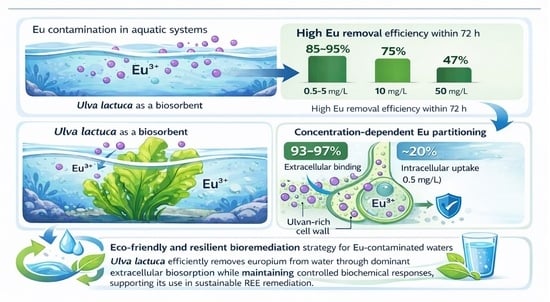
1. Introduction
2. Materials and Methods
2.1. Reagents and Materials
2.2. Collection and Preparation
2.3. Europium Accumulation by Ulva lactuca Macroalgae
2.4. Extracellular and Intracellular Europium Concentrations in Ulva lactuca
2.5. Measurement of Europium in Water and Macroalgae
2.6. Biomarker Analysis
2.6.1. Antioxidant and Biotransformation Activity
2.6.2. Cellular Damage
2.7. Data Analysis
3. Results
3.1. Europium Concentrations in Water
3.2. Efficiency of Ulva lactuca in Reducing Europium Levels in Seawater
3.3. Europium Partitioning in Ulva lactuca
3.4. Biochemical Responses of Europium Toxicity in Ulva Lactuca
3.4.1. Antioxidant Defenses
3.4.2. Cellular Damage
4. Discussion
4.1. Efficacy of Europium Load on Seawater Decontamination
4.2. Europium Extra- and Intracellular Partition
4.3. Toxicological Effect of Europium in Ulva lactuca
5. Conclusions
Author Contributions
Funding
Institutional Review Board Statement
Informed Consent Statement
Data Availability Statement
Acknowledgments
Conflicts of Interest
References
- Aide, M.T.; Aide, C. Rare earth elements: Their importance in understanding soil genesis. Int. Sch. Res. Not. 2012, 2012, 783876. [Google Scholar] [CrossRef]
- Jarocka, A.; Fetliński, B.; Dębowski, P.; Pietrzak, T.K.; Jurak, K.; Wasiucionek, M. Facile and cost-effective technique to control europium oxidation states in glassy fluorophosphate matrices with tunable photoluminescence. Sci. Rep. 2022, 12, 18774. [Google Scholar] [CrossRef]
- Miyamoto, Y.; Uekawa, M.; Ikeda, H.; Kaifu, K. Electroluminescent properties of a Eu-complex doped in phosphorescent materials. J. Lumin. 1999, 81, 159–164. [Google Scholar] [CrossRef]
- Lewandowski, E.C.; Arban, C.B.; Deal, M.P.; Batchev, A.L.; Allen, M.J. Europium (II/III) coordination chemistry toward applications. Chem. Commun. 2024, 60, 10655–10671. [Google Scholar] [CrossRef]
- Syamchand, S.S.; Sony, G. Europium enabled luminescent nanoparticles for biomedical applications. J. Lumin. 2015, 165, 190–215. [Google Scholar] [CrossRef]
- Evangelista, R.A.; Pollak, A.; Allore, B.; Templeton, A.F.; Morton, R.C.; Diamandis, E.P. A new europium chelate for protein labelling and time-resolved fluorometric applications. Clin. Biochem. 1988, 21, 173–178. [Google Scholar] [CrossRef]
- Coey, J.M.D. Perspective and Prospects for Rare Earth Permanent Magnets. Engineering 2020, 6, 119–131. [Google Scholar] [CrossRef]
- Gonzalez, V.; Vignati, D.A.L.; Leyval, C.; Giamberini, L. Environmental fate and ecotoxicity of lanthanides: Are they a uniform group beyond chemistry. Environ. Int. 2014, 71, 148–157. [Google Scholar] [CrossRef]
- Rim, K.T.; Koo, K.H.; Park, J.S. Toxicological Evaluations of Rare Earths and Their Health Impacts to Workers. Saf. Health Work 2013, 4, 12–26. [Google Scholar] [CrossRef]
- Ramos, S.J.; Dinali, G.S.; Oliveira, O.; Martins, G.C.; Moreira, C.G.; Siqueira, O.J.; Guilherme, L.R.G. Rare Earth Elements in the Soil Environment. Curr. Pollut. Rep. 2016, 2, 28–50. [Google Scholar] [CrossRef]
- Lafrenière, M.-C.; Lapierre, J.-F.; Ponton, D.E.; Guillemette, F.; Amyot, M. Rare earth elements (REEs) behavior in a large river across a geological and anthropogenic gradient. Geochim. Cosmochim. Acta 2023, 353, 129–141. [Google Scholar] [CrossRef]
- Möller, P.; Knappe, A.; Dulski, P. Seasonal variations of rare earths and yttrium distribution in the lowland Havel River, Germany, by agricultural fertilization and effluents of sewage treatment plants. Appl. Geochem. 2014, 41, 62–72. [Google Scholar] [CrossRef]
- Banaee, M.; Mossotto, C.; Maganza, A.; Azizi, R.; Prearo, M.; Pastorino, P.; Faggio, C. Rare earth elements on aquatic organisms: Toxicity, detoxification, and ecological implications. Emerg. Contam. 2025, 11, 100457. [Google Scholar] [CrossRef]
- Qian, Y.; Zheng, L.; Jiang, C.; Chen, X.; Chen, Y.; Xu, Y.; Chen, Y. Environmental geochemical characteristics of rare-earth elements in surface waters in the Huainan coal mining area, Anhui Province, China. Environ. Geochem. Health 2022, 44, 3527–3539. [Google Scholar] [CrossRef]
- Gao, X.; Han, G.; Liu, J.; Zhang, S. Spatial distribution and sources of rare earth elements in urban river water: The indicators of anthropogenic inputs. Water 2023, 15, 654. [Google Scholar] [CrossRef]
- Migaszewski, Z.M.; Gałuszka, A. The use of gadolinium and europium concentrations as contaminant tracers in the Nida River watershed in south-central Poland. Geol. Q. 2016, 60, 67–76. [Google Scholar] [CrossRef]
- Zheng, X.-Y.; Plancherel, Y.; Saito, M.A.; Scott, P.M.; Henderson, G.M. Rare earth elements (REEs) in the tropical South Atlantic and quantitative deconvolution of their non-conservative behavior. Mar. Chem. 2016, 177, 217–237. [Google Scholar] [CrossRef]
- Kaegi, R.; Gogos, A.; Voegelin, A.; Hug, S.J.; Winkel, L.H.E.; Buser, A.M.; Berg, M. Quantification of individual Rare Earth Elements from industrial sources in sewage sludge. Water Res. X 2021, 11, 100092. [Google Scholar] [CrossRef] [PubMed]
- Pinto, I.; Henriques, B.; Viana, T.; Freitas, R.; Pereira, E.; Antunes, S.C. From high-tech to high-risk? Unveiling the acute ecotoxicological effects of rare earth elements on Daphnia magna. Bull. Environ. Contam. Toxicol. 2025, 114, 67. [Google Scholar] [CrossRef]
- Leite, C.; Russo, T.; Pinto, J.; Polese, G.; Soares, A.M.V.M.; Pretti, C.; Pereira, E.; Freitas, R. From the cellular to tissue alterations induced by two rare earth elements in the mussel species Mytilus galloprovincialis: Comparison between exposure and recovery periods. Sci. Total Environ. 2024, 915, 169754. [Google Scholar] [CrossRef]
- Leite, C.; Russo, T.; Polese, G.; Soares, A.M.V.M.; Pretti, C.; Pereira, E.; Freitas, R. Effects of the interaction of salinity and rare earth elements on the health of Mytilus galloprovincialis: The case of praseodymium and europium. J. Xenobiot. 2024, 14, 2015–2038. [Google Scholar] [CrossRef]
- Senila, M.; Levei, E.A.; Senila, L.; Cadara, O. Validation of microwave acid digestion, diffusive gradients in thin-film preconcentration and inductively coupled plasma optical emission spectrometry methodology for the determination of REEs in natural zeolites. Anal. Methods 2024, 16, 4807–4816. [Google Scholar] [CrossRef]
- Henriques, B.; Morais, T.; Cardoso, C.E.D.; Freitas, R.; Viana, T.; Ferreira, N.; Fabre, E.; Pinheiro-Torres, J.; Pereira, E. Can the recycling of europium from contaminated waters be achieved through living macroalgae? Study on accumulation and toxicological impacts under realistic concentrations. Sci. Total Environ. 2021, 786, 147176. [Google Scholar] [CrossRef] [PubMed]
- Costis, S.; Mueller, K.K.; Coudert, L.; Mihaela Neculita, C.; Reynier, N.; Blais, J.F. Recovery potential of rare earth elements from mining and industrial residues: A review and cases studies. J. Geochem. Explor. 2020, 221, 106699. [Google Scholar] [CrossRef]
- Swain, N.; Mishra, S. A review on the recovery and separation of rare earths and transition metals from secondary resources. J. Clean. Prod. 2019, 220, 884–898. [Google Scholar] [CrossRef]
- Gkika, D.A.; Chalaris, M.; Kyzas, G.Z. Review of methods for obtaining rare earth elements from recycling and their impact on the environment and human health. Processes 2024, 12, 1235. [Google Scholar] [CrossRef]
- Opare, E.O.; Struhs, E.; Mirkouei, A. A comparative state-of-technology review and future directions for rare earth element separation. Renew. Sustain. Energy Rev. 2021, 143, 110917. [Google Scholar] [CrossRef]
- Borja, D.; Nguyen, K.A.; Silva, R.A.; Park, J.H.; Gupta, V.; Han, Y.; Lee, Y.; Kim, H. Experiences and Future Challenges of Bioleaching Research in South Korea. Minerals 2016, 6, 128. [Google Scholar] [CrossRef]
- Xu, X.; Sturm, S.; Samardzija, Z.; Scancar, J.; Markovicc, K.; Rozmana, K.Z. A facile method for the simultaneous recovery of rare-earth elements and transition metals from Nd–Fe–B magnets. Green Chem. 2019, 22, 1105–1112. [Google Scholar] [CrossRef]
- Huang, C.; Wang, Y.; Huang, B.; Dong, Y.; Sun, X. The recovery of rare earth elements from coal combustion products by ionic liquids. Miner. Eng. 2019, 130, 142–147. [Google Scholar] [CrossRef]
- Azubuike, C.C.; Chikere, C.B.; Okpokwasili, G.C. Bioremediation techniques–classification based on site of application: Principles, advantages, limitations and prospects. World J. Microbiol. Biotechnol. 2016, 32, 180. [Google Scholar] [CrossRef]
- Davis, T.A.; Volesky, B.; Mucci, A. A review of the biochemistry of heavy metal biosorption by brown algae. Water Res. 2003, 37, 4311–4330. [Google Scholar] [CrossRef]
- Jacinto, J.; Henriques, B.; Duarte, A.C.; Vale, C.; Pereira, E. Removal and recovery of Critical Rare Elements from contaminated waters by living Gracilaria gracilis. J. Hazard. Mater. 2018, 344, 531–538. [Google Scholar] [CrossRef]
- Cao, Y.; Shao, P.; Chen, Y.; Zhou, X.; Yang, L.; Shi, H.; Yu, K.; Luo, X.; Luo, X. A critical review of the recovery of rare earth elements from wastewater by algae for resources recycling technologies. Resour. Conserv. Recycl. 2021, 169, 105519. [Google Scholar] [CrossRef]
- Herrero, R.; Lodeiro, P.; Rey-Castro, C.; Vilariño, T.; Sastre de Vicente, M.E. Removal of inorganic mercury from aqueous solutions by biomass of the marine macroalga Cystoseira baccata. Water Res. 2005, 39, 3199–3210. [Google Scholar] [CrossRef]
- Henriques, B.; Teixeira, A.; Figueira, P.; Reis, A.T.; Almeida, J.; Vale, C.; Pereira, E. Simultaneous removal of trace elements from contaminated waters by living Ulva lactuca. Sci. Total Environ. 2019, 652, 880–888. [Google Scholar] [CrossRef]
- Ferreira, N.; Ferreira, A.; Viana, T.; Lopes, C.B.; Costa, M.; Pinto, J.; Soares, J.; Pinheiro-Torres, J.; Henriques, B.; Pereira, E. Assessment of marine macroalgae potential for gadolinium removal from contaminated aquatic systems. Sci. Total Environ. 2020, 749, 141488. [Google Scholar] [CrossRef] [PubMed]
- Fonseka, C.; Ryu, S.; Choo, Y.; Kandasamy, J.; Foseid, L.; Ratnaweera, H.; Vigneswaran, S. Selective recovery of europium from real acid mine drainage using modified Cr-MIL and SBA15 adsorbents. Environ. Sci. Pollut. Res. 2024, 31, 51540–51550. [Google Scholar] [CrossRef] [PubMed]
- Castro, L.; Gómez-Álvarez, H.; González, F.; Muñoz, J.A. Biorecovery of rare earth elements from fluorescent lamp powder using the fungus Aspergillus niger in batch and semicontinuous systems. Miner. Eng. 2023, 201, 108215. [Google Scholar] [CrossRef]
- Hassler, C.S.; Slaveykova, V.I.; Wilkinson, K.J. Discriminating between intra- and extracellular metals using chemical extractions. Limnol. Oceanogr. Methods 2004, 2, 237–247. [Google Scholar] [CrossRef]
- Freitas, R.; Silvestro, S.; Coppola, F.; Meucci, V.; Battaglia, F.; Intorre, L.; Soares, A.M.V.M.; Pretti, C.; Faggio, C. Combined effects of salinity changes and salicylic acid exposure in Mytilus galloprovincialis. Sci. Total Environ. 2020, 715, 136804. [Google Scholar] [CrossRef] [PubMed]
- Beauchamp, C.; Fridovich, I. Superoxide dismutase: Improved assays and an assay applicable to acrylamide gels. Anal. Biochem. 1971, 44, 276–287. [Google Scholar] [CrossRef] [PubMed]
- Johansson, L.H.; Borg, L.A.H. A spectrophotometric method for determination of catalase activity in small tissue samples. Anal. Biochem. 1988, 174, 331–336. [Google Scholar] [CrossRef]
- Carregosa, V.; Velez, C.; Soares, A.M.V.M.; Figueira, E.; Freitas, R. Physiological and biochemical responses of three Veneridae clams exposed to salinity changes. Ecotoxicol. Environ. Saf. 2014, 107, 302–311. [Google Scholar] [CrossRef]
- Paglia, D.E.; Valentine, W.N. Studies on the quantitative and qualitative characterization of erythrocyte glutathione peroxidase. J. Lab. Clin. Med. 1967, 70, 158–169. [Google Scholar]
- Ohkawa, H.; Ohishi, N.; Yagi, K. Assay for lipid peroxides in animal tissues by thiobarbituric acid reaction. Anal. Biochem. 1979, 95, 351–358. [Google Scholar] [CrossRef]
- Anderson, M. PERMANOVA+ for PRIMER: Guide to Software and Statistical Methods; Primer-E Limited: Auckland, New Zealand, 2008; Available online: https://learninghub.primer-e.com/books/permanova-for-primer-guide-to-software-and-statistical-methods (accessed on 1 January 2026).
- Ramprasad, C.; Gwenzi, W.; Chaukura, N.C.; Azelee, N.I.V.; Rajapaksha, A.U.; Naushad, M.; Rangabhashiyam, S. Strategies and options for the sustainable recovery of rare earth elements from electrical and electronic waste. Chem. Eng. J. 2022, 442, 135992. [Google Scholar] [CrossRef]
- Malhotra, N.; Hsu, H.S.; Liang, S.T.; Roldan, M.J.M.; Lee, J.S.; Ger, T.R.; Hsiao, C.D. An Updated Review of Toxicity Effect of the Rare Earth Elements (REEs) on Aquatic Organisms. Animals 2020, 10, 1663. [Google Scholar] [CrossRef]
- Brown, R.M.; Mirkouei, A.; Reed, D.; Thompson, V. Current nature-based biological practices for rare earth elements extraction and recovery: Bioleaching and biosorption. Renew. Sustain. Energy Rev. 2023, 173, 113099. [Google Scholar] [CrossRef]
- Heilmann, M.; Breiter, R.; Becker, A.M. Towards rare earth element recovery from wastewaters: Biosorption using phototrophic organisms. Appl. Microbiol. Biotechnol. 2021, 105, 5229–5239. [Google Scholar] [CrossRef]
- Naja, G.; Volesky, B. Optimization of a Biosorption Column Performance. Environ. Sci. Technol. 2008, 42, 5622–5629. [Google Scholar] [CrossRef]
- Viana, T.; Colónia, J.; Tavares, D.S.; Andrade, M.; Ferreira, N.; Freitas, R.; Pereira, E.; Henriques, B. Uptake and effects of yttrium on the seaweed Ulva sp.: A study on the potential risks of rare earth elements in aquatic environments. Water 2025, 17, 3023. [Google Scholar] [CrossRef]
- Ishii, N.; Tagami, K.; Uchida, S. Removal of rare earth elements by algal flagellate Euglena gracilis. J. Alloys Compd. 2006, 408–412, 417–420. [Google Scholar] [CrossRef]
- Pinto, J.; Costa, M.; Henriques, B.; Soares, J.; Dias, M.; Viana, T.; Ferreira, N.; Vale, C.; Pinheiro-Torres, J.; Pereira, E. Competition among rare earth elements on sorption onto six seaweeds. J. Rare Earths 2021, 39, 734–741. [Google Scholar] [CrossRef]
- Atinkpahoun, C.N.H.; Pons, M.; Louis, P.; Leclerc, J.; Soclo, H.H. Rare earth elements (REE) in the urban wastewater of Cotonou (Benin, West Africa). Chemosphere 2020, 251, 126398. [Google Scholar] [CrossRef]
- Ni’am, A.C.; Wang, Y.; Chen, S.; Chang, G.; You, S. Simultaneous recovery of rare earth elements from waste permanent magnets (WPMs) leach liquor by solvent extraction and hollow fiber supported liquid membrane. Chem. Eng. Process. 2020, 148, 107831. [Google Scholar] [CrossRef]
- Mwewa, B.; Tadie, M.; Ndlovu, S.; Simate, G.S.; Matinde, E. Recovery of rare earth elements from acid mine drainage: A review of the extraction methods. J. Environ. Chem. Eng. 2022, 10, 107704. [Google Scholar] [CrossRef]
- Blaby-Haas, C.E.; Merchant, S.S. The ins and outs of algal metal transport. Biochim. Biophys. Acta 2012, 1823, 1531–1552. [Google Scholar] [CrossRef]
- Ma, J.; Wang, W.; Liu, X.; Wang, Z.; Gao, G.; Wu, H.; Li, X.; Xu, J. Zinc toxicity alters the photosynthetic response of red alga Pyropia yezoensis to ocean acidification. Environ. Sci. Pollut. Res. 2020, 27, 3202–3212. [Google Scholar] [CrossRef]
- Freitas, R.; Coppola, F.; Marchia, L.D.; Codella, V.; Prettib, C.; Chiellinic, F.; Morellic, A.; Polesed, G.; Soaresa, A.M.V.M.; Figueira, E. The influence of Arsenic on the toxicity of carbon nanoparticles in bivalves. J. Hazard. Mater. 2018, 358, 484–493. [Google Scholar] [CrossRef] [PubMed]
- Chen, W.; Sun, M. Acute copper stress showed toxic effects on the physiological metabolism of Ulva lactuca, a common green macroalgae. Sci. Rep. 2024, 14, 24883. [Google Scholar] [CrossRef] [PubMed]
- Alonso, P.; Blas, J.; Amaro, F.; de Francisco, P.; Martín-González, A.; Gutiérrez, J.C. Cellular response of adapted and non-adapted Tetrahymena thermophila strains to europium Eu(III) compounds. Biology 2024, 13, 285. [Google Scholar] [CrossRef]
- Li, C.; Tang, T.; Du, Y.; Jiang, L.; Yao, Z.; Ning, L.; Zhu, B. Ulvan and Ulva oligosaccharides: A systematic review of structure, preparation, biological activities and applications. Bioresour. Bioprocess. 2023, 10, 66. [Google Scholar] [CrossRef]
- Wang, Y.; Li, Y.; Luo, X.; Ren, Y.; Gao, E.; Gao, H. Effects of yttrium and phosphorus on growth and physiological characteristics of Microcystis aeruginosa. J. Rare Earths 2018, 36, 781–788. [Google Scholar] [CrossRef]
- Wu, L.; Yang, F.; Xue, Y.; Gu, R.; Liu, H.; Xia, D.; Liu, Y. The biological functions of europium-containing biomaterials: A systematic review. Mater. Today Bio 2023, 19, 100595. [Google Scholar] [CrossRef] [PubMed]



| Nominal Concentration (mg/L) | |||||
| Blank | 0.5 | 1.0 | 5.0 | 10 | 50 |
| Measured concentration (mg/L) | |||||
| <0.020 | 0.41 ± 0.04 | 0.74 ± 0.02 | 4.1 ± 0.04 | 8.7 ± 0.49 | 50 ± 4.9 |
Disclaimer/Publisher’s Note: The statements, opinions and data contained in all publications are solely those of the individual author(s) and contributor(s) and not of MDPI and/or the editor(s). MDPI and/or the editor(s) disclaim responsibility for any injury to people or property resulting from any ideas, methods, instructions or products referred to in the content. |
© 2026 by the authors. Licensee MDPI, Basel, Switzerland. This article is an open access article distributed under the terms and conditions of the Creative Commons Attribution (CC BY) license.
Share and Cite
Mohammadpour, S.; Viana, T.; Freitas, R.; Pereira, E.; Henriques, B. Remediation Potential of Ulva lactuca for Europium: Removal Efficiency, Metal Partitioning and Stress Biomarkers. J. Xenobiot. 2026, 16, 20. https://doi.org/10.3390/jox16010020
Mohammadpour S, Viana T, Freitas R, Pereira E, Henriques B. Remediation Potential of Ulva lactuca for Europium: Removal Efficiency, Metal Partitioning and Stress Biomarkers. Journal of Xenobiotics. 2026; 16(1):20. https://doi.org/10.3390/jox16010020
Chicago/Turabian StyleMohammadpour, Saereh, Thainara Viana, Rosa Freitas, Eduarda Pereira, and Bruno Henriques. 2026. "Remediation Potential of Ulva lactuca for Europium: Removal Efficiency, Metal Partitioning and Stress Biomarkers" Journal of Xenobiotics 16, no. 1: 20. https://doi.org/10.3390/jox16010020
APA StyleMohammadpour, S., Viana, T., Freitas, R., Pereira, E., & Henriques, B. (2026). Remediation Potential of Ulva lactuca for Europium: Removal Efficiency, Metal Partitioning and Stress Biomarkers. Journal of Xenobiotics, 16(1), 20. https://doi.org/10.3390/jox16010020