


Desired but Unattained Breastfeeding: A Qualitative Exploration of Maternal Perceptions in a Cultural–Religious Context
 ,
,  , , , and
Abstract
1. Introduction
2. Materials and Methods
2.1. Study Design and Participants
2.2. Data Collection
2.3. Ethical Considerations
2.4. Data Analysis
2.5. Rigour
3. Results
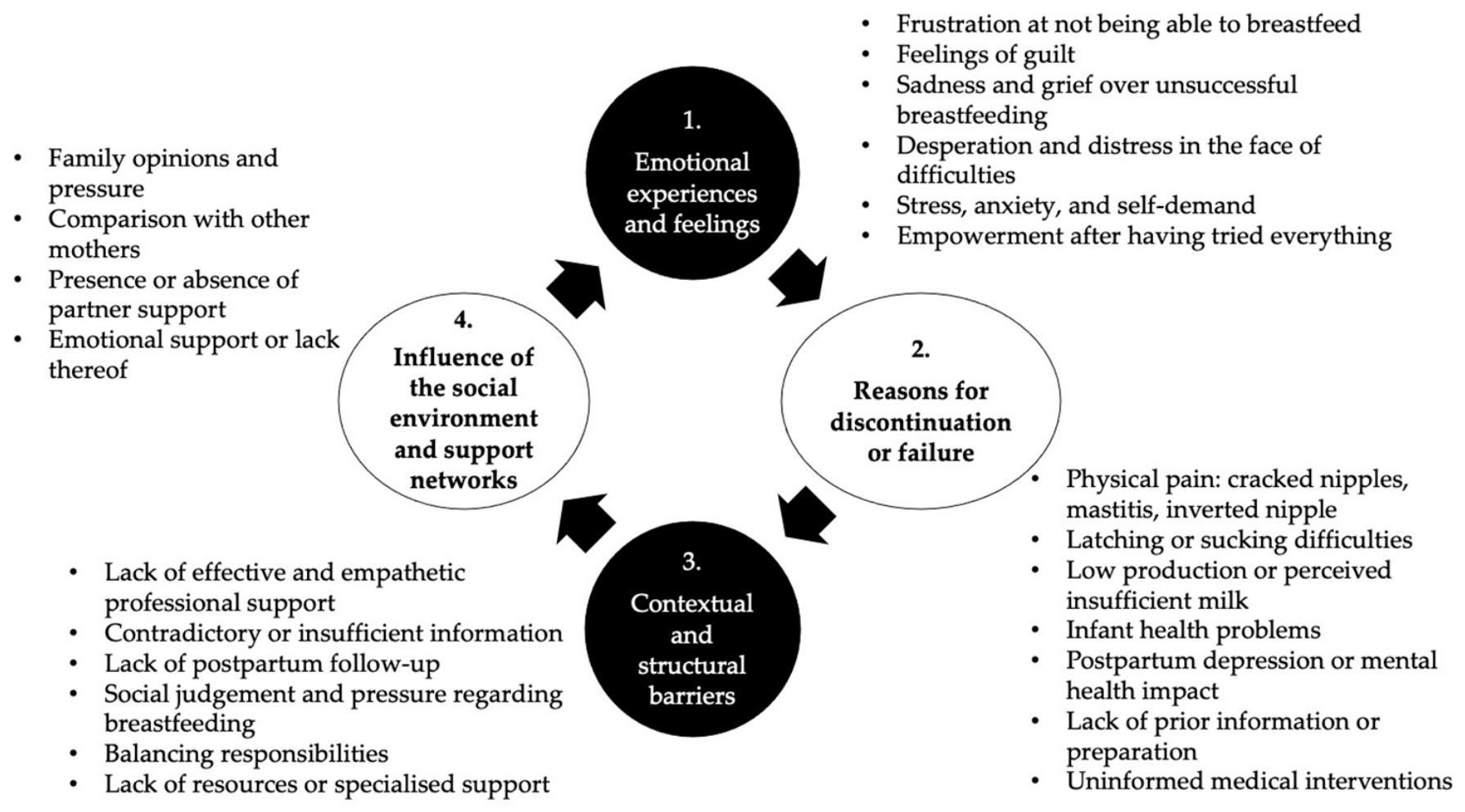
3.1. Emotional Experiences and Feelings
“I felt sad because I expected it to last longer (breastfeeding). I felt bad, as if I were failing as a mother. I kept thinking: ‘why can’t I feed my baby myself?’ I felt frustrated, useless, very sad.”(Mw1)
“Terrible, it made me feel really bad, like I was a bad mother, as if I were taking something very important away from my daughter. I felt awful, and I cried all day.”(mw5)
“It was very hard for me. I felt empty, as if I were taking something away from my baby.”(mw9)
“Honestly, I felt terrible. Terrible because I felt I couldn’t manage something that is supposed to be natural, something all mothers do. It hurt a lot, but more than the physical pain, it was the thought that I was failing as a mother.”(mw10)
“I felt an overwhelming sadness. I felt so guilty, as if I were choosing the easier option rather than what was best for my daughter.”(cw1)
“Sometimes it was quite overwhelming because I would breastfeed him, and people around me would say, ‘if he asks for it so often, it’s because he’s still hungry’, so you feel like you’re not giving him enough, which was quite frustrating.”(cw12)
“I don’t know, I felt a mix of anger and guilt. Anger because I didn’t have more support, and guilt because I thought that if I had tried harder, maybe I would have managed.”(cw15)
“It was very hard. I felt incapable, helpless, completely overwhelmed. I cried a lot, didn’t sleep well, and everything revolved around the fact that I couldn’t breastfeed the way I wanted to.”(cw11)
3.2. Reasons for Breastfeeding Discontinuation
“They told me my baby wasn’t eating enough, that I had to give her a bottle, and I just couldn’t cope anymore with the pain and the stress.”(MW6)
“It’s true that I was in a lot of pain, I was crying, and I had a fever, so my mother told me it was better to stop breastfeeding because it was making me ill.”(MW8)
“I breastfed for a week, then I developed mastitis and had to go to the emergency department. They prescribed antibiotics and told me it was best to stop. My mother-in-law kept insisting that I should give formula from the first day.”(MW11)
“The first time I stopped breastfeeding was after three days because I had severe mastitis. I had a fever, I was crying and very distressed, and I felt very frustrated, as if I wasn’t capable of doing something so basic.”(MW12)
“I didn’t stop myself, it just stopped. It stopped because my baby wasn’t getting enough, so I had to give a bottle, and then he didn’t want the breast anymore.”(CW7)
“It hurt so much, and I cried every time I tried. They told me it was fine to give a bottle, that the important thing was that the baby was fed.”(CW14)
“I had an emergency caesarean section and was separated from my baby for many hours. When they brought him to me, he couldn’t latch properly, and they told me to give a bottle.”(CW8)
“Bad, very bad because I had to stop without wanting to. I was forced by work, and it made me extremely sad. It was very hard to accept, I cried for several days. My mother told me to do what I could, but not to become obsessed.”(CW13)
3.3. Contextual and Structural Barriers
“I did try to breastfeed, but in the hospital, they didn’t explain anything to me, and when I got home I felt completely lost and no one helped me, so I started using a bottle.”(MW2)
“(Laughs). I didn’t feel bad because it just wasn’t possible. I was alone and had to take care of my other children as well. I didn’t have time or help, and it was impossible to continue.”(MW7)
“Terrible, I cried. It made me feel really bad. There weren’t even nurses to explain how to do it, everything was very cold and rushed, and in the end I didn’t feel encouraged to continue.”(MW5)
“In antenatal classes everything is very general, not personal. No one says: ‘Let’s see your case’, ‘Sit down, let’s see how you’re doing’, ‘How are you managing?’ Do you understand? There’s a lot of misinformation.”(MW15)
“I stopped because I went back to work and they didn’t give me time to express milk. Between that and the baby getting used to the bottle, it just ended.”(CW7)
“I was in Valencia with pneumonia, I was hospitalised for a week… I was given quite a lot of medication… The doctors told me: ‘Don’t even think about breastfeeding the baby’. And it upset me because he was so small and used to the breast… It was hard for him to take the bottle.”(CW15)
“I had a caesarean section and didn’t see him for hours. When they finally brought him to me, he couldn’t latch properly, and no one came to help me with positioning.”(CW8)
“I wanted to continue, but in primary care they told me that since I was already using formula, it didn’t matter if I stopped completely, so I did.”(CW10)
3.4. Influence of the Social Environment and Support Networks
“What frustrates me is not being alone with my baby. That doesn’t bother me. What overwhelms me is when there are people around giving their opinions, like my husband, my mother-in-law and my sister-in-law. That really affects me, that’s what’s frustrating.”(MW5)
“They saw me suffering and told me, ‘Just give a bottle and that’s it’. They didn’t really encourage me, to be honest.”(MW3)
“I felt quite bad because breastfeeding wasn’t how they had described it to me. Everything was more difficult, my milk wasn’t coming in, the baby was crying, and I felt very insecure and nervous. I thought it was my fault. My partner told me that if I wanted to stop, I could, that he supported me.”(MW6)
“In the end, what you need is for someone to help calm things down so you can have a moment of peace. I already had another baby at home, and it was very stressful. I didn’t have help in that sense. My partner was the main issue, actually. Grandmothers do help, but in the end, the person who needs to help you is the one who lives with you every day, and I didn’t have that support. You know? He would go to work, and it was like, ‘There you are, on your own with the two girls’.”(MW8)
“Well… I didn’t feel bad in the end because I had a lot of support. My partner helped me a lot; he kept telling me I was doing well even when I felt I couldn’t cope.”(CW4)
“I was very anxious, I cried all the time. My mother supported me, but she also told me that if I was suffering so much, it wasn’t worth continuing.”(CW6)
“My husband, my mother… everyone supported me: ‘Come on, you can do it’, ‘Let’s try again’, but it just didn’t work.”(CW9)
“Bad, very bad because I had to stop without wanting to. I was forced by work, and it made me extremely sad. It was very hard to accept, I cried for several days. My mother told me to do what I could, but not to become obsessed.”(CW13)
4. Discussion
4.1. Emotional Experiences and Feelings
4.2. Reasons for Breastfeeding Discontinuation
4.3. Contextual and Structural Barriers
4.4. Influence of the Social Environment and Support Networks
4.5. Future Research Directions
4.6. Strengths and Limitations
5. Conclusions
Author Contributions
Funding
Institutional Review Board Statement
Informed Consent Statement
Data Availability Statement
Public Involvement Statement
Guidelines and Standards Statement
Use of Artificial Intelligence
Acknowledgments
Conflicts of Interest
Abbreviations
| CW | Christian Women |
| MW | Muslim Women |
| SD | Standard Deviation |
| SPSS | Statistical Package for the Social Sciences |
| WHO | World Health Organization |
References
- Cortés-Rúa, L.; Díaz-Grávalos, G.J. Interrupción temprana de la lactancia materna. Un estudio cualitativo. Enferm. Clín. 2019, 29, 207–215. [Google Scholar] [CrossRef] [Scilit] [PubMed]
- Ministerio de Salud del Salvador. Política de Protección, Promoción y Apoyo a La Lactancia Materna; Ministerio de Salud del Salvador: San Salvador, El Salvador, 2011. Available online: https://platform.who.int/docs/default-source/mca-documents/policy-documents/policy/SLV-MN-67-02-POLICY-2011-esp-POLITICA-LACTANCIA-MATERNA.pdf (accessed on 7 August 2025).
- Alvarenga, W.d.A.; Gomes, T.R.d.C.; Rodrigues-Da Silva, C.H.; Machado-Kayzuka, G.C.; Castanheira-Nascimento, L.; Moraes-Leite, A.; De-Montigny, F. Father’s influence on breastfeeding continuity or interruption: Meta-synthesis Influencia del padre en la continuidad o interrupción de la lactancia materna: Metasíntesis. Rev. Esc. Enferm. USP 2025, 59, e20240303. [Google Scholar] [CrossRef] [Scilit] [PubMed]
- Olza, I.; Ruiz-Berdún, D.; Villarmea, S. La culpa de las madres. Promover la lactancia materna sin presionar a las mujeres. Dilemata 2017, 25, 217–225. [Google Scholar]
- Oberfichtner, K.; Oppelt, P.; Fritz, D.; Hrauda, K.; Fritz, C.; Schildberger, B.; Lastinger, J.; Stelzl, P.; Enengl, S. Breastfeeding in Primiparous Women–Expectations and Reality: A Prospective Questionnaire Survey. BMC Pregnancy Childbirth 2023, 23, 654. [Google Scholar] [CrossRef] [Scilit] [PubMed]
- Turner, S.E.; Brockway, M.; Azad, M.B.; Grant, A.; Tomfohr-Madsen, L.; Brown, A. Breastfeeding in the Pandemic: A Qualitative Analysis of Breastfeeding Experiences among Mothers from Canada and the United Kingdom. Women Birth 2023, 36, e388–e396. [Google Scholar] [CrossRef] [Scilit] [PubMed]
- Sharma, M.; Anand, A.; Goswami, I.; Pradhan, M.R. Factors Associated with Delayed Initiation and Non-Exclusive Breastfeeding among Children in India: Evidence from National Family Health Survey 2019-21. Int. Breastfeed. J. 2023, 18, 28. [Google Scholar] [CrossRef] [Scilit] [PubMed]
- Rivera-Salazar, G.; Espinoza-Villamar, H.; Velasco-Parraga, I.; Suárez-Fuentes, R. Factores socioculturales asociados a la interrupción de la lactancia materna exclusiva en madres con niños menores de 6 meses. Recimundo 2018, 2, 3–25. [Google Scholar] [CrossRef] [Scilit]
- Ciriza-Barea, E.; Codoñer-Canet, A.; Gómez Fernández-Vegue, M.; Oliva-González, E.; Sánchez-Mena, M.; Menéndez-Orenga, M. Lactancia frustrada. Cuando la lactancia dura menos de lo deseado. Revisión sobre la experiencia materna de amamantar. Rev. Lact. Matern. 2025, 3, e32605. [Google Scholar] [CrossRef] [Scilit]
- López-Guzmán, T.J.; Fernández, V.G.; Torres, L.H.; Quiles, O.L. Melilla: Ciudad fronteriza internacional e intercontinental. Front. Norte 2007, 19, 7–33. [Google Scholar]
- Gutiérrez-Martínez, A.P. ¿Y tú, das pecho o biberón? Narrativas, identidad de género y lactancia materna. Desacatos Rev. Cienc. Soc. 2020, 63, 104–121. [Google Scholar] [CrossRef] [Scilit] [PubMed]
- Jackson, L.; Fallon, V.; Harrold, J.; De Pascalis, L. Maternal Guilt and Shame in the Postpartum Infant Feeding Context: A Concept Analysis. Midwifery 2022, 105, 3–11. [Google Scholar] [CrossRef] [Scilit] [PubMed]
- Jackson, L.; De Pascalis, L.; Harrold, J.; Fallon, V. Guilt, Shame, and Postpartum Infant Feeding Outcomes: A Systematic Review. Matern. Child. Nutr. 2021, 17, e13141. [Google Scholar] [CrossRef] [Scilit] [PubMed]
- Maidana, R.E.; Ojeda, N.A.; Vera, R.D.; Campero, M.N.; Scavuzzo, C.M. Representaciones sociales respecto a la lactancia humana en aquellas mujeres-madres que decidieron interrumpir la lactancia. Rev. Salud Pública 2023, 29. [Google Scholar] [CrossRef] [Scilit]
- Mota-Castillo, P.J.; Hernández-Ibarra, L.E.; Pelcastre-Villafuerte, B.E.; Rangel-Flores, Y.Y. Experiencias y creencias de madres sobre la lactancia materna exclusiva en una región de México. J. Nurs. Health 2019, 9, 2–14. [Google Scholar] [CrossRef] [Scilit]
- Douglas, P. Re-Thinking Lactation-Related Nipple Pain and Damage. Womens Health 2022, 18, 17455057221087865. [Google Scholar] [CrossRef] [Scilit] [PubMed]
- Nagel, E.M.; Howland, M.A.; Pando, C.; Stang, J.; Mason, S.M.; Fields, D.A.; Demerath, E.W. Maternal Psychological Distress and Lactation and Breastfeeding Outcomes: A Narrative Review. Clin. Ther. 2022, 44, 215–227. [Google Scholar] [CrossRef] [Scilit] [PubMed]
- Whitley, J.; Wouk, K.; Bauer, A.E.; Grewen, K.; Gottfredson, N.C.; Meltzer-Brody, S.; Propper, C.; Mills-Koonce, R.; Pearson, B.; Stuebe, A. Oxytocin during Breastfeeding and Maternal Mood Symptoms. Psychoneuroendocrinology 2020, 113, 104581. [Google Scholar] [CrossRef] [Scilit] [PubMed]
- Mikšić, Š.; Uglešić, B.; Jakab, J.; Holik, D.; Milostić Srb, A.; Degmečić, D. Positive Effect of Breastfeeding on Child Development, Anxiety, and Postpartum Depression. Int. J. Environ. Res. Public. Health 2020, 17, 2725. [Google Scholar] [CrossRef] [Scilit] [PubMed]
- Butler, M.S.; Young, S.L.; Tuthill, E.L. Perinatal Depressive Symptoms and Breastfeeding Behaviors: A Systematic Literature Review and Biosocial Research Agenda. J. Affect. Disord. 2021, 283, 441–471. [Google Scholar] [CrossRef] [Scilit] [PubMed]
- Gianni, M.L.; Bettinelli, M.E.; Manfra, P.; Sorrentino, G.; Bezze, E.; Plevani, L.; Cavallaro, G.; Raffaeli, G.; Crippa, B.L.; Colombo, L.; et al. Breastfeeding Difficulties and Risk for Early Breastfeeding Cessation. Nutrients 2019, 11, 2266. [Google Scholar] [CrossRef] [Scilit] [PubMed]
- Mahurin-Smith, J. Challenges with Breastfeeding: Pain, Nipple Trauma, and Perceived Insufficient Milk Supply. MCN Am. J. Matern. Nurs. 2023, 48, 161–167. [Google Scholar] [CrossRef] [Scilit] [PubMed]
- Wen, Z.; Walner, D.L.; Popova, Y.; Walner, E.G. Tongue-Tie and Breastfeeding. Int. J. Pediatr. Otorhinolaryngol. 2022, 160, 111242. [Google Scholar] [CrossRef] [Scilit] [PubMed]
- Par, E.J.; Hughes, C.; DeRico, P. Neonatal Hyperbilirubinemia: Evaluation and Treatment. Am. Fam. Physician 2023, 107, 525–534. [Google Scholar] [PubMed]
- Ansari, H.; Yeravdekar, R. Respectful Maternity Care and Breastfeeding. Glob. Health Promot. 2021, 28, 70–72. [Google Scholar] [CrossRef] [Scilit] [PubMed]
- Moreno-Ávila, I.D.M.; Martínez-Linares, J.M.; García-Pintor, S.; Rubia-Ortega, S.M.; Ortiz-Paneque, J.; El Messaoudi-Ouardani, S.; Cortés-Martín, J. Perceptions on the Reasons Influencing the Choice and Abandonment of Exclusive Breastfeeding in Muslim and Christian Women: A Phenomenological Study. Nurs. Health Sci. 2025, 27, e70195. [Google Scholar] [CrossRef] [Scilit] [PubMed]
- Tarabeih, M.; Sabbah, M.; Yahya, O.; Bisharat, S.; Awawdi, K. Factors Contributing to Breastfeeding Cessation Among Arab Women in Israel. Nutrients 2025, 17, 735. [Google Scholar] [CrossRef] [Scilit] [PubMed]
- Reyes-Montero, Y.; Alonso-Uría, R.M.; Rodríguez-Alonso, B.; Castillo-Isaac, E. Factores clínicos y sociodemográficos en lactantes con destete precoz. Rev. Cuba. Pediatr. 2020, 92, e671. [Google Scholar]
- Stein, E.; Dixon, K.; Burns, E. “They Painted a Rosy View, but I Would Have Preferred to Hear the Reality”-Australian Women’s Experiences of Antenatal Breastfeeding Education. Women Birth 2025, 38, 101888. [Google Scholar] [CrossRef] [Scilit] [PubMed]
- Solís Salazar, A.K.; Quiroz Hidalgo, R.M.; Campos Bravo, Y.L. El comienzo de la lactancia materna: Experiencias de madres primerizas postcesárea en un hospital de Chiclayo–2017. ACC CIETNA Rev. Esc. Enferm. 2019, 6, 37–44. [Google Scholar] [CrossRef] [Scilit]
- Chang, Y.-S.; Li, K.M.C.; Li, K.Y.C.; Beake, S.; Lok, K.Y.W.; Bick, D. Relatively Speaking? Partners’ and Family Members’ Views and Experiences of Supporting Breastfeeding: A Systematic Review of Qualitative Evidence. Philos. Trans. R. Soc. B Biol. Sci. 2021, 376, 20200033. [Google Scholar] [CrossRef] [Scilit] [PubMed]
- Hanley, L. Medication Use During Lactation: Either a Potential Contributor to Premature Weaning or Evidence-Based Support of the Mother/Child Couplet. Clin. Ther. 2020, 42, 393–400. [Google Scholar] [CrossRef] [Scilit] [PubMed]
- Bertino, E.; Varalda, A.; Di Nicola, P.; Coscia, A.; Occhi, L.; Vagliano, L.; Soldi, A.; Perathoner, C. Drugs and Breastfeeding: Instructions for Use. J. Matern. Fetal Neonatal Med. 2012, 25, 70–72. [Google Scholar] [CrossRef] [Scilit] [PubMed]
- Dalli-Almiñana, M. Desinformación sobre lactancia materna en contra de los derechos de la infancia y de las mujeres. Gac. Sanit. 2025, 39, 2–4. [Google Scholar] [CrossRef] [Scilit] [PubMed]
- Tchaconas, A.; Keim, S.A.; Heffern, D.; Adesman, A. Pediatric Care Providers, Family, and Friends as Sources of Breastfeeding Support Beyond Infancy. Breastfeed. Med. 2018, 13, 116–122. [Google Scholar] [CrossRef] [Scilit] [PubMed]
- Shipton, E.V.; Foxcroft, K.; De Jersey, S.J.; Callaway, L.; Lee, N. “Butterflies in the Air, You’re Now a Breastfeeding Mother”: A Qualitative Study of Women’s Experiences Receiving Postnatal Midwifery Breastfeeding Support. Women Birth 2025, 38, 101859. [Google Scholar] [CrossRef] [Scilit] [PubMed]
- Ken-Maviso, M.; Ferguson, B.; Maye-Kaforau, L.; Capper, T. A Qualitative Descriptive Inquiry into Factors Influencing Early Weaning and Breastfeeding Duration among First-Time Mothers in Papua New Guinea’s Rural Eastern Highlands. Women Birth 2022, 35, 68–74. [Google Scholar] [CrossRef] [Scilit] [PubMed]
- Leeming, D.; Marshall, J.; Hinsliff, S. Self-conscious Emotions and Breastfeeding Support: A Focused Synthesis of UK Qualitative Research. Matern. Child. Nutr. 2022, 18, e13270. [Google Scholar] [CrossRef] [Scilit] [PubMed]
- Whittaker, X.; Meedya, S.; Capper, T. Factors and Interventions That Positively Influence Breastfeeding Rates at Six Months Postpartum: An Integrative Literature Review. Women Birth 2025, 38, 101904. [Google Scholar] [CrossRef] [Scilit] [PubMed]
- Woollard, F.; Porter, L. Breastfeeding and Defeasible Duties to Benefit. J. Med. Ethics 2017, 43, 515–518. [Google Scholar] [CrossRef] [Scilit] [PubMed]
- Kuhnert-Campos, L.; Almeida de Figueiredo, N.M. Feelings, Practices, and the Breastfeeding Discourse Among Women of Low Socioeconomic Status. J. Hum. Lact. 2025, 41, 434–444. [Google Scholar] [CrossRef] [Scilit] [PubMed]
- Kehinde, J.; O’Donnell, C.; Grealish, A. The Effectiveness of Prenatal Breastfeeding Education on Breastfeeding Uptake Postpartum: A Systematic Review. Midwifery 2023, 118, 2–35. [Google Scholar] [CrossRef] [Scilit] [PubMed]
- Moreno-Ávila, I.D.M.; Martínez-Linares, J.M.; Mimun-Navarro, K.; Pozo-Muñoz, C. Muslim and Christian Women’s Perceptions of the Influence of Spirituality and Religious Beliefs on Motherhood and Child-Rearing: A Phenomenological Study. Healthcare 2023, 11, 2932. [Google Scholar] [CrossRef] [Scilit] [PubMed]
- Xiaoling-Zheng, C.; Atchan, M.; Hartz, D.; Davis, D.; Kurz, E. Factors Influencing Aboriginal and Torres Strait Islander Women’s Breastfeeding Practice: A Scoping Narrative Review. Women Birth 2023, 36, 11–16. [Google Scholar] [CrossRef] [Scilit] [PubMed]
- Maviso, M.K.; Kaforau, L.M.; Hastie, C. Influence of Grandmothers on Breastfeeding Practices in a Rural Community in Papua New Guinea: A Critical Discourse Analysis of First-Time Mothers’ Perspectives. Women Birth 2023, 36, 263–269. [Google Scholar] [CrossRef] [Scilit] [PubMed]
- Campiño-Valderrama, S.M.; Duque, P.A. Lactancia materna: Factores que propician su abandono. Arch. Med. Manizales 2019, 19, 331–341. [Google Scholar] [CrossRef] [Scilit]
- Acevedo-Bedoya, S.Y.; Londoño-Sierra, D.C.; Sterling-Villada, M.D.L.A.; Osorio-Posada, A.; Garnica-Cardona, C.; Restrepo-Mesa, S.L. Experiencias en lactancia materna, vivencia desde la mujer que amamanta: Estudio cualitativo. Rev. Colomb. Obstet. Ginecol. 2023, 74, 287–296. [Google Scholar] [CrossRef] [Scilit] [PubMed]
- Ochoa Marín, S.C.; Arboleda Jurado, A.; García Madrid, E.M.; Arroyave, I.C. Apoyo a la lactancia materna en una unidad de cuidados neonatales. Rev. Cuid. 2023, 14, e2946. [Google Scholar] [CrossRef] [Scilit] [PubMed]
- O’Brien, B.C.; Harris, I.B.; Beckman, T.J.; Reed, D.A.; Cook, D.A. Standards for reporting qualitative research: A synthesis of recommendations. Acad. Med. 2014, 89, 1245–1251. [Google Scholar] [CrossRef] [Scilit] [PubMed]

| Number | Questions |
|---|---|
| 1 | Please describe, in as much detail as possible, how you felt when you decided to stop breastfeeding your baby. |
| 2 | Did you experience any difficulties during breastfeeding? Which ones? |
| 3 | Why did you stop breastfeeding? (e.g., cracked nipples, pain, caesarean section, baby-related issues, postpartum depression, etc.). |
| 4 | Did you feel supported during breastfeeding by your family/friends? If not, why or how did they influence your decision to stop? |
| 5 | What positive feelings would you associate with breastfeeding? And what about negative ones (e.g., distress, loneliness, frustration, etc.)? |
| 6 | Do you feel guilty about not breastfeeding? Why? |
| 7 | Do you feel that you did everything possible to continue breastfeeding? |
| 8 | Do you think you could have done anything more to maintain it? |
| 9 | On the other hand, do you think too much importance is placed on breastfeeding? In other words, do you feel that women are sometimes pressured to breastfeed? |
| 10 | Would you like to add anything else about your breastfeeding experience? |
| Variable | ||||
|---|---|---|---|---|
| Muslim Women | Christian Woman | |||
| Mean | SD 1 | Mean | SD | |
| Maternal age | n | % | n | % |
| 25.9 | 4.6 | 26.8 | 5.7 | |
| Marital status | ||||
| Married | 14 | 93.3 | 8 | 53.3 |
| Single | 1 | 6.7 | 7 | 46.7 |
| Educational level | ||||
| Primary education | 1 | 6.7 | 2 | 13.3 |
| Lower secondary education | 4 | 26.7 | 1 | 6.7 |
| Upper secondary education | 3 | 20 | 3 | 20 |
| Vocational training | 4 | 26.7 | 3 | 20 |
| Intermediate-level training | 1 | 6.7 | 1 | 6.7 |
| University | 2 | 13.3 | 5 | 33.3 |
| Self-reported socioeconomic status | ||||
| Low | 0 | 0 | 1 | 6.7 |
| Medium | 14 | 93.3 | 13 | 86.7 |
| High | 1 | 6.7 | 1 | 6.7 |
| Attendance at antenatal education | ||||
| No | 5 | 33.3 | 3 | 20 |
| Yes | 10 | 66.7 | 12 | 80 |
| Themes | Subthemes | Textual Quotation |
|---|---|---|
| 1. Emotional experiences and feelings | Frustration at not being able to breastfeed | “I felt frustrated, I couldn’t do it, I wasn’t able to, I felt incapable.” |
| Feelings of guilt | “I felt guilty, I failed as a mother, I did it wrong, I regret it.” | |
| Sadness and grief over unsuccessful breastfeeding | “I felt sad, I cried a lot, it was like grief, I experienced it as a loss.” | |
| Desperation and distress in the face of difficulties | “I didn’t know what to do, I felt distressed, I was desperate, I felt like I was sinking.” | |
| Stress, anxiety, and self-demand | “I couldn’t sleep, anxiety was overwhelming me, I wanted to do it perfectly, I was too hard on myself.” | |
| Empowerment after having tried everything | “I tried everything, I did everything I could, I feel at peace, I fought until the end.” | |
| 2. Reasons for breastfeeding discontinuation | Physical pain: cracked nipples, mastitis, inverted nipple | “It hurt a lot, I had cracks, I couldn’t bear the pain, my breast became inflamed.” |
| Latching or sucking difficulties | “The baby wouldn’t latch, would fall asleep at the breast, didn’t suck properly, choked.” | |
| Low production or perceived insufficient milk | “I had no milk, nothing was coming out, my breast felt empty, the baby wasn’t gaining weight.” | |
| Infant health problems | “The baby rejected the breast, wasn’t gaining weight, cried a lot, didn’t want to feed.” | |
| Postpartum depression or mental health impact | “I was very sad, everything overwhelmed me, I couldn’t cope, I had no strength.” | |
| Lack of prior information or preparation | “No one explained anything to me, I knew nothing, I wasn’t prepared, I thought it would be easy.” | |
| Uninformed medical interventions | “They gave a bottle without telling me, they separated me from my baby, they didn’t respect my plan.” | |
| 3. Contextual and structural barriers | Lack of effective and empathetic professional support | “No one helped me, I felt alone, they didn’t listen to me, they didn’t understand me.” |
| Contradictory or insufficient information | “Everyone said something different, I was confused, they didn’t know how to guide me.” | |
| Lack of postpartum follow-up | “They sent me home and that was it, there were no check-ups, no one followed up.” | |
| Social judgement and pressure regarding breastfeeding | “They told me I had to breastfeed, they judged me, it was my duty as a mother.” | |
| Balancing responsibilities | “I couldn’t manage everything, I had other children, I had to return to work, it was exhausting.” | |
| Lack of resources or specialised support | “There were no support groups, I couldn’t find help, everything was very general, no one understood my case.” | |
| 4. Influence of the social environment and support networks | Family opinions and pressure | “My mother told me to give a bottle, my partner didn’t understand, everyone had an opinion.” |
| Comparison with other mothers | “Others could do it, I felt inferior, they compared me, I wasn’t like them.” | |
| Presence or absence of partner support | “My partner wasn’t involved, said I was exaggerating, I felt alone.” | |
| Emotional support or lack thereof | “I had no one to talk to, I kept everything to myself, I couldn’t find comfort.” |
Disclaimer/Publisher’s Note: The statements, opinions and data contained in all publications are solely those of the individual author(s) and contributor(s) and not of MDPI and/or the editor(s). MDPI and/or the editor(s) disclaim responsibility for any injury to people or property resulting from any ideas, methods, instructions or products referred to in the content. |
© 2026 by the authors. Licensee MDPI, Basel, Switzerland. This article is an open access article distributed under the terms and conditions of the Creative Commons Attribution (CC BY) license.
Share and Cite
Rodríguez-Huamán, E.C.; Sánchez-Ojeda, M.A.; Trujillo-Muñoz, P.J.; Mezyani-Haddu, K.; Hoyo-Guillot, I.; Navarro-Prado, S. Desired but Unattained Breastfeeding: A Qualitative Exploration of Maternal Perceptions in a Cultural–Religious Context. Nurs. Rep. 2026, 16, 291. https://doi.org/10.3390/nursrep16080291
Rodríguez-Huamán EC, Sánchez-Ojeda MA, Trujillo-Muñoz PJ, Mezyani-Haddu K, Hoyo-Guillot I, Navarro-Prado S. Desired but Unattained Breastfeeding: A Qualitative Exploration of Maternal Perceptions in a Cultural–Religious Context. Nursing Reports. 2026; 16(8):291. https://doi.org/10.3390/nursrep16080291
Chicago/Turabian StyleRodríguez-Huamán, Eva Carolina, María Angustias Sánchez-Ojeda, Providencia Juana Trujillo-Muñoz, Karima Mezyani-Haddu, Irene Hoyo-Guillot, and Silvia Navarro-Prado. 2026. "Desired but Unattained Breastfeeding: A Qualitative Exploration of Maternal Perceptions in a Cultural–Religious Context" Nursing Reports 16, no. 8: 291. https://doi.org/10.3390/nursrep16080291
APA StyleRodríguez-Huamán, E. C., Sánchez-Ojeda, M. A., Trujillo-Muñoz, P. J., Mezyani-Haddu, K., Hoyo-Guillot, I., & Navarro-Prado, S. (2026). Desired but Unattained Breastfeeding: A Qualitative Exploration of Maternal Perceptions in a Cultural–Religious Context. Nursing Reports, 16(8), 291. https://doi.org/10.3390/nursrep16080291

