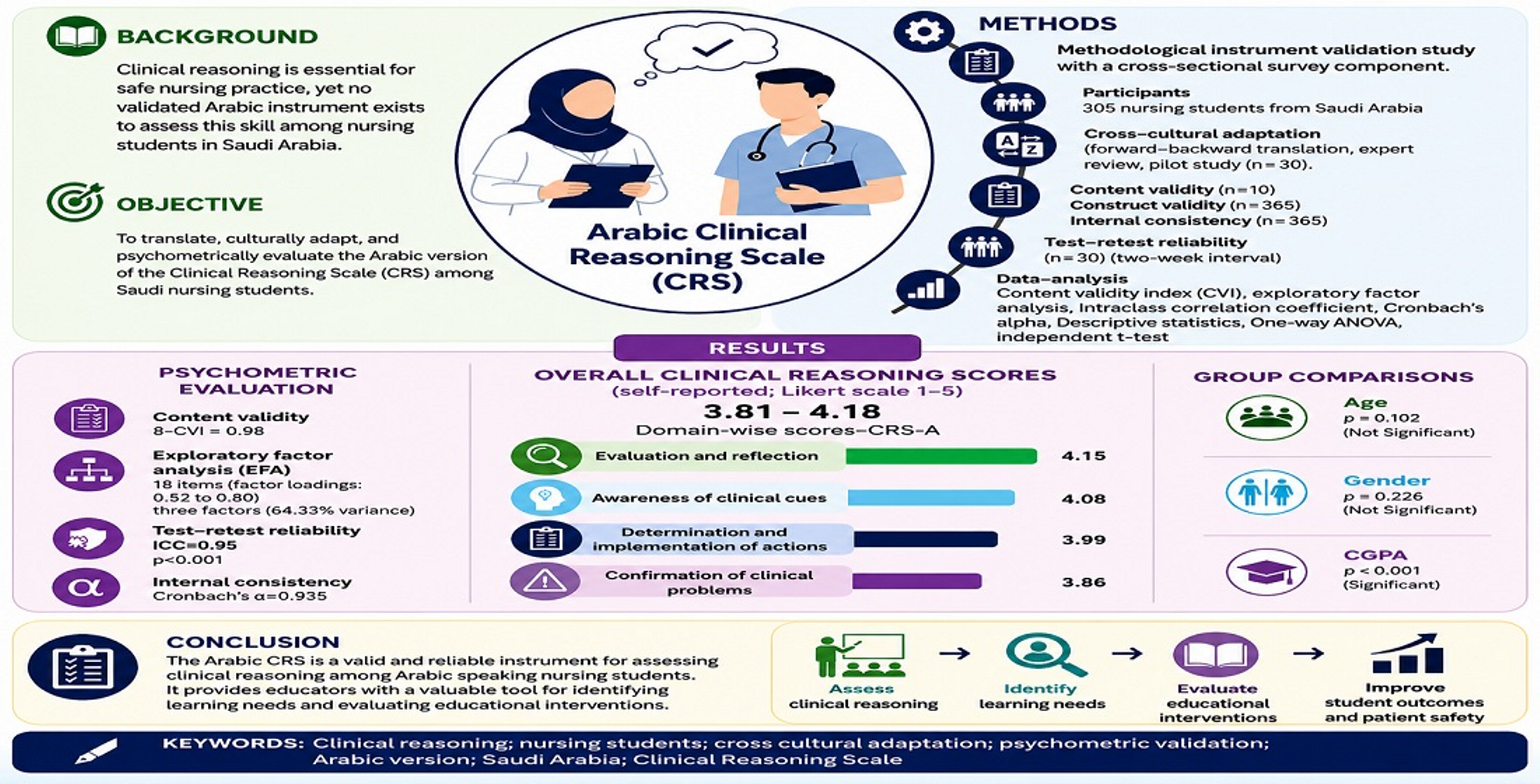

Cross-Cultural Adaptation and Psychometric Evaluation of the Arabic Clinical Reasoning Scale Among Nursing Students
 ,
,
Abstract
1. Introduction
2. Materials and Methods
2.1. The Research Design
2.2. Sample Size and Setting
Setting
2.3. Clinical Reasoning Scale (CRS) Survey Tool
2.4. Translation and Cultural Adaptation
2.5. Psychometric Evaluation of the CRS-A
2.6. Clinical Reasoning Assessment
2.7. Data Analysis Technique
2.8. Ethical Considerations
3. Results
3.1. Pilot Study Findings
3.2. Background Variables
3.3. Content Validity
3.4. Construct Validity
3.5. Test–Retest Reliability (ICC)
3.6. Internal Consistency
3.7. Descriptive Statistics of the Arabic Clinical Reasoning Scale Items
3.8. Comparison of Clinical Reasoning Scores with Background Variables
3.8.1. Comparison of Clinical Reasoning Scores by Gender
3.8.2. Comparison of Clinical Reasoning Scores by Age Group
3.8.3. Comparison of Clinical Reasoning Scores by Academic Performance
4. Discussion
5. Conclusions
Supplementary Materials
Author Contributions
Funding
Institutional Review Board Statement
Informed Consent Statement
Data Availability Statement
Public Involvement Statement
Guidelines and Standards Statement
Use of Artificial Intelligence
Acknowledgments
Conflicts of Interest
Abbreviations
| CRS | Clinical Reasoning Scale |
| CRS-A | Arabic Clinical Reasoning Scale |
| CGPA | Cumulative Grade Point Average |
| CV | Content Validity |
| I-CVI | Item-wise Content Validity Index |
| ICC | Intraclass Correlation Coefficient |
| S-CVI/Ave | Scale-wise Content Validity Index by average method |
| S-CVI/UA | Scale-wise Content Validity Index by universal agreement method |
References
- Bae, J.; Lee, J.; Choi, M.; Jang, Y.; Park, C.G.; Lee, Y.J. Development of the Clinical Reasoning Competency Scale for Nurses. BMC Nurs. 2023, 22, 138. [Google Scholar] [CrossRef]
- Lewis, L.S.; Rebeschi, L.M.; Hunt, E. Nursing Education Practice Update 2022: Competency-Based Education in Nursing. Sage Open Nurs. 2022, 8, 23779608221140774. [Google Scholar] [CrossRef] [PubMed]
- Melnyk, B.M.; Tan, A.; Hsieh, A.P.; Gawlik, K.; Arslanian-Engoren, C.; Braun, L.T.; Dunbar, S.; Dunbar-Jacob, J.; Lewis, L.M.; Millan, A.; et al. Critical Care Nurses’ Physical and Mental Health, Worksite Wellness Support, and Medical Errors. Am. J. Crit. Care 2021, 30, 176–184. [Google Scholar] [CrossRef] [PubMed]
- Dickison, P.; Haerling, K.A.; Lasater, K. Integrating the National Council of State Boards of Nursing Clinical Judgment Model into Nursing Educational Frameworks. J. Nurs. Educ. 2019, 58, 72–78. [Google Scholar] [CrossRef] [PubMed]
- Giddens, J.; Douglas, J.P.; Conroy, S. The Revised AACN Essentials: Implications for Nursing Regulation. J. Nurs. Regul. 2022, 12, 16–22. [Google Scholar] [CrossRef]
- Njie-Mokonya, N. Exploring Clinical Reasoning and Judgement Processes Among New Graduate Nurses. Ph.D. Thesis, University of Ottawa, Ottawa, ON, Canada, 2024. Available online: https://ruor.uottawa.ca/items/e342ea5e-595f-45b1-8f3a-934060d4a484 (accessed on 9 May 2026).
- Griffits, S.; Hines, S.; Moloney, C. Characteristics and Processes of Registered Nurses’ Clinical Reasoning and Factors Relating to the Use of Clinical Reasoning in Practice: A Scoping Review. JBI Evid. Synth. 2023, 21, 713–743. [Google Scholar] [CrossRef] [PubMed]
- Mohammadi-Shahboulaghi, F.; Khankeh, H.; HosseinZadeh, T. Clinical Reasoning in Nursing Students: A Concept Analysis. Nurs. Forum 2021, 56, 1008–1014. [Google Scholar] [CrossRef] [PubMed]
- AL-Dossary, R.N.; Dorgham, S.R.A.; Maniago, J.D. Perceptions of Clinical Decision-Making Skills among Saudi Nursing Students: A Comparative Study. J. Health Allied Sci. NU 2019, 9, 91–97. [Google Scholar] [CrossRef]
- Alotaibi, A.; Saleh, W.; Abdulbaqi, A.; Alosaimi, M. Health Research Priority Agenda for Ministry of Health, Kingdom of Saudi Arabia from 2020 to 2025. J. Epidemiol. Glob. Health 2022, 12, 413–429. [Google Scholar] [CrossRef] [PubMed]
- Alhejaili, A. How Do Students Obtain Evidence-Based Health Information? A Study of Nursing Interns in Clinical Practice in Saudi Arabia. Ph.D. Thesis, University of Nottingham, Nottingham, UK, 2023. Available online: https://search.proquest.com/openview/7fd979c643a8d16710a466a6b02f8310/1?pq-origsite=gscholar&cbl=2026366&diss=y (accessed on 9 May 2026).
- Al-Thubaity, D.D. The Ability of Newly Qualified Saudi Nurses Working on Paediatric Wards to Recognise a Deteriorating Child: Can a Focused Educational Intervention Impact on This? Ph.D. Thesis, University of Central Lancashire, Preston, UK, 2019. Available online: https://clok.uclan.ac.uk/29719/1/29719%20Al%20Thubaity%20Daifallah%20Final%20e-Thesis%20(Master%20Copy).pdf (accessed on 9 May 2026).
- Guerrero, J.G.; Rosales, N.S.; Castro, G.M.T. Impact of High-fidelity Simulation Exposure of Nursing Students with Their Objective Structured Clinical Examination: A Quasi-experimental Study. Nurs. Open 2023, 10, 765–772. [Google Scholar] [CrossRef] [PubMed]
- Huang, H.-M.; Huang, C.-Y.; Lee-Hsieh, J.; Cheng, S.-F. Establishing the Competences of Clinical Reasoning for Nursing Students in Taiwan: From the Nurse Educators’ Perspectives. Nurse Educ. Today 2018, 66, 110–116. [Google Scholar] [CrossRef] [PubMed]
- Doyon, O.; Raymond, L. Clinical Reasoning and Clinical Judgment in Nursing Research: A Bibliometric Analysis. Int. J. Nurs. Knowl. 2025, 36, 339–350. [Google Scholar] [CrossRef] [PubMed]
- Abu Arra, A.Y.; Ayed, A.; Toqan, D.; Albashtawy, M.; Salameh, B.; Sarhan, A.L.; Batran, A. The Factors Influencing Nurses’ Clinical Decision-Making in Emergency Department. INQUIRY 2023, 60, 00469580231152080. [Google Scholar] [CrossRef] [PubMed]
- Shibiru, S.; Aschalew, Z.; Kassa, M.; Bante, A.; Mersha, A. Clinical Competence of Nurses and the Associated Factors in Public Hospitals of Gamo Zone, Southern Ethiopia: A Cross-Sectional Study. Nurs. Res. Pract. 2023, 2023, 9656636. [Google Scholar] [CrossRef] [PubMed]
- Jessee, M.A. An Update on Clinical Judgment in Nursing and Implications for Education, Practice, and Regulation. J. Nurs. Regul. 2021, 12, 50–60. [Google Scholar] [CrossRef]
- Guandalini, L.S.; Santos, V.B.; Tesoro, M.G.; Maurício, A.B.; Drehmer De Almeida Cruz, E.; deLima Lopes, J.; Lopes, C.T.; Bottura Leite De Barros, A.L. Cross-Cultural Adaptation for Brazil and Validity of a Guide to Assist Nursing Students’ Clinical Reasoning. Int. J. Nurs. Knowl. 2022, 33, 215–224. [Google Scholar] [CrossRef] [PubMed]
- Pesut, D. The Outcome Present State Test (OPT) Model of Clinical Reasoning: A Comparative Analysis with Other Nursing Process and Clinical Judgment Models; University of Minnesota: Minneapolis, MN, USA, 2026. [Google Scholar]
- Benner, P. From Novice to Expert Excellence and Power in Clinical Nursing Practice. Am. J. Nurs. 1984, 84, 1479. [Google Scholar] [CrossRef]
- Tanner, C.A. Thinking Like a Nurse: A Research-Based Model of Clinical Judgment in Nursing. J. Nurs. Educ. 2006, 45, 204–211. [Google Scholar] [CrossRef] [PubMed]
- Levett-Jones, T.; Hoffman, K.; Dempsey, J.; Jeong, S.Y.-S.; Noble, D.; Norton, C.A.; Roche, J.; Hickey, N. The ‘Five Rights’ of Clinical Reasoning: An Educational Model to Enhance Nursing Students’ Ability to Identify and Manage Clinically ‘at Risk’ Patients. Nurse Educ. Today 2010, 30, 515–520. [Google Scholar] [CrossRef] [PubMed]
- Huang, H.-M.; Huang, C.-Y.; Lin, K.-C.; Yu, C.-H.; Cheng, S.-F. Development and Psychometric Testing of the Clinical Reasoning Scale Among Nursing Students Enrolled in Three Types of Programs in Taiwan. J. Nurs. Res. 2023, 31, e263. [Google Scholar] [CrossRef] [PubMed]
- Lasater, K. Clinical Judgment Development: Using Simulation to Create an Assessment Rubric. J. Nurs. Educ. 2007, 46, 496–503. [Google Scholar] [CrossRef] [PubMed]
- Adamson, K.A.; Gubrud, P.; Sideras, S.; Lasater, K. Assessing the Reliability, Validity, and Use of the Lasater Clinical Judgment Rubric: Three Approaches. J. Nurs. Educ. 2012, 51, 66–73. [Google Scholar] [CrossRef] [PubMed]
- Nayer, M.; Glover Takahashi, S.; Hrynchak, P. Twelve Tips for Developing Key-Feature Questions (KFQ) for Effective Assessment of Clinical Reasoning. Med. Teach. 2018, 40, 1116–1122. [Google Scholar] [CrossRef] [PubMed]
- Aubart, F.C.; Papo, T.; Hertig, A.; Renaud, M.-C.; Steichen, O.; Amoura, Z.; Braun, M.; Palombi, O.; Duguet, A.; Roux, D. Are Script Concordance Tests Suitable for the Assessment of Undergraduate Students? A Multicenter Comparative Study. Rev. Méd. Interne 2021, 42, 243–250. [Google Scholar] [CrossRef]
- Griffits, S.; Hines, S.; Moloney, C.; Ralph, N. Characteristics and Processes of Clinical Reasoning in Nurses and Factors Related to Its Use: A Scoping Review Protocol. JBI Evid. Synth. 2017, 15, 2832–2836. [Google Scholar] [CrossRef]
- Bayzat, C.; Dinc, L. Turkish Adaptation of the Clinical Reasoning Evaluation Simulation Tool (CREST-TR): A Validity and Reliability Study. BMC Nurs. 2025, 24, 819. [Google Scholar] [CrossRef] [PubMed]
- Alzubaidi, H.; Hussein, A.; Mc Namara, K.; Scholl, I. Psychometric Properties of the Arabic Version of the 9-Item Shared Decision-Making Questionnaire: The Entire Process from Translation to Validation. BMJ Open 2019, 9, e026672. [Google Scholar] [CrossRef] [PubMed]
- Nunnally, J.C.; Bernstein, I.H. Psychometric Theory, 3rd ed.; McGraw-Hill: New York, NY, USA, 1994. [Google Scholar]
- The WHOQOL Group. The World Health Organization Quality of Life Assessment (WHOQOL): Development and General Psychometric Properties. Soc. Sci. Med. 1998, 46, 1569–1585. [Google Scholar] [CrossRef] [PubMed]
- Mokkink, L.B.; Prinsen, C.A.; Bouter, L.M.; de Vet, H.C.; Terwee, C.B. The Consensus-Based Standards for the Selection of Health Measurement Instruments (COSMIN) and How to Select an Outcome Measurement Instrument. Braz. J. Phys. Ther. 2016, 20, 105–113. [Google Scholar] [CrossRef] [PubMed]
- Yusoff, M.S.B. ABC of Content Validation and Content Validity Index Calculation. Educ. Med. J. 2019, 11, 49–54. [Google Scholar] [CrossRef]
- Polit, D.F.; Beck, C.T. Nursing Research: Generating and Assessing Evidence for Nursing Practice; Lippincott Williams & Wilkins: Philadelphia, PA, USA, 2021. [Google Scholar]
- Ebadi, A.; Zarshenas, L.; Rakhshan, M.; Zareiyan, A.; Sharifnia, S.; Mojahedi, M. Principles of Scale Development in Health Science; Jame-e-Negar: Tehran, Iran, 2017; Volume 6, p. 402. [Google Scholar]
- Streiner, D.L.; Norman, G.R.; Cairney, J. Health Measurement Scales: A Practical Guide to Their Development and Use, 6th ed.; Oxford University Press: Oxford, UK, 2024. [Google Scholar]
- Koo, T.K.; Li, M.Y. A Guideline of Selecting and Reporting Intraclass Correlation Coefficients for Reliability Research. J. Chiropr. Med. 2016, 15, 155–163. [Google Scholar] [CrossRef] [PubMed]
- Taber, K.S. The Use of Cronbach’s Alpha When Developing and Reporting Research Instruments in Science Education. Res. Sci. Educ. 2018, 48, 1273–1296. [Google Scholar] [CrossRef]
- Yong, A.G.; Pearce, S. A Beginner’s Guide to Factor Analysis: Focusing on Exploratory Factor Analysis. Quant. Methods Psychol. 2013, 9, 79–94. [Google Scholar] [CrossRef]
- Kaiser, H.F. An Index of Factorial Simplicity. Psychometrika 1974, 39, 31–36. [Google Scholar] [CrossRef]
- Kaiser, H.F. The Application of Electronic Computers to Factor Analysis. Educ. Psychol. Meas. 1960, 20, 141–151. [Google Scholar] [CrossRef]
- Tavakol, M.; Dennick, R. Making Sense of Cronbach’s Alpha. Int. J. Med. Educ. 2011, 2, 53. [Google Scholar] [CrossRef] [PubMed]
- Usry, J.; Partington, S.W.; Partington, J.W. Using Expert Panels to Examine the Content Validity and Inter-Rater Reliability of the ABLLS-R. J. Dev. Phys. Disabil. 2018, 30, 27–38. [Google Scholar] [CrossRef]
- Bijani, M.; Pourshahri, E.; Kouhpayeh, S.A.; Bae, J.; Taghinezhad, A. Translation, Cultural Adaptation, and Psychometric Validation of the Persian Version of the Clinical Reasoning Competency Scale (CRCS) for Nurses in Iran. J. Adv. Biomed. Sci. 2025, 15, 309–318. [Google Scholar]
- Sousa, V.D.; Rojjanasrirat, W. Translation, Adaptation and Validation of Instruments or Scales for Use in Cross-cultural Health Care Research: A Clear and User-friendly Guideline. Eval. Clin. Pract. 2011, 17, 268–274. [Google Scholar] [CrossRef] [PubMed]
- Na-Na, G.; Xiao, A.; Yu, X.; Ya-Ting, X.; Hong, W. Mediating Effect of Intolerance of Uncertainty between Critical Thinking and Clinical Reasoning in Nursing Undergraduates. J. Nurs. 2025, 32, 1–6. [Google Scholar]
- Kaur, G. Assessment of Clinical Reasoning Skills among BSc Nursing Students: Script Concordance Test. Nurs. J. India 2021, 112, 153–156. [Google Scholar] [CrossRef]
- Xu, H.-Y.; Wang, X.-J. Analysis of the Current Situation and Factors Influencing the Clinical Thinking Ability of Nursing Undergraduates. Altern. Ther. Health Med. 2023, 29, 200–208. [Google Scholar] [PubMed]


| Items | Raters | Experts in Agreement | I-CVI | UA | ||||||||||
|---|---|---|---|---|---|---|---|---|---|---|---|---|---|---|
| 1 | 2 | 3 | 4 | 5 | 6 | 7 | 8 | 9 | 10 | |||||
| Q1 | 1 | 1 | 1 | 1 | 1 | 1 | 1 | 1 | 1 | 1 | 10 | 1 | 1 | |
| Q2 | 1 | 1 | 1 | 1 | 1 | 1 | 1 | 1 | 1 | 1 | 10 | 1 | 1 | |
| Q3 | 1 | 1 | 1 | 1 | 1 | 1 | 1 | 1 | 1 | 1 | 10 | 1 | 1 | |
| Q4 | 1 | 1 | 1 | 1 | 1 | 1 | 0 | 1 | 1 | 1 | 9 | 0.9 | 0 | |
| Q5 | 1 | 1 | 1 | 1 | 1 | 1 | 1 | 1 | 1 | 1 | 10 | 1 | 1 | |
| Q6 | 1 | 1 | 1 | 1 | 1 | 1 | 1 | 1 | 1 | 1 | 10 | 1 | 1 | |
| Q7 | 1 | 1 | 1 | 1 | 1 | 1 | 1 | 1 | 1 | 1 | 10 | 1 | 1 | |
| Q8 | 1 | 1 | 1 | 1 | 1 | 1 | 0 | 1 | 1 | 1 | 9 | 0.9 | 0 | |
| Q9 | 1 | 1 | 1 | 1 | 1 | 1 | 1 | 1 | 1 | 1 | 10 | 1 | 1 | |
| Q10 | 1 | 1 | 1 | 1 | 1 | 1 | 1 | 1 | 1 | 1 | 10 | 1 | 1 | |
| Q11 | 1 | 1 | 1 | 1 | 1 | 1 | 1 | 1 | 1 | 1 | 10 | 1 | 1 | |
| Q12 | 1 | 1 | 1 | 1 | 1 | 1 | 1 | 1 | 1 | 1 | 10 | 1 | 1 | |
| Q13 | 1 | 1 | 1 | 1 | 1 | 1 | 1 | 1 | 1 | 1 | 10 | 1 | 1 | |
| Q14 | 1 | 1 | 1 | 1 | 1 | 1 | 1 | 1 | 1 | 1 | 10 | 1 | 1 | |
| Q15 | 1 | 1 | 1 | 1 | 1 | 1 | 1 | 1 | 1 | 1 | 10 | 1 | 1 | |
| Q16 | 1 | 1 | 1 | 1 | 1 | 1 | 1 | 1 | 1 | 1 | 10 | 1 | 1 | |
| S-CVI/Ave | 0.98 | |||||||||||||
| Proportion relevance | 1 | 1 | 1 | 1 | 1 | 1 | 0.85 | 1 | 1 | 1 | S-CVI/UA | 0.85 | ||
| Average percentage of items deemed pertinent by ten experts | 0.98 | |||||||||||||
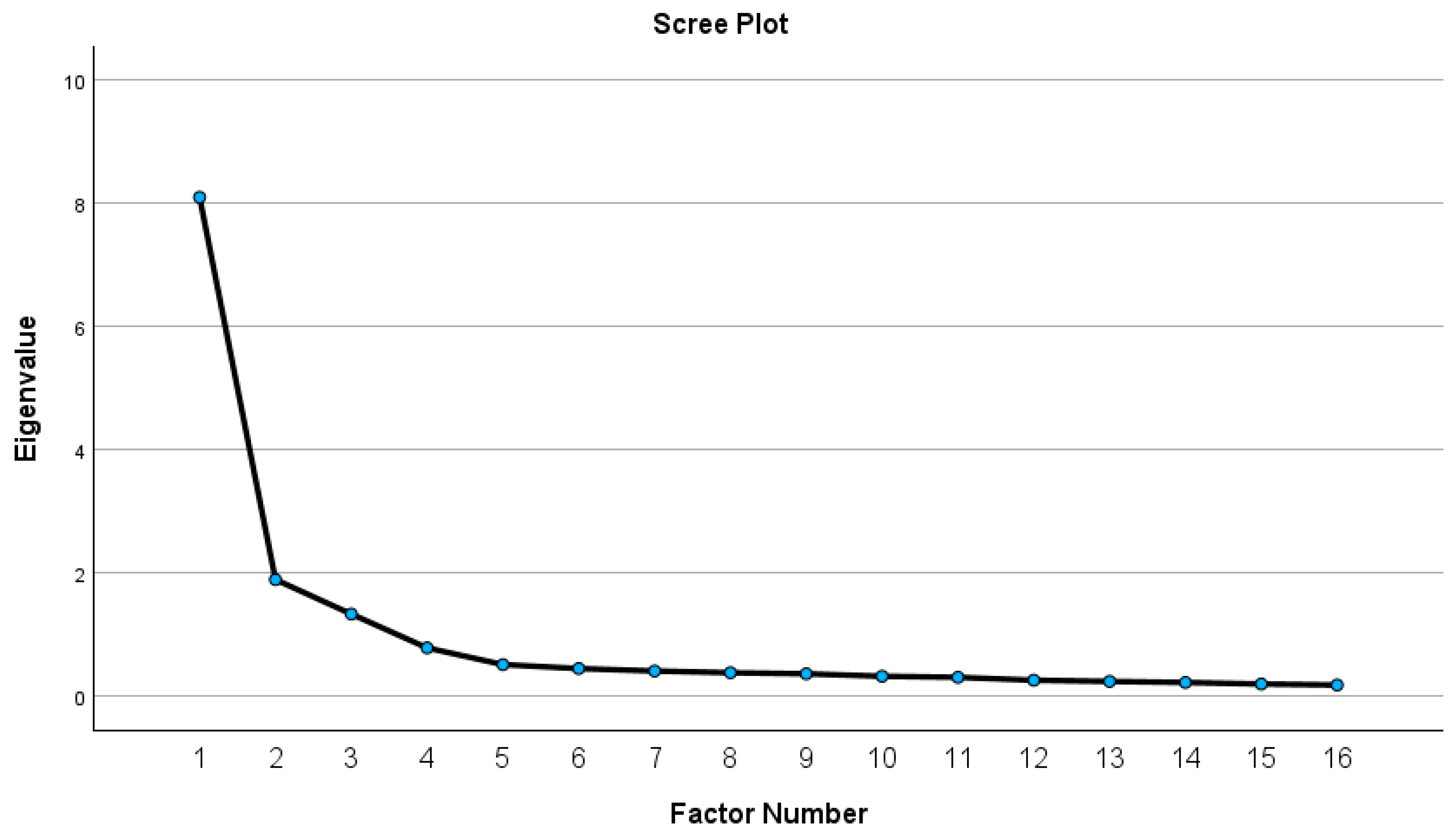
| Factors | Initial Eigenvalues | Extraction Sums of Squared Loadings | Rotation Sums of Squared Loadings | ||||||
|---|---|---|---|---|---|---|---|---|---|
| Total | % of Variance | Cumulative % | Total | % of Variance | Cumulative % | Total | % of Variance | Cumulative % | |
| 1 | 8.101 | 50.633 | 50.633 | 7.745 | 48.408 | 48.408 | 3.706 | 23.161 | 23.161 |
| 2 | 1.896 | 11.848 | 62.481 | 1.545 | 9.653 | 58.061 | 3.32 | 20.747 | 43.908 |
| 3 | 1.337 | 8.354 | 70.835 | 1.003 | 6.269 | 64.33 | 3.268 | 20.422 | 64.33 |
| 4 | 0.787 | 4.92 | 75.755 | ||||||
| 5 | 0.515 | 3.22 | 78.975 | ||||||
| 6 | 0.452 | 2.823 | 81.798 | ||||||
| 7 | 0.411 | 2.571 | 84.37 | ||||||
| 8 | 0.384 | 2.401 | 86.771 | ||||||
| 9 | 0.366 | 2.289 | 89.06 | ||||||
| 10 | 0.326 | 2.04 | 91.1 | ||||||
| 11 | 0.309 | 1.93 | 93.03 | ||||||
| 12 | 0.262 | 1.638 | 94.668 | ||||||
| 13 | 0.243 | 1.517 | 96.185 | ||||||
| 14 | 0.225 | 1.408 | 97.593 | ||||||
| 15 | 0.2 | 1.253 | 98.846 | ||||||
| 16 | 0.185 | 1.154 | 100 | ||||||
| Items | Factor | ||
|---|---|---|---|
| 1 | 2 | 3 | |
| 1 | 0.138 | 0.204 | 0.778 |
| 2 | 0.154 | 0.265 | 0.717 |
| 3 | 0.194 | 0.175 | 0.807 |
| 4 | 0.301 | 0.175 | 0.692 |
| 5 | 0.542 | 0.135 | 0.489 |
| 6 | 0.605 | 0.126 | 0.482 |
| 7 | 0.758 | 0.146 | 0.391 |
| 8 | 0.675 | 0.252 | 0.329 |
| 9 | 0.671 | 0.405 | 0.118 |
| 10 | 0.628 | 0.4 | 0.156 |
| 11 | 0.642 | 0.472 | 0.066 |
| 12 | 0.548 | 0.539 | 0.106 |
| 13 | 0.351 | 0.679 | 0.234 |
| 14 | 0.293 | 0.703 | 0.282 |
| 15 | 0.232 | 0.791 | 0.207 |
| 16 | 0.157 | 0.782 | 0.237 |
| Measures | ICC | Confidence Interval 95% | F Test for ICC | p-Value | |||
|---|---|---|---|---|---|---|---|
| Lower Bound | Upper Bound | Value | df1 | df2 | |||
| Single measures | 0.949 a | 0.896 | 0. 985 | 38.50 | 29 | 29 | <0.001 |
| Average measures | 0.974 c | 0.945 | 0.987 | 38.40 | 29 | 29 | <0.001 |
| Items | Mean | SD |
|---|---|---|
| Awareness of clinical cues | ||
| I can notice the patient’s needs when I get in contact with the patient. | 4.10 | 0.69 |
| I can notice the patient’s potential health concerns based on the clinical cues I have observed. | 4.04 | 0.69 |
| I can use various data collection methods (such as medical history, physical assessment) to collect clues pertinent to the problem | 4.09 | 0.69 |
| My clinical practical experience can help me to detect a patient’s health concerns. | 4.06 | 0.66 |
| Confirmation of clinical problems | ||
| I can collect all the data on an abnormality before I confirm a patient’s health problems. | 3.81 | 0.75 |
| I can explain the connection between observed cues and a patient’s health problems. | 3.86 | 0.73 |
| I can identify a patient’s health problems by synthesizing the cues collected. | 3.87 | 0.71 |
| I can use theories and nursing knowledge to interpret clinical cues to determine a patient’s health problems. | 3.91 | 0.75 |
| Determination and implementation of actions | ||
| I can think through problem-solving steps before resolving patient issues. | 4.0 | 0.73 |
| I can set a goal for problem-solving based on a patient’s condition. | 3.98 | 0.72 |
| I can find the most appropriate solution based on a patient’s condition. | 3.99 | 0.70 |
| I can provide theory- and evidence-based nursing interventions | 4.0 | 0.71 |
| Evaluation and reflection | ||
| I can evaluate whether a patient’s problems are resolved. | 4.13 | 0.71 |
| I can evaluate effectiveness of problem solving from a variety of aspects. | 4.09 | 0.69 |
| I can re-evaluate a patient’s needs if the problem is not resolved. | 4.18 | 0.70 |
| I can reflect on the steps of problem solving for improvement whether the problem is resolved or not. | 4.18 | 0.69 |
| Domain-Wise Scores of Clinical Reasoning Scale—Arabic Version | ||||
|---|---|---|---|---|
| Minimum | Maximum | Mean | Std. Deviation | |
| Awareness of clinical cues | 2.00 | 5.00 | 4.08 | 0.59 |
| Confirmation of clinical problems | 1.75 | 5.00 | 3.86 | 0.64 |
| Determination and implementation of actions | 1.75 | 5.00 | 3.99 | 0.62 |
| Evaluation and reflection | 1.75 | 5.00 | 4.15 | 0.61 |
| Gender | CR Score | t-Test | p-Value | ||||
|---|---|---|---|---|---|---|---|
| Frequency | % | Mean | SD | ||||
| CRS Scores | Male | 68 | 19 | 65.86 | 10.11 | 1.21 | 0.23 |
| Female | 297 | 81 | 64.12 | 7.80 | |||
| Age Group | Frequency | % | CR Score | F-Test | p-Value | ||
|---|---|---|---|---|---|---|---|
| Mean | SD | ||||||
| CRS Scores | 18–23 Years | 179 | 49.04 | 65.26 | 8.28 | 2.08 | 0.102 |
| 24–29 Years | 96 | 26.30 | 62.76 | 8.47 | |||
| 30–35 Years | 62 | 16.99 | 64.03 | 6.97 | |||
| >35 years | 28 | 7.67 | 63.86 | 6.80 | |||
| CGPA | Frequency | % | CR Score | F-Test | p-Value | ||
|---|---|---|---|---|---|---|---|
| Mean | SD | ||||||
| CRS Scores | Excellent (4.75–5) | 42 | 11.5 | 65.54 | 7.37 | 6.19 | <0.001 |
| Very good (3.75–4.74) | 219 | 60.0 | 65.31 | 7.73 | |||
| Good (2.75–3.74) | 97 | 26.6 | 61.34 | 8.33 | |||
| Satisfactory (2–2.74) | 7 | 1.9 | 65.42 | 9.55 | |||
| Factor/Name | Items |
|---|---|
| 1. Confirmation of clinical problems and determination and implementation of actions | 5. I can collect all the data on an abnormality before I confirm a patient’s health problems. يمكنني جمع كافة البيانات عن أي حالة غير طبيعية قبل التأكد من المشاكل الصحية للمريض. |
| 6. I can explain the connection between observed clues and a patient’s health problems. أستطيع أن أشرح العلاقة بين الاعراض والعلامات الملاحظة والمشاكل الصحية للمريض. | |
| 7. I can identify a patient’s health problems by synthesizing the clues collected. يمكنني التعرف على المشاكل الصحية للمريض من خلال تحليل القرائن التي جمعتها. | |
| 8. I can use theories and nursing knowledge to interpret clinical clues to determine a patient’s health problems. يمكنني استخدام النظريات ومعلومات التمريض لتفسير القرائن السريرية لتحديد المشكلات الصحية للمريض. | |
| 9. I can think through the problem-solving steps before resolving patient issues. يمكنني التفكير من خلال استخدام خطوات حل المشكلات قبل حل مشكلات المرضى. | |
| 10. I can set a goal for problem solving based on a patient’s condition. يمكنني تحديد هدف لحل المشكلات بناءً على حالة المريض | |
| 11. I can find the most appropriate solution based on a patient’s condition. يمكنني العثور على الحل الأنسب بناءً على حالة المريض. | |
| 12. I can provide theory- and evidence-based nursing interventions. يمكنني تقديم تدخلات تمريضية قائمة على النظرية والأدلة. | |
| 2. Evaluation and reflection | 13. I can evaluate whether a patient’s problems are resolved. يمكنني تقييم ما إذا كانت مشاكل المريض قد تم حلها أم لا. |
| 14. I can evaluate effectiveness of problem solving from a variety of aspects. يمكنني تقييم فعالية حل المشكلة من جوانب مختلفة | |
| 15. I can re-evaluate a patient’s needs if the problem is not resolved. يمكنني إعادة تقييم احتياجات المريض إذا لم يتم حل المشكلة. | |
| 16. I can reflect on the steps of problem solving for improvement whether the problem is resolved or not. يمكنني التفكير في خطوات حل المشكلات للتحسين سواء تم حل المشكلة أم لا | |
| 3. Awareness of clinical cues | 1. I can notice patient’s needs when I get in contact with the patient. أستطيع أن ألاحظ احتياجات المريض عندما أتواصل معه. |
| 2. I can notice patient’s potential health concerns based on the clinical clues I have observed. أستطيع أن ألاحظ المخاوف الصحية المحتملة للمريض بناءً على القرائن السريرية التي لاحظتها | |
| 3. I can use various data collection methods (such as medical history, physical assessment) to collect clues pertinent to the problem. لجمع الأدلة ذات الصلة بالمشكلة الصحية (مثل التاريخ الطبي والتقييم البدن) يمكنني استخدام طرق مختلفة لجمع البيانات | |
| 4. My clinical practical experiences can help me to detect a patient’s health concerns. يمكن أن تساعدني تجاربي العملية السريرية على اكتشاف مخاوف المريض الصحية. |
Disclaimer/Publisher’s Note: The statements, opinions and data contained in all publications are solely those of the individual author(s) and contributor(s) and not of MDPI and/or the editor(s). MDPI and/or the editor(s) disclaim responsibility for any injury to people or property resulting from any ideas, methods, instructions or products referred to in the content. |
© 2026 by the authors. Licensee MDPI, Basel, Switzerland. This article is an open access article distributed under the terms and conditions of the Creative Commons Attribution (CC BY) license.
Share and Cite
Kunjan, M.K.; Seethalakshmi, A.; Arulanantham, Z.J.; Nagalakshmi, S. Cross-Cultural Adaptation and Psychometric Evaluation of the Arabic Clinical Reasoning Scale Among Nursing Students. Nurs. Rep. 2026, 16, 214. https://doi.org/10.3390/nursrep16070214
Kunjan MK, Seethalakshmi A, Arulanantham ZJ, Nagalakshmi S. Cross-Cultural Adaptation and Psychometric Evaluation of the Arabic Clinical Reasoning Scale Among Nursing Students. Nursing Reports. 2026; 16(7):214. https://doi.org/10.3390/nursrep16070214
Chicago/Turabian StyleKunjan, Minimole Kalarickal, Avudaippan Seethalakshmi, Zechariah Jebakumar Arulanantham, and Sethuraman Nagalakshmi. 2026. "Cross-Cultural Adaptation and Psychometric Evaluation of the Arabic Clinical Reasoning Scale Among Nursing Students" Nursing Reports 16, no. 7: 214. https://doi.org/10.3390/nursrep16070214
APA StyleKunjan, M. K., Seethalakshmi, A., Arulanantham, Z. J., & Nagalakshmi, S. (2026). Cross-Cultural Adaptation and Psychometric Evaluation of the Arabic Clinical Reasoning Scale Among Nursing Students. Nursing Reports, 16(7), 214. https://doi.org/10.3390/nursrep16070214