
A Comparative Analysis of Pre-Exposure Prophylaxis Awareness, Acceptance, and Barriers Among Populations of Men Who Have Sex with Men in Global Settings: An Integrative Literature Review



Abstract
1. Introduction
1.1. Rationale for the Study
1.2. Study Objective
2. Methods
2.1. Study Design
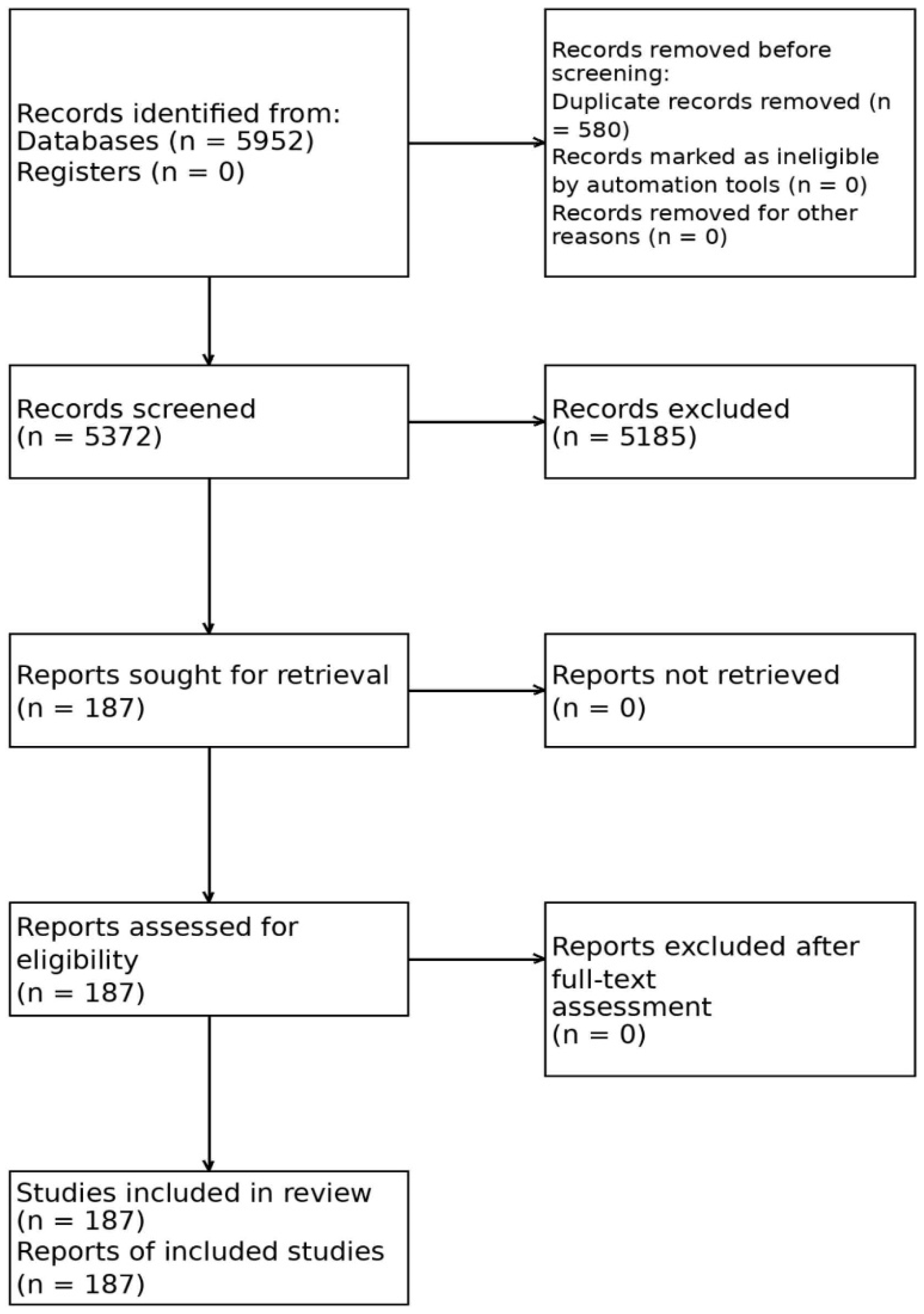
2.2. Study Procedure
2.3. Problem Identification
2.4. Literature Search
2.5. Quality Appraisal
2.6. Data Extraction and Synthesis
3. Results
3.1. Characteristics of Included Studies
3.2. Institutional Foundations and Economic Accessibility of PrEP: How Policy Environments Shape Uptake
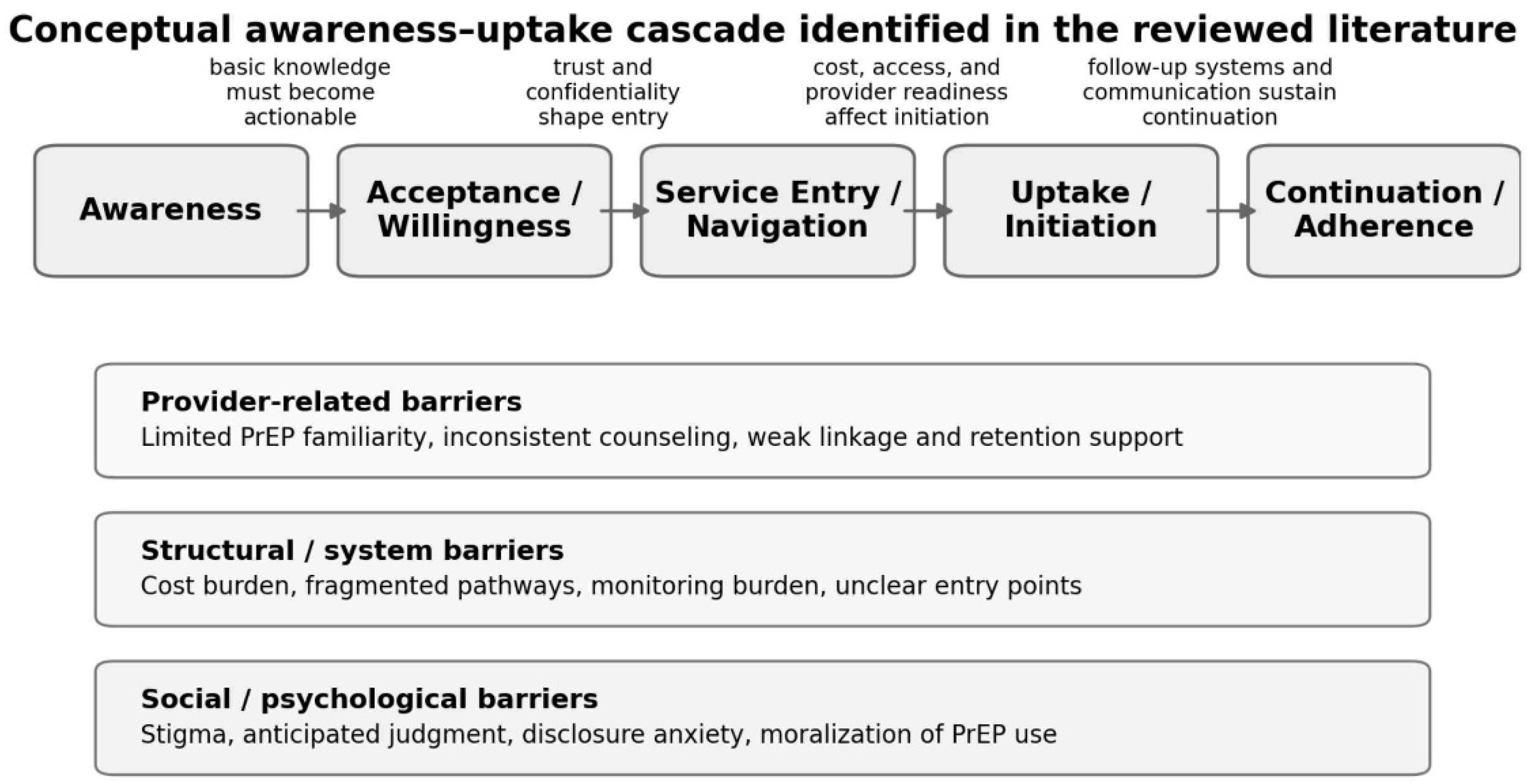
3.3. PrEP Awareness and Acceptance Among MSM Populations: Information Asymmetry and the Formation of the Awareness–Uptake Gap
3.4. Multidimensional Barriers Driving the Awareness–Uptake Gap: Stigma, Privacy, Institutional/System Factors, and Provider Factors
4. Discussion
5. Conclusions and Recommendations
Author Contributions
Funding
Institutional Review Board Statement
Informed Consent Statement
Data Availability Statement
Public Involvement Statement
Guidelines and Standards Statement
Use of Artificial Intelligence
Conflicts of Interest
References
- Ribeiro Banze, Á.; Muleia, R.; Nuvunga, S.; Boothe, M.; Semá Baltazar, C. Trends in HIV prevalence and risk factors among men who have sex with men in Mozambique: Implications for targeted interventions and public health strategies. BMC Public. Health 2024, 24, 1185. [Google Scholar] [CrossRef] [Scilit]
- Korea Disease Control and Prevention Agency. 2024 HIV/AIDS Registration Status Report. 2025. Available online: https://dportal.kdca.go.kr/pot/bbs/BD_selectBbsList.do?q_bbsSn=1010&q_clsfNo=1 (accessed on 10 April 2026).
- Anderson, P.L.; Glidden, D.V.; Liu, A.; Buchbinder, S.; Lama, J.R.; Guanira, J.V.; McMahan, V.; Bushman, L.R.; Casapia, M.; Montoya-Herrera, O.; et al. Emtricitabine-tenofovir concentrations and pre-exposure prophy laxis efficacy in men who have sex with men. Sci. Transl. Med. 2012, 4, 151ra125. [Google Scholar] [CrossRef] [Scilit]
- Krakower, D.S.; Mayer, K.H. The role of healthcare providers in the roll out of preexposure prophylaxis. Curr. Opin. HIV AIDS 2016, 11, 41–48. [Google Scholar] [CrossRef] [Scilit] [PubMed]
- Chang, H.H.; Kim, S.-W.; Jung, H.; Lee, S.A.; Park, H.K.; Kim, S.; Lee, J.M.; Choi, J.Y. Awareness and acceptance of HIV pre-exposure prophylaxis among medical personnel and men who have sex with men in Korea. J. Korean Med. Sci. 2018, 33, e91. [Google Scholar] [CrossRef] [Scilit]
- Baek, Y.J.; Lee, Y.; Lee, J.A.; Ahn, S.; Han, M.; Seong, J.; Lee, S.-G.; Kim, J.H.; Ahn, J.Y.; Choi, J.Y. Sexual risk compensation and retention in PrEP care in Korea: An HIV PrEP demonstration study. J. Korean Med. Sci. 2025, 40, e102. [Google Scholar] [CrossRef] [Scilit] [PubMed]
- Whittemore, R.; Knafl, K. The integrative review: Updated methodology. J. Adv. Nurs. 2005, 52, 546–553. [Google Scholar] [CrossRef] [Scilit] [PubMed]
- United States Preventive Services Task Force. Preexposure prophylaxis for the prevention of HIV infection: US Preventive Services Task Force recommendation statement. JAMA 2019, 321, 2203–2213. [Google Scholar] [CrossRef] [Scilit]
- United States Preventive Services Task Force. Preexposure prophylaxis to prevent acquisition of HIV: US Preventive Services Task Force recommendation statement. JAMA 2023, 330, 736–745. [Google Scholar] [CrossRef] [Scilit]
- Centers for Disease Control and Prevention. Preexposure Prophylaxis for the Prevention of HIV Infection in the United States-2021 Update: A Clinical Practice Guideline; U.S. Department of Health and Human Services: Washington, DC, USA, 2021. Available online: https://stacks.cdc.gov/view/cdc/112360 (accessed on 10 April 2026).
- Centers for Disease Control and Prevention. Ending the HIV Epidemic in the US (EHE). 2024. Available online: https://www.cdc.gov/endhiv/index.html (accessed on 10 April 2026).
- Centers for Disease Control and Prevention. Clinical Guidance for PrEP. HIV Nexus. 2025. Available online: https://www.cdc.gov/hivnexus/hcp/prep/index.html (accessed on 10 April 2026).
- U.S. Department of Labor; U.S. Department of Health and Human Services; U.S. Department of the Treasury. FAQs About Affordable Care Act and Women’s Health and Cancer Rights Act Implementation: Part 68. 2024. Available online: https://www.cms.gov/files/document/faqs-implementation-part-68.pdf (accessed on 10 April 2026).
- Chemnasiri, T.; Varangrat, A.; Amico, K.R.; Chitwarakorn, A.; Dye, B.J.; Grant, R.M.; Holtz, T.H.; HPTN 067/ADAPT Study Team. Facilitators and barriers affecting PrEP adherence among Thai men who have sex with men (MSM) in the HPTN 067/ADAPT study. AIDS Care 2020, 32, 249–254. [Google Scholar] [CrossRef] [Scilit]
- Newman, P.A.; Tepjan, S.; Fongkaew, K.; Akkakanjanasupar, P.; de Lind van Wijngaarden, J.W.; Chonwanarat, N. Multilevel factors impacting PrEP engagement among young gay men and young transgender women in Thailand: A qualitative analysis. J. Int. Assoc. Provid. AIDS Care 2023, 22, 23259582231188221. [Google Scholar] [CrossRef] [Scilit]
- Peng, L.; Cao, W.; Gu, J.; Hao, C.; Li, J.; Wei, D.; Li, J. Willingness to use and adhere to HIV pre-exposure prophylaxis (PrEP) among men who have sex with men (MSM) in China. Int. J. Environ. Res. Public. Health 2019, 16, 2620. [Google Scholar] [CrossRef] [Scilit]
- Liu, Y.; Xian, Y.; Liu, X.; Cheng, Z.; Wei, S.; Wang, J.; Chen, J.; Li, C.; Ma, J.; Yang, J.; et al. Significant insights from a national survey in China: PrEP awareness, willingness, uptake, and adherence among YMSM students. BMC Public. Health 2024, 24, 1009. [Google Scholar] [CrossRef] [Scilit]
- Buffel, V.; Reyniers, T.; Masquillier, C.; Thunissen, E.; Nöstlinger, C.; Laga, M.; Wouters, E.; Berghe, W.V.; Deblonde, J.; Vuylsteke, B. Awareness of, willingness to take PrEP and its actual use among Belgian MSM at high risk of HIV infection: Secondary analysis of the Belgian European MSM Internet Survey. AIDS Behav. 2022, 26, 1793–1807. [Google Scholar] [CrossRef] [Scilit]
- Di Ciaccio, M.; Villes, V.; Delabre, R.M.; Alain, T.; Morel, S.; Michels, D.; Schmidt, A.J.; Rojas Castro, D. When awareness is not a barrier to PrEP uptake among men who have sex with men who are eligible for PrEP in France. AIDS Care 2024, 36, 390–399. [Google Scholar] [CrossRef] [Scilit]
- Hoagland, B.; De Boni, R.B.; Moreira, R.I.; Valdez Madruga, J.; Kallas, E.G.; Goulart, S.P.; Cerqueira, N.; Torres, T.S.; Luz, P.M.; Fernandes, N.M.; et al. Awareness and willingness to use pre-exposure prophylaxis (PrEP) among men who have sex with men and transgender women in Brazil. AIDS Behav. 2017, 21, 1278–1287. [Google Scholar] [CrossRef] [Scilit] [PubMed]
- Blair, K.J.; Torres, T.S.; Hoagland, B.; Bezerra, D.R.B.; Veloso, V.G.; Grinsztejn, B.; Costa, A.B. Pre-exposure pro- phylaxis use, HIV knowledge, and internalized homonegativity among men who have sex with men in Brazil. Lancet Reg. Health-Am. 2022, 6, 100152. [Google Scholar] [CrossRef] [Scilit] [PubMed]
- Batista, D.R.; Davila, R.N.; dos Santos, A.C.; Rocha, F.Q.; Araujo, J.A.; Alencar, A.C.; Nascimento, L.R.; de Araujo, N.D.; Pinto Lopes, S.C.; Saraiva Araujo, P. Perception and barriers to access pre-exposure prophylaxis for HIV/AIDS (PrEP) among the MSM (men who have sex with men) Brazilian Amazon: A qualitative study. PLoS ONE 2024, 19, e0296201. [Google Scholar] [CrossRef] [Scilit] [PubMed]
- Coulaud, P.-J.; Sagaon-Teyssier, L.; Mrenda, B.M.; Maradan, G.; N’Diaye, I.; Cisse, M.; Idohou-Dossou, N.; Aho, A.; Diabate, S.; d’Almeida, K.W.; et al. Interest in HIV pre- exposure prophylaxis in men who have sex with men in West Africa (CohMSM ANRS 12324-Expertise France). Trop. Med. Int. Health 2018, 23, 1084–1091. [Google Scholar] [CrossRef] [Scilit]
- Karuga, R.N.; Njenga, S.N.; Mulwa, R.; Kilonzo, N.; Bahati, P.; O’Reilley, K.; Mugo, P.M.; Njoroge, J.; Sanders, E.J. “How I wish this thing was initiated 100 years ago!” Willingness to take daily oral pre-exposure prophylaxis among men who have sex with men in Kenya. PLoS ONE 2016, 11, e0151716. [Google Scholar] [CrossRef] [Scilit]
- Ahouada, C.; Diabaté, S.; Mondor, M.; Hessou, S.; Guédou, F.A.; Béhanzin, L.; Batona, G.; Gning, N.N.; Zannou, D.M.; Alary, M. Acceptability of pre-exposure prophylaxis for HIV prevention: Facilitators, barriers and impact on sexual risk behaviors among men who have sex with men in Benin. BMC Public. Health 2020, 20, 1267. [Google Scholar] [CrossRef] [Scilit]
- Diabate, S.; Kra, O.; Biekoua, Y.J.; Pelletier, S.J.; Osso, D.G.; Diane, B.; N’Dhatz-Ebagnitchie, M.; Ahouada, C.; Kobena, A.K.; Alary, M. Pre-exposure prophylaxis among men who have sex with men in Cote d’Ivoire: A quantitative study of acceptability. AIDS Care 2021, 33, 1228–1236. [Google Scholar] [CrossRef] [Scilit]
- Yi, S.; Tuot, S.; Mwai, G.W.; Ngin, C.; Chhim, K.; Pal, K.; Igbinedion, E.; Holland, P.; Chhoun, P.; Mburu, G.; et al. Awareness and willingness to use HIV pre-exposure prophylaxis among men who have sex with men in low- and middle-income countries: A systematic review and meta-analysis. J. Int. AIDS Soc. 2017, 20, 21580. [Google Scholar] [CrossRef] [Scilit]
- Calabrese, S.K.; Underhill, K. How stigma surrounding the use of HIV preexposure prophylaxis undermines prevention and pleasure: A call to destigmatize “Truvada whores”. Am. J. Public. Health 2015, 105, 1960–1964. [Google Scholar] [CrossRef] [Scilit]
- Golub, S.A. PrEP stigma: Implicit and explicit drivers of disparity. Curr. HIV/AIDS Rep. 2018, 15, 190–197. [Google Scholar] [CrossRef] [Scilit]
- Mustanski, B.; Ryan, D.T.; Hayford, C.; Phillips, G.; Newcomb, M.E.; Smith, J.D. Geographic and individual associations with PrEP stigma: Results from the RADAR cohort of diverse young men who have sex with men and transgender women. AIDS Behav. 2018, 22, 3044–3056. [Google Scholar] [CrossRef] [Scilit] [PubMed]
- Beauchamp, G.; Hosek, S.; Donnell, D.; Chan, K.C.G.; Anderson, P.L.; Dye, B.J.; Mgodi, N.; Bekker, L.G.; Delany-Moretlwe, S.; Celum, C.; et al. The effect of disclosure of PrEP use on adherence among African young women in an open-label PrEP study: Findings from HPTN 082. AIDS Behav. 2024, 28, 1512–1521. [Google Scholar] [CrossRef] [Scilit] [PubMed]
- Cole, S.W.; Glick, J.L.; Campoamor, N.B.; Sanchez, T.H.; Sarkar, S.; Vannappagari, V.; Rinehart, A.; Rawlings, K.; Sullivan, P.S.; Bridges, J.F. Willingness and preferences for long-acting injectable PrEP among US men who have sex with men: A discrete choice experiment. BMJ Open 2024, 14, e083837. [Google Scholar] [CrossRef] [Scilit] [PubMed]



| Appraisal Tool | Applicable Study Design | Studies Appraised, n | High-Quality Threshold/Summary Used in This Review |
|---|---|---|---|
| AXIS | Cross-sectional | 120 | ≥15/20 |
| Newcastle–Ottawa Scale | Cohort and case–control | 16 | ≥7 stars |
| RoB 2.0 | Randomized controlled trials | 6 | Low overall risk of bias |
| CASP | Qualitative | 35 | Positive judgment across the major domains |
| MMAT | Mixed-methods | 10 | ≥4/5 |
| Overall classification | All included studies | 187 | High quality: 139 (74.3%); Moderate quality: 48 (25.7%) |
| Characteristics | Category | n (%) |
|---|---|---|
| Publication Year | 2015–2019 | 67 (35.8) |
| 2020–2025 | 120 (64.2) | |
| Study Region | North America | 87 (46.5) |
| Asia | 35 (18.7) | |
| Europe/Others | 65 (34.8) | |
| Study Design | Quantitative | 141 (75.4) |
| Qualitative | 35 (18.7) | |
| Mixed-methods | 11 (5.9) | |
| Population Composition | MSM-only samples | 156 (83.4) |
| Mixed key-population | 31 (16.6) | |
| Sample Size (N) | <100 | 31 (16.6) |
| 100–499 | 94 (50.3) | |
| 500–999 | 38 (20.3) | |
| ≥1000 | 24 (12.8) |
| Region/Setting | Policy/Access Context and Key Barriers | Awareness/Acceptance Pattern | Implications for South Korea |
|---|---|---|---|
| South Korea | Conditional reimbursement and public support programs exist, but service pathways remain fragmented; key barriers include cost concerns, uncertainty about access, privacy concerns, stigma, and limited provider preparedness. | Awareness is improving, but procedural understanding and sustained uptake remain limited. | Need clearer navigation, confidentiality protections, and structured follow-up. |
| United States | Policy recommendations, insurance coverage, and clinical guidelines are more institutionally aligned, but uptake remains constrained by stigma, complex care engagement, provider bias, and retention challenges. | Awareness is comparatively high, but uptake is still limited by stigma and trust barriers. | Illustrates the value of aligning policy, financing, and service protocols. |
| Other Asian settings | Community-led or pilot-site delivery supports access in settings such as Thailand, but implementation remains uneven; major barriers include procedural knowledge gaps, youth-unfriendly services, stigma, side-effect concerns, and reliance on limited delivery sites. | Awareness is often moderate to high, yet major drop-off persists from awareness to willingness, uptake, or adherence. | Suggests that financing alone is insufficient without community-linked delivery, affirming counseling, and clear service navigation. |
| Europe/other high-income settings | PrEP is more often integrated into reimbursed or publicly supported preventive services with identifiable hospital or community entry points, but uptake still varies according to knowledge of dosing options, uneven geographic access, lower self-efficacy, and limited provider or community discussion. | Awareness is generally high, but uptake still varies according to regimen literacy, perceived need, and visibility of access points. | Shows that even when financing improves, uptake still depends on literacy about PrEP modalities and accessible counseling pathways. |
| Latin America (including Brazil, if eligible) | Public-sector expansion broadens formal access in Brazil, but services remain concentrated and unevenly distributed; internalized homonegativity, misinformation, stigma linking PrEP to hidden HIV status, racial inequity, and service concentration continue to limit use. | Awareness and willingness are present, yet consistent current use remains lower than expected among eligible MSM. | Highlights how stigma and concentrated service delivery can limit uptake even when formal access exists. |
| Sub-Saharan Africa (if eligible, MSM-focused studies were included) | Community-based and demonstration settings generate interest, but routine access remains uneven and often donor-dependent; key barriers include low awareness, stigma, fear of side effects, affordability concerns, and uncertainty about sustained access and adherence. | Willingness frequently exceeds baseline awareness; once informed, many MSM express strong interest or acceptability. | Reinforces the importance of culturally safe communication and reliable delivery systems when awareness does not automatically lead to use. |
| Barrier Domain | Typical Manifestations | How the Gap Widens | Implications for Nursing and Service Design |
|---|---|---|---|
| Social and psychological | PrEP stigma, anticipated judgment, disclosure anxiety, moralization of PrEP use | Awareness does not become willingness when anticipated judgment outweighs perceived preventive benefit. | Use affirming counseling, normalize PrEP as prevention, and protect privacy in communication and documentation. |
| Structural and system | Unclear entry points, fragmented monitoring, conditional reimbursement or cost burden, travel and time burden | Interested users delay or abandon initiation because the pathway into care is complex, costly, or hard to trust. | Provide clear referral pathways, step-by-step navigation, appointment coordination, and confidentiality safeguards. |
| Informational and relational | Surface awareness without procedural knowledge, uncertainty about side effects, monitoring, and regimen options | Users may know PrEP exists but still feel unprepared to start or sustain it. | Provide regimen education, written follow-up guidance, and decision support tailored to practical concerns. |
| Provider-related | Limited provider familiarity, inconsistent counseling, weak linkage and retention support | Care transitions break down after eligibility assessment or early initiation. | Strengthen nurse and provider training, standardize counseling and follow-up, and build retention support systems. |
Disclaimer/Publisher’s Note: The statements, opinions and data contained in all publications are solely those of the individual author(s) and contributor(s) and not of MDPI and/or the editor(s). MDPI and/or the editor(s) disclaim responsibility for any injury to people or property resulting from any ideas, methods, instructions or products referred to in the content. |
© 2026 by the authors. Licensee MDPI, Basel, Switzerland. This article is an open access article distributed under the terms and conditions of the Creative Commons Attribution (CC BY) license.
Share and Cite
Hwang, W.J.; Kim, H.; Reynolds, N.R. A Comparative Analysis of Pre-Exposure Prophylaxis Awareness, Acceptance, and Barriers Among Populations of Men Who Have Sex with Men in Global Settings: An Integrative Literature Review. Nurs. Rep. 2026, 16, 148. https://doi.org/10.3390/nursrep16050148
Hwang WJ, Kim H, Reynolds NR. A Comparative Analysis of Pre-Exposure Prophylaxis Awareness, Acceptance, and Barriers Among Populations of Men Who Have Sex with Men in Global Settings: An Integrative Literature Review. Nursing Reports. 2026; 16(5):148. https://doi.org/10.3390/nursrep16050148
Chicago/Turabian StyleHwang, Won Ju, Hwiyun Kim, and Nancy R. Reynolds. 2026. "A Comparative Analysis of Pre-Exposure Prophylaxis Awareness, Acceptance, and Barriers Among Populations of Men Who Have Sex with Men in Global Settings: An Integrative Literature Review" Nursing Reports 16, no. 5: 148. https://doi.org/10.3390/nursrep16050148
APA StyleHwang, W. J., Kim, H., & Reynolds, N. R. (2026). A Comparative Analysis of Pre-Exposure Prophylaxis Awareness, Acceptance, and Barriers Among Populations of Men Who Have Sex with Men in Global Settings: An Integrative Literature Review. Nursing Reports, 16(5), 148. https://doi.org/10.3390/nursrep16050148