

Educational Applications of AI-Based Chatbots in Nursing: A Scoping Review
 ,
,  ,
,  , , and
Abstract
1. Introduction
- Identify the areas of the nursing curriculum in which chatbots are being applied.
- Describe how AI-based chatbots are being used, including the pedagogical strategies applied in nursing education.
- Map the main outcomes associated with the use of chatbots in nursing education.
- Identify the main challenges and limitations reported in integrating chatbots into nursing education.
2. Materials and Methods
2.1. Research Question
2.2. Search Strategy
2.3. Eligibility Criteria
2.4. Evidence Screening and Study Selection
2.5. Data Extraction and Organization
2.6. Data Analysis and Synthesis
3. Results
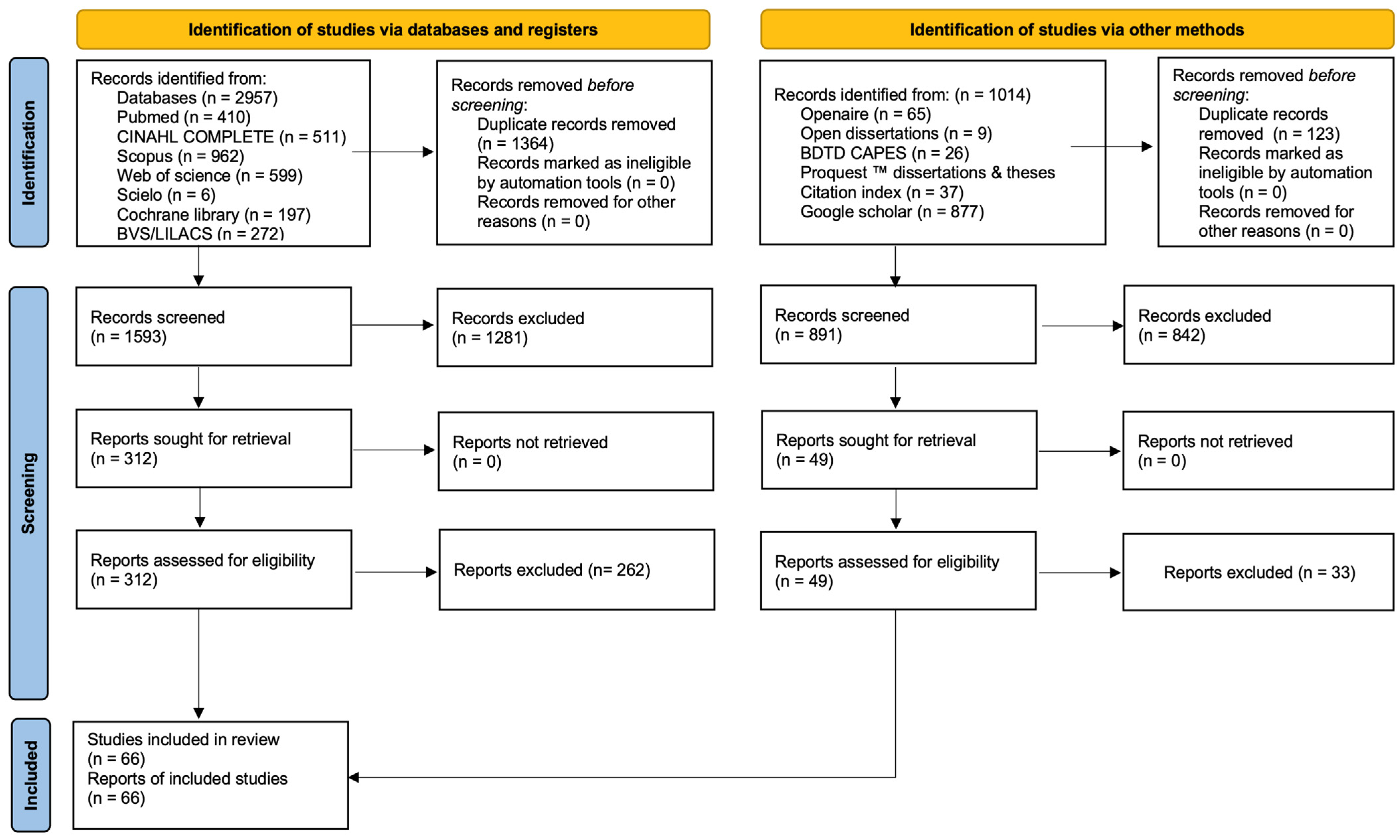
3.1. Study Selection
3.2. Study Characteristics
3.3. Technological and Educational Applications of AI Chatbots
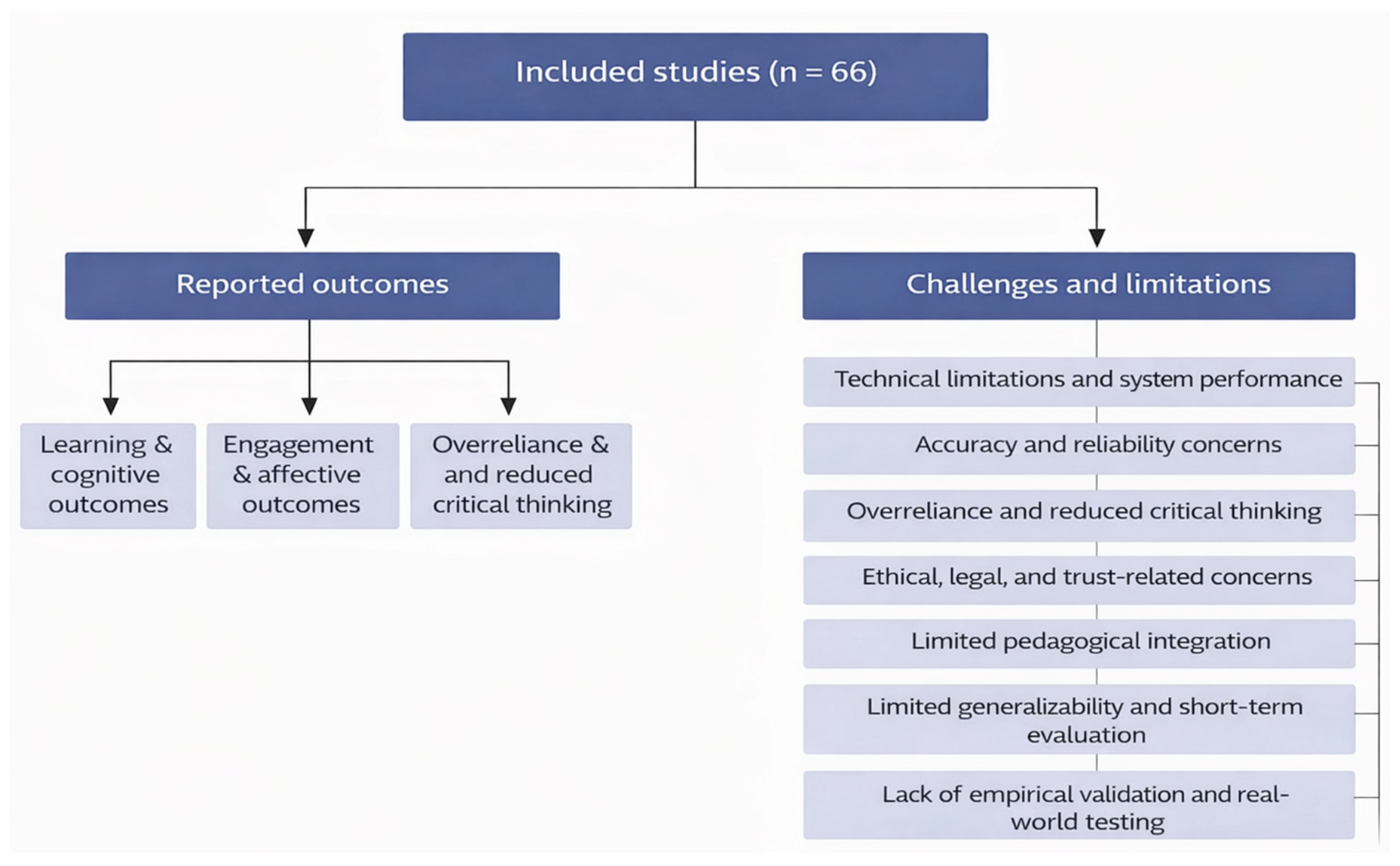
3.4. Educational Applications and Outcomes
3.5. Implementation Challenges and Barriers
4. Discussion
4.1. Practical Implications and Challenges
4.2. Future Directions
4.3. Implications for Clinical Practice Readiness
4.4. Limitations
5. Conclusions
Supplementary Materials
Author Contributions
Funding
Institutional Review Board Statement
Informed Consent Statement
Data Availability Statement
Public Involvement Statement
Guidelines and Standards Statement
Use of Artificial Intelligence
Acknowledgments
Conflicts of Interest
References
- Helm, J.M.; Swiergosz, A.M.; Haeberle, H.S.; Karnuta, J.M.; Schaffer, J.L.; Krebs, V.E.; Spitzer, A.I.; Ramkumar, P.N. Machine learning and artificial intelligence: Definitions, applications, and future directions. Curr. Rev. Musculoskelet. Med. 2020, 13, 69–76. [Google Scholar] [CrossRef]
- Wang, P. On defining artificial intelligence. J. Artif. Gen. Intell. 2019, 10, 1–37. [Google Scholar] [CrossRef]
- Jakhar, D.; Kaur, I. Artificial intelligence, machine learning and deep learning: Definitions and differences. Clin. Exp. Dermatol. 2020, 45, 131–132. [Google Scholar] [CrossRef]
- Pham, T.D.; Karunaratne, N.; Exintaris, B.; Liu, D.; Lay, T.; Yuriev, E.; Lim, A. The impact of generative AI on health professional education: A systematic review in the context of student learning. Med. Educ. 2025, 59, 1280–1289. [Google Scholar] [CrossRef] [PubMed]
- Subillaga, O.; Coulter, A.P.; Tashjian, D.; Seymour, N.; Hubbs, D. Artificial intelligence-assisted narratives: Analysis of surgical residency personal statements. J. Surg. Educ. 2025, 82, 103566. [Google Scholar] [CrossRef]
- Sengar, S.S.; Hasan, A.B.; Kumar, S.; Carroll, F. Generative artificial intelligence: A systematic review and applications. Multimed. Tools Appl. 2025, 84, 23661–23700. [Google Scholar] [CrossRef]
- Labrague, L.J.; Sabei, S.A. Integration of AI-powered chatbots in nursing education: A scoping review of their utilization, outcomes, and challenges. Teach. Learn. Nurs. 2025, 20, e285–e293. [Google Scholar] [CrossRef]
- Shaw, K.; Henning, M.A.; Webster, C.S. Artificial intelligence in medical education: A scoping review of the evidence for efficacy and future directions. Med. Sci. Educ. 2025, 35, 1803–1816. [Google Scholar] [CrossRef]
- Feigerlova, E.; Hani, H.; Hothersall-Davies, E. A systematic review of the impact of artificial intelligence on educational outcomes in health professions education. BMC Med. Educ. 2025, 25, 129. [Google Scholar] [CrossRef]
- World Health Organization. Digitalized Health Workforce Education: An Elicitation of Research Gaps and Selection of Case Studies; World Health Organization: Geneva, Switzerland, 2023. [Google Scholar]
- Peters, M.D.J.; Marnie, C.; Tricco, A.C.; Pollock, D.; Munn, Z.; Alexander, L.; McInerney, P.; Godfrey, C.M.; Khalil, H. Updated methodological guidance for the conduct of scoping reviews. JBI Evid. Synth. 2020, 18, 2119–2126. [Google Scholar] [CrossRef]
- Zhang, S.; Yang, X.; Zhang, L.; Liu, H.; Chen, X.; Yang, X.; Hu, Y.; Liu, Q.; He, Y. Exploring the role and potential of chatbots in learning from the perspective of nursing students: A systematic review of qualitative studies. Int. Nurs. Rev. 2025, 72, e70060. [Google Scholar] [CrossRef]
- Rodrigues, D.D.; Alves, J.; Ribeiro, L.; Pereira, R. Intelligent tutoring systems in nursing education: A scoping review protocol. Servir 2025, 2, e41879. [Google Scholar] [CrossRef]
- Fernandes, F.; Encarnação, R.; Lima, S.; Alves, P. Artificial intelligence chatbots in nursing education: A scoping review protocol. Athena Health Res. J. 2026, 3. [Google Scholar] [CrossRef]
- Pollock, D.; Peters, M.D.J.; Khalil, H.; McInerney, P.; Alexander, L.; Tricco, A.C.; Evans, C.; de Moraes, É.B.; Godfrey, C.M.; Pieper, D.; et al. Recommendations for the extraction, analysis, and presentation of results in scoping reviews. JBI Evid. Synth. 2023, 21, 520. [Google Scholar] [CrossRef]
- Page, M.J.; McKenzie, J.E.; Bossuyt, P.M.; Boutron, I.; Hoffmann, T.C.; Mulrow, C.D.; Shamseer, L.; Tetzlaff, J.M.; Akl, E.A.; Brennan, S.E.; et al. The PRISMA 2020 statement: An updated guideline for reporting systematic reviews. BMJ 2021, 372, n71. [Google Scholar] [CrossRef]
- Levac, D.; Colquhoun, H.; O’Brien, K.K. Scoping studies: Advancing the methodology. Implement. Sci. 2010, 5, 69. [Google Scholar] [CrossRef] [PubMed]
- Ouzzani, M.; Hammady, H.; Fedorowicz, Z.; Elmagarmid, A. Rayyan—A web and mobile app for systematic reviews. Syst. Rev. 2016, 5, 210. [Google Scholar] [CrossRef] [PubMed]
- Park, S.-A.; Kim, H.Y. Development and effects of a scenario-based labor nursing simulation education program using an artificial intelligence tutor: A quasi-experimental study. Womens Health Nurs. 2025, 31, 143–154. [Google Scholar] [CrossRef] [PubMed]
- Wang, R.; Raman, A. Enhancing nursing education: An AI-powered chatbots for fostering engagement and higher-order thinking skills. Res. Sq. 2025. [Google Scholar] [CrossRef]
- Arkan, B.; Ordin, Y.; Yilmaz, D. Artificial intelligence applications in nursing education: A systematic and pedagogical perspective. Comput. Inform. Nurs. 2025, 43, 198–206. [Google Scholar] [CrossRef]
- Chang, C.Y.; Chen, Y.H.; Lin, Y.J. Nursing students’ perceptions of chatbot-assisted learning: A cross-sectional study. Nurse Educ. Today 2024, 128, 105874. [Google Scholar] [CrossRef]
- Ni, Z.; Peng, R.; Zheng, X.; Xie, P. Embracing the future: Integrating ChatGPT into China’s nursing education system. Int. J. Nurs. Sci. 2024, 11, 295–299. [Google Scholar] [CrossRef]
- Ahn, J.; Park, H.O. Development of a case-based nursing education program using generative artificial intelligence. J. Korean Acad. Soc. Nurs. Educ. 2023, 29, 234–246. [Google Scholar] [CrossRef]
- Chen, Y.; Lin, Q.; Chen, X.; Liu, T.; Ke, Q.; Yang, Q.; Guan, B.; Ming, W.K. Needs assessment for history-taking instruction using a chatbot for nursing students: A qualitative focus group study. Digit. Health 2023, 9, 20552076231185435. [Google Scholar] [CrossRef]
- Rodriguez-Arrastia, M.; Martinez-Ortigosa, A.; Ruiz-Gonzalez, C.; Ropero-Padilla, C.; Roman, P.; Sanchez-Labraca, N. Experiences and perceptions of final-year nursing students of using a chatbot in a simulated emergency situation: A qualitative study. J. Nurs. Manag. 2022, 30, 3874–3884. [Google Scholar] [CrossRef]
- Han, J.W.; Park, J.; Lee, H. Analysis of the effect of an artificial intelligence chatbot educational program on non-face-to-face classes: A quasi-experimental study. BMC Med. Educ. 2022, 22, 830. [Google Scholar] [CrossRef]
- Shorey, S.; Ang, E.; Yap, J.; Ng, E.D.; Lau, S.T.; Chui, C.K. A virtual counseling application using artificial intelligence for communication skills training in nursing education: Development study. J. Med. Internet Res. 2019, 21, e14658. [Google Scholar] [CrossRef]
- Chuang, Y.H.; Chen, Y.T.; Kuo, C.L. The design and application of a chatbot in clinical nursing education. J. Nurs. 2021, 68, 19–24. [Google Scholar] [CrossRef]
- Han, J.; Park, J.; Lee, H. Development and effects of a chatbot education program for self-directed learning in nursing students. BMC Med. Educ. 2025, 25, 825. [Google Scholar] [CrossRef] [PubMed]
- Topaz, M.; Peltonen, L.-M.; Michalowski, M.; Stiglic, G.; Ronquillo, C.; Pruinelli, L.; Song, J.; O’Connor, S.; Miyagawa, S.; Fukahori, H. The ChatGPT effect: Nursing education and generative artificial intelligence. J. Nurs. Educ. 2025, 64, e40–e43. [Google Scholar] [CrossRef] [PubMed]
- Chang, L.-C.; Wang, Y.-N.; Lin, H.-L.; Liao, L.-L. Registered nurses’ attitudes towards ChatGPT and self-directed learning: A cross-sectional study. J. Adv. Nurs. 2025, 81, 3811–3820. [Google Scholar] [CrossRef]
- Chen, P.-J. Effectiveness of integrating generative artificial intelligence with virtual reality for maternity communication simulation: A randomized controlled trial. Clin. Simul. Nurs. 2025, 105, 101786. [Google Scholar] [CrossRef]
- Dabney, B.W.; DeNotto, L.A. A qualitative exploration of student perceptions on the use of AI in an undergraduate nursing research course. J. Nurs. Educ. 2025, 64, 620–626. [Google Scholar] [CrossRef] [PubMed]
- Vaughn, J.; Ford, S.H.; Scott, M.; Jones, C.; Lewinski, A. Enhancing healthcare education: Leveraging ChatGPT for innovative simulation scenarios. Clin. Simul. Nurs. 2024, 87, 101487. [Google Scholar] [CrossRef]
- Laun, M.; Puderbach, L.; Hirt, K.; Wyss, E.L.; Friemert, D.; Hartmann, U.; Wolff, F. Chatbots in education: Outperforming students but perceived as less trustworthy. Contemp. Educ. Psychol. 2025, 81, 102373. [Google Scholar] [CrossRef]
- Elliott, M.; Williams, J.; Aldwikat, R.; Wong, P. Using ChatGPT to enhance student learning: A case study in a nursing curriculum. Teach. Learn. Nurs. 2025, 20, e309–e312. [Google Scholar] [CrossRef]
- Shokr, E.A. Integrating a knowledge-based artificial intelligence chatbot into nursing training programs: A comparative quasi-experimental study in Egypt and Saudi Arabia. BMC Nurs. 2025, 24, 1245. [Google Scholar] [CrossRef]
- Abou Hashish, E.A.; Alsayed, S.A.; Abdel Razek, N.M.F. Embracing AI in academia: A mixed methods study of nursing students’ and educators’ perspectives on using ChatGPT. PLoS ONE 2025, 20, e0327981. [Google Scholar] [CrossRef]
- Benfatah, M.; Elazizi, I.; Lamiri, A.; Belhaj, H.; Nejjari, C.; Youlyouz-Marfak, I. AI-assisted prebriefing to enhance simulation readiness in nursing education. Teach. Learn. Nurs. 2025, 21, e57–e63. [Google Scholar] [CrossRef]
- Gunawan, J.; Aungsuroch, Y.; Marzilli, C.; Nazliansyah; Chaerani, E.; Montayre, J. Artificial intelligence chatbot as perceived by nursing students: A qualitative study. SAGE Open 2024, 14, 21582440241303453. [Google Scholar] [CrossRef]
- Aslan, F. Postgraduate nursing students’ experiences with ChatGPT: A descriptive phenomenological study. J. Prof. Nurs. 2025, 59, 148–154. [Google Scholar] [CrossRef] [PubMed]
- Kang, S.R.; Kim, S.J.; Kang, K.A. Awareness of using chatbots and factors influencing usage intention among nursing students in South Korea: A descriptive study. Child Health Nurs. Res. 2023, 29, 290–299. [Google Scholar] [CrossRef]
- Kazley, A.S.; Andresen, C.; Mund, A.; Blankenship, C.; Segal, R. Is use of ChatGPT cheating? Students of health professions perceptions. Med. Teach. 2025, 47, 894–898. [Google Scholar] [CrossRef] [PubMed]
- Moskovich, L.; Rozani, V. Health professions students’ perceptions of ChatGPT in healthcare and education: A mixed-methods study. BMC Med. Educ. 2025, 25, 98. [Google Scholar] [CrossRef]
- Eltaybani, S.; Ali, H.F.M.; Abdelhalim, G.E. Exploring nurse educators’ and students’ use of large language models for academic purposes in a developing country. Nurse Educ. Pract. 2025, 87, 104502. [Google Scholar] [CrossRef] [PubMed]
- Durmuş Sarıkahya, S.; Özbay, Ö.; Torpuş, K.; Usta, G.; Çınar Özbay, S. The impact of ChatGPT on nursing education: A qualitative study based on the experiences of faculty members. Nurse Educ. Today 2025, 152, 106755. [Google Scholar] [CrossRef]
- Sultan, H.M.; Sam, B.J.; Pillai, R.R. Nursing students’ perceptions and ethical considerations of ChatGPT usage in nursing education: A cross-sectional study. Teach. Learn. Nurs. 2025, 20, e1197–e1206. [Google Scholar] [CrossRef]
- Olla, P.; Wodwaski, N.; Long, T. Beyond the bot: A dual-phase framework for evaluating AI chatbot simulations in nursing education. Nurs. Rep. 2025, 15, 280. [Google Scholar] [CrossRef]
- Sandoval Peña, J.M.; Macalupú Ipanaqué, J.V.; Rufino Sosa, M.; García Paz, E.S.; Morocho Ricalde, C.J. Chatbot as an artificial intelligence program in autonomous learning in nursing students. Migr. Lett. 2023, 20, 85–104. [Google Scholar] [CrossRef]
- Ahmed, F.R.; Rushdan, E.E.; Al-Yateem, N.; Almaazmi, A.N.; Subu, M.A.; Hijazi, H.; Abdelbasset, W.K.; Mottershead, R.; Ahmed, A.A.; Aburuz, M.E. AI in higher education: Nursing students’ perspectives on ChatGPT. Teach. Learn. Nurs. 2025, 20, e408–e413. [Google Scholar] [CrossRef]
- Benfatah, M.; Marfak, A.; Saad, E.; Hilali, A.; Nejjari, C.; Youlyouz-Marfak, I. Assessing the efficacy of ChatGPT as a virtual patient in nursing simulation training. Teach. Learn. Nurs. 2024, 19, e486–e493. [Google Scholar] [CrossRef]
- Reid, J.A. Building clinical simulations with ChatGPT in nursing education. J. Nurs. Educ. 2025, 64, e6–e7. [Google Scholar] [CrossRef]
- Ghaffari, R.; Ghaffari, F.; Mehrabi, M.; Sabery, M. Effectiveness of ChatGPT for clinical scenario generation. Adv. Biomed. Res. 2025, 14, 172. [Google Scholar]
- Makhlouf, E.; Alenezi, A.; Shokr, E.A. Effectiveness of designing a knowledge-based chatbot system. Nurse Educ. Today 2024, 137, 106159. [Google Scholar] [CrossRef]
- Ríos Gonzales, J.D.R.; Tomanguilla Reyna, J.T.; Vereau Amaya, E.A.; Vásquez Luján, I.G. Evaluation of the impact of ChatGPT on research skills. Int. J. Learn. Teach. Educ. Res. 2025, 24, 370–390. [Google Scholar] [CrossRef]
- Saleh, Z.T.; Rababa, M.; Elshatarat, R.A.; Alharbi, M.; Alhumaidi, B.N.; Al-Za’areer, M.S.; Jarrad, R.A.; Al Niarat, T.F.; Almagharbeh, W.T.; Al-Sayaghi, K.M.; et al. Faculty perceptions regarding AI chatbots in nursing education. BMC Nurs. 2025, 24, 440. [Google Scholar] [CrossRef] [PubMed]
- Çalık, A.; Özkul, D. Exploring the utility of ChatGPT in nursing care plan development. Lokman Hekim Health Sci. 2025, 5, 170–180. [Google Scholar] [CrossRef]
- Ma, Y.; Liu, T.; Qi, J.; Gan, Y.; Cheng, Q.; Wang, J.; Xiao, M. Facilitators and barriers of large language model adoption. J. Adv. Nurs. 2025, 81, 4856–4870. [Google Scholar] [CrossRef]
- Higashitsuji, A.; Otsuka, T.; Watanabe, K. Impact of ChatGPT on case creation efficiency. Teach. Learn. Nurs. 2025, 20, e159–e166. [Google Scholar] [CrossRef]
- Gonzalez-Garcia, A.; Bermejo-Martinez, D.; Lopez-Alonso, A.I.; Trevisson-Redondo, B.; Martín-Vázquez, C.; Perez-Gonzalez, S. Impact of ChatGPT usage on nursing education. Heliyon 2025, 11, e41559. [Google Scholar] [CrossRef]
- Bouriami, A.; Takhdat, K.; Barkatou, S.; Chiki, H.; Boussaa, S.; El Adib, A.R. Nurse educators’ use of ChatGPT. Educ. Med. 2025, 26, 101006. [Google Scholar] [CrossRef]
- Chan, V.C. Integrating generative artificial intelligence in writing courses. J. Prof. Nurs. 2025, 57, 85–91. [Google Scholar] [CrossRef]
- Aboulfotoh, M.A. Integration of Poe AI chatbot into medical vocabulary learning. Int. J. Res. Educ. Sci. 2025, 11, 554. [Google Scholar]
- Albikawi, Z.F.; Abuadas, M.H. Impact of ChatGPT utilization on psychiatric nursing education. Univers. J. Public Health 2025, 13, 403–412. [Google Scholar] [CrossRef]
- Wang, Y.F.; Hsu, M.H.; Wang, M.Y.F. Gamified mobile learning chatbot. Health Educ. J. 2025, 84, 174–188. [Google Scholar] [CrossRef]
- Karaçay, P. Nursing students’ experiences toward using ChatGPT. Teach. Learn. Nurs. 2025, 20, 104063. [Google Scholar] [CrossRef]
- Han, S.; Kang, H.S.; Gimber, P.; Lim, S. Nursing students’ perceptions of generative artificial intelligence. Nurs. Rep. 2025, 15, 68. [Google Scholar] [CrossRef]
- Chang, C.Y.; Hwang, G.J.; Gau, M.L. Mobile chatbot approach for nursing training. Br. J. Educ. Technol. 2022, 53, 171–188. [Google Scholar] [CrossRef]
- Kestel, S.; Calik, A.; Kus, M. Effect of chatbot-supported instruction on nursing students. J. Prof. Nurs. 2025, 60, 93–100. [Google Scholar] [CrossRef]
- Yin, J.; Hao, X.; Xing, G.; Xu, M. Effects of ChatGPT-driven blended teaching model. Nurse Educ. Pract. 2025, 88, 104545. [Google Scholar] [CrossRef] [PubMed]
- Shin, H.; De Gagne, J.C.; Kim, S.S.; Hong, M. The Impact of Artificial Intelligence-Assisted Learning on Nursing Students’ Ethical Decision-making and Clinical Reasoning in Pediatric Care: A Quasi-Experimental Study. Comput. Inform. Nurs. 2024, 42, 704–711. [Google Scholar] [CrossRef]
- Başaran, F.; Duru, P. Impact of Kahoot and ChatGPT educational technologies. Sex. Disabil. 2024, 42, 801–815. [Google Scholar] [CrossRef]
- Clodfelter, A.D. Improving Alarm Management Practices Wireless Bed Exit Alerts on Medical-Surgical Units. Comput. Inform. Nurs. 2025, 43, e01324. [Google Scholar] [CrossRef] [PubMed]
- Bumbach, M.D. Use of AI-powered ChatGPT for nursing education. J. Nurs. Educ. 2024, 63, 564–567. [Google Scholar] [CrossRef] [PubMed]
- Russell, R.G.; White, J.; Karns, A.; Rodriguez, K.; Jeffries, P.R.; Sengstack, P. Toward amplifying the good in nursing education: A quality improvement study on implementing artificial intelligence-based assistants in a learning system. Nurs. Outlook 2025, 73, 102483. [Google Scholar] [CrossRef]
- Sağlam, R.K.; Kalanlar, B. Use of ChatGPT: Perspectives of Graduate Students in Public Health Nursing. Nurse Educ. Pract. 2025, 88, 104585. [Google Scholar] [CrossRef] [PubMed]
- Salazar, C.F. Using cloud-based chatbot builder in education. Int. J. Eng. Trends Technol. 2023, 71, 301–314. [Google Scholar] [CrossRef]
- Khlaif, Z.N.; Salameh, N.; Ajouz, M.; Mousa, A.; Itmazi, J.; Alwawi, A.; Alkaissi, A. Using generative AI in nursing education. BMC Med. Educ. 2025, 25, 926. [Google Scholar] [CrossRef]
- Afonso, D.L.A. Uso da Inteligência Artificial em Chatbot para Apoio aos Estudantes na Área da Saúde; Universidade Federal de São Paulo: São Paulo, Brazil, 2024. [Google Scholar]
- Goktas, P.; Kucukkaya, A.; Karacay, P. Utilizing GPT-4.0 in nursing education. Teach. Learn. Nurs. 2024, 19, e358–e367. [Google Scholar] [CrossRef]
- Hsu, M.H.; Wang, Y.F.; Wang, M.Y.F. Mastering medical terminology with ChatGPT and Termbot. J. Educ. Comput. Res. 2024, 83, 352–358. [Google Scholar] [CrossRef]
- Kim, D.; Choi, Y.R.; Lee, Y.N.; Park, W.H.; Kwon, D.Y.; Chang, S.O. Towards web-based adaptive learning on the behavioral and psychological symptoms of dementia care for nursing staff of long-term care facilities: A quasi-experimental study. Res. Sq. 2023. [Google Scholar] [CrossRef]
- Mohamed, A.M.; Alanezi, N.A.; Darrag, Y.; Alrwuaili, N.S.; Alshamrani, R.A.H.; Berdida, D.J.E. The role of AI chatbots in nursing students’ autonomous learning in mastering medical vocabulary: A quasi-experimental study. Teach. Learn. Nurs. 2025, 20, e76–e85. [Google Scholar] [CrossRef]
- Jeffries, P.R. A framework for designing, implementing, and evaluating simulations used as teaching strategies in nursing. Nurs. Educ. Perspect. 2005, 26, 96–103. [Google Scholar] [PubMed]
- International Nursing Association for Clinical Simulation and Learning. Healthcare simulation standards of best practiceTM. Clin. Simul. Nurs. 2021, 58, 66. [Google Scholar] [CrossRef]
- Zimmerman, B.J. Becoming a self-regulated learner: An overview. Theory Pract. 2002, 41, 64–70. [Google Scholar] [CrossRef]
- Lee, J.D.; See, K.A. Trust in automation: Designing for appropriate reliance. Hum. Factors 2004, 46, 50–80. [Google Scholar] [CrossRef]
- Bretag, T.; Harper, R.; Burton, M.; Ellis, C.; Newton, P.; van Haeringen, K.; Saddiqui, S.; Rozenberg, P. Contract cheating and assessment design: Exploring the relationship. Assess. Eval. High. Educ. 2019, 44, 676–691. [Google Scholar] [CrossRef]
- Hohmann, B.; Kollár, G. Reflections on the data protection compliance of AI systems under the EU AI Act. Cogent Soc. Sci. 2025, 11, 2560654. [Google Scholar] [CrossRef]
- Haynes, M.d.L. Governing at a distance: The EU AI Act and GDPR as pillars of global privacy and corporate governance. SSRN 2025. [Google Scholar] [CrossRef]
- Lau, P.L. The AI Act and data protection: The interplay between artificial intelligence and data: The AI Act and the GDPR. In The European Artificial Intelligence Act: Promises and Perils? Raposo, V.L., Ed.; Springer Nature: Cham, Switzerland, 2025; pp. 289–313. [Google Scholar]
- Finch, W.W.; Butt, M. Gaps in AI-compliant complementary governance frameworks’ suitability and structural asymmetries: A systematic review. J. Cybersecur. Priv. 2025, 5, 101. [Google Scholar] [CrossRef]
- Kirkpatrick, D.L.; Kirkpatrick, J.D. Evaluating Training Programs: The Four Levels, 3rd ed.; Berrett-Koehler: San Francisco, CA, USA, 2006. [Google Scholar]
- Davis, F.D. Perceived usefulness, perceived ease of use, and user acceptance of information technology. MIS Q. 1989, 13, 319–340. [Google Scholar] [CrossRef]
- Ajzen, I. The theory of planned behavior. Organ. Behav. Hum. Decis. Process. 1991, 50, 179–211. [Google Scholar] [CrossRef]
- Venkatesh, V.; Morris, M.G.; Davis, G.B.; Davis, F.D. User acceptance of information technology: Toward a unified view. MIS Q. 2003, 27, 425–478. [Google Scholar] [CrossRef]
- Bosnjak, M.; Ajzen, I.; Schmidt, P. The theory of planned behavior: Selected recent advances and applications. Eur. J. Psychol. 2020, 16, 352–356. [Google Scholar] [CrossRef]
- Damschroder, L.J.; Aron, D.C.; Keith, R.E.; Kirsh, S.R.; Alexander, J.A.; Lowery, J.C. Fostering implementation of health services research findings into practice. Implement. Sci. 2009, 4, 50. [Google Scholar] [CrossRef]
- Cruz Rivera, S.; Liu, X.; Chan, A.-W.; Denniston, A.K.; Calvert, M.J. Guidelines for clinical trial protocols involving artificial intelligence: The SPIRIT-AI extension. Nat. Med. 2020, 26, 1351–1363. [Google Scholar] [CrossRef] [PubMed]
- Arksey, H.; O’Malley, L. Scoping studies: Towards a methodological framework. Int. J. Soc. Res. Methodol. 2005, 8, 19–32. [Google Scholar] [CrossRef]
- Tricco, A.C.; Lillie, E.; Zarin, W.; O’Brien, K.K.; Colquhoun, H.; Levac, D.; Moher, D.; Peters, M.D.J.; Horsley, T.; Weeks, L.; et al. PRISMA Extension for Scoping Reviews (PRISMAScR): Checklist and Explanation. Ann. Intern Med. 2018, 169, 467–473. [Google Scholar] [CrossRef] [PubMed]



| n | % | |
|---|---|---|
| Year of Publication | ||
| 2019 | 1 | 1.5 |
| 2021 | 1 | 1.5 |
| 2022 | 3 | 4.5 |
| 2023 | 6 | 9.1 |
| 2024 | 12 | 18.2 |
| 2025 | 43 | 65.2 |
| Region | ||
| Europe | 3 | 4.5 |
| North America | 7 | 10.6 |
| Asia | 42 | 63.6 |
| Africa | 5 | 7.6 |
| South America | 3 | 4.5 |
| Oceania | 1 | 1.5 |
| Multiple regions | 5 | 7.6 |
| Study design | ||
| Quasi-experimental study | 25 | 37.9 |
| Randomized controlled trial | 4 | 6.0 |
| Cross-sectional surveys | 8 | 12.1 |
| Qualitative study | 14 | 21.2 |
| Mixed-methods study | 7 | 10.6 |
| Methodological/developmental study | 4 | 6.0 |
| Case studies/quality improvement initiatives | 4 | 6.0 |
| Application Area | Number of Studies | Examples of Use | Most Frequently Reported Outcomes |
|---|---|---|---|
| Learning support | 34 | Self-directed study, clarification of doubts, academic task assistance, concept explanation | Improved knowledge acquisition, increased autonomy, enhanced engagement, improved academic performance |
| Clinical simulation | 11 | Virtual patients, case-based interaction, scenario-based reasoning, simulation support | Improved clinical reasoning, increased confidence, enhanced decision-making skills |
| Virtual tutoring | 12 | Guided feedback, question-answer interaction, personalized tutoring, scaffolding | Improved learning outcomes, increased engagement, improved skill acquisition |
| Teaching support | 6 | Content preparation, instructional material generation, teaching assistance | Increased teaching efficiency, improved instructional design |
| Assessment and skills practice | 9 | Formative quizzes, structured clinical responses, skills rehearsal, competency assessment | Improved skill performance, reinforcement of learning, enhanced competency development |
Disclaimer/Publisher’s Note: The statements, opinions and data contained in all publications are solely those of the individual author(s) and contributor(s) and not of MDPI and/or the editor(s). MDPI and/or the editor(s) disclaim responsibility for any injury to people or property resulting from any ideas, methods, instructions or products referred to in the content. |
© 2026 by the authors. Licensee MDPI, Basel, Switzerland. This article is an open access article distributed under the terms and conditions of the Creative Commons Attribution (CC BY) license.
Share and Cite
Fernandes, F.; Encarnação, R.; Alves, J.; Pais-Vieira, C.; Lima, S.B.S.d.; Alves, P. Educational Applications of AI-Based Chatbots in Nursing: A Scoping Review. Nurs. Rep. 2026, 16, 87. https://doi.org/10.3390/nursrep16030087
Fernandes F, Encarnação R, Alves J, Pais-Vieira C, Lima SBSd, Alves P. Educational Applications of AI-Based Chatbots in Nursing: A Scoping Review. Nursing Reports. 2026; 16(3):87. https://doi.org/10.3390/nursrep16030087
Chicago/Turabian StyleFernandes, Francisco, Rúben Encarnação, José Alves, Carla Pais-Vieira, Suzinara Beatriz Soares de Lima, and Paulo Alves. 2026. "Educational Applications of AI-Based Chatbots in Nursing: A Scoping Review" Nursing Reports 16, no. 3: 87. https://doi.org/10.3390/nursrep16030087
APA StyleFernandes, F., Encarnação, R., Alves, J., Pais-Vieira, C., Lima, S. B. S. d., & Alves, P. (2026). Educational Applications of AI-Based Chatbots in Nursing: A Scoping Review. Nursing Reports, 16(3), 87. https://doi.org/10.3390/nursrep16030087