Article

Voluntary Assisted Dying and Community Palliative Care: A Retrospective Study in Victoria, Australia


by
Robert Molenaar
1,*,
Susan Lee
1,2,
Jodi Lynch
1 and
Kelly Rogerson
1,2
1
Palliative Care South East, Narre Warren 3805, Australia
2
School of Nursing and Midwifery, Peninsula Campus, Monash University, Frankston 3199, Australia
*
Author to whom correspondence should be addressed.
Nurs. Rep. 2025, 15(2), 34; https://doi.org/10.3390/nursrep15020034

Submission received: 28 November 2024 / Revised: 16 January 2025 / Accepted: 20 January 2025 / Published: 24 January 2025

Abstract

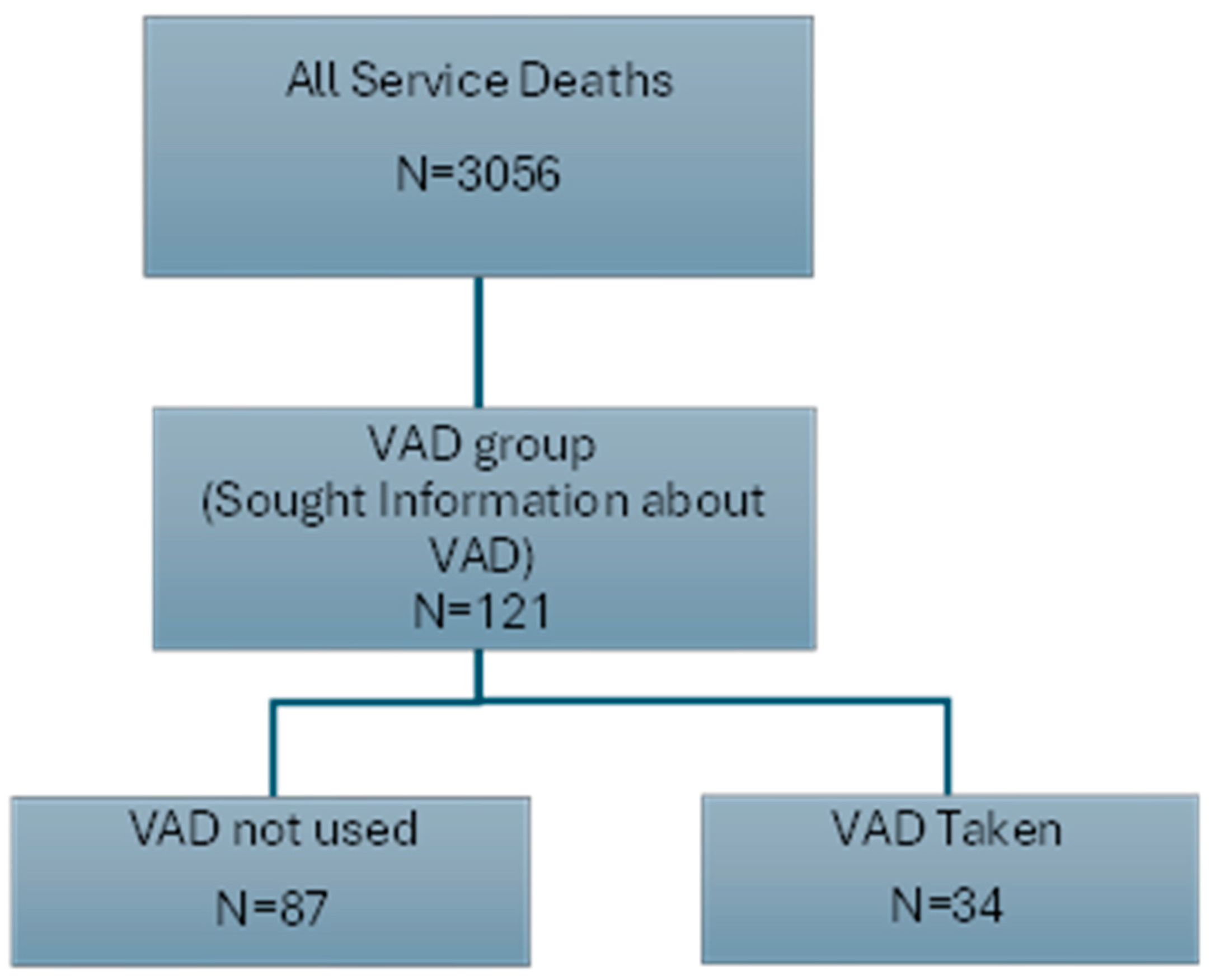
Background/Objectives: Voluntary Assisted Dying in Australia was first legislated in 2019, with significant concern expressed by palliative care services about the impact on services. We aimed to describe the impact of Voluntary Assisted Dying on community-based palliative care client care. Methods: This study was a retrospective cohort study that compared the characteristics and outcomes of clients who expressed interest in VAD, those who chose voluntary assisted death, and the broader client population of the service. Results: Only 4% of the total client population expressed interest in VAD, and 1% died through VAD. Of the clients who expressed interest in VAD, most had malignancy as their primary diagnosis. The median length of palliative care service for clients who expressed interest in VAD was 101 days, compared to 48 days for all service clients. For 97% of individuals who died from taking the substance, death occurred in their place of choice compared with 71% of all service clients. Of the clients who died through VAD, 88% of these deaths occurred in a community setting compared with 56% of all service clients. Conclusions: Most clients who took the VAD medicine died in their place of choice, which was the community. A review of the length of engagement with the service indicated that a longer length of engagement was illustrated by individuals navigating the VAD process. This study emphasised the value of early referral to community-based palliative care, enabling a focus on quality of life, symptom management, and planning for death.
Keywords: voluntary assisted death; palliative care; primary care; assisted suicide; nursing voluntary assisted death; palliative care; primary care; assisted suicide; nursing