Prevalence and Epidemiological Determinants of Tinnitus in the Southern Region of Saudi Arabia: A Community-Based Cross-Sectional Study

 , , , , , and
Abstract
1. Introduction
2. Materials and Methods
2.1. Study Design and Setting
2.2. Participants and Sampling
2.3. Data Collection Instrument
2.4. Statistical Analysis
2.5. Ethical Considerations
3. Results
3.1. Sociodemographic Characteristics of the Study Participants
3.2. Chronic Conditions Among Participants
3.3. Noise Exposure Characteristics
3.4. Prevalence and Clinical Characteristics of Tinnitus (Past 12 Months)
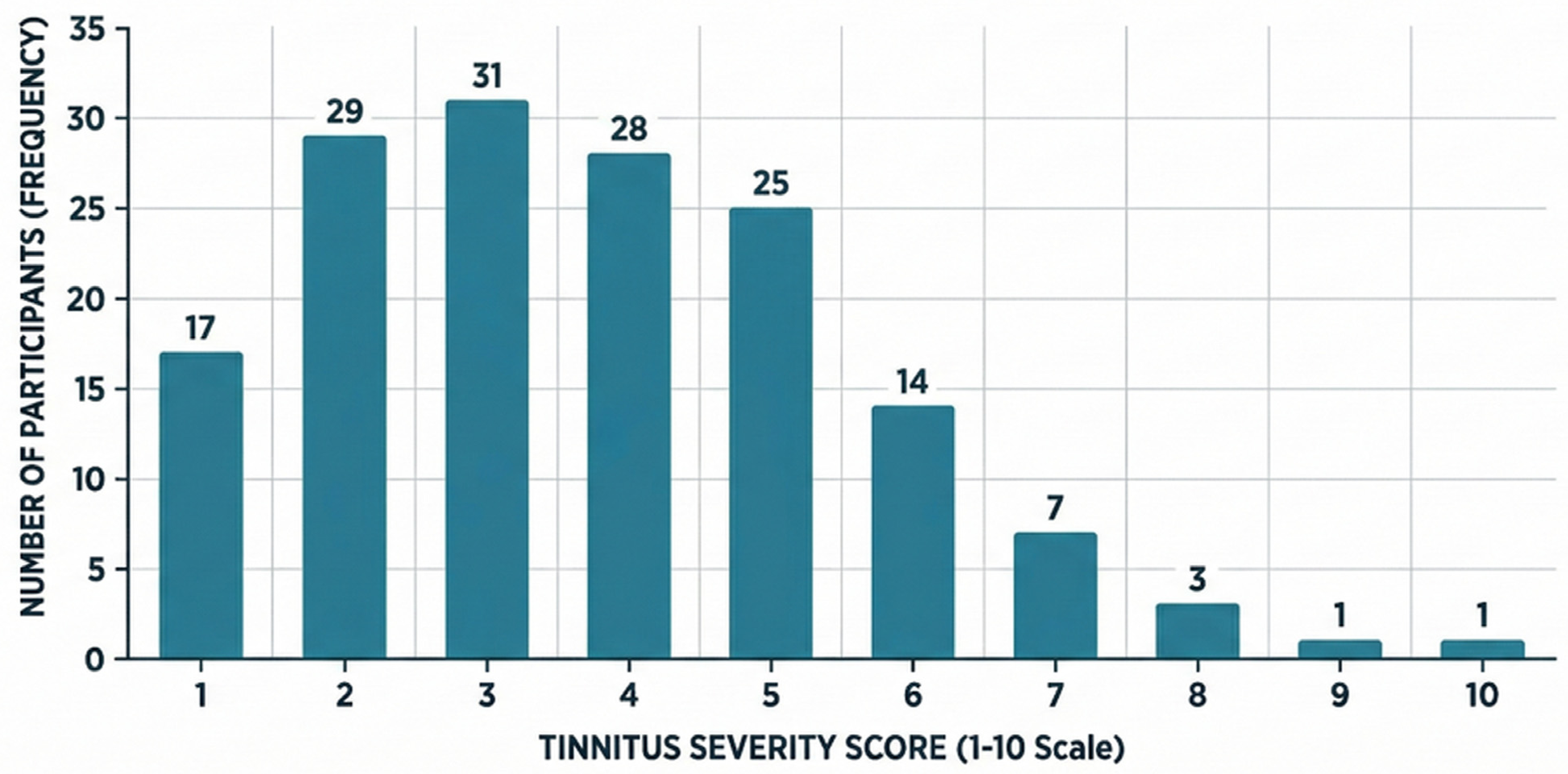
3.5. Distribution of Tinnitus Severity
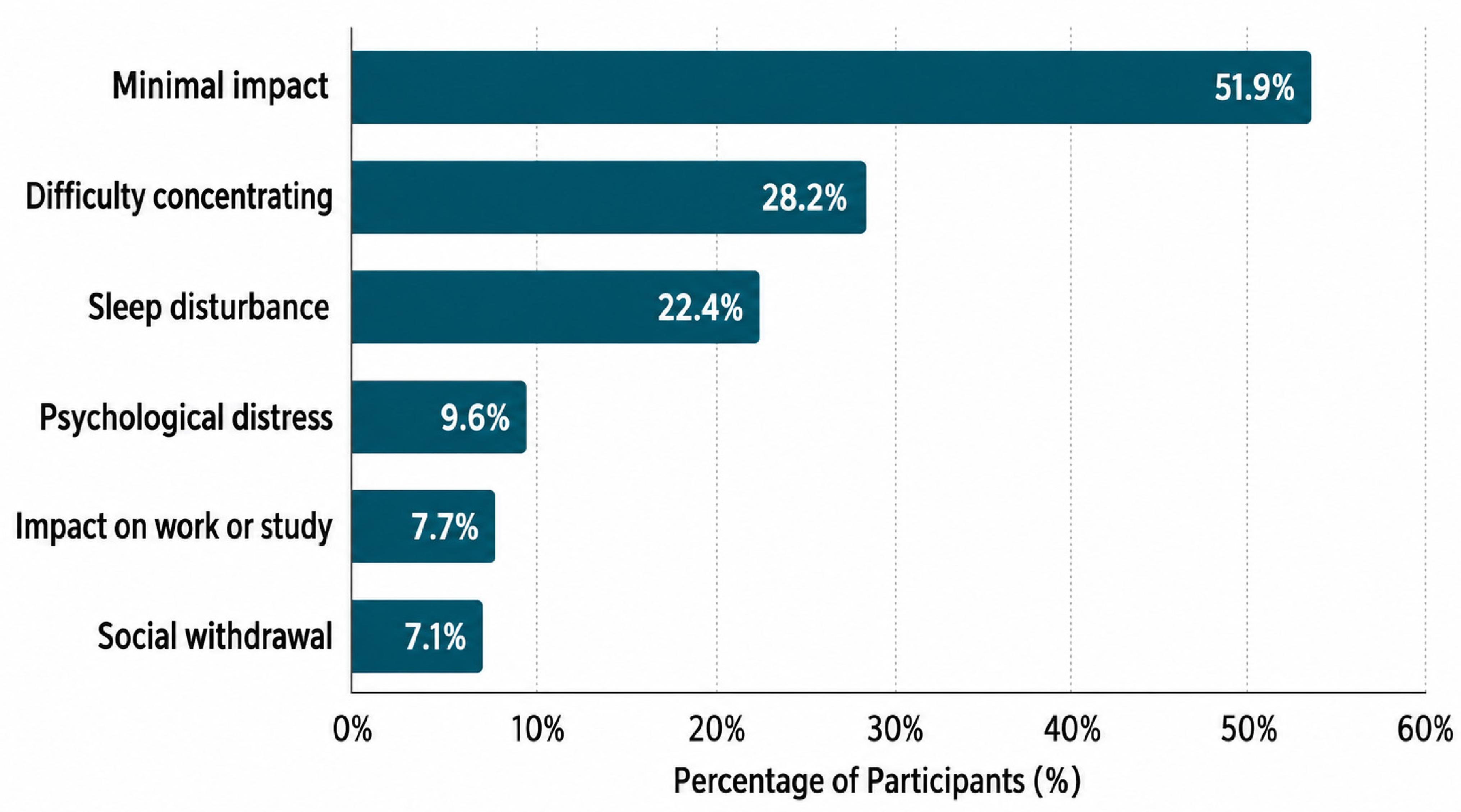
3.6. Impact of Tinnitus on Daily Life
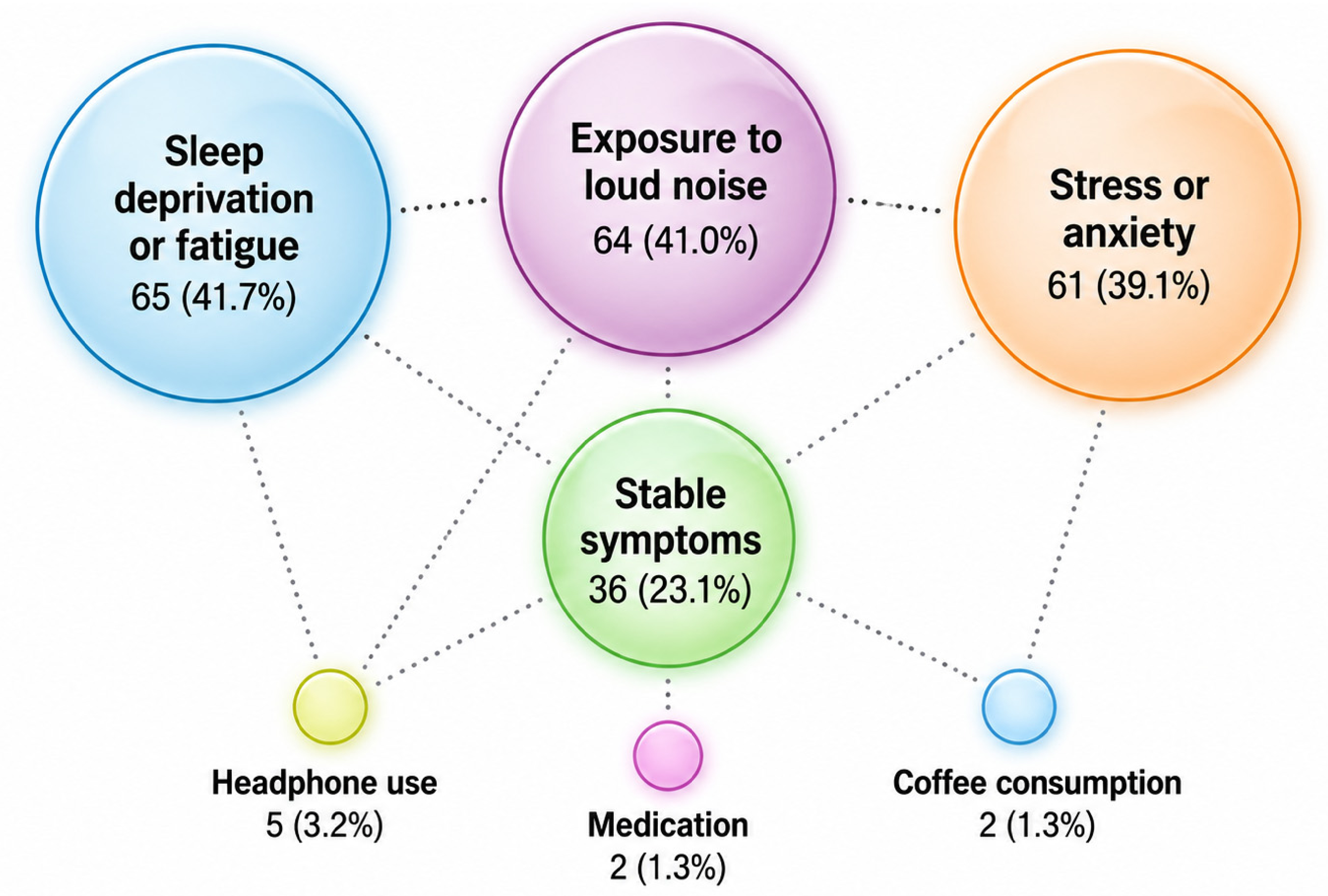
3.7. Exacerbating Factors of Tinnitus
3.8. Factors Associated with Tinnitus
4. Discussion
4.1. Prevalence of Tinnitus in Southern Saudi Arabia
4.2. Epidemiological Determinants
4.2.1. Noise Exposure: The Primary Associated Factor
4.2.2. Body Mass Index: A Noteworthy Regional Finding
4.2.3. Demographic and Chronic Disease Factors
4.3. Clinical Characteristics and Healthcare Utilization
4.3.1. Tinnitus Presentation and Severity
4.3.2. Healthcare Utilization: A Critical Gap
4.3.3. Associated Medical Conditions and Exacerbating Factors
4.4. Strengths and Limitations
4.5. Clinical and Public Health Implications
5. Conclusions
Author Contributions
Funding
Institutional Review Board Statement
Informed Consent Statement
Data Availability Statement
Conflicts of Interest
Abbreviations
| BMI | Body Mass Index |
| CI | Confidence Interval |
| DM | Diabetes Mellitus |
| HTN | Hypertension |
| IBS | Irritable Bowel Syndrome |
| PID | Pelvic Inflammatory Disease |
| RA | Rheumatoid Arthritis |
| SD | Standard Deviation |
| TMJ | Temporomandibular Joint |
| VAS | Visual Analog Scale |
| OR | Odds Ratio |
References
- Jarach, C.M.; Lugo, A.; Scala, M.; van den Brandt, P.A.; Cederroth, C.R.; Odone, A.; Garavello, W.; Schlee, W.; Langguth, B.; Gallus, S. Global prevalence and incidence of tinnitus: A systematic review and meta-analysis. JAMA Neurol. 2022, 79, 888–900. [Google Scholar] [CrossRef] [Scilit] [PubMed]
- Alanazi, A.A. Tinnitus prevalence, associated characteristics, and treatment patterns among adults in Saudi Arabia. Audiol. Res. 2024, 14, 760–777. [Google Scholar] [CrossRef] [Scilit] [PubMed]
- Kim, H.-J.; Lee, H.-J.; An, S.-Y.; Sim, S.; Park, B.; Kim, S.W.; Lee, J.S.; Hong, S.K.; Choi, H.G. Analysis of the prevalence and associated risk factors of tinnitus in adults. PLoS ONE 2015, 10, e0127578. [Google Scholar] [CrossRef] [Scilit] [PubMed]
- Biswas, R.; Lugo, A.; Akeroyd, M.A.; Schlee, W.; Gallus, S.; Hall, D.A. Tinnitus prevalence in Europe: A multi-country cross-sectional population study. Lancet Reg. Health Eur. 2022, 12, 100250. [Google Scholar] [CrossRef] [Scilit] [PubMed]
- Bhatt, J.M.; Lin, H.W.; Bhattacharyya, N. Prevalence, severity, exposures, and treatment patterns of tinnitus in the United States. JAMA Otolaryngol. Head Neck Surg. 2016, 142, 959–965. [Google Scholar] [CrossRef] [Scilit] [PubMed]
- Khedr, E.M.; Ahmed, M.A.; Shawky, O.A.; Mohamed, E.S.; El Attar, G.S.; Mohammad, K.A. Epidemiological study of chronic tinnitus in Assiut, Egypt. Neuroepidemiology 2010, 35, 45–52. [Google Scholar] [CrossRef] [Scilit] [PubMed]
- McCormack, A.; Edmondson-Jones, M.; Somerset, S.; Hall, D. A systematic review of the reporting of tinnitus prevalence and severity. Hear. Res. 2016, 337, 70–79. [Google Scholar] [CrossRef] [Scilit] [PubMed]
- Bhatt, J.M.; Bhattacharyya, N.; Lin, H.W. Relationships between tinnitus and the prevalence of anxiety and depression. Laryngoscope 2017, 127, 466–469. [Google Scholar] [CrossRef] [Scilit] [PubMed]
- Alkahtani, R.; Alkhalaf, A.; Aljabr, A.; Alharbi, D.; Almulafikh, N.; Almotairi, S. Tinnitus prevalence, impact on quality of life, and health-care-seeking behavior among adults: A cross-sectional study. Indian J. Otol. 2024, 30, 192–198. [Google Scholar] [CrossRef] [Scilit] [PubMed]
- Musleh, A.; Alzahrani, S.S.; Al Shehri, T.K.; Alqahtani, M.A.; Yahya, S.Y.A.; Alshahrani, O.S. The magnitude and determinants of tinnitus among health science students at King Khalid University. Sci. World J. 2020, 2020, 3071657. [Google Scholar] [CrossRef] [Scilit] [PubMed]
- Fageeh, Y.A.; Alzahrani, F.S.; Alkhaldi, L.R.; Rukbah, L.K.A.; Almalki, A.G.; Al-Rasheedi, A.N. Tinnitus prevalence and associated factors among the population of Taif, Saudi Arabia. Saudi J. Otorhinolaryngol. Head Neck Surg. 2025, 27, 46–53. [Google Scholar] [CrossRef] [Scilit] [PubMed]
- Al-Qurashi, M.M.; El-Mouzan, M.I.; Al-Herbish, A.S.; Al-Salloum, A.A.; Al-Omar, A.A. The prevalence of sickle cell disease in Saudi children and adolescents: A community-based survey. Saudi Med. J. 2008, 29, 1480–1483. [Google Scholar] [CrossRef] [Scilit] [PubMed]
- Xu, X.; Bu, X.; Zhou, L.; Xing, G.; Liu, C.; Wang, D. An epidemiologic study of tinnitus in a population in Jiangsu Province, China. J. Am. Acad. Audiol. 2011, 22, 578–585. [Google Scholar] [CrossRef] [Scilit] [PubMed]
- Yang, H.; Cai, Y.; Guo, H.; Xiong, H.; Sun, Y.; Huang, X.; Zheng, Y. Prevalence and factors associated with tinnitus: Data from adult residents in Guangdong Province, South of China. Int. J. Audiol. 2018, 57, 892–899. [Google Scholar] [CrossRef] [Scilit] [PubMed]
- Aryal, S.; Sharma, Y.; Prabhu, P. Prevalence of tinnitus and its characteristics among the Indian adult population. Ann. Otol. Neurotol. 2022, 5, 15–20. [Google Scholar] [CrossRef] [Scilit]
- Haji, A.K.; Qashar, A.A.; Alqahtani, S.H.; Masarit, R.M.; AlSindi, T.S.; Ali-Eldin, E.M. Prevalence of noise-induced tinnitus in adults aged 15 to 25 years: A cross-sectional study. Cureus 2022, 14, e32081. [Google Scholar] [CrossRef] [Scilit] [PubMed]
- Ahmed, H.O.; Dennis, J.H.; Badran, O.; Ismail, M.; Ballal, S.G.; Ashoor, A.; Jerwood, D. Occupational noise exposure and hearing loss of workers in two plants in eastern Saudi Arabia. Ann. Occup. Hyg. 2001, 45, 371–380. [Google Scholar] [CrossRef] [Scilit]
- Makar, S.K. Etiology and pathophysiology of tinnitus: A systematic review. Int. Tinnitus J. 2021, 25, 76–86. [Google Scholar] [CrossRef] [Scilit] [PubMed]
- Musleh, A.; Alshehri, S.; Qobty, A. Hyperlipidemia and its relation with tinnitus: Cross-sectional approach. Niger. J. Clin. Pract. 2022, 25, 1046–1049. [Google Scholar] [CrossRef] [Scilit] [PubMed]
- Rammal, A.; Alsinni, H.; Alkhamesi, A.A.; Alshahrani, G.; Bouges, R.N.; Shosho, R.Y.; Aljuhani, M.O. The prevalence of insomnia among patients with chronic tinnitus in the general population of the Kingdom of Saudi Arabia. Cureus 2024, 16, e64295. [Google Scholar] [CrossRef] [Scilit] [PubMed]
- Alsanosi, A.A. Impact of tinnitus on the quality of life among Saudi patients. Saudi Med. J. 2011, 32, 1274–1278. [Google Scholar] [CrossRef] [Scilit] [PubMed]
- Alqarny, M.; Assiri, A.M.; Alshehri, A.; Alharbi, S.M.; Alshahrani, E.H.; Alessa, H.; Alghubishi, S.A. Patterns and correlations of hearing loss among adolescents, adults, and elderly in Saudi Arabia: A retrospective study. Cureus 2021, 13, e13913. [Google Scholar] [CrossRef] [Scilit] [PubMed]
- Musleh, A.; Alharthy, A.K.H.; Alzahrani, M.Y.M.; Bin Maadhah, S.A.; Al Zehefa, I.A.; Alqahtani, R.Y.; Alshehri, I.S.M.; Alqahtani, F.B.A.; Asiri, K.A.M.; Almushari, A.A. Psychological impact and quality of life in adults with tinnitus: A cross-sectional study. Cureus 2024, 16, e51976. [Google Scholar] [CrossRef] [Scilit] [PubMed]



| Characteristics | Mean ± SD/Frequency (%) |
|---|---|
| Age (years) | 30 ± 11 |
| Sex | |
| Female | 309 (61.7%) |
| Male | 192 (38.3%) |
| Marital status | |
| Single | 295 (58.9%) |
| Married | 186 (37.1%) |
| Divorced/Widowed | 20 (4.0%) |
| Residence | |
| Jazan | 156 (31.1%) |
| Aseer | 134 (26.7%) |
| Najran | 108 (21.6%) |
| Al-Baha | 103 (20.6%) |
| Education level | |
| University or higher | 410 (81.8%) |
| High school | 82 (16.4%) |
| Middle school or less | 9 (1.8%) |
| BMI (kg/m2) | 25 ± 5.5 |
| Smoking status | |
| Never | 431 (86.0%) |
| Ex-smoker | 42 (8.4%) |
| Current smoker | 28 (5.6%) |
| Characteristics | Frequency (%) |
|---|---|
| Chronic conditions | |
| Hypertension (HTN) | 40 (8.0%) |
| Diabetes mellitus (DM) | 37 (7.4%) |
| Dyslipidemia | 38 (7.6%) |
| Depressive disorder | 40 (8.0%) |
| Asthma | 8 (1.6%) |
| Thyroid disorder | 10 (2.0%) |
| Renal condition | 3 (0.6%) |
| Anemia | 5 (1.0%) |
| Irritable bowel syndrome (IBS) | 6 (1.2%) |
| Celiac disease | 1 (0.2%) |
| Pelvic inflammatory disease (PID) | 1 (0.2%) |
| Rheumatoid arthritis (RA) | 1 (0.2%) |
| Characteristics | Frequency (%) |
|---|---|
| Weekly noise exposure (>5 h) | |
| No | 305 (60.9%) |
| Yes | 196 (39.1%) |
| Recreational noise exposure | |
| No | 272 (54.3%) |
| Yes | 229 (45.7%) |
| Exposure to sudden loud sounds (e.g., fireworks, gunshots, explosions) | |
| No | 288 (57.5%) |
| Yes | 213 (42.5%) |
| Occupational noise exposure (>3 months) | |
| No | 397 (79.2%) |
| Yes | 104 (20.8%) |
| Characteristics | Mean ± SD/Frequency (%) |
|---|---|
| Current or past 12-month tinnitus (unilateral or bilateral) (n = 501) | |
| No | 345 (68.9%) |
| Yes | 156 (31.1%) |
| Side of tinnitus (n = 156) | |
| Both ears/inside the head | 74 (47.4%) |
| Right ear only | 46 (29.5%) |
| Left ear only | 36 (23.1%) |
| Duration of tinnitus (n = 156) | |
| Less than 3 months | 49 (31.4%) |
| 3 months to 1 year | 49 (31.4%) |
| 1–5 years | 35 (22.4%) |
| >5 years | 23 (14.7%) |
| Tinnitus severity score (VAS) (n = 156) | 3.7 ± 1.9 |
| Sought medical or professional care for tinnitus (n = 156) | |
| No, did not seek treatment | 120 (76.9%) |
| Previously received treatment | 27 (17.3%) |
| Currently receiving treatment | 9 (5.8%) |
| Type of medical care received * | |
| Medication | 37 (23.7%) |
| Treatment of the underlying cause | 17 (10.9%) |
| Behavioral treatment | 11 (7.1%) |
| Hearing aid | 4 (2.6%) |
| Ear cleaning | 2 (1.3%) |
| Underlying medical conditions associated with tinnitus * | |
| Ear infection | 40 (25.6%) |
| Hearing loss | 38 (24.4%) |
| Temporomandibular joint disorder (TMJ) | 17 (10.9%) |
| Head or neck injury | 3 (1.9%) |
| Tympanic membrane perforation | 1 (0.6%) |
| Otosclerosis | 1 (0.6%) |
| Tinnitus | |||
|---|---|---|---|
| Predictors | OR | 95% CI | p |
| Age (years) | 0.99 | 0.96–1.03 | 0.706 |
| Sex (reference: [Female]) | |||
| [Male] | 0.66 | 0.38–1.13 | 0.132 |
| Marital status (reference: [Single]) | |||
| [Divorced/Widowed] | 0.78 | 0.24–2.40 | 0.675 |
| [Married] | 0.64 | 0.32–1.27 | 0.209 |
| Residence (reference: [Jazan]) | |||
| [Al-Baha] | 1.11 | 0.61–2.00 | 0.735 |
| [Aseer] | 1.32 | 0.76–2.27 | 0.322 |
| [Najran] | 0.64 | 0.33–1.22 | 0.181 |
| Education level (reference: [Middle school or less]) | |||
| [High school] | 1.10 | 0.22–8.42 | 0.914 |
| [University or higher] | 1.72 | 0.37–12.60 | 0.526 |
| BMI (kg/m2) | 1.06 | 1.02–1.10 | 0.005 |
| Smoking status (reference: [Current]) | |||
| [Ex-smoker] | 1.02 | 0.33–3.20 | 0.974 |
| [Never] | 1.03 | 0.40–2.81 | 0.955 |
| Hypertension (reference: [No]) | |||
| [Yes] | 1.13 | 0.50–2.49 | 0.759 |
| Diabetes mellitus (reference: [No]) | |||
| [Yes] | 1.32 | 0.54–3.05 | 0.527 |
| Depressive disorder (reference: [No]) | |||
| [Yes] | 1.30 | 0.62–2.70 | 0.484 |
| Weekly noise exposure (>5 h) (reference: [No]) | |||
| [Yes] | 2.14 | 1.34–3.42 | 0.001 |
| Recreational noise exposure (reference: [No]) | |||
| [Yes] | 1.36 | 0.86–2.17 | 0.190 |
| Exposure to sudden loud sounds (reference: [No]) | |||
| [Yes] | 1.16 | 0.75–1.78 | 0.503 |
| Occupational noise exposure (>3 months) (reference: [No]) | |||
| [Yes] | 1.30 | 0.76–2.21 | 0.337 |
Disclaimer/Publisher’s Note: The statements, opinions and data contained in all publications are solely those of the individual author(s) and contributor(s) and not of MDPI and/or the editor(s). MDPI and/or the editor(s) disclaim responsibility for any injury to people or property resulting from any ideas, methods, instructions or products referred to in the content. |
© 2026 by the authors. Licensee MDPI, Basel, Switzerland. This article is an open access article distributed under the terms and conditions of the Creative Commons Attribution (CC BY) license.
Share and Cite
Otaif, A.A.; Mubarki, M.H.; Ardi, K.T.; Otaif, A.A.; Otayf, D.A.H.; Ahmari, G.S.A.; Al Mutib, D.M.; Althumali, R.M.; Jawahi, T.A.; Yami, N.M.A.; et al. Prevalence and Epidemiological Determinants of Tinnitus in the Southern Region of Saudi Arabia: A Community-Based Cross-Sectional Study. Audiol. Res. 2026, 16, 101. https://doi.org/10.3390/audiolres16040101
Otaif AA, Mubarki MH, Ardi KT, Otaif AA, Otayf DAH, Ahmari GSA, Al Mutib DM, Althumali RM, Jawahi TA, Yami NMA, et al. Prevalence and Epidemiological Determinants of Tinnitus in the Southern Region of Saudi Arabia: A Community-Based Cross-Sectional Study. Audiology Research. 2026; 16(4):101. https://doi.org/10.3390/audiolres16040101
Chicago/Turabian StyleOtaif, Abdulrahman Ali, Musleh Hussain Mubarki, Khalid Talat Ardi, Abdulelah A. Otaif, Dhiyaa A. H. Otayf, Ghala S. Al Ahmari, Danah M. Al Mutib, Razan M. Althumali, Tif A. Jawahi, Najla M. Al Yami, and et al. 2026. "Prevalence and Epidemiological Determinants of Tinnitus in the Southern Region of Saudi Arabia: A Community-Based Cross-Sectional Study" Audiology Research 16, no. 4: 101. https://doi.org/10.3390/audiolres16040101
APA StyleOtaif, A. A., Mubarki, M. H., Ardi, K. T., Otaif, A. A., Otayf, D. A. H., Ahmari, G. S. A., Al Mutib, D. M., Althumali, R. M., Jawahi, T. A., Yami, N. M. A., & Algarni, A. M. (2026). Prevalence and Epidemiological Determinants of Tinnitus in the Southern Region of Saudi Arabia: A Community-Based Cross-Sectional Study. Audiology Research, 16(4), 101. https://doi.org/10.3390/audiolres16040101