
Short-Term Music Training Enhances Spectral Resolution for Prelingually Deafened Children with Cochlear Implants


Abstract
1. Introduction
2. Materials and Methods
2.1. Overall Study Design
2.2. Participants
- Aged between 6:0 and 9:11 years at enrolment.
- Bilateral moderate-to-profound sensorineural HL (consistent with the pediatric audiological criteria for a CI in Australia).
- Prelingual onset of hearing loss, with hearing aid(s) and/or CI(s) fitted < age 3.5 years.
- Bilateral hearing device use (i.e., bilateral CI or CI with contralateral hearing aid).
- Consistent full-time users of their hearing device(s).
- No additional impairments that would prohibit the completion of the task requirements (e.g., significant intellectual or visual impairment, diagnosed syndrome, etc.).
2.3. Materials
2.3.1. Spectral-Temporally Modulated Ripple Test
2.3.2. The Role of Music in Families Questionnaire
- Formal activities (n = 6): Music lessons, singing groups, instrumental groups, special children’s music programs, dance classes, and other organized music programs or activities.
- Informal activities (n = 9): Listening to music informally, social music activities, musical videos, family musical activities, online music training or games, independent music exploration, creating/making up songs or music performances during play, dancing informally, and music concerts.
2.4. Procedure
2.4.1. The Role of Music in Families Questionnaire
2.4.2. Spectral-Temporally Modulated Ripple Testing
2.4.3. Training
2.5. Statistical Analyses
3. Results
3.1. Pre-Training Double-Baseline Testing
3.2. Effect of Music Training Intervention on Spectral Resolution (Hypothesis 1)
3.3. Effect of Prior Formal and Informal Music Engagement on Spectral Resolution (Hypothesis 2)
3.4. Effect of Chronological Age and Hearing Age on Spectral Resolution (Hypothesis 3)
3.5. Effect of Chronological Age and Hearing Age on Formal and Informal Music Engagement (Exploratory Analyses)
4. Discussion
4.1. Hypothesis 1—Effect of Music Intervention Will Enhance Spectral Resolution Perception
4.2. Hypothesis 2—Prior Formal and Informal Music Engagement Will Enhance Spectral Resolution Perception
4.3. Hypothesis 3—Effect of Chronological Age and Hearing Age on Spectral Resolution
4.4. Exploratory Analyses—Effect of Chronological Age and Hearing Age on Formal and Informal Music Engagement
4.5. Limitations and Future Directions
5. Conclusions
Author Contributions
Funding
Institutional Review Board Statement
Informed Consent Statement
Data Availability Statement
Conflicts of Interest
Abbreviations
| CI | Cochlear implant |
| HL | Hearing loss |
| SIN | Speech-in-noise |
| TH | Typical hearing |
| SMRT | Spectral-Temporally Modulated Ripple Test |
| rpo | Ripples per octave |
| RMFQ | The Role of Music in Families Questionnaire |
References
- Sharma, S.D.; Cushing, S.L.; Papsin, B.C.; Gordon, K.A. Hearing and speech benefits of cochlear implantation in children: A review of the literature. Int. J. Pediatr. Otorhinolaryngol. 2020, 133, 109984. [Google Scholar] [CrossRef]
- Caldwell, A.; Nittrouer, S. Speech Perception in Noise by Children with Cochlear Implants. J. Speech Lang. Hear. Res. 2013, 56, 13–30. [Google Scholar] [CrossRef]
- Noble, A.R.; Halverson, D.M.; Resnick, J.; Broncheau, M.; Rubinstein, J.T.; Horn, D.L. Spectral Resolution and Speech Perception in Cochlear Implanted School-Aged Children. Otolaryngol. Head Neck Surg. 2024, 170, 230–238. [Google Scholar] [CrossRef]
- Winn, M.B.; Litovsky, R.Y. Using speech sounds to test functional spectral resolution in listeners with cochlear implants. J. Acoust. Soc. Am. 2015, 137, 1430–1442. [Google Scholar] [CrossRef]
- Kumar, N.R.; Chinnaraj, G.; Jain, S. Spectro-temporal resolution abilities in children with cochlear implants: A systematic review. Int. J. Audiol. 2025, 1–12. [Google Scholar] [CrossRef] [PubMed]
- O’Loughlin, B.J.; Moore, B.C.J. Effect of probe duration on psychoacoustical tuning curves obtained in forward masking. J. Acoust. Soc. Am. 1981, 70, 628–630. [Google Scholar] [CrossRef]
- Supin, A.Y.; Popov, V.V.; Milekhina, O.N.; Tarakanov, M.B. Frequency-temporal resolution of hearing measured by rippled noise. Hear. Res. 1997, 108, 17–27. [Google Scholar] [CrossRef] [PubMed]
- Supin, A.Y.; Popov, V.V.; Milekhina, O.N.; Tarakanov, M.B. Ripple depth and density resolution of rippled noise. J. Acoust. Soc. Am. 1999, 106, 2800–2804. [Google Scholar] [CrossRef] [PubMed]
- Limb, C.J.; Roy, A.T. Technological, biological, and acoustical constraints to music perception in cochlear implant users. Hear. Res. 2014, 308, 13–26. [Google Scholar] [CrossRef]
- Drennan, W.R.; Rubinstein, J.T. Music perception in cochlear implant users and its relationship with psychophysical capabilities. J. Rehabil. Res. Dev. 2008, 45, 779–790. [Google Scholar] [CrossRef]
- Moore, B.C.J. Psychoacoustics of normal and impaired hearing. Br. Med. Bull. 2002, 63, 121–134. [Google Scholar] [CrossRef]
- Fu, Q.J.; Nogaki, G. Noise susceptibility of cochlear implant users: The role of spectral resolution and smearing. J. Assoc. Res. Otolaryngol. 2005, 6, 19–27. [Google Scholar] [CrossRef] [PubMed]
- Won, J.H.; Drennan, W.R.; Rubinstein, J.T. Spectral-Ripple Resolution Correlates with Speech Reception in Noise in Cochlear Implant Users. J. Assoc. Res. Otolaryngol. 2007, 8, 384–392. [Google Scholar] [CrossRef] [PubMed]
- Henry, B.A.; Turner, C.W.; Behrens, A. Spectral peak resolution and speech recognition in quiet: Normal hearing, hearing impaired, and cochlear implant listeners. J. Acoust. Soc. Am. 2005, 118, 1111–1121. [Google Scholar] [CrossRef] [PubMed]
- Jahn, K.N.; Arenberg, J.G.; Horn, D.L. Spectral Resolution Development in Children with Normal Hearing and with Cochlear Implants: A Review of Behavioral Studies. J. Speech Lang. Hear. Res. 2022, 65, 1646–1658. [Google Scholar] [CrossRef]
- Jeddi, Z.; Lotfi, Y.; Moossavi, A.; Bakhshi, E.; Hashemi, S.B. Correlation between auditory spectral resolution and speech perception in children with cochlear implants. Iran. J. Med. Sci. 2019, 44, 382–389. [Google Scholar] [CrossRef]
- Jung, K.H.; Won, J.H.; Drennan, W.R.; Jameyson, E.; Miyasaki, G.; Norton, S.J.; Rubinstein, J.T. Psychoacoustic performance and music and speech perception in prelingually deafened children with cochlear implants. Audiol. Neurotol. 2012, 17, 189–197. [Google Scholar] [CrossRef]
- DeFreese, A.; Camarata, S.; Sunderhaus, L.; Holder, J.; Berg, K.; Lighterink, M.; Gifford, R. The impact of spectral and temporal processing on speech recognition in children with cochlear implants. Sci. Rep. 2024, 14, 14094. [Google Scholar] [CrossRef]
- DiNino, M.; Arenberg, J.G. Age-Related Performance on Vowel Identification and the Spectral-temporally Modulated Ripple Test in Children with Normal Hearing and with Cochlear Implants. Trends Hear. 2018, 22, 2331216518770959. [Google Scholar] [CrossRef]
- Horn, D.L.; Dudley, D.J.; Dedhia, K.; Nie, K.; Drennan, W.R.; Won, J.H.; Rubinstein, J.T.; Werner, L.A. Effects of age and hearing mechanism on spectral resolution in normal hearing and cochlear-implanted listeners. J. Acoust. Soc. Am. 2017, 141, 613–623. [Google Scholar] [CrossRef]
- Nittrouer, S.; Caldwell-Tarr, A.; Moberly, A.C.; Lowenstein, J.H. Perceptual weighting strategies of children with cochlear implants and normal hearing. J. Commun. Disord. 2014, 52, 111–133. [Google Scholar] [CrossRef]
- Gfeller, K.; Oleson, J.; Knutson, J.F.; Breheny, P.; Driscoll, V.; Olszewski, C. Multivariate Predictors of Music Perception and Appraisal by Adult Cochlear Implant Users. J. Am. Acad. Audiol. 2008, 19, 120–134. [Google Scholar] [CrossRef] [PubMed]
- Aksu, B.; Kara, H.; Ataş, A. Effect of music integrated phonological awareness program on preschool cochlear implant users. Int. J. Pediatr. Otorhinolaryngol. 2024, 180, 111923. [Google Scholar] [CrossRef] [PubMed]
- Barlow, N.; Purdy, S.C.; Sharma, M.; Giles, E.; Narne, V. The Effect of Short-Term Auditory Training on Speech in Noise Perception and Cortical Auditory Evoked Potentials in Adults with Cochlear Implants. Semin. Hear. 2016, 37, 84–98. [Google Scholar] [CrossRef]
- Reis, M.; McMahon, C.M.; Távora-Vieira, D.; Humburg, P.; Boisvert, I. Effectiveness of Computer-Based Auditory Training for Adult Cochlear Implant Users: A Randomized Crossover Study. Trends Hear. 2021, 25, 23312165211025938. [Google Scholar] [CrossRef]
- Lo, C.Y.; Looi, V.; Thompson, W.F.; McMahon, C.M. Music Training for Children with Sensorineural Hearing Loss Improves Speech-in-Noise Perception. J. Speech Lang. Hear. Res. 2020, 63, 1990–2015. [Google Scholar] [CrossRef]
- Nechaev, D.; Goykhburg, M.; Supin, A.; Bakhshinyan, V.; Tavartkiladze, G. Application of Signals with Rippled Spectra as a Training Approach for Speech Intelligibility Improvements in Cochlear Implant Users. J. Pers. Med. 2022, 12, 1426. [Google Scholar] [CrossRef]
- Jeon, E.K.; Driscoll, V.; Mussoi, B.S.; Scheperle, R.; Guthe, E.; Gfeller, K.; Abbas, P.J.; Brown, C.J. Evaluating Changes in Adult Cochlear Implant Users’ Brain and Behavior Following Auditory Training. Ear Hear. 2025, 46, 150–162. [Google Scholar] [CrossRef]
- Patel, A.D. Why would Musical Training Benefit the Neural Encoding of Speech? The OPERA Hypothesis. Front. Psychol. 2011, 2, 142. [Google Scholar] [CrossRef]
- Patel, A.D. Can nonlinguistic musical training change the way the brain processes speech? The expanded OPERA hypothesis. Hear. Res. 2014, 308, 98–108. [Google Scholar] [CrossRef]
- Moore, D.R.; Halliday, L.F.; Amitay, S. Use of auditory learning to manage listening problems in children. Philos. Trans. R. Soc. B Biol. Sci. 2009, 364, 409–420. [Google Scholar] [CrossRef] [PubMed]
- Gfeller, K. Music-based training for pediatric CI recipients: A systematic analysis of published studies. Eur. Ann. Otorhinolaryngol. Head Neck Dis. 2016, 133, S50–S56. [Google Scholar] [CrossRef]
- Shukor, N.F.A.; Lee, J.; Seo, Y.J.; Han, W. Efficacy of music training in hearing aid and cochlear implant users: A systematic review and meta-analysis. Clin. Exp. Otorhinolaryngol. 2021, 14, 15–28. [Google Scholar] [CrossRef]
- Jiam, N.T.; Limb, C. Music perception and training for pediatric cochlear implant users. Expert Rev. Med. Devices 2020, 17, 1193–1206. [Google Scholar] [CrossRef]
- Lo, C.Y.; McMahon, C.M.; Looi, V.; Thompson, W.F. Melodic Contour Training and Its Effect on Speech in Noise, Consonant Discrimination, and Prosody Perception for Cochlear Implant Recipients. Behav. Neurol. 2015, 2015, 352869. [Google Scholar] [CrossRef]
- Lo, C.Y.; Dubinsky, E.; Gilmore, S.A.; Wright-Whyte, K.; Singh, G.; Russo, F.A. Choir Singing and Music Appreciation Training Enhances Unaided Speech-in-Noise Perception and Frequency Following Responses for Older Adult Hearing Aid Users: A Randomized Controlled Trial. Semin Hear. 2025, 46, 125–140. [Google Scholar] [CrossRef]
- Slater, J.; Skoe, E.; Strait, D.L.; O’Connell, S.; Thompson, E.; Kraus, N. Music training improves speech-in-noise perception: Longitudinal evidence from a community-based music program. Behav. Brain Res. 2015, 291, 244–252. [Google Scholar] [CrossRef]
- Lo, C.Y.; Looi, V.; Thompson, W.F.; McMahon, C.M. Beyond Audition: Psychosocial Benefits of Music Training for Children with Hearing Loss. Ear Hear. 2022, 43, 128–142. [Google Scholar] [CrossRef]
- Jeon, E.K.; Turner, C.W.; Karsten, S.A.; Henry, B.A.; Gantz, B.J. Cochlear implant users’ spectral ripple resolution. J. Acoust. Soc. Am. 2015, 138, 2350–2358. [Google Scholar] [CrossRef] [PubMed]
- Aronoff, J.M.; Landsberger, D.M. The development of a modified spectral ripple test. J. Acoust. Soc. Am. 2013, 134, EL217–EL222. [Google Scholar] [CrossRef] [PubMed]
- Looi, V.; Torppa, R.; Prvan, T.; Vickers, D.A.D. The Role of Music in Families of Children with Hearing Loss and Normal Hearing in Australia, Finland and the UK. Front. Neurosci. 2019, 13, 1002. [Google Scholar] [CrossRef]
- Looi, V.; Tuckerman, J.; Lo, C.Y.; Prvan, T.; Rutherford, C. The role of music in families of children with hearing loss in Australia & South Africa. In Proceedings of the 34th World Congress in Audiology, Cape Town, South Africa, 28–31 October 2018. [Google Scholar]
- MusicFirst Junior; Achieve Partners: New York, NY, USA, 2020.
- Shannon, R.V. Speech and Music Have Different Requirements for Spectral Resolution. Int. Rev. Neurobiol. 2005, 70, 121–134. [Google Scholar] [CrossRef] [PubMed]
- Welch, G.F.; Saunders, J.; Edwards, S.; Palmer, Z.; Himonides, E.; Knight, J.; Mahon, M.; Griffin, S.; Vickers, D.A. Using singing to nurture children’s hearing? A pilot study. Cochlear Implant. Int. 2015, 16, S63–S70. [Google Scholar] [CrossRef] [PubMed]
- Torppa, R.; Xu, L.; Keitilä, L.; Huhtinen-Hildén, L.; Looi, V. Improved Singing Accuracy in Children with Bilateral Hearing Devices with More Musical Activities and Better Verbal Fluency. Ear Hear. 2026. [Google Scholar] [CrossRef]
- Jerger, S. Current State of Knowledge: Perceptual Processing by Children with Hearing Impairment. Ear Hear. 2007, 28, 754–765. [Google Scholar] [CrossRef] [PubMed]
- Jamey, K.; Foster, N.E.V.; Hyde, K.L.; Dalla Bella, S. Does music training improve inhibition control in children? A systematic review and meta-analysis. Cognition 2024, 252, 105913. [Google Scholar] [CrossRef]
- Putkinen, V.; Saarikivi, K.; Tervaniemi, M. Do informal musical activities shape auditory skill development in preschool-age children? Front. Psychol. 2013, 4, 572. [Google Scholar] [CrossRef]


| ID | Group 1 | Age/ Hearing Age (Yrs) 2 | Age at First Fitting of HA or CI (Yrs) 3 | Sex | Formal Music Experience 4 | Informal Music Experience 4 | Degree of HL | Device Configuration |
|---|---|---|---|---|---|---|---|---|
| HL1 | 1 | 6.3/6.0 | 0.3 † | F | 0 | 7.6 | L: Profound; R: Profound | CI |
| HL3 | 1 | 8.3/7 | 1.3 | M | 3.7 | 7.7 | L: Profound; R: Profound | CI |
| HL5 | 1 | 6.1/3.1 | 3.0 | F | 0.7 | 4.6 | L: Profound; R: Moderate | Bimodal |
| HL6 | 1 | 7.8/7.5 | 0.3 | M | 1.3 | 8.7 | L: Moderately severe; R: Severe | Bimodal |
| HL11 | 2 | 6.7/6.2 | 0.5 | F | 0 | 2.1 | L: Moderately severe; R: Profound | Bimodal |
| HL12 | 2 | 7.8/5.8 | 2.0 | M | 4.3 | 17 | L: Profound; R: Profound | CI |
| HL14 | 2 | 6.7/4.9 | 1.8 | F | 0.2 | 2.2 | L: Profound; R: Profound | CI |
| HL15 | 2 | 6.3/6.0 | 0.3 † | M | 1.3 | 11.9 | L: Profound; R: Profound | CI |
| HL17 | 2 | 6.8/6.7 | 0.1 † | F | 4.5 | 4 | L: Profound; R: Severe | Bimodal |
| HL18 * | 2 | 9.2/7.2 | 2.0 | F | 0 | 0 | L: Profound; R: Profound | CI |
| HL19 * | 2 | 6.8/6.3 | 0.5 | M | 0 | 6.1 | L: Profound; R: Profound | CI |
| HL20 * | 2 | 8.8/8.4 | 0.4 | M | 3.6 | 0.2 | L: Profound; R: Profound | CI |
| Mean | NA | 7.3/6.3 | 1.0 | NA | 1.6 | 6.0 | NA | NA |
| Time | Estimate (M, SE) | t | p | 95% Confidence Interval | |
|---|---|---|---|---|---|
| Lower Bound | Upper Bound | ||||
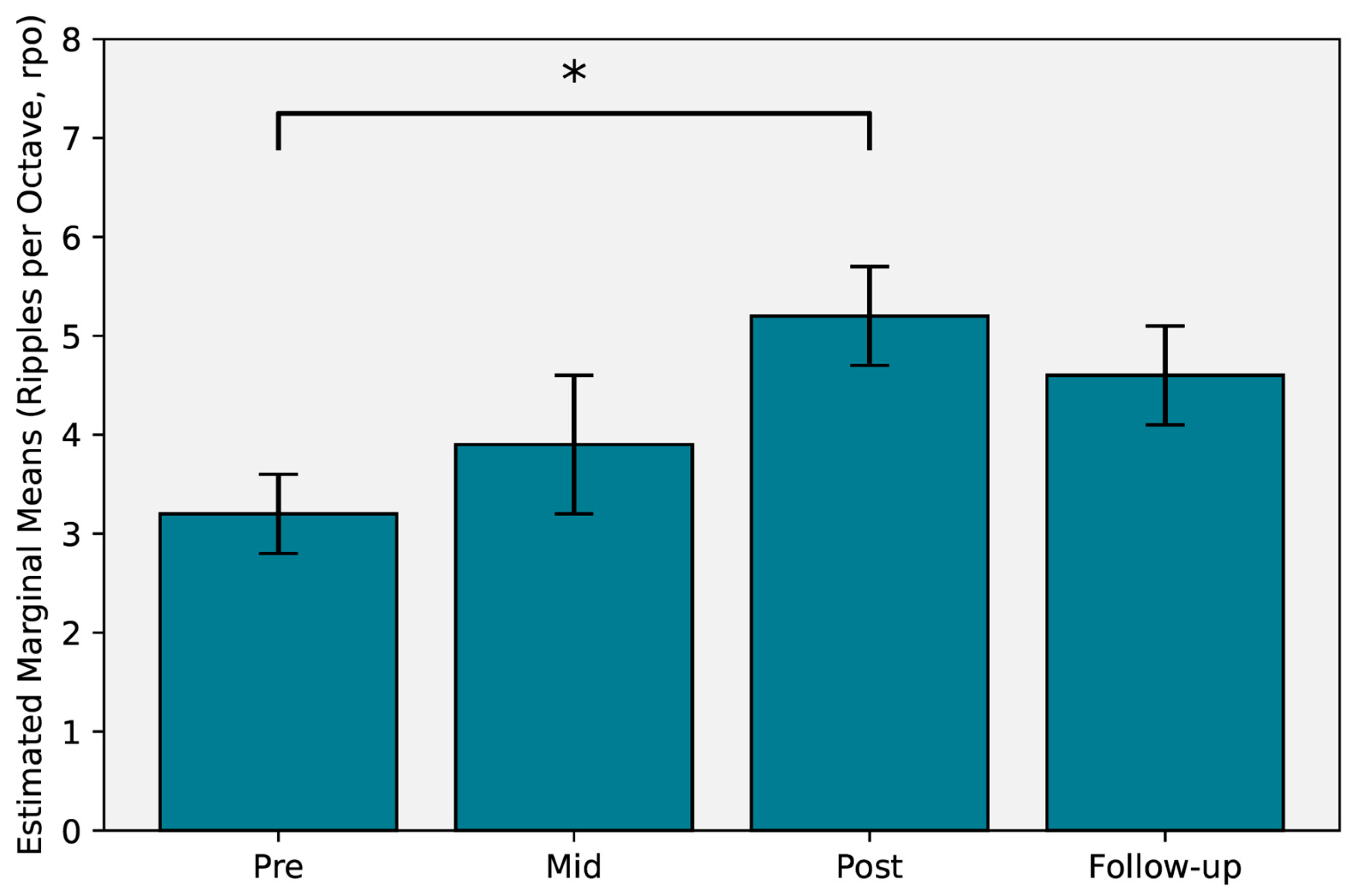
| Pre | 3.2 (0.4) | - | - | 2.3 | 4.1 |
| Mid | 3.9 (0.7) | 1.172 | 0.815 | 2.5 | 5.4 |
| Post | 5.2 (0.5) | 3.859 | 0.017 | 3.9 | 6.4 |
| Follow-up | 4.6 (0.5) | 3.011 | 0.061 | 3.4 | 5.8 |
| Activity Type | Participating Participants, n (%) * | Frequency (M, SD) | Duration (M, SD) | Formal or Informal Score (M, SD) | |
|---|---|---|---|---|---|
| Formal Music Activities | Music lessons | 5 (42%) | 1.67 (2.06) | 0.71 (1.05) | 0.47 (0.70) |
| Singing groups | 5 (42%) | 1.58 (2.35) | 0.75 (1.06) | 0.53 (0.86) | |
| Dance classes | 4 (33%) | 1.50 (2.28) | 0.58 (0.90) | 0.42 (0.62) | |
| Instrumental groups | 2 (17%) | 0.67 (1.65) | 0.13 (0.43) | 0.08 (0.21) | |
| Special children’s programs | 1 (8%) | 0.33 (1.15) | 0.13 (0.43) | 0.08 (0.29) | |
| Other music programs | 1 (8%) | 0.33 (1.15) | 0.17 (0.58) | 0.11 (0.38) | |
| Informal Music Activities | Listening to music informally | 9 (75.0%) | 4.50 (2.88) | 3.29 (2.97) | 2.19 (2.10) |
| Musical videos | 8 (66.7%) | 3.33 (2.65) | 1.42 (1.44) | 0.69 (0.80) | |
| Dancing informally | 8 (66.7%) | 3.33 (2.84) | 1.29 (1.18) | 0.67 (0.64) | |
| Social music activities | 7 (58.3%) | 1.50 (2.27) | 1.79 (2.29) | 0.47 (0.75) | |
| Creating/making music during play | 7 (58.3%) | 2.92 (2.63) | 1.71 (1.43) | 0.73 (0.88) | |
| Independent musical exploration | 6 (50.0%) | 1.67 (2.14) | 1.79 (2.43) | 0.73 (1.43) | |
| Music concerts | 6 (50.0%) | 0.50 (0.52) | 2.17 (2.60) | 0.24 (0.29) | |
| Family music activities | 3 (25.0%) | 0.75 (1.90) | 0.33 (0.65) | 0.08 (0.20) | |
| Online music training or games | 1 (8.3%) | 0.42 (1.44) | 0.33 (1.15) | 0.19 (0.64) |
Disclaimer/Publisher’s Note: The statements, opinions and data contained in all publications are solely those of the individual author(s) and contributor(s) and not of MDPI and/or the editor(s). MDPI and/or the editor(s) disclaim responsibility for any injury to people or property resulting from any ideas, methods, instructions or products referred to in the content. |
© 2026 by the authors. Licensee MDPI, Basel, Switzerland. This article is an open access article distributed under the terms and conditions of the Creative Commons Attribution (CC BY) license.
Share and Cite
Lo, C.Y.; Looi, V. Short-Term Music Training Enhances Spectral Resolution for Prelingually Deafened Children with Cochlear Implants. Audiol. Res. 2026, 16, 73. https://doi.org/10.3390/audiolres16030073
Lo CY, Looi V. Short-Term Music Training Enhances Spectral Resolution for Prelingually Deafened Children with Cochlear Implants. Audiology Research. 2026; 16(3):73. https://doi.org/10.3390/audiolres16030073
Chicago/Turabian StyleLo, Chi Yhun, and Valerie Looi. 2026. "Short-Term Music Training Enhances Spectral Resolution for Prelingually Deafened Children with Cochlear Implants" Audiology Research 16, no. 3: 73. https://doi.org/10.3390/audiolres16030073
APA StyleLo, C. Y., & Looi, V. (2026). Short-Term Music Training Enhances Spectral Resolution for Prelingually Deafened Children with Cochlear Implants. Audiology Research, 16(3), 73. https://doi.org/10.3390/audiolres16030073