
Experience in Box Simulation Program for Pediatric Laparoscopic Inguinal Hernia Repair Using Training Model Assembled with Common Hospital Items
 , ,
, ,
Abstract
1. Introduction
2. Materials and Methods
3. Results
4. Discussion
Supplementary Materials
Author Contributions
Funding
Institutional Review Board Statement
Informed Consent Statement
Data Availability Statement
Conflicts of Interest
Abbreviations
| LIHR | Laparoscopic Inguinal Hernia Repair |
| OSATS | Objective Structured Assessment of Technical Skills |
References
- Esposito, C.; Escolino, M.; Saxena, A.; Montupet, P.; Chiarenza, F.; De Agustin, J.; Draghici, I.M.; Cerulo, M.; Sagaon, M.M.; Di Benedetto, V.; et al. European society of pediatric endoscopic surgeons (ESPES) guidelines for training program in pediatric minimally invasive surgery. Pediatr. Surg. Int. 2015, 31, 367–373. [Google Scholar] [CrossRef] [Scilit] [PubMed]
- Grasso, F.; Baldanza, F.; Pernicone, S.; Pensabene, M.; Sergio, M.; Di Pace, M.R. The Role of Endoscopy in the Postoperative Management of Patients Treated for Esophageal Atresia: 20 Years of Experience. Diagnostics 2025, 15, 843. [Google Scholar] [CrossRef] [Scilit] [PubMed] [PubMed Central]
- Coelho, A.; Mendes, L.; Correia-Pinto, J.; Moreira-Pinto, J. Preliminary Assessment of a Dry-Lab Model for Laparoscopic Percutaneous Inguinal Ring Suture Training. J. Laparoendosc. Adv. Surg. Tech. A 2018, 28, 1121–1124. [Google Scholar] [CrossRef] [Scilit] [PubMed]
- Lee, S.R. Laparoscopic iliopubic tract repair to treat recurrent pediatric inguinal hernia. Surg. Endosc. 2022, 36, 4321–4327. [Google Scholar] [CrossRef] [Scilit] [PubMed] [PubMed Central]
- Shibuya, S.; Fujiwara, N.; Ochi, T.; Wada, M.; Takahashi, T.; Lee, K.D.; Miyazaki, E. The learning curve of laparoscopic percutaneous extraperitoneal closure (LPEC) for inguinal hernia: Protocoled training in a single center for six pediatric surgical trainees. BMC Surg. 2019, 19, 6. [Google Scholar] [CrossRef] [Scilit] [PubMed]
- Morini, F.; Dreuning, K.M.A.; Janssen Lok, M.J.H.; Wester, T.; Derikx, J.P.M.; Friedmacher, F.; Miyake, H.; Zhu, H.; Pio, L.; Lacher, M.; et al. Surgical Management of Pediatric Inguinal Hernia: A Systematic Review and Guideline from the European Pediatric Surgeons’ Association Evidence and Guideline Committee. Eur. J. Pediatr. Surg. 2022, 32, 219–232. [Google Scholar] [CrossRef] [Scilit] [PubMed]
- Chang, O.H.; King, L.P.; Modest, A.M.; Hur, H.C. Developing an Objective Structured Assessment of Technical Skills for Laparoscopic Suturing and Intracorporeal Knot Tying. J. Surg. Educ. 2016, 73, 258–263. [Google Scholar] [CrossRef] [Scilit] [PubMed]
- Duboureau, H.; Renaud-Petel, M.; Klein, C.; Haraux, E. Development and evaluation of a low-cost part-task trainer for laparoscopic repair of inguinal hernia in boys and the acquisition of basic laparoscopy skills. J. Pediatr. Surg. 2021, 56, 674–677. [Google Scholar] [CrossRef] [Scilit] [PubMed]
- Athanasiadis, D.I.; Anton, N.E.; Karim, A.; Colgate, C.L.; Stefanidis, D. Does the advanced training in laparoscopic suturing enhance laparoscopic suturing skill beyond fundamentals of laparoscopic surgery? Surgery 2021, 170, 1125–1130. [Google Scholar] [CrossRef] [Scilit] [PubMed]
- Peláez Mata, D.; Herrero Álvarez, S.; Gómez Sánchez, A.; Pérez Egido, L.; Corona Bellostas, C.; de Agustín Asensio, J.C. Laparoscopic learning curves. Cir. Pediatr. 2021, 34, 20–27. [Google Scholar] [PubMed]
- Nakashima, M.; Ide, K.; Kawakami, K. Laparoscopic versus open repair for inguinal hernia in children: A retrospective cohort study. Surg. Today 2019, 49, 1044–1050. [Google Scholar] [CrossRef] [Scilit] [PubMed]
- Dreuning, K.; Maat, S.; Twisk, J.; van Heurn, E.; Derikx, J. Laparoscopic versus open pediatric inguinal hernia repair: State-of-the-art comparison and future perspectives from a meta-analysis. Surg. Endosc. 2019, 33, 3177–3191. [Google Scholar] [CrossRef] [Scilit] [PubMed] [PubMed Central]
- Bada-Bosch, I.; Escolino, M.; De Agustín, J.C.; Esposito, C. Pediatric Inguinal Hernia Repair, Laparoscopic Versus Open Approach: A Systematic Review and Meta-Analysis of the Last 10-Year Evidence. J. Laparoendosc. Adv. Surg. Tech. A 2022, 32, 583–594. [Google Scholar] [CrossRef] [Scilit] [PubMed]
- Gödeke, J.; Muensterer, O.J. Femoral, Direct, and Rare Inguinal Hernias in Children-An Update. Eur. J. Pediatr. Surg. 2017, 27, 484–494. [Google Scholar] [CrossRef] [Scilit] [PubMed]
- Chinnaswamy, P.; Malladi, V.; Jani, K.V.; Parthasarthi, R.; Shetty, R.A.; Kavalakat, A.J.; Prakash, A. Laparoscopic inguinal hernia repair in children. JSLS J. Soc. Laparoendosc. Surg. 2005, 9, 393–398. [Google Scholar] [PubMed] [PubMed Central]
- Hanssen, A.; Hanssen, D.A.; Hanssen, R.A.; Plotnikov, S.; Haddad, J.; Daes, J.E. Implementation and Validation of a Novel and Inexpensive Training Model for Laparoscopic Inguinal Hernia Repair. J. Abdom. Wall Surg. 2022, 1, 10305. [Google Scholar] [CrossRef] [Scilit] [PubMed] [PubMed Central]
- Uemura, M.; Jannin, P.; Yamashita, M.; Tomikawa, M.; Akahoshi, T.; Obata, S.; Souzaki, R.; Ieiri, S.; Hashizume, M. Procedural surgical skill assessment in laparoscopic training environments. Int. J. Comput. Assist. Radiol. Surg. 2016, 11, 543–552. [Google Scholar] [CrossRef] [Scilit] [PubMed]
- Cabarcas Maciá, L.; Marmolejo Franco, F.; Siu Uribe, A.; Palomares Garzón, C.; Rojo Díez, R. Pilot study for low-cost model validation in laparoscopic pediatric pyeloplasty simulation. Cir. Pediatr. 2022, 35, 141–145. [Google Scholar] [CrossRef] [Scilit] [PubMed]
- Spiliotis, A.E.; Spiliotis, P.M.; Palios, I.M. Transferability of Simulation-Based Training in Laparoscopic Surgeries: A Systematic Review. Minim. Invasive Surg. 2020, 2020, 5879485. [Google Scholar] [CrossRef] [Scilit] [PubMed] [PubMed Central]
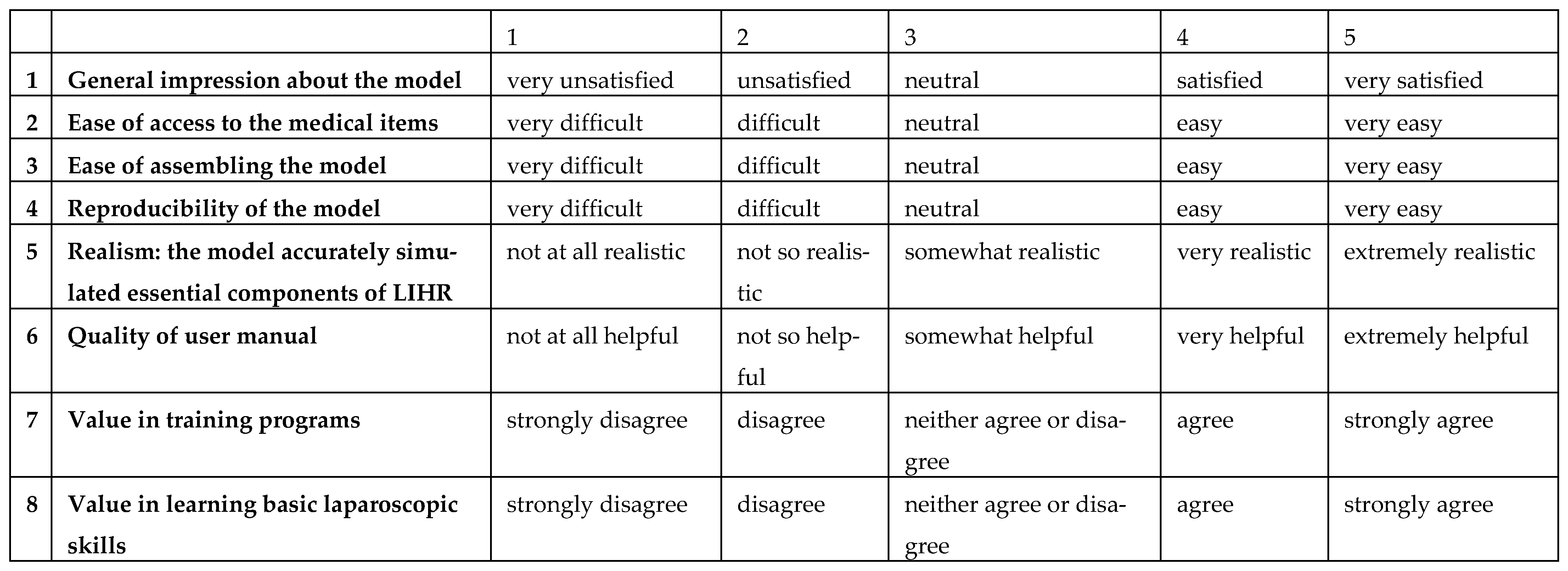



| Question | 1 | 2 | 3 | 4 | 5 | 6 | 7 | 8 |
|---|---|---|---|---|---|---|---|---|
| Consultant 1 | 5 | 5 | 4 | 5 | 4 | 4 | 5 | 4 |
| Consultant 2 | 4 | 4 | 4 | 5 | 5 | 5 | 4 | 5 |
| Consultant 3 | 4 | 5 | 5 | 5 | 4 | 5 | 5 | 5 |
| Consultant 4 | 5 | 5 | 5 | 4 | 5 | 5 | 4 | 5 |
| Consultant 5 | 5 | 4 | 5 | 4 | 5 | 5 | 5 | 5 |
| Registrar 1 | 4 | 4 | 4 | 4 | 4 | 4 | 5 | 4 |
| Registrar 2 | 5 | 5 | 4 | 4 | 5 | 3 | 4 | 5 |
| Registrar 3 | 5 | 5 | 5 | 4 | 5 | 5 | 4 | 5 |
| Registrar 4 | 4 | 4 | 5 | 5 | 5 | 4 | 4 | 4 |
| Registrar 5 | 5 | 4 | 3 | 4 | 5 | 5 | 5 | 4 |
| Registrar 6 | 3 | 5 | 5 | 4 | 4 | 4 | 4 | 5 |
| Registrar 7 | 4 | 4 | 5 | 5 | 4 | 5 | 4 | 5 |
| Registrar 8 | 4 | 5 | 4 | 5 | 5 | 3 | 5 | 4 |
| Registrar 9 | 4 | 5 | 5 | 4 | 5 | 5 | 4 | 4 |
| Registrar 10 | 5 | 5 | 4 | 4 | 4 | 4 | 5 | 5 |
| Registrar 11 | 4 | 5 | 3 | 4 | 5 | 5 | 5 | 4 |
| Registrar 12 | 5 | 5 | 4 | 4 | 4 | 5 | 5 | 5 |
| Average Likert score | 4.4 | 4.6 | 4.3 | 4.3 | 4.5 | 4.5 | 4.5 | 4.5 |
| OSATS PRE | TIME PRE (Minute) | OSATS POST | TIME POST (Minute) | |
|---|---|---|---|---|
| Consultant 1 | 39 | 22.16 | 47 | 19.24 |
| Consultant 2 | 35 | 25.34 | 41 | 20.53 |
| Consultant 3 | 37 | 31.26 | 42 | 24.12 |
| Consultant 4 | 40 | 29.57 | 46 | 21.14 |
| Consultant 5 | 39 | 26.42 | 44 | 17.55 |
| Registrar 1 | 25 | 44.36 | 31 | 37.28 |
| Registrar 2 | 22 | 48.19 | 29 | 44.43 |
| Registrar 3 | 29 | 39.58 | 35 | 34.14 |
| Registrar 4 | 30 | 33.22 | 34 | 29.41 |
| Registrar 5 | 28 | 40.35 | 33 | 35.17 |
| Registrar 6 | 23 | 57.12 | 29 | 52.59 |
| Registrar 7 | 26 | 41.00 | 31 | 32.46 |
| Registrar 8 | 24 | 39.37 | 28 | 32.10 |
| Registrar 9 | 25 | 43.57 | 29 | 38.46 |
| Registrar 10 | 23 | 48.10 | 30 | 39.55 |
| Registrar 11 | 24 | 62.34 | 27 | 51.14 |
| Registrar 12 | 27 | 52.14 | 30 | 43.59 |
| LIHR In Vivo | Before | After |
|---|---|---|
| Consultant 1 | 71 (85–65) | 58 (75–50) |
| Consultant 2 | 78 (85–75) | 70 (75–65) |
| Consultant 3 | 81 (95–70) | 65 (90–50) |
| Consultant 4 | 72 (80–65) | 55 (70–40) |
| Consultant 5 | 74 (85–65) | 60 (75–45) |
Disclaimer/Publisher’s Note: The statements, opinions and data contained in all publications are solely those of the individual author(s) and contributor(s) and not of MDPI and/or the editor(s). MDPI and/or the editor(s) disclaim responsibility for any injury to people or property resulting from any ideas, methods, instructions or products referred to in the content. |
© 2026 by the authors. Licensee MDPI, Basel, Switzerland. This article is an open access article distributed under the terms and conditions of the Creative Commons Attribution (CC BY) license.
Share and Cite
Grasso, F.; Baldanza, F.; Cambiaso, C.; Pensabene, M.; Sergio, M.; Di Pace, M.R. Experience in Box Simulation Program for Pediatric Laparoscopic Inguinal Hernia Repair Using Training Model Assembled with Common Hospital Items. Surg. Tech. Dev. 2026, 15, 16. https://doi.org/10.3390/std15020016
Grasso F, Baldanza F, Cambiaso C, Pensabene M, Sergio M, Di Pace MR. Experience in Box Simulation Program for Pediatric Laparoscopic Inguinal Hernia Repair Using Training Model Assembled with Common Hospital Items. Surgical Techniques Development. 2026; 15(2):16. https://doi.org/10.3390/std15020016
Chicago/Turabian StyleGrasso, Francesco, Fabio Baldanza, Chiara Cambiaso, Marco Pensabene, Maria Sergio, and Maria Rita Di Pace. 2026. "Experience in Box Simulation Program for Pediatric Laparoscopic Inguinal Hernia Repair Using Training Model Assembled with Common Hospital Items" Surgical Techniques Development 15, no. 2: 16. https://doi.org/10.3390/std15020016
APA StyleGrasso, F., Baldanza, F., Cambiaso, C., Pensabene, M., Sergio, M., & Di Pace, M. R. (2026). Experience in Box Simulation Program for Pediatric Laparoscopic Inguinal Hernia Repair Using Training Model Assembled with Common Hospital Items. Surgical Techniques Development, 15(2), 16. https://doi.org/10.3390/std15020016