


Highlights
What are the main findings?
- Tractionless arthroscopic treatment achieved significant improvements in pain scores and inflammatory markers with no perioperative complications and no infection recurrence at one-year follow-up.
- Tenosynovial giant cell tumor was identified in one-third of patients, all presenting with negative cultures and clinical features indistinguishable from septic arthritis.
What is the implication of the main finding?
- This technique provides effective infection control while avoiding traction-related complications and requiring only basic arthroscopic equipment.
- Tenosynovial giant cell tumor should be considered in culture-negative suspected hip septic arthritis to guide appropriate treatment decisions.
Abstract
Background: Septic arthritis of the hip (SAH) requires emergent surgical intervention. While open arthrotomy has been the traditional approach, arthroscopic treatment is emerging as an effective alternative. Tractionless techniques in adult populations remain understudied. Methods: Twenty-one patients (22 hips) met inclusion criteria. Six patients (7 hips) were excluded for age < 18 years, post-COVID osteomyelitis, prior hip surgery, or insufficient records, resulting in a final cohort of 15 patients. All fifteen patients underwent tractionless arthroscopic irrigation and debridement for suspected SAH (2014–2023). Inclusion required ≥2 clinical criteria (hip pain, limited range of motion, inability to bear weight, fever > 38 °C) AND ≥ 1 laboratory criterion (leukocytosis, elevated CRP, synovial WBC > 50,000, positive culture). Primary outcomes included Visual Analog Scale pain scores, inflammatory markers, and complications. Results: Median age was 33 years (range 20–76); 60% were female. VAS scores improved from 7 (6–10) to 1 (0–3) at discharge (p < 0.001). CRP levels decreased from 115 mg/L (35–206) to <5 mg/L (<5–9) postoperatively (p < 0.001). Positive cultures were obtained in 26.7% of cases, predominantly methicillin-sensitive Staphylococcus aureus. No perioperative complications occurred. Histopathological analysis revealed tenosynovial giant cell tumor (TGCT) in 33.3% of cases, representing an important differential diagnosis. Among non-TGCT cases, the culture-positive rate was 40%. No infection recurrence was observed during a minimum one-year follow-up. Conclusions: Tractionless arthroscopic irrigation and debridement appears effective for managing suspected SAH in adults, achieving significant improvements in pain scores and inflammatory markers without perioperative complications. This technique offers potential advantages by eliminating traction-related risks while maintaining effective joint debridement. Additionally, TGCT should be considered in the differential diagnosis of suspected SAH with culture-negative inflammatory arthropathy.
1. Introduction
Septic arthritis of the hip (SAH) represents a surgical emergency requiring prompt intervention to prevent severe complications, including sepsis, chronic osteomyelitis, and accelerated joint degeneration [1,2,3,4]. Without timely and appropriate treatment, SAH can lead to irreversible joint damage, significantly impacting patient outcomes. Current systematic reviews confirm that early surgical intervention combined with appropriate antibiotic therapy remains the cornerstone of management [5,6].
The indications for surgical intervention in suspected acute SAH are based on a constellation of clinical, laboratory, and imaging parameters, often requiring treatment before definitive microbiological confirmation. The primary goals include thorough joint debridement, reduction in bacterial load, and relief of elevated intraarticular pressure [5,7]. While open hip arthrotomy has traditionally been considered the gold standard approach, mounting evidence suggests that hip arthroscopy offers a safe and effective alternative with potentially reduced morbidity [6,8,9].
Contemporary hip arthroscopy typically employs mechanical traction to create sufficient joint distraction for central compartment access (the articulation between the acetabulum and femoral head). While effective, this approach carries certain risks, with reported complications including nerve palsies, soft tissue injuries, and perineal complications [10,11,12]. Although these complications are manageable with proper technique and newer post-less traction methods [13,14], they represent an additional consideration in surgical planning.
A key clinical question in the management of SAH is whether central compartment access is necessary for effective treatment. Given that open hip arthrotomy effectively manages infection through peripheral compartment access without joint distraction [15,16], there is compelling rationale to investigate whether arthroscopic techniques targeting primarily the peripheral compartment might provide adequate treatment while potentially simplifying the procedure. Moreover, accessing the central compartment carries inherent risks of iatrogenic damage to the articular cartilage and labrum [10,17]. The theoretical advantages include reducing procedure complexity while maintaining effective infection control.
Previous studies have demonstrated successful outcomes using tractionless arthroscopic hip irrigation and debridement in pediatric populations [18,19]. However, the literature on tractionless hip arthroscopy for SAH in adults remains notably limited.
The purpose of this study was to evaluate the clinical outcomes of tractionless arthroscopic irrigation and debridement for the management of suspected SAH in an adult population. The hypothesis was that this technique would achieve favorable clinical outcomes with minimal postoperative adverse events while potentially reducing risks associated with traction and central compartment access.
2. Methods
2.1. Study Design
This single-center retrospective chart review study, conducted between April 2014 and April 2023, was approved by the institutional review board (Protocol TLV-0402-13) and performed in accordance with the Declaration of Helsinki. Written informed consent was waived due to the retrospective and anonymized nature of the study. Medical records of patients who underwent tractionless arthroscopic irrigation and debridement for suspected SAH were reviewed for admission characteristics, operative findings, postoperative course, and follow-up outcomes.
Acute SAH may manifest with varied clinical symptoms and laboratory parameters [1,6,20,21]. Inclusion criteria required high clinical suspicion for SAH, defined as at least two clinical criteria: hip pain, limited and painful active and passive hip joint range of motion (ROM), inability to bear weight, or fever (>38 °C). Additionally, at least one of the following laboratory criteria was required: leukocytosis (white blood cells, WBC > 11,000/µL), elevated C-reactive protein (CRP) levels, synovial fluid WBC > 50,000 or positive Gram-stain, and positive culture based on Newman’s criteria [1,7,15,22,23]. All patients underwent the same surgical technique regardless of preoperative laboratory values. Exclusion criteria comprised age < 18 years, insufficient medical records, proximal femoral osteomyelitis, and prior hip surgery.
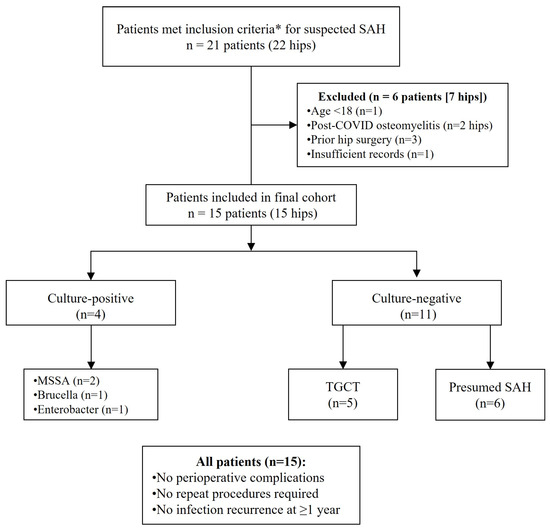
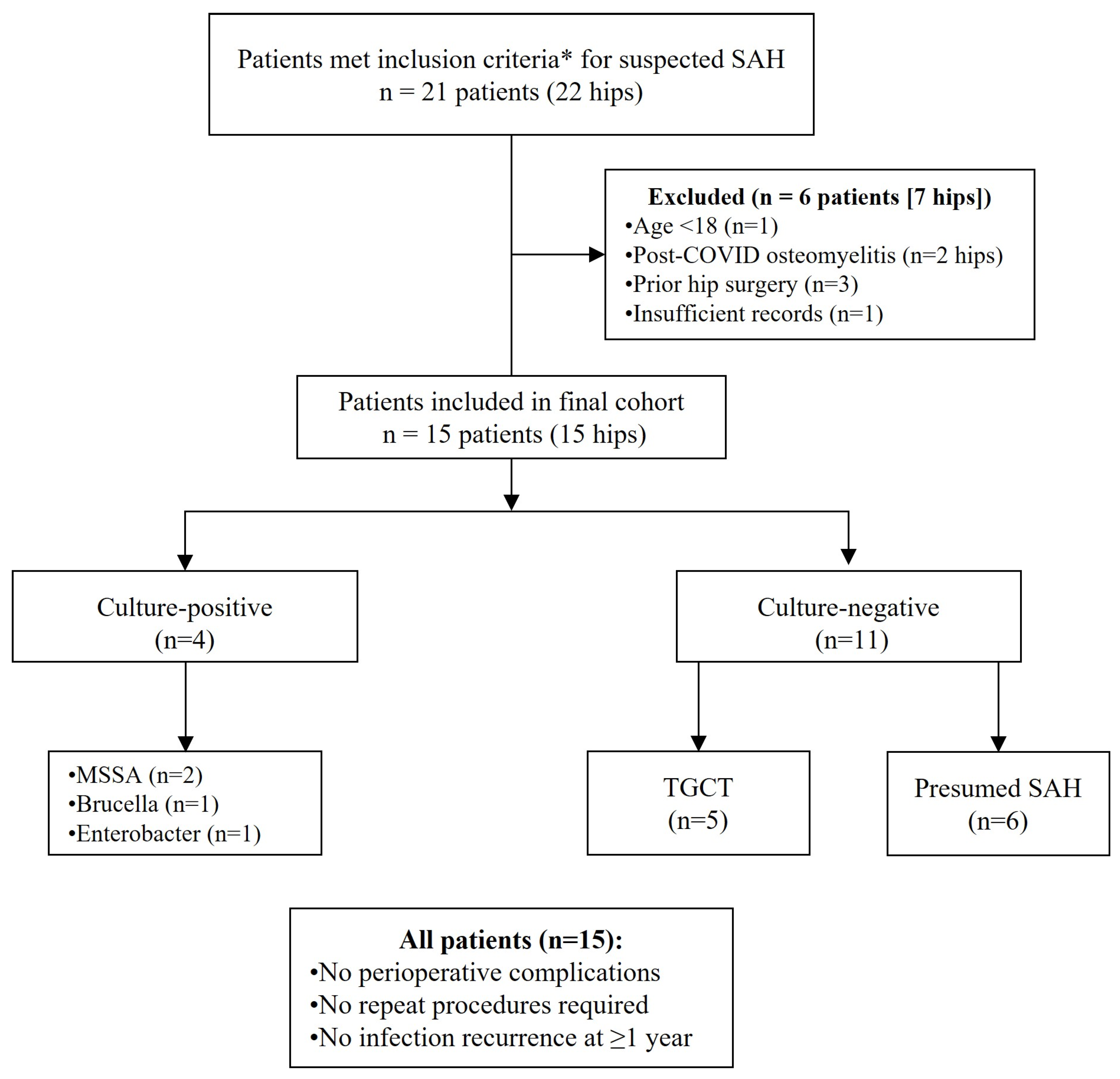
Twenty-one patients (22 hips) met inclusion criteria. Six patients (7 hips) were excluded: one for age, two hips for post-COVID-19 bilateral osteonecrosis with osteomyelitis of the proximal femur, three for prior hip surgery, and one for insufficient records, yielding a final cohort of fifteen patients (15 hips). The patient selection process and final diagnostic outcomes are illustrated in Figure 1.
Figure 1.
Patient selection flow diagram. Screening, inclusion/exclusion criteria, and diagnostic outcomes stratified by culture results and final diagnosis (TGCT vs. septic arthritis vs. presumed SAH). TGCT = tenosynovial giant cell tumor; MSSA = methicillin-sensitive Staphylococcus aureus; SAH = septic arthritis of the hip. * Inclusion criteria defined as at least two clinical criteria (hip pain, limited and painful active and passive hip joint range of motion, inability to bear weight, fever > 38 °C) AND at least one laboratory criterion (leukocytosis [WBC > 11,000/µL], elevated C-reactive protein, synovial fluid WBC > 50,000, positive Gram-stain, or positive culture).
2.2. Data Collection
2.2.1. Pre-Operative Data
Clinical data included acute symptom onset, hip pain assessed using a visual analog scale (VAS), limited hip ROM, inability to bear weight, fever at presentation, and symptom duration prior to surgical intervention.
Imaging studies such as hip ultrasound (US), computed tomography (CT), or magnetic resonance imaging (MRI) were performed when clinically indicated for diagnosis or exclusion of alternative pathologies. Laboratory studies included complete blood count (CBC) with differential, CRP levels, and blood cultures. Synovial fluid analysis from emergency department (ED) aspiration included WBC count, microscopic direct smear, microbiological cultures, and pan-microbial polymerase chain reaction (PM-PCR) [24]. PM-PCR was performed using validated in-house assays for bacterial, fungal, and mycobacterial DNA detection, followed by direct sequencing for pathogen identification, as described by Khoury et al. [24]. This molecular diagnostic approach provides enhanced sensitivity compared to conventional culture methods, particularly in cases with prior antibiotic exposure. Urinalysis and urine cultures were reviewed when obtained to exclude concurrent urinary tract infections.
2.2.2. Intraoperative Data
Arthroscopic findings from operative reports, synovial fluid analyses, microbiological cultures, PM-PCR results, and histopathology from excised specimens were documented. Tissue specimens for histopathological examination were selectively obtained during arthroscopy when localized synovial lesions morphologically distinct from diffuse inflammatory synovitis were identified, rather than as part of routine systematic sampling. The decision to biopsy was based on visual arthroscopic assessment of synovial tissue appearance.
2.2.3. Postoperative Outcomes
Objective measures included resolution of fever, WBC count normalization, CRP levels at discharge and follow-up, antibiotic treatment duration, time to full hip ROM, pain scores (VAS) at discharge and follow-up visits, hospital length of stay (LOS), and additional imaging studies when performed.
2.2.4. Antibiotic Protocol
Empiric intravenous antibiotic therapy was initiated promptly following ED joint aspiration and culture collection, as determined by the consulting infectious disease specialist. Initial empiric regimens typically included broad-spectrum coverage (e.g., third-generation cephalosporin with or without doxycycline for potential Brucella coverage in the endemic area). Antibiotic selection and duration were subsequently modified based on culture results, organism sensitivities, clinical response, and normalization of inflammatory markers. Treatment duration ranged from 0.4 to 12 weeks (median 4 weeks), with shorter courses in culture-negative cases with rapid clinical improvement and longer courses for confirmed bacterial infections.
2.3. Surgical Technique
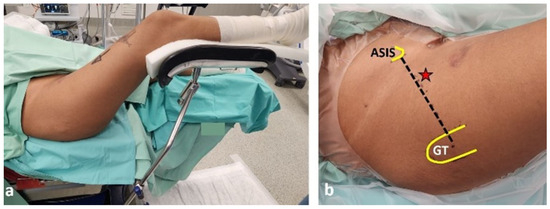
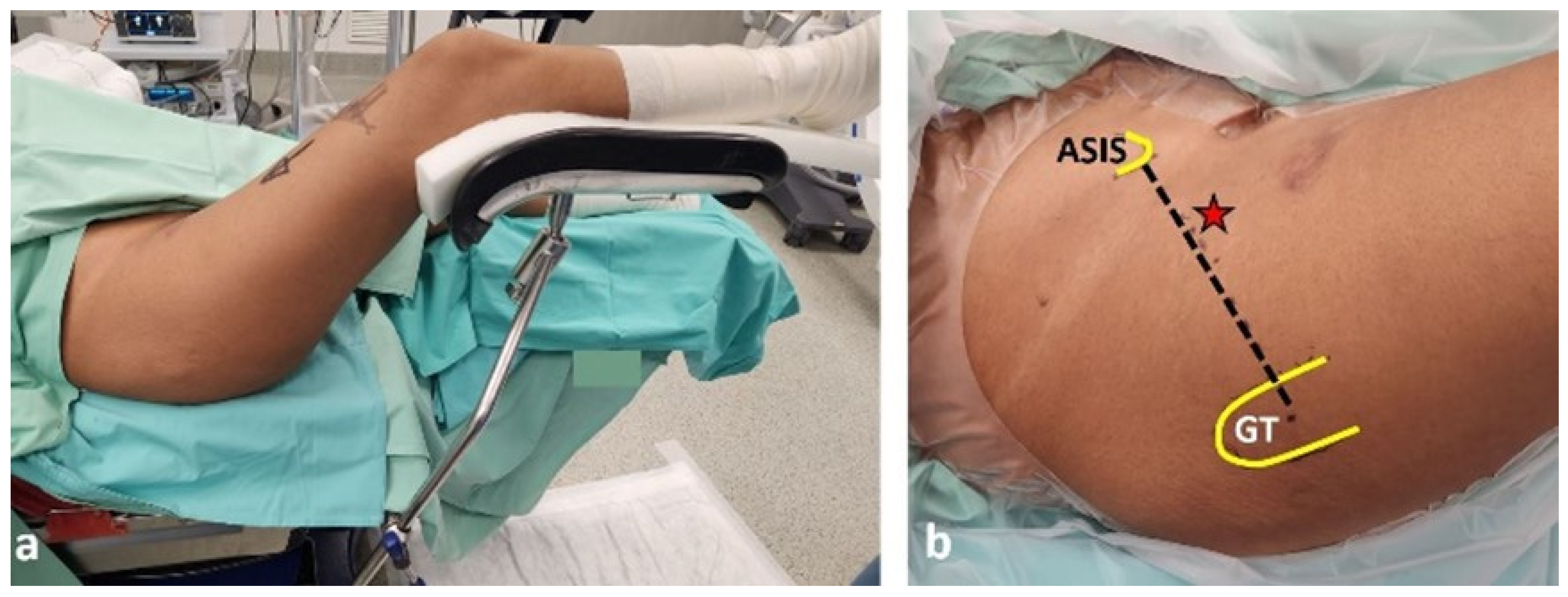
All procedures were performed by a fellowship-trained orthopedic sports surgeon, with patients under general anesthesia in the supine position. The hip was flexed 45° on a gynecology/urology leg holder with careful padding of the popliteal region and fibular head (Figure 2a). Surgery was performed without traction, following principles similar to open arthrotomy, where central compartment access is not required for effective debridement and irrigation.
Figure 2.
Patient positioning and portal placement. (a) The hip was flexed 45 degrees on a gynecology/urology leg holder. (b) The proximal anterolateral portal (PAP) was created in a soft spot (red star) slightly anterior to the point located one-third of the distance along a line drawn from the anterior superior iliac spine (ASIS) to the tip of the greater trochanter (GT).
The proximal anterolateral portal (PAP) [25] was first established for peripheral compartment visualization. The PAP was created in a soft spot slightly anterior to the point located one-third of the distance along a line drawn from the anterior superior iliac spine (ASIS) to the greater trochanter tip (Figure 2b). In the first five cases, fluoroscopy confirmed accurate needle placement perpendicular to the femoral neck. As experience with the technique developed and consistent reproducibility of portal placement was achieved using anatomical landmarks alone, subsequent cases were performed without fluoroscopy, reducing radiation exposure while maintaining accuracy.
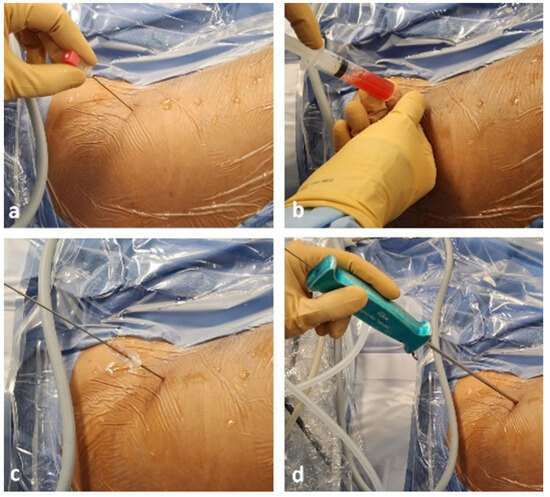
A 14-gauge spinal needle was inserted at a 45° caudal and 45° posterior direction until the femoral neck was palpated, then repositioned just anterior to the neck (Figure 3a). Successful joint access was confirmed by fluid aspiration (Figure 3b). In cases where direct aspiration was not possible, 10 mL normal saline was injected and aspirated to confirm intra-articular position. This approach mirrors the initial steps of open arthrotomy, where joint access is achieved without traction.
Figure 3.
Joint access and cannulation technique. (a) A spinal needle was inserted at a 45-degree caudal and 45-degree posterior direction just anterior to the neck. (b) Joint fluid aspiration confirmed the intra-articular position of the needle. (c) Nitinol wire inserted through the needle was used as a guide for a cannulated dilator (d).
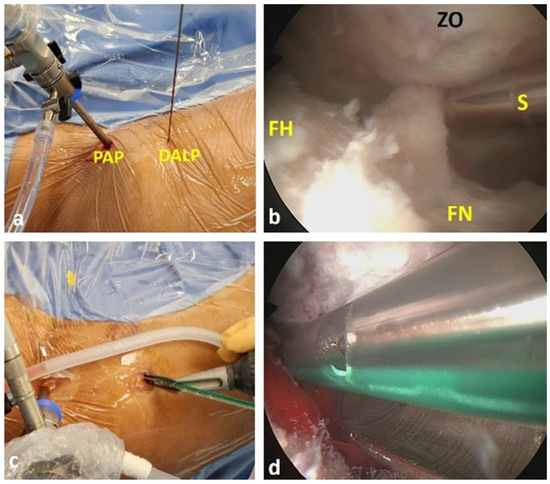
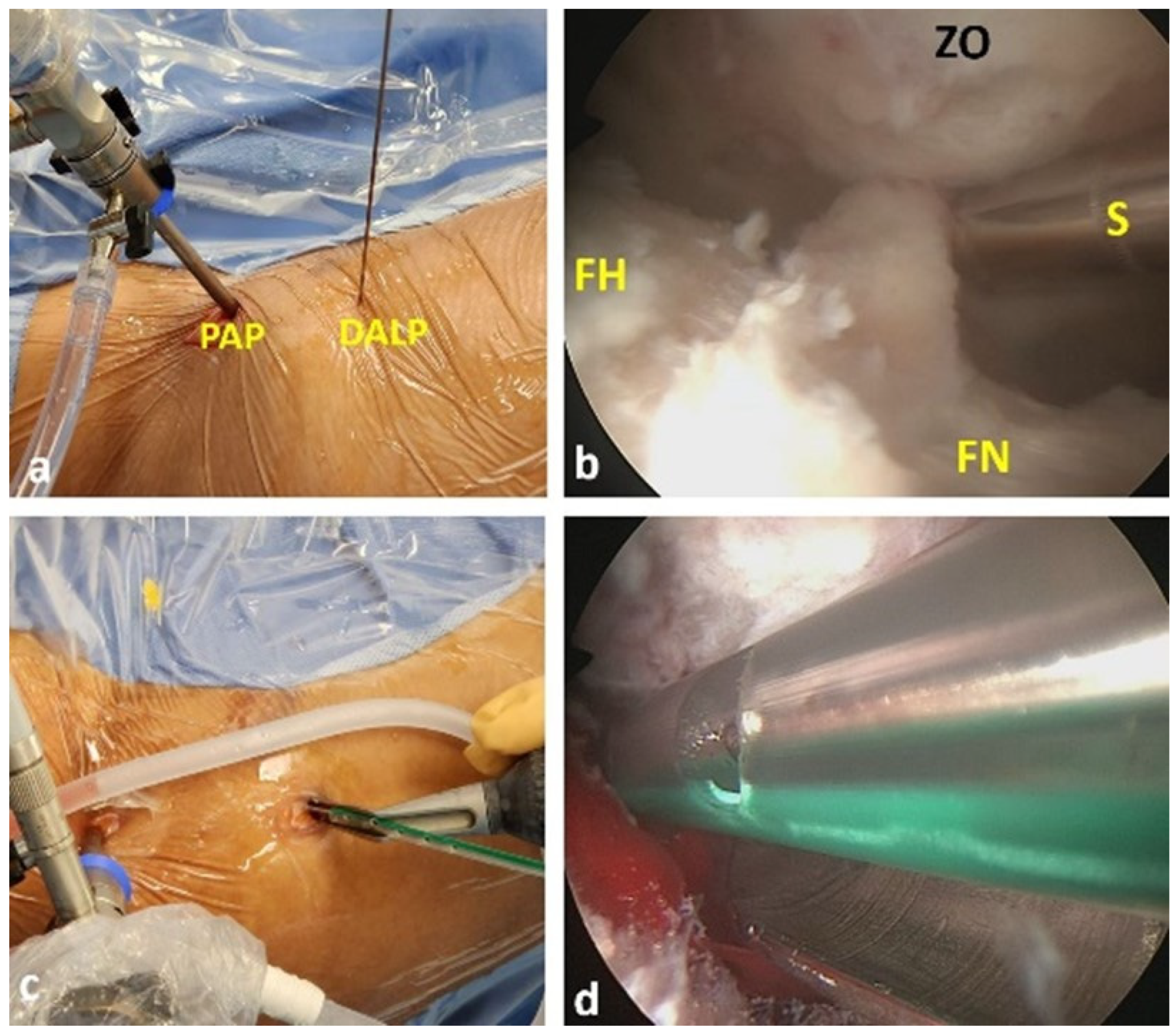
A nitinol wire (Figure 3c) was inserted through the needle and used as a guide for a cannulated dilator (Figure 3d) (DePuy Mitek, Raynham, MA, USA), followed by the arthroscope sheath. A distal anterolateral portal was then established under direct visualization, penetrating the capsule distal to the viewing portal (Figure 4a). Periportal or longitudinal interportal capsulotomy between the two entry points was performed with a hooked radiofrequency probe (VAPR; DePuy Mitek, Raynham, MA, USA) to facilitate instrument manipulation.
Figure 4.
Portal establishment and arthroscopic findings. (a) A distal anterolateral portal (DALP) was established under direct visualization distal to the viewing proximal anterolateral portal (PAP). (b) Arthroscopic picture: Intra-articular debris was systematically removed using a 3.5 mm full radius resector. FH: femoral head; FN: femoral neck; S: synovium; ZO: zona orbicularis. (c,d) At the end of the procedure, a 12-French drain was placed through the distal anterolateral portal at the level of the femoral neck and secured with a drain stitch.
Diagnostic arthroscopy of the peripheral compartment was performed systematically, examining the anteromedial neck area, posteromedial gutter, femoral head periphery and labrum, anterolateral neck, posterolateral gutter, distal neck, and capsule.
All patients demonstrated marked synovitis. Debris was systematically removed using a 3.5 mm full-radius resector (Smith and Nephew, London, UK) from the capsular side, head, and neck, starting at the anteromedial joint gutter, followed by the posteromedial, anterior, anterolateral, posterolateral, anterior neck, and capsule (Figure 4b).
The joint was irrigated with 9–12 L of saline using an arthroscopy pump (DePuy Mitek, Raynham, MA, USA). The hip was gently manipulated in external and internal rotation during irrigation to ensure thorough lavage. The capsulotomy was left open to allow joint drainage. A 12 French drain was placed through the distal anterolateral portal at the femoral neck level and secured with a drain stitch (Figure 4c,d). Drain placement facilitated continued drainage and reduced hematoma formation risk, as is common practice in joint infection [5,26]. The drains were removed within 24–48 h upon drainage resolution. Skin portals were closed with non-absorbable sutures.
2.4. Adverse Events
Postoperative adverse events were categorized according to Bovonratwet et al. [8,27] and divided into minor adverse events (MAEs) and serious adverse events (SAEs). MAEs were defined as wound dehiscence, blood transfusion requirement, or pneumonia. SAEs were defined as systemic infection (sepsis or septic shock), pulmonary embolism confirmed with CT angiography, deep venous thrombosis (DVT) confirmed with duplex ultrasound, or return to the operating room for additional procedures related to septic arthritis.
Other adverse events reported during follow-up visits were also reviewed. All adverse events were examined for a 30-day postoperative period, consistent with established methodology in arthroscopic literature [8,27,28,29,30,31,32].
2.5. Statistical Analysis
Descriptive statistics are reported as percentages for categorical variables and as median (range) for continuous variables. The Shapiro–Wilk test assessed normality of continuous variables.
For paired data analysis, the Wilcoxon signed-rank test was applied to continuous variables (CRP levels, VAS pain scores) due to non-normal distribution and small sample size. This nonparametric test evaluates both direction and magnitude of paired changes. For categorical variables (fever presence, leukocytosis), McNemar’s test for paired nominal data was employed. For variables with censored data (CRP values below the detection threshold of 5 mg/L), two complementary analyses were performed:
(1) Non-parametric analysis (Wilcoxon signed-rank test) for all patients, reporting medians and ranges
(2) Parametric analysis (paired t-test) for the subset with quantifiable values, reporting means, standard deviations, 95% confidence intervals, and Cohen’s d effect sizes
Cohen’s d was calculated for paired data as: d = mean change/SD of differences, with interpretation: |d| = 0.2–0.5 (small), 0.5–0.8 (medium), >0.8 (large), >1.2 (very large).
For VAS scores, which showed no censoring, parametric analysis (paired t-test) was used for all patients.
Two-tailed p-values ≤ 0.05 were considered statistically significant. Given the exploratory nature of this study and small sample size, no adjustments for multiple comparisons were performed. Statistical analyses were conducted using IBM SPSS Statistics Version 26 (IBM Corp., Armonk, NY, USA).
3. Results
3.1. Patient Demographics and Baseline Characteristics
The study cohort comprised fifteen patients (15 hips) with suspected SAH. Median age was 33 years (range: 20–76); 60% were female (9/15). Median symptom duration prior to surgical intervention was 3 days (range: 1–9). Comprehensive baseline demographics and clinical characteristics are presented in Table 1.
Table 1.
Patient Demographics and Clinical Characteristics.
3.2. Clinical Outcomes
Clinical improvement following arthroscopic intervention was observed across multiple parameters in all patients. VAS pain scores decreased markedly, with mean VAS improving from 7.3 ± 1.3 preoperatively to 1.3 ± 1.2 at discharge or first follow-up, representing a mean decrease of 6.0 points (95% CI: −6.7 to −5.3; p < 0.001) and a very large effect size (Cohen’s d = −4.6). All patients demonstrated minimal or no limitations in hip range of motion by discharge or first follow-up.
Four patients (26.7%) were febrile (>38 °C) at presentation, with complete fever resolution by discharge. Median LOS was 10 days (range: 3–32). Extended hospitalizations were primarily attributable to underlying medical comorbidities and social factors, notably in one patient (32 days) with an IV drug use history and hepatitis C.
3.3. Laboratory Findings
Laboratory findings demonstrated consistent improvement in inflammatory markers. All 15 patients initially presented with elevated CRP levels (>5 mg/L), with a median preoperative value of 115 mg/L (range: 35–206). By discharge or initial follow-up, CRP normalized (<5 mg/L) in 11 of 15 patients (73.3%), with a median value <5 mg/L (range: <5–9), representing a statistically significant reduction for each patient (p < 0.001). Among the subset of 5 patients with quantifiable pre- and postoperative CRP values (discharge CRP ≥ 5 mg/L), mean CRP decreased from 128.0 ± 52.3 mg/L to 7.0 ± 1.9 mg/L, representing a mean decrease of 121.0 mg/L (95% CI: −187.0 to −55.0; paired t-test p = 0.007) and a very large effect size (Cohen’s d = −2.3). The remaining 10 patients achieved CRP normalization below the detection threshold (<5 mg/L).
Eight patients (53.3%) presented with leukocytosis (WBC count > 11,000 cells/µL); all cases resolved by discharge.
3.4. Microbiological Results
Microbiological analysis yielded positive synovial cultures in 26.7% of cases (4/15 hips). Methicillin-sensitive Staphylococcus aureus (MSSA) was identified in two cases (50% of positive cultures), with one case each of Brucella melitensis and Enterobacter species. Three patients maintained positive cultures in both preoperative and intraoperative samples (two MSSA cases and one B. melitensis case). Blood cultures were positive in three patients (20%), all demonstrating corresponding positive synovial cultures.
3.5. Treatment Outcomes and Follow-Up
Antimicrobial therapy comprised empiric IV antibiotics prescribed by an infectious disease specialist, initiated promptly following ED joint aspiration. Regimens were modified based on culture results and antimicrobial sensitivities. Treatment duration ranged from 0.4 to 12 weeks (median 4 weeks). All patients completed a minimum one-year follow-up, with no cases lost to follow-up and no instances of infection recurrence observed.
3.6. Incidental Findings
During arthroscopic examination, localized synovial lesions were identified and excised in five patients (33.3%). Subsequent histopathological examination confirmed tenosynovial giant cell tumor (TGCT) in all five cases. These patients had presented with clinical and laboratory findings indistinguishable from septic arthritis, including elevated synovial fluid WBC counts (38,000–120,000 cells/μL), elevated CRP levels (35–124 mg/L), and in one case, fever > 38 °C. All TGCT cases had negative cultures from both preoperative and intraoperative samples, suggesting TGCT as the underlying cause of their inflammatory presentation.
Analysis of the non-TGCT cases (10 patients) revealed a median age of 45 years (range: 26–76), with 60% female representation. The positive culture rate in this subgroup was 40% (4/10 hips). Detailed outcomes for both the overall cohort and subgroups are presented in Table 2.
Table 2.
Treatment Outcomes and Clinical Response.
3.7. Complications
No perioperative adverse events were recorded within 30 days of arthroscopic surgical treatment. No patients in this series required repeat arthroscopic washout. Had repeat intervention been necessary, the decision would have been based on persistent fever, worsening clinical status, or failure of inflammatory markers to improve despite appropriate antibiotic therapy and initial surgical treatment. All patients demonstrated improvement in clinical parameters and inflammatory markers, with successful resolution of presenting symptoms.
4. Discussion
The main findings of this study demonstrate that tractionless arthroscopic irrigation and debridement for suspected SAH achieved effective resolution of clinical and laboratory parameters in all patients. This improvement was evidenced by significant decreases in CRP levels (p < 0.001), resolution of fever and leukocytosis, and marked improvement in pain scores (p < 0.001). These findings align with outcomes reported for both traditional arthroscopic [6,7,8,33,34] and open approaches [8,15,16], while potentially offering advantages through reduced soft tissue trauma and elimination of traction-related complications.
The culture-positive rate in the current series (26.7% overall, 40% in non-TGCT cases) is consistent with the challenges in SAH diagnosis, where culture-negative cases are increasingly recognized, with reported rates ranging from 18 to 70% [1,9,20,35]. When analyzing only the non-TGCT cases, the positive culture rate better aligns with similar studies (Table 3).
Table 3.
Comparison of Outcomes in Hip Septic Arthritis Management.
A significant advantage of the tractionless technique is the potential reduction in iatrogenic articular damage. Central compartment access during conventional hip arthroscopy carries inherent risks of cartilage and labral injury, with reported rates ranging from 12 to 68% across various studies [11,17,37]. Several investigations have documented that iatrogenic chondral and labral injuries occur even when procedures are performed by experienced arthroscopists [10,12,17,37,38,39]. By focusing primarily on peripheral compartment access without traction, this technique may reduce these risks while maintaining effectiveness for infection management.
This study revealed an unexpected but clinically significant finding: 33.3% of patients (5/15) initially presenting with clinical and laboratory findings consistent with septic arthritis were ultimately diagnosed with TGCT. These cases were indistinguishable from septic arthritis preoperatively, displaying marked synovitis, elevated synovial WBC counts (38,000–120,000 cells/μL), and elevated inflammatory markers. This finding highlights TGCT as an important differential diagnosis that should be considered in culture-negative cases of suspected SAH.
A potential limitation of the technique is the reduced visualization of central weight-bearing surfaces of the femoral head and acetabulum. This could theoretically impact debridement thoroughness in cases where infection extensively involves these surfaces. However, the current cohort demonstrated 100% infection control without central compartment access. This suggests that peripheral compartment access may provide sufficient debridement and irrigation for effective infection management, similar to the established effectiveness of open arthrotomy, which also focuses on peripheral compartment access [1,6,8,16]. The concept of tractionless hip arthroscopy has been described for pediatric patients with favorable outcomes [18,19]. The peripheral approach allows effective synovectomy and debris removal, while the capsulotomy left open facilitates continued drainage.
Traditional hip arthroscopy carries well-documented risks of traction-related complications, typically reported within 30 days post-operatively [6,28,29,40]. These include both distraction-type and compressive-type injuries that can manifest as early as the first post-operative day [10,40,41]. Distraction-type injuries, particularly traction-related neurapraxia, commonly result from prolonged or excessive traction force. Compressive-type injuries affecting soft tissue structures, including pudendal nerve palsy and damage to the scrotum or labia majora, are frequently associated with perineal post counter-traction, with pudendal nerve palsy reported in up to 4–13% of cases [12,42]. Although many traction-related complications of arthroscopic surgery are transient [43], they represent the majority of hip arthroscopy complications and can be avoided by eliminating traction when feasible.
Hip arthroscopy is a technically demanding procedure with an extended learning curve, often limited to dedicated arthroscopic centers [10,11,37]. The tractionless technique described in this study necessitates only basic arthroscopic tools without requiring specialized hip arthroscopy instruments. Thus, it can be included in the arsenal of tools available in centers that do not perform hip arthroscopy on a regular basis. Table 4 summarizes the key differences between surgical approaches across various domains, including surgical technique, traction requirements, compartment access, visualization, and complication profiles.
Table 4.
Comparison of Surgical Approaches for Hip Septic Arthritis.
5. Limitations
This study has several methodological limitations. Its retrospective single-center design and relatively small sample size limit generalizability and may not detect uncommon adverse events, although this is typical for studies of SAH given its rare occurrence [1,20,35]. While perioperative adverse events were examined for a 30-day postoperative period, complications might occur beyond this timeframe. However, this 30-day window aligns with established methodology in arthroscopic literature [8,27,28,29,30,31,32].
Another limitation is the absence of standardized patient-reported outcome measures (PROMs). However, in the specific context of SAH, PROMs are less commonly reported, likely due to the emergent nature of treatment, where immediate surgical intervention is prioritized to manage infection and prevent joint destruction. The urgency of these cases often precludes baseline PROM collection, making assessment of postoperative functional outcomes using these measures challenging. Consequently, while PROMs are valuable tools in elective orthopedic procedures, their application in emergent surgeries like those for SAH is limited and not routinely documented in the literature [6].
A broader challenge lies in the diagnosis and treatment of SAH itself [1,6,20,21]. The literature reveals no consensus on diagnostic methods or consistent indications for surgical treatment. The diagnosis of septic hips typically relies on the detection of infectious organisms in synovial fluid cultures, which takes 3–5 days to grow. However, SA is considered a medical emergency requiring immediate treatment. Furthermore, culture-negative cases frequently occur despite clinical signs consistent with SA. In such cases, diagnosis and surgical indications often depend on a combination of clinical criteria, laboratory values, and imaging findings that collectively provide a high suspicion of SAH while excluding other diagnoses.
The absence of a comparison group limits the ability to draw definitive conclusions about the efficacy and safety of tractionless arthroscopy compared to other surgical techniques. Future prospective comparative studies should evaluate differences between traction and tractionless approaches regarding infection recurrence, cartilage preservation, and functional outcomes. Despite these limitations, this study provides valuable initial evidence supporting the use of tractionless arthroscopy for managing suspected SAH in adults.
Antibiotic protocols varied over the study period and were individualized by infectious disease specialists based on clinical response and culture results, precluding the establishment of standardized treatment algorithms. Nevertheless, all patients received specialist consultation, and organism-directed therapy was administered when cultures were positive, with favorable outcomes achieved across the cohort.
6. Conclusions
This case series demonstrates that tractionless arthroscopic irrigation and debridement represents an effective treatment option for suspected acute septic arthritis of the native hip in adults. Significant improvements in both clinical parameters and inflammatory markers were achieved with no perioperative complications. The procedure offers potential advantages through reduced soft tissue trauma and avoidance of traction-related complications while achieving infection control comparable to traditional approaches. Additionally, the findings highlight TGCT as an important differential diagnosis that should be considered in culture-negative cases of suspected SAH. Further research, including comparative studies with larger sample sizes, is needed to validate these findings and establish the definitive role of this technique in the management of suspected SAH.
Author Contributions
Conceptualization, N.G., M.D. and E.R.; Methodology, M.D.; Formal analysis, R.A. and A.S.; Investigation, R.A., A.S. and S.B.; Data curation, S.B.; Writing—original draft, N.G., E.R. and E.A.; Writing—review and editing, N.G., S.F. and E.A.; Supervision, E.R.; Project administration, S.F. All authors have read and agreed to the published version of the manuscript.
Funding
This research did not receive any specific funding.
Institutional Review Board Statement
This study received ethical approval from the Ethics Committee of the Medical Center under the protocol number TLV-0402-13. The approval date is 2 January 2025.
Informed Consent Statement
Written informed consent was waived due to the retrospective and anonymized nature of the investigation.
Data Availability Statement
The datasets generated and analyzed during the current study are not publicly available due to patient privacy considerations but are available from the corresponding author on reasonable request and with appropriate ethical approval.
Conflicts of Interest
The authors declare that they have no relevant financial or non-financial interests to report.
References
- Mathews, C.J.; Weston, V.C.; Jones, A.; Field, M.; Coakley, G. Bacterial septic arthritis in adults. Lancet 2010, 375, 846–855. [Google Scholar] [CrossRef] [Scilit]
- Kao, F.C.; Hsu, Y.C.; Liu, P.H.; Tu, Y.K.; Jou, I.M. High 2-year mortality and recurrent infection rates after surgical treatment for primary septic arthritis of the hip in adult patients: An observational study. Medicine 2019, 98, e16765. [Google Scholar] [CrossRef] [Scilit]
- Hunter, J.G.; Gross, J.M.; Dahl, J.D.; Amsdell, S.L.; Gorczyca, J.T. Risk Factors for Failure of a Single Surgical Debridement in Adults with Acute Septic Arthritis. J. Bone Jt. Surg. 2015, 97, 558–564. [Google Scholar] [CrossRef] [Scilit]
- De Souza Miyahara, H.; Helito, C.P.; Oliva, G.B.; Aita, P.C.; Croci, A.T.; Vicente, J.R.N. Clinical and epidemiological characteristics of septic arthritis of the hip, 2006 to 2012, a seven-year review. Clinics 2014, 69, 464–468. [Google Scholar] [CrossRef] [Scilit] [PubMed]
- D’Angelo, F.; Monestier, L.; Zagra, L. Active septic arthritis of the hip in adults: What’s new in the treatment? A systematic review. EFORT Open Rev. 2021, 6, 164–172. [Google Scholar] [CrossRef] [Scilit] [PubMed]
- De Sa, D.; Cargnelli, S.; Catapano, M.; Peterson, D.; Simunovic, N.; Larson, C.M.; Ayeni, O.R. Efficacy of Hip Arthroscopy for the Management of Septic Arthritis: A Systematic Review. Arthrosc. J. Arthrosc. Relat. Surg. 2015, 31, 1358–1370. [Google Scholar] [CrossRef] [Scilit] [PubMed]
- Lum, Z.C.; Shieh, A.K.; Meehan, J.P. Native Adult Hip with Bacterial Septic Arthritis. JBJS Rev. 2018, 6, e2. [Google Scholar] [CrossRef] [Scilit]
- Khazi, Z.M.; Cates, W.T.; An, Q.; Duchman, K.R.; Wolf, B.R.; Westermann, R.W. Arthroscopy Versus Open Arthrotomy for Treatment of Native Hip Septic Arthritis: An Analysis of 30-Day Complications. Arthrosc. J. Arthrosc. Relat. Surg. 2020, 36, 1048–1052. [Google Scholar] [CrossRef] [Scilit]
- Fukushima, K.; Uekusa, Y.; Koyama, T.; Ohashi, Y.; Uchiyama, K.; Takahira, N.; Takaso, M. Efficacy and safety of arthroscopic treatment for native acute septic arthritis of the hip joint in adult patients. BMC Musculoskelet. Disord. 2021, 22, 318. [Google Scholar] [CrossRef] [Scilit]
- Papavasiliou, A.V.; Bardakos, N.V. Complications of arthroscopic surgery of the hip. Bone Jt. Res. 2012, 1, 131–144. [Google Scholar] [CrossRef] [Scilit]
- Smart, L.R.; Oetgen, M.; Noonan, B.; Medvecky, M. Beginning Hip Arthroscopy: Indications, Positioning, Portals, Basic Techniques, and Complications. Arthrosc. J. Arthrosc. Relat. Surg. 2007, 23, 1348–1353. [Google Scholar] [CrossRef] [Scilit]
- Nakano, N.; Lisenda, L.; Jones, T.L.; Loveday, D.T.; Khanduja, V. Complications following arthroscopic surgery of the hip: A systematic review of 36,761 cases. Bone Jt. J. 2017, 99, 1577–1583. [Google Scholar] [CrossRef] [Scilit]
- Mei-Dan, O.; Kraeutler, M.J.; Garabekyan, T.; Goodrich, J.A.; Young, D.A. Hip Distraction Without a Perineal Post: A Prospective Study of 1000 Hip Arthroscopy Cases. Am. J. Sports Med. 2018, 46, 632–641. [Google Scholar] [CrossRef] [Scilit] [PubMed]
- Kraeutler, M.J.; Fasulo, S.M.; Dávila Castrodad, I.M.; Mei-Dan, O.; Scillia, A.J. A Prospective Comparison of Groin-Related Complications After Hip Arthroscopy With and Without a Perineal Post. Am. J. Sports Med. 2023, 51, 155–159. [Google Scholar] [CrossRef] [Scilit] [PubMed]
- Davis, C.M.; Zamora, R.A. Surgical Options and Approaches for Septic Arthritis of the Native Hip and Knee Joint. J. Arthroplast. 2020, 35, S14–S18. [Google Scholar] [CrossRef] [Scilit] [PubMed]
- Goldenberg, D.L. Septic arthritis. Lancet 1998, 351, 197–202. [Google Scholar] [CrossRef] [Scilit]
- Ilizaliturri, V.M. Complications of Arthroscopic Femoroacetabular Impingement Treatment: A Review. Clin. Orthop. Relat. Res. 2009, 467, 760–768. [Google Scholar] [CrossRef] [Scilit]
- El-Sayed, A.M.M. Treatment of early septic arthritis of the hip in children: Comparison of results of open arthrotomy versus arthroscopic drainage. J. Child. Orthop. 2008, 2, 229–237. [Google Scholar]
- Ellis, H.B.; Copley, L.; Pennock, A.; Nepple, J.J.; Willimon, C.; Mayer, S.W.; Yen, Y.M. Tractionless Hip Arthroscopy for Septic Arthritis in Children. Arthrosc. Tech. 2021, 10, e659–e667. [Google Scholar] [CrossRef] [Scilit]
- Lee, Y.K.; Park, K.S.; Ha, Y.C.; Koo, K.H. Arthroscopic treatment for acute septic arthritis of the hip joint in adults. Knee Surg. Sports Traumatol. Arthrosc. 2014, 22, 942–945. [Google Scholar] [CrossRef] [Scilit]
- Ross, J.J. Septic Arthritis of Native Joints. Infect. Dis. Clin. N. Am. 2017, 31, 203–218. [Google Scholar] [CrossRef] [Scilit]
- Margaretten, M.E.; Kohlwes, J.; Moore, D.; Bent, S. Does This Adult Patient Have Septic Arthritis? JAMA 2007, 297, 1478–1488. [Google Scholar] [CrossRef] [Scilit]
- Newman, J.H. Review of septic arthritis throughout the antibiotic era. Ann. Rheum. Dis. 1976, 35, 198–205. [Google Scholar] [CrossRef] [Scilit] [PubMed]
- Khoury, N.; Amit, S.; Geffen, Y.; Adler, A. Clinical utility of pan-microbial PCR assays in the routine diagnosis of infectious diseases. Diagn. Microbiol. Infect. Dis. 2019, 93, 232–237. [Google Scholar] [CrossRef] [Scilit] [PubMed]
- Wettstein, M.; Dienst, M. Arthroscopy of the Peripheral Compartment of the Hip. Oper. Tech. Orthop. 2005, 15, 225–230. [Google Scholar] [CrossRef] [Scilit]
- Tornero, E.; Morata, L.; Martínez-Pastor, J.C.; Bori, G.; Climent, C.; García-Velez, D.M.; García-Ramiro, S.; Bosch, J.; Mensa, J.; Soriano, A. KLIC-score for predicting early failure in prosthetic joint infections treated with debridement, implant retention and antibiotics. Clin. Microbiol. Infect. 2015, 21, 786.e9–786.e17. [Google Scholar] [CrossRef] [Scilit]
- Bovonratwet, P.; Nelson, S.J.; Bellamkonda, K.; Ondeck, N.T.; Shultz, B.N.; Medvecky, M.J.; Grauer, J.N. Similar 30-Day Complications for Septic Knee Arthritis Treated With Arthrotomy or Arthroscopy: An American College of Surgeons National Surgical Quality Improvement Program Analysis. Arthrosc. J. Arthrosc. Relat. Surg. 2018, 34, 213–219. [Google Scholar] [CrossRef] [Scilit]
- Malviya, A.; Raza, A.; Jameson, S.; James, P.; Reed, M.R.; Partington, P.F. Complications and Survival Analyses of Hip Arthroscopies Performed in the National Health Service in England: A Review of 6,395 Cases. Arthrosc. J. Arthrosc. Relat. Surg. 2015, 31, 836–842. [Google Scholar] [CrossRef] [Scilit]
- Cvetanovich, G.L.; Chalmers, P.N.; Levy, D.M.; Mather, R.C.; Harris, J.D.; Bush-Joseph, C.A.; Nho, S.J. Hip Arthroscopy Surgical Volume Trends and 30-Day Postoperative Complications. Arthrosc. J. Arthrosc. Relat. Surg. 2016, 32, 1286–1292. [Google Scholar] [CrossRef] [Scilit]
- Martin, C.T.; Pugely, A.J.; Gao, Y.; Wolf, B.R. Risk Factors for Thirty-Day Morbidity and Mortality Following Knee Arthroscopy: A Review of 12,271 Patients from the National Surgical Quality Improvement Program Database. JBJS 2013, 95, e98. [Google Scholar] [CrossRef] [Scilit]
- Martin, C.T.; Gao, Y.; Pugely, A.J.; Wolf, B.R. 30-day morbidity and mortality after elective shoulder arthroscopy: A review of 9410 cases. J. Shoulder Elb. Surg. 2013, 22, 1667–1675.e1. [Google Scholar] [CrossRef] [Scilit]
- Anthony, C.A.; Pugely, A.J.; Gao, Y.; Westermann, R.R.; Martin, C.T.; Wolf, B.R.; Amendola, A. Complications and Risk Factors for Morbidity in Elective Hip Arthroscopy: A Review of 1325 Cases. Arthrosc. J. Arthrosc. Relat. Surg. 2014, 32, 1563–1569. [Google Scholar]
- Domb, B.G.; Philippon, M.J.; Giordano, B.D. Arthroscopic Capsulotomy, Capsular Repair, and Capsular Plication of the Hip: Relation to Atraumatic Instability. Arthrosc. J. Arthrosc. Relat. Surg. 2013, 29, 162–173. [Google Scholar] [CrossRef] [Scilit]
- Kuhns, B.D.; Weber, A.E.; Levy, D.M.; Bedi, A.; Mather, R.C.; Salata, M.J.; Nho, S.J. Capsular Management in Hip Arthroscopy: An Anatomic, Biomechanical, and Technical Review. Available online: http://journal.frontiersin.org/Article/10.3389/fsurg.2016.00013/abstract (accessed on 21 October 2024).
- Schröder, J.H.; Krüger, D.; Perka, C.; Hufeland, M. Arthroscopic Treatment for Primary Septic Arthritis of the Hip in Adults. Adv. Orthop. 2016, 2016, 1–7. [Google Scholar] [CrossRef] [Scilit] [PubMed]
- Shukla, A.; Beniwal, S.K.; Sinha, S. Outcome of arthroscopic drainage and debridement with continuous suction irrigation technique in acute septic arthritis. J. Clin. Orthop. Trauma. 2014, 5, 1–5. [Google Scholar] [CrossRef] [Scilit] [PubMed]
- Harris, J.D.; McCormick, F.M.; Abrams, G.D.; Gupta, A.K.; Ellis, T.J.; Bach, B.R.; Bush-Joseph, C.A.; Nho, S.J. Complications and Reoperations During and After Hip Arthroscopy: A Systematic Review of 92 Studies and More Than 6000 Patients. Arthrosc. J. Arthrosc. Relat. Surg. 2013, 29, 589–595. [Google Scholar] [CrossRef] [Scilit]
- Dienst, M.; Seil, R.; Kohn, D.M. Safe Arthroscopic Access to the Central Compartment of the Hip. Arthrosc. J. Arthrosc. Relat. Surg. 2005, 21, 1510–1514. [Google Scholar] [CrossRef] [Scilit]
- Byrd, J.W.T. Avoiding the labrum in hip arthroscopy. Arthrosc. J. Arthrosc. Relat. Surg. 2000, 16, 770–773. [Google Scholar] [CrossRef] [Scilit]
- Frandsen, L.; Lund, B.; Grønbech Nielsen, T.; Lind, M. Traction-related problems after hip arthroscopy. J. Hip Preserv. Surg. 2017, 4, 54–59. [Google Scholar] [CrossRef] [Scilit]
- Gupta, A.; Redmond, J.M.; Hammarstedt, J.E.; Schwindel, L.; Domb, B.G. Safety Measures in Hip Arthroscopy and Their Efficacy in Minimizing Complications: A Systematic Review of the Evidence. Arthrosc. J. Arthrosc. Relat. Surg. 2014, 30, 1342–1348. [Google Scholar] [CrossRef] [Scilit]
- Kern, M.J.; Murray, R.S.; Sherman, T.I.; Postma, W.F. Incidence of Nerve Injury After Hip Arthroscopy. J. Am. Acad. Orthop. Surg. 2018, 26, 773–778. [Google Scholar] [CrossRef] [Scilit]
- Martin, H.D.; Palmer, I.J.; Champlin, K.; Kaiser, B.; Kelly, B.; Leunig, M. Physiological Changes as a Result of Hip Arthroscopy Performed With Traction. Arthrosc. J. Arthrosc. Relat. Surg. 2012, 28, 1365–1372. [Google Scholar] [CrossRef] [Scilit]
- Hoppe, D.J.; De Sa, D.; Simunovic, N.; Bhandari, M.; Safran, M.R.; Larson, C.M.; Ayeni, O.R. The Learning Curve for Hip Arthroscopy: A Systematic Review. Arthrosc. J. Arthrosc. Relat. Surg. 2014, 30, 389–397. [Google Scholar] [CrossRef] [Scilit] [PubMed]
- Lee, Y.K.; Ha, Y.C.; Hwang, D.S.; Koo, K.H. Learning curve of basic hip arthroscopy technique: CUSUM analysis. Knee Surg. Sports Traumatol. Arthrosc. 2013, 21, 1940–1944. [Google Scholar] [CrossRef] [Scilit]
- Mehta, N.; Chamberlin, P.; Marx, R.G.; Hidaka, C.; Ge, Y.; Nawabi, D.H.; Lyman, S. Defining the Learning Curve for Hip Arthroscopy: A Threshold Analysis of the Volume-Outcomes Relationship. Am. J. Sports Med. 2018, 46, 1284–1293. [Google Scholar] [CrossRef] [Scilit]

Disclaimer/Publisher’s Note: The statements, opinions and data contained in all publications are solely those of the individual author(s) and contributor(s) and not of MDPI and/or the editor(s). MDPI and/or the editor(s) disclaim responsibility for any injury to people or property resulting from any ideas, methods, instructions or products referred to in the content. |
© 2025 by the authors. Licensee MDPI, Basel, Switzerland. This article is an open access article distributed under the terms and conditions of the Creative Commons Attribution (CC BY) license (https://creativecommons.org/licenses/by/4.0/).