


Mediastinal Gray Zone Lymphomas: Diagnostic Challenges, Clinicopathologic Overlap, and Emerging Management Strategies


Abstract
1. Introduction
2. Historical Perspective and WHO Classification of MGZL
3. Clinical Presentation
4. Pathology and Immunophenotype
4.1. B-Cell Markers and Transcription Factors
4.2. Activation Markers and Additional Immunophenotypic Features
4.3. Proposed Morphophenotypic Subgroups
5. Molecular and Genetic Features
5.1. Molecular Features Overlapping with CHL and PMBL
5.2. Epigenetic and Gene Expression Profiles
5.3. Copy Number Alterations and Structural Variants
5.4. Mutational Landscape
5.5. Tumor Microenvironment and Epigenetic Plasticity
6. Comparison of MGZL with PMBL and CHL
7. Treatment Approaches
7.1. Frontline Therapy
7.2. Safety and Tolerability of Frontline Immunochemotherapy
7.3. Role of Radiotherapy
7.4. Response Assesment
7.5. Relapsed/Refractory Disease and Stem Cell Transplantation
7.6. Novel Agents and Biologic Therapies
7.7. Emerging Strategies
8. Prognosis and Outcomes
9. Conclusions
Author Contributions
Funding
Institutional Review Board Statement
Informed Consent Statement
Data Availability Statement
Conflicts of Interest
References
- Alaggio, R.; Amador, C.; Anagnostopoulos, I.; Attygalle, A.D.; Araujo, I.B.O.; Berti, E.; Bhagat, G.; Borges, A.M.; Boyer, D.; Calaminici, M.; et al. The 5th edition of the World Health Organization Classification of Haematolymphoid Tumours: Lymphoid Neoplasms. Leukemia 2022, 36, 1720–1748, Erratum in Leukemia 2023, 37, 1944–1951. [Google Scholar] [CrossRef]
- Campo, E.; Jaffe, E.S.; Cook, J.R.; Quintanilla-Martinez, L.; Swerdlow, S.H.; Anderson, K.C.; Brousset, P.; Cerroni, L.; de Leval, L.; Dirnhofer, S.; et al. The International Consensus Classification of Mature Lymphoid Neoplasms: A report from the Clinical Advisory Committee. Blood 2022, 140, 1229–1253, Erratum in Blood 2023, 141, 437. [Google Scholar] [CrossRef]
- Swerdlow, S.H.; Campo, E.; Harris, N.L.; Jaffe, E.S.; Pileri, S.A.; Stein, H.; Thiele, J. WHO Classification of Tumours of Haematopoietic and Lymphoid Tissues, 4th ed.; IARC: Lyon, France, 2017. [Google Scholar]
- Pilichowska, M.; Pittaluga, S.; Ferry, J.A.; Hemminger, J.; Chang, H.; Kanakry, J.A.; Sehn, L.H.; Feldman, T.; Abramson, J.S.; Kritharis, A.; et al. Clinicopathologic consensus study of gray zone lymphoma with features intermediate between DLBCL and classical HL. Blood Adv. 2017, 1, 2600–2609. [Google Scholar] [CrossRef]
- Dunleavy, K.; Wilson, W.H. Primary mediastinal B-cell lymphoma and mediastinal gray zone lymphoma: Do they require a unique therapeutic approach? Blood 2015, 125, 33–39. [Google Scholar] [CrossRef]
- Wilson, W.H.; Pittaluga, S.; Nicolae, A.; Camphausen, K.; Shovlin, M.; Steinberg, S.M.; Roschewski, M.; Staudt, L.M.; Jaffe, E.S.; Dunleavy, K. A prospective study of mediastinal gray-zone lymphoma. Blood 2014, 124, 1563–1569. [Google Scholar] [CrossRef]
- Rüdiger, T.; Jaffe, E.S.; Delsol, G.; deWolf-Peeters, C.; Gascoyne, R.D.; Georgii, A.; Harris, N.L.; Kadin, M.E.; MacLennan, K.A.; Poppema, S.; et al. Workshop report on Hodgkin’s disease and related diseases (‘grey zone’ lymphoma). Ann. Oncol. 1998, 9, S31–S38. [Google Scholar] [CrossRef] [PubMed]
- Traverse-Glehen, A.; Pittaluga, S.; Gaulard, P.; Sorbara, L.; Alonso, M.A.; Raffeld, M.; Jaffe, E.S. Mediastinal gray zone lymphoma: The missing link between classic Hodgkin’s lymphoma and mediastinal large B-cell lymphoma. Am. J. Surg. Pathol. 2005, 29, 1411–1421. [Google Scholar] [CrossRef] [PubMed]
- Poppema, S.; Kluiver, J.L.; Atayar, C.; van den Berg, A.; Rosenwald, A.; Hummel, M.; Lenze, D.; Lammert, H.; Stein, H.; Joos, S.; et al. Report: Workshop on mediastinal grey zone lymphoma. Eur. J. Haematol. 2005, 75, 45–52. [Google Scholar] [CrossRef] [PubMed]
- Jaffe, E.S.; Harris, N.L.; Stein, H.; Campo, E.; Stefano Pileri, S.A.; Swerdlow, S.H. B-cell lymphoma, unclassifiable, with features intermediate between diffuse large B-cell lymphoma and classic Hodgkin lymphoma. In WHO Classification of Tumours of Haematopoietic and Lymphoid Tissues, 4th ed.; Swerdlow, S.H., Campo, E., Harris, N.L., Jaffe, E.S., Pileri, S.A., Stein, H., Thiele, J., Vardiman, J.W., Eds.; IARC Press: Lyon, France, 2008; pp. 267–268. [Google Scholar]
- Jaffe, E.S.; Stein, H.; Swerdlow, S.H.; Campo, E.; Pileri, S.A.; Harris, N.L. B-cell lymphoma, unclassifiable, with features intermediate between diffuse large B-cell lymphoma and classic Hodgkin lymphoma. In WHO Classification of Tumours of Haematopoietic and Lymphoid Tissues, 4th ed.; Swerdlow, S.H., Campo, E., Harris, N.L., Jaffe, E.S., Pileri, S.A., Stein, H., Thiele, J., Arber, D.A., Hasserjian, R.P., Le Beau, M.M., et al., Eds.; IARC Press: Lyon, France, 2017; pp. 342–344. [Google Scholar]
- Kritharis, A.; Pilichowska, M.; Evens, A.M. How I manage patients with grey zone lymphoma. Br. J. Haematol. 2016, 174, 345–350. [Google Scholar] [CrossRef]
- Sarkozy, C.; Chong, L.; Takata, K.; Chavez, E.A.; Miyata-Takata, T.; Duns, G.; Telenius, A.; Boyle, M.; Slack, G.W.; Laurent, C.; et al. Gene expression profiling of gray zone lymphoma. Blood Adv. 2020, 4, 2523–2535. [Google Scholar] [CrossRef]
- Sarkozy, C.; Hung, S.S.; Chavez, E.A.; Duns, G.; Takata, K.; Chong, L.C.; Aoki, T.; Jiang, A.; Miyata-Takata, T.; Telenius, A.; et al. Mutational landscape of gray zone lymphoma. Blood 2021, 137, 1765–1776. [Google Scholar] [CrossRef]
- Pileri, S.; Tabanelli, V.; Chiarle, R.; Calleri, A.; Melle, F.; Motta, G.; Sapienza, M.R.; Sabattini, E.; Zinzani, P.L.; Derenzini, E. Mediastinal Gray-Zone Lymphoma: Still an Open Issue. Hemato 2023, 4, 196–206. [Google Scholar] [CrossRef]
- Sarkozy, C.; Copie-Bergman, C.; Damotte, D.; Ben-Neriah, S.; Burroni, B.; Cornillon, J.; Lemal, R.; Golfier, C.; Fabiani, B.; Chassagne-Clément, C.; et al. Gray-zone Lymphoma Between cHL and Large B-Cell Lymphoma: A Histopathologic Series From the LYSA. Am. J. Surg. Pathol. 2019, 43, 341–351. [Google Scholar] [CrossRef] [PubMed]
- Quintanilla-Martinez, L.; de Jong, D.; de Mascarel, A.; Hsi, E.D.; Kluin, P.; Natkunam, Y.; Parrens, M.; Pileri, S.; Ott, G. Gray zones around diffuse large B cell lymphoma. Conclusions based on the workshop of the XIV meeting of the European Association for Hematopathology and the Society of Hematopathology in Bordeaux, France. J. Hematop. 2009, 2, 211–236. [Google Scholar] [CrossRef]
- Campo, E.; Swerdlow, S.H.; Harris, N.L.; Pileri, S.; Stein, H.; Jaffe, E.S. The 2008 WHO classification of lymphoid neoplasms and beyond: Evolving concepts and practical applications. Blood 2011, 117, 5019–5032. [Google Scholar] [CrossRef]
- Rosenwald, A.; Wright, G.; Leroy, K.; Yu, X.; Gaulard, P.; Gascoyne, R.D.; Chan, W.C.; Zhao, T.; Haioun, C.; Greiner, T.C.; et al. Molecular diagnosis of primary mediastinal B cell lymphoma identifies a clinically favorable subgroup of diffuse large B cell lymphoma related to Hodgkin lymphoma. J. Exp. Med. 2003, 198, 851–862. [Google Scholar] [CrossRef]
- Egan, C.; Pittaluga, S. Into the gray-zone: Update on the diagnosis and classification of a rare lymphoma. Expert. Rev. Hematol. 2020, 13, 1–3. [Google Scholar] [CrossRef] [PubMed]
- Eberle, F.C.; Rodriguez-Canales, J.; Wei, L.; Hanson, J.C.; Killian, J.K.; Sun, H.W.; Adams, L.G.; Hewitt, S.M.; Wilson, W.H.; Pittaluga, S.; et al. Methylation profiling of mediastinal gray zone lymphoma reveals a distinctive signature with elements shared by classical Hodgkin’s lymphoma and primary mediastinal large B-cell lymphoma. Haematologica 2011, 96, 558–566. [Google Scholar] [CrossRef]
- Tabanelli, V.; Melle, F.; Motta, G.; Mazzara, S.; Fabbri, M.; Agostinelli, C.; Calleri, A.; Del Corvo, M.; Fiori, S.; Lorenzini, D.; et al. The identification of TCF1+ progenitor exhausted T cells in THRLBCL may predict a better response to PD-1/PD-L1 blockade. Blood Adv. 2022, 6, 4634–4644. [Google Scholar] [CrossRef] [PubMed]
- Steidl, C.; Gascoyne, R.D. The molecular pathogenesis of primary mediastinal large B-cell lymphoma. Blood 2011, 118, 2659–2669. [Google Scholar] [CrossRef]
- Campo, E.; Jaffe, E.S. Taking gray zone lymphomas out of the shadows. Blood 2021, 137, 1703–1704. [Google Scholar] [CrossRef] [PubMed]
- Samhouri, Y.; Jayakrishnan, T.T.; Alnimer, L.; Bakalov, V.; Wegner, R.E.; Khan, C.; Fazal, S.; Lister, J. Treatment Selection and Survival in Patients with Gray Zone Lymphoma: A Comprehensive Population-Based Analysis. Hematol. Oncol. Stem Cell Ther. 2023, 16, 245–253. [Google Scholar] [CrossRef] [PubMed]
- Gargano, G.; Vegliante, M.C.; Esposito, F.; Pappagallo, S.A.; Sabattini, E.; Agostinelli, C.; Pileri, S.A.; Tabanelli, V.; Ponzoni, M.; Lorenzi, L.; et al. A targeted gene signature stratifying mediastinal gray zone lymphoma into classical Hodgkin lymphoma-like or primary mediastinal B-cell lymphoma-like subtypes. Haematologica 2024, 109, 3771–3775. [Google Scholar] [PubMed]
- Quintanilla-Martinez, L.; Fend, F. Mediastinal gray zone lymphoma. Haematologica 2011, 96, 496–499. [Google Scholar] [CrossRef]
- Higgins, J.P.; Warnke, R.A. CD30 expression is common in med iastinal large B-cell lymphoma. Am. J. Clin. Pathol. 1999, 112, 241–247. [Google Scholar] [CrossRef] [PubMed]
- Pilichowska, M.; Kritharis, A.; Evens, A.M. Gray Zone Lymphoma: Current Diagnosis and Treatment Options. Hematol. Oncol. Clin. 2016, 30, 1251–1260. [Google Scholar] [CrossRef]
- Picardi, M.; Giordano, C.; Pugliese, N.; Mascolo, M.; Varricchio, S.; Troncone, G.; Vigliar, E.; Bellavicine, C.; Lamagna, M.; Lisi, D.; et al. Liposomal-encapsulated doxorubicin supercharge-containing front-line treatment improves response rates in primary mediastinal large B-cell lymphoma and mediastinal gray zone lymphoma. Hematol. Oncol. 2024, 42, e3242. [Google Scholar] [CrossRef]
- Zinzani, P.L.; Martelli, M.; Magagnoli, M.; Pescarmona, E.; Scaramucci, L.; Palombi, F.; Bendandi, M.; Martelli, M.P.; Ascani, S.; Orcioni, G.F.; et al. Treatment and clinical management of primary mediastinal large B-cell lymphoma with sclerosis: MACOP-B regimen and mediastinal radiotherapy monitored by (67) Gallium scan in 50 patients. Blood 1999, 94, 3289–3293. [Google Scholar] [CrossRef]
- Plastaras, J.P.; Svoboda, J. PET/CT Responses in Primary Mediastinal Large B-Cell Lymphoma: What’s Negative? Int. J. Radiat. Oncol. Biol. Phys. 2021, 111, 595–596. [Google Scholar] [CrossRef]
- Cavalli, F.; Ceriani, L.; Zucca, E. Functional Imaging Using 18-Fluorodeoxyglucose PET in the Management of Primary Mediastinal Large B-Cell Lymphoma: The Contributions of the International Extranodal Lymphoma Study Group. Am. Soc. Clin. Oncol. Educ. Book 2016, 35, e368–e375. [Google Scholar] [CrossRef]
- Menguc, M.U.; Arikan, F.; Toptas, T. Medıastınal Gray Zone Lymphoma; Shades of Gray. Hematol. Transfus. Cell Ther. 2024, 46, 18–19. [Google Scholar] [CrossRef]
- Evens, A.M.; Kanakry, J.A.; Sehn, L.H.; Kritharis, A.; Feldman, T.; Kroll, A.; Gascoyne, R.D.; Abramson, J.S.; Petrich, A.M.; Hernandez-Ilizaliturri, F.J.; et al. Gray zone lymphoma with features intermediate between classical Hodgkin lymphoma and diffuse large B-cell lymphoma: Characteristics, outcomes, and prognostication among a large multicenter cohort. Am. J. Hematol. 2015, 90, 778–783. [Google Scholar] [CrossRef]
- Santoro, A.; Moskowitz, A.J.; Ferrari, S.; Carlo-Stella, C.; Lisano, J.; Francis, S.; Wen, R.; Akyol, A.; Savage, K.J. Nivolumab combined with brentuximab vedotin for relapsed/refractory mediastinal gray zone lymphoma. Blood 2023, 141, 2780–2783. [Google Scholar] [CrossRef] [PubMed]
- Green, M.R.; Monti, S.; Rodig, S.J.; Juszczynski, P.; Currie, T.; O’Donnell, E.; Chapuy, B.; Takeyama, K.; Neuberg, D.; Golub, T.R.; et al. Integrative analysis reveals selective 9p24.1 amplification, increased PD-1 ligand expression, and further induction via JAK2 in nodular sclerosing Hodgkin lymphoma and primary mediastinal large B-cell lymphoma. Blood 2010, 116, 3268–3277. [Google Scholar] [CrossRef] [PubMed]
- Kuruvilla, J. Targeted therapy in mediastinal gray zone lymphoma. Blood 2023, 141, 2673–2674. [Google Scholar] [CrossRef] [PubMed]
- Salamoon, M. Treatment of Mediastinal Gray Zone Lymphoma After Progression on First-Line Therapy IncludingRituximab: Treatment with High-Dose Therapy, Nivolumab and Ipilimumab. Clin. Lymphoma Myeloma Leuk. 2025, 25, S740. [Google Scholar] [CrossRef]

| Feature | PMBL | CHL (NS) | MGZL |
|---|---|---|---|
| Gender predilection | Female | Female | Male predominance |
| Age | 30s | 20–30s | 30–40s |
| Morphology | Sheets of large cells, fibrosis | Lacunar RS cells, nodular sclerosis, inflammatory | Transitional, pleomorphic RS-like cells, less inflammation |
| B-cell markers | Strong (CD20, PAX5, OCT-2, BOB.1) | Weak/absent | Variable (≥1 marker usually) |
| CD30 | Variable, weaker | Strong, diffuse | Usually positive |
| CD15 | Negative | Positive (~75%) | Variable |
| CD45 | Positive | Negative | Variable |
| Molecular profile | 9p24.1 (JAK2/PD-L1/PD-L2), REL | 9p24.1 (JAK2/PD-L1/PD-L2) | Intermediate + unique (HOXA5, MYC) |
| CD20 | Strong | Negative/weak | Variable (often reduced) |
| PAX5 | Strong | Weak | Variable (weak to moderate |
| CD79a/OCT-2/BOB.1 | Strong Positive | Usually, absent Negative | Variable/heterogeneous Often variable; may be positive in RS-like forms |
| MAL | Positive | Negative | Often positive |
| PD-L1/PD-L2 | Positive (9p24.1 amp) | Variable | Frequently positive |
| EBER | Rare | Rare | Occasionally reported (excludes MGZL under ICC/WHO-HEMA5 |
| Clinical Setting | Recommended Approach | Level of Evidence | Key Caveats |
|---|---|---|---|
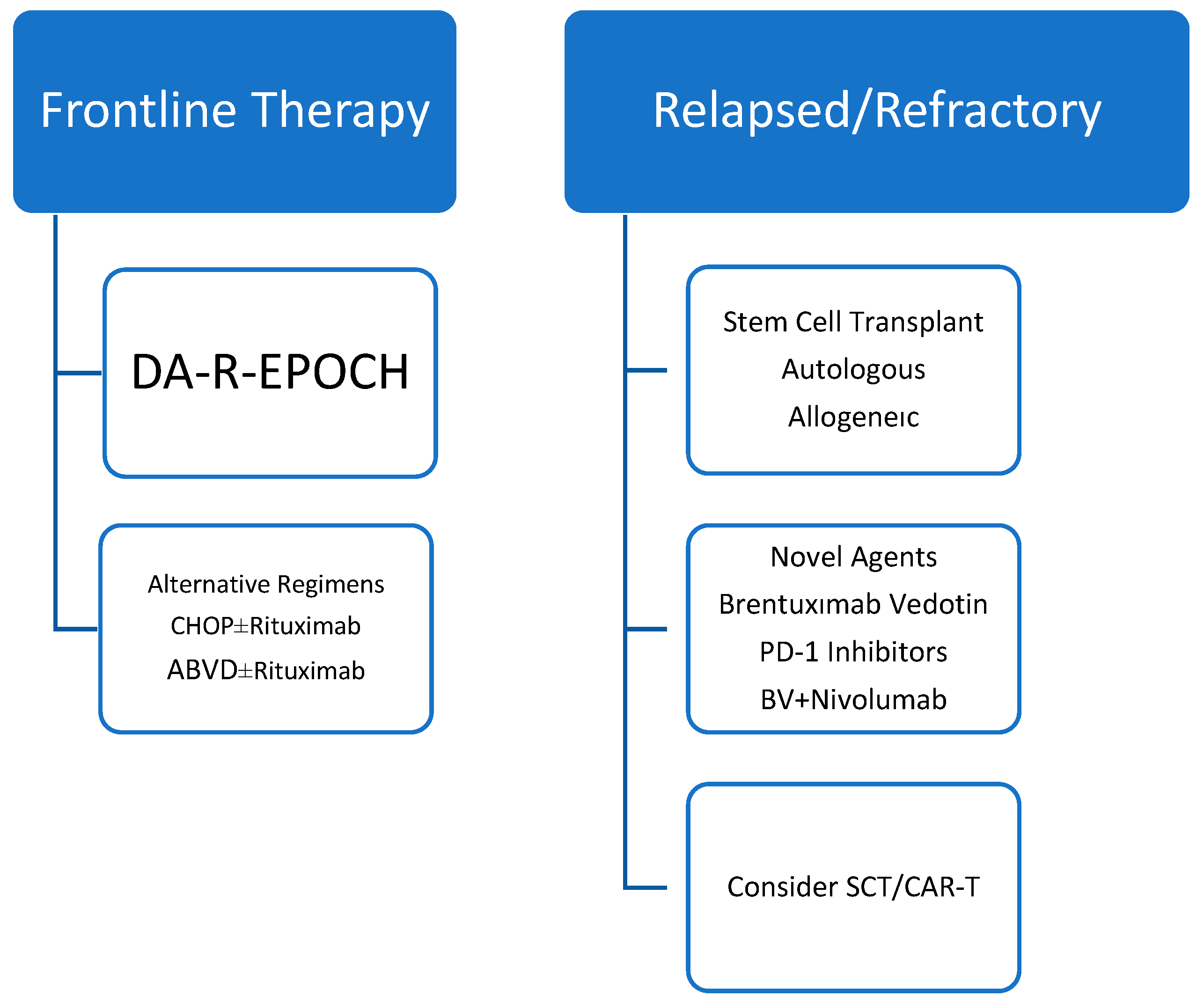
| Frontline therapy | DA-EPOCH-R | Retrospective cohorts | Small patient numbers; mixed historical GZL cohorts; outcomes not directly comparable to PMBL |
| CHOP ± rituximab | Retrospective cohorts | Lower toxicity but potentially inferior disease control | |
| ABVD ± rituximab | Retrospective cohorts | Inferior PFS compared with CHOP-based regimens | |
| Relapsed/refractory disease | Salvage chemotherapy → ASCT | Retrospective series | Limited MGZL-specific data; extrapolated from DLBCL/PMBL |
| Allogeneic SCT | Case series | Selected patients only; higher toxicity | |
| Novel agents | Brentuximab vedotin | Small series/case reports | CD30 expression variable; limited durability |
| PD-1 inhibitors (±BV) | Small cohorts | Rationale based on 9p24.1 alterations; MGZL-specific data limited | |
| Advanced salvage | CAR-T/SCT-based cellular therapy | Extrapolated evidence | Data derived from PMBL/DLBCL; MGZL-specific outcomes scarce |
| Regimen | Dose Strategy | Reported Grade ≥3 Toxicities | Other Safety Considerations |
|---|---|---|---|
| DA-EPOCH-R | Dose-adjusted, dose-dense | Neutropenia, anemia, thrombocytopenia, febrile neutropenia, infections | Frequent need for G-CSF; hospitalization not uncommon |
| CHOP ± Rituximab | Standard dose | Lower incidence of severe hematologic toxicity | Better tolerability but inferior disease control |
| escBEACOPP | Highly dose-intensive | Severe myelotoxicity, infections | High treatment-related morbidity; limited to fit patients |
| ACBVP | Dose-intensive | Grade ≥3 cytopenias, infections | Increased toxicity limits broad applicability |
| R-COMP-DI (liposomal doxorubicin) | Dose-intensified | Mainly hematologic; low incidence of severe non-hematologic toxicity | No reported hospitalization; favorable cardiac safety profile |
| Parameter | Commonly Reported Characteristics |
|---|---|
| Target site | Residual mediastinal lymph nodes (typically anterior mediastinum) |
| Residual nodal size | Often corresponding to initial bulky disease (>7–10 cm at diagnosis) |
| Imaging basis | Post-treatment CT or PET/CT |
| Radiotherapy volume | IFRT or ISRT |
| Total dose | 30–36 Gy |
| Timing after chemotherapy | Usually 3–6 weeks after last cycle |
| Therapy | ORR | CR | Median PFS | Comments |
|---|---|---|---|---|
| Brentuximab Vedotın (BV) | Effective in case series | Variable (small numbers) | Not well defined | Also used as ASCT maintenance; immunomodulatory effect |
| PD-1 Inhibitors (Nivolumab, Pembrolizumab) | Clinical activiy reported in R/R MGZL | Variable (case-based) | Not well defined | Responses resemble CHL/PMBL |
| BV + Nivolumab | 70% | 50% | 22 months | Durable responses, favorable safety; bridge to SCT |
Disclaimer/Publisher’s Note: The statements, opinions and data contained in all publications are solely those of the individual author(s) and contributor(s) and not of MDPI and/or the editor(s). MDPI and/or the editor(s) disclaim responsibility for any injury to people or property resulting from any ideas, methods, instructions or products referred to in the content. |
© 2025 by the authors. Licensee MDPI, Basel, Switzerland. This article is an open access article distributed under the terms and conditions of the Creative Commons Attribution (CC BY) license.
Share and Cite
Zorlu, T.; Seyhan, M.; Abdullayeva, N.; Ulas, T.; Sinan Dal, M. Mediastinal Gray Zone Lymphomas: Diagnostic Challenges, Clinicopathologic Overlap, and Emerging Management Strategies. Hematol. Rep. 2026, 18, 5. https://doi.org/10.3390/hematolrep18010005
Zorlu T, Seyhan M, Abdullayeva N, Ulas T, Sinan Dal M. Mediastinal Gray Zone Lymphomas: Diagnostic Challenges, Clinicopathologic Overlap, and Emerging Management Strategies. Hematology Reports. 2026; 18(1):5. https://doi.org/10.3390/hematolrep18010005
Chicago/Turabian StyleZorlu, Tugba, Mert Seyhan, Nigar Abdullayeva, Turgay Ulas, and Mehmet Sinan Dal. 2026. "Mediastinal Gray Zone Lymphomas: Diagnostic Challenges, Clinicopathologic Overlap, and Emerging Management Strategies" Hematology Reports 18, no. 1: 5. https://doi.org/10.3390/hematolrep18010005
APA StyleZorlu, T., Seyhan, M., Abdullayeva, N., Ulas, T., & Sinan Dal, M. (2026). Mediastinal Gray Zone Lymphomas: Diagnostic Challenges, Clinicopathologic Overlap, and Emerging Management Strategies. Hematology Reports, 18(1), 5. https://doi.org/10.3390/hematolrep18010005

