
Article

Effects of Indole-3-Butyric Acid Concentration and Explant Origin on Rooting-Related Traits and Early Ex Vitro Growth of Regenerated Physalis peruviana Shoots

by
Griselida Rojas-Campos
,
Raúl Vargas
*,
Anyela Marcela Ríos-Ríos
,
Eyner Huaman
,
Amilcar Valle-Lopez
and
Manuel Oliva-Cruz
*
Instituto de Investigación para el Desarrollo Sustentable de Ceja de Selva, Universidad Nacional Toribio Rodríguez de Mendoza de Amazonas, Chachapoyas 01001, Peru
*
Authors to whom correspondence should be addressed.
Int. J. Plant Biol. 2026, 17(7), 55; https://doi.org/10.3390/ijpb17070055
Submission received: 3 May 2026 / Revised: 24 June 2026 / Accepted: 30 June 2026 / Published: 6 July 2026

Abstract

Physalis peruviana L. is an Andean crop of high nutritional and commercial value; however, the limited availability of uniform planting material restricts its large-scale propagation. Indole-3-butyric acid (IBA) is widely used to promote adventitious rooting, although its concentration and application methods influence the response observed throughout the different stages of root development. This study evaluated how IBA concentration and explant origin influenced rooting-related traits and early vegetative growth of in vitro-regenerated P. peruviana shoots during a 30-day ex vitro acclimatization phase. The evaluated variables included rooting percentage, root number, longest root length, root fresh and dry mass, shoot length, leaf and node number, stem diameter, shoot fresh and dry mass, leaf area, and photosynthetic pigment contents. The experiment followed a completely randomized design with a 2 × 4 factorial arrangement consisting of two explant origins (cotyledon and hypocotyl) and four IBA concentrations (0, 400, 800, and 1600 mg L−1), with five biological replicates per treatment combination. All shoots formed at least one visible root, resulting in 100% rooting across all treatment combinations. IBA concentration significantly affected root fresh and dry mass and several shoot-growth traits, whereas root number and longest root length were not significantly affected. Among the concentrations tested, 800 mg L−1 produced the highest root biomass and favorable responses in selected shoot-growth traits, whereas 1600 mg L−1 was associated with lower values for some growth variables. Hypocotyl-derived shoots had more leaves and nodes, greater stem diameter, and higher shoot dry mass than cotyledon-derived shoots. These results indicate a concentration- and trait-dependent response to IBA and identify 800 mg L−1 as the most favorable concentration among those tested for increasing root biomass and selected shoot-growth traits under the evaluated acclimatization conditions.

1. Introduction

Physalis peruviana L. is an herbaceous species of the family Solanaceae, commonly known as golden berry, “uchuva” in Colombia, “uvilla” in Ecuador, and “aguaymanto” in Peru. Native to the Peruvian Andes, it is currently distributed across tropical highland regions and some subtropical areas, including Malaysia, Africa, China, and the Caribbean [1,2,3,4,5]. Its fruit is valued for its nutritional composition, particularly its content of vitamins C, A, and B, as well as for its pleasant flavor and aroma. These attributes, together with its recognized health-promoting potential, have increased consumer interest and enhanced its commercial value [6,7,8].
Plant tissue culture represents an efficient biotechnological alternative for the propagation of P. peruviana, since it can improve propagation efficiency and allows the production of uniform plant material [9] and secondary metabolites of interest under controlled conditions [10]. However, the success of this process depends not only on in vitro regeneration but also on the development of a functional root system during ex vitro acclimatization, which is essential for water and nutrient uptake and subsequent plant establishment [11,12,13]. In this species, juvenile explants such as hypocotyls and cotyledons have shown high regenerative capacity because of their meristematic activity and responsiveness to plant growth regulators [14,15,16]. This regenerative potential supports their use in clonal propagation, conservation, and genetic improvement programs, as well as the development of efficient regeneration and ex vitro establishment protocols [17,18,19].
Among plant growth regulators, indole-3-butyric acid (IBA) is widely used to induce adventitious root formation [20,21]. However, adventitious rooting is a multidimensional process where rooting parameters—such as initiation, root number, elongation, and biomass accumulation—respond differently to auxin concentration, exposure time, and application method [22]. In P. peruviana, IBA has been reported to influence rooting-related responses in both in vitro and vegetative propagation systems [16,23,24]. Studies in Physalis minima and in other plant species have similarly shown that auxin responses depend on the concentration applied and the physiological condition of the propagule [21,25,26,27,28].
Rooting induction, acclimatization, and early vegetative growth are closely related but distinct processes [29]. Rooting induction refers to the formation and development of adventitious roots, whereas acclimatization involves the gradual adjustment of regenerated plants to reduced relative humidity, non-sterile substrate, and ex vitro environmental conditions [22,30,31]. Early vegetative growth describes the development of shoot and leaf traits during the initial period following transfer. Therefore, an increase in shoot growth or biomass does not necessarily indicate a corresponding increase in root initiation or complete acclimatization success [32].
Limited information is available on how IBA concentration affects rooting-related traits and early vegetative growth of P. peruviana shoots regenerated from different explant origins during ex vitro acclimatization. It also remains unclear whether shoots regenerated from cotyledon and hypocotyl explants differ in their subsequent post-regeneration performance. Therefore, the objective of this study was to determine how IBA concentration and explant origin influence rooting-related traits and early vegetative growth of in vitro-regenerated P. peruviana shoots during the first 30 days of the ex vitro acclimatization phase. We hypothesized that these responses would depend on both IBA concentration and explant origin, with an intermediate IBA concentration producing more favorable responses than either the untreated control or the highest concentration.

2. Materials and Methods

2.1. Plant Material

The plant material used in this study consisted of Physalis peruviana L. shoots regenerated in vitro from cotyledon and hypocotyl explants, following the protocol described by Vargas et al. [9]. Shoot regeneration was achieved on culture medium supplemented with 5.54 µM thidiazuron (TDZ) and 0.5 µM indole-3-butyric acid (IBA), and regenerated shoots were obtained after 8 weeks of culture. These shoots were subsequently maintained in vitro for an additional 6 weeks to allow sufficient growth before ex vitro establishment.
At the end of the additional six-week in vitro growth period, shoots with normal morphology, no visible chlorosis or deformities, and visually homogeneous development were selected for the ex vitro experiment. The regeneration protocol and the general characteristics of shoots produced under these conditions were previously reported by Vargas et al. [9]. However, individual shoot length, leaf number, stem diameter, and vigor were not quantitatively recorded immediately before IBA application and ex vitro transfer.
The selected shoots were randomly chosen from a heterogeneous pool of regenerated plant material originating from multiple source explants and maintained in several in vitro culture vessels. The specific source explant and culture vessel of each selected shoot were not recorded. Therefore, although the selected material represented several explants and culture vessels, complete independence among regeneration events could not be confirmed.
The selected shoots were carefully excised and temporarily placed in sterile water to prevent dehydration until IBA treatment and planting.

2.2. Substrate Sterilization

For ex vitro establishment, the commercial substrate PlugMix® Fardo (Maruplast Internacional S.A.C., Lima, Peru) was used. According to the manufacturer, this substrate is composed of oligotrophic Sphagnum peat moss, silt, trace elements, NPK mineral fertilizers, a wetting agent, and 15% per-lite to improve drainage. It has a pH of 5.5 and a fine particle size ranging from 0 to 7.5 mm [33].
Before use, the substrate was sterilized in an autoclave at 121 °C and 2.05 bar for 15 min. After sterilization, it was allowed to cool for 40 min, moistened with sterile water, and placed into two 7 × 4-cell trays for planting.

2.3. IBA Pulse Treatment and Ex Vitro Acclimatization

Indole-3-butyric acid (IBA; PhytoTechnology Laboratories, Product No. I538, Lenexa, KS, USA) solutions were prepared at concentrations of 400, 800, and 1600 mg L−1. For each preparation, a minimal amount of 1 N NaOH was added gradually until the IBA was completely dissolved. The solution was subsequently brought to a final volume of 1 L with sterile distilled water. The exact volume of NaOH used was not recorded, and the final pH of the solutions was not measured or adjusted. The control treatment consisted of sterile distilled water without IBA or NaOH; therefore, a solvent- and pH-matched control was not included.
Before planting, the regenerated shoots were removed from the water used to maintain hydration and subjected to a rapid pulse treatment by immersion for 1 min in the corresponding IBA solution (0, 400, 800, or 1600 mg L−1). After treatment, each shoot was established individually in the sterilized substrate.
The relatively high IBA concentrations evaluated in this study, compared with those commonly incorporated continuously into in vitro rooting media, were selected because the treatment consisted of a brief basal immersion before transfer to substrate. Temporary IBA treatments followed by ex vitro establishment have previously been used in Physalis peruviana; Moreno et al. [23] immersed the basal ends of 25-cm-long apical cuttings from adult plants in IBA solutions at 0, 200, 400, 600, or 800 mg L−1 for 5 min before planting them in peat moss or in a 1:1 (v/v) mixture of black soil and rice husks. More generally, short-pulse and quick-dip approaches involve brief exposure of the basal portion of shoots or cuttings to comparatively concentrated auxin solutions, followed by transfer to an auxin-free rooting medium or substrate. Lawson et al. [26] evaluated a 30 s quick dip in 1 mM K-IBA before transferring Prunus microshoots to IBA-free medium, whereas Pardi et al. [34] applied a brief dip in 3300 mg L−1 IBA before transferring Myrtus communis shoots to hormone-free medium or directly to ex vitro conditions. These studies provided the methodological basis for evaluating a 1 min IBA immersion in the present experiment. However, IBA uptake and alternative immersion durations were not assessed.
Each individual regenerated shoot was considered one biological replicate and one experimental unit. Five shoots were evaluated for each combination of explant origin and IBA concentration. The 2 × 4 factorial arrangement therefore comprised eight treatment combinations and a total of 40 experimental units. The same five shoots were evaluated for rooting and growth traits and were subsequently used for destructive measurements at the end of the 30-day evaluation period.
After planting, the trays were covered with transparent plastic film to maintain high relative humidity and reduce abrupt water loss after removal from the in vitro culture vessels. The trays were maintained at 25 ± 1 °C under a 16 h light/8 h dark photoperiod and a photosynthetic photon flux density of 70 µmol m−2 s−1 provided by cool-white LED lamps (6500 K). During the 30-day ex vitro acclimatization phase, small perforations were gradually made in the plastic film to increase ventilation and progressively reduce relative humidity. Rooting and early growth therefore occurred ex vitro, simultaneously with the acclimatization process.

2.4. Evaluation of Rooting and Growth Parameters

The effects of IBA concentration and explant origin on rooting-related traits and early growth during ex vitro acclimatization were evaluated 30 days after planting. Rooting-related responses included rooting percentage, number of roots, length of the longest root, fresh root mass, and dry root mass. Rooting percentage was calculated as the proportion of shoots that developed at least one visible root relative to the total number of shoots evaluated in each treatment combination.
In addition, shoot growth variables were recorded, including shoot length, number of leaves, number of nodes, stem diameter, fresh shoot mass, dry shoot mass, and leaf area.
Shoot length, longest root length, and stem diameter were measured individually for each regenerated shoot using a digital caliper. The number of leaves, number of nodes, and number of roots were recorded manually for each shoot. Shoot fresh mass, shoot dry mass, root fresh mass, and root dry mass were determined separately for each experimental unit using an analytical balance. For dry-mass determination, samples were dried in an oven at 40 °C for 96 h. Leaf area was estimated individually for each shoot from digital images captured with an Honor Magic 7 Lite mobile device and analyzed using ImageJ software, version 1.54i [35].

2.5. Pigment Extraction and Determination

Pigment extraction was performed as described by Lopez-Hidalgo et al. [36], with some modifications, the leaf material was collected, dried in an oven at 40 °C for 96 h, and ground into a fine, uniform powder, which was stored in 2 mL Eppendorf tubes at −20 °C until analysis. For extraction, 7.5 mg of the dried material was weighed and suspended in 1 mL of 80% ethanol at room temperature. The suspension was manually agitated every 10 min for one hour. The samples were refrigerated at 4 °C for 48 h and then agitated again on a vortex (2500 rpm, 30 s) and centrifuged at 10,000 rpm for 10 min at room temperature (25 °C) in a refrigerated centrifuge (Eppendorf 5430 R, Eppendorf AG, Hamburg, Germany). The supernatant was then collected and used for pigment analysis.
A 40 µL aliquot of extract and 160 µL of 80% ethanol were added to 96-well microplates. Absorbance was measured at wavelengths of 470, 649, and 664 nm using a UV-Vis spectrophotometer equipped with a microplate reader (Varioskan™ LUX, Thermo Scientific™, Life Technologies Holdings Pte Ltd., Singapore). The concentrations of chlorophyll a, chlorophyll b, and total carotenoids were calculated using the equations proposed by Lichtenthaler [37] with optical path length correction for the microplate format (correction factor = 1.4). The results were expressed as micrograms of pigment per milligram of dry mass (µg mg−1 DW), according to the following equations:
Chlorophyll a (μg/mL) = 13.36 A664 − 5.19 A649
Chlorophyll b (μg/mL) = 27.43 A649 − 8.12 A664
Total carotenoids (μg/mL) = (1000 A470 − 2.13 Ca − 97.63 Cb)/209
where Ca and Cb represent the concentrations of chlorophyll a and b, respectively.

2.6. Experimental Design and Statistical Analysis

The experiment was conducted using a completely randomized design with a 2 × 4 factorial arrangement, consisting of two explant origins (cotyledon and hypocotyl) and four IBA concentrations (0, 400, 800, and 1600 mg L−1), resulting in a total of eight treatments. Each treatment combination consisted of five biological replicates, with one regenerated shoot constituting one experimental unit. The selected shoots were randomly assigned to the eight treatment combinations and allocated to the available positions in the two trays according to a generated random sequence. The trays remained in fixed positions and were not rotated during the 30-day evaluation period. Each response variable was analyzed using the individual measurements obtained from the 40 experimental units. Treatment means were calculated only for descriptive presentation and were not used as observations in the ANOVA.
Normality was assessed for all variables using the Shapiro–Wilk test, and homogeneity of variances was evaluated using Levene’s test. When required, data were transformed to satisfy model assumptions. Dry root mass and longest root length were transformed using the natural logarithm [ln(x + 1)], whereas dry shoot mass and fresh root mass were transformed using the square-root transformation (√x).
All ANOVA and Tukey HSD tests for variables requiring transformation were performed using the transformed data. For biological interpretability, the tables and descriptive summaries present arithmetic means calculated from the original, untransformed observations, whereas statistical significance and grouping letters were derived from analyses conducted on the transformed scale. Rooting percentage was not subjected to inferential analysis because all shoots developed at least one visible root and the response showed no variation among treatment combinations.
Variables that met the assumptions were analyzed by two-way analysis of variance (ANOVA), considering the effects of explant origin, IBA concentration, and their interaction. When significant effects were detected, mean comparisons were performed using Tukey’s honestly significant difference (HSD) test at p ≤ 0.05 using the HSD.test function in the agricolae package.
All statistical analyses were performed in R version 4.4.1 [38] using the agricolae package [39].

3. Results

3.1. Rooting-Related Traits

All shoots developed at least one visible root after 30 days of ex vitro acclimatization. Rooting percentage was therefore 100% in all treatment combinations, and no inferential analysis was performed for this variable.
Root number and longest root length were not significantly affected by explant origin, IBA concentration, or their interaction (p > 0.05; Table S1).
Root fresh mass was significantly affected by IBA concentration (p < 0.001), but not by explant origin or the interaction between factors. The highest value was recorded at 800 mg L−1 IBA (86.03 mg), followed by 1600 mg L−1 (45.40 mg), 400 mg L−1 (24.54 mg), and the control (10.94 mg). The 800 mg L−1 treatment differed significantly from the control and 400 mg L−1, but not from 1600 mg L−1 (Table 1).
Root dry mass also varied significantly with IBA concentration (p < 0.001). The highest value was obtained at 800 mg L−1 (2.81 mg), which was significantly greater than the values recorded in the control (0.38 mg), 400 mg L−1 (0.97 mg), and 1600 mg L−1 (0.85 mg) treatments (Table 1).

3.2. Shoot Growth Traits

Shoot length was significantly affected by IBA concentration (p = 0.004) and by the explant origin × IBA concentration interaction (p = 0.028; Table S1). The highest mean shoot length was observed in hypocotyl-derived shoots treated with 800 mg L−1 IBA (111.58 mm), whereas the lowest mean was recorded in hypocotyl-derived shoots treated with 1600 mg L−1 (37.50 mm). Tukey’s HSD test showed that these two combinations differed significantly from each other; however, the 800 mg L−1 hypocotyl treatment was not significantly different from the other treatment combinations (Table 2).
Explant origin significantly affected the number of leaves (p = 0.010) and nodes (p = 0.005). Hypocotyl-derived shoots produced more leaves and nodes than cotyledon-derived shoots, with means of 6.20 versus 5.40 leaves and 5.80 versus 4.85 nodes, respectively (Table 1).
Stem diameter was significantly affected by both explant origin (p = 0.002) and IBA concentration (p < 0.001), with no significant interaction between factors. Hypocotyl-derived shoots had a greater stem diameter than cotyledon-derived shoots (2.19 and 1.78 mm, respectively). Among IBA concentrations, the 800 mg L−1 treatment produced a significantly greater stem diameter (2.81 mm) than the control, 400 mg L−1, and 1600 mg L−1 treatments, which ranged from 1.60 to 1.85 mm (Table 1).
Shoot fresh mass was significantly affected by IBA concentration (p < 0.001), but not by explant origin or the interaction. The highest value was obtained at 800 mg L−1 IBA (1739.68 mg), while the control, 400 mg L−1, and 1600 mg L−1 treatments produced 505.30, 801.46, and 689.84 mg, respectively (Table 1).
Shoot dry mass was significantly affected by explant origin (p = 0.001), IBA concentration (p < 0.001), and their interaction (p = 0.023; Table S1). Hypocotyl-derived shoots treated with 800 mg L−1 IBA produced significantly greater shoot dry mass (132.84 mg) than all other explant origin × IBA concentration combinations. Cotyledon-derived shoots treated with 800 mg L−1 reached 62.46 mg, whereas the remaining combinations ranged from 21.94 to 49.42 mg (Table 2).
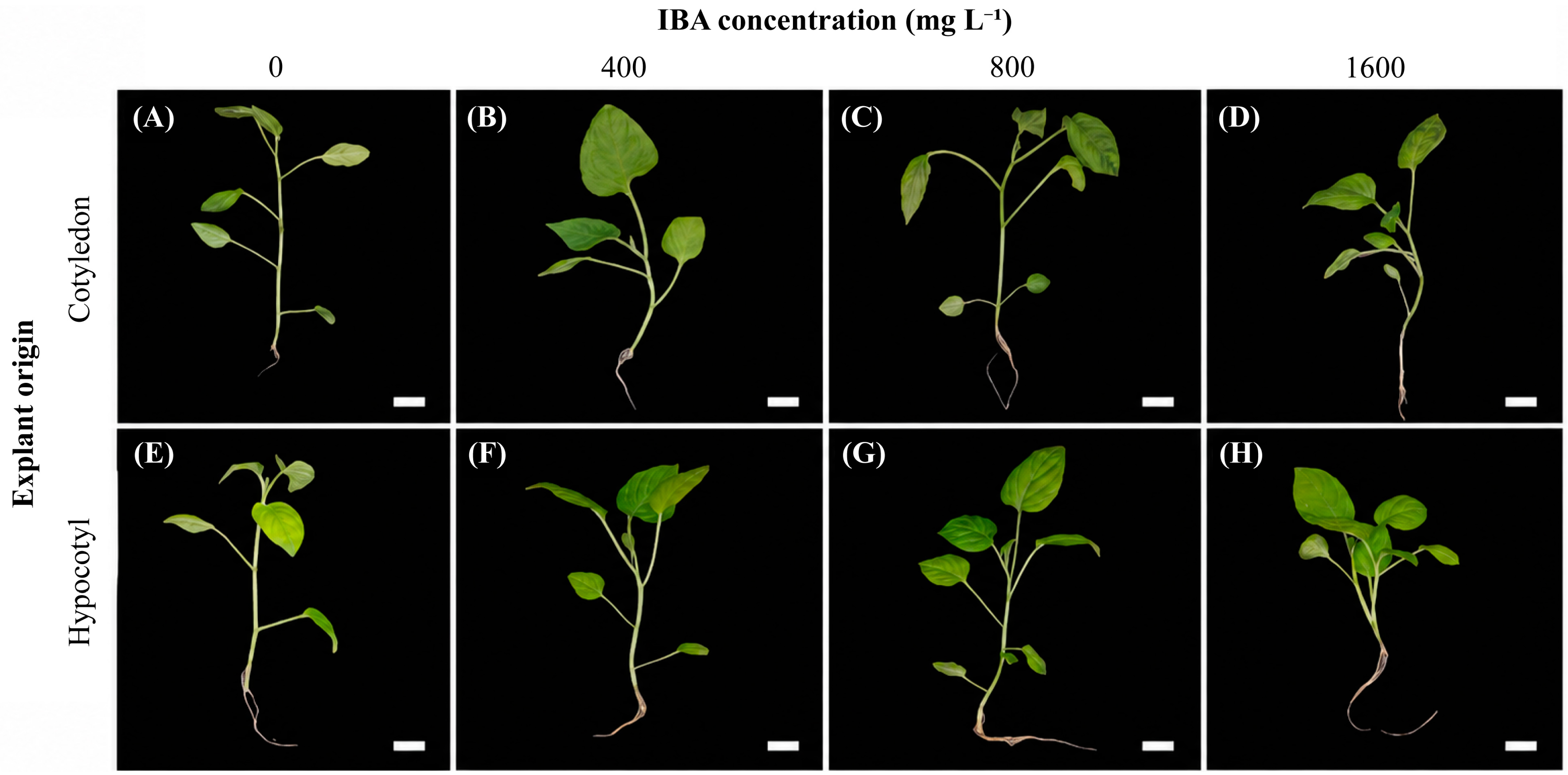
Leaf area was significantly affected by IBA concentration (p < 0.001). The 800 mg L−1 treatment produced significantly greater leaf area (64.22 cm2) than the control, 400 mg L−1, and 1600 mg L−1 treatments, which showed values of 14.92, 28.03, and 26.09 cm2, respectively (Table 1). Explant origin and the interaction between factors were not significant. Representative shoot and root morphology across explant origins and IBA concentrations is shown in Figure 1.

3.3. Photosynthetic Pigments

Chlorophyll a, chlorophyll b, total carotenoids, total chlorophyll, and the chlorophyll a/b ratio were not significantly affected by explant origin, IBA concentration, or their interaction (p > 0.05; Table S1).

4. Discussion

The present study showed concentration- and trait-dependent responses to exogenous IBA during ex vitro acclimatization. All shoots developed at least one visible root, and neither root number nor longest root length was significantly affected by IBA concentration. In contrast, fresh and dry root biomass were highest at 800 mg L−1, together with higher values for several shoot-growth traits. These findings indicate that, under the evaluated conditions, IBA primarily influenced root biomass accumulation and early vegetative growth rather than rooting occurrence or root proliferation.
The response observed at 800 mg L−1 is consistent with previous evidence showing that the effects of exogenous auxins depend on the concentration applied, propagation material, application method, and growth trait evaluated [24,40,41,42]. Lee et al. [43] found that 500 mg L−1 IBA increased shoot dry mass and favored biomass accumulation and several morphophysiological traits in Hedera algeriensis stem cuttings, whereas increasing the concentration to 1000 mg L−1 did not consistently improve all evaluated responses. Likewise, IBA concentrations of 200–400 mg L−1 favored rooting and growth in Morus alba cuttings [44], whereas 2000 mg L−1 promoted adventitious rooting in Eucalyptus benthamii mini-cuttings [45]. In ex vitro-rooted Myrtus communis microshoots, a rapid dip in 3300 mg L−1 IBA increased rooting percentage and root number, although lower concentrations produced longer roots [34]. Together, these findings show that the most favorable IBA concentration is species- and protocol-dependent and may also vary according to the response variable considered.
The favorable root biomass response observed at 800 mg L−1 IBA may be associated, at least partly, with the brief pulse application used before transfer to the substrate. In contrast to conventional in vitro rooting systems, in which explants may remain continuously exposed to auxins in the culture medium, the regenerated shoots in the present study were exposed to IBA only for a short period. Previous studies have shown that IBA delivery method and exposure regime can influence rooting and subsequent acclimatization, and brief applications of relatively high IBA concentrations have been used in ex vitro rooting and vegetative propagation protocols for other plant species [26,34,45]. However, because exposure duration and application method were not experimentally compared in the present study, the specific contribution of the pulse treatment to the observed increase in root biomass cannot be determined.
The lower values observed for several growth traits at 1600 mg L−1 indicate that increasing the IBA concentration beyond 800 mg L−1 did not confer additional benefits under the conditions evaluated. Comparable nonlinear responses have been documented in vegetative propagation studies, in which intermediate IBA concentrations favored rooting-related traits or biomass accumulation, whereas higher concentrations produced smaller, neutral, or less consistent responses [24,25,26,27,30,40,42,43,44,45]. The magnitude and direction of these responses may vary according to species, genotype, physiological status, auxin delivery method, and exposure duration. Because anatomical, hormonal, and molecular variables were not measured, the response at 1600 mg L−1 cannot be attributed to a specific physiological mechanism and should be interpreted only as a less favorable early-growth response relative to 800 mg L−1.
Accordingly, 800 mg L−1 should be regarded as the most favorable concentration among those tested for increasing root biomass and selected shoot-growth traits under the present acclimatization conditions. Its broader applicability should be evaluated using different exposure periods, substrates, humidity regimes, and light conditions, together with solvent- and pH-matched controls.
Explant origin affected selected shoot-growth traits. Hypocotyl-derived shoots had more leaves and nodes, greater stem diameter, and higher shoot dry mass than cotyledon-derived shoots. In contrast, rooting percentage, root number, longest root length, fresh and dry root mass, shoot fresh mass, leaf area, and photosynthetic pigment contents were not significantly affected by explant origin. Thus, the effect of explant origin was mainly associated with shoot development rather than rooting-related performance as a whole.
Differences between shoots derived from cotyledonary and hypocotyl explants may reflect variation in the physiological condition, developmental stage, cellular differentiation, and endogenous hormonal status of the source tissues. Plant regeneration competence is not uniform among explants, because the ability of cells to undergo dedifferentiation, reprogramming, and subsequent organogenesis depends on explant identity, tissue age, genotype, and the hormonal and environmental conditions imposed during culture [46,47,48,49]. Differences in endogenous hormone and nutrient status among tissues may also modify their responsiveness to exogenously supplied plant growth regulators and, consequently, the characteristics of the regenerated shoots [48,49].
In P. peruviana, both cotyledonary and hypocotyl explants have demonstrated regenerative competence, although shoot regeneration and biomass accumulation may vary according to explant type and its interaction with the plant growth regulator regime [9,16]. Studies in other micropropagation systems have similarly shown that explant type and the hormonal conditions used during regeneration can influence shoot development and subsequent acclimatization performance [50]. Nevertheless, in the present study, shoot length, leaf number, stem diameter, and vigor were not quantitatively recorded immediately before IBA application and ex vitro transfer. Consequently, pre-existing differences in shoot size, developmental status, or quality between explant origins cannot be excluded. The higher values observed in hypocotyl-derived shoots should therefore be interpreted as associations between explant origin and post-regeneration performance rather than as evidence of inherently greater morphogenic competence or universally superior ex vitro performance [9,48,49,50,51].
Photosynthetic pigment contents were not significantly affected by IBA concentration, explant origin, or their interaction. Chlorophyll a, chlorophyll b, total carotenoids, total chlorophyll, and the chlorophyll a/b ratio did not differ significantly among treatments. Under the evaluated conditions, the IBA pulse influenced selected biomass and growth traits without producing detectable differences in photosynthetic pigment accumulation.
The results should be interpreted considering the number of biological replicates and the origin of the experimental material. Five replicate shoots were evaluated per treatment combination, which may have limited the precision of the estimates and the ability to detect small or highly variable effects. Although the shoots were selected from multiple source explants and several culture vessels and were randomly assigned to the ex vitro treatments, the source explant and culture vessel of each shoot were not recorded. Complete independence among regeneration events therefore could not be confirmed, and variation associated with the regeneration event or culture vessel could not be estimated. In addition, the trays remained in fixed positions throughout the experiment, so residual tray or positional effects cannot be excluded. Future studies should include larger sample sizes, independently established regeneration batches, traceability of source explants and culture vessels, and formal control of tray and position effects through rotation, blocking, or mixed-effects models.
Another limitation was the absence of quantitative baseline measurements immediately before ex vitro transfer. Although the shoots were selected based on normal morphology and visually homogeneous development, pre-existing differences between shoots regenerated from cotyledon and hypocotyl explants cannot be ruled out. Future studies should record initial shoot characteristics and evaluate growth increments or apply baseline-adjusted statistical models.
A further methodological limitation concerns the preparation of the IBA solutions. A minimal amount of 1 N NaOH was used to dissolve IBA before the solutions were brought to their final volume with sterile distilled water. However, the volume of NaOH was neither standardized nor recorded, the final pH was not measured or adjusted, and the control treatment contained only sterile distilled water. Consequently, a possible effect of the solubilizing agent or differences in solution pH cannot be completely excluded. Future experiments should standardize the solvent volume, include a NaOH-matched control, and verify the final pH of all treatment solutions.
Overall, the short IBA pulse produced trait-specific responses during ex vitro acclimatization. Among the concentrations tested, 800 mg L−1 resulted in the highest fresh and dry root biomass and higher values for several vegetative growth traits, although rooting percentage was 100% across all treatment combinations and root number and longest root length were not significantly affected. Hypocotyl-derived shoots also exhibited higher values for selected shoot-growth traits, but not for rooting-related variables or photosynthetic pigment contents. These findings may contribute to the refinement of protocols aimed at increasing root biomass accumulation and supporting early vegetative growth for P. peruviana, although further validation with larger sample sizes and independent regeneration batches is required.

5. Conclusions

IBA concentration influenced root biomass accumulation and selected shoot-growth traits of Physalis peruviana during the 30-day ex vitro acclimatization period. Among the concentrations tested, 800 mg L−1 produced the highest fresh and dry root biomass and higher values for stem diameter, shoot fresh mass, shoot dry mass, and leaf area under the evaluated conditions. However, rooting percentage was 100% across all treatment combinations, and IBA concentration did not significantly affect root number or longest root length. Thus, the response to IBA was mainly associated with biomass accumulation and early vegetative growth rather than with rooting occurrence or root proliferation.
Hypocotyl-derived shoots had more leaves and nodes, greater stem diameter, and higher shoot dry mass than cotyledon-derived shoots. Nevertheless, explant origin did not significantly affect rooting percentage, root number, longest root length, root fresh mass, root dry mass, shoot fresh mass, leaf area, or photosynthetic pigment contents. Therefore, the advantage associated with hypocotyl origin was limited to selected shoot-growth traits and should not be interpreted as superior overall rooting-related performance or early ex vitro growth.
Under the conditions evaluated, a short pulse of 800 mg L−1 IBA was the most favorable treatment among those tested for increasing root biomass and selected shoot-growth traits. Further studies using larger sample sizes, independent regeneration batches, standardized initial shoot characteristics, standardized IBA solutions, and appropriate solvent- and pH-matched controls, and longer acclimatization and survival assessments are needed before recommending this concentration for broader application.

Supplementary Materials

The following supporting information can be downloaded at: https://www.mdpi.com/article/10.3390/ijpb17070055/s1, Table S1. F-statistics and p-values from two-way analysis of variance for the effects of explant origin, IBA concentration, and their interaction on rooting-related, shoot-growth, and photosynthetic pigment traits of Physalis peruviana shoots during ex vitro acclimatization.

Author Contributions

Conceptualization, G.R.-C. and M.O.-C.; methodology, G.R.-C., R.V. and A.M.R.-R.; formal analysis, R.V.; investigation, G.R.-C. and A.M.R.-R.; resources, E.H. and M.O.-C.; writing—original draft preparation, G.R.-C.; writing—review and editing, R.V., A.M.R.-R., A.V.-L. and M.O.-C.; supervision, M.O.-C.; project administration, M.O.-C. All authors have read and agreed to the published version of the manuscript.

Funding

This research was funded by Project CUI No. 2590699, “Mejoramiento del Servicio de Promoción de la Ciencia, Tecnología e Innovación Tecnológica en el Centro de Investigación en Fruticultura ‘CIF’ de la UNTRM—Distrito de Magdalena de la Provincia de Chachapoyas del Departamento de Amazonas.” Additional support for the article processing charge was provided by the Vice-Rectorate for Research of the Universidad Nacional Toribio Rodríguez de Mendoza de Amazonas (UNTRM).

Data Availability Statement

The data presented in this study are available within the article and its Supplementary Materials. Additional information may be obtained from the corresponding authors upon reasonable request.

Acknowledgments

The authors express their gratitude to the Laboratorio de Investigación en Fisiología y Biotecnología Vegetal (FISIOBVLAB), Universidad Nacional Toribio Rodríguez de Mendoza de Amazonas (UNTRM), for providing the infrastructure, laboratory facilities, and technical support essential for the successful development of this study.

Conflicts of Interest

The authors declare no conflicts of interest.

References

  1. Olas, B. Physalis peruviana Fruits and Their Food Products as New Important Components of Functional Foods. Int. J. Mol. Sci. 2025, 26, 3493. [Google Scholar] [CrossRef] [PubMed]
  2. Olivares-Tenorio, M.-L.; Dekker, M.; van Boekel, M.A.J.S.; Verkerk, R. Evaluating the Effect of Storage Conditions on the Shelf Life of Cape Gooseberry (Physalis peruviana L.). LWT 2017, 80, 523–530. [Google Scholar] [CrossRef]
  3. Puente, L.A.; Pinto-Muñoz, C.A.; Castro, E.S.; Cortés, M. Physalis peruviana Linnaeus, the Multiple Properties of a Highly Functional Fruit: A Review. Food Res. Int. 2011, 44, 1733–1740. [Google Scholar] [CrossRef]
  4. Yıldız, G.; İzli, N.; Ünal, H.; Uylaşer, V. Physical and Chemical Characteristics of Goldenberry Fruit (Physalis peruviana L.). J. Food Sci. Technol. 2015, 52, 2320–2327. [Google Scholar] [CrossRef] [PubMed]
  5. Fischer, G.; Almanza-Merchán, P.; Miranda, D. Importancia y Cultivo de La Uchuva (Physalis peruviana L.). Rev. Bras. Frutic. 2014, 36, 1–15. [Google Scholar] [CrossRef]
  6. Hassanien, M.F.R. Physalis peruviana: A Rich Source of Bioactive Phytochemicals for Functional Foods and Pharmaceuticals. Food Rev. Int. 2011, 27, 259–273. [Google Scholar] [CrossRef]
  7. Muñoz, P.; Parra, F.; Simirgiotis, M.J.; Chavera, G.F.S.; Parra, C. Chemical Characterization, Nutritional and Bioactive Properties of Physalis peruviana Fruit from High Areas of the Atacama Desert. Foods 2021, 10, 2699. [Google Scholar] [CrossRef] [PubMed]
  8. Añibarro-Ortega, M.; Dias, M.I.; Petrović, J.; Mandim, F.; Núñez, S.; Soković, M.; López, V.; Barros, L.; Pinela, J. Nutrients, Phytochemicals, and In Vitro Biological Activities of Goldenberry (Physalis peruviana L.) Fruit and Calyx. Plants 2025, 14, 327. [Google Scholar] [CrossRef] [PubMed]
  9. Vargas, R.; Ríos-Ríos, A.M.; Mori-Vigo, S.; Vigo, C.N.; Huaman, E.; Oliva-Cruz, M. Optimization of In Vitro Organogenesis and Phenolic Production in Physalis peruviana L. Through Explant Type and Auxin–TDZ Interactions. Horticulturae 2026, 12, 173. [Google Scholar] [CrossRef]
  10. Zhong, Y.J.; Wu, S.F.; Zhang, L.; Yin, Z.P.; Xie, Y.H.; Chen, J.G. In vitro strategy to enhance the production of bioactive polyphenols and caffeoylputrescine in the hairy roots of Physalis peruviana L. Sci. Rep. 2024, 14, 27600. [Google Scholar] [CrossRef] [PubMed]
  11. Mascarenhas, L.M.S.; De Santana, J.R.F.; Brito, A.L. Micropropagation of Physalis peruviana L. Pesqui. Agropecu. Trop. 2019, 49, e55603. [Google Scholar] [CrossRef]
  12. Singh, P.; Singh, S.P.; Shalitra, R.; Singh, S.; Tiwari, A. In Vitro Regeneration of Cape Gooseberry (Physalis peruviana L.) Through Nodal Segment. Bioscan 2016, 11, 41–44. [Google Scholar]
  13. Geneva, M.; Zayova, E.; Stancheva, I.; Kirova, E.; Sichanova, M.; Rathi, R.; Debnath, M. Enzyme and Non-Enzyme Antioxidant Activity of Micro Propagated Cape Gooseberry (Physalis peruviana L.). Agric. Conspec. Sci. 2022, 87, 303–310. [Google Scholar]
  14. Swartwood, K.; Van Eck, J. Development of Plant Regeneration and Agrobacterium tumefaciens-Mediated Transformation Methodology for Physalis grisea. Plant Cell Tissue Organ Cult. 2019, 137, 465–472. [Google Scholar] [CrossRef]
  15. Yaroshko, O.; Rakhmetov, D.; Kuchuk, M.V. Effect of the Plant Growth Stimulant Zeatin on Regeneration Capacity of Some Physalis Species In Vitro Culture. J. V.N.Karazin Kharkiv Natl. Univ. Ser. Biol. 2020, 35, 124–130. [Google Scholar] [CrossRef]
  16. Vargas, R.; Vigo, C.N.; Juarez-Contreras, L.; Oliva-Cruz, M. Development and Optimization of In Vitro Shoot Regeneration in Physalis peruviana Using Cotyledon Explants. J. Genet. Eng. Biotechnol. 2025, 23, 100463. [Google Scholar] [CrossRef] [PubMed]
  17. Khezri, M.; Asghari-Zakaria, R.; Zare, N. Plant Cell and Tissue Culture: Propagation, Improvement, and Conservation of Medicinal Plants. In BT-Biosynthesis of Natural Products in Plants: Bioengineering in Post-Genomics Era; Kumar, N., Ed.; Springer Nature: Singapore, 2024; pp. 267–291. [Google Scholar] [CrossRef] [PubMed]
  18. Nuñez-Zarantes, V.M.; Sanchez-Betancourt, E.P.; García-Arias, F.L. Chapter 6-Crop Breeding and Genetics of Cape Gooseberry. In Handbook of Goldenberry (Physalis peruviana); Ramadan, M.F., Ed.; Academic Press: Cambridge, MA, USA, 2024; pp. 67–82. [Google Scholar] [CrossRef]
  19. Barrero, L.S.; Sanchez-Betancourt, E.P.; Garzón-Martinez, G.A.; García-Arias, F.L.; Osorio-Guarin, J.A.; Nuñez-Zarantes, V.M.; Enciso-Rodríguez, F.E. Chapter 4-Physalis peruviana Genetics, Genomics, and Transcriptomics for Conservation and Breeding Purposes. In Handbook of Goldenberry (Physalis peruviana); Ramadan, M.F., Ed.; Academic Press: Cambridge, MA, USA, 2024; pp. 39–53. [Google Scholar] [CrossRef]
  20. Ludwig-Müller, J. Indole-3-Butyric Acid in Plant Growth and Development. Plant Growth Regul. 2000, 32, 219–230. [Google Scholar] [CrossRef]
  21. Woodward, A.W.; Bartel, B. Auxin: Regulation, Action, and Interaction. Ann. Bot. 2005, 95, 707–735. [Google Scholar] [CrossRef] [PubMed]
  22. Steffens, B.; Rasmussen, A. The Physiology of Adventitious Roots. Plant Physiol. 2016, 170, 603–617. [Google Scholar] [CrossRef] [PubMed]
  23. Moreno, N.H.; Álvarez-herrera, J.G.; Enrique, H.; Gerhard, B. Asexual Propagation of Cape Gooseberry (Physalis peruviana L.) Using Different Substrates and Auxin Levels. Agron. Colomb. 2009, 27, 341–348. [Google Scholar]
  24. Alvarado-sanabria, O.H.; Álvarez-herrera, J.G. Effect of Indole-3-Butyric Acid and Trichoderma harzianum Rifai on Asexual Cape Gooseberry Propagation (Physalis peruviana L.). Agron. Colomb. 2014, 32, 326–333. [Google Scholar] [CrossRef]
  25. Sandhya, H.; Srinath, R. Role of Growth Regulators on In Vitro Callus Induction and Direct Regeneration in Physalis minima Linn. Int. Lett. Nat. Sci. 2015, 44, 38–44. [Google Scholar] [CrossRef]
  26. Lawson, J.D.; Bridges, W.C.; Adelberg, J.W. IBA Delivery Technique and Media Salts Affected In Vitro Rooting and Acclimatization of Eight prunus Genotypes. Plants 2023, 12, 289. [Google Scholar] [CrossRef] [PubMed]
  27. El-Banna, M.F.; Farag, N.B.B.; Massoud, H.Y.; Kasem, M.M. Exogenous IBA Stimulated Adventitious Root Formation of Zanthoxylum beecheyanum K. Koch Stem Cutting: Histo-Physiological and Phytohormonal Investigation. Plant Physiol. Biochem. 2023, 197, 107639. [Google Scholar] [CrossRef] [PubMed]
  28. Saini, P.; Bishnoi, A.; Kathwal, R.; Sharma, R. Vegetative Propagation Techniques of Fruit Crops through Cuttings—A Review. Int. J. Farm Sci. 2025, 15, 29–37. [Google Scholar] [CrossRef]
  29. Pospóšilová, J.; Tichá, I.; Kadleček, P.; Haisel, D.; Plzáková, Š. Acclimatization of Micropropagated Plants to Ex Vitro Conditions. Biol. Plant. 1999, 42, 481–497. [Google Scholar] [CrossRef]
  30. Sekhukhune, M.K.; Maila, Y.M. Growth Regulator Indole-3-Butyric Acid on Rooting Potential of Actinidia deliciosa Rootstock and Actinidia arguta Female Scion Species Stem Cuttings. Horticulturae 2025, 11, 53. [Google Scholar] [CrossRef]
  31. Kozai, T. Acclimatization of Micropropagated Plants BT. In High-Tech and Micropropagation I; Bajaj, Y.P.S., Ed.; Springer: Berlin/Heidelberg, Germany, 1991; pp. 127–141. [Google Scholar]
  32. Schippers, J.H.M.; Schmidt, R.; Wagstaff, C.; Jing, H.-C. Living to Die and Dying to Live: The Survival Strategy behind Leaf Senescence. Plant Physiol. 2015, 169, 914–930. [Google Scholar] [CrossRef] [PubMed]
  33. PLUGMIX-FT-2026. Available online: https://maruplast.com/wp-content/uploads/2026/03/PLUGMIX-FT-2026.pdf (accessed on 27 April 2026).
  34. Pardi, R.; Basile, G.N.; De Mastro, G.; Gargano, M.L.; Tagarelli, A.; Ruta, C. Efficient Micropropagation by Ex Vitro Rooting of Myrtus communis L. Horticulturae 2025, 11, 207. [Google Scholar] [CrossRef]
  35. Maloof, J.N.; Nozue, K.; Mumbach, M.R.; Palmer, C.M. LeafJ: An ImageJ Plugin for Semi-Automated Leaf Shape Measurement. J. Vis. Exp. 2013, e50028. [Google Scholar] [CrossRef] [PubMed]
  36. López-Hidalgo, C.; Meijón, M.; Lamelas, L.; Valledor, L. The Rainbow Protocol: A Sequential Method for Quantifying Pigments, Sugars, Free Amino Acids, Phenolics, Flavonoids and MDA from a Small Amount of Sample. Plant Cell Environ. 2021, 44, 1977–1986. [Google Scholar] [CrossRef] [PubMed]
  37. Lichtenthaler, H. Chlorophylls and Carotenoids: Pigments of Photosynthetic Biomembranes. Methods Enzymol. 1987, 148, 350–382. [Google Scholar] [CrossRef]
  38. R Core Team. R: A Language and Environment for Statistical Computing; R Foundation for Statistical Computing: Vienna, Austria, 2024; Available online: https://www.r-project.org/ (accessed on 20 June 2026).
  39. de Mendiburu, F. Agricolae: Statistical Procedures for Agricultural Research; International Potato Center: Lima, Peru, 2023. [Google Scholar]
  40. Shrestha, S.; Panthi, B.; Manandhar, D.; Dawadi, N.; Poudel, P.R.; Kunwar, P. Effect of indole-3-butyric acid on in vitro rooting and shoot development of potato (Solanum tuberosum L.) under activated charcoal-supplemented conditions. Cogent Food Agric. 2026, 12, 2656508. [Google Scholar] [CrossRef]
  41. de Klerk, G.-J.; van der Krieken, W.; de Jong, J.C. Review the Formation of Adventitious Roots: New Concepts, New Possibilities. Vitr. Cell. Dev. Biol.-Plant 1999, 35, 189–199. [Google Scholar] [CrossRef]
  42. Oğuztürk, T.; Alparslan, C.; Aydın, Y.; Öztatar, U.; Oğuztürk, G.E. Effect of Different Indole Butyric Acid (IBA) Concentrations in Various Rooting Media on the Rooting Success of Loropetalum chinense var. rubrum Yieh Cuttings and Its Modeling with Artificial Neural Networks. Horticulturae 2025, 11, 564. [Google Scholar] [CrossRef]
  43. Lee, J.H.; Lee, S.; Nam, S.Y. Optimized Concentrations of Auxinic Rooting Promoters Improve Stem Cutting Propagation Efficiency and Morphophysiological Characteristics in Hedera algeriensis cv. Gloire de Marengo. Hortic. Sci. Technol. 2025, 43, 357–372. [Google Scholar] [CrossRef]
  44. Sourati, R.; Sharifi, P.; Poorghasemi, M.; Alves Vieira, E.; Seidavi, A.; Anjum, N.A.; Sehar, Z.; Sofo, A. Effects of Naphthaleneacetic Acid, Indole-3-Butyric Acid and Zinc Sulfate on the Rooting and Growth of Mulberry Cuttings. Int. J. Plant Biol. 2022, 13, 245–256. [Google Scholar] [CrossRef]
  45. Brondani, G.E.; Baccarin, F.J.B.; de Wit Ondas, H.W.; Stape, J.L.; Gonçalves, A.N.; Almeida, M. de Low Temperature, IBA Concentrations and Optimal Time for Adventitious Rooting of Eucalyptus benthamii Mini-Cuttings. J. For. Res. 2012, 23, 583–592. [Google Scholar] [CrossRef]
  46. Duclercq, J.; Sangwan-Norreel, B.; Catterou, M.; Sangwan, R.S. De Novo Shoot Organogenesis: From Art to Science. Trends Plant Sci. 2011, 16, 597–606. [Google Scholar] [CrossRef] [PubMed]
  47. Ikeuchi, M.; Ogawa, Y.; Iwase, A.; Sugimoto, K. Plant Regeneration: Cellular Origins and Molecular Mechanisms. Development 2016, 143, 1442–1451. [Google Scholar] [CrossRef] [PubMed]
  48. Long, Y.; Yang, Y.; Pan, G.; Shen, Y. New Insights Into Tissue Culture Plant-Regeneration Mechanisms. Front. Plant Sci. 2022, 13, 926752. [Google Scholar] [CrossRef] [PubMed]
  49. Bull, T.; Michelmore, R. Molecular Determinants of In Vitro Plant Regeneration: Prospects for Enhanced Manipulation of Lettuce (Lactuca sativa L.). Front. Plant Sci. 2022, 13, 888425. [Google Scholar] [CrossRef] [PubMed]
  50. Cortés-Olmos, C.; Guerra-Sandoval, V.M.; Blanca-Giménez, V.; Rodríguez-Burruezo, A. Micropropagation and Acclimatization of Gymnocalycium cv. Fancy (Cactaceae): Developmental Responses to Different Explant Types and Hormone Conditions. Plants 2023, 12, 3932. [Google Scholar] [CrossRef] [PubMed]
  51. Fehér, A. Callus, Dedifferentiation, Totipotency, Somatic Embryogenesis: What These Terms Mean in the Era of Molecular Plant Biology? Front. Plant Sci. 2019, 10, 536. [Google Scholar] [CrossRef] [PubMed]
Figure 1. Representative morphology of Physalis peruviana shoots regenerated from cotyledon and hypocotyl explants during ex vitro acclimatization under different IBA concentrations. The upper row shows shoots regenerated from cotyledon explants (AD), and the lower row shows shoots regenerated from hypocotyl explants (EH). Columns correspond to IBA concentrations of 0 mg L−1 (A,E), 400 mg L−1 (B,F), 800 mg L−1 (C,G), and 1600 mg L−1 (D,H). Scale bars = 1 cm.
Ijpb 17 00055 g001
Table 1. Main effects of explant origin and IBA concentration on rooting-related and vegetative growth traits of Physalis peruviana shoots during ex vitro acclimatization.
FactorNumber of LeavesNumber of NodesStem
Diameter (mm)
Shoot Fresh Mass
(mg)
Root Fresh Mass
(mg)
Root Dry Mass
(mg)
Leaf Area (cm2)
Explant origin (E)
Cotyledon5.40 b z4.85 b1.78 b892.87 a42.64 a1.00 a29.46 a
Hypocotyl6.20 a5.80 a2.19 a975.27 a40.82 a1.51 a37.17 a
IBA concentration (I)
0 mg L−15.40 a5.10 a1.60 b505.30 b10.94 c0.38 b14.92 b
400 mg L−15.50 a5.10 a1.85 b801.46 b24.54 bc0.97 b28.03 b
800 mg L−16.20 a5.50 a2.81 a1739.68 a86.03 a2.81 a64.22 a
1600 mg L−16.10 a5.60 a1.69 b689.84 b45.40 ab0.85 b26.09 b
z Values are marginal means across the levels of the other experimental factor, based on five biological replicates per treatment combination, with one regenerated shoot constituting one experimental unit. Within each factor and response variable, means followed by different lowercase letters differ significantly according to Tukey’s HSD test at p < 0.05. Statistical analyses of root fresh mass and root dry mass were performed using square-root- and ln(x + 1)-transformed data, respectively, whereas the values presented in the table are arithmetic means calculated from the original, untransformed observations. Main effects are presented only for variables for which the explant origin × IBA concentration interaction was not significant. Shoot length and shoot dry mass, which exhibited significant interaction effects, are presented separately in Table 2. E, explant origin; I, indole-3-butyric acid concentration.
Table 2. Shoot length and shoot dry mass of Physalis peruviana shoots as affected by the interaction between explant origin and IBA concentration during ex vitro acclimatization.
Explant OriginIBA Concentration (mg L−1)Shoot Length (mm)Shoot Dry Mass (mg)
Cotyledon089.12 a z21.94 c
40072.18 ab32.68 bc
80080.96 ab62.46 b
160072.98 ab34.74 bc
Hypocotyl086.58 ab24.30 bc
40086.48 ab38.66 bc
800111.58 a132.84 a
160037.50 b49.42 bc
z Values are means of five biological replicates, with one regenerated shoot constituting one experimental unit. Different lowercase letters within a column indicate significant differences among explant origin × IBA concentration combinations according to Tukey’s HSD test at p < 0.05. The interaction between explant origin and IBA concentration was evaluated using two-way analysis of variance. Statistical analysis of shoot dry mass was performed using square-root-transformed data, whereas the values presented in the table are arithmetic means calculated from the original, untransformed observations. E, explant origin; I, indole-3-butyric acid concentration.
Disclaimer/Publisher’s Note: The statements, opinions and data contained in all publications are solely those of the individual author(s) and contributor(s) and not of MDPI and/or the editor(s). MDPI and/or the editor(s) disclaim responsibility for any injury to people or property resulting from any ideas, methods, instructions or products referred to in the content.