
Influence of Vineyard Location on Physicochemical Properties, Phenolic Content, and Antioxidant Capacity of ‘Touriga Nacional’ Grapes Cultivated in Brazil and Portugal



Abstract
1. Introduction
2. Materials and Methods
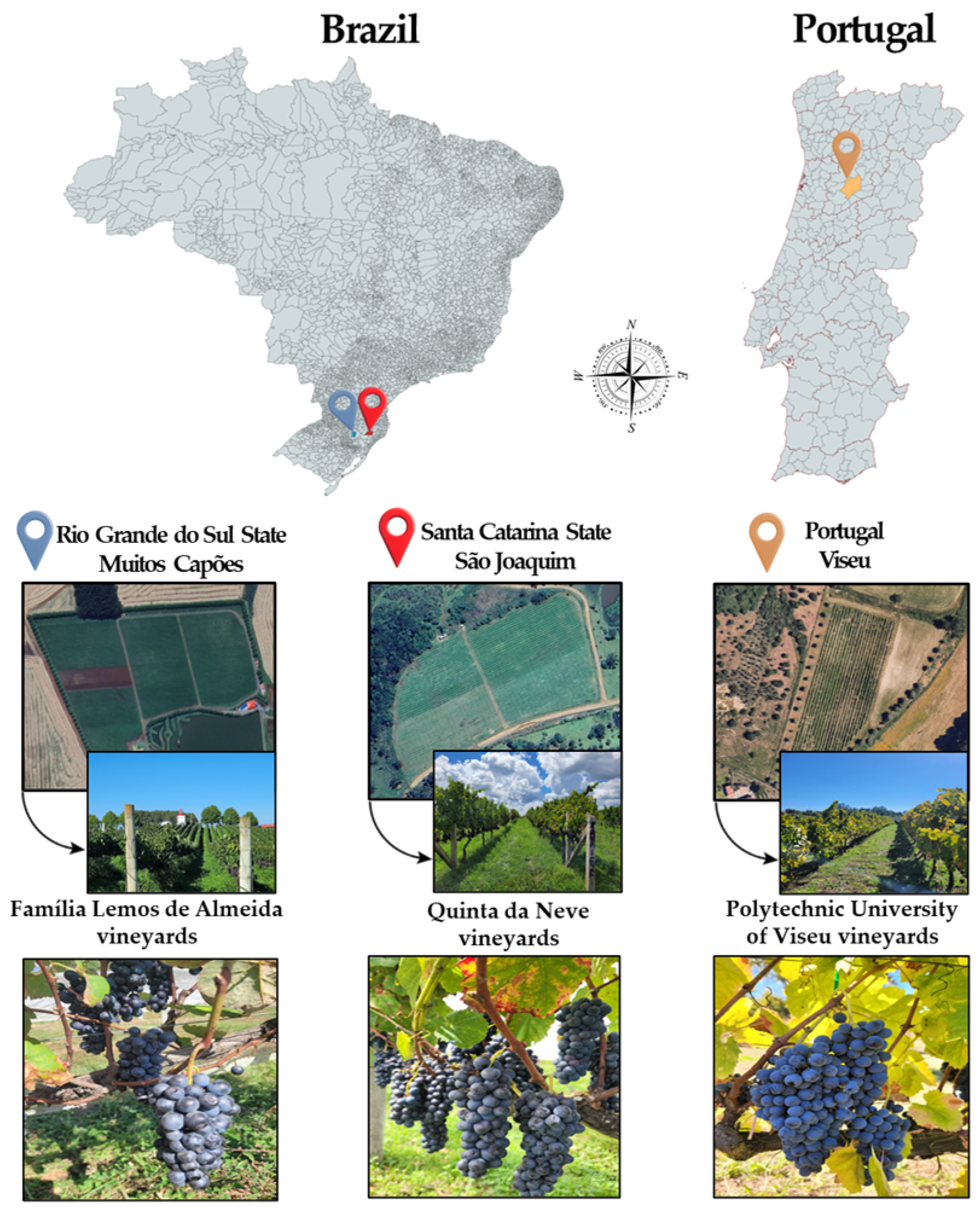
2.1. Vineyard Locations and Grape Sampling
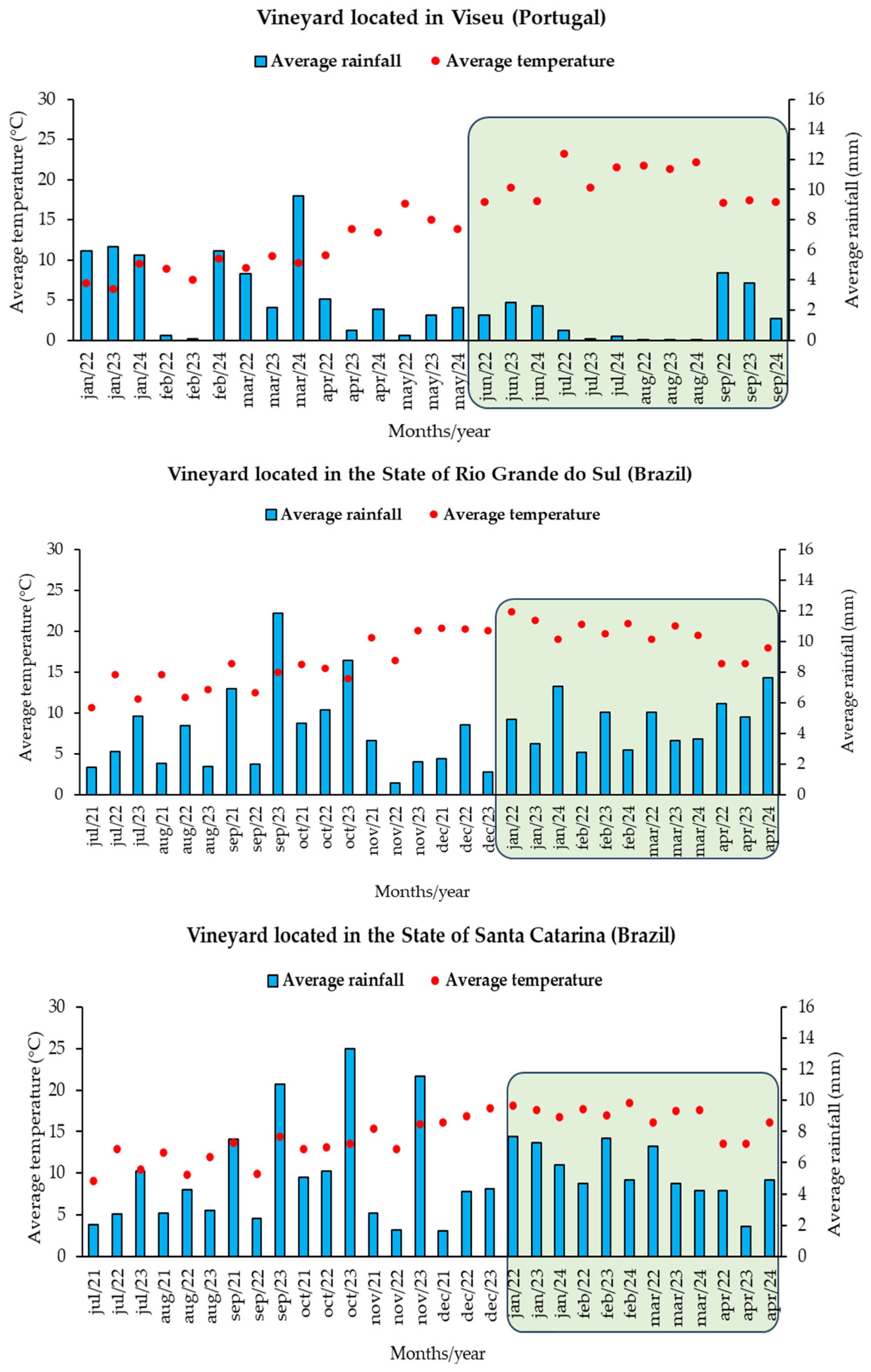
2.2. Characterization of Climatic Conditions
2.3. Preparation of Grape Samples
2.4. General Physicochemical Grape Analysis
2.5. General Phenolic Composition and Chromatic Parameters
2.6. Antioxidant Capacity Determination
2.7. Statistical Analysis
3. Results
3.1. General Physicochemical Composition

| Parameters | Vintages | Vineyard Location | Days After Veraison | ||||
|---|---|---|---|---|---|---|---|
| 14 | 28 | 42 | 49 | 56 * | |||
| Grape berry weight (g) 1 | 2022 | Portugal | 157.66 ± 0.05 Cc | 164.75 ± 0.05 Bbc | 179.17 ± 0.05 Aa | 164.56 ± 0.05 Bbc | 174.99 ± 0.05 Bab |
| R. Grande Sul | 182.29 ± 4.29 Ab | 184.54 ± 4.54 Aab | 170.54 ± 3.54 Ac | 176.62 ± 5.62 Abc | 195.11 ± 2.89 Aa | ||
| Santa Catarina | 171.91 ± 0.09 Bb | 176.46 ± 4.46 Ab | 177.92 ± 3.08 Ab | 187.60 ± 1.48 Aa | 192.98 ± 1.98 Aa | ||
| 2023 | Portugal | 144.84 ± 0.05 Cbc | 139.28 ± 0.00 Bc | 165.10 ± 0.00 Ba | 162.04 ± 0.00 Ca | 148.09 ± 0.05 Cb | |
| R. Grande Sul | 190.05 ± 1.61 Ab | 186.85 ± 2.41 Abc | 201.79 ± 2.79 Aa | 183.18 ± 0.52 Ac | 164.83 ± 1.32 Bd | ||
| Santa Catarina | 177.72 ± 6.46 Bbc | 181.69 ± 0.62 Ab | 167.74 ± 1.11 Bc | 176.23 ± 3.10 Bbc | 218.47 ± 6.39 Aa | ||
| 2024 | Portugal | 102.20 ± 0.05 Ce | 118.80 ± 0.03 Bd | 164.40 ± 0.08 Cb | 195.20 ± 0.06 Aa | 162.80 ± 0.05 Bc | |
| R. Grande Sul | 200.34 ± 0.74 Aa | 175.99 ± 2.59 Acd | 184.43 ± 0.28 Ab | 181.96 ± 6.16 Abc | 172.04 ± 0.30 Bd | ||
| Santa Catarina | 153.02 ± 3.68 Bc | 173.53 ± 2.65 Ab | 177.18 ± 2.62 Bb | 178.90 ± 10.25 Ab | 219.92 ± 9.96 Aa | ||
| Must volume (mL) 2 | 2022 | Portugal | 102.00 ± 0.05 Bb | 109.00 ± 0.01 Aab | 116.00 ± 0.04 Aa | 110.00 ± 0.00 Bab | 118.00 ± 0.05 Ba |
| R. Grande Sul | 112.50 ± 2.50 Ab | 115.50 ± 4.50 Ab | 114.50 ± 4.50 Ab | 121.00 ± 2.00 Ab | 157.50 ± 2.50 Aa | ||
| Santa Catarina | 89.00 ± 1.00 Cc | 92.00 ± 2.00 Bbc | 100.50 ± 3.50 Bb | 113.50 ± 5.50 ABa | 115.00 ± 5.00 Ba | ||
| 2023 | Portugal | 84.00 ± 0.00 Ca | 75.00 ± 1.00 Cb | 85.00 ± 1.05 Ca | 65.00 ± 0.00 Bc | 67.00 ± 0.05 Cbc | |
| R. Grande Sul | 126.50 ± 2.50 Ab | 121.50 ± 2.50 Abc | 132.00 ± 2.00 Aa | 116.00 ± 2.00 Ac | 97.00 ± 1.00 Bd | ||
| Santa Catarina | 108.00 ± 6.00 Bb | 112.00 ± 2.00 Bb | 106.50 ± 1.50 Bb | 109.00 ± 5.00 Ab | 136.00 ± 1.00 Aa | ||
| 2024 | Portugal | 52.00 ± 0.04 Ce | 68.00 ± 0.05 Cd | 96.00 ± 0.08 Cb | 115.98 ± 0.03 Aa | 83.98 ± 0.04 Cc | |
| R. Grande Sul | 129.5 ± 1.50 Aa | 123.00 ± 5.00 Aa | 129.25 ± 5.25 Aa | 110.50 ± 1.50 Bb | 99.50 ± 0.50 Bc | ||
| Santa Catarina | 91.00 ± 5.00 Bd | 97.00 ± 3.00 Bcd | 105.00 ± 1.00 Bbc | 106.50 ± 4.50 Bb | 140.00 ± 0.02 Aa | ||
| Must yield (%) 3 | 2022 | Portugal | 74.92 ± 0.02 Ac | 75.02 ± 0.03 Ab | 74.01 ± 0.02 Ad | 76.72 ± 0.03 Aa | 74.99 ± 0.03 Ab |
| R. Grande Sul | 71.74 ± 1.29 Aa | 69.47 ± 0.59 Bab | 73.05 ± 1.19 Aa | 69.47 ± 2.22 Bab | 66.42 ± 1.27 Bb | ||
| Santa Catarina | 61.87 ± 3.25 Bb | 62.18 ± 2.36 Cb | 64.33 ± 0.86 Bab | 66.64 ± 1.03 Bab | 68.17 ± 0.10 Ba | ||
| 2023 | Portugal | 58.00 ± 0.80 Ca | 53.85 ± 2.07 Bb | 51.50 ± 0.83 Cb | 40.11 ± 1.17 Bd | 45.24 ± 2.03 Bc | |
| R. Grande Sul | 80.37 ± 0.93 Aa | 80.77 ± 1.35 Aa | 80.22 ± 0.51 Aa | 78.97 ± 1.34 Aa | 75.63 ± 1.68 Ab | ||
| Santa Catarina | 77.16 ± 0.05 Ba | 78.20 ± 1.18 Aa | 78.06 ± 0.93 Ba | 78.01 ± 0.86 Aa | 78.53 ± 1.84 Aa | ||
| 2024 | Portugal | 50.90 ± 2.32 Cb | 57.26 ± 1.34 Ca | 58.40 ± 0.51 Ca | 59.40 ± 1.08 Ca | 51.60 ± 1.06 Cb | |
| R. Grande Sul | 84.86 ± 2.04 Aa | 81.39 ± 0.71 Aa | 82.02 ± 0.83 Aa | 75.85 ± 1.73 Bb | 75.19 ± 0.61 Bb | ||
| Santa Catarina | 73.36 ± 2.60 Bc | 75.28 ± 1.96 Bc | 73.87 ± 0.19 Bc | 86.17 ± 0.43 Aa | 79.78 ± 1.50 Ab | ||
| Estimated alcohol degree (%, v/v) | 2022 | Portugal | 10.29 ± 0.00 Ce | 11.06 ± 0.00 Bd | 11.97 ± 0.04 Bc | 12.65 ± 0.00 Aa | 12.29 ± 0.00 Bb |
| R. Grande Sul | 11.26 ± 0.03 Ad | 11.97 ± 0.03 Ab | 11.65 ± 0.12 Cc | 12.26 ± 0.03 Ca | 11.59 ± 0.00 Cc | ||
| Santa Catarina | 10.62 ± 0.03 Be | 12.00 ± 0.00 Ad | 12.38 ± 0.03 Ac | 12.47 ± 0.00 Bb | 12.85 ± 0.03 Aa | ||
| 2023 | Portugal | 6.71 ± 0.00 Cd | 8.18 ± 0.00 Cc | 10.35 ± 0.00 Cb | 11.47 ± 0.00 Ca | 11.59 ± 0.00 Ca | |
| R. Grande Sul | 12.54 ± 0.17 Ab | 12.33 ± 0.14 Ab | 12.59 ± 0.14 Ab | 13.16 ± 0.07 Aa | 12.50 ± 0.08 Ab | ||
| Santa Catarina | 9.75 ± 0.09 Bd | 10.81 ± 0.12 Bc | 11.53 ± 0.00 Bb | 12.10 ± 0.17 Ba | 11.90 ± 0.05 Ba | ||
| 2024 | Portugal | 4.26 ± 0.04 Ce | 6.74 ± 0.04 Cd | 10.21 ± 0.04 Bc | 11.24 ± 0.00 Ca | 11.12 ± 0.00 Cb | |
| R. Grande Sul | 11.08 ± 0.03 Ac | 11.00 ± 0.00 Ac | 11.98 ± 0.03 Ab | 12.04 ± 0.03 Ab | 12.33 ± 0.03 Aa | ||
| Santa Catarina | 8.71 ± 0.00 Be | 9.55 ± 0.03 Bd | 10.24 ± 0.00 Bc | 11.47 ± 0.00 Bb | 12.06 ± 0.00 Ba | ||
| Parameters | Vintages | Vineyard Location | Days After Veraison | ||||
|---|---|---|---|---|---|---|---|
| 14 | 28 | 42 | 49 | 56 * | |||
| pH | 2022 | Portugal | 3.84 ± 0.01 Ac | 3.86 ± 0.01 Ac | 4.00 ± 0.00 Ab | 4.07 ± 0.01 Aa | 4.10 ± 0.01 Aa |
| R. Grande Sul | 3.88 ± 0.45 Aa | 3.63 ± 0.01 Ba | 3.62 ± 0.03 Ba | 3.65 ± 0.01 Ca | 3.54 ± 0.01 Ca | ||
| Santa Catarina | 3.36 ± 0.01 Bd | 3.56 ± 0.04 Cc | 3.68 ± 0.04 Ba | 3.72 ± 0.02 Ba | 3.63 ± 0.01 Bb | ||
| 2023 | Portugal | 3.21 ± 0.00 Bc | 3.39 ± 0.01 Bb | 3.63 ± 0.00 Aa | 3.39 ± 0.01 Cb | 3.21 ± 0.00 Bc | |
| R. Grande Sul | 3.49 ± 0.01 Abc | 3.46 ± 0.02 Ac | 3.52 ± 0.03 Bab | 3.54 ± 0.01 Aa | 3.45 ± 0.01 Ac | ||
| Santa Catarina | 3.15 ± 0.01 Bc | 3.32 ± 0.03 Cb | 3.33 ± 0.01 Cb | 3.42 ± 0.01 Ba | 3.43 ± 0.05 Aa | ||
| 2024 | Portugal | 2.82 ± 0.00 Cd | 2.98 ± 0.00 Cc | 3.29 ± 0.00 Ca | 3.27 ± 0.02 Ca | 3.15 ± 0.01 Cb | |
| R. Grande Sul | 3.61 ± 0.01 Ad | 3.60 ± 0.02 Ad | 3.72 ± 0.01 Ac | 3.75 ± 0.01 Bb | 3.78 ± 0.01 Ba | ||
| Santa Catarina | 3.31 ± 0.01 Bd | 3.57 ± 0.01 Bc | 3.67 ± 0.01 Bb | 3.81 ± 0.01 Aa | 3.82 ± 0.01 Aa | ||
| Titratable acidity (mg tartaric acid g−1 of berry) ** | 2022 | Portugal | 2.30 ± 0.02 Ba | 2.16 ± 0.08 Bb | 1.58 ± 0.03 Cc | 1.58 ± 0.03 Cc | 1.49 ± 0.03 Bc |
| R. Grande Sul | 2.38 ± 0.07 Bb | 2.16 ± 0.08 Bb | 2.32 ± 0.14 Bb | 2.44 ± 0.04 Bb | 3.33 ± 0.16 Aa | ||
| Santa Catarina | 3.96 ± 0.01 Aa | 2.95 ± 0.09 Ac | 2.92 ± 0.08 Ac | 2.77 ± 0.20 Ac | 3.33 ± 0.09 Ab | ||
| 2023 | Portugal | 10.12 ± 0.46 Aa | 8.68 ± 1.46 Aa | 4.24 ± 0.24 Ab | 2.55 ± 0.02 Abc | 2.37 ± 0.11 Ac | |
| R. Grande Sul | 1.53 ± 0.05 Ca | 1.44 ± 0.01 Bab | 1.39 ± 0.04 Cb | 1.33 ± 0.06 Cb | 1.35 ± 0.04 Cb | ||
| Santa Catarina | 2.54 ± 0.09 Ba | 2.24 ± 0.04 Bb | 2.19 ± 0.06 Bb | 1.89 ± 0.02 Bc | 1.98 ± 0.06 Bc | ||
| 2024 | Portugal | 6.41 ± 0.15 Ba | 4.96 ± 0.15 Ab | 2.47 ± 0.02 Cc | 1.94 ± 0.07 Cd | 1.51 ± 0.00 Ce | |
| R. Grande Sul | 4.44 ± 0.30 Ca | 4.12 ± 0.09 Bab | 3.31 ± 0.39 Bbc | 2.89 ± 0.45 Bc | 2.80 ± 0.17 Bc | ||
| Santa Catarina | 8.21 ± 0.25 Aa | 5.00 ± 0.14 Ab | 4.56 ± 0.05 Ac | 3.81 ± 0.07 Ad | 4.67 ± 0.10 Abc | ||
| Tartaric acid (mg·g−1 of berry) ** | 2022 | Portugal | 0.94 ± 0.01 Ba | 0.52 ± 0.00 Ae | 0.82 ± 0.01 Ac | 0.80 ± 0.00 Bd | 0.91 ± 0.00 Ab |
| R. Grande Sul | 1.13 ± 0.01 Aa | 0.43 ± 0.01 Bd | 0.83 ± 0.01 Ac | 1.02 ± 0.03 Ab | 0.87 ± 0.02 Bc | ||
| Santa Catarina | 0.69 ± 0.01 Ca | 0.25 ± 0.01 Cd | 0.49 ± 0.01 Bb | 0.32 ± 0.02 Cc | 0.34 ± 0.01 Cc | ||
| 2023 | Portugal | 1.51 ± 0.75 Aa | 0.40 ± 0.49 Aa | 0.88 ± 0.54 Aa | 0.64 ± 0.21 Aa | 1.17 ± 0.47 Aa | |
| R. Grande Sul | 0.56 ± 0.04 Aa | 0.39 ± 0.12 Aa | 0.76 ± 0.05 Aa | 0.58 ± 0.08 Aa | 0.53 ± 0.06 Aa | ||
| Santa Catarina | 1.02 ± 0.27 Aa | 0.74 ± 0.02 Aa | 0.58 ± 0.02 Aa | 0.75 ± 0.02 Aa | 0.78 ± 0.39 Aa | ||
| 2024 | Portugal | 0.63 ± 0.13 Aa | 0.76 ± 0.55 Aa | 0.23 ± 0.22 Aba | 0.11 ± 0.09 Aa | 0.10 ± 0.11 Ba | |
| R. Grande Sul | 0.52 ± 0.00 Aa | 0.53 ± 0.02 Aa | 0.46 ± 0.00 Aa | 0.37 ± 0.24 Aa | 0.48 ± 0.02 Aa | ||
| Santa Catarina | 0.29 ± 0.08 Ba | 0.02 ± 0.01 Ac | 0.13 ± 0.00 Bbc | 0.07 ± 0.05 Ac | 0.21 ± 0.00 Bab | ||
| Malic acid (mg·g−1 of berry) ** | 2022 | Portugal | 2.88 ± 0.05 Aa | 2.48 ± 0.05 Ab | 1.75 ± 0.09 Bc | 1.77 ± 0.05 Ac | 1.55 ± 0.19 Bd |
| R. Grande Sul | 1.57 ± 0.05 Ca | 1.16 ± 0.02 Cbc | 1.28 ± 0.03 Cb | 1.05 ± 0.09 Bc | 1.50 ± 0.12 Ba | ||
| Santa Catarina | 2.46 ± 0.00 Ba | 2.32 ± 0.05 Bb | 2.06 ± 0.01 Abc | 1.91 ± 0.19 Ac | 2.11 ± 0.06 Ab | ||
| 2023 | Portugal | 2.24 ± 0.85 Ba | 2.18 ± 0.27 Aa | 1.01 ± 0.09 Cb | 0.82 ± 0.07 Bb | 0.54 ± 0.24 Cb | |
| R. Grande Sul | 2.33 ± 0.17 Ba | 2.05 ± 0.18 Aa | 2.34 ± 0.11 Ba | 2.21 ± 0.12 Aa | 2.17 ± 0.11 Ba | ||
| Santa Catarina | 3.91 ± 0.32 Aa | 3.12 ± 0.92 Aa | 4.06 ± 0.12 Aa | 2.85 ± 0.49 Aa | 3.44 ± 0.44 Aa | ||
| 2024 | Portugal | 0.55 ± 0.11 Aa | 1.01 ± 0.41 Ba | 0.96 ± 0.18 Ba | 1.09 ± 0.08 Aa | 0.91 ± 0.08 Ba | |
| R. Grande Sul | 1.07 ± 0.21 Ad | 2.74 ± 0.02 Aa | 1.93 ± 0.03 Ab | 1.31 ± 0.29 Acd | 1.56 ± 0.01 Abc | ||
| Santa Catarina | 1.24 ± 0.53 Aa | 1.10 ± 0.36 Ba | 1.20 ± 0.27 Ba | 1.04 ± 0.19 Aa | 1.04 ± 0.27 Ba | ||
3.2. Phenolic Parameters
| Parameters | Vintages | Vineyard Location | Days After Veraison | ||||
|---|---|---|---|---|---|---|---|
| 14 | 28 | 42 | 49 | 56 * | |||
| Total phenols (mg gallic acid equiv. g−1 of berry) ** | 2022 | Portugal | 1.01 ± 0.00 Ac | 1.31 ± 0.00 Ab | 1.33 ± 0.00 Ab | 1.52 ± 0.00 Aa | 1.36 ± 0.01 Ab |
| R. Grande Sul | 0.51 ± 0.00 Bc | 0.50 ± 0.01 Cc | 0.65 ± 0.01 Bb | 0.64 ± 0.01 Cb | 0.73 ± 0.03 Ca | ||
| Santa Catarina | 0.40 ± 0.01 Cc | 0.59 ± 0.00 Bb | 0.32 ± 0.01 Cc | 1.00 ± 0.06 Ba | 0.92 ± 0.03 Ba | ||
| 2023 | Portugal | 0.28 ± 0.00 Cb | 0.30 ± 0.00 Cab | 0.34 ± 0.00 Ba | 0.20 ± 0.00 Cc | 0.31 ± 0.00 Cab | |
| R. Grande Sul | 0.70 ± 0.06 Aab | 0.74 ± 0.06 Aab | 0.66 ± 0.03 Ab | 0.80 ± 0.01 Aa | 0.47 ± 0.06 Bc | ||
| Santa Catarina | 0.53 ± 0.04 Bd | 0.61 ± 0.03 Bc | 0.70 ± 0.02 Ab | 0.73 ± 0.03 Bb | 0.85 ± 0.01 Aa | ||
| 2024 | Portugal | 0.17 ± 0.00 Cd | 0.17 ± 0.00 Cd | 0.27 ± 0.00 Cb | 0.30 ± 0.00 Ba | 0.25 ± 0.00 Cc | |
| R. Grande Sul | 0.72 ± 0.07 Ab | 0.72 ± 0.03 Ab | 0.87 ± 0.05 Aa | 0.83 ± 0.04 Aab | 0.88 ± 0.03 Ba | ||
| Santa Catarina | 0.47 ± 0.03 Be | 0.62 ± 0.03 Bd | 0.78 ± 0.00 Bc | 0.88 ± 0.02 Ab | 1.13 ± 0.06 Aa | ||
| Non-flavonoid phenols (mg gallic acid equiv. g−1 of berry) ** | 2022 | Portugal | 0.16 ± 0.00 Ab | 0.17 ± 0.00 Aa | 0.18 ± 0.00 Aa | 0.18 ± 0.00 Ba | 0.15 ± 0.00 Bc |
| R. Grande Sul | 0.11 ± 0.00 Bd | 0.15 ± 0.01 Bc | 0.14 ± 0.00 Ac | 0.18 ± 0.01 Bb | 0.20 ± 0.01 Aa | ||
| Santa Catarina | 0.12 ± 0.00 Bb | 0.16 ± 0.00 Bab | 0.17 ± 0.00 Aab | 0.21 ± 0.01 Aa | 0.18 ± 0.01 Aab | ||
| 2023 | Portugal | 0.05 ± 0.01 Bb | 0.05 ± 0.01 Bb | 0.10 ± 0.01 Ba | 0.10 ± 0.01 Ba | 0.11 ± 0.01 Ba | |
| R. Grande Sul | 0.15 ± 0.02 Aa | 0.16 ± 0.01 Aa | 0.14 ± 0.03 ABa | 0.18 ± 0.01 Aa | 0.18 ± 0.02 Aa | ||
| Santa Catarina | 0.13 ± 0.01 Ab | 0.16 ± 0.02 Aab | 0.17 ± 0.02 Aab | 0.19 ± 0.02 Aa | 0.13 ± 0.01 Bb | ||
| 2024 | Portugal | 0.03 ± 0.00 Ce | 0.07 ± 0.00 Cd | 0.14 ± 0.00 Bc | 0.18 ± 0.00 Bb | 0.23 ± 0.01 Aa | |
| R. Grande Sul | 0.14 ± 0.01 Aab | 0.14 ± 0.01 Bab | 0.13 ± 0.01 Bab | 0.13 ± 0.01 Cb | 0.16 ± 0.01 Ba | ||
| Santa Catarina | 0.11 ± 0.01 Bc | 0.17 ± 0.01 Ab | 0.20 ± 0.01 Aa | 0.20 ± 0.01 Aa | 0.22 ± 0.02 Aa | ||
| Flavonoid phenols (mg gallic acid equiv. g−1 of berry) ** | 2022 | Portugal | 0.84 ± 0.00 Ae | 1.14 ± 0.00 Ad | 1.15 ± 0.00 Ac | 1.34 ± 0.00 Aa | 1.21 ± 0.00 Ab |
| R. Grande Sul | 0.40 ± 0.00 Bc | 0.35 ± 0.00 Cd | 0.51 ± 0.01 Bab | 0.48 ± 0.02 Cb | 0.53 ± 0.01 Ca | ||
| Santa Catarina | 0.28 ± 0.01 Cc | 0.43 ± 0.00 Bb | 0.15 ± 0.01 Cd | 0.79 ± 0.05 Ba | 0.74 ± 0.03 Ba | ||
| 2023 | Portugal | 0.22 ± 0.01 Bab | 0.25 ± 0.01 Ca | 0.24 ± 0.01 Ba | 0.10 ± 0.01 Cc | 0.20 ± 0.01 Bb | |
| R. Grande Sul | 0.55 ± 0.07 Aa | 0.59 ± 0.05 Aa | 0.51 ± 0.05 Aa | 0.63 ± 0.01 Aa | 0.29 ± 0.08 Bb | ||
| Santa Catarina | 0.39 ± 0.05 Bc | 0.45 ± 0.03 Bbc | 0.53 ± 0.04 Ab | 0.53 ± 0.03 Bb | 0.70 ± 0.05 Aa | ||
| 2024 | Portugal | 0.14 ± 0.00 Ca | 0.11 ± 0.00 Cd | 0.13 ± 0.00 Cb | 0.12 ± 0.00 Bc | 0.02 ± 0.00 Ce | |
| R. Grande Sul | 0.58 ± 0.08 Aa | 0.58 ± 0.04 Aa | 0.72 ± 0.06 Aa | 0.68 ± 0.07 Aa | 0.73 ± 0.03 Ba | ||
| Santa Catarina | 0.37 ± 0.02 Bd | 0.44 ± 0.05 Bd | 0.57 ± 0.02 Bc | 0.67 ± 0.01 Ab | 0.94 ± 0.03 Aa | ||
| Parameters | Vintages | Vineyard Location | Days After Veraison | ||||
|---|---|---|---|---|---|---|---|
| 14 | 28 | 42 | 49 | 56 * | |||
| Total anthocyanins (mg of malvidin-3-monoglucoside equiv. g−1 of berry) ** | 2022 | Portugal | 0.68 ± 0.00 Ae | 0.98 ± 0.00 Ab | 0.81 ± 0.00 Ad | 1.13 ± 0.00 Aa | 0.97 ± 0.00 Ac |
| R. Grande Sul | 0.22 ± 0.00 Bc | 0.20 ± 0.00 Cd | 0.28 ± 0.01 Ca | 0.25 ± 0.01 Cb | 0.27 ± 0.01 Cab | ||
| Santa Catarina | 0.17 ± 0.00 Cd | 0.27 ± 0.00 Bc | 0.31 ± 0.00 Bb | 0.37 ± 0.02 Ba | 0.33 ± 0.01 Bb | ||
| 2023 | Portugal | 0.19 ± 0.01 Cd | 0.30 ± 0.00 Bc | 0.42 ± 0.00 Ba | 0.34 ± 0.00 Bb | 0.30 ± 0.00 Bc | |
| R. Grande Sul | 0.53 ± 0.01 Aab | 0.48 ± 0.04 Ab | 0.50 ± 0.02 Aab | 0.56 ± 0.01 Aa | 0.34 ± 0.03 Bc | ||
| Santa Catarina | 0.32 ± 0.01 Bc | 0.46 ± 0.02 Ab | 0.54 ± 0.04 Aa | 0.59 ± 0.01 Aa | 0.60 ± 0.02 Aa | ||
| 2024 | Portugal | 0.03 ± 0.00 Cd | 0.16 ± 0.00 Cc | 0.70 ± 0.02 Ab | 0.92 ± 0.04 Aa | 0.65 ± 0.01 Ab | |
| R. Grande Sul | 0.58 ± 0.10 Aa | 0.60 ± 0.03 Aa | 0.67 ± 0.04 Aa | 0.55 ± 0.03 Ba | 0.63 ± 0.04 Aa | ||
| Santa Catarina | 0.30 ± 0.02 Bd | 0.45 ± 0.05 Bc | 0.52 ± 0.03 Bbc | 0.55 ± 0.02 Bb | 0.67 ± 0.02 Aa | ||
| Total tannins (mg catechin equiv. g−1 of berry) ** | 2022 | Portugal | 0.77 ± 0.04 Ad | 1.21 ± 0.01 Aa | 1.17 ± 0.01 Aa | 0.93 ± 0.02 Ac | 1.00 ± 0.02 Ab |
| R. Grande Sul | 0.28 ± 0.01 Bc | 0.44 ± 0.01 Bab | 0.48 ± 0.01 Ba | 0.21 ± 0.00 Cd | 0.41 ± 0.03 Cb | ||
| Santa Catarina | 0.30 ± 0.00 Bc | 0.09 ± 0.01 Ce | 0.21 ± 0.02 Cd | 0.58 ± 0.03 Ba | 0.52 ± 0.02 Bb | ||
| 2023 | Portugal | 1.43 ± 0.29 Aa | 1.18 ± 0.30 Aa | 1.17 ± 0.18 Aa | 0.46 ± 0.07 Ab | 0.59 ± 0.13 Ab | |
| R. Grande Sul | 0.42 ± 0.02 Bbc | 0.46 ± 0.02 Bab | 0.41 ± 0.02 Bbc | 0.53 ± 0.08 Aa | 0.32 ± 0.01 Bc | ||
| Santa Catarina | 0.50 ± 0.07 Ba | 0.47 ± 0.05 Ba | 0.62 ± 0.31 Ba | 0.52 ± 0.07 Aa | 0.56 ± 0.06 Aa | ||
| 2024 | Portugal | 1.79 ± 0.01 Ab | 1.23 ± 0.01 Ae | 1.36 ± 0.00 Ad | 2.41 ± 0.00 Aa | 1.53 ± 0.00 Ac | |
| R. Grande Sul | 0.31 ± 0.08 Ba | 0.27 ± 0.02 Ba | 0.06 ± 0.04 Cb | 0.35 ± 0.03 Ba | 0.29 ± 0.05 Ba | ||
| Santa Catarina | 0.28 ± 0.02 Ba | 0.21 ± 0.03 Ca | 0.23 ± 0.09 Ba | 0.25 ± 0.03 Ca | 0.30 ± 0.05 Ba | ||
3.3. Chromatic Characteristics
| Parameters | Vintages | Vineyard Location | Days After Veraison | ||||
|---|---|---|---|---|---|---|---|
| 14 | 28 | 42 | 49 | 56 * | |||
| Color intensity (abs. units × 10) | 2022 | Portugal | 12.59 ± 0.09 Ae | 15.69 ± 0.05 Ac | 14.63 ± 0.13 Ad | 16.95 ± 0.05 Ab | 18.23 ± 0.03 Aa |
| R. Grande Sul | 11.08 ± 0.18 Bc | 12.66 ± 0.07 Bb | 13.44 ± 0.19 Ca | 12.32 ± 0.15 Cb | 11.40 ± 0.03 Cc | ||
| Santa Catarina | 11.08 ± 0.05 Bd | 12.81 ± 0.05 Bc | 14.19 ± 0.04 Bb | 15.29 ± 0.52 Ba | 13.97 ± 0.03 Bb | ||
| 2023 | Portugal | 6.39 ± 0.79 Bc | 10.24 ± 1.07 Bab | 12.64 ± 0.92 Ba | 10.13 ± 0.91 Bb | 12.64 ± 0.92 Ba | |
| R. Grande Sul | 13.67 ± 0.86 Aa | 14.72 ± 0.97 Aa | 15.38 ± 0.94 Aa | 15.60 ± 1.55 Aa | 12.65 ± 2.73 Ba | ||
| Santa Catarina | 12.68 ± 0.89 Ad | 14.53 ± 0.04 Ac | 16.45 ± 0.56 Ab | 17.71 ± 0.28 Ab | 19.68 ± 0.24 Aa | ||
| 2024 | Portugal | 2.04 ± 0.16 Ce | 6.61 ± 0.19 Cd | 17.33 ± 0.22 Bb | 14.20 ± 0.16 Cc | 18.62 ± 0.53 Ba | |
| R. Grande Sul | 14.02 ± 0.12 Ad | 12.92 ± 0.20 Be | 14.95 ± 0.14 Cc | 15.50 ± 0.24 Bb | 18.62 ± 0.09 Ba | ||
| Santa Catarina | 12.42 ± 0.09 Bd | 19.45 ± 0.26 Ac | 21.52 ± 0.60 Ab | 22.37 ± 0.36 Ab | 23.51 ± 0.48 Aa | ||
| Color hue (abs. units) | 2022 | Portugal | 0.80 ± 0.00 Aa | 0.55 ± 0.00 Ad | 0.59 ± 0.01 Ac | 0.65 ± 0.00 Ab | 0.65 ± 0.00 Ab |
| R. Grande Sul | 0.64 ± 0.02 Ba | 0.50 ± 0.01 Bb | 0.47 ± 0.02 Bbc | 0.51 ± 0.02 Bb | 0.46 ± 0.01 Cc | ||
| Santa Catarina | 0.50 ± 0.01 Ca | 0.50 ± 0.00 Ba | 0.48 ± 0.00 Ba | 0.52 ± 0.06 Ba | 0.50 ± 0.00 Ba | ||
| 2023 | Portugal | 0.42 ± 0.00 Bb | 0.42 ± 0.00 Cb | 0.51 ± 0.01 Aa | 0.40 ± 0.03 Bb | 0.51 ± 0.01 Ba | |
| R. Grande Sul | 0.53 ± 0.02 Aa | 0.47 ± 0.02 Ba | 0.49 ± 0.01 Ba | 0.51 ± 0.07 Aa | 0.50 ± 0.03 Ba | ||
| Santa Catarina | 0.50 ± 0.07 Abc | 0.50 ± 0.01 Ac | 0.54 ± 0.02 Abc | 0.59 ± 0.02 Aab | 0.67 ± 0.01 Aa | ||
| 2024 | Portugal | 0.84 ± 0.02 Aa | 0.53 ± 0.01 Ac | 0.50 ± 0.00 Bd | 0.56 ± 0.00 Bb | 0.53 ± 0.00 Bc | |
| R. Grande Sul | 0.51 ± 0.01 Bd | 0.51 ± 0.01 Bd | 0.59 ± 0.00 Ab | 0.61 ± 0.00 Aa | 0.57 ± 0.00 Ac | ||
| Santa Catarina | 0.38 ± 0.00 Cd | 0.40 ± 0.00 Ccd | 0.43 ± 0.01 Cbc | 0.46 ± 0.01 Cab | 0.48 ± 0.02 Ca | ||
| CIELAB coordinate a* (abs. units) | 2022 | Portugal | 41.21 ± 0.20 Ba | 36.70 ± 0.44 Aab | 36.17 ± 0.94 Bab | 17.58 ± 4.53 Bc | 32.12 ± 0.10 Bb |
| R. Grande Sul | 42.54 ± 0.44 Ab | 35.16 ± 0.70 Bd | 38.04 ± 0.01 Ac | 34.27 ± 0.19 Ad | 44.43 ± 0.04 Aa | ||
| Santa Catarina | 39.64 ± 0.24 Ca | 36.96 ± 0.06 Ab | 26.12 ± 0.02 Cd | 15.27 ± 0.03 Be | 30.87 ± 0.09 Cc | ||
| 2023 | Portugal | 28.23 ± 1.37 Bb | 37.02 ± 1.63 Aa | 40.46 ± 1.67 Aa | 27.36 ± 0.94 Cb | 30.55 ± 1.58 Bb | |
| R. Grande Sul | 33.49 ± 0.82 Ab | 25.60 ± 1.18 Bc | 30.61 ± 0.29 Bb | 39.50 ± 1.65 Ba | 23.73 ± 1.21 Cc | ||
| Santa Catarina | 36.28 ± 2.41 Ab | 35.92 ± 1.68 Ab | 42.49 ± 2.06 Aa | 46.21 ± 1.40 Aa | 42.64 ± 0.30 Aa | ||
| 2024 | Portugal | 7.98 ± 0.32 Cd | 29.25 ± 0.29 Cc | 50.03 ± 0.08 Aa | 48.91 ± 0.52 Ab | 49.01 ± 0.58 Aab | |
| R. Grande Sul | 28.80 ± 1.09 Bc | 32.57 ± 1.81 Bbc | 35.04 ± 1.12 Bb | 32.50 ± 1.33 Cbc | 39.18 ± 1.85 Ba | ||
| Santa Catarina | 39.60 ± 1.27 Ac | 48.70 ± 1.35 Aab | 49.51 ± 1.45 Aa | 45.79 ± 1.35 Bb | 49.47 ± 1.18 Aa | ||
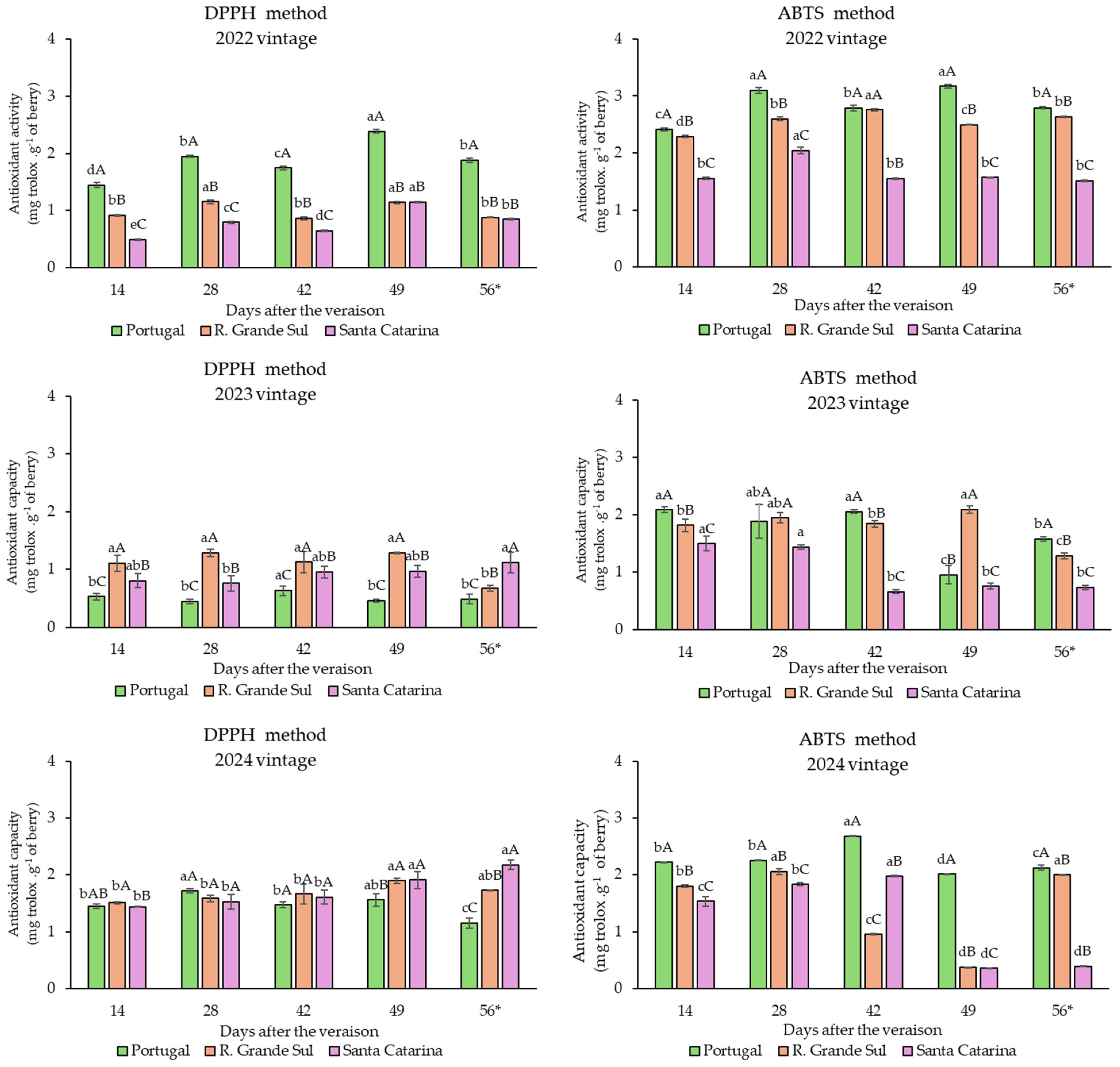
3.4. Antioxidant Capacity

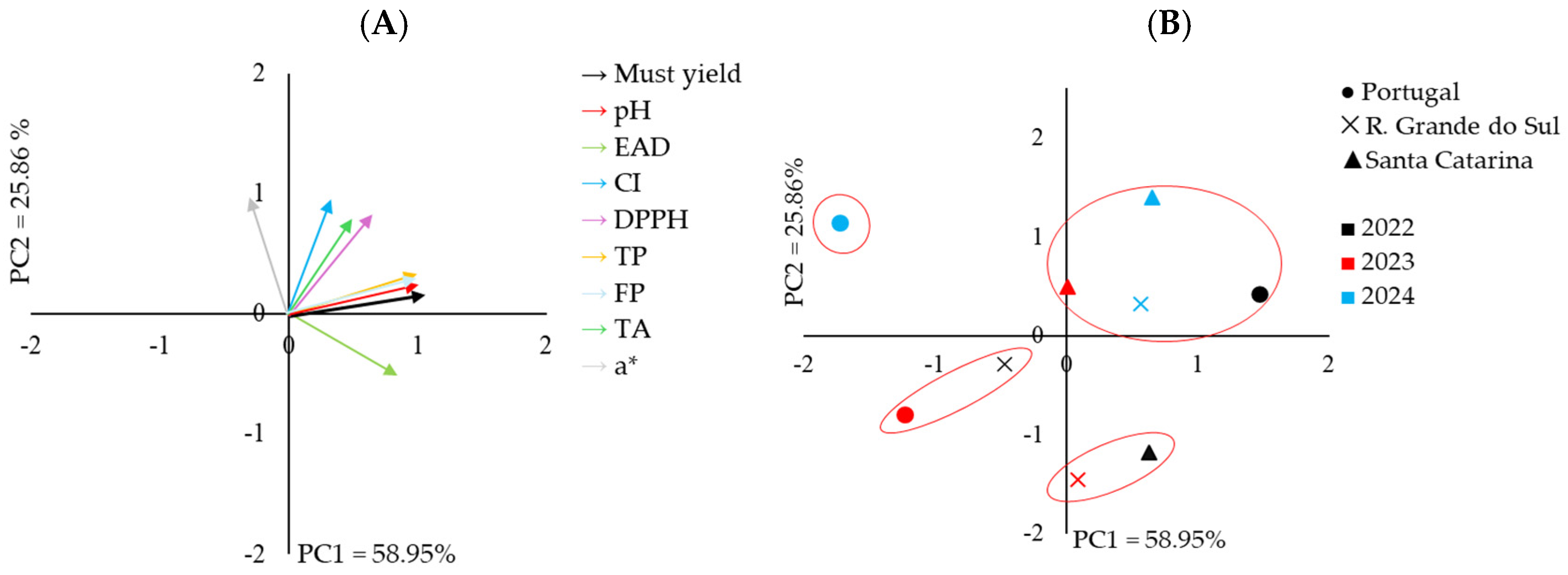
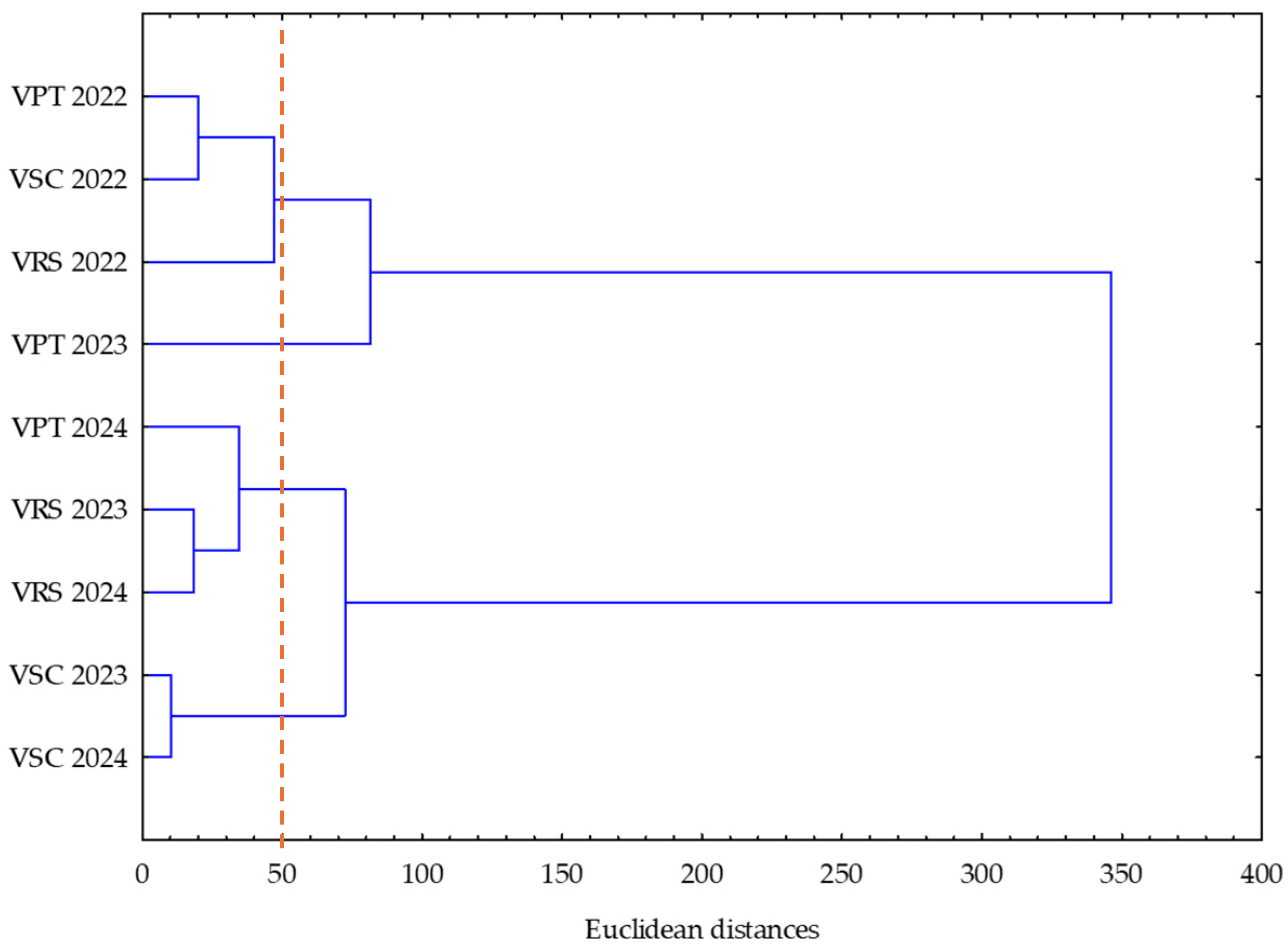
3.5. Principal Components and UPGMA Cluster Analyses
4. Discussion
4.1. General Physicochemical Composition of Grapes
4.2. Global Phenolic Composition and Chromatic Characteristics
4.3. Grapes Antioxidant Capacity
5. Conclusions
Supplementary Materials
Author Contributions
Funding
Data Availability Statement
Acknowledgments
Conflicts of Interest
References
- IBGE. Levantamento Sistematico da Produção Agrícola—Tabela 1618. 2025. Available online: https://sidra.ibge.gov.br/Tabela/1618#resultado (accessed on 14 January 2025).
- Protas, J.F.S.; Lazzarotto, J.J.; Machado, C.A.E. Panorama da Vitivinicultura Brasileira em 2023; Embrapa Uva e Vinho: Bento Gonçalves, Brazil, 2025; pp. 1–25. [Google Scholar]
- Camargo, U.A.; Tonietto, J.; Hoffmann, A. Progressos na viticultura brasileira. Rev. Bras. Frutic. 2011, 33, 144–149. [Google Scholar] [CrossRef] [Scilit]
- Costa, C.; Graça, A.; Fontes, N.; Teixeira, M.; Gerós, H.; Santos, J.A. The interplay between atmospheric conditions and grape berry quality parameters in Portugal. Appl. Sci. 2020, 10, 4943. [Google Scholar] [CrossRef] [Scilit]
- Pons, A.; Allamy, L.; Schuttler, A.; Rauhut, D.; Thibon, C.; Darriet, P. What is the expected impact of climate change on wine aroma compounds and their precursors in grape? OENO One 2017, 51, 141–146. [Google Scholar] [CrossRef] [Scilit]
- Canturk, S.; Kunter, B.; Keskin, N.; Kaya, O. Deciphering terroirs code: Vineyard site selection for phenolic performance in ‘Kalecik Karası’ grape cultivar (V. vinifera L.). Appl. Fruit Sci. 2024, 66, 1831–1841. [Google Scholar] [CrossRef] [Scilit]
- Catarino, S.; Madeira, M.; Monteiro, F.; Caldeira, I.; Bruno de Sousa, R.; Curvelo-Garcia, A. Mineral composition through soil-wine system of portuguese vineyards and its potential for wine traceability. Beverages 2018, 4, 85. [Google Scholar] [CrossRef] [Scilit]
- Costa, E.; Cosme, F.; Rivero-Pérez, M.D.; Jordão, A.M.; González-SanJosé, M.L. Influence of wine region provenance on phenolic composition, antioxidant capacity and radical scavenger activity of traditional portuguese red grape varieties. Eur. Food Res. Technol. 2015, 241, 61–73. [Google Scholar] [CrossRef] [Scilit]
- Zhang, X.; Kontoudakis, N.; Šuklje, K.; Antalick, G.; Blackman, J.W.; Rutledge, D.N.; Schmidtke, L.M.; Clark, A.C. Changes in red wine composition during bottle aging: Impacts of grape variety, vineyard location, maturity, and oxygen availability during aging. J. Agric. Food Chem. 2020, 68, 13331–13343. [Google Scholar] [CrossRef] [Scilit]
- Kaya, O. Unveiling the transformations in phytochemicals and grape features: A thorough examination of ‘Italia’ and ‘Bronx Seedless’ cultivars throughout multiple berry development stages. Eur. Food Res. Technol. 2024, 250, 2147–2160. [Google Scholar] [CrossRef] [Scilit]
- Allegro, G.; Pastore, C.; Valentini, G.; Filippetti, I. The evolution of phenolic compounds in Vitis vinifera L. red berries during ripening: Analysis and role on wine sensory—A review. Agronomy 2021, 11, 999. [Google Scholar] [CrossRef] [Scilit]
- Rienth, M.; Vigneron, N.; Darriet, P.; Sweetman, C.; Burbidge, C.; Bonghi, C.; Walker, R.P.; Famiani, F.; Castellarin, S.D. Grape berry secondary metabolites and their modulation by abiotic factors in a climate change scenario—A review. Front. Plant Sci. 2021, 12, 262. [Google Scholar] [CrossRef] [Scilit]
- Ali, K.; Maltese, F.; Toepfer, R.; Choi, Y.H.; Verpoorte, R. Metabolic characterization of palatinate German white wines according to sensory attributes, varieties, and vintages using NMR spectroscopy and multivariate data analyses. J. Biomol. NMR 2011, 49, 255–266. [Google Scholar] [CrossRef] [Scilit]
- Tramontini, S.; Van Leeuwen, C.; Domec, J.-C.; Destrac-Irvine, A.; Basteau, C.; Vitali, M.; Mosbach-Schulz, O.; Lovisolo, C. Impact of soil texture and water availability on the hydraulic control of plant and grape-berry development. Plant Soil 2013, 368, 215–230. [Google Scholar] [CrossRef] [Scilit]
- Van Leeuwen, C.; Roby, J.-P.; De Rességuier, L. Soil-related terroir factors: A review. OENO One 2018, 52, 173–188. [Google Scholar] [CrossRef] [Scilit]
- Keskin, N.; Bilir Ekbic, H.; Kaya, O.; Keskin, S. Antioxidant activity and biochemical compounds of Vitis vinifera L. (cv. ‘Katıkara’) and Vitis labrusca L. (cv. ‘Isabella’) grown in black sea coast of Turkey. Erwerbs-Obstbau 2021, 63, 115–122. [Google Scholar] [CrossRef] [Scilit]
- Akaberi, M.; Hosseinzadeh, H. Grapes (Vitis vinifera) as a potential candidate for the therapy of the metabolic syndrome. Phytother. Res. 2016, 30, 540–556. [Google Scholar] [CrossRef] [Scilit]
- Sikuten, I.; Štambuk, P.; Andabaka, Ž.; Tomaz, I.; Marković, Z.; Stupić, D.; Maletić, E.; Kontić, J.K.; Preiner, D. Grapevine as a rich source of polyphenolic compounds. Molecules 2020, 25, 5604. [Google Scholar] [CrossRef] [Scilit]
- Aleixandre-Tudo, J.L.; Nieuwoudt, H.; Olivieri, A.; Aleixandre, J.L.; Du Toit, W. Phenolic profiling of grapes, fermenting samples and wines using UV-Visible spectroscopy with chemometrics. Food Control 2018, 85, 11–22. [Google Scholar] [CrossRef] [Scilit]
- Chavarria, G.; Bergamaschi, H.; da Silva, L.C.; dos Santos, H.P.; Mandelli, F.; Guerra, C.C.; Flores, C.A.; Tonietto, J. Relações hídricas, rendimento e compostos fenólicos de uvas ‘Cabernet Sauvignon’ em três tipos de solo. Bragantia 2011, 70, 481–487. [Google Scholar] [CrossRef] [Scilit]
- Hamie, N.; Nacouzi, D.; Choker, M.; Salameh, M.; Darwiche, L.; El Kayal, W. Maturity Assessment of different table grape cultivars grown at six different altitudes in Lebanon. Plants 2023, 12, 3237. [Google Scholar] [CrossRef] [Scilit]
- Mansour, G.; Ghanem, C.; Mercenaro, L.; Nassif, N.; Hassoun, G.; Caro, A.D. Effects of altitude on the chemical composition of grapes and wine: A review. OENO One 2022, 56, 227–239. [Google Scholar] [CrossRef] [Scilit]
- Mateus, N.; Machado, J.M.; de Freitas, V. Development changes of anthocyanins in Vitis vinifera grapes grown in the Douro Valley and concentration in respective wines. J. Sci. Food Agric. 2002, 82, 1689–1695. [Google Scholar] [CrossRef] [Scilit]
- Satisha, J.; Dasharath, P.O.; Amruta, N.V.; Smita, R.M.; Ajay, K.S.; Ramhari, G.S. Influence of canopy management practices on fruit composition of wine grape cultivars grown in semi-arid tropical region of India. Afr. J. Agric. Res. 2013, 8, 3462–3472. [Google Scholar] [CrossRef] [Scilit]
- Hewitt, S.; Hernández-Montes, E.; Dhingra, A.; Keller, M. Impact of heat stress, water stress, and their combined effects on the metabolism and transcriptome of grape berries. Sci. Rep. 2023, 13, 9907. [Google Scholar] [CrossRef] [Scilit]
- Duchêne, E.; Dumas, V.; Jaegli, N.; Merdinoglu, D. Genetic variability of descriptors for grapevine berry acidity in Riesling, Gewürztraminer and their progeny. Aust. J. Grape Wine Res. 2014, 20, 91–99. [Google Scholar] [CrossRef] [Scilit]
- Silva, L.R.; Queiroz, M. Bioactive compounds of red grapes from Dão region (Portugal): Evaluation of phenolic and organic profile. Asian Pac. J. Trop. Biomed. 2016, 6, 315–321. [Google Scholar] [CrossRef] [Scilit]
- Cameron, W.; Petrie, P.R.; Barlow, E.W.R.; Patrick, C.J.; Howell, K.; Fuentes, S. Is Advancement of grapevine maturity explained by an increase in the rate of ripening or advancement of veraison? Aust. J. Grape Wine Res. 2021, 27, 334–347. [Google Scholar] [CrossRef] [Scilit]
- Suter, B.; Destrac Irvine, A.; Gowdy, M.; Dai, Z.; van Leeuwen, C. Adapting wine grape ripening to global change requires a multi-trait approach. Front. Plant Sci. 2021, 12, 624867. [Google Scholar] [CrossRef] [Scilit]
- Costa, E.; da Silva, J.F.; Cosme, F.; Jordão, A.M. Adaptability of some french red grape varieties cultivated at two different portuguese terroirs: Comparative analysis with two portuguese red grape varieties using physicochemical and phenolic parameters. Food Res. Int. 2015, 78, 302–312. [Google Scholar] [CrossRef] [Scilit]
- Fraga, H.; de Cortázar Atauri, I.G.; Malheiro, A.C.; Moutinho-Pereira, J.; Santos, J.A. Viticulture in Portugal: A review of recent trends and climate change projections. OENO One 2017, 51, 61–69. [Google Scholar] [CrossRef] [Scilit]
- IVV. Anuário Vinhos e Aguardentes de Portugal; Instituto da Vinha e do Vinho: Lisboa, Portugal, 2023; pp. 1–186.
- IVV. Catalogue of Grape Varieties for Wine Grown in Portugal, 1st ed.; Instituto da Vinha e do Vinho: Lisboa, Portugal, 2011.
- IVDP. Castas. Available online: https://www.ivdp.pt/pt/vinha/castas/ (accessed on 12 June 2025).
- Rouxinol, M.I.; Martins, M.R.; Salgueiro, V.; Costa, M.J.; Barroso, J.M.; Rato, A.E. Climate effect on morphological traits and polyphenolic composition of red wine grapes of Vitis vinifera. Beverages 2023, 9, 8. [Google Scholar] [CrossRef] [Scilit]
- Barreto de Oliveira, J.; Lemos Faria, D.; Fernandes Duarte, D.; Egipto, R.; Laureano, O.; de Castro, R.; Pereira, G.E.; Ricardo-da-Silva, J.M. Effect of the harvest season on phenolic composition and oenological parameters of grapes and wines cv. ‘Touriga Nacional’ (Vitis vinifera L.) produced under tropical semi-arid climate, in the state of Pernambuco, Brazil. Ciênc. Téc. Vitiviníc. 2018, 33, 145–166. [Google Scholar] [CrossRef] [Scilit]
- Costa, J.M.; Ortuño, M.F.; Lopes, C.M.; Chaves, M.M. Grapevine varieties exhibiting differences in stomatal response to water deficit. Funct. Plant Biol. 2012, 39, 179–189. [Google Scholar] [CrossRef] [Scilit] [PubMed]
- Paňitrur-De La Fuente, C.; Valdés-Gómez, H.; Roudet, J.; Acevedo-Opazo, C.; Verdugo-Vásquez, N.; Araya-Alman, M.; Lolas, M.; Moreno, Y.; Fermaud, M. Classification of winegrape cultivars in Chile and France according to their susceptibility to Botrytis cinerea related to fruit maturity. Aust. J. Grape Wine Res. 2018, 24, 145–157. [Google Scholar] [CrossRef] [Scilit]
- Sommer, S.; Anderson, A.F.; Fricke, L.; Graves, J.; Larsen, L.; Weber, F. Exploring the stabilization of phenolic material and red wine color through different polysaccharide extraction and addition strategies. ACS Food Sci. Technol. 2024, 4, 757–765. [Google Scholar] [CrossRef] [Scilit]
- Alves Filho, E.G.; Silva, L.M.A.; Lima, T.O.; Ribeiro, P.R.V.; Vidal, C.S.; Carvalho, E.S.S.; Druzian, J.I.; Marques, A.T.B.; Canuto, K.M. 1H NMR and UPLC-HRMS-Based metabolomic approach for evaluation of the grape maturity and maceration time of ‘Touriga Nacional’ wines and their correlation with the chemical stability. Food Chem. 2022, 382, 132359. [Google Scholar] [CrossRef] [Scilit]
- Freire, L.; Guerreiro, T.M.; Caramês, E.T.S.; Lopes, L.S.; Orlando, E.A.; Pereira, G.E.; Lima Pallone, J.A.; Catharino, R.R.; Sant’Ana, A.S. Influence of maturation stages in different varieties of wine grapes (Vitis vinifera) on the production of Ochratoxin A and its modified forms by Aspergillus carbonarius and Aspergillus niger. J. Agric. Food Chem. 2018, 66, 8824–8831. [Google Scholar] [CrossRef] [Scilit]
- Cardoso, J.C. Soil Map Portugal—Carta de Solos de Portugal—European Soil Data Centre ESDAC. Available online: https://esdac.jrc.ec.europa.eu/content/soil-map-portugal-carta-dos-solos-de-portugal-3 (accessed on 4 September 2024).
- dos Santos, H.G.; Jacomine, P.K.T.; dos Anjos, L.H.C.; Lumbreras, J.F.; Coelho, M.R.; de Almeida, J.A.; de Araujo Filho, J.C.; de Oliveira, J.B.; Cunha, T.J.F. Sistema Brasileiro de Classificação de Solos, 5th ed.; Embrapa: Brasília, Brazil, 2018; pp. 1–356. [Google Scholar]
- Alcarde Alvares, C.; Stape, J.; Sentelhas, P.; Gonçalves, J.; Sparovek, G. Köppen’s climate classification map for Brazil. Meteorol. Z. 2013, 22, 711–728. [Google Scholar] [CrossRef] [Scilit]
- IPMA. Time and Weather. Available online: https://www.ipma.pt/pt/educativa/tempo.clima/ (accessed on 30 May 2025).
- Carbonneau, A.; Champagnol, F. Nouveaux Systèmes de Culture Integré Du Vignoble; Institut Coopératif du Vin: Montpellier, France, 1993. [Google Scholar]
- OIV. Compendium of International Methods of Wine and Must Analysis; International Organization of Vine and Wine: Paris, France, 2023; Volume 1, p. 1679. [Google Scholar]
- Zoecklein, B.W.; Fugelsang, K.C.; Gump, B.H.; Nury, F.S. Wine Analysis and Production; Van Nostrand Reinhold: New York, NY, USA, 1990. [Google Scholar]
- Ribéreau-Gayon, P.; Peynaud, E.; Sudraud, P. Science et Techniques Du Vin, Tome 4; Dunod: Paris, France, 1982. [Google Scholar]
- Kramling, T.E.; Singleton, V.L. An estimate of nonflavonoid phenols in wines. Am. J. Enol. Vitic. 1969, 20, 86–92. [Google Scholar] [CrossRef] [Scilit]
- Ribéreau-Gayon, P.; Stonestreet, E. Le dosage des anthocyanes dans le vin rouge. Bull. Soc. Chim. Fr. 1965, 9, 2649–2652. [Google Scholar]
- Ribereau Gayon, P.; Stonestreet, E. Dosage des tanins du vin rouge et determination de leur structure. Chim. Anal. 1966, 48, 188–196. [Google Scholar]
- Brand-Williams, W.; Cuvelier, M.E.; Berset, C. Use of a free radical method to evaluate antioxidant activity. LWT-Food Sci. Technol. 1995, 28, 25–30. [Google Scholar] [CrossRef] [Scilit]
- Re, R.; Pellegrini, N.; Proteggente, A.; Pannala, A.; Yang, M.; Rice-Evans, C. Antioxidant activity applying an improved ABTS radical cation decolorization assay. Free Radic. Biol. Med. 1999, 26, 1231–1237. [Google Scholar] [CrossRef] [Scilit]
- Candar, S.; Korkutal, İ.; Bahar, E.; Aktaş, F.B. Exploring the relationship between leaf water potential, defoliation, and grape berry physical properties of merlot (Vitis vinifera L.) grapevine. Int. J. Agric. Environ. Food Sci. 2023, 7, 517–532. [Google Scholar] [CrossRef] [Scilit]
- Garrido, J.; Borges, F. Wine and grape polyphenols—A chemical perspective. Food Res. Int. 2013, 54, 1844–1858. [Google Scholar] [CrossRef] [Scilit]
- Yang, C.; Wang, Y.; Wu, B.; Fang, J.; Li, S. Volatile compounds evolution of three table grapes with different flavour during and after maturation. Food Chem. 2011, 128, 823–830. [Google Scholar] [CrossRef] [Scilit]
- Bindon, K.; Varela, C.; Kennedy, J.; Holt, H.; Herderich, M. Relationships between harvest time and wine composition in Vitis vinifera L. cv. Cabernet Sauvignon. Food Chem. 2013, 138, 1696–1705. [Google Scholar] [CrossRef] [Scilit]
- Keskin, N.; Kunter, B.; Celik, H.; Kaya, O.; Keskin, S. ANOM approach for the statistical evaluation of organic acid contents of clones of the grape variety ‘Kalecik Karasi’. Mitteilungen Klosterneubg 2021, 71, 126–138. [Google Scholar]
- Naik, S.; Tiwari, J.; Singh, B.; Sharma, D.P. Biochemical attributes of grapes grown at high elevations in Himachal Pradesh. Grape Insight 2023, 1, 23–31. [Google Scholar] [CrossRef] [Scilit]
- van Leeuwen, C.; Friant, P.; Choné, X.; Tregoat, O.; Koundouras, S.; Dubourdieu, D. Influence of climate, soil, and cultivar on terroir. Am. J. Enol. Vitic. 2004, 55, 207–217. [Google Scholar] [CrossRef] [Scilit]
- Permanhani, M.; Costa, J.M.; Conceição, M.A.F.; de Souza, R.T.; Vasconcellos, M.A.S.; Chaves, M.M. Deficit irrigation in table grape: Eco-physiological basis and potential use to save water and improve quality. Theor. Exp. Plant Physiol. 2016, 28, 85–108. [Google Scholar] [CrossRef] [Scilit]
- Teixeira, A.; Eiras-Dias, J.; Castellarin, S.D.; Gerós, H. Berry phenolics of grapevine under challenging environments. Int. J. Mol. Sci. 2013, 14, 18711–18739. [Google Scholar] [CrossRef] [Scilit] [PubMed]
- Gambetta, G.A.; Herrera, J.C.; Dayer, S.; Feng, Q.; Hochberg, U.; Castellarin, S.D. The physiology of drought stress in grapevine: Towards an integrative definition of drought tolerance. J. Exp. Bot. 2020, 71, 4658–4676. [Google Scholar] [CrossRef] [Scilit] [PubMed]
- Conde, C.; Silva, P.; Fontes, N.; Dias, A.C.P.; Tavares, R.M.; Sousa, M.J.; Agasse, A.; Delrot, S.; Gerós, H. Biochemical changes throughout grape berry development and fruit and wine quality. Food 2007, 1, 1–22. [Google Scholar]
- De La Hera-Orts, M.L.; Martínez-Cutillas, A.; López-Roca, J.M.; Gómez-Plaza, E. Effect of moderate irrigation on grape composition during ripening. Span. J. Agric. Res. 2005, 3, 352–361. [Google Scholar] [CrossRef] [Scilit]
- Otto, T.; Botelho, R.; Biasi, L.; Miljić, U.; Correia, A.C.; Jordão, A.M. Adaptability of different international grape varieties in diverse terroirs: Impact on grape and wine composition. In Recent Advances in Grapes and Wine Production—New Perspectives for Quality Improvement; Jordão, A.M., Botelho, R., Miljić, U., Eds.; IntechOpen: London, UK, 2023. [Google Scholar]
- Rodrigues, P.; Pedroso, V.; Gonçalves, F.; Reis, S.; Santos, J.A. Temperature-based grapevine ripeness modeling for cv. Touriga Nacional and Encruzado in the Dão wine region, Portugal. Agronomy 2021, 11, 1777. [Google Scholar] [CrossRef] [Scilit]
- Regina, M.D.A.; do Carmo, E.L.; Fonseca, A.R.; Purgatto, E.; Shiga, T.M.; Lajolo, F.M.; Ribeiro, A.P.; Mota, R.V. Influência da altitude na qualidade das uvas ‘Chardonnay’ e ‘Pinot Noir’ em Minas Gerais. Rev. Bras. Frutic. 2010, 32, 143–150. [Google Scholar] [CrossRef] [Scilit]
- Rienth, M.; Lamy, F.; Schoenenberger, P.; Noll, D.; Lorenzini, F.; Viret, O.; Zufferey, V. A vine physiology-based terroir study in the AOC-Lavaux region in Switzerland. OENO One 2020, 54, 863–880. [Google Scholar] [CrossRef] [Scilit]
- Mercenaro, L.; de Oliveira, A.F.; Cocco, M.; Nieddu, G. Yield and grape quality of three red grapevine cultivars (Vitis vinifera L.) in relation to altimetry. BIO Web Conf. 2019, 13, 02002. [Google Scholar] [CrossRef] [Scilit]
- Yan, H.K.; Ma, S.; Lu, X.; Zhang, C.C.; Ma, L.; Li, K.; Wei, Y.C.; Gong, M.S.; Li, S. Response of wine grape quality to rainfall, temperature, and soil properties in Hexi Corridor. HortScience 2022, 57, 1593–1599. [Google Scholar] [CrossRef] [Scilit]
- Payan, C.; Gancel, A.-L.; Jourdes, M.; Christmann, M.; Teissedre, P.-L. Wine acidification methods: A review. OENO One 2023, 57, 113–126. [Google Scholar] [CrossRef] [Scilit]
- Berli, F.J.; Moreno, D.; Piccoli, P.; Hespanhol-Viana, L.; Silva, M.F.; Bressan-Smith, R.; Cavagnaro, J.B.; Bottini, R. Abscisic acid is involved in the response of grape (Vitis vinifera L.) cv. Malbec leaf tissues to ultraviolet-B radiation by enhancing ultraviolet-absorbing compounds, antioxidant enzymes and membrane sterols. Plant Cell Environ. 2010, 33, 1–10. [Google Scholar] [CrossRef] [Scilit] [PubMed]
- Brighenti, A.F.; Brighenti, E.; Bonin, V.; Rufato, L. Caracterização fenológica e exigência térmica de diferentes variedades de uvas viníferas em São Joaquim, Santa Catarina—Brasil. Cienc. Rural 2013, 43, 1162–1167. [Google Scholar] [CrossRef] [Scilit]
- Martínez-Gil, A.M.; Gutiérrez-Gamboa, G.; Garde-Cerdán, T.; Pérez-Álvarez, E.P.; Moreno-Simunovic, Y. Characterization of phenolic composition in Carignan noir grapes (Vitis vinifera L.) from Six Wine-Growing sites in Maule Valley, Chile. J. Sci. Food Agric. 2017, 98, 274–282. [Google Scholar] [CrossRef] [Scilit] [PubMed]
- Muniz, J.N.; Simon, S.; Brighenti, A.F.; Malinovski, L.I.; Panceri, C.P.; Vanderlinde, G.; Welter, J.; Dal Zotto, D.; Silva, A.L.D. Viticultural performance of ‘Merlot’ and ‘Cabernet Sauvignon’ (Vitis vinifera L.) cultivated in high altitude regions of southern Brazil. J. Life Sci. 2015, 9, 399–410. [Google Scholar] [CrossRef] [Scilit]
- Wurz, D.A.; de Bem, B.P.; Allebrandt, R.; Bonin, B.; Dalmolin, L.G.; Canossa, A.T.; Rufato, L.; Kretzschmar, A.A. New wine-growing regions of Brazil and their importance in the evolution of Brazilian wine. BIO Web Conf. 2017, 9, 01025. [Google Scholar] [CrossRef] [Scilit]
- De Oliveira, J.B.; Egipto, R.; Laureano, O.; de Castro, R.; Pereira, G.E.; Ricardo-da-Silva, J.M. Climate effects on physicochemical composition of ‘Syrah’ grapes at low and high-altitude sites from tropical grown regions of Brazil. Food Res. Int. 2019, 121, 870–879. [Google Scholar] [CrossRef] [Scilit]
- Barnuud, N.N.; Zerihun, A.; Gibberd, M.; Bates, B. Berry composition and climate: Responses and empirical models. Int. J. Biometeorol. 2014, 58, 1207–1223. [Google Scholar] [CrossRef] [Scilit]
- Arrizabalaga-Arriazu, M.; Gomès, E.; Morales, F.; Irigoyen, J.J.; Pascual, I.; Hilbert, G. High Temperature and elevated carbon dioxide modify berry composition of different clones of grapevine (Vitis vinifera L.) cv. ‘Tempranillo’. Front. Plant Sci. 2020, 11, 603687. [Google Scholar] [CrossRef] [Scilit]
- Leeuwen, C.V.; Destrac-Irvine, A.; Gowdy, M.; Farris, L.; Pieri, P.; Marolleau, L.; Gambetta, G.A. An operational model for capturing grape ripening dynamics to support harvest decisions. OENO One 2023, 57, 505–522. [Google Scholar] [CrossRef] [Scilit]
- Fotakis, C.; Kollotou, K.; Zoumpoulakis, P.; Zervou, M. NMR metabolite fingerprinting in grape derived products: An overview. Food Res. Int. 2013, 54, 1184–1194. [Google Scholar] [CrossRef] [Scilit]
- Mazzei, P.; Celano, G.; Palese, A.M.; Lardo, E.; Drosos, M.; Piccolo, A. HRMAS-NMR metabolomics of Aglianicone grapes pulp to evaluate terroir and vintage effects, and, as assessed by the electromagnetic induction (EMI) technique, spatial variability of vineyard soils. Food Chem. 2019, 283, 215–223. [Google Scholar] [CrossRef] [Scilit]
- Gutiérrez-Escobar, R.; Aliaño-González, M.J.; Cantos-Villar, E. Wine polyphenol content and its influence on wine quality and properties: A review. Molecules 2021, 26, 718. [Google Scholar] [CrossRef] [Scilit]
- Urvieta, R.; Jones, G.; Buscema, F.; Bottini, R.; Fontana, A. Terroir and vintage discrimination of ‘Malbec’ wines based on phenolic composition across multiple sites in Mendoza, Argentina. Sci. Rep. 2021, 11, 2863. [Google Scholar] [CrossRef] [Scilit] [PubMed]
- Billet, K.; Salvador-Blanes, S.; Dugé De Bernonville, T.; Delanoue, G.; Hinschberger, F.; Oudin, A.; Courdavault, V.; Pichon, O.; Besseau, S.; Leturcq, S.; et al. Terroir influence on polyphenol metabolism from grape canes: A spatial metabolomic study at parcel scale. Molecules 2023, 28, 4555. [Google Scholar] [CrossRef] [Scilit] [PubMed]
- González-Neves, G.; Charamelo, D.; Balado, J.; Barreiro, L.; Bochicchio, R.; Gatto, G.; Gil, G.; Tessore, A.; Carbonneau, A.; Moutounet, M. Phenolic potential of ‘Tannat’, ‘Cabernet-Sauvignon’ and ‘Merlot’ grapes and their correspondence with wine composition. Anal. Chim. Acta 2004, 513, 191–196. [Google Scholar] [CrossRef]
- Drappier, J.; Thibon, C.; Rabot, A.; Geny-Denis, L. Relationship between wine composition and temperature: Impact on Bordeaux wine typicity in the context of global warming—Review. Crit. Rev. Food Sci. Nutr. 2019, 59, 14–30. [Google Scholar] [CrossRef] [Scilit]
- Kliewer, W.M.; Torres, R.E. Effect of controlled day and night temperatures on grape coloration. Am. J. Enol. Vitic. 1972, 23, 71–77. [Google Scholar] [CrossRef] [Scilit]
- Ortega-Regules, A.; Romero-Cascales, I.; López-Roca, J.M.; Ros-García, J.M.; Gómez-Plaza, E. Anthocyanin fingerprint of grapes: Environmental and genetic variations. J. Sci. Food Agric. 2006, 86, 1460–1467. [Google Scholar] [CrossRef] [Scilit]
- Gouot, J.C.; Smith, J.P.; Holzapfel, B.P.; Barril, C. Grape berry flavonoid responses to high bunch temperatures post véraison: Effect of intensity and duration of exposure. Molecules 2019, 24, 4341. [Google Scholar] [CrossRef] [Scilit]
- Qin, L.; Xie, H.; Xiang, N.; Wang, M.; Han, S.; Pan, M.; Guo, X.; Zhang, W. Dynamic changes in anthocyanin accumulation and cellular antioxidant activities in two varieties of grape berries during fruit maturation under different climates. Molecules 2022, 27, 384. [Google Scholar] [CrossRef] [Scilit]
- Santos, M.; Fonseca, A.; Fraga, H.; Jones, G.V.; Santos, J.A. Bioclimatic conditions of the portuguese wine denominations of origin under changing climates. Int. J. Climatol. 2020, 40, 927–941. [Google Scholar] [CrossRef] [Scilit]
- Lecourieux, F.; Kappel, C.; Lecourieux, D.; Serrano, A.; Torres, E.; Arce-Johnson, P.; Delrot, S. An update on sugar transport and signalling in grapevine. J. Exp. Bot. 2014, 65, 821–832. [Google Scholar] [CrossRef] [Scilit]
- Lu, L.; Delrot, S.; Liang, Z. From acidity to sweetness: A comprehensive review of carbon accumulation in grape berries. Mol. Hortic. 2024, 4, 22. [Google Scholar] [CrossRef] [Scilit]
- Dai, Z.W.; Ollat, N.; Gomès, E.; Decroocq, S.; Tandonnet, J.-P.; Bordenave, L.; Pieri, P.; Hilbert, G.; Kappel, C.; Leeuwen, C.; et al. Ecophysiological, genetic, and molecular causes of variation in grape berry weight and composition: A review. Am. J. Enol. Vitic. 2011, 62, 413–425. [Google Scholar] [CrossRef] [Scilit]
- Yang, B.; He, S.; Liu, Y.; Liu, B.; Ju, Y.; Kang, D.; Sun, X.; Fang, Y. Transcriptomics integrated with metabolomics reveals the effect of regulated deficit irrigation on anthocyanin biosynthesis in ‘Cabernet Sauvignon’ grape berries. Food Chem. 2020, 314, 126170. [Google Scholar] [CrossRef] [Scilit]
- Castellarin, S.D.; Matthews, M.A.; Di Gaspero, G.; Gambetta, G.A. Water deficits accelerate ripening and induce changes in gene expression regulating flavonoid biosynthesis in grape berries. Planta 2007, 227, 101–112. [Google Scholar] [CrossRef] [Scilit]
- He, F.; Mu, L.; Yan, G.-L.; Liang, N.-N.; Pan, Q.-H.; Wang, J.; Reeves, M.J.; Duan, C.-Q. Biosynthesis of anthocyanins and their regulation in colored grapes. Molecules 2010, 15, 9057–9091. [Google Scholar] [CrossRef] [Scilit] [PubMed]
- Watrelot, A.A.; Norton, E.L. Chemistry and reactivity of tannins in Vitis spp.: A review. Molecules 2020, 25, 2110. [Google Scholar] [CrossRef] [Scilit] [PubMed]
- Keller, M. Irrigation strategies for white and red grapes. In Proceedings of the 33rd Annual New York Wine Industry Workshop; Cornell University, New York State Agricultural Experiment Station: New York, NY, USA, 2005; pp. 102–105. [Google Scholar]
- Jordão, A.M.; Correia, A.C.; Martins, B.; Romão, A.; Oliveira, B. General physicochemical parameters, phenolic composition, and varietal aromatic potential of three red Vitis vinifera varieties (“Merlot”, Syrah”, and “Saborinho”) cultivated on Pico Island—Azores archipelago. Int. J. Plant Biol. 2024, 15, 1369–1390. [Google Scholar] [CrossRef] [Scilit]
- Xu, C.; Zhang, Y.; Cao, L.; Lu, J. Phenolic compounds and antioxidant properties of different grape cultivars grown in China. Food Chem. 2010, 119, 1557–1565. [Google Scholar] [CrossRef] [Scilit]
- Jordão, A.M.; Correia, A.C. Relationship between antioxidant capacity, proanthocyanidin and anthocyanin content during grape maturation of ‘Touriga Nacional’ and ‘Tinta Roriz’ grape varieties. S. Afr. J. Enol. Vitic. 2012, 33, 214–224. [Google Scholar] [CrossRef] [Scilit]
- Vilanova, M.; Rodríguez, I.; Canosa, P.; Otero, I.; Gamero, E.; Moreno, D.; Talaverano, I.; Valdés, E. Variability in chemical composition of Vitis vinifera cv. Mencía from different geographic areas and vintages in Ribeira Sacra (NW Spain). Food Chem. 2015, 169, 187–196. [Google Scholar] [CrossRef] [Scilit]
- Panceri, C.P.; Gomes, T.M.; De Gois, J.S.; Borges, D.L.G.; Bordignon-Luiz, M.T. Effect of dehydration process on mineral content, phenolic compounds and antioxidant activity of ‘Cabernet Sauvignon’ and ‘Merlot’ grapes. Food Res. Int. 2013, 54, 1343–1350. [Google Scholar] [CrossRef] [Scilit]
- Wang, C.C.; Chu, C.Y.; Chu, K.O.; Choy, K.W.; Khaw, K.S.; Rogers, M.S.; Pang, C.P. Trolox-equivalent antioxidant capacity assay versus oxygen radical absorbance capacity assay in plasma. Clin. Chem. 2004, 50, 952–954. [Google Scholar] [CrossRef] [Scilit]
- Villaño, D.; Fernández-Pachón, M.S.; Troncoso, A.M.; García-Parrilla, M.C. Influence of enological practices on the antioxidant activity of wines. Food Chem. 2006, 95, 394–404. [Google Scholar] [CrossRef] [Scilit]
- Benbouguerra, N.; Richard, T.; Saucier, C.; Garcia, F. Voltammetric behavior, flavanol and anthocyanin contents, and antioxidant capacity of grape skins and seeds during ripening (Vitis vinifera var. ‘Merlot’, ‘Tannat’, and ‘Syrah’). Antioxidants 2020, 9, 800. [Google Scholar] [CrossRef] [Scilit] [PubMed]
- Danilewicz, J. The Folin-Ciocalteu, FRAP, and DPPH* assays for measuring polyphenol concentration in white wine. Am. J. Enol. Vitic. 2015, 66, 463–471. [Google Scholar] [CrossRef] [Scilit]
- Burin, V.M.; Ferreira-Lima, N.E.; Panceri, C.P.; Bordifnon-Luiz, M.T. Bioactive compounds and antioxidant activity of Vitis vinifera and Vitis labrusca grapes: Evaluation of different extraction methods. Microchem. J. 2014, 114, 155–163. [Google Scholar] [CrossRef] [Scilit]


| Vineyard Location | Altitude (m) 1 | Soil Type | Plants Age (years) 4 | Rootstocks | Plant Spacing (m) | Row Spacing (m) | Training System | Production Yield (kg/plant) 5 | Vineyard Row Orientation |
|---|---|---|---|---|---|---|---|---|---|
| Portugal | 452 | Cambisol 2 | 12 | R110 | 1.3 | 2.5 | Guyot | 1.9 | Northeast/Southeast |
| Santa Catarina | 1.200 | Cambisol 3 | 9 | Paulsen 1103 | 1.5 | 3.2 | Guyot | 1.4 | North/South |
| Rio Grande Sul | 843 | Latosol 3 | 10 | 101-14 Mgt | 1.0 | 2.5 | Guyot | 1.6 | Northeast/Southeast |
Disclaimer/Publisher’s Note: The statements, opinions and data contained in all publications are solely those of the individual author(s) and contributor(s) and not of MDPI and/or the editor(s). MDPI and/or the editor(s) disclaim responsibility for any injury to people or property resulting from any ideas, methods, instructions or products referred to in the content. |
© 2026 by the authors. Licensee MDPI, Basel, Switzerland. This article is an open access article distributed under the terms and conditions of the Creative Commons Attribution (CC BY) license.
Share and Cite
França, T.O.d.; Martins, B.; Oliveira, B.G.d.; Biasi, L.A.; Botelho, R.V.; Jordão, A.M. Influence of Vineyard Location on Physicochemical Properties, Phenolic Content, and Antioxidant Capacity of ‘Touriga Nacional’ Grapes Cultivated in Brazil and Portugal. Int. J. Plant Biol. 2026, 17, 22. https://doi.org/10.3390/ijpb17030022
França TOd, Martins B, Oliveira BGd, Biasi LA, Botelho RV, Jordão AM. Influence of Vineyard Location on Physicochemical Properties, Phenolic Content, and Antioxidant Capacity of ‘Touriga Nacional’ Grapes Cultivated in Brazil and Portugal. International Journal of Plant Biology. 2026; 17(3):22. https://doi.org/10.3390/ijpb17030022
Chicago/Turabian StyleFrança, Tatiane Otto de, Bárbara Martins, Bruno Gonçalves de Oliveira, Luiz Antonio Biasi, Renato Vasconcelos Botelho, and António M. Jordão. 2026. "Influence of Vineyard Location on Physicochemical Properties, Phenolic Content, and Antioxidant Capacity of ‘Touriga Nacional’ Grapes Cultivated in Brazil and Portugal" International Journal of Plant Biology 17, no. 3: 22. https://doi.org/10.3390/ijpb17030022
APA StyleFrança, T. O. d., Martins, B., Oliveira, B. G. d., Biasi, L. A., Botelho, R. V., & Jordão, A. M. (2026). Influence of Vineyard Location on Physicochemical Properties, Phenolic Content, and Antioxidant Capacity of ‘Touriga Nacional’ Grapes Cultivated in Brazil and Portugal. International Journal of Plant Biology, 17(3), 22. https://doi.org/10.3390/ijpb17030022