
Diagnostic Challenges in Severe Electrolyte Imbalance in Early Infancy: A Case Report of Secondary Pseudohypoaldosteronism


Abstract
1. Introduction
2. Case Presentation
2.1. Perinatal History and Initial Presentation
2.2. First Hospitalization (2 Months of Age)
2.3. Second Hospitalization (4 Months of Age)
- -
- Plasma renin: 467.4 mU/L (reference range 4.4–46.1 mU/L for infants aged 1–6 months);
- -
- Aldosterone: >2770 pmol/L (reference range 139–2770 pmol/L for infants aged 1–12 months);
- -
- Cortisol: 380 nmol/L (reference range: 138–690 nmol/L);
- -
- 17-OH-progesterone: 12 nmol/L (reference range: <30 nmol/L).
3. Discussion
3.1. What Made This Case Challenging
3.2. Differential Diagnosis
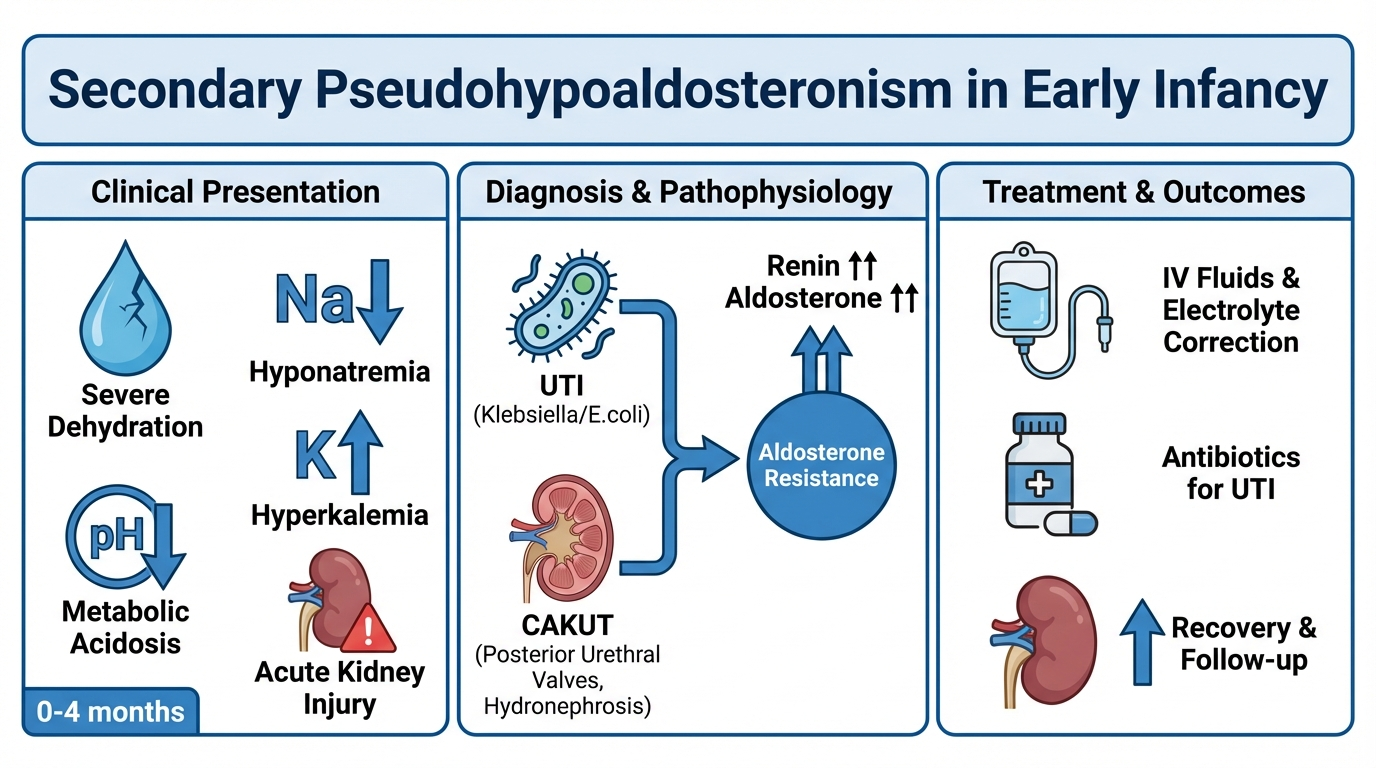
3.3. Pathophysiology of Secondary PHA
3.4. Management Principles of Secondary PHA
4. Clinical Learning Points
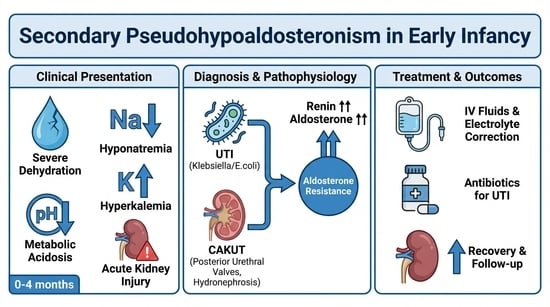
- Secondary PHA should be suspected in infants presenting with hyponatremia, hyperkalemia, metabolic acidosis, and dehydration, especially in the presence of UTI or CAKUT.
- Elevated plasma renin and aldosterone levels in the setting of hyponatremia and hyperkalemia differentiate secondary PHA from congenital adrenal hyperplasia and other adrenal disorders. Obtain these measurements before initiating treatment when clinically feasible.
- Infants with known CAKUT who develop unexplained electrolyte abnormalities during any systemic illness warrant evaluation for secondary PHA, even if UTI is not initially apparent.
- Early recognition and rapid correction of electrolyte imbalances are critical to prevent life-threatening cardiac arrhythmias and neurological complications.
- Treatment of the underlying urinary tract pathology, including prompt antibiotic therapy for UTI and surgical correction of anatomical abnormalities, leads to resolution of electrolyte disturbances in secondary PHA. Temporary electrolyte supplementation is typically required for several months because the renal tubular cells take time to fully recover from the insult that caused temporary aldosterone resistance.
- Long-term follow-up is necessary to monitor growth, renal function, and successful weaning from electrolyte supplementation as tubular function matures.
5. Conclusions
Author Contributions
Funding
Institutional Review Board Statement
Informed Consent Statement
Data Availability Statement
Acknowledgments
Conflicts of Interest
Abbreviations
| PHA | Pseudohypoaldosteronism |
| AKI | Acute kidney injury |
| UTI | Urinary tract infection |
| CAKUT | Congenital anomalies of the kidney and urinary tract |
| CAH | Congenital adrenal hyperplasia |
References
- Sánchez, M.A.; Atarés, G.Á.; Herranz, D.M.; Torres, I.A.; Salas, Y.R.; Del Olmo Izuzquiza, R.J.I. Secondary pseudohypoaldosteronism: A 15-year experience and a literature review. Pediatr. Nephrol. 2024, 39, 3233–3239. [Google Scholar] [CrossRef] [Scilit] [PubMed]
- Babar, G.S.; Tariq, M. Challenges of Diagnosing Pseudohypoaldosteronism (PHA) in an Infant. Case Rep. Endocrinol. 2022, 2022, 9921003. [Google Scholar] [CrossRef] [Scilit] [PubMed]
- Yakubov, R.; Ayman, A.; Kremer, A.K.; van den Akker, M. One-month-old girl presenting with pseudohypoaldosteronism leading to the diagnosis of CDK13-related disorder: A case report and review of the literature. J. Med. Case Rep. 2019, 13, 386. [Google Scholar] [CrossRef] [Scilit] [PubMed]
- Nakata, Y.; Nagano, C.; Imagawa, Y.; Shirai, K.; Masuda, Y.; Kido, T.; Ashina, M.; Nozu, K.; Fujioka, K. Clinical and Biochemical Characteristics of Pseudohypoaldosteronism Type 1 with and Without Genetic Mutations: A Literature Review. J. Clin. Med. 2025, 14, 4408. [Google Scholar] [CrossRef] [Scilit] [PubMed]
- Manas, F.; Singh, S. Pseudohypoaldosteronism Type II or Gordon Syndrome: A Rare Syndrome of Hyperkalemia and Hypertension with Normal Renal Function. Cureus 2024, 16, e52594. [Google Scholar] [CrossRef] [Scilit] [PubMed]
- Cruz, D.; Pintassilgo, I. Pseudohypoaldosteronism type II: The relevance of a challenging diagnosis. Eur. J. Case Rep. Intern. Med. 2025, 12. [Google Scholar] [CrossRef] [Scilit] [PubMed]
- Orphanet: Secondary Pseudohypoaldosteronism. Available online: https://www.orpha.net/en/disease/detail/93164 (accessed on 17 February 2025).
- Accomando, F.; Ceccoli, M.; Marsciani, M.; Aricò, M.O.; Valletta, E. Successful management of pseudohypoaldosteronism secondary to urinary tract malformation with urinary tract infection and gastrointestinal co-infection in an infant male: A case report. Pediatr. Med. 2024, 7, 30. [Google Scholar] [CrossRef] [Scilit]
- Jamet, E. An eye-tracking study of cueing effects in multimedia learning. Comput. Hum. Behav. 2014, 32, 47–53. [Google Scholar] [CrossRef] [Scilit]
- Betti, C.; Lavagno, C.; Bianchetti, M.G.; Kottanattu, L.; Lava, S.A.G.; Schera, F.; Lacalamita, M.C.; Milani, G.P. Transient secondary pseudo-hypoaldosteronism in infants with urinary tract infections: Systematic literature review. Eur. J. Pediatr. 2024, 183, 4205–4214. [Google Scholar] [CrossRef] [Scilit] [PubMed]
- Altınok, E.İ.; Özer, Y. A Case of Secondary Pseudohypoaldosteronism in a Neonate not Due to Urinary Tract Issues. J. Clin. Res. Pediatr. Endocrinol. 2025. Epub ahead of print. [Google Scholar] [CrossRef] [Scilit] [PubMed]
- Bowden, S.A.; Cozzi, C.; Hickey, S.E.; Thrush, D.L.; Astbury, C.; Nuthakki, S. Autosomal dominant pseudohypoaldosteronism type 1 in an infant with salt wasting crisis associated with urinary tract infection and obstructive uropathy. Case Rep. Endocrinol. 2013, 2013, 524647. [Google Scholar] [CrossRef] [Scilit] [PubMed]
- Memoli, E.; Lava, S.A.; Bianchetti, M.G.; Vianello, F.; Agostoni, C.; Milani, G.P. Prevalence, diagnosis, and management of secondary pseudohypoaldosteronism. Pediatr. Nephrol. 2020, 35, 713–714. [Google Scholar] [CrossRef] [Scilit] [PubMed]
- Morisaki, A.; Naruse, Y.; Shibata, Y.; Mori, M.; Hiramoto, R. Transient Pseudohypoaldosteronism Secondary to Group B Streptococcus Pyelonephritis. Cureus 2021, 13, e15071. [Google Scholar] [CrossRef] [Scilit] [PubMed]
- Ou, C.Y.; Chen, Y.J.; Lin, G.B.; Chen, M.-F.; Chia, S.-T. Case Report: Newborns With Pseudohypoaldosteronism Secondary to Excessive Gastrointestinal Losses Through High Output Stoma. Front. Pediatr. 2021, 9, 773246. [Google Scholar] [CrossRef] [Scilit] [PubMed]
- Efthymiadou, A.; Gautschi, I.; van Bemmelen, M.X.; Sertedaki, A.; Giannakopoulos, A.; Chrousos, G.; Schild, L.; Chrysis, D. A Mild and Transient Form of Autosomal Recessive Pseudohypoaldosteronism Type 1 Caused by a Novel Mutation in the SCNN1A Gene. Am. J. Physiol. Endocrinol. Metab. 2023, 325, E1–E9. [Google Scholar] [CrossRef] [Scilit] [PubMed]
- Calissendorff, J.; Falhammar, H. Renal Pseudohypoaldosteronism Type 1—An Adult Case Series Including a Novel Gene Variant. Endocrine 2025, 87, 1285–1290. [Google Scholar] [CrossRef] [Scilit] [PubMed]
- Martinerie, L.; Pussard, E.; Foix-L’Hélias, L.; Petit, F.; Cosson, C.; Boileau, P.; Lombès, M. Physiological partial aldosterone resistance in human newborns. Pediatr. Res. 2009, 66, 323–328. [Google Scholar] [CrossRef] [Scilit] [PubMed] [PubMed Central]
- Delforge, X.; Kongolo, G.; Cauliez, A.; Braun, K.; Haraux, E.; Buisson, P. Transient pseudohypoaldosteronism: A potentially severe condition affecting infants with urinary tract malformation. J. Pediatr. Urol. 2019, 15, 265.e1–265.e7. [Google Scholar] [CrossRef] [Scilit] [PubMed]



| Parameter (Reference Range) | WBC ×1012/L 6.0–17.5 | Hb g/L 95–130 | Plt ×109/L 150–450 | pH 7.35–7.45 | HCO3− mmol/L 22–26 | BE mmol/L −2 to +2 | Urea mmol/L 1.8–6.4 | Cr µmol/L 18–35 | UA µmol/L 143–340 | Na mmol/L 135–145 | K mmol/L 3.5–5.5 | Cl mmol/L 98–107 |
| 1st Admission (2 months) | 24.3 | 108 | 519 | 7.29 | 24.1 | −1.9 | 6.0 | 102 | 296 | 132 | 6.3 | 100 |
| 2nd Admission (4 months) | 32.2 | 96 | 1032 | 7.18 | 9.0 | −18.5 | 38.3 | 127 | 695 | 123 | 8.4 | 80 |
| Follow-up (4-year old) | 10.2 | 119 | 370 | 7.38 | 21.3 | 0.2 | 6.2 | 30 | 210 | 128 | 5.2 | 101 |
Disclaimer/Publisher’s Note: The statements, opinions and data contained in all publications are solely those of the individual author(s) and contributor(s) and not of MDPI and/or the editor(s). MDPI and/or the editor(s) disclaim responsibility for any injury to people or property resulting from any ideas, methods, instructions or products referred to in the content. |
© 2026 by the authors. Licensee MDPI, Basel, Switzerland. This article is an open access article distributed under the terms and conditions of the Creative Commons Attribution (CC BY) license.
Share and Cite
Elkina, S.; Halvadzhiyan, I.; Bozhanova, V. Diagnostic Challenges in Severe Electrolyte Imbalance in Early Infancy: A Case Report of Secondary Pseudohypoaldosteronism. Pediatr. Rep. 2026, 18, 49. https://doi.org/10.3390/pediatric18020049
Elkina S, Halvadzhiyan I, Bozhanova V. Diagnostic Challenges in Severe Electrolyte Imbalance in Early Infancy: A Case Report of Secondary Pseudohypoaldosteronism. Pediatric Reports. 2026; 18(2):49. https://doi.org/10.3390/pediatric18020049
Chicago/Turabian StyleElkina, Stanimira, Irina Halvadzhiyan, and Venetsiya Bozhanova. 2026. "Diagnostic Challenges in Severe Electrolyte Imbalance in Early Infancy: A Case Report of Secondary Pseudohypoaldosteronism" Pediatric Reports 18, no. 2: 49. https://doi.org/10.3390/pediatric18020049
APA StyleElkina, S., Halvadzhiyan, I., & Bozhanova, V. (2026). Diagnostic Challenges in Severe Electrolyte Imbalance in Early Infancy: A Case Report of Secondary Pseudohypoaldosteronism. Pediatric Reports, 18(2), 49. https://doi.org/10.3390/pediatric18020049