
How Healthcare Professionals Perceive Emergency Pediatric Care Provision in Two Public Hospitals in Greece: A Cross-Sectional Study


 , , ,
, , ,  and
and
Abstract
1. Introduction
2. Materials and Methods
2.1. Study Design and Setting
2.2. Data Collection Instrument
- Demographic information (12 items).
- Health Professionals’ Quality of Care Assessment Scale (14 double items—level of agreement and implementation in clinical practice) assessing key aspects of patient and parental experience including accessibility to care, respect, child-friendliness, communication and information continuity, pain management, and respect for privacy.
- Literature review and expert panel (content validity), which resulted in 16 items. The content validity of the questionnaire was established through a panel of experts, including pediatricians, nurses, nursing academics, and healthcare quality specialists, who reviewed the items for clarity, relevance, and cultural appropriateness to the Greek healthcare setting.
- Cognitive interviews (2 pediatricians, 2 nurses, 1 assistant nurse), which resulted in the merging of four items into two. A pilot study with 30 healthcare professionals (face validity) was performed. Minor modifications were made based on participant feedback, preserving the 14 items.
- Items with inter-item correlations and corrected item-total correlations (item analysis, n = 162) all items were preserved.
- Exploratory factor analysis was performed (construct validity, n = 70, randomly selected), and all items were preserved
- Confirmatory factor analysis was performed (construct validity, n = 162), and all items were preserved.
- Test–retest reliability (n = 30) and Cronbach’s alpha (n = 162) were assessed. The internal consistency reliability of the final instrument was evaluated using Cronbach’s alpha (α) coefficient. Internal consistency ranged from good to acceptable (implementation α = 0.800; agreement α = 0.711). A value of α ≥ 0.70 was considered acceptable, indicating a satisfactory level of reliability for each domain of the questionnaire [24]. The reliability analysis confirmed that the instrument maintained good internal consistency across all major dimensions (care characteristics, communication, information, and continuity of care).
- Independent items regarding the assessment of children and caregivers’ information (2 items) were assessed as independent variables in a 5-point Likert scale.
- Independent items capturing healthcare professionals’ views regarding the level of children’s and caregivers’ needs; the organization, safety, and overall quality of the provided care; and their personal satisfaction from their work environment (6 items) were assessed as independent variables in a 0–100 scale.
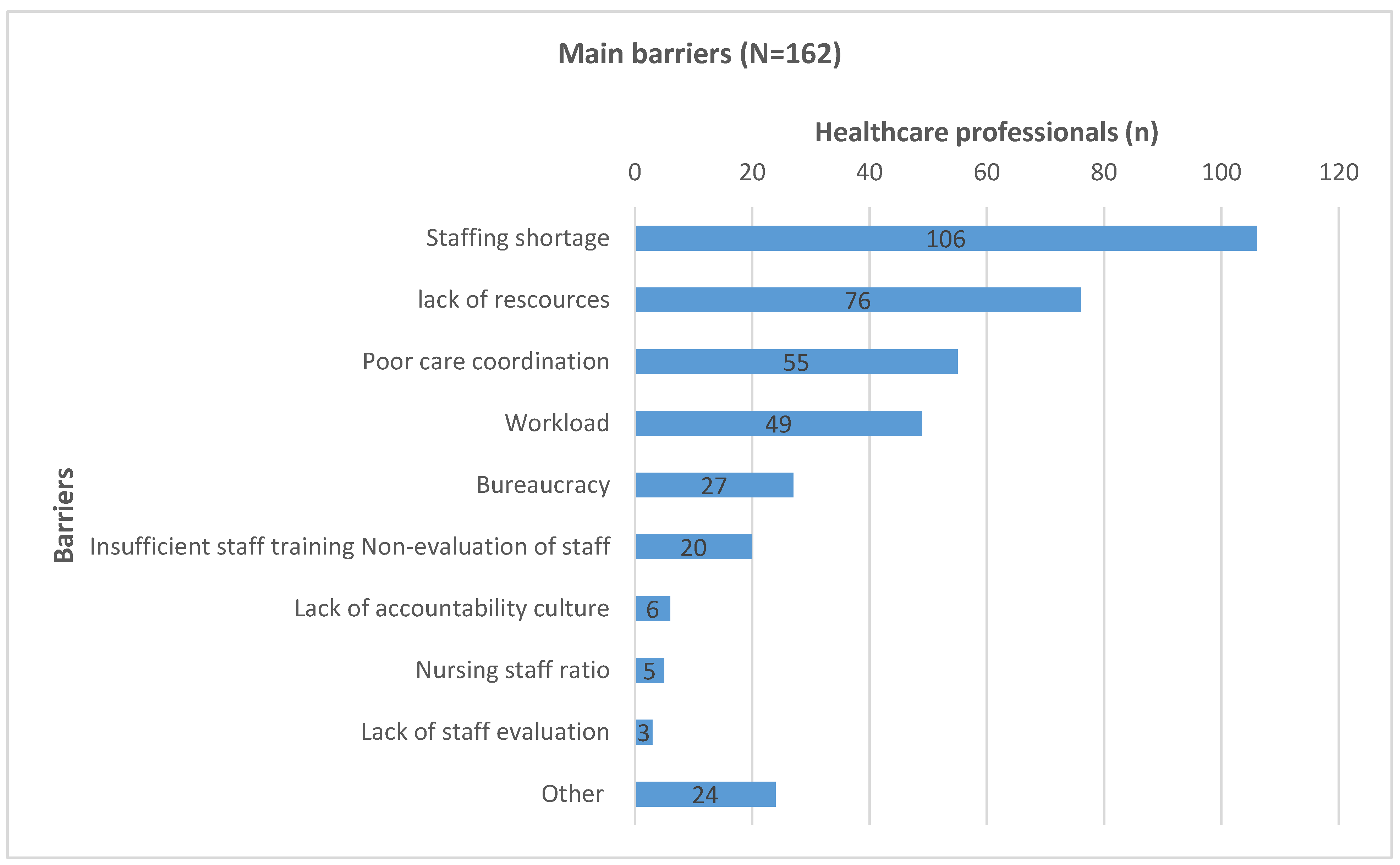
- An open-ended question was included regarding the major barriers of everyday clinical practice.
2.3. Participants and Inclusion/Exclusion Criteria
- Provision of informed consent prior to participation.
- Working at the emergency department or regular pediatric outpatient clinics during the study period.
- Availability to complete the study questionnaire.
2.4. Recruitment and Data Collection
2.5. Data Analysis
2.6. Ethical Considerations
3. Results
3.1. Demographics
3.2. Assessment of Quality of Offered Services
4. Discussion
4.1. Study Limitations
4.2. Implications for Clinical Practice
- Strengthen workforce capacity and address staffing shortages, especially nursing shortages.
- Improve organizational readiness and patient flow to effectively manage delays and overcrowding.
- Enhance child-friendly environments to reduce anxiety and improve the overall care experience for children and families, especially during long waiting periods.
- Standardize communication and information delivery to promote consistency and quality across professional groups and shifts.
- Implement protocol-driven procedures, adequate staff training, and sufficient resources to manage pain and suffering.
- Promote the professional growth and well-being of employees by controlling workloads, granting access to continuing education, and establishing chances for multidisciplinary cooperation.
4.3. Future Research Directions
5. Conclusions
Author Contributions
Funding
Institutional Review Board Statement
Informed Consent Statement
Data Availability Statement
Acknowledgments
Conflicts of Interest
References
- Muzigaba, M.; Chitashvili, T.; Choudhury, A.; Were, W.M.; Diaz, T.; Strong, K.L.; Jackson, D.; Requejo, J.; Detjen, A.; Sacks, E. Global core indicators for measuring WHO’s pediatric quality-of-care standards in health facilities: Development and expert consensus. BMC Health Serv. Res. 2022, 22, 887. [Google Scholar] [CrossRef] [PubMed]
- Sharifi, K.; Kalhor, F. Enhancing Pediatric Satisfaction in Healthcare Services: An Integrative Review. SAGE Open Pediatr. 2025, 12, 30502225251310503. [Google Scholar] [CrossRef]
- Singh, G.; Cribb, A. Aligning quality improvement with better child health for the 21st century. Arch. Dis. Child. Educ. Pract. Ed. 2021, 106, 370–377. [Google Scholar] [CrossRef]
- Seniwati, T.; Rustina, Y.; Nurhaeni, N.; Wanda, D. Patient and family-centered care for children: A concept analysis. Belitung Nurs. J. 2023, 9, 17–24. [Google Scholar] [CrossRef] [PubMed]
- Ali, S.; Maki, C.; Rahimi, A.; Ma, K.; Yaskina, M.; Wong, H.; Stang, A.; Principi, T.; Poonai, N.; Gouin, S.; et al. Family caregivers’ emotional and communication needs in Canadian pediatric emergency departments. PLoS ONE 2023, 18, e0294597. [Google Scholar] [CrossRef]
- Gross, T.K.; Lane, N.E.; Timm, N.L.; Committee on Pediatric Emergency Medicine. Crowding in the Emergency Department: Challenges and Best Practices for the Care of Children. Pediatrics 2023, 151, e2022060972. [Google Scholar] [CrossRef] [PubMed]
- Mackintosh, N.J.; Davis, R.E.; Easter, A.; Rayment-Jones, H.; Sevdalis, N.; Wilson, S.; Adams, M.; Sandall, J. Interventions to increase patient and family involvement in escalation of care for acute life-threatening illness in community health and hospital settings. Cochrane Database Syst. Rev. 2020, 12, CD012829. [Google Scholar] [CrossRef] [PubMed]
- Wei, H.; Corbett, R.W.; Rose, M.A.; Wei, T.L. Parents’ and healthcare professionals’ perceptions of the quality of care: A PITSTOP model of caring. Nurs. Forum 2019, 54, 661–668. [Google Scholar] [CrossRef] [PubMed]
- Schalkers, I.; Parsons, C.S.; Bunders, J.F.; Dedding, C. Health professionals’ perspectives on children’s and young people’s participation in health care: A qualitative multihospital study. J. Clin. Nurs. 2016, 25, 1035–1044. [Google Scholar] [CrossRef]
- Lachman, P.; Gondek, D.; Edbrooke-Childs, J.; Deighton, J.; Stapley, E. Perspectives of pediatric hospital staff on factors influencing the sustainability and spread of a safety quality improvement programme. BMJ Open 2021, 11, e042163. [Google Scholar] [CrossRef]
- Coyne, I.; Holmström, I.; Söderbäck, M. Centeredness in Healthcare: A Concept Synthesis of Family-centered Care, Person-centered Care and Child-centered Care. J. Pediatr. Nurs. 2018, 42, 45–56. [Google Scholar] [CrossRef] [PubMed]
- Foster, M.; Blamires, J. Child and Family Centred Care. J. Pediatr. Nurs. 2023, 71, A8–A9. [Google Scholar] [CrossRef] [PubMed]
- Zgambo, M.; Blamires, J.; Foster, M.; Al-Motlaq, M.; O’Sullivan, T.A.; Houghton, D.; Mörelius, E. International Network for Child and Family Centred Care. Child and Family Centred Care: A Three-Phased Principle-Based Concept Analysis. J. Adv. Nurs. 2025, 81, 4542–4565. [Google Scholar] [CrossRef] [PubMed]
- Gerlach, A.; Varcoe, C. Orienting child- and family-centered care toward equity. J. Child Health Care 2021, 25, 457–467. [Google Scholar] [CrossRef]
- Remick, K.; Gausche-Hill, M.; Joseph, M.M.; Brown, K.; Snow, S.K.; Wright, J.L. American Academy of Pediatrics Committee on Pediatric Emergency Medicine and Section on Surgery; American College of Emergency Physicians Pediatric Emergency Medicine Committee; Emergency Nurses Association Pediatric Committee. Pediatric Readiness in the Emergency Department. Pediatrics 2018, 142, e20182459. [Google Scholar] [CrossRef]
- Samuels-Kalow, M.E.; Cash, R.E.; Michelson, K.A.; Wolk, C.B.; Remick, K.E.; Loo, S.S.; Swanton, M.F.; Alpern, E.R.; Zachrison, K.S.; Camargo, C.A., Jr. Pediatric Emergency Care Coordinator Presence and Pediatric Care Quality Measures. JAMA Netw. Open 2024, 7, e2451111. [Google Scholar] [CrossRef] [PubMed]
- Remick, K.E.; Hewes, H.A.; Ely, M.; Schmuhl, P.; Crady, R.; Cook, L.J.; Ludwig, L.; Gausche-Hill, M. National Assessment of Pediatric Readiness of US Emergency Departments During the COVID-19 Pandemic. JAMA Netw. Open 2023, 6, e2321707. [Google Scholar] [CrossRef]
- Newgard, C.D.; Lin, A.; Malveau, S.; Cook, J.N.B.; Smith, M.; Kuppermann, N.; Remick, K.E.; Gausche-Hill, M.; Goldhaber-Fiebert, J.; Burd, R.S.; et al. Emergency Department Pediatric Readiness and Short-term and Long-term Mortality Among Children Receiving Emergency Care. JAMA Netw. Open 2023, 6, e2250941. [Google Scholar] [CrossRef]
- Gkentzi, D.; Katsoula, V.; Fouzas, S.; Mentis, M.; Karatza, A.; Dimitriou, G. Economic Recession and Attendances in the Pediatric Emergency Department. Biomed Res. Int. 2019, 2019, 4186486. [Google Scholar] [CrossRef] [PubMed]
- Hellenic Ministry of Health. BI-Health (Σύστημα Επιχειρηματικής Ευφυΐας ΕΣΥ). Available online: https://portal.bi.moh.gov.gr/ (accessed on 22 January 2026).
- McCoach, D.; Gable, R.; Madura, J. Review of the steps for designing an instrument. In Instrument Development in the Affective Domain, 3rd ed.; Springer: New York, NY, USA, 2013; pp. 277–284. [Google Scholar]
- Yusoff, M.S.B.; Arifin, W.N.; Hadie, S.N.H. ABC of questionnaire development and validation for survey research. Educ. Med. J. 2021, 13, 97–108. [Google Scholar] [CrossRef]
- De Winter, J.C.F.; Dodou, D.; Wieringa, P.A. Exploratory factor analysis with small sample sizes. Multivar. Behav. Res. 2009, 44, 147–181. [Google Scholar] [CrossRef]
- Taber, K.S. The Use of Cronbach’s Alpha When Developing and Reporting Research Instruments in Science Education. Res. Sci. Educ. 2018, 48, 1273–1296. [Google Scholar] [CrossRef]
- Janhunen, K.; Kankkunen, P.; Kvist, T. Pediatric emergency care: Associations between process factors and outcomes—Children’s and parents’ views combined with register data. Int. Emerg. Nurs. 2021, 54, 100937. [Google Scholar] [CrossRef]
- Jenkinson, C.; Coulter, A.; Bruster, S. The Picker Patient Experience Questionnaire: Development and validation using data from in-patient surveys in five countries. Int. J. Qual. Health Care 2002, 14, 353–358. [Google Scholar] [CrossRef] [PubMed]
- Bal, C.; AlNajjar, M.; Thull-Freedman, J.; Pols, E.; McFetridge, A.; Stang, A.S. Patient Reported Experience in a Pediatric Emergency Department. J. Patient Exp. 2020, 7, 116–123. [Google Scholar] [CrossRef]
- Parra, C.; Vidiella, N.; Marín, I.; Trenchs, V.; Luaces, C. Patient experience in the pediatric emergency department: Do parents and children feel the same? Eur. J. Pediatr. 2017, 176, 1263–1267. [Google Scholar] [CrossRef]
- World Health Organization. Standards for Improving the Quality of Care for Children and Young Adolescents in Health Facilities. 2018. Available online: https://www.who.int/publications-detail-redirect/9789241565554 (accessed on 24 December 2025).
- Remick, K.; Gausche-Hill, M.; Joseph, M.M.; Brown, K.; Snow, S.K.; Wright, J.L.; Adirim, T.; Agus, M.S.; Callahan, J.; Gross, T.; et al. Pediatric Readiness in the Emergency Department. J. Emerg. Nurs. 2019, 45, e3–e18. [Google Scholar] [CrossRef]
- Marcin, J.P.; Romano, P.S.; Dayal, P.; Dharmar, M.; Chamberlain, J.M.; Dudley, N.; Macias, C.G.; Nigrovic, L.E.; Powell, E.C.; Rogers, A.J.; et al. Provider-Level and Hospital-Level Factors and Process Measures of Quality Care Delivered in Pediatric Emergency Departments. Acad. Pediatr. 2020, 20, 524–531. [Google Scholar] [CrossRef]
- Perret, S.; Gehri, M.; Pluies, J.; Rossi, I.; Akre, C. Familles fréquentant un service d’accueil des urgences pédiatriques: Expérience, satisfaction et besoins [Families’ experiences and satisfaction with a pediatric emergency service]. Arch. Pediatr. 2017, 24, 960–968. [Google Scholar] [CrossRef] [PubMed]
- Zhang, H.; Tian, J.; Shi, Y.; Qian, Y.; Gao, X.; Zhai, X. Impact of expected waiting time on pediatric outpatient satisfaction: A behavioral experiment study. BMC Health Serv. Res. 2025, 25, 701. [Google Scholar] [CrossRef]
- Gripko, M.; Joseph, A.; MohammadiGorji, S. Effects of the physical environment on children and families in hospital-based emergency departments: A systematic literature review. J. Environ. Psychol. 2023, 86, 101970. [Google Scholar] [CrossRef] [PubMed]
- Liang, J.S.; Lin, H.Y.; Chen, Y.J.; Lai, F.C.; Liu, H.M.; Yang, C.Y.; Chiang, Y.T.; Chen, C.W. Nurses’ perspectives on child-friendly care needs in emergency departments: A qualitative study. Int. Emerg. Nurs. 2024, 73, 101402. [Google Scholar] [CrossRef]
- Ozturk, C.S.; Merter, O.S. Challenges and facilitators in child-friendly healthcare from the perspective of pediatric emergency nurses: A qualitative study. J. Pediatr. Nurs. 2024, 78, e180–e186. [Google Scholar] [CrossRef]
- Noiseux, J.; Rich, H.; Bouchard, N.; Noronha, C.; Carnevale, F.A. Children need privacy too: Respecting confidentiality in pediatric practice. Pediatr. Child Health 2019, 24, e8–e12. [Google Scholar] [CrossRef]
- Mientkiewicz, L.; Grover, P. Adolescent Confidentiality and Consent in an Emergency Setting. Pediatr. Emerg. Care 2022, 38, 697–699. [Google Scholar] [CrossRef]
- Mistarihi, M.Z.; AL-Tahat, M.D.; AL-Nimer, S.H. Improving Process Efficiency at Pediatric Hospital Emergency Department Using an Integrated Six-Sigma Simulation Methodology. Processes 2023, 11, 399. [Google Scholar] [CrossRef]
- Solarino, B.; Aricò, M. COVID-19 pandemic and pediatric healthcare policy in Italy: Time for a change. Pediatr. Rep. 2020, 12, 8823. [Google Scholar] [CrossRef] [PubMed]
- Ku, B.C.; Chamberlain, J.M.; Shaw, K.N. Quality Improvement and Safety in Pediatric Emergency Medicine. Pediatr. Clin. N. Am. 2018, 65, 1269–1281. [Google Scholar] [CrossRef]
- Michelson, K.A.; Rees, C.A.; Florin, T.A.; Bachur, R.G. Emergency Department Volume and Delayed Diagnosis of Serious Pediatric Conditions. JAMA Pediatr. 2024, 178, 362–368. [Google Scholar] [CrossRef]
- Carter, B.; Young, S.; Ford, K.; Campbell, S. The Concept of Child-Centred Care in Healthcare: A Scoping Review. Pediatr. Rep. 2024, 16, 114–134. [Google Scholar] [CrossRef] [PubMed]
- Coşkun, A.B.; Al-Motlaq, M.; Pişkin, M.; Elmaoğlu, E.; Çelebioğlu, A. Evaluation of the impact of family-centered care training on pediatric nurses’ attitudes. J. Pediatr. Nurs. 2025, 80, e136–e143. [Google Scholar] [CrossRef]
- Leaming-Van Zandt, K.J.; Zhu, H.; Banuelos, R.C.; Lopez, M.A.; Hsu, D.C. Impact of a Pediatric-Focused Communication Course on Patient/Caregiver-Perceived Physician Communication Skills in a Pediatric Emergency Department. Pediatr. Emerg. Care 2021, 37, e1173–e1180. [Google Scholar] [CrossRef]
- Dickens, R.; Leroy, P.; Eppich, W.; Brenner, M. Trustful relationships between healthcare professionals and children: A concept analysis using Rodgers’ evolutionary approach. Eur. J. Pediatr. 2025, 184, 464. [Google Scholar] [CrossRef]
- Barbarian, M.; Bishop, A.; Alfaro, P.; Biron, A.; Brody, D.A.; Cunningham-Allard, G.; Dubrovsky, A.S. Patient-Reported Experience in the Pediatric Emergency Department: What Matters Most? J. Patient Saf. 2021, 17, e1166–e1170. [Google Scholar] [CrossRef]
- Quach, A.; Tosif, S.; Nababan, H.; Duke, T.; Graham, S.M.; Were, W.M.; Muzigaba, M.; Russell, F.M. Assessing the quality of care for children attending health facilities: A systematic review of assessment tools. BMJ Glob. Health 2021, 6, e006804. [Google Scholar] [CrossRef] [PubMed]
- Assaf, R.R.; Pham, P.K.; Schmidt, A.R.; Gorab, A.; Chang, T.P.; Liu, D.R. Pediatric emergency department shift experiences and moods: An exploratory sequential mixed-methods study. AEM Educ. Train. 2021, 5, e10572. [Google Scholar] [CrossRef]
- Caruso, C.C. Negative impacts of shiftwork and long work hours. Rehabil. Nurs. 2014, 39, 16–25. [Google Scholar] [CrossRef] [PubMed]
- Perrone, P.M.; Deda, L.; Comotti, A.; Agostoni, C.; Castaldi, S.; Milani, G.P. Impact of time-of-shift on diagnostic service requests in a pediatric emergency department: A retrospective study. Intern. Emerg. Med. 2025. [Google Scholar] [CrossRef]
- Panagou, E.; Missouridou, E.D.; Zartaloudi, A.; Koutelekos, J.; Dousis, E.; Dafogianni, C.; Vlachou, E.; Evagelou, E. Compassion Fatigue and Compassion Satisfaction in Pediatric Intensive Care Professionals. Mater. Socio Med. 2023, 35, 28–32. [Google Scholar] [CrossRef] [PubMed]
- Barata, I.; Auerbach, M.; Badaki-Makun, O.; Benjamin, L.; Joseph, M.M.; Lee, M.O.; Mears, K.; Petrack, E.; Wallin, D.; Ishimine, P.; et al. A Research Agenda to Advance Pediatric Emergency Care Through Enhanced Collaboration Across Emergency Departments. Acad. Emerg. Med. 2018, 25, 1415–1426. [Google Scholar] [CrossRef]
- Ratnapalan, S.; Bennett, C.; Dopson, S.; Darwent, M. Staff Perceptions of Improving Emergency Care for Children: A Qualitative Study. Health Care Manag. 2019, 38, 29–36. [Google Scholar] [CrossRef] [PubMed]
- Soni, P.; Agrawal, A. Pediatric emergency care: Determinants and systematic barriers. World J. Clin. Pediatr. 2025, 14, 108140. [Google Scholar] [CrossRef] [PubMed]
- Lacey, B.; West, A.; Craig, S. Parents’ and carers’ impression of “quality” within a Pediatric Emergency Department. BMC Pediatr. 2021, 21, 313. [Google Scholar] [CrossRef] [PubMed]
- Onyejesi, C.D.; Elsayed, S.M.; Daniel Isaac, J.M.; Abady, E.M.; Shehada, W.; Alhaddad, J.; Alsabri, M. Improving patient outcomes through quality improvement and safety culture interventions in pediatric emergency care: A systematic review of best practices. Int. J. Emerg. Med. 2025, 18, 217. [Google Scholar] [CrossRef]
- Cesare, M.; D’Agostino, F.; Damiani, G.; Nurchis, M.C.; Ricciardi, W.; Nursing and Public Health Group; Cocchieri, A. Exploring the Impact of Medical Complexity on Nursing Complexity of Care in Paediatric Patients: A Retrospective Observational Study. J. Clin. Nurs. 2025, 34, 2748–2765. [Google Scholar] [CrossRef]
- Sheehan, R.; Ryder, M.; Brenner, M. Quality care for children and young people with complex and integrated care needs: A discussion on nursing-sensitive indicators. Int. J. Nurs. Stud. Adv. 2025, 8, 100275. [Google Scholar] [CrossRef]


| Sample Demographics (Ν = 162) | ||
|---|---|---|
| Ν | % | |
| Hospital | ||
| Pentelis General Pediatric Hospital | 69 | 42.6% |
| P & A Kyriakou Pediatric Hospital | 93 | 57.4% |
| Sex | ||
| Male | 44 | 27.2% |
| Female | 118 | 72.8% |
| Profession | ||
| Physician | 122 | 75.3% |
| Nurse | 24 | 14.8% |
| Assistant Nurse | 16 | 9.9% |
| Professional Title | ||
| Resident | 74 | 45.7% |
| Medical Supervisor B grade | 28 | 17.3% |
| Medical Supervisor A grade | 11 | 6.8% |
| Deputy Director | 4 | 2.5% |
| Medical Service Director | 6 | 3.7% |
| Nursing Assistant | 17 | 10.5% |
| Nurse | 20 | 12.3% |
| Head of Nursing | 1 | 0.6% |
| Deputy Director of Nursing | 1 | 0.6% |
| Working Department | ||
| General pediatric | 50 | 30.9% |
| Pediatric specialty | 42 | 25.9% |
| Surgical | 33 | 20.4% |
| Not stated | 37 | 22.8% |
| Age (years) | ||
| <30 | 67 | 41.4% |
| 31–40 | 53 | 32.7% |
| 41–50 | 23 | 14.2% |
| 51–60 | 16 | 9.9% |
| >60 | 3 | 1.9% |
| Family Status | ||
| Married | 59 | 36.4% |
| Divorced | 9 | 5.6% |
| Widowed | 2 | 1.2% |
| Unmarried | 69 | 42.6% |
| In relationship | 23 | 14.2% |
| Number of Children in the family | ||
| 0 | 95 | 58.6% |
| 1 | 32 | 19.8% |
| 2 | 25 | 15.4% |
| 3 | 6 | 3.7% |
| Not stated | 4 | 2.5% |
| Educational Level | ||
| Institute of Vocational Training (IVT)/Technical Vocational School (TVS) | 17 | 10.5% |
| Technological Educational Institution (TEI) | 9 | 5.6% |
| University | 58 | 35.8% |
| MSc | 60 | 37.0% |
| PhD | 18 | 11.1% |
| Flexible Working Hours/Shifts | ||
| Almost never | 7 | 4.3% |
| Rarely | 3 | 1.9% |
| Sometimes | 30 | 18.5% |
| Often | 73 | 45.1% |
| Almost always | 49 | 30.2% |
| Questions | Level of Agreement | Ν (%) | p Values * | Level of Implementation in Practice | Ν (%) | p Values * |
|---|---|---|---|---|---|---|
| Question 1. Care and access for young patients in the hospital should be provided without any discrimination based on race, religion, or ethnicity. | Totally disagree | 3 (1.9%) | Age, p = 0.001 Family status, p = 0.029 | Almost never/never | 0 (0.0%) | Age, p = 0.025 Total hospital experience, p = 0.038 |
| Disagree | 0 (0.0%) | Rarely | 2 (1.2%) | |||
| Neither agree or disagree | 1 (0.6%) | Sometimes | 16 (9.9%) | |||
| Agree | 10 (6.2%) | Often | 40 (24.7%) | |||
| Totally agree | 148 (91.4%) | Almost every time/every time | 104 (64.2%) | |||
| Total answers | 162 (100.0%) | Total answers | 162 (100.0%) | |||
| Question 2. Waiting times for procedures concerning health issues or administrative matters related to the pediatric patient should be sufficient and carried out in such a way that there is no delay. | Totally disagree | 1 (0.6%) | Total experience in the department, p = 0.040 | Almost never/never | 4 (2.5%) | Age, p = 0.003 Hospital, p = 0.021 Education, p = 0.005 Children (yes/no), p = 0.011 Total years of experience in hospital, p = 0.009 Total experience in the department, p = 0.001 |
| Disagree | 3 (1.9%) | Rarely | 38 (23.5%) | |||
| Neither agree or disagree | 6 (3.7%) | Sometimes | 88 (54.3%) | |||
| Agree | 43 (26.5%) | Often | 26 (16.0%) | |||
| Totally agree | 109 (67.3%) | Almost every time/every time | 6 (3.7%) | |||
| Total answers | 162 (100.0%) | Total answers | 162 (100.0%) | |||
| Question 3. Both pediatric patients and their caregivers should be approached in a polite manner and all cases should be treated with respect and dignity. | Totally disagree | 0 (0.0%) | Almost never/never | 0 (0.0%) | Age, p = 0.015 Total hospital experience, p = 0.019 | |
| Disagree | 0 (0.0%) | Rarely | 2 (1.2%) | |||
| Neither agree or disagree | 5 (3.1%) | Sometimes | 40 (24.7%) | |||
| Agree | 31 (19.1%) | Often | 80 (49.4%) | |||
| Totally agree | 126 (77.8%) | Almost every time/every time | 40 (24.7%) | |||
| Total answers | 162 (100.0%) | Total answers | 162 (100.0%) | |||
| Question 4. The environment where children stay in the Emergency Department/Outpatient Clinics should be child-friendly. There should be a playroom equipped with books and toys appropriate for each age. | Totally disagree | 1 (0.6%) | Education, p = 0.001 | Almost never/never | 60 (37.0%) | Hospital, p = 0.001 Education, p = 0.001 Profession, p = 0.013 Total experience in the department, p = 0.001 |
| Disagree | 4 (2.5%) | Rarely | 46 (28.4%) | |||
| Neither agree or disagree | 15 (9.3%) | Sometimes | 41 (25.3%) | |||
| Agree | 40 (24.7%) | Often | 9 (5.6%) | |||
| Totally agree | 102 (63.0%) | Almost every time/every time | 6 (3.7%) | |||
| Total answers | 162 (100.0%) | Total answers | 162 (100.0%) | |||
| Question 5. The overall hygiene conditions, regarding the space in the Emergency Department/Outpatient Clinic of a Pediatric Hospital, should be excellent. (The ward should be clean, waste should be collected properly and all hygiene rules should be implemented.) | Totally disagree | 0 (0.0%) | Almost never/never | 5 (3.1%) | Education, p = 0.001 Total experience in the department, p = 0.016 | |
| Disagree | 0 (0.0%) | Rarely | 22 (13.6%) | |||
| Neither agree or disagree | 0 (0.0%) | Sometimes | 52 (32.1%) | |||
| Agree | 11 (6.8%) | Often | 60 (37.0%) | |||
| Totally agree | 151 (93.2%) | Almost every time/every time | 23 (14.2%) | |||
| Total answers | 162 (100.0%) | Total answers | 162 (100.0%) | |||
| Question 6. Health professionals should be responsive to the emotional concerns of children and their accompanying caregivers. | Totally disagree | 1 (0.6%) | Total years of experience, p = 0.001 | Almost never/never | 2 (1.2%) | Education, p = 0.050 |
| Disagree | 3 (1.9%) | Rarely | 16 (9.9%) | |||
| Neither agree or disagree | 15 (9.3%) | Sometimes | 63 (38.9%) | |||
| Agree | 56 (34.6%) | Often | 71 (43.8%) | |||
| Totally agree | 87 (53.7%) | Almost every time/every time | 10 (6.2%) | |||
| Total answers | 162 (100.0%) | Total answers | 162 (100.0%) | |||
| Question 7. Adequate and appropriate communication with hospitalized children and their parents (caregivers) should be ensured. | Totally disagree | 0 (0.0%) | Almost never/never | 0 (0.0%) | Profession, p = 0.027 | |
| Disagree | 0 (0.0%) | Rarely | 8 (4.9%) | |||
| Neither agree or disagree | 2 (1.2%) | Sometimes | 54 (33.3%) | |||
| Agree | 35 (21.6%) | Often | 81 (50.0%) | |||
| Totally agree | 125 (77.2%) | Almost every time/every time | 19 (11.7%) | |||
| Total answers | 162 (100.0%) | Total answers | 162 (100.0%) | |||
| Question 8. Information to parents (caregivers) of children, as well as to children, should be provided in a culturally appropriate and understandable manner. | Totally disagree | 0 (0.0%) | Working in shifts, p = 0.002 | Almost never/never | 1 (0.6%) | Working in shifts, p = 0.035 |
| Disagree | 2 (1.2%) | Rarely | 8 (4.9%) | |||
| Neither agree or disagree | 1 (0.6%) | Sometimes | 51 (31.5%) | |||
| Agree | 26 (16.0%) | Often | 67 (41.4%) | |||
| Totally agree | 133 (82.1%) | Almost every time/every time | 35 (21.6%) | |||
| Total answers | 162 (100.0%) | Total answers | 162 (100.0%) | |||
| Question 9. Information to children should be adequate regarding their health condition, possible diagnosis, potential treatments and procedures. (As long as Age > 4 years and their cognitive level allows it.) | Totally disagree | 1 (0.6%) | Almost never/never | 3 (1.9%) | Sex, p = 0.050 Profession, p = 0.013 | |
| Disagree | 5 (3.1%) | Rarely | 31 (19.1%) | |||
| Neither agree or disagree | 27 (16.7%) | Sometimes | 69 (42.6%) | |||
| Agree | 57 (35.2%) | Often | 42 (25.9%) | |||
| Totally agree | 72 (44.4%) | Almost every time/every time | 17 (10.5%) | |||
| Total answers | 162 (100.0%) | Total answers | 162 (100.0%) | |||
| Question 10. Information to parents (caregivers) should be sufficient regarding the child’s health status, possible diagnosis, potential treatments and procedures. | Totally disagree | 0 (0.0%) | Profession, p = 0.013 Education, p = 0.003 | Almost never/never | 0 (0.0%) | Profession, p = 0.002 Department, p = 0.005 |
| Disagree | 1 (0.6%) | Rarely | 6 (3.7%) | |||
| Neither agree or disagree | 1 (0.6%) | Sometimes | 24 (14.8%) | |||
| Agree | 21 (13.0%) | Often | 70 (43.2%) | |||
| Totally agree | 139 (85.8%) | Almost every time/every time | 62 (38.3%) | |||
| Total answers | 162 (100.0%) | Total answers | 162 (100.0%) | |||
| Question 11. The information provided to the children’s guardians upon discharge should be written and clear. | Totally disagree | 0 (0.0%) | Almost never/never | 4 (2.5%) | Profession, p = 0.002 | |
| Disagree | 0 (0.0%) | Rarely | 12 (7.4%) | |||
| Neither agree or disagree | 5 (3.1%) | Sometimes | 33 (20.4%) | |||
| Agree | 34 (21.0%) | Often | 61 (37.7%) | |||
| Totally agree | 123 (75.9%) | Almost every time/every time | 52 (32.1%) | |||
| Total answers | 162 (100.0%) | Total answers | 162 (100.0%) |
| Assessment of the Parental and Children Information Level | ||||
|---|---|---|---|---|
| Likert Scale | Level of Parental Information | Level of Child Information | ||
| Ν | % | Ν | % | |
| Not at all informed | 0 | 0 | 10 | 6.2 |
| Slightly informed | 4 | 2.5 | 35 | 21.6 |
| Moderately informed | 48 | 29.6 | 78 | 48.1 |
| Quite informed | 81 | 50.0 | 27 | 16.7 |
| Very informed | 29 | 17.9 | 12 | 7.4 |
| Total answers | 162 | 100.0 | 162 | 100.0 |
| Evaluation Parameter (Score 0–100) | Mean Value | Standard Deviation | Median | Minimum Value | Maximum Value | Intra-Quartile Range |
|---|---|---|---|---|---|---|
| To what extent do you believe that the overall needs (physical, emotional, psychosocial, informational, etc.) of children are covered? | 61.79 | 15.61 | 60 | 20 | 100 | 50–70 |
| To what extent do you believe that the overall needs (physical, emotional, psychosocial, informational, etc.) of parents/caregivers are covered? | 65.77 | 17,01 | 70 | 10 | 100 | 58.75–80 |
| How do you evaluate the quality of the health services provided at the hospital where you work? | 65.25 | 16.79 | 70 | 20 | 100 | 50–80 |
| How satisfied are you with the organization of the care provided to children and parents? | 60.85 | 18.76 | 60 | 0 | 100 | 50–80 |
| How safe do you consider the care provided to children and parents to be? | 73.27 | 16.78 | 75 | 20 | 100 | 63.75–90 |
| How satisfied are you with your work in this specific department (regular outpatient clinics)? | 68.15 | 19.70 | 70 | 0 | 100 | 60–80 |
Disclaimer/Publisher’s Note: The statements, opinions and data contained in all publications are solely those of the individual author(s) and contributor(s) and not of MDPI and/or the editor(s). MDPI and/or the editor(s) disclaim responsibility for any injury to people or property resulting from any ideas, methods, instructions or products referred to in the content. |
© 2026 by the authors. Licensee MDPI, Basel, Switzerland. This article is an open access article distributed under the terms and conditions of the Creative Commons Attribution (CC BY) license.
Share and Cite
Vathi, E.; Petsios, K.; Dousis, E.; Koutelekos, I.; Koumpagioti, D.; Anastasopoulou, E.; Ntikoudi, A.; Vlachou, E.; Evangelou, E. How Healthcare Professionals Perceive Emergency Pediatric Care Provision in Two Public Hospitals in Greece: A Cross-Sectional Study. Pediatr. Rep. 2026, 18, 27. https://doi.org/10.3390/pediatric18010027
Vathi E, Petsios K, Dousis E, Koutelekos I, Koumpagioti D, Anastasopoulou E, Ntikoudi A, Vlachou E, Evangelou E. How Healthcare Professionals Perceive Emergency Pediatric Care Provision in Two Public Hospitals in Greece: A Cross-Sectional Study. Pediatric Reports. 2026; 18(1):27. https://doi.org/10.3390/pediatric18010027
Chicago/Turabian StyleVathi, Eleni, Konstantinos Petsios, Evangelos Dousis, Ioannis Koutelekos, Despoina Koumpagioti, Eirini Anastasopoulou, Anastasia Ntikoudi, Eugenia Vlachou, and Eleni Evangelou. 2026. "How Healthcare Professionals Perceive Emergency Pediatric Care Provision in Two Public Hospitals in Greece: A Cross-Sectional Study" Pediatric Reports 18, no. 1: 27. https://doi.org/10.3390/pediatric18010027
APA StyleVathi, E., Petsios, K., Dousis, E., Koutelekos, I., Koumpagioti, D., Anastasopoulou, E., Ntikoudi, A., Vlachou, E., & Evangelou, E. (2026). How Healthcare Professionals Perceive Emergency Pediatric Care Provision in Two Public Hospitals in Greece: A Cross-Sectional Study. Pediatric Reports, 18(1), 27. https://doi.org/10.3390/pediatric18010027