
Brief Report

Dectin-3 Plays a Redundant Role in the Immune Response to Paracoccidioides brasiliensis

by
Mariana de Resende Damas Cardoso-Miguel
1,2,
Pedro Henrique Bürgel
3,
Raffael Júnio Araújo de Castro
4,
Clara Luna Marina
3,
Stephan Alberto de Oliveira
5,
Patrícia Albuquerque
1,6,7,
Ildinete Silva-Pereira
6,
Anamélia Lorenzetti Bocca
8,9,10,† and
Aldo Henrique Tavares
1,7,11,*,†
1
Graduate Program in Microbial Biology, Department of Cell Biology, Institute of Biological Sciences, University of Brasília, UnB, Brasília 70910-900, DF, Brazil
2
Federal Institute of Education, Science and Technology of São Paulo, Hortolândia 13183-250, SP, Brazil
3
School of Medicine, University of Brasília, UnB, Brasília 70910-900, DF, Brazil
4
Department of Genetics and Morphology, Institute of Biological Sciences, University of Brasília, UnB, Brasília 70910-900, DF, Brazil
5
Évora Veterinary Diagnostics, Brasília 71200-010, DF, Brazil
6
Laboratory of Molecular Biology of Pathogenic Fungi, Department of Cell Biology, Institute of Biological Sciences, University of Brasília, UnB, Brasília 70910-900, DF, Brazil
7
Faculty of Health Sciences and Technologies, University of Brasília, UnB, Brasília 72220-275, DF, Brazil
8
Center of Molecular Biotechnology (C-BIOTECH), University of Brasília, UnB, Brasília 70910-900, DF, Brazil
9
Bi-Institutional Translational Medicine Platform, Oswaldo Cruz Foundation (Fiocruz), Ribeirão Preto 14049-900, SP, Brazil
10
National Institute of Science and Technology in Human Pathogenic Fungi, Ribeirão Preto 14049-900, SP, Brazil
11
Laboratory of Microorganism and Immunology, Faculty of Ceilândia, University of Brasília, UnB, Brasília 72220-275, DF, Brazil
*
Author to whom correspondence should be addressed.
These authors contributed equally to this work.
Microbiol. Res. 2026, 17(7), 128; https://doi.org/10.3390/microbiolres17070128 (registering DOI)
Submission received: 5 June 2026 / Revised: 30 June 2026 / Accepted: 1 July 2026 / Published: 5 July 2026
(This article belongs to the Section Medical and Veterinary Microbiology)

Abstract

C-type lectin receptors (CLRs) play central roles in sensing fungal pathogens and coordinating Syk-CARD9-dependent inflammatory responses. While Dectin-3 contributes to antifungal immunity against several clinically relevant fungi, its role in host defense against Paracoccidioides brasiliensis remains unknown. Here, we investigated the impact of Dectin-3 deficiency using Clec4d/ mice and primary phagocytes during experimental Paracoccidioidomycosis. Dectin-3-deficient macrophages and dendritic cells displayed unaltered cytokine production, phagocytic capacity, fungicidal activity, and maturation following P. brasiliensis challenge. Consistently, the absence of Dectin-3 did not impact survival or pulmonary fungal burden during long-term systemic infection. These findings are consistent with functional redundancy among CLRs, potentially involving Dectin-1, Dectin-2, or other Syk-coupled receptors rendering Dectin 3 dispensable for immunity to systemic experimental P. brasiliensis infection.

1. Introduction

Paracoccidioides spp. are the causative agents of Paracoccidioidomycosis (PCM), a Latin America endemic systemic mycosis that significantly impacts several countries, particularly Brazil. Infection occurs through inhalation of propagules from the saprophytic mycelial form, and once they reach the lungs, the parasitic yeast forms develop [1,2]. Sensing of invading fungal pathogens relies heavily on C-type lectin receptors (CLRs), which are pattern recognition receptors (PRRs) mainly expressed on myeloid cells and are essential in coordinating innate and adaptive immune responses against fungal infections. Among CLRs, Dectin-1 and Dectin-2 have gained considerable attention, with several reports showing a critical role of these receptors in the recognition of cell wall pathogen-associated molecular patterns (PAMPs) of invasive fungi, including P. brasiliensis, the most prevalent and clinically relevant species of the genus Paracoccidioides [3,4,5,6]. Regarding Dectin-2, we recently showed that mice lacking this CLR are highly susceptible to systemic P. brasiliensis infection and exhibit impaired phagocyte function [3].
Besides Dectin-1 and Dectin-2, Dectin-3 (also known as CLECSF8, MCL, or Clec4d) has been implicated in protective antifungal responses during experimental infections with Candida albicans, Candida tropicalis, Cryptococcus gattii serotype B, and Cryptococcus neoformans serotype AD, but not with C. neoformans serotype A, Blastomyces dermatitidis, or Fonsecaea pedrosoi [7,8,9,10,11,12,13], indicating that Dectin-3 is not universally required and may function in a pathogen-specific and context-dependent manner. In P. brasiliensis, human plasmacytoid dendritic cells (pDCs) treated with blocking antibodies targeting Dectin-2 or Dectin-3 exhibit reduced antifungal activity [14]. However, the functional role of Dectin-3 in genetically deficient mice has not been addressed in P. brasiliensis infection.
Dectin-3 can form a heterodimeric PRR with Dectin-2 to optimally recognize α-1,2-Mannans from C. albicans cell wall. Additionally, it can sense capsular glucuronoxylomannan (GXM) from C. gattii serotype B, and C. neoformans serotype AD [8,10]. Notably, Dectin-3 shares the Syk-Card9 signaling pathway with Dectin-1 and Dectin-2, which triggers NF-κB and MAPK activation [7,8]. In this context, considering the prevalence of α-1,2-Mannans residues in the P. brasiliensis yeast cell wall [15], we investigated the role of Dectin-3 in phagocyte function, as well as its contribution to host survival using Clec4d-deficient mice challenged with P. brasiliensis.

2. Materials and Methods

2.1. Mice and P. brasiliensis Growth Conditions

The yeast form of P. brasiliensis Pb18 strain was cultured for seven days at 36 °C on BHI agar and harvested for inoculum preparation for in vitro and in vivo infection. Male C57BL/6 mice deficient in Dectin-3 (Clec4d-/-) and wild type (WT) Clec4d+/+ littermates were kindly provided by Dr. Bruce Klein of the University of Wisconsin, USA. Animal procedures were performed following the Animal Ethics Committee of the University of Brasília guidelines, permit number UnBDoc 559242016.

2.2. Bone Marrow-Derived DCs and Macrophage Generation

Bone marrow-derived DCs (BMDCs) and macrophages (BMDMs) from Clec4d-/- and WT mice were obtained, as reported elsewhere [3,16]. Briefly, femurs were washed with cold RPMI medium, and 2 × 10⁶ progenitor cells were plated into Petri dishes in RPMI supplemented with GM-CSF (20 ng/mL). After eight days, nonadherent and adherent cells were harvested. Typically, as analyzed by flow cytometry, 75–80% of nonadherent cells are phenotypically characterized as CD11c+/MHC class II+ (BMDCs), and 85–90% of adherent cells as CD11b+/F4/80+ (BMDMs). Phagocytes were infected with 1.25 × 10⁵ P. brasiliensis yeast cells at a multiplicity of Infection (MOI) of 0.5 yeasts per phagocyte and cultured in RPMI medium at 37 °C. After 6 and 24 h, the supernatants were harvested, and the secretion of TNF-α, IL-6, IL-10, IL-1β, and CCL2 was quantified using ELISA Ready-SET-Go! Kit (Thermofisher, Waltham, MA, USA).

2.3. Macrophage Phagocytosis, Fungicidal Assay, and Production of Nitric Oxide

BMDMs from Clec4d-/- and WT mice were infected with P. brasiliensis yeast cells (MOI: 0.5). After 24 h, supernatants were harvested and macrophages fixed with methanol and stained with Giemsa to evaluate phagocytosis (percentage of macrophages with at least one internalized fungi) and the Phagocytic index (PI), defined as the ratio of intracellular yeasts to the number of macrophages with internalized yeasts [3]. To determine fungicidal activity, BMDMs were infected with P. brasiliensis and treated or not with lipopolysaccharide (LPS) (100 ng/mL, Escherichia coli O111:B4) plus IFN-γ (20 ng/mL). After 24 h, supernatants were collected for nitric oxide (NO) quantification, and non-internalized fungi were removed by washing, followed by macrophage lysis. The suspension was diluted (1:10) and plated on BHI-agar plates at 37 °C. After 10–15 days, colony-forming units (CFU) were counted and expressed as CFU/mL. NO was indirectly determined by the quantification of nitrite in the culture supernatant using the Griess reagent and expressed as micromolar NO2.

2.4. Expression of BMDCs Maturation Markers CD80 and CD86

Maturation of BMDCs from mice lacking Dectin-3 and WT was evaluated by quantifying CD80 and CD86 expression using flow cytometry. As above, BMDCs were infected with P. brasiliensis. Uninfected BMDCs were stimulated with LPS (500 ng/mL; E. coli O111:B4) as a control. After 24 h, 3 × 10⁵ cells were labeled with antibodies anti-CD11c-APC, anti-CD80-FITC, anti-CD86-FITC, and isotype-matched control antibody (Thermofisher, Waltham, MA, USA) for 1 h at 4 °C. After washes, the cells were analyzed.

2.5. Survival Study and Colony-Forming Units (CFU) Assay

Survival curves were performed using 8 animals per group (Clec4d-/- and WT) intravenously infected with 1 × 10⁶ yeast/100 μL in sterile PBS and observed for 40 weeks. For fungal load quantification, another set animals were infected, as above. After 60 days, whole lungs of euthanized mice were harvested, weighted, and homogenized in PBS for CFU assay. The organ homogenates were diluted (1:10) and plated on BHI-agar plates at 37 °C. After 10–15 days, CFU were counted and the results were determined as CFU per gram of tissue.

2.6. Statistical Analysis

Differences between control WT and Clec4d-/- groups were assessed using Student’s t-test for parametric data or the Mann–Whitney test for nonparametric data. Survival curves were analyzed with the log-rank (Mantel–Cox) test. Results were considered significant at p ≤ 0.05. Two to three biological replicates were performed for all experiments.

3. Results

3.1. Dectin-3 Is Dispensable for Murine Phagocyte Activation and Effector Responses Against P. brasiliensis

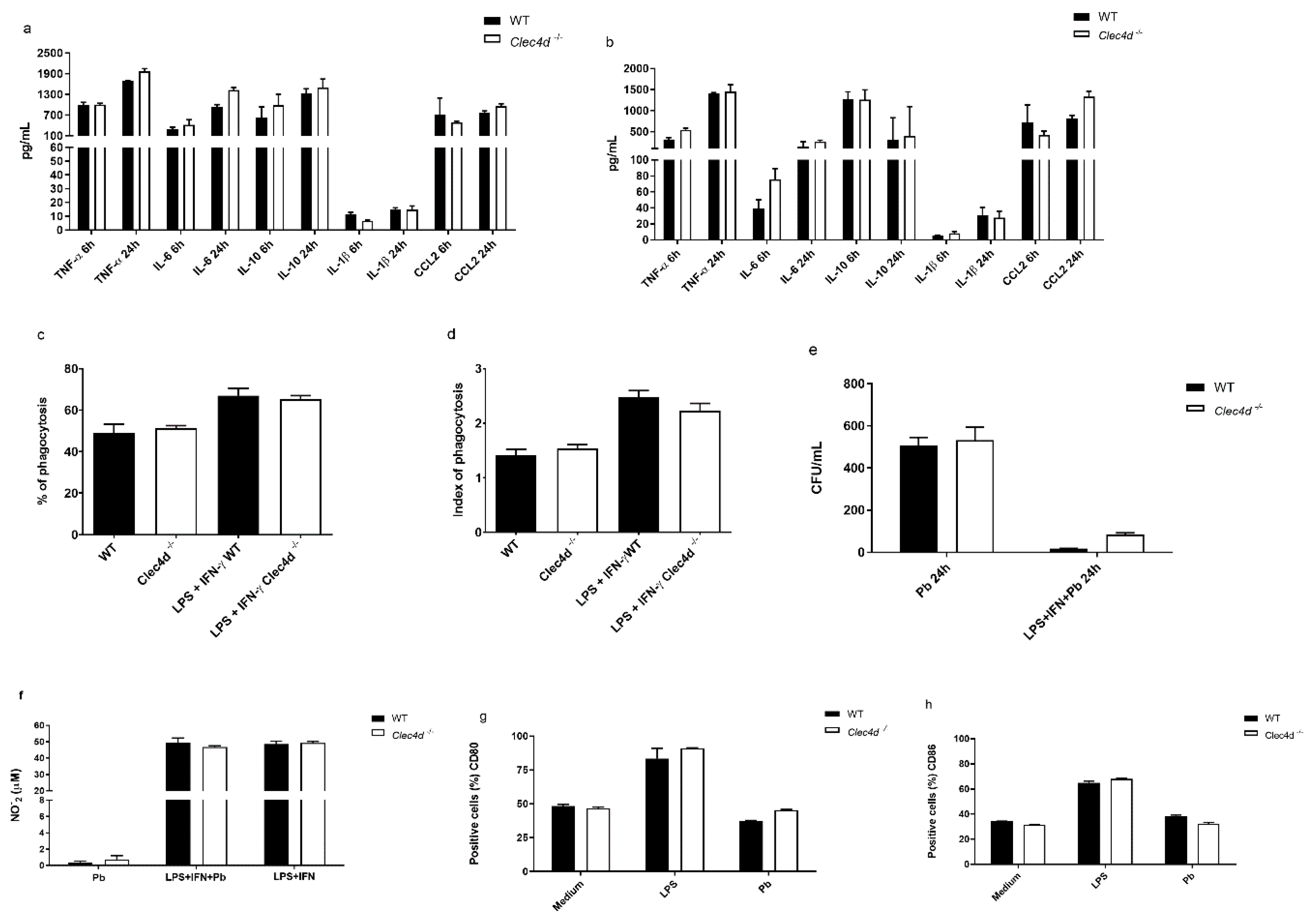
Macrophages and dendritic cells constitute the primary immunological defense following Paracoccidioides infection. To evaluate the role of Dectin-3 in the functional activity of these phagocytes, BMDMs and BMDCs were generated from Clec4d-/- mice. Neither BMDMs (Figure 1a) nor BMDCs (Figure 1b) derived from Dectin-3-deficient mice infected with P. brasiliensis displayed any significant alterations in the secretion of pro-inflammatory cytokines (TNF-α, IL-1β, IL-6, and CCL2) or IL-10 after 6 or 24 h of co-culture. Furthermore, the absence of Dectin-3 did not impair phagocytic uptake, as both the phagocytic percentage and index remained equivalent across genotypes under basal and stimulated (LPS plus IFN-γ) conditions (Figure 1c,d). The fungicidal activity, as assessed by CFU recovery, and the production of NO, the principal effector molecule involved in P. brasiliensis killing [17,18], remained unchanged in Dectin-3-deficient macrophages (Figure 1e,f). Additionally, dendritic cell maturation, a critical process for priming naïve T cells, remained unaffected, as evidenced by comparable expression of the maturation markers CD80 and CD86 after 24 h of co-culture (Figure 1g,h). Collectively, these findings suggest that Dectin-3 is dispensable for early murine phagocyte activation and effector responses against P. brasiliensis.

3.2. The Absence of Dectin-3 Did Not Alter Survival or Pulmonary Fungal Burden During Long-Term Systemic Infection

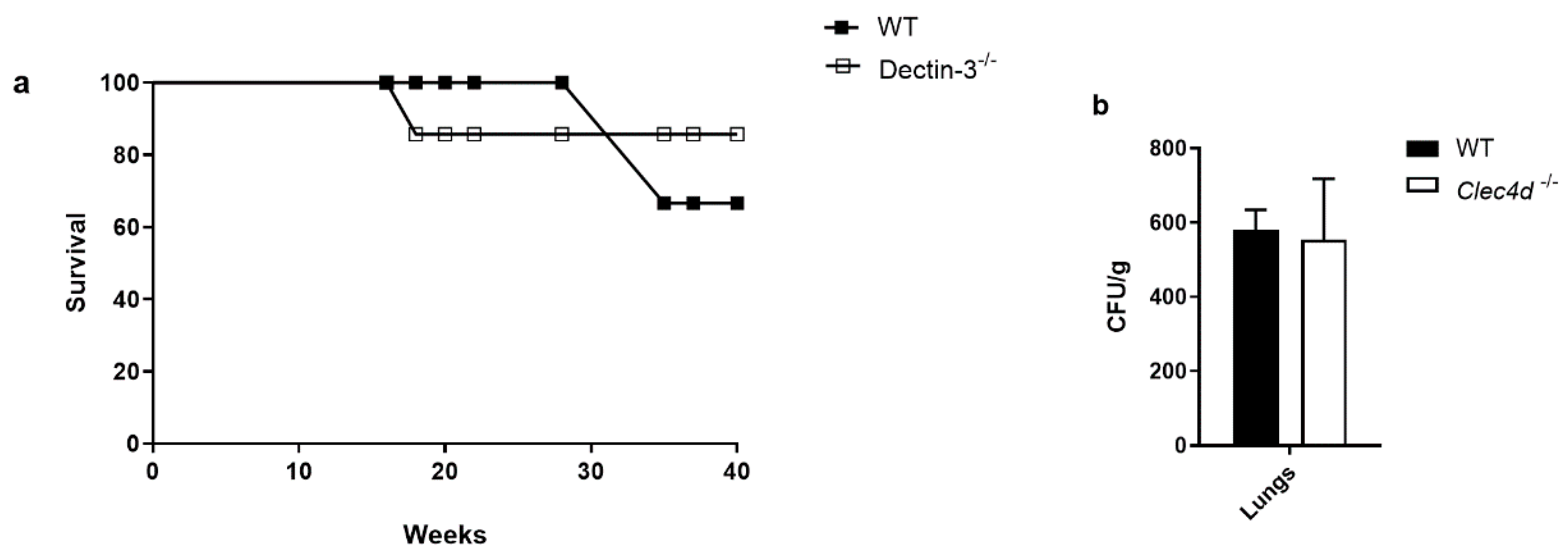
To explore the impact of Dectin-3 during experimental systemic PCM, we intravenously infected Clec4--/- and WT mice with yeast cells of P. brasiliensis and monitored survival for a 40-week period. Our data indicate that Dectin-3 is not associated with long-term survival during P. brasiliensis infection as mice lacking Dectin-3 exhibited survival rates similar to their WT counterparts (Figure 2a). Accordingly, the evaluation of CFU counts in the lungs revealed no significant differences at 60 days after infection (Figure 2b).

4. Discussion

Our findings regarding the dispensability of Dectin-3 in the context of P. brasiliensis contrast with its established role in host defense against other major invasive fungal pathogens. These findings reveal important pathogen-specific differences in CLR requirements and highlight the complexity of antifungal immune recognition. In models of systemic candidiasis, Dectin-3-deficient mice are highly susceptible to infection, showing impaired production of critical cytokines and chemokines [8]. Dectin-3 recognizes α-mannans on the surface of C. albicans hyphae, forming heterodimeric complexes with Dectin-2 to enhance the response of the innate immune system [8]. Similarly, in C. tropicalis infection, Dectin-3 deficiency promotes colitis development due to the impaired phagocytic and fungicidal abilities of macrophages [9]. However, Dectin-3 is dispensable for innate resistance during primary pulmonary infection with B. dermatitidis, as well as for the induction of protective Th17 differentiation in mice infected with F. pedrosoi, with Dectin-2 serving as the key CLR driving adaptive immunity [12,13]. Our findings extend this pathogen-specific pattern to P. brasiliensis, demonstrating that Dectin-3 deficiency does not impair cytokine production, phagocytosis, fungicidal activity, or long-term survival in mice. Observations in Cryptococcus further highlight the selective nature of Dectin-3-mediated protection. Dectin-3 is a direct receptor for GXM from C. gatii serotype B and C. neoformans serotype AD, and its absence leads to high susceptibility to these fungi [10]. However, consistent with our results, Dectin-3 does not alter survival or functional activity of macrophages from mice infected the predominant clinical C. neoformans serotype, serotype A [11].
The apparent dispensability of Dectin-3 in murine P. brasiliensis infection likely reflects functional redundancy among CLRs, a well-established feature of antifungal immunity [19]. This is particularly evident when comparing our results to the critical role of Dectin-2 in P. brasiliensis. Dectin-2-deficient mice are highly susceptible to P. brasiliensis, exhibiting shortened survival, high fungal burdens, and impaired cytokine secretion [3]. While Dectin-3 can act as a synergistic partner for Dectin-2, such as in the recognition of α-1,2-Mannans in the C. albicans cell wall [8], our data suggest that, for P. brasiliensis, Dectin-2 serves as the dominant mannose-sensing receptor, effectively signaling as a homodimer or functionally collaborating with other receptors such as Dectin-1. Indeed, using anti-Dectin-1 and anti-Dectin-2 blocking antibodies, the respective knockout mice, and a Syk chemical inhibitor, we previously demonstrated that Dectin-1 and Dectin-2 collaborate via the canonical Syk-dependent pathway to induce optimal functional responses in phagocytes during P. brasiliensis sensing, potentially rendering Dectin-3 unnecessary [3].
An interesting aspect of our findings is the contrast between murine and human studies. Previous research has shown that human pDCs utilize both Dectin-2 and Dectin-3 for P. brasiliensis recognition, with antibody blockade of either receptor diminishing antifungal responses [7]. This apparent discrepancy could be due to the lack of expression of the genes encoding Dectin-1 and Mincle in pDCs, but not in conventional myeloid dendritic cells (mDCs), phenotypically and functionally more similar to murine BMDCs. Therefore, human pDCs may depend primarily on Dectin-2 or Dectin-3 signaling pathways to exert their antifungal effects [7,14]. In addition, a critical point to consider is that total amino acid sequence identity between human and mouse Dectin-3 is approximately 63% [20], potentially leading to different ligand recognition motifs and carbohydrate specificity. Thus, these differences may contribute to the divergent roles of Dectin-3 observed in murine versus human systems and highlight the need for caution when extrapolating results across species.
A limitation of our study is the use of a single Paracoccidioides species. Although P. brasiliensis is the most prevalent and clinically relevant member of the genus, our findings may not necessarily extend to other species such as P. lutzii, particularly given that studies in the Cryptococcus genus have shown substantial variability in Dectin-3 dependency. In addition, our experimental model focused on the yeast phase of the fungus. Whether Dectin-3 contributes to the recognition of the infectious mycelial form or conidia remains unresolved and warrants future investigation.
In conclusion, our findings demonstrate that Dectin-3 is dispensable for the measured innate phagocyte responses and host resistance during experimental systemic P. brasiliensis infection, suggesting a functional redundancy among CLRs, where receptors such as Dectin-1 and Dectin-2 may sufficiently compensate for the lack of Dectin-3-mediated signaling.

Author Contributions

Conceptualization, M.d.R.D.C.-M., A.L.B. and A.H.T.; methodology, M.d.R.D.C.-M., A.L.B., P.H.B., R.J.A.d.C., C.L.M., S.A.d.O. and A.H.T.; software, A.H.T.; validation, M.d.R.D.C.-M., A.L.B. and A.H.T.; formal analysis, M.d.R.D.C.-M., A.L.B., P.H.B., R.J.A.d.C., C.L.M., S.A.d.O. and A.H.T.; investigation, M.d.R.D.C.-M., A.L.B., P.H.B., R.J.A.d.C., C.L.M., S.A.d.O. and A.H.T.; resources, P.A., I.S.-P., A.L.B. and A.H.T.; data curation, M.d.R.D.C.-M., A.L.B. and A.H.T.; writing—original draft preparation, M.d.R.D.C.-M. and A.H.T.; writing—review and editing, A.H.T.; visualization, M.d.R.D.C.-M., A.L.B. and A.H.T.; supervision, A.L.B. and A.H.T.; project administration, A.L.B. and A.H.T.; funding acquisition, A.L.B. and A.H.T. All authors have read and agreed to the published version of the manuscript.

Funding

This research was funded by Conselho Nacional de Pesquisa (CNPq) and Fundação de Apoio Pesquisa do Distrito Federal (FAPDF).

Institutional Review Board Statement

The animal study protocol was approved by the Ethics Committee on Animal Use of the University of Brasília, Brazil under protocol no. UnBDoc 559242016. It received approval on 16 August 2016.

Informed Consent Statement

Not applicable.

Data Availability Statement

The original contributions presented in this study are included in the article. Further inquiries can be directed to the corresponding author.

Conflicts of Interest

The authors declare no conflicts of interest. The funders had no role in the design of the study; in the collection, analyses, or interpretation of data; in the writing of the manuscript; or in the decision to publish the results.

Abbreviations

CLRsC-type lectin receptors
PCMParacoccidioidomycosis
BMDMsBone marrow-derived macrophages
BMDCsBone marrow-derived dendritic cells
CFUColony-forming units

References

  1. Rodrigues, A.M.; Hagen, F.; Puccia, R.; Hahn, R.C.; de Camargo, Z.P. Paracoccidioides and Paracoccidioidomycosis in the 21st Century. Mycopathologia 2023, 188, 129–133. [Google Scholar] [CrossRef]
  2. Hahn, R.C.; Hagen, F.; Mendes, R.P.; Burger, E.; Nery, A.F.; Siqueira, N.P.; Guevara, A.; Rodrigues, A.M.; de Camargo, Z.P. Paracoccidioidomycosis: Current Status and Future Trends. Clin. Microbiol. Rev. 2022, 35, e0023321. [Google Scholar] [CrossRef] [PubMed]
  3. Cardoso-Miguel, M.R.D.; Bürgel, P.H.; de Castro, R.J.A.; Marina, C.L.; de Oliveira, S.A.; Albuquerque, P.; Silva-Pereira, I.; Bocca, A.L.; Tavares, A.H. Dectin-2 is critical for phagocyte function and resistance to Paracoccidioides brasiliensis in mice. Med. Mycol. 2023, 61, myad117. [Google Scholar] [CrossRef]
  4. Goyal, S.; Castrillón-Betancur, J.C.; Klaile, E.; Slevogt, H. The interaction of human pathogenic fungi with C-type lectin receptors. Front. Immunol. 2018, 9, 1261. [Google Scholar] [CrossRef]
  5. Malamud, M.; Brown, G.D. The Dectin-1 and Dectin-2 clusters: C-type lectin receptors with fundamental roles in immunity. EMBO Rep. 2024, 25, 5239–5264. [Google Scholar] [CrossRef] [PubMed]
  6. Loures, F.V.; Araújo, E.F.; Feriotti, C.; Bazan, S.B.; Costa, T.A.; Brown, G.D.; Calich, V.L.G. Dectin-1 induces M1 macrophages and prominent expansion of CD8 + IL-17 + cells in pulmonary paracoccidioidomycosis. J. Infect. Dis. 2014, 210, 762–773. [Google Scholar] [CrossRef] [PubMed]
  7. Graham, L.M.; Gupta, V.; Schafer, G.; Reid, D.M.; Kimberg, M.; Dennehy, K.M.; Hornsell, W.G.; Guler, R.; Campanero-Rhodes, M.A.; Palma, A.S.; et al. The C-type lectin receptor CLECSF8 (CLEC4D) is expressed by myeloid cells and triggers cellular activation through Syk kinase. J. Biol. Chem. 2012, 28, 25964–25974. [Google Scholar] [CrossRef] [PubMed]
  8. Zhu, L.L.; Zhao, X.Q.; Jiang, C.; You, Y.; Chen, X.P.; Jiang, Y.Y.; Jia, X.-M.; Lin, X. C-type lectin receptors Dectin-3 and Dectin-2 form a heterodimeric pattern-recognition receptor for host defense against fungal infection. Immunity 2013, 39, 324–334. [Google Scholar] [CrossRef] [PubMed]
  9. Wang, T.; Pan, D.; Zhou, Z.; You, Y.; Jiang, C.; Zhao, X.; Lin, X. Dectin-3 Deficiency Promotes Colitis Development due to Impaired Antifungal Innate Immune Responses in the Gut. PLoS Pathog. 2016, 12, e1005662. [Google Scholar] [CrossRef] [PubMed]
  10. Huang, H.R.; Li, F.; Han, H.; Xu, X.; Li, N.; Wang, S.; Xu, J.-F.; Jia, X.-M. Dectin-3 Recognizes Glucuronoxylomannan of Cryptococcus neoformans Serotype AD and Cryptococcus gattii Serotype B to Initiate Host Defense Against Cryptococcosis. Front. Immunol. 2018, 9, 781. [Google Scholar] [CrossRef] [PubMed]
  11. Campuzano, A.; Castro-Lopez, N.; Wozniak, K.L.; Wager, C.M.; Wormley, F.L., Jr. Dectin-3 Is Not Required for Protection against Cryptococcus neoformans Infection. PLoS ONE 2017, 12, e0169347. [Google Scholar] [CrossRef] [PubMed]
  12. Wang, H.; Li, M.; Lerksuthirat, T.; Klein, B.; Wuthrich, M. The C-Type Lectin Receptor MCL Mediates Vaccine-Induced Immunity against Infection with Blastomyces dermatitidis. Infect. Immun. 2016, 84, 635–642. [Google Scholar] [CrossRef] [PubMed]
  13. Wüthrich, M.; Wang, H.; Li, M.; Lerksuthirat, T.; Hardison, S.E.; Brown, G.D.; Klein, B. Fonsecaea pedrosoi-induced Th17-cell differentiation in mice is fostered by Dectin-2 and suppressed by Mincle recognition. Eur. J. Immunol. 2015, 45, 2542–2552. [Google Scholar] [CrossRef] [PubMed]
  14. Preite, N.W.; Feriotti, C.; Souza de Lima, D.; da Silva, B.B.; Condino-Neto, A.; Pontillo, A.; Calich, V.L.G.; Loures, F.V. The Syk-Coupled C-Type Lectin Receptors Dectin-2 and Dectin-3 Are Involved in Paracoccidioides brasiliensis Recognition by Human Plasmacytoid Dendritic Cells. Front. Immunol. 2018, 9, 464. [Google Scholar] [CrossRef] [PubMed]
  15. Ahrazem, O.; Prieto, A.; San-Blas, G.; Leal, J.A.; Jiménez-Barbero, J.; Bernabé, M. Structural differences between the alkali-extracted water-soluble cell wall polysaccharides from mycelial and yeast phases of the pathogenic dimorphic fungus Paracoccidioides brasiliensis. Glycobiology 2003, 13, 743–747. [Google Scholar] [CrossRef] [PubMed]
  16. Tavares, A.H.; Magalhães, K.G.; Almeida, R.D.; Correa, R.; Burgel, P.H.; Bocca, A.L. NLRP3 inflammasome activation by Paracoccidioides brasiliensis. PLoS Negl. Trop. Dis. 2013, 7, e2595. [Google Scholar] [CrossRef] [PubMed]
  17. Gonzalez, A.; de Gregori, W.; Velez, D.; Restrepo, A.; Cano, L.E. Nitric oxide participation in the fungicidal mechanism of gamma interferon-activated murine macrophages against Paracoccidioides brasiliensis conidia. Infect. Immun. 2000, 68, 2546–2552. [Google Scholar] [CrossRef] [PubMed]
  18. Nascimento, F.R.; Calich, V.L.; Rodríguez, D.; Russo, M. Dual role for nitric oxide in paracoccidioidomycosis: Essential for resistance, but overproduction associated with susceptibility. J. Immunol. 2002, 168, 4593–4600. [Google Scholar] [CrossRef] [PubMed]
  19. Ostrop, J.; Lang, R. Contact, Collaboration, and Conflict: Signal Integration of Syk-Coupled C-Type Lectin Receptors. J. Immunol. 2017, 198, 1403–1414. [Google Scholar] [CrossRef] [PubMed]
  20. Arce, I.; Martínez-Muñoz, L.; Roda-Navarro, P.; Fernández-Ruiz, E. The human C-type lectin CLECSF8 is a novel monocyte/macrophage endocytic receptor. Eur. J. Immunol. 2004, 34, 210–220. [Google Scholar] [CrossRef] [PubMed]
Figure 1. Dectin-3 is dispensable for the functional responses of phagocytes against Paracoccidioides brasiliensis. Bone marrow-derived macrophages (BMDMs) and dendritic cells (BMDCs) from wild-type (WT) and Dectin-3 deficient (Clec4d-/-) mice were infected with P. brasiliensis yeasts (MOI 0.5). Cytokine and chemokine levels in culture supernatants from BMDMs (a) and BMDCs (b) were quantified by ELISA at 6 and 24 h post-infection. Phagocytic capacity was evaluated in BMDMs after 24 h of infection as the percentage of phagocytosis (c) and the phagocytic index (d). To assess fungicidal activity and nitric oxide production, viable yeast counts (CFU/mL) in BMDM lysates (e) and nitrite (NO2) levels (f) in supernatants were measured 24 h post-infection. Maturation of BMDCs was determined by flow cytometry, measuring the expression of costimulatory molecules CD80 and CD86, presented as the percentage of positive cells (g) and mean fluorescence intensity (MFI) (h). Data are presented as the mean ± SD of three independent experiments conducted in triplicate. LPS: lipopolysaccharide (100 ng/mL); IFN: interferon-γ (20 ng/mL).
Microbiolres 17 00128 g001
Figure 2. Dectin-3 is not required for host protection against experimental infection with P. brasiliensis. (a) C57BL/6 Wild-type (WT) and deficient Dectin-3 mice (Clec4d-/-) were intravenously infected with 1 × 10⁶ yeasts of P. brasiliensis and daily observed for 40 weeks to estimate their survival as assessed by the log-rank (Mantel–Cox) test. (b) Pulmonary fungal burden was evaluated 60 days post-infection in WT and Clec4d-/- mice. Results are expressed as Colony Forming Units (CFU) per gram of lung tissue, representing the number of viable yeast cells recovered from organ homogenates. Data are presented as the mean ± SD of three independent experiments conducted in triplicate.
Microbiolres 17 00128 g002
Disclaimer/Publisher’s Note: The statements, opinions and data contained in all publications are solely those of the individual author(s) and contributor(s) and not of MDPI and/or the editor(s). MDPI and/or the editor(s) disclaim responsibility for any injury to people or property resulting from any ideas, methods, instructions or products referred to in the content.