Article

Metabolic Stimulants as Functional Enhancers of Sustainable Microbial Omega-3 Fatty Acid Production


Eastern Regional Research Center, Agricultural Research Service, U.S. Department of Agriculture, 600 E. Mermaid Lane, Wyndmoor, PA 19038, USA
*
Author to whom correspondence should be addressed.
Microbiol. Res. 2026, 17(7), 126; https://doi.org/10.3390/microbiolres17070126
Submission received: 18 April 2026 / Revised: 21 June 2026 / Accepted: 27 June 2026 / Published: 3 July 2026

Abstract

This study evaluates the effects of seven biochemical stimulants, ferulic acid, malic acid, L-carnitine, ergothioneine, magnesium sulfate, trehalose, and betaine, on biomass accumulation, total lipid content, and docosahexaenoic acid (DHA) production in Aurantiochytrium sp. ATCC PRA-276 under controlled fermentation conditions. The compounds were selected based on their reported roles in antioxidant defense, carbon flux regulation, osmoprotection, or methyl group donation, with the aim of assessing whether targeted, non-GMO supplementation could modestly enhance microbial productivity. Compared with the control, supplementation with L-carnitine and ferulic acid resulted in the greatest enhancement of DHA production, increasing DHA concentration by 31.7% and 29.2%, respectively. These treatments were also associated with statistically significant, albeit moderate, increases in total lipid accumulation and biomass production. These responses indicate correlated improvements in overall cellular productivity rather than isolated effects on lipid biosynthesis. DHA concentrations were quantified following lipid extraction and transesterification using GC-based analysis; however, comprehensive fatty acid compositional profiling (e.g., saturated, monounsaturated, and polyunsaturated fatty acid distributions or DHA-to-total lipid ratios) was not performed. Although direct mechanistic assays were not performed, the observed trends are consistent with known biochemical functions related to redox balance, cofactor availability, and stress adaptation. A preliminary cost-efficiency analysis identified malic acid as the most economical stimulant for DHA enhancement, whereas ergothioneine was the least cost-effective despite measurable biological effects. Collectively, these findings demonstrate that biochemical stimulation can provide incremental yet reproducible gains in DHA production and lipid accumulation. This work supports the use of targeted biochemical supplementation as a scalable, non-GMO strategy for microbial omega-3 production and establishes a foundation for future optimization through combinatorial supplementation, multi-omics validation, and process engineering.

1. Introduction

Docosahexaenoic acid (DHA) is a long-chain omega-3 polyunsaturated fatty acid (PUFA) that plays a critical role in human health, particularly in neural development, visual function, cardiovascular health, and modulation of inflammatory responses [1]. DHA consists of 22 carbon atoms and six cis double bonds (22:6 n-3), a highly unsaturated structure that confers exceptional flexibility and contributes to membrane fluidity, cellular signaling, and lipid–protein interactions [2,3,4]. Due to its abundance in neuronal and retinal tissues, DHA is considered an essential nutrient for maintaining normal physiological functions throughout life. These membrane-modifying properties are central to DHA’s biological function and contribute to its widespread physiological importance. Traditionally, DHA has been obtained from fish oils; however, concerns regarding declining marine resources, environmental sustainability, contamination risks, and increasing global demand have stimulated interest in alternative and eco-friendly production systems [2].
Among these alternatives, microbial production of DHA, especially through thraustochytrids, has emerged as a promising solution. Marine protists such as Aurantiochytrium can accumulate lipids up to 50% of their dry weight, with DHA comprising a significant fraction of their total fatty acid profile [5,6]. These microorganisms offer several advantages, including fast growth rates, substrate flexibility, and scalability under heterotrophic conditions, making them ideal candidates for industrial omega-3 production. DHA biosynthesis in thraustochytrids occurs through two major pathways: (1) the elongase/desaturase (FAS) route, and (2) the polyketide synthase (PKS)-like multi-enzyme system. Recent evidence indicates that Aurantiochytrium relies predominantly on the PKS pathway, which includes ketoacyl synthase (KS), acyl transferase (AT), ketoacyl reductase (KR), dehydratase (DH), and enoyl reductase (ER) modules that cooperatively generate the highly unsaturated 22:6 structure [7]. The activity of these pathways depends on cellular redox balance, acetyl-CoA availability, and NADPH supply [4,8].
Recent reviews highlight the integration of circular bioeconomy principles into microbial DHA production, emphasizing the use of waste-derived feedstocks, fermentation engineering, and antioxidant stabilization to improve both yield and oil quality. These innovations not only reduce production costs but also enhance the oxidative stability and nutritional value of microbial DHA oils, making them suitable for functional foods, nutraceuticals, and pharmaceutical applications [9].
Efforts to enhance microbial DHA production have included media optimization, metabolic engineering, and process intensification [10,11]. However, the complexity of DHA biosynthesis spanning aerobic and anaerobic pathways and involving polyketide synthase (PKS)-like enzymes poses challenges for scalability. In response, non-GMO strategies using biochemical stimulants have gained traction. These compounds modulate cellular metabolism by influencing redox balance, energy flux, osmoregulation, and precursor availability, thereby enhancing lipid biosynthesis without genetic modification [12,13]. These stimulants can influence redox balance, energy flux, osmoregulation, and precursor availability, thereby enhancing DHA biosynthesis and lipid production [14,15].
Several stimulants have shown promise in boosting lipid production in oleaginous microorganisms [16,17,18,19,20,21,22,23,24,25,26,27,28]. To provide clearer biochemical context, the compounds examined in this study can be grouped according to their putative metabolic roles. Ferulic acid and ergothioneine function primarily as antioxidants that reduce oxidative stress and may protect PUFA-rich membranes from peroxidation, thereby supporting DHA stability during fermentation [22,23,24]. Malic acid contributes to central carbon metabolism, as its decarboxylation by malic enzyme generates pyruvate and NADPH both essential for fatty acid biosynthesis [25,26,27]. Magnesium ions supplied through magnesium sulfate serve as cofactors for malic enzyme and other ATP-dependent metabolic reactions, influencing acetyl-CoA and NADPH generation [20]. L-carnitine facilitates the transport of long-chain fatty acids into mitochondria for β-oxidation, potentially increasing precursor availability for PUFA synthesis [21]. Trehalose and betaine act as osmoprotectants that help stabilize proteins and membranes under osmotic stress, which in turn may modulate lipid accumulation and DHA biosynthesis [26,27,28]. These osmolytes may act either by altering external osmolarity or through intracellular uptake and retention. Osmotic stress responses in marine and halotolerant microorganisms can also trigger glycerol accumulation as a counter-osmolyte, which interacts with central carbon and lipid metabolic pathways [18], and stress-induced changes in membrane fluidity and thickness have been shown to influence PUFA incorporation and DHA biosynthesis [19].
Emerging research has also demonstrated the effectiveness of adaptive laboratory evolution (ALE) in enhancing DHA production. By acclimating Aurantiochytrium strains to low pH and optimizing oxygen and temperature conditions, ALE has led to significant increases in biomass and DHA yield. Transcriptomic analyses reveal upregulation of key enzymes in glycolysis, the PKS pathway, and the pentose phosphate pathway, indicating a rewiring of central carbon metabolism to favor polyunsaturated fatty acid synthesis [29].
Furthermore, recent studies underscore the importance of optimizing physical parameters such as carbon source, nitrogen availability, salinity, and pH to maximize DHA production in microbial systems. These factors influence enzyme activity, membrane fluidity, and metabolic fluxes, and their fine-tuning is essential for achieving high-yield fermentation processes [18,30].
This study investigates the impact of seven biochemical stimulants, ferulic acid, malic acid, L-carnitine, ergothioneine, magnesium sulfate, trehalose, and betaine, on biomass growth, lipid content, and DHA production in Aurantiochytrium sp. ATCC PRA-276. By identifying the most effective stimulants and understanding their metabolic roles, this research provides critical insights into non-GMO strategies for maximizing microbial DHA production. The outcomes have broad implications for sustainable omega-3 biotechnology, supporting the development of high-quality supplements, infant nutrition products, and therapeutic formulations targeting cardiovascular, neurodegenerative, and inflammatory diseases. While several of these biochemical stimulants have been individually investigated in previous studies, a systematic side-by-side comparison under standardized fermentation conditions remains limited. The present study addresses this gap by providing a controlled comparative evaluation of multiple stimulants, enabling direct assessment of their relative physiological performance and economic feasibility.

2. Materials and Methods

2.1. Microorganism and Cultivation Conditions

The microorganism utilized in this study was Aurantiochytrium sp. ATCC PRA-276, obtained from the American Type Culture Collection (ATCC, Baltimore, MD, USA). The procedures for culture maintenance, seed preparation, and fermentation were adapted from previously established protocols [31]. The strain was maintained on seawater nutrient agar (SNA), composed of 28 g/L nutrient agar and 17.5 g/L artificial seawater. Seed cultures were initiated by transferring a strip of 48-h-old SNA containing ten colonies (approximately) into a 500 mL Erlenmeyer flask containing 100 mL of seed medium. The seed medium consisted of 60 g/L glucose, 6 g/L artificial sea salt, 2 g/L yeast extract, and 8 g/L monosodium glutamate (MSG). Cultures were incubated at 30 °C for 48 h with continuous agitation at 250 rpm. For fermentation, 10 mL of seed culture was inoculated into 100 mL of production medium, which had the same composition as the seed medium except for an increased glucose concentration of 70 g/L. The fermentation/production medium was supplemented with various biochemical stimulants as described below. The fermentations were carried out for 144 h at 30 °C. To ensure that all cultivations were harvested at comparable physiological stages, the growth kinetics of Aurantiochytrium sp. ATCC PRA-276 were monitored in preliminary time-course experiments. Optical density at 600 nm (OD600), glucose consumption, and pH were monitored every 24 h. At each sampling point, 1 mL of culture was aseptically withdrawn from each flask using sterile techniques for analytical measurements. The sampled volume represented less than 1% of the total culture volume and did not significantly affect fermentation performance. Across all conditions, cultures consistently reached the stationary phase between 120 and 132 h, characterized by a plateau in biomass accumulation and greater than 95% glucose consumption. Lipid and DHA accumulation also stabilized during this period. Based on these observations, the 144-h endpoint was selected to ensure that all cultures, control and stimulant-treated, were compared in the same physiological growth phase. All materials and reagents were sterilized before fermentation by autoclaving at 121 °C for 20 min and were sourced from Sigma-Aldrich (Millipore Sigma, St. Louis, MO, USA) unless otherwise stated.

2.2. Biochemical Stimulants and Reagents

Different biochemical stimulants were selected based on preliminary findings and their proposed roles in enhancing lipid accumulation, mitigating oxidative stress, and supporting osmotic regulation in microbial systems. All reagents were of analytical grade and procured from certified suppliers to ensure experimental consistency and reproducibility. Ferulic acid (≥99%), trehalose dihydrate (≥99%), malic acid (≥99%), L-carnitine (≥98%), ergothioneine (≥98%), magnesium sulfate heptahydrate (MgSO4·7H2O, ACS grade), and betaine anhydrous (≥98%) were purchased from Sigma-Aldrich (Millipore Sigma, St. Louis, MO, USA). Stock solutions were prepared in sterile deionized water, depending on the solubility of each compound, and filtered using 0.22 μm membrane filters. Prior to the main fermentation experiment, a series of preliminary dose–response trials were conducted to identify appropriate concentrations for each biochemical stimulant. For every compound, at least three concentrations were evaluated typically spanning low (25–50 mg/L), medium (50–100 mg/L), and high (100–200 mg/L) ranges, or based on reported effective doses in lipid-producing microorganisms. These concentrations were tested in 100 mL cultures under identical fermentation conditions. Biomass, total lipid content, DHA yield, medium clarity, and culture health were assessed after 144 h. Concentrations that caused growth inhibition, oxidative stress sensitivity, or medium instability were excluded. The final concentrations used in this study (e.g., 50 mg/L ferulic acid, 75 mg/L malic acid, 100 mg/L L-carnitine, etc.) corresponded to the lowest doses that reproducibly increased lipid and/or DHA accumulation while maintaining robust biomass formation. These screening results ensured that each stimulant was tested under physiologically relevant and non-inhibitory conditions. Based on our preliminary optimization experiments, the following final concentrations were used in the fermentation medium: 50 mg/L ferulic acid, 75 mg/L malic acid, 100 mg/L L-carnitine, 75 mg/L ergothioneine, 0.5 g/L magnesium sulfate, 75 mg/L trehalose, and 100 mg/L betaine. All reagents were stored according to manufacturer’s recommendations to preserve chemical stability throughout the study.

2.3. Cell Biomass Quantification

Cell biomass was harvested by centrifugation at 4000× g for 15 min. The collected cells were washed twice with 30 mL of sterile water and subsequently freeze-dried for 18 h. Dry cell weight (DCW) was determined gravimetrically following the method described in our previous investigations [32,33].

2.4. Lipid Extraction and Fatty Acid Profiling

Lipid extraction was conducted utilizing the Folch method [34]. Approximately 30 mg of freeze-dried biomass was mixed with a chloroform–methanol solution in a 2:1 volume ratio. Methylation was carried out for 4 h with 10% methanolic HCl at a temperature of 60 °C [29,30,33,34]. Fatty acid methyl esters (FAMEs) were extracted using n-hexane and subsequently analyzed through gas chromatography–mass spectrometry. The Gas Chromatograph (GC–MS 8890N, Agilent, Wilmington, DE, USA) used for this analysis was equipped with an Agilent model 5977N mass selective (MS) detector. A Supelco SP-2380 column, measuring 30 m in length, 0.25 mm in diameter, and featuring a film thickness of 0.2 μm, was employed. The temperature program for the GC was as follows: initially held at 50 °C for 3 min, then ramped to 200 °C at a rate of 6 °C/min, followed by an increase to 250 °C at 4 °C/min, and finally held for an additional 5 min [35,36,37,38]. Fatty acid identification and quantification were performed according to the analytical procedures described in prior studies [35,36,37,38], which provide complete methodological details regarding chromatographic conditions, FAME identification, and quantification protocols.

2.5. Statistical Analysis

All experiments were conducted in triplicate. Data are presented as mean ± standard deviation (SD) and were analyzed using one-way analysis of variance (ANOVA) followed by Tukey’s post hoc test to evaluate differences among treatments. Statistical groupings are indicated by superscript letters in Table 1 and asterisks in Figure 1. The suitability of ANOVA assumptions was assessed by inspection of residual plots and Q–Q plots. Statistical analyses were performed using GraphPad Prism 7.0 (GraphPad Software LLC, San Diego, CA, USA), with significance accepted at p < 0.05. To further assess data consistency, the coefficient of variation (CV%) was calculated for all measured parameters across biological replicates. Variability remained within acceptable ranges for most treatments, confirming the reproducibility of observed trends.

3. Results and Discussion

Initial screening trials were carried out to assess how compounds like Ferulic acid, trehalose dihydrate, malic acid, L-carnitine, ergothioneine, magnesium sulfate heptahydrate, and betaine anhydrous influence the growth, lipid accumulation, and DHA synthesis in Aurantiochytrium sp. ATCC PRA-276. These stimulants and their respective concentrations were chosen based on our preliminary experiments.
A comprehensive overview of biomass, total lipid, and DHA yields for each treatment is provided in the following table (g/L at 144 h), offering quantitative insight into the stimulants’ differential effects on cellular output (Table 1).

3.1. Biomass Enhancement

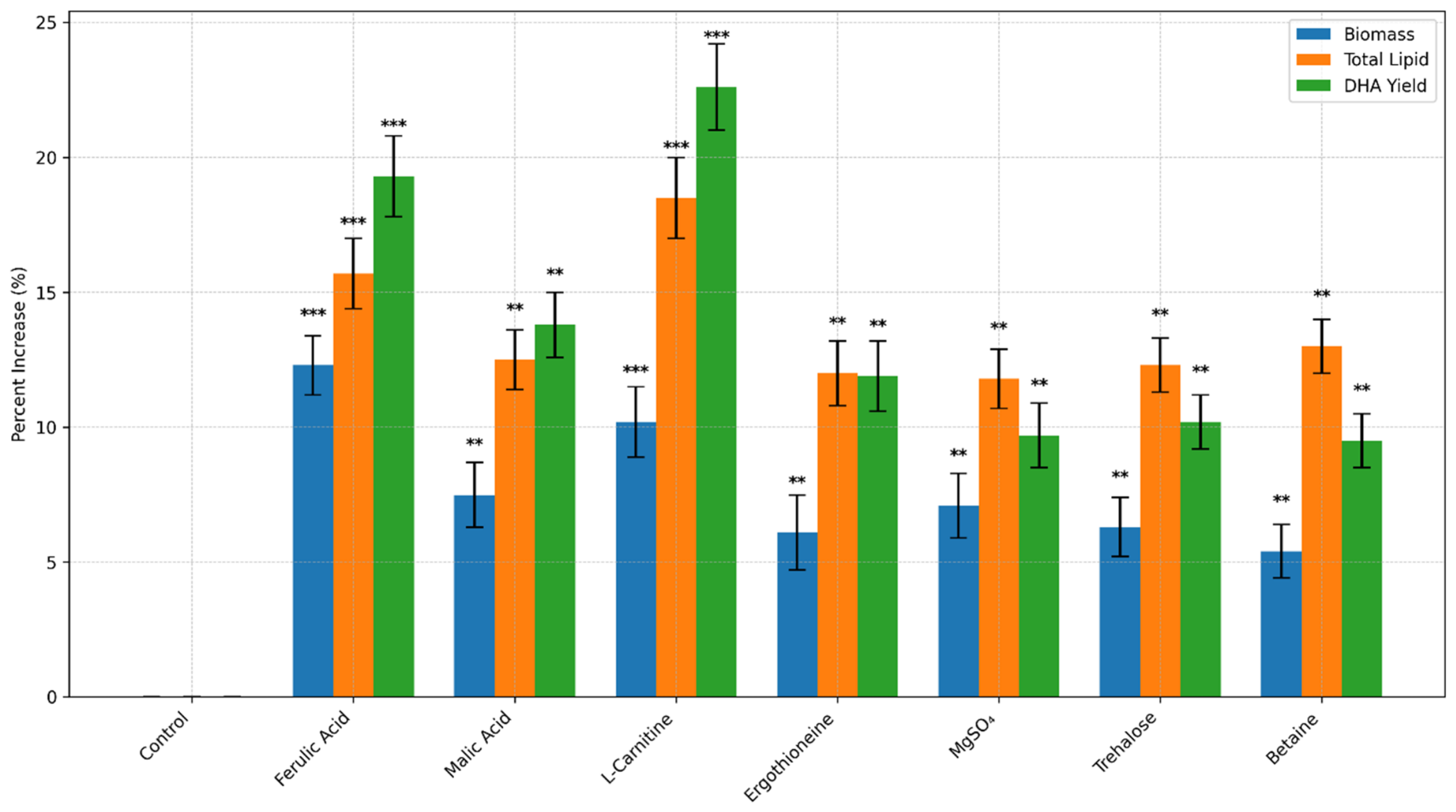
Biomass accumulation in Aurantiochytrium sp. ATCC PRA-276 showed reproducible gains but was consistently enhanced by supplementation with the tested biochemical stimulants (Figure 1; Table 1). When normalized to dry cell weight, total lipid content ranged from 57.2% in the control to 62.7% in L-carnitine-treated cultures, confirming that observed increases were not solely due to biomass enhancement but also reflected true intracellular lipid accumulation. All treatments resulted in statistically significant increases relative to control; however, the magnitude of these effects remained relatively low, with mean biomass improvements generally below 13%. These results indicate that biochemical stimulation exerts a measurable but limited influence on cellular growth under the tested batch fermentation conditions, and that the observed improvements should be interpreted as incremental rather than transformative.
Among the evaluated compounds, ferulic acid and L-carnitine produced the highest mean increases in biomass, approximately 12.3% and 10.2%, respectively. Although these differences were statistically significant, the associated standard deviations reveal biological variability among replicates and overlapping biomass ranges were observed between treatments. Accordingly, these outcomes are best described as statistically supported trends rather than precise or uniform biological gains across replicates. Importantly, the present study did not include direct measurements of oxidative stress, metabolic flux, or gene expression; consequently, mechanistic interpretations are inferred from established literature rather than experimentally validated here. Although both biomass (dry cell weight) and total lipid accumulation were quantified, biomass alone cannot be directly attributed to lipid biosynthesis because cellular mass also includes proteins, carbohydrates, and other macromolecules. However, normalization of lipid content to dry cell weight (% DCW) and the observed correlation between lipid and DHA production provide stronger evidence that the stimulants enhanced intracellular lipid accumulation rather than biomass alone.
The comparatively higher biomass observed with ferulic acid supplementation is consistent with previous reports describing the role of phenolic antioxidants in alleviating oxidative stress and stabilizing cellular membranes in microbial systems [39,40,41,42]. In addition to any effects on lipid metabolism, alleviation of oxidative stress itself can directly enhance cellular growth and biomass yield by preserving metabolic efficiency and cellular integrity during fermentation. Ferulic acid has also been shown to regulate genes associated with lipid homeostasis and stress resistance [43], which may contribute to improved cellular robustness during fermentation. In the context of the present study, the elevated biomass associated with ferulic acid suggests improved cellular resilience during cultivation, although direct evidence of redox modulation was not assessed and remains to be confirmed in future work.
Moderate biomass increases were also observed with malic acid, ergothioneine, trehalose, magnesium sulfate, and betaine, with no clear separation among these treatments based on statistical grouping. These compounds are known to influence central metabolism, redox balance, osmotic regulation, or enzymatic activity [44,45,46,47,48], suggesting that multiple pathways may contribute incrementally to growth enhancement. Magnesium sulfate supplementation, for example, resulted in a biomass increase of approximately 7.1%, consistent with the essential role of magnesium ions as cofactors in ATP-dependent enzymatic reactions and metabolic stabilization under stress [9,47]. Similarly, the modest effect of betaine (~5.4%) aligns with its function as a methyl donor and osmoprotectant, which supports cellular stability without substantially altering growth dynamics [48,49]. The lack of pronounced differentiation among these treatments suggests that their effects on biomass are likely supportive rather than strongly growth-limiting or growth-driving.
Overall, biomass data demonstrate that biochemical stimulation can reproducibly yield small but positive effects on Aurantiochytrium growth. The principal contribution of this section lies in the controlled, side-by-side experimental comparison of multiple stimulants under identical conditions, providing an internally consistent dataset for evaluating relative performance. These findings establish a quantitative baseline indicating that biochemical supplementation alone is unlikely to drive large biomass increases but may serve as a complementary strategy when integrated with combinatorial supplementation, process optimization, or strain improvement approaches [38,50,51,52,53,54,55]. Although variability was observed in certain treatments (e.g., DHA values under malic acid supplementation), overall trends remained consistent across biological replicates. This variability likely reflects inherent biological heterogeneity in microbial fermentation systems rather than experimental inconsistency. The observed trends are consistent with established biochemical roles of these compounds; however, this study intentionally focuses on phenotypic screening outcomes relevant to industrial application rather than mechanistic validation.

3.2. Lipid and DHA Accumulation

Biochemical supplementation modestly but significantly enhanced total lipid and DHA accumulation in Aurantiochytrium sp. ATCC PRA-276, as shown in Figure 1 and summarized in Table 1. Among the compounds tested, L-carnitine and ferulic acid yielded the highest average increases in DHA and lipid production, consistent with previous studies, but the observed variability among biological replicates indicates that these effects should be interpreted cautiously. Although biological variability was observed among treatments, the statistical analysis supports the overall trends presented in Table 1. Nevertheless, treatments exhibiting similar mean responses should be interpreted cautiously, and the results are best viewed as evidence of general trends in productivity enhancement rather than strict quantitative rankings of stimulant effectiveness. These findings indicate that biochemical supplementation can reproducibly improve lipid and DHA production, while highlighting the importance of considering biological variability when comparing treatments with relatively similar performance.
Malic acid also contributed positively to lipid synthesis, with an ~11.9% increase in total lipids and ~12.8% in DHA yield. One possible explanation is that malic acid contributes to cellular NADPH generation through central carbon metabolism, which has been reported to support fatty acid biosynthesis in oleaginous microorganisms [56,57].
Ergothioneine and trehalose showed comparable responses (~13% increases in lipids and ~10–11% increases in DHA). These observed trends may reflect the antioxidant and osmoprotective properties previously reported for ergothioneine and trehalose, which can help maintain cellular integrity and metabolic activity during lipid biosynthesis [58,59].
L-carnitine supplementation resulted in a 31.7% increase in DHA concentration and a 19.8% increase in total lipid accumulation relative to the control, while ferulic acid increased DHA concentration and total lipid accumulation by 29.2% and 20.2%, respectively. These findings are consistent with previous reports suggesting that L-carnitine may support fatty acid transport and metabolism, potentially contributing to enhanced lipid biosynthesis and increased production of polyunsaturated fatty acids such as DHA [52,53]. Similarly, ferulic acid possesses antioxidant properties and has been reported to support lipid metabolism in various microbial systems, potentially contributing to improved DHA stability and lipid accumulation under fermentation conditions [43,54,55].
Correlation analysis revealed a very strong positive relationship between total lipid content and DHA production (r = 0.99), indicating that increases in DHA production were closely associated with increased lipid accumulation. A strong positive correlation between biomass and lipid accumulation (r = 0.91) further suggests that metabolic stimulation influences both cellular growth and storage lipid formation. These relationships support the interpretation that biochemical stimulation promotes coordinated enhancement of cellular growth, lipid accumulation, and DHA biosynthesis rather than isolated pathway-specific effects. The observed correlation indicates that increases in DHA production occurred concurrently with increased lipid accumulation. However, because comprehensive fatty acid profiling was not performed, the present data do not allow assessment of whether DHA enrichment, dilution, or redistribution within the overall lipid fraction occurred. Consequently, the correlation should be interpreted as a relationship between total lipid accumulation and DHA titer rather than evidence of changes in fatty acid composition.
DHA yields reported in this study were determined by GC analysis following fatty acid methyl ester (FAME) preparation. However, comprehensive fatty acid profiling, including quantification of saturated, monounsaturated, and polyunsaturated fatty acid fractions, was not performed. Therefore, while increases in DHA titers (g/L) were observed under several treatments, broader changes in fatty acid composition remain beyond the scope of the present study. The observed lipid accumulation trends are consistent with extensive prior literature demonstrating enhanced lipid biosynthesis under nitrogen-limited conditions in oleaginous microorganisms [31,32,33,34,35].
Magnesium sulfate and betaine induced modest lipid/DHA improvements. MgSO4 enhanced lipid and DHA by ~12.6% and ~9.8%, respectively. Based on published literature, one possible explanation is the role of magnesium as a cofactor for enzymes involved in fatty acid biosynthesis, including acetyl-CoA carboxylase [60,61]. Betaine, which supports methylation and osmoregulation, led to increases of ~10.8% in lipids and ~9.1% in DHA [62]. Although statistically supported, these differences are small in magnitude, and do not indicate substantial shifts in lipid metabolism under the tested conditions.
Beyond our selected stimulants, recent studies have reported promising alternatives. Laminaria japonica hydrolysate (LPH), enriched in plant hormones, enhanced DHA by 40.78% and total lipids by 49.48%, primarily through upregulation of ACC1 and FAS2 [50]. Ferric chloride (FC) improved DHA production by 66%. Based on previous studies, this effect may be associated with the involvement of iron in desaturase activity and cellular redox regulation [38]. Genetic strategies such as plasma mutagenesis led to up to an 80% DHA yield increase via enhanced G6PDH activity and NADPH supply [51]. Additionally, adaptive laboratory evolution under acid stress resulted in a 106.3% DHA increase via activation of the PKS pathway and central metabolism genes [63]. Carbon source optimization is also emerging as a viable strategy. Glycerol substitution for glucose has been shown to upregulate glycerol kinase and redirect flux toward lipid synthesis, offering improved yields and reduced substrate cost [64].
Overall, our results demonstrate that biochemical stimulants produce consistent but modest improvements in lipid and DHA productivity, and their utility may lie in combinatorial or integrative applications, rather than as standalone solutions. Although several mechanistic explanations are discussed based on established biochemical functions reported in the literature, the present study was designed as a comparative phenotypic screening investigation and did not directly assess reactive oxygen species levels, enzyme activities, gene expression, intracellular metabolite concentrations, or metabolic flux distributions. Consequently, the proposed mechanisms should be regarded as literature-supported hypotheses rather than experimentally validated conclusions and warrant further investigation through targeted mechanistic studies.
Future work should include metabolic flux analysis, gene expression profiling, and oxidative stress assays to validate proposed mechanisms and enhance practical relevance [65].

3.3. Translational Relevance and Cost-Efficiency Analysis

A key contribution of this work lies in the comparative evaluation of multiple stimulants under identical conditions, allowing direct ranking of their effectiveness, an approach that is rarely addressed in prior studies focusing on single-compound optimization. The observed increases in DHA titer and lipid accumulation across all tested stimulants support the viability of non-GMO biochemical strategies to enhance both the quantity and quality of microbial oils. By leveraging well-characterized, food-grade compounds, this study introduces a potentially accessible and scalable alternative to genetic modification, aligning with industry trends favoring regulatory-friendly, consumer-acceptable ingredients for omega-3 production.
Unlike prior studies that primarily focus on single metabolic pathways or genetic engineering, the present work delivers a comparative, systems-level assessment of biochemical stimulants under standardized fermentation conditions. Through side-by-side evaluation, the effects of each compound on biomass, total lipid yield, and DHA production were decoupled and quantified (Figure 1; Table 1), offering mechanistic insight into how specific metabolites may modulate metabolic resilience, oxidative stress responses, and lipid biosynthesis.
To evaluate the economic feasibility of incorporating these stimulants into scaled fermentation processes, a preliminary cost-effectiveness analysis was conducted. Based on current bulk market prices, the estimated cost to achieve a 1% increase in DHA production per 1000 L of medium was as follows: ferulic acid ($0.91), malic acid ($0.10), L-carnitine ($1.01), ergothioneine ($23.97), magnesium sulfate ($0.80), trehalose ($0.16), and betaine ($0.35).
For total lipid enhancement, the corresponding costs were: ferulic acid ($1.14), malic acid ($0.11), L-carnitine ($1.27), ergothioneine ($20.70), magnesium sulfate ($0.62), trehalose ($0.12), and betaine ($0.24). Malic acid emerged as the most cost-effective compound for both lipid and DHA enhancement, while ergothioneine was the least economical, due to its high cost despite moderate performance gains.
This cost performance mapping provides a useful decision-making framework for industrial biomanufacturers seeking to balance efficacy and economic viability. It also reinforces the value of process optimization, where low-cost, metabolically synergistic additives, such as malic acid and trehalose, could be prioritized for commercial application in combination with optimized dosing strategies.
Nonetheless, several limitations must be acknowledged. Biochemical responses to these additives may vary across Aurantiochytrium strains or fermentation platforms. Additionally, trade-offs between lipid accumulation and biomass growth were observed in certain cases, suggesting the need for tailored supplementation regimes. The long-term performance, stability, and scalability of these enhancements under industrial conditions have yet to be validated.
Future investigations should explore combinatorial and time-resolved supplementation protocols, possibly guided by real-time metabolic sensing. Given its favorable cost-performance profile, future studies should prioritize systematic optimization of malic acid concentration and feeding strategy using multi-level experimental designs (e.g., response surface methodology or time-resolved supplementation) to maximize DHA and lipid productivity. Moreover, integrating multi-omics profiling including transcriptomics, proteomics, metabolomics, and lipidomics will help decipher regulatory feedback mechanisms and optimize the metabolic network for sustained omega-3 production. Such studies will also enable the identification of synergistic interactions between compounds or with environmental stressors, such as pH or salinity, which could further amplify yield and robustness.
Ultimately, this study lays the groundwork for a precision fermentation framework that leverages non-GMO biochemical cues, cost-effectiveness considerations, and systems-level insights to improve microbial omega-3 biomanufacturing. Despite measurable increases in DHA titers, the absence of complete fatty acid profiles and lipid class analyses limits interpretation of how individual stimulants influence the broader PUFA spectrum. Previous studies in thraustochytrids and other oleaginous microorganisms have demonstrated that targeted biochemical or process-level interventions can alter fatty acid composition, often resulting in reduced saturated fatty acids and enhanced DHA or PUFA enrichment [9,47,66,67,68,69]. Such compositional shifts have been linked to changes in redox balance, precursor availability, and desaturase or polyketide synthase pathway activity [70,71,72,73]. However, validation of these effects requires comprehensive fatty acid profiling and lipid class analysis, which were beyond the scope of the present study. Future studies should incorporate full FAME-based compositional analysis and lipid-omics approaches to determine whether DHA enhancement arises from selective enrichment, altered desaturation flux, or overall lipid accumulation. Notably, incremental yet consistent improvements achieved through non-GMO biochemical stimulation are industrially relevant, as they can be readily integrated into existing fermentation workflows without regulatory or genetic modification constraints.
While the observed increases in biomass, lipid accumulation, and DHA production are modest, they are statistically significant and biologically relevant within the context of non-genetic metabolic modulation. However, the present study remains primarily phenomenological in nature, and further targeted analyses including redox profiling, enzyme activity assays, and transcriptomic or metabolomic approaches will be required to elucidate the precise molecular mechanisms underlying these enhancements.

4. Conclusions

This study demonstrates that targeted biochemical stimulation can modestly but reproducibly enhance biomass yield, total lipid accumulation, and DHA production in Aurantiochytrium sp. ATCC PRA-276. Among the tested stimulants, L-carnitine and ferulic acid produced the greatest enhancement of DHA production, increasing DHA concentration by 31.7% and 29.2%, respectively, relative to the control. These treatments were also associated with increased lipid accumulation and biomass production, indicating coordinated improvements in overall cellular productivity. While the observed gains were moderate, they demonstrate the potential of targeted biochemical supplementation as a practical non-GMO strategy for improving microbial omega-3 production.
These findings support the feasibility of using non-GMO biochemical inputs as scalable and tunable levers for improving microbial omega-3 biosynthesis. While specific mechanistic pathways were inferred based on known biochemical roles, they were not directly validated in this study. Nonetheless, trends align with antioxidant defense, NADPH regeneration, and stress adaptation functions, providing a rational framework for future system-level optimization through nutrient supplementation.
A preliminary cost-efficiency analysis identified malic acid as the most economical stimulant for DHA enhancement, reinforcing its industrial relevance. Conversely, ergothioneine, despite potential cellular benefits, was the least cost-effective, highlighting the importance of balancing efficacy with affordability.
Future research should prioritize combinatorial and time-resolved supplementation strategies, integration of multi-omics profiling, and validation under fed-batch and pilot-scale fermentation conditions to determine whether the observed responses can be translated to industrial production systems. Ultimately, this work lays the foundation for precision fermentation approaches that leverage biochemical cues and process engineering to advance sustainable DHA production for nutraceutical, pharmaceutical, and functional food applications.
The primary contribution of this study lies in establishing a comparative and economically contextualized framework for biochemical stimulation, enabling rational selection of cost-effective additives for scalable microbial omega-3 production. Importantly, the integration of comparative biochemical screening, quantitative normalization (% DCW), and correlation analysis provides a more robust framework for evaluating non-GMO metabolic interventions in microbial lipid production systems.

Author Contributions

Conceptualization, S.A.H. and M.I.S.; Methodology, S.A.H. and M.I.S.; Validation, S.A.H. and B.K.S.; Formal analysis, S.A.H. and B.K.S.; Investigation, S.A.H.; Resources, M.I.S. and T.Z.J.; Data curation, S.A.H., M.I.S., B.K.S. and T.Z.J.; Writing—original draft, S.A.H.; Writing—review & editing, S.A.H., M.I.S., B.K.S. and T.Z.J.; Visualization, S.A.H.; Supervision, M.I.S. Funding acquisition, M.I.S. All authors have read and agreed to the published version of the manuscript.

Funding

The U.S. Department of Agriculture—Agriculture Research Services funded this research.

Institutional Review Board Statement

Not applicable.

Informed Consent Statement

Not applicable.

Data Availability Statement

Data is contained within the article.

Acknowledgments

The authors extend their gratitude to Zerlina Muir for her bench work assistance.

Conflicts of Interest

The authors declare no conflicts of interest. Mention of trade names or commercial products in this publication is solely for the purpose of providing specific information and does not imply recommendation or endorsement by the U.S. Department of Agriculture (USDA). The USDA is an equal opportunity provider and employer.

References

  1. Mir, S.M.; Kanjilal, S.; Syed, U.A. Omega-3 Fatty Acids in Inflammatory Diseases. In Omega-3 Fatty Acids; Zanwar, A.A., Adekar, S.P., Hegde, M.V., Eds.; Springer: Cham, Switzerland, 2025. [Google Scholar] [CrossRef]
  2. Byreddy, A.R. Thraustochytrids as an Alternative Source of Omega-3 Fatty Acids, Carotenoids and Enzymes. Lipid Technol. 2016, 28, 68–70. [Google Scholar] [CrossRef]
  3. Stillwell, W.; Wassall, S.R. Docosahexaenoic acid: Membrane properties of a unique fatty acid. Chem. Phys. Lipids 2003, 126, 1–27. [Google Scholar] [CrossRef] [PubMed]
  4. Wassall, S.R.; Stillwell, W. Polyunsaturated fatty acid–cholesterol interactions: Domain formation in membranes. Biochim. Biophys. Acta Biomembr. 2009, 1788, 24–32. [Google Scholar] [CrossRef] [PubMed]
  5. Tzirita, M.; Quilty, B.; Papanikolaou, S. Lipid and Poly-Unsaturated Fatty Acid Production by Oleaginous Microorganisms Cultivated on Hydrophobic Substrates. In Nutraceutical Fatty Acids from Oleaginous Microalgae: A Human Health Perspective; Patel, A.K., Matsakas, L., Eds.; 2020; Chapter 4. [Google Scholar] [CrossRef]
  6. Quilodrán, B.; Cortinez, G.; Bravo, A.; Silva, D. Characterization and Comparison of Lipid and PUFA Production by Native Thraustochytrid Strains Using Complex Carbon Sources. Heliyon 2020, 6, e05404. [Google Scholar] [CrossRef] [PubMed]
  7. Zhang, H.; Zhao, X.; Zhang, J.; Liu, L.; Liu, J. Overview of Docosahexaenoic Acid (DHA) Biosynthesis by Aurantiochytrium: Biosynthetic Pathway, High-Yield Mechanism, and Metabolic Engineering Strategies. Food Rev. Int. 2025, 41, 883–921. [Google Scholar] [CrossRef]
  8. Hishikawa, D.; Valentine, W.J.; Iizuka-Hishikawa, Y.; Shindou, H.; Shimizu, T. Metabolism and functions of docosahexaenoic acid-containing membrane glycerophospholipids. FEBS Lett. 2017, 591, 2730–2744. [Google Scholar] [CrossRef] [PubMed]
  9. Yin, F.; Sun, X.; Luo, X.; Zheng, W.; Yin, L.; Zhang, Y.; Fu, Y. A Review on Marine Microbial Docosahexaenoic Acid Production Through Circular Economy, Fermentation Engineering, and Antioxidant Technology. Mar. Drugs 2025, 23, 256. [Google Scholar] [CrossRef] [PubMed]
  10. Wang, Z.; Wang, S.; Feng, Y.; Wan, W.; Zhang, H.; Bai, X.; Cui, Q.; Song, X. Obtaining High-Purity Docosahexaenoic Acid Oil in Thraustochytrid Aurantiochytrium through a Combined Metabolic Engineering Strategy. J. Agric. Food Chem. 2021, 69, 10215–10222. [Google Scholar] [CrossRef] [PubMed]
  11. Patel, A.; Karageorgou, D.; Katapodis, P.; Sharma, A.; Rova, U.; Christakopoulos, P.; Matsakas, L. Bioprospecting of thraustochytrids for omega-3 fatty acids: A sustainable approach to reduce dependency on animal sources. Trends Food Sci. Technol. 2021, 115, 433–444. [Google Scholar] [CrossRef]
  12. Arumugam, M.K.; Paal, M.C.; Donohue, T.M., Jr.; Ganesan, M.; Osna, N.A.; Kharbanda, K.K. Beneficial Effects of Betaine: A Comprehensive Review. Biology 2021, 10, 456. [Google Scholar] [CrossRef] [PubMed]
  13. Ren, L.-J.; Sun, X.-M.; Ji, X.-J.; Chen, S.-L.; Guo, D.-S.; Huang, H. Enhancement of Docosahexaenoic Acid Synthesis by Manipulation of Antioxidant Capacity and Prevention of Oxidative Damage in Schizochytrium sp. Bioresour. Technol. 2017, 223, 141–148. [Google Scholar] [CrossRef] [PubMed]
  14. Chintagunta, A.D.; Jeevan Kumar, S.P.; Sampath Kumar, N.S. Metabolic Engineering and Genome Editing Strategies for Enhanced Lipid Production in Microalgae. Biocell 2024, 48, 1181–1195. [Google Scholar] [CrossRef]
  15. Morabito, C.; Bournaud, C.; Maës, C.; Schuler, M.; Aiese Cigliano, R.; Dellero, Y.; Maréchal, E.; Amato, A.; Rébeillé, F. The Lipid Metabolism in Thraustochytrids. Prog. Lipid Res. 2019, 76, 101007. [Google Scholar] [CrossRef] [PubMed]
  16. Wang, Q.; Jin, W.; Han, W.; Song, K.; Chen, Y.; Chen, C.; Jiang, G.; Zhou, X. Enhancement of DHA Production from Aurantiochytrium sp. by Atmospheric and Room Temperature Plasma Mutagenesis Aided with Microbial Microdroplet Culture Screening. Biomass Conv. Bioref. 2023, 13, 16807–16818. [Google Scholar] [CrossRef]
  17. Liang, S.; Yang, X.; Zhu, X.; Ibrar, M.; Liu, L.; Li, S.; Li, X.; Tian, T.; Li, S. Metabolic Engineering to Improve Docosahexaenoic Acid Production in Marine Protist Aurantiochytrium sp. by Disrupting 2,4-Dienoyl-CoA Reductase. Front. Mar. Sci. 2022, 9, 939716. [Google Scholar] [CrossRef]
  18. Abbas, N.; Riaz, S.; Mazhar, S.; Essa, R.; Maryam, M.; Saleem, Y.; Syed, Q.; Perveen, I.; Bukhari, B.; Ashfaq, S.; et al. Microbial production of docosahexaenoic acid (DHA): Biosynthetic pathways, physical parameter optimization, and health benefits. Arch. Microbiol. 2023, 205, 321. [Google Scholar] [CrossRef] [PubMed]
  19. De Carvalho, C.C.C.R.; Caramujo, M.J. The Various Roles of Fatty Acids. Molecules 2018, 23, 2583. [Google Scholar] [CrossRef] [PubMed]
  20. Zhang, S.; Chen, X.; Sen, B.; Bai, M.; He, Y.; Wang, G. Exogenous Antioxidants Improve the Accumulation of Saturated and Polyunsaturated Fatty Acids in Schizochytrium sp. PKU#Mn4. Mar. Drugs 2021, 19, 559. [Google Scholar] [CrossRef] [PubMed]
  21. Jovanovic, S.; Dietrich, D.; Becker, J.; Kohlstedt, M.; Wittmann, C. Microbial Production of Polyunsaturated Fatty Acids—High-Value Ingredients for Aquafeed, Superfoods, and Pharmaceuticals. Curr. Opin. Biotechnol. 2021, 69, 199–211. [Google Scholar] [CrossRef] [PubMed]
  22. Zduńska, K.; Dana, A.; Kolodziejczak, A.; Rotsztejn, H. Antioxidant properties of ferulic acid and its possible application. Skin Pharmacol. Physiol. 2018, 31, 332–336. [Google Scholar] [CrossRef] [PubMed]
  23. Zhang, M.; Zhang, H.; Li, H.; Lai, F.; Li, X.; Tang, Y.; Min, T.; Wu, H. Antioxidant Mechanism of Betaine without Free Radical Scavenging Ability. J. Agric. Food Chem. 2016, 64, 7921–7930. [Google Scholar] [CrossRef] [PubMed]
  24. Longo, N.; Frigerio, M.; Pasquali, M. Carnitine transport and fatty acid oxidation. Biochim. Biophys. Acta Mol. Cell Res. 2016, 1863, 2422–2435. [Google Scholar] [CrossRef] [PubMed]
  25. Zhang, Y.; Liu, Q.; Li, P.; Wang, Y.; Li, S.; Gao, M.; Song, Y. Enhanced lipid production by addition of malic acid in fermentation of recombinant Mucor circinelloides Mc-MT-2. Sci. Rep. 2021, 11, 12674. [Google Scholar] [CrossRef] [PubMed]
  26. Fernández, M.; Marín, R.; Proverbio, F.; Ruette, F. Effect of magnesium sulfate in oxidized lipid bilayers properties by using molecular dynamics. Biochem. Biophys. Rep. 2021, 26, 100998. [Google Scholar] [CrossRef] [PubMed]
  27. Hussain, S.A.; Sarker, M.I.; Liu, Y.; Jin, T.Z. DNA Methylation and Its Role in Personalized Nutrition: Mechanisms, Clinical Insights, and Future Perspectives. Int. J. Mol. Sci. 2026, 27, 566. [Google Scholar] [CrossRef] [PubMed]
  28. Kuczyńska-Wiśnik, D.; Stojowska-Swędrzyńska, K.; Laskowska, E. Intracellular Protective Functions and Therapeutical Potential of Trehalose. Molecules 2024, 29, 2088. [Google Scholar] [CrossRef] [PubMed]
  29. Ding, X.; Zhu, X.; Zhao, Y.; Xie, N.; Wang, G. Multiple Factors Based Adaptive Laboratory Evolution Strategy Enhances DHA Production in Aurantiochytrium sp. PKU#Mn16 by Rewiring Key Metabolic Pathways. Microb. Cell Fact. 2025, 24, 169. [Google Scholar] [CrossRef] [PubMed]
  30. Metz, J.G.; Roessler, P.; Facciotti, D.; Levering, C.; Dittrich, F.; Lassner, M.; Valentine, R.; Lardizabal, K.; Domergue, F.; Yamada, A.; et al. Production of polyunsaturated fatty acids by polyketide synthases in both prokaryotes and eukaryotes. Science 2001, 293, 290–293. [Google Scholar] [CrossRef] [PubMed]
  31. Nazir, Y.; Shuib, S.; Kalil, M.S.; Song, Y.; Hamid, A.A. Optimization of culture conditions for enhanced growth, lipid and docosahexaenoic acid (DHA) production of Aurantiochytrium SW1 by response surface methodology. Sci. Rep. 2018, 8, 8909. [Google Scholar] [CrossRef] [PubMed]
  32. Hussain, S.A.; Hameed, A.; Khan, M.A.K.; Zhang, Y.; Zhang, H.; Garre, V.; Song, Y. Engineering of fatty acid synthases (FASs) to boost the production of medium-chain fatty acids (MCFAs) in Mucor circinelloides. Int. J. Mol. Sci. 2019, 20, 786. [Google Scholar] [CrossRef] [PubMed]
  33. Hussain, S.A.; Nazir, Y.; Hameed, A.; Yang, W.; Mustafa, K.; Song, Y. Optimization of diverse carbon sources and cultivation conditions for enhanced growth and lipid and medium-chain fatty acid (MCFA) production by Mucor circinelloides. Fermentation 2019, 5, 35. [Google Scholar] [CrossRef]
  34. Folch, J.; Lees, M.; Stanley, G.S. A simple method for the isolation and purification of total lipides from animal tissues. J. Biol. Chem. 1957, 226, 497–509. [Google Scholar] [CrossRef] [PubMed]
  35. Nazir, Y.; Halim, H.; Al-Shorgani, N.K.N.; Manikan, V.; Hamid, A.A.; Song, Y. Efficient conversion of extracts from low-cost, rejected fruits for high-valued docosahexaenoic acid production by Aurantiochytrium sp. SW1. Algal Res. 2020, 50, 101977. [Google Scholar]
  36. Yosief, H.O.; Hussain, S.A.; Sarker, M.I.; Annous, B.A. Efficacy of fatty acid amide derivatives against Listeria monocytogenes. ChemistrySelect 2020, 5, 12261–12265. [Google Scholar] [CrossRef]
  37. Hussain, S.A.; Garcia, A.; Khan, M.A.K.; Nosheen, S.; Zhang, Y.; Koffas, M.A.G.; Garre, V.; Lee, S.C.; Song, Y. Increased accumulation of medium-chain fatty acids by dynamic degradation of long-chain fatty acids in Mucor circinelloides. Genes 2020, 11, 890. [Google Scholar] [PubMed]
  38. Hussain, S.R.; Sarker, M.I.; Yosief, H.O.; Yadav, M.P. Evaluation of diverse biochemical stimulants to enhance growth, lipid and docosahexaenoic acid (DHA) production of Aurantiochytrium sp. ATCC PRA-276. Biocatal. Agric. Biotechnol. 2021, 35, 102122. [Google Scholar] [CrossRef]
  39. Srinivasan, M.; Sudheer, A.R.; Menon, V.P. Ferulic acid: Therapeutic potential through its antioxidant property. J. Clin. Biochem. Nutr. 2007, 40, 92–100. [Google Scholar] [CrossRef] [PubMed]
  40. Kumar, N.; Pruthi, V. Potential applications of ferulic acid from natural sources. Biotechnol. Rep. 2014, 4, 86–93. [Google Scholar] [CrossRef] [PubMed]
  41. Bumrungpert, A.; Lilitchan, S.; Tuntipopipat, S.; Tirawanchai, N.; Komindr, S. Ferulic Acid Supplementation Improves Lipid Profiles, Oxidative Stress, and Inflammatory Status in Hyperlipidemic Subjects: A Randomized, Double-Blind, Placebo-Controlled Clinical Trial. Nutrients 2018, 10, 713. [Google Scholar] [CrossRef] [PubMed]
  42. Khan, K.A.; Saleem, M.H.; Afzal, S.; Hussain, I.; Ameen, F.; Fahad, S. Ferulic Acid: Therapeutic Potential Due to Its Antioxidant Properties, Role in Plant Growth, and Stress Tolerance. Plant Growth Regul. 2024, 104, 1329–1353. [Google Scholar] [CrossRef]
  43. Wu, X.; Pan, X.; Kang, J.; Huang, Y.; Ren, J.; Pan, J.; Yu, K.; Li, Y. Ferulic Acid Inhibits ox-LDL-Induced Ferroptosis and Apoptosis in RAW 264.7 Cells via the HIF-1 Signaling Pathway. Front. Pharmacol. 2025, 16, 1524736. [Google Scholar] [CrossRef] [PubMed]
  44. Jiang, H.; Li, G.; Yang, X.; Feng, X.; Li, P.; Yang, H.; Cai, D.; Jiang, Q.; Shu, G. Malic Enzyme 3 Mediated the Effects of Malic Acid on Intestinal Redox Status and Feed Efficiency in Broilers. J. Anim. Sci. Biotechnol. 2025, 16, 28. [Google Scholar] [CrossRef] [PubMed]
  45. Yang, Y.; Yao, Y.; Li, J.; Zhang, J.; Zhang, X.; Hu, L.; Ding, D.; Bakpa, E.P.; Xie, J. Trehalose Alleviated Salt Stress in Tomato by Regulating ROS Metabolism, Photosynthesis, Osmolyte Synthesis, and Trehalose Metabolic Pathways. Front. Plant Sci. 2022, 13, 772948. [Google Scholar] [CrossRef] [PubMed]
  46. Zhang, H.; Liu, Z.; Wang, Z.; Lei, Z.; Jia, Y.; Chen, W.; Shi, R.; Wang, C. A Review of Novel Antioxidant Ergothioneine: Biosynthesis Pathways, Production, Function and Food Applications. Foods 2025, 14, 1588. [Google Scholar] [CrossRef] [PubMed]
  47. Cowan, J.A. Structural and catalytic chemistry of magnesium-dependent enzymes. Biometals 2002, 15, 225–235. [Google Scholar] [CrossRef] [PubMed]
  48. Zhang, L.; Qi, Y.; Luo, Z.A.; Liu, S.; Zhang, Z.; Zhou, L. Betaine Increases Mitochondrial Content and Improves Hepatic Lipid Metabolism. Food Funct. 2019, 10, 216–223. [Google Scholar] [CrossRef] [PubMed]
  49. Wang, X.; Shang, X.; Pan, Y.; Fu, Y.; Zhu, H.; Yan, S. Betaine Alleviates Obesity-Related Metabolic Disorders in Rats: Insights from Microbiomes, Lipidomics, and Transcriptomics. Front. Nutr. 2025, 12, 1604801. [Google Scholar] [CrossRef] [PubMed]
  50. Lin, J.-X.; Wang, Y.; Zhao, S.-G.; Huang, B.-C.; Zhang, Y.; Wang, Z.-Q.; Li, S.-J.; Liu, Q.; Ma, Y.; Ye, J.-R.; et al. Laminaria Japonica Hydrolysate as a Novel Biostimulant for Enhancing DHA Accumulation in Aurantiochytrium limacinum. World J. Microbiol. Biotechnol. 2025, 41, 290. [Google Scholar] [CrossRef] [PubMed]
  51. Nazir, Y.; Phabakaran, P.; Halim, H.; Mohamed, H.; Naz, T.; Abdul Hamid, A.; Song, Y. Strategic Development of Aurantiochytrium sp. Mutants with Superior Oxidative Stress Tolerance and Glucose-6-Phosphate Dehydrogenase Activity for Enhanced DHA Production through Plasma Mutagenesis Coupled with Chemical Screening. Front. Nutr. 2022, 9, 876649. [Google Scholar] [CrossRef] [PubMed]
  52. Xiang, F.; Zhang, Z.; Xie, J.; Xiong, S.; Yang, C.; Liao, D.; Xia, B.; Lin, L. Comprehensive Review of the Expanding Roles of the Carnitine Pool in Metabolic Physiology: Beyond Fatty Acid Oxidation. J. Transl. Med. 2025, 23, 324. [Google Scholar] [CrossRef] [PubMed]
  53. Meadows, J.A.; Wargo, M.J. Carnitine in Bacterial Physiology and Metabolism. Microbiology 2015, 161, 1161–1174. [Google Scholar] [CrossRef] [PubMed]
  54. Liang, Z.; Huang, Y.; Zhang, P.; Fang, Z. Impact of Fermentation on the Structure and Antioxidant Activity of Selective Phenolic Compounds. Food Biosci. 2023, 56, 103147. [Google Scholar] [CrossRef]
  55. Ou, S.; Kwok, K.-C. Ferulic acid: Pharmaceutical functions, preparation and applications in foods. J. Sci. Food Agric. 2004, 84, 1261–1269. [Google Scholar] [CrossRef]
  56. Zhu, B.H.; Zhang, R.H.; Lv, N.N.; Yang, G.P.; Wang, Y.S.; Pan, K.H. The Role of Malic Enzyme on Promoting Total Lipid and Fatty Acid Production in Phaeodactylum tricornutum. Front. Plant Sci. 2018, 9, 826. [Google Scholar] [CrossRef] [PubMed]
  57. Liang, Y.-J.; Jiang, J.-G. Characterization of Malic Enzyme and the Regulation of Its Activity and Metabolic Engineering on Lipid Production. RSC Adv. 2015, 5, 45558–45570. [Google Scholar] [CrossRef]
  58. Cumming, B.M.; Chinta, K.C.; Reddy, V.P.; Steyn, A.J.C. Role of Ergothioneine in Microbial Physiology and Pathogenesis. Antioxid. Redox Signal. 2018, 28, 431–444. [Google Scholar] [CrossRef] [PubMed]
  59. Benaroudj, N.; Lee, D.H.; Goldberg, A.L. Trehalose Accumulation during Cellular Stress Protects Cells and Cellular Proteins from Damage by Oxygen Radicals. J. Biol. Chem. 2001, 276, 24261–24267. [Google Scholar] [CrossRef] [PubMed]
  60. Nepal, S.; Kumar, P. Growth, Cell Division, and Gene Expression of Escherichia coli at Elevated Concentrations of Magnesium Sulfate: Implications for Habitability of Europa and Mars. Microorganisms 2020, 8, 637. [Google Scholar] [CrossRef] [PubMed]
  61. Zhang, X.-Y.; Li, B.; Huang, B.-C.; Wang, F.-B.; Zhang, Y.-Q.; Zhao, S.-G.; Li, M.; Wang, H.-Y.; Yu, X.-J.; Liu, X.-Y.; et al. Production, Biosynthesis, and Commercial Applications of Fatty Acids from Oleaginous Fungi. Front. Nutr. 2022, 9, 873657. [Google Scholar] [CrossRef] [PubMed]
  62. Zou, H.; Chen, N.; Shi, M.; Xian, M.; Song, Y.; Liu, J. The metabolism and biotechnological application of betaine in microorganisms. Appl. Microbiol. Biotechnol. 2016, 100, 3865–3876. [Google Scholar] [CrossRef] [PubMed]
  63. Rampai, T.; Nopgasorn, R.; Laoteng, K.; Wannawilai, S. Adaptive Evolution of Aurantiochytrium limacinum for Efficient Production of Docosahexaenoic Acid Under Acidic and High-Temperature Conditions. Microorganisms 2025, 13, 2022. [Google Scholar] [CrossRef] [PubMed]
  64. Zhang, H.; Zhao, X.; Zhao, C.; Zhang, J.; Liu, Y.; Yao, M.; Liu, J. Effects of glycerol and glucose on docosahexaenoic acid synthesis in Aurantiochyrium limacinum SFD-1502 by transcriptome analysis. Prep. Biochem. Biotechnol. 2023, 53, 81–92. [Google Scholar] [CrossRef] [PubMed]
  65. Wang, Z.-Z.; Zeng, D.-W.; Zhu, Y.-F.; Zhou, M.-H.; Kondo, A.; Hasunuma, T.; Zhao, X.-Q. Fermentation design and process optimization strategy based on machine learning. BioDesign Res. 2025, 7, 100002. [Google Scholar] [CrossRef] [PubMed]
  66. Virmani, M.A.; Cirulli, M. The Role of L-Carnitine in Mitochondria, Prevention of Metabolic Inflexibility and Disease Initiation. Int. J. Mol. Sci. 2022, 23, 2717. [Google Scholar] [CrossRef] [PubMed]
  67. Mikołajczak, N.; Pilarski, W.; Gęsiński, K.; Tańska, M. Effect of Ferulic Acid and Its Derivatives on Cold-Pressed Flaxseed Oil Oxidative Stability and Bioactive Compounds Retention during Oxidation. Foods 2023, 12, 1088. [Google Scholar] [CrossRef] [PubMed]
  68. Patel, A.; Karageorgou, D.; Rova, E.; Katapodis, P.; Rova, U.; Christakopoulos, P.; Matsakas, L. An Overview of Potential Oleaginous Microorganisms and Their Role in Biodiesel and Omega-3 Fatty Acid-Based Industries. Microorganisms 2020, 8, 434. [Google Scholar] [CrossRef] [PubMed]
  69. Ratledge, C.; Wynn, J.P. The biochemistry and molecular biology of lipid accumulation in oleaginous microorganisms. Adv. Appl. Microbiol. 2002, 51, 1–52. [Google Scholar] [CrossRef] [PubMed]
  70. Xu, X.; Huang, C.; Xu, Z.; Xu, H.; Wang, Z.; Yu, X. The Strategies to Reduce Cost and Improve Productivity in DHA Production by Aurantiochytrium sp.: From Biochemical to Genetic Respects. Appl. Microbiol. Biotechnol. 2020, 104, 9433–9447. [Google Scholar] [CrossRef] [PubMed]
  71. Wang, Q.; Jin, W.; Zhou, X.; Chen, C.; Han, W.; Mahlia, T.M.I.; Li, X.; Jiang, G.; Liu, H.; Wang, Q. Enhancing Docosahexaenoic Acid Production in Aurantiochytrium Species Using Atmospheric and Room Temperature Plasma Mutagenesis and Comprehensive Multi-Omics Analysis. Sci. Total Environ. 2024, 912, 169217. [Google Scholar] [CrossRef] [PubMed]
  72. Oulia, F.; Charton, P.; Lo-Thong-Viramoutou, O.; Acevedo-Rocha, C.G.; Liu, W.; Huynh, D.; Damour, C.; Wang, J.; Cadet, F. Metabolic Fluxes Using Deep Learning Based on Enzyme Variations: Application to Glycolysis in Entamoeba histolytica. Int. J. Mol. Sci. 2024, 25, 13390. [Google Scholar] [CrossRef] [PubMed]
  73. Du, Y.-H.; Wang, M.-Y.; Yang, L.-H.; Tong, L.-L.; Guo, D.-S.; Ji, X.-J. Optimization and Scale-Up of Fermentation Processes Driven by Models. Bioengineering 2022, 9, 473. [Google Scholar] [CrossRef] [PubMed]
Figure 1. Effect of various biochemical stimulants, Ferulic Acid, Malic Acid, L-Carnitine, Ergothioneine, MgSO4, Trehalose, and Betaine, on percent increase in biomass (blue bars), total lipid (orange bars), and DHA yield (green bars) in Aurantiochytrium sp. ATCC PRA-276 after 144 h of cultivation. Control represents untreated conditions. Values are means ± standard deviation from triplicate biological replicates (n = 3). Statistical significance relative to the control is indicated by asterisks: ** p < 0.01, and *** p < 0.001. Percent increases reflect mean values and should be interpreted as modest, correlated enhancements rather than precise biological effects. Additionally, absolute values (g/L) and normalized lipid content (% DCW) are provided in Table 1 for quantitative interpretation.
Microbiolres 17 00126 g001
Table 1. Biomass, total lipid, and DHA concentrations (g/L) measured at 144 h of cultivation in cultures supplemented with various biochemical stimulants.
StimulantBiomass (g/L) ± SDTotal Lipid (g/L) ± SDTotal Lipid (% DCW)DHA (g/L) ± SD
Control7.80 ± 0.10 a4.50 ± 0.16 a57.71.20 ± 0.13 a
Ferulic Acid8.76 ± 0.12 b5.41 ± 0.48 b61.71.55 ± 0.32 b
Malic Acid8.38 ± 0.04 c5.03 ± 0.06 c60.11.35 ± 0.40 c
L-Carnitine8.60 ± 0.27 b5.39 ± 0.44 b62.71.58 ± 0.34 b
Ergothioneine8.28 ± 0.32 c5.09 ± 0.20 c61.51.34 ± 0.31 c
MgSO48.35 ± 0.14 c5.07 ± 0.09 c60.51.32 ± 0.41 c
Trehalose8.29 ± 0.71 c5.10 ± 0.04 c61.51.32 ± 0.42 c
Betaine8.22 ± 0.60 c5.13 ± 0.72 c62.41.31 ± 0.33 c
Data are presented as mean ± SD (n = 3). The control represents baseline productivity without supplementation. Values sharing the same letter are not significantly different (p > 0.05); different letters indicate significant differences (p < 0.05) in one-way ANOVA with Tukey’s post hoc test.
Disclaimer/Publisher’s Note: The statements, opinions and data contained in all publications are solely those of the individual author(s) and contributor(s) and not of MDPI and/or the editor(s). MDPI and/or the editor(s) disclaim responsibility for any injury to people or property resulting from any ideas, methods, instructions or products referred to in the content.