


Communication

Whole-Genome Sequences of β-Lactamase–Mediated Klebsiella pneumoniae ST127, ST224, and ST1630 Isolates Co-Harboring blaTEM, blaSHV, and blaOXA Genes from Equines

1
Department of Veterinary Science, Martin-Gatton College of Agriculture, Food and Environment, University of Kentucky, Lexington, KY 40546, USA
2
Colorado Department of Public Health and Environment, Denver, CO 80230, USA
3
McGee Medical Center, Hagyard Equine Medical Institute, 4250 Iron Works Pike, Lexington, KY 40511, USA
*
Author to whom correspondence should be addressed.
Microbiol. Res. 2026, 17(4), 74; https://doi.org/10.3390/microbiolres17040074
Submission received: 10 February 2026 / Revised: 31 March 2026 / Accepted: 1 April 2026 / Published: 4 April 2026

Abstract

Klebsiella pneumoniae has been associated with reproductive infections in equines. The detection of β-lactam resistance determinants, especially extended-spectrum β-lactamase (ESBL) genes, within genomic regions linked to horizontal gene transfer (HGT), is of a particular concern. In this study, we characterize the whole-genome sequences (WGS) of three K. pneumoniae equine isolates harboring multiple antimicrobial resistance genes. Two isolates were recovered from uterine washes of mares: one with endometritis (YAH-KPEM1) and one clinically normal (YAH-KPSE1), and a third from the feces of a diarrheic foal (YAH-KPF132). WGS was performed using the Illumina MiSeq platform, and the reads were subsequently processed through hybrid assembly in Unicycler v0.5.1. Genome annotation was completed using PROKKA v1.14.5. Strain YAH-KPEM1 was classified as ST127, whereas YAH-KPSE1 and YAH-KPF132 belonged to ST1630 and ST224, respectively. Notably, K. pneumoniae ST1630 and ST224 have not been reported before in equines. All three genomes encoded multiple antimicrobial resistance (AMR) determinants, including two encoding ESBL genes (CTX-M-15), as well as virulence factors and regions associated with HGT. Additionally, two (YAH-KPEM1 and YAH-KPSE1) isolates were found to be multidrug resistant (MDR), harboring an IncFIB(K) plasmid replicon, and another isolate, YAH-KPF132, carried an IncFII replicon. The detection of AMR and virulence genes in equine Klebsiella isolates has important clinical implications for guiding antimicrobial selection and improving treatment success.

1. Introduction

Klebsiella pneumoniae is a Gram-negative bacterium belonging to the family Enterobacteriaceae and is known for its broad host range. Its highly flexible genome enables rapid adaptation, contributing to its emergence as a significant threat to clinical medicine and global public health [1]. K. pneumoniae is frequently encountered in diverse niches, including humans, animals, and environmental reservoirs, where it may exist as a commensal organism but can also act as an opportunistic pathogen [2]. This bacterium is recognized as a leading etiological agent of numerous infectious pathologies and has gained increasing attention due to the global emergence of hypervirulent K. pneumoniae (hvKp) and multidrug-resistant (MDR) lineages [3,4]. MDR K. pneumoniae, including strains producing extended-spectrum β-lactamases (ESBLs), poses a growing issue, as these enzymes confer resistance to extended-spectrum cephalosporins and other β-lactam antibiotics, severely limiting therapeutic options [5,6]. Because K. pneumoniae circulates across human, animal, and environmental interfaces, the emergence of resistant strains is increasingly viewed within a One Health framework that highlights the interconnected roles of multiple reservoirs in the dissemination of antimicrobial resistance (AMR) [7].
Within veterinary medicine, K. pneumoniae has been reported in several animal species, including companion animals and livestock [8]. In equine populations, this organism has been associated with important clinical conditions, particularly reproductive tract infections such as endometritis and abortion [9]. These infections have increasingly coincided with the emergence of MDR Klebsiella lineages in equine populations, posing challenges for antimicrobial therapy and infection control in veterinary practice [10]. Genome characterization of MDR isolates provides a comprehensive understanding of resistance mechanisms and their potential for horizontal gene transfer. However, genomic surveillance of K. pneumoniae circulating in equine hosts remains limited. Whole-genome sequencing (WGS) provides a powerful approach to characterize AMR determinants, virulence factors, and the genetic relatedness of circulating strains [11]. Genomic characterization of equine Klebsiella isolates is expected to elucidate the population structure of circulating strains and offer a deeper understanding of their AMR profiles, including the distribution of key resistance determinants. This study aims to report the WGS of three β-lactamase-producing K. pneumoniae strains isolated from equines, where YAH-KPEM1 and YAH-KPSE1 were isolated from the uterine wash of Arabian-cross and Thoroughbred mares, and YAH-KPF132 was recovered from the feces of a crossbred foal that was experiencing diarrhea.

2. Materials and Methods

2.1. Bacterial Isolates and Culture Conditions

Uterine and fecal samples were enriched overnight in nutrient broth at 37 °C and cultured in Orientation agar media (CHROMagarTM, Saint-Denis, France) and incubated at 37 °C for 24 h. Initially metallic blue colonies were selected and sub-cultured in MacConkey Agar media with 24 h of incubation at 37 °C. From the subculture, strong lactose-fermented colonies with a bright, deep pink or red appearance and pronounced mucus production, were selected for PCR confirmation targeting 16s rRNA and rpoB gene [12,13]. K. pneumoniae isolates were stored in 80% glycerol stocks at −80 °C and revived on Luria–Bertani (LB) agar plates incubated at 37 °C overnight before downstream analyses.

2.2. DNA Extraction and Whole-Genome Sequencing

Genomic DNA was extracted using Qiagen DNeasy Kit (Qiagen, Germantown, MD, USA) on QIAcube Connect instrument (Qiagen, Germantown, MD, USA). The total DNA concentration was quantified using a Qubit fluorometer and the dsDNA High Sensitivity kit (Thermo-Fisher Scientific, Waltham, MA, USA) [14]. DNA purity was assessed using a NanoDrop OneC Microvolume UV-Vis Spectrophotometer (ThermoFisher Scientific, Waltham, MA, USA). The genomic library was prepared using the Illumina DNA Prep Kit (Illumina, San Diego, CA, USA). Genome sequencing was conducted on MiSeq Illumina platform, generating 2 × 300 bp-long paired-end reads at a depth of approximately 50× [15].

2.3. Genome Assembly and Bioinformatic Analysis

Adapter trimming from paired-end reads was performed using Trimmomatic v.0.40 (https://github.com/usadellab/Trimmomatic/releases, accessed on 31 March 2026), and hybrid assembly was conducted using Unicycler v.0.5.1 [16]. The assembled contigs were annotated using PROKKA v.1.14.5 [17]. Species identification was carried out by comparing 53 genes encoding ribosomal protein subunits against the Ribosomal Multilocus Sequence Typing (rMLST) database. Both multilocus sequence typing (MLST) and core genome sequence typing (cgMLST) were performed using the Klebsiella Pasteur MLST server (https://bigsdb.pasteur.fr/klebsiella/ (accessed on 2 December 2025) [18].
AMR and virulence genes were detected using ABRicate v. 1.0.1 (https://github.com/tseemann/abricate, accessed on 31 March 2026), screened against the comprehensive antibiotic resistance database (CARD) [19] and the virulence factor database (VFDB) [20]. Plasmid replicons and insertion sequences were detected using Plasmid Finder https://cge.food.dtu.dk/services/PlasmidFinder/ (accessed on 5 December 2025) and ISfinder server https://www-is.biotoul.fr/ (accessed on 5 December 2025).

2.4. Antimicrobial Susceptibility Testing

Antibiotic susceptibility testing was performed in vitro using the broth microdilution method against a panel of antimicrobial agents, including penicillins (ampicillin), cephalosporins (ceftriaxone), carbapenems (imipenem), aminoglycosides (amikacin and gentamicin), tetracyclines (tetracycline and doxycycline), fluoroquinolones (ciprofloxacin), folate-pathway inhibitors (trimethoprim–sulfamethoxazole), and phenicols (chloramphenicol) as described previously [21]. Minimum inhibitory concentration breakpoints were interpreted based on CLSI 2024.

3. Results and Discussion

3.1. Genome Assembly, Annotation, and Molecular Typing

Isolates YAH-KPEM1, YAH-KPSE1, and YAH-KPF132 produced approximately 36, 44, and 62 contigs, respectively, with a GC content of approximately 57%. The total genome lengths were 5,420,648 bp (YAH-KPEM1), 5,368,370 bp (YAH-KPSE1), and 5,405,663 bp (YAH-KPF132) with N50 values of 444,172 bp, 374,413 bp, and 268,923 bp, respectively. Such genome sizes, GC contents and N50 values aligned with previously published Klebsiella genomes [22]. Annotation with Prokka revealed a total of 5273 CDS in YAH-KPEM1, 5209 CDS in YAH-KPSE1, and 5374 CDS in YAH-KPF132. According to MLST, YAH-KPEM1 belonged to ST127 (scgMLST629_S: scgST-35798; capsule locus KL30), YAH-KPSE1 belonged to ST1630 (scgMLST629_S: scgST-21425; capsule locus KL21), and strain YAH-KPF132 belonged to ST224 (scgMLST629_S: scgST-61830; capsule locus KL167). Sequence type ST127 has been previously reported in equines [23], whereas ST1630 and ST224 were identified in equines for the first time in this study. ST1630 has previously been identified in human isolates [24], whereas ST224 has been reported in bovine and poultry sources according to the Klebsiella Pasteur MLST database [18]. The presence of these sequence types in equine clinical isolates may indicate cross-species transmission originating from non-equine sources, emphasizing the One Health significance. The identification of distinct sequence types and capsule loci highlights the genetic heterogeneity of K. pneumoniae circulating in animal-associated reservoirs, specifically the equine environment, supporting the presence of multiple evolutionary lineages outside clinical settings [25].

3.2. Antimicrobial Resistance and Virulence Gene Profiles

Antimicrobial resistance genes (ARGs) and virulence factors (VFs) associated genes were identified in all three isolates. In YAH-KPEM1, six perfect (100% similarity) ARGs (SHV-11, KpnF, CrcB, LptD, dfrA14, and OXA-1), nine perfect ARGs for YAH-KPSE1 (KpnE, KpnF, SHV-1, LptD, CTX-M-15, TEM-1, sul2, dfrA14, and OXA-1), and four perfect ARGs for YAH-KPF132 (SHV-119, KpnF, oqxA, and LptD) hits were detected (Figure 1A–C). Additional ARGs showing nucleotide coverage greater than 90% and identity above 80% are listed in Figure 1A–C. Among the detected genes, intrinsic resistance or MDR efflux pump genes, including MdtQ, KpnE, KpnF, LptD, oqxA, and oqxB19, may show baseline multidrug efflux capacity that may contribute to reduced antimicrobial susceptibility [26]. β-lactamase genes identified across the isolates, including blaSHV variants (SHV-1, SHV-11, SHV-119), blaTEM-1, blaOXA-1, and the extended-spectrum β-lactamase blaCTX-M-15, collectively suggest a broad capacity for resistance to penicillins and cephalosporins, with ESBL-mediated activity evident in selected lineages [23]. Presence of diversified ARGs represents the heterogenicity of resistance gene acquisition based on exposure to different antimicrobial agents [27]. The pronounced genomic plasticity observed in Klebsiella in the present context is consistent with earlier reports [28]. Comparison with the VFDB revealed that all three isolates contain virulence genes related to siderophore/iron acquisition, adherence, colonization, biofilm formation, Type VI secretion system, global and two-component regulation, capsule/LPS, and surface remodeling. However, none of these isolates were classified as hvKp strain, as this requires the co-occurrence of capsule hyperproduction (rmpA/rmpA2), high-affinity iron acquisition systems (particularly aerobactin), and virulence plasmids, often within specific capsular lineages such as K1 or K2 [29]. The consistent presence of virulence-associated genes across isolates, regardless of resistance burden, suggests that pathogenic potential may be maintained independently of AMR, particularly in non-clinical animal reservoirs [30,31].

3.3. Plasmid Replicons and Associated Genetic Features

Plasmid-associated replicons were identified in all three isolates. Specifically, the IncFIB(K) replicon was detected on contig 13 in YAH-KPEM1 and on contig 17 in YAH-KPSE1. These plasmid-bearing contigs harbored a suite of metal-resistance determinants, including the Cus and Pco copper-efflux systems and the Sil silver-binding locus, together with toxin–antitoxin modules (VapBC and RelBE) and SOS-linked mutagenesis genes (umuC/umuD). On the other hand, isolate YAH-KPF132 contained the IncFII plasmid replicon. The presence of IncF-type plasmids carrying metal-resistance operons and stress-response systems suggests that selective pressures beyond antimicrobial exposure, such as environmental or husbandry-related factors, may contribute to plasmid maintenance. The presence of these genes on plasmids may facilitate their transfer to other bacterial populations through horizontal gene transfer mechanisms. The identified plasmids were previously reported to carry several AMR genes [32,33]. These plasmid features may enhance bacterial persistence and facilitate the long-term retention and dissemination of such resistance determinants [34].

3.4. Antimicrobial Resistance Profiles

Antimicrobial susceptibility testing (AST) revealed notable variation in resistance profiles among all the K. pneumoniae isolates in vitro. Isolate YAH-KPF132 exhibited resistance to ampicillin, ceftriaxone, and chloramphenicol, while showing intermediate susceptibility to tetracycline. In contrast, YAH-KPEM1 demonstrated a marked MDR phenotype, with resistance to ampicillin, ceftriaxone, tetracycline, doxycycline, ciprofloxacin, trimethoprim–sulfamethoxazole, and chloramphenicol, and only limited susceptibility to amikacin and gentamicin. Isolate YAH-KPSE1 showed an intermediate pattern, with resistance to ampicillin, ceftriaxone, gentamicin, ciprofloxacin, and trimethoprim–sulfamethoxazole. Comparable resistance phenotypes have been reported in Klebsiella isolates originating from both the United States and France [23,35]. Ceftriaxone resistance in YAH-KPSE1 is primarily mediated by blaCTX-M-15, whereas in YAH-KPEM1 it likely arises from a combination of blaSHV-11, enhanced efflux activity (acrB, oqxA, oqxB, marA), and altered membrane permeability (OmpK37), indicating a non-ESBL-driven resistance mechanism [29,36,37]. Based on the AST findings, two out of the three isolates met the criteria for MDR, as each showed resistance to antibiotics from more than three distinct antimicrobial classes (Table 1) [38]. The observed phenotypic variability among isolates further underscores the heterogeneous resistance potential of K. pneumoniae in animal-associated environments, and also confirms the function of genotypic determinants, highlighting the importance of integrating phenotypic and genomic data for comprehensive surveillance. These MDR strains require alternative-to-antibiotics approach such as bacteriophage therapy or targeted antimicrobial delivery systems, for control in such environments [39,40,41].

4. Conclusions

The detection of MDR K. pneumoniae in equine populations, particularly isolates such as YAH-KPSE1 exhibiting extended-spectrum β-lactamase activity, underscores a significant clinical concern for veterinarians, as these strains may restrict therapeutic options and complicate case management. The genomic analyses presented here provide a detailed characterization of equine-associated Klebsiella genomes, thereby expanding the existing reference resources. Collectively, these findings highlight the ongoing need for systematic surveillance of AMR within equine populations.

Author Contributions

Conceptualization, Supervision, Project Administration, Funding Acquisition, Y.A.H.; data curation, A.K., R.R., M.S., D.M. and Y.A.H.; samples collection, B.L.W., J.T., B.T.S. and N.M.S.; methodology, A.K., R.R., M.S., D.M. and Y.A.H.; formal analysis, A.K. and Y.A.H.; Resources, D.M., B.T.S., N.M.S., M.H.T.T., H.E.-S.A. and Y.A.H.; original draft preparation, A.K., R.R. and Y.A.H.; review and editing, A.K., R.R., M.S., D.M., B.T.S., N.M.S., M.H.T.T., H.E.-S.A. and Y.A.H. All authors have read and agreed to the published version of the manuscript.

Funding

This research was supported by the Center of Biomedical Research Excellence (COBRE) for Translational Chemical Biology (CTCB, NIH P20 GM130456), and the National Center for Advancing Translational Sciences (KL2TR001996).

Institutional Review Board Statement

All procedures were carried out in accordance with institutional and national guidelines for animal research. The study protocol was reviewed and approved by the University of Kentucky Institutional Animal Care and Use Committee on 17 May 2023 (IACUC; Protocol #2023-4225).

Informed Consent Statement

Not applicable.

Data Availability Statement

All sequences are available in the NCBI database under BioProject PRJNA1357882. The corresponding BioSample accessions are SAMN53091893 (YAH-KPEM1), SAMN53091894 (YAH-KPSE1), and SAMN53358841 (YAH-KPF132).

Conflicts of Interest

The authors declare no conflicts of interest.

References

  1. Asokan, S.; Jacob, T.; Jacob, J.; AlSosowaa, A.A.; Cherian, T.; Peijnenburg, W.J.G.M.; Vijayan, S. Klebsiella pneumoniae: A growing threat in the era of antimicrobial resistance. Microbe 2025, 7, 100333. [Google Scholar] [CrossRef] [Scilit]
  2. Fusco, V.; Abriouel, H.; Benomar, N.; Kabisch, J.; Chieffi, D.; Cho, G.-S.; Franz, C.M.A.P. Chapter 10—Opportunistic Food-Borne Pathogens. In Food Safety and Preservation; Grumezescu, A.M., Holban, A.M., Eds.; Academic Press: Cambridge, MA, USA, 2018; pp. 269–306. [Google Scholar] [CrossRef] [Scilit]
  3. Effah, C.Y.; Sun, T.; Liu, S.; Wu, Y. Klebsiella pneumoniae: An increasing threat to public health. Ann. Clin. Microbiol. Antimicrob. 2020, 19, 1. [Google Scholar] [CrossRef] [Scilit]
  4. Abbas, R.; Chakkour, M.; Zein El Dine, H.; Obaseki, E.F.; Obeid, S.T.; Jezzini, A.; Ghssein, G.; Ezzeddine, Z. General overview of Klebsiella pneumonia: Epidemiology and the role of siderophores in its pathogenicity. Biology 2024, 13, 78. [Google Scholar] [CrossRef] [Scilit]
  5. Zhang, Y.; Wang, M.; Li, Z.; Peng, Y.; Yang, Y.; Liu, X.; Li, Z.; Kan, B.; Zeng, M.; Lu, X. Characteristics of ESBL-positive Klebsiella pneumoniae isolated from paired children with and without diarrhea. Gut Pathog. 2025, 17, 36. [Google Scholar] [CrossRef] [Scilit]
  6. Kabir, A.; Lamichhane, B.; Habib, T.; Adams, A.; El-Sheikh Ali, H.; Slovis, N.M.; Troedsson, M.H.; Helmy, Y.A. Antimicrobial Resistance in Equines: A Growing Threat to Horse Health and Beyond—A Comprehensive Review. Antibiotics 2024, 13, 713. [Google Scholar] [CrossRef] [Scilit]
  7. Chawla, K.; Piveteau, P.; Sharma, S. Klebsiella pneumoniae: A connecting link in the One Health concept. Pathog. Glob. Health 2025, 119, 184–197. [Google Scholar] [CrossRef] [Scilit] [PubMed]
  8. Ribeiro, M.G.; de Morais, A.B.C.; Alves, A.C.; Bolaños, C.A.D.; de Paula, C.L.; Portilho, F.V.R.; de Nardi Júnior, G.; Lara, G.H.B.; de Souza Araújo Martins, L.; Moraes, L.S.; et al. Klebsiella-induced infections in domestic species: A case-series study in 697 animals (1997–2019). Braz. J. Microbiol. 2022, 53, 455–464. [Google Scholar] [CrossRef] [Scilit] [PubMed]
  9. Gravey, F.; Sévin, C.; Castagnet, S.; Foucher, N.; Maillard, K.; Tapprest, J.; Léon, A.; Langlois, B.; Le Hello, S.; Petry, S. Antimicrobial resistance and genetic diversity of Klebsiella pneumoniae strains from different clinical sources in horses. Front. Microbiol. 2024, 14, 1334555. [Google Scholar] [CrossRef] [Scilit]
  10. Wyres, K.L.; Holt, K.E. Klebsiella pneumoniae as a key trafficker of drug resistance genes from environmental to clinically important bacteria. Curr. Opin. Microbiol. 2018, 45, 131–139. [Google Scholar] [CrossRef] [Scilit]
  11. Matsumura, Y.; Yamamoto, M.; Gomi, R.; Tsuchido, Y.; Shinohara, K.; Noguchi, T.; Nagao, M. Integrating whole-genome sequencing into antimicrobial resistance surveillance: Methodologies, challenges, and perspectives. Clin. Microbiol. Rev. 2025, 38, e00140-22. [Google Scholar] [CrossRef] [Scilit] [PubMed]
  12. Munoz, M.; Ahlström, C.; Rauch, B.; Zadoks, R. Fecal shedding of Klebsiella pneumoniae by dairy cows. J. Dairy. Sci. 2006, 89, 3425–3430. [Google Scholar] [CrossRef] [Scilit]
  13. He, Y.; Guo, X.; Xiang, S.; Li, J.; Li, X.; Xiang, H.; He, J.; Chen, D.; Chen, J. Comparative analyses of phenotypic methods and 16S rRNA, khe, rpoB genes sequencing for identification of clinical isolates of Klebsiella pneumoniae. Antonie Van. Leeuwenhoek 2016, 109, 1029–1040. [Google Scholar] [CrossRef] [Scilit]
  14. Helmy Yosra, A.; Kabir, A.; Saleh, M.; Kennedy Laura, A.; Burns, L.; Johnson, B. Draft genome sequence analysis of multidrug-resistant Salmonella enterica subsp. enterica serovar Mbandaka harboring colistin resistance gene mcr-9.1 isolated from foals in Kentucky, USA. Microbiol. Resour. Announc. 2024, 13, e00737-24. [Google Scholar] [CrossRef] [Scilit]
  15. El Zowalaty, M.E.; Lamichhane, B.; Falgenhauer, L.; Lee, D.-Y.; Eze, E.C.; Young, S.G.; Saleh, A.; Forsythe, S.; Zishiri, O.; Lee, D.-H. Phenotypic and genome-based characterization of Klebsiella species from different One Health sources in South Africa reveals the presence of multidrug-resistant isolates. Front. Microbiol. 2026, 17, 1752622. [Google Scholar]
  16. Hassan, J.; Bag, M.A.S.; Ali, M.W.; Kabir, A.; Hoque, M.N.; Hossain, M.M.; Rahman, M.T.; Islam, M.S.; Khan, M.S.R. Diversity of Streptococcus spp. and genomic characteristics of Streptococcus uberis isolated from clinical mastitis of cattle in Bangladesh. Front. Vet. Sci. 2023, 10, 1198393. [Google Scholar] [CrossRef] [Scilit] [PubMed]
  17. Seemann, T. Prokka: Rapid prokaryotic genome annotation. Bioinformatics 2014, 30, 2068–2069. [Google Scholar] [CrossRef] [Scilit]
  18. Diancourt, L.; Passet, V.; Verhoef, J.; Grimont, P.A.; Brisse, S. Multilocus sequence typing of Klebsiella pneumoniae nosocomial isolates. J. Clin. Microbiol. 2005, 43, 4178–4182. [Google Scholar] [CrossRef] [Scilit] [PubMed]
  19. Jia, B.; Raphenya, A.R.; Alcock, B.; Waglechner, N.; Guo, P.; Tsang, K.K.; Lago, B.A.; Dave, B.M.; Pereira, S.; Sharma, A.N.; et al. CARD 2017: Expansion and model-centric curation of the comprehensive antibiotic resistance database. Nucleic Acids Res. 2017, 45, D566–D573. [Google Scholar] [CrossRef] [Scilit] [PubMed]
  20. Chen, L.; Zheng, D.; Liu, B.; Yang, J.; Jin, Q. VFDB 2016: Hierarchical and refined dataset for big data analysis--10 years on. Nucleic Acids Res 2016, 44, D694–D697. [Google Scholar] [CrossRef] [Scilit]
  21. Kabir, A.; Kelley, W.G.; Glover, C.; Erol, E.; Helmy, Y.A. Phenotypic and genotypic characterization of antimicrobial resistance and virulence profiles of Salmonella enterica serotypes isolated from necropsied horses in Kentucky. Microbiol. Spectr. 2025, 13, e02501–e02524. [Google Scholar] [CrossRef] [Scilit]
  22. Kumar, V.; Sun, P.; Vamathevan, J.; Li, Y.; Ingraham, K.; Palmer, L.; Huang, J.; Brown, J.R. Comparative genomics of Klebsiella pneumoniae strains with different antibiotic resistance profiles. Antimicrob. Agents Chemother. 2011, 55, 4267–4276. [Google Scholar] [CrossRef] [Scilit]
  23. Garcia-Fierro, R.; Drapeau, A.; Dazas, M.; Saras, E.; Rodrigues, C.; Brisse, S.; Madec, J.-Y.; Haenni, M. Comparative phylogenomics of ESBL-, AmpC- and carbapenemase-producing Klebsiella pneumoniae originating from companion animals and humans. J. Antimicrob. Chemother. 2022, 77, 1263–1271. [Google Scholar] [CrossRef] [Scilit]
  24. Hetland, M.A.K.; Winkler, M.A.; Kaspersen, H.; Håkonsholm, F.; Bakksjø, R.; Bernhoff , E.; Delgado-Blas, J.F.; Brisse, S.; Correia, A.; Fostervold, A. Complete genomes of 568 diverse Klebsiella pneumoniae species complex isolates from humans, animals, and marine sources in Norway from 2001 to 2020. Microbiol. Resour. Announc. 2025, 14, e00931-24. [Google Scholar] [CrossRef] [Scilit]
  25. Rodríguez-Medina, N.; Rodríguez-Santiago, J.; Alvarado-Delgado, A.; Sagal-Prado, A.; Silva-Sánchez, J.; De la Cruz, M.A.; Ares, M.A.; Sánchez-Arias, M.; Morfín-Otero, R.; Hernández-Castro, R. Comprehensive study reveals phenotypic heterogeneity in Klebsiella pneumoniae species complex isolates. Sci. Rep. 2024, 14, 5876. [Google Scholar] [CrossRef] [Scilit] [PubMed]
  26. Ni, R.T.; Onishi, M.; Mizusawa, M.; Kitagawa, R.; Kishino, T.; Matsubara, F.; Tsuchiya, T.; Kuroda, T.; Ogawa, W. The role of RND-type efflux pumps in multidrug-resistant mutants of Klebsiella pneumoniae. Sci. Rep. 2020, 10, 10876. [Google Scholar] [CrossRef] [Scilit]
  27. Li, Y.; Kumar, S.; Zhang, L.; Wu, H.; Wu, H. Characteristics of antibiotic resistance mechanisms and genes of Klebsiella pneumoniae. Open Med. 2023, 18, 20230707. [Google Scholar] [CrossRef] [Scilit]
  28. Potter, R.F.; Lainhart, W.; Twentyman, J.; Wallace, M.A.; Wang, B.; Burnham, C.-A.D.; Rosen, D.A.; Dantas, G. Population structure, antibiotic resistance, and uropathogenicity of Klebsiella variicola. MBio 2018, 9, e02481-18. [Google Scholar] [CrossRef] [Scilit]
  29. Srinivasan, V.B.; Singh, B.B.; Priyadarshi, N.; Chauhan, N.K.; Rajamohan, G. Role of novel multidrug efflux pump involved in drug resistance in Klebsiella pneumoniae. PLoS ONE 2014, 9, e96288. [Google Scholar] [CrossRef] [Scilit]
  30. Palacios, M.; Miner, T.A.; Frederick, D.R.; Sepulveda, V.E.; Quinn, J.D.; Walker, K.A.; Miller, V.L. Identification of two regulators of virulence that are conserved in Klebsiella pneumoniae classical and hypervirulent strains. MBio 2018, 9, e01443-18. [Google Scholar] [CrossRef] [Scilit] [PubMed]
  31. Remya, P.; Shanthi, M.; Sekar, U. Characterisation of virulence genes associated with pathogenicity in Klebsiella pneumoniae. Indian. J. Med. Microbiol. 2019, 37, 210–218. [Google Scholar] [CrossRef] [Scilit]
  32. Sun, Z.; Zhang, J.; Wang, C.; Chen, J.; Li, P.; Su, J.; Xu, X.; Wang, M. The pivotal role of IncFIB (Mar) plasmid in the emergence and spread of hypervirulent carbapenem-resistant Klebsiella pneumoniae. Sci. Adv. 2025, 11, eado9097. [Google Scholar] [CrossRef] [Scilit]
  33. Yang, X.; Ye, L.; Chan, E.W.-C.; Zhang, R.; Chen, S. Characterization of an IncFIB/IncHI1B plasmid encoding efflux pump TMexCD1-TOprJ1 in a clinical tigecycline-and carbapenem-resistant Klebsiella pneumoniae strain. Antimicrob. Agents Chemother. 2021, 65, e02340-20. [Google Scholar] [CrossRef] [Scilit]
  34. Håkonsholm, F.; Hetland, M.A.; Löhr, I.H.; Lunestad, B.T.; Marathe, N.P. Co-localization of clinically relevant antibiotic-and heavy metal resistance genes on plasmids in Klebsiella pneumoniae from marine bivalves. MicrobiologyOpen 2023, 12, e1368. [Google Scholar] [CrossRef] [Scilit]
  35. Kaye, K.S.; Gupta, V.; Mulgirigama, A.; Joshi, A.V.; Ye, G.; Scangarella-Oman, N.E.; Yu, K.; Mitrani-Gold, F.S. Prevalence, regional distribution, and trends of antimicrobial resistance among female outpatients with urine Klebsiella spp. isolates: A multicenter evaluation in the United States between 2011 and 2019. Antimicrob. Resist. Infect. Control 2024, 13, 21. [Google Scholar] [CrossRef] [Scilit]
  36. Tanni, A.A.; Sultana, N.; Ahmed, W.; Hasan, M.M.; Hossain, M.S.; Noyon, S.H.; Hossain, M.M.; Mannan, A. Investigating antimicrobial resistance and ESBL producing gene in Klebsiella isolates among neonates and adolescents in Southern Bangladesh. Can. J. Infect. Dis. Med. Microbiol. 2022, 2022, 7071009. [Google Scholar] [CrossRef] [Scilit]
  37. Fu, Y.; Xu, M.; Liu, Y.; Li, A.; Zhou, J. Virulence and genomic features of a bla CTX-M-3 and bla CTX-M-14 coharboring hypermucoviscous Klebsiella pneumoniae of serotype K2 and ST65. Infect. Drug Resist. 2019, 12, 145–159. [Google Scholar] [CrossRef] [Scilit]
  38. Magiorakos, A.P.; Srinivasan, A.; Carey, R.B.; Carmeli, Y.; Falagas, M.E.; Giske, C.G.; Harbarth, S.; Hindler, J.F.; Kahlmeter, G.; Olsson-Liljequist, B.; et al. Multidrug-resistant, extensively drug-resistant and pandrug-resistant bacteria: An international expert proposal for interim standard definitions for acquired resistance. Clin. Microbiol. Infect. 2012, 18, 268–281. [Google Scholar] [CrossRef] [Scilit] [PubMed]
  39. Tillotson, G.S. Trojan horse antibiotics–a novel way to circumvent Gram-negative bacterial resistance? Infect. Dis. Res. Treat. 2016, 9, 45–52. [Google Scholar] [CrossRef] [Scilit] [PubMed]
  40. Saleh, M.; Verma, A.; Shaaban, K.A.; Helmy, Y.A. Antibiotic Alternatives and Next-Generation Therapeutics for Salmonella Control: A One Health Approach to Combating Antimicrobial Resistance. Antibiotics 2025, 14, 1054. [Google Scholar] [CrossRef] [Scilit] [PubMed]
  41. Helmy, Y.A.; Taha-Abdelaziz, K.; Hawwas, H.A.E.-H.; Ghosh, S.; AlKafaas, S.S.; Moawad, M.M.M.; Saied, E.M.; Kassem, I.I.; Mawad, A.M.M. Antimicrobial Resistance and Recent Alternatives to Antibiotics for the Control of Bacterial Pathogens with an Emphasis on Foodborne Pathogens. Antibiotics 2023, 12, 274. [Google Scholar] [CrossRef] [Scilit]
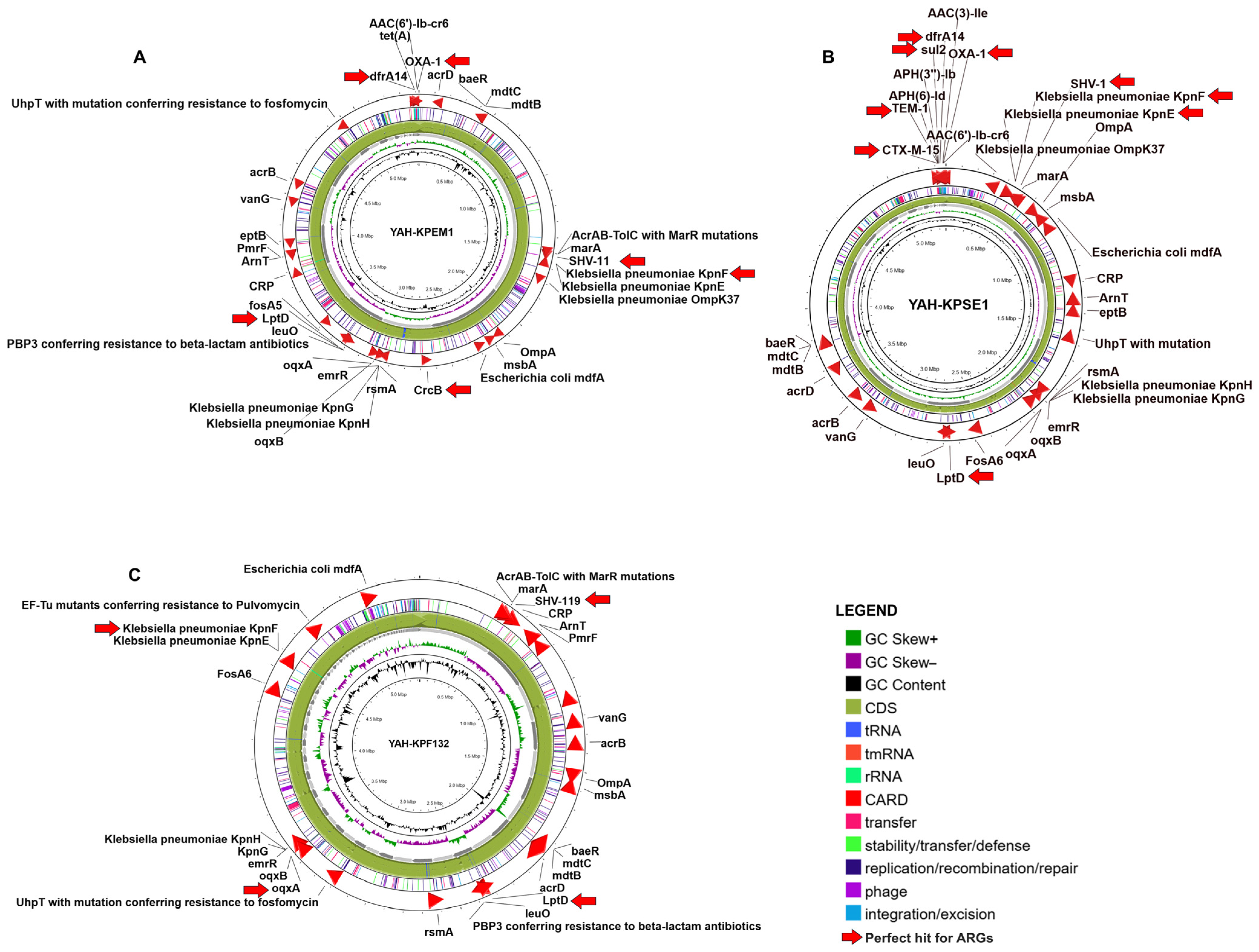
Figure 1. Circular genome representing the antimicrobial resistant genes and horizontal gene transfer regions (A) K. pneumoniae strain YAH-KPEM1, (B) K. pneumoniae strain YAH-KPSE1, and (C) K. pneumoniae strain YAH-KPF132.
Microbiolres 17 00074 g001
Table 1. Antimicrobial Susceptibility Profiles of K. pneumoniae Isolates YAH-KPF132, YAH-KPEM1, and YAH-KPSE1.
AntibioticAntibiotic ClassYAH-KPF132YAH-KPEM1YAH-KPSE1
Ampicillinβ-lactam (Penicillin)R (>64)R (>64)R (>64)
Ceftriaxoneβ-lactam (3rd gen cephalosporin)R (>8)R (8)R (8)
AmikacinAminoglycosideS (2)S (8)S (4)
GentamicinAminoglycosideS (1)S (1)R (8)
TetracyclineTetracycline classI (8)R (>32)S (≤1)
DoxycyclineTetracycline classS (4)R (16)S (2)
CiprofloxacinFluoroquinoloneS (≤0.1)R (1)R (1)
Trimethoprim-SulfamethoxazoleFolate pathway inhibitorsS (>8/152)R (>8/152)R (>8/152)
ChloramphenicolPhenicolR (64)R (>64)S (8)
Minimum inhibitory concentrations (MICs) were determined by broth microdilution. Results are reported as MIC values (µg/mL) with corresponding susceptibility interpretations: S, susceptible; I, intermediate; and R, resistant. Interpretations were based on Clinical and Laboratory Standards Institute (CLSI) guidelines (2024).
Disclaimer/Publisher’s Note: The statements, opinions and data contained in all publications are solely those of the individual author(s) and contributor(s) and not of MDPI and/or the editor(s). MDPI and/or the editor(s) disclaim responsibility for any injury to people or property resulting from any ideas, methods, instructions or products referred to in the content.


