
Article

Impact of an Essential-Oil-Based Oral Rinse on Oral and Gut Microbiota Diversity: A Pilot Study

1
Department for Sustainable Development and Ecological Transition (DISSTE), Università del Piemonte Orientale, 13100 Vercelli, Italy
2
Center on Autoimmune and Allergic Diseases (CAAD), Università del Piemonte Orientale, 28100 Novara, Italy
3
Research Training Innovation Infrastructure, Research and Innovation Department (DAIRI), Azienda Ospedaliera SS. Antonio e Biagio e Cesare Arrigo, 15121 Alessandria, Italy
4
Department of Dentistry, Sant’Andrea Hospital, 13100 Vercelli, Italy
5
Department of Science and Technological Innovation, Università del Piemonte Orientale, 15121 Alessandria, Italy
6
Institute of Dentistry and Maxillofacial Surgery, Fondazione Policlinico Universitario A. Gemelli IRCCS, Università Cattolica del Sacro Cuore, 00168 Rome, Italy
7
Department of Health Sciences, Università del Piemonte Orientale, Palazzo Bellini, 28100 Novara, Italy
*
Author to whom correspondence should be addressed.
These authors contributed equally to this work.
Microbiol. Res. 2025, 16(12), 251; https://doi.org/10.3390/microbiolres16120251
Submission received: 22 October 2025 / Revised: 26 November 2025 / Accepted: 27 November 2025 / Published: 30 November 2025

Abstract

Periodontitis is a multifactorial disease that is primarily driven by bacterial biofilm and oral dysbiosis. Listerine® is a widely used essential-oil-based mouthwash that is well established for its safety and anti-plaque efficacy. However, limited evidence exists regarding its impact on oral microbial composition or its potential effects on gut microbiota. This pilot study aimed to investigate changes in subgingival microbiota and periodontal indices after Listerine® use and to explore modulation of the gut microbiota. Twelve healthy adults were enrolled, and oral plaque and stool samples were collected at baseline and after a 28-day treatment period. Microbial profiling was performed using next-generation sequencing (NGS) to assess shifts in oral and gut microbiota. The α-diversity and β-diversity indices were computed, and differential abundance analyses were conducted to identify taxa modulated by treatment. NGS-based profiling revealed that oral microbial α-diversity and β-diversity remained stable. Several oral taxa were significantly modulated, including reductions in Gemella haemolysans, Streptococcus oralis and Granulicatella sp., along with increases in Actinomyces viscosus. In the gut microbiota, a modest trend toward reduced Shannon and Simpson diversity indices was observed. Taxonomic shifts included enrichment of the Bacteroides, Phocaeicola and Alistipes species, and decreases in Lachnospiraceae, Intestinibacter sp. and Blautia luti. Despite the limited cohort size and short observation period, these findings suggest that essential-oil-based mouthwash use can transiently modulate both oral and intestinal microbial ecosystems.

1. Introduction

Periodontal diseases are a group of inflammatory chronic diseases that affect about 20–60% of the global population [1,2,3]. Periodontitis is recognized as a multifactorial pathology, but the main cause is the accumulation of bacterial biofilm at the gingival margin and the presence of oral dysbiosis. Some prevalence studies have revealed an association between determined bacterial species and periodontal disease [4]. These latter underlined the highly dynamic characteristics of the oral microbiota and its ability to deal with external agents by modifying its composition, according to the European Federation of Periodontology (EFG) guidelines [3,5,6]. The number of microorganisms inhabiting the digestive tract, including oral cavities, exceeds 100 trillion symbiotic units and, for its role, it is considered an “essential organ” [7]. The gastrointestinal tract is first colonized, among others, by the Staphylococcus, Corynebacterium, Propionibacterium, Lactobacillus and Prevotella genera, which are fundamental for both oral and gut microbiota [8,9].
The oral microbiota is a fundamental part of the human microbiota because it protects against the colonization of external bacteria, which could affect systemic health; therefore, the host’s ecological conditions play an important role in keeping its equilibrium [9,10]. Disruption of the oral microbiota has been linked to periodontal diseases, dental caries and other systemic conditions, including cardiovascular diseases [10,11,12]. The balance of beneficial and pathogenetic bacteria is essential, with studies showing that dysbiosis in the oral microbiota contributes to inflammation and disease progression [12]. Furthermore, certain dietary components, such as polyphenols, prebiotics and probiotics have been shown to influence oral microbial composition, promoting a more balanced microbiota that is less prone to disease [13,14].
The prevention of periodontal disease is still based on the daily removal of the oral biofilm to keep the intraoral bacterial load low and to act on the composition of the biofilm, preventing the biofilm from maturing and enriching itself with opportunistic bacteria [11,12]. Modern therapeutic approaches increasingly focus on targeting microbiota dysbiosis through dietary interventions and novel probiotics to restore balance [15]. Additionally, sequencing technologies have revealed that as oral diseases progress, microbial diversity decreases, highlighting the need for strategies to maintain or restore this biodiversity [16,17]. In fact, periodontitis is a dysbiotic disease, resulting from shifting in subgingival Gram-positive bacteria to Gram-negative bacteria [18]. The evolution of periodontal dysbiosis occurs over a longer period, gradually converting the symbiotic association between host and microbe into a pathogenic form. Among the microbial clusters, the first one that has been related to the disease is the orange complex, consisting of anaerobic Gram-negative species such as Prevotella intermedia, Prevotella nigrescens, Prevotella micros and Fusobacterium nucleatum, which, with disease progression, shifts to the red complex, consisting of Tannerella forsythia, Tannerella denticola and Porphyromonas gingivalis [18].
The use of mouthwashes that are mostly classified as bacteriostatic and potentially bactericidal medical devices may support daily mechanical home hygiene, as well as non-surgical and post-surgical periodontal therapy to prevent or delay bacterial recolonization [19]. Studies have shown that mouthwashes, particularly those containing chlorhexidine, can significantly alter the oral microbiota, reducing microbial diversity. While these products are effective for controlling harmful bacteria, they may also negatively impact beneficial species, leading to oral dysbiosis and systemic health issues [20].
There is little information on their influence on the composition of the oral microbiota and none on their direct or potential effect on the composition of the gut microbiota.
The variability of the microbes that colonize the human body is in fact the result of the co-evolution between microbial communities and their hosts [21], even if environmental factors strongly influence the composition of this bacterial ecosystem [22]. Regular use of antiseptic mouthwashes could alter the oral microbial ecosystem through both direct and indirect mechanisms. The active components—such as essential oils, alcohol or quaternary ammonium compounds—exert broad-spectrum antimicrobial effects that reduce the overall bacterial load and selectively suppress susceptible taxa within oral biofilms [18]. This shift can modify local ecological networks, favoring recolonization by more resilient or commensal species and thereby reshaping the community structure and metabolic activity. Altered microbial metabolism, including nitrate-reducing and lactic acid-producing pathways, may influence salivary and systemic nitrite availability, indirectly affecting gut microbial communities through the entero-salivary circulation and swallowed saliva. Moreover, transient ingestion of antimicrobial residues or microbial metabolites could contribute to selective pressures in the gastrointestinal tract. These combined effects highlight how oral antiseptic exposure, though localized, can exert systemic consequences on host–microbe interactions and the interconnected oral–gut microbial axis.
Periodontitis has been pointed out as a risk factor for many systemic diseases, such as cardiovascular diseases, obesity, metabolic syndromes, diabetes, adverse pregnancy outcomes, respiratory tract infection, cancer, neurological disorders, rheumatoid arthritis, fatty liver, and osteoporosis [23,24,25]. In addition, dysbiosis of the gastrointestinal microbiota has been linked to important diseases, including autoimmune diseases, allergies, obesity and inflammatory bowel diseases, through mechanisms that are not yet completely elucidated [26,27,28,29,30,31,32]. Similarly, dysbiosis of the oral microbiota is associated with the exacerbation of some autoimmune diseases, including rheumatoid arthritis, diabetes and other degenerative diseases that recognize the contribution of inflammation, including Parkinson’s and Alzheimer’s disease [5,33,34].
As reported in a recent paper, the gut microbiota is influenced by the oral one. For instance, an increased population of Porphyromonas gingivalis in the oral cavity may promote the onset of dysbiosis in the intestinal tract. Considering that several oral species can arrive at the intestine via swallowing or microvesicles’ communication [35,36], and that gut dysbiosis may be associated with the onset of different pathologies [34], it can be argued that the oral microbiota may play an important role in steering the general health status of the individual.
Finally, it has recently emerged, using sequencing techniques, that some very common mouthwashes, such as chlorhexidine, may cause significant compositional changes in the oral microbiota [20,37]. Some of the most popular mouthwashes used for almost 150 years as an oral hygiene aid are essential oils, such as thymol, eucalyptol and menthol, in a non-alcoholic solution. Listerine® has been extensively studied in all aspects of safety and its ability to reduce the plaque amount and to perform an anti-inflammatory action on periodontal tissues is widely documented [38]. On the other hand, solid data are not available on its effect on the composition of the microbiota, and it is not known if this has a direct or indirect effect on the intestinal microbiota.
The aims of this study are as follows: (i) describe the quantitative and compositional changes in the subgingival microbiota following the use of Listerine® using NGS technology and correlate the periodontal clinical indices of plaque and inflammation with microbiological data and (ii) investigate a possible effect of the use of Listerine® on the composition of the gut microbiota.

2. Materials and Methods

2.1. Enrollment and Experimental Design

This study was a “human prospective observational study,” performed in accordance with the Declaration of Helsinki, and was authorized by Ethical Committee of Hospital “Santi Antonio e Biagio e Cesare Arrigo” (Alessandria) with Prot. n° AslVC.Odst.22.01, CE 24/02/2022,” Study acronym “E.O.O.I.M (Essential Oil and Oral and Intestinal Microbiota)”.
The experimental design involved the enrollment of a cohort of 12 individuals with ages ranging from 18 to 30 years that followed a Mediterranean diet (monitored with specific questionnaire) and were healthy, taking no medication and nonsmokers. The participants were not daily users of mouthwashes based on essential oils (Listerine® Cool Mint). Listerine® Cool Mint is an essential-oil-based antiseptic mouthrinse whose antimicrobial activity derives from a synergistic combination of phenolic compounds and alcohol. The formulation includes four primary active essential oils—eucalyptol (0.092%), menthol (0.042%), methyl salicylate (0.060%) and thymol (0.064%)—which collectively exert broad-spectrum antibacterial effects through membrane disruption and interference with bacterial enzymatic pathways.
The vehicle solution contains alcohol (approximately 21–22% v/v), which enhances the solubility and penetration of essential oils, as well as purified water. Additional excipients include sodium benzoate (preservative), poloxamer 407(solubilizing agent), benzoic acid, sodium saccharin (sweetener) and flavoring agents to confer the characteristic mint taste. The formulation also incorporates FD&C dyes (e.g., Green No. 3) for its distinctive coloration. Overall, the combination of essential oils, ethanol and solubilizing excipients is designed to ensure chemical stability, antimicrobial efficacy and consumer acceptability.
In this design, each subject’s baseline measurement (T0) acted as a control for the second measurement (T1). The choice of a ‘within subject’ design is made with the aim of reducing sources of variability [39]. The study was designed as a pilot exploratory investigation aimed at characterizing the short-term effects of Listerine® use on the oral and gut microbiota. A sample size of twelve participants was considered adequate for this purpose, in line with the methodological framework that is typically applied to microbiome pilot studies, where the primary objective is to assess feasibility, intra-individual variability and signal direction, rather than to achieve confirmatory statistical power. Given the high inter-individual variability that is inherent to microbial community data, small pilot cohorts (n = 10–20) are commonly used to estimate the effect sizes and variance components necessary for subsequent power calculations in larger trials. With twelve subjects, assuming a within-subject paired design and moderate effect sizes (Cohen’s d ≈ 0.6–0.8), the study provides an estimated power of 0.6–0.7 at α = 0.05, which is sufficient to detect major compositional shifts or strongly modulated taxa. Therefore, this sample size was considered appropriate to generate preliminary, hypothesis-generating insights while minimizing participant burden and resource use. The results should thus be interpreted as exploratory, pending confirmation in larger, adequately powered studies [39,40]. Patients were examined and a clinical evaluation [6,23], plaque sampling and fecal sample collection were carried out at the Department of Dentistry, Sant’Andrea Hospital in Vercelli. The evaluation of the full mouth plaque score (FMPS) was performed at the beginning of the study, and the subjects were divided in A class (1–10%), B class (11–30%), C class (31–50%) and D class (>50%). Moreover, the blooding index (FMBS) was also considered in the initial conditions of A class (1–10%) or B class (11–30%). Plaque samples were collected from all (buccal/mesial/distal/lingual/occlusal) surfaces of individual molars, using a Gracey curette n° 1 &2 (Hu Friedly, Chicago, UL, USA), and transferred to the test tube. Two stool samples were also collected in sterile devices within 48 h of enrolment and 28 days after the visit and were frozen and stored at −80 °C until further analyses. The enrolled patients were instructed to use mouthwash, 2 rinses/day (after breakfast and dinner) for 1 min, to refrain from drinking for the next 2 h, and to use Listerine for 28 days after the first visit. In the time between the two samples, the participants were encouraged to maintain the same eating habits. In addition, participants continued to perform daily oral hygiene, using mechanical cleaning with a toothbrush as usual.
Exclusion criteria: current pregnancy; cigarette smoking; taking antimicrobial, anti-inflammatory or immunosuppressive therapies in the last 6 months; systemic diseases that can individually alter the microbiota; or habitual users of oral mouthwash. The full mouth plaque score (FMPS) (A = 1–10%; B = 11–30%; C = 31–50%; D > 50%) and full mouth bleeding score (FMBS) (A = 1–10%; B = 11–30%; C = 31–50%; D > 50%) [41] were evaluated at the beginning and at the end of the study.

2.2. 16S rDNA Sequencing

DNA was extracted using QIAamp® DNA Microbiome from 0.5 mL of swab (eNAT, Copan, Brescia, Italy) medium buffer and QIAmp® PowerFecal Pro DNA kit from 0.25 g of stool, both provided by Qiagen (Milan, Italy), following the manufacturer’s instructions. DNA from each sample was quantified by the fluorimetric method according to the Qubit® 2.0 Fluorimeter protocol. Then, 16S DNA libraries were performed using the Microbiota solution A for the oral swab (amplifying V1–V3 regions) and the Microbiota solution B kit for stool (V3–V6 regions), provided by Arrow Diagnostics S.r.l. (Genoa, Italy). A negative control, containing only reagent, was added to check possible external DNA contamination. The MiSeq platform was employed for sequencing analyses, using MiSeq Reagent Nano Kit v2 (500-cycles) and Phix as the internal standard, provided by Illumina Inc. (San Diego, CA, USA).

2.3. Bioinformatic and Statistical Analysis

Raw sequence processing and statistical analyses were performed according to Torre et al. [42] and Robert et al. [43], using three different factors: treatment (baseline: T0 and after 28 days treatment with Listerine®: T1), FMPS and FMBS [41]. Briefly, MicrobAT is based on the RDP database (v.11.4) and it does not produce OTUs (operational taxonomic units). The obtained sequences, after being filtered for length and quality (data quality evaluation), were aligned against the RDP database, and were assigned to a specific species if they meet the following criteria: query coverage 80% and similarity 97%. Moreover, from MicrobAT, three files were generated and processed by Microbiome Analyst online tool Statistical analyses were performed using R software for multivariate analysis and for ANOVA (comparison of abundances) and using Microbiome Analyst for the alpha and beta diversity analyses and for the linear discriminant analysis (LDA). LDA was calculated according to the treatment, FMPS and FMBS factors for oral microbiota and according to the treatment factor for the fecal microbiota. Important features were identified by LEfSe at species level. The LEfSE algorithm employs the Kruskal–Wallis rank sum test to detect features with significant differential abundance with regard to class labels, followed by linear discriminant analysis to evaluate the relevance or effect size of differential abundant features. Features are significant, based on their discriminant analysis (p < 0.05) [44,45,46]. Multiple testing correction was applied using the false discovery rate (FDR) method, with a cutoff at 5% [45,46].

3. Results

3.1. Clinical Evaluation

Twelve individuals were enrolled in this pilot study: seven males and five females in the age range of 18 to 30 years, with a mean age of 22.9 years old, that followed a Mediterranean diet, were healthy, took no medication and were nonsmokers. In the initial conditions, they presented poor oral hygiene with a certain subjective variability. They did not show evident signs of periodontitis and therefore could be considered healthy subjects. The evaluation of the full mouth plaque score at the beginning of the study highlighted three subjects in the A class (1–10%), two in the B class (11–30%), two in the C class (31–50%) and four in the D class (>50%). At the end of the study, only one subject ameliorated the status from D to C class. All the examined subjects, although reducing the percentage of plaque present, did not change their class. No subject showed a worsening of oral hygiene conditions. Moreover, considering the blooding index, in the initial conditions, six subjects were in the A class (1–10%) and six in the B class (11–30%). At the end of the study, all the subjects improved their bleeding conditions, even if they did not change their initial class.

3.2. Next-Generation Sequencing (NGS) Analysis

After NGS analysis, a total of 1,383,325 reads were obtained with a mean value of 62,878 reads per sample for oral microbiota characterization, while a total of 967,976 reads were obtained with a mean value of 48,399 reads per sample for the fecal microbiota. After the demultiplexing step, there was a total of 1,237,870 reads (with a mean value of 56,267 reads per sample) for oral, while for fecal, a total of 722,396 reads (with a mean value of 36,120 reads per sample) was used for further analysis. The genomic sequences were included in the BioProject: ANTIORI_ORAL and PRJNA835062: ANTIORI_FECAL, available in NCBI, accessed on 4 May 2022.

3.3. Oral Microbiota Biodiversity

3.3.1. Community Overview

The community composition, through direct quantitative comparison of abundances at phylum level, showed when that comparing the oral microbiota profile at T0 and T1, the most abundant phyla were represented by Bacillota (60.9 ± 2.8% in T0 and 55.1 ± 3.4 in T1), followed by Actinomycetota (20.5 ± 1.4% in T0 and 22.6 ± 1.7 in T1), Candidatus saccharibacteria (17.3 ± 2.6% in T0 and 18.4 ± 3.6 in T1) and Bacteroidota (0.7 ± 0.1% in T0 and 2.0 ± 0.9 in T1). The statistical comparison showed no statistically significant differences between the two groups considered.

3.3.2. Community Profiling and Signature

Figure 1 showed the results regarding the biodiversity comparison of the oral microbiota at the beginning and at the end of the study. The use of mouthwash for 28 days determined no differences in the biodiversity (alpha-diversity) of the oral microbiota of the treated subjects. The beta diversity showed a trend of difference (not statistically significant) (Figure 1A,B, LABEL) in the population, associated with the enrolled subjects before and after the treatment with Listerine®.
Regarding the modulation of the microbial communities associated with the two clinical scores, full mouth plaque score (FMPS) and full mouth bleeding score (FMBS), the alpha diversity did not show statistically significant differences for both scores (Figure 1C,E, respectively), while the beta-diversity showed statistically significant differences between the different categories of FMBS (A = 1–10%; B = 11–30%; C = 31–50%; D > 50%) (Figure 1F) and not for FMPS (Figure 1D).
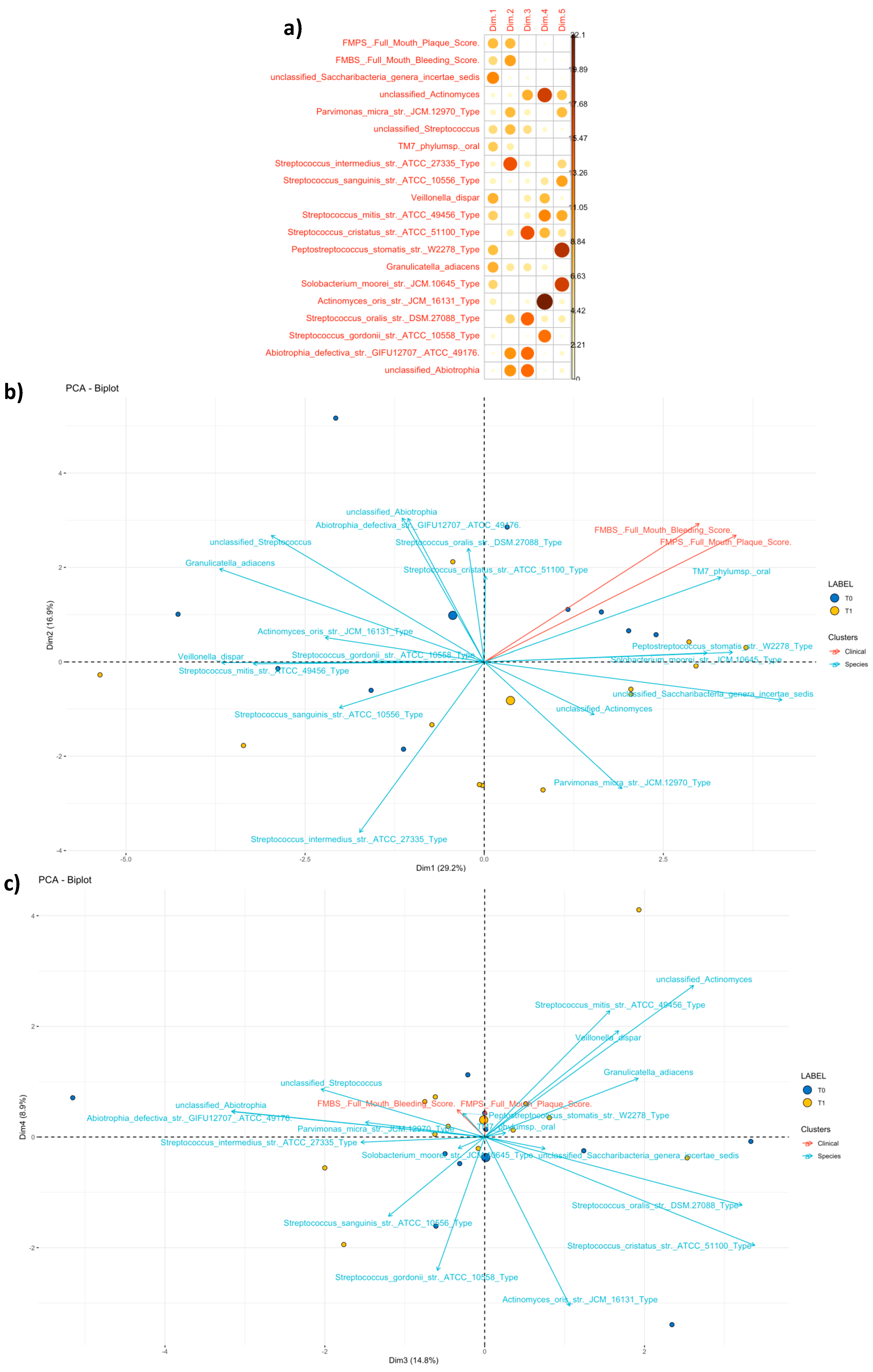
Figure 2 shows the PCA analysis of the oral microbiota at the species level (with an abundance value higher than 5%): Figure 2a shows the contributions of the clinical parameters and the different species to the different dimensions (from Dim.1 to Dim.5); Figure 2b shows Dimensions 1 and 2 (dimension 1 29.2% and dimension 2 16.9% of variability explained), in which the ball represented the mean of the samples, while the small dot indicated the single samples; and Figure 2c shows dimensions 3 and 4 (dimension 3 14.8% and dimension 4, 8.9% of variability explained).
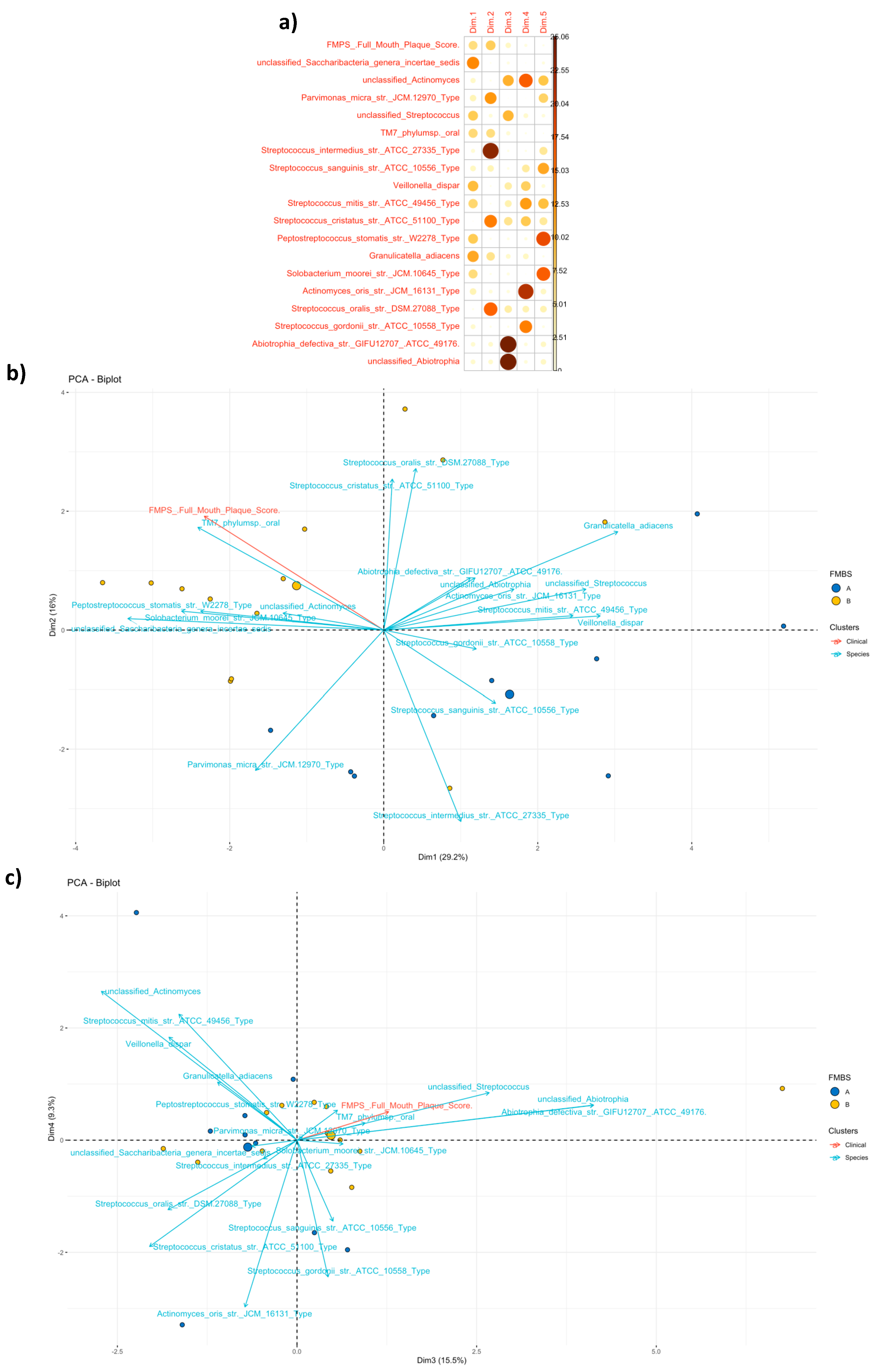
Multivariate analysis showed that the microbiota associated with treated patients differed from that associated with the initial condition (yellow and blue dots, respectively, Figure 2b,c). Figure 2b shows that the conditions associated with treated patients (T1) correlate to Streptococcus intermedius, Parvimonas micra and Saccharibacteria sp., while patients in the initial conditions (T0) are more represented by Granulicatella adiacens, Streptococcus sp., S. cristatus, S. oralis, Abiotrophia sp. and A. defectiva. Figure 2c explains that Dimensions 3 and 4 highlighted that treated patients are characterized by S. mitis, Actinomyces sp. and Veillonella dispar, while the initial conditions correlate with Actinomyces oris, S. cristatus, S. gordonii, S. oralis and S. sanguinis. Moreover, multivariate analysis, considering the categories relative to clinical parameters FMPS (Figure S1) or FMBS (Figure 3), showed that the parameter FMPS (Figure S1) in category A (1–10%) and B (11–30%) correlates with S. intermedius, S. sanguinis, S. mitis and V. dispar, while the subjects with a higher plaque score (category C = 31–50% and D > 50%) are more correlated with the FMBS and are characterized by Solobacterium morei, Peptostreptococcus stomatis, Saccharibacteria sp., Actinomyces sp., S. oralis, S. cristatus, A. defective, Abiotrophia sp., Granulicatella adiacens. The enrolled subjects were characterized by a bleeding score in categories A (1–10%) and B (11–30%) (Figure 3).
B patients were associated with the presence of P. stomatis, S. morei, Saccharibacteria sp., Actinomyces sp., S. oralis and S. cristatus. Considering the signature associated with Listerine® treatment, Table 1 (Oral Microbiota Treatment) showed that the species that were statistically significantly modulated by the mouthwash were mostly downregulated.
In particular, Gemella hæmolisans, Gemella sp., Bacillus sp. Streptococcus oralis and Granulicatella sp. were inhibited by the treatment. On the contrary, a few numbers of species were upregulated: in particular, Actinomyces viscosus and unclassified Sphingomonadaceae. Comparing the different categories of plaque score and considering low plaque scores (A and B) and higher plaque scores (B and C) (Table 1), different species were more representative of lower levels of plaque (FMPS): Streptococcus intermedius, Actinomyces israelii and Veillonella dispar. Other species were associated with a higher level of plaque (C and D): Streptococcus anginosus, Peptostreptococcus sp., P. stomatis, Olsenella phocaeensis, Mogibacterium timidum, TM7 phylum sp. oral, Solobacterium sp., unclassified Atopobiaceae and Lachnoanaerobaculum saburreum. Finally, considering the FMBS parameter, the subjects presented only values in the first two lower classes (A and B) and the species listed in Table 1 were more associated with class B: Streptococcus anginosus, Peptostreptococcus sp., Peptostreptococcus stomatis, Olsenella phocaeensis, Mogibacterium timidum, TM7 phylum sp. oral, Unclassified Atopobiaceae, Streptococcus intermedius, Olsenella sp., Veillonella dispar, Eubacterium infirmum, Solobacterium sp., Solobacterium moorei, Lachnoanaerobaculum saburreum, Mogibacterium vescum, Eubacterium sp., Veillonella sp. and Lachnoanaerobaculum sp.

3.4. Fecal Microbiota Biodiversity

3.4.1. Community Overview

The taxonomic community composition, through direct quantitative comparison of abundances at phylum level, showed that when comparing the gut microbiota profile at T0 and T1, the most abundant phyla were represented by Bacillota (66.0 ± 3.1% in T0 and 56.4 ± 3.9 in T1), followed by Bacteroidota (24.4 ± 2.3% in T0 and 35.2 ± 3.4 in T1, p-value = 0.0174), Actinomycetota (6.7 ± 1.3% in T0 and 6.2 ± 0.8 in T1), Pseudomonadota (1.5 ± 0.8% in T0 and 1.3 ± 0.3 in T1) and Verrucomicrobiota (1.3 ± 0.6% in T0 and 0.9 ± 0.4 in T1). The statistical comparison made by ANOVA showed no statistically significant differences between the two groups for all the considered phyla, except for Bacteroidota.

3.4.2. Community Profiling and Signature

Considering alpha-diversity, the mouth wash using Listerine® did not induce statistical significance modification in the biodiversity of the gut microbiota (number of observed species), even if a reduction trend could be observed in the Shannon and Simpson indexes (Figure S2A–C). On the contrary, beta-diversity analysis (Figure S2D) highlighted a statistically significant difference between a microbial population before and after the treatment with Listerine®.
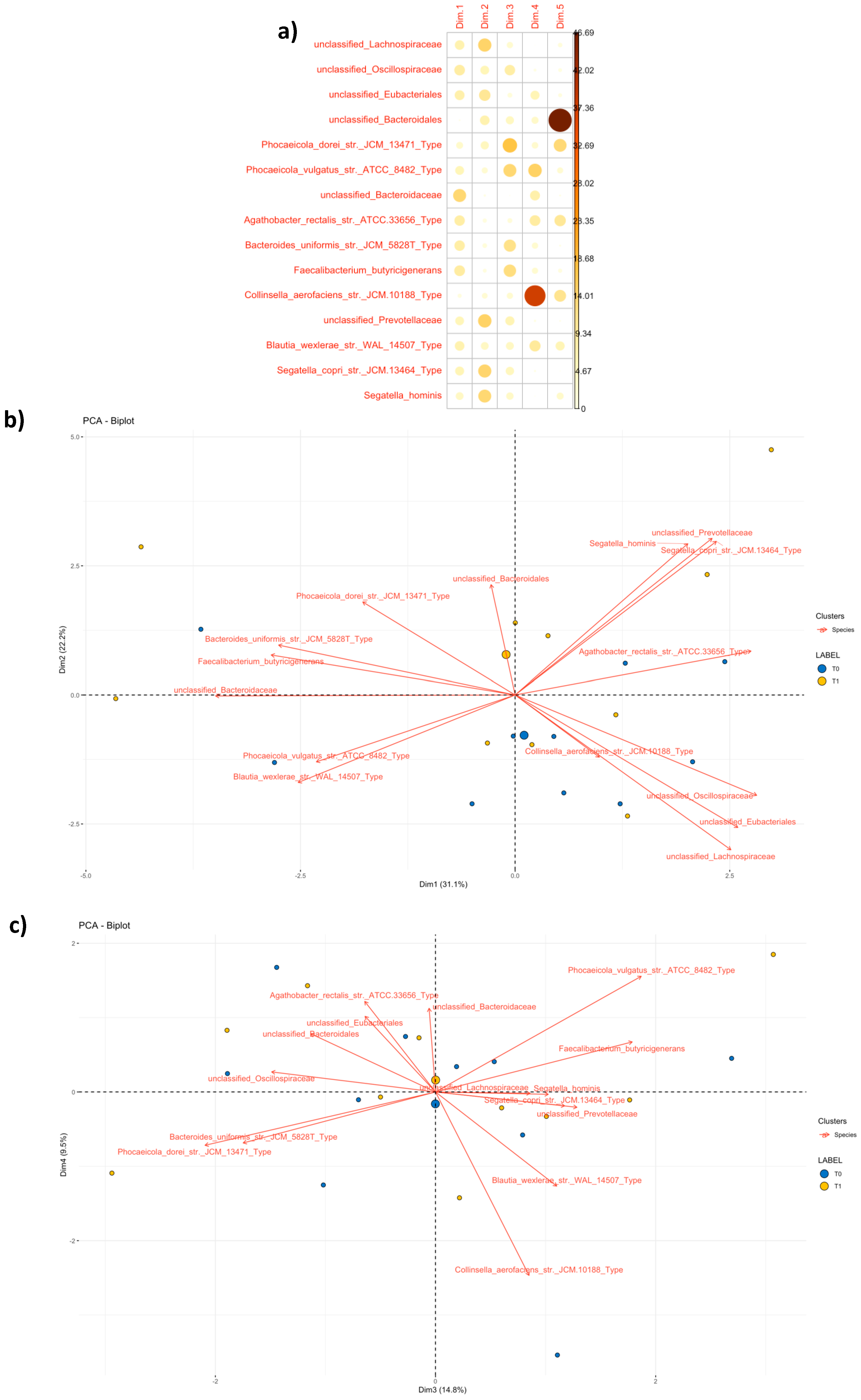
Figure 4 showed the multivariate analysis result: in detail, Phocaeicola dorei, Bacteroides uniformis and Faecalibacterium butyricigenerans were mostly associated with T1, while Collinsella aerofaciens, unclassified Oscillospiraceae, unclassified Eubacteriales and unclassified Lachnospiraceae were associated with T0. Finally, considering the signature associated with the treatment, Parabacteroides sp., Bacteroides sp., Phocaeicola sp. and Alistipes sp. were significantly stimulated after the treatment (T1). Unclassified Lachnospiraceae, unclassified Eubacteriales, Intestinibacter bartlettii, Intestinibacter sp., Blautia luti, unclassified Bacillota and unclassified Peptostreptococcaceae were significantly inhibited after the treatment with Listerine® (Table 1, gut microbiota).

4. Discussion

Excellent oral hygiene, in addition to maintaining dental health, contributes as a protective factor against systemic diseases such as diabetes, cardiovascular diseases and autoimmune diseases [25]. As explained above, our work does not aim to demonstrate the already well-known efficacy of Listerine® but rather to evaluate the impact of constant use of this mouthwash on the native oral and fecal microbiota in healthy subjects with low inflammatory levels. Analyzing the possible modulation of the gut microbiota could demonstrate the role played by mouthwashes in the prevention of gastrointestinal diseases. In this context, this work had a double purpose. The first goal was to demonstrate the effect of Listerine® treatment in the modulation of the oral communities, reducing the bacteria implicated in periodontal diseases. Moreover, the second goal was to evaluate the possible modulation, at gut level, after the Listerine® ingestion, which can occur as a result of rinsing during daily oral hygiene. No studies have addressed gut microbiota modulation in relation to the prolonged use of essential oil–based mouthwashes, including Listerine®.
Considering the clinical evaluation at the beginning and end of the study, the enrolled subjects partially presented poor oral hygiene (3 of 12 were A in plaque score), but they did not show evident signs of periodontitis and therefore could be considered to be healthy subjects. Furthermore, it should be emphasized that the subjects enrolled were between 18 and 30 years old: an age that according to the literature, has a low-risk degree of the onset of periodontal disease [47]. The use of mouthwash for 28 days induced a general improvement in hygienic conditions, although not optimally. The general improvement in hygienic conditions due to the use of mouthwash is documented in the literature. In fact, mouthwashes play a chemical role in the dental plaque removal process, but it is essential to recognize that they cannot replace fundamental mechanical cleaning methods alone. When used individually, mouthwashes primarily target the outermost layer of the microbiota and may not reach the subgingival area in the absence of tissue pathology. So, the most effective approach to plaque removal requires the combined use of mechanical and chemical cleaning techniques [48,49]. Microbiota analysis revealed some important modulation in the oral microbiota. The beta diversity of the populations associated with the analyzed subjects varied in a statistically significant way, with respect to the clinical parameter, FMBS. The same cannot be said for alpha diversity, which remained unchanged. The initial observed condition correlated with the presence of anaerobic species such as Antinomyces sp. and Actinomyces oris and species potentially associated with periodontitis and with bacteria associated with the normal oral flora, such as Streptococcus oralis, S. cristatus, Abiotrophia sp., A. defectiva and Granulicatella adiacens. This result is of particular interest in determining colonization with potentially pathogenic bacteria in advance of the onset of the disease and suggesting the potential use of the determination of oral microbiota as an instrument of prevention. At the end of the treatment, as said before, all the enrolled subjects showed a general improvement in hygienic conditions and inflammation, demonstrating the efficacy of the treatment with Listerine® mouthwash. The improved conditions observed were associated with the reduction in the oral microbiota of Gemella haemolisans and Gemella spp. (facultatively anaerobic), Streptococcus oralis and Granulicatella sp. and other commensal species that were part of the normal flora associated with healthy subjects. In parallel, the treatment induced an increase in Actinomyces viscosus.
Treated patients have fewer Abiotrophia defectiva that are reported to be part of the oral and upper respiratory flora, as well as in the intestinal mucosa. Because A. defectiva has been frequently found in dental plaque, the oral cavity is considered to be the entry portal. Although it is rare for A. defectiva to cause endocarditis, some studies estimate that it is responsible for 5-6% of all cases of inflammatory endocarditis [50]. Other species that are downmodulated by the Listerine® treatment are Gemella haemolysans and Gemella sp. that are Gram-positive cocci and part of the normal human flora in the oral cavity and upper respiratory tract. G. haemolysans has been isolated from approximately 30% of nasopharyngeal swabs and from human dental plaque. Gemella spp. functions as an opportunistic pathogen, particularly in immunocompromised patients [51]. This species is also reported to inhibit the growth of the pathogen Porphyromonas gengivalis in the literature [51].
Considering the modulation of the oral microbiota in respect to a higher level of FMPS and FMBS, the species Streptococcus anginosus, Peptostreptococcus sp., P. stomatis, Olsenella focaeensis, Mogibacterium timidum, unclassified Atopobiaceae and Lachnoanaerobaculum saburreum, TM7 phylum sp oral, Solobacterium sp. and S. moorei (associated only with a higher level of bleeding) characterized the higher level of inflammation, while the trend of Veillonella dispar is controversial, because it was associated with a lower level of plaque but a higher level of bleeding. Different bacterial species are associated with oral diseases: for example, S. anginosus, belonging to the viridans streptococci group, is reported to be linked to abscess formation and an elevated presence in esophageal cancer and oral squamous cell carcinoma (OSCC) [52].
The members of the genus Olsenella are strictly anaerobic, Gram-positive, non-motile, non-spore-forming bacilli or cocci. This genus was first named by Dewhirst and coworkers in 2001 [53] and was amended by Zhi et al. in 2009 [54] and Kraatz et al. in 2011 [55]. This genus has recently been reclassified as a member of the family Atopobiaceae, under order Coriobacteriales, class Coriobacteria and phylum Actinobacteria [56]. The main habitats of the Olsenella are the oral cavity and gastrointestinal tract of humans [57,58,59,60], animals and various anaerobic environmental sites [61,62,63]. This genus is reported in the literature as being present in the oral cavity of individuals with plant-rich diets and as being inversely associated with the occurrence of recurrent ulcers in the mouth [64]. The species identified in this work has never been reported to be associated with high levels of inflammation.
Members of the genus Mogibacterium are described as being strictly anaerobic and asaccharolytic Gram-positive rod-shaped bacteria [65]. Mogibacterium timidum has been shown to be present in oral environments and to be involved in infectious oral diseases. M. timidum was isolated from the subgingival biofilm of periodontitis [65]. In addition, detection of M. timidum increased as the severity of the clinical parameters of gingivitis increased [65], suggesting that this species could contribute to the increased susceptibility of adults to gingivitis and periodontitis.
Lachnoanaerobaculum saburreum is an obligate anaerobic, Gram-positive, spore-forming, rod-shaped bacillus that was isolated from oral plaque [66]. L. saburreum has been found in the exposed pulp space of primary endodontic infections but has not been determined to be a definite cause of infection. Moreover, a case of bacteriemia was reported to have been caused by this bacterium [66].
Solobacterium sp. and S. moorei—anaerobic, non-sporulated Gram-positive bacilli isolated from human feces—were part of the oral flora. Three years after its characterization, S. moorei was found to be part of the tongue microbiota species and phylotypes that were significantly associated with halitosis [67]. S. moorei has also been increasingly reported as being associated with other various oral diseases, including different periodontal and endodontic diseases [67]. Apart from being a microorganism present within the oral microbiota, S. moorei was described as being a member of the intestinal microbiota. In particular, it has been significantly associated with colorectal cancer; this species might be involved in colorectal carcinogenesis [68].
Finally, Veillonella sp. in the present study was associated with better conditions for FMPS but worse bleeding conditions. First of all, there is evidence that Veillonella spp., as bridging organisms due to the abundance of adhesins, play a pivotal role in establishing biofilm communities via interactions with both initial and, later, oral colonizers [69]. Further studies are necessary to better understand Veillonella’s role in the development of multispecies biofilm communities [69]. Secondly, it is crucial that future research focuses on Veillonella’s role as an “accessory pathogen” in incipient dysbiosis. Indeed, while their pathogenic potential has been shown to be limited, the role of V. atypica in producing nutrients and reducing the oxidative microenvironment to support and facilitate the growth of periodontal pathogens has been reported [69,70,71]. Moreover, Hoare and coworkers reported that P. gingivalis can also survive in a co-culture with V. parvula. In addition, Veillonella spp. are spatiotemporally associated with acidogenic bacteria in oral biofilms and during caries development and then identified as an early indicator of dysbiosis communities in dental caries [69]. Most of the literature dealing with the ecological role of Veillonellae in oral biofilms reports species-specific results. For example, V. denticariosi has been reported to only be identified in caries sites, while V. rogosae is only isolated in healthy plaque [72]. Another work describes the interspecies interaction between Veillonellae and other oral microbes and showed, for example, that all V. parvula, partial V. atypica and V. rogosae, and none of V. dispar, physically interact with Streptococcus gordonii [69].
Most of the species previously described as being associated with oral dysbiosis and diseases are also reported as being present in the oral saliva of subjects with different autoimmune pathologies [73]. In particular, Veillonella sp., Atopobium sp. and Solobacterium moorei are associated with rheumatoid arthritis; Solobacterium sp., Mogibacterium sp. and TM7 are associated with juvenile idiopathic arthritis [73]. Moreover, interestingly, the saliva of patients with ankylosing spondylitis is enriched in Veillonella sp. and depleted in Streptococcus sp., underling the role of the oral dysbiosis in the onset of autoimmune diseases [73]. This implication underlines the importance of using mouthwashes containing essential oils and/or oral antibiotic treatment to contain the risk of proliferation of species with a negative effect [38]. It is important to consider that the transversal effect on bacterial growth and, above all, prolonged use over time can also lead to the reduction in species with a protective function.
To answer the second purpose of this paper, regarding gut microbiota, the authors observed a significant decrease in certain bacterial categories, including unclassified Lachnospiraceae, Intestinibacter barlettii (the only species of the genus Intestinibacter, belonging to the family Clostridiaceae), Inestinibacter sp. and unclassified Peptostreptococcaceae. Moreover, the reduction in the presence of a bacterium abundant in the intestinal flora, Blautia luti, was highlighted. The significant reduction in certain categories leads to an increase in the fraction of Bacteroides sp. in the analyzed subjects, emphasizing how the constant use of products containing compounds with antibacterial action during oral hygiene may have an impact on the composition of the gut microbiota. However, the observed modulation could be attributable to the sensitivity of certain bacterial categories to the essential oil components of the Listerine® formulation. Finally, it should be noted that the compositional changes detected in both oral and gut microbiota might not reflect stable community restructuring, but rather short-term, reversible responses to the brief exposure period. Longer follow-up studies are therefore required to determine whether these modulations persist or revert after treatment discontinuation and investigate whether probiotic supplementation or prebiotic-enriched diets could facilitate the re-establishment of balanced and functionally stable oral–gut microbiota [74,75].

5. Conclusions

This study demonstrates how the precise characterization of the microbiota associated with specific districts can be used as a pre-clinical prevention tool. Indeed, the presence of species associated with inflammation and periodontitis can be highlighted, providing specific information that may contribute to determining the risk of the onset of more serious diseases. Overall, this work shows a rebalancing of the normal flora of the oral cavity, with the reduction in species being associated with major inflammatory events such as periodontitis. Thus, this work shows that the constant use of mouthwash, although it does not eliminate the presence of plaque, induces the proliferation of bacteria that are not predisposed to inflammation. It must be emphasized that the studied cohort is made up of healthy subjects who are not at risk, and therefore, future studies may involve extending the cohort to include at-risk age groups to assess the method’s potential for personalized prevention.
Finally, the effect of mouthwash on the intestinal microbiota suggests that its use should not be prolonged. To consider this aspect in detail, future studies should be planned considering medium- and long-term exposures.

6. Study Limitations

This study presents some limitations that should be acknowledged. First, the sample size was small and limited to young, healthy adults, which restricts the generalizability of the findings to broader populations, including individuals with periodontal disease or systemic comorbidities. Second, the short observation period (28 d) did not allow for an assessment of long-term microbial resilience or recovery after treatment discontinuation. Third, only 16S rRNA gene sequencing was employed, which, although informative for taxonomic profiling, does not provide functional insights or strain-level resolution. Additionally, dietary habits and lifestyle factors were self-reported and may have introduced bias.
Future research should therefore involve larger and more diverse populations, with extended follow-up to evaluate the temporal dynamics of microbial recovery after treatment discontinuation. Longitudinal designs incorporating repeated sampling and functional metagenomic analyses would further clarify whether observed taxonomic shifts translate into stable ecological or metabolic changes. Moreover, subsequent studies could explore combined or sequential interventions—such as mouthwash use followed by probiotic supplementation—to assess potential compensatory mechanisms and the restoration of microbial homeostasis.

Supplementary Materials

The following supporting information can be downloaded at: https://www.mdpi.com/article/10.3390/microbiolres16120251/s1, Figure S1. PCA analysis at species level of Oral microbiota considering the FMPS. Figure S2. Alpha and beta diversity of Gut microbiota.

Author Contributions

E.B.: Contributed to conception, design, analysis and data acquisition and interpretation, drafted and critically revised the manuscript. F.C.: Contributed to conception and design, contributed during sampling and patients’ characterization and drafted and critically revised the manuscript. A.C.: Contributed to analysis and drafted the manuscript. N.M.: Contributed to analysis and drafted the manuscript. C.B.: Contributed to analysis and drafted the manuscript. R.P.: Contributed to conception and design and critically revised the manuscript. V.R.: Contributed to conception and design and critically revised the manuscript. L.R.: Contributed to conception, design and founding the work and drafted and critically revised the manuscript. All authors have read and agreed to the published version of the manuscript.

Funding

The authors acknowledge the support of Facility di Integrative Genomics (CAAD, Università del Piemonte Orientale) and thank Marta Mellai for technical assistance.

Institutional Review Board Statement

The study was conducted in accordance with the Declaration of Helsinki and approved by the Ethics Committee of Hospital “Santi Antonio e Biagio e Cesare Arrigo” (Alessandria) with Prot. n° AslVC.Odst.22.01, CE 24/02/2022,” Study acronym “E.O.O.I.M (Essential Oil and Oral and Intestinal Microbiota)” for studies involving humans.

Informed Consent Statement

Informed consent was obtained from all subjects involved in the study.

Data Availability Statement

The authors shared the raw data (fastq files) in the public NCBI repository at the following links: https://submit.ncbi.nlm.nih.gov/subs/sra/SUB11427370/overview; https://submit.ncbi.nlm.nih.gov/subs/sra/SUB11427886/overview.

Conflicts of Interest

The authors declare no conflicts of interest.

References

  1. Newman, T.; Carranza, K. Carranza’s Clinical Periodontology, 11th ed.; Elsevier: Amsterdam, The Netherlands, 2012; ISBN 978-1-4377-0416-7. [Google Scholar]
  2. Nazir, M.A. Prevalence of Periodontal Disease, Its Association with Systemic Diseases and Prevention. Int. J. Health Sci. 2017, 1, 72–80. [Google Scholar]
  3. Sanz, M.; Herrera, D.; Kebschull, M.; Chapple, I.; Jepsen, S.; Berglundh, T.; Sculean, A.; Tonetti, M.S. EFP Workshop Participants and Methodological Consultants Treatment of Stage I–III Periodontitis—The EFP S3 Level Clinical Practice Guideline. J. Clin. Periodontol. 2020, 47, 4–60. [Google Scholar] [CrossRef]
  4. Socransky, S.S.; Smith, C.; Haffajee, A.D. Subgingival Microbial Profiles in Refractory Periodontal Disease: Refractory Microbial Profiles. J. Clin. Periodontol. 2002, 29, 260–268. [Google Scholar] [CrossRef]
  5. Patini, R.; Staderini, E.; Lajolo, C.; Lopetuso, L.; Mohammed, H.; Rimondini, L.; Rocchetti, V.; Franceschi, F.; Cordaro, M.; Gallenzi, P. Relationship between Oral Microbiota and Periodontal Disease: A Systematic Review. Eur. Rev. Med. Pharmacol. Sci. 2018, 22, 5775–5788. [Google Scholar]
  6. Herrera, D.; Berglundh, T.; Schwarz, F.; Chapple, I.; Jepsen, S.; Sculean, A.; Kebschull, M.; Papapanou, P.N.; Tonetti, M.S.; Sanz, M.; et al. Prevention and Treatment of Peri-implant Diseases—The EFP S3 Level Clinical Practice Guideline. J. Clin. Periodontol. 2023, 50, 4–76. [Google Scholar] [CrossRef]
  7. O’Hara, A.M.; Shanahan, F. The Gut Flora as a Forgotten Organ. EMBO Rep. 2006, 7, 688–693. [Google Scholar] [CrossRef]
  8. Unusan, N. Essential Oils and Microbiota: Implications for Diet and Weight Control. Trends Food Sci. Technol. 2020, 104, 60–71. [Google Scholar] [CrossRef]
  9. Gendreau, L.; Loewy, Z.G. Epidemiology and Etiology of Denture Stomatitis. J. Prosthodont. 2011, 20, 251–260. [Google Scholar] [CrossRef] [PubMed]
  10. Arweiler, N.B.; Netuschil, L. The Oral Microbiota. In Microbiota. In Microbiota of the Human Body: Implications in Health and Disease; Schwiertz, A., Ed.; Springer International Publishing: Cham, Switzerland, 2016; pp. 45–60. ISBN 978-3-319-31248-4. [Google Scholar]
  11. Hou, K.; Wu, Z.-X.; Chen, X.-Y.; Wang, J.-Q.; Zhang, D.; Xiao, C.; Zhu, D.; Koya, J.B.; Wei, L.; Li, J.; et al. Microbiota in Health and Diseases. Signal Transduct. Target. Ther. 2022, 7, 135. [Google Scholar] [CrossRef]
  12. Zhang, Y.; Wang, X.; Li, H.; Ni, C.; Du, Z.; Yan, F. Human Oral Microbiota and Its Modulation for Oral Health. Biomed. Pharmacother. 2018, 99, 883–893. [Google Scholar] [CrossRef] [PubMed]
  13. Bhandary, R.; Venugopalan, G.; Ramesh, A.; Tartaglia, G.; Singhal, I.; Khijmatgar, S. Microbial Symphony: Navigating the Intricacies of the Human Oral Microbiome and Its Impact on Health. Microorganisms 2024, 12, 571. [Google Scholar] [CrossRef]
  14. Santonocito, S.; Giudice, A.; Polizzi, A.; Troiano, G.; Merlo, E.M.; Sclafani, R.; Grosso, G.; Isola, G. A Cross-Talk between Diet and the Oral Microbiome: Balance of Nutrition on Inflammation and Immune System’s Response during Periodontitis. Nutrients 2022, 14, 2426. [Google Scholar] [CrossRef] [PubMed]
  15. Kamel, M.; Aleya, S.; Alsubih, M.; Aleya, L. Microbiome Dynamics: A Paradigm Shift in Combatting Infectious Diseases. J. Pers. Med. 2024, 14, 217. [Google Scholar] [CrossRef] [PubMed]
  16. Rodríguez-Daza, M.C.; Pulido-Mateos, E.C.; Lupien-Meilleur, J.; Guyonnet, D.; Desjardins, Y.; Roy, D. Polyphenol-Mediated Gut Microbiota Modulation: Toward Prebiotics and Further. Front. Nutr. 2021, 8, 689456. [Google Scholar] [CrossRef] [PubMed]
  17. Rodríguez-Daza, M.C.; De Vos, W.M. Polyphenols as Drivers of a Homeostatic Gut Microecology and Immuno-Metabolic Traits of Akkermansia muciniphila: From Mouse to Man. Int. J. Mol. Sci. 2022, 24, 45. [Google Scholar] [CrossRef]
  18. Mohanty, R.; Asopa, S.; Joseph, M.D.; Singh, B.; Rajguru, J.; Saidath, K.; Sharma, U. Red Complex: Polymicrobial Conglomerate in Oral Flora: A Review. J. Fam. Med. Prim. Care 2019, 8, 3480. [Google Scholar] [CrossRef]
  19. Van der Weijden, F.A.; Slot, D.E. Efficacy of Homecare Regimens for Mechanical Plaque Removal in Managing Gingivitis a Meta Review. J. Clin. Periodontol. 2015, 42, S77–S91. [Google Scholar] [CrossRef]
  20. Bescos, R.; Ashworth, A.; Cutler, C.; Brookes, Z.L.; Belfield, L.; Rodiles, A.; Casas-Agustench, P.; Farnham, G.; Liddle, L.; Burleigh, M.; et al. Effects of Chlorhexidine Mouthwash on the Oral Microbiome. Sci. Rep. 2020, 10, 5254. [Google Scholar] [CrossRef]
  21. Davenport, E.R.; Sanders, J.G.; Song, S.J.; Amato, K.R.; Clark, A.G.; Knight, R. The Human Microbiome in Evolution. BMC Biol. 2017, 15, 127. [Google Scholar] [CrossRef]
  22. Chow, J.; Lee, S.M.; Shen, Y.; Khosravi, A.; Mazmanian, S.K. Disease. In Advances in Immunology; Elsevier: Amsterdam, The Netherlands, 2010; Volume 107, pp. 243–274. ISBN 978-0-12-381300-8. [Google Scholar]
  23. Sanz, M.; Kornman, K.; on behalf of working group 3 of the joint EFP/AAP Workshop. Periodontitis and Adverse Pregnancy Outcomes: Consensus Report of the Joint EFP/AAP Workshop on Periodontitis and Systemic Diseases. J. Periodontol. 2013, 84, S164–S169. [Google Scholar] [CrossRef]
  24. Mattila, K.J.; Nieminen, M.S.; Valtonen, V.V.; Rasi, V.P.; Kesaniemi, Y.A.; Syrjala, S.L.; Jungell, P.S.; Isoluoma, M.; Hietaniemi, K.; Jokinen, M.J. Association between Dental Health and Acute Myocardial Infarction. BMJ 1989, 298, 779–781. [Google Scholar] [CrossRef]
  25. Bui, F.Q.; Almeida-da-Silva, C.L.C.; Huynh, B.; Trinh, A.; Liu, J.; Woodward, J.; Asadi, H.; Ojcius, D.M. Association between Periodontal Pathogens and Systemic Disease. Biomed. J. 2019, 42, 27–35. [Google Scholar] [CrossRef]
  26. Schippa, S.; Conte, M. Dysbiotic Events in Gut Microbiota: Impact on Human Health. Nutrients 2014, 6, 5786–5805. [Google Scholar] [CrossRef]
  27. Ho, H.; Bunyavanich, S. Role of the Microbiome in Food Allergy. Curr. Allergy Asthma Rep. 2018, 18, 27. [Google Scholar] [CrossRef]
  28. Bai, J.; Hu, Y.; Bruner, D.W. Composition of Gut Microbiota and Its Association with Body Mass Index and Lifestyle Factors in a Cohort of 7–18 Years Old Children from the American Gut Project: Gut Microbiota and BMI in Children. Pediatr. Obes. 2019, 14, e12480. [Google Scholar] [CrossRef]
  29. Gérard, P. Gut Microbiota and Obesity. Cell. Mol. Life Sci. 2016, 73, 147–162. [Google Scholar] [CrossRef] [PubMed]
  30. Lopez-Legarrea, P.; Fuller, N.R.; Zulet, M.A.; Martinez, J.A.; Caterson, I.D. The Influence of Mediterranean, Carbohydrate and High Protein Diets on Gut Microbiota Composition in the Treatment of Obesity and Associated Inflammatory State. Asia Pac. J. Clin. Nutr. 2014, 23, 360–368. [Google Scholar] [PubMed]
  31. Candon, S.; Perez-Arroyo, A.; Marquet, C.; Valette, F.; Foray, A.-P.; Pelletier, B.; Milani, C.; Ventura, M.; Bach, J.-F.; Chatenoud, L. Antibiotics in Early Life Alter the Gut Microbiome and Increase Disease Incidence in a Spontaneous Mouse Model of Autoimmune Insulin-Dependent Diabetes. PLoS ONE 2015, 10, e0125448. [Google Scholar] [CrossRef] [PubMed]
  32. De Filippo, C.; Di Paola, M.; Giani, T.; Tirelli, F.; Cimaz, R. Gut Microbiota in Children and Altered Profiles in Juvenile Idiopathic Arthritis. J. Autoimmun. 2019, 98, 1–12. [Google Scholar] [CrossRef]
  33. Ley, R.E.; Peterson, D.A.; Gordon, J.I. Ecological and Evolutionary Forces Shaping Microbial Diversity in the Human Intestine. Cell 2006, 124, 837–848. [Google Scholar] [CrossRef]
  34. Mao, S.; Huang, C.-P.; Lan, H.; Lau, H.-G.; Chiang, C.-P.; Chen, Y.-W. Association of Periodontitis and Oral Microbiomes with Alzheimer’s Disease: A Narrative Systematic Review. J. Dent. Sci. 2022, 17, 1762–1779. [Google Scholar] [CrossRef]
  35. Kandpal, M.; Indari, O.; Baral, B.; Jakhmola, S.; Tiwari, D.; Bhandari, V.; Pandey, R.K.; Bala, K.; Sonawane, A.; Jha, H.C. Dysbiosis of Gut Microbiota from the Perspective of the Gut–Brain Axis: Role in the Provocation of Neurological Disorders. Metabolites 2022, 12, 1064. [Google Scholar] [CrossRef]
  36. Singh, S.; Sharma, P.; Sarma, D.K.; Kumawat, M.; Tiwari, R.; Verma, V.; Nagpal, R.; Kumar, M. Implication of Obesity and Gut Microbiome Dysbiosis in the Etiology of Colorectal Cancer. Cancers 2023, 15, 1913. [Google Scholar] [CrossRef]
  37. Yano, Y.; Hua, X.; Wan, Y.; Suman, S.; Zhu, B.; Dagnall, C.L.; Hutchinson, A.; Jones, K.; Hicks, B.D.; Shi, J.; et al. Comparison of Oral Microbiota Collected Using Multiple Methods and Recommendations for New Epidemiologic Studies. mSystems 2020, 5, e00156-20. [Google Scholar] [CrossRef] [PubMed]
  38. Ross, N.M.; Charles, C.H.; Dills, S.S. Long-Term Effects of Listerine Antiseptic on Dental Plaque and Gingivitis. J. Clin. Dent. 1989, 1, 92–95. [Google Scholar] [PubMed]
  39. Julious, S.A. Sample Size of 12 per Group Rule of Thumb for a Pilot Study. Pharm. Stat. 2005, 4, 287–291. [Google Scholar] [CrossRef]
  40. Thiese, M.S. Observational and Interventional Study Design Types; an Overview. Biochem. Medica 2014, 24, 199–210. [Google Scholar] [CrossRef]
  41. Cole, J.R.; Wang, Q.; Fish, J.A.; Chai, B.; McGarrell, D.M.; Sun, Y.; Brown, C.T.; Porras-Alfaro, A.; Kuske, C.R.; Tiedje, J.M. Ribosomal Database Project: Data and Tools for High Throughput rRNA Analysis. Nucleic Acids Res. 2014, 42, D633–D642. [Google Scholar] [CrossRef]
  42. Torre, E.; Sola, D.; Caramaschi, A.; Mignone, F.; Bona, E.; Fallarini, S. A Pilot Study on Clinical Scores, Immune Cell Modulation, and Microbiota Composition in Allergic Patients with Rhinitis and Asthma Treated with a Probiotic Preparation. Int. Arch. Allergy Immunol. 2022, 183, 186–200. [Google Scholar] [CrossRef]
  43. Robert, C.; Cascella, F.; Mellai, M.; Barizzone, N.; Mignone, F.; Massa, N.; Nobile, V.; Bona, E. Influence of Sex on the Microbiota of the Human Face. Microorganisms 2022, 10, 2470. [Google Scholar] [CrossRef] [PubMed]
  44. McMurdie, P.J.; Holmes, S. Phyloseq: An R Package for Reproducible Interactive Analysis and Graphics of Microbiome Census Data. PLoS ONE 2013, 8, e61217. [Google Scholar] [CrossRef]
  45. Segata, N.; Izard, J.; Waldron, L.; Gevers, D.; Miropolsky, L.; Garrett, W.S.; Huttenhower, C. Metagenomic Biomarker Discovery and Explanation. Genome Biol. 2011, 12, R60. [Google Scholar] [CrossRef]
  46. Segata, N.; Boernigen, D.; Tickle, T.L.; Morgan, X.C.; Garrett, W.S.; Huttenhower, C. Computational Meta’omics for Microbial Community Studies. Mol. Syst. Biol. 2013, 9, 666. [Google Scholar] [CrossRef]
  47. Jacob, S. Global Prevalence of Periodontitis: A Literarure Review. Int. Arab. J. Dent. 2012, 3, 26–30. [Google Scholar]
  48. Yazicioglu, O.; Ucuncu, M.K.; Guven, K. Ingredients in Commercially Available Mouthwashes. Int. Dent. J. 2024, 74, 223–241. [Google Scholar] [CrossRef]
  49. Spuldaro, T.R.; Rogério Dos Santos Júnior, M.; Vicentis De Oliveira Fernandes, G.; Rösing, C.K. Efficacy of Essential Oil Mouthwashes With and Without Alcohol on the Plaque Formation: A Randomized, Crossover, Double-Blinded, Clinical Trial. J. Evid. Based Dent. Pract. 2021, 21, 101527. [Google Scholar] [CrossRef] [PubMed]
  50. Chinnaraj, H.; Vinay Vardhan, M.; Gudibandi, H.V.; Kumar, J.S.; Kumarasamy, S. Abiotrophia defectiva: A Rare Causative Agent of Infective Endocarditis With Severe Complications. Cureus 2024, 16, e73715. [Google Scholar] [CrossRef] [PubMed]
  51. Miyoshi, T.; Oge, S.; Nakata, S.; Ueno, Y.; Ukita, H.; Kousaka, R.; Miura, Y.; Yoshinari, N.; Yoshida, A. Gemella haemolysans Inhibits the Growth of the Periodontal Pathogen Porphyromonas gingivalis. Sci. Rep. 2021, 11, 11742. [Google Scholar] [CrossRef] [PubMed]
  52. Senthil Kumar, S.; Gunda, V.; Reinartz, D.M.; Pond, K.W.; Thorne, C.A.; Santiago Raj, P.V.; Johnson, M.D.L.; Wilson, J.E. Oral Streptococci S. Anginosus and S. Mitis Induce Distinct Morphological, Inflammatory, and Metabolic Signatures in Macrophages. Infect. Immunol. 2024, 92, e00536-23. [Google Scholar] [CrossRef]
  53. Dewhirst, F.E.; Paster, B.J.; Tzellas, N.; Coleman, B.; Downes, J.; Spratt, D.A.; Wade, W.G. Characterization of Novel Human Oral Isolates and Cloned 16S rDNA Sequences That Fall in the Family Coriobacteriaceae: Description of Olsenella Gen. Nov., Reclassification of Lactobacillus uli as Olsenella uli Comb. Nov. and Description of Olsenella Profusa Sp. Nov. Int. J. Syst. Evol. Microbiol. 2001, 51, 1797–1804. [Google Scholar] [CrossRef]
  54. Zhi, X.-Y.; Li, W.-J.; Stackebrandt, E. An Update of the Structure and 16S rRNA Gene Sequence-Based Definition of Higher Ranks of the Class Actinobacteria, with the Proposal of Two New Suborders and Four New Families and Emended Descriptions of the Existing Higher Taxa. Int. J. Syst. Evol. Microbiol. 2009, 59, 589–608. [Google Scholar] [CrossRef]
  55. Kraatz, M.; Wallace, R.J.; Svensson, L. Olsenella Umbonata Sp. Nov., a Microaerotolerant Anaerobic Lactic Acid Bacterium from the Sheep Rumen and Pig Jejunum, and Emended Descriptions of Olsenella, Olsenella uli and Olsenella profusa. Int. J. Syst. Evol. Microbiol. 2011, 61, 795–803. [Google Scholar] [CrossRef]
  56. Gupta, R.S.; Chen, W.J.; Adeolu, M.; Chai, Y. Molecular Signatures for the Class Coriobacteriia and Its Different Clades; Proposal for Division of the Class Coriobacteriia into the Emended Order Coriobacteriales, Containing the Emended Family Coriobacteriaceae and Atopobiaceae Fam. Nov., and Eggerthellales Ord. Nov., Containing the Family Eggerthellaceae Fam. Nov. Int. J. Syst. Evol. Microbiol. 2013, 63, 3379–3397. [Google Scholar] [CrossRef]
  57. Munson, M.A.; Banerjee, A.; Watson, T.F.; Wade, W.G. Molecular Analysis of the Microflora Associated with Dental Caries. J. Clin. Microbiol. 2004, 42, 3023–3029. [Google Scholar] [CrossRef]
  58. Bahrani-Mougeot, F.K.; Paster, B.J.; Coleman, S.; Ashar, J.; Barbuto, S.; Lockhart, P.B. Diverse and Novel Oral Bacterial Species in Blood Following Dental Procedures. J. Clin. Microbiol. 2008, 46, 2129–2132. [Google Scholar] [CrossRef] [PubMed]
  59. Krogius-Kurikka, L.; Kassinen, A.; Paulin, L.; Corander, J.; Mäkivuokko, H.; Tuimala, J.; Palva, A. Sequence Analysis of Percent G+C Fraction Libraries of Human Faecal Bacterial DNA Reveals a High Number of Actinobacteria. BMC Microbiol. 2009, 9, 68. [Google Scholar] [CrossRef] [PubMed]
  60. Khachatryan, Z.A.; Ktsoyan, Z.A.; Manukyan, G.P.; Kelly, D.; Ghazaryan, K.A.; Aminov, R.I. Predominant Role of Host Genetics in Controlling the Composition of Gut Microbiota. PLoS ONE 2008, 3, e3064. [Google Scholar] [CrossRef] [PubMed]
  61. Hernandez, J.D.; Scott, P.T.; Shephard, R.W.; Al Jassim, R.A.M. The Characterization of Lactic Acid Producing Bacteria from the Rumen of Dairy Cattle Grazing on Improved Pasture Supplemented with Wheat and Barley Grain. J. Appl. Microbiol. 2008, 104, 1754–1763. [Google Scholar] [CrossRef] [PubMed]
  62. Leser, T.D.; Amenuvor, J.Z.; Jensen, T.K.; Lindecrona, R.H.; Boye, M.; Møller, K. Culture-Independent Analysis of Gut Bacteria: The Pig Gastrointestinal Tract Microbiota Revisited. Appl. Environ. Microbiol. 2002, 68, 673–690. [Google Scholar] [CrossRef]
  63. Weiss, A.; Jérôme, V.; Freitag, R.; Mayer, H.K. Diversity of the Resident Microbiota in a Thermophilic Municipal Biogas Plant. Appl. Microbiol. Biotechnol. 2008, 81, 163–173. [Google Scholar] [CrossRef]
  64. Wang, Y.; Yue, H.; Jiang, Y.; Huang, Q.; Shen, J.; Hailili, G.; Sun, Z.; Zhou, X.; Pu, Y.; Song, H.; et al. Oral Microbiota Linking Associations of Dietary Factors with Recurrent Oral Ulcer. Nutrients 2024, 16, 1519. [Google Scholar] [CrossRef] [PubMed]
  65. Casarin, R.C.V.; Saito, D.; Santos, V.R.; Pimentel, S.P.; Duarte, P.M.; Casati, M.Z.; Gonçalves, R.B. Detection of Mogibacterium timidum in Subgingival Biofilm of Aggressive and Non-Diabetic and Diabetic Chronic Periodontitis Patients. Braz. J. Microbiol. 2012, 43, 931–937. [Google Scholar] [CrossRef]
  66. Ida, Y.; Okuyama, T.; Araki, K.; Sekiguchi, K.; Watanabe, T.; Ohnishi, H. First Description of Lachnoanaerobaculum orale as a Possible Cause of Human Bacteremia. Anaerobe 2022, 73, 102506. [Google Scholar] [CrossRef]
  67. Alauzet, C.; Aujoulat, F.; Lozniewski, A.; Ben Brahim, S.; Domenjod, C.; Enault, C.; Lavigne, J.-P.; Marchandin, H. A New Look at the Genus Solobacterium: A Retrospective Analysis of Twenty-Seven Cases of Infection Involving S. moorei and a Review of Sequence Databases and the Literature. Microorganisms 2021, 9, 1229. [Google Scholar] [CrossRef]
  68. Yu, J.; Feng, Q.; Wong, S.H.; Zhang, D.; Liang, Q.Y.; Qin, Y.; Tang, L.; Zhao, H.; Stenvang, J.; Li, Y.; et al. Metagenomic Analysis of Faecal Microbiome as a Tool towards Targeted Non-Invasive Biomarkers for Colorectal Cancer. Gut 2017, 66, 70–78. [Google Scholar] [CrossRef]
  69. Zhou, P.; Manoil, D.; Belibasakis, G.N.; Kotsakis, G.A. Veillonellae: Beyond Bridging Species in Oral Biofilm Ecology. Front. Oral Health 2021, 2, 774115. [Google Scholar] [CrossRef]
  70. Zhou, P.; Li, X.; Huang, I.-H.; Qi, F. Veillonella Catalase Protects the Growth of Fusobacterium nucleatum in Microaerophilic and Streptococcus gordonii-Resident Environments. Appl. Environ. Microbiol. 2017, 83, e01079-17. [Google Scholar] [CrossRef] [PubMed]
  71. Diaz, P.I.; Zilm, P.S.; Rogers, A.H. Fusobacterium nucleatum Supports the Growth of Porphyromonas gingivalis in Oxygenated and Carbon-Dioxide-Depleted Environments. Microbiology 2002, 148, 467–472. [Google Scholar] [CrossRef] [PubMed]
  72. Theodorea, C.F.; Diven, S.; Hendrawan, D.; Djais, A.A.; Bachtiar, B.M.; Widyarman, A.S.; Seneviratne, C.J. Characterization of Oral Veillonella Species in Dental Biofilms in Healthy and Stunted Groups of Children Aged 6–7 Years in East Nusa Tenggara. Int. J. Environ. Res. Public Health 2022, 19, 13998. [Google Scholar] [CrossRef]
  73. Bacali, C.; Vulturar, R.; Buduru, S.; Cozma, A.; Fodor, A.; Chiș, A.; Lucaciu, O.; Damian, L.; Moldovan, M.L. Oral Microbiome: Getting to Know and Befriend Neighbors, a Biological Approach. Biomedicines 2022, 10, 671. [Google Scholar] [CrossRef]
  74. Butera, A.; Folini, E.; Cosola, S.; Russo, G.; Scribante, A.; Gallo, S.; Stablum, G.; Menchini Fabris, G.B.; Covani, U.; Genovesi, A. Evaluation of the Efficacy of Probiotics Domiciliary Protocols for the Management of Periodontal Disease, in Adjunction of Non-Surgical Periodontal Therapy (NSPT): A Systematic Literature Review. Appl. Sci. 2023, 13, 663. [Google Scholar] [CrossRef]
  75. De Oliveira, M.T.; De Oliveira, F.L.; Salgaço, M.K.; Mesa, V.; Sartoratto, A.; Duailibi, K.; Raimundo, B.V.B.; Ramos, W.S.; Sivieri, K. Restoring Balance: Probiotic Modulation of Microbiota, Metabolism, and Inflammation in SSRI-Induced Dysbiosis Using the SHIME® Model. Pharmaceuticals 2025, 18, 1132. [Google Scholar] [CrossRef] [PubMed]
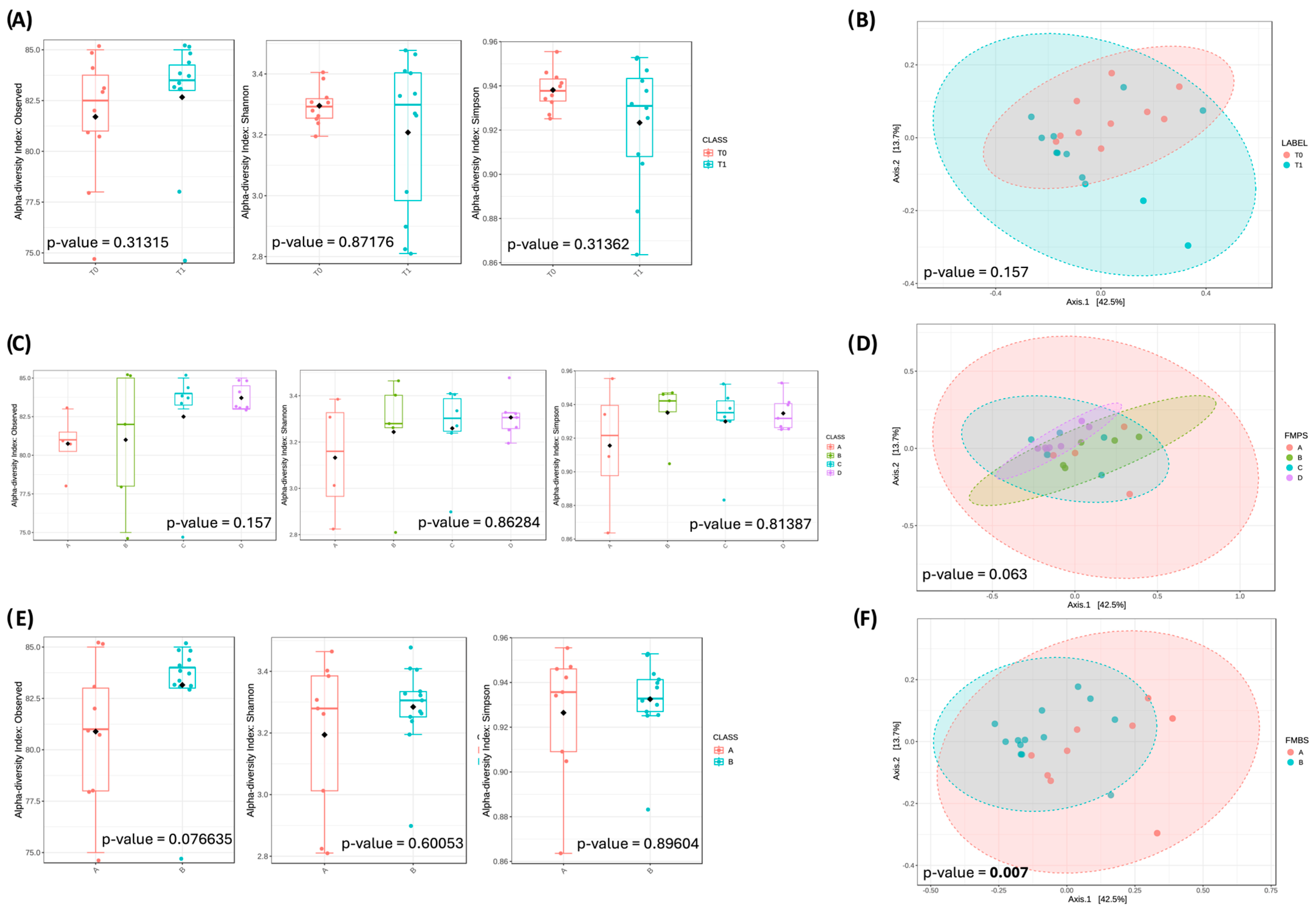
Figure 1. Alpha and beta diversity of the oral microbiota. The evaluation of the full mouth plaque score (FMPS) was performed at the beginning (T0) and at the end (T1) of the study, and the subjects were divided into A class (1–10%), B class (11–30%), C class (31–50%) and D class (>50%). Moreover, the blooding index (FMBS) was also considered in the initial (T0) and in the final (T1) conditions, as A class (1–10%) and B class (11–30%). (A) Alpha diversity indexes (number of observed species, Shannon and Simpson indexes) considering treatment. (B) Comparison by PCoA of the distance (with the Bray–Curtis distance-based method) of the different sample treatments (T0–T1). Statistical significance was performed using (PERMANOVA). (C) Alpha diversity indexes (number of observed species, Shannon and Simpson indexes) considering FMPS. (D) Comparison of the distance (with the Bray–Curtis distance-based method) of the different FMPS by PCoA. Statistical significance was performed using (PERMANOVA). (E) Alpha diversity indexes (number of observed species, Shannon and Simpson indexes) considering FMBS. (F) Comparison by PCoA of the distance (with the Bray–Curtis distance-based method) of the different FMBS. Statistical significance was performed using (PERMANOVA), p-value < 0.05. Beta diversity analysis was performed using the phyloseq package of Microbiome Analyst.
Microbiolres 16 00251 g001
Figure 2. PCA analysis of oral microbiota considering the treatment with Listerine® at species level. In a principal coordinates analysis (PCoA), each axis (or dimension) represents a direction in which the variation in microbial community composition is maximally separated, according to a chosen distance metric (e.g., Bray–Curtis). The first dimensions typically explain the largest proportion of the overall dissimilarity among samples. Although these axes do not correspond to specific biological variables, they provide an abstract spatial representation of community structure: samples positioned closer together share more similar microbial profiles, whereas those farther apart are more compositionally distinct. Thus, the PCoA dimensions should be interpreted as statistical constructs that summarize complex multivariate differences in a reduced, more tractable space. (a) Contributions of the clinical parameters and the species to different dimensions. (b) PCA with Dimensions 1 and 2 (Dimension 1, 29.2%, and Dimension 2, 16.9% of variability explained); the ball represents the mean of the samples, while the small dot indicates the single samples. (c) PCA with Dimensions 3 and 4 (Dimension 3, 14.8%, and Dimension 4, 8.9% of variability explained); the ball represents the mean of the samples, while the small dot indicates the single samples.
Microbiolres 16 00251 g002
Figure 3. PCA analysis of oral microbiota considering the FMBS, at species level. (a) Contributions of the clinical parameters and the species to different dimensions. (b) PCA with Dimensions 1 and 2 (Dimension 1, 29.2%, and Dimension 2, 16%, of variability explained); the ball represents the mean of the samples, while the small dot indicates the single samples. (c) PCA with Dimensions 3 and 4 (Dimension 3, 15.5%, and Dimension 4, 9.3% of variability explained); the ball represents the mean of the samples, while the small dot indicates the single samples.
Microbiolres 16 00251 g003
Figure 4. PCA analysis of gut microbiota considering the treatment with Listerine® at species level. In a principal coordinates analysis (PCoA), each axis (or dimension) represents a direction in which the variation in microbial community composition is maximally separated, according to a chosen distance metric (e.g., Bray–Curtis). (a) Contribution of the different species. (b) PCA with Dimensions 1 and 2 (Dimension 1, 31.1%, and Dimension 2, 22.2% of variability explained); the ball represents the mean of the samples, while the small dot indicates the single samples. (c) PCA with Dimensions 3 and 4 (Dimension 3, 14.8%, and Dimension 4, 9.5% of variability explained); the ball represents the mean of the samples, while the small dot indicates the single samples.
Microbiolres 16 00251 g004
Table 1. Signature induced by antimicrobial oral rinse in the oral and fecal microbiota.
ORAL MICROBIOTA
Treatment
Speciesp-ValueFDRT0T1--LDAscore
Gemella haemolysans0.0045320.286832495.4315.2--3.04
Gemella sp.0.00686220.2868316,5577753--3.64
Bacillus sp.0.0101230.2868312,2846795.7--3.44
Actinomyces viscosus0.0249680.418754641.710,855--−3.49
Unclassified Bacillota0.0295590.4187528,27520,852--3.57
Unclassified Bacteria0.0295590.41875117,490100,810--3.92
Unclassified Sphingomonadaceae0.0348060.42264265.241964.3--−2.93
Granulicatella sp.0.0409460.43505147246799.1--3.6
Streptococcus oralis0.0479130.452511536.5354.75--2.77
FMPS
Speciesp-ValueFDRABCDLDAscore
Streptococcus anginosus0.00250170.091112170.681737.911,44011,6863.76
Peptostreptococcus sp.0.002720.0911121762.7220.0418,88212,1413.97
Mogibacterium vescum0.00416990.091112259.111467.5933.0941853.29
Peptostreptococcus stomatis0.00428760.0911125234.8156.3324,49022,4274.09
Megasphaera micronuciformis0.00940570.159961.9245424.6601.57691.993.43
Olsenella phocaeensis0.0153090.193652303.7553.15203.947353.37
Streptococcus intermedius0.0159470.1936553,98052,95230,2328520.14.36
Mogibacterium timidum0.020660.21952159.35126.544012.11604.93.29
TM7 phylum sp oral0.0234010.2210124,809943854,97461,4584.42
Solobacterium sp.0.0302140.235571687.42205.93168.47259.93.45
Actinomyces massiliensis0.0305130.235571701.89631.94266.137813.6
Unclassified Atopobiaceae0.0332570.235571452.9696.033241.22826.63.11
Actinomyces israelii0.0420920.253813614142.23547.97968.233.24
Veillonella dispar0.0433430.2538126,99474,43511,23210,8324.5
Lachnoanaerobaculum saburreum0.044790.253812764.5711.875135.45977.73.42
FMBS
Speciesp-ValueFDRABCDLDAscore
Streptococcus anginosus0.000209540.0178111041.411,573--−3.72
Peptostreptococcus sp.0.000745450.031682905.6615,252--−3.86
Peptostreptococcus stomatis0.00120060.0326112413.423,380--−4.02
Olsenella phocaeensis0.00190160.0326111331.24951.4--−3.26
Mogibacterium timidum0.00191830.032611141.122715.9--−3.11
TM7 phylum sp oral0.00296230.0419661626958,465--−4.32
Unclassified Atopobiaceae0.00453880.0551141032.43017.9--−3
Streptococcus intermedius0.00684050.0709435340918541--4.24
Olsenella sp.0.00832790.070943344.4999.39--−2.52
Veillonella dispar0.00834620.07094353,35011,017--4.33
Eubacterium infirmum0.0122740.0802515130.415,496--−3.71
Solobacterium sp.0.0122740.0802511975.55371.5--−3.23
Solobacterium moorei0.0122740.0802515215.315,359--−3.71
Lachnoanaerobaculum saburreum0.0147930.0898171624.15589--−3.3
Mogibacterium vescum0.0212310.12031930.412684.1--−2.94
Eubacterium sp.0.0252820.13431548.561442.9--−2.65
Veillonella sp.0.0299850.149939099.82423.4--3.52
Lachnoanaerobaculum sp.0.0354210.167271195.13186.7--−3
Unclassified Streptococcaceae0.0488440.19771388.2765.94--2.49
Unclassified Eubacteriales0.0488440.19772044831,240--−3.73
Unclassified Erysipelotrichaceae0.0488440.1977687.051939.1--−2.8
GUT MICROBIOTA
Treatment
Speciesp-ValueFDRT0T1--LDAscore
Parabacteroides sp.0.000157050.013686418.382088.9--−2.92
Bacteroides sp.0.000285120.013686767.945919.5--−3.41
Phocaeicola sp.0.000506540.01620918489764.7--−3.6
Unclassified Lachnospiraceae0.00193970.046553145,830105,380--4.31
Alistipes sp.0.00457110.082543513.293287.1--−3.14
Unclassified Eubacteriales0.0051590.0825436782444192--4.07
Intestinibacter bartlettii0.00650170.0891661347.8658.69--2.54
Intestinibacter sp.0.0101650.108431677.1813.07--2.64
Blautia luti0.0101650.108434365.71911.3--3.09
Unclassified Bacillota0.0283660.272312226813051--3.66
Unclassified Bacteria0.0342940.29929240,380308,880--−4.53
Unclassified Peptostreptococcaceae0.041250.3380574639.9--3.23
Linear discriminant analysis (LDA) results, according to treatment, FMPS and FMBS factors for oral microbiota and according to treatment factor for fecal microbiota. The LEfSE algorithm employs the Kruskal–Wallis rank sum test to detect features with significant differential abundance with regard to class labels, followed by linear discriminant analysis to evaluate the relevance or effect size of differential abundant features. Features are significant, based on their discriminant analysis (p < 0.05); linear discriminant analysis effect size (LEfSe). FDR, false discovery rate. Treatment (baseline: T0 and after 28 days treatment with Listerine®: T1), full mouth plaque score (FMPS) (A = 1–10%; B = 11–30%; C = 31–50%; D > 50%) and full mouth bleeding score (FMBS) (A = 1–10%; B = 11–30%; C = 31–50%; D > 50%).
Disclaimer/Publisher’s Note: The statements, opinions and data contained in all publications are solely those of the individual author(s) and contributor(s) and not of MDPI and/or the editor(s). MDPI and/or the editor(s) disclaim responsibility for any injury to people or property resulting from any ideas, methods, instructions or products referred to in the content.