This is an early access version, the complete PDF, HTML, and XML versions will be available soon.
Review

Climate Change and Emerging Arboviral Threats in Saudi Arabia: Epidemiology, Vector Ecology, and One Health Preparedness


by
Shuaibu Abdullahi Hudu
1,2,*,
Emad A. Morad
3,
Ghusun M. Alhazimi
4 and
Abdulgafar Olayiwola Jimoh
5
1
Center for Health Research, Northern Border University, Arar 91431, Saudi Arabia
2
Department of Microbiology, Faculty of Medicine, Northern Border University, Arar 91431, Saudi Arabia
3
Department of Microbiology, Faculty of Medicine, Zagazig University, Zagazig 7120001, Al-Sharqia Governorate, Egypt
4
Department of Bacteriology Lab, Northern Border Regional Laboratory, Northern Borders Cluster, Arar 91431, Saudi Arabia
5
Department of Pharmacology and Therapeutics, Faculty of Basic Clinical Sciences, College of Health Sciences, Usmanu Danfodiyo University, Sokoto 840232, Sokoto State, Nigeria
*
Author to whom correspondence should be addressed.
Infect. Dis. Rep. 2026, 18(3), 57; https://doi.org/10.3390/idr18030057 (registering DOI)
Submission received: 21 April 2026 / Revised: 2 June 2026 / Accepted: 4 June 2026 / Published: 12 June 2026

Abstract

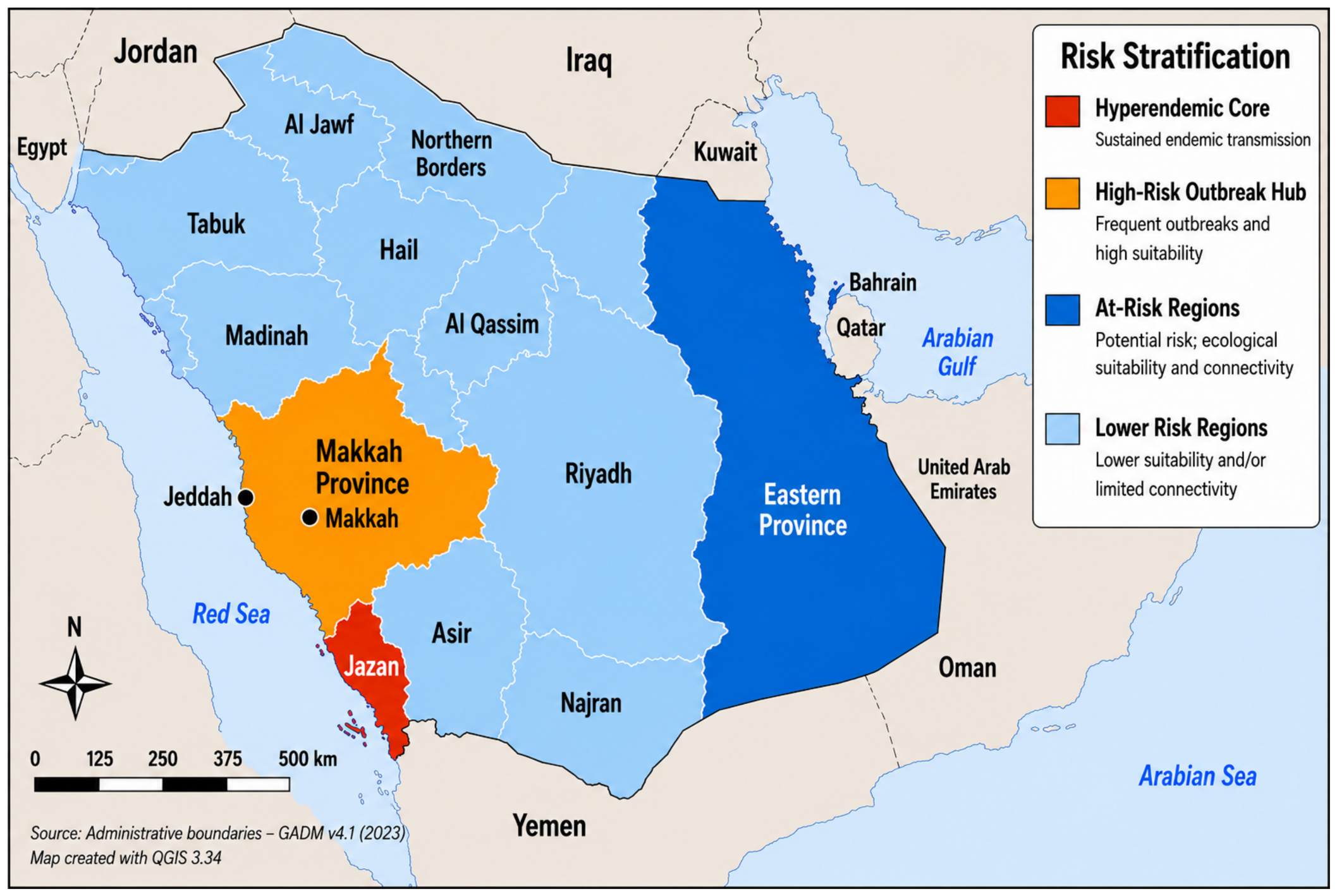
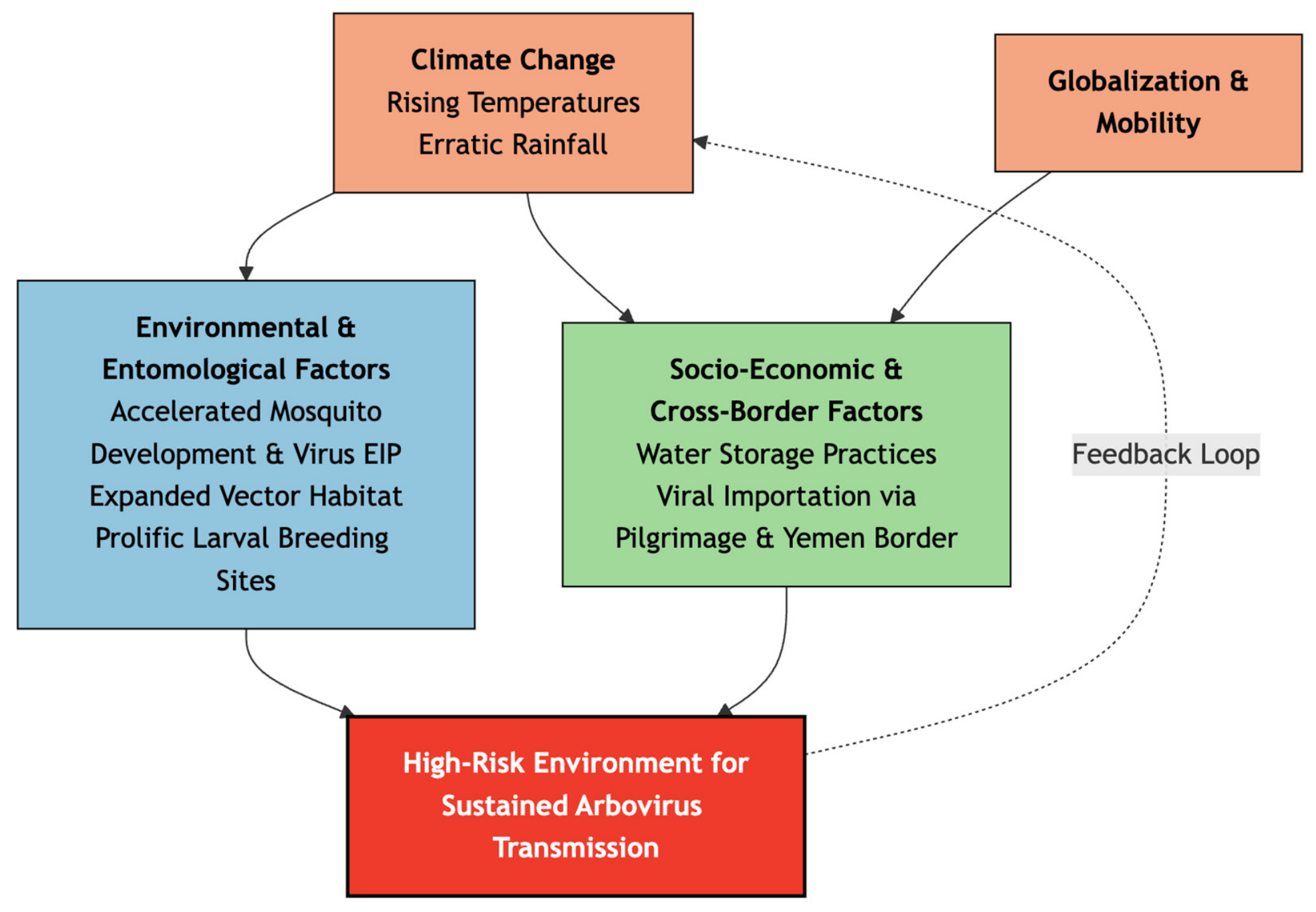
Arboviral diseases are emerging as important public health threats in Saudi Arabia, driven by rapid urbanization, climate variability, the expansion of Aedes aegypti populations, international travel, and large-scale religious mass gatherings. Dengue virus remains the most established arboviral infection in the Kingdom, particularly in the southwestern regions such as Jazan and the western urban centers of Makkah and Jeddah, where ecological and climatic conditions are conducive to sustained vector survival and transmission. This review synthesizes current evidence on the epidemiology, vector ecology, climatic determinants, diagnostics, and prevention strategies of arboviral diseases in Saudi Arabia. Particular attention is paid to the impacts of rising temperatures, changes in rainfall patterns, urban heat island effects, population mobility, and cross-border movement on vector expansion and disease emergence. The review also identifies gaps in surveillance, diagnostics, insecticide resistance monitoring, and integrated vector management programs. Emerging preparedness strategies include climate-informed early warning systems, Geographic Information System-based risk mapping, multiplex molecular diagnostics, genomic surveillance, and community-based vector control. The review emphasizes the importance of implementing a One Health approach that combines data on humans, the environment, entomology, and climate. Currently, sustained endemic transmission of chikungunya and Zika viruses has not been conclusively demonstrated in Saudi Arabia, but increased environmental suitability and connectivity with other areas highlight the need for proactive surveillance and preparedness.
Keywords: Aedes aegypti; arbovirus; climate change; dengue; Hajj; public health preparedness; Saudi Arabia; surveillance; vector control Aedes aegypti; arbovirus; climate change; dengue; Hajj; public health preparedness; Saudi Arabia; surveillance; vector control