

Progressive Multifocal Leukoencephalopathy in AIDS: The Diagnostic Role of PET Imaging

 , , ,
, , ,  and
and 
Abstract
1. Introduction
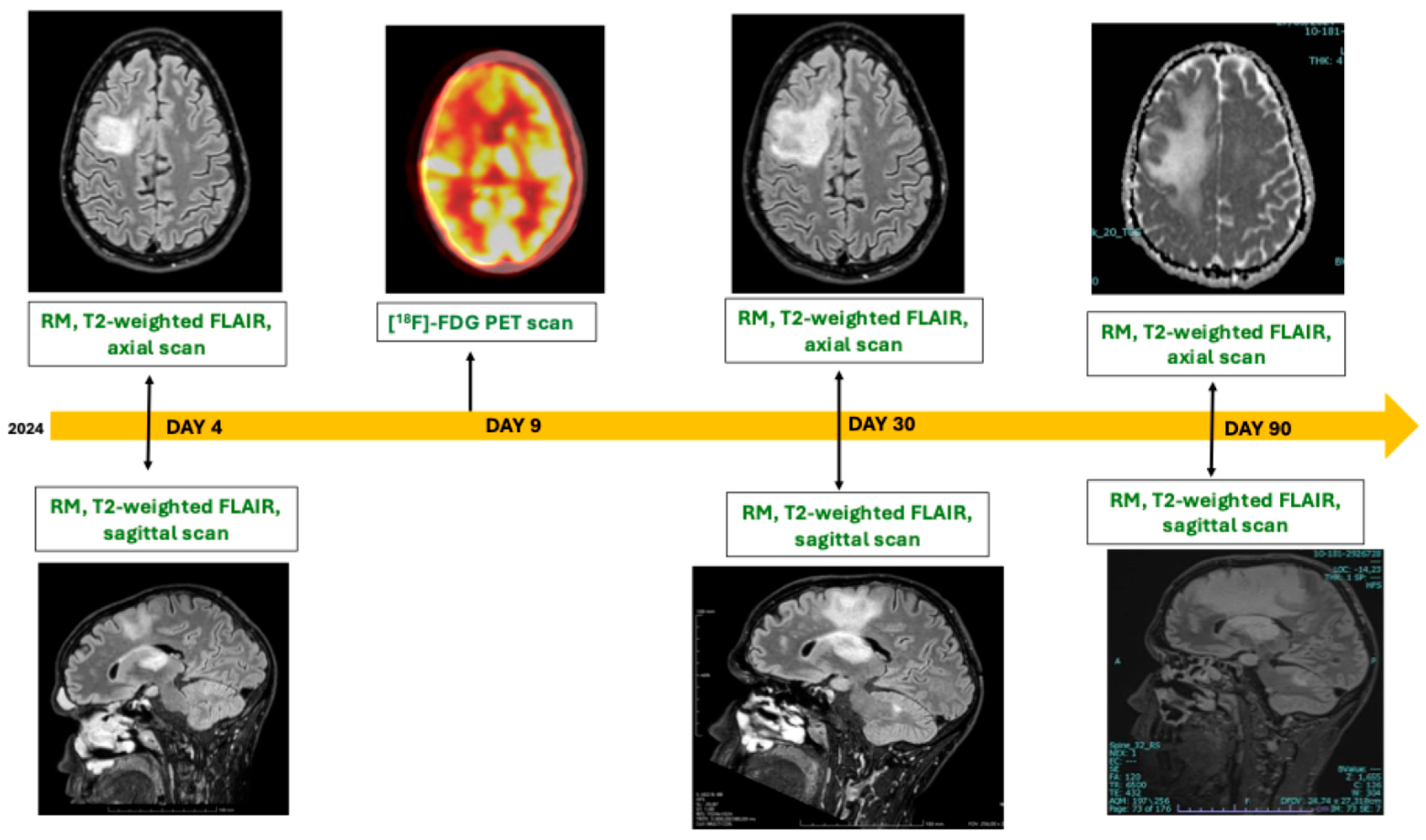
2. Case Description
3. Discussion and Conclusions

| Authors | Year | Number of Cases | Underlying Disease(s) | CSF JCV-DNA | FDG-PET Findings |
|---|---|---|---|---|---|
| Kiyosawa et al. [9] | 1988 | 1 | CLL | - | Right cerebral and left cerebellar hypometabolism |
| Hoffman et al. [10] | 1993 | 1 | HIV | - | Slight hypometabolism relative to malignancies but hypermetabolism relative to infections |
| Mark A. Pierce et al. [11] | 1995 | 2 | HIV | - | First patient: Intralesional hypometabolism Second patient: Intralesional hypermetabolism |
| Heald et al. [12] | 1996 | 2 | HIV | - | Hypermetabolism relative to infections and similar metabolism to lymphomas |
| Ochi et al. [13] | 1996 | 1 | ATL | - | Intralesional hypometabolism |
| O’Doherty et al. [14] | 1997 | 3 | HIV | - | Hypometabolism compared to malignant lesions |
| Mertens et al. [15] | 2011 | 1 | Post-transplant | - | Intralesional hypermetabolism |
| Ashesh et al. [16] | 2014 | 1 | MS under treatment with natalizumab | - | Diffuse hypometabolism in the left cerebral hemisphere |
| Shirai et al. [17] | 2014 | 3 | 1. HBV-related HCC 2. MALT lymphoma 3. SLE and DM under treatment with azathioprine and CCS | 1: - 2: 5080 cp/mL 3: 6230 cp/mL | Intralesional hypometabolism |
| Ishibashi et al. [18] | 2017 | 1 | T-cell lymphoma | 73,340 cp/mL | Intralesional hypometabolism |
| Kamourieh et al. [19] | 2017 | 1 | MS under treatment with natalizumab | 17,000 cp/mL | Intralesional hypometabolism |
| Baheerathan et al. [20] | 2018 | 1 | MS under treatment with natalizumab | - | Hypometabolism at the level of the dentate nucleus Hypermetabolism at the level of the pons and middle cerebellar peduncle, suggestive of PML-IRIS |
| Barritt et al. [21] | 2022 | 1 | MS under treatment with fingolimod | 160 cp/mL | Intralesional hypometabolism |
| Chiba et al. [7] | 2024 | 1 | Mantel cell lymphoma | 853 cp/mL | Intralesional hypometabolism |
| Our case | 2025 | 1 | HIV | 813 cp/mL | Intralesional hypometabolism |
Author Contributions
Funding
Institutional Review Board Statement
Informed Consent Statement
Data Availability Statement
Acknowledgments
Conflicts of Interest
Abbreviations
| PML | progressive multifocal leukoencephalopathy |
| JCV | polyomavirus JC |
| CNS | central nervous system |
| FDG-PET | fluorodeoxyglucose positron emission tomography |
| MRI | magnetic resonance imaging |
| CSF | cerebrospinal fluid |
| HIV | human immunodeficiency virus |
| IRIS | immune reconstitution inflammatory syndrome |
| PLT | platelets |
| IVIG | intravenous immunoglobulin |
| ATL | acute T-cell leukemia |
| CCS | corticosteroids |
| CLL | chronic lymphocytic leukemia |
| DM | dermatomyositis |
| HBV | hepatitis B virus |
| HCC | hepatocellular carcinoma |
| LCC | chronic lymphocytic leukemia |
| MS | multiple sclerosis |
| SLE | systemic lupus erythematosus |
| MALT | mucosa-associated lymphoid tissue |
References
- Cortese, I.; Reich, D.S.; Nath, A. Progressive multifocal leukoencephalopathy and the spectrum of JC virus-related disease. Nat. Rev. Neurol. 2021, 17, 37–51. [Google Scholar] [CrossRef]
- Berger, J.R.; Aksamit, A.J.; Clifford, D.B.; Davis, L.; Koralnik, I.J.; Sejvar, J.J.; Bartt, R.; Major, E.O.; Nath, A. PML diagnostic criteria: Consensus statement from the AAN Neuroinfectious Disease Section. Neurology 2013, 80, 1430–1438. [Google Scholar] [CrossRef]
- Swinnen, B.; Saegeman, V.; Beuselinck, K.; Wouters, A.; Cypers, G.; Meyfroidt, G.; Schrooten, M. Predictive value of JC virus PCR in cerebrospinal fluid in the diagnosis of PML. Diagn. Microbiol. Infect. Dis. 2019, 95, 114859. [Google Scholar] [CrossRef] [PubMed]
- Zhai, S.; Brew, B.J. Progressive multifocal leukoencephalopathy. In Handbook of Clinical Neurology; Elsevier: Amsterdam, The Netherlands, 2018; Volume 152, pp. 123–137. [Google Scholar]
- Baldassari, L.E.; Wattjes, M.P.; Cortese, I.C.M.; Gass, A.; Metz, I.; Yousry, T.; Reich, D.S.; Richert, N. The neuroradiology of progressive multifocal leukoencephalopathy: A clinical trial perspective. Brain 2022, 145, 426–440. [Google Scholar] [CrossRef]
- Horger, M.; Beschorner, R.; Beck, R.; Nägele, T.; Schulze, M.; Ernemann, U.; Heckl, S. Common and uncommon imaging findings in progressive multifocal leukoencephalopathy (PML) with differential diagnostic considerations. Clin. Neurol. Neurosurg. 2012, 114, 1123–1130. [Google Scholar] [CrossRef]
- Chiba, Y.; Kawakita, R.; Mitamura, K.; Takahashi, K.; Suzuki, T.; Nakamichi, K.; Suzuki, K.; Morishita, A.; Kobara, H.; Deguchi, K.; et al. 18F-THK5351 Positron Emission Tomography Clearly Depicted Progressive Multifocal Leukoencephalopathy after Mantle Cell Lymphoma Treatment. Intern. Med. 2024, 63, 2325–2329. [Google Scholar] [CrossRef]
- Mahler, C.; Schumacher, A.-M.; Unterrainer, M.; Kaiser, L.; Höllbacher, T.; Lindner, S.; Havla, J.; Ertl-Wagner, B.; Patzig, M.; Seelos, K.; et al. TSPO PET imaging of natalizumab-associated progressive multifocal leukoencephalopathy. Brain 2021, 144, 2683–2695. [Google Scholar] [CrossRef] [PubMed]
- Kiyosawa, M.; Bosley, T.M.; Alavi, A.; Gupta, N.; Rhodes, C.H.; Chawluk, J.; Kushner, M.; Savino, P.J.; Sergott, R.C.; Schatz, N.J.; et al. Positron emission tomography in a patient with progressive multifocal leukoencephalopathy. Neurology 1988, 38, 1864–1867. [Google Scholar] [CrossRef] [PubMed]
- Hoffman, J.M.; Waskin, H.A.; Schifter, T.; Hanson, M.W.; Gray, L.; Rosenfeld, S.; Coleman, R.E. FDG-PET in differentiating lymphoma from nonmalignant central nervous system lesions in patients with AIDS. J. Nucl. Med. 1993, 34, 567–575. [Google Scholar]
- Pierce, M.A.; Johnson, M.D.; Maciunas, R.J.; Murray, M.J.; Allen, G.S.; Harbison, M.A.; Creasy, J.L.; Kessler, R.M. Evaluating contrast-enhancing brain lesions in patients with AIDS by using positron emission tomography. Ann. Intern. Med. 1995, 123, 594–598. [Google Scholar] [CrossRef]
- Heald, A.E.; Hoffman, J.M.; Bartlett, J.A.; Waskin, H.A. Differentiation of central nervous system lesions in AIDS patients using positron emission tomography (PET). Int. J. STD AIDS 1996, 7, 337–346. [Google Scholar] [CrossRef] [PubMed]
- Ochi, H.; Yamada, T.; Hara, H.; Yoshimura, T.; Iwaki, T.; Nagashima, K.; Yogo, Y.; Kobayashi, T. A case of progressive multifocal leukoencephalopathy with methionine uptake demonstrated by PET. Rinsho Shinkeigaku 1996, 36, 858–863. [Google Scholar] [PubMed]
- O’Doherty, M.J.; Barrington, S.F.; Campbell, M.; Lowe, J.; Bradbeer, C.S. PET scanning and the human immunodeficiency virus-positive patient. J. Nucl. Med. 1997, 38, 1575–1583. [Google Scholar] [PubMed]
- Mertens, K.; Acou, M.; Van den Broecke, C.; Nuyts, R.; Van Roost, D.; Achten, E.; Goethals, I. Progressive multifocal leukoencephalopathy (PML) mimicking high-grade glioma on delayed F-18 FDG PET imaging. J. Clin. Neurosci. 2012, 19, 1167–1169. [Google Scholar] [CrossRef]
- Thaker, A.A.; Schmitt, S.E.; Pollard, J.R.; Dubroff, J.G. Natalizumab-induced progressive multifocal leukoencephalopathy. Clin. Nucl. Med. 2014, 39, e365–366. [Google Scholar] [CrossRef]
- Shirai, S.; Yabe, I.; Kano, T.; Shimizu, Y.; Sasamori, T.; Sato, K.; Hirotani, M.; Nonaka, T.; Takahashi, I.; Matsushima, M.; et al. Usefulness of 11C-methionine-positron emission tomography for the diagnosis of progressive multifocal leukoencephalopathy. J. Neurol. 2014, 261, 2314–2318. [Google Scholar] [CrossRef]
- Ishibashi, K.; Miura, Y.; Matsumura, K.; Kanemasa, Y.; Nakamichi, K.; Saijo, M.; Toyohara, J.; Ishii, K. PET Imaging of 18F-FDG, 11C-methionine, 11C-flumazenil, and 11C-4DST in Progressive Multifocal Leukoencephalopathy. Intern. Med. 2017, 56, 1219–1223. [Google Scholar] [CrossRef]
- Kamourieh, S.; Gananandan, K.; Raffel, J.; Nicholas, R. Natalizumab granule cell neuronopathy: FDG-PET in diagnosis and immune reconstitution with G-CSF. Neurol. Neuroimmunol. Neuroinflamm. 2017, 4, e384. [Google Scholar] [CrossRef]
- Baheerathan, A.; McNamara, C.; Kalam, S.; Rane, N.; Barwick, T.D.; Grote, H.; Nicholas, R. The utility of FDG-PET imaging in distinguishing PML-IRIS from PML in a patient treated with natalizumab. Neurology 2018, 91, 572–573. [Google Scholar] [CrossRef]
- Barritt, A.W.; Das, E.; Morley, N.; Seymour, M.; Saha, R.; Vera, J.; Vundavalli, S.; Dizdarevic, S.; Nicholas, R.; Berger, J.R.; et al. Management approach including pembrolizumab for fingolimod-associated progressive multifocal leukoencephalopathy in a patient with relapsing-remitting multiple sclerosis. Mult. Scler. 2023, 29, 301–306. [Google Scholar] [CrossRef]

Disclaimer/Publisher’s Note: The statements, opinions and data contained in all publications are solely those of the individual author(s) and contributor(s) and not of MDPI and/or the editor(s). MDPI and/or the editor(s) disclaim responsibility for any injury to people or property resulting from any ideas, methods, instructions or products referred to in the content. |
© 2026 by the authors. Licensee MDPI, Basel, Switzerland. This article is an open access article distributed under the terms and conditions of the Creative Commons Attribution (CC BY) license.
Share and Cite
Donini, V.; Paggi, R.; Farese, A.; Malcontenti, C.; Tagliaferri, E.; Caroselli, C.; Sani, S.; Matteini, M.; Bartoloni, A.; Zammarchi, L. Progressive Multifocal Leukoencephalopathy in AIDS: The Diagnostic Role of PET Imaging. Infect. Dis. Rep. 2026, 18, 33. https://doi.org/10.3390/idr18020033
Donini V, Paggi R, Farese A, Malcontenti C, Tagliaferri E, Caroselli C, Sani S, Matteini M, Bartoloni A, Zammarchi L. Progressive Multifocal Leukoencephalopathy in AIDS: The Diagnostic Role of PET Imaging. Infectious Disease Reports. 2026; 18(2):33. https://doi.org/10.3390/idr18020033
Chicago/Turabian StyleDonini, Virginia, Riccardo Paggi, Alberto Farese, Costanza Malcontenti, Enrico Tagliaferri, Claudio Caroselli, Spartaco Sani, Maria Matteini, Alessandro Bartoloni, and Lorenzo Zammarchi. 2026. "Progressive Multifocal Leukoencephalopathy in AIDS: The Diagnostic Role of PET Imaging" Infectious Disease Reports 18, no. 2: 33. https://doi.org/10.3390/idr18020033
APA StyleDonini, V., Paggi, R., Farese, A., Malcontenti, C., Tagliaferri, E., Caroselli, C., Sani, S., Matteini, M., Bartoloni, A., & Zammarchi, L. (2026). Progressive Multifocal Leukoencephalopathy in AIDS: The Diagnostic Role of PET Imaging. Infectious Disease Reports, 18(2), 33. https://doi.org/10.3390/idr18020033