Article

Non-Steroidal Anti-Inflammatory Drugs and Capsule Endoscopy—Spectrum of Presentation and Longitudinal Follow-Up


1
Academic Unit of Gastroenterology and Hepatology, Sheffield Teaching Hospitals, NHS Foundation Trust, Sheffield S5 7AU, UK
2
Central Manchester University Hospitals, NHS Foundation Trust, Manchester M13 9WL, UK
3
Division of Clinical Medicine, School of Medicine and Population Health, University of Sheffield, Sheffield S10 2RX, UK
*
Author to whom correspondence should be addressed.
Gastroenterol. Insights 2026, 17(2), 26; https://doi.org/10.3390/gastroent17020026
Submission received: 30 January 2026 / Revised: 9 March 2026 / Accepted: 8 April 2026 / Published: 14 April 2026
(This article belongs to the Section Gastrointestinal Disease)

Abstract

Background/Objectives: Non-steroidal anti-inflammatory drug (NSAID)-induced small bowel (SB) injuries have a variable clinical and endoscopic presentation. Limited data exists regarding their long-term outcomes, natural course, and discerning factors and differentiation from Crohn’s disease (CD). This study aims to evaluate the spectrum of presentation at capsule endoscopy (CE) and outcome in patients with documented NSAID use. Methods: We retrospectively evaluated all CEs performed at our hospital from 2014 to July 2023 in patients with documented NSAID use and with SB injury on CE. Patients’ demographics, clinical and endoscopic data, CE findings and outcome were recorded. Results: A total of 52 patients (33 females; median age 54 years, IQR 41–65) with documented NSAID use who underwent CE were included. The most prominent findings were erosions (56%) and superficial (46%) and deep ulcers (21%). Median follow-up time was 16 months (IQR 4–57). A total of 26 (50%) patients underwent repeat CE after a median interval of 12 months (IQR 10–15). In 77% (n = 20) of patients, SB injury was still present, with the majority (80%) having a Lewis score of < 790. Overall, compared to the previous CE, there were no changes in 35% of cases, worse appearance in 35%, and an improvement in 30%. SB CD was diagnosed in 7 out of 26 patients on follow-up. There were no statistically significant clinical or endoscopic differences between those with NSAID enteropathy and those diagnosed with CD. Conclusions: NSAID enteropathy presents with a wide spectrum of SB injuries, which cannot be differentiated on CE images alone. This highlights the importance of the clinical picture in the diagnostic process of these patients. Furthermore, our study demonstrated that a percentage of patients still exhibit some degree of SB damage despite cessation of NSAIDs for several months.

1. Introduction

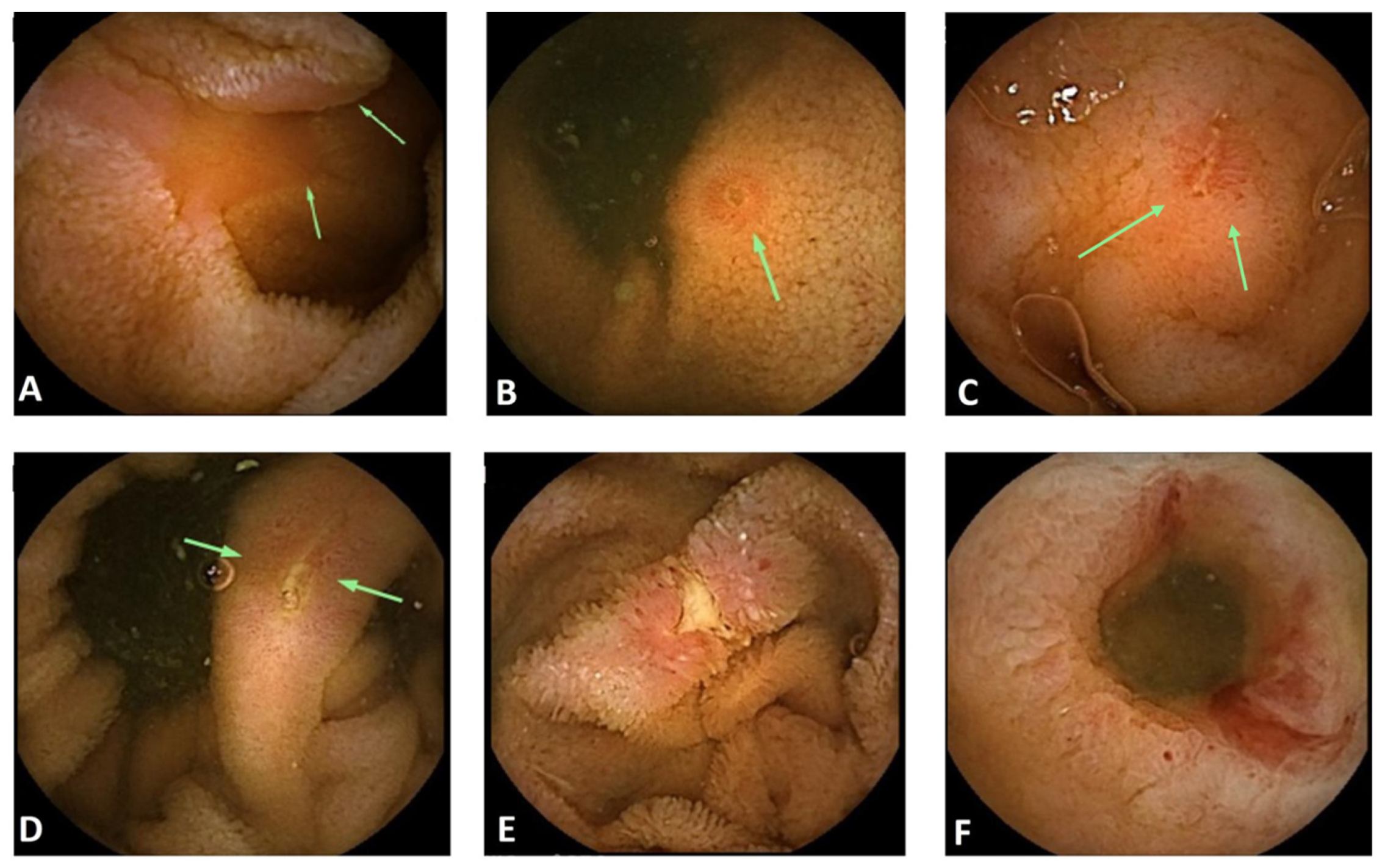
Non-steroidal anti-inflammatory drug (NSAID) enteropathy is a well-known entity, with a rising incidence over the last few years [1,2]. NSAIDs are among the most commonly prescribed agents, especially amongst patients over 65 years old [3]. Recent advancements in diagnostic techniques, particularly small bowel (SB) capsule endoscopy (CE), have highlighted the prevalence and severity of NSAID-induced enteropathy [4,5]. In NSAID users, mucosal injuries observed range from mucosal erythema, mucosal breaks, and areas of denudation to erosions, ulcerations and diaphragmatic strictures [4] (Figure 1). Mucosal involvement has been detected in up to 70% of patients with documented chronic NSAID use [6,7]. Patients may be asymptomatic with or without iron deficiency anaemia. Other presentations may include abdominal pain, sub-occlusive symptoms, hypoalbuminaemia, weight loss and overt SB bleeding [8,9]. Due to its heterogeneous presentation with nonspecific and overlapping findings, the diagnosis of NSAID enteropathy poses challenges, particularly in differentiating it from conditions such as Crohn’s disease (CD).
Patients with Crohn’s disease typically present with chronic diarrhoea, abdominal pain, weight loss, and fatigue. Laboratory investigations often demonstrate elevated inflammatory markers, including C-reactive protein and faecal calprotectin, as well as anaemia and occasionally hypoalbuminaemia [10]. Endoscopic assessment of the colon and small bowel may reveal patchy mucosal inflammation, aphthous ulcers, cobblestoning, and skip lesions, while intestinal biopsies may demonstrate transmural inflammation, granulomas, crypt architectural distortion, and focal ulceration. Crohn’s disease diagnosis is established through a combination of clinical presentation, endoscopic findings, histopathology, and cross-sectional imaging [10].
There are no reliable biomarkers for diagnosis or monitoring of the severity of mucosal damage or distinguishing NSAID enteropathy from CD [9,11]. Several studies have shown that faecal calprotectin is raised in 44–70% of patients on NSAIDs [8,12]. Additionally, although crucial in diagnosing most gastrointestinal pathologies, histology is nonspecific or inconclusive in up to 80% of cases of SB biopsy sampling [13,14]. A misdiagnosis of CD has been reported in up to 25% of cases of NSAID enteropathy [15].
The understanding of the long-term outcomes and natural course of NSAID-induced enteropathy is still limited, with previous studies mainly focusing on the incidence and description of NSAID-induced SB injuries.
The aim of the study was to evaluate and describe the spectrum of presentations observed through capsule endoscopy and the clinical and endoscopic outcomes of patients with documented NSAID use.

2. Materials and Methods

In this single-centre retrospective study, we aimed to evaluate the spectrum of presentation of SB inflammatory lesions on CE in patients with documented NSAID use and their outcomes. Follow-up data were collected, including repeat procedures and final diagnosis. All adult patients (>16 years old) who underwent SB CE with declared NSAID use and presence of SB injury at CE at Sheffield Teaching Hospital (Sheffield, UK) from January 2014 to July 2023 were included. Patients were specifically asked about NSAID use, including surreptitious and non-prescriptive use. Inflammatory SB injuries consistent with NSAID use were defined as mucosal erythema, mucosal breaks, areas of denudation, subepithelial haemorrhages, erosions, ulcerations, and stenosis. All capsules were reported by 2 expert CE readers (>1000 lifetime CE reads). All SB CE types used at our institution were included, specifically Pill Cam SB3 (Medtronic, Dublin, Ireland) and Capsocam (CapsoVision Inc., Saratoga, CA, USA).
Medical records of enrolled patients were retrospectively evaluated, and data were collected including demographics, clinical symptoms and duration, previous NSAID use (Naproxen, Ibuprofen, Diclofenac), and use of other medications such as proton pump inhibitors (PPIs) and selective serotonin reuptake inhibitors (SSRIs). Blood indices were reviewed specifically for the presence of anaemia and haematinic deficiency and albumin levels. When available, NSAID type (topical NSAID steroids were not included) and frequency (daily, weekly or as-needed use), blood tests (haemoglobin, albumin, C-reactive protein, vitamin B12, folate, ferritin), faecal calprotectin, findings at standard bi-directional endoscopic investigations, and cross-sectional imaging findings were recorded as well. SB CE findings (classified as erosions, superficial ulcers, deep ulcers, white-tipped villi, denuded mucosa, stenosis, red patches/erythema), completeness of SB CE, location of the lesions along the SB (proximal, distal or diffuse changes—tertiles defined based on SB transit times where proximal SB corresponds to the first tertile, distal to the second and/or third tertiles), SB CE retention, SB transit time, and Lewis score [15] were collected. In a proportion of patients where double-balloon enteroscopy (DBE) was carried out, findings and subsequent histology were collated, including final outcome and requirement for surgery.
All investigations included in our study had to be performed within 3 months prior to or after CE.
In patients who had a second capsule endoscopy on the basis of clinical need, the reported time since cessation of NSAIDs (more or less than 6 months) and use of additional medications such as steroids (local or systemic steroids) were scrutinised along with all the previously mentioned parameters.
Patients with a preexisting diagnosis of Crohn’s disease were excluded, as well as those with less than 6 months of follow-up.

Statistical Analysis

Continuous variables are summarised as medians with interquartile ranges (IQR) and categorical variables are presented as numbers and proportions. Comparisons between groups were performed using Fisher’s exact test. A two-sided p-value of <0.05 was considered statistically significant. All statistical analyses were performed using Stata version 18 (StataCorp, College Station, TX, USA). The study was approved by the Health Research Authority (HRA) IRAS project ID 295838.

3. Results

3.1. Demographic and Clinical Data

A total of 73 patients with documented NSAID use who underwent SB CE and had inflammatory lesions compatible with NSAID enteropathy on CE were included. Twenty patients were excluded from the study: 13 due to insufficient follow-up or lack of clinical data and 7 due to having a pre-existing diagnosis of Crohn’s disease. The remaining 52 patients were analysed. The majority of patients were females (63%; n = 33), and the median age of the patients was 54 (IQR 41–65, range 22–79) years old. The median follow-up time was 16 months (IQR 4.4–57). Patients’ demographic and clinical features are shown in Table 1.
All patients reported use of NSAIDs, with 40% (n = 21) reporting weekly consumption, 13% (n = 7) daily and 13% (n = 7) on an as-needed basis; however, the exact frequency of intake was not available for 34% (n = 17) of patients. The most common NSAIDs taken in our cohort were ibuprofen (31%, n = 16) and naproxen (31%, n = 16), followed by low-dose aspirin (15%, n = 8) and diclofenac (10%, n = 5). Other concomitant drugs taken by patients included PPIs (46%, n = 24), anticoagulants (6%, n = 3), other anti-platelets (4%, n = 2) and selective serotonin reuptake inhibitors (2%, n = 1).
The most common indications for SB CE were gastrointestinal symptoms (50%, n = 26), iron deficiency anaemia (29%, n = 15), or both symptoms and anaemia (21%, n = 11). The most frequent symptoms were abdominal pain (56%, n = 29), diarrhoea (38%, n = 20), weight loss (13%, n = 7) and altered bowel habits (10%, n = 5), with 58% (n = 23) having two or more gastrointestinal symptoms. All patients had symptoms for at least 4 months (range 4–36 months) prior to SB CE. Iron deficiency anaemia was present in 50% (n = 26) of cases, with the majority (58%, n = 15) being asymptomatic from a gastrointestinal point of view.
Most patients underwent other investigations in their diagnostic work-up: endoscopic tests (94%, n = 49), specifically traditional bidirectional endoscopy (71%, n = 37), esophago-gastroduodenoscopy alone (4%, n = 2), and colonoscopy (21%, n = 11), which were not contributory, and cross-sectional imaging tests (60%, n = 31). In 20 patients (39%), faecal calprotectin was requested, showing values of >50 mg/kg in 90% (n = 18/20) and >150 mg/kg in 50% (n = 10/20).

3.2. Small Bowel Capsule Findings

The most prominent finding at SB CE was erosions (56%, n = 29), followed by superficial ulcers (46%, n = 24), mucosal erythema (31%, n = 16), deep ulcers (21%, n = 11) and stenosis (8%, n = 4). There were four incomplete capsule examinations (8%) but no cases of capsule retention. Lesions were more frequently distributed in the distal SB compared with the proximal SB (57.7% vs. 15.3%, p = 0.007). The median Lewis score was 186 (IQR 112–450, range 0–3360). Further details on SB CE findings and characteristics are provided in Table 2. As shown in Table 3, device-assisted enteroscopy (DAE) was performed in 13 patients to obtain a histological sample of the lesions visualised at SB CE due to uncertainty of the diagnosis. Biopsies were performed in 7/13 patients, all resulting either normal findings or showing non-specific findings, except in one case which was suggestive of NSAID-related SB damage.

3.3. Follow-Up Small Bowel Capsule

A second SB CE was performed in 26 patients of our cohort, as dictated by the responsible clinician. The median time interval between the two capsules was 12 months (IQR 10–15, range 4–44). Seventy-three percent (n = 19) of patients had suspended NSAID use for longer than 6 months before the second capsule endoscopy. Among the seven patients still on NSAIDs at follow-up, five were taking low-dose aspirin and two ingested NSAIDs as required.
On follow-up CE, SB inflammatory lesions (Lewis score > 135) were still observed in 77% (n = 20) of patients, with the majority (80%) demonstrating mild changes (Lewis score 135–790). The median Lewis score was 225 (IQR 118–675, range 0–3360). Among those with persistent SB inflammation, 35% showed no changes compared to the previous CE findings (Lewis score ± 200 compared to previous CE), 35% worsened, and 30% showed improvement. Detailed findings on the second CE are summarised in Table 4.
Among this subgroup of patients, 12% (n = 6) of patients were prescribed a reducing course of steroids (i.e., budesonide) as a trial before the second capsule. Of this group of patients, one-third (2/6) experienced an improvement/normalisation of the Lewis score while half (3/6) experienced an increase in the Lewis score. Small bowel CD was diagnosed in 7 out of 26 patients on follow-up, based on a combination of symptoms, blood parameters, and CE +/− histology. Interestingly, among those treated with budesonide with an increase in the Lewis score, only one was eventually diagnosed with CD, while the other two were diagnosed with NSAID enteropathy with diaphragmatic SB stricture. There were no statistically significant differences in any clinical or endoscopic parameter between those with NSAID enteropathy and those that were diagnosed with CD.

4. Discussion

This retrospective study assessed the features and outcomes of NSAID-related enteropathy in patients undergoing SB CE. To the best of our knowledge, this is one of the few studies that included a second follow-up SB CE to assess endoscopic disease progression. This significantly contributes to the current literature, as most studies primarily include only clinical follow-up [16,17,18,19]. Although minor erosions can be found in up to 10% of healthy subjects, our study demonstrates the impact of NSAIDs to cause a variety of small bowel injuries, with significant erosions and superficial ulcers being the most common findings [18,19,20], in up to 60% of patients. In our patients, NSAID-related lesions were more frequently located in the distal SB compared to other SB tertiles. The literature presents conflicting data regarding lesion distribution. Goldstein et al. [19] found no significant difference in the distribution of mucosal breaks throughout the SB, while Fujimori et al. [21] found a higher incidence of ulcers in the distal SB, and Sugimori et al. [16] observed more frequent mucosal breaks in the jejunum.
The pathogenesis of NSAID enteropathy, although not completely understood, is believed to be multifactorial [22]. Similar to NSAID-induced gastro-duodenal damage, through cyclooxygenase inhibition, NSAIDs have a topical effect, impairing prostaglandin production and facilitating mucosal ulceration. In the SB, these alterations compromise cellular gut barrier function, resulting in permeability of bacterial toxins, in turn activating inflammatory cascades and stimulating pro-inflammatory cytokine secretion and neutrophil-mediated mucosal damage [22]. In contrast to NSAID injury in the upper gastrointestinal tract, PPIs do not appear to have a protective role in NSAID enteropathy; rather, they may exacerbate it. Studies suggest that the combination of NSAIDs and PPIs can lead to SB damage more frequently than NSAIDs alone [9,19,23]. By altering the gut pH, PPIs can lead to gut dysbiosis and a reduction in Gram-positive bacteria [24] (Actinobacteria and Bifidobacteria spp.), which have a protective effect on the intestinal mucosa. This, in turn, makes the SB more susceptible to ulceration and bleeding upon NSAID exposure [9,23,24]. Interestingly, our study did not confirm this finding when comparing the severity of the lesions—based on the Lewis score (>790) or the presence of at least one deep ulcer—in patients taking NSAIDs alone versus those taking NSAIDs and PPIs. This may be due to the relatively small number of patients included and the exclusion of patients on NSAIDs who did not have inflammatory lesions at SB CE.
The differential diagnosis of SB inflammatory lesions, such as ulcers and erosions, primarily includes CD and NSAID enteropathy, but also intestinal tuberculosis, especially in endemic areas, and idiopathic terminal ileitis (ITI) [25]. The latter, the incidence of which has been rising in the last few years, is defined by the presence of inflammatory stigmata exclusively involving the terminal ileum, which cannot be attributed to any other pathological condition [25]. ITI is a challenging entity to diagnose, as about 30% of patients first diagnosed with it eventually develop specific pathologies, most commonly Crohn’s disease. Given the lack of reliable predictive factors, ITI should be followed up, preferably using non-invasive modalities such as SB CE and faecal calprotectin [25]. Histologically, NSAID-induced enteropathy may present with ulcers, usually surrounded by normal mucosa, eosinophilic infiltrate or submucosal fibrosis without inflammatory infiltrate at deeper muscular layers [26]. However, in the majority of cases, histology is non-specific, as demonstrated in our study. Studies evaluating the diagnostic yield of histological sampling for SB inflammatory lesions (including CD, intestinal tuberculosis, NSAID enteropathy) show a low diagnostic yield, with results being non-specific or inconclusive in up to 80% of cases [10,25].
When comparing lesion distribution between CD and NSAID enteropathy, our study did not find any statistically significant difference. Although this result might be influenced by the low number of CD patients in our study, the well-known preferential involvement of the terminal ileum and distal ileum in CD supports our findings [26].
In our study, after the first CE, six patients were started on a trial of budesonide, followed by a second CE. Of these, only one was eventually diagnosed with CD, while the remaining five were identified as having NSAID-induced enteropathy. Notably, in half of these patients, budesonide treatment did not result in an improvement in SB mucosal damage [27,28].
Other possible treatments for preventing and treating NSAID enteropathy include muco-protective agents, such as misoprostol and rebamipide [4,6]. The first is a synthetic prostaglandin and the second is an amino acid derivative that stimulates prostaglandin production [4,29]. The rationale for their use in NSAID enteropathy is to counteract NSAID-induced prostaglandin depletion and mitigate known gastrointestinal damage [4,30]. However, the data available on them is not convincing in terms of efficacy in the case of rebamipide [29] and associated side effects (diarrhoea) for misoprostol [4]. Additionally, therapies such as antibiotics (metronidazole) and probiotics have been suggested, with the aim of modulating gut dysbiosis and the related pro-inflammatory processes. However, their role in treating NSAID-induced lesions is still unclear [4]. At follow-up, when comparing patients diagnosed with CD and those with NSAID enteropathy, there was no statistically significant difference in clinical or endoscopic variables, including faecal calprotectin, haemoglobin levels, Lewis score at the first SB CE and symptoms. These results may be due to the retrospective nature of the study and the small number of patients diagnosed with CD (n = 7), limiting our statistical power. Elevations in faecal calprotectin cannot be used to differentiate NSAID enteropathy from CD, as shown in our study and in the published literature [8,12].
Overall, these findings underline the challenges in diagnosing SB CD, emphasising the crucial roles that clinical presentation and accurate history collection have in the diagnostic process. The most recent European Society Gastrointestinal Endoscopy (ESGE) and European Crohn’s and Colitis Organization (ECCO) guidelines [27,28,31] suggest that cessation of NSAIDs for 4 weeks is sufficient for SB mucosal healing and to repeat CE for further assessment in cases of suspected CD. They also highlight the importance of scrutiny of NSAID use prior to making a diagnosis of CD, as previous studies have highlighted that a significant number of patients engage in surreptitious use of NSAIDs and do not declare use of these drugs [32]. In our study, patients were repeatedly asked about NSAID use before CE and at follow-up, and in some cases, NSAID use was only reported after the procedure after further questioning. Among the subgroup of patients who underwent a second SB CE, almost 80% had some degree of persistence of SB mucosal inflammation, even after discontinuing NSAIDs for at least 6 months. In the majority of cases, the injury was graded as mild, with a Lewis score between 135 and 790. However, two-thirds of patients presented with stable or worsening disease at CE. A possible confounder factor in our cohort is that the persistence of SB inflammation in a portion of patients at follow-up could be due to unreported NSAID use; however, we did not perform urine NSAID screening.
Our study suggests that a longer interval may be indicated. Further studies, with a prospective design and with a larger cohort, are needed to clarify these findings.
The pathogenesis of NSAID-induced injury involves dysregulation of the cyclooxygenase-1 (COX-1) pathway, leading to reduced prostaglandin synthesis and impairment of mucus and bicarbonate secretion, as well as disruption of the gastrointestinal microcirculation [22]. This results in vasoconstriction and relative ischemia at the level of the intestinal microcirculatory system. Delayed mucosal healing may also be related to the effects of NSAIDs on the intestinal microbiome, which have been associated with activation of Toll-like receptor 4 (TLR4), leading to increased inflammation and further intestinal injury [22]. In patients receiving proton pump inhibitors, NSAID-induced enteropathy may be more severe and healing could potentially be slower [22]. In our study, no significant difference in findings was observed between patients receiving PPIs and those who were not; however, this may reflect the small sample size of our cohort. Moreover, the use of capsule endoscopy and the Lewis score, which detect only macroscopic mucosal injury, may have underestimated ongoing small bowel damage and inflammation. Studies including microbiome analysis and evaluation of the underlying molecular mechanisms in these groups of patients would be valuable for future research. One of the most severe and rare complications associated with chronic NSAID use is the development of SB strictures, which present as concentric, diaphragm-like fibrostenotic segments [33,34]. These strictures can cause intermittent or complete SB obstruction, often requiring surgery [33] or endoscopic intervention [9]. They are considered pathognomonic of NSAID-associated damage and are usually short in length, but are often not detected by cross-sectional imaging. However, diaphragm-strictures can also be longer, mimicking those caused by CD [9]. In our study, four patients presented with SB strictures, none of which impeded the passage of the CE. However, cases of NSAID strictures leading to SB obstruction and requiring dilatation or surgery have been described in the literature [33,34].
Despite these significant results, the study has several limitations. Firstly, this is a retrospective single-centre study, which introduces inherent biases. Secondly, the selection bias due to a second SB CE being performed only on a subset of patients, likely those with persistent symptoms or abnormal blood tests, may have excluded patients with clinical improvement but not necessarily SB damage resolution. Indeed, previous studies have shown that there is a poor correlation between the endoscopic findings and clinical symptoms [4] in NSAID enteropathy. Additionally, the small number of patients who underwent a second SB CE and those diagnosed with CD at follow-up limited the statistical power of our analyses, potentially preventing us from identifying distinguishing factors. Furthermore, the Lewis score [35] was used as the method to grade the severity of enteropathy, which, although validated as a diagnostic score for CD in SB CE, is not typically used for NSAID enteropathy or to evaluate the response to therapy in either condition. The variables used to calculate the Lewis score include ulcers, stenosis and mucosal oedema, but not erosions or aphthous lesions, which might have limited the variability in the score obtained in many of our patients.

5. Conclusions

NSAID enteropathy presents a broad spectrum of manifestations at SB CE, making it challenging to distinguish from CD based on the SB CE findings alone. This underlines the importance of symptoms and clinical presentation in the diagnostic process of these patients, especially in those with SB CD.
In this setting of patients, we would suggest differentiating between NSAIDs and Crohn’s disease based on clinical history, collating all blood tests and faecal biomarkers. Whilst these can be elevated in both conditions, both histology and longitudinal follow-up are imperative to differentiate between the two. Where NSAID screening is available, it would be immensely helpful in the diagnostic work-up.
Our study, albeit small in terms of sample size, highlights that a percentage of patients continue to exhibit some degree of SB damage even after several months of NSAID discontinuation, despite ESGE guidelines suggesting that 4-week suspension is sufficient for mucosal healing. Although further research is needed to support these findings, they suggest that a longer discontinuation period may be indicated before re-evaluating the SB in patients with known use of NSAIDs.

Author Contributions

Conceptualization, R.S. and M.E.M.; methodology, R.S. and N.N.; formal analysis, N.N. and M.G.S.; data curation, N.N., P.O. and M.G.S.; writing—original draft preparation, N.N.; writing—review and editing, R.S. and M.E.M. All authors have read and agreed to the published version of the manuscript.

Funding

This research received no external funding.

Institutional Review Board Statement

The study was conducted in accordance with the Declaration of Helsinki, and approved by the HRA and Health Care Research Wales (HCRW) (approval code: 21/HRA/0636, approval date: 22 February 2021).

Informed Consent Statement

For our study no inform consent was required as per ethical approval as deidentified data.

Data Availability Statement

The data presented in this study are available on request from the corresponding author due to privacy and ethical restrictions.

Conflicts of Interest

The authors declare no conflicts of interest.

Abbreviations

The following abbreviations are used in this manuscript:
NSAIDsNon-steroidal anti-inflammatory drugs
SBSmall bowel
CDCrohn’s disease
CECapsule Endoscopy
IQRInterquartile range
DAEDevice-assisted Enteroscopy
LSLewis Score

References

  1. Hunt, R.H.; Lanas, A.; Stichtenoth, D.O.; Scarpignato, C. Myths and facts in the use of anti-inflammatory drugs. Ann. Med. 2009, 41, 423–437. [Google Scholar] [CrossRef] [PubMed]
  2. Lanas, A.; Perez-Aisa, M.A.; Feu, F.; Ponce, J.; Saperas, E.; Santolaria, S.; Rodrigo, L.; Balanzo, J.; Bajador, E.; Almela, P.; et al. A nationwide study of mortality associated with hospital admission due to severe gastrointestinal events and those associated with nonsteroidal antiinflammatory drug use. Am. J. Gastroenterol. 2005, 100, 1685–1693. [Google Scholar] [CrossRef]
  3. Zhou, Y.; Boudreau, D.M.; Freedman, A.N. Trends in the use of aspirin and nonsteroidal anti-inflammatory drugs in the general U.S. population. Pharmacoepidemiol. Drug Saf. 2014, 23, 43–50. [Google Scholar] [CrossRef]
  4. Watanabe, T.; Fujiwara, Y.; Chan, F.K.L. Current knowledge on non-steroidal anti-inflammatory drug-induced small-bowel damage: A comprehensive review. J. Gastroenterol. 2020, 55, 481–495. [Google Scholar] [CrossRef]
  5. Tai, F.W.D. How Capsule Endoscopy Has Illumened the Prevalence of NSAID-Related Distal Small Intestinal Ulceration. Dig. Dis. Sci. 2021, 66, 2481–2482. [Google Scholar] [CrossRef]
  6. Teutsch, B.; Boros, E.; Vancsa, S.; Varadi, A.; Frim, L.; Kiss, S.; Dembrovszky, F.; Helyes, Z.; Patricia, S.; Peter, H.; et al. Mucoprotective drugs can prevent and treat nonsteroidal anti-inflammatory drug-induced small bowel enteropathy: A systematic review and meta-analysis of randomized controlled trials. Therap. Adv. Gastroenterol. 2021, 14, 17562848211038772. [Google Scholar] [CrossRef]
  7. Gao, F.; Chen, X.; Zhang, J. Prevalence of Gastric and Small-Intestinal Mucosal Injury in Elderly Patients Taking Enteric-Coated Aspirin by Magnetically Controlled Capsule Endoscopy. Gastroenterol. Res. Pract. 2019, 2019, 1582590. [Google Scholar] [CrossRef]
  8. Fortun, P.J.; Hawkey, C.J. Nonsteroidal antiinflammatory drugs and the small intestine. Curr. Opin. Gastroenterol. 2005, 21, 169–175. [Google Scholar] [CrossRef] [PubMed]
  9. Tai, F.W.D.; McAlindon, M.E. Non-steroidal anti-inflammatory drugs and the gastrointestinal tract. Clin. Med. 2021, 21, 131–134. [Google Scholar] [CrossRef] [PubMed]
  10. Dolinger, M.; Torres, J.; Vermeire, S. Crohn’s disease. Lancet 2024, 403, 1177–1191. [Google Scholar] [CrossRef] [PubMed]
  11. Hijos-Mallada, G.; Sostres, C.; Gomollón, F. NSAIDs, gastrointestinal toxicity and inflammatory bowel disease. Gastroenterol. Hepatol. 2022, 45, 215–222. [Google Scholar] [CrossRef]
  12. Slesser, A.A.P.; Wharton, R.; Smith, G.V.; Buchanan, G.N. Systematic review of small bowel diaphragm disease requiring surgery. Color. Dis. 2012, 14, 804–813. [Google Scholar] [CrossRef]
  13. Sachdeva, K.; Agarwal, S.; Kumar, P.; Mathew, D.; Kurrey, L.; Vuyyuru, S.K.; Kante, B.; Sahu, P.; Mundhra, S.; Virmani, S.; et al. Revised Algorithmic Approach to Differentiate Between Nonspecific and Specific Etiologies of Chronic Terminal Ileitis. Am. J. Gastroenterol. 2023, 118, 2052–2060. [Google Scholar] [CrossRef]
  14. Freitas, M.; Gonçalves, T.C.; Carvalho, P.B.; de Castro, F.D.; Rosa, B.; Moreira, M.J.; Cotter, J. From terminal ileitis to Crohn’s disease: How capsule endoscopy is crucial to diagnosis. Eur. J. Gastroenterol. Hepatol. 2021, 33, 631–638. [Google Scholar] [CrossRef]
  15. Gay, G.; Delvaux, M.; Frederic, M. Capsule endoscopy in non-steroidal anti-inflammatory drugs-enteropathy and miscellaneous, rare intestinal diseases. World J. Gastroenterol. 2008, 14, 5237–5244. [Google Scholar] [CrossRef] [PubMed]
  16. Sugimori, S.; Watanabe, T.; Tabuchi, M.; Kameda, N.; Machida, H.; Okazaki, H.; Tanigawa, T.; Yamagami, H.; Shiba, M.; Watanabe, K.; et al. Evaluation of small bowel injury in patients with rheumatoid arthritis by capsule endoscopy: Effects of anti-rheumatoid arthritis drugs. Digestion 2008, 78, 208–213. [Google Scholar] [CrossRef] [PubMed]
  17. Maiden, L.; Thjodleifsson, B.; Theodors, A.; Gonzalez, J.; Bjarnason, I. A quantitative analysis of NSAID-induced small bowel pathology by capsule enteroscopy. Gastroenterology 2005, 128, 1172–1178. [Google Scholar] [CrossRef] [PubMed]
  18. Graham, D.Y.; Opekun, A.R.; Willingham, F.F.; Qureshi, W.A. Visible small-intestinal mucosal injury in chronic NSAID users. Clin. Gastroenterol. Hepatol. 2005, 3, 55–59. [Google Scholar] [CrossRef]
  19. Goldstein, J.L.; Eisen, G.M.; Lewis, B.; Gralnek, I.M.; Zlotnick, S.; Fort, J.G. Video capsule endoscopy to prospectively assess small bowel injury with celecoxib, naproxen plus omeprazole, and placebo. Clin. Gastroenterol. Hepatol. 2005, 3, 133–141. [Google Scholar] [CrossRef]
  20. Shim, K.N.; Song, E.M.; Jeen, Y.T.; Kim, J.O.; Jeon, S.R.; Chang, D.K.; Song, H.J.; Lim, Y.J.; Kim, J.S.; Ye, B.D.; et al. Long-Term Outcomes of NSAID-Induced Small Intestinal Injury Assessed by Capsule Endoscopy in Korea: A Nationwide Multicenter Retrospective Study. Gut Liver 2015, 9, 727–733. [Google Scholar] [CrossRef] [PubMed][Green Version]
  21. Fujimori, S.; Gudis, K.; Takahashi, Y.; Seo, T.; Yamada, Y.; Ehara, A.; Kobayashi, T.; Mitsui, K.; Yonezawa, M.; Tanaka, S.; et al. Distribution of small intestinal mucosal injuries as a result of NSAID administration. Eur. J. Clin. Investig. 2010, 40, 504–510. [Google Scholar] [CrossRef]
  22. Oncel, S.; Basson, M.D. Gut homeostasis, injury, healing: New therapeutic targets. World J. Gastroenterol. 2022, 28, 1725–1750. [Google Scholar] [CrossRef] [PubMed]
  23. Washio, E.; Esaki, M.; Maehata, Y.; Miyazaki, M.; Kobayashi, H.; Ishikawa, H.; Kitazono, T.; Matsumoto, T. Proton Pump Inhibitors Increase Incidence of Nonsteroidal Anti-Inflammatory Drug-Induced Small Bowel Injury: A Randomized, Placebo-Controlled Trial. Clin. Gastroenterol. Hepatol. 2016, 14, 809–815.e1. [Google Scholar] [CrossRef]
  24. Syer, S.D.; Blackler, R.W.; Martin, R.; de Palma, G.; Rossi, L.; Verdu, E.; Bercik, P.; Surette, M.G.; Aucouturier, A.; Langella, P.; et al. NSAID enteropathy and bacteria: A complicated relationship. J. Gastroenterol. 2015, 50, 387–393. [Google Scholar] [CrossRef]
  25. Nandi, N.; Tai, F.W.D.; McAlindon, M.; Sidhu, R. Idiopathic terminal ileitis: Myth or true entity? Curr. Opin. Gastroenterol. 2024, 40, 217–224. [Google Scholar] [CrossRef] [PubMed]
  26. Price, A.B. Pathology of drug-associated gastrointestinal disease. Br. J. Clin. Pharmacol. 2003, 56, 477–482. [Google Scholar] [CrossRef] [PubMed]
  27. Yanai, H.; Feakins, R.; Allocca, M.; Burisch, J.; Ellul, P.; Iacucci, M.; Maaser, C.; Zilli, A.; Zidar, N.; Wilkens, R.; et al. ECCO-ESGAR-ESP-IBUS Guideline on Diagnostics and Monitoring of Patients with Inflammatory Bowel Disease: Part 2: IBD scores and general principles and technical aspects. J. Crohn’s Colitis 2025, 19, jjaf107. [Google Scholar] [CrossRef]
  28. Maaser, C.; Sturm, A.; Vavricka, S.R.; Kucharzik, T.; Fiorino, G.; Annese, V.; Calabrese, E.; Baumgart, D.C.; Bettenworth, D.; Borralho Nunes, P.; et al. ECCO-ESGAR Guideline for Diagnostic Assessment in IBD Part 1: Initial diagnosis, monitoring of known IBD, detection of complications. J. Crohn’s Colitis 2019, 13, 144–164. [Google Scholar] [CrossRef] [PubMed]
  29. Oh, D.J.; Yoon, H.; Kim, H.S.; Choi, Y.J.; Shin, C.M.; Park, Y.S.; Kim, N.; Lee, D.H.; Ha, Y.J.; Kang, E.H.; et al. The effect of rebamipide on non-steroidal anti-inflammatory drug-induced gastro-enteropathy: A multi-center, randomized pilot study. Korean J. Intern. Med. 2022, 37, 1153–1166. [Google Scholar] [CrossRef]
  30. Park, S.C.; Chun, H.J.; Kang, C.D.; Sul, D. Prevention and management of non-steroidal anti-inflammatory drugs-induced small intestinal injury. World J. Gastroenterol. 2011, 17, 4647–4653. [Google Scholar] [CrossRef]
  31. Pennazio, M.; Rondonotti, E.; Despott, E.J.; Dray, X.; Keuchel, M.; Moreels, T.; Sanders, D.S.; Spada, C.; Carretero, C.; Valdivia, P.C.; et al. Small-bowel capsule endoscopy and device-assisted enteroscopy for diagnosis and treatment of small-bowel disorders: European Society of Gastrointestinal Endoscopy (ESGE) Guideline—Update 2022. Endoscopy 2023, 55, 58–95. [Google Scholar] [CrossRef] [PubMed]
  32. Sidhu, R.; Brunt, L.K.; Morley, S.R.; Sanders, D.S.; McAlindon, M.E. Undisclosed use of nonsteroidal anti-inflammatory drugs may underlie small-bowel injury observed by capsule endoscopy. Clin. Gastroenterol. Hepatol. 2010, 8, 992–995. [Google Scholar] [CrossRef]
  33. Sample, J.W.; Solanki, M.H.; Thiels, C.; Bingener, J. Nonsteroidal anti-inflammatory drug-induced small bowel strictures (diaphragm disease)—An under-recognized cause of small bowel obstruction. J. Gastrointest. Surg. 2024, 28, 1430–1435. [Google Scholar] [CrossRef] [PubMed]
  34. Tayyub, M.U.; Egan, L.; Goulding, C. Endoscopy Capsule Retention in a Young Female with Small Bowel Strictures Secondary to Non-Steroidal Anti-Inflammatory Drugs. Case Rep. Gastroenterol. 2021, 15, 948–953. [Google Scholar] [CrossRef] [PubMed]
  35. Yablecovitch, D.; Lahat, A.; Neuman, S.; Levhar, N.; Avidan, B.; Ben-Horin, S.; Eliakim, R.; Kopylov, U. The Lewis score or the capsule endoscopy Crohn’s disease activity index: Which one is better for the assessment of small bowel inflammation in established Crohn’s disease? Therap. Adv. Gastroenterol. 2018, 11, 1756283X17747780. [Google Scholar] [CrossRef]
Figure 1. Non-steroidal anti-inflammatory drug (NSAID)-induced small bowel inflammatory mucosal lesions at capsule endoscopy: (A) area of denuded mucosa, (B,C) erosions, (D) linear ulcer, (E) ulcer, (F) diaphragmatic stricture.
Gastroent 17 00026 g001
Table 1. Demographics and baseline characteristics of patients included in the study (52 patients).
%
Sex63%
Age (median, IQR)54 (41–65)
Clinical Symptoms
Abdominal pain56%
Diarrhoea38%
Weight loss13%
Altered bowel habits58%
Asymptomatic29%
Biomarkers
Anaemia50%
CRP2.85 mg/L (1.5–6.5)
FCP
>50 mg/kg90%
>150 mg/kg50%
Findings at Standard Endoscopy
OGD performed42% (22/52)
 Normal64%
 Gastric erosions23%
 Duodenal erosions13%
Colonoscopy performed96% (50/52)
 Normal88%
 TI erosions6%
 TI ulcers6%
Histology (from TI)48/50 (96%)
 Normal90%
 Non-specific inflammation10%
 Suggestive of CD0%
Imaging Performed
CT54% (28/52)
MRI15% (8/52)
SB MRI17% (9/52)
CT + MRI15% (8/52)
Findings at Imaging
CT
 Normal79%
 Stricture18%
 Active Bleeding3%
MRI & SB MRI
  Normal75%
  SB Strictures25%
Indication for SB CE
Suspected IBD71%
Anaemia29%
Abbreviations: IQR, interquartile range; CRP, C-reactive protein; FCP, faecal calprotectin; OGD, oesphago-gastro-duodenoscopy; TI, terminal ileum; CD, Crohn’s disease; CT, computerised tomography; MRI, magnetic resonance imaging; SB, small bowel.
Table 2. Findings at first small bowel capsule endoscopy.
FindingsN (%)
Erosions29 (56%)
Superficial ulcers24 (46%)
Deep ulcers11 (21%)
White-tipped villi9 (17%)
Denuded mucosa8 (15%)
Erythematous mucosa16 (31%)
Stenosis4 (8%)
Lewis score (median, IQR, range)186 (11–450; 92; 0–3360)
Proximal SB changes8 (15%)
Distal SB changes30 (58%)
Diffuse SB changes15 (29%)
Complete SB CE48 (92%)
SB CE retention0 (0%)
SB transit time (mean, SD)4 h 24 min ± 1 h 57 min
Abbreviations: IQR, interquartile range; SB, small bowel; CE, capsule endoscopy; SD, standard deviation.
Table 3. Device-assisted enteroscopy findings and characteristics.
Findings and CharacteristicsN, (%)
DBE performed13
Technically successful12 (92%)
Lesions visualised at CE, not reached4 (31%)
Findings
Ulcers4 (32%)
Erosions2 (16%)
Erythema1 (8%)
Histological sampling performed
Normal7 (54%)
Non-conclusive for Crohn’s disease1 (8%)
Compatible with NSAID enteropathy1 (8%)
Stenosis dilation performed0 (0%)
Abbreviations: DBE, double-balloon enteroscopy; CE, capsule endoscopy; NSAIDs, non-steroidal anti-inflammatory drugs.
Table 4. Small bowel CE characteristics and findings at second SB CE (n = 26).
FindingsN, %
Positive findings at CE20 (77%)
Improved findings—↓ >200 points LS6 (30%)
Stable findings—±200 points LS7 (35%)
Worsened findings—↑ >200 points LS7 (35%)
Lewis score (median, IQR)225 (118–675)
Time interval between CE (median, IQR)12 months (10–15)
Erosions14 (54%)
Superficial ulcers14 (54%)
Deep ulcers6 (23%)
White-tipped villi2 (8%)
Denuded mucosa2 (8%)
Erythematous mucosa8 (31%)
Stenosis3 (12%)
Proximal SB changes (n, %)4 (15%)
Distal SB changes (n, %)15 58%)
Diffuse SB changes (n, %)3 (12%)
Complete SB CE (n, %)21 (81%)
SB CE retention (n, %)0 (0%)
Abbreviations: IQR, interquartile range; SB, small bowel; CE, capsule endoscopy; LS, Lewis score; ↓ decrease; ↑, increase.
Disclaimer/Publisher’s Note: The statements, opinions and data contained in all publications are solely those of the individual author(s) and contributor(s) and not of MDPI and/or the editor(s). MDPI and/or the editor(s) disclaim responsibility for any injury to people or property resulting from any ideas, methods, instructions or products referred to in the content.