Article

Improving Prognostic Accuracy in Locally Advanced Rectal Cancer: Integrating Tumor Deposits with Lymph Node Metastases—A Retrospective Study

1
Department of General Surgery, The Sixth Affiliated Hospital, Sun Yat-sen University, Guangzhou 510655, China
2
Guangdong Provincial Key Laboratory of Colorectal and Pelvic Floor Diseases, The Sixth Affiliated Hospital, Sun Yat-sen University, Guangzhou 510655, China
3
Biomedical Innovation Center, The Sixth Affiliated Hospital, Sun Yat-sen University, Guangzhou 510655, China
4
Department of Gastrointestinal Surgery, People’s Hospital of the Xinjiang Uygur Autonomous Region, Urumqi 830001, China
5
Department of General Surgery, Shenzhen People’s Hospital, Shenzhen 518020, China
*
Authors to whom correspondence should be addressed.
Gastroenterol. Insights 2026, 17(2), 24; https://doi.org/10.3390/gastroent17020024
Submission received: 26 January 2026 / Revised: 15 March 2026 / Accepted: 27 March 2026 / Published: 7 April 2026
(This article belongs to the Section Gastrointestinal Disease)

Abstract

Objectives: This study aimed to investigate the impact of TDs on the survival of patients with locally advanced rectal cancer (LARC). Additionally, we propose a novel staging method that combines TDs and lymph node metastases (LNMs) to enhance prognostic accuracy. Methods: Patients with LARC were retrospectively identified from the Surveillance, Epidemiology, and End Results (SEER) database and a Sun Yat-sen University (SYSU) cohort. Propensity score matching (PSM) was utilized to minimize selection bias when evaluating TDs. We quantitatively stratified TDs counts and integrated them with regional LNMs to formulate a novel tumor node metastasis (TNM) staging system. Furthermore, a prognostic nomogram incorporating TDs was constructed and validated to predict survival. Results: Overall, 19,991 patients were included in the SEER database, with 2667 (13.3%) TDs-positive and 17,324 (86.7%) TDs-negative tumors. After PSM, multivariate Cox analysis reveals that TDs are an independent adverse prognostic factor (HR = 1.521, 95% CI: 1.366–1.693, p < 0.001). Patients with high-risk group (TDs > 4) at any TNM stage exhibit OS comparable to or worse than that of stage IIIC disease. For patients staged as T4N2M0, the high-risk group (TDs > 4) demonstrates OS equivalent to stage IV disease. The nomogram achieved C-indices of 0.713 (training cohort, n = 8586) and 0.789 (external validation cohort, n = 304), with AUCs of 0.774 (3-year) and 0.710 (5-year). Conclusions: The presence of TDs is associated with poorer OS, and integrating TDs with LNMs improves the accuracy of TNM staging. The nomogram (C-index = 0.789) provides enhanced prognostic stratification and survival prediction.

1. Introduction

According to the 2020 global cancer statistics, colorectal cancer (CRC) ranks as the second most deadly malignant tumor worldwide. Rectal cancer constitutes around 30% of all CRC cases [1]. During the standard treatment of RC, the need for postoperative adjuvant chemotherapy depends on the tumor stage [2]. Nevertheless, tumor node metastasis (TNM) staging cannot provide precise prognostic information for patients, resulting in varying clinical outcomes among individuals with the same tumor stage [3]. Consequently, it is urgent to develop a novel prognostic tool to evaluate the recurrence risk of RC patients, thus personalizing the treatments for patients at high risk of recurrence in advance.
A tumor deposit is a discrete nodular mass within the pericolic and perirectal adipose tissue or adjacent mesentery, lacking discernible vascular structure or lymph node [4]. In the 8th AJCC TNM staging system, once a TD is confirmed, it will be directly classified as N1c regardless of the number [5]. However, the pN1c category in TNM 8 does not adequately reflect the prognostic effect of TDs. Several studies revealed that the presence of TDs was an independent and powerful prognostic factor for RC patients [6,7,8,9,10,11]. A growing consensus viewed TDs as indicative of distant metastasis [6,12]. Furthermore, recent research also indicated that TD counting was significantly associated with poor outcomes [13].
LARC constitutes approximately 70–80% of new rectal cancer diagnoses and carries a substantial risk of relapse and metastasis [14]. However, the prognostic value of TDs’ presence in patients with LARC has not been thoroughly investigated. For LARC patients with TDs, a new staging method to accurately classify TDs and predict postoperative survival is also being developed. Given these factors, we aimed to investigate the influence of TDs on patient prognosis and to present a novel staging methodology that enables more accurate prognosis prediction for patients with LARC.
Nomograms serve as visual prediction tools, combining multiple factors like clinical features and molecular markers to estimate individual patient outcomes. However, current nomogram models often fail to account for detailed TD grouping. This study developed a novel multi-parameter nomogram integrating quantitative TD stratification with T/N stage and carcinoembryonic antigen (CEA) levels. This tool offers clinicians an intuitive prognostic assessment method and informs treatment decisions for high-risk patients.

2. Materials and Methods

2.1. Patient Selection

2.1.1. Our Center Training Cohorts

Patients with LARC who underwent surgical treatment at Sun Yat-Sen University’s Sixth Affiliated Hospital between January 2010 and December 2017 were selected (SYSU cohort).
Inclusion criteria were as follows: (1) diagnosis of stage T3–T4 and/or positive local lymph nodes according to the 7th American Joint Committee on Cancer (AJCC) Classification criteria; (2) age ≥ 18 years old, regardless of gender; (3) American Society of Anesthesiologists (ASA) physical status score of 1–3; (4) colorectal adenocarcinoma confirmed by preoperative biopsy and/or postoperative pathology; and (5) recipient of radical surgery (R0 excision). LARC was defined as tumors staged as T3–T4 and/or node-positive (N+) without distant metastasis (M0). Notably, the presence of regional lymph node metastasis (N1/N2), regardless of the T stage (including T1 or T2), classified the disease as LARC.
Exclusion criteria were as follows: (1) history of adenomatous polyposis, Crohn’s disease, or ulcerative colitis; (2) metastatic or recurrent tumors; (3) presence of primary tumors in other areas (except the colorectal); (4) a history of tumor surgery within 5 years; and (5) lack of clinical or follow-up data.
Follow-up: Patients were followed every 6 months for the first 3 years after surgery, transitioning to an annual schedule thereafter if no abnormalities were found. Follow-up included survival/recurrence, time of death/recurrence, cause of death, recurrence site, and treatment, etc.

2.1.2. Seer External Validation Cohorts

Using 18 population-based SEER registries in the SEER database from 2010 to 2017, patients diagnosed with RC (including information on chemotherapy and radiotherapy) were selected based on the following criteria: (1) age ≥ 18 years; (2) tumor location in the colorectum; (3) pathological diagnosis of malignant tumor; (4) TNM stage II–III; (5) recipient of surgical treatment; and (6) complete survival data.
Results: The study’s endpoints were patient death and distant metastasis. A patient’s OS was defined as from diagnosis to death. Distant metastases were defined as liver, lung, bone, or brain metastases that occurred during or after an RC diagnosis.
In evaluating the macro-level TNM staging framework, overall survival (OS) was utilized. Conversely, when constructing the individualized prediction nomogram, cancer-specific survival (CSS) was specifically selected to minimize the impact of competing risks. A small subset of M1 patients (Stage IV) was purposefully retained to serve strictly as a comparative baseline reference group for subsequent subgroup survival analyses. Stage II patients were included to map out the complete prognostic hierarchy across all stages.

2.1.3. Variables

Age was classified into <60 and ≥60 years. Carcinoembryonic antigen (CEA)was classified into negative and positive. Grade was grouped as well: moderately, poorly differentiated, and undifferentiated. Histology information was classified into adenocarcinoma (codes 8140–8389) and cystic, mucinous, and serous neoplasms (codes 8440–8499). The number of positive lymph nodes (nLN) was divided into 0, 1–3, 4–6, and >6 according to the 7th American Joint Committee on Cancer (AJCC) N stage. The number of regional lymph nodes removed was categorized as none, 1–3, and ≥4.

2.1.4. Ethical Approval

This study was conducted in accordance with the Declaration of Helsinki. Ethical review and the requirement for written informed consent were officially waived for this study. For the public dataset, the waiver was justified by the use of the publicly available Surveillance, Epidemiology, and End Results (SEER) database, which consists of de-identified patient data. For the institutional clinical data, ethical approval and the requirement for patient-informed consent were waived by the Institutional Review Board of The Sixth Affiliated Hospital, Sun Yat-sen University, due to the retrospective nature of the study and the use of anonymized patient data.

2.2. Statistical Analysis

Propensity score matching (PSM) was used to minimize selection bias. The propensity score was estimated by logistic regression, with TD status (TD-positive vs. TD-negative) as the dependent variable. To minimize confounding bias, the pre-exposure covariates included age, gender, T stage, N stage, grade, CEA, histology, regional lymph nodes removed, radiotherapy, and chemotherapy. We matched patients 1:1 using the nearest-neighbor matching algorithm without replacement, with the caliper value fixed at 0.02 for the propensity matching scores. After excluding the missing samples, the SEER cohort was randomly divided 7:3 into training (n = 8586) and internal validation (n = 3680) sets using computer-generated random numbers. The training set derived prognostic predictors and constructed the nomogram, while the internal validation set assessed model performance. External validation used the SYSU cohort. The discriminative ability was evaluated using the area under the curve (AUC) and concordance index (C-index), while calibration plots were employed to assess calibration ability. Continuous variables were expressed as medians with 95% confidence intervals (CIs) and interquartile ranges (IQRs), and categorical variables were expressed as frequencies and percentages with 95% CIs. The Mann–Whitney U test was applied for continuous variables Pearson’s chi-squared test or Fisher’s exact test was used for categorical variables. We performed PSM and all calculations using the R statistical software package (version 4.2.1; R Project for Statistical Computing, Vienna, Austria). All tests were two-sided. p-values of <0.05 were considered statistically significant.
Other statistical analyses were performed using SPSS 26.0 (IBM Corp., Armonk, NY, USA). The chi-square test was used to analyze categorical variables’ demographic and clinical characteristics. The logistic regression coefficients were used to estimate the odds ratios (OR) for the relationship between TDs and distant metastasis patterns. The Kaplan–Meier curve was used to calculate the survival rate, and the log-rank test was used to assess the difference. Calculated hazard ratio (HR), 95.0% confidence interval (CI), and Cox proportional hazards model were used for univariate and multivariate analysis.

3. Results

3.1. Characteristics of Patients

We extracted two sets of data, including 19,991 and 306 LARC patients, respectively (Figure S1). Overall, the TD-positive patients in the SEER database and the SYSU cohort were 13.3% (n = 2667) and 14.4% (n = 44), respectively. There were no significant differences between the TD (+) group and the TD (−) group regarding the characteristics of gender and race. In terms of the data from the SEER Database In the TD (+) group, 928 patients (50.8%) were CEA positive, 2194 patients (84.5%) were classified as grade IIIB/IIIC tumor, 427 patients (19.7%) were classified as T4, 793 patients (29.7%) were classified as N2, 197 patients (7.3%) had cystic, mucinous or serous neoplasms, and 75 patients (3.0%) were classified as distance metastasis; the proportions of these characteristics were obviously higher than those in the counterparts of the TD (−) group. Of the TD-positive patients, 1874 (70.3%) were pN1 (<4 positive lymph nodes) and 200 (29.7%) were pN2 (≥4 positive lymph nodes). It should be emphasized that this 3.0% subset of M1 patients was purposefully retained and utilized exclusively as a comparative Stage IV baseline for subsequent subgroup cross-stage survival analyses, ensuring they did not confound the localized survival evaluations of the M0 LARC subgroups.
Detailed information is listed in Table 1.

3.2. TDs Were an Independent Prognostic Factor of OS in the SEER Cohort

Univariate analysis in the entire cohort demonstrated that age, race, carcinoembryonic antigen (CEA), grade, histology information, nLN, AJCC staging, regional lymph nodes removed, radiotherapy, and chemotherapy information affect the patient’s OS. Moreover, multivariate analyses demonstrate that TDs were an independent prognostic factor. Using TD-negative as a reference, patients with TDs represented worse OS in the SEER database. (HR = 1.644, 95% CI: 1.499–1.803, p < 0.001, Table 2).
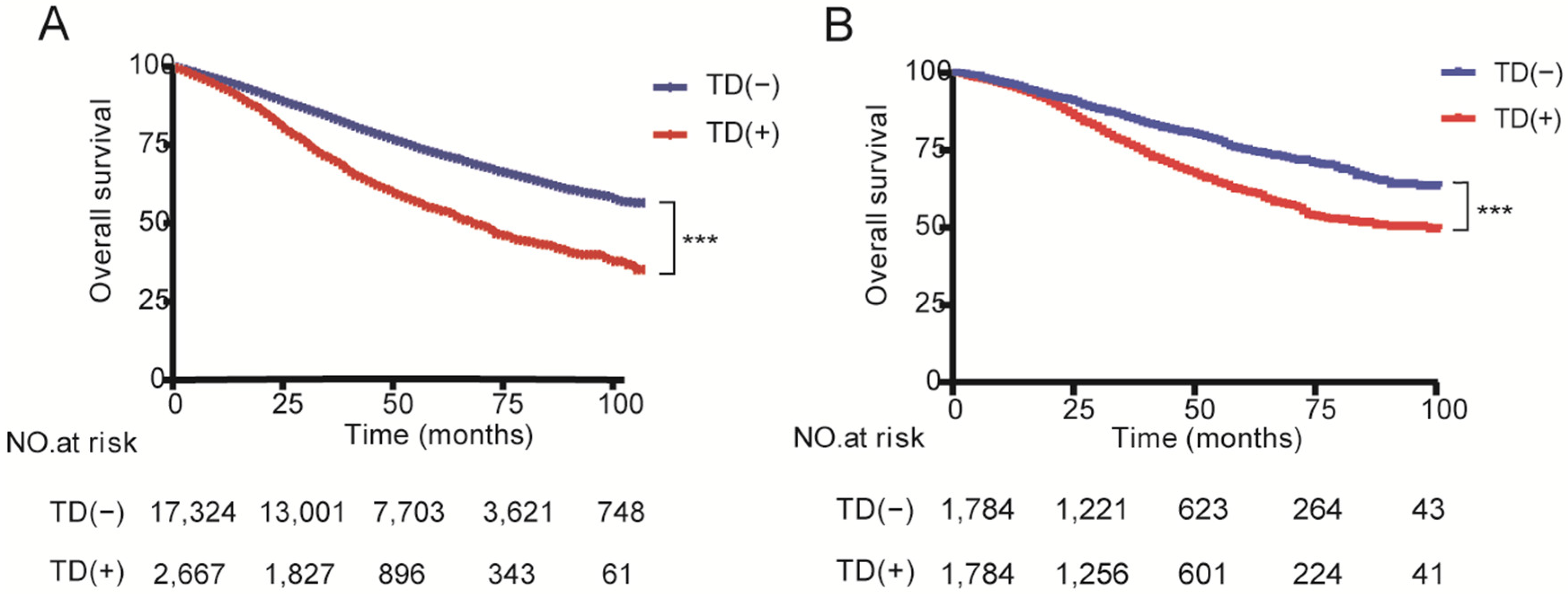
However, multivariate analyses also showed that race was an independent prognostic factor of OS, which seems unreasonable. We wondered whether the controversial outcomes were due to the data biases and confounding factors. Consequently, we adopted propensity score matching (1:1) to compare TD (+) and TD (−) patients from the SEER database (n = 19,991) to minimize selection bias. We reviewed 17,324 patients with TD (TD (+) and TD (−)), of whom 2643 patients met the matching criteria, yielding 2643 pairs of patients. After matching, baseline characteristics did not differ between the TD (+) group and TD (TD (+) and TD (−)) group, indicating proper matching quality (Table 3). Kaplan–Meier curves illustrated the association between TDs and OS, revealing that patients with TDs had significantly poorer survival compared to those without TDs (p < 0.0001, Figure 1).
The univariate Cox analyses and multivariate Cox analyses were performed to evaluate the prognostic effects of the included factors on the OS in LARC patients. The results of univariate Cox analyses indicated that TDs, age, gender, pathological type, grade, the record number of tumors at diagnosis, CEA, T stage, radiotherapy, and chemotherapy affect the patient’s OS. However, the impact of race on OS lacked statistical significance (p = 0.262). These results were supported by the multivariate analyses (Table S1).

3.3. TDs Were an Independent Risk Factor for LARC in SEER and SYSU Cohorts

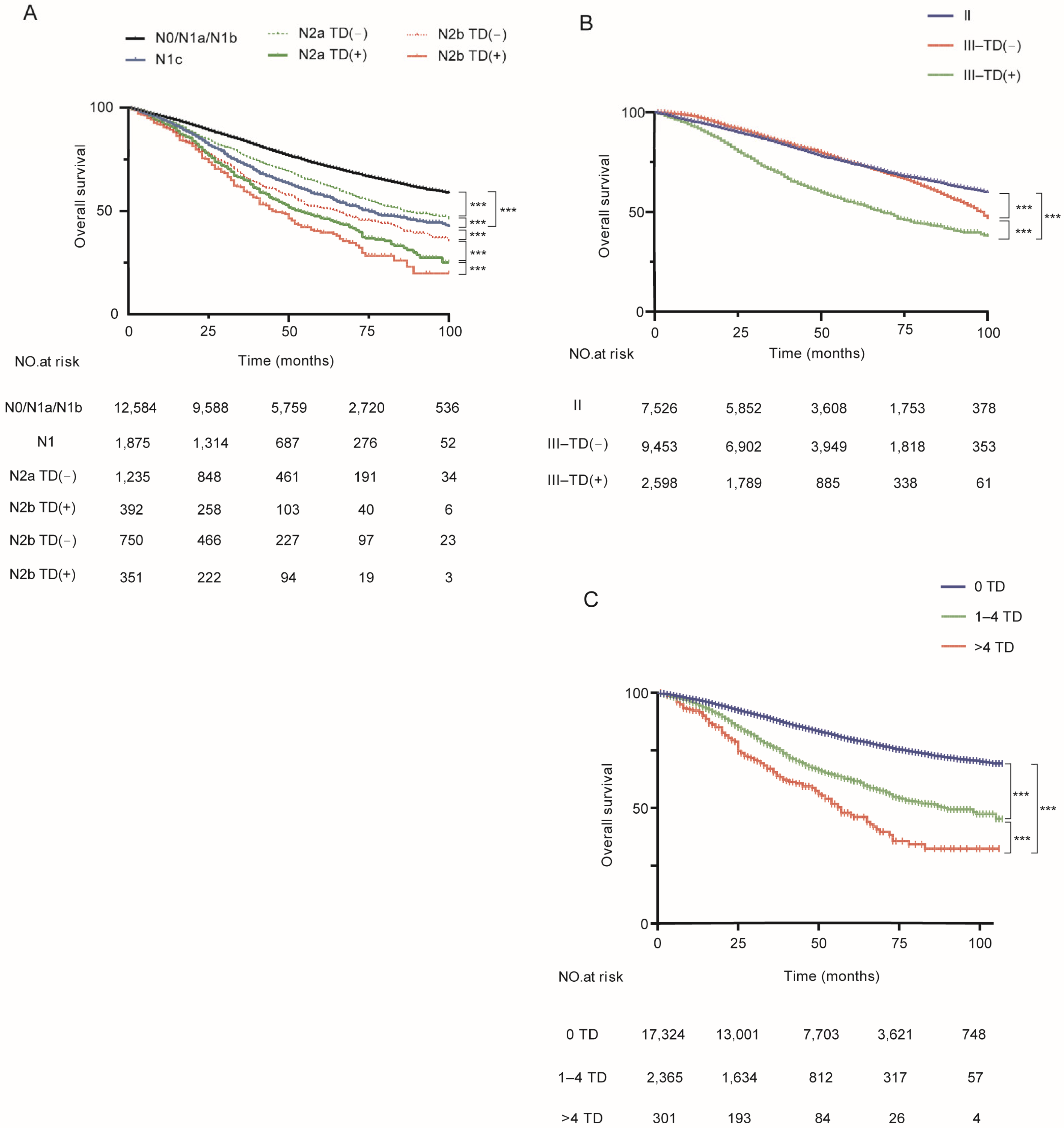
To study the relationship between TDs and LARC, we compared the survival months between TD-positive and TD-negative patients. Considering that previous clinical studies had reported that the presence of a TD had little effect and no clinical significance at stage T, we performed a survival analysis for each sub-category of patients with lymph node staging; survival information is shown in Table S2, Figure 2A,B.
The results showed that compared to the patients without TDs, the patients with TDs were significantly associated with worse OS in each subgroup (p < 0.0001). OS of N1c patients was not different from that of the N2 category (median survival time 69.076 versus 69.747, p = 0.635). Survival analyses were compared between TD-positive and TD-negative groups in the SEER and SYSU cohorts, respectively. Moreover, the results revealed that TDs had adverse prognostic effects on the OS, CSS, and DFS in the SYSU cohort (p < 0.001, Figure S2).

3.4. Exploring the Prognostic Value of TDs

Considering the impact of TDs on prognosis, we integrated the number of TDs into the TNM staging system as a substitute for the current “N1c”. This integration aims to establish a more scientific and reasonable TNM staging system. We utilized the x-tile software (Yale University, New Haven, CT, USA) to determine the optimal cut-off value for TDs, resulting in three subgroups: 0TD, 1–4TD, and >4TD (Figure 2C). The logistic-rank test demonstrated statistically significant differences in OS rates among these subgroups (p < 0.001, Table S3).

3.5. Validating the Prognostic Value of TDs

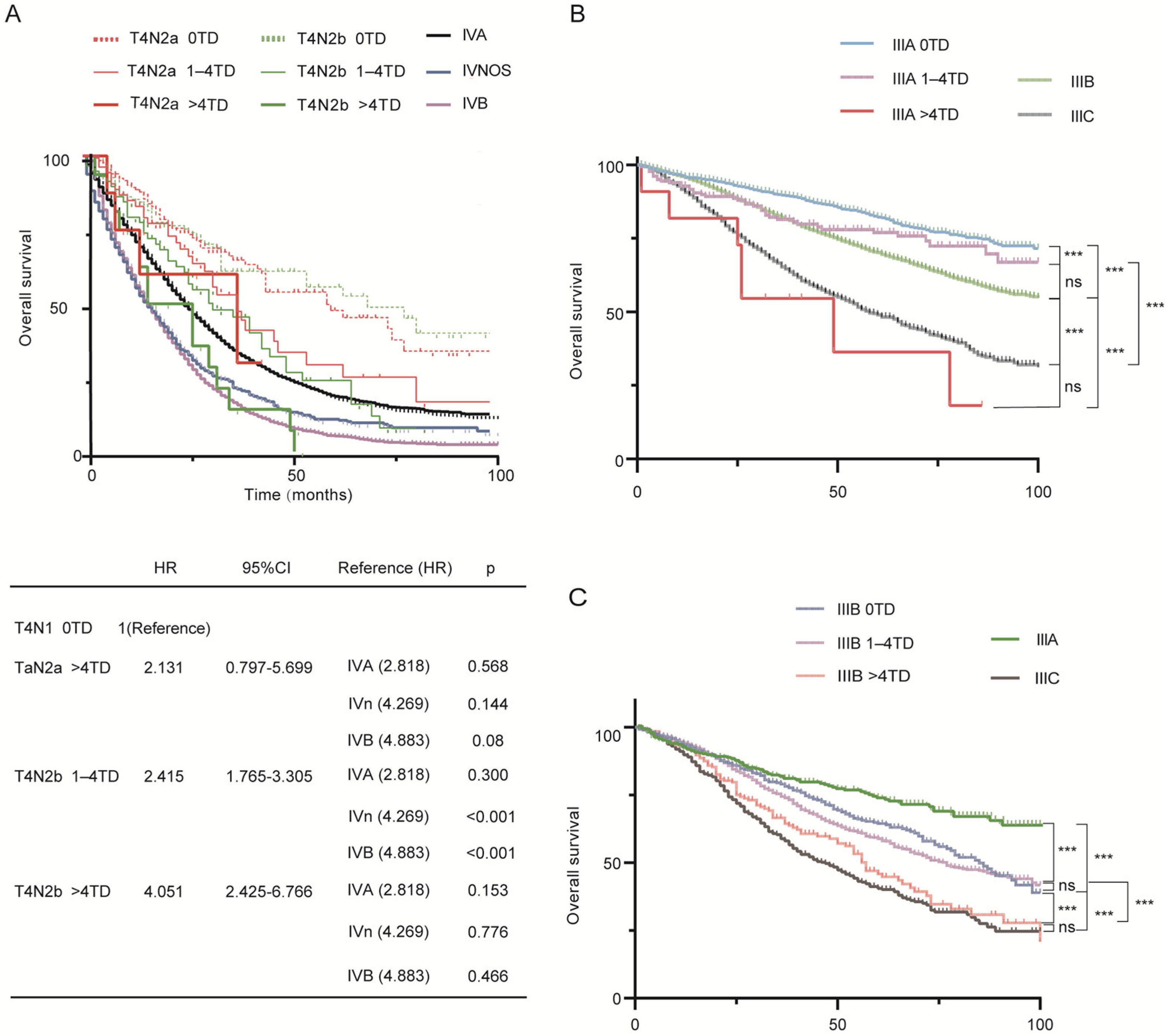
To further verify the prognostic value of TDs, we hypothesized that some stage III TDs in medium-risk or high-risk group patients were already showing similar outcomes to stage IV patients. We performed a survival analysis for each subcategory of stage III and stage IV patients. In the abovementioned analyses, T4N2aM0 > 4TD, T4N2M0 > 4TD, and T4N2bM0 1–4TD patients demonstrated median overall survival (OS) times of 28.5 months (95% CI: 17.0–39.9; HR = 2.13), 36.0 months (95% CI: 23.5–48.5; HR = 1.36), and 36.4 months (95% CI: 29.5–43.3; HR = 2.42), respectively. These outcomes exhibited a comparable prognostic trend to patients in stage IVA (median OS: 35.3 months, 95% CI: 34.3–36.4; HR = 2.82), with no significant differences observed between these respective subgroups and stage IVA (p = 0.568, p = 0.447, and p = 0.300). This trend was significantly different from that of patients in stage IIIC (median OS: 61.4 months, 95% CI: 59.3–63.5), stage IIIB (median OS: 79.8 months, 95% CI: 78.9–80.8), and stage IIIA (median OS: 89.2 months, 95% CI: 87.4–90.9) (p < 0.001). Furthermore, T4N2bM0 > 4TD patients demonstrated a median OS of 23.7 months (95% CI: 16.0–31.5; HR = 4.05). These outcomes exhibited a comparable prognostic trend to patients in stage IVA (median OS: 35.3 months, 95% CI: 34.3–36.4; HR = 2.82) and stage IVB (median OS: 20.8 months, 95% CI: 20.0–21.7; HR = 4.88), with no significant differences observed (p = 0.153 and p = 0.776, respectively). Survival information is shown in Table S4.4 and Figure 3A.
Then we wondered whether the stage III patients with 1–4TD or >4TD would show similar outcomes to those with higher TNM stages. We performed a survival analysis for each of the three TNM subcategories of stage III patients. The results showed that stage IIIA 1–4TD patients demonstrated a comparable prognostic trend to patients in stage IIIB (median OS: 84.8 months vs. 79.8 months, p = 0.129). Stage IIIB > 4TD patients also demonstrated a comparable prognostic trend to patients in stage IIIC (median OS: 59.3 months vs. 61.4 months, p = 0.666, Figure 3B). The prognosis of patients with stage IIIA > 4TD is found to be inferior compared to that of stage IIIC (median OS: 46.5 months vs. 61.4 months, p = 0.312). However, due to the statistically significant difference in prognosis between these patients and those in stage IVA, as well as considering the limited number of cases in this particular stage (11 cases), we opted to categorize them under stage IIIC instead of stage IVA (Figure 3C). Using a similar approach, we categorized T4N1M0 1–4TD patients (median OS: 54.5 months, 95% CI: 49.0–60.1), who demonstrated a comparable prognostic trend to stage IIIC (median OS: 61.4 months, 95% CI: 59.3–63.5) instead of IVA. Survival information is shown in Table S4.5.
The modified prognostic risk stratification (mod-TNM framework) was established as follows: T4N2aM0 > 4TD patients and T4N2bM0 1–4TD patients were classified into a prognostic risk group equivalent to stage IVA, T4N2bM0 > 4TD equivalent to stage IVB, IIIA 1–4TD equivalent to stage IIIB, stage IIIA > 4TD, and stage IIIB > 4TD equivalent to stage IIIC. In brief, patients with >4TDs (high-risk group) at any TNM stage exhibit OS comparable to or worse than that of stage IIIC disease. Patients staged as T4N2M0, high-risk group (TDs > 4), demonstrate OS representing a prognostic risk equivalent to stage IV disease. Notably, in the specific subgroup of LARC patients classified as T4N2bM0, the presence of TDs (regardless of quantity) corresponds to survival outcomes mirroring stage IV metastatic disease.
Results regarding the discriminative abilities of the AJCC system and the mod-TNM framework are reported in Figure S3. The mod-TNM framework is associated with less information loss than the AJCC TNM system in the overall population, as evidenced by a lower AIC (241,081.9 vs. 241,086.2; ΔAIC = 4.3 > 2) with a relative likelihood <0.001. Moreover, the discriminative abilities of the AJCC and the mod-TNM framework are very similar, as evidenced by Harrell’s C statistics (0.738 vs. 0.737) in the overall population, showing that both models are equally able to accurately differentiate the prognosis of patients. Likewise, the homogeneity of classes appeared different in the overall population, as illustrated by a higher log likelihood ratio score for the mod-TNM framework (9.112 vs. 9.111), representing better homogeneity of the mod-TNM framework in this population, meaning that the same AJCC TNM grades might group patients with different prognoses.

3.6. Constructing a Nomogram Model Based on the Number of TDs

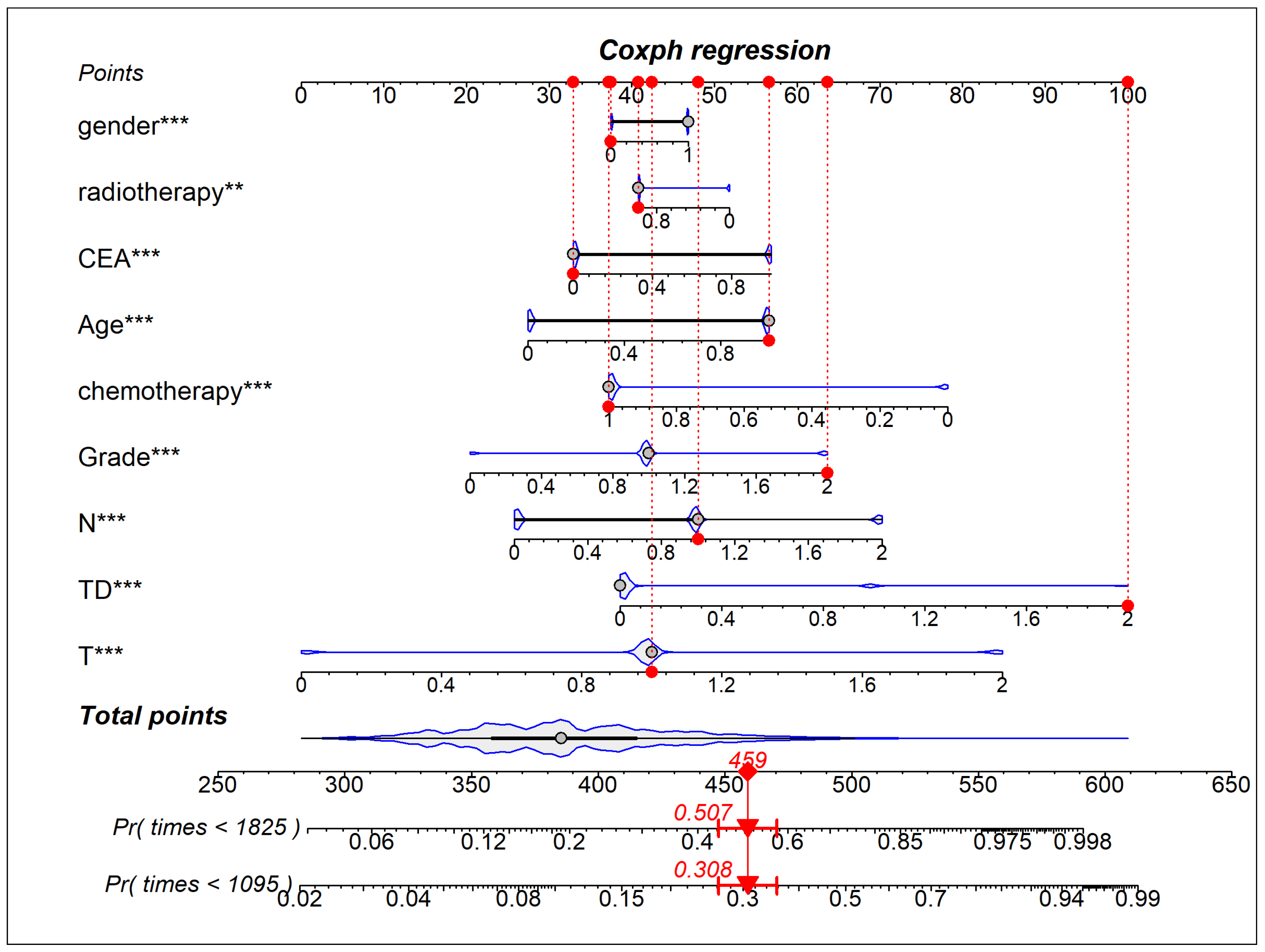
After excluding the samples with missing data, a total of 12,266 patients were included in the SEER database, among which 8586 were in the training cohort and 3680 in the internal validation cohort. The external validation cohort of the SYSU consisted of 304 cases. Ten clinical parameters were analyzed: age, gender, TDs number, tumor size, pathological grade, T stage, N stage, radiotherapy, chemotherapy, and CEA. Age was divided into <60 and ≥60 years. The number of TDs was divided into the following three groups: low-risk group (TD = 0), intermediate-risk group (1 ≤ TD ≤ 4), and high-risk group (TD > 4). The pathological grade was divided into the well-differentiated, moderately differentiated, and low/undifferentiated. CEA was divided into positive and negative groups. Tumor size was obtained using the R software package and the Kaplan–Meier method to obtain the cut-off value, and was divided into <54 and ≥54 mm groups. The T stage was divided into T1/T2, T3, and T4 groups. Univariate analysis identified nine significant CSS predictors (all except tumor size, Table S5). Nine variables were used to construct a nomogram for predicting 3-year and 5-year survival rates. (Figure 4). Each variable received a score (0–100 points) based on its prognostic contribution. The nomogram identified T stage, TDs count, and N stage as primary CSS determinants (Figure 4).
Total scores were calculated by summing individual variable scores. Projecting total scores onto the x-axis determined 3- and 5-year survival rates. The nomogram achieved C-indices of 0.713 (training), 0.717 (internal validation), and 0.789 (external validation). Calibration curves demonstrated strong concordance between predicted and observed 3-/5-year survival in all cohorts (Figure S4).
ROC analysis demonstrated significantly higher discrimination for the nomogram compared to TNM staging across all datasets. In the training cohort, the nomogram achieved AUCs of 0.774 (3-year) and 0.710 (5-year), significantly outperforming TNM staging (AUC 0.645 [3-year] and 0.636 [5-year]; both p < 0.001). This superiority was maintained in internal validation (nomogram AUC: 0.741 [3-year], 0.712 [5-year]; TNM AUC: 0.655 [3-year], 0.666 [5-year]; both p < 0.001) and external validation (nomogram AUC: 0.782 [3-year], 0.768 [5-year]; TNM AUC: 0.775 [3-year], 0.655 [5-year]; p < 0.001 [3-year], p = 0.047 [5-year], Figure S5).
DCA indicated that the prediction model had greater net benefit and higher clinical application value than the AJCC TNM staging model (Figure S6).

4. Discussion

The prognostic value of TDs in patients with CRC has been well-studied [7,8,9,10,11]. Nevertheless, the prognostic value of TDs’ presence in patients with LARC has not been thoroughly investigated. According to previous studies, TDs were detected in over 13% of patients with CRC [6,7,10,15]. Consistently, our study found that in a collection of 19,991 patients with LARC, the incidence of TDs was 13.3%. Furthermore, patients without lymph node metastases but with TDs (namely, the pN1c population) experience similar outcomes to patients staged as pN2. Recently, there has been rising evidence indicating that the number of TDs has a linear effect on prognosis and should therefore be considered as a quantitative variable rather than qualitative information [13].
The presence of TDs has been considered to be a strong and independent prognostic factor for poor OS [6,7,10,15]. Here, univariate, multivariate, and PSM analyses consistently confirm that TDs were associated with poor prognosis of patients with LARC. To account for the impact of standard therapies on survival, we incorporated chemotherapy and radiotherapy into our multivariate Cox regression analysis as adjusted covariates. This approach effectively adjusts for treatment-related confounding, clarifying that the “high-risk” prognostic value of TDs was computed independently of treatment benefits. For patients in any subgroup of stage III, as well as those in the N2a and N2b stages, TD (+) patients consistently exhibit a worse prognosis compared to those without TDs (p < 0.001). TDs display an intermediary impact on OS between LNMs and distant metastasis, consistent with a retrospective study involving 551 patients from 2000 to 2008 [16]. Specifically, the inclusion of TDs in the LNM counts results in an augmentation of stages compared to the original TNM phase.
Prior research reported a clear linear relationship between TD quantity and adverse prognosis [13]. Some experts in the field of CRC also concur with recording TD quantity in a manner similar to lymph nodes [8]. In our study, we categorize patients into three subgroups based on TD count (TDs = 0, 1 ≤ TDs ≤ 4, TDs > 4). Earlier researchers have demonstrated that the combination of TDs and LNMs yields noteworthy implications for staging accuracy [6,17,18]. Cohen et al. restaged 75 low-risk stages III patients (i.e., pT1–3 and pN1) as high-risk (i.e., pT4 and/or N2) by combining the number of TDs with the LNMs to optimize TNM staging [7]. To optimize the current staging system, some authors proposed that T4aN2bM0 TDs (+) and T4bN2M0 TDs (+) should be classified into a prognostic risk group equivalent to stage IV based on a retrospective study of patients with RC from two large independent cohorts [11]. Their novel approach could reduce the prognostic differences in the AJCC staging system, but it was not comprehensive. Here, we put forward a modified prognostic risk stratification (mod-TNM framework), classifying T4N2aM0 > 4TDs and T4N2bM0 1–4TDs into a prognostic risk group equivalent to stage IVA, T4N2bM0 > 4TDs equivalent to IVB, IIIA 1–4TDs equivalent to stage IIIB, stage IIIA > 4TDs and stage IIIB > 4TDs equivalent to stage IIIC, which is superior to the previous staging method.
In addition, a previous meta-analysis demonstrated that TD presence significantly increased the risk of liver, lung, and peritoneal metastasis [6]. This could potentially clarify why the average survival times of some subgroups of TD (+) patients are similar to those of stage IV patients. However, the current therapeutic modalities might be insufficient for these subgroups of TD (+) patients [19,20]. According to the RC clinical guidelines, targeted therapy, immunotherapy, and more frequent surveillance are currently only recommended for stage IV disease.
There have been many randomized controlled trials (RCTs) extending targeted therapy agents’ application in the adjuvant therapy of locally advanced colorectal cancer (LACRC). However, some of these studies have not achieved satisfactory outcomes. The possible reason is that these studies included the patients with stages II and III who vary significantly in tumor nature and prognosis [21,22,23,24]. Considering that the addition of targeted therapeutic drugs may increase toxicity rates during CRT and early postoperative complications, it is crucial to selectively include high-risk locally advanced rectal cancer (LARC) patients. These include patients with classifications such as T4N2M0 > 4 tumor deposits (TDs), T4N2bM0 with 1–4 TDs, and T4N2bM0 > 4 TDs.
This study has several limitations. Firstly, the present study is a retrospective analysis, which comes with some inherent biases. In addition, the SEER database lacked data on disease-free survival time and progression-free survival, leading to the inability to compare survival rates between SEER data and data from the SYSU cohort. Furthermore, key pathologic factors such as tumor regression grade and vascular invasion are unavailable, leading to unadjusted conclusions in our study. More importantly, diagnosing inter-observer variability in TDs is particularly challenging for SEER data due to the various pathologists involved in data generation. It should be noted that certain extreme subgroups (e.g., stage IIIA > 4TD) had small sample sizes, which reflects both their biological rarity and the potential for pathological underreporting in routine clinical practice. Therefore, their specific hazard ratios should be interpreted with clinical caution. More importantly, diagnosing inter-observer variability in TDs is particularly challenging for SEER data due to the various pathologists involved and the lack of a centralized pathology review.
Considering these constraints, an urgent need exists for a comprehensive international, multicenter, randomized controlled prospective study to precisely assess the predictive value of TDs.
Previous studies have mostly analyzed TDs as binary variables. For example, Li et al. [25] identified TDs presence as an independent adverse prognostic factor for colorectal signet ring cell carcinoma (SRCC). However, they did not quantify how TD counts influence refined staging stratification. While Liu et al. [26] established the combined prognostic value of TDs and lymph node ratio (LNR) in stage III CRC, their model omitted specific subgroups, including LARC. We developed a nomogram using the SEER database and the SYSU cohort. By stratifying TD counts and integrating them with T/N staging and CEA levels, our model significantly enhanced the accuracy of predicting 3- and 5-year CSS in LARC patients. The training cohort achieved a C-index of 0.713, significantly outperforming the AJCC staging model (AUC improvement: 4–10%). Furthermore, our external validation cohort attained a C-index of 0.789, exceeding that reported by Li et al. (0.713) [25] and Liu et al. (0.72) [26]. This suggests that the model has good generalization ability. Decision curve analysis (DCA) further demonstrated superior clinical net benefit for predicting 3- and 5-year survival versus traditional staging.

Supplementary Materials

The following supporting information can be downloaded at: https://www.mdpi.com/article/10.3390/gastroent17020024/s1. Figure S1: The flow chart for patient selection of the SEER database; Figure S2: The K-M and log-rank test of OS (A), CSS (B), and DFS (C) at our center. The patients with TDs showed significantly shorter OS, CSS, and DFS than patients without TDs. Figure S3: After combining the TD counting and LMNs, the novel TMN staging system is conducted; Figure S4: (A) 3-year and 5-year survival rates of the training cohort; (B) 3-year and 5-year survival rates of the internal validation cohort; (C) 3-year and 5-year survival rates of the external validation cohort. Figure S5: Comparison of ROC curves and AUC between the prediction model and TNM staging: (A) training cohort; (B) internal validation cohort; (C) external validation cohort. Figure S6: Comparison of DCA between the prediction model and TNM staging (the upper figure shows the 3-year DCA curve, the lower figure shows the 5-year DCA curve): (A) training cohort; (B) internal validation cohort; (C) external validation cohort. Table S1: Baseline demographic and related clinical characteristics for patients diagnosed with LARC. Table S2: Univariate and multivariate analyses of OS for the SEER cohort. Table S3: Patient characteristics before and after the propensity score matching. Table S4.1: Overall survival in N0/N1a/N1b, N1c, and N2 patients according to the presence or absence of tumor deposits. Table S4.2: Overall survival in stage II, III patients according to the presence or absence of tumor deposits; Table S4.3: Survival analysis according to TDs in the SEER cohort; Table S4.4: Survival analysis according to the clinical stage (T4Nx) in the SEER cohort; Table S4.5: Survival analysis according to the clinical stage (III stagings) in the SEER cohort. Table S5: Cox univariate and multivariate analysis of factors influencing CSS in LARC patients.

Author Contributions

All authors contributed to the study conception and design. Material preparation, data collection, investigation, and analysis were performed by Y.H., P.W., Y.W., X.C., C.Y. and R.H. Methodology, project administration, and supervision were conducted by J.L., Z.J., J.W. and M.H. Funding acquisition was managed by J.L. and M.H. The first draft of the manuscript was written by Y.H., and all authors commented on previous versions of the manuscript. All authors have read and agreed to the published version of the manuscript.

Funding

This work was supported by the National Natural Science Foundation of China (No. 82372715, YL; No. 81972245, YL; No. 82173067, YL; No. 82272965, HY), the Natural Science Foundation of Guangdong Province (No. 2022A1515012656, HY), the Fundamental Research Funds for the Central Universities, Sun Yat-sen University (2022007, MH), the Sixth Affiliated Hospital of Sun Yat-sen University Clinical Research—‘1010’ Program (1010CG(2022)-02, MH; 1010CG(2022)-03, YL; 1010PY(2022)-10, JL), the Medical Scientific Research Foundation of Guangdong Province (A2023094, JL), the Science and Technology Program of Guangzhou (202201011004, HY; 2023A04J1817, JL), the Scientific Research Project of the Sixth Affiliated Hospital of Sun Yat-Sen University (2022JBGS07), the Talent Project of the Sixth Affiliated Hospital of Sun Yat-sen University (No. P20150227202010251, YL), the Excellent Talent Training Project of the Sixth Affiliated Hospital of Sun Yat-sen University (No. R2021217202512965, YL), the Fundamental Research Funds for the Central Universities, Sun Yat-sen University (No. 23ykbj007, HY), the Program of Introducing Talents of Discipline to Universities (YL), and National Key Clinical Discipline (2012).

Institutional Review Board Statement

Ethical review and approval were waived for this study. For the public dataset, the waiver was due to the use of the publicly available SEER database, consisting of de-identified patient data. For the data from The Sixth Affiliated Hospital, Sun Yat-sen University, ethical review was waived due to the retrospective nature of the study and the use of de-identified data.

Informed Consent Statement

Patient consent was waived due to the retrospective nature of this study and the use of de-identified data.

Data Availability Statement

The original contributions presented in this study are included in the article/Supplementary Materials. Further inquiries can be directed to the corresponding authors.

Acknowledgments

The authors gratefully acknowledge the staff members of the National Cancer Institute and their colleagues across the United States and at Information Management Services, Inc., who have been involved with the SEER Program.

Conflicts of Interest

The authors declare no conflicts of interest.

References

  1. Sung, H.; Ferlay, J.; Siegel, R.L.; Laversanne, M.; Soerjomataram, I.; Jemal, A.; Bray, F. Global Cancer Statistics 2020: GLOBOCAN Estimates of Incidence and Mortality Worldwide for 36 Cancers in 185 Countries. CA Cancer J. Clin. 2021, 71, 209–249. [Google Scholar] [CrossRef]
  2. Benson, A.B.; Venook, A.P.; Al-Hawary, M.M.; Arain, M.A.; Chen, Y.-J.; Ciombor, K.K.; Cohen, S.; Cooper, H.S.; Deming, D.; Garrido-Laguna, I.; et al. NCCN Guidelines Insights: Rectal Cancer, Version 6.2020. J. Natl. Compr. Cancer Netw. 2020, 18, 806–815. [Google Scholar] [CrossRef] [PubMed]
  3. Edge, S.B.; Compton, C.C. The American Joint Committee on Cancer: The 7th edition of the AJCC cancer staging manual and the future of TNM. Ann. Surg. Oncol. 2010, 17, 1471–1474. [Google Scholar] [CrossRef]
  4. Kawai, K.; Nozawa, H.; Hata, K.; Kiyomatsu, T.; Tanaka, T.; Nishikawa, T.; Sugihara, K.; Watanabe, T. Nomogram Predicting Survival After Recurrence in Patients with Stage I to III Colon Cancer: A Nationwide Multicenter Study. Dis. Colon Rectum 2018, 61, 1053–1062. [Google Scholar] [CrossRef]
  5. Cuccurullo, V.; Mansi, L. AJCC cancer staging handbook: From the AJCC cancer staging manual. Eur. J. Nucl. Med. Mol. Imaging 2011, 38, 408. [Google Scholar] [CrossRef]
  6. Nagtegaal, I.D.; Knijn, N.; Hugen, N.; Marshall, H.C.; Sugihara, K.; Tot, T.; Ueno, H.; Quirke, P. Tumor Deposits in Colorectal Cancer: Improving the Value of Modern Staging—A Systematic Review and Meta-Analysis. J. Clin. Oncol. 2017, 35, 1119–1127. [Google Scholar] [CrossRef] [PubMed]
  7. Cohen, R.; Shi, Q.; Meyers, J.; Jin, Z.; Svrcek, M.; Fuchs, C.; Couture, F.; Kuebler, P.; Ciombor, K.; Bendell, J.; et al. Combining tumor deposits with the number of lymph node metastases to improve the prognostic accuracy in stage III colon cancer: A post hoc analysis of the CALGB/SWOG 80702 phase III study (Alliance). Ann. Oncol. 2021, 32, 1267–1275. [Google Scholar] [CrossRef] [PubMed]
  8. Lord, A.; Brown, G.; Abulafi, M.; Bateman, A.; Frankel, W.; Goldin, R.; Gopal, P.; Kirsch, R.; Loughrey, M.B.; Märkl, B.; et al. Histopathological diagnosis of tumor deposits in colorectal cancer: A Delphi consensus study. Histopathology 2021, 79, 168–175. [Google Scholar] [CrossRef]
  9. Agger, E.; Jörgren, F.; Jöud, A.; Lydrup, M.-L.; Buchwald, P. Negative Prognostic Impact of Tumor Deposits in Rectal Cancer—A National Study Cohort. Ann. Surg. 2023, 278, e109–e116. [Google Scholar] [CrossRef]
  10. D’sOuza, N.; Shaw, A.; Lord, A.; Balyasnikova, S.; Abulafi, M.; Tekkis, P.; Brown, G. Assessment of a Staging System for Sigmoid Colon Cancer Based on Tumor Deposits and Extramural Venous Invasion on Computed Tomography. JAMA Netw. Open 2019, 2, e1916987. [Google Scholar] [CrossRef]
  11. Schaap, D.P.; Voogt, E.L.; Burger, J.W.; Cnossen, J.S.; Creemers, G.-J.M.; van Lijnschoten, I.; Nieuwenhuijzen, G.A.; Rutten, H.J.; Daniels-Gooszen, A.W.; Nederend, J.; et al. Prognostic Implications of MRI-Detected EMVI and Tumor Deposits and Their Response to Neoadjuvant Therapy in cT3 and cT4 Rectal Cancer. Int. J. Radiat. Oncol. Biol. Phys. 2021, 111, 816–825. [Google Scholar] [CrossRef] [PubMed]
  12. Wu, W.; Zeng, S.; Zhang, X.; Liu, P.; Qiu, T.; Li, S.; Gong, P. The value of tumor deposits in evaluating colorectal cancer survival and metastasis: A population-based retrospective cohort study. World J. Surg. Oncol. 2022, 20, 41. [Google Scholar] [CrossRef]
  13. Kato, S.; Asano, N.; Miyata-Takata, T.; Takata, K.; Elsayed, A.A.; Satou, A.; Takahashi, E.; Kinoshita, T.; Nakamura, S. The impact of tumor deposits on colonic adenocarcinoma AJCC TNM staging and outcome. Am. J. Surg. Pathol. 2015, 39, 109–115. [Google Scholar] [CrossRef]
  14. Kagawa, Y.; Smith, J.J.; Fokas, E.; Watanabe, J.; Cercek, A.; Greten, F.R.; Bando, H.; Shi, Q.; Garcia-Aguilar, J.; Romesser, P.B.; et al. Future direction of total neoadjuvant therapy for locally advanced rectal cancer. Nat. Rev. Gastroenterol. Hepatol. 2024, 21, 444–455. [Google Scholar] [CrossRef]
  15. Lo, D.S.; Pollett, A.; Siu, L.L.; Gallinger, S.; Burkes, R.L. Prognostic significance of mesenteric tumor nodules in patients with stage III colorectal cancer. Cancer 2008, 112, 50–54. [Google Scholar] [CrossRef]
  16. Yabata, E.; Udagawa, M.; Okamoto, H. Effect of tumor deposits on overall survival in colorectal cancer patients with regional lymph node metastases. J. Rural Med. 2014, 9, 20–26. [Google Scholar] [CrossRef]
  17. Wang, S.; Guan, X.; Ma, M.; Zhuang, M.; Ma, T.; Liu, Z.; Chen, H.; Jiang, Z.; Chen, Y.; Wang, G.; et al. Reconsidering the prognostic significance of tumor deposit count in the TNM staging system for colorectal cancer. Sci. Rep. 2020, 10, 89. [Google Scholar] [CrossRef]
  18. Goldstein, N.S.; Turner, J.R. Pericolonic tumor deposits in patients with T3N+MO colon adenocarcinomas: Markers of reduced disease-free survival and intra-abdominal metastases and their implications for TNM classification. Cancer 2000, 88, 2228–2238. [Google Scholar] [CrossRef]
  19. National Comprehensive Cancer Network. NCCN Guidelines: Rectal Cancer. Available online: https://www.nccn.org/professionals/physician_gls/pdf/rectal.pdf (accessed on 14 April 2021).
  20. Hashiguchi, Y.; Muro, K.; Saito, Y.; Ito, Y.; Ajioka, Y.; Hamaguchi, T.; Hasegawa, K.; Hotta, K.; Ishida, H.; Ishiguro, M.; et al. Japanese Society for Cancer of the Colon and Rectum (JSCCR) guidelines 2019 for the treatment of colorectal cancer. Int. J. Clin. Oncol. 2020, 25, 1–42. [Google Scholar] [CrossRef] [PubMed]
  21. Taieb, J.; Balogoun, R.; Le Malicot, K.; Tabernero, J.; Mini, E.; Folprecht, G.; Van Laethem, J.-L.; Emile, J.-F.; Mulot, C.; Fratté, S.; et al. Adjuvant FOLFOX +/− cetuximab in full RAS and BRAF wildtype stage III colon cancer patients. Ann. Oncol. 2017, 28, 824–830. [Google Scholar] [CrossRef]
  22. Karoui, M.; Rullier, A.; Piessen, G.; Legoux, J.L.; Barbier, E.; De Chaisemartin, C.; Lecaille, C.; Bouche, O.; Ammarguellat, H.; Brunetti, F.; et al. Perioperative FOLFOX 4 Versus FOLFOX 4 Plus Cetuximab Versus Immediate Surgery for High-Risk Stage II and III Colon Cancers: A Phase II Multicenter Randomized Controlled Trial (PRODIGE 22). Ann. Surg. 2020, 271, 637–645. [Google Scholar] [CrossRef] [PubMed]
  23. Sargent, D.J.; Alberts, S.R.; Nair, S.; Mahoney, M.R.; Mooney, M.; Thibodeau, S.N.; Smyrk, T.C.; Sinicrope, F.A.; Chan, E.; Gill, S.; et al. Effect of oxaliplatin, fluorouracil, and leucovorin with or without cetuximab on survival among patients with resected stage III colon cancer: A randomized trial. JAMA 2012, 307, 1383–1393. [Google Scholar] [CrossRef] [PubMed]
  24. Taieb, J.; Tabernero, J.; Mini, E.; Subtil, F.; Folprecht, G.; Van Laethem, J.-L.; Thaler, J.; Bridgewater, J.; Petersen, L.N.; Blons, H.; et al. Oxaliplatin, fluorouracil, and leucovorin with or without cetuximab in patients with resected stage III colon cancer (PETACC-8): An open-label, randomised phase 3 trial. Lancet Oncol. 2014, 15, 862–873. [Google Scholar] [CrossRef] [PubMed]
  25. Li, F.; Liu, L.; Feng, Q.; Wang, X.; Liu, F.; Yang, L.; Miao, L.; Wang, W.; Ji, G.; Yu, C. Prognostic and predictive value of tumor deposits in advanced signet ring cell colorectal cancer: SEER database analysis and multicenter validation. World J. Surg. Oncol. 2024, 22, 107. [Google Scholar] [CrossRef]
  26. Liu, L.; Ji, J.; Ge, X.; Ji, Z.M.; Li, J.M.; Wu, J.; Zhu, J.M.; Yao, J.M.; Zhu, F.M.; Mao, B.M.; et al. Prognostic value of tumor deposits and positive lymph node ratio in stage III colorectal cancer: A retrospective cohort study. Int. J. Surg. 2024, 110, 3470–3479. [Google Scholar] [CrossRef]
Figure 1. Kaplan–Meier survival curve analysis of cancer nodules and overall survival in the pre-matching cohort (A) and the post-matching cohort (B). *** p < 0.001.
Gastroent 17 00024 g001
Figure 2. Survival comparisons between TD (+) and TD (−) patients. (A) Survival comparison between TD (+) and TD (−) patients based on the N stage. (B) Survival comparison between TD (+) and TD (−) patients based on the II-III clinical stage. (C) Survival comparison among patients with different numbers of TDs. *** p < 0.001.
Gastroent 17 00024 g002
Figure 3. Kaplan–Meier survival curves and log-rank tests of overall survival (OS) based on clinical stage. (A) The “T4N2a > 4TD” and “T4N2b 1–4TD” groups show decreased survival compared with clinical stage IVB, demonstrating a comparable prognostic trend to the stage IVA group. The “T4N2b > 4TD” group exhibits a comparable prognostic trend to clinical stage IVB. (B) The survival curve of the “IIIB > 4TD” group shows decreased survival compared with clinical stage IV, demonstrating comparable survival to the stage IIIC group. (C) The survival curve of the “IIIA 1–4TD” group indicates lower survival rates compared to clinical stage IIIC, exhibiting a comparable prognostic trend to the stage IIIB group. Furthermore, the survival curve of the “IIIA > 4TD” group shows decreased survival rates compared to clinical stage IVA, demonstrating comparable survival to the stage IIIC group. The establishment of a modified prognostic risk stratification. *** p < 0.001; ns, not significant.
Gastroent 17 00024 g003
Figure 4. Column line graphs predicting 3- and 5-year survival in LARC patients. Age: 0 is <60, 1 is ≥60; Gender: 0 is female, 1 is male; TD: 0 is low-risk group (TD = 0), 1 is intermediate-risk group (1 ≤ TD ≤ 4), 2 is high-risk group (TD > 4); Pathologic grading: 0 is well differentiated, 1 is moderately differentiated, and 2 is poorly/undifferentiated; T-staging: 0 is T1/T2, 1 is T3, and 2 is T4; Radiotherapy: 0 is not received, 1 is received; Chemotherapy: 0 is not received, 1 is received; CEA: 0 is negative, 1 is positive. ** p < 0.01; *** p < 0.001.
Gastroent 17 00024 g004
Table 1. Baseline demographic and related clinical characteristics for patients diagnosed with LARC.
CharacteristicLARC Patients in the SEER CohortpLARC Patients in the SYSH Cohortp
Without TDsWith TDsWithout TDsWith TDs
(n = 17,324,
86.7%)
(n = 2667,
13.3%)
(n = 262,
85.6%)
(n = 44,
14.4%)
Age 0.087 0.097
<607728 (44.6)1237 (46.4) 169 (64.5)34 (77.3)
≥609596 (55.4)1430 (53.6) 93 (35.5)10 (22.7)
Age61.01 ± 13.361.61 ± 12.90.02848.8 ± 14.453.86 ± 11.60.031
Gender 0.214 0.465
Male10,508 (60.7)1584 (40.6) 176 (67.2)32 (72.7)
Female6816 (39.3)1083 (59.4) 86 (32.8)12 (27.3)
Race 0.846
White13,984 (81.0)2141 (80.5)
Black1419 (8.2)226 (11.0)
Other1870 (10.8)293 (8.5)
BMI---22.9 ± 3.422.9 ± 3.80.243
CEA <0.001 0.051
negative6955 (57.9)893 (48.9) 182 (69.5)24 (54.5)
positive5004 (41.6)928 (50.8) 80 (30.5)20 (45.5)
AJCC <0.001 <0.001
IIA6745 (39.7)180 (6.9) 94 (35.9)0 (0)
IIB237 (1.4)15 (0.6) 1 (0.4)0(0)
IIC544 (3.2)19 (0.7) 0 (0)0 (0)
IIIA1512 (8.9)189 (7.3) 7 (2.7)11 (25)
IIIB6625 (39.0)1643 (63.3) 24 (9.2)27 (61.4)
IIIC1316 (7.8)551 (21.2) 1 (0.4)6 (13.6)
T stage <0.001 <0.001
T04 (0.1)3 (0.1) 56 (21.5)3 (7.1)
T1484 (2.8)50 (1.9) 20 (7.7)0 (0)
T21240 (7.2)176 (12.4) 67 (25.7)5 (11.9)
T313,662 (79.7)1968 (12.6) 118 (45.2)34 (81.0)
T41744 (10.2)427 (19.7) 0 (0)0 (0)
N stage <0.001 <0.001
N07545 (43.6)215 (8.1) 230 (87.8)0 (0)
N17513 (43.4)1659 (62.2) 22 (8.4)33 (75)
N22266 (13.1)793 (29.7) 10 (3.8)11 (25)
Pathological <0.001
Adenocarcinoma16,393 (94.6)2471 (92.7)
other931 (5.4)196 (7.3)
Metastasis <0.001 0.001
no15,311 (98.5)2393 (97.0) 213 (81.3)26 (59.1)
yes232 (1.5)75 (3.0) 49 (18.7)18 (40.9)
Table 2. Univariate and multivariate analyses of OS for the SEER cohort. The value 1 denotes the reference group.
VariableUnivariate Cox AnalysispMultivariate Cox Analysisp
HR (95% CI)HR (95% CI)
Age
<601 1
≥602.193 (2.069–2.323)<0.0011.349 (1.185–1.626)<0.001
Gender
female1 1
male1.206 (1.142–1.275)<0.0011.349 (1.251–1.456)<0.001
Race <0.001
other1 1
white1.182 (1.077–1.296)<0.0011.136 (1.011–1.277)0.033
black1.516 (1.343–1.711)<0.0011.388 (1.185–1.626)<0.001
CEA
negative1 1
positive1.561 (1.461–1.668)<0.0011.411 (1.315–1.515)<0.001
Grade <0.001 <0.001
well 1 1
moderately 1.057 (0.942–1.187)0.3461.121 (0.966–1.300)0.133
poorly 1.664 (1.459–1.897)<0.0011.640 (1.386–1.941)<0.001
undifferentiated1.846 (1.496–2.278)<0.001
Histology
other1 1
adenomas and adenocarcinomas0.641 (0.582–0.706)<0.0010.865 (0.754–0.992)0.038
T stage <0.001 <0.001
T11 1
T21.345 (1.1057–1.712)0.0161.243 (0.892–1.734)0.199
T31.873 (1.513–2.318)<0.0011.654 (1.227–2.229)0.001
T43.669 (2.941–4.578)<0.0012.797 (2.055–3.808)<0.001
N stage <0.001 <0.001
N01 1
N10.993 (0.936–1.053)0.8151.008 (0.928–1.096)0.843
N21.604 (1.490–1.727)<0.0011.562 (1.410–1.731)<0.001
TDs
negative1 1
positive1.860 (1.740–1.988)<0.0011.644 (1.499–1.803)<0.001
Regional lymph nodes removed <0.001 0.021
none1 1
1 to 3 1.012 (0.854–1.201)0.8880.977 (0.763–1.250)0.977
4 or more 0.783 (0.696–0.880)<0.0010.824 (0.696–0.976)0.025
Metastasis
no1 1
yes1.650 (1.378–1.976)<0.0011.941 (1.489–2.530)<0.001
Table 3. Patient characteristics before and after the propensity score matching.
VariableBefore MatchingpAfter Matchingp
TD (−)TD (+)TD (−)TD (+)
n = 17,324 (%)n = 2667 (%)n = 1784 (%)n = 1784 (%)
Age ≥ 609596 (55.4)1430 (53.6)0.09915 (51.3)903 (50.6)0.893
Male10,508 (60.7)1584 (59.4)0.2221055 (59.1)1071 (60.0)0.609
Race 0.846 0.635
white13,984 (80.7)2141 (80.3) 1457 (81.7)1437 (80.5)
black1419 (8.2)226 (8.5) 123 (6.9)136 (7.6)
other1921 (11.1)300 (11.2) 204 (11.4)211 (11.8)
Pathological = Adenocarcinoma16,393 (94.6)2471(92.7)<0.0011659 (93.0)1660 (93.0)0.995
Grade <0.001 0.782
well1138 (6.6)129 (4.8) 128 (4.8)129 (4.9)
moderately12,565 (72.5)1851 (69.4) 1872 (70.8)1851 (70.0)
poorly/undifferentiated1840 (10.6)488 (18.3) 464 (17.6)465 (17.6)
Record number ≥ 22356 (13.6)343 (12.9)0.313330 (12.5)338 (12.8)0.772
CEA <0.001 0.897
negative6955 (40.1)893 (33.5) 847 (47.5)879 (49.3)
positive5004 (28.9)928 (34.8) 937 (52.5)905 (50.7)
T stage <0.001 0.991
T1/T21728 (10.0)229 (8.6) 144 (8.7)144 (8.1)
T313,662 (78.9)1968 (73.8) 1349 (75.6)1346 (75.4)
T41744 (10.1)427 (16.0) 291 (16.3)294 (16.5)
Disclaimer/Publisher’s Note: The statements, opinions and data contained in all publications are solely those of the individual author(s) and contributor(s) and not of MDPI and/or the editor(s). MDPI and/or the editor(s) disclaim responsibility for any injury to people or property resulting from any ideas, methods, instructions or products referred to in the content.