Review

Immune-Mediated Colitis in the Era of Immune Checkpoint Inhibition: From Mechanisms to Clinical Management


by
Cristina Polo Cuadro
1,2,3,
Pilar Corsino Roche
1,*,
Marta Gascón Ruiz
3,4,5,
Santiago García López
1,2,
Carmen Yagüe Caballero
1,2,3,
Ana Royo Esteban
1,
Laura Almenara Michelena
1 and
Diego Casas Deza
1,2
1
Gastroenterology Department, Miguel Servet University Hospital, 50009 Zaragoza, Spain
2
Gastroenteroloy Department, Alcañiz Hospital, 44600 Teruel, Spain
3
Health Investigation Institute Aragon (IIS-A), 50009 Zaragoza, Spain
4
Oncology Department, Miguel Servet University Hospital, 50009 Zaragoza, Spain
5
Medicine Department, Zaragoza University, 50009 Zaragoza, Spain
*
Author to whom correspondence should be addressed.
Gastroenterol. Insights 2026, 17(1), 20; https://doi.org/10.3390/gastroent17010020
Submission received: 29 December 2025 / Revised: 19 January 2026 / Accepted: 2 February 2026 / Published: 10 March 2026
(This article belongs to the Special Issue Immunological Aspects of Gastrointestinal Diseases)

Abstract

Immunotherapy with immune checkpoint inhibitors (ICIs) has represented a major breakthrough in the treatment of multiple solid and hematological malignancies, significantly improving survival and tumor control. However, the blockade of immune regulatory pathways such as cytotoxic T-lymphocyte-associated protein 4 (CTLA-4) and programmed cell death protein 1/programmed death-ligand 1 (PD-1/PD-L1) is associated with the development of immune-related adverse events, among which immune-mediated colitis (IMC) constitutes one of the most relevant gastrointestinal complications due to its frequency, potential severity, and impact on the continuation of oncologic treatment. IMC typically presents with diarrhea, abdominal pain, and gastrointestinal bleeding, and may progress to severe, life-threatening forms. Its incidence varies according to the type of ICI, and is higher with CTLA-4 inhibitors and particularly elevated with combination therapies. The pathophysiology is complex and multifactorial, involving dysregulated activation of proinflammatory T lymphocytes, impairment of immune regulatory mechanisms, disruption of the intestinal epithelial barrier, and a key modulatory role of the gut microbiota. Diagnosis requires a high index of clinical suspicion and relies on endoscopy with biopsies, given the poor correlation between clinical severity and endoscopic or histological findings. Fecal biomarkers, such as calprotectin and lactoferrin, are useful for risk stratification and disease monitoring. Treatment is based on a stepwise immunosuppressive approach, with corticosteroids as first-line therapy and biologic agents such as infliximab or vedolizumab in refractory cases. Emerging strategies, including fecal microbiota transplantation, offer new therapeutic perspectives. This article provides a comprehensive review of the current evidence on the epidemiology, pathophysiology, diagnosis, and management of IMC, as well as future challenges and opportunities in its clinical management.

1. Introduction

Over the past decade, immunotherapy has profoundly transformed the therapeutic landscape of multiple solid and hematological malignancies. In particular, immune checkpoint inhibitors (ICIs) have consistently demonstrated substantial improvements in overall survival and tumor control across a wide range of neoplasms [1,2,3,4,5].
These agents act by blocking physiological mechanisms of negative immune regulation, thereby enhancing the cytotoxic activity of T lymphocytes against tumor cells [6]. In current clinical practice, approved ICIs target cytotoxic T-lymphocyte-associated protein 4 (CTLA-4) (i.e., ipilimumab, tremelimumab), programmed cell death protein 1 (PD-1) (i.e., nivolumab, pembrolizumab, cemiplimab, dostarlimab, tislelizumab), and programmed death-ligand 1 (PD-L1) (i.e., atezolizumab, durvalumab, avelumab). PD-1 and PD-L1 are coinhibitory molecules expressed by lymphocytes and antigen-presenting cells (APCs) that play a central role in maintaining self-tolerance and preventing autoimmunity, whereas CTLA-4 is expressed on T and B cells and acts as a key negative regulator of lymphocyte activation [7,8]. The main immune checkpoint inhibitors (ICIs) currently approved in Europe, together with their mechanisms of action and therapeutic indications, are summarized in Table 1.
While disruption of immune tolerance is essential for antitumor efficacy, it simultaneously predisposes patients to the development of immune-related adverse events (irAEs) as a consequence of dysregulated immune activation. These toxicities differ substantially from those observed with conventional chemotherapy and may involve virtually any organ system, most commonly the skin, gastrointestinal tract, endocrine organs, and liver [10,11]. Among them, gastrointestinal manifestations stand out due to their frequency and clinical relevance [12].
IMC represents one of the most clinically relevant gastrointestinal toxicities associated with ICI use. It typically presents with diarrhea, often accompanied by abdominal pain, fecal urgency, and mucus or blood in stools, and may progress to severe, potentially life-threatening complications such as toxic megacolon or intestinal perforation [13,14]. Importantly, the development of colitis may necessitate temporary or permanent discontinuation of immunotherapy, thereby directly compromising oncologic disease control and patient prognosis [15,16].
The incidence and severity of IMC vary considerably according to the class of ICI administered. CTLA-4 inhibitors are associated with a higher frequency and greater severity of diarrhea and colitis compared with PD-1/PD-L1 inhibitors, whereas combination strategies that target multiple immune regulatory pathways markedly increase the risk of severe and refractory gastrointestinal toxicity. In addition, drug-related factors, tumor characteristics, baseline gut microbiota composition, and the presence of pre-existing autoimmune diseases appear to modulate individual susceptibility to colitis [8,13,16,17]. Nevertheless, the exact pathogenesis has not been fully elucidated, which hinders the identification of predictive biomarkers and the development of personalized therapeutic strategies.
Current management of IMC relies primarily on immunosuppression, with corticosteroids as first-line therapy and biologic agents such as infliximab or vedolizumab reserved for refractory cases. Despite these strategies, significant clinical challenges persist, particularly in patients with steroid-refractory or recurrent disease, fueling growing interest in alternative and adjunctive therapeutic approaches, including interventions targeting the gut microbiota [16,18].
In this context, the present article provides a comprehensive review of the most robust and up-to-date evidence on the etiopathogenesis, clinical presentation, diagnostic approach, management strategies, and future perspectives of IMC.

2. Epidemiology: Incidence and Risk Factors for Development

IMC represents one of the most clinically relevant gastrointestinal manifestations within the spectrum of immune-mediated adverse events and constitutes a potentially serious complication of oncologic treatment. Its reported frequency has increased in parallel with the widespread adoption of immunotherapy across multiple solid and hematological malignancies, enabling a more refined epidemiological characterization in recent years [19,20].
The incidence of immune checkpoint inhibitor-induced colitis reported in clinical trials and observational studies ranges from 0.7% to 13.6%. However, the true incidence is likely underestimated, as systematic endoscopic evaluation or routine assessment of fecal inflammatory biomarkers is not part of standard follow-up in most patients, leading to potential underdiagnosis of this complication [21,22,23,24,25,26,27].
The incidence of IMC varies markedly according to the class of immune checkpoint inhibitor administered. Antibodies targeting CTLA-4 are consistently associated with a higher risk of IMC compared with inhibitors of the PD-1/PD-L1 axis. In clinical trials and observational cohorts, colitis of any grade has been reported in approximately 5–10% of patients treated with anti-CTLA-4 agents, whereas severe forms (grade ≥ 3 according to the Common Terminology Criteria for Adverse Events [CTCAE]) reach rates close to 5%. In contrast, colitis associated with PD-1 or PD-L1 inhibitors administered as monotherapy occurs less frequently, with reported incidences of approximately 1–3% for all grades and below 2% for severe cases. The highest risk is observed with combination regimens, particularly those combining anti-CTLA-4 and anti-PD-1 agents, in which overall incidence may exceed 15–20%, accompanied by a parallel increase in clinical severity and the need for advanced immunosuppressive therapy [8,14,15,16,19]. This pattern likely reflects a more intense and less-tightly regulated immune activation, translating into a higher propensity for gastrointestinal toxicity. The incidence and severity of immune-mediated colitis vary markedly according to the class of immune checkpoint inhibitor administered, with higher rates observed with anti-CTLA-4 agents and combination regimens compared with PD-1/PD-L1 monotherapy, as summarized in Table 2.
Evidence regarding the relationship between IMC occurrence and drug dose remains heterogeneous. In cohorts treated with different dosing regimens of pembrolizumab and nivolumab, no significant differences in colitis incidence have been observed across evaluated schedules [28,29]. In contrast, administration of ipilimumab at higher doses, either as monotherapy or in combination with PD-1/PD-L1 inhibitors, has been consistently associated with an increased frequency of IMC compared with lower-dose regimens [30,31].
Compared with immune checkpoint inhibitor monotherapy, combination regimens with chemotherapy or tyrosine kinase inhibitors are associated with a significantly increased risk of gastrointestinal toxicity. In a meta-analysis of phase I–IV clinical trials, the combination of ICIs with other systemic anticancer therapies was associated with a higher risk of all-grade diarrhea compared with monotherapy (Relative Risk [RR] of approximately 1.7; 95% CI: 1.4–2.1; p < 0.001). In contrast, no statistically significant differences were observed in the incidence of severe colitis (≥grade 3), which remained low in both treatment groups (approximately 0.5%) [16].
From a temporal standpoint, IMC may develop both early during treatment—typically around 5–6 weeks—and after treatment discontinuation, with reported times to onset ranging from 0 to 6.3 months [22,32]. Notably, a shorter median time to presentation has been documented in patients exposed to anti-CTLA-4 agents (6–7 weeks) or combination therapies (7 weeks; range 0–51 weeks), compared with those receiving PD-1/PD-L1 inhibitors, in whom onset may occur much later, with a median of up to 2 years [33].
Beyond the type of drug administered, several patient-related risk factors have been identified. Pre-existing autoimmune diseases, particularly inflammatory bowel disease (IBD), are associated with a substantially increased risk of immune-mediated gastrointestinal adverse events. Abu Sbeih et al. reported that patients with IBD have a fourfold higher risk of developing gastrointestinal adverse events compared with individuals without this condition, with IMC appearing to be primarily associated with anti-CTLA-4 therapies [34]. Nevertheless, available evidence suggests that selected patients with IBD may still benefit from immunotherapy when careful patient selection and close clinical monitoring are applied. In this context, patients with IBD appear to tolerate anti-PD-1 therapy better than anti-CTLA-4 therapy [35,36].
Increasing evidence supports the role of the gut microbiota as a key determinant of susceptibility to IMC associated with ICI therapy. Reduced microbial diversity and alterations in the abundance of specific bacterial taxa have been associated with an increased risk of gastrointestinal toxicity, suggesting a modulatory role of the microbiota–immune system axis [37,38]. External factors such as the use of nonsteroidal anti-inflammatory drugs (NSAIDs) have also been linked to an increased risk of IMC; therefore, caution is warranted when prescribing NSAIDs in this clinical setting [39].
Other clinical and demographic factors have been proposed as potential modifiers of IMC risk, including female sex and advanced age; however, available data remain inconsistent [40].
Overall, current evidence indicates that the epidemiology of IMC is complex and multifactorial, determined by the interaction between the type of ICI therapy, the intensity of immune checkpoint blockade, and patient baseline characteristics. Identification of these factors is essential for risk stratification, early detection, and optimization of clinical management in patients treated with ICIs.

3. Etiopathogenesis: What Do We Know So Far?

The marked variability in the incidence, severity, and timing of IMC according to the type of immune checkpoint inhibitor, treatment regimen, and patient-related factors underscores that its development cannot be explained by a single pathogenic mechanism. These epidemiological observations strongly suggest a complex and multifactorial biological basis, prompting increasing interest in elucidating the underlying immunological and molecular processes responsible for intestinal inflammation in this setting. In this context, understanding the etiopathogenesis of immune-mediated colitis is essential to explain its clinical heterogeneity and to inform more targeted therapeutic strategies.
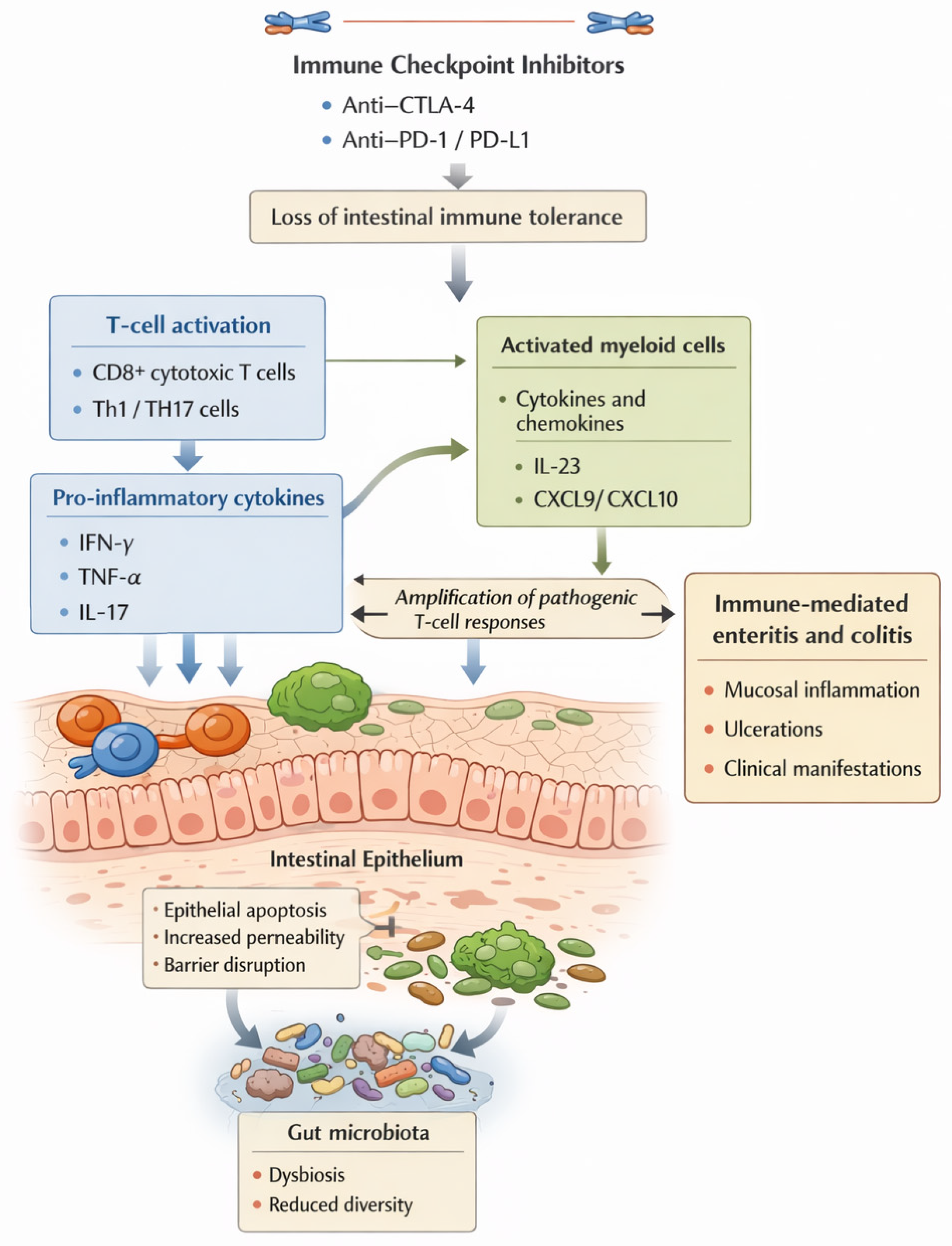
IMC associated with ICIs arises from a disruption of intestinal immune tolerance induced by blockade of CTLA-4 and/or PD-1/PD-L1. Under physiological conditions, these regulatory pathways restrain T-lymphocyte activation following antigen recognition and maintain intestinal mucosal homeostasis despite continuous exposure to microbial and dietary antigens. Pharmacological inhibition of these checkpoints enhances antitumor immunity but simultaneously predisposes to aberrant inflammatory responses within the gut [41,42].
From a pathophysiological standpoint, IMC is driven by a multifactorial and dynamic process. A central mechanism involves excessive activation of effector T lymphocytes, particularly cytotoxic CD8+ cells and proinflammatory CD4+ subsets (Th1 and Th17), accompanied by increased production of key cytokines such as interferon-γ (IFN-γ), tumor necrosis factor-α (TNF-α), and interleukin-17 (IL-17) [43,44,45]. These mediators promote direct epithelial injury, endothelial activation, and recruitment of additional inflammatory cells, thereby sustaining and amplifying mucosal inflammation. In parallel, both quantitative and functional impairment of regulatory T lymphocytes has been described, further contributing to loss of local immune control [46,47,48,49].
Recent advances have underscored the pivotal role of the intestinal myeloid compartment, particularly activated macrophages exhibiting a proinflammatory phenotype. These cells produce IL-23 and the chemokines CXCL9 and CXCL10, which drive the expansion and differentiation of pathogenic CD4+ T lymphocytes capable of co-producing IFN-γ and IL-17. This macrophage–T-lymphocyte axis correlates closely with clinical and endoscopic disease severity and provides a strong mechanistic rationale for therapeutic strategies targeting IL-23 or related signaling pathways [50,51].
The gut microbiota exerts an additional and highly relevant modulatory influence. Specific microbial signatures enriched in Firmicutes, such as Faecalibacterium prausnitzii, have been associated with an increased risk of colitis, whereas the presence of Bacteroides spp. appears to confer a protective effect by promoting immunoregulatory responses. These observations reinforce the concept of a bidirectional interaction between the gut microbiota and mucosal immunity in the setting of ICI therapy [36,38,39,52].
Finally, ICI-induced intestinal inflammation is accompanied by disruption of the epithelial barrier, characterized by increased enterocyte apoptosis and enhanced mucosal permeability. This barrier dysfunction facilitates translocation of luminal antigens, further amplifying the inflammatory cascade and perpetuating tissue damage [38,39].
Taken together, these interconnected mechanisms provide a biological framework to explain the marked clinical, endoscopic, and histological heterogeneity observed in IMC.
The main immunological and cellular mechanisms involved in immune checkpoint inhibitor-induced enteritis and colitis are summarized in Figure 1.

4. Diagnosis: Clinical Presentation, Endoscopic and Histological Findings, and the Role of Biomarkers

4.1. Clinical Presentation: Severity Stratification

IMC associated with ICIs most commonly presents with diarrhea, although its absence does not exclude the diagnosis [20]. Diarrhea may be accompanied by abdominal pain, rectal bleeding, fecal urgency, and tenesmus. Less typical manifestations include fatigue, anorexia, significant weight loss, or dehydration secondary to persistent diarrhea [53].
Clinical presentation is highly variable and depends largely on the type of ICI administered, with higher frequency and greater severity observed in regimens including anti-CTLA-4 agents, particularly when combined with anti-PD-1/PD-L1 therapy. IMC typically develops between 5 and 10 weeks after the second or third treatment dose. However, several studies have reported later onset, with symptoms occurring up to four months after the last dose and, in some cases, recurrence one to two years following treatment discontinuation [20,54,55]. Importantly, IMC may follow a rapidly progressive course, leading to severe and potentially life-threatening complications such as toxic megacolon, ileus, peritonitis, intestinal perforation, and death [56].
Severity stratification of IMC is commonly based on the CTCAE, a grading system ranging from 1 to 5 originally developed for oncology clinical trials. Nevertheless, the clinical validity of this classification for guiding management decisions in IMC has not been fully established. Briefly, grade 1 colitis is characterized by the absence of clinical symptoms, with only pathological or radiological abnormalities; grade 2 is defined by abdominal pain accompanied by mucus or blood in stools; grade 3 includes additional features such as fever or peritoneal signs; grade 4 encompasses severe complications, including perforation, ischemia, necrosis, or toxic megacolon; and grade 5 corresponds to death.
With regard to diarrhea, grade 1 is defined as an increase of fewer than four bowel movements per day above baseline; grade 2 corresponds to an increase of 4 to 6 bowel movements; grade 3 is defined by seven or more bowel movements per day and typically requires hospitalization; grade 4 is considered life-threatening and mandates urgent intervention; and grade 5 is defined as death [57].
Severity stratification of IMC is commonly based on the CTCAE classification, although alternative grading systems proposed by major oncology societies are also used. These grading criteria are summarized in Table 3.
Accumulating evidence indicates a significant discordance between clinical severity as assessed by CTCAE and endoscopic or histological disease severity. Patients with apparently moderate symptoms may harbor extensive mucosal ulcerations, whereas others with severe diarrhea may demonstrate only limited inflammatory changes. In this context, the presence of alarm features—such as severe abdominal pain, fever, persistent gastrointestinal bleeding, or rapid clinical deterioration—should prompt early and comprehensive diagnostic evaluation, irrespective of the assigned CTCAE grade [19,50,58].

4.2. Endoscopic Findings

Endoscopy with biopsy sampling constitutes the cornerstone of diagnosis and staging in IMC, as clinical symptoms do not reliably correlate with either endoscopic or histological severity. Early endoscopic evaluation after symptom onset—ideally within the first week—has been associated with shorter symptom duration and reduced exposure to corticosteroid therapy, whereas performing endoscopy in asymptomatic patients does not appear to confer prognostic benefit [59,60]. Accordingly, current American Society of Clinical Oncology (ASCO) guidelines recommend endoscopic assessment in all patients presenting with grade ≥ 2 disease [19].
Ulcerative and non-ulcerative endoscopic phenotypes occur with comparable frequency [61,62]. Non-ulcerative findings typically include erythema, edema, erosions, exudate, mucosal friability, and loss of the vascular pattern. Importantly, approximately 20–30% of patients may exhibit a macroscopically normal mucosa despite histological evidence of microscopic colitis, underscoring that a normal endoscopic appearance does not exclude the diagnosis of IMC [63,64,65,66,67].
Recently, a novel immune-mediated colitis endoscopic score (IMCES) has been proposed, incorporating ten ulcerative and non-ulcerative features into a unified 10-point system. In a large multicenter cohort, an IMCES cutoff ≥ 4 demonstrated higher specificity for guiding selective immunosuppressive therapy than clinical grading or the Mayo Endoscopic subscore, supporting its potential role in risk stratification and therapeutic decision-making [68].
With regard to disease extent, the most commonly reported patterns include left-sided colitis (31–43%), pancolitis (23–40%), and ileitis (11–14%) [57,69,70]. Pancolitis is of particular clinical relevance, as it has been consistently identified as a predictor of steroid-refractory disease [71]. In most cases, inflammation is diffuse and continuous, closely resembling ulcerative colitis; however, a subset of patients exhibits a segmental or patchy distribution, more akin to Crohn’s disease [72].
Endoscopic features carry clear prognostic implications. The presence of deep ulcerations (>1 cm in diameter or >2 mm in depth) and extensive mucosal involvement delineates a high-risk phenotype, characterized by lower responsiveness to corticosteroids, increased need for biologic therapy, and a more severe clinical course. Although no endoscopy-specific scoring system has been validated for IMC, instruments commonly used in inflammatory bowel disease—such as the Mayo endoscopic subscore and the Simple Endoscopic Score for Crohn’s Disease (SES-CD)—are frequently applied in clinical practice to assess disease severity and guide therapeutic decision-making [73,74].

4.3. Histological Findings

Histological findings typically encompasses a broad spectrum of acute active colitis. Common features include increased inflammatory cellularity within the lamina propria, intraepithelial neutrophil infiltration, cryptitis and crypt abscess formation, as well as prominent epithelial apoptosis. In many cases, these acute changes coexist with features of chronicity, such as crypt architectural distortion, basal or plasmacytic infiltrates, and Paneth cell or pseudopyloric metaplasia, reflecting a complex and heterogeneous inflammatory process.
Although IMC may display histological features overlapping with those of classic inflammatory bowel disease (IBD), the two entities are often indistinguishable on histological grounds alone. In routine practice, a definitive distinction between IMC and de novo or pre-existing IBD cannot be reliably established without appropriate clinical correlation, including immune checkpoint inhibitor exposure, timing of symptom onset, endoscopic distribution, and disease course [71,73,75,76].
Nonetheless, certain histological features may favor an immune-mediated or drug-induced injury pattern, particularly in early or acute presentations. Prominent crypt epithelial apoptosis, often exceeding one apoptotic body per crypt, represents a characteristic finding in IMC and is commonly associated with drug-induced colitis and graft-versus-host disease (GvHD)-like patterns. This apoptotic phenotype typically reflects acute epithelial injury and may occur in the absence of marked chronic architectural changes [71,75].
By contrast, classic IBD—especially long-standing disease—is more commonly characterized by chronic architectural distortion, including crypt branching and shortening, basal plasmacytosis, and chronic expansion of the lamina propria. Although such chronic features may also develop in IMC, particularly in recurrent or prolonged cases, their presence alone does not allow reliable differentiation between the two conditions. Overall, histological findings should therefore be interpreted within a multidisciplinary clinicopathological framework, in which crypt apoptosis supports an immune-mediated or drug-related process, while established architectural distortion suggests, but does not definitively confirm, an IBD-like phenotype [71,73].
In a minority of patients, histological patterns consistent with microscopic colitis—either lymphocytic or collagenous—have been described. These phenotypes are of particular clinical relevance, as they frequently present with a macroscopically normal colonic mucosa on endoscopy, underscoring the importance of routine biopsy sampling even in the absence of visible lesions.
In cases of severe, atypical, or corticosteroid-refractory disease, systematic evaluation for superimposed cytomegalovirus (CMV) infection is essential, as CMV may represent either an alternative diagnosis or a complicating co-infection in immune-mediated colitis. In this setting, CMV should be actively sought through identification of viral inclusions and confirmation by immunohistochemistry and/or tissue-based molecular techniques, since reliance on routine hematoxylin–eosin staining alone may lead to underdiagnosis, particularly in early infection or when biopsy samples are limited. In line with published series of steroid-refractory immune checkpoint inhibitor-related colitis, immunohistochemistry should therefore be considered a standard component of the diagnostic work-up, given that CMV inclusions may be absent or difficult to identify on conventional H&E sections [75,76,77,78].

4.4. Role of Biomarkers

At present, no single biomarker is diagnostic of immune-mediated colitis (IMC). In routine clinical practice, however, fecal inflammatory markers play a valuable role in prioritizing endoscopic evaluation and monitoring disease activity over time. Current American Gastroenterological Association (AGA) guidelines recommend early assessment of fecal calprotectin and lactoferrin in patients with grade ≥ 2 IMC, as well as in selected less severe cases, to aid in risk stratification and clinical decision-making [18].
Across observational series and narrative reviews, fecal lactoferrin has demonstrated good sensitivity for detecting macroscopic colitis and, in particular, for identifying histological inflammation. In parallel, fecal calprotectin shows a strong correlation with endoscopic inflammatory activity and may serve as a meaningful therapeutic target, with low values acting as a surrogate marker of mucosal and histological healing.
In this context, ASCO guidelines have proposed a fecal calprotectin threshold of ≤116 μg/g as a potential indicator of endoscopic and histological remission, supporting key clinical decisions such as the safe reintroduction of immune checkpoint inhibitor therapy.
Beyond fecal inflammatory markers, increasing research efforts have focused on the identification of systemic immunological biomarkers that may improve risk stratification and prediction of disease severity or therapeutic response in immune-mediated colitis. In particular, alterations in peripheral blood lymphocyte subsets, including expansion of activated CD8+ T cells, Th17 cells, and a relative reduction in regulatory T cells, have been associated with the development and severity of immune-mediated gastrointestinal toxicity in exploratory studies [33,43]. In parallel, distinct cytokine profiles, characterized by elevated levels of proinflammatory mediators such as TNF-α, IFN-γ, IL-17, and IL-23, have been correlated with endoscopic and histological disease activity, supporting their potential role as future biomarkers and therapeutic targets [45,50]. However, these immunological parameters remain investigational and are not yet validated for routine clinical use. From a systemic standpoint, laboratory abnormalities including elevated C-reactive protein (CRP), anemia, or hypoalbuminemia may accompany active IMC; however, these findings are nonspecific and should be interpreted within the broader clinical and diagnostic context [8,19].

4.5. Differential Diagnosis

The differential diagnosis of diarrhea and colitis in patients treated with ICIs is broad and represents a critical step prior to the initiation of immunosuppressive therapy. All major clinical guidelines emphasize that infectious causes must be systematically excluded, even in patients with a high clinical suspicion of IMC [20]. Initial diagnostic evaluation should include testing for Clostridioides difficile, routine bacterial stool cultures, and—depending on the epidemiological context—parasitological studies. Importantly, the coexistence of infection and IMC is not uncommon, particularly in moderate-to-severe presentations [79,80].
Cytomegalovirus (CMV) infection warrants special consideration. It may present either as an alternative diagnosis or as a superimposed coinfection, especially in patients with severe, prolonged, or corticosteroid-refractory colitis. Peripheral viremia may be absent; therefore, definitive diagnosis requires identification of viral inclusions, immunohistochemical staining, and/or polymerase chain reaction (PCR) testing on intestinal biopsy specimens. Recognition of CMV infection is essential, as it necessitates specific antiviral management and may account for apparent refractoriness to conventional immunosuppressive therapy [81,82,83,84,85,86,87].
Beyond infectious etiologies, other noninfectious causes should be carefully considered. Gastrointestinal involvement by metastatic disease, particularly in the presence of signs suggestive of an acute abdomen, mandates prompt exclusion of complications such as intestinal perforation through appropriate imaging studies [36]. In addition, several medications—including nonsteroidal anti-inflammatory drugs, chemotherapeutic agents, immunosuppressive therapies, and proton pump inhibitors—may induce colonic injury that mimics IMC, often with characteristic histological patterns. Thorough review of medication exposure and temporal relationships with symptom onset is therefore essential [88,89,90,91].
Differentiation from inflammatory bowel disease (IBD) is also critical. IMC typically presents with an abrupt onset and histological features such as prominent crypt apoptosis, which are uncommon in IBD. Conversely, findings such as transmural inflammation, granuloma formation, or an insidious clinical course favor a diagnosis of IBD. In cases of diagnostic uncertainty, endoscopic evaluation with extensive and repeated biopsy sampling remains a key tool for establishing an accurate diagnosis [21,51,71].
Finally, other immune-related adverse events may manifest with diarrhea, including hyperthyroidism, adrenal insufficiency, and exocrine pancreatic insufficiency. Consequently, diagnostic assessment should be comprehensive and account for the possibility of multiple concomitant immune-related toxicities [9,16,55]. Table 4 summarizes the main differential diagnoses and their associated characteristics.

5. Management and Treatment

In patients receiving ICIs, the development of diarrhea or colitis mandates prompt diagnostic assessment and timely therapeutic intervention. Although management strategies are often guided by the CTCAE, this grading system does not always accurately reflect the true biological or prognostic severity of IMC and therefore should be complemented by additional clinical, endoscopic, and laboratory tools [90]. To date, IMC management is largely informed by expert consensus and clinical severity, as prospective trials specifically addressing gastrointestinal toxicity are lacking. Early initiation of therapy—ideally within the first five days following symptom onset—is strongly recommended, as it has been associated with faster and more favorable clinical resolution [12,18].
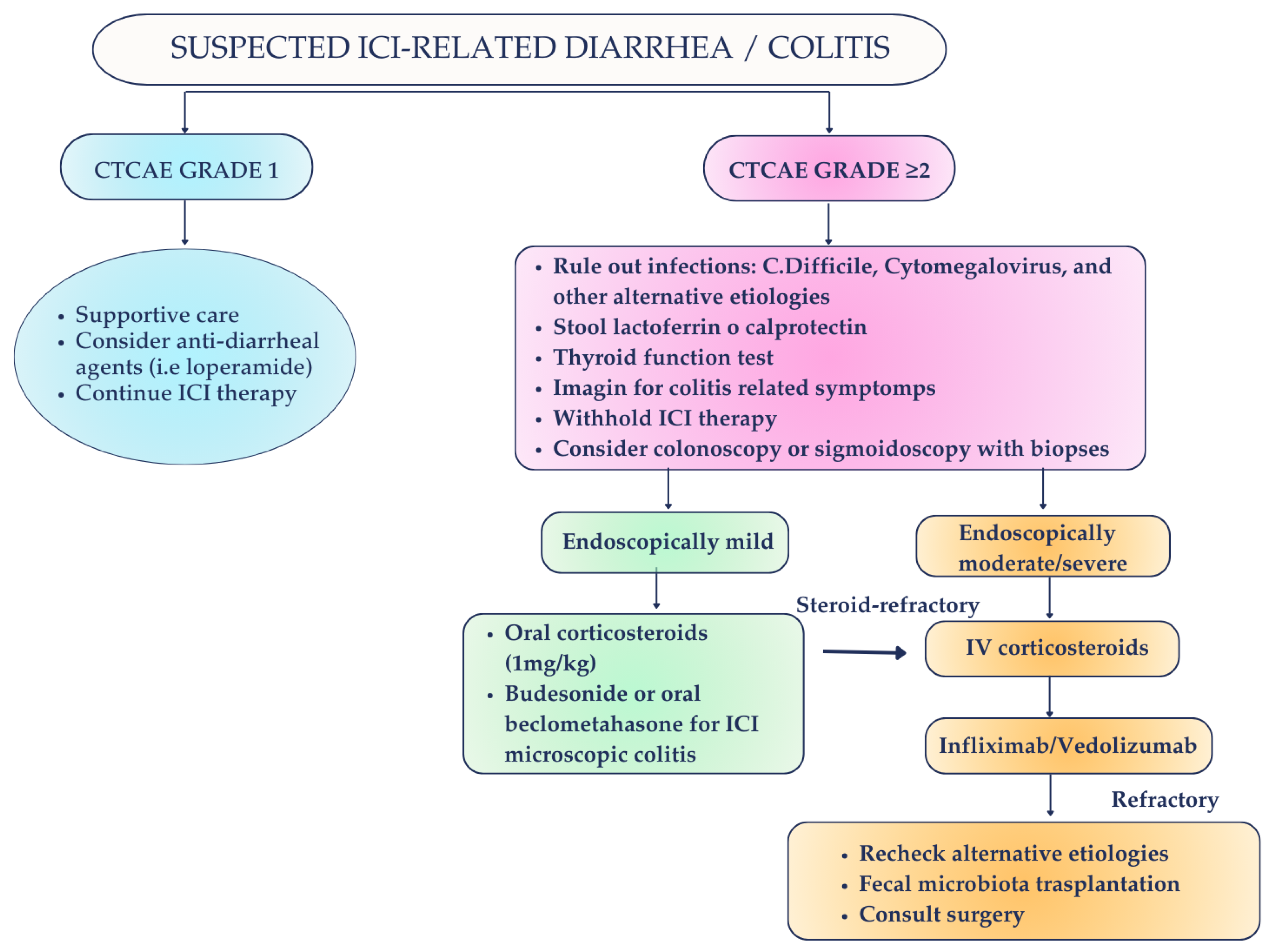
In cases of grade 1 colitis, current AGA and ASCO guidelines indicate that interruption of ICI therapy is not required. Management should remain conservative and supportive, focusing on adequate hydration and a low-fiber diet [18,19]. Antidiarrheal agents, such as loperamide or atropine/diphenoxylate, may be considered only after exclusion of infectious etiologies and in the absence of clinical features suggestive of colitis. In this setting, hospital admission and endoscopic evaluation are generally unnecessary. Likewise, immediate initiation of corticosteroids is not routinely indicated, although it may be considered if symptoms persist beyond two weeks despite conservative measures [92].
From grade 2 onward, treatment is primarily based on systemic corticosteroids, with escalation to biologic therapies such as infliximab or vedolizumab in refractory cases [18,93]. In a small subset of patients (approximately 1–1.5%), IMC may progress to colonic perforation, necessitating urgent surgical management. In this scenario, emergency subtotal colectomy is typically preferred, given the frequent extent and severity of colonic involvement [94].
According to major clinical guidelines, ICI therapy should be withheld when symptoms exceed grade 2. In patients presenting with grade 3 or 4 diarrhea or colitis, discontinuation of immunotherapy should be immediate and permanent [18,19].

5.1. Corticosteroid Therapy

Corticosteroids constitute the cornerstone of initial therapy for IMC. Their therapeutic efficacy is primarily mediated through suppression of T-lymphocyte activation and attenuation of proinflammatory cytokine production, resulting in broad modulation of both innate and adaptive immune responses. In addition, corticosteroids have been shown to upregulate PD-1 expression on CD4+ and CD8+ lymphocytes, further contributing to dampening of inflammatory activity [95,96].
In patients with grade 2 or higher colitis, current clinical guidelines recommend temporary suspension of immune checkpoint inhibitor therapy and initiation of systemic corticosteroids, typically prednisone or methylprednisolone at doses of 1–2 mg/kg/day. Treatment should be continued until clinical improvement to grade 1 or lower is achieved, followed by a gradual taper over approximately 4 to 6 weeks to reduce the risk of relapse. In more severe presentations (grade ≥ 3), hospitalization is frequently required, together with correction of hydroelectrolytic disturbances and administration of intravenous methylprednisolone at equivalent dosing [18,19].
In mild cases (grade 1) in which symptoms persist beyond two weeks despite conservative measures, oral budesonide may be considered as an initial therapeutic option, most commonly at a dose of 9 mg/day for a minimum of four weeks, followed by stepwise tapering. Systemic prednisone is generally reserved for patients who fail to respond adequately to budesonide. Although clinical experience in IMC has largely relied on conventional budesonide formulations, newer preparations such as budesonide Multi-Matrix System (MMX)—designed for targeted colonic drug delivery—may be particularly advantageous in disease patterns resembling ulcerative colitis. Nonetheless, this potential benefit remains to be confirmed in dedicated clinical trials [97,98].
Despite its central role, corticosteroid therapy has important limitations. Between 30% and 60% of patients with immune-mediated diarrhea or colitis demonstrate primary corticosteroid refractoriness, defined as absence of response to high-dose therapy within the first 72 h or only partial improvement after one week of treatment [71,99]. Furthermore, a substantial proportion of initial responders experience disease relapse. Following first-line corticosteroid therapy, CTLA-4-associated IMC recurs in approximately 44% of patients, whereas PD-1/PD-L1-induced IMC recurs in approximately 34% [62].
Prolonged or high-dose corticosteroid exposure is also associated with clinically relevant adverse effects, including impaired glucose metabolism, increased susceptibility to infections, and loss of bone mineral density. Compounding these concerns is the ongoing uncertainty regarding the potential negative impact of sustained immunosuppression on the antitumor efficacy of ICIs. For these reasons, current practice emphasizes minimizing both treatment duration and cumulative corticosteroid exposure, with tapering initiated as soon as adequate clinical control is achieved [95].

5.2. Biologic Agents

In clinical practice, increasing emphasis is placed on the early identification of patients who are unlikely to respond adequately to corticosteroids and may benefit from prompt escalation to biologic therapy. Rather than relying exclusively on clinical grading, a combination of endoscopic, biomarker-based, and early treatment response criteria is increasingly used to guide this decision. Extensive disease patterns, particularly pancolitis or ileal involvement, and the presence of deep or large mucosal ulcerations have been consistently associated with a higher risk of corticosteroid refractoriness and a more severe clinical course [20,71,73]. In addition, lack of meaningful clinical improvement within the first 72 h of high-dose corticosteroids, as well as persistently elevated fecal calprotectin levels, further support consideration of early biologic therapy in selected patients [18,19,20]. Incorporating these parameters into therapeutic algorithms allows a more proactive approach, aiming to reduce cumulative corticosteroid exposure and improve overall disease control.
In cases of corticosteroid-refractory disease, as well as in patients who relapse during corticosteroid tapering or after completion of an initial corticosteroid course, a comprehensive clinical reassessment is mandatory. This evaluation should aim to exclude alternative diagnoses or complications—most notably cytomegalovirus colitis, which has been consistently associated with a higher risk of recurrence and an increased need for colectomy [81,82,83,84,85,86,87]—and to determine the appropriateness of early escalation to additional immunosuppressive therapies. In this setting, biologic agents represent a key therapeutic option [20,100].
Importantly, in patients deemed to be at high risk, biologic therapy may be considered at an earlier stage—either as monotherapy or in combination with corticosteroids—rather than being reserved exclusively for corticosteroid failure. A recent single-center retrospective study including 179 patients demonstrated that early initiation of infliximab (IFX) or vedolizumab (VDZ) was significantly associated with reduced hospitalization rates and shorter cumulative exposure to corticosteroids. High-risk patient identification in this cohort was primarily based on IMC severity and response to corticosteroids, as well as elevated fecal calprotectin levels, the presence of extensive and deep mucosal ulcerations, and inflammatory involvement extending beyond the left colon [20,40,73].
To date, selection of the biologic agent and its dosing regimen has largely relied on clinical experience and extrapolation from inflammatory bowel disease management. Within this framework, current clinical guidelines recommend infliximab (IFX) as the preferred initial biologic therapy, while vedolizumab (VDZ) is considered a suitable alternative [18,19,92,99].

5.2.1. Infliximab

Infliximab (IFX) has emerged as the biologic treatment of choice for patients with corticosteroid-refractory IMC. Multiple retrospective studies and clinical series have consistently reported high efficacy, with clinical remission rates ranging from approximately 54% to 81%, clustering around 70% in most published cohorts [100,101]. Beyond its ability to induce remission, IFX therapy has been associated with more rapid resolution of gastrointestinal symptoms and earlier discontinuation of corticosteroids compared with corticosteroid therapy alone, without a clear detrimental effect on overall survival or time to treatment failure [102,103].
From a pharmacological perspective, IFX is a chimeric monoclonal antibody targeting tumor necrosis factor alpha (TNF-α), a central cytokine in the inflammatory cascade underlying IMC pathophysiology. It is administered intravenously at a standard dose of 5 mg/kg, consistent with dosing regimens used in inflammatory bowel disease. Clinical improvement is often observed within days of administration. Approximately 70% of patients respond after a single infusion; however, in cases of persistent or recurrent symptoms, a full induction regimen consisting of three doses at weeks 0, 2, and 6 may be required. Some studies suggest that this approach reduces recurrence rates and increases the likelihood of achieving endoscopic and histological remission, although the optimal duration of therapy remains undefined [102,104].
In terms of safety, IFX is generally well tolerated, with adverse events occurring infrequently, although rare complications such as immune-mediated hepatitis and serious infections have been reported [105]. The impact of TNF-α blockade on antitumor immunity remains controversial. While some preclinical and clinical data suggest potential synergy with ICIs and preservation of antitumor responses, other observational studies have reported reduced overall survival with prolonged anti-TNF exposure. Consequently, most guidelines recommend discontinuing IFX once clinical remission has been achieved, with therapeutic decisions individualized according to oncologic context and patient evolution [106,107,108].

5.2.2. Vedolizumab

Vedolizumab (VDZ) represents a clinically relevant alternative to IFX in the management of ICI-associated IMC, particularly in patients who are corticosteroid-refractory or have contraindications to TNF-α inhibition. VDZ is a humanized IgG1 monoclonal antibody directed against the α4β7 integrin, selectively blocking the trafficking of activated T lymphocytes to the intestinal mucosa through inhibition of their interaction with mucosal addressin cell adhesion molecule 1 (MAdCAM-1). This gut-selective mechanism confers a marked intestinal tropism, potentially resulting in reduced systemic immunosuppression and a more favorable impact on antitumor immune responses [109].
Given its gut-selective mechanism of action, vedolizumab (VDZ) may offer specific advantages in selected clinical scenarios. In particular, VDZ may be preferentially considered in patients at increased risk of systemic infections or in those in whom avoidance of broad systemic immunosuppression is desirable, such as elderly or frail patients. In addition, its intestinal selectivity makes VDZ an attractive option in cases of IMC confined to the gastrointestinal tract, without concomitant extraintestinal immune-related adverse events, where a targeted anti-inflammatory effect may be sufficient [18,109,110,111].
VDZ is typically administered intravenously at a fixed dose of 300 mg, following an induction schedule at weeks 0, 2, and 6, analogous to that used in inflammatory bowel disease. Although definitive data regarding optimal treatment duration are lacking, administration of three induction doses has been associated with lower relapse rates and a higher likelihood of endoscopic and histological remission [108,109]. While overall clinical experience with VDZ in IMC is more limited than with IFX, multiple retrospective studies and multicenter series have demonstrated substantial efficacy in corticosteroid-refractory disease, with sustained clinical remission rates ranging from 84% to 86%. Notably, response rates appear to be higher in biologic-naïve patients, approaching 95%, whereas efficacy is reduced in those previously exposed to IFX [108,110].
Direct comparative data between VDZ and IFX remain scarce; however, available observational analyses suggest comparable overall effectiveness between the two agents. In selected cohorts, VDZ has been associated with longer durations of clinical remission, reduced cumulative corticosteroid exposure, and shorter hospital stays. Moreover, VDZ appears to exhibit a favorable safety profile, with a lower incidence of infectious complications compared with IFX—an especially relevant consideration in oncologic populations. Some studies have also reported lower rates of tumor progression in patients treated with VDZ, although these findings should be interpreted with caution given the retrospective nature of the evidence [110].
Given its intestinal selectivity and apparent long-term safety, VDZ has been incorporated—alongside IFX—into clinical practice guidelines issued by societies such as ASCO. Nonetheless, the choice of biologic agent should be individualized and discussed within a multidisciplinary framework, pending prospective clinical trials that more clearly define the relative roles of VDZ and IFX in the management of IMC [18,19,100].

5.2.3. Other Therapies

Small-molecule therapies, particularly inhibitors of the Janus kinase (JAK) family, are emerging as potential therapeutic options in selected cases of IMC, mainly extrapolating from their established efficacy in inflammatory bowel disease. To date, evidence supporting their use in IMC remains limited and is largely restricted to case reports and small case series describing successful induction of remission with tofacitinib in patients with severe IMC refractory to corticosteroids and biologic agents such as infliximab or vedolizumab [20,77]. More recently, isolated reports have also suggested a potential role for selective JAK1 inhibitors in highly refractory disease, further supporting the biological plausibility of targeting downstream cytokine signaling pathways involved in IMC pathogenesis [54].
Nevertheless, robust prospective data are currently lacking, and important safety concerns—including increased risk of serious infections, thromboembolic events, and potential interference with antitumor immune responses—limit the routine use of JAK inhibitors in this setting. Consequently, JAK inhibition should currently be regarded as an experimental or last-line rescue strategy, reserved for highly selected patients with refractory disease and managed within a multidisciplinary framework until further evidence becomes available [18,20].
Based on current clinical guidelines and available evidence, a stepwise diagnostic and therapeutic approach to immune checkpoint inhibitor-related immune-mediated colitis is summarized in Figure 2, integrating disease severity, endoscopic findings, and treatment escalation.

5.3. Risk of Recurrence After Immune Checkpoint Inhibitor Reintroduction

Recurrence of IMC after reintroduction of immune checkpoint inhibitors represents a clinically relevant and increasingly encountered scenario in routine practice. Available observational studies indicate that recurrence of gastrointestinal immune-related adverse events occurs in approximately 25–35% of patients after treatment resumption, although reported rates vary according to the type of immune checkpoint inhibitor, severity of the initial episode, and prior requirement for biologic therapy [63,74]. Recurrence typically develops early after treatment reintroduction, most commonly within the first two to three months, and frequently necessitates renewed immunosuppressive therapy, with permanent discontinuation of immunotherapy in a substantial proportion of cases [62].
Importantly, the risk of recurrence appears to differ according to the class of immune checkpoint inhibitor reintroduced. Higher recurrence rates have been consistently reported following reintroduction of CTLA-4 inhibitors compared with PD-1 or PD-L1 inhibitors. In retrospective cohorts, recurrence of IMC has been observed in up to 40–45% of patients re-exposed to anti-CTLA-4 agents, whereas rates closer to 30% have been described after resumption of anti-PD-L1 therapy [62,71]. In this context, switching from an anti-CTLA-4 agent to an anti-PD-L1 inhibitor may be associated with a lower risk of recurrent colitis compared with re-exposure to CTLA-4 blockade, while escalation to anti-CTLA-4 therapy after a prior episode of PD-L1-induced colitis appears to confer a particularly high risk of recurrence in some series [34,62].
Taken together, these data underscore the need for careful individualized risk–benefit assessment before immune checkpoint inhibitor reintroduction. Factors such as severity of the initial colitis episode, response to corticosteroids, need for biologic therapy, endoscopic extent of disease, and availability of alternative oncologic strategies should be considered [18,19]. When reintroduction is pursued, close clinical monitoring during the early treatment period is essential, and prompt evaluation of recurrent gastrointestinal symptoms is warranted to facilitate early intervention and minimize morbidity.

6. Looking Ahead: Potential Challenges

Although the understanding of IMC has expanded substantially in recent years, important knowledge gaps persist that continue to limit a truly individualized clinical approach. The pathophysiology of IMC remains incompletely defined and appears to involve complex, interconnected mechanisms extending beyond simple immune hyperactivation, including alterations in the gut microbiota, disruption of the intestinal epithelial barrier, and host-specific susceptibility factors [56,57,60,61]. In particular, it remains unclear why some patients develop severe, refractory, or chronic disease, whereas others experience self-limited clinical courses. In parallel, the absence of validated predictive biomarkers capable of anticipating disease onset, severity, or therapeutic response represents a major unresolved research challenge, hampering risk stratification and personalized treatment selection [18,50,56].
In contrast, near-term clinical priorities are increasingly focused on improving early recognition of high-risk phenotypes, refining endoscopic and biomarker-based stratification strategies, and optimizing corticosteroid-sparing therapeutic approaches. In this context, several ongoing clinical trials are evaluating targeted and gut-selective interventions aimed at improving disease control while minimizing systemic immunosuppression. These include phase II studies exploring early or concomitant use of vedolizumab as first-line therapy for immune-related colitis, as well as trials designed to define the optimal dosing and duration of vedolizumab in steroid-refractory or steroid-dependent disease (e.g., NCT04797325, NCT06841705). In parallel, emerging clinical evidence supports the investigation of pathway-specific biologic agents, such as IL-12/23 blockade with ustekinumab, in patients with refractory IMC, building on mechanistic data implicating these cytokine pathways in disease pathogenesis [56,111]. Microbiota-based strategies, including fecal microbiota transplantation, are also under prospective evaluation in highly selected patients, reinforcing the concept of a microbiota–immune axis as a modifiable therapeutic target [37,38,52]. Collectively, these efforts reflect a progressive shift toward mechanism-based and precision medicine approaches that aim to achieve durable control of intestinal inflammation while preserving the antitumor efficacy of immune checkpoint inhibition.
In this context, the present review seeks to move beyond a purely descriptive overview of immune checkpoint inhibitor-related gastrointestinal toxicity by focusing specifically on immune-mediated colitis as a distinct clinical entity. Unlike previous reviews that primarily address diarrhea and enteritis in a broad or oncology-centered manner, this work integrates emerging mechanistic insights with a gastroenterology-oriented perspective, emphasizing endoscopic and histological phenotypes, biomarker-guided risk stratification, and practical decision-making in therapeutic escalation. By bridging pathophysiology with real-world clinical management and incorporating recent evidence on targeted biologic therapies and ongoing clinical trials, this review provides a clinically actionable framework that complements the existing literature and supports both current practice and future research directions.

Author Contributions

Conceptualization, D.C.D., C.P.C. and M.G.R.; methodology, P.C.R., D.C.D., M.G.R. and C.P.C.; data curation, C.Y.C., L.A.M., A.R.E. and S.G.L.; writing—original draft preparation, C.P.C.; writing—review and editing, All authors; supervision, D.C.D.; project administration, D.C.D., M.G.R. and P.C.R. All authors have read and agreed to the published version of the manuscript.

Funding

Diego Casas Deza is funded by a Juan Rodés Grant from Instituto de Salud Carlos III, Madrid, Spain (Grant number JR24/00033).

Institutional Review Board Statement

Not applicable.

Informed Consent Statement

Not applicable.

Data Availability Statement

No new data were created or analyzed in this study. Data sharing is not applicable to this article.

Conflicts of Interest

The authors declare no conflicts of interest.

Abbreviations

The following abbreviations are used in this manuscript:
ADLActivities of Daily Living (actividades de la vida diaria)
AGAAmerican Gastroenterological Association
APC(s)Antigen-Presenting Cell(s)
ASCOAmerican Society of Clinical Oncology
CIConfidence Interval
CMVCytomegalovirus
CRPC-reactive Protein
CSCOChinese Society of Clinical Oncology
CTChemotherapy
CTCAECommon Terminology Criteria for Adverse Events
CTLA-4Cytotoxic T-Lymphocyte-associated Antigen 4
dMMRDeficient Mismatch Repair
EMAEuropean Medicines Agency
ESMOEuropean Society for Medical Oncology
GvHDGraft-versus-host disease
IBDInflammatory Bowel Disease
ICIsImmune Checkpoint Inhibitors (inhibidores de puntos de control inmunitario)
IFXInfliximab
IHCImmunohistochemistry
IL-17/IL-23Interleukin-17/Interleukin-23
CXCL9/CXCL10C-X-C motif chemokine ligand 9/C-X-C motif chemokine ligand 10
IMCImmune-Mediated Colitis
IMCESImmune-Mediated Colitis Endoscopic Score
irAEsImmune-Related Adverse Events
irColitisImmune-Related Colitis
IFN-γInterferon gamma
IL-2Interleukin 2
IgG1Immunoglobulin G1
MMXMulti-Matrix System
MSI-HHigh Microsatellite Instability
MAdCAM-1Mucosal Addressin Cell Adhesion Molecule 1
PCRPolymerase Chain Reaction
PD-1Programmed Cell Death Protein 1
PD-L1Programmed Death-Ligand 1
RRRelative Risk
SES-CDSimple Endoscopic Score for Crohn’s Disease
Th1/Th17T helper 1/T helper 1
TKITyrosine Kinase Inhibitor
TNF-αTumor Necrosis Factor alpha
VDZVedolizumab

References

  1. Ansell, S.M. Immunotherapy in Hodgkin lymphoma: The road ahead. Trends Immunol. 2019, 40, 380–386. [Google Scholar] [CrossRef] [PubMed]
  2. Herbst, R.S.; Morgensztern, D.; Boshoff, C. The biology and management of non-small cell lung cancer. Nature 2018, 553, 446–454. [Google Scholar] [CrossRef]
  3. Hodi, F.S.; O’Day, S.J.; McDermott, D.F.; Weber, R.W.; Sosman, J.A.; Haanen, J.B.; Gonzalez, R.; Robert, C.; Schadendorf, D.; Hassel, J.C.; et al. Improved survival with ipilimumab in patients with metastatic melanoma. N. Engl. J. Med. 2010, 363, 711–723. [Google Scholar] [CrossRef]
  4. Saung, M.T.; Pelosof, L.; Casak, S.; Donoghue, M.; Lemery, S.; Yuan, M.; Rodriguez, L.; Schotland, P.; Chuk, M.; Davis, G.; et al. FDA approval summary: Nivolumab plus ipilimumab for the treatment of patients with hepatocellular carcinoma previously treated with sorafenib. Oncologist 2021, 26, 797–806. [Google Scholar] [CrossRef]
  5. Motzer, R.J.; Escudier, B.; McDermott, D.F.; George, S.; Hammers, H.J.; Srinivas, S.; Tykodi, S.S.; Sosman, J.A.; Procopio, G.; Plimack, E.R.; et al. Nivolumab versus everolimus in advanced renal-cell carcinoma. N. Engl. J. Med. 2015, 373, 1803–1813. [Google Scholar] [CrossRef]
  6. Raskov, H.; Orhan, A.; Christensen, J.P.; Gögenur, I. Cytotoxic CD8+ T cells in cancer and cancer immunotherapy. Br. J. Cancer 2021, 124, 359–367. [Google Scholar] [PubMed]
  7. Bagchi, S.; Yuan, R.; Engleman, E.G. Immune checkpoint inhibitors for the treatment of cancer: Clinical impact and mechanisms of response and resistance. Annu. Rev. Pathol. 2021, 16, 223–249. [Google Scholar] [PubMed]
  8. Terrin, M.; Migliorisi, G.; Dal Buono, A.; Gabbiadini, R.; Mastrorocco, E.; Quadarella, A.; Repici, A.; Santoro, A.; Armuzzi, A. Checkpoint inhibitor-induced colitis: From pathogenesis to management. Int. J. Mol. Sci. 2023, 24, 11504. [Google Scholar] [CrossRef]
  9. Riveiro-Barciela, M.; Carballal, S.; Díaz-González, Á.; Mañosa, M.; Gallego-Plazas, J.; Cubiella, J.; Jiménez-Fonseca, P.; Varela, M.; Menchén, L.; Sangro, B.; et al. Management of liver and gastrointestinal toxicity induced by immune checkpoint inhibitors: Position statement of the AEEH-AEG-SEPD-SEOM-GETECCU. Gastroenterol. Hepatol. 2024, 47, 401–432. [Google Scholar] [CrossRef]
  10. Brahmer, J.R.; Abu-Sbeih, H.; Ascierto, P.A.; Brufsky, J.; Cappelli, L.C.; Cortazar, F.B.; Gerber, D.E.; Hamad, L.; Hansen, E.; Johnson, D.B.; et al. Society for Immunotherapy of Cancer (SITC) clinical practice guideline on immune checkpoint inhibitor-related adverse events. J. Immunother. Cancer 2021, 9, e002435. [Google Scholar] [CrossRef]
  11. Ramos-Casals, M.; Brahmer, J.R.; Callahan, M.K.; Flores-Chávez, A.; Keegan, N.; Khamashta, M.A.; Lambotte, O.; Mariette, X.; Prat, A.; Suárez-Almazor, M.E. Immune-related adverse events of checkpoint inhibitors. Nat. Rev. Dis. Primers 2020, 6, 38. [Google Scholar] [CrossRef]
  12. Tran, A.N.; Wang, M.; Hundt, M.; Chugh, R.; Ohm, J.; Grimshaw, A.; Ciarleglio, M.; Hung, K.W.; Proctor, D.D.; Price, C.C.; et al. Immune checkpoint inhibitor-associated diarrhea and colitis: A systematic review and meta-analysis of observational studies. J. Immunother. 2021, 44, 325–334. [Google Scholar] [CrossRef]
  13. Nakane, T.; Mitsuyama, K.; Yamauchi, R.; Kakuma, T.; Torimura, T. Characteristics of immune checkpoint inhibitor-induced colitis: A systematic review. Kurume Med. J. 2023, 68, 43–52. [Google Scholar] [CrossRef]
  14. Dong, H.; Peng, Y.; Wang, X.; Cui, H. An updated review on immune checkpoint inhibitor-induced colitis: Epidemiology, pathogenesis, treatment strategies, and the role of traditional Chinese medicine. Front. Immunol. 2025, 16, 1551445. [Google Scholar] [CrossRef]
  15. Friedman, C.F.; Proverbs-Singh, T.A.; Postow, M.A. Treatment of the immune-related adverse effects of immune checkpoint inhibitors: A review. JAMA Oncol. 2016, 2, 1346–1353. [Google Scholar] [CrossRef]
  16. Nielsen, D.L.; Juhl, C.B.; Chen, I.M.; Kellermann, L.; Nielsen, O.H. Immune checkpoint inhibitor-induced diarrhea and colitis: Incidence and management. Cancer Treat. Rev. 2022, 109, 102440. [Google Scholar] [CrossRef]
  17. Petrousis, G.; Szczegielniak, S.; Sabhan, H.; Elbe, P.; Bilican, G.; Strid, H.; Bresso, F.; Hedin, C.; Haas, S.L. Endoscopic insights into digestive-related adverse effects of immune checkpoint inhibitors: A narrative review. World J. Gastrointest. Endosc. 2025, 17, 107798. [Google Scholar] [CrossRef]
  18. Dougan, M.; Wang, Y.; Rubio-Tapia, A.; Lim, J.K. AGA clinical practice update on diagnosis and management of immune checkpoint inhibitor colitis and hepatitis: Expert review. Gastroenterology 2021, 160, 1384–1393. [Google Scholar] [CrossRef] [PubMed]
  19. Schneider, B.J.; Naidoo, J.; Santomasso, B.D.; Lacchetti, C.; Adkins, S.; Anadkat, M.; Atkins, M.B.; Brassil, K.J.; Caterino, J.M.; Chau, I.; et al. Management of immune-related adverse events in patients treated with immune checkpoint inhibitor therapy: ASCO guideline update. J. Clin. Oncol. 2021, 39, 4073–4126. [Google Scholar] [CrossRef] [PubMed]
  20. Gong, Z.; Wang, Y. Immune checkpoint inhibitor–mediated diarrhea and colitis: A clinical review. JCO Oncol. Pract. 2020, 16, 453–461. [Google Scholar] [CrossRef] [PubMed]
  21. Soularue, E.; Lepage, P.; Colombel, J.F.; Coutzac, C.; Faleck, D.; Marthey, L.; Collins, M.; Chaput, N.; Robert, C.; Carbonnel, F. Enterocolitis due to immune checkpoint inhibitors: A systematic review. Gut 2018, 67, 2056–2067. [Google Scholar] [CrossRef]
  22. Wang, D.Y.; Mooradian, M.J.; Kim, D.; Shah, N.J.; Fenton, S.E.; Conry, R.M.; Mehta, R.; Silk, A.W.; Zhou, A.; Compton, M.L.; et al. Clinical characterization of colitis arising from anti-PD-1–based therapy. Oncoimmunology 2018, 8, e1524695. [Google Scholar] [CrossRef]
  23. Bishay, K.; Tandon, P.; Bourassa-Blanchette, S.; Laurie, S.A.; McCurdy, J.D. Risk of diarrhea and colitis in patients with lung cancer treated with immune checkpoint inhibitors: A systematic review and meta-analysis. Curr. Oncol. 2020, 27, e486–e494. [Google Scholar] [CrossRef]
  24. Khoja, L.; Day, D.; Chen, T.W.; Siu, L.L.; Hansen, A.R. Tumour- and class-specific patterns of immune-related adverse events of immune checkpoint inhibitors: A systematic review. Ann. Oncol. 2017, 28, 2377–2385. [Google Scholar]
  25. De Velasco, G.; Je, Y.; Bossé, D.; Awad, M.M.; Ott, P.A.; Moreira, R.B.; Schutz, F.; Bellmunt, J.; Sonpavde, G.P.; Hodi, F.S.; et al. Comprehensive meta-analysis of key immune-related adverse events from CTLA-4 and PD-1/PD-L1 inhibitors in cancer patients. Cancer Immunol. Res. 2017, 5, 312–318. [Google Scholar] [CrossRef]
  26. Collins, M.; Soularue, E.; Marthey, L.; Carbonnel, F. Management of patients with immune checkpoint inhibitor-induced enterocolitis: A systematic review. Clin. Gastroenterol. Hepatol. 2020, 18, 1393–1403. [Google Scholar] [CrossRef]
  27. Zoghbi, M.; Burk, K.J.; Haroun, E.; Saade, M.; Carreras, M.T.C. Immune checkpoint inhibitor-induced diarrhea and colitis: An overview. Support. Care Cancer 2024, 32, 680. [Google Scholar] [CrossRef] [PubMed]
  28. Kumar, V.; Chaudhary, N.; Garg, M.; Floudas, C.S.; Soni, P.; Chandra, A.B. Current diagnosis and management of immune-related adverse events induced by immune checkpoint inhibitor therapy. Front. Pharmacol. 2017, 8, 49. [Google Scholar]
  29. Mok, T.S.K.; Wu, Y.L.; Kudaba, I.; Kowalski, D.M.; Cho, B.C.; Turna, H.Z.; Castro, G., Jr.; Srimuninnimit, V.; Laktionov, K.K.; Bondarenko, I.; et al. Pembrolizumab versus chemotherapy for previously untreated, PD-L1-expressing, locally advanced or metastatic non-small-cell lung cancer (KEYNOTE-042): A randomised, open-label, controlled, phase 3 trial. Lancet 2019, 393, 1819–1830. [Google Scholar] [CrossRef]
  30. Ascierto, P.A.; Del Vecchio, M.; Robert, C.; Mackiewicz, A.; Chiarion-Sileni, V.; Arance, A.; Lebbé, C.; Bastholt, L.; Hamid, O.; Rutkowski, P.; et al. Ipilimumab 10 mg/kg versus ipilimumab 3 mg/kg in patients with unresectable or metastatic melanoma: A randomised, double-blind, multicentre, phase 3 trial. Lancet Oncol. 2017, 18, 611–622. [Google Scholar] [CrossRef] [PubMed]
  31. Hashash, J.G.; Francis, F.F.; Farraye, F.A. Diagnosis and management of immune checkpoint inhibitor colitis. Gastroenterol. Hepatol. 2021, 17, 358–366. [Google Scholar]
  32. Weber, J.S.; Kähler, K.C.; Hauschild, A. Management of immune-related adverse events and kinetics of response with ipilimumab. J. Clin. Oncol. 2012, 30, 2691–2697. [Google Scholar] [CrossRef]
  33. Luoma, A.M.; Suo, S.; Williams, H.L.; Sharova, T.; Sullivan, K.; Manos, M.; Bowling, P.; Hodi, F.S.; Rahma, O.; Sullivan, R.J.; et al. Molecular pathways of colon inflammation induced by cancer immunotherapy. Cell 2020, 182, 655–671.e22. [Google Scholar] [CrossRef]
  34. Abu-Sbeih, H.; Faleck, D.M.; Ricciuti, B.; Mendelsohn, R.B.; Naqash, A.R.; Cohen, J.V.; Sellers, M.C.; Balaji, A.; Ben-Betzalel, G.; Hajir, I.; et al. Immune checkpoint inhibitor therapy in patients with preexisting inflammatory bowel disease. J. Clin. Oncol. 2020, 38, 576–583. [Google Scholar] [CrossRef] [PubMed]
  35. Som, A.; Mandaliya, R.; Alsaadi, D.; Farshidpour, M.; Charabaty, A.; Malhotra, N.; Mattar, M.C. Immune checkpoint inhibitor-induced colitis: A comprehensive review. World J. Clin. Cases 2019, 7, 405–418. [Google Scholar] [CrossRef] [PubMed]
  36. Kähler, K.C.; Eigentler, T.K.; Gesierich, A.; Heinzerling, L.; Loquai, C.; Meier, F.; Meiss, F.; Pföhler, C.; Schlaak, M.; Terheyden, P.; et al. Ipilimumab in metastatic melanoma patients with pre-existing autoimmune disorders. Cancer Immunol. Immunother. 2018, 67, 825–834. [Google Scholar] [CrossRef] [PubMed]
  37. Pitt, J.M.; Vétizou, M.; Waldschmitt, N.; Kroemer, G.; Chamaillard, M.; Boneca, I.G.; Zitvogel, L. Fine-tuning cancer immunotherapy: Optimizing the gut microbiome. Cancer Res. 2016, 76, 4602–4607. [Google Scholar] [CrossRef]
  38. Chaput, N.; Lepage, P.; Coutzac, C.; Soularue, E.; Le Roux, K.; Monot, C.; Boselli, L.; Routier, E.; Cassard, L.; Collins, M.; et al. Baseline gut microbiota predicts clinical response and colitis in metastatic melanoma patients treated with ipilimumab. Ann. Oncol. 2019, 30, 2012. [Google Scholar] [CrossRef]
  39. Marthey, L.; Mateus, C.; Mussini, C.; Nachury, M.; Nancey, S.; Grange, F.; Zallot, C.; Peyrin-Biroulet, L.; Rahier, J.F.; de Beauregard, M.B.; et al. Cancer immunotherapy with anti-CTLA-4 monoclonal antibodies induces an inflammatory bowel disease. J. Crohns Colitis 2016, 10, 395–401. [Google Scholar] [CrossRef]
  40. Abu-Sbeih, H.; Ali, F.S.; Wang, Y. Immune-checkpoint inhibitors induced diarrhea and colitis: A review of incidence, pathogenesis and management. Curr. Opin. Gastroenterol. 2020, 36, 25–32. [Google Scholar] [CrossRef]
  41. Melero, I.; Hervas-Stubbs, S.; Glennie, M.; Pardoll, D.M.; Chen, L. Immunostimulatory monoclonal antibodies for cancer therapy. Nat. Rev. Cancer 2007, 7, 95–106. [Google Scholar] [CrossRef]
  42. Chikuma, S.; Terawaki, S.; Hayashi, T.; Nabeshima, R.; Yoshida, T.; Shibayama, S.; Okazaki, T.; Honjo, T. PD-1-mediated suppression of IL-2 production induces CD8+ T cell anergy in vivo. J. Immunol. 2009, 182, 6682–6689. [Google Scholar] [CrossRef]
  43. He, J.Y.; Kim, Y.J.; Mennillo, E.; Rusu, I.; Bain, J.; Rao, A.A.; Andersen, C.; Law, K.; Yang, H.; Tsui, J.; et al. Dysregulation of CD4+ and CD8+ resident memory T, myeloid, and stromal cells in steroid-experienced checkpoint inhibitor colitis. J. Immunother. Cancer 2024, 12, e008628. [Google Scholar] [CrossRef] [PubMed]
  44. Li, C.; Jiang, P.; Wei, S.; Xu, X.; Wang, J. Regulatory T cells in tumor microenvironment: New mechanisms, potential therapeutic strategies and future prospects. Mol. Cancer 2020, 19, 116. [Google Scholar] [CrossRef]
  45. Sasson, S.C.; Slevin, S.M.; Cheung, V.T.F.; Nassiri, I.; Olsson-Brown, A.; Fryer, E.; Ferreira, R.C.; Trzupek, D.; Gupta, T.; Al-Hillawi, L.; et al. Interferon-gamma-producing CD8+ tissue resident memory T cells are a targetable hallmark of immune checkpoint inhibitor colitis. Gastroenterology 2021, 161, 1229–1244.e9. [Google Scholar] [CrossRef] [PubMed]
  46. Nagorsen, D.; Scheibenbogen, C.; Marincola, F.M.; Letsch, A.; Keilholz, U. Natural T cell immunity against cancer. Clin. Cancer Res. 2003, 9, 4296–4303. [Google Scholar] [PubMed]
  47. Qureshi, O.S.; Zheng, Y.; Nakamura, K.; Attridge, K.; Manzotti, C.; Schmidt, E.M.; Baker, J.; Jeffery, L.E.; Kaur, S.; Briggs, Z.; et al. Trans-endocytosis of CD80 and CD86: A molecular basis for the cell-extrinsic function of CTLA-4. Science 2011, 332, 600–603. [Google Scholar] [CrossRef]
  48. Moreau, J.M.; Velegraki, M.; Bolyard, C.; Rosenblum, M.D.; Li, Z. Transforming growth factor-β1 in regulatory T cell biology. Sci. Immunol. 2022, 7, eabi4613. [Google Scholar] [CrossRef]
  49. Badran, Y.R.; Cohen, J.V.; Brastianos, P.K.; Parikh, A.R.; Hong, T.S.; Dougan, M. Concurrent therapy with immune checkpoint inhibitors and TNFα blockade in patients with gastrointestinal immune-related adverse events. J. Immunother. Cancer 2019, 7, 226. [Google Scholar] [CrossRef]
  50. Tang, Z.; Shi, J.; Xu, S.; Liu, S.; Yin, W.; Xiang, Y.; Li, J.; He, Z.; Yao, X.; Li, Z.; et al. Single-cell multiomics reveals macrophage-derived IL-23 and CXCL9/10 drive pathogenic IFNG+ IL17+ T cells in immunotherapy-related colitis. J. Immunother. Cancer 2025, 13, e011959. [Google Scholar] [CrossRef]
  51. Saez, A.; Gomez-Bris, R.; Herrero-Fernandez, B.; Mingorance, C.; Rius, C.; Gonzalez-Granado, J.M. Innate lymphoid cells in intestinal homeostasis and inflammatory bowel disease. Int. J. Mol. Sci. 2021, 22, 7618. [Google Scholar] [CrossRef]
  52. Dubin, K.; Callahan, M.K.; Ren, B.; Khanin, R.; Viale, A.; Ling, L.; No, D.; Gobourne, A.; Littmann, E.; Huttenhower, C.; et al. Intestinal microbiome analyses identify melanoma patients at risk for checkpoint-blockade-induced colitis. Nat. Commun. 2016, 7, 10391. [Google Scholar] [CrossRef]
  53. Giesler, S.; Riemer, R.; Lowinus, T.; Zeiser, R. Immune-mediated colitis after immune checkpoint inhibitor therapy. Trends Mol. Med. 2025, 31, 265–280. [Google Scholar] [CrossRef]
  54. Samaan, M.A.; Pavlidis, P.; Papa, S.; Powell, N.; Irving, P.M. Gastrointestinal toxicity of immune checkpoint inhibitors: From mechanisms to management. Nat. Rev. Gastroenterol. Hepatol. 2018, 15, 222–234. [Google Scholar] [CrossRef]
  55. Geukes Foppen, M.H.; Rozeman, E.A.; van Wilpe, S.; Postma, C.; Snaebjornsson, P.; van Thienen, J.V.; van Leerdam, M.E.; Heuvel, M.v.D.; Blank, C.U.; van Dieren, J.; et al. Immune checkpoint inhibition-related colitis: Symptoms, endoscopic features, histology and response to management. ESMO Open 2018, 3, e000278. [Google Scholar] [CrossRef]
  56. Shah, R.; Witt, D.; Asif, T.; Mir, F.F. Ipilimumab as a cause of severe pan-colitis and colonic perforation. Cureus 2017, 9, e1182. [Google Scholar] [CrossRef] [PubMed]
  57. Common Terminology Criteria for Adverse Events (CTCAE). National Cancer Institute. 2017. Available online: https://ctep.cancer.gov/protocoldevelopment/electronic_applications/ctc.htm (accessed on 15 December 2025).
  58. Cheung, V.T.F.; Gupta, T.; Olsson-Brown, A.; Subramanian, S.; Sasson, S.C.; Heseltine, J.; Fryer, E.; Collantes, E.; Sacco, J.J.; Pirmohamed, M.; et al. Immune checkpoint inhibitor-related colitis assessment and prognosis: Can IBD scoring point the way? Br. J. Cancer 2020, 123, 207–215. [Google Scholar] [CrossRef] [PubMed]
  59. Widmann, G.; Nguyen, V.A.; Plaickner, J.; Jaschke, W. Imaging features of toxicities by immune checkpoint inhibitors in cancer therapy. Curr. Radiol. Rep. 2016, 5, 59. [Google Scholar] [CrossRef] [PubMed]
  60. Tang, L.; Wang, J.; Lin, N.; Zhou, Y.; He, W.; Liu, J.; Ma, X. Immune checkpoint inhibitor-associated colitis: From mechanism to management. Front. Immunol. 2021, 12, 800879. [Google Scholar] [CrossRef]
  61. Kubo, K.; Kato, M.; Mabe, K. Nivolumab-associated colitis mimicking ulcerative colitis. Clin. Gastroenterol. Hepatol. 2017, 15, A35–A36. [Google Scholar] [CrossRef][Green Version]
  62. Bellaguarda, E.; Hanauer, S. Checkpoint inhibitor-induced colitis. Am. J. Gastroenterol. 2020, 115, 202–210. [Google Scholar] [PubMed]
  63. Beck, K.E.; Blansfield, J.A.; Tran, K.Q.; Feldman, A.L.; Hughes, M.S.; Royal, R.E.; Kammula, U.S.; Topalian, S.L.; Sherry, R.M.; Kleiner, D.; et al. Enterocolitis in patients with cancer after antibody blockade of cytotoxic T-lymphocyte-associated antigen 4. J. Clin. Oncol. 2006, 24, 2283–2289. [Google Scholar] [PubMed]
  64. Spain, L.; Diem, S.; Khabra, K.; Turajlic, S.; Gore, M.; Yousaf, N.; Larkin, J. Patterns of steroid use in diarrhoea and/or colitis from immune checkpoint inhibitors. Ann. Oncol. 2016, 27, vi374. [Google Scholar] [CrossRef]
  65. Choi, K.; Abu-Sbeih, H.; Samdani, R.; Nogueras Gonzalez, G.; Raju, G.S.; Richards, D.M.; Gao, J.; Subudhi, S.; Stroehlein, J.; Wang, Y. Can immune checkpoint inhibitors induce microscopic colitis or a brand new entity? Inflamm. Bowel Dis. 2019, 25, 385–393. [Google Scholar]
  66. Baroudjian, B.; Lourenco, N.; Pagès, C.; Chami, I.; Maillet, M.; Bertheau, P.; Bagot, M.; Gornet, J.-M.; Lebbé, C.; Allez, M. Anti-PD-1-induced collagenous colitis in a melanoma patient. Melanoma Res. 2016, 26, 308–311. [Google Scholar] [CrossRef] [PubMed]
  67. Yamauchi, Y.; Arai, M.; Akizue, N.; Ohta, Y.; Okimoto, K.; Matsumura, T.; Fan, M.M.; Imai, C.; Tawada, A.; Kato, J.; et al. Colonoscopic evaluation of diarrhea/colitis occurring as an immune-related adverse event. Jpn. J. Clin. Oncol. 2021, 51, 363–370. [Google Scholar] [CrossRef] [PubMed]
  68. Wang, Y.; Abu-Sbeih, H.; Tang, T.; Shatila, M.; Faleck, D.; Harris, J.; Dougan, M.; Olsson-Brown, A.; Johnson, D.B.; Shi, C.; et al. Novel endoscopic scoring system for immune-mediated colitis: A multicenter retrospective study of 674 patients. Gastrointest. Endosc. 2024, 100, 273–282.e4. [Google Scholar] [CrossRef]
  69. Kim, M.K.; Hwang, S.W. Endoscopic findings of immune checkpoint inhibitor-related gastrointestinal adverse events. Clin. Endosc. 2024, 57, 725–734. [Google Scholar] [CrossRef]
  70. Del Gaudio, A.; Di Vincenzo, F.; Petito, V.; Giustiniani, M.C.; Gasbarrini, A.; Scaldaferri, F.; Lopetuso, L.R. Focus on immune checkpoint inhibitor-related intestinal inflammation: From pathogenesis to therapeutic approach. Inflamm. Bowel Dis. 2024, 30, 1018–1031. [Google Scholar] [CrossRef]
  71. Nishida, T.; Iijima, H.; Adachi, S. Immune checkpoint inhibitor-induced diarrhea/colitis: Endoscopic and pathologic findings. World J. Gastrointest. Pathophysiol. 2019, 10, 17–28. [Google Scholar]
  72. Jain, A.; Lipson, E.J.; Sharfman, W.H.; Brant, S.R.; Lazarev, M.G. Colonic ulcerations may predict steroid-refractory course in patients with ipilimumab-mediated enterocolitis. World J. Gastroenterol. 2017, 23, 2023–2028. [Google Scholar] [CrossRef]
  73. Abu-Sbeih, H.; Ali, F.S.; Luo, W.; Qiao, W.; Raju, G.S.; Wang, Y. Importance of endoscopic and histological evaluation in the management of immune checkpoint inhibitor-induced colitis. J. Immunother. Cancer 2018, 6, 95. [Google Scholar] [CrossRef]
  74. Mooradian, M.J.; Wang, D.Y.; Coromilas, A.; Lumish, M.; Chen, T.; Giobbie-Hurder, A.; Johnson, D.B.; Sullivan, R.J.; Dougan, M. Mucosal inflammation predicts response to systemic steroids in immune checkpoint inhibitor colitis. J. Immunother. Cancer 2020, 8, e000451. [Google Scholar] [CrossRef] [PubMed]
  75. Wang, Y.; Abu-Sbeih, H.; Mao, E.; Ali, N.; Qiao, W.; Trinh, V.A.; Zobniw, C.; Johnson, D.H.; Samdani, R.; Lum, P.; et al. Endoscopic and histologic features of immune checkpoint inhibitor-related colitis. Inflamm. Bowel Dis. 2018, 24, 1695–1705. [Google Scholar] [CrossRef]
  76. Casas Deza, D.; Polo Cuadro, C.; Gascón Ruiz, M.; Barreiro-de Acosta, M.; Mañosa, M.; Rodríguez-Moranta, F.; Zabana, Y.; Céspedes Martínez, E.; Ordás, I.; Miranda Bautista, J.; et al. Clinical, Endoscopic, and Histological Characteristics of Severe Immune Checkpoint Inhibitor-Induced Colitis. J. Clin. Med. 2026, 15, 353. [Google Scholar] [CrossRef]
  77. Perry, A.; Walter, J.; Olsen, S.; Ansstas, G. Concurrent ipilimumab and CMV colitis refractory to oral steroids. J. Community Support. Oncol. 2018, 16, e30–e33. [Google Scholar] [CrossRef]
  78. van Turenhout, S.T.; Berghuis, M.; Snaebjornsson, P.; Wilgenhof, S.; Burgers, J.A.; Haanen, J.B.; van Dieren, J.M. Cytomegalovirus in steroid-refractory immune checkpoint inhibition-related colitis. J. Thorac. Oncol. 2020, 15, e15–e20. [Google Scholar] [CrossRef] [PubMed]
  79. Li, H.; Fu, Z.Y.; Arslan, M.E.; Cho, D.; Lee, H. Differential diagnosis and management of immune checkpoint inhibitor-induced colitis: A comprehensive review. World J. Exp. Med. 2021, 11, 79–92. [Google Scholar] [CrossRef]
  80. Vasavada, S.; Panneerselvam, K.; Amin, R.; Varatharajalu, K.; Okhuysen, P.C.; Oliva, I.C.G.; Wang, J.; Grivas, P.; Thomas, A.S.; Wang, Y. Clostridioides difficile infection in cancer patients receiving immune checkpoint inhibitors. Ann. Gastroenterol. 2022, 35, 393–399. [Google Scholar] [CrossRef]
  81. Lankes, K.; Hundorfean, G.; Harrer, T.; Pommer, A.J.; Agaimy, A.; Angelovska, I.; Tajmir-Riahi, A.; Göhl, J.; Schuler, G.; Neurath, M.F.; et al. Anti-TNF-refractory colitis after checkpoint inhibitor therapy: Possible role of CMV-mediated immunopathogenesis. Oncoimmunology 2016, 5, e1128618. [Google Scholar] [CrossRef]
  82. Furuta, Y.; Miyamoto, H.; Naoe, H.; Shimoda, M.; Hinokuma, Y.; Miyamura, T.; Miyashita, A.; Fukushima, S.; Tanaka, M.; Sasaki, Y. Cytomegalovirus enterocolitis in a patient with refractory immune-related colitis. Case Rep. Gastroenterol. 2020, 14, 103–109. [Google Scholar] [CrossRef]
  83. Ni, J.; Zhang, X.; Zhang, L. Opportunistic bowel infection after corticosteroid dosage tapering in a stage IV lung cancer patient with tislelizumab-related colitis. Thorac. Cancer 2020, 11, 1699–1702. [Google Scholar] [CrossRef]
  84. Harris, K.B.; Funchain, P.; Baggott, B.B. CMV coinfection in treatment refractory immune checkpoint inhibitor colitis. BMJ Case Rep. 2020, 13, e236141. [Google Scholar] [CrossRef]
  85. Nakai, M.; Kai, Y.; Suzuki, K.; Matsuda, M.; Kikukawa, S.; Masuda, H.; Soga, M.; Ueda, T.; Yoshimura, A.; Takano, M.; et al. Perforated immune-related colitis complicated by cytomegalovirus infection during treatment of immune-related adverse effects in lung cancer immunotherapy. Respir. Med. Case Rep. 2023, 41, 101794. [Google Scholar]
  86. Luo, C.; Chen, H.; Wu, H.; Liu, Y.; Li, G.; Li, G.; Lun, W. Toripalimab-associated severe immune-related colitis in advanced nasopharyngeal carcinoma. Front. Immunol. 2023, 14, 1298902. [Google Scholar] [CrossRef] [PubMed]
  87. Iwamuro, M.; Tanaka, T.; Makimoto, G.; Ichihara, E.; Hiraoka, S. Two cases of cytomegalovirus colitis during the treatment of immune checkpoint inhibitor-associated colitis. Cureus 2024, 16, e63308. [Google Scholar] [CrossRef]
  88. Herlihy, N.; Feakins, R. Gut inflammation induced by drugs: Can pathology help to differentiate from inflammatory bowel disease? United Eur. Gastroenterol. J. 2022, 10, 451–464. [Google Scholar] [CrossRef] [PubMed]
  89. Daniels, J.A.; Gibson, M.K.; Xu, L.; Sun, S.; Canto, M.I.; Heath, E.; Wang, J.; Brock, M.; Montgomery, E. Gastrointestinal tract epithelial changes associated with taxanes: Marker of drug toxicity versus effect. Am. J. Surg. Pathol. 2008, 32, 473–477. [Google Scholar] [CrossRef] [PubMed]
  90. Horvat, T.Z.; Adel, N.G.; Dang, T.O.; Momtaz, P.; Postow, M.A.; Callahan, M.K.; Carvajal, R.D.; Dickson, M.A.; D’Angelo, S.P.; Woo, K.M.; et al. Immune-related adverse events, need for systemic immunosuppression, and effects on survival and time to treatment failure in melanoma patients treated with ipilimumab. J. Clin. Oncol. 2015, 33, 3193–3198. [Google Scholar] [CrossRef]
  91. Desmedt, V.; Jauregui-Amezaga, A.; Fierens, L.; Aspeslagh, S.; Dekervel, J.; Wauters, E.; Peeters, M.; Sabino, J.; Crapé, L.; Somers, M.; et al. Position statement on the management of immune checkpoint inhibitor-induced colitis via multidisciplinary modified Delphi consensus. Eur. J. Cancer 2023, 187, 36–57. [Google Scholar] [CrossRef]
  92. Callens, R.; Tamsin, A.; van Zandweghe, L. Nivolumab-induced fulminant immune-related colitis despite infliximab in a patient with NSCLC. J. Thorac. Oncol. 2019, 14, e49–e50. [Google Scholar]
  93. Allouchery, M.; Beuvon, C.; Pérault-Pochat, M.C.; Roblot, P.; Puyade, M.; Martin, M. Safety of immune checkpoint inhibitor resumption after interruption for immune-related adverse events: A narrative review. Cancers 2022, 14, 955. [Google Scholar] [CrossRef]
  94. Favara, D.M.; Spain, L.; Au, L.; Clark, J.; Daniels, E.; Diem, S.; Chauhan, D.; Turajlic, S.; Powell, N.; Larkin, J.M.; et al. Five-year review of corticosteroid duration and complications in immune checkpoint inhibitor-related diarrhoea and colitis in advanced melanoma. ESMO Open 2020, 5, e000585. [Google Scholar]
  95. Ohwada, S.; Ishigami, K.; Akutsu, N.; Nakase, H. Pharmacological treatments available for immune checkpoint inhibitor-induced colitis. Biomedicines 2022, 10, 1334. [Google Scholar]
  96. Salice, M.; Rizzello, F.; Calabrese, C.; Privitera Hrustemovic, H.; Gionchetti, P. Budesonide MMX: Efficacy and safety profile in the treatment of ulcerative colitis. Expert Rev. Gastroenterol. Hepatol. 2019, 13, 607–613. [Google Scholar] [CrossRef] [PubMed]
  97. Thompson, J.A.; Schneider, B.J.; Brahmer, J.; Andrews, S.; Armand, P.; Bhatia, S.; Budde, L.E.; Costa, L.; Davies, M.; Dunnington, D.; et al. NCCN guidelines insights: Management of immunotherapy-related toxicities, version 1.2020. J. Natl. Compr. Cancer Netw. 2020, 18, 230–241. [Google Scholar] [CrossRef]
  98. Powell, N.; Ibraheim, H.; Raine, T.; Speight, R.A.; Papa, S.; Brain, O.; Green, M.; Samaan, M.A.; Spain, L.; Yousaf, N.; et al. British Society of Gastroenterology endorsed guidance for the management of immune checkpoint inhibitor-induced enterocolitis. Lancet Gastroenterol. Hepatol. 2020, 5, 679–697. [Google Scholar] [CrossRef] [PubMed]
  99. Lo, Y.C.; Price, C.; Blenman, K.; Patil, P.; Zhang, X.; Robert, M.E. Checkpoint inhibitor colitis shows drug-specific differences in immune cell reaction that overlap with inflammatory bowel disease and predict response to colitis therapy. Am. J. Clin. Pathol. 2021, 156, 214–228. [Google Scholar] [CrossRef] [PubMed]
  100. Alexander, J.L.; Ibraheim, H.; Sheth, B.; Little, J.; Khan, M.S.; Richards, C.; Hunter, N.; Chauhan, D.; Ratnakumaran, R.; McHugh, K.; et al. Clinical outcomes of patients with corticosteroid-refractory immune checkpoint inhibitor-induced enterocolitis treated with infliximab. J. Immunother. Cancer 2021, 9, e002742. [Google Scholar]
  101. Brahmer, J.R.; Lacchetti, C.; Schneider, B.J.; Atkins, M.B.; Brassil, K.J.; Caterino, J.M.; Chau, I.; Ernstoff, M.S.; Gardner, J.M.; Ginex, P.; et al. Management of immune-related adverse events in patients treated with immune checkpoint inhibitor therapy: American Society of Clinical Oncology clinical practice guideline. J. Clin. Oncol. 2018, 36, 1714–1768. [Google Scholar] [CrossRef]
  102. Johnson, D.H.; Zobniw, C.M.; Trinh, V.A.; Ma, J.; Bassett, R.L., Jr.; Abdel-Wahab, N.; Anderson, J.; Davis, J.E.; Joseph, J.; Uemura, M.; et al. Infliximab associated with faster symptom resolution compared with corticosteroids alone for the management of immune-related enterocolitis. J. Immunother. Cancer 2019, 7, 107. [Google Scholar] [CrossRef] [PubMed]
  103. Vermeire, S.; Gils, A.; Accossato, P.; Lula, S.; Marren, A. Immunogenicity of biologics in inflammatory bowel disease. Ther. Adv. Gastroenterol. 2018, 11, 1756283X17750355. [Google Scholar] [CrossRef]
  104. Assarzadegan, N.; Montgomery, E.; Anders, R.A. Immune checkpoint inhibitor colitis: The flip side of the wonder drugs. Virchows Arch. 2018, 472, 125–133. [Google Scholar] [CrossRef]
  105. Bertrand, F.; Montfort, A.; Marcheteau, E.; Imbert, C.; Gilhodes, J.; Filleron, T.; Rochaix, P.; Andrieu-Abadie, N.; Levade, T.; Meyer, N.; et al. TNFα blockade overcomes resistance to anti-PD-1 in experimental melanoma. Nat. Commun. 2017, 8, 2256. [Google Scholar] [CrossRef]
  106. Bamias, G.; Delladetsima, I.; Perdiki, M.; Siakavellas, S.I.; Goukos, D.; Papatheodoridis, G.V.; Daikos, G.L.; Gogas, H. Immunological characteristics of colitis associated with anti-CTLA-4 antibody therapy. Cancer Investig. 2017, 35, 443–455. [Google Scholar] [CrossRef]
  107. Feagan, B.G.; Rutgeerts, P.; Sands, B.E.; Hanauer, S.; Colombel, J.F.; Sandborn, W.J.; Van Assche, G.; Axler, J.; Kim, H.-J.; Danese, S.; et al. Vedolizumab as induction and maintenance therapy for ulcerative colitis. N. Engl. J. Med. 2013, 369, 699–710. [Google Scholar]
  108. Abu-Sbeih, H.; Ali, F.S.; Alsaadi, D.; Jennings, J.; Luo, W.; Gong, Z.; Richards, D.M.; Charabaty, A.; Wang, Y. Outcomes of vedolizumab therapy in patients with immune checkpoint inhibitor-induced colitis: A multicenter study. J. Immunother. Cancer 2018, 6, 142. [Google Scholar] [PubMed]
  109. Hsieh, A.H.; Ferman, M.; Brown, M.P.; Andrews, J.M. Vedolizumab: A novel treatment for ipilimumab-induced colitis. BMJ Case Rep. 2016, 2016, bcr2016216641. [Google Scholar] [CrossRef]
  110. Zou, F.; Faleck, D.; Thomas, A.; Harris, J.; Satish, D.; Wang, X.; Charabaty, A.; Ernstoff, M.S.; Oliva, I.C.G.; Hanauer, S.; et al. Efficacy and safety of vedolizumab and infliximab treatment for immune-mediated diarrhea and colitis in patients with cancer: A two-center observational study. J. Immunother. Cancer 2021, 9, e003277. [Google Scholar] [CrossRef]
  111. Thomas, A.S.; Ma, W.; Wang, Y. Ustekinumab for refractory colitis associated with immune checkpoint inhibitors. N. Engl. J. Med. 2021, 384, 581–583. [Google Scholar] [CrossRef] [PubMed]
Figure 1. Proposed mechanisms underlying immune checkpoint inhibitor-induced enteritis and colitis. Blockade of CTLA-4 and PD-1/PD-L1 pathways leads to loss of intestinal immune tolerance, resulting in excessive activation of effector T lymphocytes and myeloid cells. The subsequent release of pro-inflammatory cytokines and chemokines, together with disruption of the intestinal epithelial barrier and modulation by the gut microbiota, promotes sustained mucosal inflammation and the development of immune-mediated enteritis and colitis.
Gastroent 17 00020 g001
Figure 2. Diagnosis and management of immune checkpoint inhibitor-related immune-mediated colitis. Adapted from Kim MK et al. [70] ICI, Immune Checkpoint Inhibitor; CTCAE, Common Terminology Criteria for Adverse Events; IV, Intravenous.
Gastroent 17 00020 g002
Table 1. Name and mechanism of action of immune checkpoint inhibitors with more advanced clinical development and approved indications (EMA). Adapted from Riveiro-Barciela M et al. [9].
Mechanism of ActionDrugApproved Indications (EMA)
Anti-PD-1CemiplimabCutaneous squamous cell carcinoma, basal cell carcinoma, non-small cell lung cancer, cervical cancer.
DostarlimabMSI-H/dMMR endometrial cancer.
NivolumabNon-small cell lung cancer, melanoma, renal cell carcinoma, malignant pleural mesothelioma, squamous cell. Cancer of the head and neck, urothelial carcinoma, MSI-H/dMMR colorectal cancer, oesophageal squamous cell carcinoma, gastric or oesophageal adenocarcinoma.
PembrolizumabNon-small cell lung cancer, melanoma, renal cell carcinoma, squamous cell cancer of the head and neck, urothelial carcinoma, MSI-H/dMMR colorectal, endometrial, gastric, biliary, small intestine cancer, oesophageal carcinoma, triple-negative breast cancer, endometrial carcinoma, cervical cancer.
TislelizumabNon-small cell lung cancer, small cell lung cancer, oesophageal squamous cell carcinoma, gastric or gastroesophageal junction adenocarcinoma.
Anti-PD-L1AtezolizumabNon-small cell lung cancer, small cell lung cancer, urothelial carcinoma, hepatocellular carcinoma, triple-negative breast cancer.
AvelumabMerkel cell carcinoma, urothelial carcinoma, renal cell carcinoma.
DurvalumabNon-small cell lung cancer, small cell lung cancer, biliary tract cancer, hepatocellular carcinoma.
Anti-CTLA-4IpilimumabMelanoma, non-small cell lung cancer, renal cell carcinoma, malignant pleural mesothelioma, oesophageal squamous cell carcinoma, MSI-H/dMMR colorectal cancer.
TremelimumabHepatocellular carcinoma.
MSI-H, high microsatellite instability; dMMR, mismatch repair deficient.
Table 2. Incidence of immune-mediated colitis according to the drug.
DrugTherapeutic RegimenIncidence of Colitis
(All Grades)
Incidence of Severe Colitis
(≥Grade 3)
Relevant Information
Anti-CTLA-4
Ipilimumab [15,16,19]Monotherapy5–10%4–6%Higher overall risk of colitis; earlier onset and greater clinical severity
Anti-PD-1
Nivolumab [8,15,16]Monotherapy1–3%≤1–2%Lower risk compared with anti-CTLA-4; colitis usually milder
Pembrolizumab [15,16,27]Monotherapy1–3%≤1–2%Incidence comparable to Nivolumab
Cemipilimab [14,27]Monotherapy<2%<1%Limited data; profile similar to other anti-PD-1 agents
Anti-PD-L1
Atezolizumab [15,16]Monotherapy<2%<1%Lower incidence of colitis compared with anti-CTLA-4
Durvalumab [15,27]Monotherapy<2%<1%Colitis is uncommon; diarrhea without endoscopic colitis is more frequent
Avelumab [15,16]Monotherapy<2%<1%Data mainly derived from phase III trials
Combination therapy
Ipilimumab + Nivolumab [14,15]Combination15–25%5–10%Highest risk of colitis; greater need for immunosuppression
ICIs + chemotherapy or TKI
Anti-PD-1/PD-L1 + CT/TKI [16,27]Combination10–30%
(diarrhea)
<1%
(severe colitis)
High incidence of diarrhea, but severe inflammatory colitis is uncommon
ICIs, immune checkpoint inhibitors; TKI, tyrosine kinase inhibitor; CT, chemotherapy.
Table 3. Grading systems for irColitis [14].
GuidelineGrade
IIIIIIIV
CTCAE 5.0Asymptomatic; clinical or diagnostic observations only; intervention not indicatedAbdominal pain; mucus or blood in stoolSevere abdominal pain;
peritoneal signs
Life-threatening consequences; urgent intervention indicated
ESMOIncrease of <4 stools/day
over baseline
Increase of 4–6 stools/day
over baseline
Increase of ≥7 stools/dayLife-threatening consequences or any grade of diarrhea and one of the following: hematochezia, abdominal pain, mucus in stool, dehydration, fever
ASCOIncrease of <4 stools/day over baseline; mild increase in ostomy output compared with baselineIncrease of 4–6 stools/day over baseline; moderate increase in ostomy output compared with baselineIncrease of ≥7 stools/day over baseline; incontinence; hospitalization indicated; severe increase in ostomy output compared with baseline, and limiting self-care ADLLife-threatening consequences; urgent intervention indicated
CSCOAsymptomatic; requires only clinical or diagnostic observation (diarrhea ≤ 4 times/day).Abdominal pain; fecal mucus or blood (diarrhea frequency 4–6 times/day).Severe abdominal pain; changes in bowel habits; requires pharmacological intervention;
signs of peritoneal irritation (diarrhea frequency ≥ 7 times/day).
Life-threatening symptoms;
requires urgent intervention.
CTCAE, Common Terminology Criteria for Adverse Events; ESMO, European Society for Medical Oncology; ASCO, American Society of Clinical Oncology; CSCO, Chinese Society of Clinical Oncology.
Table 4. Differential diagnosis of immune-mediated colitis.
EtiologyClinical
Presentation
Laboratory
Findings
Endoscopic
Findings
Confirmatory
Test
Additional
Information
Immune-mediated colitis [18,19,27,55,70]Subacute onset; abdominal pain; possible blood/mucus;
frequent with anti-CTLA-4 therapy
CRP ↑,
calprotectin/
lactoferrin ↑
Erythema, friability, erosions, ulcerationsEndoscopy with biopsiesPathological histology may be present despite macroscopically normal mucosa
Bacterial infection (incl. C. difficile) [9,18,19]Acute diarrhea; fever; temporal association with antibioticsLeukocytosis, CRP ↑Pseudomembranes
(C. difficile)
Stool toxin
assay/PCR
Must always be ruled out before initiating
immunosuppression
CMV infection [9,70]Steroid-refractory
disease; immunosuppressed patients
Variable;
viremia not always
present
Deep ulcersInclusion
bodies on
biopsy, IHC or tissue PCR
Coinfection is common in severe immune-mediated colitis
Chemotherapy-induced colitis [9,27]Watery, self-limited
diarrhea; minimal pain
Usually
normal
Normal or mild edemaClinical
diagnosis
Significant histological
inflammation is
uncommon
Radiation-
induced colitis [9,27]
History of pelvic
irradiation
VariableTelangiectasias, friabilityClinical
history
Typically predominates in the rectum
Microscopic
Colitis [8,27,70]
Chronic watery
diarrhea; no bleeding
NormalNormalSerial
biopsies
May coexist with
immune-mediated colitis
Intestinal
Metastases [9,27,70]
Pain, obstruction, bleedingAnemiaFocal lesionBiopsyShould be suspected in
obstructive symptoms
Pancreatic
insufficiency/endocrinopathies [9,27,70]
Steatorrhea or watery diarrhea; other
systemic symptoms
Hormonal
abnormalities
NormalFunctional
tests
Consider other
concomitant irAEs
CRP, C-reactive protein; CMV, cytomegalovirus; CTLA-4, cytotoxic T-lymphocyte-associated antigen 4; IHC, immunohistochemistry; PCR, polymerase chain reaction; irAEs, immune-related adverse events; ↑ increased levels.
Disclaimer/Publisher’s Note: The statements, opinions and data contained in all publications are solely those of the individual author(s) and contributor(s) and not of MDPI and/or the editor(s). MDPI and/or the editor(s) disclaim responsibility for any injury to people or property resulting from any ideas, methods, instructions or products referred to in the content.