
Interpretable Station-Level Charging Congestion Pressure Assessment and Multi-Horizon Early Warning for Electric-Vehicle Charging Infrastructure

Abstract
1. Introduction
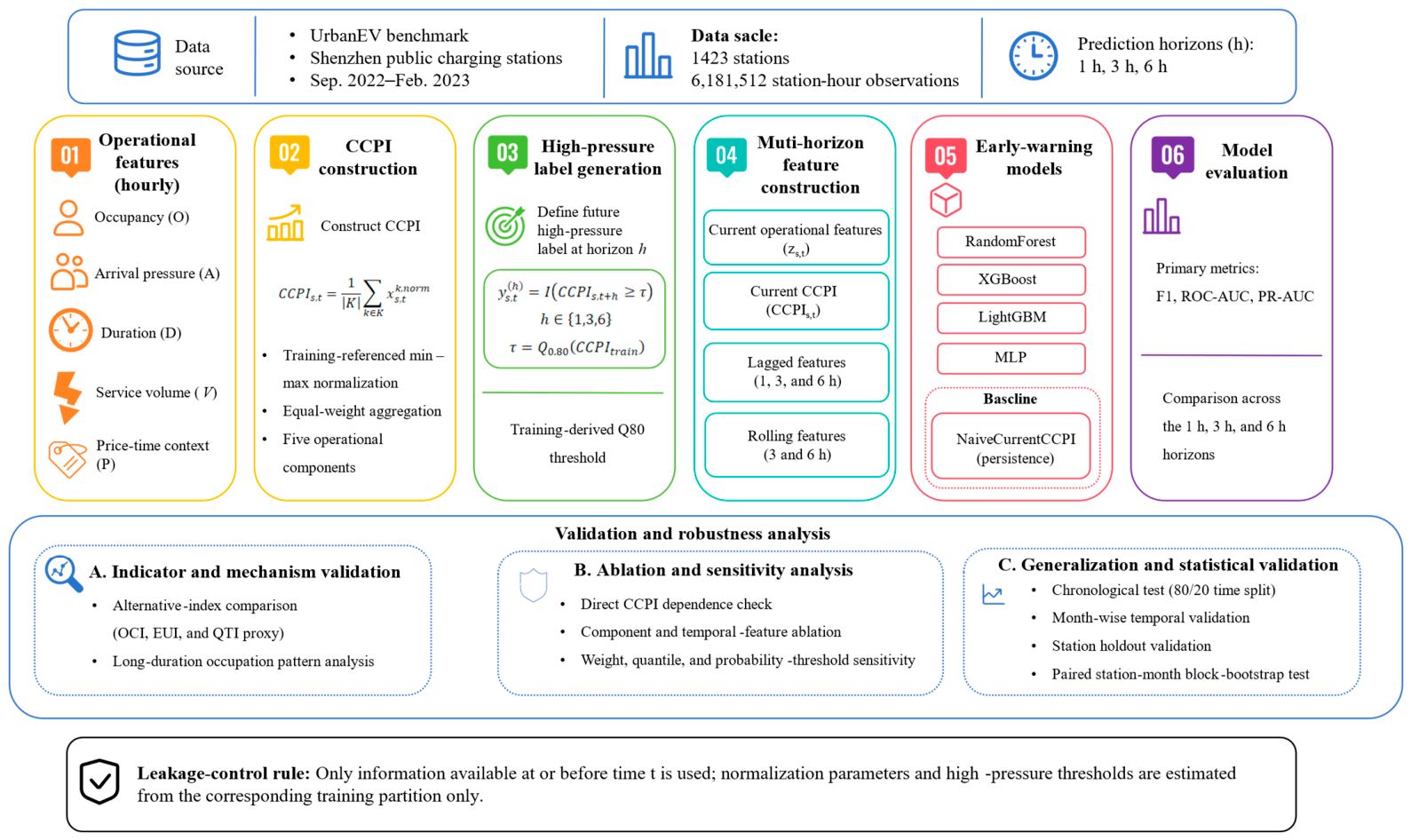
- This study develops an interpretable station-level Charging Congestion Pressure Index (CCPI) to represent EV charging congestion as a multidimensional operating state. Unlike single-indicator descriptions based only on occupancy or demand volume, the proposed CCPI integrates occupancy, arrival pressure, charging or occupation duration, service volume, and price–time context into a unified station–hour pressure representation. The index provides an interpretable pressure indicator for subsequent warning analysis.
- This study formulates EV charging congestion management as a multi-horizon high-pressure warning task for charging-infrastructure operation. Future high-pressure states are predicted at 1 h, 3 h, and 6 h horizons, allowing the framework to distinguish short-term pressure persistence from longer-horizon early-warning capability. These horizons correspond to different operational response windows, ranging from immediate station monitoring and user guidance to charging-service coordination and local resource planning. Temporally aligned lagged and rolling features are constructed so that only information available at or before the prediction timestamp is used.
- This study provides a deployment-oriented validation framework for evaluating EV charging pressure warning under temporal dependence and station heterogeneity. Chronological testing, month-wise temporal validation, and station holdout validation are used to examine performance under chronological, later-month, and unseen-station settings. Indicator ablation, feature ablation, mechanism analysis, and paired station–month block-bootstrap tests are further used to evaluate feature contributions, statistical stability, and the robustness of the proposed warning framework for charging-infrastructure operation.
2. Related Work
3. Methodology
3.1. Overall Framework and Data Preparation
3.2. Charging Congestion Pressure Index Construction
3.3. Multi-Horizon Warning Task and Feature Construction
3.4. Models, Evaluation Metrics, and Validation Protocol
4. Results and Analysis
4.1. Main High-Pressure Warning Performance
4.2. Component-Level Ablation, Indicator Comparison, and Mechanism Analysis
4.3. Feature Ablation and Temporal Feature Contribution
4.4. Temporal and Station Generalization
5. Discussion
6. Conclusions
Supplementary Materials
Funding
Informed Consent Statement
Data Availability Statement
Conflicts of Interest
References
- International Energy Agency. Global EV Outlook 2026; IEA: Paris, France, 2026; Available online: https://www.iea.org/reports/global-ev-outlook-2026 (accessed on 5 August 2026).
- Muratori, M. Impact of uncoordinated plug-in electric vehicle charging on residential power demand. Nat. Energy 2018, 3, 193–201. [Google Scholar] [CrossRef] [Scilit]
- Pal, A.; Bhattacharya, A.; Chakraborty, A.K. Planning of EV charging station with distribution network expansion considering traffic congestion and uncertainties. IEEE Trans. Ind. Appl. 2023, 59, 3810–3825. [Google Scholar] [CrossRef] [Scilit]
- Zhang, B.; Zhao, M.; Hu, X. Location planning of electric vehicle charging station with users’ preferences and waiting time: Multi-objective bi-level programming model and HNSGA-II algorithm. Int. J. Prod. Res. 2023, 61, 1394–1423. [Google Scholar] [CrossRef] [Scilit]
- Guillet, M.; Hiermann, G.; Kröller, A.; Schiffer, M. Electric vehicle charging station search in stochastic environments. Transp. Sci. 2022, 56, 483–500. [Google Scholar] [CrossRef] [Scilit]
- Pourvaziri, H.; Sarhadi, H.; Azad, N.; Afshari, H.; Taghavi, M. Planning of electric vehicle charging stations: An integrated deep learning and queueing theory approach. Transp. Res. Part E Logist. Transp. Rev. 2024, 186, 103568. [Google Scholar] [CrossRef] [Scilit]
- Saki, S.; Hagen, T. What drives drivers to start cruising for parking? Modeling the start of the search process. Transp. Res. Part B Methodol. 2024, 188, 103058. [Google Scholar] [CrossRef] [Scilit]
- Yaghoubi, E.; Yaghoubi, E.; Khamees, A.; Razmi, D.; Lu, T. A systematic review and meta-analysis of machine learning, deep learning, and ensemble learning approaches in predicting EV charging behavior. Eng. Appl. Artif. Intell. 2024, 135, 108789. [Google Scholar] [CrossRef] [Scilit]
- Kim, M.; Park, W.Y.; Moon, H.S.; Kim, Y.-S. A review of electric vehicle charging demand forecasting models by prediction horizon: A multi-criteria decision analysis approach. J. Electr. Eng. Technol. 2026, 21, 1457–1476. [Google Scholar] [CrossRef] [Scilit]
- Roberts, D.R.; Bahn, V.; Ciuti, S.; Boyce, M.S.; Elith, J.; Guillera-Arroita, G.; Hauenstein, S.; Lahoz-Monfort, J.J.; Schröder, B.; Thuiller, W.; et al. Cross-validation strategies for data with temporal, spatial, hierarchical, or phylogenetic structure. Ecography 2017, 40, 913–929. [Google Scholar] [CrossRef] [Scilit]
- Bergmeir, C.; Hyndman, R.J.; Koo, B. A note on the validity of cross-validation for evaluating autoregressive time series prediction. Comput. Stat. Data Anal. 2018, 120, 70–83. [Google Scholar] [CrossRef] [Scilit]
- Zhang, X.; Chan, K.W.; Li, H.; Wang, H.; Qiu, J.; Wang, G. Deep-learning-based probabilistic forecasting of electric vehicle charging load with a novel queuing model. IEEE Trans. Cybern. 2021, 51, 3157–3170. [Google Scholar] [CrossRef] [Scilit] [PubMed]
- Ostermann, A.; Haug, T. Probabilistic forecast of electric vehicle charging demand: Analysis of different aggregation levels and energy procurement. Energy Inform. 2024, 7, 13. [Google Scholar] [CrossRef] [Scilit]
- Tian, J.; Liu, H.; Gan, W.; Zhou, Y.; Wang, N.; Ma, S. Short-term electric vehicle charging load forecasting based on TCN-LSTM network with comprehensive similar day identification. Appl. Energy 2025, 381, 125174. [Google Scholar] [CrossRef] [Scilit]
- Sreekumar, A.V.; Lekshmi, R.R. Electric vehicle charging station demand prediction model deploying data slotting. Results Eng. 2024, 24, 103095. [Google Scholar] [CrossRef] [Scilit]
- Zamee, M.A.; Han, D.; Cha, H.; Won, D. Self-supervised online learning algorithm for electric vehicle charging station demand and event prediction. J. Energy Storage 2023, 71, 108189. [Google Scholar] [CrossRef] [Scilit]
- Yi, Z.; Liu, X.C.; Wei, R.; Chen, X.; Dai, J. Electric vehicle charging demand forecasting using deep learning model. J. Intell. Transp. Syst. 2022, 26, 690–703. [Google Scholar] [CrossRef] [Scilit]
- Wang, S.; Zhuge, C.; Shao, C.; Wang, P.; Yang, X.; Wang, S. Short-term electric vehicle charging demand prediction: A deep learning approach. Appl. Energy 2023, 340, 121032. [Google Scholar] [CrossRef] [Scilit]
- Orzechowski, A.; Lugosch, L.; Shu, H.; Yang, R.; Li, W.; Meyer, B.H. A data-driven framework for medium-term electric vehicle charging demand forecasting. Energy AI 2023, 14, 100267. [Google Scholar] [CrossRef] [Scilit]
- Ma, T.-Y.; Faye, S. Multistep electric vehicle charging station occupancy prediction using hybrid LSTM neural networks. Energy 2022, 244, 123217. [Google Scholar] [CrossRef] [Scilit]
- Chen, Q.; You, L.; Qu, H.; Abdelmoniem, A.M.; Yuen, C. AFML: An asynchronous federated meta-learning mechanism for charging station occupancy prediction with biased and isolated data. IEEE Trans. Big Data 2025, 11, 1772–1786. [Google Scholar] [CrossRef] [Scilit]
- Baek, K.; Lee, E.; Kim, J. A dataset for multi-faceted analysis of electric vehicle charging transactions. Sci. Data 2024, 11, 262. [Google Scholar] [CrossRef] [Scilit] [PubMed]
- Li, H.; Qu, H.; Tan, X.; You, L.; Zhu, R.; Fan, W. UrbanEV: An open benchmark dataset for urban electric vehicle charging demand prediction. Sci. Data 2025, 12, 523. [Google Scholar] [CrossRef] [Scilit] [PubMed]
- Wang, S.; Li, Y.; Shao, C.; Wang, P.; Wang, A.; Zhuge, C. An adaptive spatio-temporal graph recurrent network for short-term electric vehicle charging demand prediction. Appl. Energy 2025, 383, 125320. [Google Scholar] [CrossRef] [Scilit]
- Yan, J.; Zhang, J.; Liu, Y.; Lv, G.; Han, S.; Alfonzo, I.E.G. EV charging load simulation and forecasting considering traffic jam and weather to support the integration of renewables and EVs. Renew. Energy 2020, 159, 623–641. [Google Scholar] [CrossRef] [Scilit]
- Wang, S.; Chen, A.; Wang, P.; Zhuge, C. Predicting electric vehicle charging demand using a heterogeneous spatio-temporal graph convolutional network. Transp. Res. Part C Emerg. Technol. 2023, 153, 104205. [Google Scholar] [CrossRef] [Scilit]
- Qu, H.; Kuang, H.; Wang, Q.; Li, J.; You, L. A physics-informed and attention-based graph learning approach for regional electric vehicle charging demand prediction. IEEE Trans. Intell. Transp. Syst. 2024, 25, 14284–14297. [Google Scholar] [CrossRef] [Scilit]
- You, L.; Chen, Q.; Qu, H.; Zhu, R.; Yan, J.; Santi, P.; Ratti, C. FMGCN: Federated meta learning-augmented graph convolutional network for EV charging demand forecasting. IEEE Internet Things J. 2024, 11, 24452–24466. [Google Scholar] [CrossRef] [Scilit]
- Qu, H.; Li, H.; You, L.; Zhu, R.; Yan, J.; Santi, P.; Ratti, C.; Yuen, C. ChatEV: Predicting electric vehicle charging demand as natural language processing. Transp. Res. Part D Transp. Environ. 2024, 136, 104470. [Google Scholar] [CrossRef] [Scilit]
- Kuang, H.; Deng, K.; You, L.; Li, J. Citywide electric vehicle charging demand prediction approach considering urban region and dynamic influences. Energy 2025, 320, 135170. [Google Scholar] [CrossRef] [Scilit]
- Huang, Y.; Wu, S.; Wang, Z.; Liu, X.; Li, C.; Hu, Y. Causality-aware multi-graph convolutional networks with critical node dynamics for electric vehicle charging station load forecasting. IEEE Trans. Smart Grid 2025, 16, 3210–3225. [Google Scholar] [CrossRef] [Scilit]
- Wu, T.; Fainman, E.; Maïzi, Y.; Shu, J.; Li, Y. Allocate electric vehicles’ public charging stations with charging demand uncertainty. Transp. Res. Part D Transp. Environ. 2024, 130, 104178. [Google Scholar] [CrossRef] [Scilit]
- Zhang, J.; Wang, Z.; Miller, E.J.; Cui, D.; Liu, P.; Zhang, Z.; Sun, Z. Multi-period planning of locations and capacities of public charging stations. J. Energy Storage 2023, 72, 108565. [Google Scholar] [CrossRef] [Scilit]
- Wang, H.; Meng, Q.; Wang, J.; Zhao, D. An electric-vehicle corridor model in a dense city with applications to charging location and traffic management. Transp. Res. Part B Methodol. 2021, 149, 79–99. [Google Scholar] [CrossRef] [Scilit]
- Dudkina, E.; Scarpelli, C.; Apicella, V.; Ceraolo, M.; Crisostomi, E. Optimised centralised charging of electric vehicles along motorways. Sustainability 2025, 17, 5668. [Google Scholar] [CrossRef] [Scilit]
- Wang, B.; Ge, X.; Jin, Y.; Xu, M.; Huang, Z. Orderly charging scheduling for EVs with a novel queuing model under power capacity constraints. Appl. Sci. 2025, 15, 12038. [Google Scholar] [CrossRef] [Scilit]
- Wang, B.; Yao, Y.; Gao, J.; Luo, D. Two-stage orderly charging scheduling for large-scale electric vehicle charging stations via the SMPD framework. World Electr. Veh. J. 2026, 17, 320. [Google Scholar] [CrossRef] [Scilit]
- Kuang, H.; Zhang, X.; Qu, H.; You, L.; Zhu, R.; Li, J. Unraveling the effect of electricity price on electric vehicle charging behavior: A case study in Shenzhen, China. Sustain. Cities Soc. 2024, 115, 105836. [Google Scholar] [CrossRef] [Scilit]
- Wang, Y.; Yao, E.; Pan, L. Electric vehicle drivers’ charging behavior analysis considering heterogeneity and satisfaction. J. Clean. Prod. 2021, 286, 124982. [Google Scholar] [CrossRef] [Scilit]
- Yang, X.; Peng, Z.; Wang, P.; Zhuge, C. Seasonal variance in electric vehicle charging demand and its impacts on infrastructure deployment: A big data approach. Energy 2023, 280, 128230. [Google Scholar] [CrossRef] [Scilit]
- Nardo, M.; Saisana, M.; Saltelli, A.; Tarantola, S.; Hoffmann, A.; Giovannini, E. Handbook on Constructing Composite Indicators: Methodology and User Guide; OECD Publishing: Paris, France, 2008. [Google Scholar] [CrossRef] [Scilit]
- Varma, S.; Simon, R. Bias in error estimation when using cross-validation for model selection. BMC Bioinform. 2006, 7, 91. [Google Scholar] [CrossRef] [Scilit] [PubMed]
- Cawley, G.C.; Talbot, N.L.C. On over-fitting in model selection and subsequent selection bias in performance evaluation. J. Mach. Learn. Res. 2010, 11, 2079–2107. [Google Scholar]
- Dietterich, T.G. Approximate statistical tests for comparing supervised classification learning algorithms. Neural Comput. 1998, 10, 1895–1923. [Google Scholar] [CrossRef] [Scilit] [PubMed]
- Efron, B. Bootstrap methods: Another look at the jackknife. Ann. Stat. 1979, 7, 1–26. [Google Scholar] [CrossRef] [Scilit]
- Künsch, H.R. The jackknife and the bootstrap for general stationary observations. Ann. Stat. 1989, 17, 1217–1241. [Google Scholar] [CrossRef] [Scilit]
- Becker, W.; Saisana, M.; Paruolo, P.; Vandecasteele, I. Weights and importance in composite indicators: Closing the gap. Ecol. Indic. 2017, 80, 12–22. [Google Scholar] [CrossRef] [Scilit] [PubMed]
- Greco, S.; Ishizaka, A.; Tasiou, M.; Torrisi, G. On the methodological framework of composite indices: A review of the issues of weighting, aggregation, and robustness. Soc. Indic. Res. 2019, 141, 61–94. [Google Scholar] [CrossRef] [Scilit]
- Hyndman, R.J.; Fan, Y. Sample quantiles in statistical packages. Am. Stat. 1996, 50, 361–365. [Google Scholar] [CrossRef] [Scilit]
- Tashman, L.J. Out-of-sample tests of forecasting accuracy: An analysis and review. Int. J. Forecast. 2000, 16, 437–450. [Google Scholar] [CrossRef] [Scilit]
- Breiman, L. Random forests. Mach. Learn. 2001, 45, 5–32. [Google Scholar] [CrossRef] [Scilit]
- Friedman, J.H. Greedy function approximation: A gradient boosting machine. Ann. Stat. 2001, 29, 1189–1232. [Google Scholar] [CrossRef] [Scilit]
- Chen, T.; Guestrin, C. XGBoost: A scalable tree boosting system. In Proceedings of the 22nd ACM SIGKDD International Conference on Knowledge Discovery and Data Mining, San Francisco, CA, USA, 13–17 August 2016; pp. 785–794. [Google Scholar] [CrossRef] [Scilit]
- Ke, G.; Meng, Q.; Finley, T.; Wang, T.; Chen, W.; Ma, W.; Ye, Q.; Liu, T.-Y. LightGBM: A highly efficient gradient boosting decision tree. In Proceedings of the 31st International Conference on Neural Information Processing Systems (NIPS’17), Long Beach, CA, USA, 4–9 December 2017; Volume 30, pp. 3146–3154. Available online: https://proceedings.neurips.cc/paper/2017/hash/6449f44a102fde848669bdd9eb6b76fa-Abstract.html (accessed on 9 August 2026).
- Rumelhart, D.E.; Hinton, G.E.; Williams, R.J. Learning representations by back-propagating errors. Nature 1986, 323, 533–536. [Google Scholar] [CrossRef] [Scilit]
- Grinsztajn, L.; Oyallon, E.; Varoquaux, G. Why do tree-based models still outperform deep learning on typical tabular data? In Proceedings of the Advances in Neural Information Processing Systems 35, New Orleans, LA, USA, 28 November–9 December 2022; pp. 507–520. [Google Scholar] [CrossRef] [Scilit]
- Shahriar, S.; Al-Ali, A.R.; Osman, A.H.; Dhou, S.; Nijim, M. Prediction of EV charging behavior using machine learning. IEEE Access 2021, 9, 111576–111586. [Google Scholar] [CrossRef] [Scilit]
- He, H.; Garcia, E.A. Learning from imbalanced data. IEEE Trans. Knowl. Data Eng. 2009, 21, 1263–1284. [Google Scholar] [CrossRef] [Scilit]
- Fawcett, T. An introduction to ROC analysis. Pattern Recognit. Lett. 2006, 27, 861–874. [Google Scholar] [CrossRef] [Scilit]
- Saito, T.; Rehmsmeier, M. The precision-recall plot is more informative than the ROC plot when evaluating binary classifiers on imbalanced datasets. PLoS ONE 2015, 10, e0118432. [Google Scholar] [CrossRef] [Scilit] [PubMed]
- Sokolova, M.; Lapalme, G. A systematic analysis of performance measures for classification tasks. Inf. Process. Manag. 2009, 45, 427–437. [Google Scholar] [CrossRef] [Scilit]
- Hernández-Orallo, J.; Flach, P.; Ferri, C. A unified view of performance metrics: Translating threshold choice into expected classification loss. J. Mach. Learn. Res. 2012, 13, 2813–2869. Available online: https://www.jmlr.org/papers/v13/hernandez-orallo12a.html (accessed on 9 August 2026).



| Item | Value |
|---|---|
| Number of stations | 1423 |
| Station–hour samples | 6,181,512 |
| Time period | 1 September 2022 to 28 February 2023 |
| Mean occupancy | 3.553 |
| Mean aggregated charging duration | 2.587 |
| Mean volume | 20.250 |
| Mean CCPI | 0.115 |
| CCPI Q75 | 0.125 |
| CCPI Q80 | 0.126 |
| CCPI Q90 | 0.136 |
| Horizon | Method | F1 | ROC-AUC | PR-AUC |
|---|---|---|---|---|
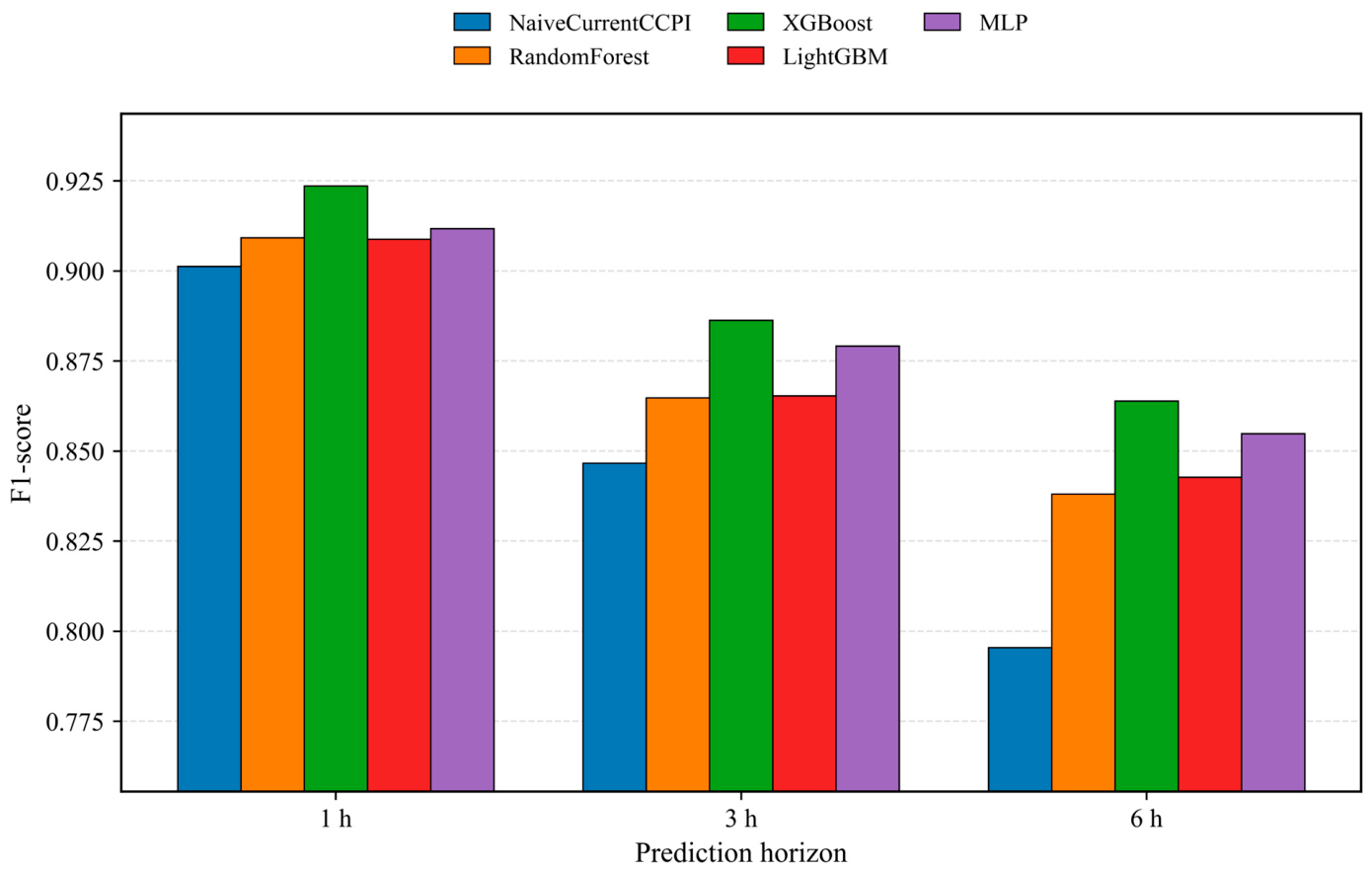
| 1 h | NaiveCurrentCCPI | 0.901 | 0.980 | 0.945 |
| 1 h | RandomForest | 0.909 | 0.993 | 0.976 |
| 1 h | XGBoost | 0.924 | 0.993 | 0.977 |
| 1 h | LightGBM | 0.909 | 0.993 | 0.978 |
| 1 h | MLP | 0.912 | 0.991 | 0.972 |
| 3 h | NaiveCurrentCCPI | 0.847 | 0.959 | 0.891 |
| 3 h | RandomForest | 0.865 | 0.985 | 0.954 |
| 3 h | XGBoost | 0.886 | 0.986 | 0.957 |
| 3 h | LightGBM | 0.867 | 0.985 | 0.957 |
| 3 h | MLP | 0.880 | 0.984 | 0.950 |
| 6 h | NaiveCurrentCCPI | 0.795 | 0.936 | 0.840 |
| 6 h | RandomForest | 0.838 | 0.979 | 0.936 |
| 6 h | XGBoost | 0.864 | 0.981 | 0.940 |
| 6 h | LightGBM | 0.845 | 0.980 | 0.941 |
| 6 h | MLP | 0.854 | 0.978 | 0.930 |
| Horizon | Baseline F1 | XGBoost F1 | Delta F1 | 95% CI | p-Value |
|---|---|---|---|---|---|
| 1 h | 0.901 | 0.924 | +0.022 | [+0.021, +0.024] | <0.001 |
| 3 h | 0.847 | 0.886 | +0.040 | [+0.036, +0.043] | <0.001 |
| 6 h | 0.795 | 0.864 | +0.068 | [+0.062, +0.075] | <0.001 |
| Horizon | Occupancy-Only F1 | Duration-Only F1 | Volume-Only F1 | Price–Time F1 | Full CCPI Features F1 |
|---|---|---|---|---|---|
| 1 h | 0.848 | 0.781 | 0.790 | 0.453 | 0.909 |
| 3 h | 0.813 | 0.749 | 0.756 | 0.453 | 0.865 |
| 6 h | 0.795 | 0.732 | 0.741 | 0.455 | 0.838 |
| Horizon | Full Features | Excl. Current CCPI | Excl. CCPI-Family | Raw Lagged Ops. | Current Ops. Only |
|---|---|---|---|---|---|
| 1 h | 0.909 | 0.908 (−0.002) | 0.901 (−0.008) | 0.897 (−0.012) | 0.876 (−0.033) |
| 3 h | 0.865 | 0.864 (−0.001) | 0.857 (−0.008) | 0.856 (−0.009) | 0.814 (−0.051) |
| 6 h | 0.838 | 0.837 (−0.001) | 0.830 (−0.008) | 0.828 (−0.010) | 0.763 (−0.075) |
| Validation Setting | Horizon | Current CCPI F1 | RandomForest F1 | XGBoost F1 | LightGBM F1 | MLP F1 |
|---|---|---|---|---|---|---|
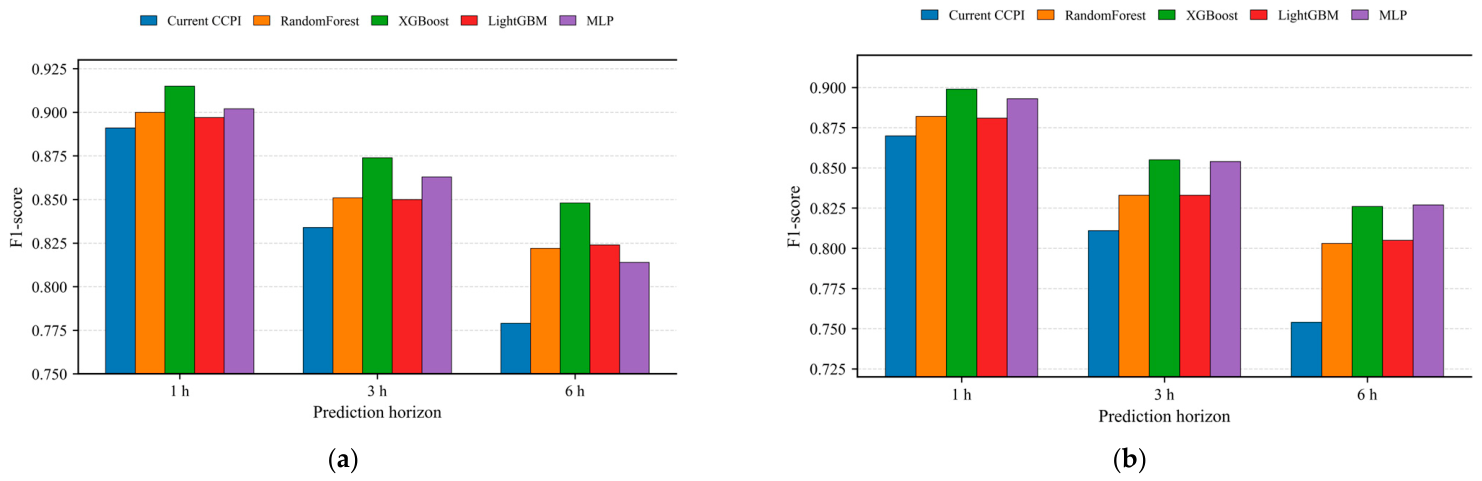
| Month-wise temporal | 1 h | 0.891 | 0.900 | 0.915 | 0.897 | 0.902 |
| Month-wise temporal | 3 h | 0.834 | 0.851 | 0.874 | 0.850 | 0.863 |
| Month-wise temporal | 6 h | 0.779 | 0.822 | 0.848 | 0.824 | 0.814 |
| Station holdout | 1 h | 0.870 | 0.882 | 0.899 | 0.881 | 0.893 |
| Station holdout | 3 h | 0.811 | 0.833 | 0.855 | 0.833 | 0.854 |
| Station holdout | 6 h | 0.754 | 0.803 | 0.828 | 0.805 | 0.827 |
Disclaimer/Publisher’s Note: The statements, opinions and data contained in all publications are solely those of the individual author(s) and contributor(s) and not of MDPI and/or the editor(s). MDPI and/or the editor(s) disclaim responsibility for any injury to people or property resulting from any ideas, methods, instructions or products referred to in the content. |
© 2026 by the author. Published by MDPI on behalf of the World Electric Vehicle Association. Licensee MDPI, Basel, Switzerland. This article is an open access article distributed under the terms and conditions of the Creative Commons Attribution (CC BY) license.
Share and Cite
Shi, K. Interpretable Station-Level Charging Congestion Pressure Assessment and Multi-Horizon Early Warning for Electric-Vehicle Charging Infrastructure. World Electr. Veh. J. 2026, 17, 443. https://doi.org/10.3390/wevj17090443
Shi K. Interpretable Station-Level Charging Congestion Pressure Assessment and Multi-Horizon Early Warning for Electric-Vehicle Charging Infrastructure. World Electric Vehicle Journal. 2026; 17(9):443. https://doi.org/10.3390/wevj17090443
Chicago/Turabian StyleShi, Kai. 2026. "Interpretable Station-Level Charging Congestion Pressure Assessment and Multi-Horizon Early Warning for Electric-Vehicle Charging Infrastructure" World Electric Vehicle Journal 17, no. 9: 443. https://doi.org/10.3390/wevj17090443
APA StyleShi, K. (2026). Interpretable Station-Level Charging Congestion Pressure Assessment and Multi-Horizon Early Warning for Electric-Vehicle Charging Infrastructure. World Electric Vehicle Journal, 17(9), 443. https://doi.org/10.3390/wevj17090443