
Article

Future Projections of Lifecycle Cost and Greenhouse Gas Emissions of Light-Duty Vehicles

1
Toyota Motor North America, 1555 Woodridge Ave, Ann Arbor, MI 48105, USA
2
Idaho National Laboratory, Idaho Falls, ID 83415, USA
*
Author to whom correspondence should be addressed.
World Electr. Veh. J. 2026, 17(7), 347; https://doi.org/10.3390/wevj17070347
Submission received: 8 April 2026 / Revised: 24 June 2026 / Accepted: 29 June 2026 / Published: 3 July 2026
(This article belongs to the Section Vehicle and Transportation Systems)

Abstract

Vehicles with electrified powertrains carry the promise of significant reductions in greenhouse gas (GHG) emissions from a lifecycle analysis (LCA) standpoint compared to conventional internal combustion engine (CICE) vehicles. However, trade-offs exist between different types of electrified powertrains in terms of cost, consumer acceptance, and GHG reduction efficacy for different operating conditions. The open-source tool CarGHG was developed with an aim to enable the exploration of a plethora of parametric study scenarios, including the cost of electrification technologies, different driving patterns and charging habits, and the cost and carbon intensity of electricity and fuel blends. This paper introduces the framework of CarGHG, then showcases total cost of ownership (TCO) and LCA GHG results for select models of light-duty vehicles. Another capability of CarGHG, which is the ability to estimate the performance of “virtual” vehicle models (perceived vehicle design specifications not yet on the market), is utilized to explore future scenarios of electrification and low-carbon fuel blends for Small Sports Utility Vehicles (SUVs), a popular light-duty vehicle segment in North America. With opportunities, but also uncertainties, in future scenarios, it is likely wise to continue pursuing multiple ways towards the reduction of LCA GHG.

1. Introduction

Vehicles with electrified powertrains, also known as electrified vehicles [1] or electric drive vehicles [2], are loosely defined as vehicles that include a traction battery and one or more electric motors that can supply (fully or partially) the traction power needed to move the vehicle. Electrified powertrains include (non-plug-in) hybrid electric vehicles (HEVs), plug-in hybrid electric vehicles (PHEVs), battery-only electric vehicles (BEVs), hydrogen fuel-cell (hybrid) electric vehicles (FCEVs) [3] and plug-in fuel-cell electric vehicles (PFCEVs) [4]. All types of electrified powertrains seek to reduce greenhouse gas (GHG) emissions compared to conventional internal combustion engine (CICE) vehicles. In the case of HEVs whose sole source of energy (much like CICEs) is fuel combustion in an internal combustion engine, the GHG reductions are realized via better fuel economy due to some common traits among all electrified powertrains, including: (i) regenerative braking, which is the ability to recapture vehicle kinetic energy during braking events by operating the electric motor(s) as generator(s), (ii) the ability to buffer/store energy in the traction battery, and (iii) the high efficiency of electric motors across a broad operating range of torque and speed requirements, which in turn, by utilizing the motor(s) for acceleration assist, enables better optimization of the engine, allowing it to operate within its efficient torque-speed operating range or completely shut down at low power requirements.
Aside from HEVs, other types of electrified powertrains seek to further reduce GHG emissions by relying on lower carbon intensity (CI) energy sources, such as electricity for BEVs or Hydrogen for FCEVs. PHEVs have a battery size/capacity larger than HEVs but generally smaller than BEV batteries. Like BEVs, PHEVs can charge the traction battery from the electric grid and have a dual powertrain like HEVs that enables automatically switching to “HEV-mode” (fuel consumption in the engine as the energy source) when the energy level in the battery becomes low. When charged consistently, PHEVs combine attractive traits of both BEVs and HEVs; utilization of low-CI grid electricity for an appreciable fraction of the travel distance and good fuel economy when the battery runs out.
BEVs, FCEVs and PFCEVs produce no GHG emissions from the vehicle “tailpipe” (also known as “tank to wheels”, T2W), but in most cases, there are GHG emissions associated with the generation and transmission of electricity or the production/delivery of Hydrogen. Those GHG emissions are often termed “upstream” or “well to tank” (W2T) emissions. Accounting for both upstream and tailpipe (or W2T and T2W) provides the total GHG emissions during the “use phase” of the vehicle, which is also known as “well to wheels” (W2W) emissions. For lifecycle analysis (LCA) of GHG emissions, one considers the use phase plus GHG estimates for production of the vehicle, as well as the GHG for disposal of the vehicle at its end-of-life.
Energy efficiency gains alone (without considering a lower CI energy source) allow HEVs to reduce tailpipe GHG emissions by 25% to 35% depending on the vehicle and powertrain configuration, as well as the driving conditions, according to the estimates in [5,6]. However, for certain larger vehicles, such as full-sized pickup trucks (FSPTs), the fuel consumption savings (proportional to the reduction in tailpipe GHG emissions) appear closer to 10% when comparing some fuel economy ratings [7] of current FSPT models that have both CICE and HEV offerings. Aside from comfort with utilizing new technology and the higher initial cost for vehicle purchase compared to an equivalent CICE, there appears to be no other significant hurdles that would hinder mass-market adoption of HEVs instead of CICEs. A study in 2016 [8] showed that when regional effects such as driving patterns, ambient temperature and electricity generation fuel mix (for a model of the US grid at the time) are all considered, the LCA GHG emissions for a BEV model was not necessarily better than that of an HEV model for most of the US. As vehicle technologies improved and the CI of electricity generation was reduced (via an increased fraction of renewable and low-Carbon energy sources, along with gradual phasing out of high-CI energy sources such as Coal and Heavy Oil), it is likely that at the present day, a BEV would bring more LCA GHG reduction benefit than an equivalent HEV in most parts of the US (except for a few regions that are still heavily dependent on Coal electricity generation). Unfortunately, widespread adoption of BEVs among mass-market vehicle owners faces several challenges. Purchase cost aside, perceptions about the BEV driving range, charging time and availability of charging infrastructure appear to be contributing to the reluctance of adopting BEVs [9,10,11]. FCEVs and PFCEVs have an advantage in their refueling time compared to the charging time of BEVs, even when BEVs are utilizing high-powered direct current (DC) fast chargers. However, FCEVs and PFCEVs face more challenges in the infrastructure availability, supply chain and price of Hydrogen, and the need for cost reductions of the fuel cell unit and Hydrogen storage tanks [12,13,14,15]. PHEVs present an interesting compromise in terms of GHG and cost [16]. While the initial acquisition cost (without considering incentives) of PHEVs will most likely be more than equivalent HEVs (due to having a larger battery), the total cost of ownership (TCO) depends on usage conditions as well as the retail price of fuel (gasoline) and electricity. In terms of W2W or LCA GHG, under the worst conditions (PHEVs not charged at all or CI of electricity is very high), the GHG performance of the PHEV could be slightly worse than that of an equivalent HEV, while in the best of conditions, the LCA GHG reduction benefit of a PHEV could be as good as, or even slightly better, than a BEV [16,17].
Studies seeking to quantify the benefits of electrified powertrains have considered the US EPA window-sticker ratings [18,19,20], but such studies are limited to vehicle models that are already on the market and have obtained window-sticker ratings. For predictions of future electrified vehicles, some powertrain modeling capability is needed. Various levels of modeling detail have been employed since the early works of Markel and Simpson [21], Samaras and Meisterling [22], and Bradly and Frank [23]. Among the various powertrain models and software, two are endorsed by the US Department of Energy [24], namely, Autonomie [25] and FASTSim [26], both of which have been utilized in studies in the literature, such as [16,17,27,28,29,30]. Among the attractive qualities of FASTSim, which was originally developed by the National Renewable Energy Laboratory (NREL), is its level of modeling abstraction for powertrain components being efficiency curves [29] rather than torque-speed maps. This choice by the developers of FASTSim enables very fast computations, along with sufficiently high-fidelity results (especially for tuned FASTSim models [30]) when compared with real-world vehicles energy and fuel consumption. Fast computations in FASTSim enabled W2W GHG simulations in [17], which utilized large-scale second-by-second information of more than 60 thousand real-world trips from the 2010–2012 California Household Travel Survey (CHTS) [31], which was taken as a proxy representative of the overall driving in California, a departure from traditional approaches relying on a limited number of dynamometer drive cycles for estimation of energy and fuel consumption.
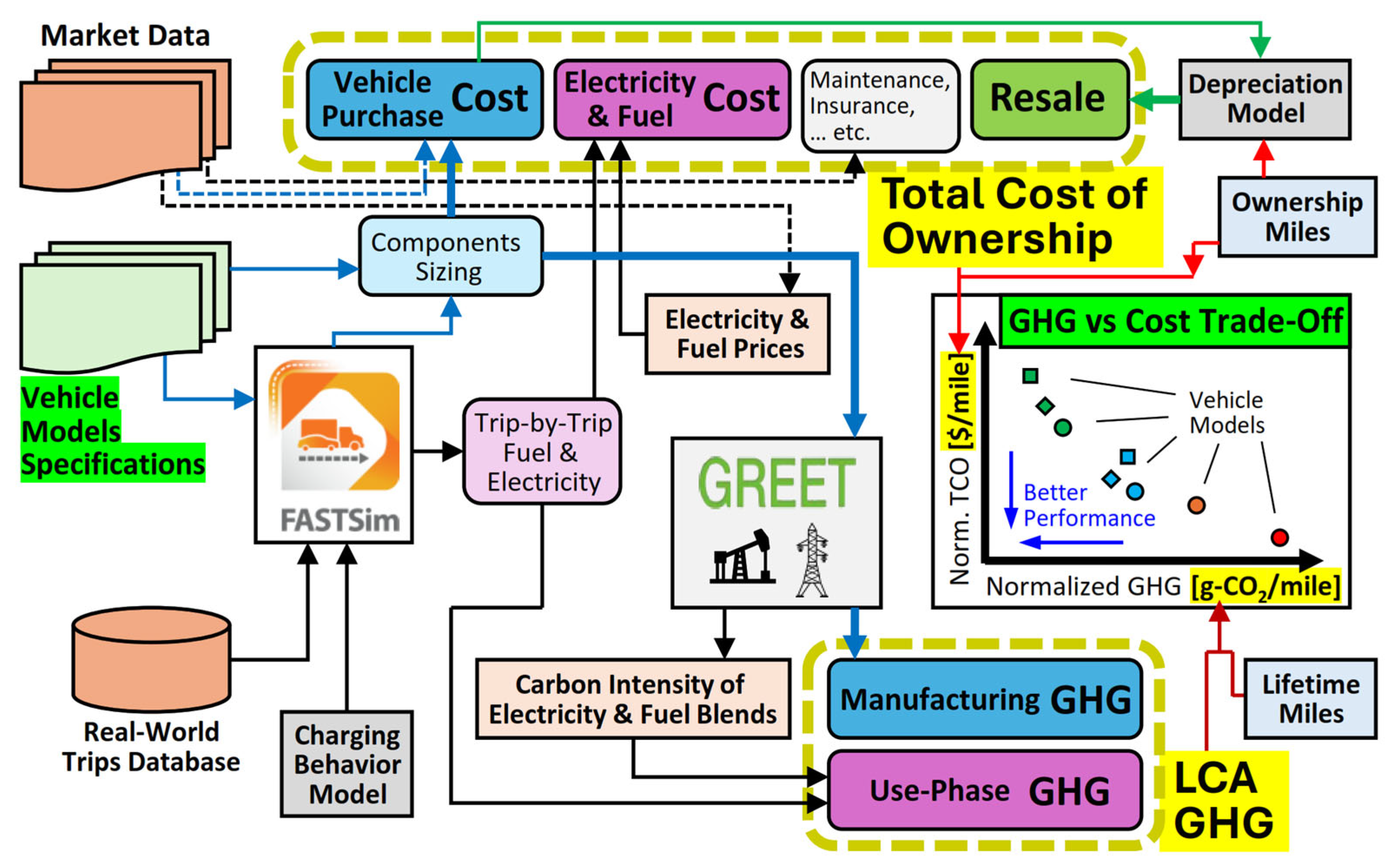
An extension of the W2W GHG analysis in [17] into LCA GHG was conducted as part of the development of the open-source tool CarGHG [32]. Extension of the analysis from W2W (based on FASTSim simulations of CHTS trips) into LCA was done by considering estimates for the GHG emissions that occur during manufacturing of the batteries for the electrified powertrains, as well as a lump-sum model for the GHG emissions due to manufacturing the rest of the vehicle. Estimates for manufacturing GHG were based on estimates from the 2020 version of GREET [33], which is also an open-source tool developed by Argonne National Laboratory (ANL). As illustrated in Figure 1, LCA GHG is a primary metric of performance for light-duty vehicles, with another metric being the total cost of ownership (TCO). The broadlines of TCO analysis of a vehicle are generally well understood as considering the acquisition/purchase cost (minus incentives) and running costs (fuel, electricity, maintenance, insurance and licensing), minus the resale value [19,34,35]. However, uncertainty exists with regards to powertrain specific depreciation rates, or future electricity and fuel costs. The design of CarGHG is meant to enable quick examination of many different settings of uncertain parameters, which, in turn, enables efficient generation of many future-looking scenarios, some of which will be illustrated in this paper.
This paper starts with an introduction to electrified powertrains in light-duty vehicles and a brief review of prior work in the literature leading to the development of CarGHG. The rest of the manuscript briefly explains key details about CarGHG, then proceeds to utilize it for showcasing scenarios of LCA GHG versus TCO cost for select existing light-duty vehicle models, as well as future scenarios involving “virtual” vehicle models (leveraging the modeling capability of FASTSim to predict the performance for electrified vehicles not yet on the market). Section 2 provides an overview of the computations in CarGHG in relation to this paper, Section 3 presents scenario results for select existing vehicles, and Section 4 presents scenario results for select virtual vehicle models. Section 5 discusses limitations and identified open-ended modeling issues before the paper concludes.

2. Computations in CarGHG

2.1. Overview

When referring to CarGHG, as explained in its landing web page [32], it is useful to distinguish between an easy/ready-to-use within web browser (but with limited capability) version, which is referred to as “CarGHG Web-App” [36], and the full capability version, referred as “CarGHG Desktop”. The full source code in Java for CarGHG Desktop [37] is available on GitHub. A pre-compilation of the source code, along with two study example sets of vehicle models, can be downloaded from [32]. The pre-compiled desktop app has been briefly tested on Mac OS and Linux, but the majority of the testing and usage (including results shown in this paper) was done on a Windows PC. For brevity, when mentioning CarGHG from this point forward in the manuscript, the implied mention is that of CarGHG Desktop on a Windows PC.
As illustrated in Figure 1, a main goal of the software tool is to enable utilizing a set of vehicle model specifications as a main input (green highlight text on the left part of Figure 1) to infer the trade-off between LCA GHG versus TCO (green highlight text on the right part of Figure 1). The TCO in question is from the first vehicle owner’s perspective, modeled as an owner who buys the vehicle new and then resells it after a certain number of years have passed. Trade-off analysis implies that there are two quantities calculated for each vehicle model (yellow highlight text in Figure 1), which are: (i) Normalized LCA GHG [in equivalent g-CO2/mile] for the lifetime of the vehicle and (ii) Normalized TCO [in $/mile] for the first vehicle owner. Various other pieces of information aside from vehicle model specifications are also necessary to generate the estimates of LCA GHG and TCO. In general, inputs are grouped into two types: (i) Sensitivity or Scenario parameters, for which the input takes the form of upper and lower bounds, and (ii) other inputs and parameters. An overview of the various inputs is discussed in Section 2.2, and core computations are discussed in Section 2.3, Section 2.4 and Section 2.5.

2.2. Model Inputs

2.2.1. Scenario Parameters

Sensitivity or Scenario parameters are set in CarGHG in such a way so that quick adjustments can be performed (via slider bars), with the corresponding adjustment of the output LCA GHG and/or TCO occurring (almost instantly) in the output modules. Scenario parameters are defined during the setup of a “new study” in CarGHG via a default/baseline value, as well as upper and lower bounds. A listing of all available scenario parameters in CarGHG is provided in Table 1.

2.2.2. Other Inputs and Parameters

Aside from the adjustable scenario parameters discussed in Section 2.2.1, several other inputs are required to enable the estimation of LCA GHG and TCO via the computation modules. Due to some consistency of information flow and coding constraints, once set during the initiation of a “new study”, some of the inputs are no longer allowed to change (except via creating another new study). An example of such inputs includes the creation of FASTSim vehicle models, which itself is a task that takes time and requires expertise with FASTSim. Creation of the FASTSim models for all vehicles models presented in this paper followed the iterative procedures outlined in [38] and are provided in Supplementary Data. Due to the complexity of the setup task, it is not implemented as part of the graphical user interface (GUI) of CarGHG. Rather, setup of a new study in CarGHG is delegated to advanced users, who should consult the advanced user’s manual on how to appropriately prepare the relevant input files. For other inputs that can be edited/adjusted in the GUI (after initiation of a new study), we classify those inputs into ones that require the rerun of FASTSim simulations and inputs that do not require the rerun of FASTSim simulations upon editing/adjusting. An explanation of the various inputs is listed as follows:
Initiation of a New Study Inputs:
  • Set of vehicle models to be analyzed/compared, including Powertrain type and nominal all-electric range (AER) for plug-in vehicles, i.e., BEV, PHEV or PFCEV.
  • Complete FASTSim model (separate file for each vehicle): among the information included is (depending on powertrain type) sizing (in kW) of the engine, motor or fuel cell, as well as the type of fuel used in the engine (Gasoline, Diesel or Natural Gas), sizing (in kWh) and power capacity (in kW) of the traction battery, total mass of the vehicle and mass of the vehicle excluding the traction battery.
  • Designation (for each vehicle in the set) of whether the vehicle model is “virtual” or approximately based on some real model with available market data:
    If the vehicle model is not designated as virtual, the average purchase price from market data (or any other means of estimation) is required as an input;
    If the vehicle model is designated as virtual, then for estimation of the purchase price, an identifier of another vehicle that the virtual vehicle is derived from (everything similar except the powertrain) is required as an input.
  • Maximum total incentive (in first year equivalent $ amount) for each vehicle.
  • Baseline value for the CI of manufacturing the traction battery (in g-CO2/kWh): Since this value depends on the battery chemistry as well as the setup of the battery pack, and could also depend on the supply chain, this input can be separately adjusted for each vehicle model in the set. In this paper, these values are based on industry-wide generic estimates from GREET [33].
  • Default/baseline value and variation limits (upper and lower bound) for the adjustable scenario parameters discussed in Section 2.2.1.
  • Cost profile scaling curves for the main powertrain components: For example, following the cost estimation model for a gasoline engine system in the NREL model in [39], the default value of $19.81/kW only applies to an engine sized at 100 kW. Downsizing the engine does not proportionally reduce the cost of the engine system because the first-order cost model in [39] includes a constant term of $531. Instead, if a 100 kW engine system costs $1981, a 50 kW engine system costs $1256 (rather than $990.5).
  • Charging availability and behavior model: The simulations consider a baseline case where all the plug-in vehicles are fully charged at the beginning of any driving day. Additional simulation options also consider daytime opportunistic charging when the time signature of trips/drive cycles show a break between trips that exceeds some threshold time window. Simulation options can also consider a fraction of the PHEVs not charging at all.
  • Charging equipment inputs: this includes the power ratings for Level-1 (L1) and Level-2 (L2) chargers, battery state of charge (SOC) profile when utilizing DC Fast charging, and whether plug-in vehicle owners choose to install L2 charger at home.
  • Range anxiety model for BEVs, defined via the profile of a piecewise linear curve for the amount of “spare remaining AER” needed before taking a trip, as a function of the upcoming trip length: For example, the behavior of some owners is simulated as that they would not take a 100-mile trip with their BEV unless the SOC indicator shows 120 miles of remaining range available (i.e., 20 miles to spare). Multiple levels of range anxiety (representing different risk tolerance levels by BEV owners) can also be defined.
  • Designation for one or two vehicle models that serve as the “replacement vehicle” for the BEV on days where the BEV AER and planned driving pattern (trip lengths and charging opportunities between trips) would make it fall short of the range anxiety requirements: to limit the complexity of alternative FASTSim simulations that need to be performed, the designated replacement vehicle is restricted from being a plug-in vehicle, i.e., it can only be CICE, HEV or FCEV.
Adjustable Inputs that Require Rerun of FASTSim Simulations:
  • Set of trips/drive cycles that represent real-world driving: In this paper, all ~65 thousand trips in CHTS [31] are utilized, but other trips/drive cycles could be imported via the GUI of CarGHG. For example, if one wishes to consider more urban or more rural driving patterns, it is plausible to consider partitioning CHTS trips accordingly, such as in [40].
Adjustable Inputs that Do Not Require Rerun of FASTSim Simulations:
  • Hourly profile for marginal GHG emissions in the electric grid [41] and the unit cost of electricity: It is noted that while adjustments to the hourly profile of the electric grid do not require rerunning of the FASTSim simulations, they do require rerunning of the post-processing after FASTSim simulations for event timing optimization (discussed in Section 2.3.4). In this paper, the adopted hourly profile for marginal GHG emissions followed that of the Western US in [41], while the unit cost of electricity was assumed to be time invariant.
  • Depreciation model as function of years of ownership and accumulated mileage at the time of vehicle resale: since this can differ between different powertrain types, size category or even brand, the depreciation model can be edited separately for each vehicle in a study set.
  • Manufacturing GHG estimates for everything in the vehicle except the traction battery, as well as the expected lifetime miles, further discussed in Section 2.4.2.
  • Charging Efficiency: This can be adjusted separately for each plug-in vehicle in the study and can be different by charger type (L1, L2 or DC Fast). For studies in this paper, however, the default value of 86% from FASTSim [26] is adopted for all plug-in vehicles and charger types (i.e., for every 1.0 kWh consumed from the electric grid, energy in the traction battery increases by 0.86 kWh).
  • Annual licensing and insurance costs (in $) for each vehicle in the study set.
  • Maintenance cost, modeled as an average $/mile for each vehicle in the study set.
  • Costs of installing a home charger.
  • Cost model for the replacement vehicle for unfulfilled BEV driving days: This could take the form of a flat fee (in $/unfulfilled-day), representing a situation where the replacement is a rental vehicle; distance-based fee (in $/mile), representing a situation where the replacement is a ride share or accumulated mileage on another household vehicle; or a combination of $/unfulfilled-day and $/mile. For studies in this paper, we consider the replacement vehicle being another household vehicle, with the $/mile value estimated from the TCO of the CICE vehicle.

2.3. FASTSim Simulations

2.3.1. Overview of FASTSim

For seamless integration of FASTSim simulations within CarGHG, a translation of FASTSim computations (available from NREL as an Excel sheet or Python code [26]) into Java code was conducted and, similar to the NREL versions availability, was made publicly open source [42] and seamlessly linked with other modules in CarGHG. For non-plug-in vehicles in a study (i.e., CICE, HEV, FCEV), each vehicle model requires only one FASTSim simulation for each trip/drive cycle that has been set up in the inputs (as discussed in Section 2.2.2). Outputs from FASTSim simulations (distance traveled and fuel amount for each trip) are stored in intermediate files, which allows for not only estimation of the average fuel consumption per mile, but also allows generation of statistical distributions for the fuel consumption and/or (if need be) exclusion of outliers. For Plug-in vehicles, however, each vehicle model requires multiple runs of FASTSim simulations for all the trips/drive cycles in order to consider various plausible charging behaviors, as further detailed in Section 2.3.2 and Section 2.3.3. Upon completion of the FASTSim simulations of plug-in vehicle models, additional post-processing (detailed in Section 2.3.4) is conducted to assess the characteristics of associated charging events.

2.3.2. Simulation of Plug-In Hybrids

Two of the data input requirements for real-world trips/drive cycles in CarGHG is that each trip has a date/time signature and that the trips are grouped in sequence into driving days, which allows pre-calculation of the time parked between trips. Unlike non-plug-in vehicles, outputs of FASTSim simulation for a trip of plug-in hybrids (i.e., PHEVs and PFCEVs) not only includes the travel distance and fuel amount, but also includes the amount of electric energy (in kWh) consumed and the battery SOC at the end of the trip. In such trip-level simulations, the SOC at the beginning of each trip is a necessary input. FASTSim simulations of plug-in hybrids in CarGHG consider a baseline charging behavior of “Overnight-only Charging”, where the vehicles are fully charged (i.e., SOC = 1 or 100%) at the beginning of the first trip of each driving day, but no charging events occur during the day. For the second and subsequent trips within a driving day, the SOC at the start of the trip is taken as the FASTSim simulated value for SOC at the end of the previous trip. Corresponding charging events to the baseline charging behavior have time-window bounds between the end of the last trip of one driving day and beginning of the first trip of the next driving day.
For simulation of the outcome where plug-in hybrid owners do not charge their vehicles at all, FASTSim simulations are conducted with a fully empty battery (SOC = 0 or 0%) for the first trip of the first driving day, then all subsequent trips utilize the SOC value from the FASTSim simulated value of SOC at the end of the previous trip. This simulation case generates no corresponding charging events and does not record any electric energy consumption throughout the trips.
In addition to the simulation cases of overnight-only charging and no charging behaviors, we consider what could be an upper bound on charging frequency for plug-in hybrids, where in addition to being fully charged at the start of every driving day, the vehicle performs a charging event every time when the duration between trips (considered as a window of opportunity) exceeds a certain threshold number (or fraction) of hours. Study initialization inputs to CarGHG (discussed in Section 2.2.2) allow for multiple different values of the window of opportunity duration to be considered. For these overnight and daytime opportune charging behaviors, the following is considered:
  • For driving days with a total distance (sum of travel distance among all trips within the driving day) less than or equal to the AER of the plug-in hybrid, the simulation proceeds similar to the overnight-only charging behavior (i.e., no daytime charging), as it is assumed that the vehicle owner would not bother seeking to do daytime charging events.
  • For driving days with a total distance exceeding the AER but no time gaps between trips of the day that exceed the threshold duration for opportune charging, the simulation proceeds similar to the overnight-only charging behavior.
  • For driving days with a total distance exceeding the AER and that have (one or more) time gaps between trips of the day that exceed the threshold duration for opportune charging, the simulation considers a charging event to have occurred during that time gap. The model for a daytime charging event is that it increases the SOC (from its value at the end of the previous trip) in accordance with the charger type (assumed to be L2 for plug-in hybrids; BEVs can have DC Fast) and the amount of time available for charging, or up to SOC = 1.

2.3.3. Simulation of BEVs

FASTSim simulations of BEVs within CarGHG consider the overnight-only charging behavior as a baseline case and can have additional simulation cases of overnight-plus-daytime opportune charging, similar to the plug-in hybrids discussed in Section 2.3.2. For BEVs, however, there is an additional consideration for the owner’s range anxiety tolerance level. Thus, a separate FASTSim simulation run is conducted for each combination case of charging behavior and range anxiety level. For each driving day in the real-world trips/drive cycles, simulations are conducted as follows:
  • If the total distance for the driving day is less than the AER of the BEV by a margin that satisfies range anxiety for the simulation case, the FASTSim BEV model is simulated with SOC = 1 (fully charged) at the start of the first trip of the day, and no daytime charging events are conducted. For each trip, the travel distance and electricity consumption (in kWh) are recorded, and the corresponding charging event for that drive day is only the one preceding the day (i.e., after the last trip of the previous day).
  • If the AER of the BEV is not sufficiently longer than the total distance for the driving day by a margin that satisfies range anxiety for the simulation case, and the simulated charging behavior is overnight-only, then the BEV is assumed to not be utilized for this driving day, and instead, the FASTSim model of the designated replacement vehicle(s) will be simulated, and the corresponding type and amount of fuel is recorded for each trip of that driving day.
  • If the AER of the BEV is not sufficiently longer than the total distance for the driving day by a margin that satisfies range anxiety for the simulation case, and the simulated charging behavior considers opportune daytime charging, the capability of the BEV to fulfill the driving day is assessed by considering as many as possible daytime charging events during stops between trips that have a longer duration than the threshold of the daytime opportune charging model. The driving day is considered “BEV fulfillable” if the BEV could complete the driving day with DC Fast charging during the opportune daytime charging events without the SOC falling below the range anxiety limit of the simulation case.
    If the driving day is deemed BEV fulfillable, the BEV model is used for the FASTSim simulations, trip distances and electric energy consumption are recorded, and the corresponding charging events time limits are recorded. Though fulfillment of the driving day is based on whether it could be completed with DC Fast charging, if the duration between trips is long enough that the day could be completed with L2 charging, the charging events are flagged as L2 charging.
    If the driving day is not deemed BEV fulfillable, FASTSim simulations are conducted for the designated replacement vehicle(s), and the corresponding type and amount of fuel is recorded for each trip of that driving day.
Throughout the simulations of any driving day using a BEV model, the simulated SOC level at the end of each trip is monitored, and if it falls below zero (which could happen in some cases where the range anxiety margin is small), the driving day is flagged as an “inconvenienced day” (for example, the driver thought they had enough range when they began their day, but sometime into the day, they realize the remaining range is insufficient), where in more realistic tones, the driver will need to alter their trip(s) to include additional stops for charging.

2.3.4. Inferring Charging Event Characteristics

While conducting FASTSim simulations of cases involving plug-in vehicles in CarGHG, whenever there is a change in the SOC that is attributed to the occurrence of a charging event (be it overnight or daytime), as discussed in Section 2.3.2 and Section 2.3.3, the following is recorded in a file (one separate per simulation case for each plug-in vehicle model in a study):
(i)
Electric energy ε c j k delivered to the battery (in kWh);
(ii)
Type of charger (L1, L2 or DC Fast);
(iii)
Date and time signature for end of the trip prior to the charging event t c j k S ;
(iv)
Date and time signature for start of the trip after the charging event t c j k E ;
(v)
Necessary time duration for completing the charging event ( τ c j k ) at the modeled charging rate for the charger type, which must be no more (but could be less) than the charging time window of opportunity between t c j k S and t c j k E .
Here, j is an index for the charging behavior model, while k is an index for the range anxiety level for BEVs (and is not used for plug-in hybrids). As a notation, j = 1 refers to overnight-only charging behavior (as discussed in Section 2.3.2 and Section 2.3.3), while j > 1 refers to cases of overnight-plus-daytime opportune charging. c is an index for charging events within a simulation case with the indices j and k for a plug-in vehicle.
Among the adjustable inputs to CarGHG (discussed in Section 2.2.2) are hourly curves for the electric grid relative marginal GHG emissions, denoted as hG(t), and hourly relative cost, denoted as hC(t). As a notation, a value of 1.0 for the hourly curves indicates “equal to the grid average” for upstream GHG (g-CO2/kWh) or cost ($/kWh), while values less/more than 1.0 indicate proportionally less/more than the grid average, respectively. If the necessary time duration to complete a charging event ( τ c j k ) “barely fits” (within ±5 min) within the limiting time bounds t c j k S and t c j k E , then there is no room for GHG (or cost) optimization via adjusting the starting time of the charging event, and scaling factors that relate the equivalent GHG (or cost) to the average grid value are calculated as:
H c j k G = 1 η c j k τ c j k t c j k S t c j k E h G ( t ) d t
H c j k C = Ω c j k η c j k τ c j k t c j k S t c j k E h C ( t ) d t
where H c j k G is the average scaling factor (g-CO2/kWh per g-CO2/kWh of grid-average CI) for GHG of the charging event, while H c j k C is the average scaling factor ($/kWh per $/kWh of grid-average) for the cost of the charging event. ηcjk is the average charging efficiency during the charging event (relating kWh delivered to the vehicle traction battery to kWh consumed from the electric grid). ηcjk is assumed to be a function of both the vehicle and charger type. Ω is a cost adjustment premium (one of the adjustable scenario parameters discussed in Section 2.2.1) if the charger type is DC Fast.
When the time gap between t c j k S and t c j k E is sufficiently larger than τcjk, this implies the existence of an opportunity to optimize (reduce) the GHG and/or cost associated with the charging event via shifting its timing within the time bounds. CarGHG considers optimized delay of the start of charging by δ c j k G for GHG reduction or δ c j k C for cost reduction. However, CarGHG does not consider splitting a charging event into more than one charging session. When charge timing optimization is considered, average scaling factors for the charging event (depending on whether GHG or cost is prioritized) include the GHG scaling factor optimized for GHG ( H c j k G G ) and the corresponding cost scaling factor ( H c j k C G ), as well as the cost scaling factor optimized for cost ( H c j k C C ) and the corresponding GHG scaling factor ( H c j k G C ). Those scaling factors are calculated as:
H c j k G G = 1 η c j k τ c j k t c j k S + δ c j k G t c j k S + δ c j k G + τ c j k h G ( t ) d t
H c j k C G = Ω c j k η c j k τ c j k t c j k S + δ c j k G t c j k S + δ c j k G + τ c j k h C ( t ) d t
H c j k G C = 1 η c j k τ c j k t c j k S + δ c j k C t c j k S + δ c j k C + τ c j k h G ( t ) d t
H c j k C C = Ω c j k η c j k τ c j k t c j k S + δ c j k C t c j k S + δ c j k C + τ c j k h C ( t ) d t

2.4. GHG Estimation

2.4.1. Well to Wheels GHG

For non-plug-in vehicles, which only have one FASTSim simulation case per study, the normalized W2W GHG (in g-CO2/mile) can be calculated for every trip/drive cycle as:
ϕ i = α i λ / l i
where i is an index for the trips/drive cycles simulated; l is the length of the trip (in miles); α is the amount of fuel consumed (estimated via FASTSim simulation for the trip); λ is the CI for the fuel (in g-CO2 per unit of fuel), which is one of the scenario parameter inputs discussed in Section 2.2.1; and ϕ is the normalized W2W GHG. For brevity, in the remainder of this paper, ϕ is simply referred to as “W2W GHG”, even though it has units of g-CO2/mile. Examination of the statistical distribution of ϕ across (which is one of the output options in CarGHG not discussed in this paper) can be insightful for better understanding of the real-world trips, sanity-checking the FASTSim vehicle models and/or exclusion of outliers. The overall W2W GHG performance metric for a vehicle model is then calculated as a weighted average among all simulated trips as follows:
Φ = i w i l i ϕ i i w i l i
where wi is a weighing factor for the trip/drive cycle i. In the absence of Supporting Information that one/some trips/drive cycles ought to have more weight than others, all the weights (wi) are simply set equal to 1.0. However, for some public datasets of real-world trips (such as CHTS [31], which is utilized for generation of the results presented in this paper), sets of real-world trips belonging to one real-world vehicle have associated weights based on the demographics of the vehicle owner. Further details about CHTS sample weighing may be found in CHTS documentation or from the California Department of Transportation.
For plug-in vehicles, not only is it possible for trip simulations to have different values of fuel (αi) and electric energy (βi) consumption depending on the simulation case for charging behavior (j index) and range anxiety (k index), but also the adjusted CI (and cost) for the unit of electric energy can differ depending on the charging behavior, range anxiety and owner prioritization (minimization of GHG or cost) for timing of the charging events, as discussed in Section 2.3.4. To calculate the W2W GHG corresponding to a simulation case for a plug-in vehicle, we first estimate the corresponding CI for electricity, starting with the adjustable scenario parameter (u), where u = 0 indicates prioritization of minimizing cost via adjusting the timing of charging events, and u = 1 indicates prioritization of minimizing GHG. The equivalent scaling for GHG of a charging event is calculated as follows from Equation (9) for charging events that have room for timing adjustment. For charging events that do not have room for timing adjustment, the GHG scaling (irrespective of GHG or cost prioritization) is calculated via Equation (1).
H c j k G = ( 1 u ) H c j k G G + u H c j k G C
A weighted average for the scaling factor for the GHG of charging events for the whole simulation case of a plug-in vehicle model is then calculated as:
H j k G = c w i ε c j k H c j k G c w i ε c j k
Next, W2W GHG corresponding to each trip in each simulation case of plug-in vehicles is calculated per Equation (11), and for the special case of non-charging plug-in hybrids (designated by the index j = 0), W2W GHG is calculated per Equation (12).
ϕ i j k = ( α i j k λ + β i j k H j k G μ ) / l i
ϕ i 0 = α i 0 λ / l i
where β is the amount of electric energy utilized from the traction battery (estimated via FASTSim simulation of the trip), and μ is the average electric grid CI (in g-CO2/kWh). As a note, the amount of fuel consumed (αijk) for a BEV will be either zero if the trip is within a BEV fulfillable driving day, or it will be the corresponding amount of fuel estimated via FASTSim simulation for the replacement vehicle model if the trip is within a BEV non-fulfillable driving day. Similar to Equation (8), the W2W GHG performance metric for a simulation case (or non-charging plug-in hybrids) is calculated as:
Φ j k = i w i l i ϕ i j k i w i l i
Φ 0 = i w i l i ϕ i 0 i w i l i
In addition to estimation of W2W GHG for specific simulation cases charging behavior (j index) and range anxiety (k index), CarGHG has the option of providing interpolations in between the discrete levels per sliding-scale input scenario parameters (discussed in Section 2.2.1). The sliding scale inputs consider values between 0 and 1 for ζ, which indicates some intermediate level between index j and j + 1; ν, which indicates some intermediate level between index k and k + 1; and γ, which indicates an equivalent fraction of non-charging plug-in hybrids. The interpolated W2W GHG is calculated via Equation (15) for BEVs and via Equations (16) and (17) for plug-in hybrids.
Φ ( j , k , ζ , ν ) = ( 1 ζ ) ( 1 ν ) Φ j k + ζ ( 1 ν ) Φ j + 1 , k + ( 1 ζ ) ν Φ j , k + 1 + ζ ν Φ j , + 1 k + 1
Φ ( j , ζ | γ = 0 ) = ( 1 ζ ) Φ j + ζ Φ j + 1
Φ ( j , ζ , γ ) = ( 1 γ ) Φ ( j , ζ | γ = 0 ) + γ Φ 0

2.4.2. Lifecycle GHG

Estimates for W2W GHG performance (Φ) for non-plug-in vehicles, BEVs and plug-in hybrids, via Equations (8), (15), (17), respectively, represent the “use phase” within LCA. For the GHG estimates to represent full LCA, additional consideration is needed for the manufacturing of the vehicles, as well as disposal at end-of-life (EOL) of the vehicles. The GREET model, which the manufacturing GHG estimates in this paper are based upon, does not explicitly include estimates for the equivalent GHG for vehicle EOL disposal. In general, vehicle disposal includes energy expenditure for tasks such as transportation, disassembly, tear-down, and recycling, which would have positive GHG (i.e., additional emissions), but such tasks can also be a way to reclaim materials via a less-CI pathway, resulting in net energy savings and thus negative GHG (i.e., avoided emissions). By considering a fraction of the materials used for manufacturing of the vehicle being “recycled materials”, the GREET model implicitly considers the EOL part of vehicle LCA for such materials. Furthermore, the vehicle EOL disposal contribution to LCA GHG is understood to be much smaller than either the manufacturing or use phase, and as such, vehicle EOL disposal is not explicitly considered in CarGHG or studies in this paper.
For estimation of the equivalent GHG for the manufacturing of a vehicle, CarGHG disassembles and then reassembles estimates from GREET into a first-order model:
ψ = ( 1 ρ ) M L + ρ M U m + θ M B b
where ψ is total manufacturing GHG (in g-CO2); m is the mass of the vehicle (in kg) without the traction battery pack; b is the rated capacity (in kWh) of the traction battery; MB is the CI for manufacturing of the traction battery pack (in g-CO2/kWh-battery); ML and MU are, respectively, the lower and upper limits of the CI for manufacturing the rest of the vehicle (in in g-CO2/kg-vehicle); and ρ and θ are scaling factors (part of the scenario parameter inputs discussed in Section 2.2.1). As a note, the GREET 2020 model utilized for studies in this paper offers sample data for the manufacturing GHG of traction batteries of various chemistries (from which one could derive values for MB), as well as lower-end and higher-end manufacturing GHG for a generic car, SUV and pickup truck (from which one could derive values for ML and MU). Dividing the total manufacturing GHG (from Equation (18)) by the expected total lifetime vehicle driving distance (L, in miles), which is one of the adjustable parameters discussed in Section 2.2.2, one obtains the normalized manufacturing GHG (Ψ, in g-CO2/mile), which in turn can be added to the use phase W2W GHG to obtain the normalized LCA GHG (Θ, in g-CO2/mile).
Ψ = ψ / L
Θ = Φ + Ψ

2.5. Cost Estimation

Estimation of TCO (in $) and normalized TCO (in $/mile) is done in CarGHG for the first vehicle owner following the modeling approach and general assumptions in [35]. TCO, which is denoted by the symbol (Γ), has two main components: acquisition cost (ΓA) and running costs (ΓR), as shown in Equation (21). Acquisition cost is modeled (per Equation (22)) as the difference between: (i) the vehicle purchase price including taxes, which is referred to as the “purchase cost” and denoted by the symbol (ΓP), and (ii) the equivalent resale value of the vehicle, plus incentives, rebates or tax credits, all of which are collectively referred to as “resale and incentives” and denoted by the symbol (ΓV).
Γ = Γ A + Γ R
Γ = Γ P Γ V + Γ R
As a note, though CarGHG includes the capability to consider FCEVs and other types of fuels (as indicated by some of the parameter descriptions in Table 1), studies in this paper focus only on CICEs, HEVs, PHEVs and BEVs, with gasoline blends and/or electricity as the energy source. For the considered types of powertrains, when the modeled vehicles in a study represent actual vehicles that are already on the market, the purchase cost can readily be estimated directly from the manufacturer’s suggested retail price (MSRP) or web sources such as Kelly Blue Book [43]. Such a “present-day” purchase cost can become the basis for estimation of the future purchase cost under different scenarios for future powertrain costs by considering the purchase cost model as:
Γ P = 1 + p r C d ( d ) + C o + s C b ( b ) + C e ( e )
where p is the purchase tax percentage rate; s and r are, respectively, the RPE value for electrified powertrain components and the RPE value for everything else in the vehicle. b is the rated capacity (in kWh) for the traction battery (same quantity and symbol utilized in Equation (18)), while e and d are, respectively, the rated power (in kW) for the electric drive system (motor, inverter, etc.) and the conventional drive system (engine, fuel system, air intake, exhaust, etc.). C is a function for estimating the direct cost, which, depending on its subscript (b, e or d), indicates the type of estimated cost. For example, Cb(b) is the estimated direct cost of the traction battery as a function of the rated battery capacity. Co represents the direct cost of everything else in the vehicle aside from the traction battery and electric and conventional drive systems.
RPE is a scaling factor that relates direct cost to the selling price [44], and while it could be argued that RPE may differ among different vehicle manufacturers and among different subsystems within a vehicle, such a level of granularity for RPE values is difficult to establish via public-domain data. However, the research in [44] makes a compelling case via analysis of publicly available financial statements from various vehicle manufacturers in the US that the industry-wide average RPE value is approx. 1.46. As such, a default value of 1.5 is used in CarGHG, as well as studies in this paper, for both r and s. Powertrain sizing information for cost estimates (b, e and d) are matched to the FASTSim model of the vehicle, and the cost functions C can be customized to various profiles as piecewise linear functions in CarGHG. However, studies in the current paper utilize the simple profile of a first-order model, similar to [39], which in turn permits easy consideration of future scenarios by considering alternative values of $/kWh of the traction battery and $/kW of the electric drive system.
When constructing a model for a vehicle that is already on the market, the present-day left-hand side (ΓP) of Equation (23) is a known quantity. With known values of (b, e and d) and the respective direct cost estimation functions, the only unknown in the equation (for the present-day case) is the term (Co) for the direct cost of “everything else” in the vehicle. When considering future scenario cost estimates, the term (Co) is assumed to remain unchanged, while the cost of the powertrain system is adjusted in accordance with the scenario parameters (discussed in Section 2.2.1). Furthermore, it is also possible to estimate the purchase cost of a “virtual vehicle” model (a vehicle that does not exist on the market yet) from its FASTSim model (and corresponding b, e and d values) via an assumption that the virtual vehicle model will retain the same (Co) value as another vehicle existing on the market.
An earlier version of CarGHG implemented an estimate of incentives for BEVs and PHEVs, which affects the term (ΓV) in Equation (22). However, such estimates in the earlier version of CarGHG were based on US federal and California data around the year 2019. However, the structure and conditions for eligibility for incentives at federal and local levels continue to change and remain uncertain for the near term. Though incentives may be important for near-term studies, it can be argued that a long-term sustainable policy will eventually need to dial incentives back down to zero and let a free market drive the consumer choices, and for that reason, incentives are not considered in studies presented in this paper. As such, the term (ΓV) in Equation (22) reduces to an estimate of the resale value of the vehicle, which is assumed to be a function of the purchase cost (ΓP), as well as the number of years of ownership (n) and the average annual driving distance (a):
Γ V = Γ P D ( n , a )
where D is the vehicle depreciation and is a function of the number of years of ownership and the vehicle mileage. With sufficient data from sources such as [43], the depreciation function could be custom-tuned/differentiated by individual vehicle models or powertrain types; however, studies in this paper utilize the observed depreciation rates for conventional vehicles for all powertrain types, which is somewhat of a deviation from the treatment in [35] but is perceived as a likely future outcome as the reliability of electrification technologies and public perceptions about their reliability become mainstream.
Running costs (ΓR) include annual licensing (also known as registration), insurance and maintenance, as well as the cost of fuel and/or electricity. Licensing and insurance can vary between different states but are generally modeled as a constant annual fee (Rl, Rs in $/year for licensing and insurance costs, respectively). Insurance cost is modeled on an average per-mile basis (Rm in $/mile), similar to [35]. The costs of electricity and fuel are calculated by multiplying the unit cost (Re in $/kWh and Rg in $/gal for electricity and gasoline, respectively) by the average electricity or fuel consumption (in kWh/mile or gal/mile) estimated via FASTSim simulations, as discussed in Section 2.4.1. For BEVs, the annual cost may also include “unfulfilled driving days”, where the travel distance and stops between trips make it such that the BEV (limited by range and charging time) is unable to complete the driving day in the FASTSim simulations without altering the driving pattern to include additional or longer stops for charging. The cost of one BEV unfulfilled driving day can be estimated as a flat fee (Rr in $/day), which resembles a situation where a rental vehicle is utilized instead of the BEV, or on a per-distance basis (Ra in $/mile), which resembles a situation where an alternative vehicle in the household or a pay per mile service is utilized. The collective running cost for the first vehicle owner throughout (n) years of ownership is then calculated as:
Γ R = n R l + R s + a R m + a R g i w i l i i w i α i + a R e i w i l i i w i β i + u R r + a v R a
where u is the estimated number of BEV unfulfilled driving days per year, and v is the fraction of annual travel distance occurring on BEV unfulfilled driving days. Combining acquisition and running costs provides an estimate for TCO (as per Equation (21)). The Normalized TCO (Δ), which is taken as the second metric of performance in Figure 1, is then calculated as:
Δ = ( Γ A + Γ R ) n a

3. Results for Select Light-Duty Vehicles

3.1. Select 2016–2017 Model-Year Vehicles

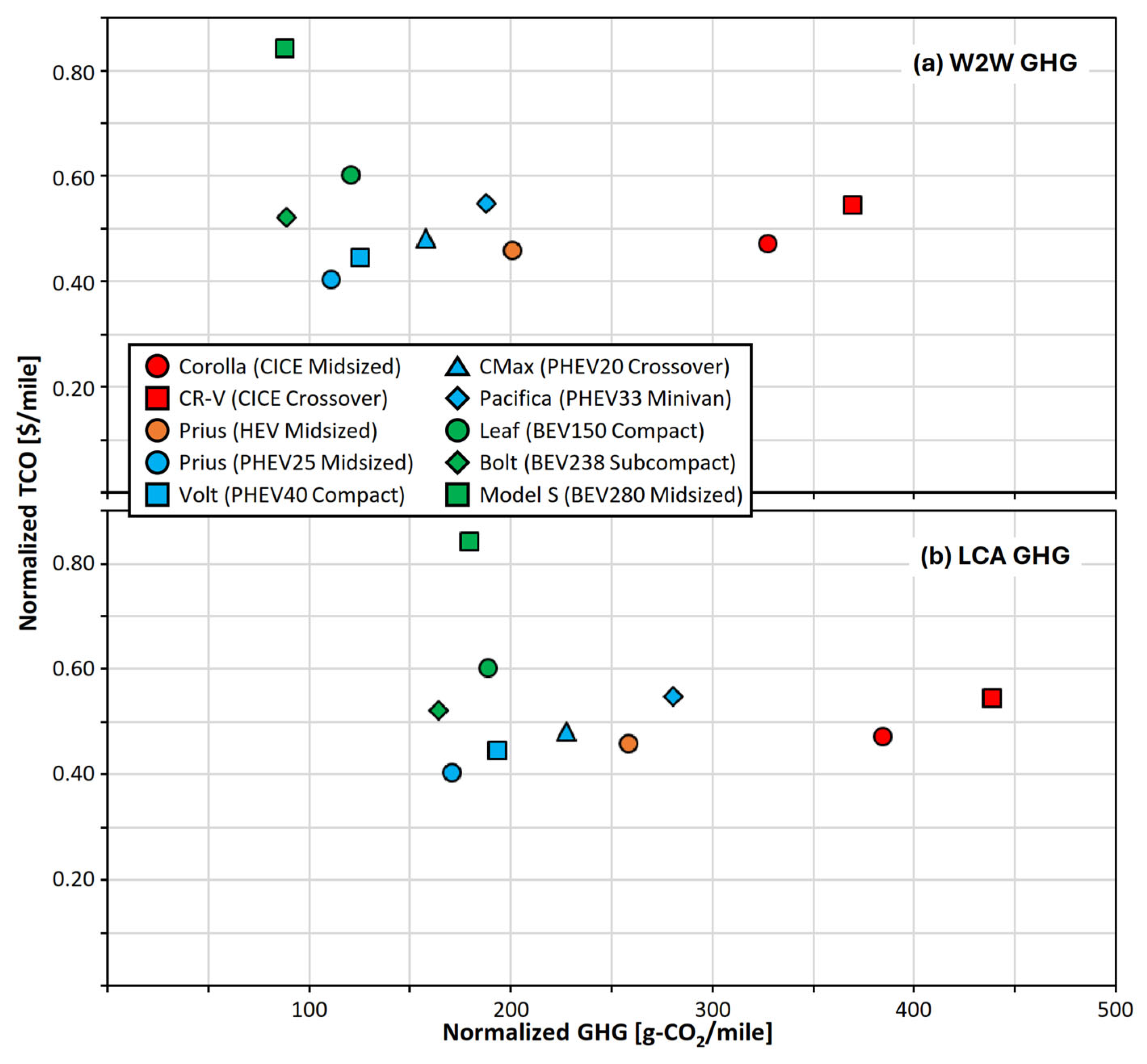
The first application of the modeling approach for normalized W2W and LCA GHG versus normalized TCO discussed in Section 2 utilized FASTSim models for a set of “real” model-year 2016–2017 vehicles. The FASTSim models for those vehicles have been elaborately tuned so that estimates via FASTSim simulations of the electric energy and/or fuel consumption closely match the real-world performance of these vehicles in California, as observed in an aggregate sample of real-world trips obtained from a data collection by the University of California at Davis about households that owned a zero-emission vehicle [45]. Further details about tuning of the FASTSim models may be found in [38]. Additionally, researchers interested in regeneration of results in this paper via CarGHG can find FASTSim model files and other parameters settings in Supplemental Material.
This set of vehicle models is one (out of two) sample studies featured in the web-app version of CarGHG. For key scenario parameters of $4/gal gasoline, $0.12/kWh and 220 g-CO2/kWh electricity, and a 5-year ownership period, the normalized TCO versus GHG is shown in Figure 2. Despite such model-year 2016–2017 vehicles being somewhat outdated, this study serves as a snapshot in time for those vehicles and has the merit of elaborately tuned FASTSim models and known vehicle purchase costs. Observation of Figure 2 reveals some broadline observations of: (i) reduction in GHG (to various levels) from CICE to HEV to PHEVs and BEVs, and (ii) comparable TCO between CICEs, HEV and PHEVs, with BEVs being slightly on the more expensive side. However, with disparities between size (from subcompact to minivan) and category (Model S being notably a luxury vehicle), it becomes difficult to draw firm conclusions. In the upcoming Section 3.2, Section 4.1 and Section 4.2, vehicle models in a study are chosen so that they are more comparable.

3.2. Select 2022 Model-Year Pickup Trucks

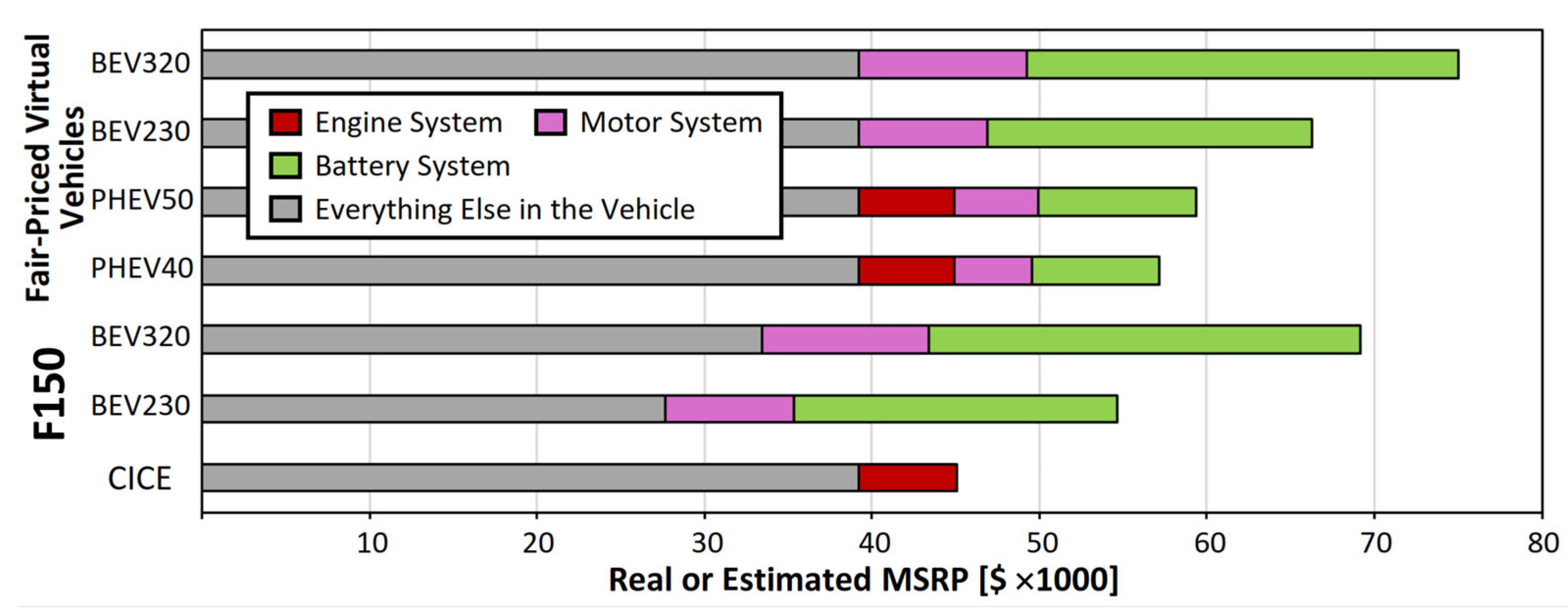
The study in this subsection considers a 2022 model-year CICE pickup truck (F-150), as well as its BEV230 and BEV320 counterparts, which were some of the first major brand full-sized BEV pickup trucks in the US. The MSRPs (as obtained from public source [46]) for the CICE, BEV230 and BEV320 were approx. $45,000, $54,700 and $69,200, respectively. Due to the unavailability of sufficient real-world trips data, tuning of the FASTSim models was limited to publicly available data from the EPA [47]. As with all studies in this paper, detailed FASTSim models are available in Supplemental Data. Results for the estimated normalized TCO versus normalized GHG are combined with the results in Section 4.1 for models of similarly sized virtual pickup trucks. In the current subsection, however, we examine and compare the 2022 real-market MSRP for the CICE and BEV versions of the pickup truck and how the MSRP relates to sizing/specifications of the main powertrain components, namely, the engine, motors and traction battery systems.
Based on public domain sources [48,49,50], the engine power for the CICE is modeled as 298 kW; motors combined power at 318 kW and 420 kW for the BEV230 and BEV320, respectively; and the usable battery energy of 98 kWh and 131 kWh for the BEV230 and BEV320, respectively. We then apply the NREL first-order cost model [39] to estimate the cost of the engine, air intake, fuel and exhaust, all of which combined are referred to as the “Engine System”. With an RPE value of 1.5, the estimated contribution of a 298 kW engine system to the MSRP of the CICE comes to $5840, which, with an MSRP of $45,000, leaves $39,160 for “Everything Else in the Vehicle”, as shown in Figure 3 for the F-150 CICE. While it is difficult to estimate exact values for the cost coefficients ($/kW-motor and $/kWh-battery) for a specific real vehicle, since that type of information is typically confidential between suppliers and vehicle manufacturers, even with optimistic estimates at $15/kW and $120/kWh (compared to estimates in [35,51]), the remaining portion (“Everything Else”) of the MSRP for F-150 BEV230 and BEV320 is noticeably less than that of F-150 CICE, as in Figure 3. This implicitly hints at the profitability (or lack thereof) being less favorable to the vehicle manufacturer for the BEV models compared to the CICE. If the cost coefficients for the motor and battery system were higher than the adopted optimistic estimates, then the profitability of the BEV models for the vehicle manufacturer could be even worse. More than a year after initial sales of model-year 2022 of the F-150 BEVs, the manufacturer announced major losses per vehicle sold [52,53], which confirms the predictions in this section about the MSRP of the BEV230 and BEV320 being less profitable for the manufacturer.

4. Results for Virtual Vehicle Models

4.1. Pickup Trucks

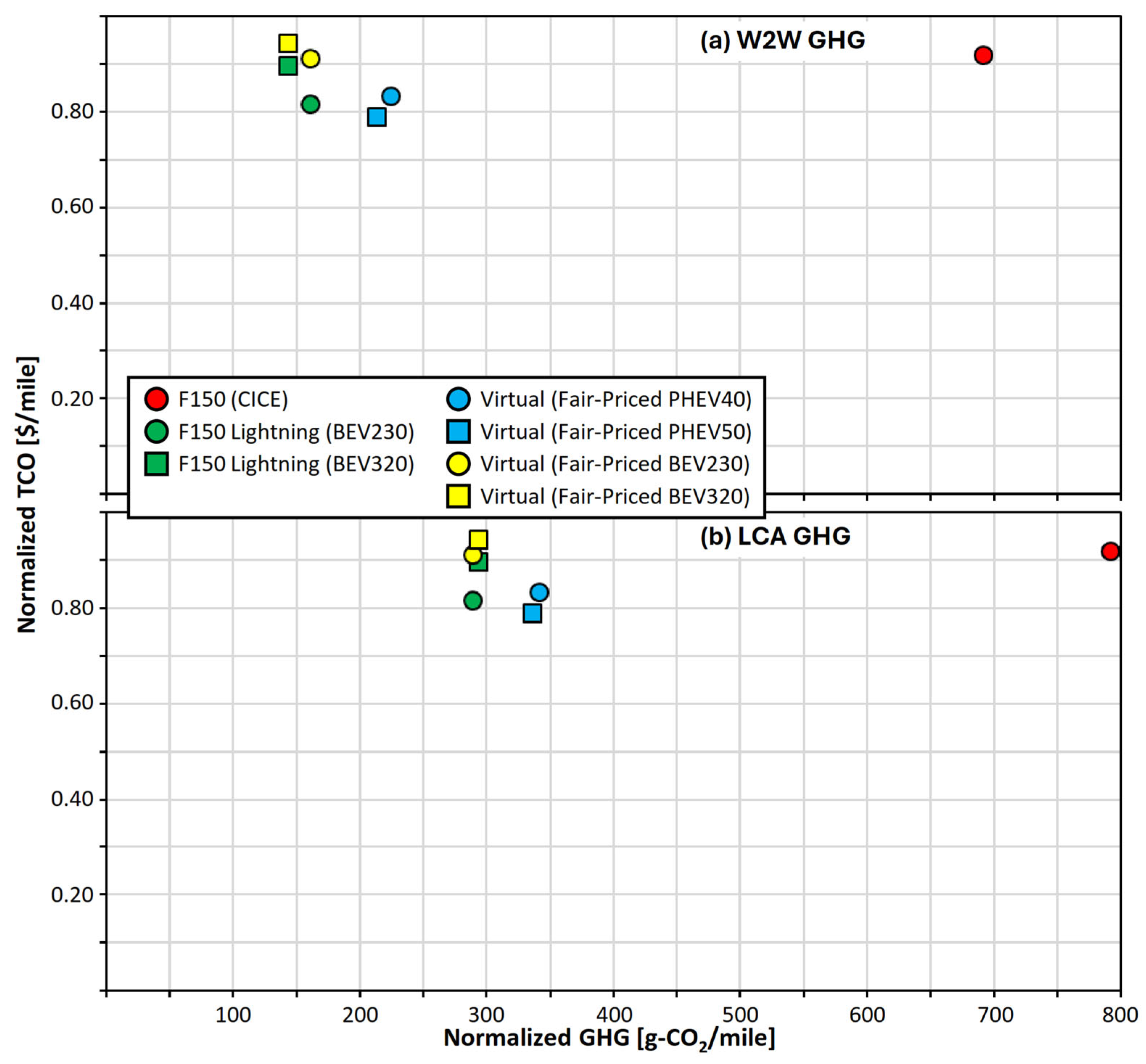
In addition to the models of F-150 discussed in Section 3.2, additional models were constructed for “virtual vehicles”, which is the term utilized to describe models that do not necessarily match a vehicle available on the market. Virtual vehicles in this subsection include what we consider to be “fair priced” PHEV40, PHEV50, BEV230 and BEV320. Vehicle specifications (and FASTSim models) for the fair-priced virtual BEV230 and BEV320 are identical to their respective F-150 counterparts. What is perceived to be “fair price” is for everything else in the vehicle (aside from the powertrain systems) to be similar to that of the equivalent CICE, with the powertrain systems contribution to the MSRP being consistent with the modeled cost of the relative powertrain subsystems. Models for the virtual PHEV40 and PHEV50 utilize a similarly sized engine as the F-150 CICE, along with downsized motors and batteries compared to the BEVs, at 180 kW and 31 kWh for the PHEV40 and 200 kW and 39 kWh for the PHEV50; full details of the FASTSim models are provided in Supplementary Data. The ensuing estimated MSRP for the fair-priced pickup truck virtual vehicle models is shown in Figure 3. Setting vehicle usage conditions similar to Section 3.1 but with slightly more expensive gasoline (of $5/gal gasoline, $0.12/kWh and 220 g-CO2/kWh electricity, and a 5-year ownership period), the normalized TCO versus normalized GHG results are generated and shown in Figure 4.
Comparing the F-150 CICE versus F-150 BEVs in terms of TCO in Figure 4, one notes that despite a higher MSRP for the BEVs (Figure 3), the TCO for both F-150 BEV230 and F-150 BEV320 is lower than the F-150 CICE, which is largely due to the difference in running costs (driving an electric being lower cost than gasoline). Also note that the TCO in Figure 4 is not considering any incentives; while incentives did exist during the later part of the Biden administration, either of the BEV versions is likely to have been economically beneficial to customers who acquired that. When considering the fair-priced BEVs without incentives, however, only the virtual BEV230 comes to approximate TCO break-even compared to the CICE, while the virtual BEV320 comes at a slightly higher TCO than the CICE. Though not available on the market in 2022, the TCO result for the fair-priced virtual vehicle models of PHEV40 and PHEV50 show them to be comparable to (if not better than) the BEVs.
Reductions in GHG via adopting BEVs instead of CICE are noticeably more per vehicle for pickup trucks than the smaller vehicles considered in Section 3.1 (even though Section 3.1 did not include exactly size-wise comparable CICEs and BEVs). The reduction in W2W GHG from CICE to BEV trucks is approx. 550 g-CO2/mile per vehicle (from ~700 g-CO2/mile to ~150 g-CO2/mile in Figure 4a), but the reduction is somewhat less when considering LCA GHG, at approx. 500 g-CO2/mile per vehicle (from ~800 g-CO2/mile to ~300 g-CO2/mile in Figure 4b), which is primarily due to the GHG contribution from battery manufacturing to the LCA GHG. The estimated LCA GHG reduction via virtual PHEVs is approx. 450 g-CO2/mile per vehicle (from ~800 g-CO2/mile to ~350 g-CO2/mile in Figure 4b), which is approx. 90% of the LCA GHG reduction achievable via BEVs.

4.2. Different Scenarios for Small SUVs

4.2.1. Baseline Scenario

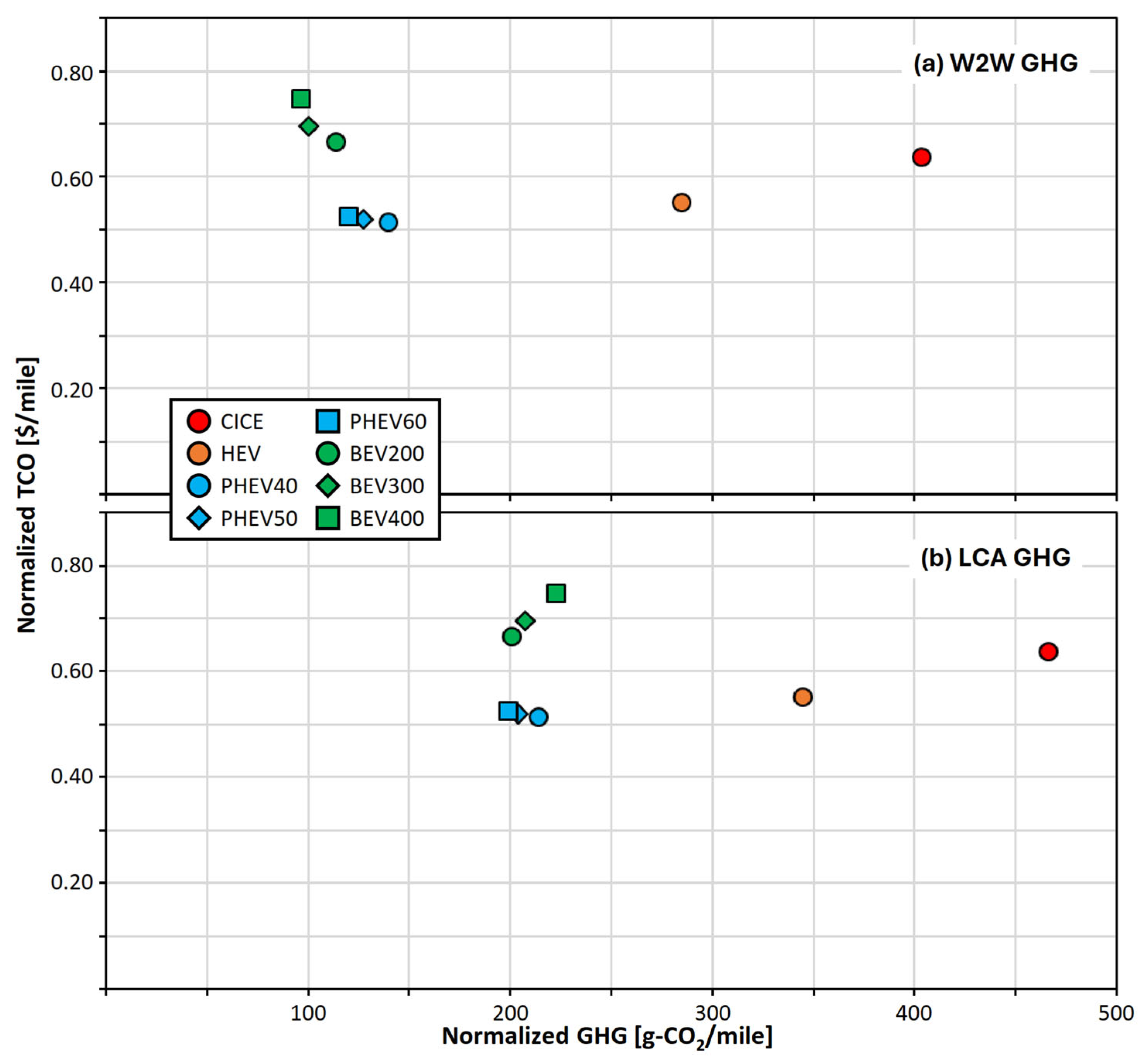
Having showcased the modeling capabilities of real or virtual vehicles throughout Section 3.1, Section 3.2 and Section 4.1, this subsection focuses on multiple scenarios for different powertrain variants of a “Small SUV”, such as a RAV4 or CR-V, which is a category of light-duty vehicles experiencing growth in the US market, according to the US EPA [54]. A baseline version of this set of vehicle models is featured as the second (among two) sets of vehicles shown in the Web-App version of CarGHG [36]. The vehicle models are derived (via battery resizing and fair-price estimates of the MSRP discussed in Section 4.1) from model year 2021–2022 CICE, HEV and PHEV small SUVs in the US market. Full details of the FASTSim models and other parameters (such as estimates of manufacturing GHG and MSRP) are provided in Supplementary Data. Settings for scenario parameters, as they appear in the Web-App version of CarGHG as default values, are shown in Table 2. The corresponding plots for the normalized TCO versus normalized W2W and LCA GHG are respectively shown in Figure 5a,b. However, prior to considering other settings of the scenario parameters that aim to model future settings, we first conduct a sensitivity analysis, as summarized in the next section.

4.2.2. Sensitivity of LCA GHG and TCO to Scenario Parameters

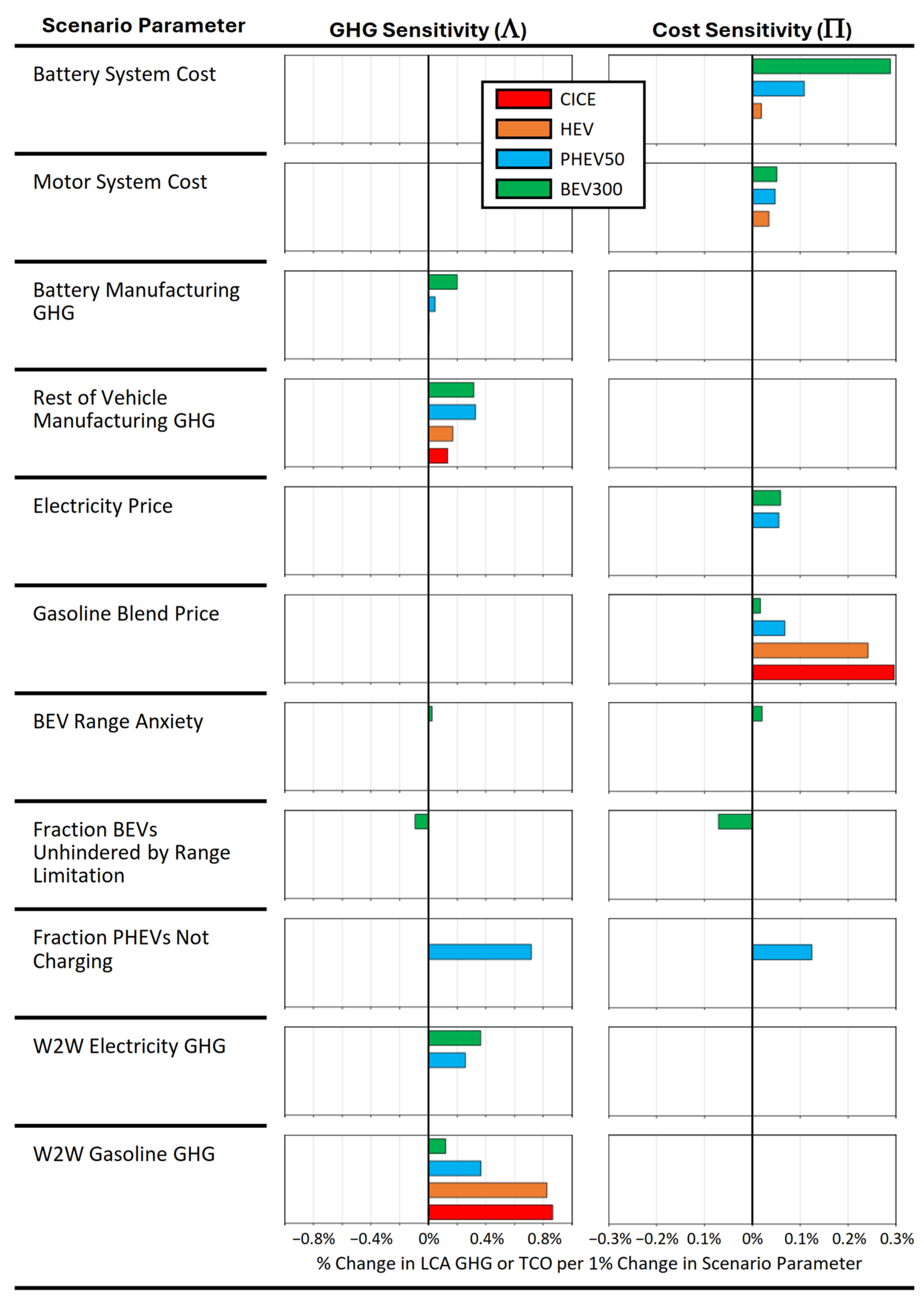
We conduct sensitivity analysis via perturbing the scenario parameters from their baseline values, one parameter at a time, and calculating the corresponding change in normalized LCA GHG and normalized TCO for the CICE, HEV, PHEV50 (as representative of PHEVs) and BEV300 (as representative of BEVs). We then calculate the corresponding sensitivity functions Λ and Π (for LCA GHG and TCO, respectively) as the percentage change in normalized LCA GHG or TCO due to a 1% change in the scenario parameters. For scenario parameters with inherently discrete (or different model) effects, namely, the charging behaviors of BEVs and PHEVs, we conduct the sensitivity analysis by considering 0% versus 100% of the vehicles following one behavioral model or the other. In the case of BEVs, a 0% change in charging behavior is the baseline case in Table 2, where all the vehicles charge to full overnight but will not be used on a driving day that exceeds their driving range, while a 100% change in charging behavior is where 100% of the vehicles will have “unlimited” charging, i.e., will be used in every driving day, making additional stops to charge as needed. In the case of PHEVs, the perturbation in charging behavior examines the fraction of PHEVs that do not charge and only operate in charging sustaining mode, similar to an equivalent HEV. Results of the sensitivity analysis are shown in Figure 6.
In examining the sensitivity plots shown in Figure 6, one ought to keep in mind that one parameter perturbation at a time does not capture correlations or interactions that could be observed when two or more impactful parameters are simultaneously adjusted. For example, lower-CI gasoline blends have a high impact on the LCA GHG of CICE and HEV but no impact on cost; however, even some of the least expensive lower-CI gasoline blends, such as E85, have been historically more expensive than regular gasoline per equivalent energy content [55]. As such, while adjustment of the scenario parameter for CI of the gasoline blend appears to have no impact on cost in Figure 6, one needs to keep in mind that when crafting future scenario estimates, certain parameters cannot be adjusted independently. Furthermore, a limitation of the sensitivity analysis and the overall modeling framework in this paper is that secondary behavioral effects (such as an increase in the price of gasoline affecting the charging frequency of PHEVs and/or willingness to utilize BEVs in long road trips) cannot be accounted for. With such limitations in mind, the main observations from sensitivity analysis could be summarized as:
  • The CI of the gasoline blend is the most impactful scenario parameter for LCA GHG of CICEs and HEVs, and is also moderately impactful for PHEVs and only slightly for BEVs. The reason the CI of gasoline has any bearing at all on the GHG of BEVs in this model is an artifact of considering the driving on the replacement CICE vehicle on days where the BEV is unable to fulfill the required driving. Such dependency of the GHG of BEVs on the CI of gasoline gets eliminated in scenarios where 100% of BEVs are utilized for all trips while altering the driving plan to include additional stops if necessary.
  • The fraction of non-charging vehicles has a high impact on the LCA GHG of PHEVs as well as their TCO. In fact, in an extreme case where none of the PHEVs are ever charged, the LCA of the PHEV becomes slightly worse than an equivalent HEV due to approximately the same W2W GHG (additional mass from a larger battery than an equivalent HEV is on par with one additional passenger in the car), but there is higher manufacturing GHG for the larger-sized battery. The increased TCO for PHEVs that do not charge stems from low electricity prices compared to gasoline, where PHEVs that do not charge could be missing out on an opportunity for cost savings. However, in scenarios with more expensive electricity prices, the cost advantage of charging PHEVs (and the sensitivity of TCO to charging behavior) diminishes.
  • The W2W GHG of electricity is significant for both BEVs (most significant parameter) as well as PHEVs (though not the most significant parameter).
  • The manufacturing GHG for everything in the vehicle aside from the traction battery is of some significance to CICEs and HEVs (but not as much as the CI of gasoline), and very significant for PHEVs and BEVs, even more so than the manufacturing GHG for the traction batteries. While this might be somewhat of a surprising finding, especially for BEVs that have large batteries, it is a testament (per the GREET model [33]) that even a BEV has many parts that require many different materials besides the traction battery.
  • The cost of the traction batteries is the most significant parameter for the TCO of BEVs and is also significant for PHEVs, while cost of the electric drive (motor) system is secondary (but not trivial) for BEVs, PHEVs and HEVs. The price of electricity for charging also appears secondary (but not trivial) for both BEVs and PHEVs.
  • The cost of the gasoline blend is the most significant parameter for the TCO of CICEs and HEVs, and is secondary (but not trivial) for PHEVs.

4.2.3. Simulation of Near-Term and Future Scenarios

In crafting the scenario parameters in Table 2, we note that uncertainties do exist and are hard to eliminate in future (or even present-day) estimates of technology costs, manufacturing GHG and human behavior. In seeking to maintain the relevance of CarGHG results, despite some of the assumptions from the 2021-to-2022 timeframe (which were justifiable at the time) not necessarily holding anymore, we revise some of the assumptions but do not provide a specific model-year or calendar year for when such parameter values are expected to be realized. Instead, we designate the scenarios “Near Term-1” and “Near Term-2” as a plausible range for “present-day to near future” (e.g., 2025 to 2028), and the scenarios “Future Setting-1” and “Future Setting-2” as a plausible range for what could be realized sometime between 2030 and 2040.
For the near-term scenarios in Table 2, we do not consider significant changes in the cost of the manufacturing processes or the manufacturing GHG for the rest of the vehicle aside from the traction batteries. However, we consider mild reductions in the manufacturing GHG of the traction batteries as an update from model-year 2021–2022 vehicles (upon which the FASTSim models in this paper were created) to more recent versions of GREET, where the manufacturing GHG for traction batteries is approx. 10% to 15% less than in the 2020 version of GREET. We also consider mild reductions in the W2W GHG of electricity, as well as increased electricity prices per the steady increase in the US in recent years [56], as opposed to the price of gasoline, which has remained mostly steady (aside from a recent war-induced crisis) [57].
Charging behavior is also one of the uncertain issues. For PHEVs, there have been studies examining how well their fraction of distance traveled on electric power in various parts of the world match up against the standard assumption of being fully charged overnight before every driving day [58,59]. While contributions of various real-world factors to the real GHG performance of PHEVs is rather complex [60], in this modeling work we consider that practically any “less than ideal” charging behavior of a PHEV could be modeled as a fraction of “equivalent HEV”. An estimate for the fraction of equivalent HEVs is taken at approximately 12%, which we consider to be in line with the findings in a recent large-scale study of real-world PHEVs data in the US and Canada [61].
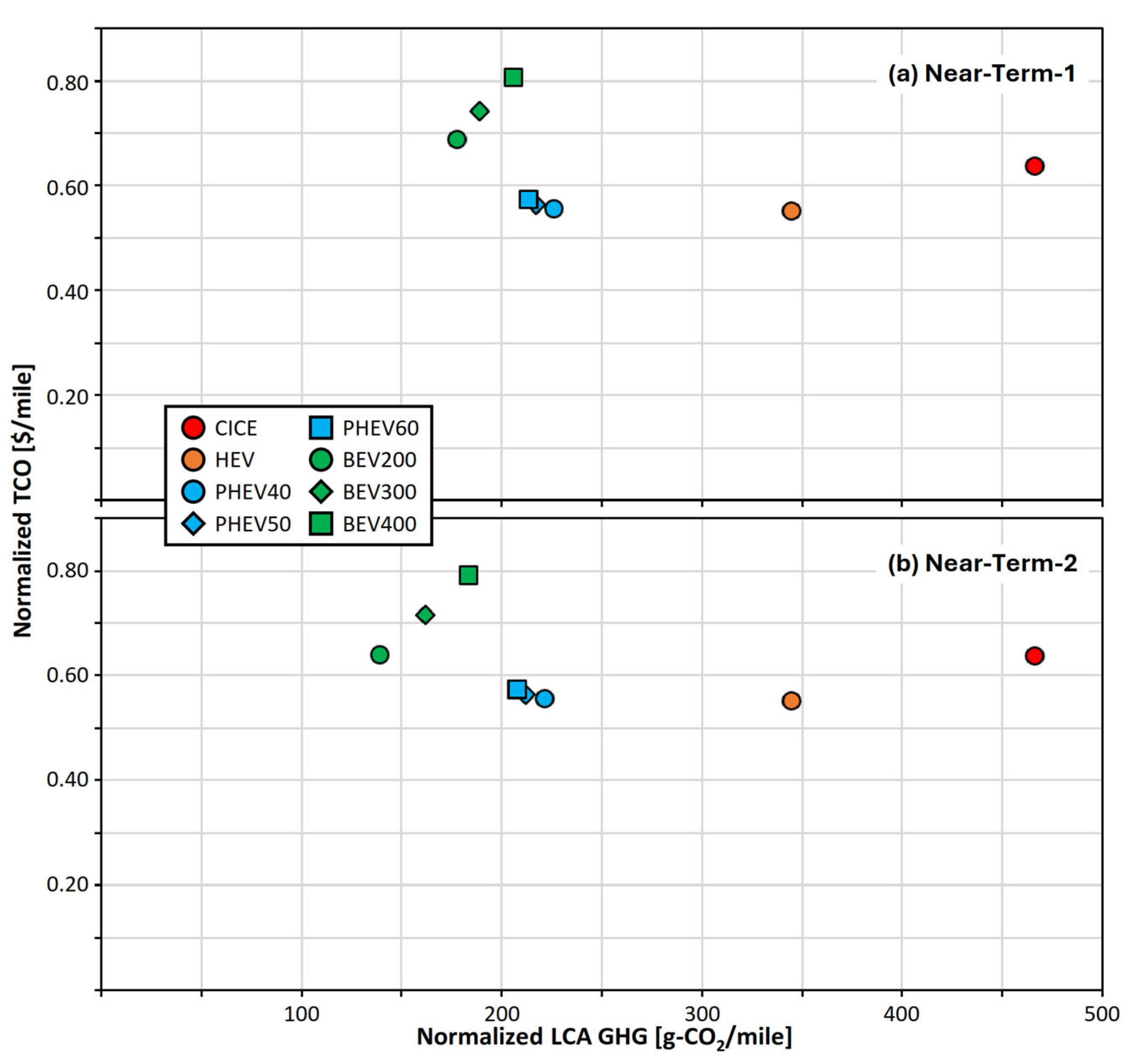
For the charging behavior of BEVs, the near-term scenarios in Table 2 consider two alternatives; in Near Term-1, the simulated BEV will conduct the driving of the day if it is capable of completing the driving day (starting the day with a fully charged battery, conducting as many daytime charging events as feasibly possible during stops between trips in the real-world dataset, but without altering the duration of the stops between trips, as discussed in Section 2.3.3), but a replacement vehicle (CICE) will be used for driving days that the BEV is unable to fulfill. In Near Term-2, the BEV is assumed capable of completing all driving days via the driver altering their travel pattern to include additional or longer stops for charging. Although CarGHG does not implicitly have the capability to alter the duration between trips, estimates for a BEV that does not rely on a replacement vehicle for unfulfilled driving days are conducted in this paper by setting the cost coefficients (Rr and Ra) in Equation (25) and the BEV replacement vehicle CI of fuel (λ) in Equation (11) to zero. Focusing the scenario analysis on LCA, results for normalized TCO versus normalized LCA GHG for both near-term scenarios are shown in Figure 7.
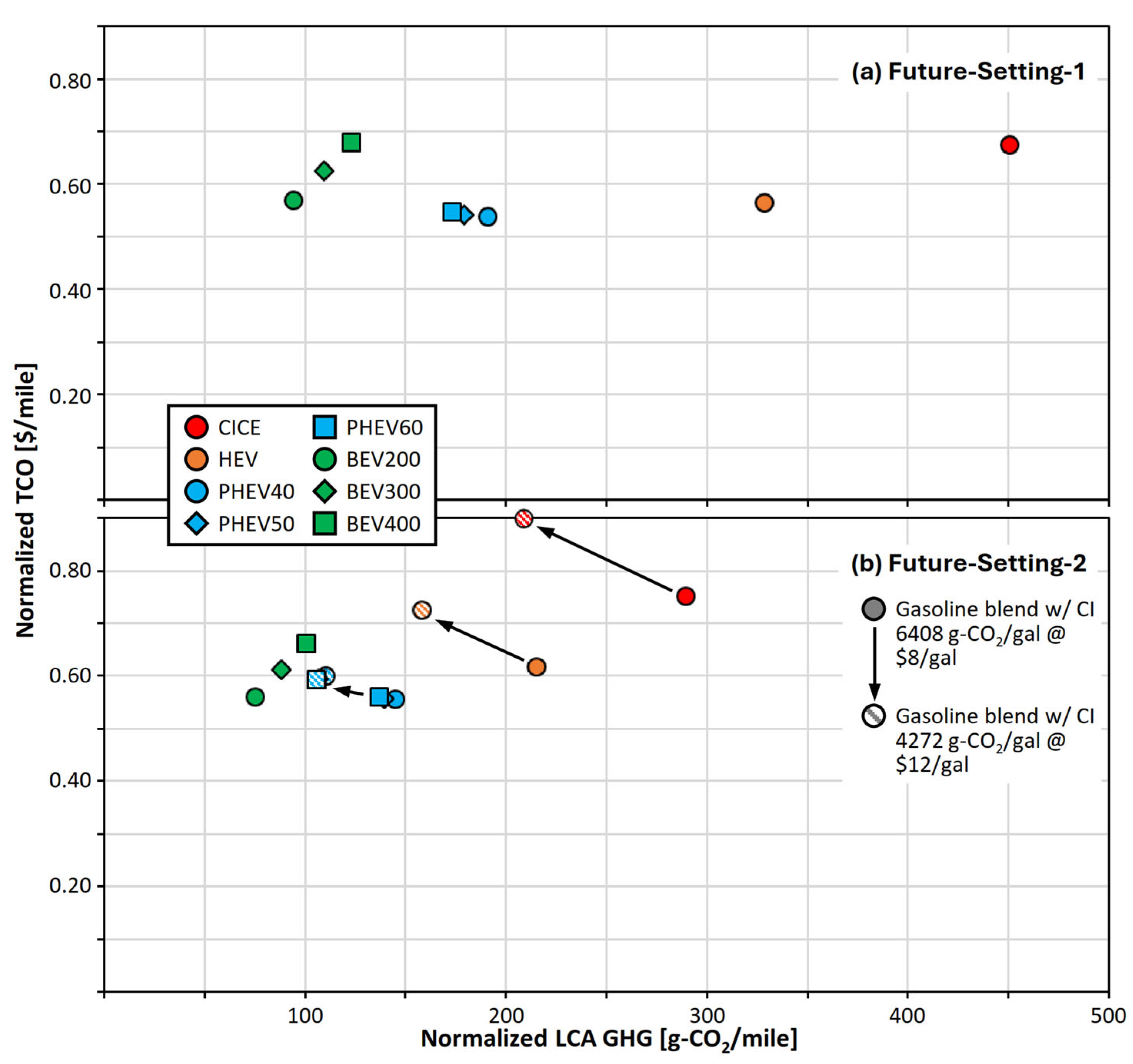
For the future setting scenarios in Table 2, reductions in both the cost and GHG of manufacturing are considered, with no changes in the price of electricity or the charging behavior compared to Near Term-2. However, the main elements of the study in those scenarios are the CI of electricity and gasoline blends. In Future Setting-1, the CI of gasoline blend is set to the same level as present day, along with a mild increase in its price, while the CI of electricity is reduced to 120 g-CO2/kWh. As a note, 120 g-CO2/kWh approximately corresponds to a model for an electric grid that utilizes Natural Gas generation (as modeled in GREET [33]) for 25% of the generated electricity, with the rest of the electric energy generation coming from renewable (such as Hydro, Solar and Wind) or very-low-CI sources (such as Nuclear or Geothermal). In Future Setting-2, we consider even lower CI for electricity (at 60 g-CO2/kWh), as well as lower-CI gasoline blends that could be incorporating lower-carbon liquid fuels, such as Biofuels [62] or eFuels [63]. Low-CI fuel blends is an extensive field of research in its own right [64], with a wide range of expectations, ranging from a mild ~5–to-7% reduction in the CI of gasoline at almost no additional cost (via a slightly higher ratio of Ethanol in the gasoline blend) to zero-CI synthetic fuels at uncertain costs and/or supply availability. In the Future Setting-2 scenario, however, we consider a range between 40% and 60% lower-CI gasoline blend, along with an increase of 33% to 100% in the price of gasoline blend compared to Future Setting-1 scenario. Results for normalized TCO versus normalized LCA GHG for both future setting scenarios are shown in Figure 8.

5. Discussion

Replication of the normalized TCO versus GHG results at the default scenario parameter settings of the Web-App version of CarGHG (Section 3.1 and first scenario in Section 4.2) serves as an affirmation of the matching between the Web-App version and the desktop version of CarGHG, per the modeling details provided in Section 2. Models for full-sized pickup trucks (Section 3.2 and Section 4.1) highlight the opportunities for powertrain electrification to achieve larger GHG reductions (in terms of g-CO2/mile per vehicle) compared to electrification of smaller-sized vehicles. Another important highlight from the study of the pickup truck models is the challenge associated with MSRP estimates coming from the real market of existing vehicles, because some vehicles may be selling at an MSRP that is unprofitable for the manufacturer, which is difficult to sustain in the long term. As a way of demonstrating the ability to predict near-term and future scenarios, a set of fair-priced small SUV vehicle models that are similar in all aspects except the powertrain are examined in Section 4.2.
Examining the various small SUV scenarios in Section 4.2, one notes that although the CICE in a fair-priced model of the MSRP is typically the least expensive option, when factoring in the running costs (with the primary difference being the cost of fuel), the HEV comes as a superior option in terms of TCO in every near-term and future scenario compared to the CICE (Figure 7 and Figure 8), which makes the HEV an all-around superior option compared to the CICE, since the HEV also has lower W2W and LCA GHG. Yet, BEVs and PHEVs bring more GHG reduction compared to the HEV. However, the economics and the amount of GHG reduction depend on other scenario parameters. Without consideration of incentives, the MSRP of BEVs, primarily due to the cost of traction batteries, prevents the TCO of BEVs from becoming a more economical option compared to the HEV in the near-term scenarios (Figure 7). Furthermore, the increase in the cost of electricity from $0.12/kWh to $0.3/kWh all but negates the TCO advantage for PHEVs compared to the HEV (comparing the normalized TCO for PHEVs in Figure 5 and Figure 7). When considering future scenarios, even with the significantly reduced cost of batteries and other vehicle electrification technologies, without incentives, the TCO of BEVs and PHEVs still does not appear to have a clear advantage compared to the TCO of the HEV (Figure 8a).
Noting that the main intent of Section 4.2 is to conduct a free market assessment of fair-priced vehicles, neither official incentives (federal, state or local/municipal governments providing rebates, tax breaks or other forms of monetary-equivalent purchase decision influence) nor “hidden incentives” (reduction of the MSRP at a loss to the OEMs) are considered in the scenario analysis of Section 4.2. For a less precise estimate of the impact of $1000 in equivalent incentives on the normalized TCO, one may subtract an incentive-equivalent value (in $/mile) from the vertical ordinate of Figure 5, Figure 7 or Figure 8, with the incentive equivalent calculated as the total present-day incentive amount divided by the total expected miles of travel for the ownership period, which comes to $0.015/mile for every $1000 of incentive (for 5 years of ownership and 13,2000 miles of travel per year). However, the impact of incentives on the acquisition cost, and by extent, the TCO, can be affected by complex market dynamics, since incentives for newly bought vehicles can cause lower resale prices of used vehicles. On the other hand, some “lucky” vehicle buyers could benefit from acquiring a new vehicle while certain incentives are in place, while also benefiting from a better resale value if incentives are phased out by the time of vehicle resale. Such market dynamics, however, are beyond the scope of the modeling in this paper.
The LCA GHG of BEVs is impacted by several factors, where it could appear to be only slightly better than the LCA GHG of PHEVs (Figure 7a), from a more pronounced improvement should the long-trip charging experience for BEVs improve such that occurrences of alternate vehicle swapping are eliminated (Figure 7b), to an even more pronounced advantage in a future setting with lower-CI electricity and battery manufacturing (Figure 8a). The LCA GHG of PHEVs is, on the other hand, contingent on both the CI of the electricity as well as the charging frequency. In the worst case, the LCA of PHEVs could become slightly worse than that of the HEV if none of the PHEVs are charged.
The introduction of low-CI fuels (gasoline blends with a lower g-CO2/gal at higher per gallon prices) appears to be all-round advantageous in multiple ways (Figure 8b). Firstly, the lower CI of the fuels help reduce the LCA GHG of the CICE, HEV and PHEVs, not to mention other older/legacy higher-emissions CICEs (not modeled in this paper). Secondly, with likely higher prices for lower-CI fuel per unit, electric-powered driving becomes economically more attractive. Among all the considered scenarios, it is only in Future Setting-2 (Figure 7b) that the TCO of BEVs becomes less than the TCO of the HEV. Furthermore, though not modeled in this paper, when electric driving is significantly more economically advantageous, it can lower the percentage of non-charging PHEVs and/or increase their charging frequency, which can in turn improve the LCA GHG of PHEVs.
Among the limitations of the work in this paper is that, in being focused on only two metrics of performance of light-duty vehicle powertrains (cost and GHG), it may not necessarily reflect all the factors in the decision-making process by all vehicle buyers. Some vehicle buyers may place high importance on lowering GHG or avoiding the use of gasoline irrespective of cost, while other vehicle buyers may regard the economics of ownership as the most important attribute. Even among vehicle buyers that value the economic attributes, the perceived value of cost savings throughout the ownership period may not be at the same perception level as the willingness to pay for the purchase cost [65]. Other vehicle buyers may prioritize other attributes, such as style, handling, range and/or a combination of all the vehicle attributes, with varying levels of importance. Charging behavior and attitudes towards charging is also a complex topic that is affected by the availability, convenience and perceived economic advantage of charging.
One other limitation is that the modeling work in this paper for TCO versus GHG shows results that correspond to “what if all the vehicles were <one powertrain> type”; it may not be possible to have that many vehicles available to customers (particularly the long-range BEVs) in the near term due to critical material availability and supply chain issues. Lastly, another limitation of this work is the CHTS dataset [31] from which the second-by-second real-world vehicle trips are obtained. CHTS is more than a decade old but still stands as one of the rich publicly available datasets in the US for second-by-second vehicle speeds. Although one could argue that driving aggressiveness in California (where CHTS data was collected) should not necessarily be significantly different than other parts of the US or the world, the commute distances (affecting the plausible fraction of electric driving for PHEVs and vehicle swapping for BEVs) could vary significantly depending on location. As such, interpretation of the scenario analysis should be only considered in the qualitative/directional sense for places with different travel patterns compared to California. And even for California, with uncertainties about the future of the cost, convenience and performance of various technologies, as well as the evolution of perceptions among various types of vehicle buyers, it is difficult to conclude that any one technology alone is the sole best solution for everyone. As such, continuing to develop and pursue all technologies that can lower vehicle GHG is a safe course of action.

6. Conclusions

This paper presents an overview of the modeling details of CarGHG, an open-source tool for analyzing various scenarios for the trade-off between the cost and GHG of various types of powertrains in light-duty vehicles. Select vehicle model results are regenerated as an affirmation of existing perspectives in the public-domain CarGHG, then studies are conducted that involve additional/new vehicle models (F-150 and virtual pickup trucks), as well as near-term and future parameter settings (small SUVs). The generated results highlight the importance of sustainable economics in efforts towards GHG reduction, as well as the existence of multiple plausible alternatives for future GHG reduction. With uncertainties still lingering about the future costs of technology, the materials supply chain and consumer preferences, a safe course of action towards future GHG reduction is to continue pursuing all options, including BEVs, PHEVs, and HEVs, as well as lower-CI fuels.
Studies in this paper are based on simulation models, and models are never perfect. Future extensions of this work could consider/implement additional aspects, such as different driving data sets, more detailed charging behaviors, and critical materials availability and supply chain constraints, as well as the wide spectrum of mindsets among future vehicle buyers and their attitudes towards various powertrain technologies.

Supplementary Materials

Study initiation files for CarGHG that enable regeneration of results presented in this paper can be downloaded at: https://www.mdpi.com/article/10.3390/wevj17070347/s1.

Author Contributions

Conceptualization, K.H., K.L., K.-C.C. and P.B.; methodology, K.H., K.L., K.-C.C. and P.B.; software, K.H., K.-C.C. and P.B.; validation, K.L. and K.-C.C.; formal analysis, K.H., K.L., K.-C.C. and P.B.; investigation, K.H., K.L., K.-C.C. and P.B.; writing—original draft preparation, K.H.; writing—review and editing, K.L., K.-C.C. and P.B.; visualization, K.H.; supervision, K.L.; project administration, K.L. All authors have read and agreed to the published version of the manuscript.

Funding

This research received no external funding.

Data Availability Statement

CHTS data and all source code for CarGHG are available in the public domain via the referenced citations. Additional data such as custom FASTSim vehicle model parameters are available for download from the Supplementary Materials.

Conflicts of Interest

Karim Hamza, Kenneth Laberteaux and Peter Benoliel are employees of Toyota Motor North America Research & Development (United States). They declare that the research reflects their views as scientists and not the views of the company. Kang-Ching Chu has no conflicts of interest to declare. The research was conducted in the absence of any commercial or financial relationships that could be construed as a potential conflict of interest.

Abbreviations

The following abbreviations are used in this manuscript:
AERAll-Electric Range
ANLArgonne National Laboratory
BEVBattery (only) Electric Vehicle
CHTSCalifornia Household Travel Survey
CICarbon Intensity
CICEConventional Internal Combustion Engine
DCDirect Current
EOLEnd of Life
FCEV(Hydrogen) Fuel-Cell (hybrid) Electric Vehicle
FSPTFull-sized Pickup Truck
GHGGreenhouse Gas
GUIGraphical User Interface
HEVHybrid Electric Vehicle
L1Level-1 (charger), typically low power, up to 1.5 kW
L2Level-2 (charger), higher power than L1, typically up to 6 kW to 7 kW
LCALifecycle Analysis
MSRPManufacturer’s suggested retail price
NRELNational Renewable Energy Laboratory
PFCEVPlug-in (Hydrogen) Fuel-Cell Electric Vehicle
PHEVPlug-in Hybrid Electric Vehicle
RPERetail Price Equivalent
SOCState of Charge (for the traction battery)
SUVSports Utility Vehicle
T2WTank to Wheels
TCOTotal Cost of Ownership
W2TWell to Tank
W2WWell to Wheels
Symbols
The following symbols are used in this manuscript:
αAmount of fuel consumed in a trip
βAmount of electric energy consumed in a trip
δOptimized amount of time delay for start of charging
εAmount of electric energy (in kWh) charged or discharged to/from the traction battery
ϕNormalized W2W GHG (in g-CO2/mile)
γFraction of non-charging plug-in hybrids
ηCharging efficiency from the grid for a plug-in vehicle
λCI of fuel (in g-CO2 per unit of fuel)
μGrid average CI of electricity (in g-CO2/kWh)
νSliding scale for interpolation between levels of BEV range anxiety
θScaling factor for traction battery manufacturing GHG
ρSliding scale between lower and upper bounds for the manufacturing GHG of everything in the vehicle except the traction battery
τNecessary duration to complete a charging event
ψTotal manufacturing GHG (in g-CO2) for a vehicle
ζSliding scale for interpolation between levels of charging behavior
ΔNormalized total cost of ownership for first vehicle owner (in $/mile)
ΦVehicle model estimated W2W GHG performance (in g-CO2/mile)
ΓTotal cost of ownership for first vehicle owner (in $)
ΛNormalized LCA GHG sensitivity
ΠNormalized TCO sensitivity
ΘNormalized LCA GHG for a vehicle (in g-CO2/mile)
ΩPrice premium scaling for DC Fast charging
ΨNormalized total manufacturing GHG for a vehicle (in g-CO2/mile)
aAverage annual travel distance by vehicle (in miles/year)
bRated capacity of vehicle traction battery (in kWh)
dRated power of conventional drive system (in kW)
eRated power of electric drive system (in kW)
hHourly curve (relative marginal GHG emissions or relative cost) for the electric grid
lLength (or driving distance) for a trip/drive cycle
mMass of everything in a vehicle except the traction battery pack
nNumber of Years of vehicle ownership
pPurchase tax rate
rRPE for everything in the vehicle except the electrified powertrain
sRPE for the electrified powertrain
tDate and time signature
uEstimated number of BEV unfulfilled driving days per year (in days)
vEstimated fraction of annual miles traveled that are unfulfilled by a BEV
wDemographic weighing factor for a trip/drive cycle
CFunction for estimation of the direct cost for a subsystem in the vehicle (type of vehicle subsystem indicated via a subscript)
DDepreciation function for estimating the resale value of a vehicle
HAverage scaling factor for GHG or cost of charging, relating the average GHG/cost associated with the timing of charging event(s) relative to the average for the grid
LExpected vehicle lifetime travel distance (in miles)
MManufacturing GHG CI (per kg-vehicle or per kWh-traction battery)
RRunning cost coefficient (type and units of the running cost indicated via a subscript)
Subscripts
aIndicates cost per distance traveled (in $/mile) on alternative vehicle for BEV unfulfilled driving days
bIndicates function for estimation of the direct cost of the traction battery system
cIndex for simulated occurrences of charging events
dIndicates function for estimation of the direct cost of the conventional drive system
eWith main symbol C, indicates function for estimation of the direct cost of the electric motor system; With main symbol R, indicates unit cost of electricity for charging the vehicle (in $/kWh)
gIndicates unit cost of gasoline (in $/gal)
iIndex for simulated trips or drive cycles
jIndex for charging behavior model
kIndex for BEV range anxiety setting
lIndicates annual licensing fee (in $/year)
mIndicates average insurance cost (in $/mile)
oIndicates estimate of the direct cost of everything else in the vehicle
rIndicates cost per day (in $/day) for BEV unfulfilled driving days
sIndicates annual insurance cost (in $/year)
Superscripts
AIndicates acquisition cost portion of the TCO
BIndicates CI for manufacturing GHG of the traction battery in (in gCO2/kWh-battery)
CIndicates relative cost for hourly curves of the electric grid, cost scaling factor (relative to grid average) for a charging event, or delayed start of charging for minimum cost of a charging event
EIndicates ending time bound for a charging event
GIndicates relative GHG emissions for hourly curves of the electric grid, GHG scaling factor (relative to grid average) for a charging event, or delayed start of charging for minimum GHG of a charging event
LIndicates lower bound for CI of manufacturing GHG for everything in a vehicle except the traction battery pack (in gCO2/kg-vehicle)
PIndicates purchase cost portion of the acquisition cost in the TCO
RIndicates running cost portion of the TCO
SIndicates starting time bound for a charging event
UIndicates upper bound for CI of manufacturing GHG for everything in a vehicle except the traction battery pack (in gCO2/kg-vehicle)
VIndicates resale value and incentives portion of the acquisition cost in the TCO

References

  1. US Energy Information Administration. Today in Energy. Available online: https://www.eia.gov/todayinenergy/detail.php?id=36312 (accessed on 1 August 2024).
  2. US Department of Energy. Hybrid and Plug-in Electric Vehicles. Available online: https://www.energy.gov/sites/prod/files/2014/05/f15/52723.pdf (accessed on 1 August 2024).
  3. US Department of Energy. Fuel Cell Electric Vehicles. Available online: https://afdc.energy.gov/vehicles/fuel-cell (accessed on 1 August 2024).
  4. Lane, B. Plug-in Fuel Cell Electric Vehicles: A Vehicle and Infrastructure Analysis and Comparison with Alternative Vehicle Types. Master’s Thesis, University of California, Irvine, CA, USA, 2017. Available online: https://escholarship.org/uc/item/57h0j2sv (accessed on 1 March 2025).
  5. Elgowainy, A.; Han, J.; Ward, J.; Joseck, F.; Gohlke, D.; Lindauer, A.; Ramsden, T.; Biddy, M.; Alexander, M.; Barnhart, S.; et al. Current and Future United States Light-Duty Vehicle Pathways: Cradle-to-Grave Lifecycle Greenhouse Gas Emissions and Economic Assessment. Environ. Sci. Technol. 2018, 52, 2392–2399. [Google Scholar] [CrossRef] [PubMed]
  6. Wu, D.; Guo, F.; Field, F.R.; De Kleine, R.D.; Kim, H.C.; Wallington, T.J.; Kirchain, R.E. Regional Heterogeneity in the Emissions Benefits of Electrified and Lightweighted Light-Duty Vehicles. Environ. Sci. Technol. 2019, 53, 10560–10570. [Google Scholar] [CrossRef] [PubMed]
  7. US Department of Energy; US Environmental Protection Agency. Model Year 2024 Fuel Economy Guide. Available online: https://fueleconomy.gov/feg/pdfs/guides/FEG2024.pdf (accessed on 1 March 2025).
  8. Yuksel, T.; Tamayao, A.M.; Hendrickson, C.; Azevedo, I.M.L.; Michalek, J. Effect of regional grid mix, driving patterns and climate on the comparative carbon footprint of gasoline and plug-in electric vehicles in the United States. Environ. Res. Lett. 2016, 11, 044007. [Google Scholar] [CrossRef]
  9. Helveston, J.P.; Liu, Y.; Feit, E.M.; Fuchs, E.; Klampfl, E.; Michalek, J. Will subsidies drive electric vehicle adoption? Measuring consumer preferences in the U.S. and China. Transp. Res. Part A 2015, 73, 96–112. [Google Scholar] [CrossRef]
  10. Shetty, D.K.; Shetty, S.; Rodrigues, L.R.; Naik, N.; Maddodi, C.B.; Malarout, N.; Sooriyaperakasam, N. Barriers to widespread adoption of plug-in electric vehicles in emerging Asian markets: An analysis of consumer behavioral attitudes and perceptions. Cogent Eng. 2020, 7, 1796198. [Google Scholar] [CrossRef]
  11. Krishna, G. Understanding and identifying barriers to electric vehicle adoption through thematic analysis. Transp. Res. Interdiscip. Perspect. 2021, 10, 100364. [Google Scholar] [CrossRef]
  12. Hardman, S.; Chandan, A.; Shiu, E.; Steinberger-Wilckens, R. Consumer attitudes to fuel cell vehicles post trial in the United Kingdom. Int. J. Hydrogen Energy 2016, 41, 6171–6179. [Google Scholar] [CrossRef]
  13. Trencher, G.; Taeihagh, A.; Yarime, M. Overcoming barriers to developing and diffusing fuel-cell vehicles: Governance strategies and experiences in Japan. Energy Policy 2020, 142, 111533. [Google Scholar] [CrossRef]
  14. Trencher, G.; Edianto, A. Drivers and Barriers to the Adoption of Fuel Cell Passenger Vehicles and Buses in Germany. Energies 2021, 14, 833. [Google Scholar] [CrossRef]
  15. Rosales-Tristancho, A.; Brey, R.; Carazo, A.F.; Brey, J.J. Analysis of the barriers to the adoption of zero-emission vehicles in Spain. Transp. Res. Part A 2022, 158, 19–43. [Google Scholar] [CrossRef]
  16. Karabasoglu, O.; Michalek, J. Influence of driving patterns on life cycle cost and emissions of hybrid and plug-in electric vehicle power trains. Energy Policy 2013, 60, 445–461. [Google Scholar] [CrossRef]
  17. Laberteaux, K.P.; Hamza, K.; Willard, J. Optimizing the electric range of plug-in vehicles via fuel economy simulations of real-world driving in California. Transp. Res. Part D 2019, 73, 15–33. [Google Scholar] [CrossRef]
  18. Needell, Z.A.; McNerney, J.; Chang, M.T.; Trancik, J.E. Potential for widespread electrification of personal vehicle travel in the United States. Nat. Energy 2016, 1, 16112. [Google Scholar] [CrossRef]
  19. Miotti, M.; Supran, G.J.; Kim, E.J.; Trancik, J.E. Personal Vehicles Evaluated against Climate Change Mitigation Targets. Environ. Sci. Technol. 2016, 50, 10795–10804. [Google Scholar] [CrossRef] [PubMed]
  20. Carboncounter. Available online: https://www.carboncounter.com/ (accessed on 1 April 2025).
  21. Markel, T.; Simpson, A. Cost-Benefit Analysis of Plug-In Hybrid Electric Vehicle Technology. World Electr. Veh. J. 2007, 1, 293–301. [Google Scholar] [CrossRef]
  22. Samaras, C.; Meisterling, K. Life Cycle Assessment of Greenhouse Gas Emissions from Plug-in Hybrid Vehicles: Implications for Policy. Environ. Sci. Technol. 2008, 42, 3170–3176. [Google Scholar] [CrossRef] [PubMed]
  23. Bradley, T.; Frank, A. Design, demonstrations and sustainability impact assessments for plug-in hybrid electric vehicles. Renew. Sustain. Energy Rev. 2009, 13, 115–128. [Google Scholar] [CrossRef]
  24. US Department of Energy; Vehicle Technologies Office. Modeling and Simulation. Available online: http://energy.gov/eere/vehicles/vehicle-technologies-office-modeling-and-simulation (accessed on 1 April 2025).
  25. Autonomie Suite. Available online: https://vms.taps.anl.gov/tools/autonomie/ (accessed on 1 April 2025).
  26. FASTSim: Future Automotive Systems Technology Simulator. Available online: https://www2.nrel.gov/transportation/fastsim (accessed on 1 April 2025).
  27. Kim, N.; Rousseau, A.; Rask, E. Autonomie model validation with test data for 2010 Toyota Prius. In Proceedings of the SAE World Congress, Detroit, MI, USA, 24–26 April 2012. 2012-01-1040. [Google Scholar]
  28. Karbowski, D.; Sokolov, V.; Rousseau, A. Vehicle Energy Management Optimisation through Digital Maps and Connectivity. In Proceedings of the 22nd ITS World Congress, Bordeaux, France, 5–9 October 2015. [Google Scholar]
  29. Brooker, A.; Gonder, J.; Wang, L.; Wood, E.; Lopp, S.; Ramroth, L. FASTSim: A Model to Estimate Vehicle Efficiency, Cost and Performance. In Proceedings of the SAE World Congress, Detroit, MI, USA, 21–23 August 2015. 2015-01-0973. [Google Scholar]
  30. Hamza, K.; Chu, K.C.; Favetti, M.; Benoliel, P.K.; Karanam, V.; Laberteaux, K.P.; Tal, G. Comparisons of Real-World Vehicle Energy Efficiency with Dynamometer-Based Ratings and Simulation Models. World Electr. Veh. J. 2021, 12, 161. [Google Scholar] [CrossRef]
  31. 2010–2012 California Household Travel Survey. Available online: https://www.nrel.gov/transportation/secure-transportation-data/tsdc-california-travel-survey (accessed on 1 April 2025).
  32. CarGHG. Available online: https://www.carghg.org/ (accessed on 1 December 2023).
  33. GREET. Available online: https://www.anl.gov/topic/greet (accessed on 1 April 2025).
  34. Al-Alawi, B.M.; Bradley, T.H. Total cost of ownership, payback, and consumer preference modeling of plug-in hybrid electric vehicles. Appl. Energy 2013, 103, 488–506. [Google Scholar] [CrossRef]
  35. Hamza, K.; Laberteaux, K.; Chu, K.C. On Modeling the Total Cost of Ownership of Electric and Plug-in Hybrid Vehicles; SAE Technical Paper; SAE: Warrendale, PA, USA, 2020. [Google Scholar] [CrossRef]
  36. CarGHG Web-App. Available online: https://app.carghg.org/ (accessed on 1 June 2025).
  37. CarGHG on GitHub. Available online: https://github.com/khamza075/PVC/ (accessed on 1 June 2025).
  38. Hamza, K.; Benoliel, P.; Chu, K.C.; Laberteaux, K. Extended Modeling, Calibration and Validity Assessment of Vehicle Models in Future Automotive Systems Technology Simulator via Real-World Driving Data. In Proceedings of the SAE World Congress, Detroit, MI, USA, 5–7 April 2022. [Google Scholar]
  39. Simpson, A. Cost-Benefit Analysis of Plug-in Hybrid Electric Vehicle Technology. In Proceedings of the Electric Vehicles Symposium, NREL/CP-540-40485, Yokohama, Japan, 23–28 October 2006. [Google Scholar]
  40. Laberteaux, K.; Hamza, K. A study on opportune reduction in greenhouse gas emissions via adoption of electric drive vehicles in light duty vehicle fleet. Transp. Res. Part D 2018, 63, 839. [Google Scholar] [CrossRef]
  41. Zivin, J.; Kotchen, M.; Mansur, E. Spatial and temporal heterogeneity of marginal emissions: Implications for electric cars and other electricity-shifting policies. J. Econ. Behav. Organ. 2014, 107, 248. [Google Scholar] [CrossRef]
  42. FASTSim-Java on GitHub. Available online: https://github.com/khamza075/FASTSim-Java (accessed on 1 June 2025).
  43. Kelly Blue Book. Available online: https://www.kbb.com/ (accessed on 1 September 2025).
  44. Rogozhin, A.; Gallaher, M.; Helfand, G.; McManus, W. Using indirect cost multipliers to estimate the total cost of adding new technology in the automobile industry. Int. J. Prod. Econ. 2010, 124, 360. [Google Scholar] [CrossRef]
  45. Emerging Technology Zero Emission Vehicle Household Travel and Refueling Behavior. Available online: https://escholarship.org/uc/item/2v0853tp (accessed on 1 September 2025).
  46. Edmunds. Available online: https://www.edmunds.com/ (accessed on 1 April 2022).
  47. US Department of Energy, US Environmental Protection Agency. Available online: https://fueleconomy.gov/ (accessed on 1 April 2022).
  48. Car and Driver. Available online: https://www.caranddriver.com/ford/f-150-2022 (accessed on 1 April 2022).
  49. Motor1. Available online: https://cdn.motor1.com/pdf-files/ford-f-150-lightning-specs.pdf (accessed on 1 April 2022).
  50. Inside EVs. Available online: https://insideevs.com/news/574208/ford-f150-lightning-epa-range/ (accessed on 1 April 2022).
  51. Hsieh, I.; Pan, M.; Chiang, Y.; Green, W. Learning only buys you so much: Practical limits on battery price reduction. Appl. Energy 2019, 239, 218. [Google Scholar] [CrossRef]
  52. Inside EVs. Available online: https://insideevs.com/news/693626/ford-cuts-ev-investment-after-losing-36000-usd-every-ev-sold-q3/ (accessed on 1 September 2025).
  53. Reuters. Available online: https://www.reuters.com/business/autos-transportation/ford-reduce-f-150-lightning-production-2024-01-19/ (accessed on 1 September 2025).
  54. US Environmental Protection Agency. Highlights of the Automotive Trends Report. Available online: https://www.epa.gov/automotive-trends/highlights-automotive-trends-report (accessed on 1 September 2025).
  55. US Department of Energy. Available online: https://afdc.energy.gov/fuels/prices.html (accessed on 1 June 2026).
  56. Federal Reserve Bank of St. Louis. Available online: https://fred.stlouisfed.org/series/APUS49A72610 (accessed on 1 September 2025).
  57. Federal Reserve Bank of St. Louis. Available online: https://fred.stlouisfed.org/series/APUS49A7471A (accessed on 1 September 2025).
  58. Mandev, A.; Plötz, P.; Sprei, F. Factors impacting real-world fuel economy of plug-in hybrid electric vehicles in Europe—An empirical analysis. Environ. Res. Commun. 2024, 6, 051001. [Google Scholar]
  59. Hamza, K.; Laberteaux, K. On the Need for Revisions of Utility Factor Curves for Plug-In Hybrids in the US. In Proceedings of the SAE World Congress, Detroit, MI, USA, 16–18 April 2024. [Google Scholar]
  60. Hamza, K.; Laberteaux, K.; Chu, K.C. An Approach for Estimating Contributions of Real-World Factors towards Attained Well-to-Wheels Greenhouse Gas Emissions of Plug-in Hybrid Electric Vehicles. In Proceedings of the SAE World Congress, Detroit, MI, USA, 8–10 April 2025. [Google Scholar]
  61. Hamza, K.; Laberteaux, K. Identifying Patterns of Real-World Charging Frequency for a Sample of Plug-in Hybrid Electric Vehicles in North America. In Proceedings of the WCX SAE World Congress Experience, Detroit, MI, USA, 14 April 2026. SAE Technical Paper 2026-01-0429. [Google Scholar] [CrossRef]
  62. US Department of Energy. Available online: https://www.energy.gov/eere/bioenergy/biofuel-basics (accessed on 1 September 2025).
  63. eFuel Alliance. Available online: https://www.efuel-alliance.eu/efuels/what-are-efuels (accessed on 1 September 2025).
  64. Benajes, J.; Garcia, A.; Monsalve-Serrano, J.; Guzman-Mendoza, M. A review on low carbon fuels for road vehicles: The good, the bad and the energy potential for the transport sector. Fuel 2024, 361, 130647. [Google Scholar]
  65. Greene, D.; Hossain, A.; Hofmann, J.; Helfand, G.; Beach, R. Consumer willingness to pay for vehicle attributes: What do we Know? Transp. Res. A 2018, 118, 258. [Google Scholar] [CrossRef]
Figure 1. Illustration of information flow within main modules of CarGHG.
Wevj 17 00347 g001
Figure 2. Web-app CarGHG default results for models of select 2016–2017 model-year vehicles.
Wevj 17 00347 g002
Figure 3. Components of MSRP and estimation of fair price for virtual pickup truck models.
Wevj 17 00347 g003
Figure 4. Pickup truck modeling results, including estimates for fair-priced PHEVs and BEVs.
Wevj 17 00347 g004
Figure 5. Web-app CarGHG default result for virtual vehicle models of small SUVs.
Wevj 17 00347 g005
Figure 6. Sensitivity of normalized LCA, GHG and TCO to perturbations in scenario parameters.
Wevj 17 00347 g006
Figure 7. Results for near-term scenarios for virtual vehicle models of small SUVs.
Wevj 17 00347 g007
Figure 8. Results for future setting scenarios for virtual vehicle models of small SUVs.
Wevj 17 00347 g008
Table 1. Listing of all available scenario parameters.
Scenario Parameter DescriptionDefault Unit
Cost model of Gasoline Engine System$/kW
Cost model of Diesel Engine System$/kW
Cost model of Natural Gas Engine System$/kW
Cost model of Hydrogen Fuel Cell System (not including Tank)$/kW
Cost model of Hydrogen Tank$/kg-H2
Cost model of Electric Motor(s)$/kW
Cost model of Traction Battery$/kWh
Retail Price Equivalent (RPE)
RPE for Electric Powertrain Components (Battery, Motors,… etc.)
Vehicle Ownership Timeyear
Average Annual Driving Distancemile
Average Annual Number of Driving Daysday
Fraction of vehicle buyers installing a new home charger%
Sliding scale for equivalent amount of incentive received%
Average price of Gasoline$/gal
Average price of Diesel$/gal
Average price of Natural Gas$/m3
Average price of Hydrogen$/kg-H2
Average price of Electricity$/kWh
Electricity price premium for DC Fast Charging%
Average W2W GHG of Gasolineg-CO2/gal
Average W2W GHG of Dieselg-CO2/gal
Average W2W GHG of Natural Gasg-CO2/m3
Average W2T GHG of Hydrogeng-CO2/kg-H2
Average W2T GHG of Electricityg-CO2/kWh
Sliding scale for Manufacturing GHG of “Everything Except Battery”%
Sliding scale for Manufacturing GHG of Battery%
Equivalent fraction of PHEVs that do not charge%
Minimum time between trips to consider a charging eventhour
Sliding scale for timing of charging events (minimizing charging cost vs. dynamic hourly pricing or minimizing charging GHG)%
Sliding scale for BEV replacement vehicle for days where a BEV range and charging capabilities cannot fulfill the required travel%
Sliding scale for BEV range anxiety%
Table 2. Scenario parameters settings for small SUV study.
Scenario ParameterScenario
Web-App DefaultNear Term-1Near Term-2Future
Setting-1
Future
Setting-2
Battery System Cost [$/kWh]15015015010090
Motor System Cost [$/kW]12121266
Battery Mfg. GHG(Baseline)10% Less20% Less50% Less50% Less
Rest of Vehicle Mfg. GHG(Baseline)(Baseline)(Baseline)30% Less30% Less
Electricity Price [$/kWh]0.120.30.30.30.3
Gasoline Blend Price [$/gal]55568–12
BEV Range Anxiety [miles]2020
BEV Charging BehaviorOvernightOvernight + DaytimeUnlimitedUnlimitedUnlimited
PHEV Charging BehaviorOvernightOvernight w/12% Non-Chg.Overnight w/12% Non-Chg.Overnight w/12% Non-Chg.Overnight w/12% Non-Chg.
W2W Electricity GHG
[g-CO2/kWh]
22020018012060
W2W Gasoline Blend GHG
[g-CO2/gal]
10,68010,68010,68010,6806408–4272
Disclaimer/Publisher’s Note: The statements, opinions and data contained in all publications are solely those of the individual author(s) and contributor(s) and not of MDPI and/or the editor(s). MDPI and/or the editor(s) disclaim responsibility for any injury to people or property resulting from any ideas, methods, instructions or products referred to in the content.