
A Time-Partitioned Dual-Layer LSTM Based on Route Spatiotemporal for Electric Bus Energy Prediction



Abstract
1. Introduction
- (1)
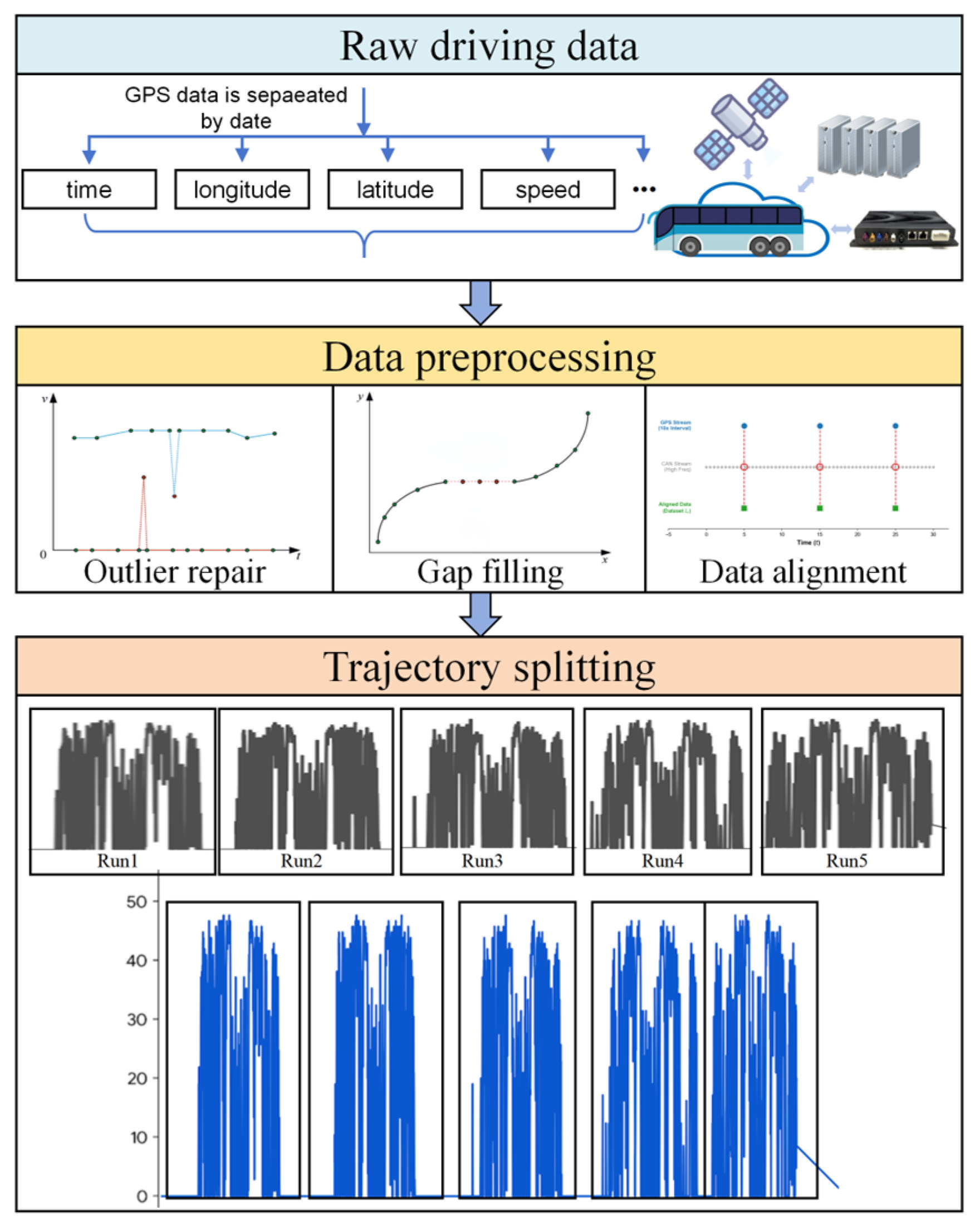
- A cloud-based data acquisition and processing framework is proposed to handle the distinct characteristics of cloud-side data. Unlike vehicle-end data acquisition, this approach accounts for the heterogeneity of multi-source information in the cloud-platform, ensuring high-quality inputs for prediction.
- (2)
- A spatiotemporal-characteristics-based route feature extraction is developed to decouple the inherent heterogeneity of urban bus operations. Compared with conventional route analysis, it preserves temporal continuity across regimes and mitigates the “pattern averaging” effect.
- (3)
- A Time-partitioned dual-layer LSTM (TP-D-LSTM) architecture is developed for high-precision prediction. Different from standard deep learning models, it incorporates intermediate electrochemical state prediction and residual correction, improving both interpretability and predictive accuracy under complex traffic conditions.
2. Acquisition and Preprocessing of Cloud-Based Operating Data
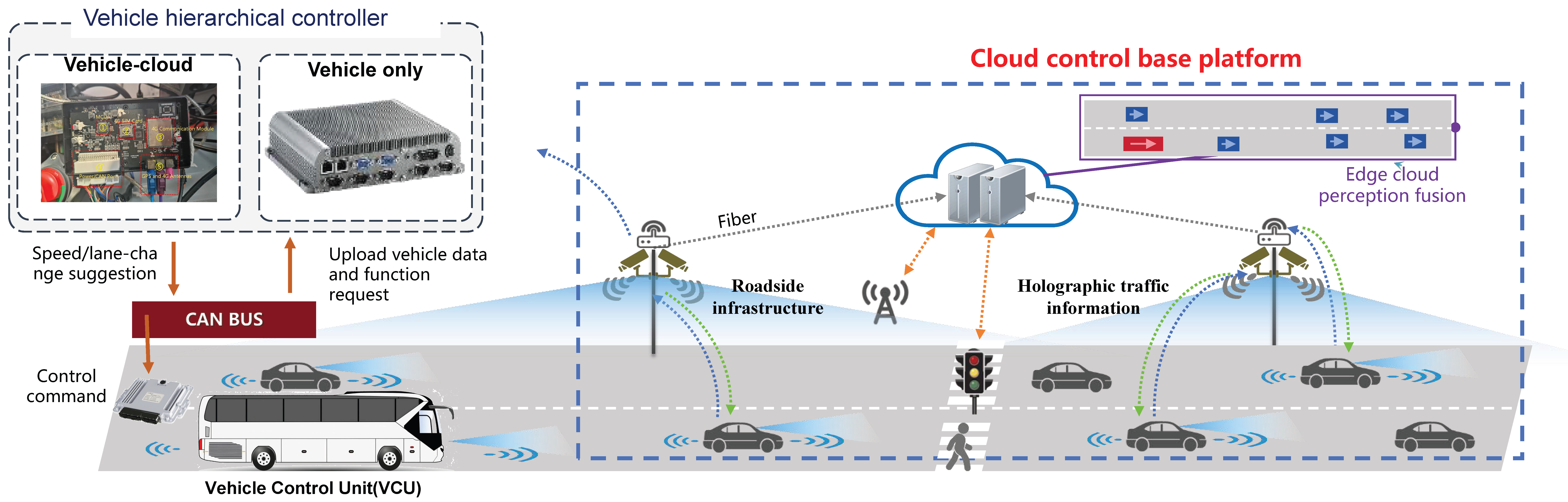
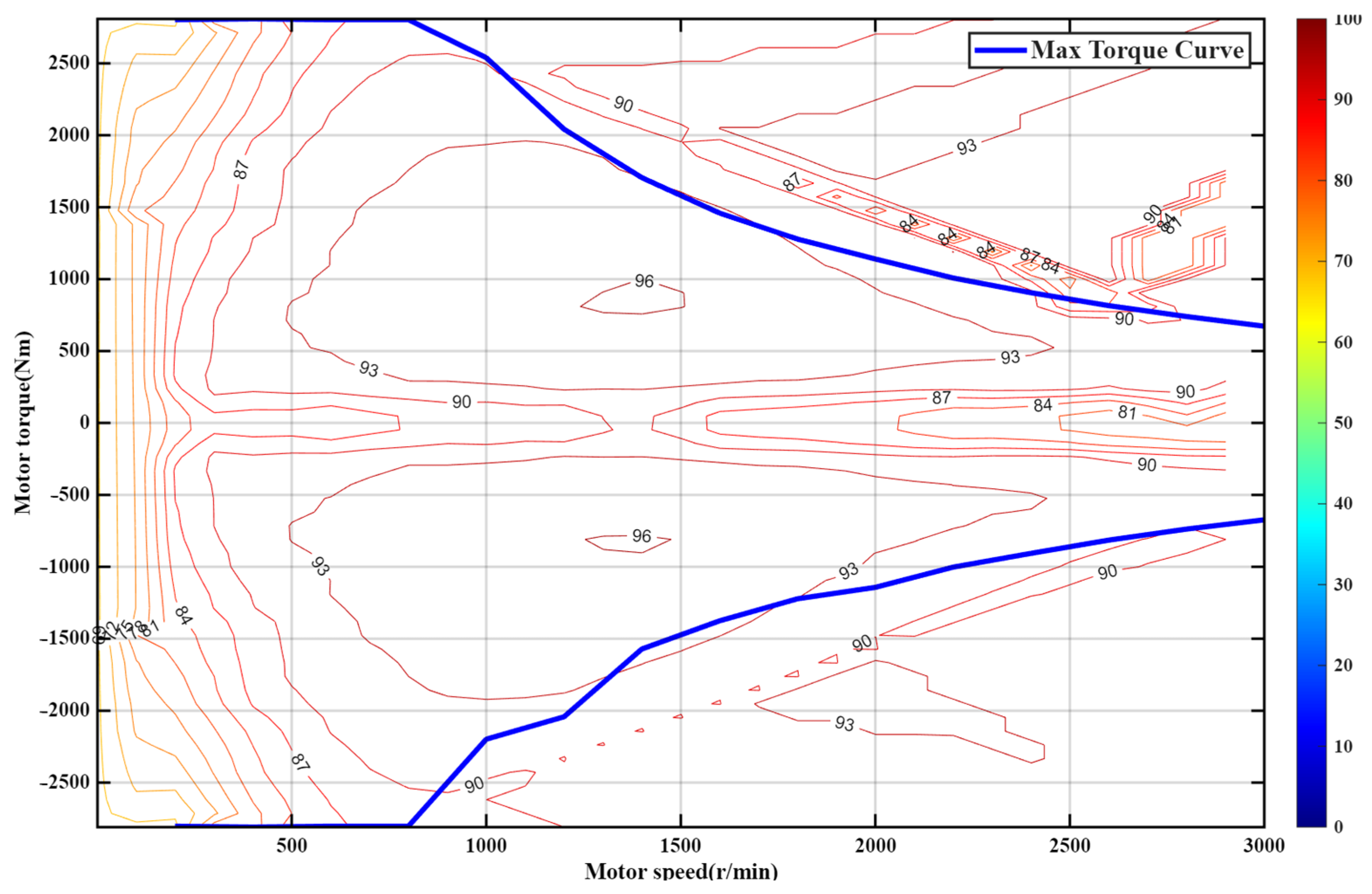
2.1. Vehicle–Road–Cloud Platform Architecture and Physical Configurations
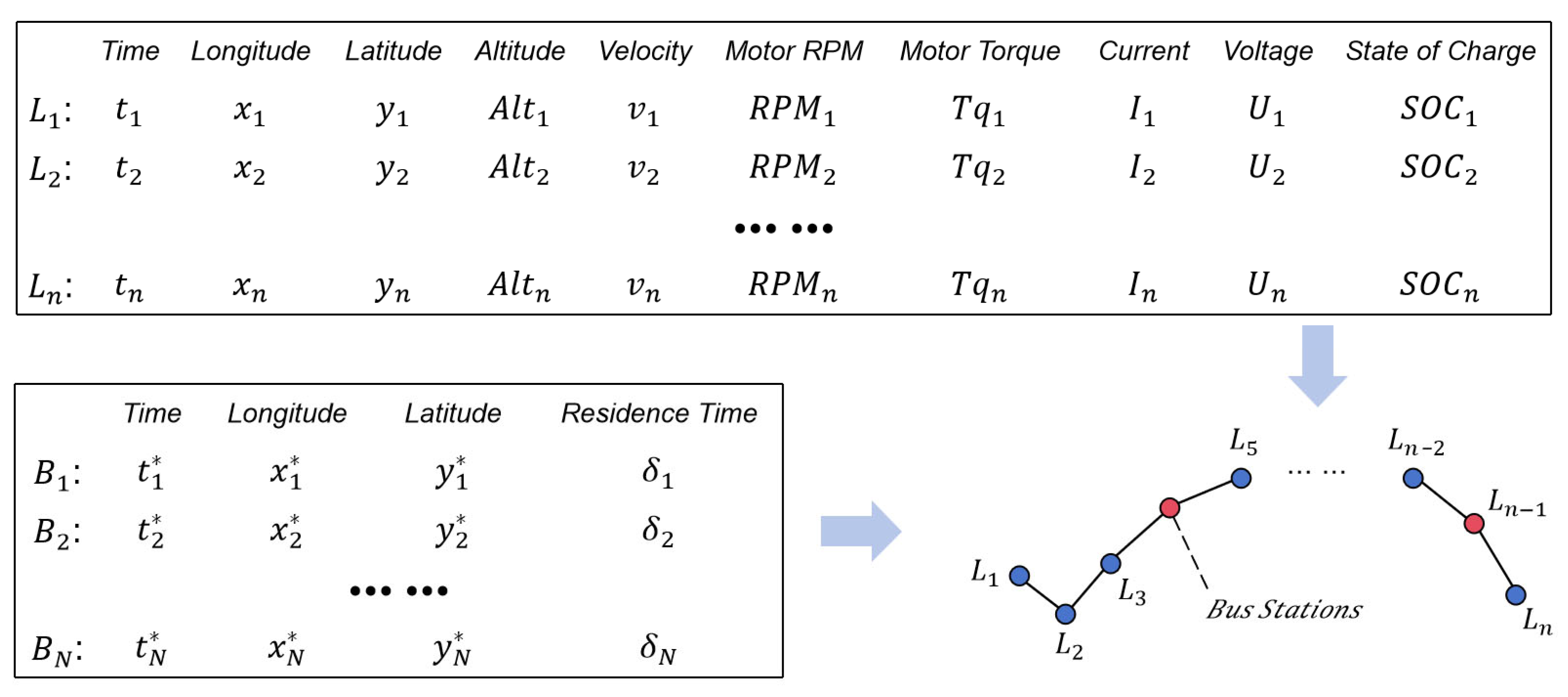
2.2. Dynamic–Static Data Association and Sequence Preprocessing
3. Analysis of Spatiotemporal Characteristics for Urban Bus Routes
3.1. Route Profiling and Microscopic Kinematic Indicators
3.2. Spatiotemporal Coupling and Long-Tail Effect Analysis
3.2.1. Analysis of Temporal Evolution Characteristics
3.2.2. Analysis of Spatial Distribution Characteristics
4. Time-Partitioned Dual-Layer LSTM Framework
4.1. Trip-Based Soft Time-Partitioning Strategy
4.2. TP-D-LSTM Architecture with Soft Physical Constraints
5. Experimental Validation and Discussion
5.1. Evaluation Metrics and Experimental Settings
5.2. Performance Evaluation of the TP-D-LSTM Framework
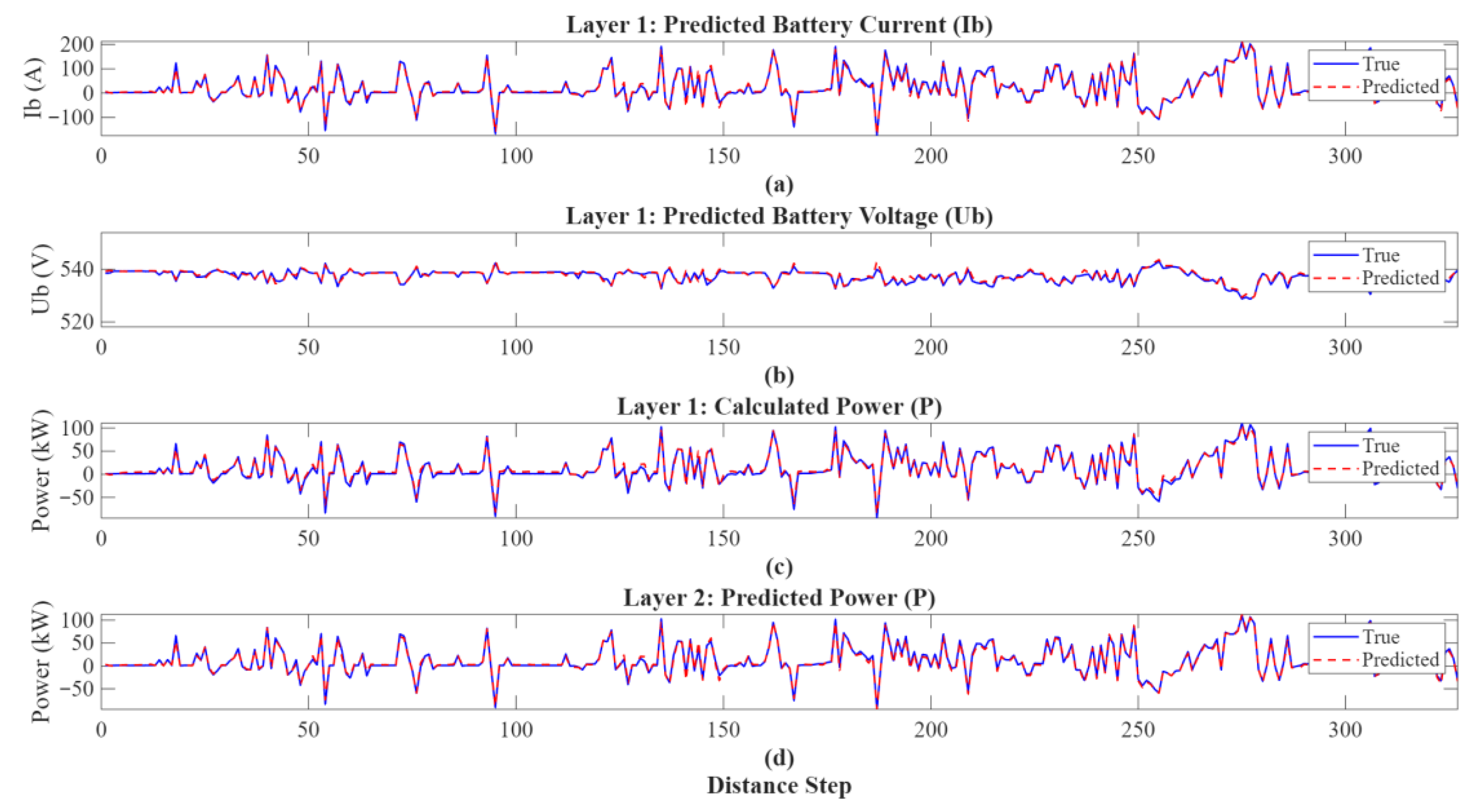
5.2.1. Mechanism-Oriented Verification of the Dual-Layer Architecture
5.2.2. Superiority of the Time-Partitioning Strategy
5.2.3. Comparative Analysis with Baseline Models
6. Conclusions
Author Contributions
Funding
Data Availability Statement
Conflicts of Interest
References
- Chen, Y.; Zhang, Y.; Sun, R. Data-driven estimation of energy consumption for electric bus under real-world driving conditions. Transp. Res. Part D Transp. Environ. 2021, 98, 102969. [Google Scholar] [CrossRef]
- Zhang, J.; Wang, Z.; Liu, P.; Zhang, Z. Energy consumption analysis and prediction of electric vehicles based on real-world driving data. Appl. Energy 2020, 275, 115408. [Google Scholar] [CrossRef]
- Logan, K.G.; Nelson, J.D.; Hastings, A. Electric and hydrogen buses: Shifting from conventionally fuelled cars in the UK. Transp. Res. Part D Transp. Environ. 2020, 85, 102350. [Google Scholar] [CrossRef]
- Li, P.; Zhang, Y.; Zhang, Y.; Zhang, Y.; Zhang, K. Prediction of electric bus energy consumption with stochastic speed profile generation modelling and data driven method based on real-world big data. Appl. Energy 2021, 298, 117204. [Google Scholar] [CrossRef]
- Çiçek, A.; Karakuş, F.; Erdinç, O. A novel concept for optimal operation of multi-swap stations serving electric metrobuses. Energy Sustain. Dev. 2025, 86, 101722. [Google Scholar] [CrossRef]
- Lim, L.K.; Muis, Z.A.; Ho, W.S.; Hashim, H.; Bong, C.P.C. Review of the energy forecasting and scheduling model for electric buses. Energy 2023, 263, 125773. [Google Scholar] [CrossRef]
- Aljohani, T.M.; Ebrahim, A.; Mohammed, O. Real-time metadata-driven routing optimization for electric vehicle energy consumption minimization using deep reinforcement learning and Markov chain model. Electr. Power Syst. Res. 2021, 192, 106962. [Google Scholar] [CrossRef]
- Zhang, Z.; Ye, B.; Wang, S.; Ma, Y. Analysis and estimation of energy consumption of electric buses using real-world data. Transp. Res. Part D Transp. Environ. 2024, 126, 104017. [Google Scholar] [CrossRef]
- Szilassy, P.Á.; Földes, D. Consumption estimation method for battery-electric buses using general line characteristics and temperature. Energy 2022, 261, 125080. [Google Scholar] [CrossRef]
- Nan, S.; Tu, R.; Li, T.; Sun, J.; Chen, H. From driving behavior to energy consumption: A novel method to predict the energy consumption of electric bus. Energy 2022, 261, 125188. [Google Scholar] [CrossRef]
- Ma, X.; Miao, R.; Wu, X.; Liu, X. Examining influential factors on the energy consumption of electric and diesel buses: A data-driven analysis of large-scale public transit network in Beijing. Energy 2021, 216, 119196. [Google Scholar] [CrossRef]
- Ma, X.; Tao, Z.; Wang, Y.; Yu, H.; Wang, Y. Long short-term memory neural network for traffic speed prediction using remote microwave sensor data. Transp. Res. Part C Emerg. Technol. 2015, 54, 187–197. [Google Scholar] [CrossRef]
- Jiang, J.; Yu, Y.; Min, H.; Cao, Q.; Sun, W.; Zhang, Z.; Luo, C. Trip-level energy consumption prediction model for electric bus combining Markov-based speed profile generation and Gaussian processing regression. Energy 2023, 263, 125866. [Google Scholar] [CrossRef]
- Abdelaty, H.; Mohamed, M. A prediction model for battery electric bus energy consumption in transit. Energies 2021, 14, 2824. [Google Scholar] [CrossRef]
- Fiori, C.; Ahn, K.; Rakha, H.A. Power-based electric vehicle energy consumption model: Model development and validation. Appl. Energy 2016, 168, 257–268. [Google Scholar] [CrossRef]
- Pamuła, T.; Pamuła, W. Estimation of the energy consumption of battery electric buses for public transport networks using real-world data and deep learning. Energies 2020, 13, 2340. [Google Scholar] [CrossRef]
- Dong, C.; Xiong, Z.; Zhang, C.; Li, N.; Li, Y.; Xie, N.; Zhang, J.; Wang, H. A transformer-based approach for deep feature extraction and energy consumption prediction of electric buses based on driving distances. Appl. Energy 2025, 380, 123941. [Google Scholar] [CrossRef]
- Li, Z.; Cui, Z.; Liao, H.; Ash, J.; Zhang, G.; Xu, C.; Wang, Y. Steering the future: Redefining intelligent transportation systems with foundation models. CHAIN 2024, 1, 46–53. [Google Scholar] [CrossRef]
- Wang, H.; Song, J.; Li, X. A survey of electric vehicles in sustainable systems: Environmental benefits, pattern analysis, and AI-driven operation methodologies. CHAIN 2024, 1, 177–202. [Google Scholar] [CrossRef]
- Zhao, J.; He, J. Energy consumption prediction for electric buses based on traction modeling and LightGBM. World Electr. Veh. J. 2025, 16, 159. [Google Scholar] [CrossRef]
- Ng, M.-F.; Zhao, J.; Yan, Q.; Conduit, G.J.; Seh, Z.W. Predicting the state of charge and health of batteries using data-driven machine learning. Nat. Mach. Intell. 2020, 2, 161–170. [Google Scholar] [CrossRef]
- Zhang, W.; Zhang, H.; Bi, Z. A time series physics-informed neural network framework for the state of health estimation of lithium-ion batteries. J. Energy Storage 2026, 142, 119549. [Google Scholar] [CrossRef]
- Yu, H.; Zhang, H.; Zhang, Z.; Yang, S. State estimation of lithium-ion batteries via physics-machine learning combined methods: A methodological review and future perspectives. eTransportation 2025, 24, 100420. [Google Scholar] [CrossRef]
- Xu, H.; Tu, R.; Li, T.; Chen, H. Interpretable bus energy consumption model with minimal input variables considering powertrain types. Transp. Res. Part D Transp. Environ. 2023, 119, 103742. [Google Scholar] [CrossRef]
- Mersha, M.; Lam, K.; Wood, J.; AlShami, A.K.; Kalita, J. Explainable artificial intelligence: A survey of needs, techniques, applications, and future direction. Neurocomputing 2024, 599, 128111. [Google Scholar] [CrossRef]
- Mei, P.; Karimi, H.R.; Chen, F.; Yang, S.; Huang, C.; Qiu, S. A learning-based vehicle-cloud collaboration approach for joint estimation of state-of-energy and state-of-health. Sensors 2022, 22, 9474. [Google Scholar] [CrossRef] [PubMed]
- Wang, Y.; Tang, H.; Pan, B.; Wang, S.; Niu, Y.; Wang, R. A cloud energy management strategy for intelligent connected HEVs based on end-edge-cloud collaboration. Proc. Inst. Mech. Eng. Part D J. Automob. Eng. 2024, 239, 4756–4773. [Google Scholar] [CrossRef]
- Guo, S.; Zhao, C. iEVEM: Big data-empowered framework for intelligent electric vehicle energy management. Systems 2025, 13, 118. [Google Scholar] [CrossRef]
- Hochreiter, S.; Schmidhuber, J. Long short-term memory. Neural Comput. 1997, 9, 1735–1780. [Google Scholar] [CrossRef]
- Gers, F.A.; Schmidhuber, J.; Cummins, F. Learning to forget: Continual prediction with LSTM. Neural Comput. 2000, 12, 2451–2471. [Google Scholar] [CrossRef]
- Xiang, Y.; Wang, S.; Su, T.; Li, J.; Mao, S.S.; Geimer, M. KIT Bus: A Shuttle Model for CARLA Simulator. In Proceedings of the 2021 IEEE Industrial Electronics and Applications Conference (IEACon), Penang, Malaysia, 22–23 November 2021; IEEE: New York, NY, USA, 2021; pp. 7–12. [Google Scholar] [CrossRef]







| Category | Parameter | Symbol | Value/Unit |
|---|---|---|---|
| Static Specs | Overall Dimensions () | - | |
| Frontal Area | |||
| Dynamics | Curb Weight/Gross Vehicle Weight | ||
| Rolling Radius | |||
| Final Drive Ratio | |||
| Dynamic Features | Instantaneous Speed/Acceleration | ||
| Longitude and Latitude and Altitude | |||
| Power States | Motor Speed/Motor Torque | ||
| Bus Voltage/Bus Current | |||
| State of Charge |
| 9 April 2025 10:42:02 | 116.8950757 | 36.81136350 | 1252 | 37.82 |
| 9 April 2025 10:42:12 | 116.8950202 | 36.81193800 | 472 | 13.66 |
| 9 April 2025 10:42:22 | 116.8946093 | 36.81196167 | 841 | 25.21 |
| 9 April 2025 10:42:32 | 116.8941537 | 36.81164850 | 745 | 22.06 |
| 9 April 2025 10:42:42 | 116.8941325 | 36.81140883 | 0 | 0 |
| 9 April 2025 10:50:22 | 116.8939383 | 36.81119217 | 0 | 0 |
| 9 April 2025 10:56:12 | 116.8939312 | 36.81119550 | 0 | 0 |
| 9 April 2025 11:03:42 | 116.8939390 | 36.81118450 | 0 | 0 |
| 9 April 2025 11:09:02 | 116.8939362 | 36.81117967 | 0 | 0 |
| 9 April 2025 11:17:52 | 116.8939383 | 36.81122583 | 0 | 0 |
| 9 April 2025 11:18:02 | 116.8940685 | 36.81131333 | 404 | 11.55 |
| 9 April 2025 11:18:12 | 116.8945442 | 36.81118950 | 404 | 11.55 |
| 9 April 2025 11:18:22 | 116.8948353 | 36.81112450 | 451 | 13.66 |
| 9 April 2025 11:18:32 | 116.8949415 | 36.81095317 | 480 | 13.66 |
| Period | Avg Speed (km/h) | Low Speed Ratio (%) | Stop Density (Stops/km) |
|---|---|---|---|
| Morning Peak | 21.99 | 67.83 | 1.81 |
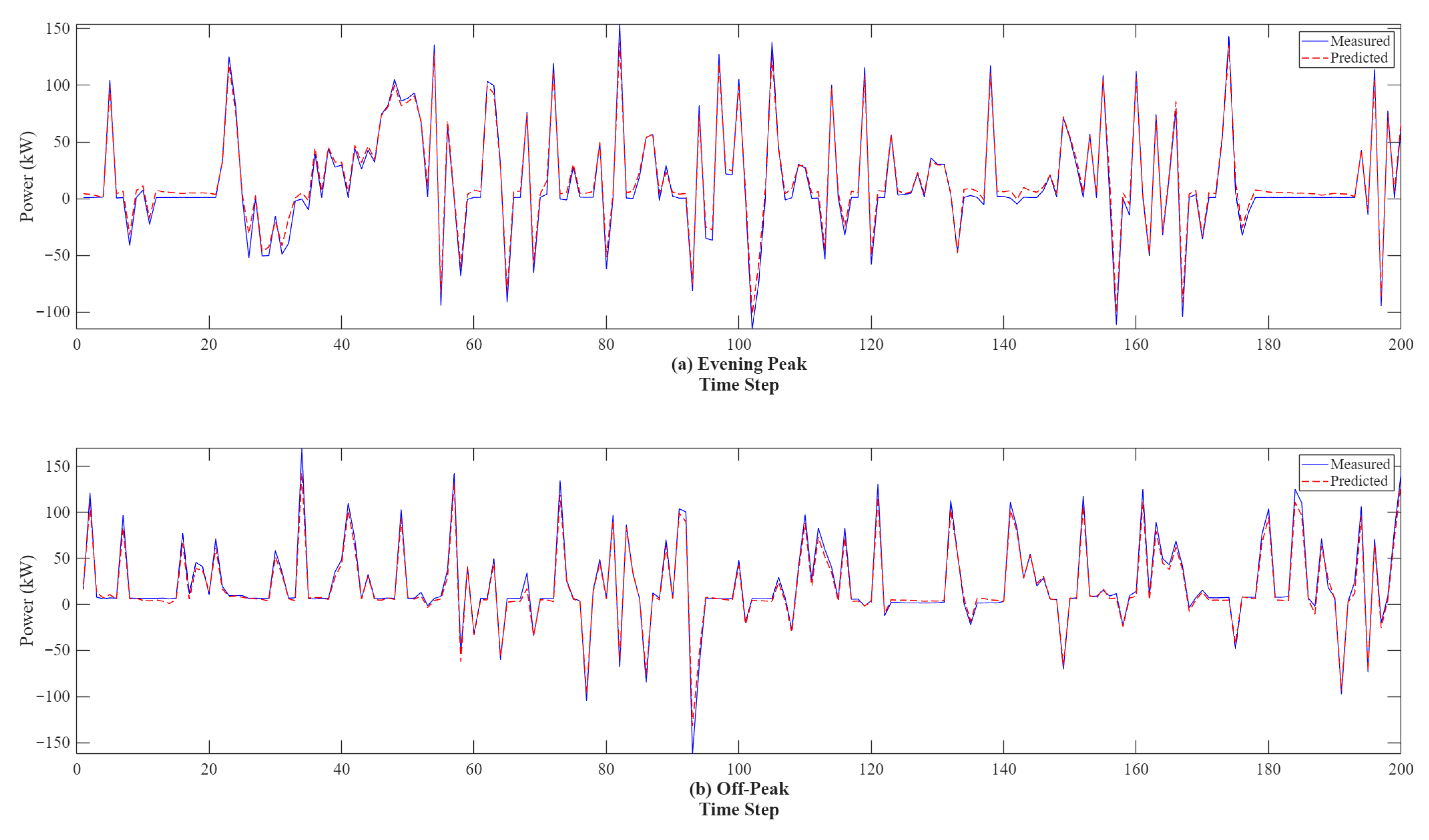
| Off-Peak | 25.64 | 57.49 | 1.09 |
| Evening Peak | 22.99 | 63.77 | 1.38 |
| Model Parameter | Layer 1 | Layer 2 |
|---|---|---|
| Input Dimension | 6 | 9 |
| Time Window Size | 200 | 200 |
| Stride Step | 10 | 10 |
| Hidden Units | 128 | 64 |
| Activation | ReLU | ReLU |
| Dropout Rate | - | 0.5 |
| L2 Regularization | - | 0.01 |
| Optimizer | Adam | Adam |
| Initial Learning Rate | 0.0005 | 0.005 |
| Mini-Batch Size | 32 | 32 |
| Max Epochs | 200 | 200 |
| LR Decay Strategy | Piecewise (Period = 100) | Piecewise (Period = 40) |
| Method | RMSE | MAE | |
|---|---|---|---|
| 18.83 | 9.32 | 0.895 | |
| 13.83 | 6.11 | 0.965 | |
| Improvement | +26.6% | +9.6% | - |
| Period | RMSE | MAE | |
|---|---|---|---|
| All Scenarios (Global) | 13.83 | 6.11 | 0.965 |
| Morning Peak | 8.37 | 6.24 | 0.968 |
| Off-Peak | 5.85 | 5.73 | 0.984 |
| Evening Peak | 6.15 | 5.89 | 0.981 |
| Models | RMSE | MAE | |
|---|---|---|---|
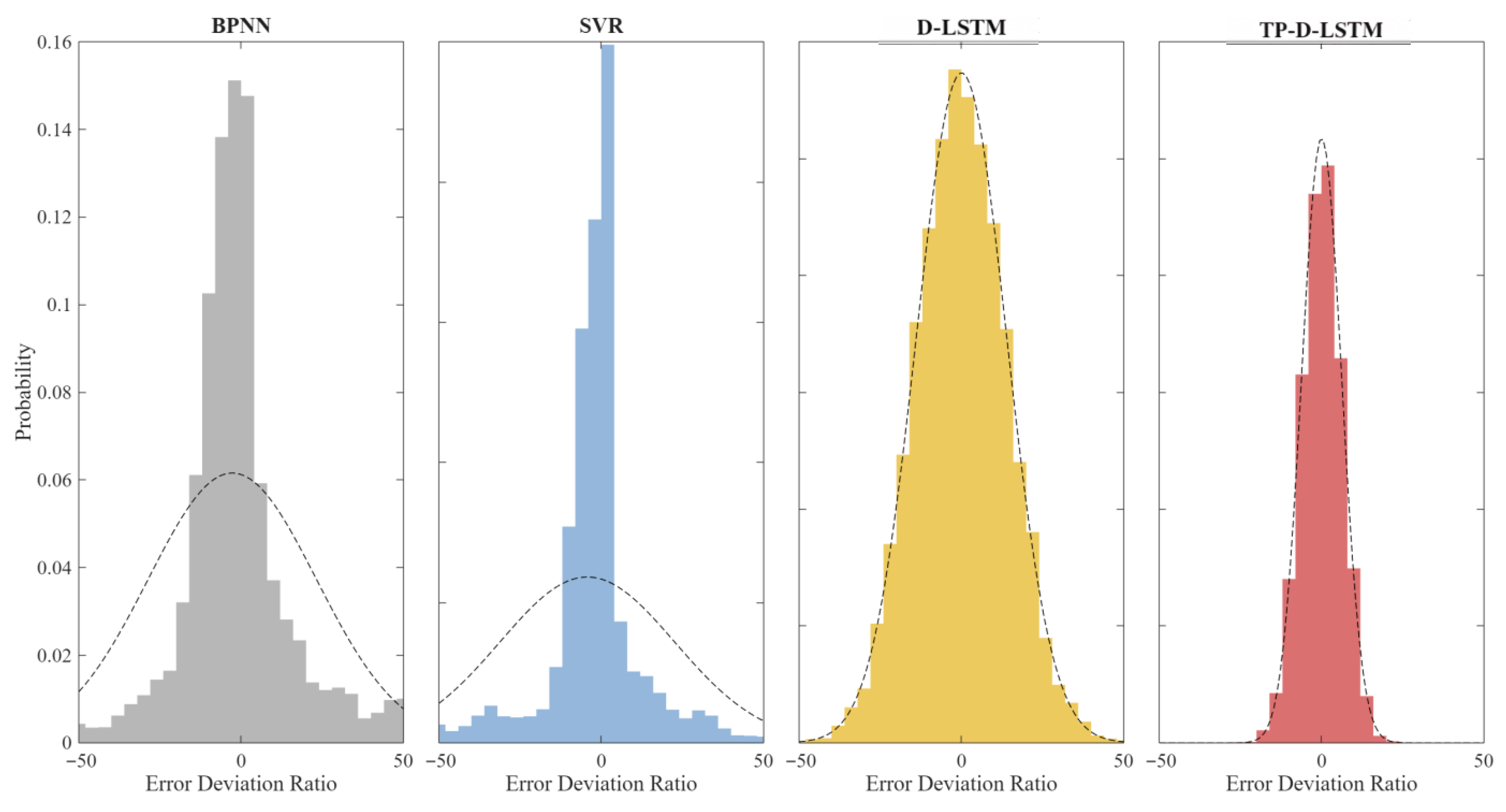
| BPNN | 25.76 | 15.56 | 0.8356 |
| SVR | 25.92 | 13.34 | 0.8336 |
| D-LSTM | 13.83 | 8.43 | 0.9550 |
| TP-D-LSTM | 6.15 | 4.43 | 0.9812 |
Disclaimer/Publisher’s Note: The statements, opinions and data contained in all publications are solely those of the individual author(s) and contributor(s) and not of MDPI and/or the editor(s). MDPI and/or the editor(s) disclaim responsibility for any injury to people or property resulting from any ideas, methods, instructions or products referred to in the content. |
© 2026 by the authors. Published by MDPI on behalf of the World Electric Vehicle Association. Licensee MDPI, Basel, Switzerland. This article is an open access article distributed under the terms and conditions of the Creative Commons Attribution (CC BY) license.
Share and Cite
Wang, Y.; Wang, Y.; Liu, S.; Zhu, Y.; Wang, B.; Li, Y.; Yao, G.; Zhong, W. A Time-Partitioned Dual-Layer LSTM Based on Route Spatiotemporal for Electric Bus Energy Prediction. World Electr. Veh. J. 2026, 17, 210. https://doi.org/10.3390/wevj17040210
Wang Y, Wang Y, Liu S, Zhu Y, Wang B, Li Y, Yao G, Zhong W. A Time-Partitioned Dual-Layer LSTM Based on Route Spatiotemporal for Electric Bus Energy Prediction. World Electric Vehicle Journal. 2026; 17(4):210. https://doi.org/10.3390/wevj17040210
Chicago/Turabian StyleWang, Yue, Yu Wang, Shiqi Liu, Yanpeng Zhu, Bo Wang, Yixin Li, Guoqun Yao, and Wei Zhong. 2026. "A Time-Partitioned Dual-Layer LSTM Based on Route Spatiotemporal for Electric Bus Energy Prediction" World Electric Vehicle Journal 17, no. 4: 210. https://doi.org/10.3390/wevj17040210
APA StyleWang, Y., Wang, Y., Liu, S., Zhu, Y., Wang, B., Li, Y., Yao, G., & Zhong, W. (2026). A Time-Partitioned Dual-Layer LSTM Based on Route Spatiotemporal for Electric Bus Energy Prediction. World Electric Vehicle Journal, 17(4), 210. https://doi.org/10.3390/wevj17040210