Article

Parametric Cross-Section Design and Crashworthiness Optimization of High-Strength Steel Double-Cell Roll-Formed Tubes Under Lateral Bending


1
School of Mechanical Engineering, Guangxi University, Nanning 530004, China
2
Guangxi Huge Stone New Energy Technology Co., Ltd., Nanning 530009, China
*
Author to whom correspondence should be addressed.
World Electr. Veh. J. 2026, 17(4), 179; https://doi.org/10.3390/wevj17040179
Submission received: 16 February 2026 / Revised: 21 March 2026 / Accepted: 24 March 2026 / Published: 27 March 2026
(This article belongs to the Section Manufacturing)

Abstract

Lightweight design and crashworthiness of protective structures are critical for battery safety in electric vehicles (EVs). This study addresses the limited research on cross-sectional shape design of high-strength steel double-cell roll-formed tubes (DCRFTs), widely used in EV bumper beams, battery boxes, and electric bus frames. A parametric design method is proposed based on three parameters: middle flange offset (o), upper deflection angle (α), and lower deflection angle (β). Under the constraints of constant cross-sectional height and enclosed area, this method systematically generates diverse shapes, including square, trapezoid, hexagon, re-entrant hexagon, and various hybrid shapes. Validated finite element models were employed to analyze the deformation modes and crashworthiness of DP980 steel DCRFTs under idealized lateral three-point bending with simple supports. The results indicated that the re-entrant hexagon section reduced maximum deformation (Disp) by 2.95%, peak crushing force (PCF) by 9.53%, and improved crushing force efficiency (CFE) by 13.88% compared to the baseline square section. The parametric study and sensitivity analysis confirmed that the offset (o) was the most critical parameter, contributing over 80% of the variance in Disp, PCF, and CFE. Multi-objective optimization using an RBF surrogate model and the NSGA-II algorithm yielded Pareto optimal solutions. Compared to the baseline, three representative solutions achieved Disp reductions of 11.83–25.10% and CFE improvements of 15.63–22.26%, each with distinct trade-offs among objectives. This work establishes a methodological framework for parametric cross-section design of roll-formed profiles; its extension to realistic boundary conditions will further facilitate practical EV protective structure design.

1. Introduction

With the rapid growth of the electric vehicle (EV) market, lightweight body design and battery safety under crash loading have become two central and often competing demands in automotive engineering [1,2]. The power battery pack, typically integrated into the bottom of the chassis, is particularly vulnerable to lateral impact loads. In side pole collision scenarios, excessive structural intrusion can damage internal battery cells and trigger catastrophic thermal runaway [3]. Achieving an optimal balance between lightweight design and high lateral bending crashworthiness for battery protection structures is therefore of paramount importance. High-strength steel thin-walled structures offer an attractive combination of specific strength, energy absorption capacity, and cost-effectiveness, making them competitive candidates for such applications [4,5]. Roll forming, as illustrated in Figure 1a, is a key manufacturing process for these structures. It converts a flat steel sheet of constant thickness into closed-section profiles through sequential bending and welding across a series of roll stands [6,7]. This process efficiently produces longitudinally uniform profiles with complex geometries. Extruded aluminum profiles suffer from high material cost and poor weldability [8], while carbon fiber composites are limited by long curing cycles and difficult recyclability [9,10]. In contrast, roll-formed high-strength steel profiles offer low material cost, production scalability, and good recyclability, making them a preferred choice for EV battery protection structures.
As a representative roll-formed profile, the double-cell roll-formed tube (DCRFT) features a simple and symmetric double-cell cross-section (Figure 1b) with excellent bending and torsional resistance. It is therefore widely employed as a critical energy-absorbing component subjected to lateral bending impact loads across various EV platforms. As shown in Figure 1c–e, typical applications include bumper beams for front/rear crash protection, protective side frames for passenger EV battery boxes, and structural skeletons of heavy-duty electric buses [11,12]. However, current strategies for improving DCRFT bending crashworthiness mainly focus on material upgrading—such as adopting higher-strength steels like DP980 and DP1180 [13,14]—or wall thickness optimization [15,16]. In contrast, systematic studies on cross-sectional shape design remain limited, with most existing research restricted to conventional square or rectangular sections, thereby hindering further performance enhancement.
Existing studies have demonstrated that cross-sectional shape is a critical factor influencing the bending performance of thin-walled tubes. These studies address both external contours [17] and internal cross-sectional structures [18,19,20]. Regarding external contours, Tang et al. [21] systematically compared several basic cross-sections under lateral impact, including circular, elliptical, rectangular, trapezoidal, and hat-shaped configurations. Their results revealed that geometric parameters markedly influence bending behaviors. Sookchanchai et al. [22] reported that a W-shaped cross-section exhibits superior bending performance for side-door intrusion beams compared with circular and U-shaped cross-sections. In terms of internal structures, Albak [23] proved that introducing internal reinforcing ribs with various cross-sections substantially enhances the bending crashworthiness of multi-cell tubes. Similarly, He et al. [24] mitigated the cross-sectional flattening of circular tubes by incorporating different forms of internal ribs, effectively enhancing their three-point bending crashworthiness. Beyond traditional configurations, several high-efficiency configurations have been introduced in thin-walled tube design to improve bending performance, including hexagon [25], re-entrant hexagon [26,27], and bionic configurations [28,29]. Kahraman et al. [26] proposed novel metal honeycomb tubes by combining hexagons, re-entrant hexagons, and octagons with multi-cell structures. Their comparative study indicated that the re-entrant hexagon configuration achieved the highest specific energy absorption. Song et al. [30] designed a bionic grooved tube inspired by cornstalk cross-sections, which significantly enhanced lateral impact resistance. These findings confirm that employing high-efficiency energy-absorbing cross-sections effectively improves the bending crashworthiness of thin-walled tubes.
Although previous studies have demonstrated the efficiency of specific cross-sectional shapes, most are limited to comparative analyses of several preset, discrete configurations. This approach tends to overlook intermediate configurations with potentially superior performance between typical shapes. The parametric design method provides an effective solution by describing and generating diverse cross-sectional shapes through continuously varying geometric parameters. It also combines surrogate model-based multi-objective optimization to identify optimal designs [31,32]. This approach has been validated in research on stamped hat-shaped beams. For example, Zhang et al. [33] defined geometric parameters to describe irregular cross-sections of double-hat beams and employed the Kriging surrogate model to obtain optimal shapes. Miao et al. [34] combined geometric parameters with spline curves to generate novel cross-sections (e.g., cruciform, elliptical, and butterfly) and performed multi-objective optimization using the RBF surrogate model. Similarly, Zahedan et al. [35] parametrically designed internal reinforcing ribs of hat-shaped beams and conducted multi-objective optimization using a response surface surrogate model. While parametric cross-section studies on stamped double-hat beams are well developed [33,34,35], systematic parametric design and optimization for DCRFTs remain lacking. A DCRFT is roll-formed from a single steel sheet. Its cross-sectional profile must therefore follow a single, unbranched continuous path and include a built-in middle flange that divides the section into upper and lower cells. By contrast, a stamped double-hat beam is assembled by welding two separately stamped halves along their flanges. Moreover, a roll-formed cross-section must be bilaterally symmetric to prevent twisting during forming. These structural and process differences prevent direct transfer of existing double-hat beam parametric methods to DCRFTs. Meanwhile, existing DCRFT research focuses mainly on conventional square or rectangular cross-sections and does not incorporate configurations with proven high energy absorption efficiency, such as hexagons and re-entrant hexagons, into a unified parametric framework. This gap limits further exploration of DCRFT bending crashworthiness.
To address this gap, this study proposes a novel parametric cross-section design method for DCRFTs. Based on the traditional square double-cell cross-section, the method introduces three shape parameters: middle flange offset (o), upper deflection angle (α), and lower deflection angle (β). Its novelty lies in the ability to systematically generate square, trapezoid, hexagon, re-entrant hexagon, and various hybrid shapes within a continuous design space, while satisfying the uniform-thickness, symmetry, and single-path topology requirements of roll-formed sections and keeping the total cross-sectional height and enclosed area constant. Experimentally validated finite element models are employed to investigate the effects of these parameters on the lateral bending crashworthiness of DCRFTs. Subsequently, given the high computational cost of dynamic crash simulations and the highly nonlinear, mutually conflicting relationships among crashworthiness indicators, a radial basis function (RBF) surrogate model is adopted to improve optimization efficiency. This model is combined with the NSGA-II algorithm, which provides excellent convergence and yields a uniformly distributed Pareto front for multi-objective problems. The resulting optimization framework is used to identify the optimal parameter combination balancing specific energy absorption, peak crushing force, maximum deformation, and crushing force efficiency. The findings establish a systematic methodological framework for the parametric cross-section design and crashworthiness optimization of roll-formed profiles. Although the current analysis adopts idealized boundary conditions and centered loading, the proposed method is inherently general and can be extended to more realistic structural configurations, thereby facilitating the development of high-performance, lightweight roll-formed profiles for EV protective applications.

2. Parametric Cross-Section Design and Crashworthiness Indicators

2.1. Parametric Cross-Section Design Method

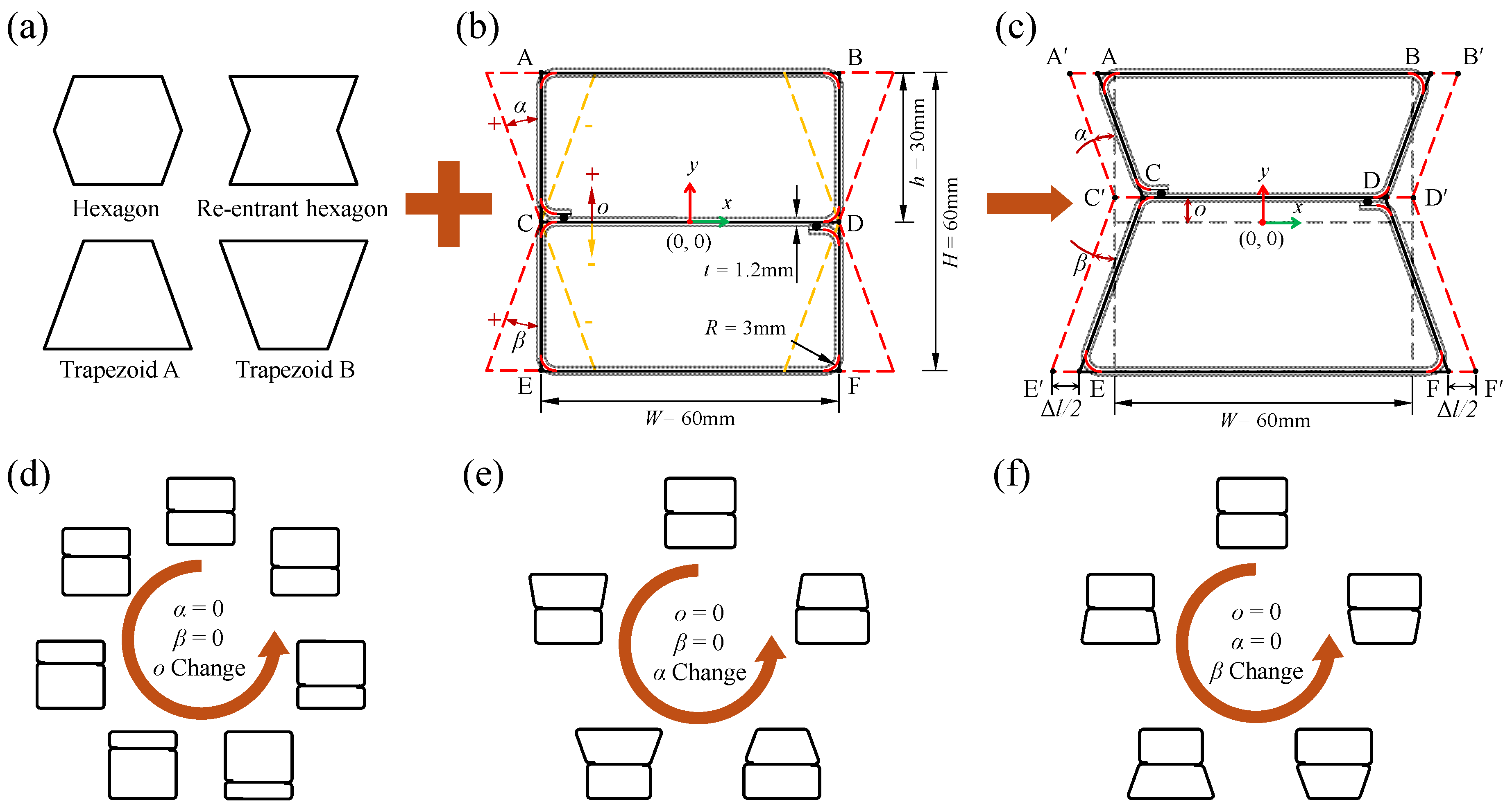
Figure 2b shows the baseline configuration for the cross-section design used in this study—a square DCRFT. This profile is roll-formed from a 1.2 mm-thick DP980 high-strength steel sheet and features two laser weld seams (marked by black dots). The cross-sectional width W and height H are both 60 mm. The vertical distance h between the middle flange and upper flange is 30 mm, and all fillet radii R are 3 mm. Building upon this baseline square cross-section, a parametric design method is proposed by introducing the configurations shown in Figure 2a. Under the constraints of maintaining a constant cross-sectional height and enclosed area, three parameters are defined to describe the cross-sectional shape.
The definitions of the three parameters are shown in Figure 2b. Specifically, the middle flange offset (o) denotes the vertical distance by which the middle flange CD deviates from the horizontal centerline. Upward deviation is defined as positive (o > 0) and downward as negative (o < 0). The upper deflection angle (α) represents the deflection of the upper side walls AC and BD relative to the vertical direction, with C and D acting as rotation centers. Outward deflection is positive (α > 0) and inward deflection is negative (α < 0). Finally, the lower deflection angle (β) is the deflection of the lower side walls CE and DF, with the sign convention consistent with α. To address the exact geometric generation and mathematical reproducibility, it should be noted that the aforementioned geometric parameterization is rigorously defined based on the theoretical sharp-cornered skeleton line of the cross-section. The minute area deviations caused by the uniform wall thickness (t = 1.2 mm) and fillet radii (R = 3 mm) are identical across all variants and are therefore neglected in the theoretical derivation.
To explicitly demonstrate this parametric generation, a re-entrant hexagon (o > 0, α > 0, β > 0) is taken as an example based on the Cartesian coordinate system established in Figure 2c (with the origin (0, 0) at the geometric center). Initially, the middle flange CD is offset upward by o (width lC′D′ = W = 60 mm). The upper and lower side walls then pivot outward by α and β around C’ and D’, transforming the initial square skeleton into an intermediate dashed shape A′B′D′F′E′C′. The lengths of the transverse flanges and the intermediate enclosed area (S′) at this stage are calculated using Equations (1)–(4).
l C D = W
l A B = W + 2 h o tan α
l E F = W + 2 ( h + o ) tan β
S = h o 2 ( l A B + l C D ) + h + o 2 ( l E F + l C D ) = 2 h W + ( h o ) 2 tan α + ( h + o ) 2 tan β
To strictly guarantee the final enclosed area equals the baseline area (S0 = 2hW), an area compensation operation is performed. The intermediate skeleton is virtually split along the y-axis, and the left and right halves are symmetrically translated by Δl/2 (calculated from Equation (5)). The corrected final edge lengths are expressed in Equations (6)–(8). By substituting these compensated lengths back into the geometric area formulation, Equation (9) mathematically verifies that the final enclosed area S strictly equals the initial baseline area 2hW.
Δ l = ( 2 h W S ) 2 h = ( h o ) 2 tan α + ( h + o ) 2 tan β 2 h
l CD = l C D + Δ l = W ( h o ) 2 tan α + ( h + o ) 2 tan β 2 h
l AB = l A B + Δ l = W + 2 ( h o ) tan α ( h o ) 2 tan α + ( h + o ) 2 tan β 2 h
l EF = l E F + Δ l = W + 2 ( h + o ) tan β ( h o ) 2 tan α + ( h + o ) 2 tan β 2 h
S = h o 2 ( l AB + l CD ) + h + o 2 ( l EF + l CD ) = 2 h W
To facilitate parametric modelling and ensure full reproducibility, the explicit final spatial coordinates (x, y) of the primary nodes on the right half (nodes B, D, and F) are mathematically defined in Equations (10)–(12). By symmetry about the y-axis, the coordinates of the corresponding left-half nodes (A, C, E) are simply ( x B , y B ), ( x D , y D ), and ( x F , y F ). Through this translation, the exact skeleton shape (solid black lines in Figure 2c) is established. The actual DCRFT model is then generated by applying the uniform thickness and fillets to this mathematically determined skeleton.
x D = W 2 + Δ l 2 ,     y D = o
x B = W 2 + ( h o ) tan α + Δ l 2 ,     y B = h
x F = W 2 + ( h + o ) tan β + Δ l 2 ,     y F = h
Finally, since the thickness and extrusion length are constant, the total structural mass is strictly proportional to the total skeleton length, Ltotal:
L total = l AB + l CD + l EF + 2 l AC + 2 l CE = 3 W + h o 2 h cos α [ 4 h + ( h + 3 o ) sin α ] + h + o 2 h cos β [ 4 h + ( h 3 o ) sin β ]
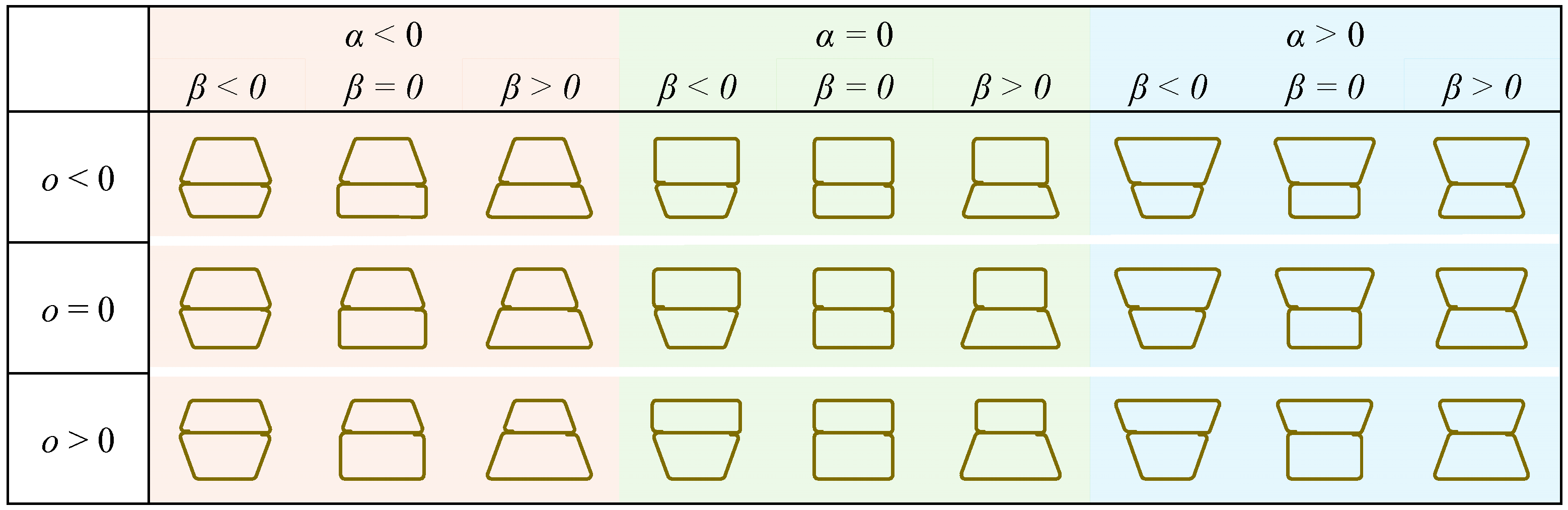
As indicated by Equation (13), the theoretical skeleton length Ltotal, and consequently the total structural mass, inevitably vary with different combinations of the shape parameters (o, α, β). To rigorously account for these inherent mass variations and ensure a strictly fair comparison of crashworthiness among diverse configurations, the Specific Energy Absorption (SEA) is inherently adopted as the primary evaluation indicator in the subsequent analyses. Figure 2d–f respectively illustrate the evolution of the cross-sectional shape when o, α, and β vary independently. Figure 3 illustrates various cross-sections with equal enclosed areas obtained by combining different signs for o, α, and β and adjusting their lengths. These cross-sections encompass not only typical configurations such as squares, hexagons, re-entrant hexagons, Trapezoid A, and Trapezoid B, but also a wide range of hybrid shapes.

2.2. Definition of Parameter Levels

To investigate the independent effects of three shape parameters on the bending crashworthiness of DCRFTs, specific parameter levels are defined for the parametric study. The roll-forming process of high-strength steel (e.g., DP980) imposes strict manufacturing constraints on achievable forming angles, minimum bend radii, and cross-sectional depth variations [6,36]. Specifically, extreme middle flange offsets (o) induce uneven longitudinal strain distributions during the continuous forming process, which can trigger uncontrollable springback, profile twisting, and edge wave defects. Additionally, highly re-entrant cross-sectional angles severely restrict tooling accessibility, as internal supporting rolls cannot enter the closed double-cell cavity to provide the necessary counter-pressure without physical interference. Exceeding these limits inevitably leads to material flow issues, excessive localized thinning, and potential corner defects.
To respect these constraints, consultations with experienced roll-forming engineers were conducted to establish the extreme parameter boundaries that are manufacturable under well-controlled processing conditions. Consequently, the deflection angles (α and β) were conservatively capped at ±20°, and the middle flange offset (o) was restricted to ±15 mm. The manufacturing feasibility of representative cross-sections within these parameter ranges is further confirmed in Section 5.3 through roll flower pattern analysis. Based on these manufacturing constraints and considering computational efficiency and the research objectives, the specific parameter levels were defined as summarized in Table 1. Subsequent analyses investigating the effects of cross-sectional shape and individual parameters on bending performance are based on these quantitative values.

2.3. Crashworthiness Indicators and Their Calculation

Four key indicators are used to evaluate the bending crashworthiness of DCRFTs: Maximum Deformation (Disp), Specific Energy Absorption (SEA), Peak Crushing Force (PCF), and Crushing Force Efficiency (CFE).
Maximum Deformation (Disp) represents the maximum structural deflection of the DCRFT in the Z-direction during impact. For measurement convenience, it is quantified by the maximum displacement of the hammer in this direction.
Specific Energy Absorption (SEA) represents the energy absorption per unit mass of the DCRFT, calculated using Equation (14). Here, m denotes the mass of the DCRFT, and EA denotes the total energy absorbed during impact, calculated using Equation (15). In this equation, F(x) represents the instantaneous crushing force.
SEA = EA m
EA = 0 Disp F ( x ) d x
Peak Crushing Force (PCF) represents the maximum crushing force during impact; a lower PCF is preferable.
Crushing Force Efficiency (CFE) reflects the stability of crushing force variation during impact, calculated using Equation (16). Here, MCF denotes the mean crushing force, calculated using Equation (17).
CFE = MCF PCF × 100 %
MCF = EA Disp
Ideally, DCRFTs with excellent bending crashworthiness should exhibit low Disp and PCF, along with high SEA and CFE.

3. Finite Element Model Construction and Validation

3.1. Finite Element Model Construction

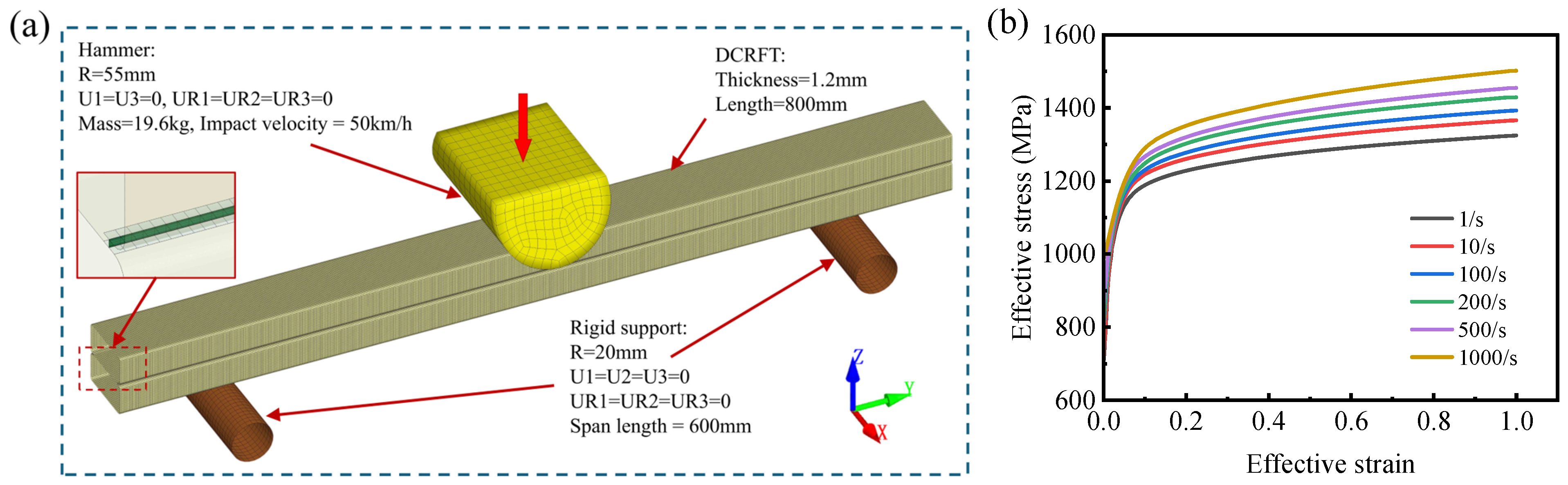
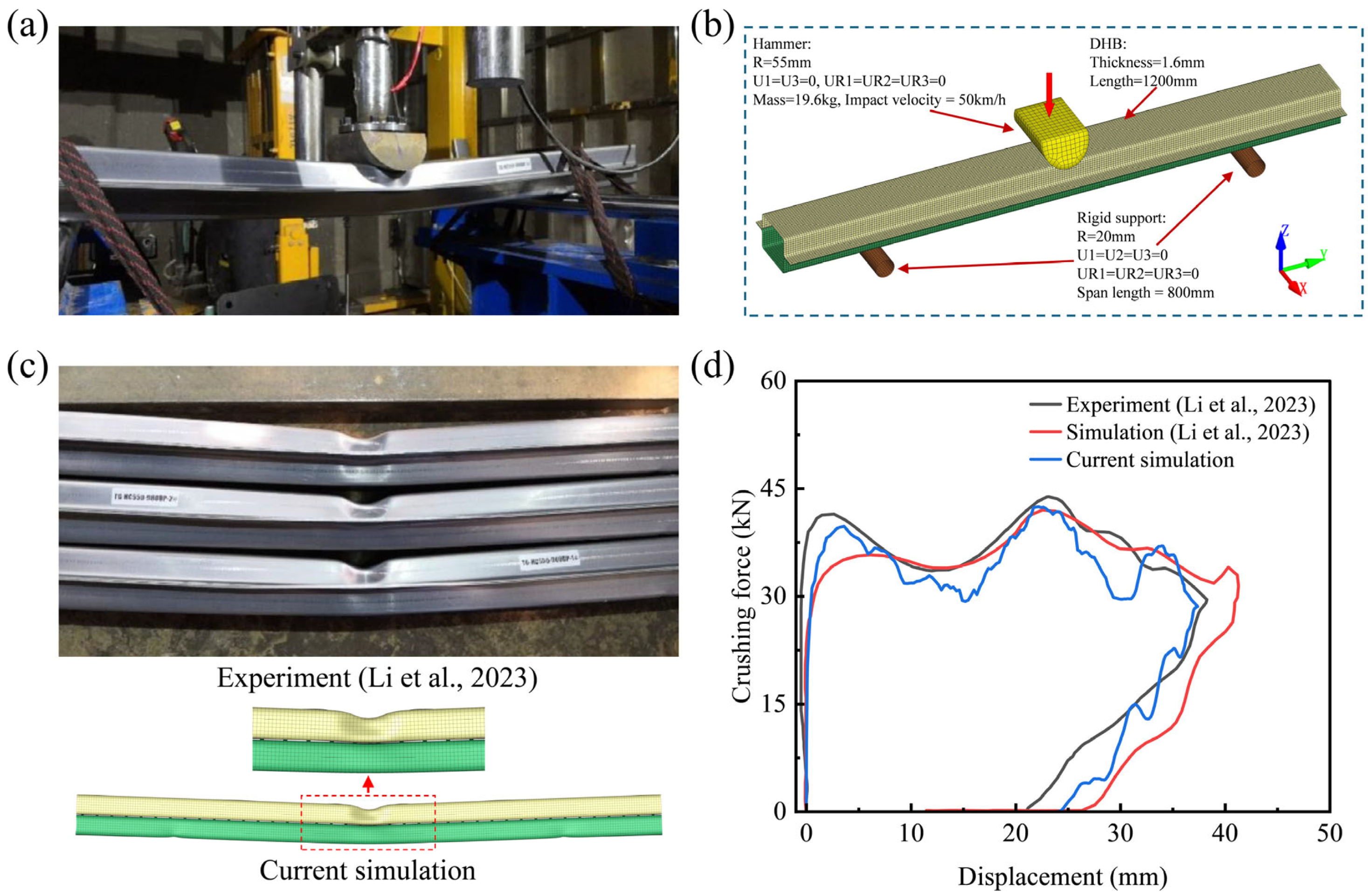
This study employed the finite element solver LS-DYNA (R11.0) to simulate the bending behavior of DCRFTs. The simulation model setup is illustrated in Figure 4a [37]. In this model, an 800 mm-long DCRFT was placed horizontally on two cylindrical supports spaced 600 mm apart. A 19.60 kg hammer impacted the midpoint of the DCRFT with an initial velocity of 50 km/h. The cylindrical supports were fully constrained (all six degrees of freedom), while the hammer retained only translational freedom in the Z-direction. The DCRFT remained unconstrained. The DCRFT and cylindrical supports were modelled using shell elements with 5 integration points in the direction of thickness, while the hammer was modelled using solid elements.
The material of the DCRFT was dual-phase steel HC550/DP980, with a density of 7.86 × 10³ kg/m3, an elastic modulus of 210 GPa, and a Poisson’s ratio of 0.3. Given that DP980 is a strain rate-sensitive material, its mechanical properties vary with strain rate under high-speed impact. Consequently, the stress–strain curves at different strain rates (as shown in Figure 4b) and the aforementioned basic parameters were incorporated into the MAT24 material model to simulate its characteristics. Each DCRFT contained two laser weld seams. In previous crashworthiness studies of high-strength steel double-hat beams [33,34] and tailor-welded structures [38,39], modeling approaches often omit ductile failure and employ shared nodes for welds. This simplified methodology has proven to provide sufficient accuracy for comparing the crash deformation modes and overall crashworthiness performance of different structures. Furthermore, according to references [40,41], the strength of DP980 laser weld seams can reach up to 96% of the base metal. Therefore, considering the study’s focus on comparative evaluation rather than precise fracture prediction, to strike a balance between simulation accuracy and computational efficiency, a ductile failure model was not introduced in the current simulation model. The laser weld seams were simulated using two rows of shell elements that share nodes and material properties with the base metal (Figure 4a). The hammer and cylindrical supports were modelled as rigid bodies (MAT20) due to their negligible deformation during impact. The self-contact of the DCRFT and its interactions with the rigid tools were simulated using the automatic single-surface and automatic surface-to-surface contact algorithms, respectively. For all contacts, the static and dynamic friction coefficients were set to 0.2 and 0.15.
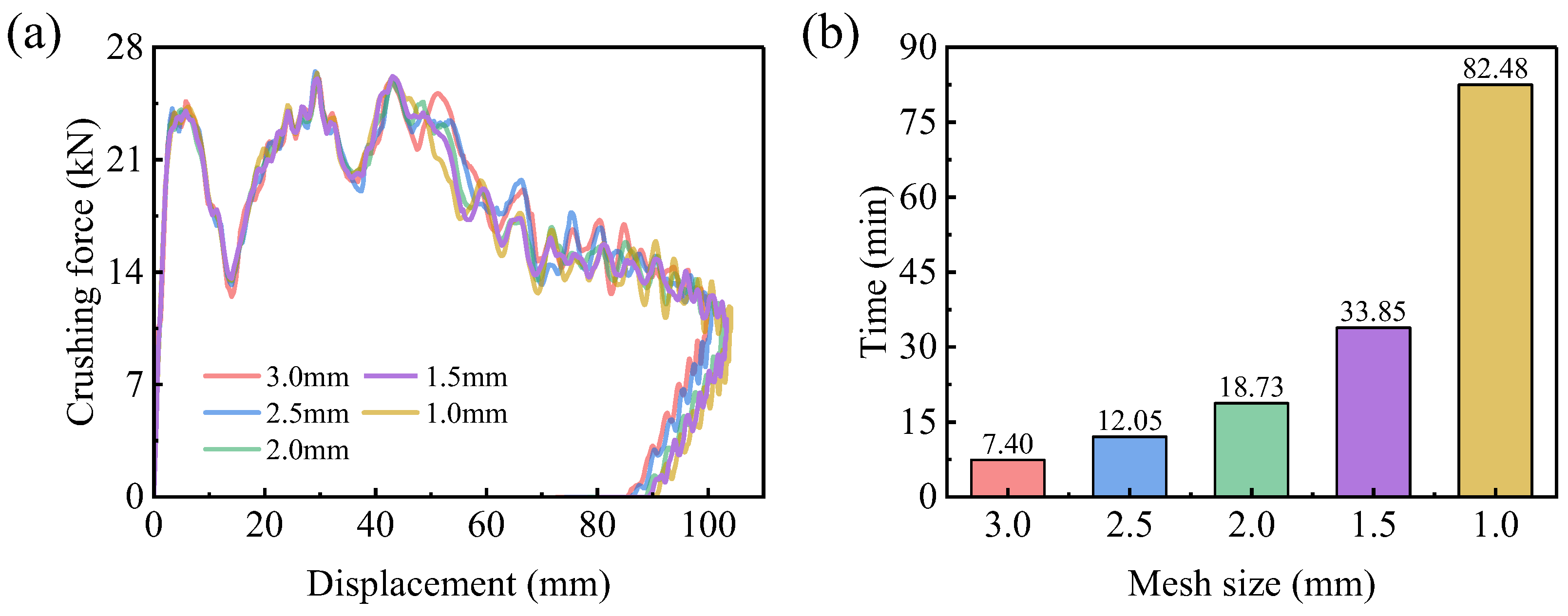
The size of the mesh influences the accuracy and computational efficiency of the simulation model. To determine an appropriate mesh size, a convergence study was conducted by simulating the bending behavior of the baseline square DCRFT using five different mesh sizes. Figure 5 presents crushing force–displacement curves and the computational times corresponding to different mesh sizes. As illustrated, the force–displacement curves for mesh sizes of 1.5 mm and 1 mm exhibited negligible differences in the post-peak region, yielding similar maximum deformations. However, the computational time for the 1 mm mesh was approximately 2.4 times that of the 1.5 mm mesh. Consequently, balancing simulation accuracy with computational efficiency, a mesh size of 1.5 mm was adopted for all subsequent simulations.

3.2. Finite Element Model Validation

To comprehensively validate the accuracy of the finite element (FE) modeling approach, both direct quasi-static three-point bending tests on the DCRFTs and an indirect dynamic drop-weight test based on a literature benchmark were conducted. The former verifies the structural deformation response and the rationality of the weld modeling simplifications, while the latter assesses the accuracy of the strain-rate-dependent material behavior under high-speed impact. The quantitative comparisons of key crashworthiness indicators for both validations are summarized in Table 2.

3.2.1. Direct Validation: Quasi-Static Three-Point Bending of DCRFTs

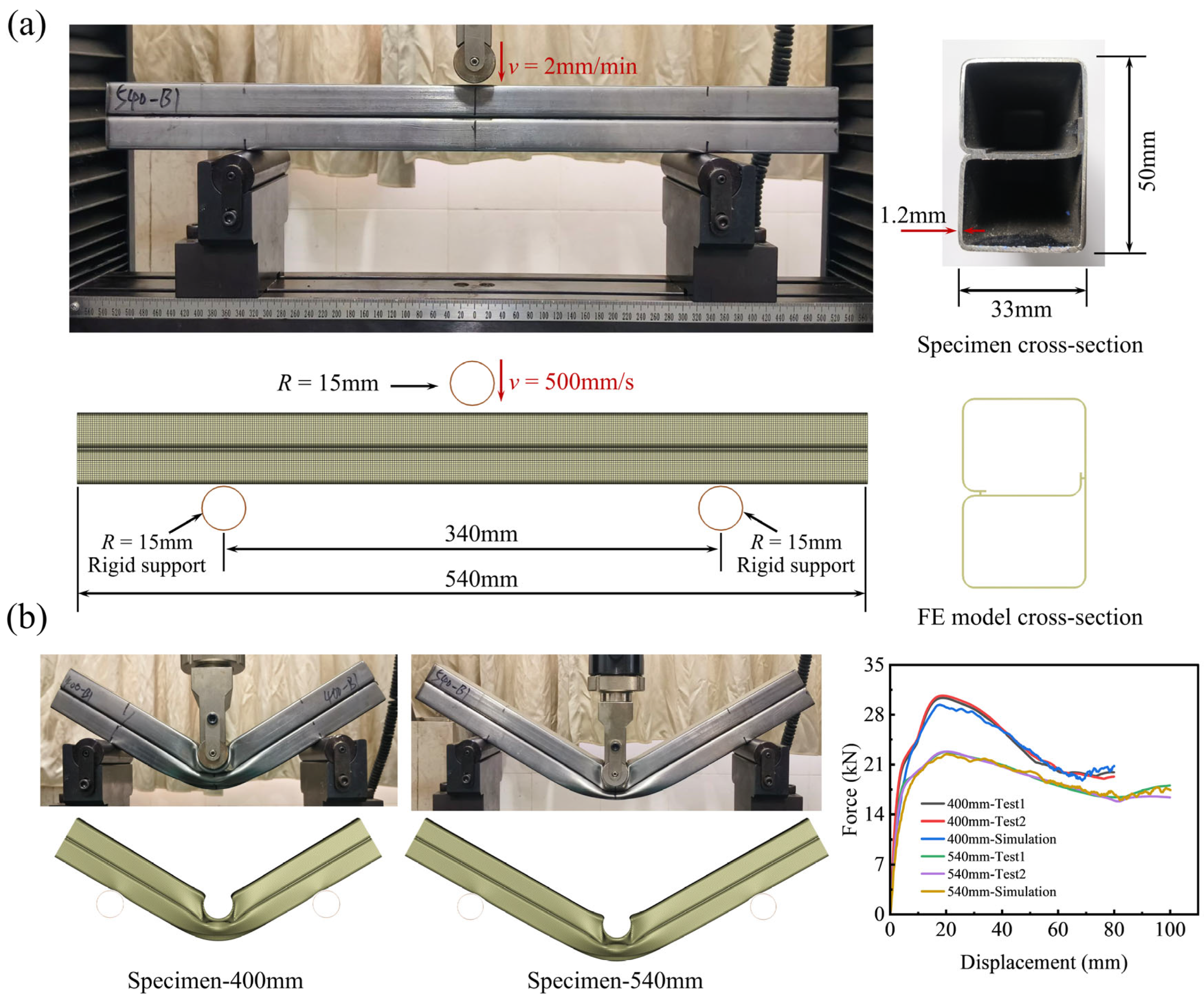
To directly validate the proposed DCRFT model, quasi-static three-point bending tests were conducted on DP980 rectangular DCRFT specimens with a wall thickness of 1.2 mm. Two sets of specimens with different dimensions were tested: Specimen-400 mm (length of 400 mm, span of 240 mm) and Specimen-540 mm (length of 540 mm, span of 340 mm). As illustrated in Figure 6a, the detailed test conditions, specimen dimensions, and the double-cell cross-sectional shape are presented. The tests were performed at a constant loading speed of 2 mm/min. The prescribed punch displacements for the 400 mm and 540 mm specimens were set to 80 mm and 100 mm, respectively. Corresponding FE models were established with identical geometric dimensions and boundary conditions. Consistent with the methodology described in Section 3.1, a mesh size of 1.5 mm and the simplified weld seam modeling were adopted. To improve computational efficiency, the punch velocity in the simulation was scaled to 500 mm/s, a standard practice in explicit dynamics where kinetic energy is monitored to ensure it remains negligible compared to internal energy.
Figure 6b illustrates the comparison of deformation modes and force–displacement curves between the experiments and simulations. The deformation modes of the simulated models closely match the experimental observations, with the structures folding smoothly. Notably, no macroscopic material fracture or weld seam tearing occurred during the physical tests. This observation physically justifies the modeling assumption of simplifying the weld seams and omitting a complex ductile damage model, as the base material exhibits sufficient ductility and the weld strength is adequate under the investigated bending conditions. Furthermore, the simulated force–displacement curves align well with the experimental data. As detailed in Table 2, the simulations are compared against the average results of the two repeated physical tests. The predicted PCF and SEA yield relative errors of −3.70% and −2.31% for Specimen-400 mm, and −1.50% and −1.02% for Specimen-540 mm, all of which are well within the acceptable 5–10% margin. However, it must be specifically clarified that this direct experimental validation was conducted under quasi-static conditions, and therefore should not be considered directly predictive of the dynamic crash performance.

3.2.2. Indirect Validation: Dynamic Bending of a Double-Hat Beam

To further verify the reliability of the modeling strategy under dynamic impact conditions, a numerical simulation was conducted to reproduce the dynamic three-point bending test of a double-hat beam performed by Li et al. [37]. This test was selected as the validation benchmark because it used the same DP980 high-strength steel and shared identical dynamic loading conditions, except for the cylindrical support spacing. The experimental setup and the corresponding FE model are shown in Figure 7a,b, respectively. All model parameters were set consistently with the descriptions in the literature.
As illustrated in Figure 7c, the current simulation model accurately reproduced the global bending and local collapse modes of the test specimen. Furthermore, Figure 7d demonstrates that the simulated force–displacement curve agrees well with both the experimental and numerical results from reference [37] in terms of the overall trend. Specifically, it accurately captures the initial linear elastic stage and the subsequent nonlinear fluctuating region. As detailed in Table 2, the predicted PCF (42.47 kN) and Disp (37.42 mm) yield relative errors of −2.10% and −2.96%, respectively, compared to the experimental values. Additionally, the relative errors for both EA and SEA are −5.26%. These results demonstrate that the current modeling strategy effectively captures the strain-rate-dependent material behavior under dynamic impact conditions.
Through both direct quasi-static tests on DCRFTs and indirect dynamic validation from the literature, the maximum discrepancies for all critical metrics (PCF, Disp, EA, SEA) remain below 5.3%. These comprehensive validation results confirm that the modeling approach possesses sufficient accuracy and validity. However, it should be clearly emphasized that the current model is able to simulate progressive folding behavior but cannot simulate fracture-based failure modes, which may be relevant under more severe loading conditions. Consequently, the simulation model depicted in Figure 4a was used as the basis for all subsequent investigations.

4. Results of Simulations and Discussion

4.1. Deformation Mode and Force–Displacement Curve of the Baseline DCRFT

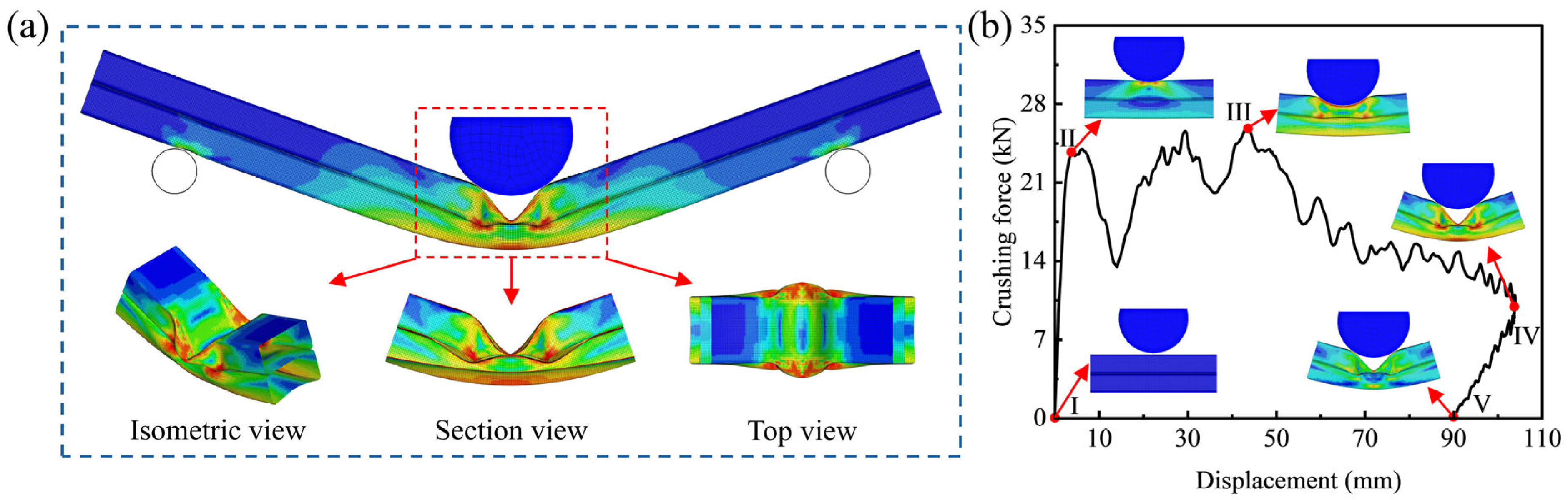
The deformation mode and crushing force–displacement curve of the baseline square DCRFT are shown in Figure 8. References [42,43] indicate that square thin-walled metal tubes under three-point bending primarily exhibit two deformation modes: “bending collapse” and “bending with indentation”, depending on whether the hammer lies inside the indentation region. As evident in Figure 8a, the deformation mode of the baseline square DCRFT was bending collapse. In this mode, the structure underwent global bending, while the central impact zone experienced significant local collapse, with the hammer remaining outside the collapse region. Deformation and buckling were primarily concentrated in the upper half of the cross-section. Specifically, the upper flange formed V-shaped folds, and the middle flange formed W-shaped folds, which came into contact with each other after deformation. Additionally, the side walls bulged outward to form plastic hinges, whereas the lower flange mainly underwent global bending.
Figure 8b illustrates the crushing force–displacement curve and the corresponding deformation modes at different stages. The entire deformation process could be divided into four stages. Elastic stage (I–II): The DCRFT only underwent elastic deformation, and the crushing force increased linearly with displacement to the initial peak. Bending with indentation stage (II–III): The upper flange developed local indentation under impact, and the structure underwent minor global bending. The crushing force fluctuated upward as the indentation deepened, with the peak crushing force (PCF) occurring during this stage. Bending collapse stage (III–IV): Local indentation transitioned to local collapse, with the hammer remaining outside the collapse region, and global bending deformation intensified. The load-bearing capacity decreased, and the crushing force decreased with increasing displacement until the hammer came to rest. Springback stage (IV–V): The structure underwent springback, and the crushing force gradually unloaded to zero. During the impact, the kinetic energy of the hammer was primarily dissipated through the deformation of the DCRFT in the first three stages. Consequently, subsequent analyses of different DCRFTs focus mainly on their performance during these stages.

4.2. Comparison of Bending Crashworthiness for Different Cross-Sectional Shapes

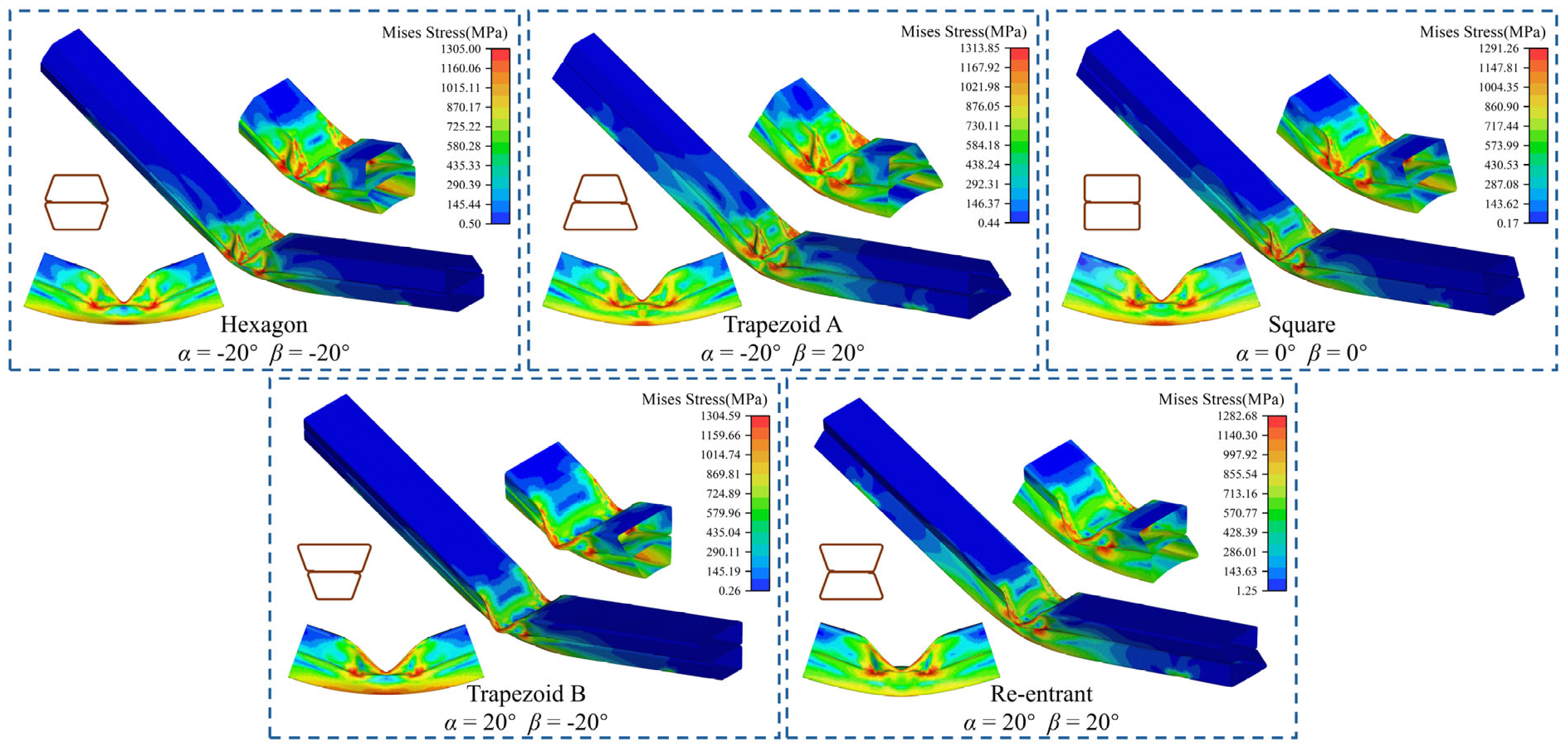
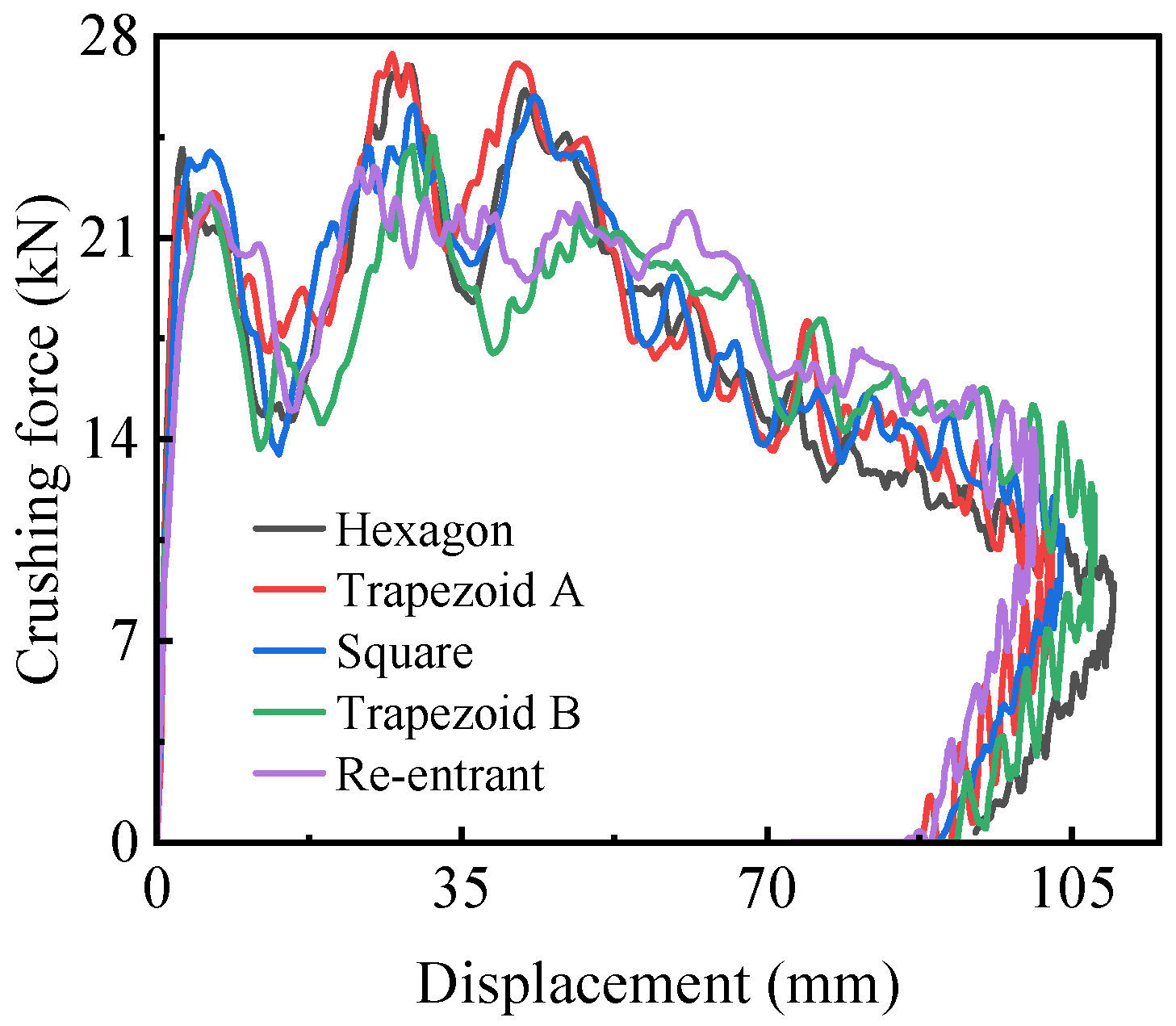
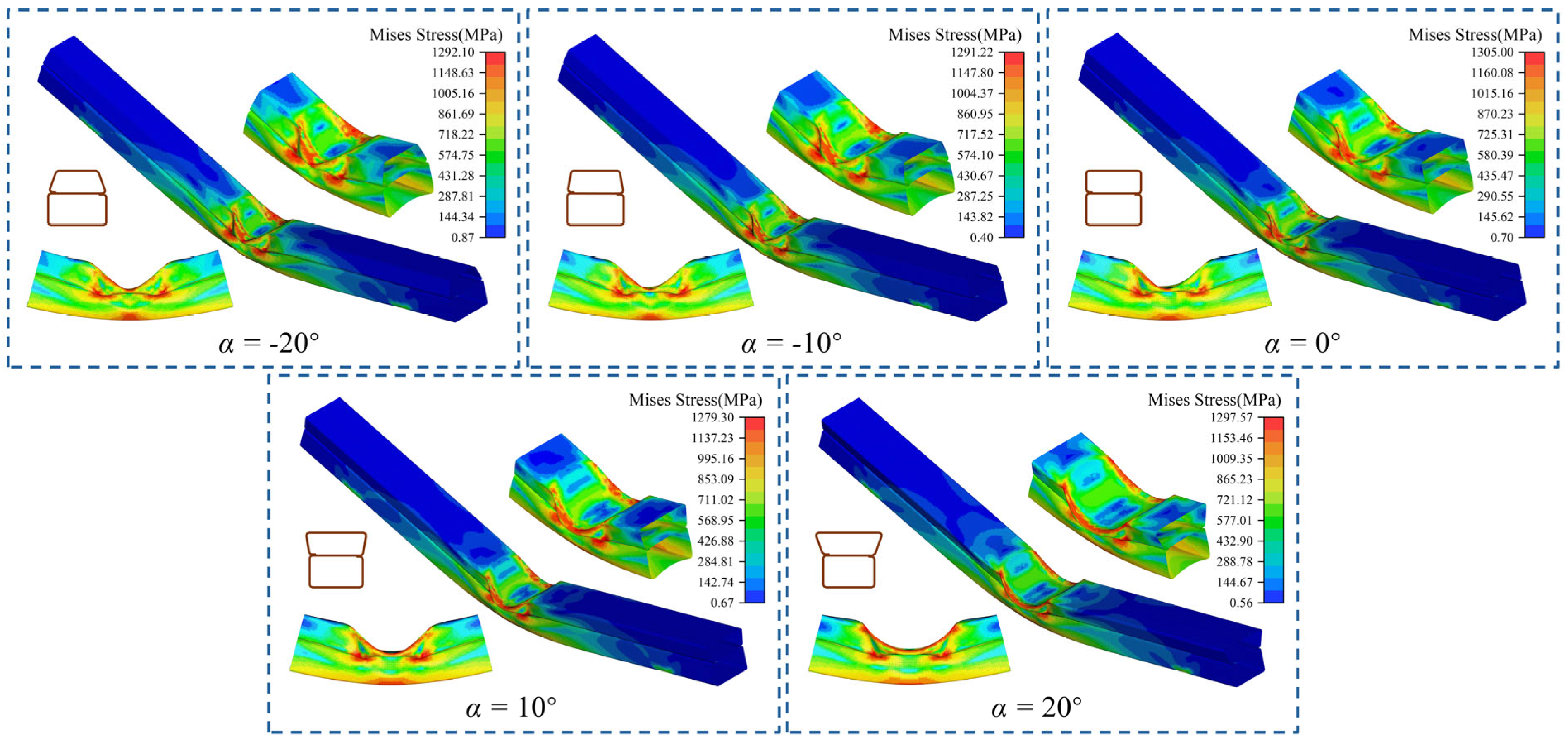
Figure 9 shows the deformation modes of five typical DCRFTs with different cross-sectional shapes at o = 0 mm: square, hexagon, re-entrant hexagon, Trapezoid A, and Trapezoid B. As illustrated, the DCRFTs with different cross-sectional shapes exhibited a deformation mode consistent with that of the baseline square cross-section, all displaying the bending collapse mode. However, significant differences existed in deformation details and stress distribution. The re-entrant hexagon and Trapezoid B exhibited larger collapse regions and reduced global bending deformation, indicating that these two configurations absorbed energy more efficiently through extensive deformation of the collapse region. Figure 10 presents the crushing force–displacement curves for the five DCRFTs. As can be seen, the overall trends of each curve were similar to that of the square cross-section, but with distinct characteristics. The hexagon, Trapezoid A, and square cross-sections exhibited large crushing force differences between the bending with indentation stage (II–III) and the bending collapse stage (III–IV), with the force–displacement curves showing pronounced fluctuations and a higher PCF. In contrast, the re-entrant hexagon and Trapezoid B cross-sections exhibited a small crushing force difference between the two stages, a lower PCF, minimal load fluctuations throughout the process, and fuller force–displacement curves. This indicates that the deformation process of DCRFTs with re-entrant hexagon and Trapezoid B cross-sections was more stable.
Table 3 lists the bending crashworthiness indicators and their rankings for the five cross-sectional shapes at o = 0 mm. The values in parentheses represent the rankings of the corresponding indicators from best to worst. The total ranking score is the sum of all individual rankings, with a lower score indicating better comprehensive performance. Compared with the square, the other four shapes each exhibited at least one superior indicator. Notably, the Disp, PCF, and CFE of the re-entrant hexagon were all better than those of the square. Specifically, Disp decreased by 2.95%, PCF by 9.53%, and CFE increased by 13.88%, while only SEA deteriorated slightly by 4.56%. In contrast, the Disp, PCF, and CFE of the hexagon were all inferior to those of the square. Specifically, Disp increased by 5.66%, PCF by 4.01%, and CFE decreased by 9.01%, while only SEA increased by 13.18%. Ranking the configurations by total score from lowest to highest yielded the following order: re-entrant hexagon, square, Trapezoid B, Trapezoid A, hexagon. Considering both deformation modes and crashworthiness indicators, the re-entrant hexagon exhibited the best comprehensive crashworthiness, while the hexagon exhibited the worst.
The above analysis indicates that changes in cross-sectional shape significantly impact the bending crashworthiness of DCRFTs, and such changes are governed by different combinations of o, α, and β. Therefore, clarifying the individual effects of these three parameters is critical for the cross-section design of DCRFTs. Accordingly, a detailed parametric analysis is presented in the following sections.

4.3. Parametric Study

4.3.1. Effect of Middle Flange Offset o

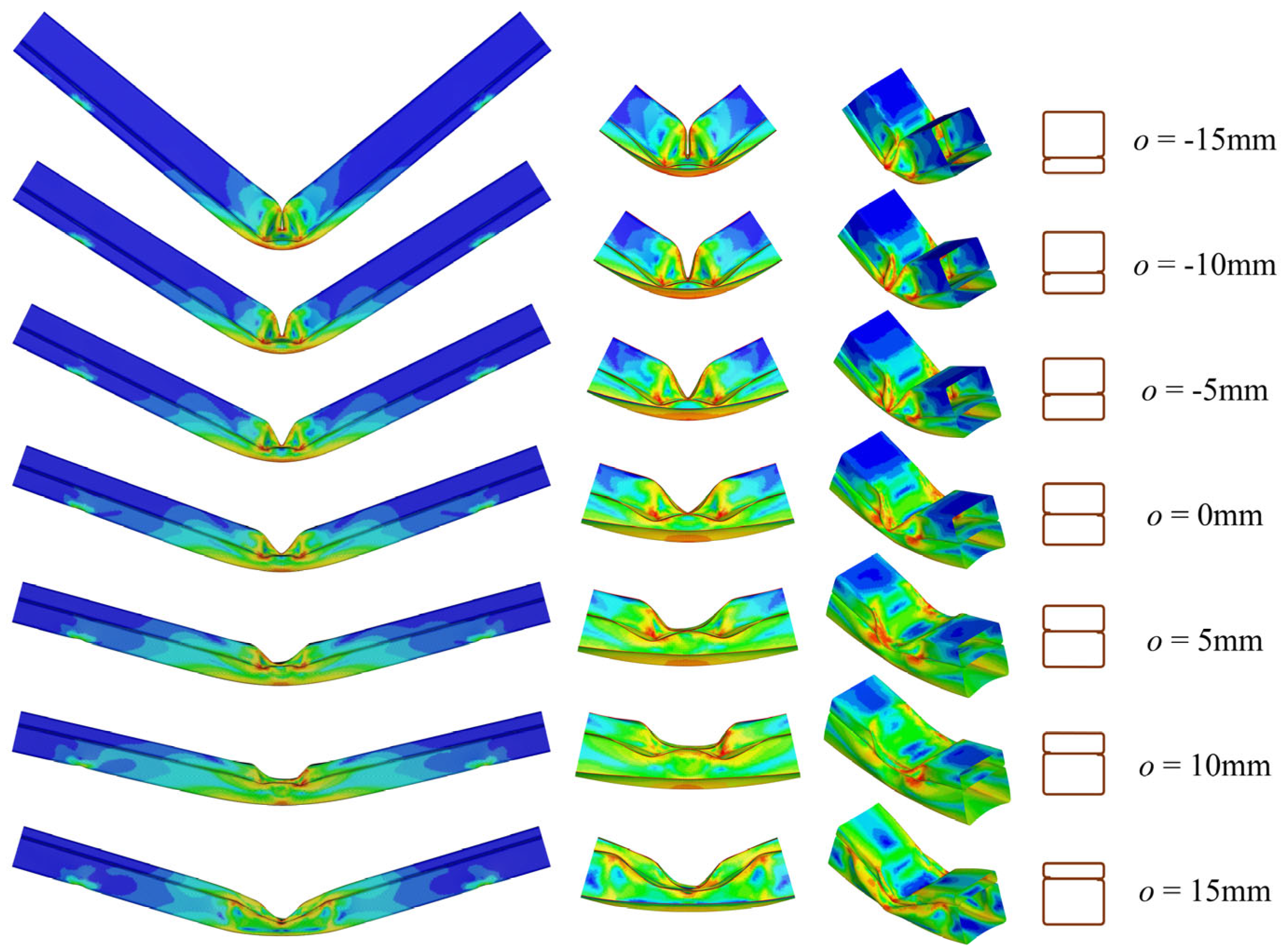
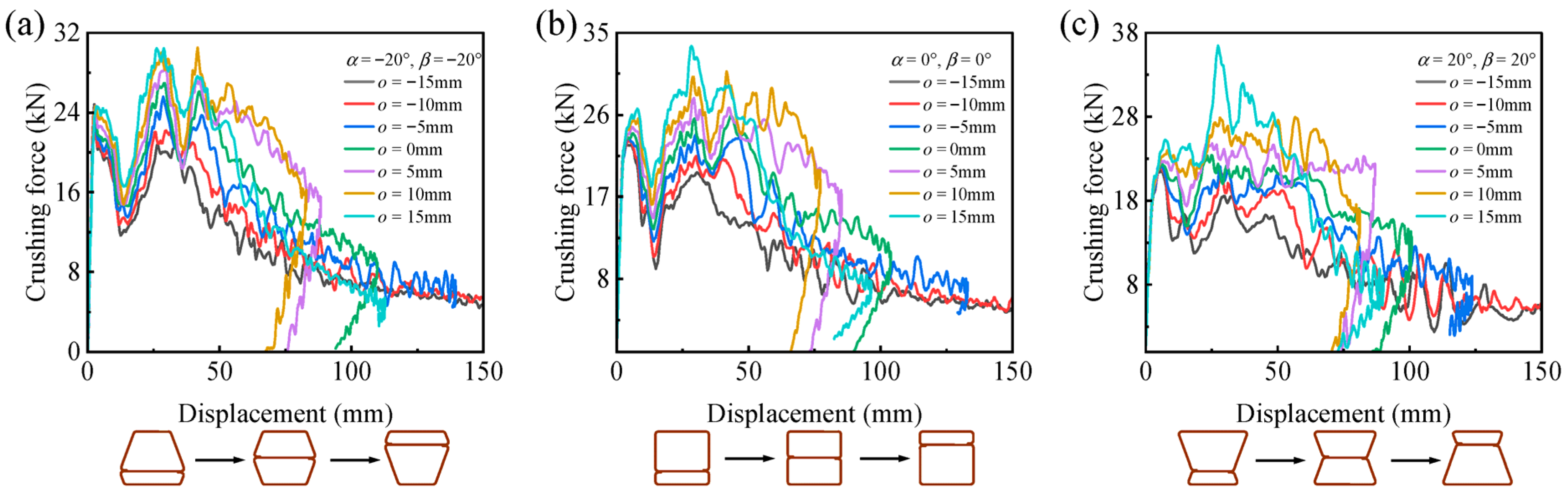
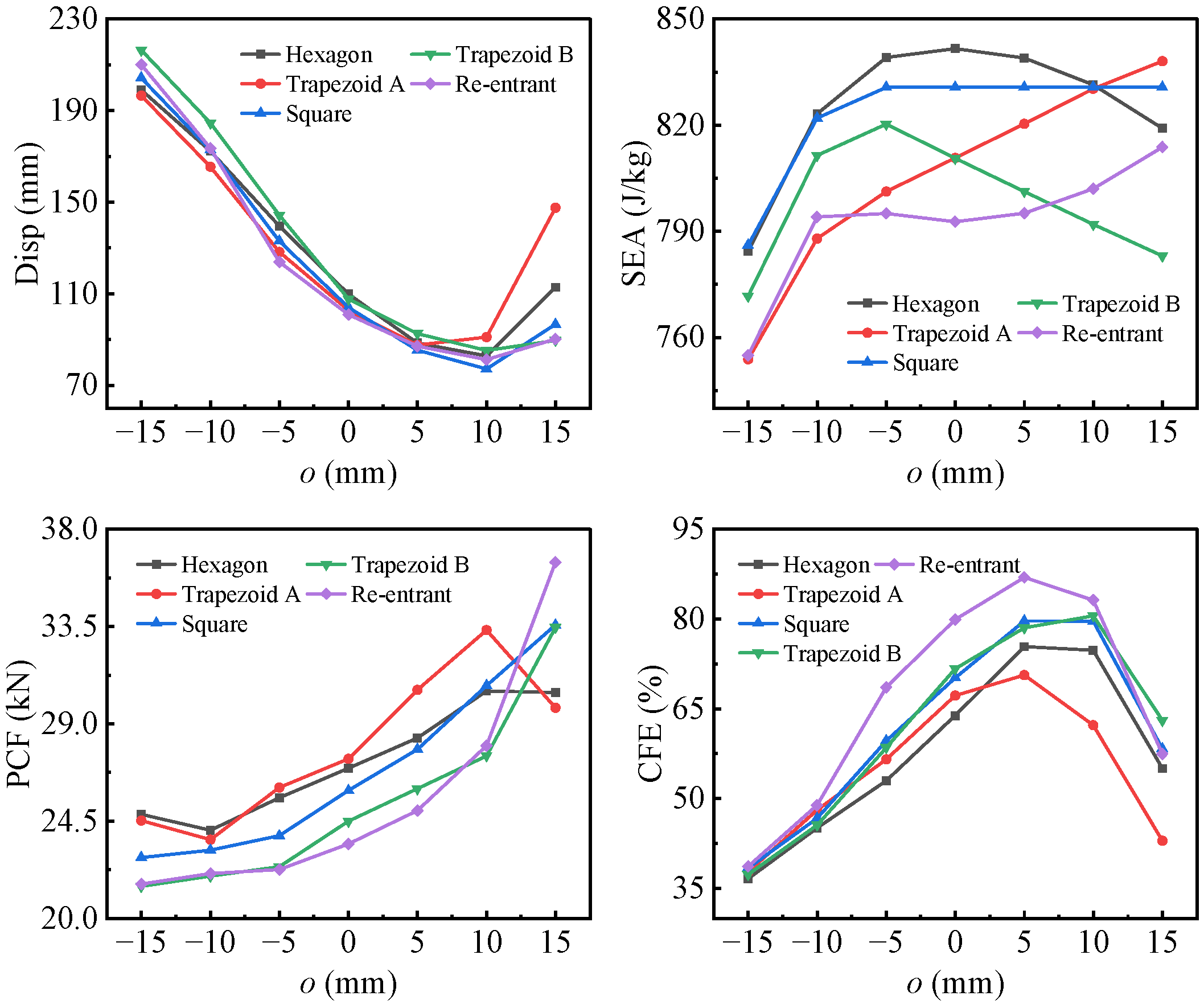
To investigate the effect of the middle flange offset o on crashworthiness, the upper deflection angle α and lower deflection angle β were fixed for the five typical cross-sections. The parameter o was varied according to the levels defined in Table 1. The deformation modes, crushing force–displacement curves, and crashworthiness indicators were analyzed through simulation. The results are presented in Figure 11, Figure 12 and Figure 13.
Figure 11 shows the deformation modes of the square DCRFTs (α = β = 0°) at different o values. As o increased, the deformation mode transitioned from bending collapse to bending with indentation (at o = 10 mm) and then reverted to bending collapse. Meanwhile, the global bending first decreased and then increased, while both the V-shaped fold angle and the fold wavelength in the local collapse region first increased and then decreased. At o = 10 mm, the structure exhibited minimal global bending and maximum local indentation. Figure 12 compares the crushing force–displacement curves of DCRFTs with the hexagon, square, and re-entrant hexagon cross-sections at different o values. As shown, all three cross-sections exhibited the same variation pattern with o. Specifically, as o increased, the overall impact load and PCF increased significantly. Furthermore, the crushing force difference between the bending with indentation stage (II–III) and the bending collapse stage (III–IV) first decreased and then increased, and the load stability first improved then deteriorated. The curves exhibited maximum stability at o = 5 mm, indicating the best deformation stability.
Figure 13 illustrates the effect of o on the crashworthiness indicators of DCRFTs with five typical cross-sections. Variations in o caused significant changes in these indicators. The variation trends of Disp, PCF, and CFE for DCRFTs with different cross-sections were consistent: as o increased from negative to positive values, Disp first decreased and then increased, PCF increased gradually, and CFE first increased and then decreased. Regarding SEA, all cross-sections exhibited an increasing trend when −15 mm ≤ o < −5 mm, but the variation pattern differed among cross-sections when −5 mm ≤ o ≤ 15 mm. This is because, under the same impact energy, when o < −5 mm, the DCRFTs cannot fully dissipate the kinetic energy of the hammer, resulting in low total energy absorption. Conversely, when o ≥ −5 mm, all five cross-sections can fully dissipate the kinetic energy, yielding similar total energy absorption. However, since each cross-section exhibited a different mass variation with o, SEA showed no unified trend. Nevertheless, most cross-sections exhibited higher SEA for positive o than for negative o.
Based on the analysis above, the effect of o on the crashworthiness of DCRFTs can be summarized as follows: within a specific range, increasing o enhances the structural bending stiffness and deformation stability, thereby reducing global bending. However, this improvement comes at the cost of a simultaneous increase in PCF. The underlying mechanism is that during lateral bending, the collapse of the upper flange brings it into contact with the middle flange, and the resistance from the middle flange creates a coupling effect with the upper flange. When the middle flange is offset to an appropriate position (i.e., at an appropriate value of o), this coupling effect becomes significant. This expands the indentation region, allowing it to absorb more energy and thereby improving bending resistance. As shown in Figure 13, at o = 5 mm, the CFE of the five typical DCRFTs reached its peak, and Disp was relatively small. Although PCF showed some increase, when comprehensively considering both bending resistance and deformation stability, the overall crashworthiness can be considered optimal at this value.

4.3.2. Effect of Upper Deflection Angle α

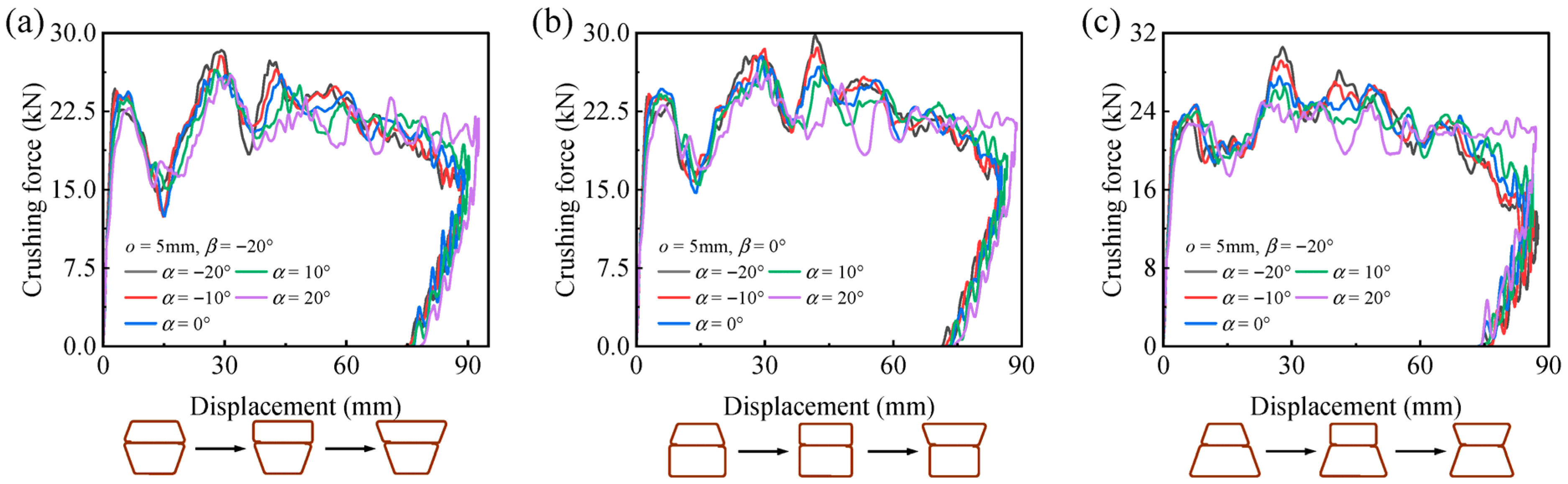
Figure 14 shows the deformation modes of DCRFTs at five different α levels when o = 5 mm and β = 0°. As shown, when α increased, the extent of global bending changed slightly, but the deformation mode underwent a significant transition: it was bending collapse when α ≤ 0° and shifted to bending with indentation when α > 0°. Additionally, the indentation region became larger, and the deformation process became more stable. Figure 15 presents the crushing force–displacement curves corresponding to different α values when o = 5 mm and β was set to −20°, 0°, and 20°. It can be observed that increasing α resulted in systematic changes in curve characteristics. Specifically, during the bending with indentation stage (II–III), the troughs of the crushing force rose while the peaks decreased. Meanwhile, during the bending collapse stage (III–IV), the crushing force increased overall. Consequently, the gap in crushing force between the two stages narrowed, resulting in smoother variations throughout the entire process.
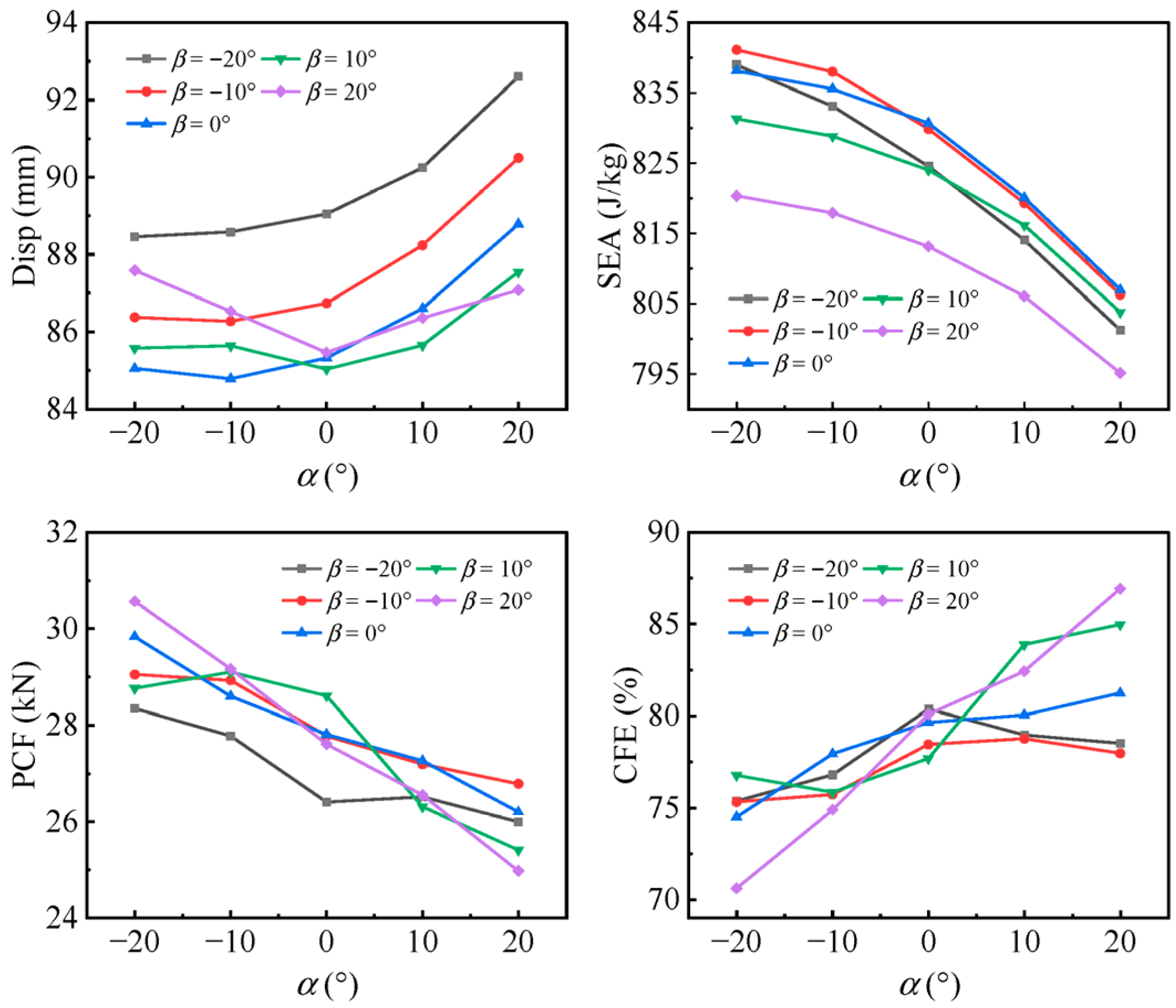
Figure 16 shows the variation trends of Disp, SEA, PCF, and CFE with α when o = 5 mm and β took five different levels. The parameter α affected all four indicators, although the magnitude of these changes was smaller than that caused by o. As α increased, Disp and CFE generally exhibited an increasing trend, while SEA and PCF generally showed a decreasing trend. Moreover, the effects on the indicators were conflicting: increasing α led to unfavorable developments in Disp and SEA but contributed to beneficial changes in PCF and CFE.

4.3.3. Effect of Lower Deflection Angle β

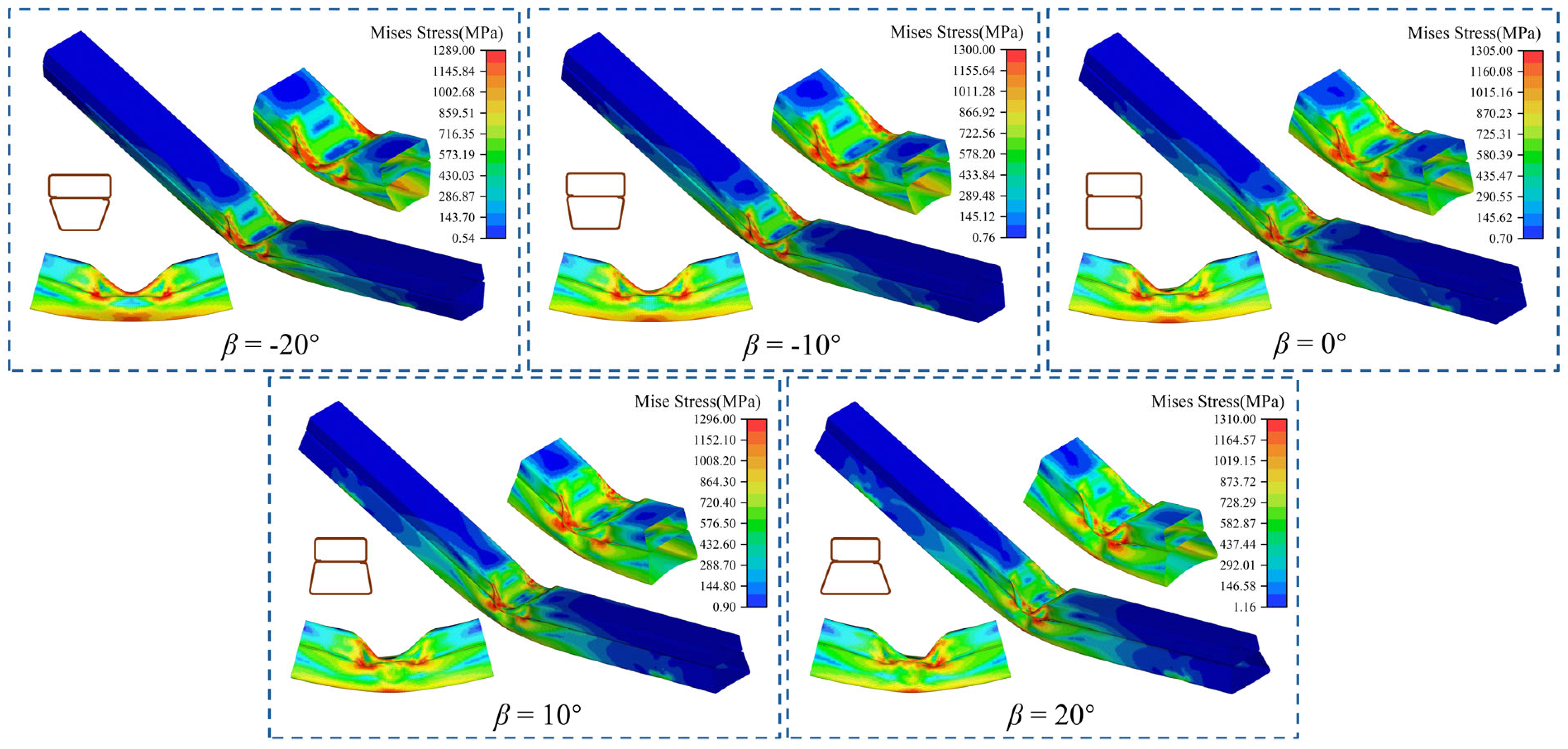
Figure 17 shows the deformation modes of DCRFTs at five different levels of β when o = 5 mm and α = 0°. As seen, when o and α were fixed, varying β did not alter the deformation mode of the DCRFTs, which all remained in bending collapse. The difference in global bending deformation was small, with only slight variations in the collapse region when β was positive or negative. When β > 0, the wavelength of the V-shaped folds was smaller than when β < 0, and the folds changed from symmetric to asymmetric.
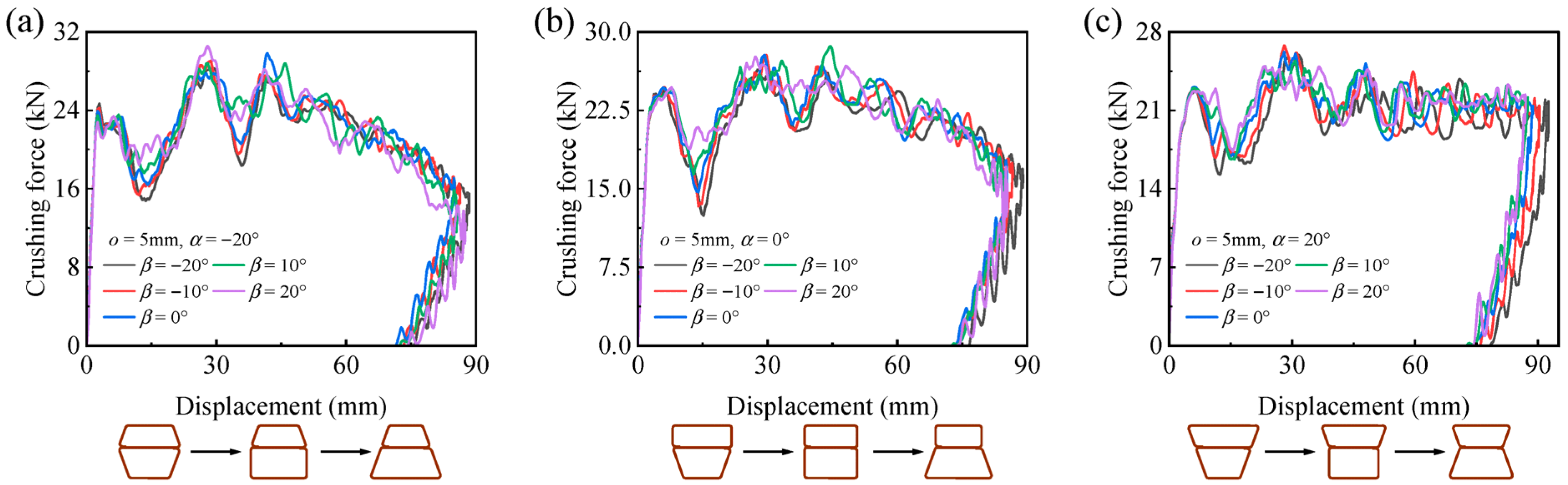
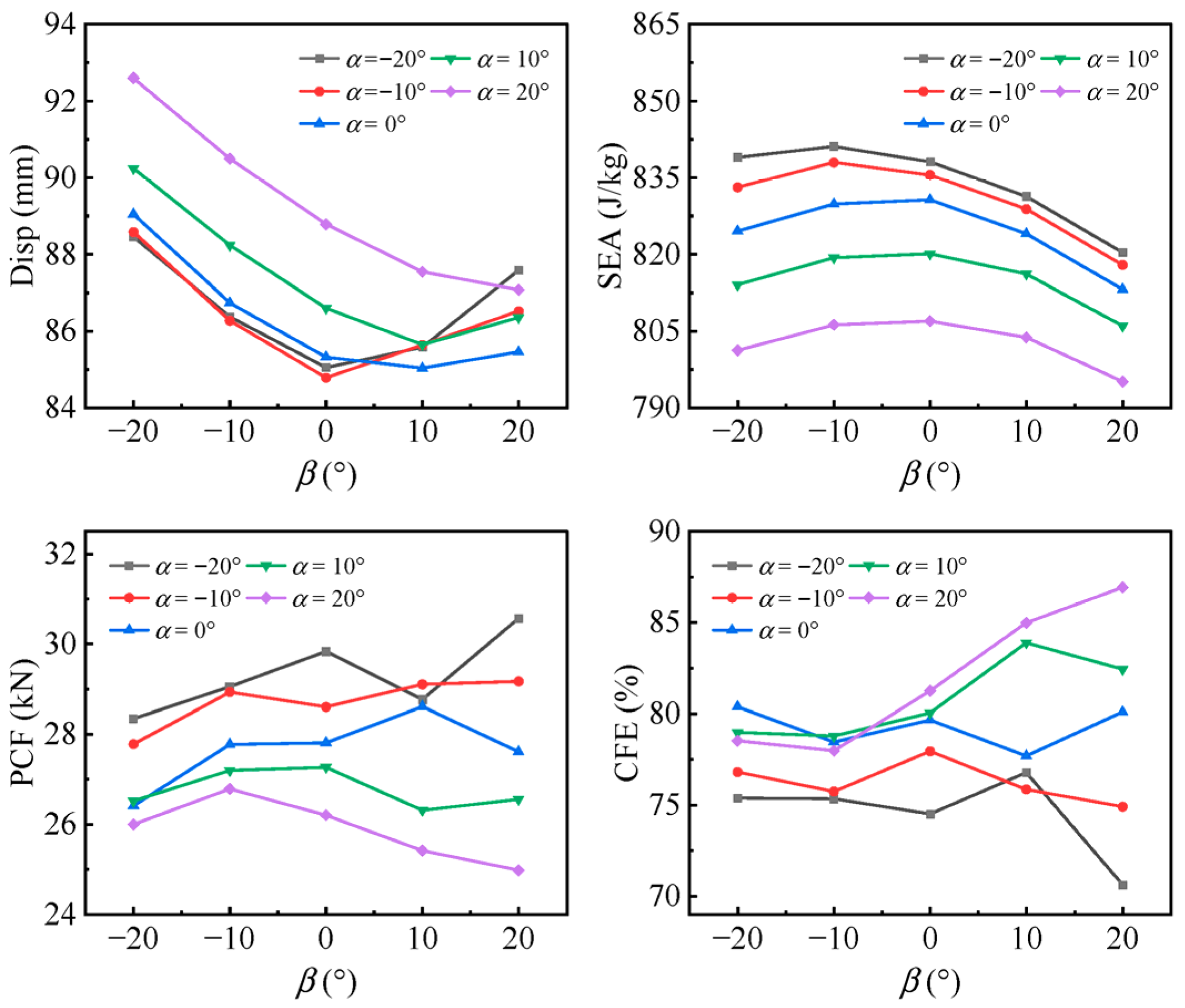
Figure 18 presents the crushing force–displacement curves for different β levels. As shown, the overall shapes of the curves for different β values were similar, but the crushing force between the initial peak and the second peak increased as β increased. Furthermore, the position of the peak crushing force (PCF) varied with β, occurring at either the second or third peak depending on the value of β. Figure 19 illustrates the effect of β on the crashworthiness indicators. As shown, under different α levels, the variation patterns of Disp and SEA with β exhibited good consistency: Disp generally decreased and then increased with increasing β, while SEA roughly increased and then decreased. In contrast, the variation patterns of PCF and CFE showed significant differences due to different α levels, with no uniform trend. This is because β alters the position where PCF occurs, and peak forces at different positions show different variation patterns with β.

4.3.4. Sensitivity Analysis

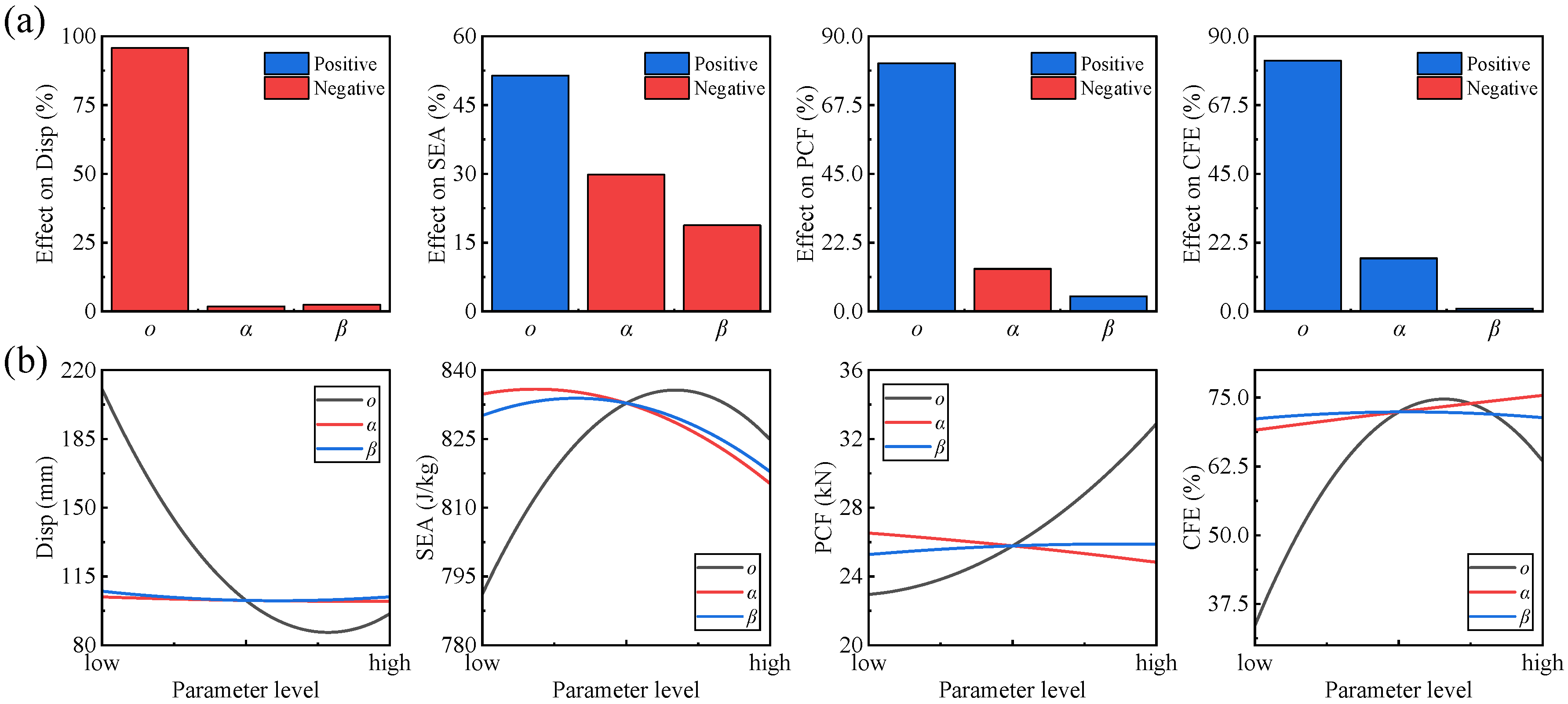
To quantitatively substantiate the dominance of the shape parameters and corroborate the findings of the preceding parametric study, a main effects sensitivity analysis was conducted. Based on the 175 sets of full factorial simulation data (defined in Table 1), a linear regression-based Analysis of Variance (ANOVA) was employed to evaluate the percentage contributions of o, α, and β to the crashworthiness indicators.
Figure 20a illustrates the percentage contribution and effect direction (positive or negative) of each parameter. It is evident that the middle flange offset (o) exhibits absolute dominance across all key indicators. Specifically, o contributes to over 95% of the variance in maximum deformation (Disp), and approximately 80% and 85% for PCF and CFE, respectively. It also acts as the primary contributor (~50%) to SEA. In contrast, the upper deflection angle (α) acts as a secondary factor, while the lower deflection angle (β) shows the weakest influence across most indicators. It is worth noting that α and β exhibit relatively higher contributions to SEA than to other indicators.
Furthermore, the main effects plots in Figure 20b reveal the overall influence trends of the parameters, which generally align with the qualitative observations in Section 4.3.1, Section 4.3.2 and Section 4.3.3. Notably, the main effect of o exhibits a distinct non-linear inverted U-shaped trend for SEA and CFE, and a U-shaped trend for Disp. This statistical evidence mathematically confirms the earlier conclusion that an optimal intermediate value of o exists, which maximizes the crushing force efficiency and specific energy absorption while minimizing the deformation by effectively coupling the deformation of the middle and upper flanges.
The above analysis indicates that o, α, and β all affect the crashworthiness of DCRFTs. However, their influence patterns are inconsistent. Furthermore, a single parameter often exerts conflicting effects on different indicators, sometimes even leading to opposite trends. Consequently, it is difficult to directly determine the optimal parameter combination for crashworthiness. Therefore, it is necessary to conduct a multi-objective optimization.

5. Multi-Objective Optimization of Shape Parameters

5.1. Definition of Optimization Problem

To formulate the optimization problem, the design variables, optimization objectives, and constraints were defined. Based on the parametric study, o, α, and β were selected as design variables. Given that DCRFTs exhibit poor bending resistance when o < −5 mm, the range of o was limited to −5 mm to 15 mm to improve optimization efficiency. To preserve diverse cross-sectional shapes, the ranges for α and β were both constrained to −20° to 20°. When DCRFTs serve as vehicle safety components, they should absorb maximum impact energy per unit mass while minimizing peak crushing force and deformation. Accordingly, SEA, PCF, and Disp were selected as optimization objectives, with SEA to be maximized and PCF and Disp to be minimized. Furthermore, since an excellent energy-absorbing structure requires stable crushing force variation (i.e., high CFE), a constraint of CFE ≥ 75% was imposed. The optimization problem is thus formulated as follows:
min   SEA ( o , α , β ) ,   PCF ( o , α , β ) ,   Disp ( o , α , β ) s . t .   CFE 75 % 5   mm o 15   mm 20 α 20 20 β 20

5.2. Optimization Process

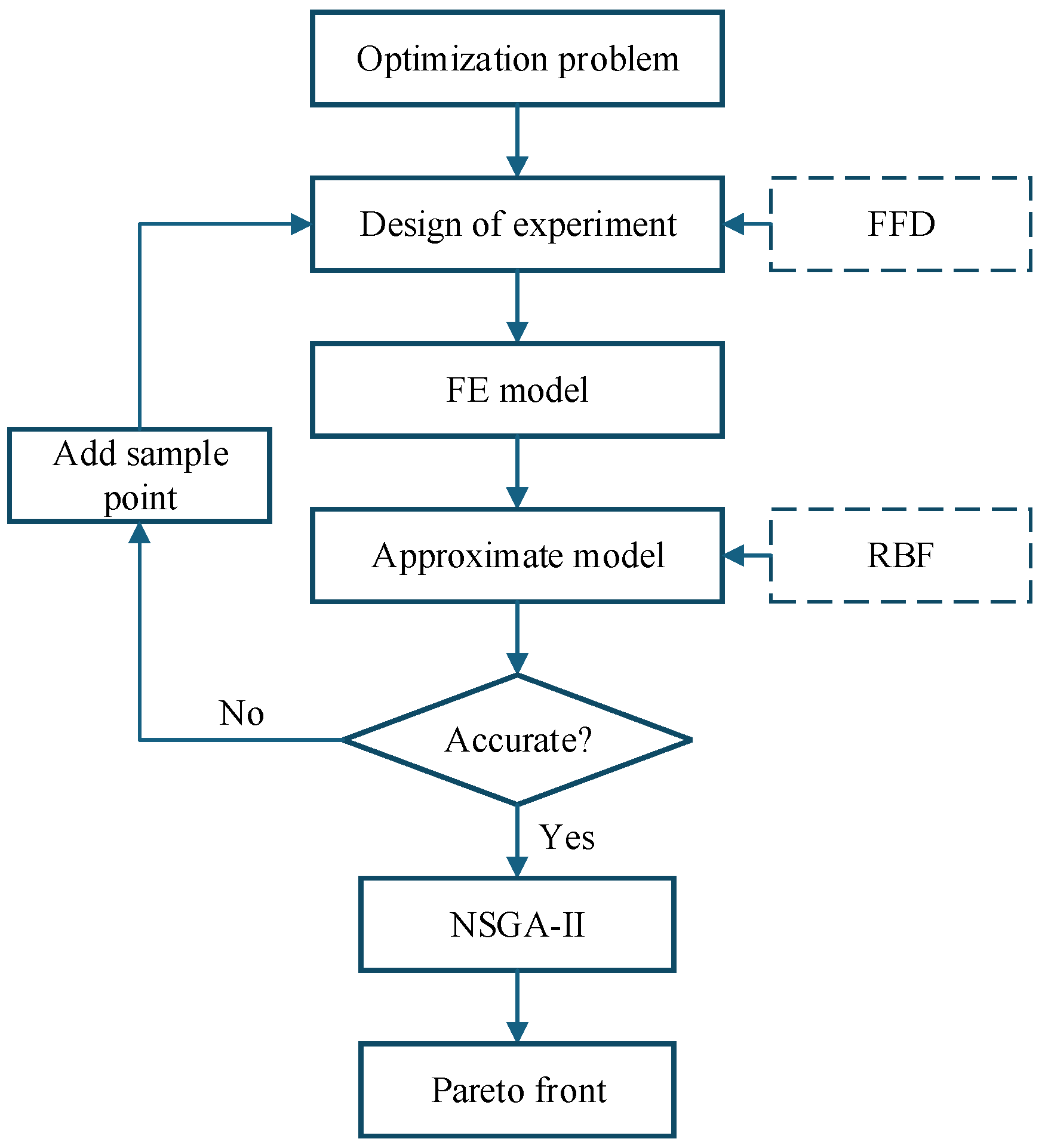
To enhance optimization efficiency, a surrogate model-based optimization method was employed. The specific optimization workflow is illustrated in Figure 21. After defining the optimization problem, sample points were determined using the full factorial design (FFD). Subsequently, finite element models following the setup in Figure 4a were established based on the sample points, and the response values were obtained through simulation. Next, a radial basis function (RBF) surrogate model was constructed based on the sample responses, and its accuracy was verified. If the accuracy met the requirements, the process proceeded to the next step; otherwise, additional sample points were added to obtain more response values and build a new surrogate model until the accuracy requirement was satisfied. Finally, the surrogate model was incorporated into the NSGA-II algorithm to obtain the Pareto frontier.

5.2.1. Design of Experiment

To obtain a high-precision surrogate model, this paper employed a full factorial design method to select sample points. Based on Table 1, the levels of α and β were expanded to 9, while the level of o was retained at 5, as shown in Table 4. Ultimately, 405 sample points were uniformly selected across the design space to serve as the basis for surrogate model construction and accuracy validation.

5.2.2. Surrogate Model Construction

Commonly used surrogate models include the response surface model (RSM), Kriging model (KRG), and radial basis function (RBF) model. The parametric analysis presented earlier revealed that the relationships between the design variables (o, α, β) and the four responses exhibited significant nonlinearity. The RBF model demonstrates excellent fitting performance for strongly nonlinear systems; therefore, it was selected to construct the surrogate model based on the 405 FEA sample points. The accuracy of the RBF surrogate model was rigorously evaluated using the Cross-Validation error analysis method in Isight. In this process, 45 points were randomly selected and iteratively removed from the sampling set to assess the discrepancies between the exact FEA results and the approximate predictive values. To evaluate its predictive accuracy, the coefficient of determination (R2), root mean square error (RMSE), and maximum absolute relative error (MARE) were employed. These metrics are calculated as follows:
R 2 = 1 i = 1 n y i y ^ i 2 i = 1 n y i y ¯ 2
RMSE = i = 1 n y i y ^ i 2 n
MARE = max i = 1 , 2 , . , n y i y ^ i y i
Here, n denotes the number of validation points; y i and y ^ i represent the finite element analysis result and the surrogate model predictive value for the i-th validation point, respectively; and y ¯ is the mean value of y i . The closer R2 is to 1, the better the fit of the surrogate model; the smaller the values of RMSE and MARE, the more accurate the surrogate model prediction. Typically, when R2 exceeds 0.9, and both RMSE and MARE are below 0.2, the accuracy of the surrogate model is considered acceptable.
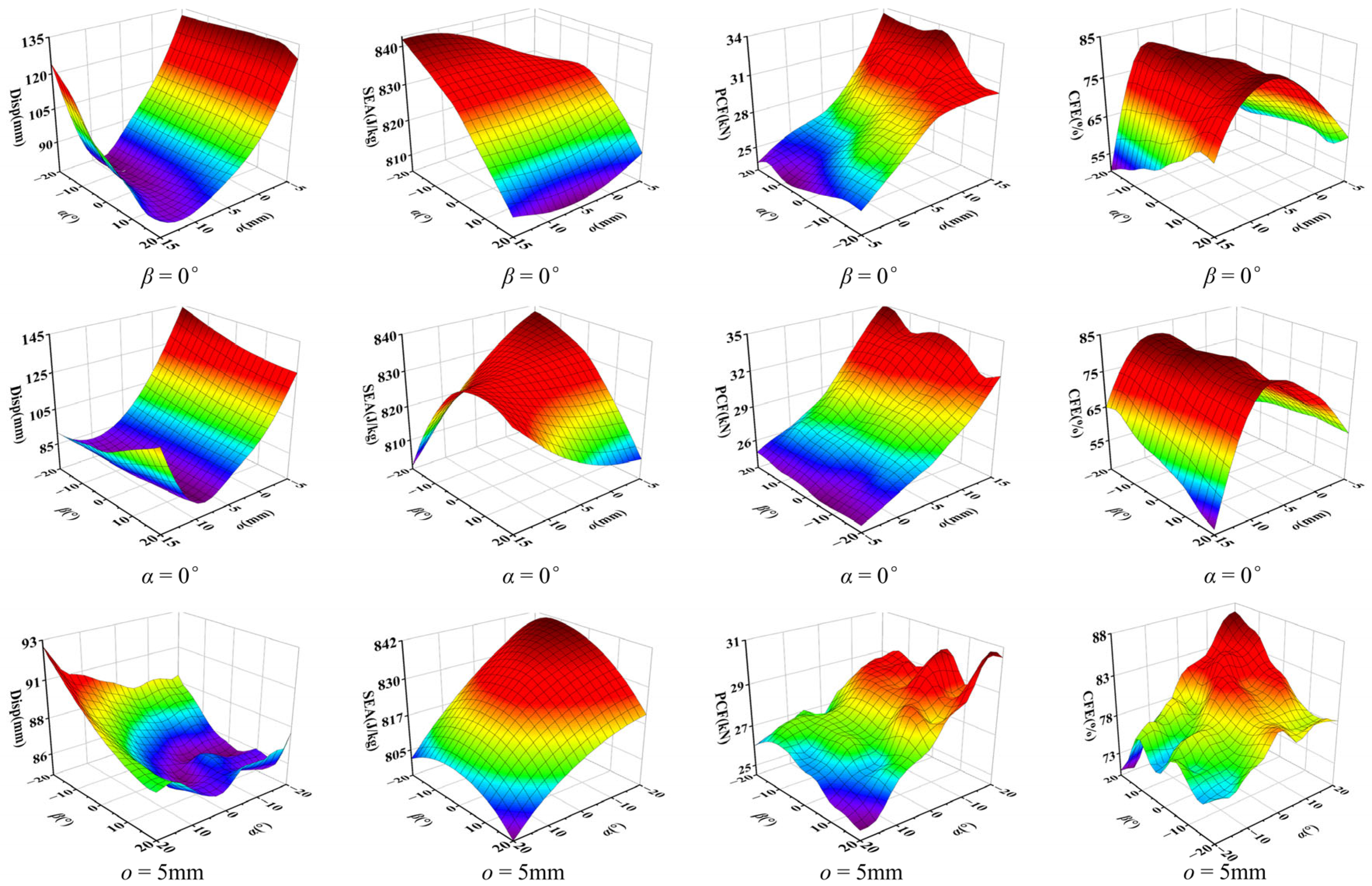
Based on the finite element analysis results of the sample points, the RBF surrogate model was constructed. Table 5 presents the accuracy evaluation results. As shown, the R2 values for all responses exceeded 0.9, while both RMSE and MARE remained below 0.2, confirming that the RBF surrogate model achieved reliable accuracy. Furthermore, representative 3D surface plots are shown in Figure 22. The trends of each response aligned with the patterns identified in the parametric analysis, confirming that the surrogate model accurately captured the relationships between the responses and design variables. However, it should be noted that the constructed surrogate model is valid within the sampled design space but not outside it.

5.2.3. Optimization Algorithm

The multi-objective optimization problem addressed in this study involved inherent conflicts among the various objectives. Consequently, the optimal outcome is not a single solution, but a set of trade-off solutions known as the Pareto frontier. An ideal Pareto frontier should be uniformly distributed within the objective space, providing designers with diverse design alternatives. The Non-dominated Sorting Genetic Algorithm II (NSGA-II) is characterized by its fast execution speed, excellent convergence, and ability to maintain a uniform distribution of solutions. Given its suitability for solving such complex problems, NSGA-II was selected as the optimization algorithm. Its key parameter settings are listed in Table 6.

5.3. Optimization Results

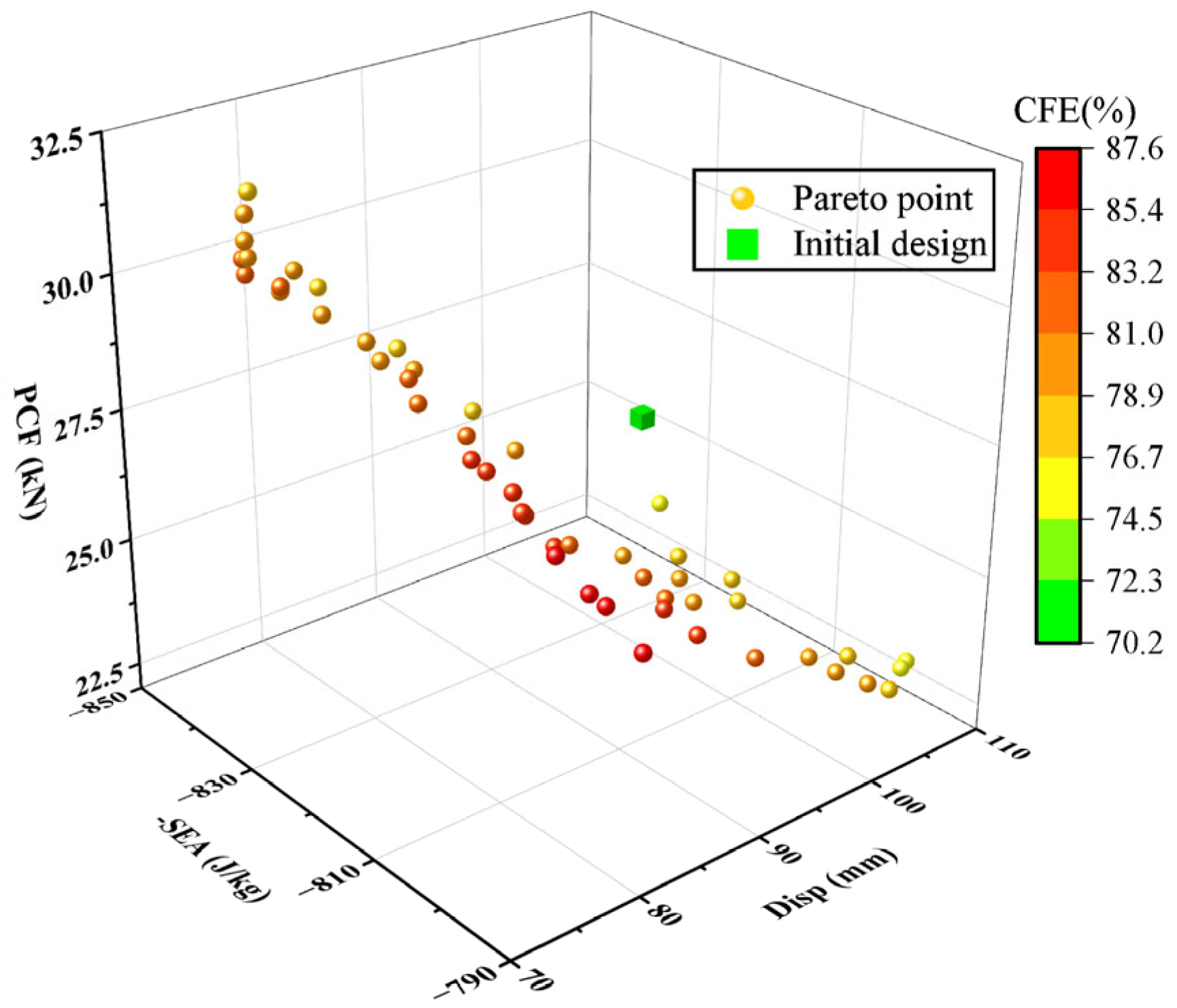
Based on the optimization model described above, the Pareto frontier was obtained through NSGA-II iteration. After eliminating duplicate and spatially proximate solutions, 50 Pareto optimal solutions were retained, as shown in Figure 23. In the figure, circular points represent the Pareto solutions, the square point represents the baseline design, and the color gradient corresponds to the CFE value. It is evident that the Pareto points are uniformly distributed across the objective space, forming a concave curve that reflects the inherent trade-off relationships among the three objectives. Furthermore, the CFE values of all Pareto solutions surpassed those of the baseline design, preliminarily validating the effectiveness of the optimization.
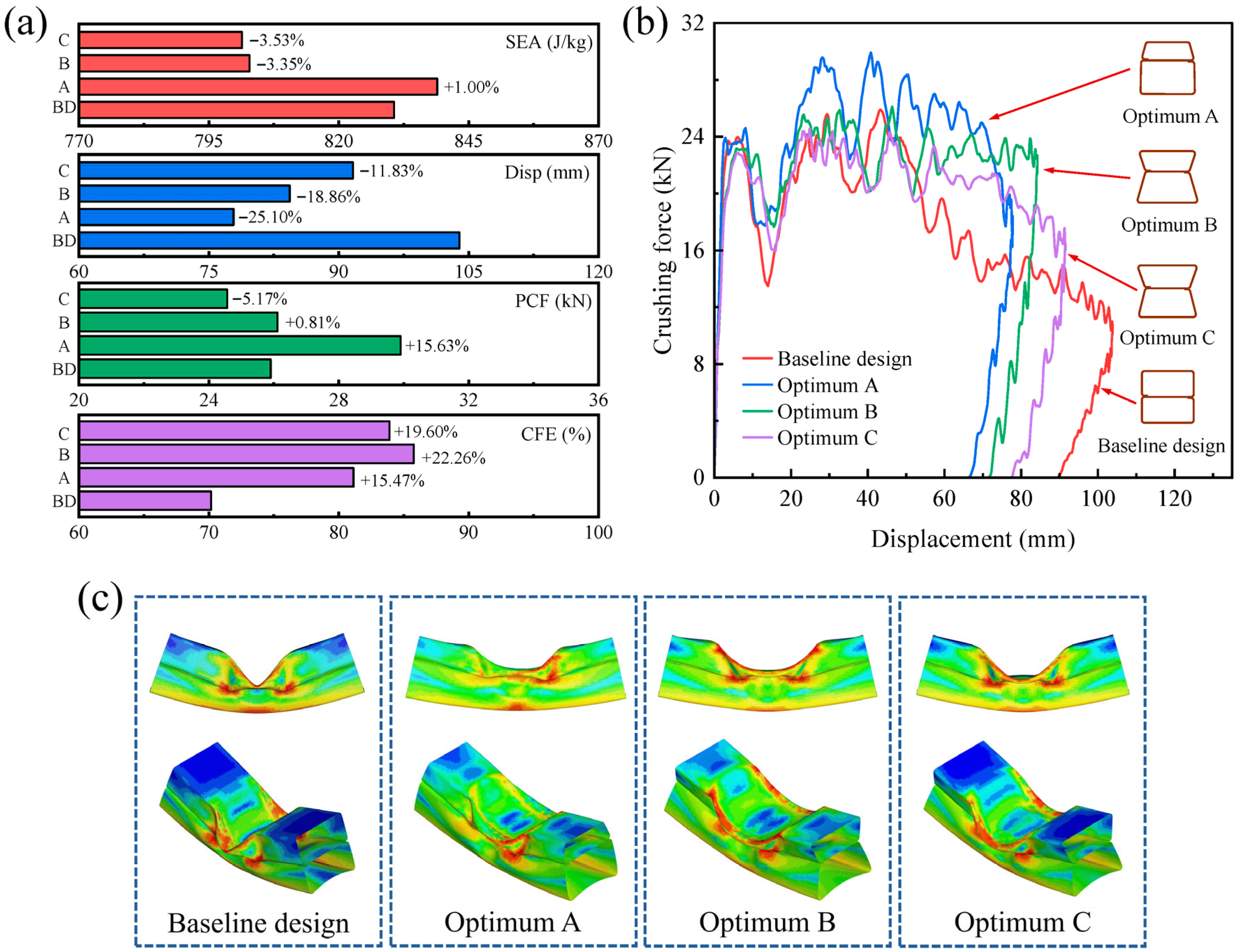
To quantitatively compare the crashworthiness of the optimized solutions with the baseline design, three representative solutions were selected from the Pareto frontier for detailed analysis. These included Optimum A, exhibiting the highest SEA and a low Disp; Optimum B, featuring the highest CFE; and Optimum C, achieving a relatively low PCF. Their design parameters and crashworthiness indicators are listed in Table 7 and Table 8, respectively. Comparisons of crashworthiness indicators, crushing force–displacement curves, and deformation modes are presented in Figure 24. As shown in Table 8, the error between the finite element results and the surrogate model predictions was less than 3% for all three solutions, satisfying the accuracy requirements. As indicated in Table 6 and Figure 24b, Optimum A had a trapezoid cross-section, while Optimum B and C had re-entrant hexagon cross-sections, with all o values greater than 0. This was consistent with the findings in Section 4.
Compared to the baseline design, all three representative solutions achieved significant improvements in Disp and CFE, each with distinct trade-offs (Figure 24a). Optimum A demonstrated the highest energy absorption efficiency and deformation resistance, with SEA improved by 1.00%, Disp reduced by 25.10%, and CFE increased by 15.63%, while PCF increased by 15.47%. Optimum B delivered the most stable crushing process, with CFE reaching 85.79% (a 22.26% improvement) and Disp reduced by 18.86%, though SEA decreased by 3.35%. Optimum C achieved relatively low impact load, with PCF reduced by 5.17%, Disp reduced by 11.83%, and CFE increased by 19.60%, though SEA decreased by 3.53%.
The improved crashworthiness of the optimized solutions stemmed from the optimization of their mechanical behaviors and deformation modes. Examining the crushing force–displacement curves (Figure 24b), the baseline design exhibited significant early fluctuations and a rapid decline in load-bearing capacity in the later stages, resulting in lower CFE. In contrast, the curves of the three optimal solutions not only demonstrated a higher overall crushing force and a fuller profile but also sustained a stable load-bearing plateau throughout the middle and late stages of displacement. This characteristic directly correlated with lower Disp and higher CFE. Regarding deformation modes (Figure 24c), the baseline square DCRFT exhibited bending collapse, characterized by significant global bending and a limited central collapse region. By leveraging superior shape parameter combinations, the optimized solutions fully utilized the cross-sectional characteristics and the coupling effect between the middle and upper flanges. Consequently, the deformation mode transitioned to bending with indentation, featuring an expanded central indentation region. This region absorbed impact energy more efficiently, thereby suppressing global bending, achieving lower Disp, and ensuring a more stable deformation process.
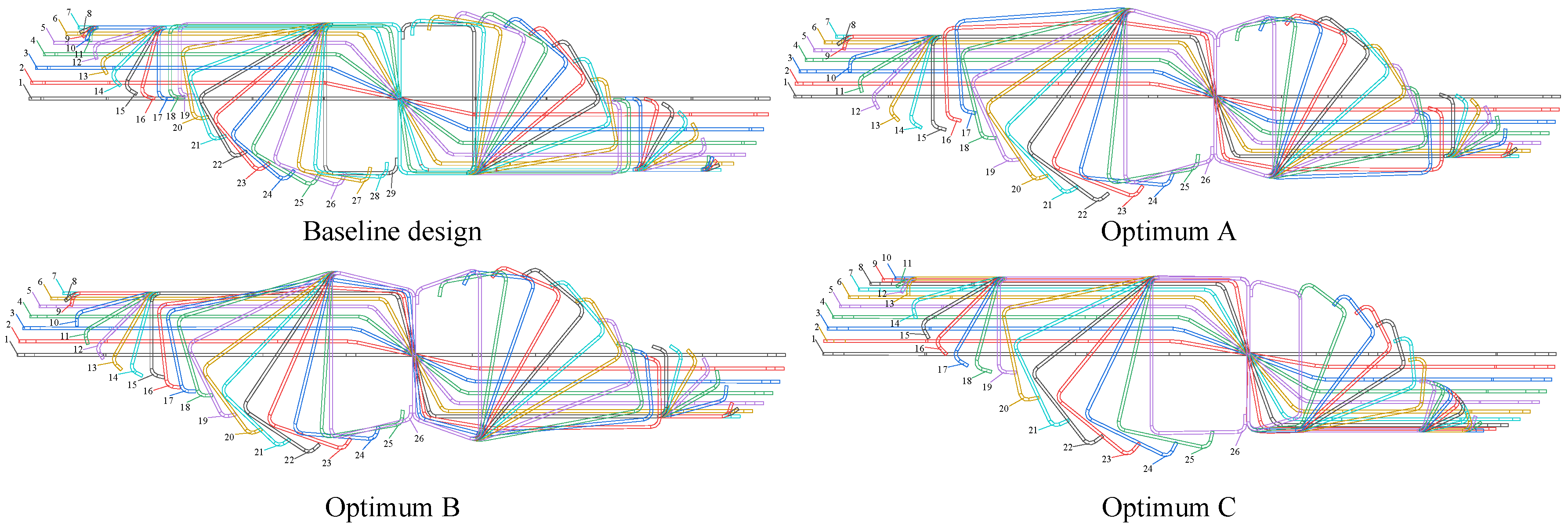
To evaluate the manufacturing feasibility of the optimized cross-sections, Figure 25 presents the roll forming sequences for the baseline design and the three optimized solutions. Comparative analysis shows that the forming process of the optimized solutions was similar to that of the baseline design, differing only in the total number of passes and the forming angle at each pass. Specifically, the baseline design required 29 forming passes, while all three optimized solutions required 26 passes. This demonstrates that the optimized solutions are manufacturable using standard roll forming processes.

6. Conclusions

This study proposed a parametric design method based on three parameters (o, α, β) for the cross-sectional shape design of high-strength steel double-cell roll-formed tubes (DCRFTs). Under idealized lateral three-point bending conditions with simple supports, the effects of shape parameters on bending crashworthiness were systematically investigated through finite element simulation models. Subsequently, multi-objective optimization was conducted using an RBF surrogate model combined with the NSGA-II algorithm. The main conclusions are as follows:
(1)
The proposed parametric design method can systematically generate diverse cross-sectional shapes, including square, trapezoid, hexagon, re-entrant hexagon, and various hybrid shapes while maintaining constant cross-sectional height and enclosed area. A comparison of five typical cross-sections (at o = 0 mm) revealed that the re-entrant hexagon exhibited the best deformation stability and comprehensive crashworthiness. Compared to the baseline square cross-section, its Disp decreased by 2.95%, PCF decreased by 9.53%, and CFE increased by 13.88%. Although SEA decreased by 4.56%, it demonstrated superior overall crashworthiness, validating the application potential of high-efficiency energy-absorbing cross-sectional shapes in DCRFTs.
(2)
The parametric study indicated that the middle flange offset o was the most critical parameter affecting bending crashworthiness, with its variation directly influencing the deformation mode of DCRFTs. Within a certain range, moving the middle flange upward (o > 0) enhanced the coupling effect between the middle and upper flanges while expanding the indentation deformation region. This reduced Disp and improved CFE, although PCF also increased. At o = 5 mm, the structure’s CFE reached its peak, exhibiting optimal overall performance.
(3)
The upper deflection angle α had a secondary effect, while the lower deflection angle β had the weakest effect. Increasing α transitioned the deformation mode from bending collapse to bending with indentation, which reduced PCF and increased CFE, but also increased Disp and decreased SEA. Variations in β did not alter the deformation mode and had a minor impact on the crashworthiness indicators. Coupling effects existed among the three parameters, necessitating concurrent optimization rather than independent adjustment.
(4)
Multi-objective optimization based on the RBF surrogate model and the NSGA-II algorithm yielded 50 uniformly distributed Pareto optimal solutions. Compared to the baseline design, all three representative solutions achieved significant improvements in Disp and CFE, while also offering distinct trade-offs. Optimum A (trapezoid, o = 8.95 mm) prioritized energy absorption and deformation control, achieving the highest SEA (+1.00%) and the greatest reduction in Disp (−25.10%). Optimum B (re-entrant hexagon, o = 6.26 mm) maximized crushing stability, achieving the highest CFE (+22.26%). Optimum C (re-entrant hexagon, o = 3.39 mm) focused on minimizing peak impact load, achieving the lowest PCF (−5.17%). These improvements were attributed to the optimal combination of shape parameters, which transitioned the deformation mode to bending with indentation. This transition resulted in a larger central collapse region that absorbed impact energy more efficiently.
Despite the aforementioned contributions, this study presents certain limitations. First, the current finite element models employ a simplified representation of the weld seams and do not incorporate a ductile fracture model. Although this approach is justified by the high joint strength of DP980 laser welds and the absence of macroscopic fracture in the validation tests, its predictive accuracy may be limited under more severe loading conditions where fracture initiation becomes dominant. Second, this study only considered a single, idealized loading condition—perfectly centered, vertical lateral bending under simple support boundary conditions. In reality, EV structures may be subject to more complex boundary conditions and loading scenarios. For instance, bumper beams and battery pack protective components are rigidly connected to the body frame via welding or bolting, and crash loads are rarely perfectly centered, often involving oblique impacts and complex stress states such as combined bending and torsion. Discrepancies in boundary conditions and loading patterns can significantly alter the bending moment distribution and deformation mechanisms. Consequently, the current findings should be interpreted primarily as a methodological framework rather than direct design guidelines. Third, manufacturing costs and detailed process feasibility were not explicitly integrated into the optimization constraints.
Future work will address these limitations through the following avenues: (i) developing a refined material model that incorporates the specific properties of the weld seams and heat-affected zones (HAZ), alongside a ductile damage criterion; (ii) extending the parametric optimization framework to system-level applications with realistic structural boundary conditions and complex loading scenarios—specifically, applying it to the cross-sectional design of roll-formed battery pack side frames and evaluating the crashworthiness of different cross-sections under multi-angle side pole impacts; and (iii) integrating manufacturing cost and process constraints into the optimization model to facilitate the translation of the proposed method from theoretical research to engineering practice.

Author Contributions

Conceptualization, P.Q. and Y.S.; methodology, P.Q., J.H. and H.W.; software, Y.S., J.L. and W.T.; validation, Y.S. and J.L.; formal analysis, Y.S. and J.L.; investigation, P.Q., Y.S. and J.H.; resources, P.Q., J.H. and H.W.; data curation, W.T.; writing—original draft preparation, Y.S.; writing—review and editing, P.Q., J.H. and W.T.; visualization, Y.S., J.L. and W.T.; supervision, P.Q. and H.W.; project administration, P.Q., J.H. and H.W.; funding acquisition, P.Q., J.H. and H.W. All authors have read and agreed to the published version of the manuscript.

Funding

This research was funded by the Guangxi Key Technologies R&D Program (grant number: GuiKeAB25069452) and the Guangxi Science and Technology Major Program (grant number: GuiKeAA23062001).

Data Availability Statement

The original contributions presented in this study are included in the article. Further inquiries can be directed to the corresponding author.

Conflicts of Interest

Hua Wu, Juncheng Lu, and Wujing Tu are employees of Guangxi Huge Stone New Energy Technology Co., Ltd. The remaining authors declare that the research was conducted in the absence of any commercial or financial relationships that could be construed as a potential conflict of interest.

Abbreviations

The following abbreviations are used in this manuscript:
DCRFTDouble-cell roll-formed tube
EAEnergy absorption
SEASpecific energy absorption
PCFPeak crushing force
MCFMean crushing force
CFECrushing force efficiency
DispMaximum deformation
RBFRadial basis function
NSGA-IINon-dominated Sorting Genetic Algorithm II

References

  1. Tang, G.; She, Z.; Zhang, Y.; Li, J.; Feng, R.; Shu, H. Design of a New Energy-Absorbing Box for Lightweight Electric Vehicles and Research on Vehicle Crashworthiness. World Electr. Veh. J. 2025, 16, 649. [Google Scholar] [CrossRef]
  2. Huang, J.; Ling, S.; Zhang, S.; Qin, P.; Lu, J.; Meng, K. Multi-Objective Lightweight Optimization and Decision for CTB Battery Box Under Multi-Condition Performance. World Electr. Veh. J. 2026, 17, 26. [Google Scholar] [CrossRef]
  3. Muresanu, A.D.; Dudescu, M.C.; Tica, D. Study on the Crashworthiness of a Battery Frame Design for an Electric Vehicle Using FEM. World Electr. Veh. J. 2024, 15, 534. [Google Scholar] [CrossRef]
  4. Sun, G.; Deng, M.; Zheng, G.; Li, Q. Design for Cost Performance of Crashworthy Structures Made of High Strength Steel. Thin Walled Struct. 2019, 138, 458–472. [Google Scholar] [CrossRef]
  5. Chen, H.; Zhao, L.; Lu, S.; Lin, Z.; Wen, T.; Chen, Z. Progress and Perspective of Ultra-High-Strength Martensitic Steels for Automobile. Metals 2022, 12, 2184. [Google Scholar] [CrossRef]
  6. Han, F.; Ning, Z. Status of Research and Development Trend of Roll Forming Technology. J. Mech. Eng. 2025, 61, 279–300. [Google Scholar] [CrossRef]
  7. Wang, Y.; Mehari, Z.A.; Wu, J.; Han, J. Optimization Design of Process Parameters for Cold and Hot Composite Roll Forming of the AHSS Square Tube Using Response Surface Methodology. Int. J. Adv. Manuf. Technol. 2022, 123, 527–542. [Google Scholar] [CrossRef]
  8. Gonçalves, M.; Monteiro, H.; Iten, M. Life Cycle Assessment Studies on Lightweight Materials for Automotive Applications-An Overview. Energy Rep. 2022, 8, 338–345. [Google Scholar] [CrossRef]
  9. Isaac, C.W.; Ezekwem, C. A Review of the Crashworthiness Performance of Energy Absorbing Composite Structure within the Context of Materials, Manufacturing and Maintenance for Sustainability. Compos. Struct. 2021, 257, 113081. [Google Scholar] [CrossRef]
  10. Yan, L.; Xu, H. Lightweight Composite Materials in Automotive Engineering: State-of-the-Art and Future Trends. Alex. Eng. J. 2025, 118, 1–10. [Google Scholar] [CrossRef]
  11. Liang, J.; Chen, C.; Liang, C.; Li, Y.; Chen, G.; Li, X.; Wang, A. One-Time Roll-Forming Technology for High-Strength Steel Profiles with “日” Section. Adv. Mater. Sci. Eng. 2019, 2019, 6505914. [Google Scholar] [CrossRef]
  12. Chen, L.; Zhu, B.; Zhang, Y. Research and Application of Roll Forming Technology of 1500MPa Advanced High Strength Steel for Automobile Bumper. In Proceedings of the 7th International Conference on Advanced High Strength Steel and Press Hardening (ICHSU 2024), Hefei, China, 21–23 August 2024; Zhang, Y., Ma, M., Eds.; Atlantis Press International BV: Dordrecht, The Netherlands, 2024; Volume 3, pp. 107–119. [Google Scholar]
  13. Chen, L.; He, Z.; Xie, X. Mechanical Properties and Characterization Model of Dual-Phase Steel HC550/DP980 at High Strain Rate. Forg. Stamp. Technol. 2025, 50, 274–282. [Google Scholar] [CrossRef]
  14. Wu, H.; Hou, D. Lightweight Design on Side Sill Beam of Ultra-High Strength Steel by Roll Forming. Forg. Stamp. Technol. 2025, 50, 88–95. [Google Scholar] [CrossRef]
  15. Yuan, J.; Jia, L.; Shi, L. Optimization Design on Variable Strength of Automobile Front Bumper Based on Hot Roll Bending Process. Forg. Stamp. Technol. 2020, 45, 127–133. [Google Scholar] [CrossRef]
  16. Duan, L.; Yang, X.; Xu, W.; Du, Z.; Liu, X.; Shi, L.; Xu, D. Ductile Failure Behaviour Characterisation of HRT with GISSMO and Crashworthiness Optimisation Design of VRB-HRT. Int. J. Crashworthiness 2024, 29, 705–725. [Google Scholar] [CrossRef]
  17. Bilston, D.; Ruan, D.; Candido, A.; Durandet, Y. Parametric Study of the Cross-Section Shape of Aluminium Tubes in Dynamic Three-Point Bending. Thin-Walled Struct. 2019, 136, 315–322. [Google Scholar] [CrossRef]
  18. Xie, Z. The Reinforcement Optimization of Thin-Walled Square Tubes for Bending Crashworthiness. Int. J. Crashworthiness 2021, 26, 591–597. [Google Scholar] [CrossRef]
  19. Zahedan, N.; Ahmadi, H.; Liaghat, G. Energy Absorption Study of a New Reinforced Top-Hat Section Beam Under Flexural Loading. Int. J. Crashworthiness 2022, 27, 784–799. [Google Scholar] [CrossRef]
  20. Xie, Z.; Wang, Z.; Guo, L.; Li, C.; Cai, J. Analyses on Bending Crashworthiness of Thin-Walled Circular Tubes Reinforced with Internal Triangular Stiffeners. Struct. Eng. Mech. 2025, 93, 55–64. [Google Scholar] [CrossRef]
  21. Tang, T.; Zhang, W.; Yin, H.; Wang, H. Crushing Analysis of Thin-Walled Beams with Various Section Geometries Under Lateral Impact. Thin Walled Struct. 2016, 102, 43–57. [Google Scholar] [CrossRef]
  22. Sookchanchai, K.; Hlaing, S.S.; Uthaisangsuk, V. A Geometrical Parametric Study of Side Door Reinforced Beams Under Lateral Impact Load. Int. J. Crashworthiness 2022, 27, 1662–1677. [Google Scholar] [CrossRef]
  23. Albak, E.İ. Optimization for Multi-Cell Thin-Walled Tubes Under Quasi-Static Three-Point Bending. J. Braz. Soc. Mech. Sci. Eng. 2022, 44, 207. [Google Scholar] [CrossRef]
  24. He, Q.; Wang, Y.; Jiang, Y.; Shi, X. Crashworthiness Behavior of Reinforced Circular Tubes Under Lateral Load Impact. J. Braz. Soc. Mech. Sci. Eng. 2022, 44, 29. [Google Scholar] [CrossRef]
  25. Abdulqadir, S.F.; Abed, A.A.; Bassam, A. Crashworthiness Enhancement of Thin-Walled Hexagonal Tubes Under Flexural Loads by Using Different Stiffener Geometries. Mater. Today Proc. 2021, 42, 2887–2895. [Google Scholar] [CrossRef]
  26. Kahraman, M.F.; İriç, S.; Genel, K. Comparative Failure Behavior of Metal Honeycomb Structures Under Bending: A Finite Element-Based Study. Eng. Fail. Anal. 2024, 157, 107963. [Google Scholar] [CrossRef]
  27. Kahraman, M.F.; Genel, K. Effect of Angle and Thickness of Cell Wall on Bending Behavior of Auxetic Beam. Mater. Today Commun. 2024, 38, 108339. [Google Scholar] [CrossRef]
  28. Liang, R.; Liu, N.; Liu, X.; Wei, T.; Mo, L.; Huang, H.; Bastien, C. Energy Absorption Performance of Bionic Multi-Cell Tubes Inspired by Shrimp Chela. Acta Mech. Solida Sin. 2023, 36, 754–762. [Google Scholar] [CrossRef]
  29. Zheng, L.; Li, F.-Q.; Wang, W.-D.; Shi, Y.-L. Bionic Corrugated Sandwich Cylindrical Tubes Subjected to Transverse Impact. Structures 2024, 64, 106599. [Google Scholar] [CrossRef]
  30. Song, J.; Xu, S.; Liu, S.; Huang, H.; Zou, M. Design and Numerical Study on Bionic Columns with Grooves Under Lateral Impact. Thin Walled Struct. 2020, 148, 106546. [Google Scholar] [CrossRef]
  31. Huang, Z.-B.; Mo, Y.-M.; Lv, J.-C.; Wang, F.; Xu, F. Optimization for Bending Behavior of Thin-Walled Beams with Trapezoid Cross-Section Based on Approximate Model. In Proceedings of the Mechanics and Materials Science (MMS), Guangzhou, China, 15–16 October 2016; Tao, C.W., Ed.; World Scientific Publishing Co. Pte Ltd.: Singapore, 2018; pp. 1191–1196. [Google Scholar]
  32. Wang, Y.; He, Q.; Shi, X.; Zhong, J. Crashworthiness Analysis and Multi-Objective Optimisation of a Novel Circular Tube under Three-Point Bending. Int. J. Crashworthiness 2022, 27, 1337–1350. [Google Scholar] [CrossRef]
  33. Zhang, B.; Yao, R.; Fang, J.; Ma, R.; Pang, T.; Zhou, D. Energy Absorption Behaviors and Optimization Design of Thin-Walled Double-Hat Beam Under Bending. Thin-Walled Struct. 2022, 179, 109577. [Google Scholar] [CrossRef]
  34. Miao, X.; Zeng, Z.; Li, Q.; Zhou, L.; Hu, L.; Wang, F. Cross-Section Parameterisation and Optimisation of Double-Hat Beams Under Dynamic Three-Point Bending. Int. J. Crashworthiness 2025, 30, 317–336. [Google Scholar] [CrossRef]
  35. Zahedan, N.; Ahmadi, H.; Liaghat, G. Experimental and Numerical Investigation on the Multi-Optimization of Reinforcing the Side Members of the Vehicle Structure. Arch. Civ. Mech. Eng. 2021, 22, 25. [Google Scholar] [CrossRef]
  36. Halmos, G.T. (Ed.) Roll Forming Handbook; CRC Press: Boca Raton, FL, USA, 2005. [Google Scholar]
  37. Li, Q.; Wang, W.; Tan, H.; Li, Z.; Huang, L.; Miao, X.; Wu, H. Dynamic Bending Behavior of Double-Hat Beams Filled with Alloy Hierarchical Structure. Aerosp. Sci. Technol. 2023, 137, 108284. [Google Scholar] [CrossRef]
  38. Chen, Y.; Xu, F.; Zhang, S.; Wu, K.; Dong, Z. Discrete Optimization Design of Tailor-Welded Blanks (TWBs) Thin-Walled Structures Under Dynamic Crashing. Int. J. Automot. Technol. 2019, 20, 265–275. [Google Scholar] [CrossRef]
  39. Wang, S.; An, W.; Lin, T.; Sun, X.; Han, X. Crashworthiness Optimization of Thin-Walled Tube Structures with Tailor-Welded Blank Using Targeting Force–Displacement Method. Struct. Multidiscip. Optim. 2022, 65, 347–370. [Google Scholar] [CrossRef]
  40. Huang, J.; Li, S.; Zhong, H.; Xiao, S.; Li, D. Microstructure, Mechanical Properties, and Corrosion Behavior of Laser-Welded Dissimilar Joints between DP980 and QP980 Steel. Steel Res. Int. 2022, 93, 2100541. [Google Scholar] [CrossRef]
  41. Huang, J.; Li, S.; Ren, Y.; Zhang, Z.; Li, D. Microstructure, Mechanical Properties and Tear Toughness of Laser-Welded DP980 Dual Phase Steel. Mater. Res. Express 2022, 9, 126501. [Google Scholar] [CrossRef]
  42. Huang, Z.; Zhang, X. Three-Point Bending Collapse of Thin-Walled Rectangular Beams. Int. J. Mech. Sci. 2018, 144, 461–479. [Google Scholar] [CrossRef]
  43. Huang, Z.; Zhang, X. Three-Point Bending of Thin-Walled Rectangular Section Tubes with Indentation Mode. Thin Walled Struct. 2019, 137, 231–250. [Google Scholar] [CrossRef]
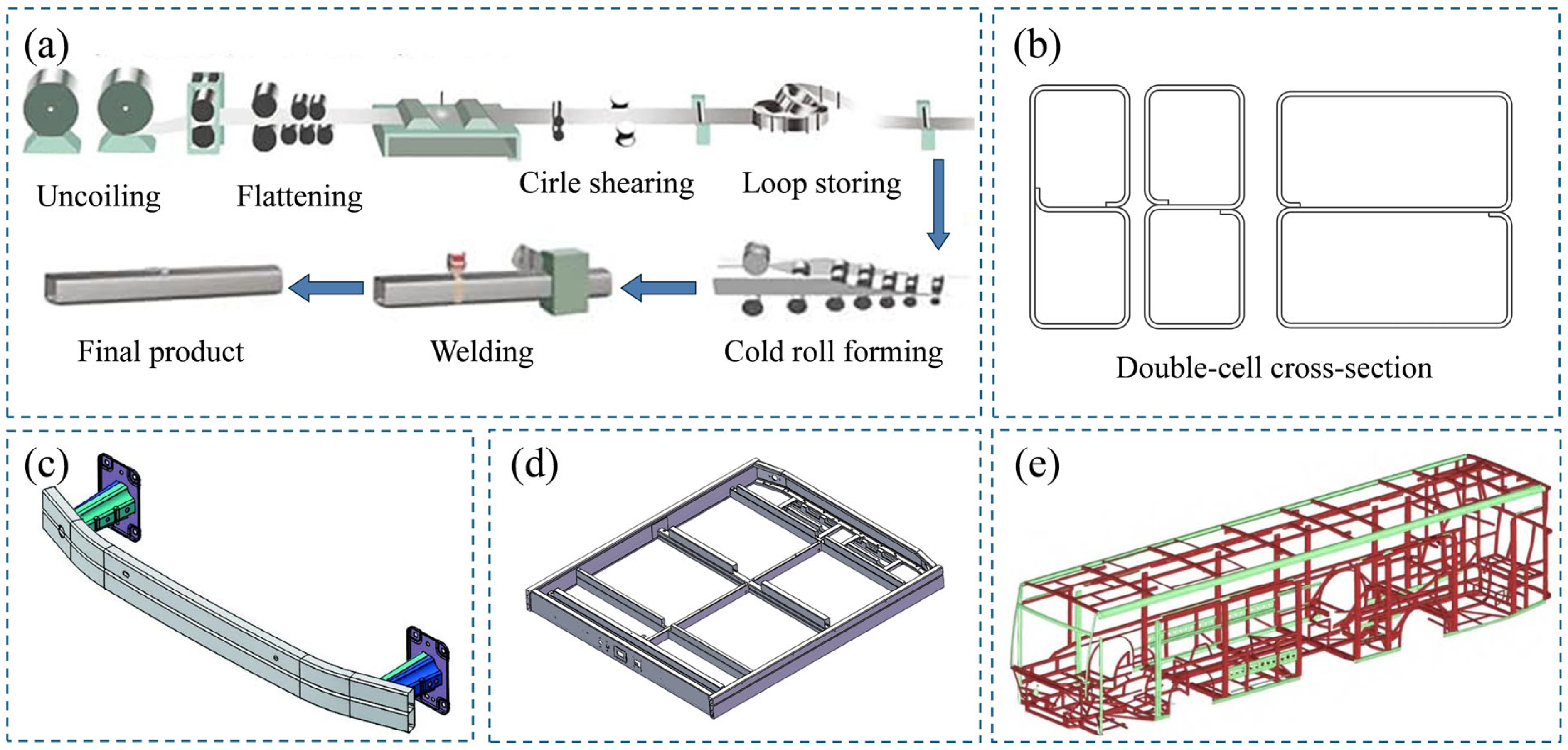
Figure 1. DCRFT forming process and applications: (a) roll-forming schematic [7]; (b) double-cell cross-section; (c) bumper beam; (d) battery box; (e) electric bus frame.
Wevj 17 00179 g001
Figure 2. Parametric cross-section design method: (a) typical configurations; (b) baseline square DCRFT and parameter definitions; (c) parametric generation example; (df) shape evolution with o, α, and β.
Wevj 17 00179 g002
Figure 3. Cross-sectional shapes generated by parameter combinations with different signs.
Wevj 17 00179 g003
Figure 4. Finite element model and material properties: (a) simulation model of DCRFT under lateral bending; (b) stress–strain curves of DP980 at different strain rates [37].
Wevj 17 00179 g004
Figure 5. Mesh convergence analysis: (a) crushing force–displacement curves; (b) computational time.
Wevj 17 00179 g005
Figure 6. Direct validation of DCRFTs: (a) experimental setup and FE model; (b) comparison of deformation modes and force–displacement curves.
Wevj 17 00179 g006
Figure 7. Indirect validation of FE model: (a) experimental setup [37]; (b) reconstructed FE model; (c) comparison of deformation modes; (d) comparison of crushing force–displacement curves.
Wevj 17 00179 g007
Figure 8. Simulation results of the baseline square DCRFT: (a) deformation mode; (b) crushing force–displacement curve.
Wevj 17 00179 g008
Figure 9. Deformation modes of DCRFTs with five typical cross-sectional shapes at o = 0 mm.
Wevj 17 00179 g009
Figure 10. Crushing force–displacement curves of DCRFTs with five typical cross-sectional shapes at o = 0 mm.
Wevj 17 00179 g010
Figure 11. Deformation modes of DCRFTs with square cross-sections at different o values (α = β = 0°).
Wevj 17 00179 g011
Figure 12. Crushing force–displacement curves of DCRFTs with three typical cross-sections at different o values: (a) hexagon; (b) square; (c) re-entrant hexagon.
Wevj 17 00179 g012
Figure 13. Crashworthiness indicators of DCRFTs with five typical cross-sections at different o values.
Wevj 17 00179 g013
Figure 14. Deformation modes of DCRFTs at different α values (o = 5 mm, β = 0°).
Wevj 17 00179 g014
Figure 15. Crushing force–displacement curves of DCRFTs at different α values (o = 5 mm): (a) β = −20°; (b) β = 0°; (c) β = 20°.
Wevj 17 00179 g015
Figure 16. Crashworthiness indicators of DCRFTs at different α values (o = 5 mm).
Wevj 17 00179 g016
Figure 17. Deformation modes of DCRFTs at different β values (o = 5 mm, α = 0°).
Wevj 17 00179 g017
Figure 18. Crushing force–displacement curves of DCRFTs at different β values (o = 5 mm): (a) α = −20°; (b) α = 0°; (c) α = 20°.
Wevj 17 00179 g018
Figure 19. Crashworthiness indicators of DCRFTs at different β values (o = 5 mm).
Wevj 17 00179 g019
Figure 20. Main effects sensitivity analysis results: (a) percentage contribution; (b) parameter influence trends.
Wevj 17 00179 g020
Figure 21. Surrogate model-based multi-objective optimization workflow for shape parameters.
Wevj 17 00179 g021
Figure 22. Representative 3D response surface plots of the RBF surrogate model.
Wevj 17 00179 g022
Figure 23. Final Pareto frontier obtained from multi-objective optimization.
Wevj 17 00179 g023
Figure 24. Comparison of bending crashworthiness between three Pareto solutions and baseline design: (a) crashworthiness indicators; (b) crushing force–displacement curves; (c) deformation modes.
Wevj 17 00179 g024
Figure 25. Roll flower patterns of three Pareto solutions and baseline design (the numbers indicate the sequence of forming passes).
Wevj 17 00179 g025
Table 1. Design levels of three shape parameters for parametric study.
o (mm)α (°)β (°)
Level index12345671234512345
Level value−15−10−5051015−20−1001020−20−1001020
Table 2. Comparison of key crashworthiness indicators between experiments and simulations for both direct and indirect validations.
Specimenm (kg)Disp (mm)PCF (kN)EA (J)SEA (J/kg)
400 mm-Test10.7198030.341884.432621.04
400 mm-Test20.7198030.671904.472648.92
Average0.7198030.511894.442634.98
400 mm-Simulation0.7248029.381864.562574.01
Error (%)0.750−3.70−1.58−2.31
540 mm-Test10.97110022.751880.941937.92
540 mm-Test20.97110022.791864.791921.28
Average0.97110022.771872.861929.60
540 mm-Simulation0.97810022.431867.791909.98
Error (%)0.750−1.50−0.27−1.02
Experiment [37]6.95638.5643.381437.46206.65
Simulation [37]6.95641.4343.061528.07219.68
Simulation6.95637.4242.471361.866195.78
Error (%)0−2.96−2.10−5.26−5.26
Table 3. Bending crashworthiness indicators of DCRFTs with five typical cross-sectional shapes at o = 0 mm.
Cross-Sectional ShapeSEA (J/kg)Disp (mm)PCF (kN)CFE (%)Total Ranking Score
Hexagon841.65 (1)109.85 (5)26.95 (4)63.85 (5)15
Trapezoid A810.74 (3)102.78 (2)27.38 (5)67.17 (4)14
Square830.70 (2)103.97 (3)25.91 (3)70.17 (3)11
Trapezoid B810.67 (4)107.66 (4)24.49 (2)71.69 (2)12
Re-entrant hexagon792.74 (5)100.90 (1)23.44 (1)79.91 (1)8
Table 4. Distribution of design variable levels for surrogate model construction.
Design VariablesLevel Distribution
o (mm)−5051015
α (°)−20−15−10−505101520
β (°)−20−15−10−505101520
Table 5. Accuracy evaluation results of the RBF surrogate model.
Output ResponseDispSEAPCFCFE
R2 (>0.9)0.99920.99980.98870.9902
RMSE (<0.2)0.00940.00400.0300.0271
MARE (<0.2)0.03540.01150.0960.1032
Table 6. Key parameter settings of the NSGA-II algorithm.
Population SizeNumber
of Generations
Crossover
Probability
Crossover
Distribution Index
Mutation
Distribution Index
40250.91020
Table 7. Design parameters of baseline design and three Pareto solutions.
Design Caseo (mm)α (°)β (°)lCD (mm)m (kg)
Baseline design000602.28
Optimum A8.95−15.800.9361.682.25
Optimum B6.2618.1915.8450.692.35
Optimum C3.3919.4813.5751.342.36
Table 8. Comparison of predicted and simulated crashworthiness indicators for three Pareto solutions.
IndicatorMetricBaseline DesignOptimum AOptimum BOptimum C
SEA (J/kg)FEA830.70839.03802.84801.39
RBF 839.25802.70801.45
Error (%) 0.03−0.020.01
Disp (mm)FEA103.9777.8784.3691.67
RBF 76.1484.4291.39
Error (%) −2.220.07−0.31
PCF (kN)FEA25.9129.9226.1224.57
RBF 30.5325.8924.79
Error (%) 2.03−0.880.90
CFE (%)FEA70.1781.1485.7983.92
RBF 81.3986.2183.77
Error (%) 0.310.49−0.18
Disclaimer/Publisher’s Note: The statements, opinions and data contained in all publications are solely those of the individual author(s) and contributor(s) and not of MDPI and/or the editor(s). MDPI and/or the editor(s) disclaim responsibility for any injury to people or property resulting from any ideas, methods, instructions or products referred to in the content.