Article

Co-DMPC Strategy for Coordinated Chassis Control of Distributed Drive Electric Vehicles

1
School of Aeronautics, Chongqing Aerospace Polytechnic, Chongqing 400021, China
2
School of Mechanical and Vehicle Engineering, Chongqing Jiaotong University, Chongqing 400074, China
3
China Merchants Testing Vehicle Technology Research Institute Co., Ltd., Chongqing 401122, China
4
Changan Automobile Global R&D Center, Chongqing 401120, China
*
Author to whom correspondence should be addressed.
World Electr. Veh. J. 2026, 17(3), 132; https://doi.org/10.3390/wevj17030132
Submission received: 19 January 2026 / Revised: 2 March 2026 / Accepted: 4 March 2026 / Published: 5 March 2026
(This article belongs to the Special Issue Vehicle System Dynamics and Intelligent Control for Electric Vehicles)

Abstract

To address the challenge that existing vehicle chassis coordinated control methods struggle to balance the nonlinear couplings and control conflicts among Four-Wheel Steering (4WS), Direct Yaw-moment Control (DYC), and Active Suspension Systems (ASS), this paper proposes a Cooperative Distributed Model Predictive Control (Co-DMPC) strategy. First, the 4WS, DYC, and ASS are modeled as three interacting agents that effectively mitigate inter-subsystem control conflicts through information exchange and coupling compensation. Second, a Gaussian Mixture Model (GMM) is utilized to extract features from vehicle state data to enable the real-time grading of instability risks, which dynamically adjusts the control weights of the 4WS, DYC, and ASS agents. Finally, a distributed iterative optimization algorithm is designed to ensure that all agents converge to a global Pareto-optimal solution through rapid negotiation, achieving a balance between control performance and computational burden. Simulation results demonstrate that compared with No-Control and CMPC, the proposed Co-DMPC strategy significantly enhances the comprehensive performance of the vehicle. In terms of path tracking accuracy, the maximum tracking errors under high- and low-adhesion road conditions are reduced by 32.73% and 17%, respectively. Regarding roll stability, the peak roll angles of the vehicle are 0.27 rad and 0.01 rad under the respective conditions. For lateral stability, the proposed method maintains a more compact sideslip angle-yaw rate phase plane envelope, effectively achieving the coordinated optimization of chassis subsystems. Hardware-in-the-Loop (HIL) experiments further validate the performance and effectiveness of the controller.

1. Introduction

Integrated chassis control has emerged as a cornerstone of vehicle active safety, driven by advances in automotive electronics. Core subsystems, including Four-Wheel Steering (4WS) [1], Direct Yaw-moment Control (DYC) [2], and Active Suspension Systems (ASS) [3], govern yaw regulation, torque distribution, and roll control, respectively. Given that instability—such as rollover and sideslip—arises from the complex coupling of lateral, longitudinal, and vertical dynamics, synergistic control of these systems is essential [4]. Existing coordination strategies are primarily categorized into weight-allocation-based and optimization-based approaches.
Extensive research addresses weight-allocation-based coordinated control. Jin et al. [5] combined Fuzzy Linear Quadratic Regulator (LQR) for 4WS with Global Fast Terminal Sliding Mode Control for DYC to enhance handling stability in four-wheel independent drive electric vehicles; however, this approach neglected vertical rollover risks. Similarly, Wang et al. [6] proposed a fuzzy logic strategy coordinating 4WS and Four-Wheel Independent Drive (4WID) to improve longitudinal and lateral stability across varying conditions. Hang et al. [7] integrated 4WS and DYC via Tube Model Predictive Control (Tube-MPC), enhancing performance under limit handling by optimizing constraints. Furthermore, Huang et al. [8]. developed a hierarchical cooperative framework based on MPC and LQR/PID to achieve an optimal tradeoff between trajectory tracking accuracy and lateral stability.
In summary, these approaches typically treat subsystems as independent entities. While they adapt to scenarios by adjusting control weights, commands are generated based on isolated objectives. Consequently, these methods often fail to address nonlinear coupling under limit conditions, leading to inter-system conflicts. For instance, 4WS steering inputs can induce unwanted roll, while ASS intervention may interfere with DYC yaw regulation, potentially compromising the stability of the coordinated system.
To address the control conflicts and nonlinear coupling inherent in weight-allocation methods, integrated control approaches based on coordinated optimization have been developed [9]. Xiao et al. [10] established a three-dimensional stability region defined by lateral velocity, yaw rate, and roll angle. By employing MPC to optimize four-wheel forces and anti-roll moments subject to these constraints, they achieved marked improvements in vehicle stability. Furthermore, Yang et al. [11] quantitatively defined stability boundaries using the Lyapunov exponent and Load Transfer Ratio (LTR). Adopting a hierarchical architecture, the upper-level MPC calculates the required resultant forces and moments during instability, while a lower-level controller distributes these commands to the actuators. However, while centralized MPC mitigates coupling conflicts, integrating additional chassis subsystems exponentially increases the complexity of the objective function and constraints [12]. Consequently, this computational burden makes it challenging to compute global theoretical optima efficiently in real-time applications.
Distributed Model Predictive Control (DMPC) presents a robust solution to the aforementioned coupling and computational challenges [13]. This architecture enables individual sub-controllers to optimize local objectives while leveraging information exchange to satisfy global constraints and prevent conflicts. While widely established in domains such as vehicle platooning [14,15] and smart grid coordination [16], DMPC application in chassis control is evolving. Chen et al. [17] proposed a Game-Theoretic framework (FSC-DMPC) that utilizes inter-controller communication to resolve conflicts, thereby ensuring enhanced stability and handling performance. Nevertheless, such game-theoretic approaches typically seek a Nash Equilibrium through non-cooperative negotiation.
Consequently, conventional DMPC fundamentally prioritizes local objectives and often struggles with tasks requiring high-level synergy [18]. Mathematically, this limitation manifests as the algorithm converging to a Nash Equilibrium, which is often suboptimal compared to the global Pareto optimality achieved by centralized convex QP. Furthermore, distributing globally coupled constraints across subsystems typically necessitates conservative approximations. Given that the vehicle chassis is a strongly coupled system, subsystems must operate cohesively to achieve global optimality, rather than functioning as isolated entities. Consequently, applying DMPC to integrated chassis control (specifically 4WS, DYC, and ASS) under strict real-time constraints presents two primary challenges: (1) designing an efficient coordination mechanism to manage nonlinear coupling among variables; and (2) ensuring the algorithm converges rapidly to a Pareto-optimal solution despite highly dynamic vehicle states.
In summary, to address the challenges of nonlinear coupling and control conflicts in vehicle chassis subsystems, this paper proposes a Cooperative Distributed Model Predictive Control (Co-DMPC) strategy, building upon the traditional DMPC framework. The main contributions of this paper are as follows:
A Co-DMPC strategy tailored for 4WS, DYC, and ASS is proposed. The chassis subsystems are modeled as three interacting agents that exchange state and control input information within the prediction horizon. This allows each agent to not only optimize its local objectives but also predict and compensate for coupling effects induced by adjacent agents, effectively resolving inter-system control conflicts.
A data-driven mechanism for instability risk identification and adaptive weighting is established. Utilizing a Gaussian Mixture Model (GMM) clustering algorithm, this mechanism automatically extracts latent features from vehicle operational data across diverse driving conditions to achieve precise stratification of instability risks. Consequently, the control weights of the 4WS, DYC, and ASS are adjusted in real-time according to the risk level, thereby enhancing the chassis system’s capability to mitigate instability.
A distributed iterative optimization algorithm is designed to achieve Pareto optimality. By facilitating rapid iterative negotiation within each sampling period, this algorithm ensures that the local optimization of each agent converges quickly to a global Pareto-optimal solution. This approach effectively strikes a balance between computational efficiency and control performance.

2. System Modeling

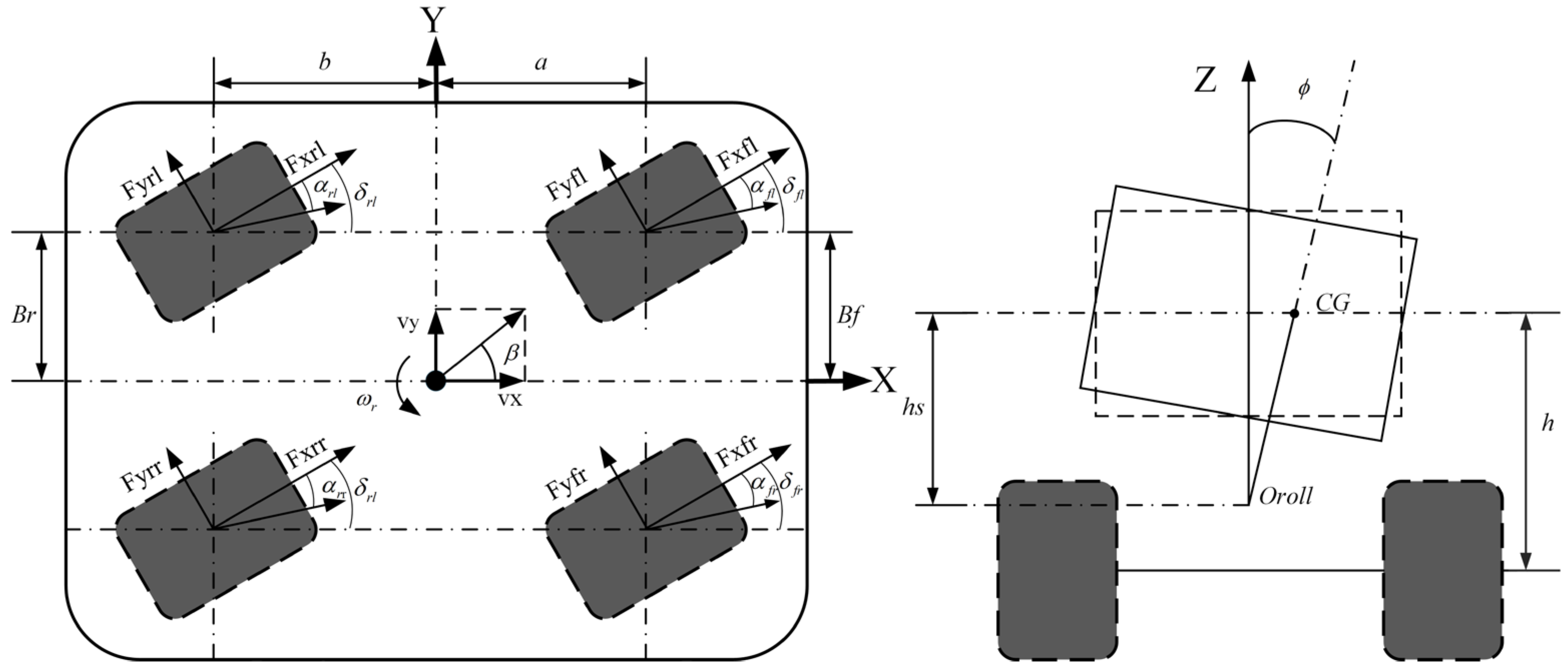
To achieve the research objectives, a comprehensive system model is constructed based on the three-degree-of-freedom (3-DOF) vehicle dynamics model (Figure 1). This formulation captures lateral, yaw, and roll dynamics, while explicitly incorporating lateral deviation and heading error for path tracking tasks.
The lateral dynamics equations are expressed as:
m ( v ˙ y + v x w ) = ( F x f l + F x f r ) sin δ f + ( F y f l + F y f r ) cos δ f + ( F y r l + F y r r ) cos δ r + ( F x r l + F x r r ) sin δ r
The yaw dynamics equation is written as:
I z ω ˙ = a [ ( F x f r F x f l ) cos δ f + ( F y f l F y f r ) sin δ f ] + b [ ( F x r r F x r l ) cos δ r + ( F y r r F y r l ) sin δ r ]
The roll dynamics equation is formulated as:
I x ϕ ¨ = m s h s ( v ˙ y + v x ω ) C ϕ p + ( m s g h s K ϕ ) ϕ Δ M x
Here, Δ M z denotes the additional yaw moment generated by the torque of the four in-wheel motors, and Δ M x represents the active anti-roll moment. The parameters m and m s denote the total vehicle mass and sprung mass, respectively. h and h s correspond to the height of the vehicle center of gravity (CG) and the sprung mass CG. K ϕ and C ϕ are the total roll stiffness and roll damping coefficient. The variables ω , β , and ϕ represent the yaw rate, vehicle sideslip angle, and roll angle, respectively. a and b denote the distances from the CG to the front and rear axles, while B f and B r represent the half-track widths of the front and rear axles. δ f and δ r are the steering angles of the front and rear wheels. v x and v y represent the longitudinal and lateral velocities. Finally, F x i and F y i denote the longitudinal and lateral tire forces, where the subscript i = f l ,   f r ,   r l ,   r r represents the front-left, front-right, rear-left, and rear-right wheels, respectively.
The Magic Formula (MF) tire model is widely adopted in both academia and industry [19] due to its superior capability in capturing the complex nonlinear characteristics of tires. The mathematical formulation is expressed as follows:
Y ( x ) = D sin C arctan B x E ( B x arctan ( B x ) )
Here, Y ( x ) denotes either the longitudinal or lateral tire force, and x represents the corresponding input variable (i.e., longitudinal slip ratio or sideslip angle). The parameters B = a 3 sin ( 2 arctan ( F z / a 4 ) ) ( 1 a 5 γ ) C D , C = a 0 , D = a 1 F z 2 + a 2 F z , and E = a 6 F z + a 7 correspond to the stiffness, shape, peak, and curvature factors, respectively, which are determined through parameter fitting. The specific numerical values of these parameters are listed in Table 1.
To facilitate controller design and enhance computational efficiency, the following assumptions are made: the front steering angle is small (implying sin δ f δ f and cos δ f 1 ), the longitudinal velocity remains constant, and the lateral forces on the left and right sides are symmetric. Consequently, the 3-DOF vehicle dynamics model is simplified as follows:
m ( v ˙ y + v x ω ) = F y f + F y r I z ω r = a F y f b F y r + Δ M z I x ϕ ¨ = m s h s ( v ˙ y + v x ω ) C ϕ p + ( m s g h s K ϕ ) ϕ Δ M x
The state-space equation of the vehicle is expressed as:
x ˙ 1 = A 1 x 1 + B 1 u y 1 = C 1 x 1
Here, the state vector is defined as x 1 = [ β , ω r , ρ , ϕ ] T , the control input vector is u = [ Δ δ f , δ r , Δ ω r , Δ M z ] T , and the output vector is y = [ β , ω r , ϕ ] T . The system matrices A 1 , B 1 and C 1 are given by:
A 1 = K f + K r m v x ( b K r a K f ) m v x 2 1 0 0 b K r a K f I z ( a 2 K f + b 2 K r ) I z v x 0 0 m s h s ( K f + K r ) m I x m s h s ( b K r a K f ) m I x v x C ϕ I x ( m s g h s K ϕ ) I x 0 0 1 0 ,   B 1 = K f m v x K r m v x 0 0 a K f I z b K r I z 1 I z 0 m s h s K f m I x v x m s h s K r m I x v x 0 1 I x 0 0 0 0 ,   C 1 = 1 0 0 0 0 1 0 0 0 0 1 0 0 0 0 1 .
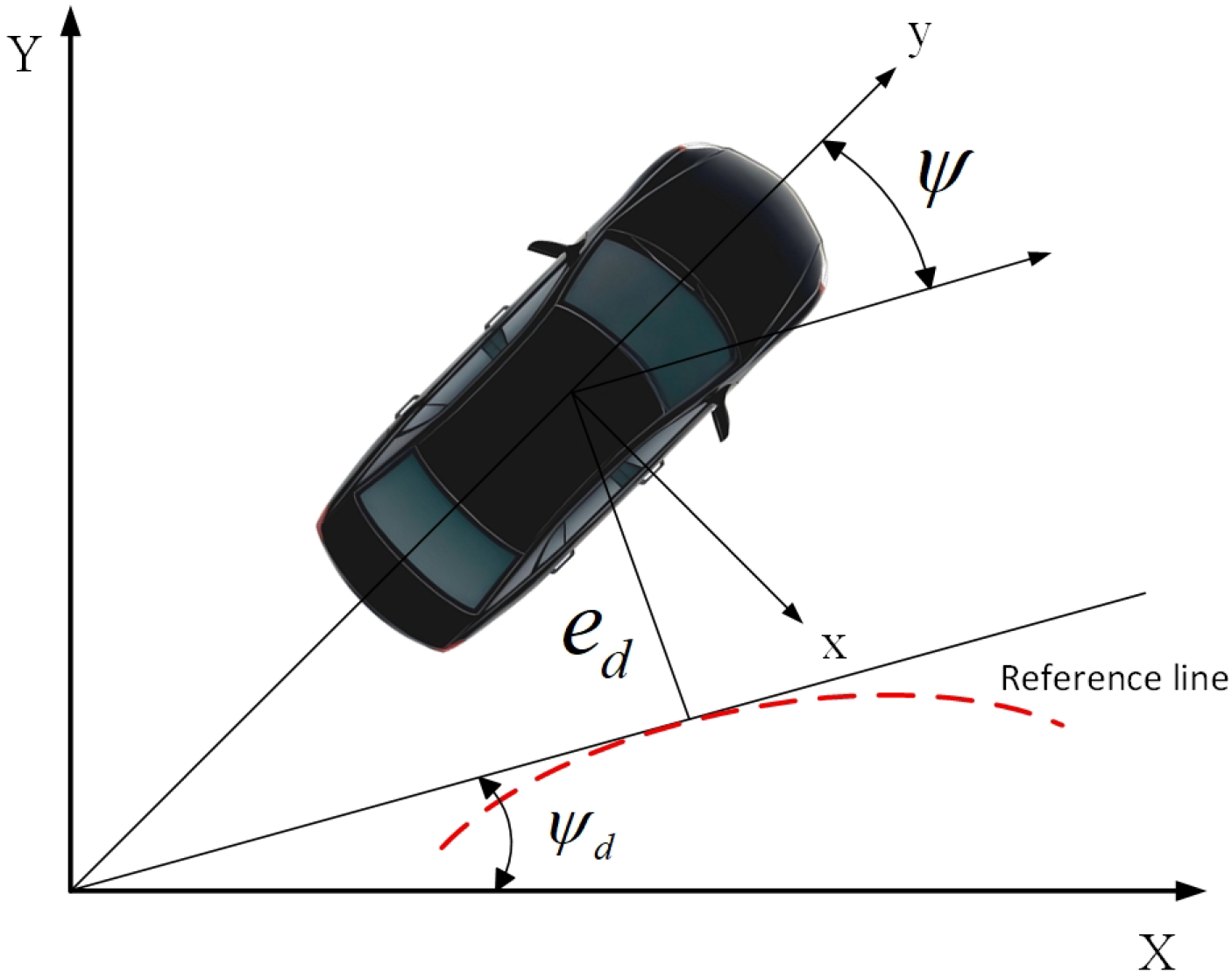
To enhance path tracking performance, a trajectory tracking error model is established based on the existing 3-DOF dynamics model, as illustrated in Figure 2. In this model, ψ denotes the vehicle heading angle, ψ d represents the reference heading angle, and e d refers to the lateral tracking error. The mathematical formulation is given by:
e ˙ d = v y + v x e ψ = v x β + v x e ψ e ˙ ψ = ω ψ ˙ d = ω v x k
Here, e ψ denotes the heading error, and k represents the curvature of the reference path.
By integrating the 3-DOF vehicle dynamics model with the trajectory tracking error model, a comprehensive system control model is established. The resulting state-space equations are expressed as follows:
x ˙ = A x + B u + W k
Here, A = K f + K r m v x ( b K r a K f ) m v x 2 1 0 0 0 0 b K r a K f I z ( a 2 K f + b 2 K r ) I z v x 0 0 0 0 m s h s ( K f + K r ) m I x m s h s ( b K r a K f ) m I x v x C ϕ I x ( m s g h s K ϕ ) I x 0 0 0 0 1 0 0 0 v x 0 0 0 0 v x 0 1 0 0 0 0 represents the system state matrix, denotes the control input matrix, B = K f m v x K r m v x 0 0 a K f I z b K r I z 1 I z 0 m s h s K f m I x v x m s h s K r m I x v x 0 1 I x 0 0 0 0 0 0 0 0 0 0 0 0 denotes the control input matrix, and W = 0 0 0 0 0 v x is the disturbance matrix. The augmented state vector x is defined as x = [ β , ω , ρ , ϕ , e d , ψ e ] T .
To explicitly demonstrate the strong interaction among the 4WS, DYC, and ASS subsystems, a simplified mathematical interaction analysis is conducted directly through the state-space matrices. The inherent coupling conflicts are evidenced by the non-zero off-diagonal cross-terms in the system matrix A and input matrix B . For instance, the elements B ( 3 , 1 ) and B ( 3 , 2 ) explicitly indicate that the front and rear steering inputs δ f and δ r from the 4WS subsystem directly induce the roll acceleration p ˙ , which consequently affects the ASS subsystem. Similarly, the non-zero term A ( 3 , 2 ) mathematically proves that variations in the yaw rate ω regulated by the DYC subsystem inherently perturb the roll dynamics. This explicit mathematical cross-coupling structure rigorously justifies the necessity of the proposed Co-DMPC framework, as an isolated control action by one agent will inevitably and continuously perturb the others.

3. Design of the Co-DMPC-Based Integrated Controller

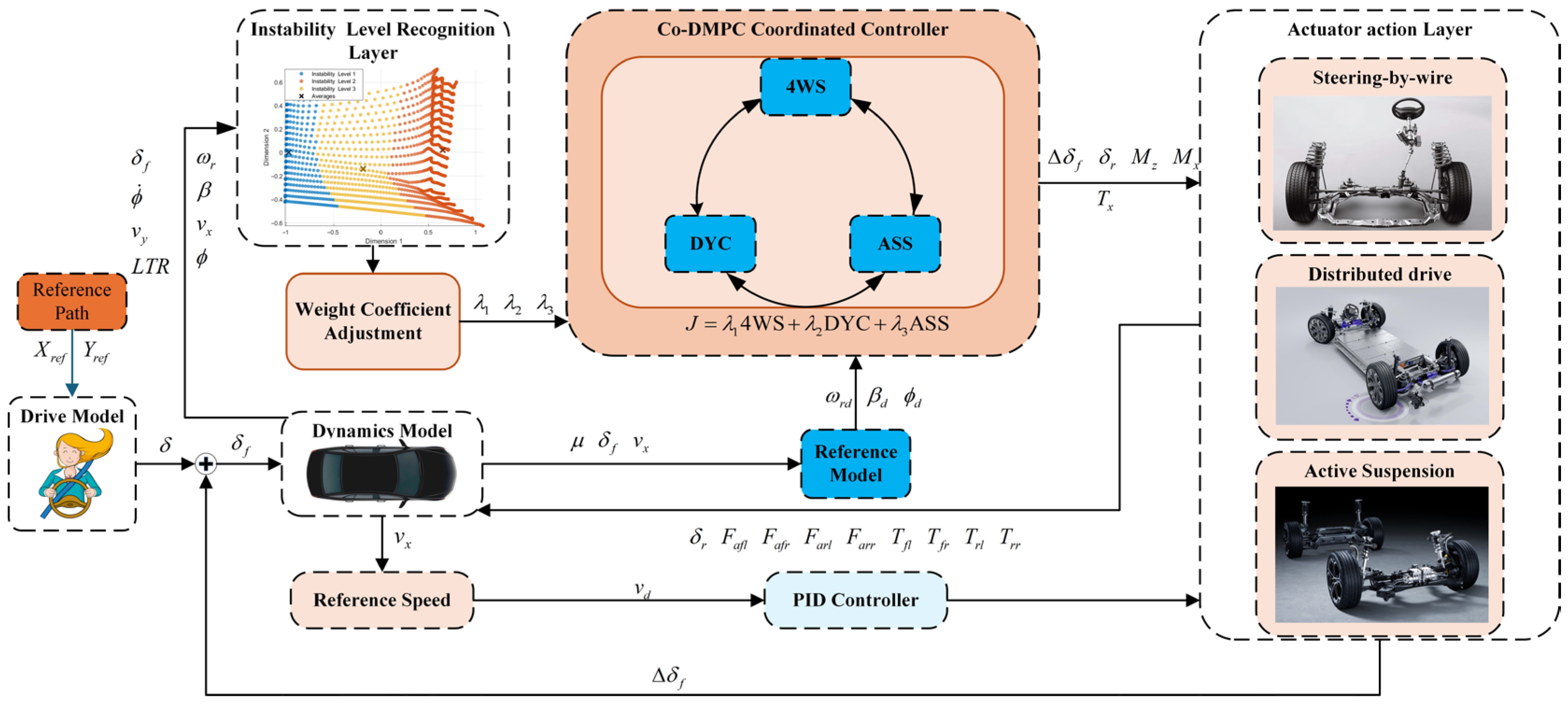
To mitigate control conflicts arising from strong subsystem coupling, a hierarchical control framework is adopted (Figure 3). This architecture comprises four layers: the Ideal State Layer (Equation (9)), which generates reference trajectories; the Instability Assessment Layer (Equations (10)–(12)), which quantifies stability risks; the Coordinated Control Layer (Equations (13)–(41)), which orchestrates 4WS, DYC, and ASS based on the assessed instability; and the Execution Layer (Equations (42)–(49)), which implements actuator commands to regulate vehicle dynamics.

3.1. Ideal State Layer

In this layer, a two-degree-of-freedom (2-DOF) vehicle model is utilized as the reference model to derive the ideal yaw rate and vehicle sideslip angle. The corresponding mathematical formulations are expressed as follows:
ω d = min v x L ( 1 + K f v x 2 ) , ω max sgn δ f β d = 0

3.2. Vehicle Instability Risk Identification Layer

In this study, the Gaussian Mixture Model (GMM) algorithm is utilized to cluster vehicle stability data. This process elucidates the specific distribution characteristics of each cluster and maps them to corresponding instability grades.

3.2.1. GMM-Based Instability Risk Identification

The Gaussian Mixture Model (GMM) is a probabilistic framework that, unlike hard clustering, assigns membership probabilities to each data point [20]. This characteristic aligns with the physics of vehicle stability, which manifests as a gradual transition rather than an abrupt, binary event. GMM assumes that the dataset originates from a mixture of sub-datasets, each following a Gaussian distribution. By associating each component with a distinct cluster, GMM can effectively characterize clusters of arbitrary shapes. For a mixture of K Gaussian components, the probability density function is defined as:
ρ ( x Θ ) = k = 1 K π k Ν ( x μ k , Σ k )
Here, x denotes a D dimensional data point, and Θ = π k , μ k , Σ k k = 1 K represents the set of model parameters. π k is the mixture coefficient for the k-th Gaussian component. The term Ν ( x μ k , Σ k ) signifies the probability density function of the k-th Gaussian component, which is uniquely determined by its mean vector μ k and covariance matrix Σ k .

3.2.2. Dataset Preparation

To comprehensively characterize vehicle stability, the selection of vehicle features is critical. The selected features primarily include the vehicle sideslip angle β , yaw rate ω r , roll angle ϕ , roll rate ρ , longitudinal velocity v x , lateral velocity v y and front wheel steering angle δ f , and the Lateral Load Transfer Ratio (LTR). The LTR is derived from the roll angle and lateral acceleration as follows:
L T R = 2 ( ϕ g + a y ) h B f g
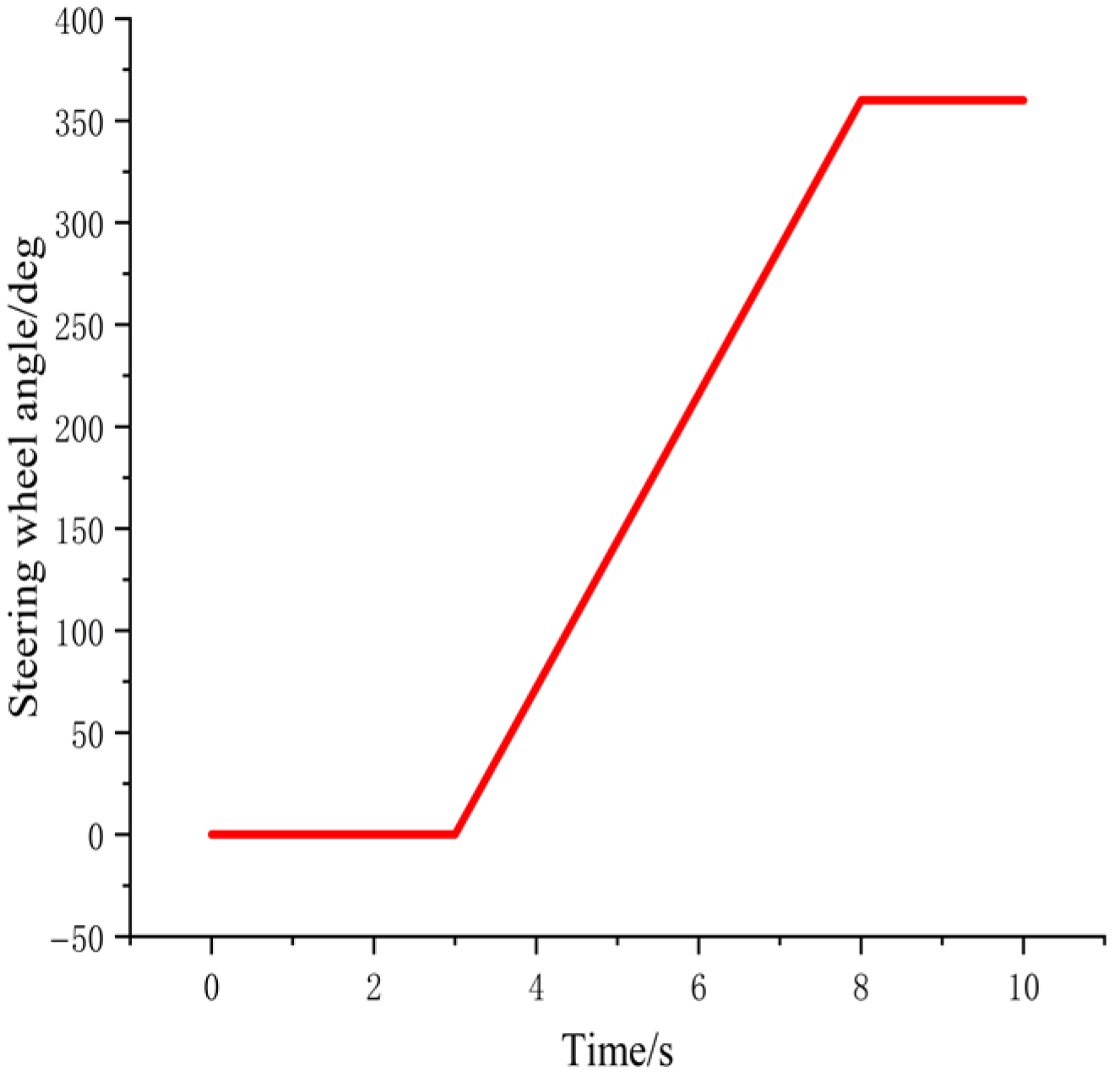
To acquire a dataset representative of vehicle stability characteristics, a specific steering input profile was designed, as illustrated in Figure 4. The steering wheel angle is maintained at zero during the initial 0–3 s interval and held constant at a specific value during the 3–8 s interval. This test maneuver is designed to encompass both stable and unstable vehicle states. The experiments were conducted under two road surface conditions with friction coefficients of 0.5 and 0.85, respectively. The longitudinal vehicle velocity ranged from 30 km/h to 120 km/h, with an increment of 5 km/h. Data characterizing vehicle stability were collected at a sampling interval of 0.05 s. A total of 7638 data samples were collected.
Vehicle state data typically comprises multiple physical quantities—such as velocity, angular velocity, and load—which possess distinct units and exhibit vastly different numerical ranges. To prevent features with large numerical magnitudes from dominating the distance metric during the clustering process, normalization of the raw dataset X N × D is essential, where N denotes the sample size and D represents the feature dimension. In this study, the Min-Max normalization method is adopted to linearly map the data of each feature j to the interval [0, 1]:
x i , j = x i , j min ( x j ) max ( x j ) min ( x j )
Here, x i , j denotes the value of the j -th feature for the i -th sample, while x j represents the vector comprising all sample values for feature j . The term x i , j corresponds to the normalized data value.
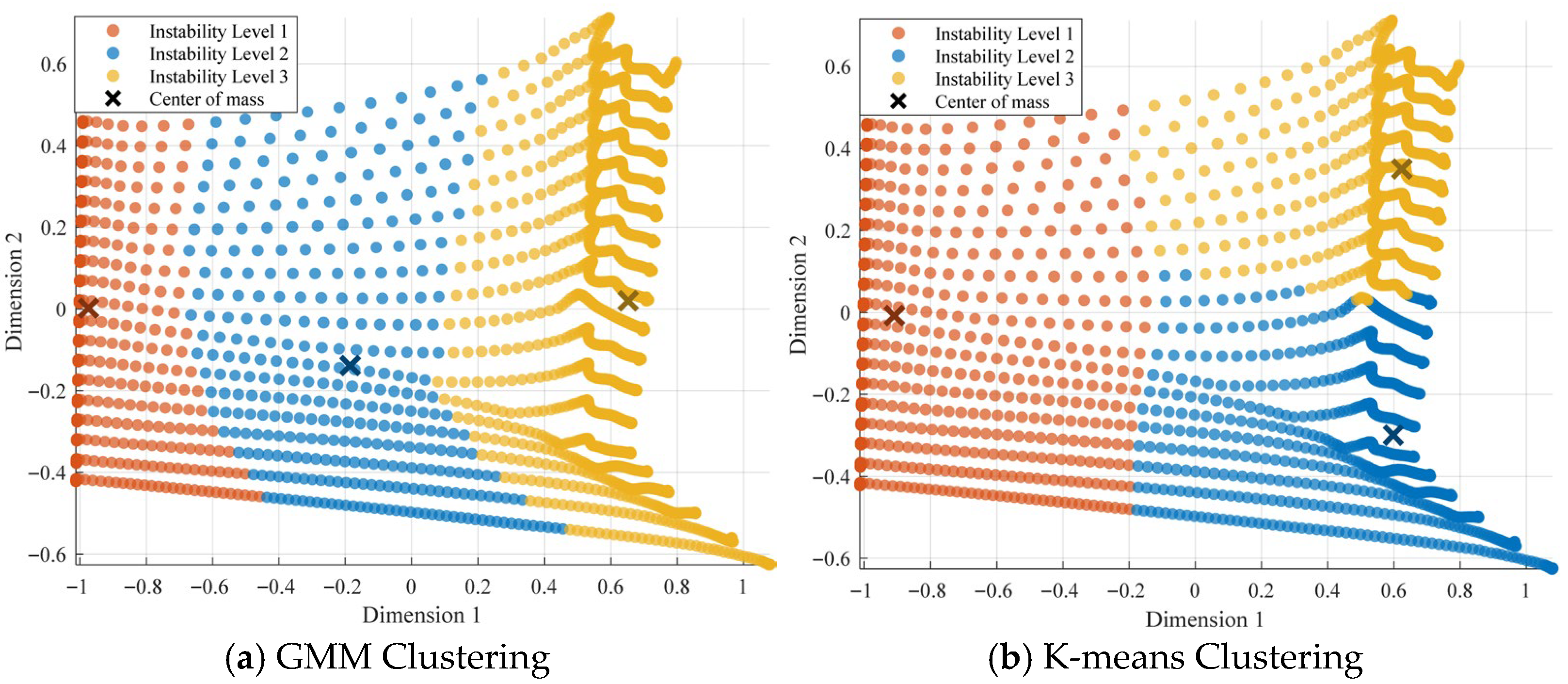
The dataset utilized for assessing vehicle instability in this study consists of eight-dimensional feature vectors. In this specific implementation, the number of Gaussian components is set to K = 3 . This selection is physically motivated by the phase-plane analysis of vehicle dynamics, which categorizes vehicle states into three distinct regimes: the linear stable region, the nonlinear transition region, and the divergent unstable region. To ensure reproducibility and stability, the GMM parameters are initialized using the K-means++ algorithm. Following initialization, the model undergoes offline training via the Expectation-Maximization (EM) algorithm until convergence. During real-time application, classification ambiguity in overlapping state regions is systematically resolved by applying the Maximum A Posteriori (MAP) criterion, which assigns state points to the risk level with the highest probability. Post-training, the identified clusters are mapped to instability grades (Grade 1 to Grade 3) based on the ascending order of the Euclidean norms of their mean vectors. To visually evaluate the clustering performance, Multidimensional Scaling (MDS) [21] is employed to project the high-dimensional clustering results onto a two-dimensional space, facilitating a comparison with the traditional K-means algorithm.
As illustrated in Figure 5a, the GMM clustering results exhibit a distinct hierarchical structure. The vehicle instability grade transitions smoothly from Grade 1 to Grade 3 as the steering wheel angle increases. This accurately reflects the physical evolution of vehicle states and aligns with fundamental vehicle dynamics principles.
In contrast, the K-means clustering results shown in Figure 5b demonstrate significant inconsistency. Due to the algorithm’s high sensitivity to initial centroid selection, the clustering output appears disordered. Specifically, certain data points exhibit unreasonable oscillations between Grade 2 and Grade 3 (2 → 3 → 2), which contradicts the physical reality of continuous vehicle motion.
To quantitatively validate the clustering quality alongside the visual projection, rigorous evaluation metrics were computed. The GMM algorithm yielded an average Silhouette score of 0.6597 and a remarkably high Calinski–Harabasz (CH) index of 5150.68. Given the continuous transition of vehicle dynamics, these metrics quantitatively confirm a highly dense and well-separated cluster structure.
Finally, a multi-run stability analysis was conducted to ensure algorithmic robustness. Benefiting from the highly robust K-means++ initialization strategy, which effectively avoids poor local optima, the EM algorithm exhibited exceptional stability across multiple independent runs. It consistently converged to the optimal global solution, terminating identically at 16 iterations with a stabilized log-likelihood of 14,630.6. This demonstrates robust multi-run stability, ensuring the absolute reliability of the subsequent variable weight adaptation.

3.3. Coordinated Control Layer

This section proposes a Cooperative Distributed Model Predictive Control (Co-DMPC) strategy. By coordinating three subsystems—Four-Wheel Steering (4WS), Direct Yaw-moment Control (DYC), and the Active Suspension System (ASS)—this strategy achieves the dual objectives of vehicle path tracking and stability control.

3.3.1. Formulation of the Prediction Model

To facilitate the design of the DMPC controller, the continuous model must first be discretized. Furthermore, an augmented model is constructed to eliminate steady-state errors. The continuous-time state-space equations are expressed as:
x ˙ ( t ) = A c x ( t ) + B c u ( t ) + W c d ( t )
Here, x ( t ) = x , A c = A , B c = B , u ( t ) = u . The term d ( t ) represents the external disturbance induced by the path curvature.
The system is discretized using the Forward Euler method with a sampling time T , e approximation x ˙ ( t ) = x ( k + 1 ) x ( k ) T into Equation (13) and performing input normalization, the discrete-time model is derived as follows:
x ( k + 1 ) = G x ( k ) + H u n o r m ( k ) + H d d ( k )
Here, u n o r m ( k ) = D u 1 u ( k ) denotes the normalized control vector, where the scaling matrix is defined as D u = d i a g ( [ δ f , max , δ r , max , M z , max , M x , max ] ) . Furthermore, G = I + T A c represents the discrete-time state transition matrix, H = T B c d i a g ( u s c a l e ) is the discrete-time control input matrix, and H d = T W c denotes the discrete-time disturbance matrix.
To eliminate steady-state errors and impose constraints on actuator rates, the DMPC strategy employs the control increment Δ u n o r m ( k ) = u n o r m ( k ) u n o r m ( k 1 ) as the optimization variable. Consequently, the augmented state vector is defined as follows:
ξ ( k ) = [ x ( k ) , u n o r m ( k 1 ) ] T
By substituting Equations (14) and (15) into the expression for ξ ( k + 1 ) , the discrete-time augmented system model is derived as follows:
x ( k + 1 ) u n o r m ( k ) = G x ( k ) + H ( u n o r m ( k 1 ) + Δ u n o r m ( k ) ) + H d d ( k ) ) u n o r m ( k 1 ) + Δ u n o r m ( k ) = G H 0 I x ( k ) u n o r m ( k 1 ) + H I Δ u n o r m ( k ) + H d 0 d ( k ) = A d ξ ( k ) + B d Δ u ( k ) + E d d ( k )
The output equation is expressed as:
y ( k ) = C d ξ ( k )
Here, A d = G H 0 4 × 6 I 4 , B d = H I 4 , E d = H d 0 4 × 1 , C d = [ I 6 , 0 6 × 4 ] .
Based on the discrete-time augmented system defined in Equation (16), the system states for the future N p time steps can be predicted. By substituting the current time step k into Equations (16) and (17), the prediction equation for the time step k + 1 is derived as follows:
y ( k + 1 k ) = ( C d A d ) ξ ( k ) + ( C d B d ) Δ u ( k ) + ( C d E d ) d ( k )
It is assumed that the external disturbance d ( k ) remains constant within the prediction horizon d ( k + 1 ) = d ( k ) .
ξ ( k + 2 k ) = A d ξ ( k + 1 k ) + B d Δ u ( k + 1 ) + E d d ( k + 1 ) = A d ( A d ξ ( k ) + B d Δ u ( k ) + E d d ( k ) ) + B d Δ u ( k ) + E d d ( k ) = A d 2 ξ ( k ) + A d B d Δ u ( k ) + B d Δ u ( k + 1 ) + ( A d E d + E d ) d ( k )
The predicted output is thus given by y ( k + 2 k ) = C d ξ ( k + 2 k ) :
ξ ( k + 2 k ) = ( C d A d 2 ) ξ ( k ) + ( C d A d B d ) Δ u ( k ) + ( C d B d ) Δ u ( k + 1 )   + C d ( A d + I ) E d d ( k )
Similarly, assuming that the control increments are zero beyond the control horizon N c (i.e., Δ u ( k + j ) = 0 , j N c ), the prediction for the i -th step is obtained as:
y ( k + i k ) = C d A d i ξ ( k ) + j = 0 min ( i 1 , N c 1 ) C d A d i 1 j B d Δ u ( k + j ) + C d ( j = 0 i 1 A d j ) E d d ( k )
By stacking the predicted outputs y ( k + 1 k ) through y ( k + N p k ) over the prediction horizon N p , the output vector Y ( k ) is constructed. Similarly, the control increments Δ u ( k ) through Δ u ( k + N c 1 ) over the control horizon N c are aggregated to form the input vector Δ U ( k ) . Consequently, the predicted system output sequence Y ( k ) can be expressed as:
Y ( k ) = S c ξ ( k ) + S u Δ U ( k ) + S d d ( k )
Here, the future output sequence is defined as Y ( k ) = [ y ( k + 1 k ) , , y ( k + N p k ) ] T , and the future control increment sequence is denoted by Δ U ( k ) = [ Δ u n o r m ( k k ) , , Δ u n o r m ( k + N c 1 k ) ] T . The prediction matrices S c , S u and S d are derived recursively from the augmented system matrices, with their specific forms given by S c = C d A d C d A d 2 C d A d N p , S u = C d B d 0 0 C d A d B d C d B d 0 C d A d N p 1 B d C d A 2 N p 2 B d C d A d N p N c B d , S d = C d E d C d ( I + A d ) E d C d ( I + A d + A d 2 ) E d C d i = 0 N p 1 A d i E d .

3.3.2. Cost Function Formulation

To achieve the decoupling of control tasks and the distribution of the computational burden, the optimization task regarding the control increment vector Δ u = [ Δ δ f , δ r , Δ M z , Δ M x ] T is distributed among three cooperative agents. Consequently, the total control increment sequence Δ U can be decomposed as follows:
Δ U = Δ δ f ( k ) Δ δ r ( k ) Δ M z ( k ) Δ M x ( k ) Δ δ f ( k + N c 1 ) Δ δ r ( k + N c 1 ) Δ M z ( k + N c 1 ) Δ M x ( k + N c 1 ) = P Δ U 1 Δ U 2 Δ U 3
where Δ U 1 2 N c × 1 represents the control increment sequence for the 4WS subsystem (comprising both Δ δ f and Δ δ r ), while Δ U 2 N c × 1 and Δ U 3 N c × 1 correspond to the DYC and ASS subsystems, respectively. P denotes the permutation matrix.
The control term S u Δ U within the prediction equation can be linearly decomposed into three distinct components:
S Δ U = S u , 1 Δ U 1 + S u , 2 Δ U 2 + S u , 3 Δ U 3
where S u , 1 6 N p × 2 N c denotes the sub-matrix constructed by extracting the columns of S u associated with Agent 1. Similarly, the sub-matrices S u , 2 6 N p × N c and S u , 3 6 N p × N c are derived for Agent 2 and Agent 3.
The reference trajectory R f u l l over the prediction horizon N p is defined. By incorporating curvature compensation, the final reference trajectory is obtained as follows:
Y r e f = R f u l l S d d ( k )
The initial prediction error vector E ( 0 ) is defined as:
E 0 = S c ξ ( k ) Y r e f
Consequently, by accounting for the control inputs, the total prediction error E ( k ) is expressed as:
E ( k ) = E 0 + S u , 1 Δ U 1 + S u , 2 Δ U 2 + S u , 3 Δ U 3
The global cost function J g l o b a l is formulated as the weighted sum of the three agent objectives, which correspond to path tracking, vehicle stability, and roll control, respectively:
J g l o b a l = i = 1 3 λ i J i
Here, J i denotes the local cost function of the i -th agent:
J i = E ( k ) Q i 2 + Δ U i R i 2 = E ( k ) T Q i E ( k ) + Δ U i T R i Δ U i
Substituting the expression for E ( k ) into J g l o b a l yields:
J g l o b a l = i = 1 3 λ i ( ( E 0 + j = 1 3 S u , j Δ U j ) T Q i ( E 0 + j = 1 3 S u , j Δ U j ) + Δ U i T R i Δ U i )
Letting Q g l o b a l = i = 1 3 λ i Q i , we have:
J g l o b a l = E 0 + j = 1 3 S u , j Δ U j Q g l o b a l 2 + i = 1 3 λ i Δ U i R i 2
To eliminate the dimensional disparities among the highly coupled 6-DOF vehicle states and strictly justify the weight selection, a systematic normalization scheme is applied prior to the empirical weight calibration. A state normalization matrix W x = d i a g ( 1 / x 1 , max , 1 / x 2 , max , 1 / x 6 , max ) is explicitly constructed using the typical maximum operational boundaries of each physical variable (e.g., maximum allowable side-slip angle, yaw rate, and roll angle). The actual state weight matrix is then mathematically formulated as Q i = W x T Q i W x , where Q ˜ i represents the dimensionless base weights. Concurrently, the control increments are normalized by the physical constraints of the chassis actuators. This systematic scaling maps all optimization variables into a unified dimensionless space, ensuring that the subsequent empirically calibrated base weights ( Q ˜ i , R i ) strictly reflect the relative priority of the control objectives, completely decoupled from their numerical magnitudes.

3.3.3. Iterative Negotiation and Information Exchange

Given that J g l o b a l constitutes a coupled Quadratic Programming (QP) problem with respect to Δ U 1 , Δ U 2 and Δ U 3 an iterative negotiation protocol is designed to solve the global optimization problem within a distributed framework. This protocol enables agents to engage in multiple rounds of information exchange, iteratively refining their control strategies to eventually converge to a global Pareto-optimal solution. By minimizing the weighted global function J g l o b a l with strictly positive weights ( λ 1 , λ 2 , λ 3 ), this convergence mathematically guarantees a Pareto efficient point. Specifically, in the k-th iteration, each agent i assumes that the control inputs U j ( k ) of the other agents ( j i ) remain fixed, and subsequently solves for its own optimal control increment Δ U i .
Taking the 4WS agent as an illustrative example, during the k-th iteration, this agent is tasked with solving a sub-optimization problem. This problem seeks to minimize the global cost function J g l o b a l , under the assumption that the control sequences of the other agents, denoted as Δ U j (where ( j i ) ), are fixed at their values from the previous iteration ( k 1 ) . Consequently, the sub-problem is formulated as follows:
min Δ U 1 = J 1 s u b = ( E 0 + S u , 2 Δ U 2 ( k 1 ) + S u , 3 Δ U 3 ( k 1 ) ) + S u , 1 Δ U 1 Q g l o b a l 2 + λ 1 Δ U 1 R 1 2
To simplify the expression in Equation (32), all terms treated as constants during the current optimization iteration are aggregated. Accordingly, the error contribution from the other agents is defined as E o t h e r s , 1 k 1 :
E o t h e r s , 1 k 1 = E 0 + S u , 2 Δ U 2 ( k 1 ) + S u , 3 Δ U 3 ( k 1 )
By substituting Equation (33) into Equation (32), the sub-cost function J 1 s u b is expanded into a standard quadratic form with respect to the optimization variable Δ U 1 :
J 1 s u b = ( E o t h e r s , 1 ( k 1 ) + S u , 1 Δ U 1 ) T Q g l o b a l ( E o t h e r , 1 ( k 1 ) + S u , 1 Δ U 1 ) + λ 1 Δ U 1 T R 1 Δ U 1
Given that Equation (34) constitutes a convex quadratic programming (QP) problem, the optimal solution can be derived by setting the partial derivative of J 1 s u b with respect to Δ U 1 to zero. This satisfies the first-order optimality condition:
J 1 s u b Δ U 1 = 2 S u , 1 T Q g l o b a l ( E o t h e r s , 1 ( k 1 ) + S u , 1 Δ U 1 ) + 2 λ 1 R 1 Δ U 1 = 0
By expanding and rearranging Equation (35)—specifically, collecting all terms involving Δ U 1 the left-hand side and shifting the constant terms to the right-hand side—a system of linear equations in the form H 1 Δ U 1 = g 1 is obtained:
( 2 S u , 1 T Q g l o b a l S u , 1 + 2 λ 1 R 1 ) Δ U 1 = 2 S u , 1 T Q g l o b a l E o t h e r s , 1 ( k 1 )
To facilitate the solution process, the Hessian matrix H 1 and the gradient vector g 1 are defined as follows H 1 = 2 ( S u , 1 T Q g l o b a l S u , 1 + λ 1 R 1 + ε I ) , g 1 = 2 S u , 1 T Q g l o b a l E o t h e r s , 1 ( k 1 ) . Consequently, the unconstrained optimal solution, denoted as Δ U 1 , r a w is obtained by:
Δ U 1 , r a w = H 1 1 g 1
The Jacobi iteration method is employed to update the solution, incorporating a relaxation factor α Consequently, the update rule is expressed as:
Δ U i , c l a m p e d ( k ) = c l a m p ( Δ U i , r a w , Δ U n o r m , Δ U n o r m )
The control increment at the k-th iteration, Δ U i ( k ) , is updated as the weighted average of the value from the previous iteration Δ U i ( k 1 ) and the currently computed clamped solution Δ U i , c l a m p e d ( k ) :
Δ U i ( k ) = ( 1 α ) Δ U i ( k 1 ) + α Δ U i , clamped ( k )
Note that the clamping operation in Equation (38) mathematically functions as a projection onto the box constraints of the control increments Δ U i . By bounding the optimization variable Δ U i within its normalized limits [ Δ U n o r m , Δ U n o r m ] , this step enforces the actuator rate constraints within the iterative loop. Since the constrained value is utilized in Equation (39) and broadcast for the next iteration, it allows other agents to inherently compensate for any saturation, ensuring the final solution respects constraints while maintaining cooperative performance.
The iterative process continues until the convergence criterion max i Δ U i ( k + 1 ) Δ U i ( k ) < t o l e r a n c e is satisfied. Upon convergence, the optimal normalized control increment sequences Δ U 1 , Δ U 2 , Δ U 3 are obtained. Following the receding horizon control principle, only the first element of these sequences is applied as the control increment Δ U n o r m ( k ) for the current time step:
Δ U n o r m ( k ) = ( Δ U 1 ) 1 ( Δ U 1 ) N c + 1 ( Δ U 2 ) 1 ( Δ U 3 ) 1
The normalized control increment is denormalized to obtain the final physical control increment:
Δ u ( k ) = Δ u n o r m ( k ) Δ u s c a l e

3.4. Lower-Level Execution Layer

The lower-level controller translates the upper-level commands into physical actuation. For example, it executes the calculated control inputs by managing actuators, utilizing the Steer-by-Wire (SBW) system for steering adjustments and employing a torque distribution strategy to allocate wheel torques.
First, a PID controller is designed to calculate the driving torque required to maintain the vehicle’s longitudinal velocity:
T d r i v e = K p e ( t ) + K i 0 t e ( t ) d t + K d d e ( t ) d t
Here, e ( t ) = v x v r e f .
To enhance vehicle stability and handling performance, an optimization-based strategy is employed for torque distribution. The core objective of this strategy is to maximize the utilization of the adhesion potential of each tire. Consequently, the cost function is formulated as follows:
min i = f l , f r , r l , r r   J = F x i 2 + F y i 2 ( μ F z i ) 2
The distributed drive electric vehicle investigated in this study features independently controllable drive motors for each wheel. By incorporating the tire lateral force estimation derived from the aforementioned Magic Formula tire model, a new cost function is formulated as follows:
min i = f l , f r , r l , r r   J = F x i 2 ( μ F z i ) 2
This objective function is designed to minimize the utilization of longitudinal driving forces, thereby actively preserving the tire adhesion margin. This strategy ensures sufficient capacity to sustain larger lateral forces, ultimately enhancing the vehicle’s lateral stability.
The system constraints are defined as follows:
F x f l m + F x f r m + F x r l m + F x r r m = F x d 2 ( F x f r + F x r r ) d 2 ( F x f l + F x r l ) = M z T min R w F x i T max R w
The optimal allocation process is performed subject to the constraints of satisfying the force and moment commands from the upper-level controller, as well as the physical limitations of the system. Where T min and T max denote the minimum and maximum torque output limits of the motors, respectively.
Ultimately, the torque allocation problem can be formulated as a standard Quadratic Programming (QP) problem:
min X 1 2 X T H X T
Here, X = [ T L 1 , T R 1 , T L 2 , T R 2 ] H = d i a g ( 1 ( F z f l μ R w ) 2 , 1 ( F z f r μ R w ) 2 , 1 ( F z r l μ R w ) 2 , 1 ( F z r r μ R w ) 2 ) .
Consequently, the driving and braking torques for the four wheels are obtained as follows:
T i j = F x i j R w
Regarding the calculation of the anti-roll moment by the ASS, given that the active actuators are constrained to exert upward forces on the vehicle body along their axes, it follows that when the anti-roll moment is positive:
F a 1 = 2 b M A S S ( a + b ) w F a 2 = 0 F a 3 = 2 a M A S S ( a + b ) w F a 4 = 0
Conversely, when the anti-roll moment is negative:
F a 1 = 0 F a 2 = 2 b M A S S ( a + b ) w F a 3 = 0 F a 4 = 2 a M A S S ( a + b ) w

4. Simulation Results and Analysis

To validate the effectiveness of the proposed control strategy, a co-simulation platform integrating CarSim and Simulink is established. In this architecture, Simulink implements the control algorithms, while CarSim provides the high-fidelity vehicle dynamics model and road environment. The strategy is systematically evaluated using Double Lane Change (DLC) maneuvers under varying road adhesion coefficients, focusing on path tracking accuracy, lateral stability, and roll safety. To validate the proposed strategy, the centralized MPC (CMPC) framework established in [11] is adopted as a benchmark for comparative analysis under identical conditions. Key vehicle and control parameters are listed in Table 2.

4.1. Comparative Analysis of Different Control Strategies

The efficacy of the proposed strategy is validated via Double Lane Change (DLC) maneuvers under two distinct road conditions. Longitudinal velocity is maintained at 90 km/h, with tire-road friction coefficients set to 0.85 and 0.40, respectively. Following extensive calibration, the weighting coefficients for the control agents, corresponding to varying instability levels, are determined and listed in Table 3. Specifically, the determination of these coefficients follows a hierarchical safety-critical tuning logic based on vehicle dynamics. For Level 1, the primary objective is precise trajectory following; thus, a dominant weight ( λ 1 = 0.9 ) is assigned to the 4WS agent to minimize tracking error, while λ 2 and λ 3 are minimized to reduce energy consumption. In Level 2, as the vehicle enters the nonlinear region, the weight for the DYC agent ( λ 2 ) is increased to 0.5 to proactively suppress sideslip angle growth. Finally, for Level 3, the strategy shifts to a ‘safety-first’ principle. The weights for yaw stability ( λ 2 ) and roll suppression ( λ 3 ) are significantly increased to 0.4 each to fully utilize the anti-roll and yaw-correcting capabilities. This configuration ensures that the controller prioritizes pulling the vehicle back into the stable envelope, even at the cost of temporary path deviation.
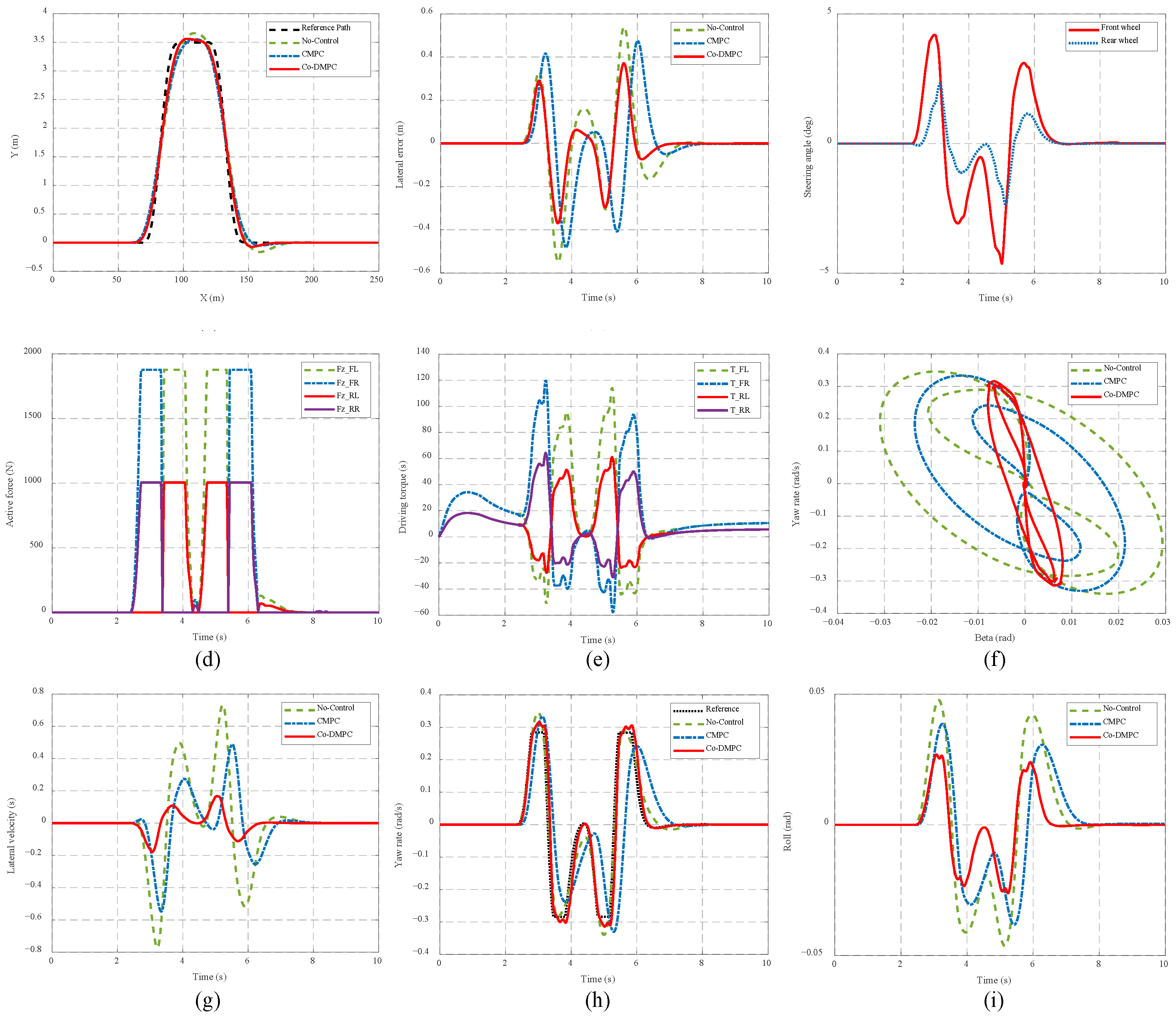
Under high adhesion conditions, the results presented in Figure 6a,b demonstrate that the Cooperative Distributed Model Predictive Control (Co-DMPC) strategy possesses significant advantages in terms of path tracking accuracy. Specifically, regarding the No-Control case, due to the absence of active yaw moment regulation, the vehicle trajectory exhibits a noticeable tracking lag at X = 155 m, followed by severe overshoot at X = 105 m. In contrast, both the Centralized MPC (CMPC) and the proposed Co-DMPC outperform the No-Control baseline, yielding superior overall path tracking performance.
The control superiority of Co-DMPC is further accentuated in terms of trajectory tracking error. It achieves the lowest peak tracking error of merely 0.371 m, whereas the peak errors for the No-Control and CMPC cases are 0.55 m and 0.481 m, respectively. This corresponds to a reduction of 32.73% and 22.87% compared to the No-Control and CMPC strategies, respectively.
However, the CMPC strategy struggles to effectively balance the trade-off between path tracking and vehicle stability. Notably, at t = 3.2 s and t = 5.38 s, its tracking error exceeds even that of the No-Control case. Furthermore, an analysis of the yaw rate profiles reveals a distinct phase difference between the CMPC response and those of the Co-DMPC and No-Control cases. This discrepancy indicates that the CMPC controller suffers from a certain degree of dynamic lag.
Figure 6c–e illustrate the control output characteristics of the three strategies during the vehicle motion. At t = 2.55 s, under the Co-DMPC strategy, the rear steering angle exhibits a counter-phase relationship with the front steering angle to rapidly enhance the yaw rate. Subsequently, the rear steering switches to an in-phase configuration to suppress excessive yaw rate overshoot.
In this maneuver, the maximum front and rear steering angles are 4.63° and 2.37°, respectively. Furthermore, the maximum drive torque reaches 120 N·m, while the peak active anti-roll force is 1876 N. These results demonstrate that the coordinated regulation of 4WS, DYC, and ASS effectively enhances both path tracking accuracy and driving stability.
Regarding lateral stability, the Co-DMPC strategy demonstrates a particularly significant improvement. Figure 6f presents the phase plane portrait of the yaw rate versus the sideslip angle. As observed in the figure, the trajectory corresponding to the Co-DMPC controller exhibits the most compact envelope (smallest fluctuation range), indicating its superior capability in maintaining the vehicle within a stable region.
Furthermore, the lateral velocity profiles depicted in Figure 6g reveal that the lateral velocity under Co-DMPC is significantly lower than that of the No-Control and CMPC cases. Simultaneously, the Co-DMPC strategy achieves more precise tracking of the desired yaw rate. These results further confirm that the Co-DMPC strategy effectively enhances the vehicle’s handling stability.
Figure 6i compares the roll stability performance of the three control strategies. Specifically, the peak roll angle under Co-DMPC is restricted to 0.27 rad, whereas the peak values for the No-Control and CMPC cases reach 0.478 rad and 0.386 rad, respectively. These results indicate that the Co-DMPC controller significantly outperforms both CMPC and No-Control in terms of roll stability, demonstrating a superior capability in suppressing vehicle roll motion.
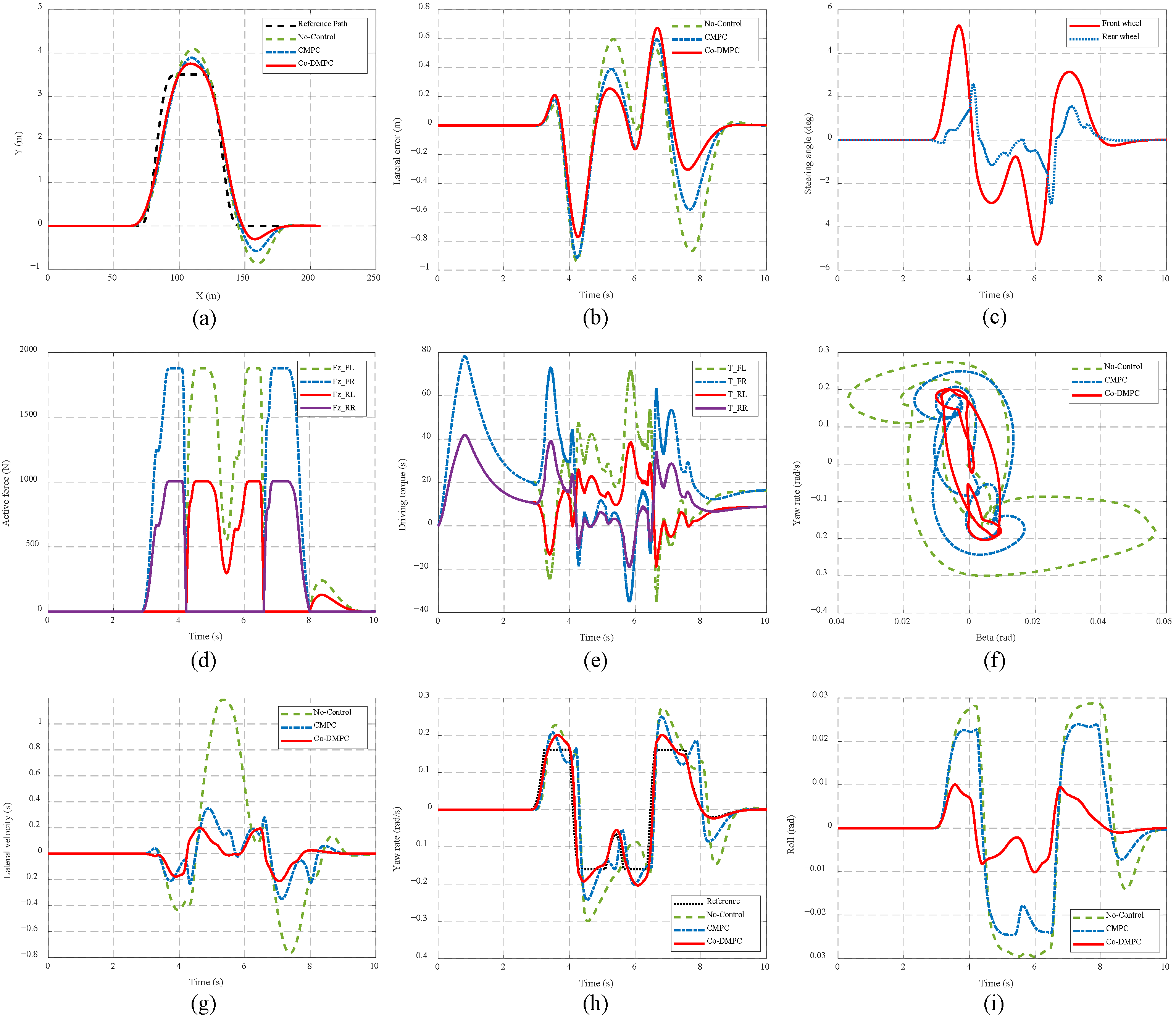
Under low road adhesion conditions, the vehicle trajectory tracking results and control inputs are presented in Figure 7a–e. The maximum tracking errors for the No-Control and CMPC cases are 0.939 m and 0.914 m, respectively. In contrast, the Co-DMPC strategy limits the maximum error to 0.771 m, representing reductions of 17% and 15.6% compared to the other two controllers, respectively. Furthermore, Co-DMPC demonstrates superior path tracking performance with significantly reduced overshoot at X = 105 m and X = 155 m.
The steering profiles of the 4WS agent exhibit trends similar to those observed under high adhesion conditions. The strategy initially employs a counter-phase rear steering angle to rapidly generate yaw moment, followed by an in-phase adjustment to mitigate excessive yaw rate overshoot. Regarding yaw rate tracking, the No-Control case deviates severely from the desired value, whereas the CMPC controller, while better than the baseline, still exhibits noticeable deviation.
In terms of control output, the yaw moment generated by the Co-DMPC’s DYC agent is reduced compared to the high adhesion scenario. This reduction occurs because, under low friction conditions, excessive yaw moment can induce tire saturation, thereby compromising path tracking accuracy. Consequently, the Co-DMPC strategy selects an optimal control action that balances path tracking accuracy with vehicle stability constraints.
The vehicle stability performance during the maneuver is illustrated in Figure 6f–i. In the phase plane portrait of the sideslip angle and yaw rate, the trajectory envelope of the Co-DMPC remains the most compact. This indicates that the Co-DMPC controller maintains robust control performance regardless of whether the road adhesion coefficient is high or low. Regarding lateral velocity, the Co-DMPC controller outperforms both the No-Control and CMPC cases; the No-Control case exhibits large fluctuations in lateral velocity, indicative of poor lateral stability.
In terms of roll stability, the Co-DMPC strategy continues to demonstrate effective control, limiting the maximum roll angle to 0.01 rad. This value is substantially lower than the 0.029 rad and 0.020 rad observed in the No-Control and CMPC cases, respectively.
In summary, the comparative analysis of different controllers under both high and low road adhesion conditions reveals that the Co-DMPC controller achieves superior path tracking performance and significantly enhances vehicle stability. These simulation results conclusively demonstrate the superiority and robustness of the proposed Co-DMPC strategy.

4.2. Computational Efficiency Analysis

To comprehensively evaluate the algorithmic complexity, a quantitative comparison between the Centralized MPC (CMPC) and the proposed Co-DMPC was conducted on a unified PC simulation platform. The simulation duration was set to 15 s with a fixed control time step of T = 0.01 s, resulting in a total of 1500 computation steps for each test run.
As shown in Table 4, the experimental results indicate that the Co-DMPC strategy significantly reduces the computational burden. The average execution time per step for Co-DMPC is 216.4345 ms, whereas it is 372.3563 ms for CMPC, representing a reduction of approximately 41.9%. Furthermore, the standard deviation of the execution time for Co-DMPC is 22.2723 ms, which is significantly lower than the 145.9724 ms observed for CMPC, indicating superior numerical stability.
It is important to note that the absolute execution time 216 ms observed on the PC exceeds the control period T = 0.01 s. This phenomenon is an expected characteristic of the “offline” simulation environment, primarily attributed to:
  • The MATLAB/Simulink environment executes code interpretatively, introducing significant latency compared to the compiled C++ code used in real-time hardware.
  • The single-threaded PC simulation executes the distributed agents sequentially, accumulating the computation time of all subsystems.

4.3. Hardware-in-the-Loop (HIL) Experiment

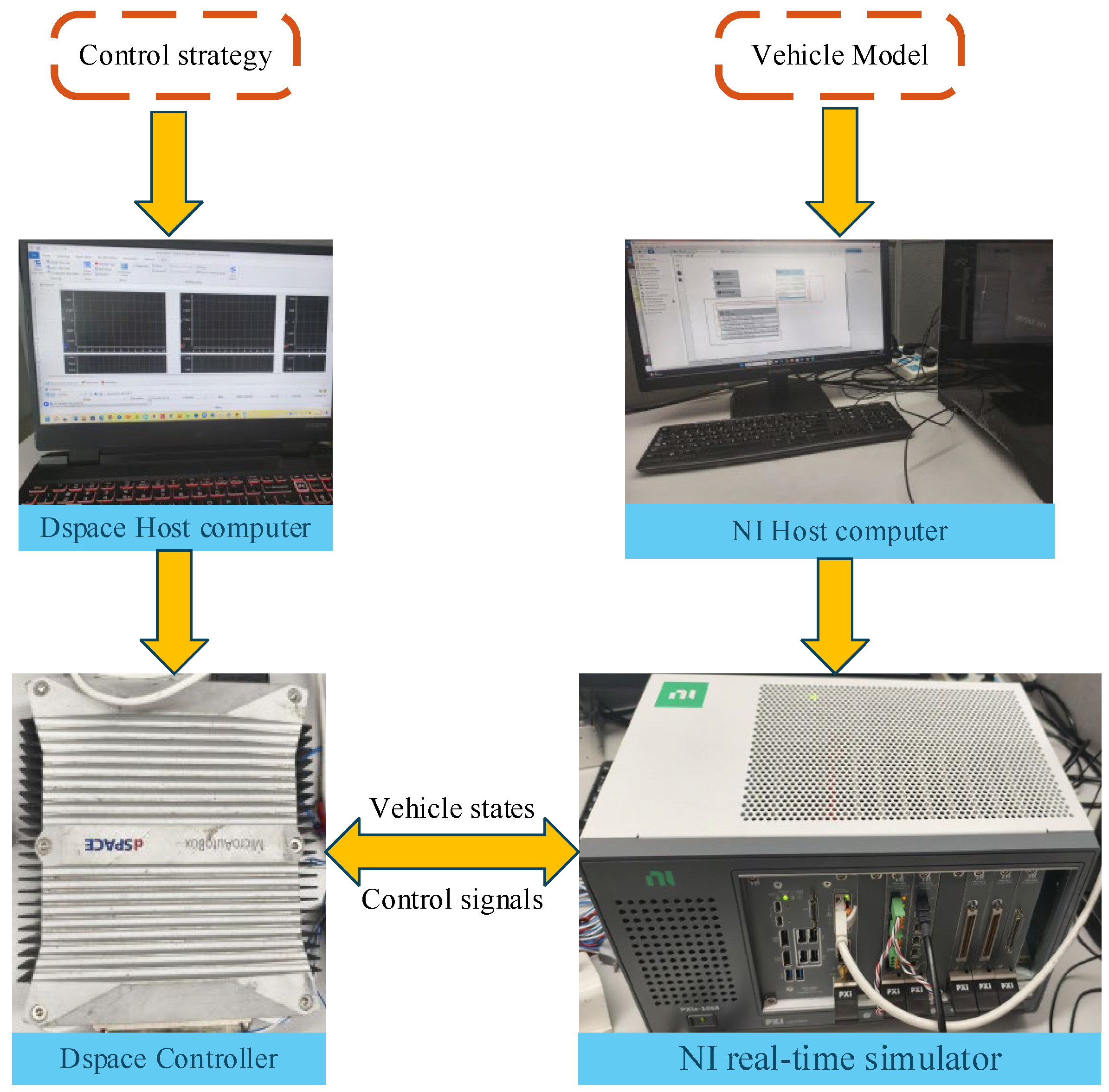
To mitigate the risks and reduce the costs associated with field testing, Hardware-in-the-Loop (HIL) testing is employed to evaluate the performance and feasibility of the proposed algorithm. As illustrated in Figure 8, the experimental platform comprises a dSPACE MicroLabBox, an NI Real-Time Simulator, and host computers.
The control strategy, developed in MATLAB 2023b/Simulink, is compiled into C++ code via dSPACE ConfigurationDesk on the host PC and subsequently deployed to the dSPACE MicroLabBox (serving as the controller). Simultaneously, the high-fidelity vehicle model and road environment constructed in Carsim are downloaded to the NI Real-Time Simulator via NI VeriStand software 2021, thereby establishing a virtual driving environment. Data exchange between the dSPACE MicroLabBox controller and the NI Real-Time Simulator is established via a CAN bus connection.
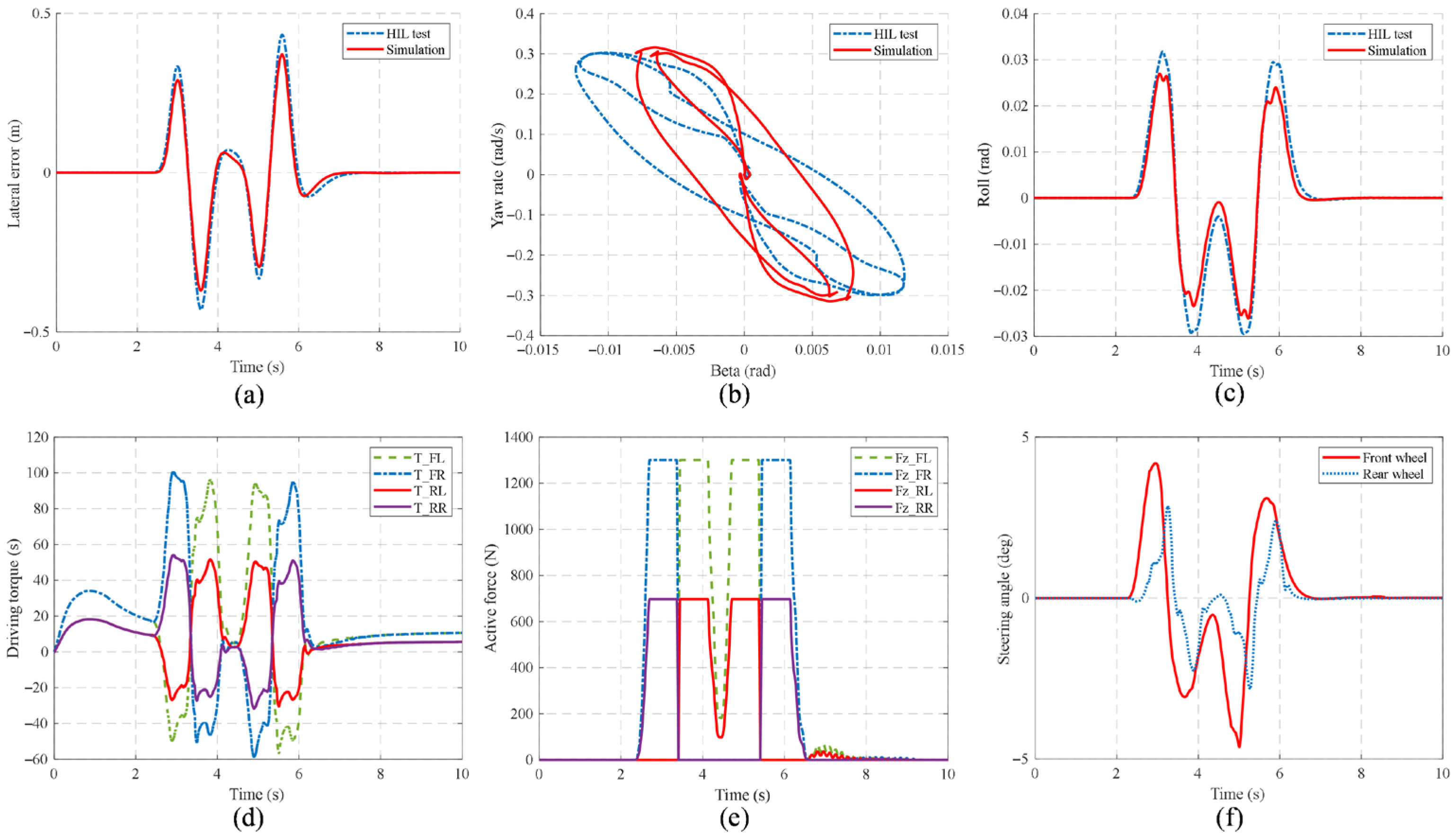
Figure 9 illustrates the experimental results obtained at a vehicle speed of 90 km/h with a road adhesion coefficient of 0.85. Constrained by the computational capacity of the actual hardware and the communication latency inherent in the CAN bus, the performance observed in the HIL test exhibits a slight degradation compared to the ideal numerical simulation results. To handle these inherent communication delays and computational jitter within the real target control period of 20 ms, a strict hard constraint on the maximum number of iterations was implemented (limited to 20). This strategy ensures that a control command is forcibly output to prevent task timeouts regardless of transient load fluctuations. While detailed historical logs for CPU load and latency jitter are unavailable due to limited post-project access to the hardware platform, the preserved vehicle stability explicitly validates the algorithm’s robustness against real-world hardware latency and signal noise.
Regarding trajectory tracking, the maximum lateral error observed in the HIL test increased to 0.433 m. In terms of lateral stability, as shown in Figure 9b, the envelope of the sideslip angle–yaw rate phase plane portrait expanded significantly; nevertheless, the vehicle’s operating states remained well within the stable region. With respect to roll stability (Figure 9c), the maximum roll angle recorded during the HIL test was 0.302 rad.
Regarding control outputs, the trends observed in the HIL test remain consistent with the simulation results. Specifically, at t = 2.1 s, the HIL test successfully reproduces the control strategy observed in the simulation: initially applying a rear steering angle in counter-phase to the front wheels to rapidly generate the required yaw moment, followed by a swift transition to in-phase steering to effectively suppress excessive overshoot.

5. Conclusions

To address the challenge that existing vehicle chassis coordinated control methods struggle to balance the nonlinear couplings and control conflicts among Four-Wheel Steering (4WS), Direct Yaw-moment Control (DYC), and Active Suspension Systems (ASS), this paper proposes a Cooperative Distributed Model Predictive Control (Co-DMPC) strategy. First, the 4WS, DYC, and ASS are modeled as three interacting agents that effectively mitigate inter-subsystem control conflicts through information exchange and coupling compensation. Second, a Gaussian Mixture Model (GMM) is utilized to extract features from vehicle state data for real-time instability risk grading—categorizing risks into Levels 1, 2, and 3—to dynamically adjust the control weights of the agents. Finally, a distributed iterative optimization algorithm is designed to ensure that all agents converge to a global Pareto-optimal solution through rapid negotiation, achieving a balance between control performance and computational burden.
Simulation experiments demonstrate that the proposed method achieves superior control effects under both high- and low-adhesion road conditions compared to No-Control and Centralized MPC (CMPC) architectures. Simulation results show that the Co-DMPC strategy significantly outperforms CMPC and No-Control in path tracking accuracy. Under high-adhesion conditions, Co-DMPC achieves the lowest peak path tracking error of 0.371 m, representing reductions of 22.87% and 32.73% compared to CMPC and No-Control, respectively. Similarly, under low-adhesion conditions, Co-DMPC reduces the maximum tracking error by 15.6% relative to CMPC and effectively mitigates the dynamic lag and overshoot observed in the CMPC strategy. Regarding vehicle stability control, the peak roll angle of Co-DMPC under high-adhesion conditions is 0.27 rad, which is 30% lower than that of CMPC. Under low-adhesion conditions, Co-DMPC also exhibits excellent robustness, with a peak roll angle of 0.01 rad—significantly lower than the 0.020 rad of CMPC and 0.029 rad of the No-Control group. These results indicate that regardless of variations in road adhesion, Co-DMPC can effectively suppress body attitude fluctuations through multi-agent coordination, ensuring driving safety under extreme conditions.
In HIL experiments, despite constraints from CAN bus latency and hardware computational power, the Co-DMPC strategy successfully maintains vehicle stability at a speed of 90 km/h, with the peak lateral error controlled within 0.433 m and a peak roll angle of 0.32 rad. The experimenfts reproduced the rear-wheel steering switching strategy consistent with simulation results, validating the engineering feasibility of the proposed distributed architecture. Despite these achievements, certain limitations remain. Currently, the control weights for the 4WS, DYC, and ASS agents are switched based on three fixed risk levels. While effective, this discrete switching strategy lacks the precision of a fully continuous adaptive system and may lead to sub-optimal weight allocation at risk level boundaries. Future work will involve designing continuous mapping functions or utilizing fuzzy logic/reinforcement learning to directly map instability risk indices to control weights for smoother and more precise coordination, alongside further research into system scalability.

Author Contributions

Conceptualization, M.Z., H.W. and Z.D.; methodology, H.W.; software, H.W.; validation, H.W.; investigation, W.L.; data curation, M.Z.; writing—original draft preparation, H.W.; writing—review and editing, M.Z., X.L. and Z.D.; supervision, Z.D.; project administration, Z.D. and W.L.; funding acquisition, Z.D. All authors have read and agreed to the published version of the manuscript.

Funding

This research was funded by Chongqing Postdoctoral Research Program Special Funding, grant number 2022COBSHTB1004.

Data Availability Statement

The original contributions presented in this study are included in the article. Further inquiries can be directed to the corresponding author.

Conflicts of Interest

Author Wanli Liu was employed by the company China Merchants Testing Vehicle Technology Research Institute Co., Ltd. Author Zhaoxue Deng and Xingquan Li were employed by the company Chongqing Changan Automobile Co., Ltd. The remaining authors declare that the research was conducted in the absence of any commercial or financial relationships that could be construed as a potential conflict of interest.

References

  1. Ji, Q.; Bi, Y.; Hao, M.; Li, J.; Chen, L. Four-Wheel Steering Control for Mining X-by-Wire Chassis Based on AUKF State Estimation. World Electr. Veh. J. 2025, 16, 677. [Google Scholar] [CrossRef]
  2. Zhang, H.; Wang, S.; Zhao, X.; Zheng, Z. Path tracking and handling stability coordinated control of 4WS and DYC for distributed in-wheel motor drive electric vehicle under extreme conditions. IEEE Trans. Veh. Technol. 2024, 73, 18402–18417. [Google Scholar] [CrossRef]
  3. Tian, J.; Wang, S.; Zhao, X.; Li, Y.; Zheng, Z.; Zhang, H. Integrated Control Strategy of Active Front-Wheel Steering and Active Suspension Based on 3D Piecewise Affine Tire Model. IEEE Trans. Transp. Electrif. 2025, 11, 7759–7772. [Google Scholar] [CrossRef]
  4. Fan, X.; Chen, M.; Huang, Z.; Yu, X. A review of integrated control technologies for four in-wheel motor drive electric vehicle chassis. J. Braz. Soc. Mech. Sci. Eng. 2025, 47, 89. [Google Scholar] [CrossRef]
  5. Jin, L.; Wen, Y.; Li, A.; Zhong, Z.; Zhang, F.; Yin, C.; Zhang, Y. Vehicle Stability Control for 4WIS-4WID EV Based on Four-Wheel Steering and Direct Yaw Moment Control. Int. J. Automot. Technol. 2025. [Google Scholar] [CrossRef]
  6. Wang, Y.; Zhou, J.; Zhang, T.; Chen, G.; Cui, Y.; Qiu, R. Fuzzy Logic-Based 4WS-4WID Vehicles Longitudinal and Lateral Coordination Control Strategy. Int. J. Automot. Technol. 2025, 1–14. [Google Scholar] [CrossRef]
  7. Hang, P.; Xia, X.; Chen, G.; Chen, X. Active safety control of automated electric vehicles at driving limits: A tube-based MPC approach. IEEE Trans. Transp. Electrif. 2021, 8, 1338–1349. [Google Scholar] [CrossRef]
  8. Huang, Y.; Zheng, X.; Han, T.; Tan, W. Coordinated Control of Trajectory Tracking and Lateral Stability for Distributed Electric-Driven Buses. World Electr. Veh. J. 2025, 16, 576. [Google Scholar] [CrossRef]
  9. Zhang, L.; Lin, L.; Ma, Y.; Liu, C. An AFS/DYC cooperative control method based on model prediction and phase plane stability analysis. Proc. Inst. Mech. Eng. Part D J. Automob. Eng. 2025, 09544070251325582. [Google Scholar] [CrossRef]
  10. Xiao, F.; Hu, J.; Jia, M.; Zhu, P.; Deng, C. A novel integrated control framework of AFS, ASS, and DYC based on ideal roll angle to improve vehicle stability. Adv. Eng. Inform. 2022, 54, 101764. [Google Scholar] [CrossRef]
  11. Yang, Z.; Cai, Y.; Sun, X.; Shi, X.; Liu, Z.; Dong, Z. An integrated control of AFS, DYC, and ASS for distributed electric driving commercial vehicle. Proc. Inst. Mech. Eng. Part D J. Automob. Eng. 2025, 09544070251329411. [Google Scholar] [CrossRef]
  12. Meng, D.; Chu, H.; Tian, M.; Gao, B.; Chen, H. Real-time high-precision nonlinear tracking control of autonomous vehicles using fast iterative model predictive control. IEEE Trans. Intell. Veh. 2024, 9, 3644–3657. [Google Scholar] [CrossRef]
  13. Camponogara, E.; Jia, D.; Krogh, B.H.; Talukdar, S. Distributed model predictive control. IEEE Control Syst. Mag. 2002, 22, 44–52. [Google Scholar]
  14. Wang, X.; Hu, M.; Bian, Y.; Wang, X.; Qin, H.; Ding, R. DMPC-based string stable platoon control with robustness against communication delays. Veh. Commun. 2023, 43, 100655. [Google Scholar] [CrossRef]
  15. An, G.; Talebpour, A. Vehicle platooning for merge coordination in a connected driving environment: A hybrid ACC-DMPC approach. IEEE Trans. Intell. Transp. Syst. 2023, 24, 5239–5248. [Google Scholar] [CrossRef]
  16. Niu, M.-B.; Wang, H.-C.; Li, J.; Liu, H.; Yin, R. Coordinated energy dispatch of highway microgrids with mobile storage system based on DMPC optimization. Electr. Power Syst. Res. 2023, 217, 109119. [Google Scholar] [CrossRef]
  17. Chen, X.; Jiang, R.; Li, S.; Zhao, W.; Wang, C.; Qu, Y. Game-theoretic integrated control of AFS, DYC and ASS based on FSC-DMPC for distributed drive electric vehicles. Veh. Syst. Dyn. 2025. [Google Scholar] [CrossRef]
  18. Zhang, L.; Zhang, Z.; Wang, Z.; Deng, J.; Dorrell, D.G. Chassis coordinated control for full x-by-wire vehicles—A review. Chin. J. Mech. Eng. 2021, 34, 42. [Google Scholar] [CrossRef]
  19. Silva, F.L.; Silva, L.C.; Eckert, J.J.; Lourenço, M.A. Robust fuzzy stability control optimization by multi-objective for modular vehicle. Mech. Mach. Theory 2022, 167, 104554. [Google Scholar] [CrossRef]
  20. Wan, H.; Wang, H.; Scotney, B.; Liu, J. A novel gaussian mixture model for classification. In Proceedings of the 2019 IEEE International Conference on Systems, Man and Cybernetics (SMC), Bari, Italy, 6–9 October 2019; IEEE: New York, NY, USA, 2019; pp. 3298–3303. [Google Scholar]
  21. Saeed, N.; Nam, H.; Haq, M.I.U.; Muhammad Saqib, D.B. A survey on multidimensional scaling. ACM Comput. Surv. 2018, 51, 47. [Google Scholar] [CrossRef]
Figure 1. 3-DOF Vehicle Dynamics Model.
Wevj 17 00132 g001
Figure 2. Trajectory Tracking Error Model.
Wevj 17 00132 g002
Figure 3. Overall Control Framework.
Wevj 17 00132 g003
Figure 4. Steering Wheel Angle.
Wevj 17 00132 g004
Figure 5. Comparison of Clustering Results.
Wevj 17 00132 g005
Figure 6. Vehicle State Responses under High-Adhesion Conditions: (a) path tracking trajectories; (b) lateral tracking errors; (c) front and rear steering angles; (d) active forces; (e) driving torques; (f) phase plane portraits of yaw rate versus sideslip angle; (g) lateral velocity profiles; (h) yaw rate responses; (i) roll angle responses.
Wevj 17 00132 g006
Figure 7. Vehicle State Responses under Low-Adhesion Conditions. (a) path tracking trajectories; (b) lateral tracking errors; (c) front and rear steering angles; (d) active forces; (e) driving torques; (f) phase plane portraits of yaw rate versus sideslip angle; (g) lateral velocity profiles; (h) yaw rate responses; (i) roll angle responses.
Wevj 17 00132 g007
Figure 8. HIL Test Environment.
Wevj 17 00132 g008
Figure 9. Comparison of HIL and Numerical Simulation Results: (a) lateral tracking errors; (b) phase plane portraits of yaw rate versus sideslip angle; (c) roll rate responses; (d) driving torques; (e) active forces; (f) steering angles.
Wevj 17 00132 g009
Table 1. Parameters of the Magic Formula Tire Model.
ParameterValue
a 0 2.2132
a 1 9.7015
a 2 1022.6
a 3 4071.4
a 4 26.5993
a 5 0.3354
a 6 0.00029074
a 7 1.0048
γ 0
Table 2. Vehicle and Control Parameters.
ParameterValueParameterValue
m 1413 kgh0.54 m
m s 1270 C ϕ 5100
h s 0.45 m K ϕ 65,000
a 1.015 mb1.895 m
N c 6 N p 8
T 0.01 α 0.2
t o l e r a n c e 10 4 δ f max 0.262 rad
δ r max 0.262 rad Δ M z max 3000 N·m
Δ M x max 3000 N·m
Table 3. Agent Weighting Coefficients Classified by Instability Level.
Risk Level of Instability λ 1 λ 2 λ 3
10.90.10
20.40.50.1
30.20.40.4
Table 4. Average Execution Time per Step.
Co-DMPCCMPC
Mean Time216.4345 ms372.3463 ms
Max Time499.1000 ms7369.6000 ms
Std22.2723 ms145.9724 ms
Disclaimer/Publisher’s Note: The statements, opinions and data contained in all publications are solely those of the individual author(s) and contributor(s) and not of MDPI and/or the editor(s). MDPI and/or the editor(s) disclaim responsibility for any injury to people or property resulting from any ideas, methods, instructions or products referred to in the content.