
A Study of Typical P-AEB Test Scenarios Based on Accident Data



Abstract
1. Introduction
2. Material and Methods
2.1. Data Sources
- The object of the accident is a passenger car and a pedestrian on the frontal collision.
- The accident vehicle is a vehicle involved in traffic.
- The collision is a primary collision (secondary collisions and other collisions with pedestrians are not considered).
- Accidents occurring on straight roads and at intersections are studied separately.
2.2. Hazard Element Selection Based on Random Forest Algorithm
2.2.1. Scene Element Selection and Coding
2.2.2. Hazard Element Selection Based on Random Forest Algorithm
2.2.3. A k-Means Clustering Algorithm Based on Local Outlier Detection
2.2.4. Number of Clusters Identification
3. Results
3.1. The Number of Accident Clustering Clusters Is Determined
3.2. Analysis of Accident Clustering Results
3.3. Typical P-AEB Test Scenario Design
4. Discussion
4.1. Comparative Analysis with Existing Protocols and Research
4.2. Parameterization and Completeness of Scenario Description
4.3. Limitations and Regional Adaptability
4.4. Study Limitations
4.5. Synthesis and Implications
5. Conclusions
Author Contributions
Funding
Data Availability Statement
Conflicts of Interest
References
- National Statistical Office. Road Traffic Accident Statistics. 2024. Available online: https://www.zgtjnj.org/index.aspx (accessed on 25 January 2025).
- Najm, W.G.; Smith, J.D. Development of Crash Imminent Test Scenarios for Integrated Vehicle—Based Safety Systems (IVBSS); NHTSA: Washington, DC, USA, 2007. Available online: https://rosap.ntl.bts.gov/view/dot/8883/dot_8883_DS1.pdf (accessed on 15 August 2025).
- The European New Car Assessment Program. European New Car Assessment Programme. 2024. Available online: https://www.euroncap.com/en/for-engineers/protocols/vulnerable-road-user-vru-protection/ (accessed on 25 September 2025).
- C-NCAP. C-NCAP (China New Car Assessment Program) Management Rules (2024 Edition). 2024. Available online: https://www.c-ncap.org.cn/article-detail/1747900203303780353?type=2 (accessed on 18 April 2025).
- Lenard, J.; Badea-Romero, A.; Danton, R. Typical pedestrian accident scenarios for the development of autonomous emergency braking test protocols. Accid. Anal. Prev. 2014, 73, 73–80. [Google Scholar] [CrossRef] [PubMed]
- Tan, Z.; Che, Y.; Xiao, L.; Hu, W.; Li, P.; Xu, J. Research of fatal car-to-pedestrian precrash scenarios for the testing of the active safety system in China. Accid. Anal. Prev. 2021, 150, 105857. [Google Scholar] [CrossRef] [PubMed]
- Hu, L.; Lu, T.; Li, G.; Zhang, X.; Cai, H. Automatic generation of intelligent vehicle testing scenarios at intersections based on natural driving datasets. IEEE Trans. Intell. Veh. 2023, 9, 5448–5460. [Google Scholar] [CrossRef]
- Huang, H.; Huang, X.; Zhou, R.; Zhou, H.; Lee, J.J.; Cen, X. Pre-crash scenarios for safety testing of autonomous vehicles: A clustering method for in-depth crash data. Accid. Anal. Prev. 2024, 203, 107616. [Google Scholar] [CrossRef] [PubMed]
- Qian, Y.; Qiu, Y.; Xiao, L.; Hu, W.; Dong, H. Research on test scenarios of aeb pedestrian system based on knowledge and accident data. Int. J. Veh. Saf. 2022, 12, 322–343. [Google Scholar] [CrossRef]
- Sander, U.; Lubbe, N. The potential of clustering methods to define intersection test scenarios: Assessing real-life performance of aeb. Accid. Anal. Prev. 2018, 113, 1–11. [Google Scholar] [CrossRef] [PubMed]
- The National Highway Traffic Safety Administration. Available online: https://www.nhtsa.gov/file-downloads?p=nhtsa/downloads/CRSS/ (accessed on 19 April 2025).
- Breiman, L. Random forests. Mach. Learn. 2001, 45, 5–32. [Google Scholar] [CrossRef]
- Zhang, G.; Cao, L.; Hu, J.; Yang, K.H. A field data analysis of risk factors affecting the injury risks in vehicle-to-pedestrian crashes. Ann. Adv. Automot. Med. 2008, 52, 199–214. [Google Scholar] [PubMed] [PubMed Central]
- Islam, M. An exploratory analysis of the effects of speed limits on pedestrian injury severities in vehicle-pedestrian crashes. J. Transp. Health 2023, 28, 101561. [Google Scholar] [CrossRef]
- Billah, K.; Sharif, H.O.; Dessouky, S. Analysis of pedestrian–motor vehicle crashes in san antonio, texas. Sustainability 2021, 13, 6610. [Google Scholar] [CrossRef]
- Ikotun, A.M.; Ezugwu, A.E.; Abualigah, L.; Abuhaija, B.; Heming, J. K-means clustering algorithms: A comprehensive review, variants analysis, and advances in the era of big data. Inf. Sci. 2023, 622, 178–210. [Google Scholar] [CrossRef]
- Anderlucci, L.; Hennig, C. The clustering of categorical data: A comparison of a model-based and a distance-based approach. Commun. Stat.-Theory Methods 2014, 43, 704–721. [Google Scholar] [CrossRef]
- Breunig, M.M.; Kriegel, H.P.; Ng, R.T.; Sander, J. Lof: Identifying density-based local outliers. ACM SIGMOD Rec. 2000, 29, 93–104. [Google Scholar] [CrossRef]
- Giordani, P.; Ferraro, M.B.; Martella, F. Quantitative Approaches to Human Behavior; Springer: Singapore, 2020; Volume 1. [Google Scholar] [CrossRef]
- Rousseeuw, P.J. Silhouettes: A graphical aid to the interpretation and validation of cluster analysis. J. Comput. Appl. Math. 1987, 20, 53–65. [Google Scholar] [CrossRef]
- Chetouane, N.; Wotawa, F. On the application of clustering for extracting driving scenarios from vehicle data. Mach. Learn. Appl. 2022, 9, 100377. [Google Scholar] [CrossRef]
- Nitsche, P.; Thomas, P.; Stuetz, R.; Welsh, R. Pre-crash scenarios at road junctions: A clustering method for car crash data. Accid. Anal. Prev. 2017, 107, 137–151. [Google Scholar] [CrossRef] [PubMed]
- Pan, D.; Han, Y.; Jin, Q.; Wu, H.; Huang, H. Study of typical electric two-wheelers pre-crash scenarios using k-medoids clustering methodology based on video recordings in China. Accid. Anal. Prev. 2021, 160, 106320. [Google Scholar] [CrossRef] [PubMed]
- Sui, B.; Lubbe, N.; Bärgman, J. A clustering approach to developing car-to-two-wheeler test scenarios for the assessment of automated emergency braking in China using in-depth Chinese crash data. Accid. Anal. Prev. 2019, 132, 105242. [Google Scholar] [CrossRef] [PubMed]
- Zhou, R.; Huang, H.; Lee, J.; Huang, X.; Chen, J.; Zhou, H. Identifying typical pre-crash scenarios based on in-depth crash data with deep embedded clustering for autonomous vehicle safety testing. Accid. Anal. Prev. 2023, 191, 107218. [Google Scholar] [CrossRef] [PubMed]



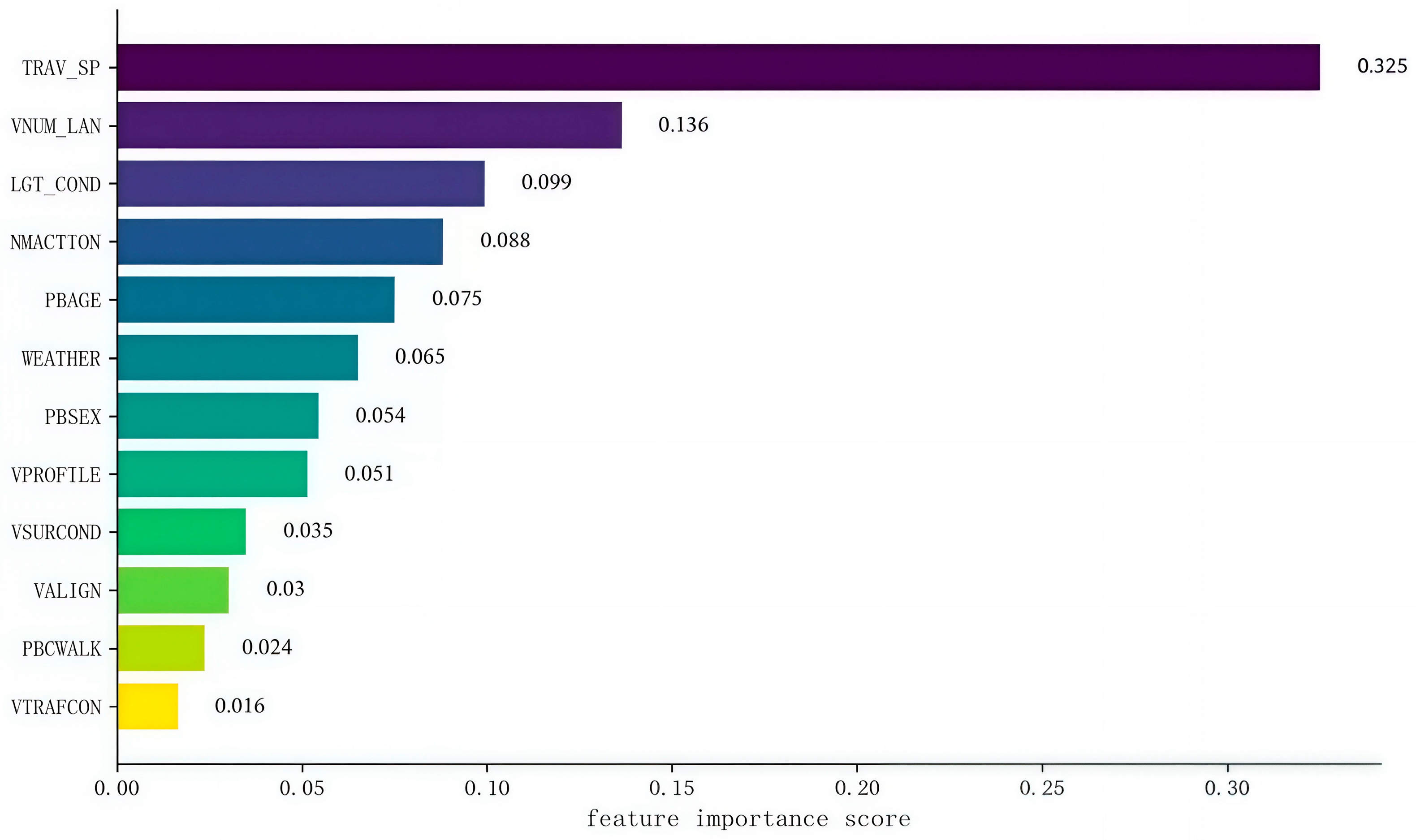
| Dimension | Setting Elements | Importance Score |
|---|---|---|
| Pedestrian Elements | Direction of pedestrian movement | 0.0881 |
| Pedestrian age | 0.075 | |
| Sex of pedestrian | 0.0544 | |
| Vehicle Elements | Speed | 0.325 |
| Transportation | Lane number | 0.1363 |
| Road gradient | 0.0514 | |
| Roadmap conditions | 0.0348 | |
| Level of road curvature | 0.0302 | |
| Availability of crosswalks | 0.0236 | |
| Traffic control | 0.0163 | |
| Environment | Lighting conditions | 0.0993 |
| Weather conditions | 0.0651 |
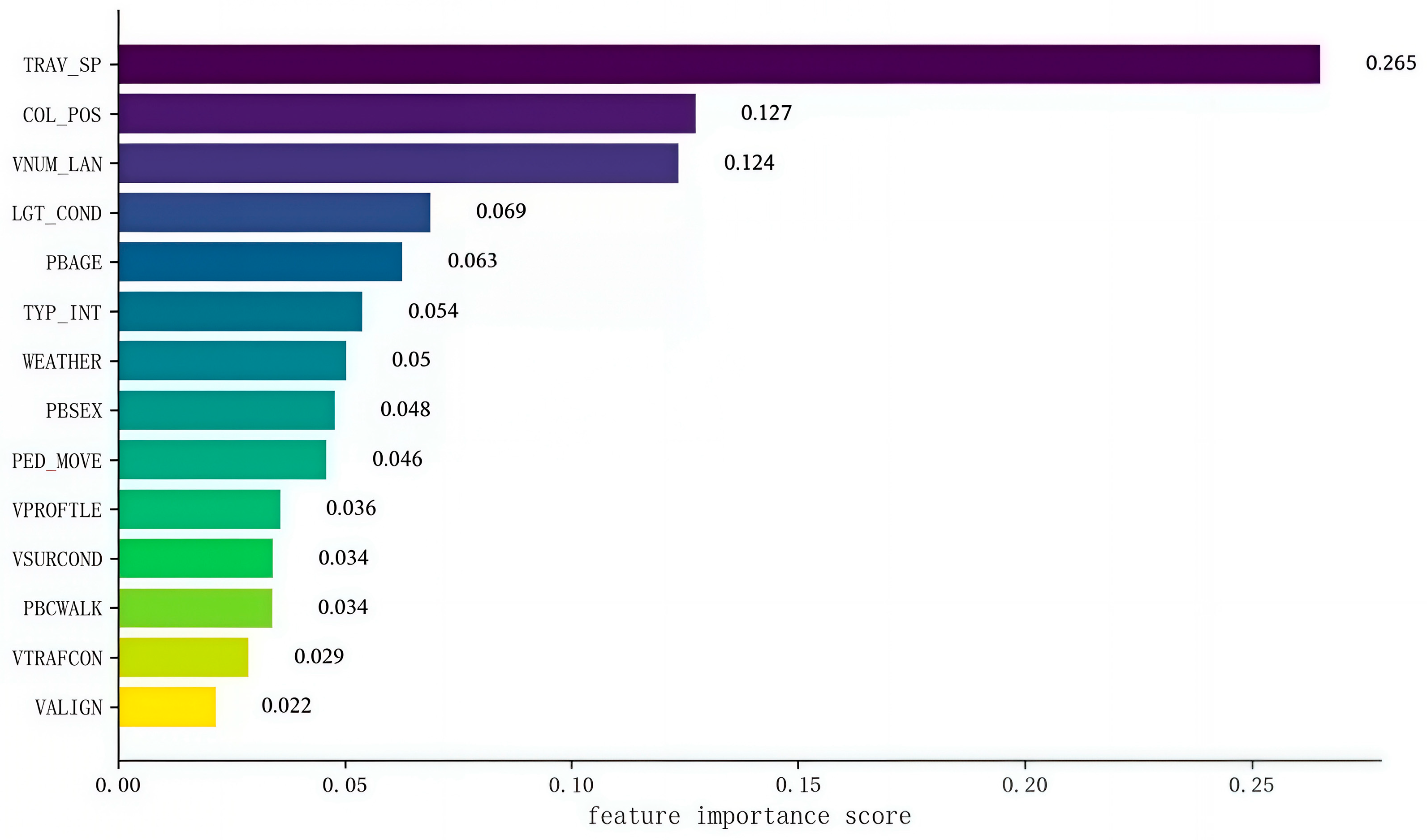
| Dimension | Setting Elements | Importance Score |
|---|---|---|
| Pedestrian Elements | Pedestrian age | 0.0626 |
| Sex of pedestrian | 0.0477 | |
| Direction of pedestrian movement | 0.0459 | |
| Vehicle Elements | Speed | 0.2652 |
| Transportation | Crash location | 0.1273 |
| Lane number | 0.1235 | |
| Intersection type | 0.0539 | |
| Road gradient | 0.0358 | |
| Roadmap conditions | 0.0341 | |
| Availability of crosswalks | 0.0339 | |
| Traffic control | 0.0287 | |
| Level of road curvature | 0.0215 | |
| Environment | Lighting conditions | 0.0689 |
| Weather conditions | 0.0503 |
| Features | Form | ||||
|---|---|---|---|---|---|
| S1 | S2 | S3 | S4 | S5 | |
| Direction of Pedestrian Movement | Concentric | Downward | Downward | Stationary | Downward |
| Sex of Pedestrian | Female | Female | Female | Female | Female |
| Pedestrian Age | Youth | Youth | Youth | Youth | Youth |
| Lane Number | Two | Two | Two | Two | Six |
| Road Gradient | Level | Level | Level | Level | Level |
| Roadmap Conditions | Dry | Dry | Dry | Dry | Dry |
| Level of Road Curvature | Linear | Linear | Linear | Linear | Linear |
| Crosswalks | No | No | No | No | No |
| Traffic Control | No | No | No | No | No |
| Lighting Conditions | No light at night | Daylight | Light at night | Daylight | No light at night |
| Weather Conditions | Sunny | Sunny | Sunny | Sunny | Sunny |
| Features | Form | ||||||
|---|---|---|---|---|---|---|---|
| J1 | J2 | J3 | J4 | J5 | J6 | J7 | |
| Direction of Pedestrian Movement | Driver’s left movement | Driver’s left movement | Driver’s left movement | Driver’s right movement | Driver’s left movement | Driver’s right movement | Driver’s left movement |
| Sex of Pedestrian | Female | Male | Male | Female | Male | Female | Male |
| Pedestrian Age | Youth | Youth | Youth | Youth | Youth | Youth | Youth |
| Crash Location | S2 | S2 | L1 | L1 | L1 | S1 | L1 |
| Lane Number | Two | Two | Six | Two | Two | Two | Three/four |
| Intersection Type | Intersection | T/Y intersection | Roundabout | Intersection | Intersection | T/Y intersection | Intersection |
| Road Gradient | Level | Level | Level | Level | Level | Level | Level |
| Roadmap Condition | Dry | Dry | Dry | Dry | Dry | Dry | Dry |
| Level of Road Curvature | Linear | Linear | Linear | Linear | Linear | Linear | Linear |
| Crosswalk | Yes | Yes | Yes | Yes | Yes | Yes | Yes |
| Traffic Control | Yes | Yes | Yes | Yes | Yes | Yes | Yes |
| Lighting Conditions | No light at night | Good daytime light | Good daytime light | No light at night | Good daytime light | No light at night | Good daytime light |
| Weather Condition | Sunny | Sunny | Sunny | Sunny | Sunny | Sunny | Sunny |
| Scene Number | Scene Schematic Diagram | Scene Description |
|---|---|---|
| S1 |  | At night without light a passenger car traveling in a two-lane roadway collided with a female youth walking in the same direction |
| S2 |  | In good daylight a passenger car traveling in a two-lane roadway collided with a female youth walking in a downward direction |
| S3 |  | At night with light a passenger car traveling in a two-lane roadway collided with a female youth walking in a perpendicular direction |
| S4 |  | In good daylight light a passenger car traveling on a two-lane roadway collided with a stationary female youth |
| S5 |  | At night without light a passenger car traveling in a six lane roadway collided with a female youth walking in a perpendicular direction |
| J1 |  | At night without light a passenger car traveling on a two-lane roadway at an intersection collides with a female youth coming from the driver’s left, collision location S2, speed 10–30 km/h |
| J2 |  | A passenger car traveling on a two-lane T/Y intersection in good daytime light collides with a male youth coming from the driver’s left side, collision position S2, speed 5–24 km/h |
| J3 | A passenger car traveling in good light during the daytime collides with a male youth coming from the driver’s left side, the collision position is L1 and the speed is 5–20 km/h | |
| J4 |  | A passenger car traveling at night without a license on a cross two-lane road collided with a female youth coming from the right side of the driver, collision position L1, speed 10–33 km/h |
| J5 |  | In good daytime light a passenger car traveling on a cross two-lane roadway collides with a male youth coming from the driver’s left, collision location L1, speed 5–15 km/h |
| J6 |  | At night without light a passenger car traveling on a two-lane T/Y intersection collides with a female youth coming from the driver’s left, collision position S1, speed 10–26 km/h |
| J7 |  | In good daytime light a passenger car traveling in three lanes at an intersection collides with a male youth coming from the driver’s right, the collision location is L1 and the speed is 10–30 km/h |
| Category | Scenario ID (This Study) | Corresponding Scenario in C-NCAP/Euro NCAP | Key Distinctions and Contributions of This Study |
|---|---|---|---|
| Pedestrian | S1 (Longitudinal, night, no light) | Adult longitudinal walking (Day/Night) | Specifies nighttime unlit condition, provides a speed range (20–45 km/h) derived from real data. |
| Pedestrian | S2, S3 (Transversal, day/night) | Near-/Far-side pedestrian crossing | Confirms standard scenarios but distinguishes lighting conditions (daylight vs. nighttime lit). |
| Pedestrian | S5 (Transversal, multi-lane, night) | Not covered | Novel scenario: Identifies high-risk crossing on six-lane roads, simulating urban arterials. |
| Intersection | J1, J4, J5, J7 (Various left-turn conflicts) | Vehicle turning (left/right) | Expands coverage: Includes pedestrians from both driver’s left and right, different collision locations (S2, L1), and data-driven speed ranges. |
| Intersection | J2, J6 (T/Y-intersection straight) | Not covered | Novel scenario: Covers straight-line collisions at T/Y-type intersections, with/without crosswalk. |
| Intersection | J3 (Multi-lane roundabout) | Limited/No coverage in protocols | Novel scenario: Represents complex multi-lane roundabout conflicts. |
Disclaimer/Publisher’s Note: The statements, opinions and data contained in all publications are solely those of the individual author(s) and contributor(s) and not of MDPI and/or the editor(s). MDPI and/or the editor(s) disclaim responsibility for any injury to people or property resulting from any ideas, methods, instructions or products referred to in the content. |
© 2026 by the authors. Published by MDPI on behalf of the World Electric Vehicle Association. Licensee MDPI, Basel, Switzerland. This article is an open access article distributed under the terms and conditions of the Creative Commons Attribution (CC BY) license.
Share and Cite
Luo, Y.; Zhan, Z.; Mao, Q.; Yi, Z. A Study of Typical P-AEB Test Scenarios Based on Accident Data. World Electr. Veh. J. 2026, 17, 114. https://doi.org/10.3390/wevj17030114
Luo Y, Zhan Z, Mao Q, Yi Z. A Study of Typical P-AEB Test Scenarios Based on Accident Data. World Electric Vehicle Journal. 2026; 17(3):114. https://doi.org/10.3390/wevj17030114
Chicago/Turabian StyleLuo, Yajun, Zhenfei Zhan, Qing Mao, and Zhenxing Yi. 2026. "A Study of Typical P-AEB Test Scenarios Based on Accident Data" World Electric Vehicle Journal 17, no. 3: 114. https://doi.org/10.3390/wevj17030114
APA StyleLuo, Y., Zhan, Z., Mao, Q., & Yi, Z. (2026). A Study of Typical P-AEB Test Scenarios Based on Accident Data. World Electric Vehicle Journal, 17(3), 114. https://doi.org/10.3390/wevj17030114