Article

Improving Coil Misalignment Performance in Wireless Power Transfer for Electric Vehicles Using Magnetic Flux Density Analysis


by
Pharida Jeebklum
1,
Takehiro Imura
2 and
Chaiyut Sumpavakup
1,3,*
1
Department of Power Engineering Technology, College of Industrial Technology, King Mongkut’s University of Technology North Bangkok, Bangkok 10800, Thailand
2
Faculty of Science and Technology, Tokyo University of Science, Chiba 278-8510, Japan
3
Centre for Modern Automotive Technology and Innovation, Techno Park, King Mongkut’s University of Technology North Bangkok, Bangkok 10800, Thailand
*
Author to whom correspondence should be addressed.
World Electr. Veh. J. 2026, 17(2), 81; https://doi.org/10.3390/wevj17020081
Submission received: 8 December 2025 / Revised: 23 January 2026 / Accepted: 2 February 2026 / Published: 6 February 2026
(This article belongs to the Section Vehicle and Transportation Systems)

Abstract

The efficiency of power transfer is a critical issue for wireless charging applications in electric vehicles. The misalignment between the transmitter coil and the receiver coil in wireless charging leads to a significant reduction in efficiency. This article investigates improving coil misalignment performance in wireless power transfer for electric vehicles using magnetic flux density analysis. The objective is to study the effect of the automatic alignment transmitter system’s movement on error distance. The automatic alignment transmitter system was integrated with a wireless power transfer system to realign the transmitter coil whenever lateral misalignment occurred between the transmitter and receiver coils. The experiment was performed with a horizontal misalignment of 0.35 m and was repeated three times. The gap between the coils was held constant at 0.15 m. The wireless charging system was designed according to the Society of Automotive Engineers (SAE) standard. The experimental results demonstrated that the movement error distance was 0.001 m, with an average error of 0.33%. These findings indicate that the automatic alignment transmitter system achieved an operational effectiveness of 99.67%. The maximum wireless charging efficiencies of 75.78% and 75.59% were recorded for the X-axis and Y-axis adjustments, respectively.

1. Introduction

Wireless charging of electric vehicles employs a transmitter coil positioned on the floor, while a power receiver coil is installed beneath the vehicle. The activation of the ground assembly generates electromagnetic flux that induces power in the vehicle assembly, thereby enabling wireless power transfer. Such systems offer both convenience and safety to users. The vehicle charging is initiated when the user parks within the designated charging area, whereupon the system initiates automatically. X. Zhang et al. [1] proposed a wireless charging system that achieved a maximum power transfer efficiency of 71% when the transmitter and receiver coils were perfectly aligned. The efficiency diminished as the gap or misalignment between the coils increased, with a minimum efficiency of 5% observed under significant misalignment. Similarly, C. Anyapo et al. [2] designed a configuration in which the transmitter coil and receiver coil were identical in size. The result demonstrated that power transfer efficiency declines with greater gaps and misalignments between the coils. S. Ghazizadeh et al. [3] simulated the coupling coefficient effect when misalignment occurs between the coils. The result was found that as the misalignment increased, the coupling coefficient decreased.
Wireless charging exhibits greater power loss within the power transfer system than wired charging. Such loss can arise from parking misalignment between the transmitter coil and the receiver coil or from an excessive air gap between the transmitter and receiver coil [1,2]. These conditions increase the magnetic flux leakage and thereby degrade wireless charging performance. Enhancing the efficiency of wireless charging systems can be effectively achieved by increasing the number of inductive coils and optimizing the associated circuitry. Y. Jia et al. [4] proposed an auxiliary coil on the receiving side. The result was found that the mutual inductance decreases under misalignment. However, the auxiliary coil keeps a higher level of mutual inductance in such conditions. A. R. Galib et al. [5] studied maximum efficiency using three coils. The result was found that the low coupling coefficient between coils affects the low power transfer efficiency. C. Fu [6] proposed the structure of the magnetic coupler. The transmitter coil is a double-D (DD). The receiver coil is a compact dual-coil. The result was found that a greater misalignment between the transmitter coil and receiver coil results in lower power transfer efficiency. S. Kodeeswaran et al. [7] proposed a two-transmitter coil design to minimize misalignment and enhance the performance of the static inductive wireless power transfer system. Both transmitter coils are designed with identical dimensions, and their inner and outer terminals are interconnected. The simulation results from LTspice and experimental data indicate that the proposed system transfers 1.95 kW of power with an efficiency of 93.07% when the gap between the coils is 150 mm. D. Ferdous et al. [8] developed a resonance-based inductive power transfer system for the wireless charging of autonomous underwater vehicles. Further, the performance of the wireless charging system was validated through simulation in the MATLAB/Simulink platform and verified through preliminary experimentation carried out in a 1 kW laboratory-scale hardware prototype. The experimental results in a saline water environment showcased a power transfer efficiency of 85–86% considering a gap of 3 cm between the transmitter and receiver coils. N. Rajamanickam et al. [9] proposed a simple nonlinear resonant circuit on the receiver side that enables misalignment-tolerant charging of these nodes without requiring precise positioning of the unmanned aerial vehicle. An unmanned aerial vehicle prototype with a power rating of 200 W and an operating frequency of 85 kHz was designed. The results illustrated that the power transfer efficiency remained stable over coupling distances from 5 cm to 10 cm. However, the efficiency of wireless power transfer decreased as lateral and angular misalignments increased. Y. Zhang et al. [10] simulated a hybrid topology to achieve misalignment tolerance using MATLAB/Simulink. As the receiver coil was displaced from 0 mm to 150 mm, the simulation results showed that the transfer efficiency remained steady despite the misalignment. This characteristic provides the wireless power transfer system with improved misalignment tolerance. Moreover, supplementary materials such as ferrite and metamaterials have been incorporated to suppress magnetic flux leakage and enhance wireless power transfer efficiency. S. Jaafari et al. [11] proposed optimizes circular coils with ferrite cores for inductive power transfer in electric cars. The circular coils were analyzed using ANSYS Electronics Suite R2-202 and the finite element method, focusing on the influence of the number of turns, inner radius, air gap, and misalignment on the coupling coefficient. The result was found that equivalent coils with ferrite boxes achieve the 95% efficiency target while producing a strong and more focused magnetic field at a lower cost. In contrast, inequivalent coils demonstrate superior capability in strengthening and centralizing the field while enhancing tolerance to misalignment through distinct mechanisms. S. Pahlavan et al. [12] presented the power transmission array configuration designed for moving objects in animal behavior research applications. The array addresses the challenges of receiver rotation and interruptions in power transfer. The results demonstrated that the system increased the received power to 146 mW and improved the transmitted power by 92 mW under receiver rotation. The transmitter array achieves an average power transfer efficiency of 18.2% and 11.5% under a 90° angular misalignment. In contrast, the conventional structure delivers no power to a perpendicular receiver coil and provides almost no power during rotation. W. O. Adepoju et al. [13] presented the ferrite-core metamaterial wireless power transfer model. Finite element Analysis (FEA) of the proposed design was conducted in the ANSYS simulation environment. The simulation results show that the proposed ferrite-core metamaterial generates higher mutual inductance and received power than a conventional wireless power transfer design. C. Lu et al. [14] proposed the model of a 3 × 3 matrix metasurface shield with resonance frequencies of 65 kHz and 190 kHz. The metasurface shield is located above the receiver coil. The gap between the receiver coil and metasurface shield is 10 cm. The results show that the metasurface shield can reduce the fundamental and harmonic magnetic flux density by 7.425 dB and 9.14 dB. The efficiency of the wireless power transfer system with the metasurface shield is 87.29%. M. Simonazzi et al. [15] investigate the use of a metamaterial slab for magnetic field shielding at a resonance frequency of 85 kHz. The comparison was between three different configurations. The result was found that the maximum values of the average shielding efficiency are almost 20 dB. P. Jeebklum et al. [16] proposed the design and development of the metamaterial slabs for a wireless charging system based on the Society of Automotive Engineers standard. The results illustrated that the edge metamaterial slab over the receiver coil reached a maximum efficiency of 75.87% at a misalignment of 0.10 m. In addition, the metamaterial slab over the receiver coil provided an efficiency 8.00% higher than the system without the metamaterial slab at a misalignment of 0.20 m. This proved that the metamaterial slab is important for increasing efficiency when misalignment occurs and for shielding the magnetic fields over the receiver coil. However, the misalignment between the transmitter and receiver coils affects the power transfer efficiency. One approach to improving the wireless charging efficiency is the automatic alignment of the transmitter and receiver coils. Vatsala et al. [17] proposed automatic adjustment of the receiver coil position and simulated the distribution effect of the magnetic field. The result was found that the coupling coefficient was varied by changing the alignment between the transmitter coil and receiver coil. The coupling coefficient is highest in the middle of the receiver coil when there is no misalignment, resulting in the highest power transfer efficiency. R. Chabaan [18] patented a method for the automatic adjustment of receiver coil position. The result was observed that the system can reduce the coils’ misalignment and increase the efficiency of wireless power transfer. The highest efficiency is when the coils are aligned. The efficiency is decreased with increasing misalignment in the horizontal plane. A. Ahmad et al. [19] proposed using a misalignment sensor between the transmitter coil and receiver coil. The result found that the misalignment between the coils reduced the coupling coefficient and mutual inductance. This can be solved by aligning the coils, thus, maximizing the efficiency of wireless power transfer. Y. Zhang et al. [20] proposed a wireless battery charging system in which the power transfer position can be automatically moved to the optimal charging placement for mobile devices. The wireless charging receiver and wireless charging transmitter are communicated by the Bluetooth module. As a result, the wireless charging receiver is adjusted to the optimal battery charging position. For this reason, the misalignment between the transmitter coil and the receiver coil must be minimized. In conventional wireless charging systems for electric vehicles, automatic alignment of the receiver coil requires the installation of dedicated hardware on every vehicle. This article instead proposes shifting the alignment mechanism to the infrastructure side by enabling autonomous adjustment of the transmitter coil in order to reduce overall costs, minimize the number of onboard components, and alleviate payload penalties. In addition, the automatic coil positioning system contributes to the efficient operation of the wireless power transfer.
The following are the major contributions of the proposed article:
(1)
This article designs methods for the automatic adjustment of the transmitter coil position in the event of misalignment with magnetic flux density analysis.
(2)
The automatic alignment transmitter system is employed in electric vehicle wireless charging applications that are designed in accordance with the SAE standard J2954 [21].
This article proposes improving coil misalignment performance in wireless power transfer for electric vehicles using magnetic flux density analysis. The content is organized into five main sections. Section 2 examines the effect of misalignment on wireless charging systems. Section 3 shows the simulation of wireless charging. Section 4 presents the design of the proposed automatic alignment transmitter system. Section 5 provides the results and discussion. Finally, Section 6 concludes the study.

2. Effect of Misalignment on Wireless Charging System

The standard of wireless power transfer for light-duty plug-in/electric vehicles and alignment methodology is determined by the SAE [21]. In the J2954 standard, power classes and frequency ranges are defined. The maximum input volt-amps that can be obtained from the grid connection determines the power classes for wireless power transfer. In power class WPT 1, the maximum input volt-amps is 3.7 kVA. For wireless power transfer, the frequency range of 79 kHz to 90 kHz specified in SAE no. J2954 must be utilized. For design, the frequency range and power classes will be decided. The ground assembly (GA) controls the frequency. A commonly used frequency is 85 kHz [22,23,24], and a minimum efficiency of 85% or higher is expected [25,26]. The design of a wireless power transfer system using a resonant circuit is one of the most effective methods for maximizing the efficiency of wireless power transfer [27,28,29].
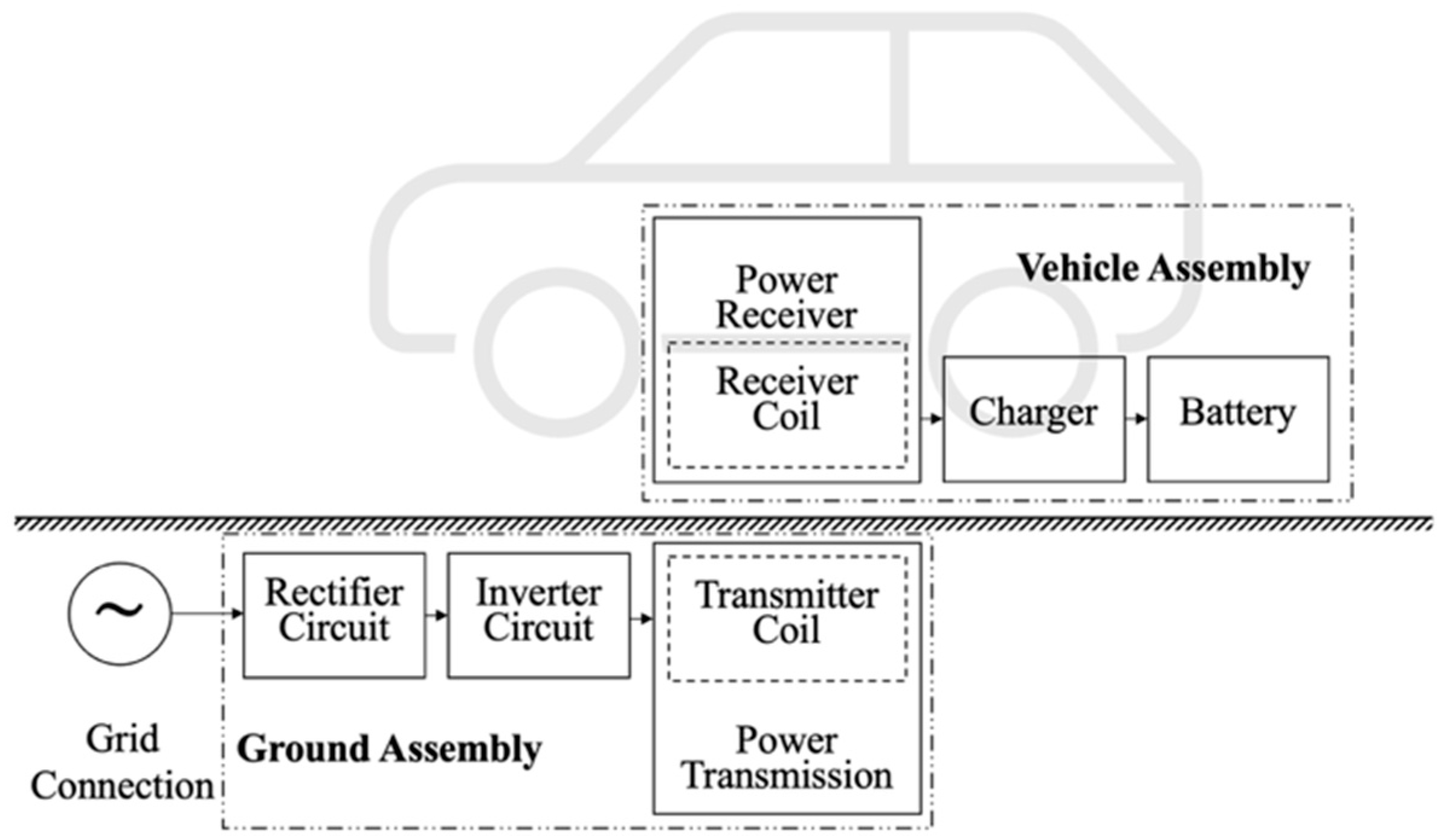
The induction principle is employed between the power transmitter and receiver sections of the wireless charging system for electric vehicles, as illustrated in Figure 1. The ground assembly and vehicle assembly constitute the two primary components of the wireless charging system. An AC power source from the grid connection supplies power to the ground assembly. The input power ( P IN ) is measured at the grid connection and can be calculated for three-phase electrical systems using Equation (1). The rectifier circuit subsequently converts the input electricity into DC power. The inverter circuit then performs a high-frequency conversion back to AC power. A series-connected inductor and capacitor form a resonant circuit that enables power transmission. Subsequently, power is transferred via the inductor coil. The power in the transmitter coil generates a magnetic field and induces the inductor coil of the receiver. The receiver coil connected in series with a capacitor thus constitutes the resonant circuit of the power receiver. Finally, the charger replenishes the battery by converting the high-frequency AC power into DC power. The output power ( P OUT ) is measured at the battery and can be calculated from Equation (2). The wireless charging efficiency ( η ) is expressed in Equation (3) [22].
P IN = 3 VICOS θ
P OUT = VI
η = P OUT P IN ·   100
where V is voltage, I is current, and COSθ is the power factor.
A. M. Gebril et al. [30] designed procedure of a non-conventional high-efficiency wireless power transfer system with great tolerance to lateral misalignment conditions. The result was found that the coupling coefficient affects the power transfer efficiency. As the coupling coefficient increases, the power transfer efficiency also increases. B. Annaselvaraj et al. [31] investigated the mutual inductance between the transmitter and receiver coils under various coil structures and misalignment conditions. Circular, square, and rectangular coil configurations were proposed. The result was found that the mutual inductance in the wireless power transfer system decreases as misalignment between the coils increases. The misalignment between the transmitter and receiver coils limits the efficient design of wireless power transfer circuits for recharging wireless sensor nodes. T. Debnath et al. [32] investigate the impact of misalignment on energy coupling between coils and propose a low-cost solution to address the issue. The results indicate that the pentagon coil achieves over 99% energy transfer efficiency, with tolerances of up to 15° angular and 0.02 m horizontal misalignment. Furthermore, the pentagon coil exhibits a high degree of stability. The variation in the coupling coefficient under misaligned conditions is only 5%. This low variation makes the pentagon coil a promising solution for robust wireless power transfer systems in transportation. S. Viqar et al. [33] proposed a highly efficient series–series compensation topology wireless power transfer system using a rectangular coil. The system operates at a resonant frequency of 85 kHz. Simulations with Ansys Maxwell 14.0 show that vertical misalignment between the transmitter and receiver coils reduces the coupling coefficient and mutual inductance. These two parameters exert the most significant influence on the wireless power transfer efficiency. The maximum efficiency is expressed in Equation (4) [33,34].
η MAX = K 2 Q P Q S 1 + 1 + K 2 Q P Q S 2
K = M L P L S
Q P = ω L P R P ,     Q S = ω L S R S
where K is the coupling coefficient that is expressed in Equation (5), QP and QS are the quality factors of the transmitter and receiver sides that can be calculated from Equation (6), M is mutual inductance, LP and LS are inductances of the transmitter and receiver coils, respectively, ω is resonant frequency, and RP and RS are the resistance of the transmitter and receiver coils, respectively.
From Equation (4), the product of the coupling coefficient and the quality factor determines the maximum wireless power transfer efficiency. These two critical characteristics depend on the position of the transmitter and receiver coils and the gap between the coils, as well as the coil size and shape. The main objective of wireless power transfer design is to achieve maximum efficiency. Therefore, the transmitter and receiver coils should be perfectly aligned to maximize the transferred power [27,33,35].
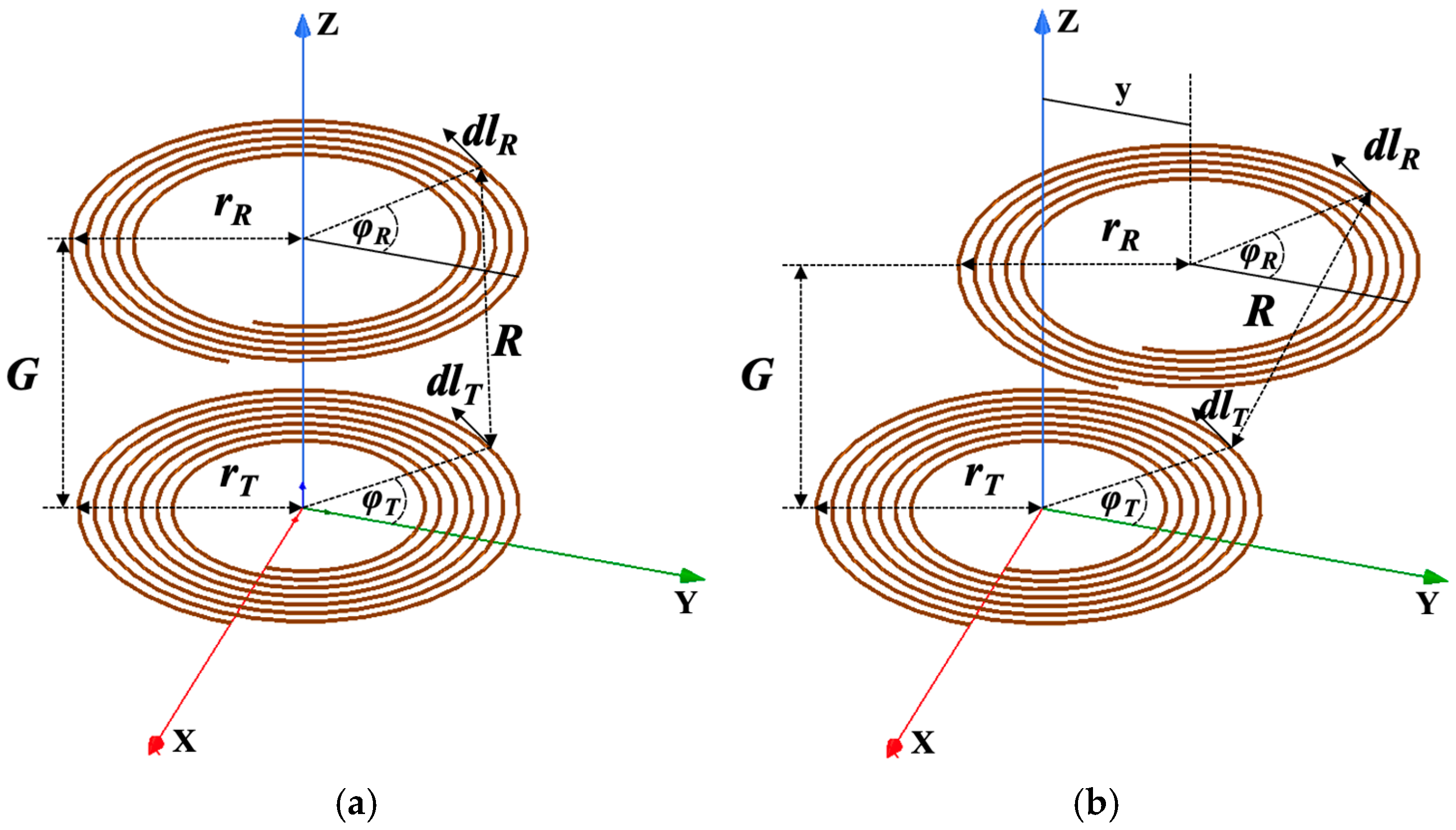
The misalignment between the transmitter and receiver coils significantly impacts both power transfer and efficiency. Figure 2 shows that when the coils are laterally misaligned, the distance between arbitrary points on the coils changes. The variation affects the mutual inductance, as described in Equation (7) [36]. The mutual inductance influences both the coupling coefficient and the inductance of the coils. The inductance and current are directly related to magnetic flux, as shown in Equation (8). The inductance serves as a coefficient indicating the amount of magnetic flux generated by the current [34]. The magnetic flux density is calculated based on the magnetic flux per unit surface area, as shown in Equation (9) [19]. The misalignment between the transmitter and receiver coils leads to a non-uniform distribution of magnetic flux density across the receiver coil.
M = μ 0 4 π c 1 c 2 1 R d l 1 d l 2
= LI
B = A
where μ0 is vacuum permeability, R is the distance between dl1 and dl2, d l expresses a line integral, ϕ is magnetic flux, L is inductance, B is magnetic flux density, and A is area.

2.1. Designing Wireless Charging for Electric Vehicles

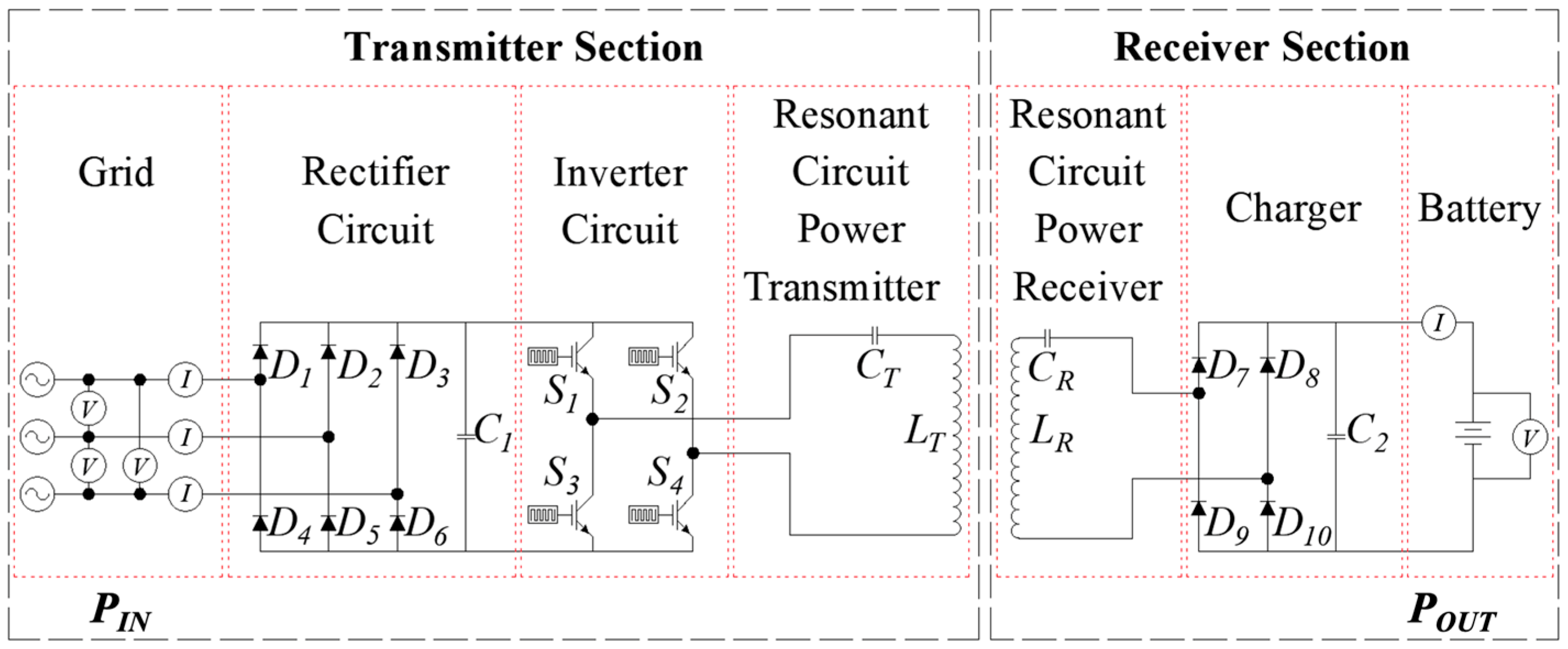
The circuit for a wireless charger is illustrated in Figure 3, which is separated into two sections: the transmitter and the receiver. The proposed stationary wireless charger complies with the SAE no. J2954 power classes WPT 1 that the maximum input volt-amps is 3.7 kVA. The transmitter section consists of a grid connection, a rectifier circuit, an inverter circuit, and a resonant power transmission circuit. A resonance circuit power receiver, charger, and battery with a 380 V 75 Ah rating for light-duty electric vehicles constitute the receiver part. The wireless charging system is installed to operate with conversion electric vehicles with a width and length of 1.72 m and 3.84 m, respectively.

2.1.1. Transmitter Section

The induction between the transmitter and receiver coils is a principle of wireless power transfer. Power generation and transfer to the receiver section are the responsibilities of the transmitter section. The AC grid connection is three-phase 380 V 50 Hz. Then, the rectifier circuit converted the power of the AC grid connection to direct-current power. After that, the inverter converted the direct-current power to alternating-current power with high frequencies so that power can be transferred. The frequency of wireless charging for light-duty electric vehicles according to the SAE No. J2954 is in the range of 79 kHz to 90 kHz. The resonance circuit power transmitter is responsible for transferring power to the receiver section. The resonance circuit has an S-S topology. The capacitance of the resonance circuit power transmitter is 2 nF. The inductance of the transmitter coil can be calculated from Equation (10) to be equal to 1900 µH [16,37]. The resonance frequency can be calculated to be 81.64 kHz. The transmitter coil is circular with a diameter of 0.72 m, which can be calculated from Equation (11) [16]. This diameter is selected to maintain compatibility with the electric vehicle’s suspension while providing adequate surface area for effective power reception. The parameters of the coils are summarized in Table 1.
L   = ( 0.0196 N ( D I + ( W + S ) N ) ) 2 0.1574 ( D I + ( W + S ) N ) + 0.4323 ( W + S ) N
D O = D I + 2 S ( N     1 ) + 2 WN
where N is the number of turns of the coil, DI is the internal width of the coil, W is the conductor width of the coil, and S is the conductor spacing of the coil.

2.1.2. Receiver Section

The resonance circuit power receiver receives power from the transmitter section. Since the resonance circuit uses an S-S topology, the capacitance and inductance values are set to match those of the resonance circuit power transmitter. K. Aditya et al. [38] investigated five diverse unsymmetrical coil pairs to identify the configuration that is least sensitive to misalignment. The position of the magnetic null shifts as the separation between the unsymmetrical coils changes. This shift moves the null position further away from the coil center, thereby increasing the effective area. To achieve an optimal coupling profile, the results indicate that the inner radius of the receiver coil should be larger than that of the transmitter coil. The charger converts the alternating current received from the transmitter section into direct current for the battery.

2.1.3. Efficiency of Wireless Charging

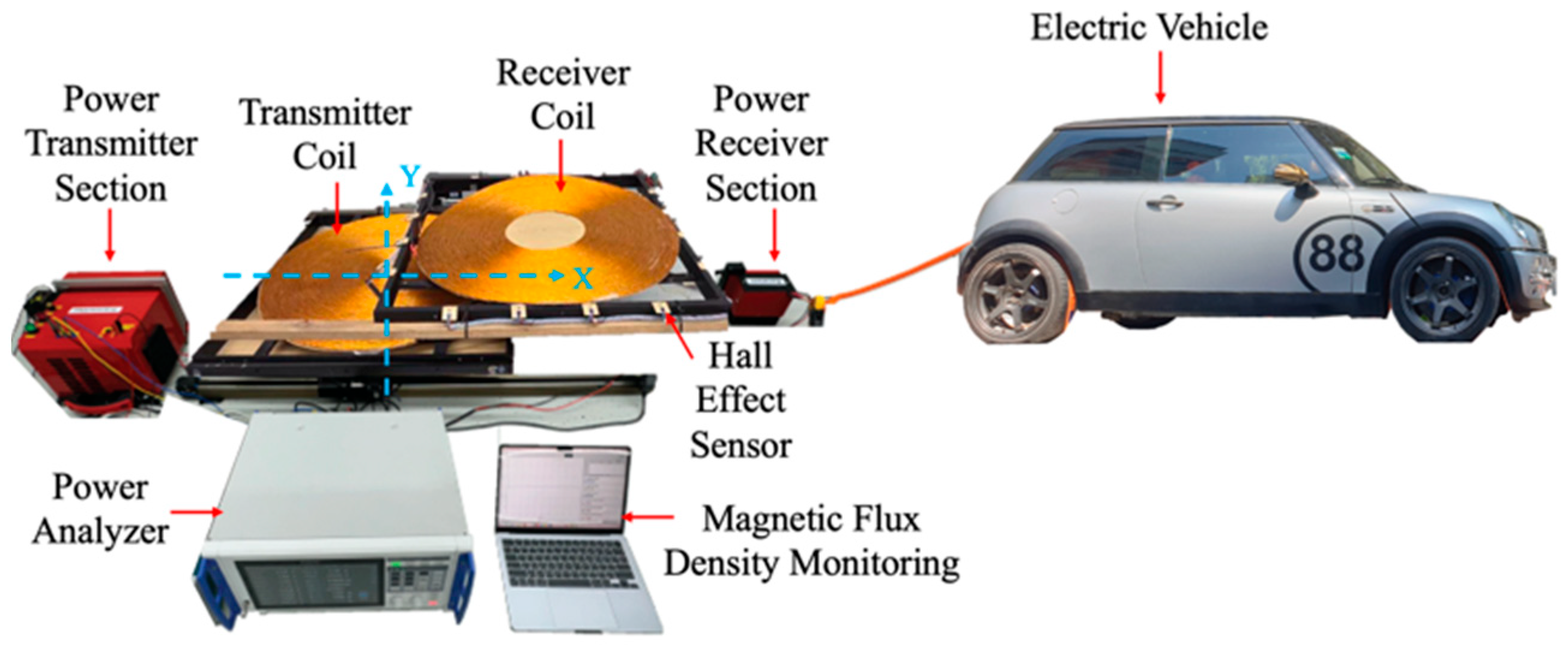
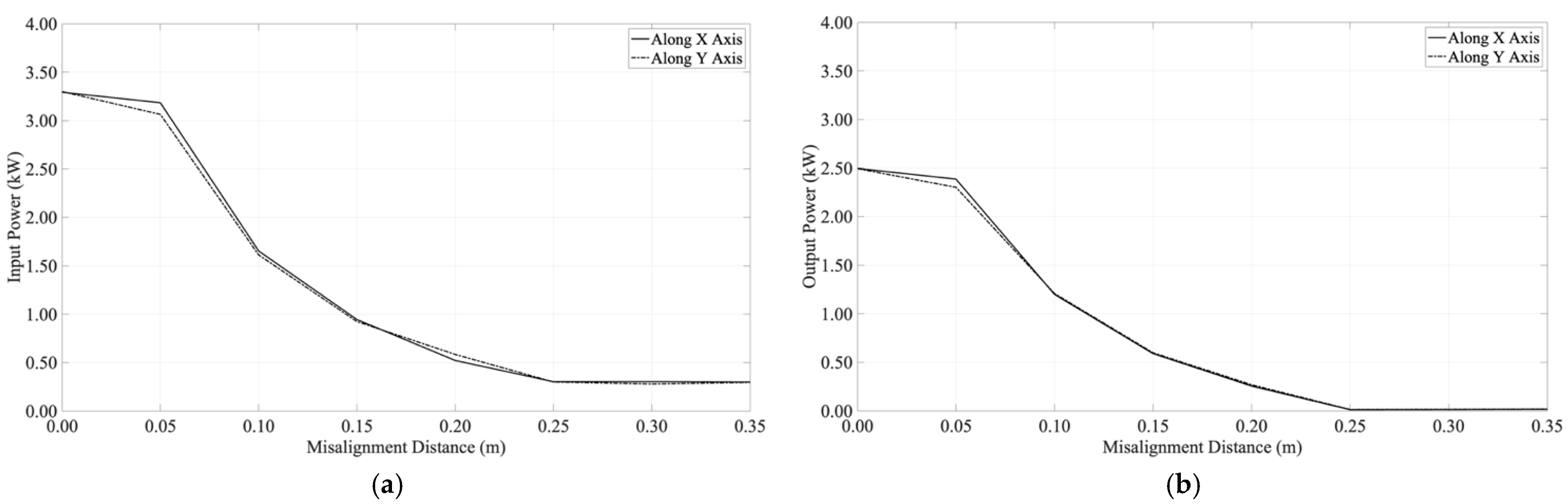
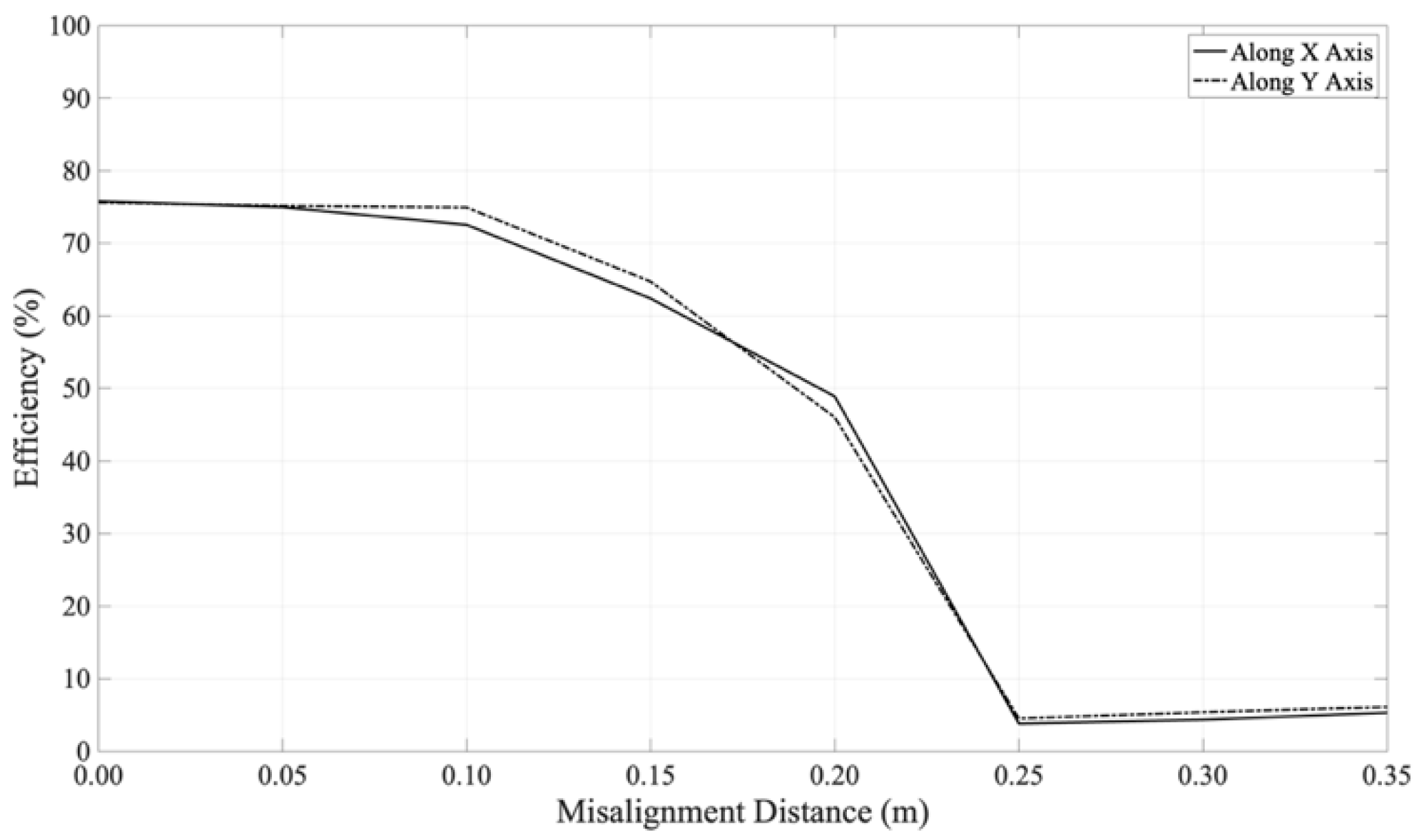
Wireless charging is configured to evaluate the effects of lateral misalignment along the x- and y-axes of the coil in the horizontal plane, as illustrated in Figure 4. The input power is measured at the grid connection, while the output power is measured at the battery terminal (See Figure 3). The input and output power of the wireless power transfer system are presented in Figure 5a,b, respectively. Figure 6 illustrates the efficiency of the wireless power transfer system, as calculated using Equation (3).
The power values of wireless charging, as measured by the Power Analyzer (Hioki E.E. Corporation, Nagano, Japan), are presented in Figure 5. According to the experimental results of the wireless charging, the maximum input power at the alignment position was 3.29 kW and 3.30 kW for the x-axis and y-axis, respectively. The maximum output power at the alignment position was 2.50 kW and 2.49 kW for the x-axis and y-axis, respectively. At the misalignment position of 0.05 m, the input power was recorded as 3.18 kW and 3.06 kW for the x-axis and y-axis, respectively. The output power at the same misalignment position was 2.39 kW and 2.30 kW for the x-axis and y-axis, respectively. In relation to the diameter of the coil, the misalignment of 0.05 m is relatively small. Therefore, the power of the wireless charging remains high. As the transmitter and receiver coils are aligned, the power reaches the maximum of the wireless charging. The increase in the misalignment distance results in a significant decrease in power. The power is lowest at misalignment positions greater than 0.25 m, which shows that the wireless charging could hardly transfer power.
The efficiency values of the wireless charging are presented in Figure 6. According to the experimental results of the wireless charging, the maximum efficiency at the alignment position was 75.78% and 75.60% for the x-axis and y-axis, respectively. At the misalignment position of 0.05 m, the efficiency was recorded as 74.94% and 75.12% for the x-axis and y-axis, respectively. As the misalignment distance increases, the efficiency of the wireless charging decreases significantly. At misalignment distances greater than 0.25 m, the wireless charging efficiency decreases to below 10%. Table 2 illustrates the power and efficiency values of the wireless charging.
The results of the wireless charging experiments demonstrated that when the transmitter and receiver coils are properly aligned, the efficiency of the wireless charging is as high as possible. A misalignment between the transmitter and receiver coils significantly affects both power transfer and efficiency. This effect is directly related to the misalignment distance, with larger misalignment distances resulting in a greater reduction in efficiency. In practical applications where wireless charging is integrated with electric vehicles, charging may be inefficient due to the excessive misalignment distance between the coils. Therefore, minimizing the misalignment distance between the coils should be considered to ensure effective power transfer.

3. Simulation of Wireless Charging

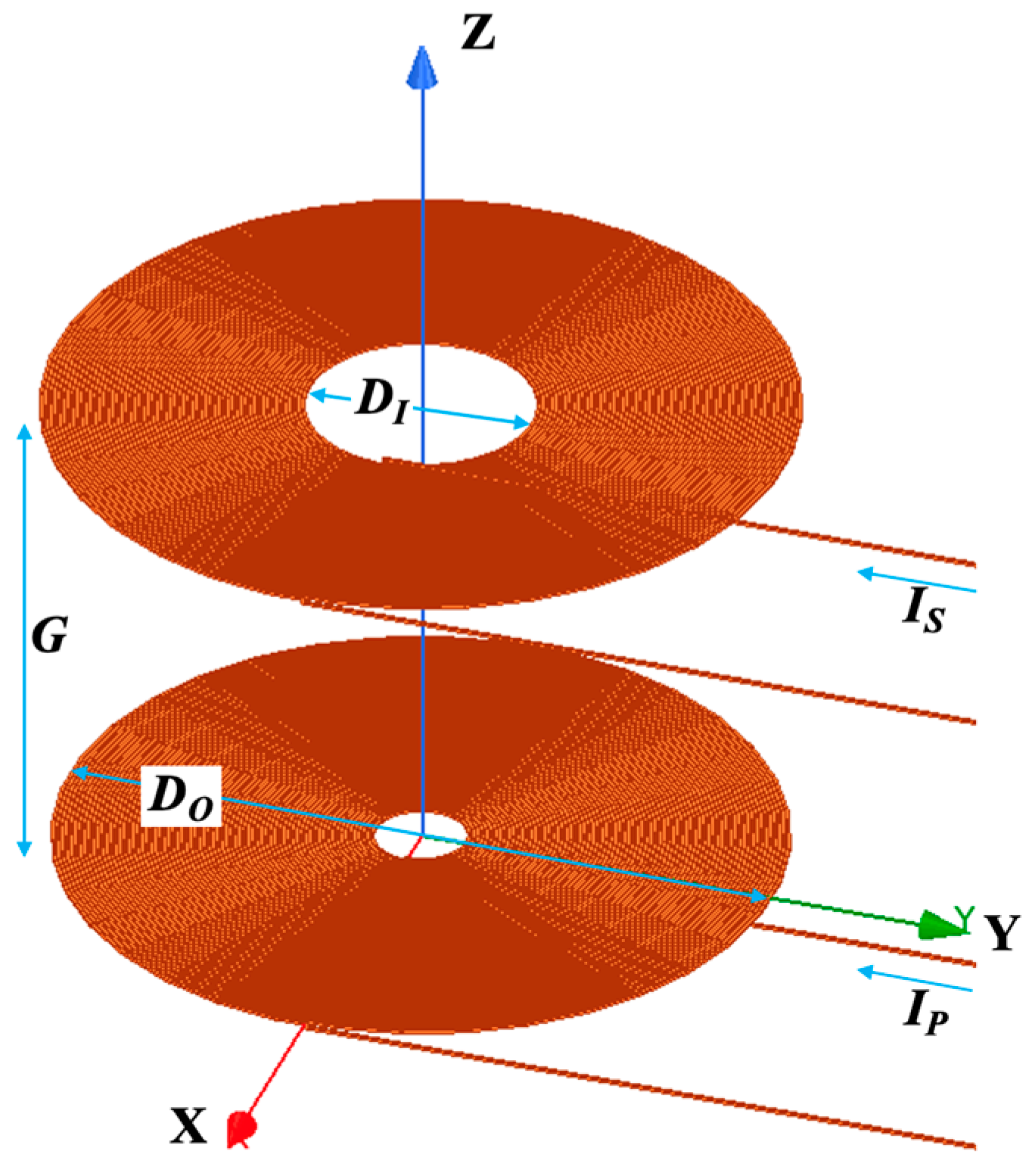
The magnetic flux density of the transmitter and receiver coils is simulated using finite element analysis on Ansys Maxwell (v2020R1). The parameters of the coils are those considered in Table 1. The current used in the simulation is consistent with the experimental results of wireless charging. The finite element analysis model of the transmitter and receiver coils is illustrated in Figure 7.
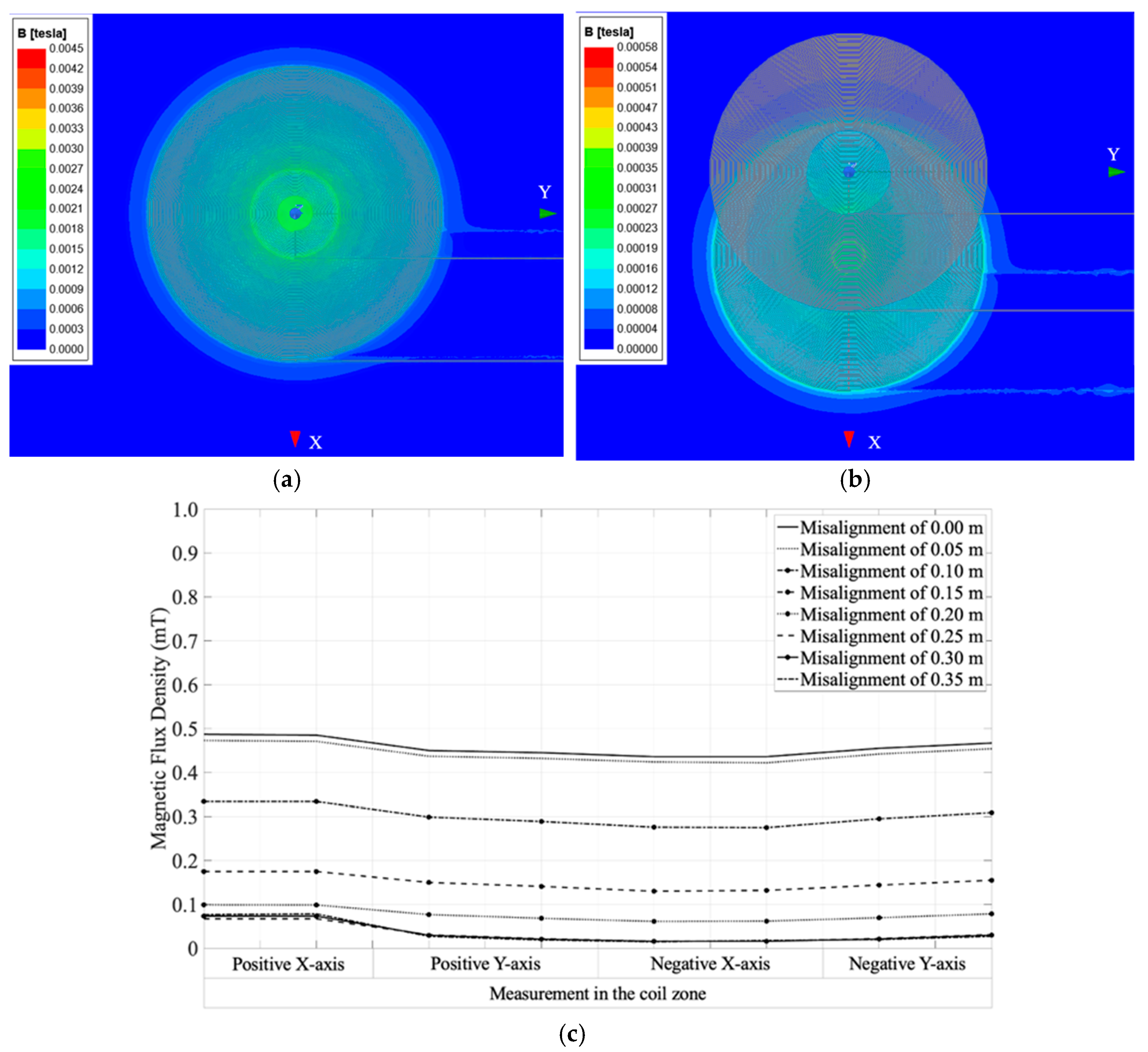
The finite element analysis result is shown in Table 3. The magnetic flux density on the receiver coil under the coil’s alignment and misalignment conditions are illustrated in Figure 8a and Figure 8b, respectively. The magnetic flux density when the coil is misaligned along the positive X-axis with measurement in each coil zone is summarized in Figure 8c. The simulation result with a misalignment condition along the positive X-axis is shown in Table 4.
From the simulation results, the finite element analysis result presented in Table 3 shows the parameters of the transmitter and receiver coils under aligned conditions. The simulation result found that the inductance of the coils is close to the designed value, with the magnetic flux of the receiver coil being approximately 0.0183 Wb. The magnetic flux density at the receiver coil was measured at a height of 0.05 m above the coil to illustrate variations in the magnetic flux density in four directions around the receiver. Figure 8a,b compare the magnetic flux density on the receiver coil under aligned conditions and under a misalignment of 0.25 m. The result can be observed that misalignment between the transmitter and receiver coils causes a reduction in the magnetic flux density on the receiver coil. Figure 8c shows the magnetic flux density when the coils are misaligned along the positive X-axis, with measurements taken across each coil zone. The results indicate a clear decrease in magnetic flux density as the degree of misalignment increases. In addition, coil misalignment leads to a reduction in mutual inductance and the coupling coefficient, as shown in Table 4. This reduction ultimately affects wireless power transfer efficiency.

4. Designing Automatic Alignment Transmitter System

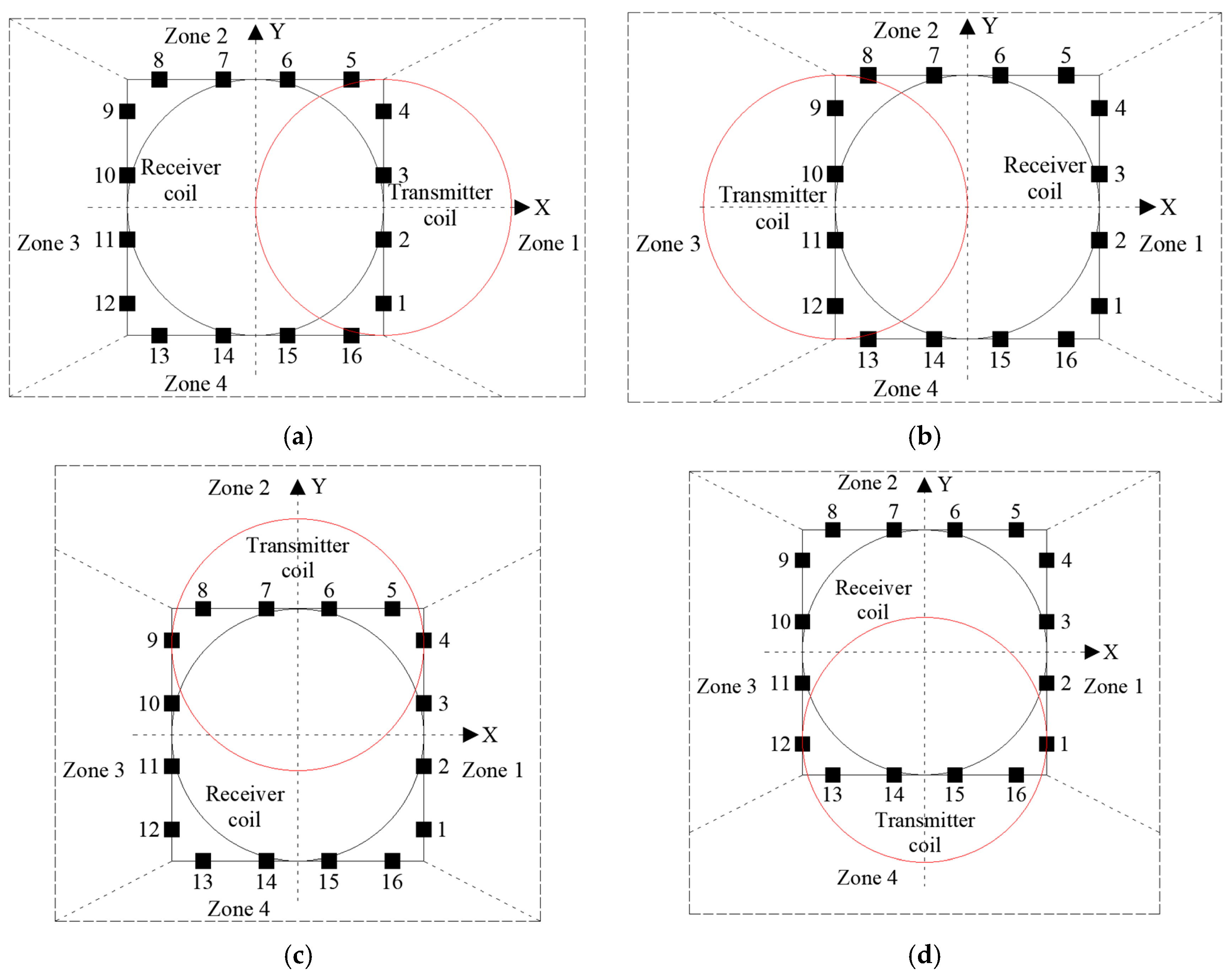
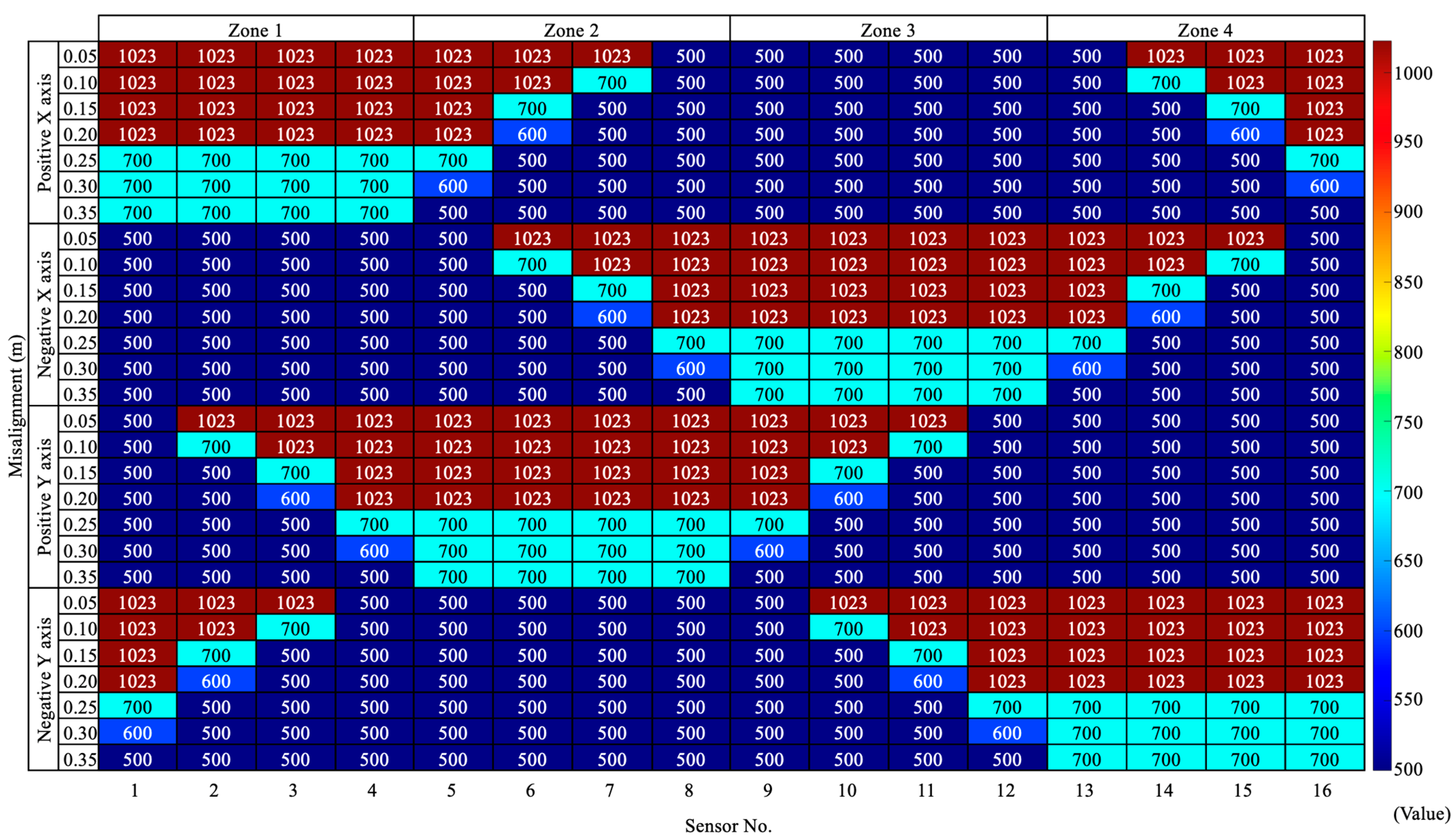
For different misalignment distances, the magnetic flux density at each position of the coil has a different value. As shown in Figure 9, the magnetic flux density of the receiver coil is measured across four zones to represent all possible coil misalignment conditions. The change in magnetic flux density is measured by the hall effect sensor model SS49E Series (Honeywell International Inc., Charlotte, NC, USA). The 16 sensors are employed because the receiver coil has a relatively large area and the hall effect sensors have a limited measurement range. The four sets of hall effect sensors are installed in each zone, as illustrated in Figure 9. The measurements of magnetic flux density changes by the 16 sets of hall effect sensors are conducted during wireless power transfer when misalignment occurs along the positive X-axis, negative X-axis, positive Y-axis, and negative Y-axis, with misalignment distances ranging from 0.05 m to 0.35 m. In each zone, four sets of hall effect sensors are employed to characterize the relative misalignment distance of two neighboring zones. Therefore, the sensor may determine the distance of coil misalignment at different positions. The measurements of the magnetic flux density along the positive X-axis, positive Y-axis, negative X-axis, and negative Y-axis of the receiver coil zone in Figure 8c correspond to Zone 1, Zone 2, Zone 3, and Zone 4 of the hall effect sensor area, respectively. The magnetic flux density reaches a maximum value in the positive X-axis zone when the coils are misaligned along the positive X-axis, as the transmitter coil is oriented in the same direction as the misalignment. Conversely, the magnetic flux density in the negative X-axis zone under the same misalignment condition reaches a minimum value because the transmitter coil is oriented in the opposite direction to the misalignment. The misalignment along the positive X-axis results in a non-uniform magnetic flux density distribution in the positive and negative Y-axis zones, with higher values occurring in regions closer to the misalignment direction. The changes in magnetic flux density measured using the hall effect sensors are presented in Figure 10.
Figure 10 shows the changes in magnetic flux density when there is misalignment between the transmitter coil and the receiver coil along the positive X-axis, negative X-axis, positive Y-axis, and negative Y-axis, with a misalignment distance ranging from 0.05 m to 0.35 m. The values shown in Figure 10 present analog readings obtained from the microcontroller rather than actual magnetic flux density values. These readings reflect variations in magnetic flux density caused by coil misalignment. These values are used to adjust the position of the transmitter coil. The misalignment causes the magnetic flux density to increase in the zone corresponding to the direction of misalignment, while the opposite zone exhibits the lowest magnetic flux density. Therefore, the automatic alignment transmitter system moves in the direction with the lowest magnetic flux density value.
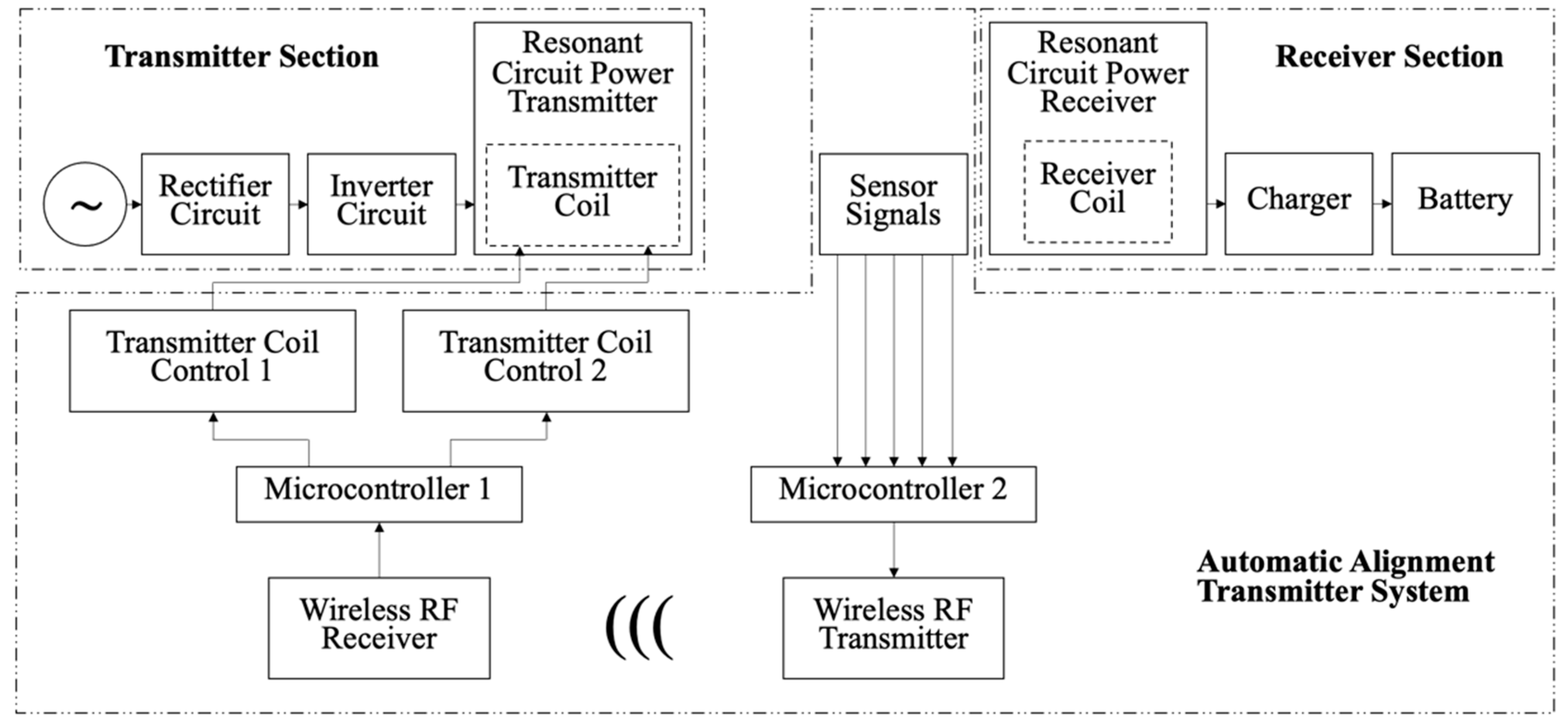
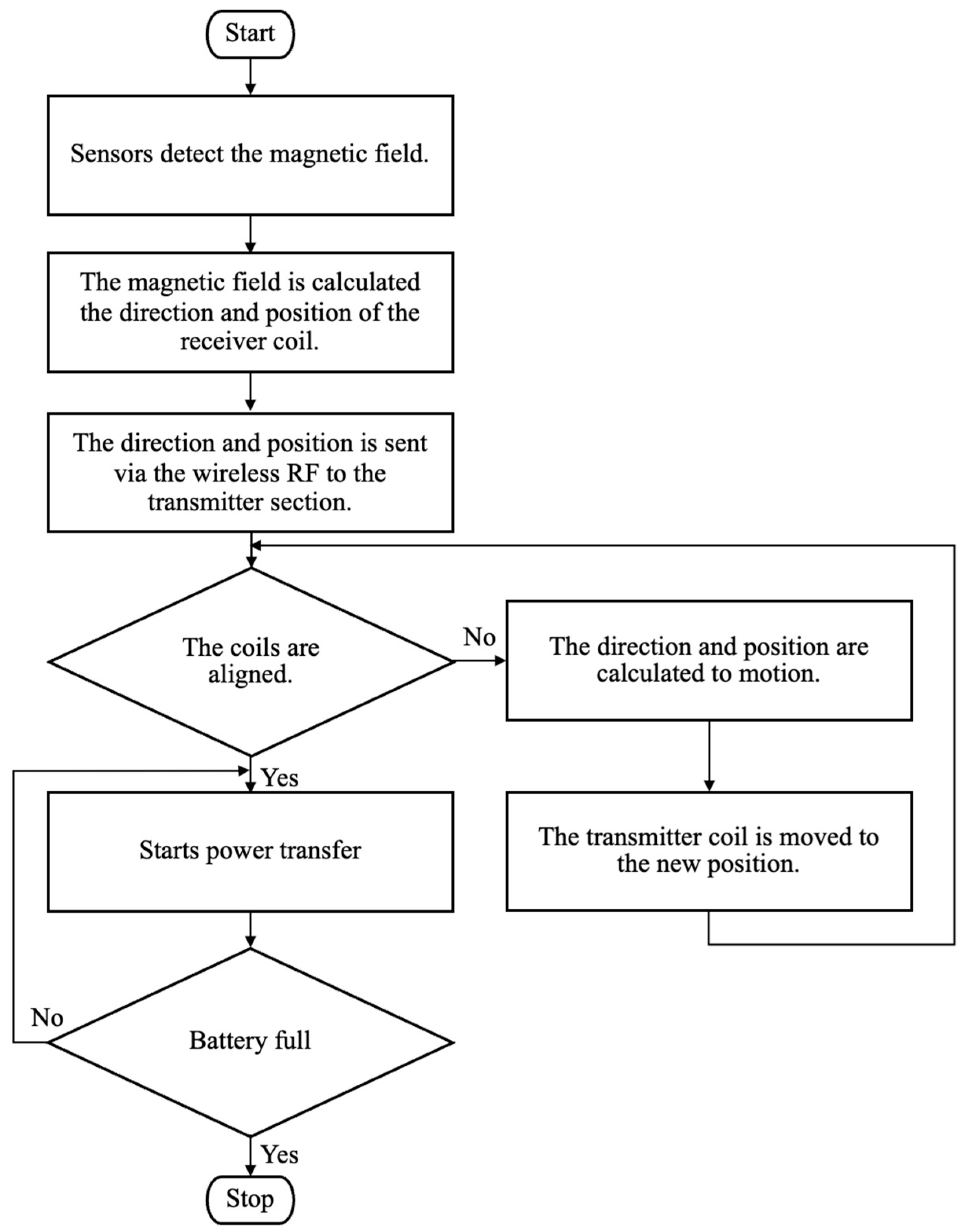
The automatic alignment transmitter system is illustrated in Figure 11. A total of 16 magnetic flux density sensor sets is installed on the frame of the receiver coil, as shown in Figure 9. When misalignment occurs in the plane and at different distances, the magnetic flux density values of each set of magnetic flux density sensors will be different. The division of the magnetic flux density measurement area for each set of magnetic flux density sensors during misalignment is shown in Figure 9. The categorization includes misalignments along the positive X-axis, negative X-axis, positive Y-axis, and negative Y-axis, with misalignment distances ranging from 0.05 m to 0.35 m. Microcontroller number 2 reads the magnetic flux density values and processes the data before transmitting the information to microcontroller number 1 via the wireless data transmission unit or wireless RF. Microcontroller number 1 estimates the required movement in both planes and controls the movement of the transmitter coil. The operation diagram of the automatic alignment transmitter system is shown in Figure 12.
The operation of the automatic alignment transmitter system is illustrated in Figure 11. First, the user commands the wireless charging. The transmitter section supplies electricity to the wireless power transfer system. The magnetic flux density sensors attached to the receiver coil receive the magnetic flux density values. Then, the magnetic flux density values are calculated by microcontroller number 2 to determine the direction and position of the receiver coil. After that, microcontroller number 2 sends the direction and position data to microcontroller number 1 via the wireless RF data transmission unit. Microcontroller number 1 evaluates whether the transmitter coil is aligned with the receiver coil. In cases where misalignment is detected, the received direction and position data of the receiver coil are utilized to estimate the position in the two-dimensional plane and to control the movement of the transmitter coil. The system then re-evaluates the alignment condition. If the transmitter coil and the receiver coil are aligned, the wireless charging system starts transferring power to the battery. Once the battery is fully charged, the wireless charging system ceases operation. The automatic alignment transmitter system also stops accordingly.
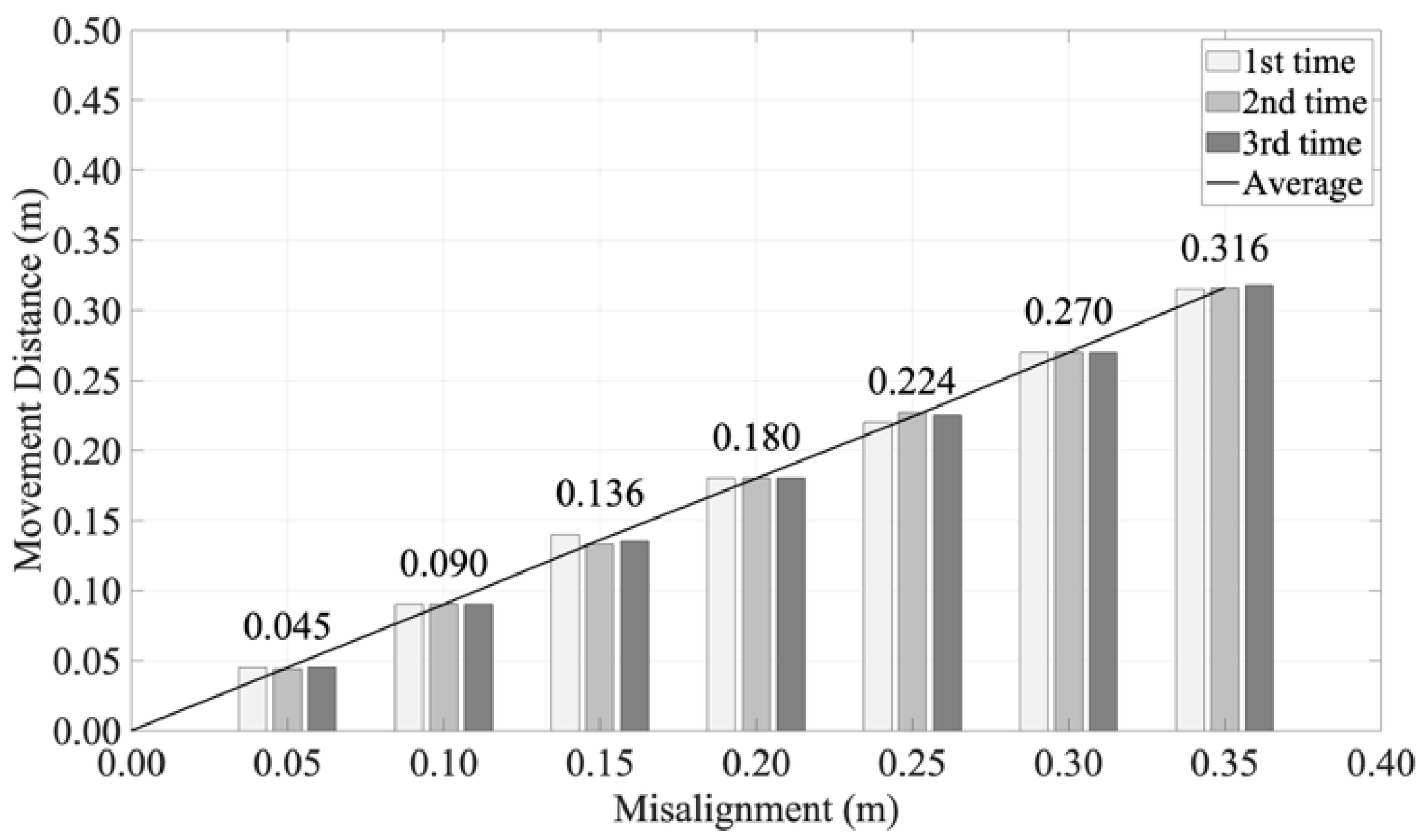
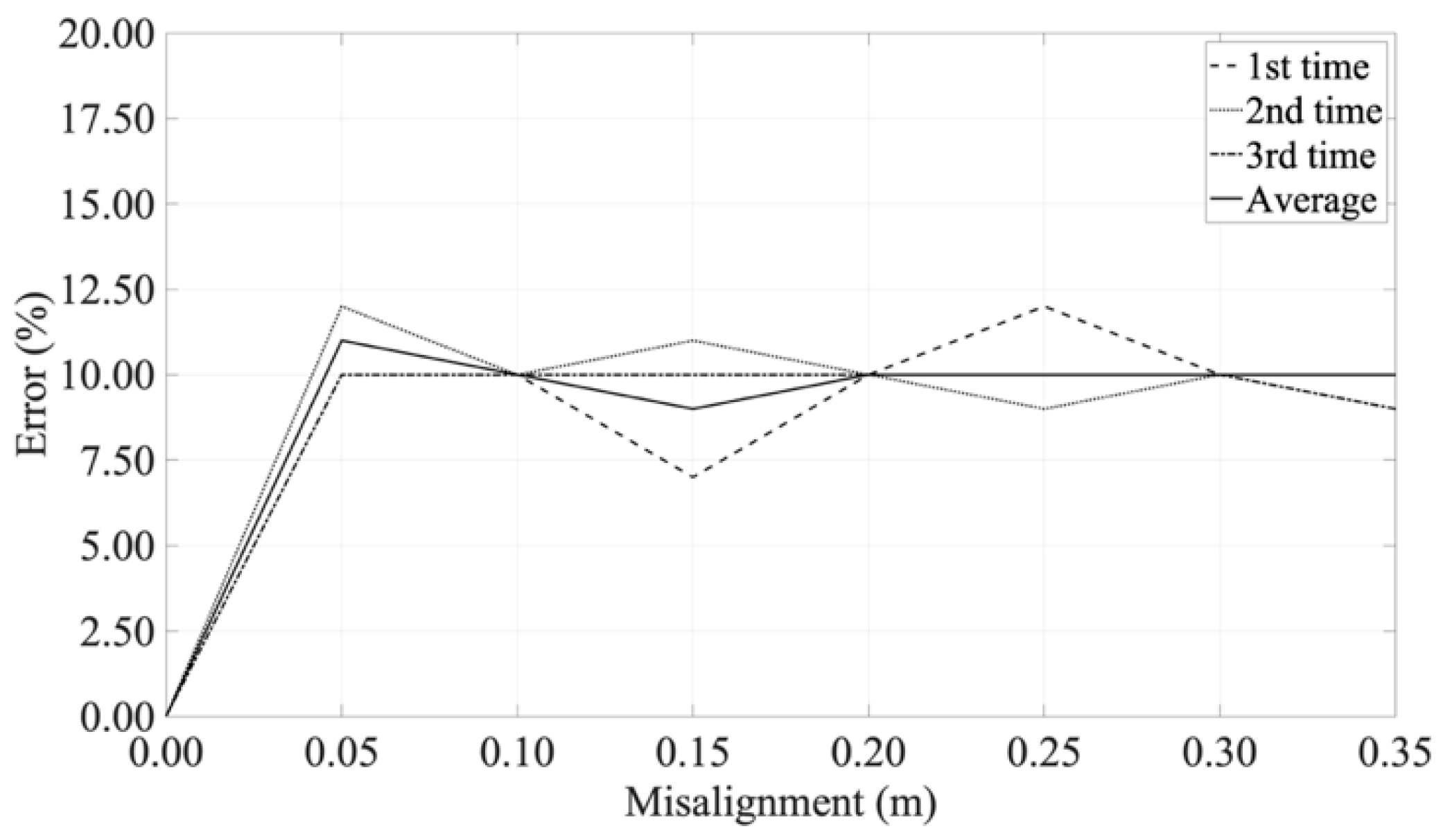
The direction and position in which the automatic alignment transmitter system moved were estimated through experimental testing. The wireless power transfer system integrated with the automatic alignment transmitter system was used in the experimental testing. The testing involved introducing intentional misalignments between the transmitter and the receiver coils. The misalignments were applied along four directions: the positive X-axis, negative X-axis, positive Y-axis, and negative Y-axis. The misalignment distances ranged from 0.05 m to 0.35 m. The gap between the transmitter and receiver coils was fixed at 0.15 m throughout the experiments. The estimation of the movement direction and position of the automatic alignment transmitter system was performed to investigate the effects of the transmitter coil’s weight and size. These physical characteristics may influence both the movement distance and the positioning error of the automatic alignment transmitter system. The transmitter coil was placed on the stand of the automatic alignment transmitter system, and misalignment between the coils in the horizontal plane was simulated. The experiment was repeated three times for accuracy. The movement distance values of the automatic alignment transmitter system are shown in Figure 13. The error values of the movement distance are shown in Figure 14.
The movement distance of the automatic alignment transmitter system in Figure 13 shows that the movement of the automatic alignment transmitter system at every misalignment distance between the transmitter and receiver coils has a deviation from the proper position. In the case where the misalignment distance is 0.350 m, the automatic alignment transmitter system achieves a movement of 0.315 m. The corresponding maximum movement error is 0.035 m. At a misalignment distance of 0.050 m, the automatic alignment transmitter system can move a distance of 0.045 m. This results in a minimum movement error of 0.005 m. The experiment found that in every movement of the automatic alignment transmitter system, there was always a deviation. The deviation increases as the misalignment distance between the transmitter and receiver coils increases.
The error values of the movement distance in Figure 14 show that when the misalignment between the transmitter and receiver coils is 0.05 m, the automatic alignment transmitter system has the highest error value of 12%. This condition also results in the highest average error value of 10.67%. The experiment found that in all cases where misalignment occurs between the transmitter and receiver coils, an error in the movement distance always exists. The average movement distance of each misalignment position was processed through regression analysis to estimate the movement distance with the highest possible accuracy. Therefore, the movement distance value must be adjusted using the equation calculated from the average movement distance of the automatic alignment transmitter system, as shown in (12). This equation is used to estimate the new movement direction and position of the automatic alignment transmitter system.
Z N = Z O     0.0003 + 0.1201 Z O     0.0466
where Z N is new movement distance and Z O is old movement distance.

5. Result and Discussion

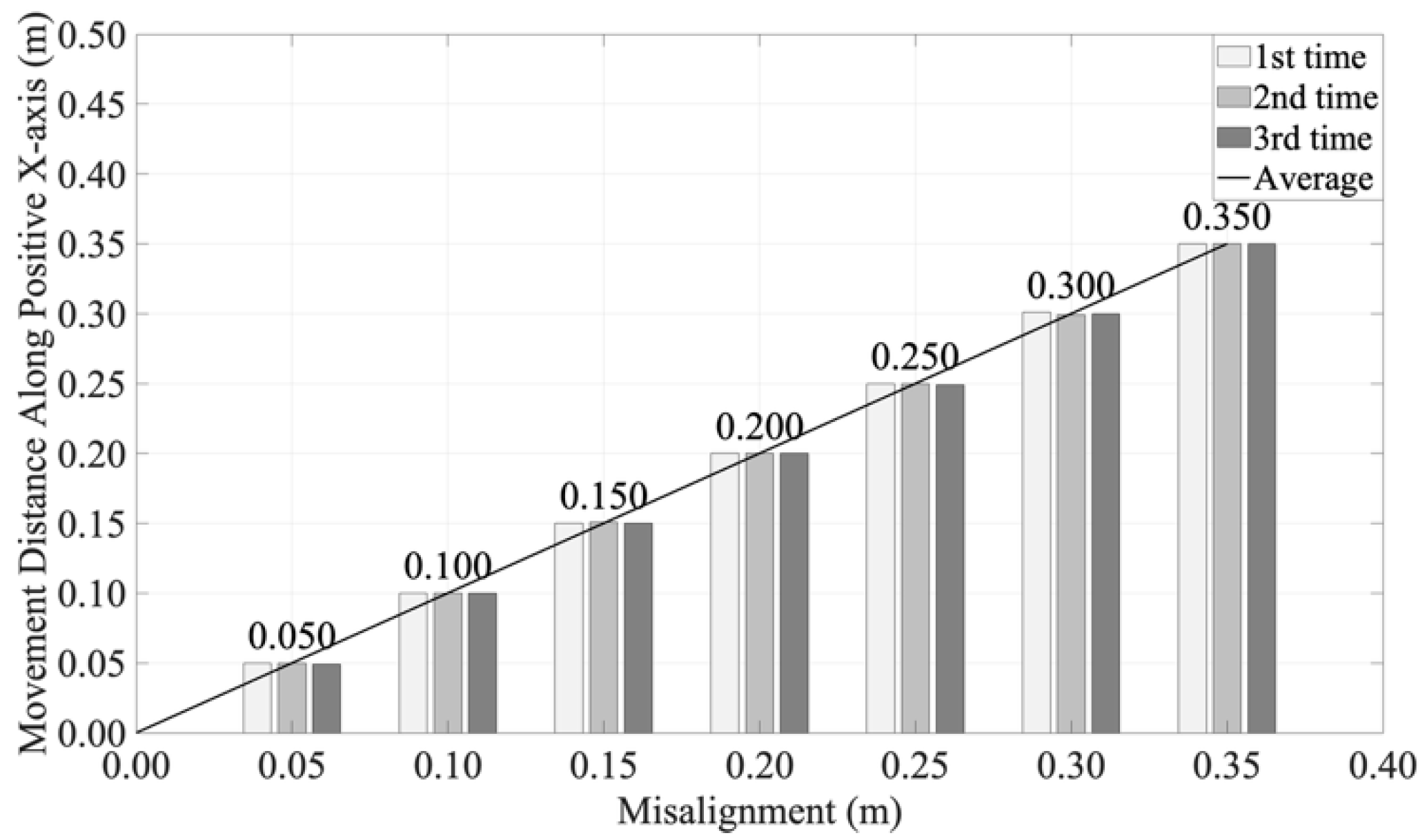
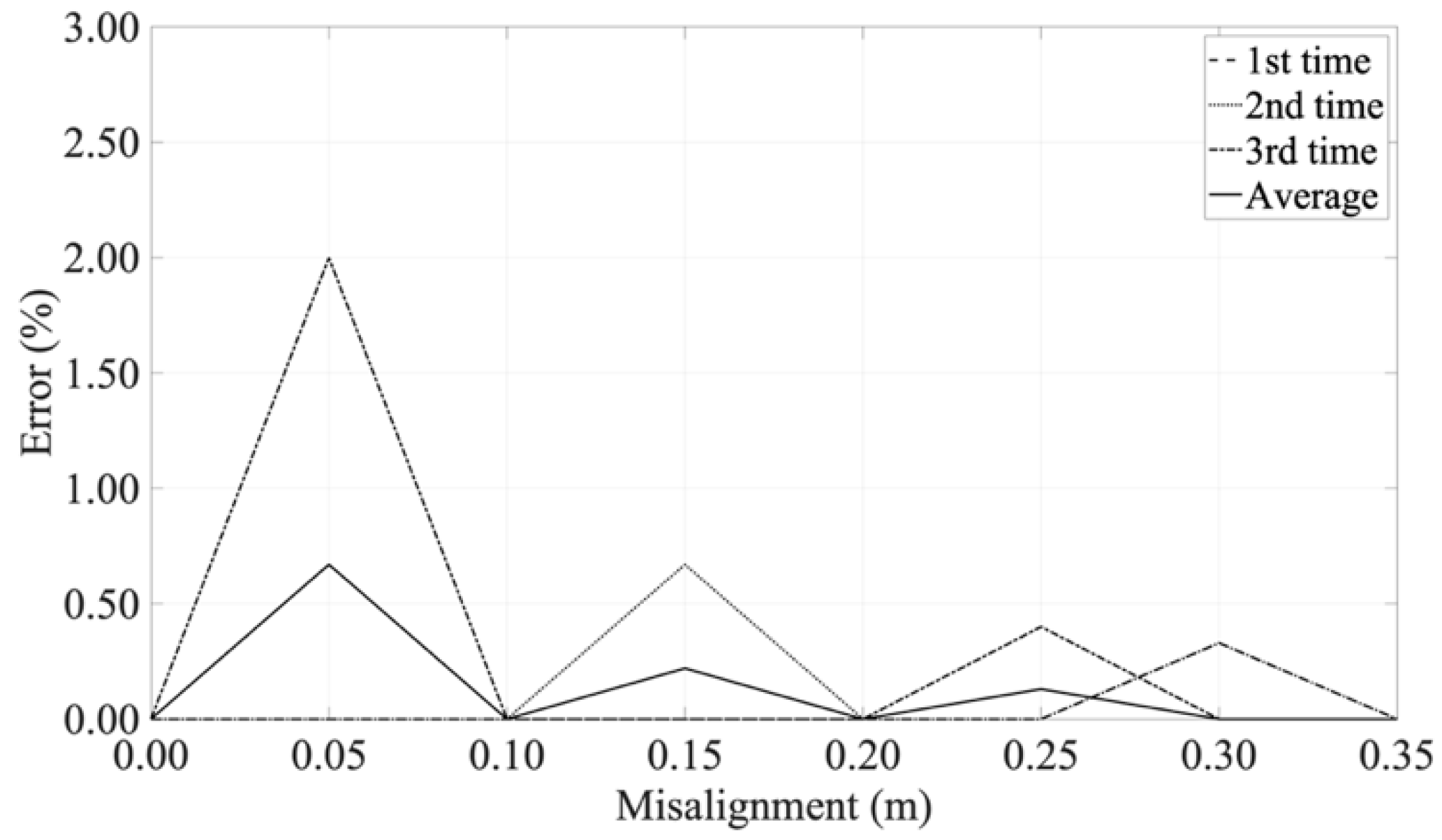
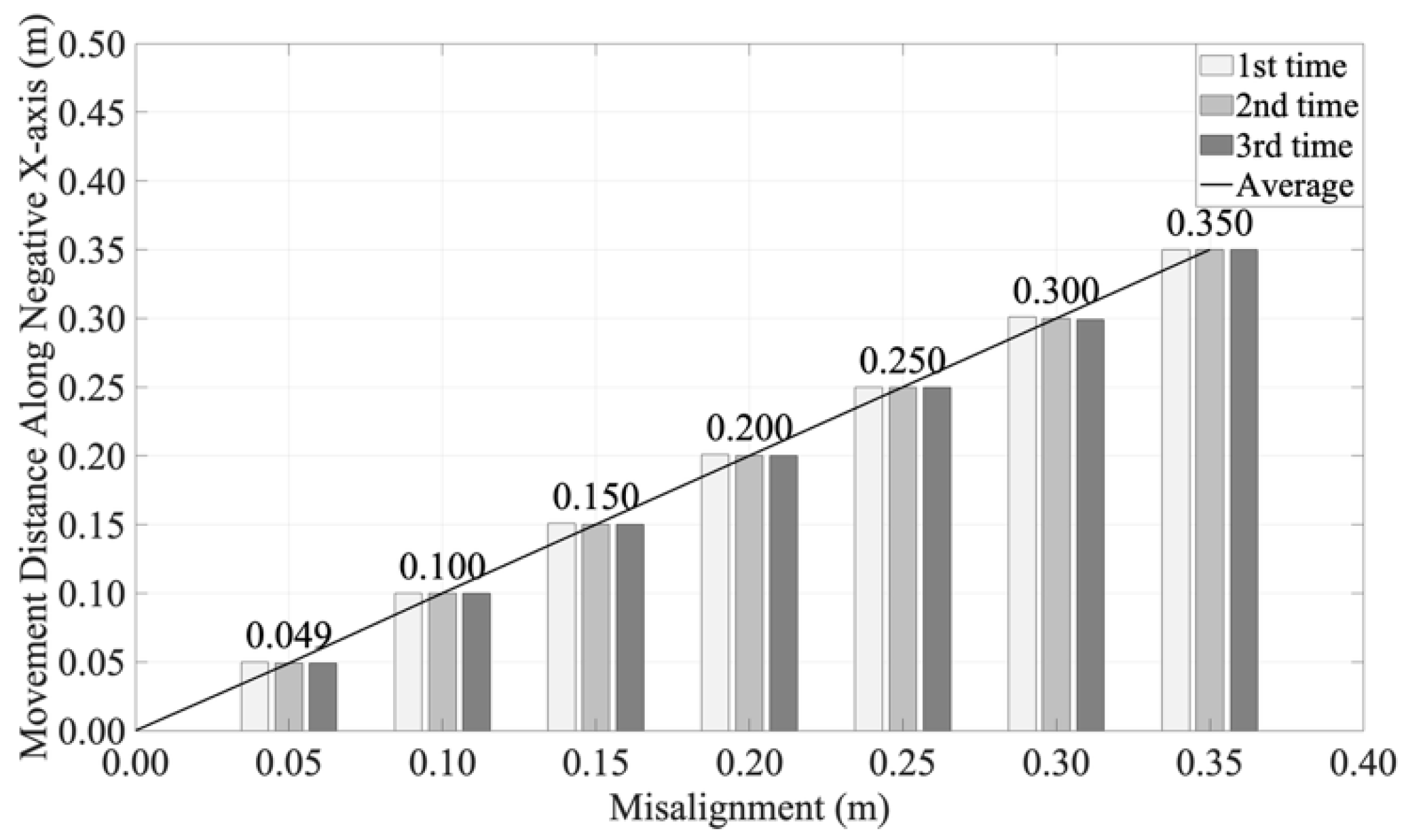
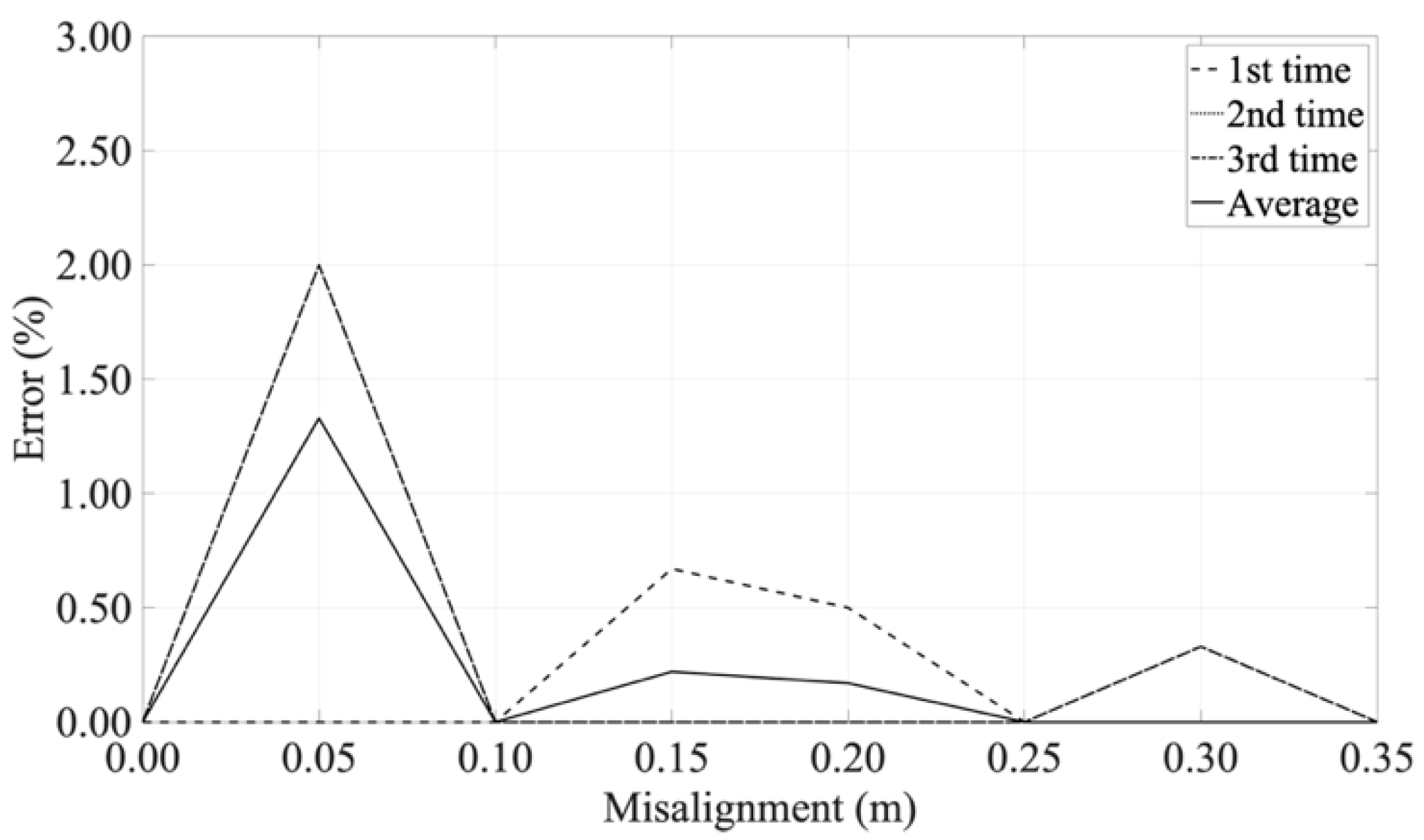
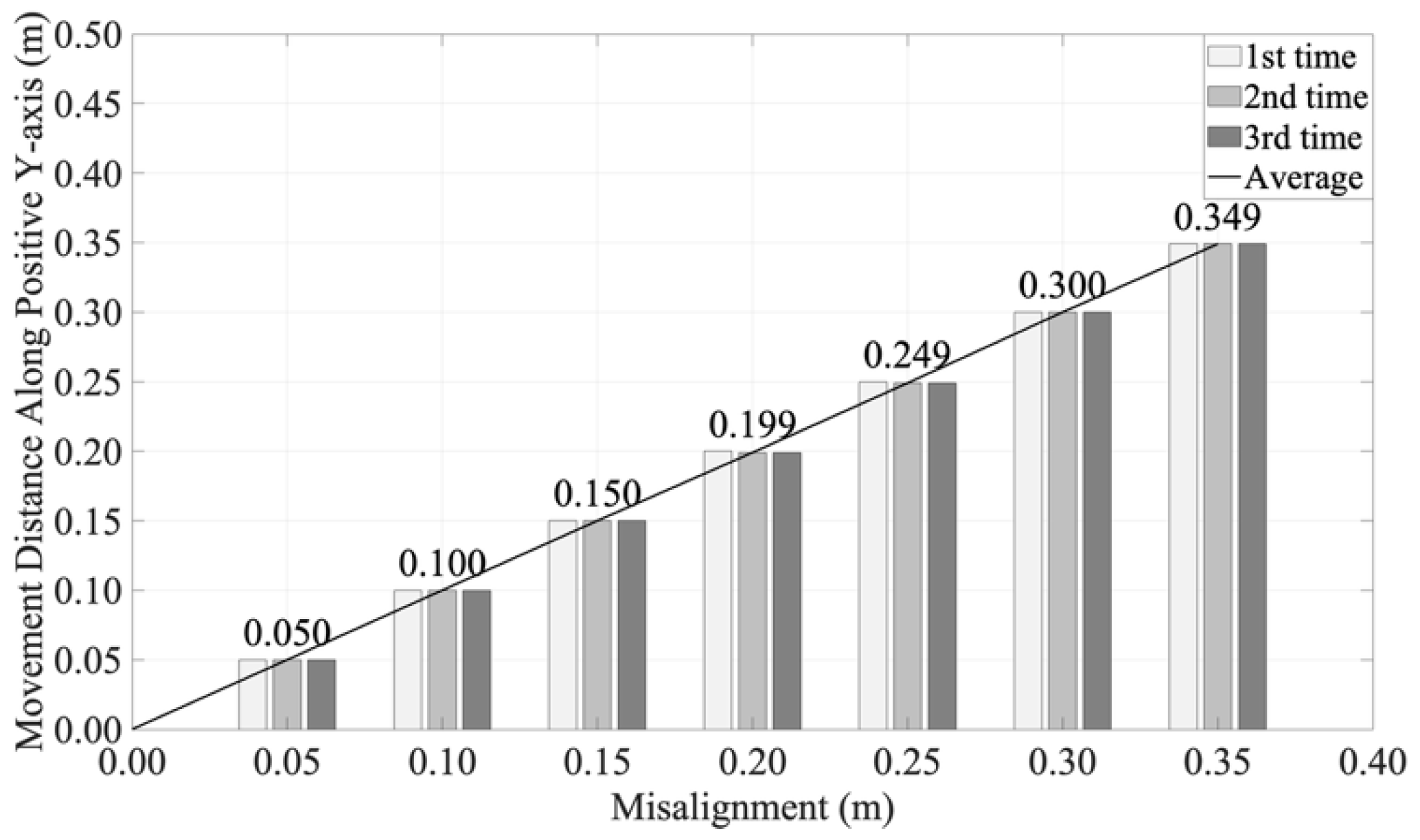
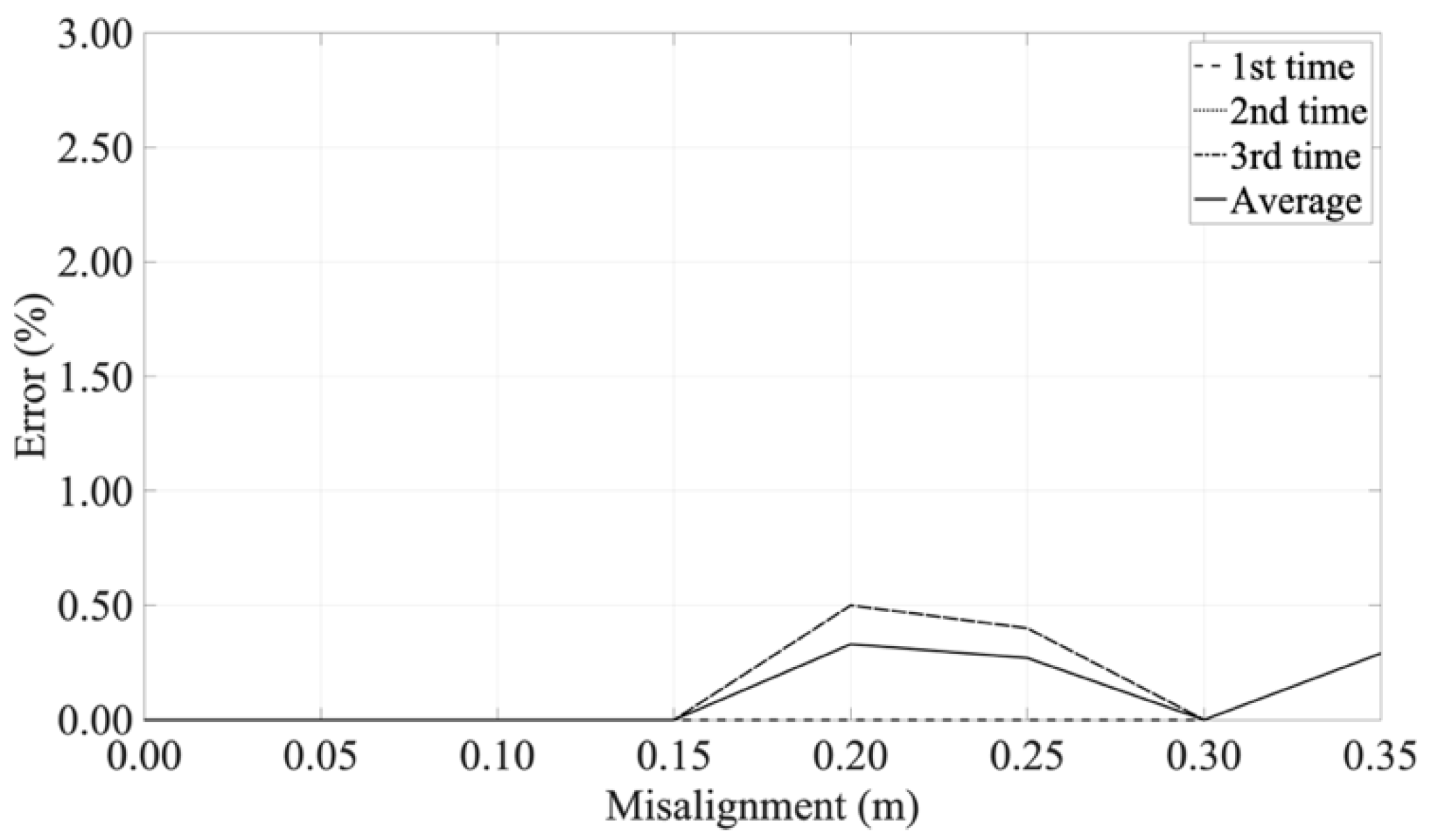
The wireless power transfer system with the automatic alignment transmitter has a gap of 0.15 m between the transmitter and receiver coils, operating at a resonance frequency of 81.64 kHz. The experiment was performed with a horizontal misalignment of 0.35 m and was repeated three times. The movement distance values of the automatic alignment transmitter system and the corresponding error values along the positive X-axis are illustrated in Figure 15 and Figure 16, respectively. Similarly, Figure 17 and Figure 18 illustrate the movement distance values of the automatic alignment transmitter system and the corresponding error values along the negative X-axis, respectively. In addition, the movement distance values of the automatic alignment transmitter system and the corresponding error values along the positive Y-axis are illustrated in Figure 19 and Figure 20, respectively. Finally, Figure 21 and Figure 22 illustrate the movement distance values of the automatic alignment transmitter system and the corresponding error values along the negative Y-axis, respectively.
The movement distance values of the automatic alignment transmitter system along the positive X-axis are shown in Figure 15. The result indicates that the system can move along the positive X-axis to realign the coils. For misalignments of 0.05, 0.15, 0.25, and 0.30 m, the maximum movement error was found to be only 0.001 m. The experimental results demonstrate that the movement error distance is minor compared to the misalignment distance, which indicates that the automatic alignment transmitter system performs with high efficiency along the positive X-axis.
The error values of the movement distance along the positive X-axis are shown in Figure 16. These values indicate that when the misalignment between the transmitter and receiver coils is 0.05 m, the automatic alignment transmitter system exhibits the highest error value of 2%. This results in an average error of 0.67%. The results show that the error value is lower than that obtained before applying Equation (12) for misalignment adjustment. This indicates that Equation (12) is highly effective. The experiment further reveals that movement error occurs at specific positions, which affects the error value. Additionally, the error value decreases as the misalignment distance between the transmitter and receiver coils increases.
The movement distance values of the automatic alignment transmitter system along the negative X-axis are shown in Figure 17. The results indicated that when a misalignment occurs between the transmitter and receiver coils, the automatic alignment transmitter system can move along the negative X-axis to align the transmitter coil with the receiver coil. For misalignments of 0.05, 0.15, 0.20, and 0.30 m, the maximum movement error was found to be 0.001 m. The experimental results demonstrate that the movement error distance is small compared to the misalignment distance between the coils, indicating that the automatic alignment transmitter system along the negative X-axis operates with high efficiency.
The movement error values along the negative X-axis are illustrated in Figure 18. The error values indicate that when a misalignment of 0.05 m occurs between the transmitter and receiver coils, the automatic alignment transmitter system has the highest error value of 2%. The highest average error is 1.33%. The experiment found that the movement error value tends to occur at specific misalignment positions along the movement error distance. The error value decreases as the misalignment distance increases.
The experimental results indicate that the movement error distance of the automatic alignment transmitter system is 0.001 m for both the positive and negative X-axis directions. The maximum error value along both the positive and negative X-axis directions is 2%, while the highest average error along the negative X-axis is 1.33%. The results indicate that the average error along the negative X-axis is higher than that along the positive X-axis, which is caused by a greater number of occurrences of movement error distance in the negative X-axis experiments. The difference between the average error values along the positive and negative X-axis directions is 0.66%.
The movement distance values of the automatic alignment transmitter system along the positive Y-axis are illustrated in Figure 19. The values show that when a misalignment occurs between the transmitter and the receiver coils, the automatic alignment transmitter system is able to move along the positive Y-axis. This movement allows the transmitter coil to align with the receiver coil. For misalignments of 0.20, 0.25, and 0.35 m, the maximum movement error distance is 0.001 m. The experimental results demonstrate that the movement error distance is insignificant compared to the misalignment distance between the transmitter and receiver coils, which indicates that the automatic alignment transmitter system performs effectively along the positive Y-axis.
The movement error values along the positive Y-axis are illustrated in Figure 20. The error values indicate that when a misalignment of 0.20 m occurs between the transmitter and receiver coils, the automatic alignment transmitter system exhibits a maximum error of 0.50%. This results in a maximum average error of 0.33%. The experimental results indicate that at certain misalignment positions, the movement error distance leads to the occurrence of error values. The error values decrease as the misalignment distance increases.
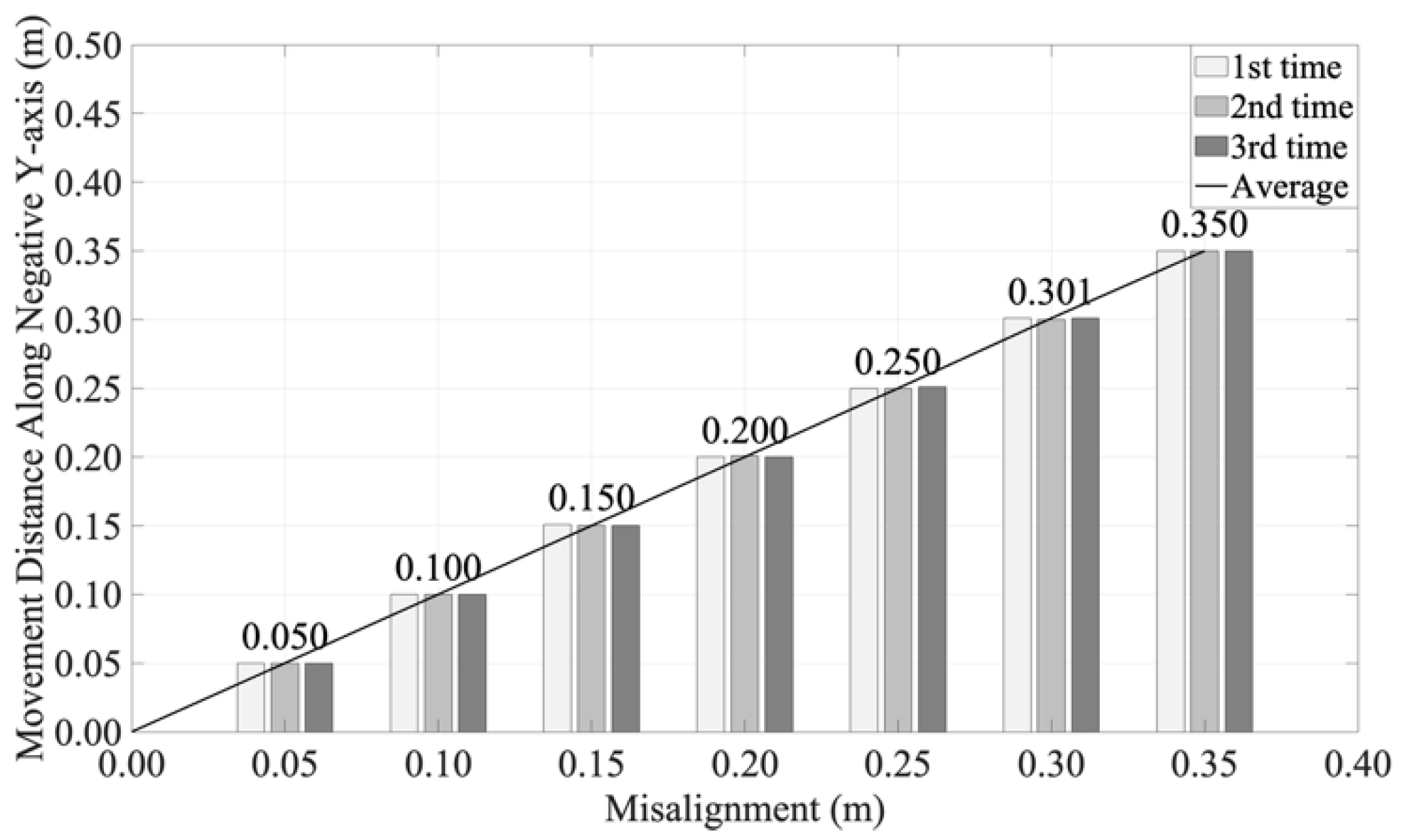
The movement distance values of the automatic alignment transmitter system along the negative Y-axis are illustrated in Figure 21. The movement distance value observed that when a misalignment occurs between the transmitter and receiver coils, the automatic alignment transmitter system can move along the negative Y-axis to align the transmitter coil with the receiver coil. For misalignments of 0.15, 0.20, 0.25, and 0.30 m, the maximum movement error distance is 0.001 m. The experimental results demonstrate that the movement error distance is small compared to the misalignment distance between the transmitter and receiver coils. The results indicate that the automatic alignment transmitter system performs efficiently along the negative Y-axis.
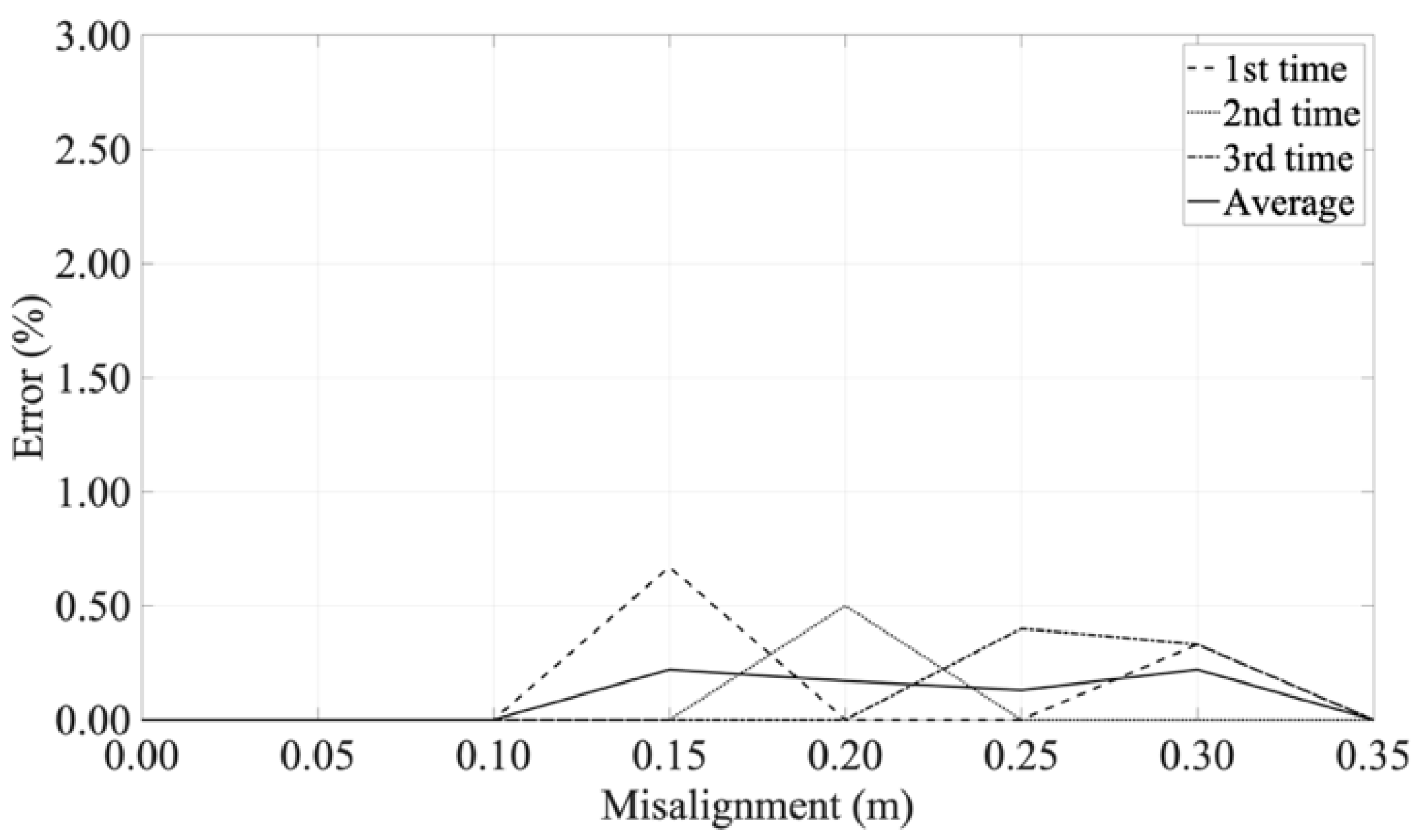
The movement error values along the negative Y-axis are illustrated in Figure 22. The error values indicate that when a misalignment of 0.15 m occurs between the transmitter and receiver coils, the automatic alignment transmitter system has the highest error value of 0.67%. The highest average error is 0.22%. The experimental results show that at misalignment positions where the movement error distance occurs, error values are generated. As the misalignment distance increases, the error values decrease.
The experimental results of the movement distance and error values of the automatic alignment transmitter system along the positive and negative Y-axes show that the movement error distance is the same at 0.001 m. The maximum error value along the negative Y-axis is 0.67%, while the maximum average error along the positive Y-axis is 0.33%. The experimental results indicate that the average error along the positive Y-axis is greater than that along the negative Y-axis. This is due to a higher number of occurrences of movement error distance along the positive Y-axis compared to the negative Y-axis. The difference in average error values between the positive and negative Y-axes is 0.11%. Table 5 and Table 6 illustrate the summary of movement distance values and error values of the automatic alignment transmitter system, respectively.
The experimental results of the movement distance and error values of the automatic alignment transmitter system along the X-axis and Y-axis indicate that the movement error distance is the same at 0.001 m. The maximum error value along the X-axis is 2% in both the positive and negative directions. The maximum average error value along the X-axis is 1.33% in the negative direction. The maximum error value along the Y-axis is 0.67% in the negative direction. The maximum average error value along the Y-axis is 0.33% in the positive direction. The experimental results indicate that the error values along the X-axis are greater than those along the Y-axis. This may be due to the occurrence of errors at low misalignment distances, a higher number of occurrences of movement error compared to the Y-axis experiments, and possibly the performance of the automatic alignment transmitter system.
The experimental results indicate that the movement error distance of the automatic alignment transmitter system has a standard deviation of 0.001 m, which is significantly smaller than the misalignment distance between the transmitter and receiver coils. Therefore, the results suggest that the efficiency of the wireless power transfer system integrated with the automatic alignment transmitter system is equal to the efficiency of the wireless power transfer system in the case where the transmitter and receiver coils are perfectly aligned. The efficiency reaches a maximum of 75.78% and 75.59% for the X-axis and Y-axis, respectively. The efficiency of the wireless charging system is illustrated in Figure 6, showing that the wireless power transfer efficiency falls below 10% when the misalignment exceeds 0.25 m. The automatic alignment transmitter system was configured for a misalignment distance of 0.35 m to demonstrate the capability to operate beyond the effective charging range, provided that the sensors can still detect the magnetic flux density. Table 7 gives a comparison of the related works and proposed system.
From Table 7, the comparison with other studies indicates that the coil adjustment in this work and in [20] influences the transmitter coil. The air gap between the coils in this work has the highest value, which is consistent with the SAE standard for light-duty electric vehicles. Furthermore, the design of the operating frequency and power is in accordance with the SAE standard. The coil position determination method employed in this work is similar to those reported in [17] and [19], which are also applied in EV applications. However, wireless communication has been incorporated into the automatic alignment transmitter system to enhance the performance of transmitter coil alignment.

6. Conclusions

The automatic alignment transmitter system was integrated with a wireless power transfer system to realign the transmitter coil whenever lateral misalignment occurred between the transmitter and receiver coils. The experiment was performed with a horizontal misalignment of 0.35 m and was repeated three times. The gap between the coils was held constant at 0.15 m. The experimental results illustrated that the movement error distance was the same at 0.001 m along both the X- and Y-axes. The maximum error value along the X-axis was 2%, with the maximum average error value of 1.33%. On the Y-axis, the maximum and mean errors were 0.67% and 0.33%, respectively. As these deviations are small compared to the misalignment distance, the efficiency of the combined wireless power transfer system and automatic alignment transmitter system is effectively the same as that obtained under perfect coil alignment. The maximum efficiencies of 75.78% and 75.59% were recorded for the X-axis and Y-axis adjustments, respectively. The proposed method provides an improved alignment strategy compared with conventional approaches. The analysis of the magnetic flux density enables accurate identification of both the direction and the position of misalignment between the coils. The direction and position information of the receiver coil is transmitted to the transmitter section, enabling the alignment system to adjust the transmitter coil accordingly and achieve optimal power transfer efficiency.
From the experimental results, the automatic alignment transmitter system is important for achieving maximum wireless charging efficiency. This article focuses on a method for adjusting the coil position, whereas angular misalignment may be addressed in future investigations. Angular misalignment may result from uneven loading conditions of the electric vehicle. Further consideration can be given to the possible range of angular deviations, including the maximum angle at which the wireless charging system can continue to operate efficiently. However, further studies on methods to enhance wireless charging performance are still required. The misalignment between the coils affects not only magnetic flux density but also other parameters such as voltage, current, power, and efficiency. Therefore, these parameters should be further studied to find the optimal solutions. The use of cameras in conjunction with artificial intelligence to determine the location of charging coils should be further investigated. In addition, incorporating materials to increase efficiency and mitigate magnetic field leakage represents a potential approach to improving the overall efficiency of wireless charging applications. However, the integration of additional materials into the system may necessitate consideration of the resulting load variation.

Author Contributions

Conceptualization, P.J. and C.S.; methodology, P.J. and C.S.; software, P.J.; validation, P.J.; formal analysis, P.J.; investigation, P.J. and C.S.; resources, C.S.; data curation, P.J.; writing—original draft preparation, P.J.; writing—review and editing, T.I. and C.S.; visualization, C.S.; supervision, C.S.; project administration, C.S.; funding acquisition, P.J. and C.S. All authors have read and agreed to the published version of the manuscript.

Funding

This project is funded by National Research Council of Thailand (NRCT) and Pan drives Company Limited (N41A650434).

Data Availability Statement

The original contributions presented in this study are included in the article. Further inquiries can be directed to the corresponding author.

Conflicts of Interest

The authors declare that this study received funding from National Research Council of Thailand (NRCT) and Pan drives Company Limited. The funder was not involved in the study design, col-lection, analysis, interpretation of data, the writing of this article or the decision to submit it for publication.

References

  1. Zhang, X.; Yuan, Z.; Yang, Q.; Li, Y.; Zhu, J.; Li, Y. Coil design and efficiency analysis for dynamic wireless charging system for electric vehicles. IEEE Trans. Magn. 2016, 52, 8700404. [Google Scholar] [CrossRef]
  2. Anyapo, C.; Teerakawanich, N.; Mitsantisuk, C. Development of multi-coils full-bridge resonant inverter for dynamic wireless power transfer. In Proceedings of the 2017 14th International Conference on Electrical Engineering/Electronics, Computer, Telecommunications and Information Technology (ECTI-CON), Phuket, Thailand, 27–30 June 2017. [Google Scholar] [CrossRef]
  3. Ghazizadeh, S.; Ahmed, K.; Seyedmahmoudian, M.; Mekhilef, S.; Chandran, J.; Stojcevski, A. Critical analysis of simulation of misalignment in wireless charging of electric vehicles batteries. Batteries 2023, 9, 106. [Google Scholar] [CrossRef]
  4. Jia, Y.; Xiao, J.; Li, X.; Gong, W.; Wu, X.; Wang, Z. Research on misalignment tolerance optimization method for EV wireless power transfer system. In Proceedings of the 2022 IEEE 9th International Conference on Power Electronics Systems and Applications (PESA), Hong Kong, Hong Kong, 20–22 September 2022. [Google Scholar] [CrossRef]
  5. Galib, A.R.; Chowdhury, M.R.; Jobayer, A.M.; Islam, M.S.; Hossain, S.; Isalm, M.N. Maximum efficiency tracking of a three-coil inductive power transfer system for wireless EV battery charging applications. In Proceedings of the 2023 Third International Conference on Advances in Electrical, Computing, Communication and Sustainable Technologies (ICAECT), Bhilai, India, 5–6 January 2023. [Google Scholar] [CrossRef]
  6. Fu, C.; Wang, D.; Zhao, Q. A compact and coupling-smooth magnetic coupler design for AGV wireless charging application. IEEE Access 2023, 11, 11288–11297. [Google Scholar] [CrossRef]
  7. Kodeeswaran, S.; Fusic, S.J.; Kannabhiran, A.; Gayathri, M.N.; Padmanaban, S. Design of dual transmitter and single receiver coil to improve misalignment performance in inductive wireless power transfer system for electric vehicle charging applications. Results Eng. 2024, 24, 103602. [Google Scholar] [CrossRef]
  8. Ferdous, D.; Saha, S.; Ray, R. A resonance based inductive wireless power transfer system for charging autonomous underwater vehicle (AUV) batteries. In Proceedings of the 2024 International Conference on Electrical Electronics and Computing Technologies (ICEECT), Greater Noida, India, 29–31 August 2024. [Google Scholar] [CrossRef]
  9. Rajamanickam, N.; Ramachandaramurthy, V.K.; Gono, R.; Bernat, P. Misalignment-tolerant wireless power transfer for high endurance IoT sensors using UAVs and nonlinear resonant circuits. Results Eng. 2025, 26, 104879. [Google Scholar] [CrossRef]
  10. Zhang, Y.; Huang, Z.; Wang, H.; Liu, C.; Mao, X. Achieving misalignment tolerance with hybrid topologies in electric vehicle wireless charging systems. Energy Rep. 2023, 9, 259–265. [Google Scholar] [CrossRef]
  11. Jaafari, S.; Hafdaoui, H.E.; Ajabboune, K.; Khallaayoun, A.; Ahouzi, E. Optimization of circular coils with ferrite boxes for enhanced efficiency in wireless power transfer for electric vehicles. Green Energy Intell. Transp. 2025, 4, 100195. [Google Scholar] [CrossRef]
  12. Pahlavan, S.; Shooshtari, M.; Jafarabadi, A.S. Star-shaped coils in the transmitter array for receiver rotation tolerance in free-moving wireless power transfer applications. Energies 2022, 15, 8643. [Google Scholar] [CrossRef]
  13. Adepoju, W.O.; Bhattacharya, I.; Bima, M.E.; Banik, T. Novel metamaterial and ai-based multi-objective optimization of coil parameters for efficient wireless power transfer. In Proceedings of the 2021 IEEE Vehicle Power and Propulsion Conference (VPPC), Gijon, Spain, 25–28 October 2021. [Google Scholar] [CrossRef]
  14. Lu, C.; Huang, X.; Liu, X.; Zeng, Y.; Liu, R.; Rong, C. Design and optimization of the low-frequency metasurface shield for wireless power transfer system. IEEE Trans. Transp. Electrif. 2022, 8, 723–733. [Google Scholar] [CrossRef]
  15. Simonazzi, M.; Sandrolini, L.; Barmada, S.; Fontana, N. Optimal metamaterial configuration for magnetic field shielding in wireless power transfer systems. In Proceedings of the 2023 IEEE Wireless Power Technology Conference and Expo (WPTCE), San Diego, CA, USA, 4–8 June 2023. [Google Scholar] [CrossRef]
  16. Jeebklum, P.; Sumpavakup, C. Metamaterial slabs for electric vehicle wireless charging application. IEEE Access 2024, 12, 156717–156729. [Google Scholar] [CrossRef]
  17. Vatsala; Ahmad, A.; Alam, M.S.; Chaban, R.C. Efficiency enhancement of wireless charging for electric vehicles through reduction of coil misalignment. In Proceedings of the 2017 IEEE Transportation Electrification Conference and Expo (ITEC), Chicago, IL, USA, 22–24 June 2017. [Google Scholar] [CrossRef]
  18. Chabaan, R. Automatic Lateral Alignment for Wireless Charging Systems. U.S. Patent 2019/0118663 A1, 25 April 2019. [Google Scholar]
  19. Ahmad, A.; Alam, M.S.; Rafat, Y.; Shariff, S. Designing and demonstration of misalignment reduction for wireless charging of autonomous electric vehicle. eTransportation 2020, 4, 100052. [Google Scholar] [CrossRef]
  20. Zhang, Y.; Lin, Y.; Lin, S.; Gao, W.; Chen, L.; Chang, W.; Hu, W.; Yu, C. An implementation of an automatic adjustment power transfer position wireless battery charging system for mobile devices. In Proceedings of the 2017 IEEE 6th Global Conference on Consumer Electronics (GCCE), Nagoya, Japan, 24–27 October 2017. [Google Scholar] [CrossRef]
  21. J2954; Wireless Power Transfer for Light-Duty Plug-in/Electric Vehicles and Alignment Methodology. SAE International: Warrendale, PA, USA, 2022.
  22. Panchal, C.; Stegen, S.; Lu, J. Review of static and dynamic wireless electric vehicle charging system. Eng. Sci. Technol. Int. J. 2018, 21, 922–937. [Google Scholar] [CrossRef]
  23. Li, Z.; Zhu, C.; Jiang, J.; Song, K.; Wei, G. A 3-kW wireless power transfer system for sightseeing car supercapacitor charge. IEEE Trans. Power Electron. 2017, 32, 3301–3316. [Google Scholar] [CrossRef]
  24. Iqteit, N.; Yahya, K.; Ahmad Khan, S. Wireless power charging in electrical vehicles. IntechOpen 2021, 1–3, 96115. [Google Scholar] [CrossRef]
  25. Jayalath, S.; Khan, A. Design, challenges, and trends of inductive power transfer couplers for electric vehicles: A review. IEEE J. Emerg. Sel. Top. Power Electron. 2021, 9, 6196–6218. [Google Scholar] [CrossRef]
  26. Shi, L.; Martin-Segura, G.; Fonseca, J.; Rivas, H.A.; García, O.; Fernandez, A. Analysis and modelling of normative WPT3 system based on standard SAE J2954. In Proceedings of the 2022 Wireless Power Week (WPW), Bordeaux, France, 5–8 July 2022. [Google Scholar] [CrossRef]
  27. Dzulfikar, R.D.; Suryoatmojo, H.; Sidqi, F.Q. Coefficient analysis and adaptive frequency resonance control on wireless power transfer. In Proceedings of the 25th International Seminar on Intelligent Technology and Its Applications (ISITIA), Mataram, Indonesia, 10–12 July 2024. [Google Scholar] [CrossRef]
  28. Detka, K.; Górecki, K. Wireless power transfer—A review. Energies 2022, 15, 7236. [Google Scholar] [CrossRef]
  29. Drici, I.; Allag, H.; Chebout, M. Implemented frequency tracking technique for resonant wireless power transfer system. In Proceedings of the 2022 19th International Multi-Conference on Systems, Signals & Devices (SSD), Sétif, Algeria, 6–10 May 2022. [Google Scholar] [CrossRef]
  30. Gebril, A.M.; Mahgoub, A.; Sakr, M. Design procedure of a misalignment tolerant high-efficiency wireless power transfer system. In Proceedings of the 2023 IEEE Conference on Power Electronics and Renewable Energy (CPERE), Luxor, Egypt, 19–21 February 2023. [Google Scholar] [CrossRef]
  31. Annaselvaraj, B.; Srinivasa Rao Nayak, P.; Sundareswaran, K.; Simon, S.P. Systematic analysis and investigations on different coil structures with misalignments for WPT system. e-Prime—Adv. Electr. Eng. Electron. Energy 2025, 12, 100959. [Google Scholar] [CrossRef]
  32. Debnath, T.; Majumder, S.; De, K. High-efficiency coil design for wireless power transfer: Mitigating misalignment challenges in transportation. Energy 2025, 325, 135929. [Google Scholar] [CrossRef]
  33. Viqar, S.; Ahmad, A.; Kirmani, S.; Rafat, Y.; Hussan, M.R.; Saad Alam, M. Modelling, simulation and hardware analysis of misalignment and compensation topologies of wireless power transfer for electric vehicle charging application. Sustain. Energy Grids Netw. 2024, 38, 101285. [Google Scholar] [CrossRef]
  34. Imura, T. Wireless Power Transfer: Using Magnetic and Electric Resonance Coupling Techniques, 1st ed.; Springer: Singapore, 2020. [Google Scholar] [CrossRef]
  35. Shu, X.; Wu, G.; Jiang, Y.W.; Zhang, X. Study on magnetic field characteristics of typicals wireless power transfer systems. In Proceedings of the 2024 IEEE 7th International Electrical and Energy Conference (CIEEC), Harbin, China, 10–12 May 2024. [Google Scholar] [CrossRef]
  36. Raju, S.; Wu, R.; Chan, M.; Yue, C.P. Modeling of mutual coupling between planar inductors in wireless power applications. IEEE Trans. Power Electron. 2014, 29, 481–490. [Google Scholar] [CrossRef]
  37. Wheeler, H.A. Simple inductance formulas for radio coils. Proc. Institude Radio Eng. 1928, 16, 1398–1400. [Google Scholar] [CrossRef]
  38. Aditya, K.; Sood, V.K.; Williamson, S.S. Magnetic characterization of unsymmetrical coil pairs using archimedean spirals for wider misalignment tolerance in IPT systems. IEEE Trans. Transp. Electrif. 2017, 3, 454–463. [Google Scholar] [CrossRef]
Figure 1. Wireless charging system for electric vehicles.
Wevj 17 00081 g001
Figure 2. Coil arrangements: (a) perfect axial alignment; (b) lateral offset misalignment.
Wevj 17 00081 g002
Figure 3. Wireless charging circuit.
Wevj 17 00081 g003
Figure 4. Wireless charging system under lateral misalignment.
Wevj 17 00081 g004
Figure 5. Power of wireless charging: (a) input power; (b) output power.
Wevj 17 00081 g005
Figure 6. Efficiency of wireless charging.
Wevj 17 00081 g006
Figure 7. The simulation model of the transmitter and receiver coils.
Wevj 17 00081 g007
Figure 8. The magnetic flux density results: (a) the coils’ alignment condition; (b) The coils’ misalignment condition; (c) The coils’ misalignment along the positive X-axis.
Wevj 17 00081 g008
Figure 9. The magnetic flux density measurement area using the hall effect sensor: (a) positive X-axis; (b) negative X-axis; (c) positive Y-axis; (d) negative Y-axis.
Wevj 17 00081 g009
Figure 10. The changes in magnetic flux density during wireless power transfer when misalignment occurs.
Wevj 17 00081 g010
Figure 11. Automatic alignment transmitter system.
Wevj 17 00081 g011
Figure 12. Diagram of automatic alignment transmitter system.
Wevj 17 00081 g012
Figure 13. Movement distance of the automatic alignment transmitter system.
Wevj 17 00081 g013
Figure 14. Error of the movement distance.
Wevj 17 00081 g014
Figure 15. Movement distance values of the automatic alignment transmitter system along the positive X-axis.
Wevj 17 00081 g015
Figure 16. Error values of the movement distance along the positive X-axis.
Wevj 17 00081 g016
Figure 17. Movement distance values of the automatic alignment transmitter system along the negative X-axis.
Wevj 17 00081 g017
Figure 18. Error values of the movement distance along the negative X-axis.
Wevj 17 00081 g018
Figure 19. Movement distance values of the automatic alignment transmitter system along the positive Y-axis.
Wevj 17 00081 g019
Figure 20. Error values of the movement distance along the positive Y-axis.
Wevj 17 00081 g020
Figure 21. Movement distance values of the automatic alignment transmitter system along the negative Y-axis.
Wevj 17 00081 g021
Figure 22. Error values of the movement distance along the negative Y-axis.
Wevj 17 00081 g022
Table 1. Parameters of coils.
SymbolParameterQuantity
DITinternal diameter of the transmitter coil0.10 m
NTnumber of turns in the transmitter coil77 turns
DOTouter diameter of the transmitter coil0.72 m
DIRinternal diameter of the receiver coil0.25 m
NRnumber of turns in the receiver coil61 turns
DORouter diameter of the receiver coil0.74 m
LTinductance of the transmitter coil1900 µH
CTcapacitance of the transmitter coil2 nF
LRinductance of the receiver coil1900 µH
CRcapacitance of the receiver coil2 nF
Wconductor diameter3 mm
Gair gap distance between the coils0.15 m
Table 2. Power and efficiency of wireless charging.
Misalignment Distance (m)Along x-AxisAlong y-Axis
PIN
(kW)
POUT
(kW)
ηX
(%)
PIN
(kW)
POUT
(kW)
ηY
(%)
0.003.292.5075.783.302.4975.60
0.053.182.3974.953.062.3075.12
0.101.651.2072.531.611.2174.92
0.150.940.5962.380.920.6064.70
0.200.520.2648.890.580.2746.01
0.250.300.013.800.300.014.51
0.300.300.014.320.280.025.37
0.350.300.025.310.300.026.10
Table 3. Calculated parameters of the transmitter and receiver coils.
SymbolParameterQuantity
LTInductance of the transmitter coil1916 µH
LRInductance of the receiver coil1916 µH
MMutual inductance776.60 µH
KCoupling coefficient0.4063
ϕTMagnetic flux of transmitter coil0.0185 Wb
ϕRMagnetic flux of receiver coil0.0183 Wb
Table 4. Calculated parameters with misalignment condition along the positive x-axis.
Misalignment Distance (m)M (µH)KϕT (Wb)ϕR (Wb)
0.00776.600.40630.01850.0183
0.05759.640.39750.01790.0176
0.10710.820.37170.01760.0173
0.15635.430.33250.00630.0057
0.20541.080.28310.00360.0028
0.25436.450.22820.00240.0008
0.30330.290.17280.00240.0008
0.35230.290.12020.00240.0006
Table 5. Movement distance values of the automatic alignment transmitter system.
AxisIterationMovement Distance Values with Misalignment Distance (m)
0.05000.10000.15000.20000.25000.30000.3500
positive x10.05000.10000.15000.20000.25000.30100.3500
20.05000.10000.15100.20000.25000.29900.3500
30.04900.10000.15000.20000.24900.30000.3500
average0.04970.10000.15030.20000.24970.30000.3500
SD0.00060.00000.00060.00000.00060.00100.0000
negative x10.05000.10000.15100.20100.25000.30100.3500
20.04900.10000.15000.20000.25000.30000.3500
30.04900.10000.15000.20000.25000.29900.3500
average0.04930.10000.15030.20030.25000.30000.3500
SD0.00060.00000.00060.00060.00000.00100.0000
positive y10.05000.10000.15000.20000.25000.30000.3490
20.05000.10000.15000.19900.24900.30000.3490
30.05000.10000.15000.19900.24900.30000.3490
average0.05000.10000.15000.19930.24930.30000.3490
SD0.00000.00000.00000.00060.00060.00000.0000
negative y10.05000.10000.15100.20000.25000.30100.3500
20.05000.10000.15000.20100.25000.30000.3500
30.05000.10000.15000.20000.25100.30100.3500
average0.05000.10000.15030.20030.25030.30060.3500
SD0.00000.00000.00060.00060.00060.00060.0000
Table 6. Error values of the automatic alignment transmitter system.
AxisIterationError Values with Misalignment Distance (%)
0.05000.10000.15000.20000.25000.30000.3500
positive x10.000.000.000.000.000.330.00
20.000.000.670.000.000.330.00
32.000.000.000.000.400.000.00
average0.670.000.220.000.130.000.00
negative x10.000.000.670.500.000.330.00
22.000.000.000.000.000.000.00
32.000.000.000.000.000.330.00
average1.330.000.220.170.000.000.00
positive y10.000.000.000.000.000.000.29
20.000.000.000.500.400.000.29
30.000.000.000.500.400.000.29
average0.000.000.000.330.270.000.29
negative y10.000.000.670.000.000.330.00
20.000.000.000.500.000.000.00
30.000.000.000.000.400.330.00
average0.000.000.220.170.130.220.00
Table 7. Comparison of related works and the proposed system.
Parameter[17][18][19][20]This Work
Power----3.7 kVA
Coil adjustmentreceiver coilreceiver coilreceiver coiltransmitter coiltransmitter coil
Air gap between the coils0.10 m-0.10 m-0.15 m
Determiningmagnetic flux densityWPT efficiencymagnetic flux densitycommunicationmagnetic flux density and wireless communication
ApplicationEVEVAEVmobile devicesEV
Disclaimer/Publisher’s Note: The statements, opinions and data contained in all publications are solely those of the individual author(s) and contributor(s) and not of MDPI and/or the editor(s). MDPI and/or the editor(s) disclaim responsibility for any injury to people or property resulting from any ideas, methods, instructions or products referred to in the content.