1. Introduction
With the progression of automated driving technology, the system’s role in vehicle control has evolved from fundamental driver aid to executing dynamic driving duties under certain situations, eventually aiming towards complete substitution of the human driver [
1]. The SAE categorisation system identifies six levels of automation (L0–L5), illustrating the evolving distribution of control and accountability between drivers and automated systems [
2]. In light of the shifting dynamics of human–machine control, some countries have started to reevaluate conventional liability regulations (
Table 1).
Current studies have focused on the issue of how distinct liability regimes should correspond with diverse degrees of automated driving technology and the changing control dynamics between humans and systems. During the initial phase of development, academic research mostly supported a driver-centred regime, claiming that the human driver is the ultimate decision maker and should thus retain primary accountability for traffic incidents [
3,
4]. As automation advances, researchers have suggested a hierarchical liability framework. According to this perspective, driver liability should prevail at Level 2 and lower; however, at higher levels, liability should progressively transition from drivers to manufacturers and system providers [
5,
6,
7,
8,
9]. Moreover, some researchers propose conferring autonomous legal personality onto automated cars, allowing them to immediately accept tort responsibility [
10,
11]. Others draw on corporate law, proposing that an autonomous car may operate as a corporate entity, with its owner acting as a shareholder while the vehicle assumes liability via corporate frameworks [
12]. Beyond analysing any single liability regime in isolation, some scholars have sought to identify the distinctive strengths of different regimes through cross-jurisdictional comparison. For example, certain studies synthesise representative legislation across jurisdictions worldwide, summarising the relative advantages of different liability models and offering institutional design recommendations [
13]. Others undertake a horizontal comparison of the early approaches adopted in China and Germany and propose a stratified liability framework [
14]. Still others integrate the existing international regulatory landscape for autonomous mobility and advocate an international coordination pathway to consolidate best practices [
15].
However, the performance of different liability regimes is not uniform across levels of driving automation [
13]. Much of the existing literature either emphasises the merits of a single regime or draws comparative lessons across jurisdictions. In practice, each liability regime is embedded in a specific automation-level context and serves distinct regulatory functions; transplant-oriented analyses therefore tend to overlook both the staged nature of a country’s regulatory trajectory and the particularities of its chosen liability model. Accordingly, rather than promoting the direct importation of foreign regimes, this article advances a new perspective grounded in the common structural dilemmas of allocating liability for autonomous driving and the concrete theoretical and practical challenges faced by single-model regimes within current, level-specific deployment contexts across jurisdictions. It conducts a horizontal comparative analysis of prevailing liability regimes in traffic incidents involving autonomous vehicles worldwide, evaluates their implementation, identifies doctrinal and practical difficulties, and proposes targeted optimisation and reform recommendations for each regime. These recommendations aim to better align each model with the relevant automation stage and national conditions without altering the basic allocation architecture, while also strengthening the theoretical and practical foundations for a transition to higher levels of automation and enabling smoother shifts across liability regimes as automation increases.
2. The Liability Regimes for Autonomous Vehicle Accidents
This paper utilises typical continents from the Asia-Pacific, Western Europe, and the Americas for comparative analysis, considering the regulatory dynamics surrounding autonomous driving testing and commercial deployment in these locations [
16]. The sample encompasses China, the United States and Canada, all of which are dominant in autonomous car technology and industry implementation [
17,
18,
19,
20]. It includes Germany, Japan, France, South Korea, and Australia, which are shifting from conventional automobile regulation to governance frameworks for autonomous driving [
21,
22,
23,
24,
25,
26,
27]. The sample furthermore includes the United Kingdom, which has established one of the first specialised regulatory frameworks for autonomous cars [
19,
25,
28]. Singapore is analysed as a location where public-road autonomous driving tests are currently conducted in densely populated environments [
29,
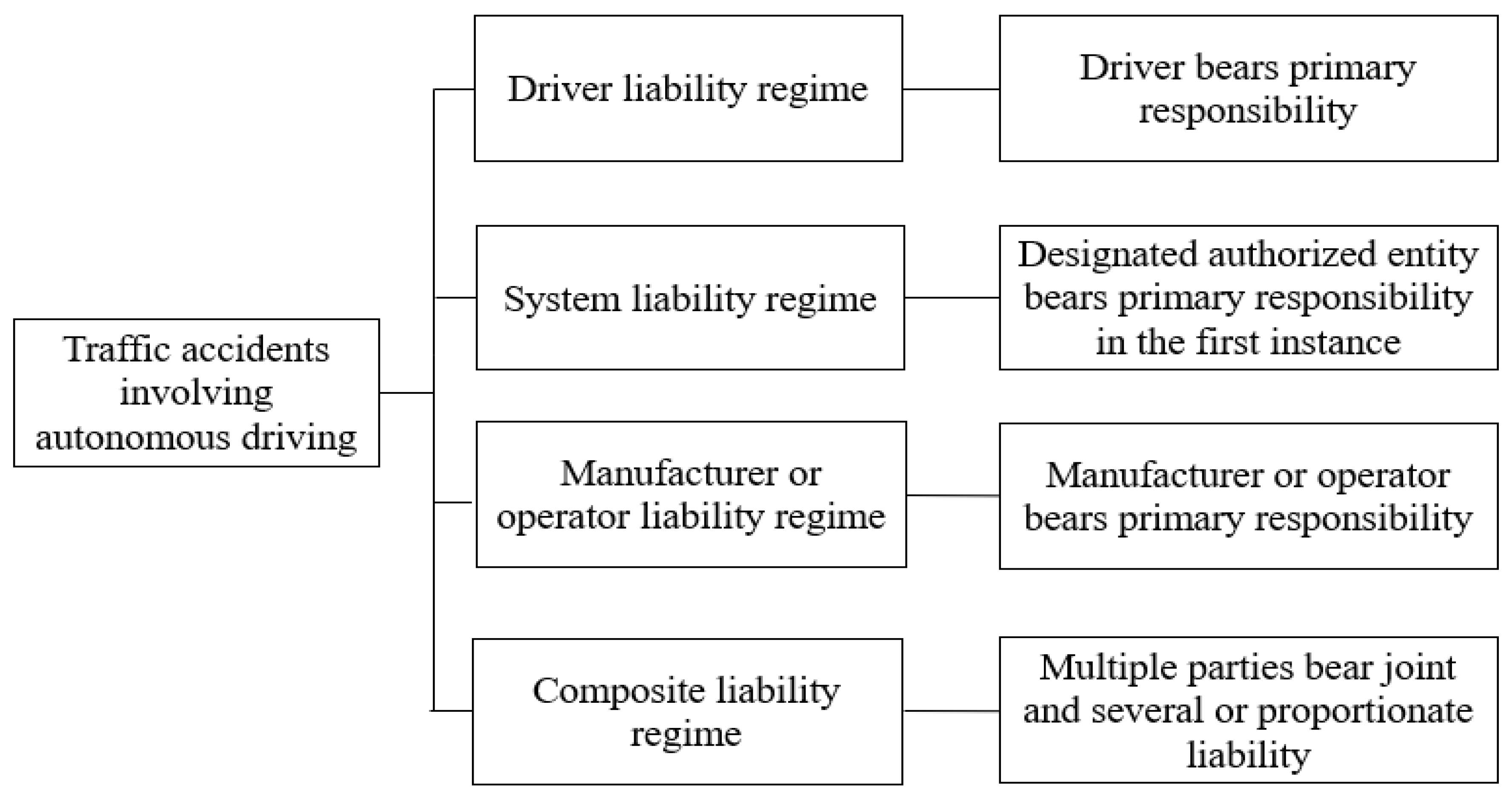
30]. A comparative analysis across regions and systems reveals the emergence of four primary liability regimes in response to incidents involving autonomous vehicles (
Figure 1). At the same time, under the current landscape, jurisdictions have adopted different liability-allocation schemes at different levels of driving automation (
Table 2). Building on this premise, this chapter analyses the concrete, regime-specific problems encountered when the four liability models are applied across different countries and automation levels, and the shared, cross-cutting structural dilemmas. The purpose is to demonstrate how the key issues requiring attention differ across liability models, thereby laying the theoretical groundwork for the optimisation proposals developed in subsequent sections in light of the relevant deployment stage and the distinctive profile of challenges.
2.1. Driver Liability Regime: Status and Dilemmas
2.1.1. Practical Application
The driver liability regime is applicable mainly to scenarios below Level 2 automation, when control of the vehicle is principally retained by the human driver. Under this framework, the driver is seen as the primary holder of culpability for traffic incidents. The concept is based on the driver’s obligation of care and behavioural control of the vehicle. When traffic regulations are breached or carelessness is shown, the driver has principal accountability for damages and associated legal liability [
31].
This regime is used in countries without specific rules for autonomous driving. Specifically, China depends on established law, including the Road Traffic Safety Law and the tort responsibility sections of the Civil Code, augmented by court interpretations regarding road-traffic liability. In the absence of national autonomous driving legislation, liability regimes mostly rely on municipal pilot rules. Over the last two years, eleven cities have implemented regulations differentiating between situations, including a safety driver and those without, so creating initial categories for liability entities [
32].
Furthermore, some countries have enacted specific laws for autonomous driving while also adhering to the conventional driver-liability framework for Level 2 and below. In the United Kingdom, the Automated Vehicles Act 2024 stipulates that any vehicle not sanctioned as self-driving by the appropriate authorities is considered to be under human control. The operator must retain enough control at all times, and automated functions may act only as driver-assistance features. Consequently, vehicles classified below Level 3 do not meet the criteria for autonomous systems and are excluded from the newly created liability framework under the Act [
33]. Germany has a similar strategy. According to the Road Traffic Act, Level 0 to Level 2 systems are classified as driver-assistance technology. Drivers must constantly observe their surroundings and be prepared for prompt action. Japan likewise regulates through the Road Traffic Act. If a driver breaches the duty of safe driving while operating a Level 2 system, liability is determined under the ordinary traffic-law framework, and responsibility continues to rest with the human driver [
34].
These countries maintain the conventional road safety framework by strengthening the driver’s duty of care and regulating driving behaviour. In addition, under this liability model, the responsible party is more clearly identified, which helps prevent accidents in the early stages of automated-driving deployment that arise from driver operational errors. Currently, prior to the extensive use of advanced automation, the driver liability regime continues to be the principal method for assigning accountability in incidents involving autonomous vehicles. Nevertheless, as automation escalates and driver control diminishes, the regime has increasing difficulties in theological justification and practical functionality.
2.1.2. Critical Challenges
This liability model assigns full responsibility to the driver, leading to an undue concentration of blame and subjecting the driver to inherent difficulties in fulfilling evidential requirements. Level 2 and below automated driving systems just provide supplementary capabilities, such as automatic parking, lane maintaining, and rudimentary obstacle avoidance, without transferring legal control of the vehicle [
35]. However, when operators engage in these tasks, the system’s real-time perception, route planning, and partial execution continue to affect vehicle trajectory, speed regulation, collision forecasting, and emergency reactions. If liability regulations persist in designating the driver as the only accountable individual, the delineation of obligation for manufacturers, system suppliers, and operators becomes ambiguous. The allocation of responsibility pressure no longer aligns with the real ability of technology.
Moreover, liability determination increasingly depends on technological evidence. This substantially elevates the evidential burden on drivers. Taking China as an example, in the Tesla traffic accidents that occurred in 2016 and 2021, judicial practice indicates that most product-liability claims concerning assisted-driving technologies have been unsuccessful. Drivers often cannot obtain critical evidence or meet the required standard of proof, and they face persistent difficulties in establishing a causal link between system performance and the alleged harm. This pattern is also reflected in other lawsuits involving automated vehicles [
36,
37,
38]. More importantly, even where courts issue disclosure orders, defendants frequently decline to provide complete data by invoking security or confidentiality concerns [
38].
In conclusion, the driver liability regime exhibits systemic inadequacies in responsibility allocation, pressure distribution, and evidential processes in Level 2 and below assisted-driving situations. It can no longer satisfy the practical requirements of risk governance in the realm of intelligent driving.
2.2. System Liability Regime: Status and Dilemmas
2.2.1. Practical Application
The system liability regime is mostly applicable to Level 3 and higher autonomous driving levels. The fundamental process is the creation of an Authorised Self-Driving Entity (ASDE), which centralises safety and compliance responsibilities that were previously fragmented across many business entities. During autonomous operation, legal liability for administrative and criminal penalties transfers from the human driver to the authorised entity. Civil compensation is managed via primary insurer liability: the insurer first pays the victim and thereafter pursues recourse against the liable business entity in compliance with legal provisions.
The United Kingdom is a representative jurisdiction using this regime. The Automated and Electric Cars Act 2018 creates a stringent insurer liability framework and authorises the Secretary of State for Transport to provide a list of cars sanctioned for autonomous operation [
39]. When an authorised vehicle operating in autonomous mode causes an accident resulting in third-party injury, the insurer is obligated to offer compensation and may later pursue reimbursement from the commercial entity accountable for the fault or failure.
In 2024, the United Kingdom enacted the Automated Vehicles Act. This Act establishes the framework for Authorized Self-Driving Entities, designating direct legal responsibility for safety and regulatory adherence to an authorised legal entity [
40]. It also establishes the criterion of No Unacceptably Unsafe Behaviour as the fundamental prerequisite for authorisation and operational consent. The insurer-liability framework established by AEVA 2018, the ASDE authorisation process, and the safety standard that applies when no user or driver is in charge constitute a cohesive legal system. The framework integrates administrative authorisation, civil compensation, and system oversight in a coherent manner, thereby providing a solid legal basis for the effective operation of the system-liability model [
41]. It also establishes a dual mechanism of ex ante regulatory control and ex post remedial protection for automated driving, promoting the sound and orderly development of autonomous driving technologies.
2.2.2. Critical Challenges
The system liability regime has considerable challenges in implementation. The principal challenge is in the substantial obligations imposed on authorised companies and insurers, coupled with the lack of explicit regulations for establishing culpability. Authorised businesses must undertake ongoing responsibilities for the comprehensive safety and regulatory adherence of autonomous driving systems. Their obligations extend well beyond conventional manufacturing duties and post-sale responsibilities. They include performance analytics, remote software updates, and real-time risk monitoring, all of which materially increase compliance costs. The disruptive impact of automated driving on the insurance sector is illustrated more directly in a report by the Bank of England: automation is projected to reduce road traffic accidents by two-thirds, cut fraud by 60%, and lower vehicle-theft rates by 50%, while simultaneously increasing the incidence of software-related failures [
42]. Accordingly, insurers will need to recalibrate existing underwriting approaches and experiment with more differentiated product lines and risk classifications. Insurers also bear a substantial claims-handling burden: they typically must indemnify victims in the first instance and then pursue subrogation against other potentially liable parties, thereby increasing the complexity and cost of redress [
43,
44]. Projections for motor-vehicle accident claims further suggest that the share of bodily-injury claims will rise from 46% to 60%, underscoring the need for institutional adjustments to mitigate remedial complexity and avoid imposing an excessive burden on insurers [
42].
A further issue emerges in the regulations pertaining to factual determination. The primary concern is determining if the autonomous driving mode was engaged. This decision is significantly dependent on the availability of operational data [
45]. A modern vehicle generates approximately 25 GB of data per hour of operation, whereas an autonomous vehicle is widely estimated to produce around 3600 GB of data per hour [
46]. In the United Kingdom, a consistent mandate concerning data ownership, organisation, storage, or disclosure is absent. Event records, raw sensor data, and remote-monitoring information are distributed across multiple systems and suffer from limited interoperability. The accumulation of vast volumes of driving data, coupled with the absence of clear regulatory standards, can seriously undermine the effectiveness of accident investigations and liability assessments. Additionally, the legislative framework has yet to clarify the link between data sharing duties and privacy safeguards, the extent of law enforcement access rights, or the meaning of poor safety performance [
47].
In summary, the system liability regime assigns primary responsibility to an authorised legal entity. However, its effectiveness depends on clear data-disclosure obligations, uniform investigation procedures and practicable safety standards. Without systematic legislative support, responsibility boundaries remain uncertain and liability determinations lack stability. This uncertainty undermines the enforceability and overall performance of the regime.
2.3. Manufacturer or Operator Liability Regime: Status and Dilemmas
2.3.1. Practical Application
The Manufacturer or Operator Liability Regime primarily applies to high-level autonomous driving at Level 3 and above. Predicated on technical control and product safety, this regime assigns primary accident liability to legal entities possessing technical authority and safety obligations during system development, production, operation, and maintenance.
Legislative practice has institutionalized this responsibility in several jurisdictions. For instance, Germany’s Road Traffic Act mandates that autonomous vehicles be equipped with “black boxes” to record vehicle operation to clarify liability. Drivers are liable for accidents during manual control, while manufacturers bear liability for system operation [
48,
49]. Similarly, France’s Highway Code establishes a liability mechanism based on vehicle status. When operating in authorised autonomous mode under compliant conditions, the driver is exempt, and liability shifts to the manufacturer or system operator [
50]. The state of Tennessee in the US has enacted similar provisions that, when an autonomous system is “fully engaged and operating reasonably under the manufacturer’s guidance,” the system is deemed the “driver or operator”. And accident liability is determined according to product liability law or common law. The EU’s Product Liability Directive enforces strict liability, holding manufacturers liable without fault for damages caused by defective products [
43].
Furthermore, some countries have established specific legal provisions under specific automated operation systems, where licensed operational entities bear primary liability for operational safety. South Korea’s Autonomous Vehicle Act requires that the vehicle operator or owner must bear liability for damages and fulfil obligations for continuous safety assurance, vehicle maintenance, and risk prevention in licensed Level 4 unmanned operation scenarios [
51]. Japan’s revised Road Traffic Act introduces a “Specific Automated Operation” system, requiring service providers or operators to conduct remote monitoring and emergency response and to bear primary legal liability for accidents. Singapore similarly designates the operator as the primary subject for safety management and compensation for unmanned vehicles on public roads [
52]. Overall, these jurisdictions allocate liability to manufacturers and operators on the basis of “technical control” and “safety obligations,” thereby bridging product-defect liability and system-operational liability. This approach clarifies the responsible party and, at the same time, creates strong incentives for manufacturers or operators to strengthen production safety duties and improve service quality.
2.3.2. Critical Challenges
Like the system-liability regime, in addition to concerns about data volume, evidentiary access, and emerging challenges for insurance business models, a critical difficulty for the manufacturer- or operator-liability regime lies in the ambiguity of attribution rules—most notably, how to delineate liability boundaries between manufacturers and operators. In the 2018 Uber autonomous vehicle collision with a pedestrian in Arizona, widely regarded as the first fatal incident involving a fully automated vehicle, the ride-hailing service provider, the technology supplier, and the vehicle manufacturer all faced tort claims arising from the same accident [
53]. This overlap is partly attributable to the functional division of responsibilities: manufacturers typically undertake product design, system integration, and algorithmic safety, whereas operators are responsible for vehicle maintenance and operational management, including ongoing servicing and remote monitoring. Despite distinct functions, distinguishing “product defect liability” from “operational management liability” is difficult during system operation [
54,
55]. For example, current German law lacks a clear distinction for subject liability in highly automated scenarios, creating significant uncertainty in practice [
19,
56].
A deeper dilemma concerns the legitimacy of imposing operator liability. Operators typically oversee day-to-day vehicle operations and maintenance, yet they do not control core algorithms or system updates. For instance, in accident reports issued by the National Transportation Safety Board, operator responsibilities are often framed narrowly—focusing on the safety driver’s duties, takeover protocols, and policies on carrying control devices [
57]. Nevertheless, operators are frequently required as a matter of law to assume primary liability for overall system safety [
58]. In the absence of complete data and technical information, operators cannot effectively fulfil this safety obligation. Imposing high compensation liability on capital-constrained operators contradicts the principle of “who controls the risk bears the liability” [
59] and may compromise victim compensation. Consequently, while attempting to share risk between two subjects, this regime struggles with operability due to coupled technical structures, blurred liability interfaces, and information asymmetry.
2.4. Composite Liability Regime: Status and Dilemmas
2.4.1. Practical Application
The Composite Liability Regime is primarily applicable to the transitional phase from Level 2 to higher automation. In this phase, the system controls the vehicle in specific conditions, but human drivers retain intervention obligations. This regime typically exists in countries lacking specific autonomous driving legislation, relying instead on traditional legal frameworks. Given the state of human–machine co-governance of vehicle control, drivers, manufacturers, developers, and operators may all influence safety. Liability is therefore allocated among multiple parties according to control, fault, and statutory compliance. This approach helps the domestic judicial framework adapt to the development of automated driving at different stages and respond more effectively to the novel situations that arise as the technology evolves.
Countries adopting the Composite Liability Regime generally follow two paths. The first path involves “no-fault compensation + post-event recourse”. In the US and Australia, mandatory insurance or no-fault mechanisms provide immediate victim relief. Subsequently, if product defects or operational negligence are identified, tort or product liability rules allow for internal recourse among drivers, manufacturers, and operators. This approach balances victim protection with behavioural regulation of responsible parties [
60,
61].
The second path involves “dynamic liability allocation” by the judiciary. For instance, Ontario’s Negligence Act allows courts to apportion fault percentages in individual cases based on control capabilities, duty of care, and causation [
62]. Courts may apply joint and several liability to prevent compensation gaps caused by insolvency. This approach extends the tort law framework to adapt to technical risks on a case-by-case basis, seeking a balance between victim protection and institutional flexibility.
2.4.2. Critical Challenges
As a transitional solution, the Composite Liability Regime exhibits strong path dependence on existing traffic accident remedies. Rather than establishing a new legal framework, states often patch traditional insurance and tort rules during the early commercialisation of autonomous driving. This reliance leads to legislative fragmentation and conflicting application [
63,
64].
The regime’s reliance on local autonomy and individual adjudication results in inconsistent standards across jurisdictions. For example, significant disparities exist between US states or Australian territories regarding the scope of no-fault compensation and liability limits. Such jurisdictional divergence creates high compliance risks for cross-border fleets [
65]. Australia’s National Transport Commission (NTC), in its In-service safety for automated vehicles: Consultation RIS, observes that entities operating across states often face the burden of multiple regulators, with cross-jurisdictional costs accounting for approximately 25% of total compliance costs. Where an automated driving system entity (ADSE) must satisfy divergent requirements across multiple jurisdictions, compliance, administrative, and delay costs are likely to be further passed on to consumers through higher prices. At the same time, such fragmentation can disrupt the normal functioning of interstate economic activity [
66]. This dilemma is also documented in the United States Government Accountability Office (GAO) report Automated Trucking [
67]. Furthermore, complex accidents involving software and infrastructure providers often require extensive technical evidence to reconstruct the accident chain [
68,
69]. This reliance on judicial discretion increases litigation costs, delays proceedings, and exacerbates unpredictability, as different courts may assign vastly different liability ratios for similar cases [
70]. For example, in Tesla v Kim Banner before Florida’s Fourth District Court of Appeal, there were significant disputes of fact as to whether Tesla had discharged its duty to warn by adequately defining the functional boundaries of its automated-driving features. The outcomes across two trials further suggest that different judges may reach divergent assessments and characterisations of vehicle automation functions [
71].
A review of how the four liability models currently operate across different stages of automation and across jurisdictions shows that each faces distinctive drawbacks rooted in its institutional design. The driver-liability regime concentrates accident liability too heavily on the human driver while substantially raising the barriers to data disclosure and evidentiary access. The system-liability regime, on that basis, imposes an excessive share of responsibility on authorised entities and insurers, and fact-finding rules remain insufficiently clear. The manufacturer- or operator-liability regime suffers from an unclear boundary of responsibility between manufacturers and operators and may allocate liability to operators in an inequitable manner. The composite liability regime, by contrast, varies markedly across regions and lacks coordination and coherence. Against this backdrop, and in light of both the regime-specific difficulties, the relevant deployment contexts, and the common demands generated by automated-driving functions, this article proceeds from the objective of optimising the existing four liability-allocation models. It integrates the requirements arising in their concrete application settings with the broader need to respond to shared structural dilemmas, and it develops transitional arrangements to prepare for the adoption of higher levels of automated-driving functionality (
Table A1).
3. Improving Liability Regimes for Autonomous Vehicles
3.1. Driver Liability Reform: Boundary Limits and Transition Pathways
As autonomous driving technology advances, the conventional driver liability regime increasingly applies just to non-automated cars and to lower levels of automation below Level 2. The future institutional function should therefore be confined to situations when the human driver maintains major control responsibilities. The optimisation of the driver liability regime must not compromise the stability of conventional liability regulations. Simultaneously, it must provide institutional backing for prospective integration with liability frameworks relevant to advanced automation levels.
Initially, regulations need to delineate the extent of the driver’s manageable responsibilities in Level 2 and below. The duty of care and operational responsibilities should be limited to dangers that the driver can feasibly control. The legislation must explicitly delineate the legal implications of typical system features, including adaptive distance control and lane-keeping assistance. These duties should not represent a transfer of power for liability considerations [
72,
73,
74]. A criterion for ascertaining system intervention should be defined. The manner, duration, and reliability of system engagement must be incorporated into liability assessments, and traditional indicators, including accident rates and drivers’ traffic-violation rates, should be used as baseline benchmarks for regulation and liability allocation, so as to ensure that the parameters of driver responsibility are verifiable and predictable.
Secondly, to guarantee continuity with forthcoming advanced autonomous driving, an additional liability framework should be included in the driver liability regime. Manufacturers, system suppliers, and operators should assume additional obligations commensurate with their level of technical control in instances of system flaws, update failures, or inadequate warnings [
75,
76,
77]. Differentiating between behavioral risk and technological risk helps maintain the driver’s responsibility while establishing the normative basis for the system liability regime at Levels 3 and above. This enables a seamless transition across various responsibility regimes.
In addition, a tiered insurance structure should be introduced. Traditional motor-vehicle insurance should continue to cover driver-related behavioural risk. System-related damage should be addressed through intelligent driving supplementary insurance or system defect liability insurance. This reflects the layered nature of risk allocation and reduces the driver’s exposure during the transition to higher automation.
In conclusion, the driver liability regime is essential in lower-level automation. Nonetheless, its functionality requires explicitly defined duty boundaries, an additional liability regime, and an insurance system. Incorporating these features into the current framework facilitates continuity between liability models from Levels 0 to 2 and those relevant to Levels 3 to 5. Thereby allowing for a progressive and consistent progression of autonomous vehicle liability.
3.2. System Liability Reform: Defining and Limiting the Liability of System Providers
To prevent imposing undue responsibility on system providers and thereby stifling technological advancement, their legal obligations should be confined to hazards within their genuine realm of technical oversight. The legislation should clearly delineate this alignment. System providers ought to undertake liability only for risks they can effectively manage. System providers should be responsible only for matters such as algorithmic safety, system reliability, over-the-air update management and risk alert mechanisms, which they can meaningfully influence. Some risks fall outside the control of the system provider, such as infrastructure failures, communication breakdowns or defects in upstream supply chains. These risks should be allocated through contractual recourse or internal risk-distribution mechanisms, rather than imposed on the system provider as direct liability [
74,
78,
79].
Furthermore, the legal framework must provide clear criteria for determining when an autonomous-driving system is engaged. It must also establish a coherent evidentiary regime to ensure that these responsibility boundaries can be identified in practice. Legislation must delineate the criteria essential to evaluating the activation of automated-driving mode, including mode selection, system architecture, warning notifications, and the timing of system engagement and disengagement [
80,
81,
82]. In parallel, an obligatory and standardised data recording and access system is necessary. Sensor outputs, system logs, and remote-monitoring recordings must adhere to national standards for format, content, and preservation to facilitate comparison across manufacturers. Regulatory bodies, courts, and insurers must access such data in line with legislative protocols, ensuring that fact-finding is not reliant on unilateral disclosure by the system provider. If a system provider unjustifiably withholds, hides, or modifies essential operational data, unfavourable inferences or a change in the burden of proof should be implemented. These safeguards inhibit data controllers from leveraging their informational superiority and ensure adherence to data preservation and disclosure obligations.
Overall, limiting the obligations of system providers and instituting a comprehensive fact-finding framework are interdependent components of a cohesive liability scheme. The former creates a rational structure for risk allocation, while the latter guarantees that these limits are both verifiable and enforced. Both are crucial for developing a reliable and predictable system-liability model for advanced autonomous driving.
3.3. Manufacturer or Operator Liability Regime: Dividing and Attributing Liability
A common challenge in the manufacturer or operator liability regime is the lack of definitive guidelines for apportioning blame between the two parties. To resolve this issue, the liability regime may be restructured to ensure that manufacturers and operators together face external duty, while internal liability is allocated based on their separate areas of control.
At the external level, the law may establish a presumption of joint and several liability for traffic accidents occurring in automated driving mode. This approach ensures timely and adequate compensation for injured parties. Internally, liability should be allocated through statutory recourse rules and mandatory contractual terms that distinguish system risks from operational risks. Damages resulting from algorithmic problems, design flaws, or defective software upgrades should be recoverable from the manufacturer once the operator has indemnified the victim. Damage resulting from inadequate maintenance, non-compliant operation, or use beyond the operational design domain should be principally attributed to the operator. This allocation can be operationalised by using indicators, including the operator’s takeover status at the time of the accident, the manufacturer’s backend data, and competent authorities’ accident-causation reports, to delineate the parties’ respective responsibility. Where these indicators point to operator-side fault or non-compliance, the manufacturer’s culpability should be reduced proportionately. This multilevel framework prevents operators from bearing de facto residual risk while imposing appropriate design and update obligations on manufacturers [
83,
84].
To stabilise this allocation, supporting mechanisms are needed. Manufacturers and operators can be required to obtain a dedicated autonomous vehicle liability insurance policy that covers both system and operational risks within a layered, quantifiable framework. Severe losses may be mitigated by reinsurance or indemnity funds [
85,
86,
87]. Operators without enough financial resources may find that licence regulations, security deposits, or obligatory partnership arrangements hinder the legal system from imposing substantial compensation duties on parties unable to fulfil them realistically.
In sum, a regime that combines external joint liability, internal risk-based apportionment and structured insurance support can ensure timely and effective victim compensation. It also enables a rational distribution of risk and supports the long-term sustainability of the autonomous-driving industry.
3.4. Composite Liability Regime: Constructing a Systematic Legal Structure
The composite liability paradigm encounters a fundamental challenge. The current strict liability regulations, product liability principles, and general negligence criteria lack a cohesive framework. Their normative hierarchy and corresponding thresholds are ambiguous, hindering the model’s capacity to facilitate a steady transition to elevated levels of autonomous driving responsibility [
88]. A comprehensive reconstruction is therefore necessary. Reform should advance along three dimensions: the legislative framework, procedural regulations, and judicial directives.
Initially, governments using this paradigm may establish a cohesive legislative framework. This may be accomplished by including a specific chapter on autonomous driving responsibility into tort law or traffic law or by legislating a separate Autonomous Driving Responsibility Act. Within this paradigm, strict responsibility, product liability, and negligence need to be integrated into a singular normative structure. The legislation must delineate the circumstances for their application, establish their priority order, and outline the resolution of disputes among them. It should also stipulate that specific autonomous driving regulations take precedence over general tort principles [
89]. Enhancing the normative hierarchy and consolidating the regulations may provide the hybrid model with a robust legal basis [
90].
Secondly, procedural regulations must be modified to mitigate the intricacy of multi-party conflicts. Civil process must have specific rules for affiliation, third-party participation, and the inclusion of parties, with explicit requirements for the engagement of manufacturers, software developers, system providers, infrastructure operators, and fleet operators. This avoids the fragmentation of a single accident chain among different proceedings [
91]. Moreover, evidence law needs to include explicit regulations pertaining to autonomous driving incidents. These regulations aim to standardise the preservation, disclosure, and retrieval of technical data. They must delineate the scope of necessary logs, sensor data, and remote-monitoring records, as well as establish obligatory retention durations. If a party neglects to provide essential facts without reason, courts may impose unfavourable presumptions, such as those of culpability or causation [
92].
Ultimately, judicial interpretation and precedent cases may mitigate discrepancies in adjudication. Superior courts may delineate explicit doctrinal frameworks for the application of strict responsibility, product liability, and negligence in standard cases. This transitions the judicial methodology from intuitive case-by-case analysis to standardised reasoning [
93]. A specialised case-law database for autonomous driving incidents, together with organised case-search tools, may facilitate uniform results. Mechanisms like panel review, rehearing, or circuit adjudication in complex matters might enhance the uniformity of lower-court practices [
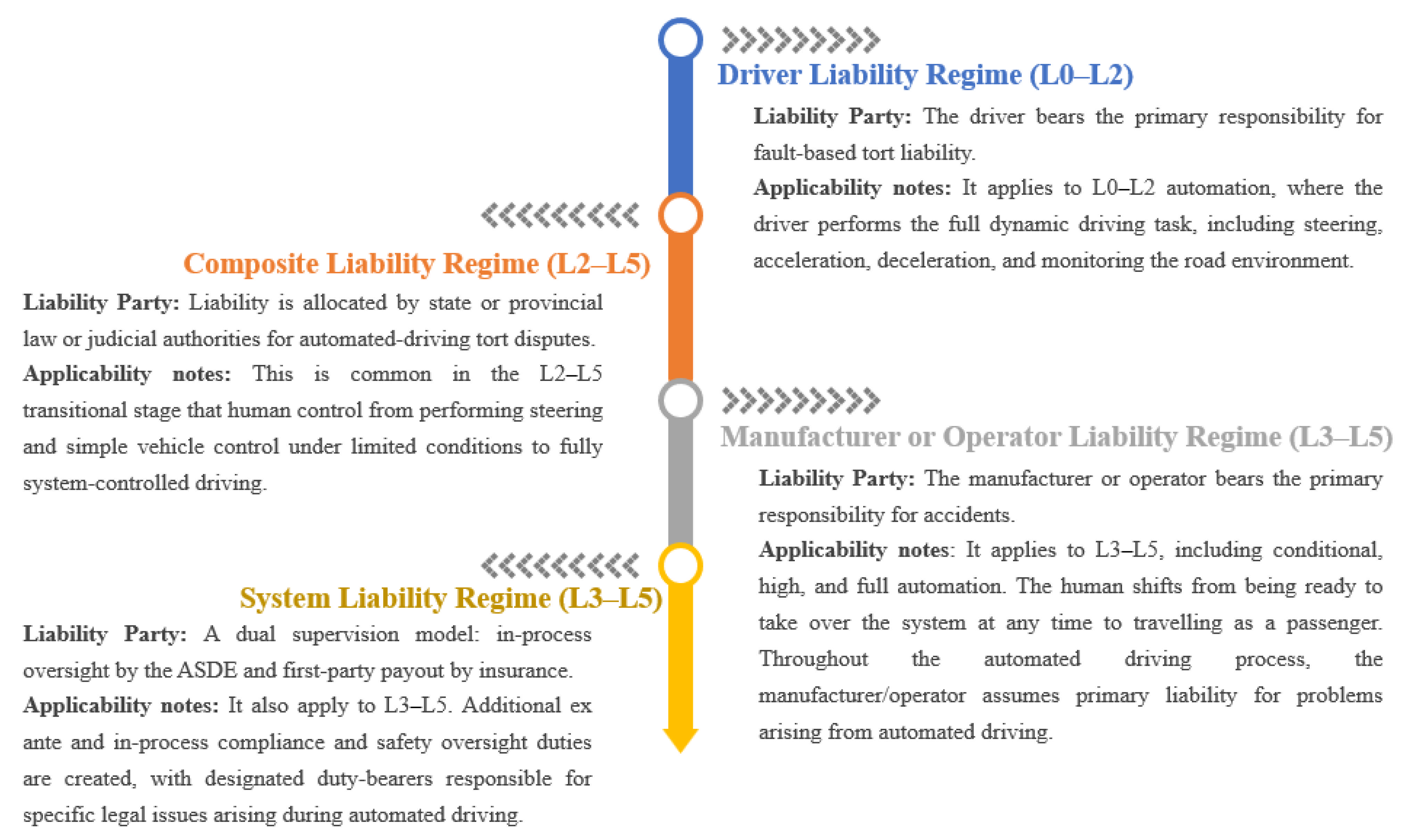
94]. Collectively, these changes may convert the mixed liability model from a disjointed collection of theories into a unified and predictable legal framework (
Figure 2 and
Table A2).
4. Conclusions
With the global proliferation of autonomous driving technologies and the gradual expansion of the autonomous vehicle market, states have generally adopted a proactive stance in embracing this new form of productive capacity. In the course of this development, however, autonomous driving has exacerbated the information asymmetry between enterprises and users with respect to access to and control over data and has exposed the difficulty of effectively coordinating regulatory constraints on autonomous driving technologies with incentives for innovation. This lack of coordination further affects the operation of different liability regimes, such that in practice the assumption and allocation of liability by responsible parties, as well as the ascertainment of liability, suffer from insufficiently clear substantive standards and inadequate institutional alignment.
On the basis of a comparative analysis of the legislative frameworks and regulatory practices of representative jurisdictions in the field of autonomous driving, this article identifies and systematises four distinct models of liability allocation and their implementation dilemmas, namely the driver liability model, the system liability model, the manufacturer or operator liability model, and the hybrid liability model. Building on the specific levels of driving automation and usage scenarios to which these four models are, respectively, suited, and examining both legislative norms and practical arrangements while drawing on the strengths of alternative models and the advanced legislative experience of other countries, the article proposes tailored optimisation recommendations for each model. Under the driver liability model, institutional support should be established to ensure linkage with attribution regimes for higher levels of automated driving, the scope of the driver’s controllable duties should be clearly defined, and supplementary insurance structures and new insurance products should be introduced. Under the system liability model, the scope of responsibility of the authorised entity should be confined, its obligations should be categorised and specified, clear trigger conditions for liability should be laid down, and standardised rules on data collection, preservation, and disclosure should be constructed to guide fact-finding. Under the manufacturer–operator liability model, the boundary of liability allocation between the two must be delineated; externally, manufacturers and operators may bear joint and several liability, whereas internally, liability should be apportioned in proportion to their respective spheres of control, with mandatory insurance and qualification thresholds in the supporting framework to reduce institutional pressure on any single enterprise. Finally, under the hybrid liability model, the overall liability allocation scheme should be systematically reconstructed by building a unified normative structure, simplifying the complexity of autonomous driving accidents, creating clear differentiations in standards of attribution and scopes of compensation, and strengthening databases of similar cases together with mechanisms for organising adjudicatory rules. By refining implementing rules and improving supporting institutions, the liability models currently adopted across jurisdictions can better serve the needs of their autonomous driving markets and lay the groundwork for the evolution towards higher levels of automated driving, thereby advancing legislative quality and adjudicatory techniques while promoting the robust and orderly development of the autonomous driving industry.
Author Contributions
Conceptualization, B.L. and Z.Z.; methodology, Q.C.; validation, B.L. and Z.Z.; formal analysis, Q.C.; investigation, B.L. and Q.C.; resources, Z.Z.; data curation, Z.Z.; writing—original draft preparation, B.L. and Q.C.; writing—review and editing, B.L. and Z.Z.; visualization, B.L.; supervision, Z.Z.; project administration, B.L. All authors have read and agreed to the published version of the manuscript.
Funding
This research was funded by the Social Science Foundation of Hunan Province, grant number 20YBQ029 and was funded by the China Scholarship Council (CSC) program, grant number 202206270151.
Data Availability Statement
The original contributions presented in this study are included in the article. Further inquiries can be directed to the corresponding author.
Conflicts of Interest
The authors declare no conflicts of interest.
Appendix A
Table A1.
Comparative analysis of the dilemmas inherent in different liability regimes.
Table A1.
Comparative analysis of the dilemmas inherent in different liability regimes.
Liability
Regime | Liable Party | Applicable Level | Jurisdictions | Legal Basis | Advantages | Specific Challenges and Disadvantage |
|---|
| Driver liability regime | Drivers | L0–L2 | China | Road Traffic Safety Law and Civil Code (China) | The liable party is clear and prevent traffic accidents caused by drivers. | Excessive concentration of liability on the driver with difficulties in obtaining evidence. |
| System liability regime | ASDE | L3–L5 | United Kingdom | The Automated and Electric Cars Act 2018 (United Kingdom).
Automated Vehicles Act 2024 (United Kingdom). | Dual supervision, in-process review and post-incident insurance. | Authorized entities and insurers bear a heavy liability. And the factual-finding rules remain unclear. |
| Manufacturer or operator liability regime | Manufacturer or Operator | L3–L5 | Germany, Japan, France, South Korea, Singapore, United States | Road Traffic Act (Germany).
Road Traffic Act (Japan).
Mobility Orientation Law (France).
Act on the Promotion of and Support for Commercialization of Autonomous Vehicles (South Korea).
Road Traffic Act (Singapore).
Automated Vehicles Act, Tennessee (United States). | Applicability is broad and improve the production and service quality. | Boundaries of liability between manufacturers and Operators. And Operators face unjust pressures. |
| Composite liability regime | Multiple parties | L2–L5 | United States, Canada, Australia | 49 U.S. Code (United States).
Motor Vehicle Safety Act (Canada).
Road Vehicle Standards Act 2018 (Australia) [95] | Minimal impact on the original legal system with stronger compatibility. | Regulatory standards are fragmented and vary significantly across regions. |
Appendix B
Table A2.
Roadmap for Optimising Different Liability Regimes.
Table A2.
Roadmap for Optimising Different Liability Regimes.
| Liability Regime | Short Term Measures | Medium Term Measures | Long Term Measures |
|---|
| Driver liability regime | Define the driver’s controllable duty boundary and the point of system takeover. | Introduce tiered insurance by automation level and scenario. | Merge liability and insurance into one continuous framework. |
| System liability regime | Limit provider duties to controllable technical risks and define when the system is engaged. | Mandate standard data logging and lawful access with proof consequences for unjustified non disclosure. | Integrate responsibility boundaries, evidence rules, and sanctions. |
| Manufacturer or operator liability regime | Presume shared external liability for accidents occurring in automated mode. | Use statutory recourse and mandatory terms to allocate system and operational risk with dedicated insurance. | Build a risk sharing structure linked to operational access conditions. |
| Composite liability regime | Ensure all relevant parties can be joined and apply diversified liability allocation models. | Consolidate strict responsibility, product liability, and negligence into a unified framework. | Establish unified adjudication practice and a specialised case database. |
References
- Wang, S.; Li, Z. Exploring the mechanism of crashes with automated vehicles using statistical modeling approaches. PLoS ONE 2019, 14, e0214550. [Google Scholar] [CrossRef] [PubMed]
- SAE International. J3016—Taxonomy and Definitions for Terms Related to Driving Automation Systems for On-Road Motor Vehicles. June 2018. Available online: https://www.sae.org/standards/content/j3016_201806/ (accessed on 26 November 2025).
- Vellinga, N.E. Automated driving and its challenges to international traffic law: Which way to go. Law Innov. Technol. 2019, 11, 257–278. [Google Scholar] [CrossRef]
- Gurney, J.K. Driving Into the Unknown: Examining the Crossroads of Criminal Law and Autonomous Vehicles. Wake Forest J. Law Policy 2015, 5, 393. [Google Scholar]
- Chen, L. Research on Tort Liability for Traffic Accidents Involving Autonomous Vehicles. Master’s Thesis, Shanghai Normal University, Shanghai, China, 2019. [Google Scholar]
- Wei, C.; Zhao, J.; Sun, L. Achieving regulatory alignment for E2E autonomous driving in China: A framework for tort liability and data governance. Comput. Law Secur. Rev. 2025, 59, 106192. [Google Scholar] [CrossRef]
- Gurney, J.K. Sue my car, not me: Products liability and accidents involving autonomous vehicles. Univ. Ill. J. Law Technol. Policy 2013, 2013, 247. [Google Scholar]
- Wu, H. Institutional arrangements and legal regulation in the era of artificial intelligence. Sci. Law—Northwest Univ. Political Law 2017, 5, 128–136. [Google Scholar]
- De Bruyne, J.; Werbrouck, J. Merging self-driving cars with the law. Comput. Law Secur. Rev. 2018, 34, 1150–1153. [Google Scholar] [CrossRef]
- Coeckelbergh, M. Responsibility and the moral phenomenology of using self-driving cars. Appl. Artif. Intell. 2016, 30, 748–757. [Google Scholar] [CrossRef]
- Yang, Q.; Zhang, L. On the artificial legal personality of artificial intelligence. J. Hunan Univ. Sci. Technol. (Soc. Sci. Ed.) 2018, 6, 91–97. [Google Scholar]
- Zipp, J.W. The road will never be the same: A re-examination of tort liability for autonomous vehicles. Transp. Law J. 2016, 43, 137. [Google Scholar]
- Ba, Z.; Zhao, Z.; Zhang, B. Liability for Autonomous Vehicle Torts: Who Should Be Held Responsible? World Electr. Veh. J. 2025, 16, 665. [Google Scholar] [CrossRef]
- Wei, X.; Guo, C. A Comparative Legal Study on the Attribution of Liability for Autonomous Driving Accidents in China and Germany. Ctry. Area Adv. Technol. 2025, 1, 1–18. [Google Scholar] [CrossRef]
- Padinhakara, M.-J. Navigating Regulatory Divergence: A Comparative Analysis of Autonomous Vehicle and Robotaxi Governance Frameworks Across Global Jurisdictions. J. Comput. Sci. Technol. Stud. 2025, 7, 746–756. [Google Scholar] [CrossRef]
- Mordor Intelligence. Autonomous Car Market Size & Share Analysis—Growth Trends & Forecasts (2025–2030). 2024. Available online: https://www.mordorintelligence.com/industry-reports/autonomous-driverless-cars-market-potential-estimation (accessed on 26 November 2025).
- IDTechEx. Autonomous Vehicles: Markets 2025. 28 October 2024. Available online: https://www.idtechex.com/en/research-report/autonomous-vehicles-markets-2025/1045 (accessed on 26 November 2025).
- Wan, D.; Peng, L. Autonomous vehicle acceptance in China: TAM-based comparison of civilian and military contexts. World Electr. Veh. J. 2025, 16, 2. [Google Scholar] [CrossRef]
- Sever, T.; Contissa, G. Automated driving regulations—Where are we now? Transp. Res. Interdiscip. Perspect. 2024, 24, 101033. [Google Scholar] [CrossRef]
- DeGuzman, C.A.; Mostafa, T.S.; Othman, K.; Donmez, B.; Abdulhai, B.; Shalaby, A.; Niece, J. What influences intention to use a first-mile/last-mile automated shuttle service in a suburban area? A case study in Toronto, Canada. Transp. Plan. Technol. 2025, 48, 536–554. [Google Scholar] [CrossRef]
- Federal Ministry for Digital and Transport (Germany). Germany Will Be the World Leader in Autonomous Driving. 27 July 2021. Available online: https://www.bmv.de/SharedDocs/EN/Articles/DG/act-on-autonomous-driving.html (accessed on 26 November 2025).
- KPMG. Autonomous Vehicles Readiness Index 2020. 7 July 2020. Available online: https://electricautonomy.ca/automakers/autonomous-vehicles/2020-07-07/kpmg-2020-autonomous-vehicles-readiness-index/ (accessed on 26 November 2025).
- GoAuto Premium. Getting Ready Index Names AV League Table. 10 May 2018. Available online: https://premium.goauto.com.au/getting-ready-index-names-av-league-table/ (accessed on 26 November 2025).
- Kriebitz, A. The German Act on Autonomous Driving: Why ethics still matters. Philos. Technol. 2022, 35, 29. [Google Scholar] [CrossRef]
- Yu, Z.; Lu, Y.; Zhan, H.; Yu, Y.; Wang, Z. A quantitative legal support system for transnational autonomous vehicle design. Drones 2025, 9, 316. [Google Scholar] [CrossRef]
- Black, J.A. Examples of transport policy formulations: Japanese institutions and organisations from ancient times to the present. Case Stud. Transp. Policy 2022, 10, 1144–1158. [Google Scholar] [CrossRef]
- Brady, M.; Tranter, K.; Bennett, B. Automated vehicles, the driver dilemma, stopping powers, and paradigms of regulating road traffic. Comput. Law Secur. Rev. 2025, 56, 106076. [Google Scholar] [CrossRef]
- Chng, S.; Cheah, L. Understanding autonomous road public transport acceptance: A study of Singapore. Sustainability 2020, 12, 4974. [Google Scholar] [CrossRef]
- KPMG Thailand. Singapore Tops the List for AV Readiness as Self-Driving Vehicles Gain Momentum in the Wake of COVID-19. 20 July 2020. Available online: https://kpmg.com/th/en/home/media/press-releases/2020/07/press-release-avri-en.html (accessed on 26 November 2025).
- Tan, S.Y.; Taeihagh, A. Adaptive governance of autonomous vehicles: Accelerating the adoption of disruptive technologies in Singapore. Gov. Inf. Q. 2021, 64, 101546. [Google Scholar] [CrossRef]
- Guo, Y. Research on Tort Liability Subject in Traffic Accidents Resulted from Autonomous Driving Vehicles. Master’s Thesis, Guangdong University of Foreign Studies, Guangzhou, China, 2024. [Google Scholar]
- Yang, L. Comparative study on the liability rules for traffic accidents of autonomous vehicle in local regulations. Law Sci. Mag. 2025, 46, 22–37. [Google Scholar]
- United Kingdom. Automated Vehicles Act 2024—Explanatory Notes (Division 6). 20 May 2024. Available online: https://www.legislation.gov.uk/ukpga/2024/10/notes/division/6/index.htm (accessed on 26 November 2025).
- Government of Japan, Cabinet Secretariat. ITS Initiative—Roadmaps 2016. 20 May 2016. Available online: https://japan.kantei.go.jp/policy/it/2016/itsinitiative_roadmaps2016.pdf (accessed on 26 November 2025).
- Zheng, F. Legal Risks of Driver Assistance and Countermeasures. Shanghai Rule of Law Daily, 30 April 2025. Available online: https://zjkxyjy.cupl.edu.cn/info/2538/8359.htm (accessed on 26 November 2025).
- CCTV News. Tesla Fatal Autopilot Case Update: Company Admits Vehicle Was in Autopilot Mode at the Time of the Incident. 27 February 2018. Available online: https://m.news.cctv.com/2018/02/27/ARTIjWkQEt1pGPo812Brgbfc180227.shtml (accessed on 26 December 2025).
- BkEconomy. Industry First: Court Orders Tesla to Provide Full Driving Data to the “Rooftop Rights-Defending” Tesla Owner. 16 September 2025. Available online: https://www.bkeconomy.com/detail-1758013976129038.html (accessed on 26 December 2025).
- Tan, Z. A study on legal liability for autonomous vehicle accidents. Digit. Law 2025, 3, 85–99. [Google Scholar]
- United Kingdom. Automated and Electric Vehicles Act 2018, Sections 1–8. 19 July 2018. Available online: https://www.legislation.gov.uk/ukpga/2018/18/pdfs/ukpga_20180018_en.pdf (accessed on 26 November 2025).
- United Kingdom. Automated Vehicles Act 2024. 20 May 2024. Available online: https://www.legislation.gov.uk/ukpga/2024/10/contents (accessed on 26 November 2025).
- Department for Transport (UK). Automated and Electric Vehicles Act 2018: Regulatory Report 2024. 10 March 2025. Available online: https://www.gov.uk/government/publications/automated-and-electric-vehicles-act-2018-regulatory-report-2024 (accessed on 26 November 2025).
- Bank of England. Potential Impacts of Autonomous Vehicles on the UK Insurance Sector. Q1 2017. Available online: https://www.bankofengland.co.uk/-/media/boe/files/quarterly-bulletin/2017/potential-impacts-of-autonomous-vehicles-on-the-uk-insurance-sector.pdf (accessed on 26 December 2025).
- European Union. Directive (EU) 2024/2853 on Liability for Defective Products (Repealing 85/374/EEC). 23 October 2024. Available online: https://eur-lex.europa.eu/eli/dir/2024/2853/oj/eng (accessed on 26 November 2025).
- ICLG. Product Liability Laws and Regulations—The New EU Product Liability Directive. 13 June 2025. Available online: https://iclg.com/practice-areas/product-liability-laws-and-regulations/01-the-new-eu-product-liability-directive (accessed on 26 November 2025).
- UK Parliament. Autonomous Vehicles Bill [HL]—Publications. 20 May 2024. Available online: https://bills.parliament.uk/bills/3506/publications (accessed on 26 November 2025).
- Telekom Website. Vehicle Data Is More Profitable than the Car Itself. 19 February 2018. Available online: https://www.linkedin.com/pulse/vehicle-data-more-profitable-than-car-itself-fran%C3%A7ois-fleutiaux (accessed on 26 December 2025).
- Marson, J. The Automated and Electric Vehicles Act 2018 Part 1 and Beyond: A Critical Review. Statut. Law Rev. 2020, 41, 395–417. [Google Scholar] [CrossRef]
- Germany. Verkehrsvorschriften §1b (NWB Datenbank). 23 October 2024. Available online: https://datenbank.nwb.de/Dokument/79226_1b/ (accessed on 26 November 2025).
- Tao, Y. Research about compensation for damage of automatic vehicle traffic accidents. J. Hunan Univ. (Soc. Sci.) 2018, 32, 136–141. [Google Scholar]
- France. Code de la Route—Section Referenced. 2024. Available online: https://www.legifrance.gouv.fr/codes/section_lc/LEGITEXT000006074228/LEGISCTA000043371833/ (accessed on 26 November 2025).
- Republic of Korea. Compulsory Motor Vehicle Liability Security Act (English Translation). 20 December 2016. Available online: https://elaw.klri.re.kr/eng_mobile/viewer.do?hseq=40982&key=4&type=sogan (accessed on 26 November 2025).
- Singapore Statutes Online. Road Traffic Act 1961. 31 December 2021. Available online: https://sso.agc.gov.sg/Act/RTA1961 (accessed on 26 November 2025).
- Bellon, T. Fatal US Self Driving Auto Accident Raises Novel Legal Questions. Reuters. 21 March 2018. Available online: https://www.reuters.com/article/technology/fatal-us-self-driving-auto-accident-raises-novel-legal-questions-idUSKBN1GW2VX/ (accessed on 26 December 2025).
- Channon, M. Automated and Electric Vehicles Act 2018: An evaluation in light of proactive law and regulatory disconnect. Eur. J. Law Technol. 2019, 10, 1–36. [Google Scholar]
- Law Commission of England and Wales; Scottish Law Commission. Automated Vehicles: Joint Report. 26 January 2022. Available online: https://www.lawcom.gov.uk/project/automated-vehicles/ (accessed on 26 November 2025).
- Kirchmair, L. How to regulate moral dilemmas involving self-driving cars: The 2021 German Act on Autonomous Driving, the trolley problem, and the search for a role model. Ger. Law J. 2023, 24, 1184–1208. [Google Scholar] [CrossRef]
- National Transportation Safety Board. Highway Accident Brief. 8 November 2017. Available online: https://www.ntsb.gov/investigations/AccidentReports/Reports/HAB1906.pdf (accessed on 26 December 2025).
- Xu, Z. On the Allocation of Liability in Autonomous Driving. Fa Zhi Zheng Fu Jian She. January 2018. Available online: https://sfj.beijing.gov.cn/sfj/fzbwj/resources/content/PDF/201801/20180522163249.pdf (accessed on 26 November 2025).
- Zhai, S.; Wang, L.; Liu, P. Not in control, but liable? Attributing human responsibility for fully automated vehicle accidents. Engineering 2024, 33, 121–132. [Google Scholar] [CrossRef]
- Geistfeld, M.A. Civil liability for motor vehicle crashes in the United States: From conventional vehicles to autonomous vehicles. In Autonomous Vehicles and Civil Liability in a Global Perspective, 1st ed.; Steege, H., Caggiano, I.A., Gaeta, M.C., von Bodungen, B., Eds.; Data Science, Machine Intelligence, and Law; Springer: Cham, Switzerland, 2024; Volume 3, pp. 91–107. [Google Scholar]
- National Transport Commission (Australia). Guidelines for Trials of Automated Vehicles in Australia 2023. 2023. Available online: https://www.ntc.gov.au/sites/default/files/assets/files/Guidelines%20for%20trials%20of%20automated%20vehicles%20in%20Australia%202023.pdf (accessed on 26 November 2025).
- Ontario (Canada). Negligence Act, R.S.O. 1990, c. N.1. 21 November 2025. Available online: https://www.ontario.ca/laws/statute/90n01 (accessed on 26 November 2025).
- Brady, M.; Burns, K.; Leiman, T.; Tranter, K. Automated vehicles and Australian personal injury compensation schemes. Torts Law J. 2017, 24, 32–63. [Google Scholar]
- National Transport Commission (Australia). Motor Accident Injury Insurance and Automated Vehicles (Discussion Paper). October 2018. Available online: https://www.ntc.gov.au/sites/default/files/assets/files/NTC%20Discussion%20Paper%20-%20Motor%20Accident%20Injury%20Insurance%20and%20Automated%20Vehicles.pdf (accessed on 26 November 2025).
- Brown, A.; Bennett, B.; Brady, M.; Tranter, K.; Butler, D. Regulating future driving: Automated vehicles and the harmonisation of Australian laws. Monash Univ. Law Rev. 2022, 48, 268–292. [Google Scholar]
- National Transport Commission. In Service Safety for Automated Vehicles. July 2019. Available online: https://oia.pmc.gov.au/sites/default/files/posts/2020/02/in-service_safety_for_automated_vehicles_consultation_ris.pdf (accessed on 26 December 2025).
- U.S. Government Accountability Office. Automated Trucking Federal Agencies Should Take Additional Steps to Prepare for Potential Workforce Effects. March 2019. Available online: https://www.gao.gov/assets/gao-19-161.pdf (accessed on 26 December 2025).
- McCague Borlack LLP. Autonomous Vehicles and the Future of Litigation (2018). May 2018. Available online: https://mccagueborlack.com/emails/articles/autonomous-litigation.html (accessed on 26 November 2025).
- Estrada Law Group. The Future of Driving: Legal Challenges and Your Rights After an Autonomous Vehicle Accident. 5 May 2025. Available online: https://www.estradalawgroup.com/blog/the-future-of-driving-legal-challenges-and-your-rights-after-an-autonomous-vehicle-accident (accessed on 26 November 2025).
- Kubica, F.M.L. Autonomous vehicles and liability law. Am. J. Comp. Law 2022, 70, i39–i69. [Google Scholar] [CrossRef]
- Florida Fourth District Court of Appeal. Tesla v Banner. Case No. 4D2023-3034. 26 February 2025. Available online: https://flcourts-media.flcourts.gov/content/download/2447924/opinion/Opinion_2023-3034.pdf?utm.com (accessed on 26 December 2025).
- Leiman, T. Law and tech collide: Foreseeability, reasonableness and advanced driver assistance systems. Policy Soc. 2021, 40, 250–271. [Google Scholar] [CrossRef]
- Gless, S.; Ligeti, K. Regulating driving automation in the European Union—Criminal liability on the road ahead? New J. Eur. Crim. Law 2024, 15, 33–57. [Google Scholar] [CrossRef]
- Milenković, M.; Sumpor, D.; Tokić, S. Legal and safety aspects of the application of automated and autonomous vehicles in the Republic of Croatia. World Electr. Veh. J. 2025, 16, 34. [Google Scholar] [CrossRef]
- Zhang, J.; Xiao, J. A study on the tort liability for self-driving vehicles. J. Shanghai Univ. (Soc. Sci. Ed.) 2019, 1, 16–31. [Google Scholar]
- He, T. Construction of China’s autonomous vehicle tort liability system—Revision of the German Road Traffic Law and its reference. Present. Law Sci. 2021, 1, 46–58. [Google Scholar]
- Zheng, Z. Legislative theory and explanatory theory on traffic accident liability of self-driving cars. Orient. Law 2021, 3, 156–170. [Google Scholar]
- Buiten, M.; de Streel, A.; Peitz, M. The law and economics of AI liability. Comput. Law Secur. Rev. 2023, 48, 105794. [Google Scholar] [CrossRef]
- Novelli, C.; Taddeo, M.; Floridi, L. Accountability in artificial intelligence: What it is and how it works. AI Soc. 2023, 39, 1871–1882. [Google Scholar] [CrossRef]
- Pi, Y. On the autonomous vehicle manufacturer’s criminal liability. J. Comp. Law 2022, 1, 55–70. [Google Scholar]
- Wang, Z. Tort liability distribution mechanism for autonomous vehicles—Examining the legislative practice in Hangzhou City. Disput. Settl. 2025, 11, 96–103. [Google Scholar] [CrossRef]
- Wu, H. Data Recorder Standards for Autonomous Driving: Ideas and Progress. National Technical Committee of Auto Standardization. 8 July 2021. Available online: https://www.catarc.org.cn/upload/202107/16/202107161009405028.pdf (accessed on 26 November 2025).
- Han, X. The liability structure of automated driving—Also on the three-layer insurance structure of automated driving vehicles. J. Shanghai Univ. (Soc. Sci. Ed.) 2019, 36, 90–103. [Google Scholar]
- Xue, Y. Research on traffic accident tort liability of highly automated vehicles. Open J. Leg. Sci. 2024, 12, 5281–5288. [Google Scholar] [CrossRef]
- Think Tank. A Common EU Approach to Liability Rules and Insurance for Connected and Autonomous Vehicles. 28 February 2018. Available online: https://www.europarl.europa.eu/thinktank/en/document/EPRS_STU(2018)615635 (accessed on 26 November 2025).
- Schellekens, M. No-fault compensation schemes for self-driving vehicles. Law Innov. Technol. 2018, 10, 314–333. [Google Scholar] [CrossRef]
- Chatzipanagiotis, M.; Leloudas, G. Automated vehicles and third-party liability: A European perspective. Univ. Ill. J. Law Technol. Policy 2020, 2020, 109–199. [Google Scholar] [CrossRef]
- Zhao, Y.; Wang, T. Liability in autonomous vehicles: Comparative analysis of legal systems and frameworks. J. Auton. Veh. Law 2023, 45, 112–134. [Google Scholar]
- Huang, J.; Zhang, X. The transition from conventional traffic liability to mixed liability in autonomous driving. Mod. Law Rev. 2021, 89, 550–575. [Google Scholar]
- Jones, M.D. Product liability and autonomous vehicles: Challenges in a multi-party liability system. Torts Insur. Law Rev. 2020, 58, 422–445. [Google Scholar]
- Wang, Y.; Li, J. Legal framework for multi-party liability in autonomous vehicles: The role of national law and local regulations. Int. J. Transp. Law 2022, 36, 20–40. [Google Scholar]
- Liu, X.; Chen, Z. Evidence law and liability in autonomous-vehicle accidents. Leg. Stud. 2021, 67, 315–340. [Google Scholar]
- Gao, P. Judicial interpretation of mixed liability in autonomous driving. J. Comp. Law Pract. 2020, 50, 182–199. [Google Scholar]
- Xu, Y.; Wang, L. Liability and insurance in the transition to fully autonomous vehicles. J. Insur. Leg. Policy 2022, 58, 99–123. [Google Scholar]
- Australia Government. Road Vehicle Standards Act 2018 (Cth), No. 163. 2018. Available online: https://www.legislation.gov.au/C2018A00163/latest/text (accessed on 26 November 2025).
| Disclaimer/Publisher’s Note: The statements, opinions and data contained in all publications are solely those of the individual author(s) and contributor(s) and not of MDPI and/or the editor(s). MDPI and/or the editor(s) disclaim responsibility for any injury to people or property resulting from any ideas, methods, instructions or products referred to in the content. |
© 2026 by the authors. Published by MDPI on behalf of the World Electric Vehicle Association. Licensee MDPI, Basel, Switzerland. This article is an open access article distributed under the terms and conditions of the Creative Commons Attribution (CC BY) license.